
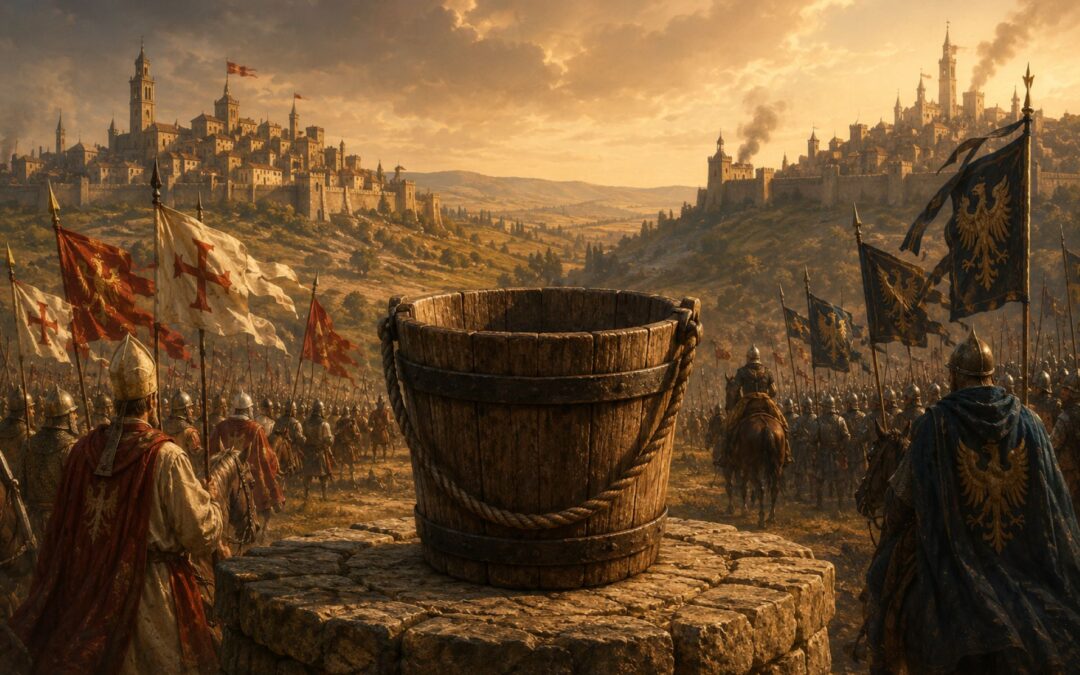
The War of the Bucket sounds like the kind of story history invents when it gets bored.
Two proud Italian cities. One stolen wooden bucket. Thousands of soldiers. A medieval battlefield. A war so petty that it feels less like politics and more like a neighborhood argument that somehow found cavalry.
The popular version is irresistible: in 1325, soldiers from Modena supposedly sneaked into Bologna, stole a bucket from a public well, and triggered a bloody war between the two cities.
It is a perfect historical anecdote.
It is also almost certainly not what really happened.
The bucket was real. Modena still preserves the memory of the Secchia rapita, the “stolen bucket,” as part of the city’s connection to the 1325 Battle of Zappolino, and the story later became famous through Alessandro Tassoni’s mock-heroic poem La secchia rapita. But the bucket was probably not the cause of the war. It was more likely taken after the fighting as a trophy — a humiliating souvenir from Bologna’s defeat.
That makes the story less absurd, but much more interesting.
Because the real War of the Bucket was not about a bucket at all. It was about pope versus emperor, city versus city, faction versus faction, and the way huge medieval power struggles could filter down into local rivalries.
The bucket survived because it was simple.
The history behind it was not.
Did Bologna and Modena Really Go to War Over a Bucket?
The short answer is no — not in the way the story is usually told.
Bologna and Modena did not wake up one morning, discover a missing bucket, and decide that thousands of men had to fight over it. By the time the bucket entered the story, the two cities already had years of rivalry behind them and were caught in one of medieval Italy’s most bitter political divides.
The object itself, however, is not fictional. Modena’s official visitor information describes the Secchia rapita as a wooden bucket traditionally linked to Modena’s victory over Bologna at the Battle of Zappolino in 1325. It became a civic symbol, a trophy, and eventually the centerpiece of a legend.
But symbols often appear after the real causes have already done their work.
The bucket became famous because it was funny, memorable, and easy to repeat. The real causes were harder to summarize: centuries of church-state conflict, imperial weakness, papal ambition, Italian factionalism, local raids, contested fortresses, and long-running hatred between neighboring cities.
So the better question is not, “Did they really fight over a bucket?”
The better question is: how did a serious medieval conflict end up being remembered through one ridiculous object?
The Real Background: Pope vs Emperor
To understand the War of the Bucket, we have to start long before Bologna and Modena faced each other at Zappolino.
One of medieval Europe’s great political questions was deceptively simple:
Who held ultimate authority — the pope or the emperor?
The pope was the head of the western Church. The Holy Roman Emperor was the most prestigious secular ruler in western Christendom. In theory, they served different functions. The pope governed spiritual life. The emperor governed political life.
In practice, the two roles overlapped constantly.
That overlap became especially important after the year 800, when Pope Leo III crowned Charlemagne emperor. The coronation gave Charlemagne immense legitimacy and helped revive the idea of a western Roman Empire. But it also created a dangerous ambiguity. If the pope crowned the emperor, did that mean the pope stood above him? Or did the emperor, as the pope’s protector, hold the real power?
Medieval Europe never fully solved that tension.
The Holy Roman Empire itself made the problem worse. It was not a centralized empire with clean borders, obedient provinces, and a modern bureaucracy. It was a fragmented political structure made up of kingdoms, duchies, counties, bishoprics, free cities, and local lordships. Even a broad historical overview of the Holy Roman Empire emphasizes how loose and complex the arrangement was.
The emperor had prestige, but prestige was not the same as control.
Local princes resisted him. Italian cities often acted independently. The pope had his own lands, allies, ambitions, and enemies. Both pope and emperor claimed to defend Christian order, but both also wanted influence over the same people, offices, and territories.
This was not just a theological disagreement.
It was a struggle over who got to rule Europe.
Why Bishops Became Political Weapons
The conflict became explosive because bishops were not only religious figures.
They were also landholders, administrators, judges, political brokers, and sometimes military actors. In a fragmented empire, a bishop could be a crucial local power.
That made bishops extremely valuable to emperors.
A hereditary noble could build a family dynasty and pass land to his children. That created a long-term threat to imperial authority. A bishop, however, was supposed to be celibate. He could not create a legitimate dynasty in the same way. If the emperor could appoint loyal bishops, he could place trusted men in powerful offices without letting those offices become inherited family possessions.
This is why the appointment of bishops and abbots mattered so much.
The practice was called lay investiture. Secular rulers “invested” church officials with the symbols of their office. From the emperor’s perspective, this was practical politics. He needed loyal administrators in a realm that was difficult to control. From the Church’s perspective, it looked like spiritual corruption.
The situation was made worse by simony — the buying and selling of church offices. If a bishopric came with wealth, land, and influence, then ambitious men had every reason to buy their way in. Reformers inside the Church saw this as a moral crisis. The Church was supposed to appoint spiritual leaders, not watch sacred offices become bargaining chips for rulers and rich men.
This is why the Investiture Controversy was not a minor procedural argument.
It was a fight over whether the Church would be politically subordinate to secular rulers, or whether the pope could free it from imperial control and place himself at the top of Christian authority.
The emperor wanted loyal bishops.
The pope wanted independent bishops.
Neither side could afford to lose.
The Investiture Controversy Changed the Balance of Power
The Investiture Controversy reached its most famous phase in the 11th century, during the clash between Pope Gregory VII and Emperor Henry IV.
Gregory VII was part of a reform movement that wanted to free the Church from secular control. He did not see the pope as a ceremonial religious figure who should bend under imperial pressure. He saw the papacy as the supreme authority within Christendom.
The claims associated with Gregory’s reform program were dramatic. The famous Dictatus Papae asserted, among other things, that the pope could depose emperors, that only the pope could depose or reinstate bishops, and that the Roman Church had never erred.
These were not mild administrative reforms.
They were a direct challenge to imperial power.
Henry IV rejected Gregory’s claims and continued to involve himself in church appointments. Gregory responded by excommunicating him. In the medieval world, excommunication was not merely a private spiritual punishment. It could destroy a ruler’s political position. If the emperor was outside the Church, his enemies could argue that Christian subjects no longer owed him obedience.
That is exactly what happened.
German princes used the conflict to turn against Henry. Under intense pressure, Henry crossed the Alps in winter and sought forgiveness from Gregory at Canossa in 1077. The episode became one of the defining images of medieval Europe: an emperor humbled before a pope. Gregory’s own account of the confrontation, preserved in the Yale Avalon Project’s medieval source collection, shows how carefully the papacy framed the moment as both moral victory and political theater.
But Canossa did not end the struggle.
The conflict continued for decades. A partial settlement came only with the Concordat of Worms in 1122, which tried to distinguish between spiritual authority and secular authority in the appointment of bishops.
It was a compromise, not a clean solution.
The broader consequence was clear enough: papal authority had grown, imperial authority had been challenged, and the emperor’s already fragmented realm became even harder to control.
That mattered deeply in northern Italy.
How the Pope-Emperor Conflict Split Medieval Italy
Northern Italy was wealthy, urban, proud, and difficult to govern from afar.
Its city-states were not passive territories waiting for orders from the emperor. They had merchants, noble families, militias, councils, rival clans, and strong civic identities. When the larger pope-versus-emperor conflict entered this world, it did not remain an abstract argument about authority.
It became local.
It became tribal.
It became violent.
Across medieval Italy, two great factional labels emerged: Guelphs and Ghibellines. Broadly speaking, Guelphs supported the papal side, while Ghibellines supported the imperial side. The names had roots in German dynastic politics, but in Italy they became part of city politics, family identity, and local warfare. A useful overview of Guelphs and Ghibellines shows how these labels became embedded in the political life of Italian cities.
But the divide was never purely ideological.
A merchant city might support the pope because it disliked imperial taxes. A landholding faction might support the emperor because it feared papal expansion. A family might adopt one side because its rival had adopted the other. Cities could even switch allegiances when power changed hands.
So the conflict was not simply “religion versus empire.”
It was ambition, money, land, taxes, pride, and revenge — all wrapped in the language of pope and emperor.
This is what made medieval Italian politics so combustible. The papacy and empire provided the grand banners. Local rivalries supplied the fuel.
And few rivalries were better suited to that world than Bologna and Modena.
Bologna vs Modena: A Local Rivalry Inside a Continental Conflict
Bologna and Modena were close enough to hate each other properly.
They were neighboring city-states in northern Italy, both proud, both politically active, and both caught inside the larger Guelph-Ghibelline divide. Bologna was broadly aligned with the Guelph, pro-papal side. Modena was broadly aligned with the Ghibelline, pro-imperial side.
That did not mean every citizen was thinking deeply about constitutional theory.
It meant every local dispute could be charged with a larger political meaning.
The two cities already had bad blood. In 1249, Bologna defeated Modena at the Battle of Fossalta. That kind of defeat did not simply disappear from memory. It fed resentment, revenge, and future conflict.
For decades, Bologna and Modena raided each other’s territory. They damaged farmland, threatened fortifications, and tested each other’s strength. Their rivalry was not a sudden emotional outburst caused by a stolen object. It was part of a long pattern of hostility between two cities with opposed political alignments and overlapping territorial interests.
By 1325, the conditions for war were already there.
The bucket just gave later generations a memorable image.
The Immediate Cause Was Not the Bucket
The immediate cause of the 1325 war was not a missing bucket.
It was the struggle over territory, fortresses, and regional dominance.
Bolognese forces had raided Modenese lands and damaged farmland. Modena’s ruler, Passerino dei Bonacolsi, responded by attacking Bologna’s defensive positions. One especially important point was the fortress of Monteveglio, part of the defensive network protecting Bologna.
That mattered far more than a wooden bucket.
A fortress controlled movement. It protected roads and approaches. It shaped the security of the city behind it. Losing such a position was not embarrassing in a symbolic sense; it was dangerous in a practical one.
Bologna needed to recover its lost ground. Modena needed to defend its gains. Both cities had factional reasons to fight, local reasons to hate each other, and military reasons to escalate.
This is where the popular myth reverses the story.
The bucket was not stolen first, causing the war. The war came first. The bucket appears to have been taken after Modena’s victory, as a trophy from Bologna.
That distinction changes the entire meaning of the event.
A war caused by a bucket is a joke about medieval stupidity.
A war remembered through a bucket is a lesson in how history turns complicated conflicts into simple symbols.
The Battle of Zappolino
The decisive clash came at the Battle of Zappolino in November 1325.
Bologna had the larger force. Modena had the more difficult task. If Bologna’s army had time to organize properly and use its numerical advantage, Modena would struggle to win.
So Modena needed to act quickly.
The Modenese maneuvered across the river and threatened Bologna’s defensive network near Zappolino. Bologna could not afford to lose another key position, so its forces moved to confront them.
By the time the two armies faced each other, daylight was running out. In many medieval battles, that might have delayed the fighting until the next day. Armies often needed time to set camp, rest, organize, and prepare.
The Modenese did not wait.
They attacked while the Bolognese were still unprepared. That decision mattered. A smaller army could not afford a slow, orderly battle against a larger one. It needed confusion, speed, and shock.
The fighting was intense, and the crucial moment appears to have been a cavalry attack that hit the Bolognese from the side or rear. Once the Bolognese line broke, the battle turned into a rout. Soldiers fled back toward Bologna while Modenese cavalry pursued them.
Later accounts give high casualty numbers, though such figures should be treated carefully. What is clear is that Bologna suffered a severe and humiliating defeat.
Modena had won the battle.
Then it took the object that would outlive the battle in popular memory.
Why Modena Took the Bucket
After defeating Bologna, the Modenese did not capture the city itself.
Instead, they devastated parts of the surrounding countryside, celebrated their victory, and eventually returned home with a trophy: a wooden bucket.
The bucket mattered because it turned defeat into humiliation.
It was not grand. It was not valuable. It was not a crown, a relic, or a royal banner. That was precisely why it worked as an insult. Modena had not only beaten Bologna in battle; it had taken something ordinary from the city and turned it into proof of superiority.
The pettiness made it powerful.
Over time, the bucket became attached to the entire conflict. Modena preserved the memory of the stolen bucket, and Tassoni’s later mock-epic poem helped transform the episode into a famous comic legend.
That literary afterlife mattered. People remember stories more easily when they have a strong image at the center. The Investiture Controversy is complex. Guelph and Ghibelline factionalism is messy. Medieval Italian city politics can feel like a maze.
A stolen bucket is unforgettable.
So the bucket did not become famous because it explained the war.
It became famous because it made the war easy to retell.
What the War Actually Changed
The War of the Bucket did not transform Europe.
It did not end the conflict between pope and emperor. It did not settle the Guelph-Ghibelline divide. It did not permanently resolve the rivalry between Bologna and Modena. It did not redraw the political map in a dramatic way.
After the battle, Bologna paid reparations. Modena returned conquered territories. The bucket stayed in Modena.
That was the practical outcome.
The larger conflicts continued. Popes and emperors kept struggling for influence. Italian city-states kept fighting. Local factions kept using grand political causes to justify very local ambitions.
So the importance of the War of the Bucket is not that it changed the course of European history.
Its importance is that it reveals how European history worked.
A conflict that began at the level of popes and emperors could travel downward into cities, families, fortresses, raids, and battlefield insults. The grand struggle over authority did not remain inside councils, coronations, and papal documents. It shaped how neighboring communities saw each other.
The War of the Bucket shows that medieval politics was not divided neatly between “serious” high politics and “petty” local rivalries.
The two were connected.
That is why the story is so strange. The bucket seems absurd only if we separate it from the world that produced it. Put it back into that world, and it becomes something else: a small object carrying the weight of a much larger conflict.
The Bigger Lesson: Silly Symbols Can Hide Serious Conflicts
The War of the Bucket is remembered because it sounds ridiculous.
That is part of its charm.
A bucket is not an obvious cause for war. It is ordinary, domestic, almost embarrassingly small. The idea that two medieval cities would fight over it makes the past seem childish and absurd.
But the real history is sharper than the joke.
Bologna and Modena fought because they were rival cities inside a divided political world. They fought because pope and emperor had spent centuries contesting authority. They fought because northern Italy was full of ambitious city-states, factional identities, territorial disputes, and old grudges. They fought because raids and fortresses mattered.
The bucket came later.
It survived because history often remembers symbols better than systems. A wooden bucket is easier to picture than lay investiture. It is easier to retell than the Concordat of Worms. It is easier to laugh at than the long struggle between papal and imperial power.
But behind the funny image was a serious medieval world of ambition, religion, violence, and civic pride.
The bucket was not the cause of the war.
It was the punchline.
Last Updated on July 9, 2026 by Aseem Gupta