
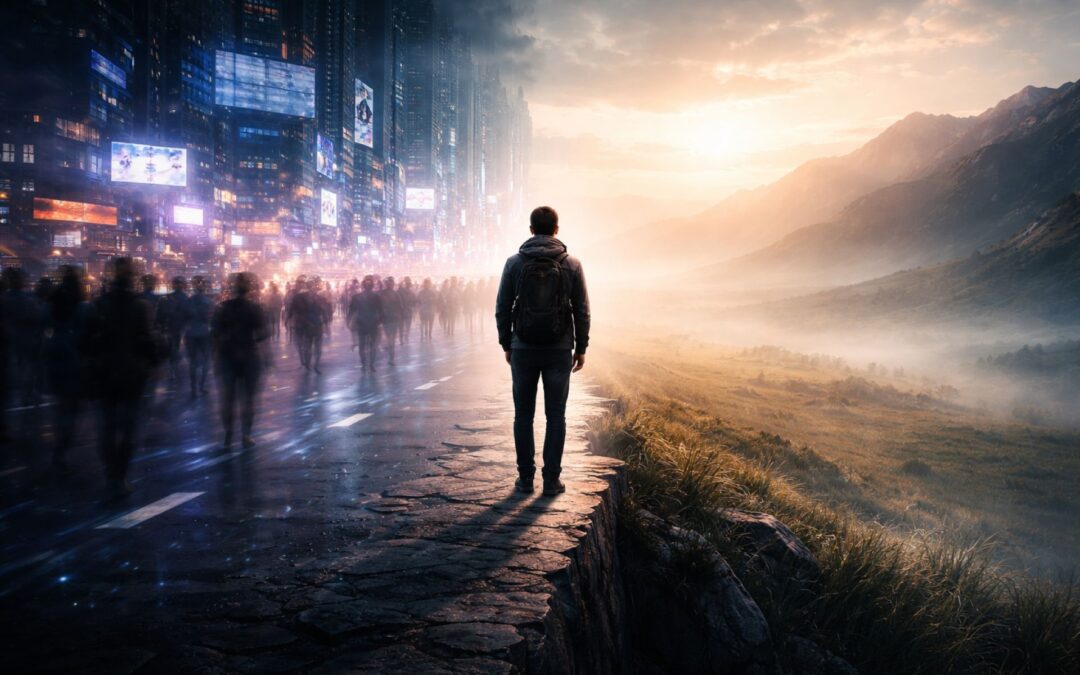
“If these times endure, I shall become a hermit…”
With these words, Eustache Deschamps captured a sentiment that has echoed across centuries—a quiet but persistent urge to withdraw from a world that feels increasingly unworthy of our participation. It is not a dramatic rebellion, nor a momentary frustration, but something deeper: a slow recognition that the structures around us may be hollow, that the noise of society may be drowning out something essential.
According to legend, Lao Tzu, the sage behind the Tao Te Ching, reached a similar conclusion. Disillusioned with the moral decay and political turbulence of his time, he is said to have walked away from civilization entirely—leaving behind not just a body of wisdom, but a powerful image: that of the thinker who turns his back on the world.
Whether or not the story is historically accurate hardly matters. The impulse it represents is unmistakably human.
Throughout history, a small but persistent group of individuals has chosen solitude over society. From forest-dwelling ascetics in ancient India to desert hermits in early Christianity, from reclusive philosophers to modern individuals who quietly disengage from the world, the figure of the hermit continues to reappear. Not as an anomaly, but as a response.
What drives someone to leave everything behind? What does solitude offer that society cannot? And in a world more connected—and more overwhelming—than ever before, is the hermit’s path still possible?
This is not merely a question about lifestyle. It is a question about how one chooses to relate to the world itself.
The hermit, contrary to popular belief, is not simply escaping life. In many cases, he is responding to it—with a clarity that most people never reach.
The Ancient Impulse to Withdraw
The hermit is often imagined as an eccentric outlier—a rare figure who abandons society in pursuit of something obscure. But history tells a different story. The impulse to withdraw is not rare, nor is it confined to any one culture or era. It appears again and again, across continents and civilizations, as if it were woven into the fabric of human possibility.
In ancient India, long before the rise of organized monastic traditions, ascetics of the Vedic world retreated into forests to live lives of contemplation and discipline. The Upanishads speak of individuals who renounced worldly duties to pursue a deeper understanding of reality—away from the distractions of social life. Their withdrawal was not seen as failure, but as a higher calling.
A similar pattern emerges in early Christianity. Figures like Paul of Thebes and Amma Syncletica fled into the harsh landscapes of the Egyptian desert, seeking spiritual clarity far from the growing institutional power of the Church. Their lives were marked not by comfort, but by deliberate austerity—a stripping away of everything unnecessary.
In China, the tradition of hermitism found expression through Taoist thought. Inspired by the teachings attributed to Lao Tzu, hermits retreated into mountains such as the Zhongnan range, where some continue to live even today. Their goal was not to escape reality, but to align more closely with it—to live in accordance with the Tao, unburdened by artificial structures.
Even outside explicitly religious contexts, the admiration for solitude persisted. Thinkers like Henry David Thoreau experimented with withdrawal, if only partially, to explore what life looks like when stripped to its essentials. His time at Walden Pond was not total isolation, but it reflected the same underlying question: what remains when we remove the unnecessary?
What becomes clear is that the hermit is not an anomaly but a recurring answer to a recurring problem. Whenever societies grow too complex, too noisy, or too disconnected from what individuals perceive as truth, some people respond not by reforming the system—but by stepping outside it.
The form changes, the context shifts, but the impulse remains.
Why People Become Hermits
If the hermit appears across cultures and centuries, the next question is unavoidable: what drives someone to make such a radical choice?
At first glance, the answer seems obvious—spiritual pursuit. Many hermits withdraw to seek something beyond the ordinary rhythms of life: union with the divine, alignment with the Tao, or a deeper understanding of existence itself. Removed from distractions, they can dedicate themselves entirely to contemplation, discipline, and insight.
But this is only part of the story.
Equally powerful is a second, less romantic motivation: dissatisfaction with society.
The early Christian hermits did not retreat simply to pray in peace. Many of them were reacting to what they saw as the corruption of their faith. As the Church became entangled with imperial power, figures like the Desert Fathers chose exile over compromise. Their withdrawal was not passive—it was a refusal to participate in what they believed had gone wrong.
The same tension can be seen in the story of Lao Tzu. Whether historical or symbolic, his departure reflects a broader sentiment: that certain environments become so distorted that remaining within them feels like a kind of betrayal.
At the core of this decision lies a sobering realization:
You cannot change the world.
Or at least, not in any meaningful or lasting way.
For most people, this thought leads to frustration or resignation. For the hermit, it leads to clarity. If the structures of society are fundamentally flawed—or simply incompatible with one’s values—then withdrawal becomes a rational response. Not an act of defeat, but an act of alignment.
This is where the hermit diverges sharply from the reformer. The reformer believes the system can be fixed. The hermit concludes that it cannot—or that the cost of trying is too high.
And so, instead of fighting endlessly against forces beyond their control, hermits choose distance.
They step out of the game.
This decision is rarely impulsive. It is the result of accumulated disillusionment: with power, with ambition, with social expectations, with the endless performance required to belong. At some point, the calculation changes. What once seemed meaningful begins to feel empty. What once seemed necessary begins to feel optional.
The world, in a sense, loses its grip.
And when that happens, the idea of solitude no longer feels like deprivation.
It begins to feel like freedom.
The Renunciation of Society
Becoming a hermit is not simply a matter of physical distance. One can leave the city, abandon a career, even cut off social ties—and still remain deeply entangled in the very world one tried to escape. The true break happens elsewhere.
The defining feature of the hermit is not isolation, but renunciation.
To renounce society is to let go of the invisible threads that bind most people to it: the need for recognition, the pursuit of status, the pressure to belong, the quiet fear of being left out. These forces are subtle, but they shape nearly every decision we make. We adjust ourselves constantly—our behavior, our opinions, even our desires—to fit into the structure around us.
The hermit steps out of this process entirely.
He no longer measures his life against others. He does not compete, does not perform, does not seek validation. The metrics that dominate ordinary life—success, reputation, influence—lose their meaning. In their place emerges something far less visible, but far more stable: a life oriented inward rather than outward.
This is why renunciation is so difficult to understand from the outside. It looks like loss. It looks like giving things up—comfort, connection, opportunity. But for the hermit, it is the opposite. It is the removal of burdens that were never necessary to begin with.
What makes this shift possible is a breaking point.
At some stage, the individual begins to see through the promises of society. The rewards it offers—status, wealth, approval—no longer appear as ends worth pursuing. They begin to look conditional, fragile, and ultimately unsatisfying. The effort required to maintain them outweighs their value.
Modern life makes this realization increasingly common.
Endless streams of information compete for attention. Social expectations multiply, even as genuine connection becomes more elusive. The pressure to optimize every aspect of life—career, relationships, identity—creates a quiet but constant strain. Many people sense this, even if they cannot fully articulate it. The thought arises, sometimes fleetingly, sometimes persistently:
I don’t want to be part of this anymore.
For most, this thought passes. Responsibilities pull them back in. Habits reassert themselves. But for the hermit, it marks a turning point.
Renunciation does not mean hatred of the world. It means indifference to its demands.
The hermit does not rage against society. He simply ceases to participate in its illusions.
What the Hermit Finds in Solitude
If renunciation is the turning away, solitude is what opens up in its place.
From the outside, a life of seclusion appears empty—stripped of relationships, stimulation, and purpose. But those who have lived it often describe something very different. Not deprivation, but a kind of fullness that only becomes visible once the noise subsides.
The most immediate change is silence.
Not just the absence of sound, but the absence of constant interruption. No expectations to meet, no roles to perform, no endless stream of information demanding attention. In that silence, something rare emerges: the ability to think clearly. To follow a thought without distraction. To sit with an idea long enough for it to deepen rather than dissolve.
For many hermits, this alone is transformative.
Freed from social pressure, the individual is no longer required to adjust themselves to others. There is no need to maintain an image, to navigate subtle hierarchies, or to participate in the quiet competition that defines much of social life. What remains is a more direct relationship with oneself—often uncomfortable at first, but ultimately clarifying.
This clarity extends beyond the self.
Removed from the constant reinforcement of shared assumptions, the hermit begins to see things differently. Patterns that once felt natural start to appear arbitrary. Norms that once seemed unquestionable begin to reveal their underlying fragility. From a distance, society loses its aura of inevitability.
It becomes something that can be observed rather than obeyed.
Many have found that solitude also sharpens intellectual and creative work. Henry David Thoreau retreated to Walden not to escape thinking, but to deepen it. Friedrich Nietzsche relied on long periods of isolation to develop ideas that would have been difficult—if not impossible—within the rhythms of ordinary life. Even Arthur Schopenhauer, who never fully withdrew, guarded his solitude carefully as a condition for serious thought.
Then there is the relationship with nature.
For those who leave the constructed environments of society, the natural world becomes more than a backdrop. It becomes immediate, present, and inescapably real. Many describe a sense of alignment that is difficult to articulate—a feeling not of conquering or controlling nature, but of existing within it. This experience, noted by both Taoist hermits and modern recluses alike, often carries a quiet but enduring sense of peace.
And perhaps most unexpectedly, solitude brings a form of liberation.
Without the need to keep up, to respond, to prove anything, life simplifies. The small frictions of daily social existence—pointless conversations, subtle obligations, constant comparison—fall away. What remains is not a grand revelation, but something more understated: a steady, unforced ease.
This is why the hermit’s life, though difficult, continues to attract those who encounter it.
Not because it promises more—but because it demands less, and in doing so, reveals what was already enough.
Seeing Through the Illusions of the World
What solitude ultimately offers is not just peace, but perspective.
Distance has a way of revealing what proximity conceals. Immersed in society, its values feel natural, even inevitable. We rarely question the things everyone else is chasing. But step outside—even slightly—and the entire structure begins to look different.
The hermit sees something that most people overlook: the instability of everything we take seriously.
Status, wealth, recognition, trends—these are treated as enduring markers of success. Yet they are remarkably fragile. They rise and fall with circumstance, with public opinion, with forces entirely outside our control. What is admired today is forgotten tomorrow. What feels urgent now becomes irrelevant with time.
This is the truth of impermanence.
It is not a philosophical abstraction, but a lived reality—one that becomes impossible to ignore when the constant reinforcement of society is removed. Without the daily reminders of what “matters,” many of these pursuits begin to lose their grip. They are revealed not as essential, but as optional.
Modern life intensifies this illusion.
Consider the endless cycle of consumption. New products, new trends, new aspirations—each presented as something that will finally satisfy. Yet the satisfaction rarely lasts. It fades, and the cycle begins again. The same applies to social validation: approval is sought, briefly attained, and then replaced by the need for more.
Even information itself becomes part of the problem.
The modern individual is exposed to a constant stream of news, updates, and opinions—most of it urgent in tone, but trivial in substance. As Rolf Dobelli argues, much of what we consume is designed not to inform, but to capture attention. It keeps us engaged, reactive, and subtly unsettled. Over time, this creates a background of anxiety that feels normal simply because it is constant.
From within the system, this all appears unavoidable.
From outside, it begins to look unnecessary.
The hermit does not reject these things out of bitterness. He simply sees through them. He recognizes that much of what drives society is based on fleeting rewards and manufactured desires. And once that recognition takes hold, participation becomes difficult to justify.
This is why renunciation often follows insight.
When you see that something is impermanent, you stop clinging to it. When you realize that something is hollow, you stop pursuing it. Not out of discipline, but because the illusion no longer works.
In this sense, the hermit’s withdrawal is not an escape from reality.
It is a movement toward it.
The Hermit’s Perspective: Outside Looking In
Once distance is established, something subtle but powerful begins to unfold: the ability to observe without being pulled in.
From within society, perception is shaped by participation. We adopt its rhythms, internalize its priorities, and rarely step back far enough to question them. But the hermit, positioned at the edge—or entirely outside—develops a different vantage point. One that is not clouded by constant involvement.
This perspective is not dramatic. It does not arrive as a sudden revelation. It emerges gradually, through sustained distance.
Patterns begin to stand out.
The repetition of trends. The predictability of public opinion. The cycles of outrage, enthusiasm, and forgetfulness. What once felt dynamic begins to look mechanical. The movements of the collective—what Friedrich Nietzsche might call the “herd”—reveal a certain uniformity that is difficult to notice from within.
The hermit sees how easily individuals are swept along.
Ideas spread not because they are true, but because they are repeated. Desires are adopted not because they are deeply felt, but because they are socially reinforced. Even identities—so often treated as fixed—shift with context and influence.
From the outside, this is not unsettling. It is clarifying.
It shows that much of what appears solid is, in fact, contingent. That many of the things we treat as essential are sustained only by collective agreement. And that stepping away, even briefly, can disrupt their hold.
This is perhaps why hermits, despite their withdrawal, have often been sought out for guidance.
There is an irony in this. People living fully within society turn to those who have left it in order to understand how to live better within it. But the reason is not mysterious. The hermit’s distance allows for a kind of honesty that is difficult to maintain while immersed.
He is less invested in outcomes, less entangled in expectations, less inclined to justify the system he no longer depends on.
What he offers, then, is not a set of solutions, but a different way of seeing.
A perspective that strips away urgency, questions assumptions, and places human concerns in a wider frame. From that vantage point, many problems shrink. Others disappear entirely.
And some reveal themselves as problems that were never worth solving in the first place.
The Modern World: Is the Hermit Still Possible?
For most of history, withdrawing from society—while difficult—was at least structurally possible. A person could disappear into forests, deserts, or mountains and sustain a life largely independent of institutions. Today, that option has narrowed considerably.
Modern society is not just a place we live in; it is a system we are embedded within.
Legal identity, financial infrastructure, communication networks—these are not optional layers but foundational requirements. To exist in most parts of the world, one needs documentation, access to money, and some form of participation in the economic system. Even the most basic necessities—land, shelter, food—are often tied to legal ownership and regulation.
True independence, in the classical sense, has become increasingly rare.
This does not mean that hermit life has disappeared. But it has been transformed.
There are still individuals who attempt to live off-grid, withdrawing as completely as possible. In certain regions—remote mountains, isolated rural areas—this remains feasible, though often precarious. In China’s Zhongnan mountains, for example, a quiet tradition of hermits continues, largely unnoticed by the outside world.
Yet for most people, such a path is neither accessible nor sustainable.
Beyond the practical constraints, there is also a cultural shift. In earlier times, hermits were often respected—even revered—as spiritual figures or sources of wisdom. Today, prolonged isolation is more likely to be interpreted as dysfunction.
The example of hikikomori in Japan illustrates this shift. Individuals who withdraw from society, sometimes for years, are generally viewed through a psychological lens—as cases to be treated rather than choices to be understood. While many such cases do involve mental health struggles, the broader implication is clear: withdrawal is no longer culturally validated.
The modern world offers little space—materially or socially—for those who wish to step outside it.
And yet, the impulse remains.
If anything, it may be growing stronger. The sheer intensity of contemporary life—constant connectivity, information overload, economic pressure—creates conditions that push some individuals toward disengagement. Not necessarily into forests or caves, but into quieter forms of withdrawal.
This raises an important question.
If the traditional hermit is increasingly difficult to sustain, does the essence of the hermit’s life still have a place today?
Or must it evolve into something else entirely?
The Rise of the Urban Hermit
If the classical hermit withdraws into nature, the modern one often does something far stranger.
He stays.
Not out of attachment, but out of necessity—or perhaps strategy. Instead of escaping society physically, he withdraws from it psychologically while remaining within its structures. This gives rise to a paradoxical figure: the urban hermit.
At first, the idea seems contradictory. Cities are defined by density, interaction, and constant movement. They are environments built for participation. And yet, in many ways, they are also the easiest places to disappear.
Anonymity scales with population.
In a small village, absence is noticed. In a large city, it is absorbed. Millions move through shared spaces without forming connections. People live side by side without ever truly encountering one another. Under these conditions, it becomes possible to be surrounded by others and yet remain entirely alone.
There is an old saying, often attributed to Chinese tradition: “The mediocre hermit resides in the forest; the great hermit lives in the city.” Whether apocryphal or not, the idea captures something essential. It suggests that true solitude is not dependent on location, but on one’s relationship to the environment.
The urban hermit embodies this.
He lives in an apartment, not a cave. He orders food, pays bills, perhaps even works remotely. On the surface, nothing distinguishes him from anyone else. But his engagement is minimal, deliberate, and controlled. Social interaction is reduced to what is necessary. Noise is filtered out. Time is reclaimed.
Technology, often seen as the source of distraction, becomes a tool of withdrawal.
Where previous generations needed physical distance to achieve solitude, the modern individual can create it digitally. Work, commerce, communication—these can all be managed without leaving one’s immediate space. The system that once demanded participation now allows for selective disengagement.
This is not the same as self-sufficiency.
The urban hermit remains dependent on the structures of society. Food, electricity, infrastructure—these are all external. In that sense, he is not independent in the way a mountain hermit might be. But he is, to a significant degree, insulated.
And that insulation creates a new kind of freedom.
It allows for solitude without total severance. Withdrawal without disappearance. A life that exists at the edge of society rather than entirely outside it.
Of course, this form of hermitism is not without its tensions.
To remain within a system one does not fully endorse requires a certain balance. Too much disengagement, and life becomes stagnant. Too much involvement, and the solitude dissolves. The urban hermit walks this line continuously, adjusting as needed.
But the existence of this figure suggests something important.
The hermit has not vanished.
He has adapted.
The Digital Nomad as a Modern Hermit
If the urban hermit withdraws by staying still, another modern variation achieves distance by moving constantly.
The digital nomad, at first glance, appears to be the opposite of a hermit—mobile, exploratory, outward-facing. But beneath the surface, there is a shared dynamic: a deliberate loosening of ties to any single place, identity, or social structure.
Where the traditional hermit creates distance through isolation, the nomad creates it through detachment.
By moving between cities and cultures, the individual avoids becoming fully embedded in any one environment. Social expectations lose their grip when they are temporary. Cultural norms feel less binding when they are not your own. The constant background pressure to conform weakens—not because it disappears, but because it becomes irrelevant.
You are, in a sense, always passing through.
This creates a subtle but powerful form of seclusion.
In large metropolises—places like Tokyo or Jakarta—anonymity becomes almost complete. Surrounded by millions, one can move unnoticed, unobserved, and largely unaffected by the social fabric that binds others more tightly. There is no history to maintain, no reputation to uphold, no expectations to fulfill.
You exist, but lightly.
What this lifestyle adds to the hermit’s philosophy is a deeper form of non-attachment. Not only to people, but to place itself. Home becomes fluid. Identity becomes less fixed. The external world is engaged with, but not clung to.
There is also a certain strangeness that reinforces this distance.
Language barriers, cultural differences, unfamiliar environments—these create invisible walls. Not hostile ones, but separating ones. They prevent full immersion and, in doing so, preserve a degree of solitude even in the midst of activity.
This is not the silence of the forest.
It is a quieter form of distance—one that exists within movement rather than stillness.
Of course, the digital nomad is not a hermit in the traditional sense. He participates in the global system, relies on infrastructure, interacts when necessary. But his relationship to all of it is provisional. Nothing is permanent. Nothing demands complete allegiance.
And in that impermanence, something resembling the hermit’s freedom begins to emerge.
A life that is engaged, but not entangled.
Present, but not bound.
Is the Hermit Life for Everyone?
For all its appeal, the hermit’s life carries a quiet danger: it is easy to misunderstand.
From a distance, solitude looks like freedom—freedom from pressure, from noise, from obligation. And in many cases, it is. But that freedom is conditional. It depends not on the absence of others, but on the state of the individual who seeks it.
Remove society, and what remains is not peace by default.
What remains is yourself.
This is where the romantic image of the hermit begins to fracture. Solitude does not erase inner conflict; it amplifies it. Without distraction, unresolved thoughts surface more clearly. Without social interaction, there is no external structure to stabilize the mind. What was once manageable in the flow of daily life can become overwhelming in isolation.
This is why withdrawal can take two very different forms.
For some, it is a movement toward clarity. A deliberate simplification that allows them to confront reality more directly. For others, it becomes an escape—an attempt to avoid problems rather than resolve them. In such cases, solitude does not heal; it traps.
The difference lies in intention.
A hermit who withdraws out of resentment carries the world with him. He may leave society physically, but remains psychologically entangled—replaying grievances, resisting what he has not fully let go of. In this state, isolation becomes a kind of confinement. The silence is no longer peaceful, but oppressive.
On the other hand, a hermit who withdraws with understanding experiences something else entirely. The absence of distraction becomes an opportunity rather than a void. Thoughts settle. Emotions lose their urgency. What once felt overwhelming begins to take on proportion.
This distinction is crucial.
It is not solitude itself that determines the outcome, but the mindset brought into it.
Modern discussions often blur this line. Isolation is frequently framed as a problem to be solved, while constant social engagement is treated as inherently healthy. But both extremes can be misleading. A crowded life can be just as empty as a solitary one, and solitude can be either restorative or destructive.
The hermit’s path, then, is not universally applicable.
It requires a certain readiness—a willingness to face oneself without distraction, to let go without bitterness, and to exist without constant reinforcement from others. Without these, what appears to be freedom can quickly become its opposite.
This is why, for most people, total withdrawal is neither necessary nor desirable.
The value of the hermit does not lie in imitation, but in understanding.
The Inner Hermit: Solitude Without Withdrawal
If complete withdrawal is neither practical nor suitable for most, the question becomes more interesting:
What, exactly, is essential in the hermit’s life?
It is not the cave. Not the forest. Not even the absence of people.
At its core, the hermit embodies a particular relationship to the world—one defined by distance, clarity, and non-attachment. And this relationship does not require physical isolation. It can be cultivated internally.
This is the idea of the inner hermit.
To live as an inner hermit is to remain in the world, but not be consumed by it. To participate where necessary, but without surrendering one’s attention entirely to its demands. It is a quiet refusal to be pulled into every current—to chase every trend, react to every piece of news, or measure one’s life against shifting social standards.
In practical terms, this can take many forms.
It may mean limiting exposure to the constant stream of information that defines modern life. It may mean reducing unnecessary social obligations, not out of indifference, but out of selectivity. It may mean carving out uninterrupted time for thought, reflection, or creative work—time that is protected from intrusion.
But beyond these outward choices lies something more fundamental.
An internal shift.
The ability to observe without immediately reacting. To experience without clinging. To let things pass without feeling compelled to engage with all of them. This is where the hermit’s philosophy becomes most relevant—not as a lifestyle to adopt, but as a discipline to practice.
There is a saying attributed to the Desert Fathers:
It is better to live among the crowd and keep a solitary spirit than to live alone with your heart in the crowd.
This captures the essence of the inner hermit.
Physical isolation, by itself, solves very little. One can be alone and still be deeply entangled—in thoughts, in desires, in imagined judgments. Conversely, one can remain within society and yet maintain a certain distance, a space that is not easily penetrated by external pressures.
This is not disengagement in the sense of apathy.
It is engagement without dependency.
The individual still works, communicates, and participates—but does so from a place of autonomy rather than compulsion. The world is no longer something that dictates meaning, but something that is navigated with awareness.
In this sense, the hermit’s path does not end in isolation.
It points toward a different way of being within the world itself.
Conclusion
The hermit has always stood at the edge of society—not as an enemy of it, but as its quiet counterpoint.
When the world grows loud, he becomes silent.
When values become distorted, he steps away.
When everyone moves in one direction, he asks whether that direction is worth following at all.
From Lao Tzu to the Desert Fathers, from forest ascetics to modern urban recluses, the hermit reappears whenever the balance between the individual and society begins to fracture. Not to fix the system, but to reveal its limits.
What he shows is not a better world waiting elsewhere.
He shows that much of what we consider necessary… isn’t.
The endless pursuit of status. The compulsion to stay informed. The need to belong at all costs. These are not fixed realities, but conditioned habits—sustained by repetition, reinforced by proximity, and rarely questioned from within.
The hermit questions them by stepping outside.
But his greatest insight does not lie in withdrawal itself.
It lies in what withdrawal reveals.
That peace is not found in accumulation, but in subtraction.
That clarity emerges not from more input, but from less noise.
That freedom is less about changing the world than about changing one’s relationship to it.
Most people will never become hermits. Nor should they.
But the figure of the hermit remains valuable—not as a model to imitate, but as a perspective to integrate. A reminder that distance is possible, even in the midst of participation. That solitude can exist, even within connection.
And that perhaps the real challenge is not to leave the world behind—
—but to move through it without losing yourself to it.