
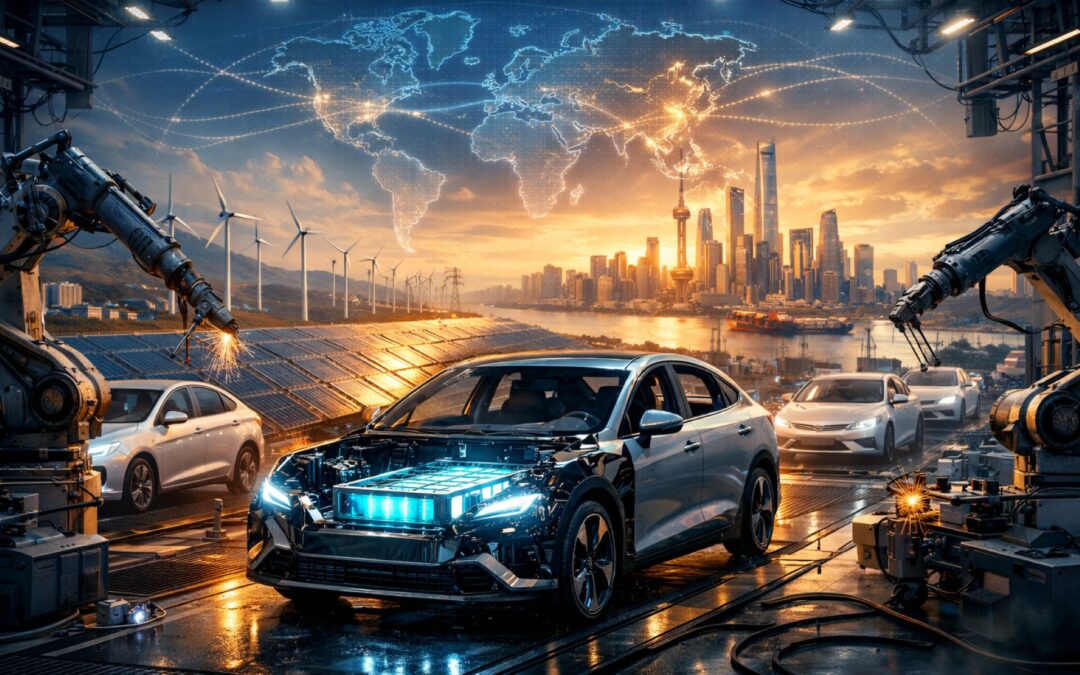
In the deserts of western China, an industrial transformation is quietly reshaping the global economy. Vast solar installations stretch across the landscape of Qinghai Province, including the enormous Gonghe Talatan Solar Park—the largest solar power plant in the world. At full capacity, it can generate enough electricity to power an entire country like Norway. And this is just one example among thousands. Across China’s deserts and plains, massive wind farms and solar arrays are rising at a staggering pace, forming the backbone of a new energy system.
The scale of China’s clean energy expansion is almost difficult to comprehend. In 2024 alone, China invested nearly $940 billion in clean energy technology, a figure larger than the entire GDP of many advanced economies. That same year, the country accounted for 64 percent of all new renewable energy capacity installed worldwide. Chinese companies now produce roughly 80 percent of the world’s solar panels, 60 percent of wind turbines, and close to 90 percent of lithium batteries used in electric vehicles. In the electric car industry—once dominated by American, Japanese, and European firms—Chinese companies now lead global production.
This dominance did not happen by accident. It is the result of decades of deliberate economic strategy. Beginning in the late twentieth century, China transformed itself from a poor, agrarian society into the world’s largest manufacturing powerhouse. For years that power rested on cheap labor and export-driven growth. But by the early 2010s, Chinese leaders realized that this model had reached its limits. If China wanted to become a technological superpower, it would need to move beyond low-cost manufacturing and dominate the industries of the future.
Under President Xi Jinping, the Chinese government launched an ambitious new industrial strategy known as Made in China 2025. The goal was nothing less than the restructuring of the country’s entire industrial base. China would pour massive state resources into strategic sectors such as robotics, aerospace, biotechnology, electric vehicles, and renewable energy. The objective was clear: reduce dependence on foreign technology and build globally competitive industries capable of dominating the next generation of manufacturing.
A decade later, the results are unmistakable. Chinese companies now stand at the center of the global clean energy supply chain. Firms like BYD, Longi Solar, and Goldwind have become world leaders in electric vehicles, solar panels, and wind turbines. Chinese factories produce these technologies at prices that many foreign competitors struggle to match. As a result, China has emerged as the dominant supplier of key technologies shaping the world’s transition toward renewable energy.
Yet this industrial transformation has also sparked intense controversy. Governments in the United States and Europe accuse China of flooding global markets with heavily subsidized exports, undermining domestic industries and distorting international trade. Tariffs on Chinese electric vehicles, solar panels, and other green technologies are increasingly becoming a central issue in global economic diplomacy.
Behind these tensions lies a deeper question about the structure of China’s economic model. Unlike most advanced economies, China’s growth strategy is built around massive industrial investment and state-directed support for strategic industries. This system has created powerful companies capable of producing advanced technology at unprecedented scale. But it has also produced enormous industrial capacity that often exceeds domestic demand, leading to fierce competition, falling prices, and growing trade imbalances.
Understanding how China built this system—and what it means for the global economy—requires tracing the country’s remarkable economic journey over the past four decades. From the failures of Mao-era central planning to the pragmatic reforms of Deng Xiaoping, and from the export boom of the 2000s to the state-driven industrial strategy of the Xi Jinping era, China’s rise represents one of the most dramatic economic transformations in modern history.
And today, that transformation is entering a new phase: a state-driven industrial revolution that is reshaping industries, supply chains, and geopolitical power across the globe.
From Mao’s Economic Catastrophe to Deng Xiaoping’s Market Reforms
China’s modern industrial rise cannot be understood without first examining the economic devastation that preceded it. When the People’s Republic of China was founded in 1949 under Mao Zedong, the country was overwhelmingly rural and impoverished. Mao’s vision was to rapidly transform China into a powerful industrial state through centralized planning and revolutionary mobilization. But the policies he pursued during the first decades of Communist rule produced some of the worst economic disasters in modern history.
The most infamous of these was the Great Leap Forward, launched in 1958. Mao believed China could rapidly industrialize by mobilizing the rural population into large collective communes and redirecting massive labor resources into industrial production. Farmers were forced into collective farms, private agriculture was abolished, and rural communities were encouraged to build small-scale backyard steel furnaces to boost industrial output.
In practice, the policy was a catastrophe. Agricultural production collapsed as labor was diverted away from farming, while local officials exaggerated production figures to meet political expectations. The state requisitioned grain based on these inflated numbers, leaving rural populations without enough food to survive. The result was one of the deadliest famines in human history. Estimates suggest that between 15 and 55 million people died between 1959 and 1961.
The economic damage went far beyond the famine itself. Centralized planning distorted incentives throughout the economy, industrial output was inefficient and poorly coordinated, and technological progress stagnated. By the time Mao died in 1976, China remained a poor, largely agrarian country, isolated from the global economy and still recovering from the political turmoil of the Cultural Revolution.
China’s economic fortunes began to change dramatically after Mao’s death, when Deng Xiaoping emerged as the country’s paramount leader. Deng had previously been purged during the Cultural Revolution for his pragmatic economic views, but by the late 1970s the failures of Maoist economic policy had become impossible to ignore. Deng believed that China needed fundamental reform if it was ever to escape poverty.
In 1978 he launched a new strategy known as “Reform and Opening Up” (改革开放). Unlike Mao’s ideological approach, Deng’s philosophy was deeply pragmatic. He famously summarized his economic thinking with the phrase: “It doesn’t matter whether a cat is black or white, as long as it catches mice.”
Under Deng’s reforms, China began gradually dismantling the rigid structures of the planned economy. Farmers were allowed to sell surplus crops on open markets, price controls were relaxed, and private businesses were permitted to emerge for the first time since the Communist revolution. At the same time, China opened its economy to foreign investment and international trade.
These reforms were cautious and incremental, but their impact was transformative. Market incentives began to reshape the Chinese economy, productivity improved rapidly, and new industries started to emerge. What followed over the next few decades would become one of the fastest economic transformations in human history.
The foundation had been laid for China’s next phase: its rise as the world’s manufacturing powerhouse.
The Rise of China as the World’s Manufacturing Hub
Special Economic Zones and the Shenzhen Miracle
One of the most important innovations of Deng Xiaoping’s reform era was the creation of Special Economic Zones (SEZs)—experimental regions where China could test market-oriented economic policies without fully abandoning central planning. These zones offered foreign investors tax incentives, simplified regulations, and access to cheap labor, making them highly attractive locations for manufacturing and export-oriented industries.
Among these zones, none would become more famous than Shenzhen. In the late 1970s, Shenzhen was little more than a small fishing village located near the border with Hong Kong. But its proximity to one of Asia’s most important financial centers made it an ideal location for economic experimentation. With strong support from Beijing, Shenzhen quickly transformed into a massive industrial hub.
Factories began appearing across the city, producing everything from clothing and toys to electronics and household goods. Foreign companies were eager to take advantage of China’s vast labor pool and extremely low wages. Meanwhile, millions of migrant workers from rural China poured into Shenzhen and other coastal cities in search of employment.
Within a single generation, Shenzhen became one of the fastest-growing cities in human history. What had once been a quiet village evolved into a sprawling metropolis and one of the most important manufacturing centers on the planet.
Low Wages and Export-Led Growth
China’s early manufacturing success was built on a powerful economic advantage: extremely low labor costs. During the 1990s, Chinese workers earned only a fraction of the wages paid in advanced economies like Japan, South Korea, or the United States.
In 1995, China’s GDP per capita was barely $600, compared with more than $12,000 in South Korea and over $44,000 in Japan. This enormous wage gap allowed Chinese manufacturers to produce goods far more cheaply than their competitors. Even when foreign firms had superior technology or more advanced production methods, Chinese factories could still win contracts simply by offering lower prices.
This cost advantage turned China into the workshop of the world. Factories across the country began producing massive quantities of consumer goods for export, ranging from textiles and toys to electronics and household appliances. As global companies increasingly outsourced manufacturing to Chinese factories, China’s export economy grew at breathtaking speed.
The transformation accelerated even further in 2001, when China joined the World Trade Organization (WTO). Membership in the WTO gave Chinese products much easier access to international markets while requiring China to gradually liberalize parts of its economy to meet global trade rules.
The results were dramatic. Over the following decade, China’s GDP per capita increased roughly fivefold, while exports surged to account for around 60 percent of the country’s GDP by 2007. Cheap Chinese goods flooded global markets, reshaping supply chains across industries.
By 2010, China had overtaken Japan to become the second-largest economy in the world.
Yet beneath this success lay an important limitation. Much of China’s manufacturing power still rested on labor-intensive, low-tech production. Chinese factories excelled at assembling products designed elsewhere, but the most advanced technologies—high-end machinery, semiconductors, and cutting-edge industrial equipment—were still dominated by companies in the United States, Japan, and Europe.
If China wanted to become a true technological superpower, it would need to move beyond cheap manufacturing and build its own advanced industries.
The Limits of the Old Model
Dependence on Low-Tech Manufacturing
By the late 2000s, China had successfully transformed itself into the world’s largest manufacturing powerhouse. Its factories produced an enormous share of the world’s consumer goods, and exports had become the engine driving the country’s rapid economic growth. Cities like Shenzhen, Guangzhou, and Shanghai had become symbols of China’s industrial rise.
But despite this remarkable progress, China’s economic model still had significant limitations.
Much of the country’s manufacturing sector was focused on low-value, labor-intensive production. Chinese factories excelled at assembling products such as electronics, textiles, toys, and household appliances, but the most valuable components and technologies were still largely developed abroad. Multinational corporations from the United States, Japan, South Korea, and Europe typically designed the products, produced the advanced components, and controlled the most profitable parts of the supply chain.
China, in many cases, served primarily as the final assembly hub.
This meant that although China exported vast quantities of manufactured goods, it often captured only a small portion of the overall value generated by those products. For example, when smartphones or computers were assembled in Chinese factories, the bulk of the profits often went to companies responsible for design, software, or specialized components.
Chinese policymakers recognized that relying indefinitely on cheap labor and basic manufacturing posed a long-term risk. Rising wages would eventually erode China’s cost advantage, and competing developing countries could begin attracting the same types of manufacturing jobs that had once fueled China’s own growth.
Reliance on Foreign Technology
China’s dependence on foreign technology was another major concern for policymakers.
Despite its growing industrial base, the country still relied heavily on imports for critical technologies such as advanced semiconductors, high-end industrial machinery, and sophisticated manufacturing equipment. Many Chinese firms lacked the research capabilities and technological expertise needed to compete with leading global companies in advanced industries.
This technological dependence created both economic and strategic vulnerabilities. If access to foreign technology were restricted—through trade disputes or geopolitical tensions—China’s industrial development could be severely constrained.
At the same time, environmental pressures were mounting. China’s rapid industrial expansion had come at a tremendous ecological cost. By 2010, around 80 percent of China’s electricity was generated by burning coal, making the country one of the world’s largest sources of greenhouse gas emissions and air pollution.
By the early 2010s, Chinese leaders faced a clear dilemma. The export-driven manufacturing model had delivered extraordinary economic growth, but it was no longer sufficient to sustain China’s ambitions as a global superpower.
To move forward, China needed to do something far more ambitious: upgrade its entire industrial base, dominate the technologies of the future, and reduce its reliance on foreign innovation.
This realization would lead to one of the most ambitious industrial strategies ever attempted by a modern state.
Xi Jinping and the Vision of Made in China 2025
Why China Needed a New Industrial Strategy
When Xi Jinping became China’s leader in 2012, the country stood at a crossroads. After three decades of rapid growth, the export-driven manufacturing model that had fueled China’s economic rise was beginning to show signs of strain. Wages were rising, environmental pressures were mounting, and global demand was becoming less reliable following the financial crises of the late 2000s.
More importantly, China’s leaders recognized that the country remained dependent on foreign technology in many critical industries. Despite producing enormous volumes of manufactured goods, Chinese firms still relied heavily on imported components, advanced machinery, and intellectual property from abroad.
For a country with ambitions of becoming a global superpower, this technological dependence posed a strategic vulnerability. If China wanted to secure its economic future—and reduce the risk of being cut off from key technologies—it would need to build its own advanced industrial capabilities.
The challenge was enormous. Upgrading a manufacturing base that had long relied on cheap labor into one driven by innovation and high-end technology required coordinated action on a national scale. It meant developing domestic expertise in fields such as advanced robotics, aerospace engineering, biotechnology, and clean energy technology.
Xi Jinping’s government responded with an ambitious long-term industrial plan.
Key Industries of the Future
In 2015, Beijing unveiled a new national strategy known as Made in China 2025. The plan was designed as a roadmap for transforming China from the world’s largest manufacturer into the world’s most advanced manufacturing power.
The strategy openly acknowledged China’s industrial weaknesses. While the country’s manufacturing sector was massive, it still lagged behind leading economies in innovation, quality, and technological sophistication. The goal of the new strategy was therefore clear: close the gap with global leaders and eventually surpass them in key sectors.
The plan identified several industries that would define the next era of global economic competition. These included robotics, aerospace technology, advanced information technology, biotechnology, electric vehicles, and renewable energy systems.
China would concentrate enormous resources on these sectors. Government policies would encourage investment, support research and development, and help domestic companies scale up production. The state would also aim to reduce reliance on imported components by building entire domestic supply chains within China.
At its core, Made in China 2025 was an attempt to re-engineer China’s economic model. Instead of competing primarily on low wages and mass production, Chinese companies would compete through innovation, advanced manufacturing, and technological leadership.
The strategy was bold—and controversial. While Chinese leaders framed it as a necessary step in the country’s development, many governments abroad saw it as a sign that China intended to dominate critical industries of the future.
Yet despite the controversy, the policy marked the beginning of a new phase in China’s economic evolution: the construction of a powerful state-supported industrial system designed to shape the global economy.
How China Built Its Industrial Machine
Direct Subsidies and Industrial Policy
China’s rapid rise in advanced industries did not occur through market forces alone. At the heart of the country’s industrial transformation lies an extensive system of state-directed industrial policy, designed to accelerate the growth of strategic sectors.
One of the most visible tools in this system is the use of direct government subsidies. Chinese authorities have spent hundreds of billions of dollars supporting industries that align with national development goals, particularly in areas such as electric vehicles, renewable energy, and advanced manufacturing.
The electric vehicle industry provides a clear example. Beginning in 2009, China introduced nationwide subsidies designed to encourage the production and adoption of electric cars. These payments were made directly to manufacturers, reducing production costs and allowing companies to scale rapidly.
The average subsidy per electric vehicle gradually declined over time—from roughly $2,700 per vehicle in 2010 to about $1,500 by 2022—but the overall scale of support grew dramatically as the industry expanded. By the final year of the program in 2022, total subsidies for EV manufacturers reached approximately $5 billion.
Individual companies benefited enormously from this support. The Chinese automaker BYD, for instance, received $3.7 billion in subsidies between 2018 and 2022 alone, including more than $2 billion in a single year. Similar forms of assistance have been extended to companies involved in renewable energy, wind turbine manufacturing, and other strategic sectors.
These subsidies helped Chinese companies scale production far faster than would normally be possible in purely market-driven environments.
Tax Incentives, Cheap Land, and State Financing
Direct subsidies represent only one component of China’s industrial support system. In practice, the government employs a wide array of policies that lower operating costs for favored industries.
Companies in strategic sectors often receive tax incentives and credits designed to encourage research and development. Local governments may also provide cheap or even free land to attract manufacturing facilities, significantly reducing the cost of building large-scale factories.
Energy prices can also be adjusted to support industrial growth. In some regions, provincial governments have deliberately lowered electricity prices for industrial users to protect profit margins for domestic manufacturers.
These policies collectively reduce the cost structure of Chinese manufacturing. Companies benefit from lower taxes, lower land costs, and lower input prices, making it easier for them to compete internationally.
The Role of State-Owned Banks
Perhaps the most powerful element of China’s industrial system is its state-controlled financial sector.
China’s banking industry is highly centralized, with state-owned banks controlling roughly 60 percent of total banking assets. This structure allows the government to channel large volumes of capital toward industries it considers strategically important.
Instead of making lending decisions purely based on market risk and profitability, state-owned banks can direct financing according to national development priorities. In recent years, this has meant massive lending programs aimed at expanding China’s manufacturing capabilities—particularly in sectors such as electric vehicles, batteries, and renewable energy technology.
Access to cheap credit gives Chinese firms a major advantage. Companies can borrow at lower interest rates and expand production capacity much more rapidly than competitors operating in more market-driven financial systems.
Beyond loans, government-backed investment funds also play a role similar to venture capital, investing directly in promising technology firms. In some cases, local governments have even stepped in to rescue struggling companies they believe are strategically important.
This combination of subsidies, favorable regulations, and state-directed financing has created one of the most powerful industrial ecosystems in the world. Chinese companies do not simply compete in global markets—they operate within a vast economic system designed to support their growth at every stage of development.
And nowhere is this more visible than in the story of one of China’s most successful industrial champions.
The BYD Story and the Rise of China’s Electric Vehicle Industry
From Battery Startup to Global EV Giant
Few companies illustrate China’s industrial transformation better than BYD. What began as a small battery manufacturer in the 1990s would eventually become one of the most important players in the global electric vehicle revolution.
The story begins with Wang Chuanfu, a young chemist born into a poor farming family in Anhui province. Growing up in rural China, Wang experienced firsthand the economic hardships that defined much of the country before its industrial boom. Through academic excellence, he earned a place at university to study chemistry and later moved to the rapidly growing manufacturing hub of Shenzhen.
In the mid-1990s, Wang recognized an opportunity in the emerging market for rechargeable batteries used in mobile phones and consumer electronics. At the time, Japanese companies such as Sony dominated the industry with sophisticated manufacturing processes and advanced technology. But these companies also faced a disadvantage: high labor costs.
Wang believed that by combining relatively simple production techniques with China’s extremely low labor costs, he could produce batteries far more cheaply than established competitors. In 1995, he founded a small company called Yadi Electronics, named after the street where the company’s first workshop was located.
The strategy worked. By relying heavily on manual assembly rather than expensive automated production lines, Wang dramatically reduced costs. Within a few years, the company became one of the largest producers of rechargeable batteries in the world. In 2002, the company went public on the Hong Kong Stock Exchange, raising over $200 million and adopting the name that would later become globally recognized: BYD, short for “Build Your Dreams.”
But Wang’s ambitions extended far beyond batteries.
In the early 2000s, BYD acquired a struggling Chinese car manufacturer and began entering the automotive industry. The move seemed risky at the time. The global automobile market was dominated by established giants such as Toyota, Volkswagen, and General Motors. Chinese car companies were still relatively unknown internationally.
However, BYD had one major advantage. Its expertise in battery technology positioned the company perfectly for the emerging electric vehicle revolution.
Government Support and Market Expansion
The Chinese government’s push toward electrification created a powerful environment for companies like BYD to thrive. As part of its broader industrial strategy, Beijing identified electric vehicles as a key technology that could simultaneously address multiple national goals: reducing pollution, lowering dependence on imported oil, and establishing leadership in a new global industry.
To accelerate the transition, the government introduced a wide range of incentives. Consumers purchasing electric vehicles received subsidies, while manufacturers benefited from research grants, tax breaks, and government procurement programs.
These policies helped create a massive domestic market for electric vehicles, allowing Chinese manufacturers to scale production rapidly.
BYD was among the biggest beneficiaries. Early government contracts helped the company expand its production capacity and gain valuable experience in large-scale manufacturing. One notable example occurred in 2011, when the Shenzhen government awarded BYD a major contract to supply electric buses for the city’s public transportation system.
The deal helped establish BYD as a leader in electric mobility and demonstrated the potential of electric buses in urban transportation networks.
Over the following decade, the company expanded aggressively. It invested heavily in battery technology, vehicle design, and manufacturing capacity. As China’s electric vehicle market exploded in size, BYD rapidly increased its production.
Today, the company stands among the largest automobile manufacturers in the world. It produces millions of vehicles each year and has expanded its operations globally, building factories and supply networks across Asia, Europe, and the Americas.
BYD’s rise mirrors the broader transformation of China’s industrial economy. A company that began as a small battery workshop has grown into a global leader in electric vehicles—supported by an ecosystem of government policy, domestic supply chains, and enormous industrial capacity.
And BYD is far from alone. Across multiple sectors of the clean energy economy, Chinese companies have risen to dominate global production.
China’s Domination of the Clean Energy Supply Chain
Solar Panels
Over the past decade, China has emerged as the undisputed leader in solar panel manufacturing. Chinese companies now control roughly 80 percent of global solar panel production capacity, giving the country enormous influence over one of the most important technologies driving the global energy transition.
This dominance did not happen overnight. In the early 2000s, European and American firms were among the pioneers of solar technology. However, Chinese manufacturers rapidly entered the market with aggressive pricing and massive production scale.
Supported by government incentives, Chinese companies invested heavily in new factories capable of producing solar panels at an unprecedented scale. At the same time, an extensive domestic supply chain began to emerge, covering everything from polysilicon production to panel assembly.
The result was a dramatic drop in the cost of solar energy technology. Over time, Chinese manufacturers were able to produce panels far more cheaply than many of their international competitors. This forced numerous Western solar companies out of business while cementing China’s leadership in the industry.
Wind Turbines
China has achieved similar dominance in the wind power industry. Chinese firms such as Goldwind and Mingyang now rank among the world’s largest producers of wind turbines.
Like the solar sector, the wind industry benefited from large-scale state support and rapid expansion of domestic demand. China built enormous wind farms across its northern and western regions, creating a huge internal market for wind turbine manufacturers.
This domestic demand allowed Chinese companies to refine their technology, expand production capacity, and achieve significant economies of scale. As their expertise improved, they began competing increasingly aggressively in global markets.
Today, Chinese firms produce around 60 percent of the world’s wind turbines, making them central players in the global expansion of renewable energy infrastructure.
Lithium Batteries and Electric Vehicles
Perhaps the most strategically important area of China’s clean energy dominance lies in lithium battery production.
Lithium-ion batteries are the core technology powering electric vehicles, smartphones, laptops, and large-scale energy storage systems. Control over battery production therefore provides enormous leverage within the modern technology economy.
Chinese companies currently account for up to 90 percent of global lithium battery production capacity. This leadership has been achieved through a combination of massive investment, strong domestic demand, and tight integration across supply chains.
China has also invested heavily in securing access to key raw materials such as lithium, cobalt, and nickel, which are essential components in battery manufacturing. Chinese firms have acquired mining stakes and supply agreements across Africa, South America, and other resource-rich regions.
These supply chains feed directly into China’s rapidly growing electric vehicle industry. Chinese consumers now purchase more electric cars each year than conventional gasoline vehicles, making the country the world’s largest EV market by far.
At the same time, Chinese manufacturers are expanding internationally. Companies such as BYD are building factories in countries like Brazil, Hungary, Thailand, and Turkey in order to supply vehicles directly to local markets.
Together, these developments have positioned China at the center of the global clean energy economy. Solar panels, wind turbines, batteries, and electric vehicles—technologies that will define the energy systems of the future—are increasingly produced by Chinese companies.
This growing dominance, however, has also triggered a powerful reaction from China’s major trading partners.
The Global Backlash: Tariffs, Protectionism, and Trade Wars
The Western Response
China’s growing dominance in clean energy technology has triggered a wave of concern among governments in the United States, Europe, and other advanced economies. While renewable energy is widely seen as essential for combating climate change, the rapid rise of Chinese manufacturers has raised fears that domestic industries could be wiped out before they have the chance to compete.
The core of the concern lies in the sheer scale of Chinese production. As Chinese factories expanded their output of solar panels, electric vehicles, and wind turbines, global markets became flooded with low-cost exports. Prices fell rapidly, making it difficult for companies in other countries to compete.
Solar panels offer one of the clearest examples. Since 2017, global solar exports from China have increased dramatically while prices have dropped by more than 60 percent. While this price collapse has made solar power much cheaper worldwide, it has also put enormous pressure on manufacturers outside China.
Many Western solar companies struggled to survive in this environment. Governments in the United States and Europe began to argue that Chinese manufacturers were benefiting from unfair advantages, particularly the extensive state subsidies and financial support provided by Beijing.
As a result, tariffs and other protectionist measures have increasingly become a central feature of trade policy toward Chinese green technology.
The Debate Over Subsidies
Critics of China’s industrial strategy argue that massive government support allows Chinese companies to produce goods below their true market cost. Subsidies, cheap loans, preferential energy prices, and government procurement programs all contribute to lowering production costs.
This allows Chinese manufacturers to export large quantities of products at prices that competitors find difficult—or impossible—to match.
However, the debate over subsidies is not entirely one-sided. Many governments also provide financial support to their own domestic industries. For example, the United States offers generous tax credits for electric vehicle production and renewable energy investments through policies such as the Inflation Reduction Act.
Supporters of China’s approach argue that the country’s industries are not simply subsidized—they are also highly competitive due to scale, integrated supply chains, and relentless cost reduction.
Still, the scale of China’s industrial support remains unusual. Estimates suggest that Chinese industrial policy spending amounts to around 1.7 percent of the country’s GDP, a level significantly higher than in most other major economies.
But the tensions surrounding Chinese exports are not driven solely by subsidies. A deeper structural feature of China’s economic model is at the heart of the controversy.
The Overcapacity Problem
China Produces More Than It Consumes
At the center of the global debate over China’s industrial rise lies a structural feature of its economic system: China produces far more than it consumes.
For decades, the Chinese growth model has prioritized investment and industrial expansion over household consumption. Rather than channeling national income primarily toward raising consumer spending, the country has directed enormous resources into infrastructure, factories, research, and manufacturing capacity.
This strategy helped transform China into the world’s largest industrial producer. The country now accounts for roughly 32 percent of global manufacturing output, an extraordinary share for a single nation.
However, domestic consumption has not kept pace with this enormous productive capacity. In 2023, household consumption accounted for only about 40 percent of China’s GDP, far below the global average of roughly 57 percent.
As a result, China’s economy generates far more goods than its domestic market can absorb. To sustain growth, the country exports a large portion of this surplus production to the rest of the world.
This imbalance helps explain why China consistently runs massive trade surpluses. In recent years, the country’s annual trade surplus has approached one trillion dollars, reflecting the gap between what China produces and what its citizens consume.
Why Prices Collapse
Overcapacity has powerful effects on global markets. When factories produce more goods than consumers are willing to buy, companies are forced to compete aggressively on price in order to sell their output.
In industries such as solar panels, electric vehicles, and wind turbines, Chinese manufacturers have built enormous production capacity. But global demand often grows more slowly than supply.
For example, in 2023 China had the ability to produce over 860 gigawatts of solar panels, while total global demand was less than half that amount. This excess capacity leads to intense competition among manufacturers, driving prices downward.
From the perspective of consumers, this can be beneficial. Lower prices make renewable energy technology more affordable and accelerate the transition toward cleaner energy systems.
But for manufacturers—both inside and outside China—the consequences can be severe. Companies may struggle to maintain profitability when market prices fall too low.
In fact, many Chinese renewable energy companies themselves are facing financial pressure as intense domestic competition erodes profit margins. Share prices for several major solar and wind manufacturers have declined significantly as the industry grapples with oversupply.
In other words, China’s industrial system does not simply create winners and losers between countries. The enormous production capacity it generates can disrupt entire industries worldwide—including those within China itself.
Understanding this dynamic is essential for grasping the broader implications of China’s industrial strategy for the global economy.
What China’s Industrial Model Means for the World
Global Consumers and Cheap Technology
From the perspective of global consumers, China’s industrial rise has produced clear benefits. The country’s enormous manufacturing capacity and relentless focus on cost reduction have dramatically lowered the price of many technologies.
This is particularly evident in the clean energy sector. The cost of solar panels has fallen by more than 90 percent over the past two decades, and a large portion of that decline can be traced directly to China’s manufacturing expansion. Chinese factories have driven down production costs through economies of scale, integrated supply chains, and aggressive competition among manufacturers.
The same dynamic is now unfolding in the electric vehicle market. As Chinese companies rapidly increase production, electric vehicles are becoming more affordable around the world. Lower prices make it easier for consumers to adopt new technologies and accelerate the transition away from fossil fuels.
From a global environmental perspective, this trend may be enormously beneficial. Cheaper renewable energy technologies mean that countries can deploy solar power, wind turbines, and electric vehicles much faster than previously expected. In this sense, China’s industrial capacity is helping to accelerate the global energy transition.
The Strategic Dependence Question
However, the same dominance that benefits consumers also raises serious strategic questions for governments.
As Chinese companies come to dominate key segments of the clean energy supply chain, other countries may become increasingly dependent on Chinese manufacturing. If most of the world’s solar panels, batteries, and electric vehicles are produced in China, disruptions to these supply chains could have major economic and political consequences.
This concern has become particularly prominent in recent years as geopolitical tensions between China and Western countries have intensified. Governments in the United States and Europe increasingly view technological supply chains not just as economic assets but as strategic infrastructure.
Dependence on foreign production—especially in industries that will shape the future of energy and transportation—can be seen as a potential national security risk.
As a result, many countries are now attempting to rebuild their own domestic manufacturing capacity in sectors such as semiconductors, batteries, and renewable energy equipment. New industrial policies in the United States, Europe, and elsewhere aim to reduce reliance on Chinese supply chains and create alternative sources of production.
Yet replicating China’s industrial ecosystem is not easy. The country’s manufacturing dominance is built on decades of infrastructure investment, integrated supply chains, and coordinated state support.
Whether other nations can successfully compete with this system remains one of the most important economic questions of the twenty-first century.
Conclusion
China’s rise as an industrial superpower represents one of the most extraordinary economic transformations in modern history. In the span of just four decades, the country moved from a poor, largely agrarian society into the world’s largest manufacturing economy. What began with Deng Xiaoping’s pragmatic reforms evolved into a vast export machine that supplied goods to markets around the world.
But the story did not end there. Recognizing the limitations of low-cost manufacturing, Chinese leaders launched an ambitious strategy to upgrade the country’s industrial base. Through initiatives such as Made in China 2025, the government directed enormous resources toward strategic industries including electric vehicles, renewable energy, advanced manufacturing, and battery technology.
The results are now visible across the global economy. Chinese companies dominate key segments of the clean energy supply chain, producing the majority of the world’s solar panels, wind turbines, and lithium batteries. Firms like BYD have risen from small domestic manufacturers to global industrial champions, reshaping entire industries along the way.
This transformation has been driven by a unique economic model. China’s system combines state-directed industrial policy, extensive financial support, integrated supply chains, and massive domestic markets. Together, these factors have allowed Chinese companies to scale production at levels rarely seen in modern industrial history.
Yet this model also creates tensions. The enormous industrial capacity generated by China’s economy often exceeds domestic demand, leading to large trade surpluses and fierce competition in global markets. Governments in other countries worry that heavily supported Chinese industries could undermine their own manufacturing sectors.
At the same time, China’s manufacturing power has dramatically lowered the cost of technologies that are crucial for the future—especially renewable energy. Cheaper solar panels, batteries, and electric vehicles may accelerate the global transition toward cleaner energy systems.
In this sense, China’s industrial revolution presents both opportunity and challenge for the rest of the world. It raises difficult questions about trade policy, economic strategy, and technological dependence.
But one thing is clear: the structure of global industry is changing. And at the center of that transformation stands a manufacturing system built not only on markets, but on the strategic direction of the Chinese state.