
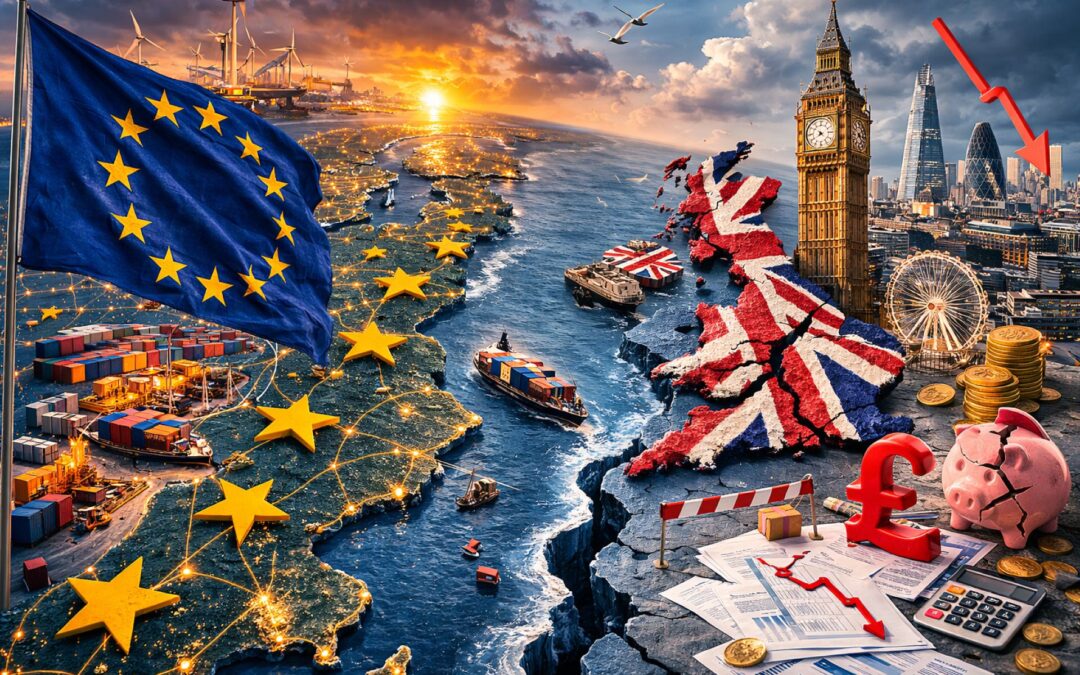
Introduction: The Promise of “Taking Back Control”
On June 23, 2016, the United Kingdom made one of the most consequential political decisions in its modern history. In a referendum that shocked much of the world, 52% of British voters chose to leave the European Union. For supporters of the decision, Brexit represented a chance to reclaim national sovereignty, restore control over immigration, and free Britain from what they saw as excessive European bureaucracy.
The campaign slogan “Take Back Control” captured the spirit of the moment. Many voters believed that leaving the EU would allow Britain to craft its own economic destiny—signing independent trade agreements, reducing immigration pressures, and removing regulatory constraints imposed by Brussels. In theory, Brexit would allow the United Kingdom to transform itself into a more agile, globally connected economy.
But nearly a decade later, the national mood has shifted dramatically.
Public support for Brexit has steadily eroded as the economic consequences have become clearer. Surveys now show that only about one-third of British citizens believe Brexit was a good idea, while a growing majority believes leaving the European Union has harmed the country. Economists estimate that Brexit has already cost the United Kingdom tens of billions of pounds in lost economic activity, with some estimates approaching £160–£200 billion in long-term economic losses.
What began as a bold political experiment has increasingly been viewed as an economic mistake.
To understand why perceptions have changed so dramatically, it is necessary to examine Brexit’s real-world impact. The effects can be seen across three key pillars of the British economy: trade, foreign investment, and immigration. Each of these areas played a central role in the Brexit debate, and each has produced outcomes that differ significantly from what many supporters originally expected.
By examining these three dimensions, we can answer the central question that has defined Britain’s post-Brexit era:
Was Brexit actually worth it?
The Trade Reality After Leaving the European Union
The Loss of Frictionless Trade
Before Brexit, the United Kingdom was part of one of the most powerful economic arrangements in the world: the European Union’s single market. Membership allowed British companies to trade freely with 27 other European nations without tariffs, customs checks, or regulatory barriers. Goods could move across borders almost as easily as they moved between regions within the same country.
This system of frictionless trade was one of the EU’s greatest economic advantages. Shared regulations meant that products approved in one EU country could be sold anywhere in the bloc without additional certification. Businesses did not have to navigate different regulatory regimes or customs processes, dramatically reducing costs and delays.
For British companies, this arrangement was particularly valuable. The EU was—and still is—the United Kingdom’s largest trading partner. For decades, British firms built supply chains, manufacturing networks, and service relationships that depended on seamless access to European markets.
Brexit fundamentally changed this arrangement.
When the post-Brexit transition period ended on December 31, 2020, the United Kingdom formally left the EU’s single market and customs union. The new Trade and Cooperation Agreement (TCA) established the framework for trade between Britain and the EU going forward. While the agreement eliminated many tariffs, it could not replicate the benefits of full EU membership.
The result was the introduction of a new reality: borders that suddenly mattered again.
The Explosion of Red Tape and Bureaucracy
One of the most immediate consequences of Brexit was the dramatic increase in administrative complexity for businesses trading with Europe. Customs declarations, rules-of-origin documentation, regulatory compliance checks, and border inspections became routine parts of UK–EU trade.
These bureaucratic requirements created significant friction in supply chains that had previously operated smoothly.
Studies and industry surveys show that a large majority of British exporters now face significant difficulties trading with the EU. Companies that once shipped goods freely across the Channel now have to navigate complex paperwork, customs procedures, and regulatory checks that add both time and cost to every transaction.
For businesses dealing with perishable goods or tightly coordinated manufacturing schedules, these delays can be especially damaging. Even minor disruptions at borders can cascade through supply chains, increasing costs and reducing competitiveness.
From the perspective of European buyers, these new complications have also changed incentives. Faced with additional paperwork and uncertainty when importing British goods, many EU businesses have simply turned to suppliers within the EU to avoid the hassle.
In other words, Brexit introduced friction into trade relationships that previously operated without it.
Why Small Businesses Suffered the Most
Large multinational corporations often have the resources to adapt to regulatory complexity. Some British companies have addressed Brexit barriers by establishing subsidiaries or distribution hubs within the European Union, allowing them to maintain access to the single market.
Small and medium-sized businesses, however, have far fewer options.
For smaller exporters, navigating multiple regulatory systems, languages, and compliance frameworks can be prohibitively expensive. Many lack the legal teams or logistics specialists required to manage complicated customs processes. As a result, some small businesses have simply stopped exporting to the EU altogether.
This shift has had a broader economic impact. Small and medium-sized enterprises make up a large portion of the UK’s export ecosystem, and barriers affecting them ripple through entire industries.
Brexit did not just change trade rules—it changed who could realistically participate in international trade.
Can Global Trade Deals Replace the EU Market?
One of the central promises made by Brexit supporters was that leaving the EU would allow Britain to negotiate its own trade agreements with countries around the world. Freed from EU trade policy, the UK would supposedly unlock new opportunities in fast-growing markets.
Since leaving the European Union, Britain has indeed signed trade agreements with several countries, including Australia and New Zealand, and has pursued negotiations with others such as India.
However, these deals face a fundamental economic reality: geography still matters in trade.
Countries tend to trade most heavily with their nearest neighbors. The European Union represents a massive, highly integrated market located directly across the Channel from the United Kingdom. Replacing that level of economic integration with trade relationships thousands of miles away is extremely difficult.
While trade with non-EU countries has increased in some cases, it has not been sufficient to offset the decline in trade intensity with the European Union. Compared to other advanced economies, the United Kingdom now shows weaker trade performance relative to the size of its economy.
In short, Brexit did not eliminate Britain’s dependence on European trade—it simply made that trade more complicated.
And when it comes to economic outcomes, increased friction almost always carries a cost.
The Collapse of Britain’s Foreign Investment Advantage
Why the UK Once Attracted Massive Foreign Investment
For decades, the United Kingdom held a unique position in the global economy. It served as a gateway between international investors and the vast European market. Companies from the United States, Asia, and the rest of the world frequently chose Britain as their base of operations for European expansion.
Several factors made the UK particularly attractive to foreign investors.
First, London was one of the world’s most important financial centers, offering deep capital markets, strong banking infrastructure, and global connectivity. Second, the United Kingdom had a stable legal system and business-friendly regulatory environment. Third, and perhaps most importantly, the country offered direct access to the European Union’s single market, which represented one of the largest trading blocs in the world.
For multinational companies, this combination was extremely powerful. By establishing operations in Britain, firms could enjoy the advantages of an English-speaking business environment while simultaneously gaining frictionless access to the entire European market.
As a result, foreign direct investment (FDI) into the United Kingdom grew rapidly in the years leading up to the Brexit referendum.
Brexit Uncertainty and the Investment Freeze
The Brexit vote immediately introduced a level of uncertainty that investors typically try to avoid.
When the referendum result was announced in 2016, businesses suddenly faced a fundamental question: What would Britain’s future relationship with Europe look like? Would companies still have access to the single market? Would tariffs be introduced? Would regulatory standards diverge?
For several years, there were no clear answers.
Negotiations between the UK and the European Union stretched on, and the final shape of the post-Brexit trade relationship remained unclear until the Trade and Cooperation Agreement was finalized at the end of 2020. During this prolonged period of uncertainty, many companies chose to delay investment decisions or redirect capital to other countries.
Foreign investors tend to prioritize stability and predictability when choosing where to deploy capital. The Brexit process created the opposite environment—one defined by uncertainty, political debate, and constantly shifting expectations.
The immediate result was a noticeable decline in new business investment.
Falling Behind Other Advanced Economies
The longer-term data has reinforced this trend.
Since the Brexit referendum, the United Kingdom has underperformed other advanced economies in business investment growth. Among the G7 nations, Britain has experienced one of the weakest investment performances over this period.
Brexit supporters sometimes point out that the UK still receives large volumes of foreign investment in absolute terms. However, economists often emphasize that the relevant comparison is not simply how much investment arrives, but how much investment would have arrived if the UK had remained within the EU framework.
Economic studies suggest that foreign direct investment into the United Kingdom is significantly lower than it might otherwise have been. Some estimates indicate that Britain could have been receiving billions of pounds more in investment each year if it had maintained its pre-Brexit position within the European economic system.
At the same time, other European countries—particularly France and Germany—have strengthened their positions as investment destinations.
The Long-Term Productivity Problem
The decline in foreign investment carries deeper economic consequences beyond the immediate loss of capital flows.
Foreign direct investment plays a crucial role in improving productivity. When multinational companies invest in new facilities, research centers, or production networks, they bring advanced technologies, management practices, and global supply chain connections. These factors help raise productivity levels across the broader economy.
Lower investment therefore translates into slower productivity growth, weaker wage growth, and reduced long-term economic expansion.
Economists estimate that the decline in investment associated with Brexit has already reduced British economic output by tens of billions of pounds. More importantly, the long-term effects may continue to accumulate over time.
Without strong inflows of foreign capital, it becomes harder for an economy to innovate, modernize, and remain competitive in global markets.
Brexit did not eliminate Britain’s ability to attract investment. But by removing one of its greatest advantages—unrestricted access to the European single market—it made the country a less obvious choice for global investors.
And in an increasingly competitive global economy, even small shifts in investment patterns can produce significant consequences over time.
The Immigration Paradox
Ending Free Movement from the European Union
Immigration was one of the most politically powerful issues driving the Brexit campaign. For many voters, the European Union’s principle of free movement of people symbolized a loss of national control over Britain’s borders. Citizens of EU member states could live and work in the United Kingdom without restrictions, and migration from Europe increased significantly during the 2000s and early 2010s.
Brexit supporters argued that leaving the EU would allow Britain to regain control over immigration policy. By ending free movement, the UK government could supposedly reduce immigration levels and design a system that prioritized domestic workers.
In political terms, this argument was extremely effective. Concerns about immigration played a central role in the referendum debate and helped mobilize support for leaving the European Union.
When Brexit finally took effect, one of its most immediate consequences was indeed the end of free movement between the UK and EU countries.
Why Immigration Fell — And Then Surged
Initially, the policy appeared to achieve its intended goal.
After Brexit, migration from EU countries declined significantly. Workers from Eastern and Southern Europe who had once moved freely into the British labor market now faced visa requirements and new bureaucratic barriers. As a result, net migration from the European Union dropped noticeably.
However, this reduction did not last long.
Within a few years, overall immigration levels into the United Kingdom began rising again—eventually reaching record highs. The key difference was that the composition of migration had changed dramatically.
While EU migration declined, non-EU immigration surged. Large numbers of international students, healthcare workers, and skilled migrants entered the country through new visa programs designed to fill labor shortages. Refugee flows and humanitarian programs also contributed to rising migration numbers.
The result was a striking paradox: although Brexit successfully reduced migration from Europe, total immigration into the United Kingdom ended up higher than it had been before Brexit.
Labor Shortages and an Aging Population
The reason for this surge lies in a deeper structural reality of the British economy.
Like many developed countries, the United Kingdom faces an aging population and a shrinking domestic workforce. As older workers retire, industries across the economy require new labor to maintain productivity and economic output.
Sectors such as healthcare, hospitality, construction, and agriculture rely heavily on migrant labor. When EU migration declined after Brexit, many of these industries experienced severe labor shortages.
To address these gaps, the British government expanded visa programs for workers from outside Europe. Healthcare systems recruited doctors and nurses from overseas, universities attracted international students, and businesses sought workers from a broader range of countries.
In other words, the economic demand for labor did not disappear simply because immigration rules changed.
A Policy That Achieved the Opposite Result
The final outcome has been deeply ironic.
One of the central promises of Brexit was that leaving the European Union would reduce immigration levels and allow Britain to regain control of its borders. In practice, while the country gained formal control over immigration policy, economic realities forced the government to maintain—and eventually increase—migration levels.
The composition of immigration changed, but the overall numbers did not fall.
Instead of large inflows from EU countries such as Poland or Romania, Britain now sees rising migration from countries including India, Nigeria, and China. The shift reflects new visa policies, global labor markets, and the UK’s continuing need for workers in key sectors.
This outcome illustrates a broader lesson about economic policy: political objectives and economic realities do not always align.
Brexit succeeded in ending EU free movement, but it did not eliminate the underlying forces that drive migration in modern economies. As long as Britain faces labor shortages, demographic pressures, and a globalized workforce, immigration will remain a central part of its economic system.
And in that sense, Brexit changed immigration policy without truly changing immigration itself.
The Economic Cost of Brexit
When evaluating a major political decision like Brexit, individual policy outcomes—such as trade barriers or immigration changes—only tell part of the story. The broader question is how these changes combine to influence the overall performance of the economy.
In the case of the United Kingdom, the cumulative economic impact has become increasingly difficult to ignore.
Economists generally measure the health of an economy through indicators such as trade activity, investment levels, productivity growth, and gross domestic product (GDP). Since the Brexit referendum in 2016, many of these indicators have shown weaker performance than expected.
One of the clearest signs is Britain’s declining trade intensity. Compared with other advanced economies, the United Kingdom now conducts less trade relative to the size of its economy. While global trade disruptions—including the COVID-19 pandemic and geopolitical tensions—have affected many countries, Britain’s slowdown has been noticeably more severe.
At the same time, business investment has remained subdued. As discussed earlier, foreign direct investment into the UK has lagged behind other major economies since the Brexit vote. Lower investment means fewer new factories, research facilities, and business expansions—each of which contributes to long-term economic growth.
These changes accumulate over time. Slower trade growth and reduced investment lead to weaker productivity gains, which in turn limit wage growth and overall economic expansion.
Several economic studies have attempted to quantify these effects. Estimates vary depending on the methodology used, but many analyses suggest that Brexit has already reduced Britain’s economic output by tens of billions of pounds. Some projections place the long-term cost of Brexit at well over £150 billion in lost economic activity.
These figures do not represent a single, visible shock to the economy. Instead, they reflect a gradual erosion of economic potential—lost opportunities, investments that never materialized, and trade relationships that slowly shifted elsewhere.
This is one of the defining characteristics of large structural policy changes: the costs often accumulate quietly over many years rather than appearing immediately.
Brexit did not cause the British economy to collapse. The United Kingdom remains a wealthy and influential country with major industries in finance, technology, and services. However, the evidence increasingly suggests that the country’s economic performance has been weaker than it might have been under the previous EU framework.
In other words, the true cost of Brexit may not lie in dramatic economic crises, but in something more subtle: a slower pace of growth and a gradual loss of economic momentum.
And over time, even small differences in growth rates can produce enormous consequences for a nation’s prosperity.
As these costs become more visible, the debate surrounding Brexit has increasingly shifted from political identity to economic reality. What once appeared to many voters as a bold step toward national independence is now widely viewed as a policy experiment whose economic benefits have yet to materialize.
The final question, therefore, remains unavoidable: was Brexit worth it?
Conclusion: Was Brexit Worth It?
Nearly a decade after the historic referendum, Brexit remains one of the most debated political decisions in modern British history. What began as a powerful political movement centered around sovereignty, national identity, and economic independence has gradually transformed into a case study in the complex consequences of economic decoupling.
The central promises of Brexit were relatively clear. Supporters argued that leaving the European Union would strengthen Britain’s economy by restoring regulatory independence, expanding global trade opportunities, attracting investment, and reducing immigration pressures. In theory, the UK would gain flexibility and freedom while still maintaining strong economic ties with the rest of the world.
However, the evidence across key economic indicators suggests a far more complicated outcome.
On trade, Brexit introduced barriers that did not previously exist. Even though the UK secured a trade agreement with the European Union, the reintroduction of customs checks, regulatory divergence, and administrative complexity has made cross-border trade more difficult. British exporters now face challenges that many of their European competitors simply do not encounter.
On foreign investment, the United Kingdom lost one of its most powerful economic advantages—its role as a gateway to the EU single market. While London remains a major global financial center, the uncertainty surrounding Brexit and the country’s changed relationship with Europe have weakened its attractiveness as a destination for multinational investment.
On immigration, the results have been deeply ironic. Brexit succeeded in ending free movement from the European Union, but economic realities forced the UK to increase immigration from non-EU countries to sustain key industries and address labor shortages. The composition of migration changed, but the overall numbers did not fall.
When these factors are combined, the economic picture becomes clearer. Trade frictions, declining investment, and labor shortages have contributed to slower economic growth and reduced economic potential. The cost of Brexit has not appeared as a single dramatic crisis, but rather as a gradual accumulation of lost opportunities.
None of this means the United Kingdom is doomed economically. The country still possesses major strengths, including world-class universities, a global financial hub in London, and deep cultural and economic connections with markets around the world. Britain remains a major player in the global economy.
But the central question is not whether the UK can survive outside the European Union.
The real question is whether it is better off.
Based on the evidence across trade, investment, and immigration, many economists now believe that Brexit has left the country economically weaker than it would have been had it remained within the EU framework. The promises of new global opportunities have so far struggled to outweigh the costs of leaving the world’s largest integrated trading bloc.
In the end, Brexit may be remembered less as a decisive economic transformation and more as a political experiment—one whose long-term consequences will continue to shape Britain’s economy for decades to come.