
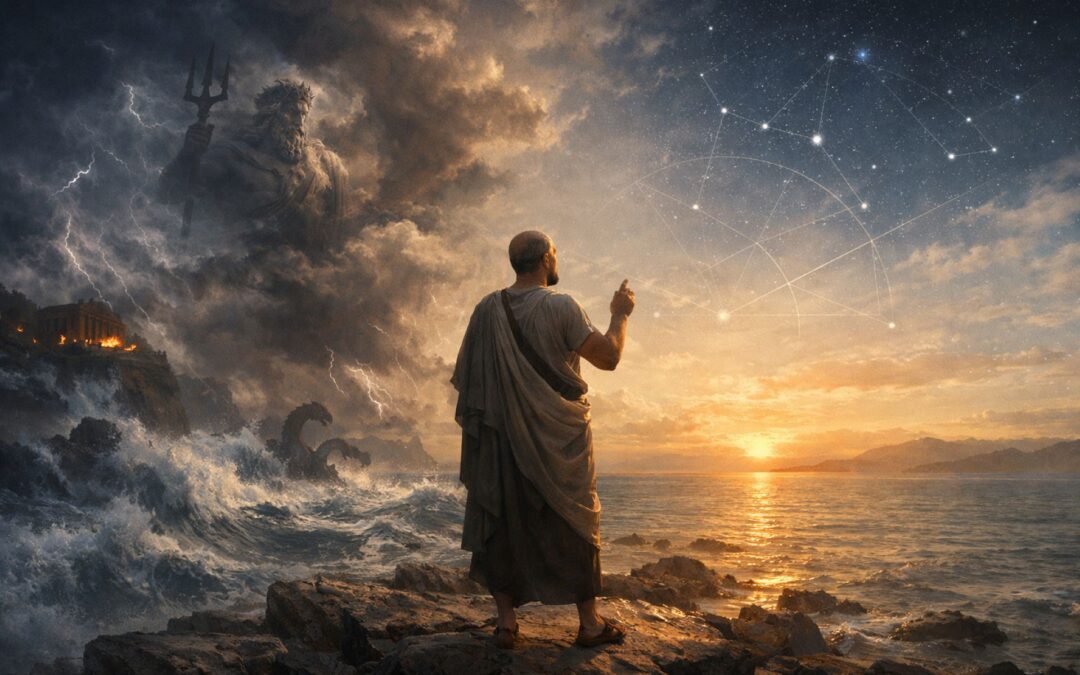
The World Before Reason
Imagine waking up in a world where nothing is merely what it appears to be.
The sun rising over the horizon is not a predictable astronomical event but the deliberate act of a divine being. The ocean is not water governed by tides and gravity, but a vast, living domain ruled by a temperamental god. A storm is not the result of atmospheric pressure and wind currents—it is anger. Punishment. A message.
In such a world, everything speaks. Not in the language of mathematics or physics, but in stories.
The ancient Greeks did not experience reality as a collection of neutral phenomena. They experienced it as a deeply animated cosmos, where every force had intention, personality, and will. The wind could be kind or cruel. The sea could bless or destroy. The earth could nourish or withhold.
And behind it all stood the gods.
Figures like Zeus, Poseidon, and Hades were not distant symbols or metaphors. They were active participants in the world. Your harvest, your health, your safety at sea—these were not matters of chance or natural law, but of divine favor.
To live in this world was to live in constant negotiation with unseen powers.
Temples were not ornamental; they were essential. Rituals were not symbolic; they were practical. Offerings, prayers, and sacrifices were attempts to maintain a fragile balance between human life and divine unpredictability.
From a modern perspective, it is tempting to dismiss such a worldview as naive or irrational. But doing so misses something important.
This was not ignorance. It was interpretation.
Faced with a world that offered no clear explanations, human beings did what they have always done: they made sense of it. They turned uncertainty into narrative. They transformed chaos into something understandable, even if only temporarily.
And in many ways, this mythological worldview worked. It provided answers where none were available. It gave structure to experience, meaning to suffering, and a sense of control in a world that was otherwise overwhelming.
But it also came with a cost.
Because when every phenomenon is explained through stories, there is little room left for questioning the stories themselves.
And yet, at some point, someone did.
Why Humans Needed Stories
To understand why mythology dominated the ancient world, you have to understand something deeper than history.
You have to understand the human mind.
Human beings are not satisfied with simply experiencing the world. We want to explain it. We want to know why things happen, where they come from, and what they mean. A storm is not just a storm—it becomes a question. A death is not just an event—it becomes a mystery.
And unanswered questions are uncomfortable.
There is a particular kind of tension that arises when we don’t understand something. It’s subtle, but persistent. A kind of mental itch. The mind searches for patterns, causes, explanations—anything that can restore a sense of order.
Now imagine living in a time where nearly everything is unexplained.
Lightning splits the sky. The ground shakes beneath your feet. Crops fail without warning. Illness strikes suddenly and without visible cause. The night sky stretches infinitely above you, filled with silent, distant lights.
No science. No established methods of investigation. No accumulated body of verified knowledge to rely on.
Just questions.
In such a world, the need for explanation becomes urgent. Not just intellectually, but emotionally. Without answers, there is only uncertainty—and prolonged uncertainty breeds anxiety.
Stories resolve that anxiety.
They do something that raw reality cannot: they provide closure. A narrative turns an unpredictable event into a meaningful one. It gives the mind something to hold onto. Instead of randomness, there is intention. Instead of chaos, there is structure.
A storm is no longer arbitrary—it is the will of a god. A bad harvest is no longer confusing—it is punishment. A victory in battle is no longer luck—it is favor.
Whether these explanations are true is, in a sense, secondary. What matters is that they feel complete.
Stories also do something else. They connect individuals to a shared framework of understanding. When a society agrees on its myths, it creates a common language for interpreting the world. Rituals, traditions, and moral codes emerge from these shared narratives, reinforcing social cohesion.
In this way, mythology is not just about explaining nature. It is about organizing human life.
And importantly, these stories were not constructed arbitrarily. They were shaped over generations—refined, expanded, and passed down. Each retelling added detail, coherence, and authority. Over time, what began as attempts to explain the unknown evolved into entire systems of belief.
Systems that felt stable. Familiar. Reliable.
Which is precisely why questioning them was so difficult.
To challenge these stories was not just to propose a different explanation of the world. It was to disrupt the very framework through which people understood reality itself.
And yet, that disruption was coming.
The Rise of Greek Mythology as a System
Mythology did not begin as a neatly organized system.
It started as fragments—local stories, scattered beliefs, regional traditions passed down through generations. Different cities had different versions of the same gods. Different communities told different origin stories. There was no single, unified account of how the world worked.
What we now call “Greek mythology” was, at first, a loose collection of narratives.
But over time, something changed.
Two figures played a crucial role in transforming this scattered body of stories into something more coherent: Homer and Hesiod.
Their contribution was not to invent the gods, but to organize them.
Through epic poetry and systematic description, they gave structure to a previously fluid and fragmented mythological landscape. They turned oral traditions into enduring works—texts that could be shared, preserved, and referenced.
Homer’s epics, the Iliad and the Odyssey, did more than tell stories of war and adventure. They presented a world in which gods and humans interacted constantly. The divine was not distant; it intervened, manipulated, favored, and punished. The gods had personalities, rivalries, and agendas.
They were powerful—but not perfect.
Hesiod, on the other hand, approached mythology differently. His work, particularly the Theogony, was less about storytelling and more about explanation. It laid out the genealogy of the gods—their origins, relationships, and hierarchy.
If Homer dramatized the gods, Hesiod systematized them.
Together, they transformed mythology into something more stable. More accessible. More authoritative.
What had once been a collection of regional traditions became a shared cultural framework.
This had profound consequences.
For the average Greek, these works became a kind of reference point for understanding reality. They provided answers to fundamental questions: Where did the gods come from? Who is in charge? Why does the world behave the way it does?
And importantly, they made the universe feel ordered.
But there was a subtle shift embedded in this process.
By organizing mythology, Homer and Hesiod also made it more visible as a system.
And once something becomes a system, it can be examined.
Compared. Questioned.
A scattered set of beliefs is difficult to challenge because it lacks clear structure. But a structured worldview—one with defined characters, relationships, and explanations—can be analyzed.
It can be doubted.
And for a small number of thinkers, that doubt would become the beginning of something entirely new.
Ionia: Where Worlds Collided
If ideas are shaped by environment, then Ionia was almost designed to produce a revolution.
Geographically, it sat at the edge of worlds.
To the west lay mainland Greece. To the east stretched the vast and ancient civilizations of Lydia, Persia, and beyond. Ionia itself was part of Asia Minor—what we now call modern-day Turkey—yet culturally, it was deeply Greek. This made it something unusual: a meeting point, not just of lands, but of perspectives.
And where perspectives meet, certainty begins to weaken.
Ionia was not isolated. Its cities were active participants in trade networks that connected distant regions. Ships came and went, carrying not only goods but also ideas. Merchants, travelers, and settlers brought with them different customs, beliefs, and ways of interpreting the world.
This constant exposure had consequences.
In more isolated societies, beliefs tend to solidify. They go unchallenged because there is nothing to compare them against. But in a place like Ionia, comparison was unavoidable. When you encounter multiple explanations for the same phenomenon, something shifts. The question is no longer what is true, but which explanation makes more sense.
And that question opens the door to inquiry.
Cultural contact also brings a kind of intellectual friction. The Greeks may have seen themselves as superior—more rational, more refined—but they were not immune to influence. They encountered advanced knowledge from other civilizations: mathematics from Egypt, astronomy from Babylon, administrative systems from the Near East.
Even if filtered through bias or misunderstanding, these encounters expanded the horizon of what was thinkable.
Ionia became a place where the familiar was constantly interrupted by the unfamiliar.
And that matters.
Because questioning does not arise in a vacuum. It arises when what you take for granted is placed alongside something different—something that doesn’t quite fit.
Over time, this creates a subtle instability in established beliefs.
The stories are still there. The gods are still worshipped. The rituals continue. But beneath the surface, something begins to shift. A small distance emerges between belief and certainty.
And in that distance, thought begins to move.
Ionia did not reject mythology overnight. But it created the conditions where mythology was no longer the only way to understand the world.
And that was enough.
Miletus: The City Where It Began
Within Ionia, one city stands out.
Miletus was not just another settlement along the Aegean coast. It was a thriving polis—busy, connected, and alive with movement. Ships crowded its harbors. Traders negotiated goods from distant lands. Foreigners walked its streets, bringing unfamiliar languages, customs, and ideas.
It was, in many ways, a city of exchange.
And not just economic exchange.
Walk through Miletus in the seventh century BC, and you would encounter two worlds existing side by side.
On one hand, the familiar rhythms of traditional Greek life. Temples dedicated to the gods. Offerings made in hope of favor. Prayers whispered into the air, asking for protection, prosperity, or relief from misfortune. The divine presence was everywhere—woven into daily routines, decisions, and fears.
The gods were not abstract. They were immediate.
On the other hand, something less visible but equally important: a growing undercurrent of curiosity. Exposure to different cultures had made the city more intellectually flexible than most. Ideas were not as tightly sealed. Assumptions were not as invisible.
Miletus was not just a place where people lived.
It was a place where ideas circulated.
Its position as a trading hub meant that its inhabitants were constantly negotiating—not only prices and goods, but perspectives. When you deal regularly with people who see the world differently, you are forced, even if subtly, to reconsider your own.
This does not immediately lead to rejection of tradition.
But it does create space.
Space to observe. To compare. To wonder whether the familiar explanations are the only possible ones.
In such an environment, belief becomes slightly less rigid. Not because it collapses, but because it is no longer alone.
And that subtle shift is enough to change everything.
It is no coincidence that the first known attempts to explain the world without relying on myth emerged here. Miletus provided something rare for its time: a combination of cultural exposure, economic activity, and relative openness.
A place where thinking differently was possible.
And among its inhabitants were a few individuals willing to take that possibility seriously.
The First Break from Myth
For most people in Miletus, the world still made sense in the old way.
The gods governed the seas. They controlled the harvest. They sent storms, illness, and fortune alike. These explanations were not only accepted—they were trusted. They had been passed down for generations, reinforced through ritual, tradition, and shared belief.
To question them was not just unusual.
It was unsettling.
Because myth was not merely a theory about the world. It was the world. It shaped how people understood cause and effect, reward and punishment, even life and death itself. Remove the gods, and you did not just lose an explanation—you lost a framework.
And yet, a few individuals began to take that risk.
They looked at the same world as everyone else—the same oceans, the same skies, the same shifting patterns of nature—but they saw something different. Or rather, they began to ask a different kind of question.
Not who is causing this?
But what is causing this?
It is difficult to overstate how radical this shift was.
Instead of attributing events to the will of human-like gods, these thinkers started to search for underlying principles. They wondered whether the world might operate according to patterns that did not depend on divine moods or intentions.
That perhaps, behind the apparent chaos, there was order.
Not a personal order, dictated by gods who could be pleased or angered—but an impersonal one. A structure built into reality itself.
This required a new kind of courage.
Because abandoning myth meant stepping into uncertainty. Unlike stories, which provide immediate and emotionally satisfying answers, this new approach offered no guarantees. It demanded observation, reflection, and a willingness to accept that some answers might be incomplete—or even wrong.
It also required a certain detachment.
If the world is governed by gods, then human behavior matters in a very specific way: you must appease them. But if the world operates through natural principles, then understanding replaces appeasement. Knowledge becomes more important than ritual.
This was a profound reorientation.
It did not happen all at once, and it was not universally accepted. Many people continued to live within the mythological framework. The temples did not disappear. The rituals did not stop.
But something new had entered the scene.
A different way of thinking about reality. One that did not rely on inherited stories, but sought its answers in the world itself.
And once that shift begins, it is very difficult to reverse.
Because the moment you realize that explanations can be questioned, you can no longer return to unquestioned belief in the same way.
This was the first break.
Quiet. Unofficial. But irreversible.
From Mythos to Logos
What began as a quiet doubt in places like Miletus gradually turned into something far more significant.
A shift not just in what people believed—but in how they thought.
The Greeks themselves would later describe this transformation using two terms: mythos and logos. These are not just words, but two fundamentally different ways of approaching reality.
Mythos is the language of stories. It explains the world through narrative, intention, and personality. Events happen because someone—usually a god—wills them to happen. The world, in this sense, is alive with purpose, but that purpose is not always consistent or predictable.
Logos, on the other hand, moves in a different direction.
It seeks explanation not through narrative, but through reason.
Instead of asking which god is responsible, it asks what principle is at work. Instead of relying on tradition, it turns to observation. Instead of accepting inherited stories, it begins to question them.
This does not mean that the early thinkers suddenly had access to modern science. Far from it. Their tools were limited, their methods still developing, and many of their conclusions would later prove incorrect.
But that is not the point.
The point is that they were trying to understand the world in a fundamentally new way.
They were looking for patterns.
They noticed that certain things seemed to follow regularities: the changing of seasons, the movement of celestial bodies, the behavior of natural elements. These were not random. They suggested some form of underlying order—something that could be studied, rather than worshipped.
This was the beginning of rational inquiry.
And with it came a subtle but powerful implication: if the world operates according to principles, then it can be understood.
Not completely. Not immediately. But progressively.
Knowledge becomes something that can grow.
This idea stands in contrast to myth, where explanations are often fixed. In a mythological framework, the story is given. It may be interpreted differently, but its structure remains largely the same.
In a logos-based approach, explanations are not final. They can be refined, challenged, replaced.
Truth becomes something to pursue, not something already inherited.
This shift also changes the role of the individual.
In a myth-driven world, understanding is largely communal. You inherit the stories of your culture. You participate in rituals. You accept the framework that has been passed down.
In a logos-driven world, the individual thinker gains importance.
Observation, reasoning, and questioning become personal responsibilities. Understanding is no longer just something you receive—it is something you actively seek.
And this is where philosophy begins.
Not as a set of doctrines, but as a method.
A way of engaging with reality that refuses to settle for easy answers. A way of thinking that values coherence, consistency, and evidence over tradition and authority.
The Presocratics did not fully develop this method.
But they started it.
And once started, it would continue to evolve—shaping not only philosophy, but science, politics, and the entire intellectual trajectory of the Western world.
The First Philosophers of Miletus
The shift from myth to reason did not happen in abstraction.
It began with individuals.
In Miletus, a small group of thinkers took the first concrete steps toward explaining the world without relying on divine narratives. They are often considered the first philosophers—not because they had all the answers, but because they asked the right kind of questions.
The earliest among them was Thales.
Thales proposed something deceptively simple: everything comes from water.
At first glance, this might sound no less strange than mythology. But the difference lies in the nature of the claim. Thales was not telling a story about a god of water creating the world. He was suggesting that beneath the diversity of things we observe, there is a single underlying substance.
A principle.
Water, in his view, was not just one thing among many—it was the fundamental building block of reality. Everything else, in some way, emerged from it.
Whether he was right is almost beside the point.
What matters is that he was trying to reduce complexity to something more basic, something that could be understood without invoking divine intention.
After Thales came Anaximander, who pushed the idea further.
He argued that the fundamental principle of the universe could not be any known substance like water. Instead, it had to be something more abstract—what he called the apeiron, often translated as the “boundless” or the “infinite.”
This was a bold move.
Anaximander was no longer pointing to something visible or tangible. He was proposing that the origin of everything lies in something beyond direct experience—an indefinite, limitless source from which all things emerge and to which they return.
In doing so, he took a step away from concrete observation toward conceptual thinking.
Then came Anaximenes, who brought the discussion back to something more familiar.
He proposed that the fundamental substance was air.
But again, the significance lies not in the specific answer, but in the approach. Anaximenes tried to explain how different forms of matter could arise from a single substance through processes like condensation and rarefaction. Air, when condensed, becomes wind, then clouds, then water, then earth. When rarefied, it becomes fire.
For the first time, we see an attempt to explain change through natural processes.
No gods required.
These thinkers did not agree with one another. In fact, their theories often contradicted each other. But that disagreement is precisely what makes them philosophers.
They were not preserving a fixed story. They were exploring possibilities.
Each of them was trying to answer the same fundamental question: What is the world made of, really?
And in doing so, they established something entirely new—a tradition of inquiry where ideas could be proposed, debated, and revised.
A tradition where explanation was no longer sacred, but provisional.
Where the goal was not to maintain belief, but to pursue understanding.
It began here, in Miletus, with a handful of thinkers willing to see the world not as a story—but as a problem to be solved.
Beyond Miletus: Expanding the Revolution
What began in Miletus did not stay there.
The impulse to explain the world through reason—once introduced—started to spread. Other thinkers, in other places, took up the same questions and pushed them in new directions. They did not form a unified school, nor did they agree with one another. But they shared something essential: a refusal to rely on myth as the final word.
Among them was Pythagoras, who introduced a radically different perspective.
For Pythagoras, the foundation of reality was not a physical substance like water or air, but number. He and his followers believed that the structure of the universe could be understood through mathematical relationships. Harmony, proportion, and order—these were not just abstract ideas, but the very fabric of existence.
This marked another shift.
The search for a fundamental principle moved from the material to the abstract.
Then there was Heraclitus, who took a different path altogether.
He looked at the world and saw not stability, but constant change. Everything flows, he argued. Nothing remains the same. You cannot step into the same river twice, because both you and the river are always in motion.
For Heraclitus, the underlying principle of reality was not a substance, but a process.
Change itself.
In contrast, Parmenides rejected the very idea of change.
According to him, change is an illusion. Reality, at its deepest level, is unchanging, eternal, and indivisible. What we perceive through our senses—movement, transformation, plurality—is misleading. True understanding must come from reason alone, not from observation.
This was a striking development.
Philosophy had now reached a point where reason could directly contradict experience.
Then came Empedocles, who attempted to reconcile these opposing views.
He proposed that everything is made up of four basic elements: earth, water, air, and fire. These elements are eternal and unchanging, but they combine and separate in different ways, giving rise to the changing world we perceive.
In this way, he preserved both permanence and change.
Each of these thinkers approached the same problem from a different angle. What is the nature of reality? What lies beneath appearances? How do we explain the world without falling back on myth?
Their answers varied—sometimes wildly.
But that variation is precisely the point.
Philosophy was no longer a single path. It had become a field of exploration.
Ideas could compete. They could evolve. They could be challenged and replaced. There was no longer a single, authoritative narrative that everyone had to accept.
Instead, there was a growing tradition of inquiry—one that valued reasoning over storytelling, and understanding over tradition.
The revolution that began in Miletus had expanded.
And it was only just getting started.
Why They Are Called the Presocratics
At some point, historians and philosophers needed a way to organize this early wave of thinkers.
They were clearly doing something new—something foundational—but they were also quite different from the philosophers who came later. Their questions, methods, and focus did not fully resemble what philosophy would eventually become.
So a distinction was made.
They were called the Presocratics.
The name itself is simple. It refers to those who came before Socrates.
But the label is not just chronological. It reflects a deeper shift in the nature of philosophical inquiry.
The Presocratics were primarily concerned with the structure of reality. They asked questions about the origin of the universe, the nature of matter, and the underlying principles that govern existence. Their focus was outward—toward the cosmos.
Socrates, by contrast, turned philosophy inward.
Instead of asking what the world is made of, he asked how we should live. What is justice? What is virtue? What does it mean to know something? His method—dialogue, questioning, and critical examination—shifted the center of philosophy from the external world to human life and ethics.
This was not a rejection of the Presocratics, but a transformation of their legacy.
Socrates built on the idea that beliefs should be questioned, that assumptions should be examined, and that understanding requires effort. But he applied this approach to a different domain.
Human behavior. Knowledge. Morality.
Because of this shift, later thinkers began to see Socrates as a kind of dividing line. A figure who marks the transition from one phase of philosophy to another.
Before him: thinkers trying to understand the nature of the universe.
After him: thinkers increasingly concerned with the nature of thought, knowledge, and human existence.
Of course, this distinction is not perfectly clean.
Some Presocratics, like Heraclitus, made observations about human behavior. And later philosophers, like Aristotle, continued to study nature in detail.
But as a broad framework, the division holds.
The Presocratics represent the earliest phase of philosophical inquiry—a time when the most pressing question was not how to live, but what the world is.
And perhaps more importantly, how to understand it without relying on myth.
The name “Presocratic” may be retrospective, but it captures something essential.
These thinkers came before a turning point.
And without them, that turning point may never have come.
The Legacy: Foundations of Western Thought
It is easy to look at the Presocratics and focus on what they got wrong.
Water is not the fundamental substance of reality. The universe is not composed of four elements. Change is neither absolute nor an illusion in the ways some of them imagined. By modern standards, many of their theories appear speculative, even naive.
But judging them this way misses the point entirely.
Their importance lies not in their conclusions, but in their approach.
For the first time in recorded history, a group of thinkers attempted to explain the world without relying on mythological narratives. They searched for underlying principles, proposed theories, argued with one another, and treated explanation as something that could be improved.
They turned understanding into a process.
This shift laid the groundwork for everything that followed.
Thinkers like Plato and Aristotle did not emerge in isolation. They inherited a world in which questioning was already possible. A world where ideas could be examined rather than simply accepted.
Plato expanded philosophical inquiry into areas like metaphysics, ethics, and epistemology, while Aristotle systematized knowledge across disciplines—from logic and biology to politics and physics. But both of them relied, in different ways, on the foundation laid by those earlier thinkers.
A foundation built on the belief that the world can be understood.
This belief would continue to evolve, eventually giving rise to science as we know it. The methods would become more refined. The tools more precise. The knowledge more accurate.
But the underlying impulse remained the same.
To look at the world not as a story, but as something that can be investigated.
The Presocratics also introduced something equally important: intellectual disagreement.
They did not speak with one voice. They contradicted each other, challenged assumptions, and proposed competing explanations. This created a dynamic environment where ideas were not fixed, but constantly in motion.
In this sense, they did more than start philosophy.
They started a tradition.
A tradition where no idea is beyond question. Where understanding is never final. Where the pursuit of truth is more important than the comfort of certainty.
That tradition continues today.
Every time we ask why something happens instead of accepting that it simply does, we are, in a small way, continuing the work they began.
The Presocratics may be distant in time, but their influence is immediate.
Because the way we think—the very act of questioning, reasoning, and seeking explanation—still carries their imprint.
Conclusion
The story of the Presocratics is not just about a group of early thinkers in ancient Greece.
It is about a moment when something fundamental shifted in the human mind.
For countless generations, people looked at the world through stories. And those stories were not foolish—they were necessary. They gave meaning to uncertainty, structure to experience, and a sense of control in a world that offered none.
But at some point, a different impulse emerged.
An unwillingness to settle for inherited explanations. A curiosity that pushed beyond narrative. A desire to understand not just what happens, but why it happens.
The Presocratics gave form to that impulse.
They did not have the tools we have today. They did not have centuries of accumulated knowledge to rely on. And yet, they chose to question what others accepted. They chose to look at the world not as a story to be preserved, but as a mystery to be explored.
That choice changed everything.
It marked the beginning of a way of thinking that would eventually reshape entire civilizations. Philosophy, science, and rational inquiry all trace their roots back to this moment—when explanation became something to pursue, rather than something to inherit.
And perhaps that is why the Presocratics still matter.
Not because their answers were correct, but because they showed that answers can be questioned.
They remind us that understanding is not a destination, but a process. That certainty is often the end of thought, while curiosity is its beginning.
In that sense, the journey they started is still ongoing.
And every time we pause to question what seems obvious, we step—however briefly—into their world.