
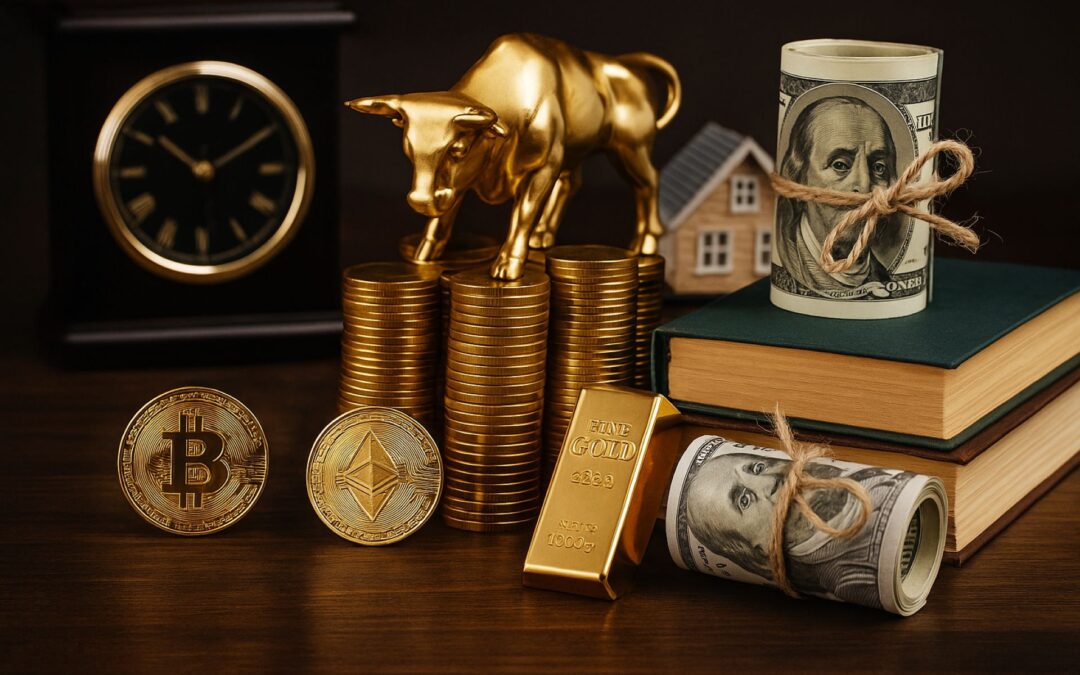
There’s a difference between having money and truly being wealthy. Money, in its raw form, is fragile—it can be frozen in an instant, wiped out by market crashes, or rendered worthless by inflation. That’s why most fortunes don’t survive more than three generations. But some families—think the Rockefellers, the Rothschilds—defy this cycle. Their wealth doesn’t just endure; it grows stronger with each passing decade.
Their secret? They don’t rely on luck or fleeting trends. They concentrate their capital in assets that retain value through wars, recessions, and the slow grind of time. These are stores of value so resilient they can be handed down like heirlooms, compounding across centuries. Here’s a look at the seven assets the ultra-wealthy use to preserve their fortunes forever—and the strategies behind them.
Real Estate: Tangible, Scarce, and Ever-Appreciating
For the truly wealthy, real estate is not simply “an investment.” It’s a strategic cornerstone of generational wealth—an asset that has both utility and prestige, and one that sits at the intersection of scarcity and necessity. While most people think of real estate as their home, the affluent see it as a living portfolio of land, structures, and rights that can be leveraged, developed, or simply held to outlast currencies, governments, and market fads.
Bill Gates’ accumulation of over 270,000 acres of farmland across 19 states is a masterclass in long-term positioning. Farmland isn’t glamorous—there’s no glass skyline or marble lobby—but it produces something far more valuable than aesthetics: food. In an era where population growth, supply chain fragility, and climate change dominate headlines, control over arable land is akin to holding a winning card in a high-stakes game that never ends.
Why Real Estate Works as a Store of Value
- It is tangible – Unlike paper assets or digits on a bank server, real estate exists in the physical world. It can be walked upon, built upon, cultivated, or even enjoyed as a residence. No cyberattack can erase it, and no financial scandal can make it vanish overnight.
- It generates income – A skyscraper can produce decades of rental payments from corporations. A farm yields harvest after harvest. Even a vacant lot can be leased for interim use. Income streams vary by property type, but they form a steady backbone of cash flow.
- It rides the wave of inflation – When goods and services become more expensive, so does land and property. Your purchasing power may erode in cash, but in prime real estate, it often strengthens.
- It is inherently scarce – No human can create more beachfront in Malibu or more parcels inside London’s Mayfair. This scarcity acts as a natural moat against value erosion.
The Wealthy’s Diversified Real Estate Playbook
Ultra-wealthy families rarely bet on a single form of real estate. Instead, they assemble a multi-tiered portfolio:
- Commercial Real Estate – Office towers, shopping centers, logistics hubs. These assets deliver consistent lease income and can be sold at substantial premiums when positioned in high-demand zones.
- Prime Residential – Apartments in global capitals like New York, Paris, or Hong Kong; villas on the Amalfi Coast; estates in Aspen. These properties appreciate not only due to scarcity but also because they’re desirable to a global elite willing to pay for location, exclusivity, and security.
- Agricultural & Timberland – Slow, steady returns with the added advantage of producing essential commodities. Timberland in particular can be harvested cyclically without depleting the underlying asset.
- Heritage & Trophy Properties – Historic castles, architectural landmarks, penthouses with panoramic views. These carry cultural capital in addition to monetary value, often attracting wealthy buyers willing to pay beyond the calculated market worth.
The Strategic Layers Behind Ownership
The wealthy don’t just “buy and hold” blindly. They structure ownership through trusts, corporations, or family offices to shield assets from taxes, creditors, and political instability. They reinvest income streams into upgrades that elevate property value, or into additional acquisitions that strengthen their geographic and sectoral spread.
Real estate also allows for leveraging without selling—borrowing against appreciated assets at low interest rates to fund new ventures, without triggering capital gains taxes. This keeps the wealth machine compounding.
And in turbulent times—currency crises, hyperinflation, bank runs—real estate often acts as the last, immovable bulwark of wealth. While stock markets may crumble and fiat currencies devalue overnight, a well-situated apartment block in a thriving city will still be there tomorrow, earning rent and holding value.
If you’d like, I can next take the stocks section and expand it to the same level of intricate detail so the article maintains consistent depth across all parts. Would you like me to proceed with that?
Stocks: Ownership in Businesses That Outlive Crises
Stocks are not just ticker symbols flashing across a screen—they’re fractional ownership in living, breathing enterprises that produce goods, deliver services, and generate profits. For the wealthy, stocks are less about speculation and more about permanent participation in the economic engines of the world.
A share of Coca-Cola isn’t just a piece of paper—it’s a legal claim on a century-old brand that sells 1.9 billion drinks every single day. A stake in Apple means you own a slice of a company that has over 2 billion active devices in circulation. These companies operate at a scale and brand dominance that make them not just resilient, but indispensable to modern life.
Why Stocks Endure as a Store of Value
- They represent productive assets – You’re not buying potential, you’re buying a piece of something already producing cash flow, already employing people, already serving global demand.
- They harness compounding – Dividends, when reinvested, buy more shares, which then generate more dividends. Over years and decades, this snowballs into enormous growth without the investor having to lift a finger.
- They are liquid – Unlike real estate, which can take months to sell, high-quality stocks can be converted to cash in seconds if liquidity is needed.
- They have built-in adaptability – Well-run companies pivot, innovate, and expand into new markets to remain relevant through changing times.
How the Wealthy Choose Their Stocks
The ultra-rich rarely chase the “next big thing.” Instead, they focus on durability and necessity. Warren Buffett’s enduring positions in Coca-Cola, American Express, and Apple illustrate this discipline. These aren’t cyclical or fad-driven businesses—they’re companies woven into the daily fabric of global commerce and consumer life.
The criteria often include:
- Market leadership – The company dominates its sector and has high barriers to entry.
- Global footprint – The brand and distribution channels reach beyond a single market or economy.
- Pricing power – They can raise prices without losing customers, protecting margins against inflation.
- Strong balance sheets – Low debt, high cash reserves, and the ability to weather recessions.
- Consistent dividend history – A track record of rewarding shareholders even in turbulent times.
The “Forever” Mindset
The wealthy buy businesses they would be comfortable holding for decades—regardless of short-term market noise. They’re not concerned if prices drop 10% this quarter; if the underlying company continues to grow earnings and serve an essential function in society, the long-term trajectory remains intact.
This approach is why many of the richest investors measure holding periods not in months or years, but in generations. Family trusts may hold the same stock positions for 50+ years, letting compounded growth do the heavy lifting.
Diversification Within Stocks
Even when focusing on blue chips, the wealthy diversify across sectors to shield themselves from isolated downturns:
- Consumer staples – Food, beverages, household goods that remain in demand regardless of economic cycles.
- Healthcare – Pharmaceutical companies, medical device makers, and hospital operators that serve an aging and growing population.
- Technology – Not just flashy startups, but established tech firms that provide infrastructure, software, or platforms the world relies on.
- Financials – Banks, insurers, and payment processors that underpin the global monetary system.
- Energy and utilities – Firms producing power, fuel, and essential services.
Stocks as an Intergenerational Asset
Stocks have an advantage over many asset classes—they can be easily transferred, split, and managed within family estates. Dividends provide cash flow to heirs without liquidating the underlying holding, while appreciation builds the family’s net worth over time.
In essence, owning the right stocks allows the wealthy to not just ride the wave of economic growth, but to own a piece of the ocean itself.
Education: The Asset That Can’t Be Seized
Buildings can crumble, markets can implode, currencies can become worthless overnight—but the one form of wealth immune to theft, inflation, or confiscation is knowledge. Education is the only store of value that resides entirely within you, compounding silently over time, and often yielding returns greater than any material asset.
For the wealthy, education is not a phase of life—it’s a permanent strategy. It’s not bound by diplomas or classrooms; it’s a lifelong commitment to upgrading one’s decision-making toolkit. When fortunes are lost—and history is full of examples—the individuals who can rebuild from the ground up are invariably those with the mental frameworks, practical skills, and adaptive thinking that education provides.
Why Education is the Most Resilient Asset
- It’s portable – You carry it with you anywhere in the world, unaffected by borders or customs.
- It’s inflation-proof – The value of your skills and insights doesn’t erode because of monetary policy.
- It’s non-transferable – No one can take it from you, sell it, or inherit it without effort; it must be earned.
- It multiplies returns across other assets – The better your knowledge, the better your real estate purchases, stock selections, business ventures, and legal protections.
The Wealthy Approach to Learning
The affluent understand that traditional schooling often fails to deliver financial literacy, negotiation skills, entrepreneurial instincts, and wealth-preservation strategies. While formal education may provide foundational knowledge, it is specialized, targeted learning that transforms fortunes into empires.
They invest in:
- Private mentorships – Learning directly from seasoned entrepreneurs, investors, and thought leaders.
- Elite seminars and mastermind groups – Access to high-level networks where information and opportunities circulate before they reach the public.
- Specialized courses and certifications – Tax law, estate planning, blockchain technology, or global macroeconomics.
- Experiential learning – Travel, cultural immersion, and industry observation to understand global markets and consumer behavior firsthand.
Education as a Wealth Multiplier
A wealthy investor who understands compound interest, risk management, and global trade flows can protect and grow capital in ways that the uninformed simply can’t. A business owner who studies organizational psychology can build teams that outperform competitors for decades. A family patriarch or matriarch with a grasp of succession planning can pass down wealth intact rather than watching it dissipate within a generation.
The educated wealthy also recognize the value of adaptability. Economic landscapes shift—industries emerge and vanish, regulations change, technologies disrupt. The ability to learn, unlearn, and relearn quickly ensures survival when static knowledge becomes obsolete.
Intergenerational Transfer of Knowledge
Perhaps most critically, education doesn’t stop with the individual—it’s passed down. The Rockefellers, for example, didn’t just hand their children money; they taught them how to manage, preserve, and ethically use that money. Family meetings, private tutors, and legacy documents ensure that knowledge—like capital—compounds across generations.
Where many families lose fortunes within three generations, those who treat education as a core inheritance defy that statistic. The heirs inherit not just the keys to the vault, but the understanding of how to keep it full.
Precious Metals: Wealth Insurance for Unstable Times
Gold and silver are the oldest form of financial security known to humankind. Long before stock markets existed, before paper currency became common, before central banks dictated interest rates, precious metals served as the foundation of trade, trust, and value. Their significance is not nostalgic—it’s structural. They have endured because their worth is independent of political regimes, corporate performance, or the whims of central banks.
For the wealthy, precious metals aren’t about flashy displays of opulence; they are silent guardians of capital. These metals sit quietly in vaults, rarely traded, often untouched for years—sometimes decades—until the moment they are needed.
Why Precious Metals Are a Core Store of Value
- Finite Supply – Gold and silver cannot be printed or artificially multiplied. They must be mined, refined, and processed—each step involving significant cost, labor, and time. Scarcity is built into their nature.
- Universal Acceptance – Whether in Dubai, New York, Zurich, or rural India, gold is recognized as valuable. A bar of gold has the same market worth across continents, making it a truly borderless asset.
- Political Immunity – While currencies can be devalued by policy changes, and stocks can be crippled by regulations, precious metals remain unaffected by domestic politics. Their value is set by global supply and demand, not by a single government’s agenda.
- Crisis-Proof – During wars, hyperinflation, or banking collapses, gold and silver often gain in value as other assets fall. They become the safe harbor for capital in turbulent seas.
The Wealthy Approach to Precious Metals
Unlike retail investors who might buy gold jewelry and hope it appreciates, the ultra-wealthy acquire metals strategically:
- Bullion Bars and Coins – High-purity gold or silver stored in private vaults or with trusted custodians.
- Allocated Storage – Ensuring metals are held in the investor’s name, fully segregated, and not pooled with others’ assets.
- Geographic Diversification – Storing metals in multiple jurisdictions (e.g., Switzerland, Singapore, Canada) to mitigate geopolitical risk.
- Gradual Accumulation – Buying consistently over time to avoid being caught at unfavorable price points.
Some also use precious metal ETFs or mining company shares to gain indirect exposure, though these come with counterparty risks that physical ownership avoids.
Gold as the “Wealth Anchor”
For centuries, gold has acted as the monetary anchor of nations and empires. Even in today’s fiat currency world, central banks hold thousands of tons of gold in their reserves—not for decoration, but as a hedge against their own paper currency systems. This practice sends a clear signal: if the most powerful monetary institutions in the world see the need to store gold, so should those intent on preserving their fortunes.
Silver: The Underestimated Counterpart
Silver is often overshadowed by gold, but it carries its own advantages. It’s more affordable, making it easier to accumulate in smaller increments. It also has significant industrial demand in electronics, solar panels, and medical applications, which can create upward pressure on prices during economic expansions. The wealthy often maintain a mix of both metals, using silver for greater liquidity and gold for concentrated value storage.
Precious Metals in the Portfolio Context
Gold and silver aren’t meant to replace growth assets like equities or real estate. Instead, they act as portfolio insurance—a hedge against systemic risks. When inflation spikes, currencies falter, or confidence in the financial system erodes, precious metals historically rise in value, offsetting losses elsewhere.
The wealthy understand that metals are not designed to make them richer quickly. Their role is subtler but no less important: to ensure that no matter what happens in the global economy, a portion of wealth remains intact and transferable.
Government Bonds: The Financial Bunkers
When chaos hits—whether it’s war, recession, political upheaval, or a sudden market collapse—the wealthy don’t always double down on high-growth assets. They retreat into safety mode, and few assets are as synonymous with safety as government bonds. To the uninitiated, bonds may seem dull or uninspiring, but to those safeguarding billions, they are the fortified vaults of the financial world.
A government bond is essentially a formal agreement: you lend money to a government, and in return, you receive fixed interest payments over a set period. At maturity, you get your principal back. For ultra-high-net-worth individuals, this isn’t about spectacular returns—it’s about preserving purchasing power while earning steady, predictable income, especially when other investments are volatile.
Why Bonds Are Considered “Financial Bunkers”
- Government Backing – Bonds are supported by the full taxing power of a sovereign nation. This makes defaults rare—particularly for countries with strong economies.
- Predictable Cash Flow – Interest payments are fixed, offering stability in an otherwise unpredictable world.
- Capital Preservation – Bonds are designed to return your original investment at maturity, making them fundamentally safer than equities.
- Crisis Inversion – In times of stock market panic, bond values often rise as investors flee to safety, cushioning overall portfolio losses.
Historical Proof of Safety
During World War II, much of Europe was in flames. Stock markets crashed, currencies collapsed, and property was destroyed in bombing raids. Yet, Swiss government bonds became one of the safest places to park money. Switzerland’s neutrality, combined with its stable banking system, turned its bonds into financial lifeboats for investors fleeing chaos.
This isn’t an isolated example. U.S. Treasury bonds became the global “go-to” during the 2008 financial crisis, attracting trillions in flight-to-safety capital. Even in 2020’s pandemic-induced economic shock, bond yields fell (meaning prices rose), proving their defensive role yet again.
How the Wealthy Use Bonds Strategically
- Diversification Buffer – Bonds act as a counterweight to riskier assets like stocks and real estate. When those markets drop, bonds often stabilize overall portfolio performance.
- Currency Hedge – Wealthy investors may buy bonds from multiple countries—U.S., Germany, Japan, Switzerland—to spread geopolitical and currency risk.
- Laddering Maturities – They stagger bond purchases so that some mature each year, providing steady liquidity without locking all capital away at once.
- Tax Efficiency – In some jurisdictions, interest on certain government bonds is tax-exempt, adding another layer of appeal.
The Safest Among the Safe
- U.S. Treasuries – Backed by the largest economy and most liquid bond market in the world, they’re often considered “risk-free” in global finance.
- German Bunds – Favored in Europe for their stability and the strength of Germany’s export-driven economy.
- Japanese Government Bonds (JGBs) – Used by global investors as a defensive anchor due to Japan’s economic resilience.
- Swiss Government Bonds – Renowned for rock-solid stability, bolstered by Switzerland’s neutrality and banking tradition.
Bonds as a Long-Term Wealth Tool
The wealthy don’t view bonds as wealth-builders; they view them as wealth defenders. By anchoring a portion of their net worth in ultra-safe government debt, they buy themselves breathing room. This stability allows them to take calculated risks elsewhere—whether in equities, real estate, or alternative assets—without jeopardizing their entire fortune.
In essence, bonds are the storm shelters of the financial world: you may not live in them forever, but when the winds pick up, you’ll be glad you have one.
Fine Art and Collectibles: Scarcity Turned into Status and Profit
For the ultra-wealthy, certain assets exist at the intersection of beauty, history, and financial strategy. Fine art and collectibles aren’t merely indulgences; they are status-laden vaults of value. The right painting, watch, or vintage car can serve as both a cultural statement and a financial instrument—appreciating steadily while offering portability and prestige.
When billionaire hedge fund manager Steve Cohen hangs a multi-million-dollar Picasso or a Basquiat in his living room, it’s not just decoration. It’s ownership of a one-of-one asset that will never be replicated. That rarity, combined with global demand among an elite class of collectors, ensures that such pieces hold or even grow in value across decades.
Why Art and Collectibles Retain Value
- Finite Supply – You can print more currency or issue more stock, but you cannot paint another original Monet or mint another 1962 Ferrari 250 GTO.
- Global Desirability – High-net-worth individuals across continents compete for the same masterpieces, driving demand in perpetuity.
- Detachment from Traditional Markets – Art prices don’t move in lockstep with equities or bonds, offering portfolio diversification.
- Tangible and Portable – Unlike real estate, a painting or rare watch can be moved, stored, or sold across borders with relative ease.
The Wealthy’s Approach to Collecting
The affluent rarely “buy on emotion” alone; they work with specialist advisors, art historians, and auction house experts to ensure authenticity, provenance, and investment potential. They:
- Track global auction results at houses like Sotheby’s and Christie’s.
- Target artists with proven markets, museum presence, and historical significance.
- Acquire at strategic moments—such as during economic downturns when discretionary spending falls and bargains emerge.
- Store works in climate-controlled, tax-advantaged freeports (e.g., Geneva, Singapore) until the timing is right to sell.
Beyond Paintings: The Expanding World of Collectibles
While fine art dominates headlines, the wealthy also diversify into:
- Luxury Watches – Limited-edition Patek Philippe or Rolex models can multiply in value as waiting lists grow and supply remains fixed.
- Vintage Automobiles – Iconic models like the Ferrari 250 GTO or Mercedes 300SL “Gullwing” often appreciate faster than stocks, with some selling for tens of millions at auction.
- Jewelry – Rare gemstones, signed pieces from Cartier or Van Cleef & Arpels, and historically significant jewels.
- Fine Wine & Whiskey – Rare vintages and limited distillery releases stored under optimal conditions.
- Pop Culture Rarities – First-edition comic books, rare Pokémon cards, and vintage sneakers have emerged as modern alternative assets.
The Role of Story and Provenance
In the collectibles market, narrative is capital. A painting with a royal ownership history, a watch worn on a notable expedition, or a car that won a famous race carries a premium far above intrinsic value. The story elevates the desirability, and desirability drives price.
Risk Management in Collectibles
The wealthy mitigate risks by:
- Diversifying across categories and artists.
- Securing proper insurance and specialized storage.
- Using trusted intermediaries for private sales to maintain confidentiality.
- Avoiding speculative hype in favor of historically proven value trajectories.
For the ultra-rich, fine art and collectibles are more than aesthetic pleasures—they are silent negotiators of wealth, operating outside the volatility of traditional finance while enhancing personal and family prestige.
Cryptocurrency: The Digital Store of Value
Cryptocurrency represents a seismic shift in how wealth can be stored, moved, and secured. For the wealthy, it’s not simply a gamble on technology—it’s a hedge against a financial system they know is far from invincible. The attraction isn’t just the potential for high returns; it’s the combination of scarcity, portability, and independence from traditional gatekeepers.
Bitcoin, the most recognized of them all, operates on a simple yet radical premise: there will only ever be 21 million coins. No central bank, government, or corporation can alter that cap. In a world where trillions of dollars can be conjured with a keystroke, a hard limit like this is rare—and valuable.
Why Cryptocurrency Appeals to the Wealthy
- Provable Scarcity – The supply is fixed by code, immune to inflationary dilution.
- Decentralization – No single entity controls the network, reducing vulnerability to political or institutional failure.
- Portability – Unlike gold, which requires physical transport, millions in crypto can be moved globally in minutes on a small hardware wallet.
- Seizure Resistance – Properly stored in self-custody wallets, crypto can’t be frozen or confiscated without access to the private keys.
How the Wealthy Approach Crypto Ownership
Ultra-high-net-worth individuals don’t “go all in” on speculative altcoins; they allocate a measured slice of their portfolios—often 1–5%—to digital assets. Their strategies include:
- Bitcoin as the Core Holding – Viewed as “digital gold” for long-term preservation.
- Ethereum and Select Altcoins – Exposure to blockchain platforms with strong developer activity and real-world applications.
- Cold Storage Custody – Using hardware wallets or multi-signature arrangements to reduce hacking risk.
- Geographic Redundancy – Splitting access credentials across multiple secure locations.
Institutional and National Adoption
Crypto’s credibility has grown as institutions and even countries embrace it. Hedge funds like Paul Tudor Jones’ allocate to Bitcoin as an inflation hedge. Public companies like MicroStrategy have shifted billions from cash reserves into Bitcoin, with founder Michael Saylor openly calling it “superior to holding cash” in a debased currency environment. El Salvador has even adopted Bitcoin as legal tender, a move that, while controversial, highlights the asset’s growing geopolitical relevance.
Risks the Wealthy Account For
Even the wealthy acknowledge cryptocurrency’s volatility. Daily price swings of 5–10% are common, and regulatory uncertainty looms in many regions. That’s why:
- They avoid overexposure, treating it as a high-potential but high-risk hedge.
- They diversify within the crypto space, holding both Bitcoin and other blockchain-based assets.
- They remain vigilant about regulatory developments, often working with legal teams to navigate compliance.
The Future Store of Value Potential
For the wealthy, cryptocurrency isn’t expected to replace the entire financial system in their lifetime. Instead, it’s a parallel system—an escape hatch from the vulnerabilities of fiat currencies and centralized banking. Its appeal lies in optionality: the ability to hold, transfer, and safeguard wealth without relying on any government or institution.
And in a world where financial landscapes can transform overnight, having even a small portion of wealth stored in a secure, borderless, and non-inflationary form is not speculation—it’s strategy.
Conclusion
Preserving wealth isn’t about chasing the hottest opportunities or timing the market with precision. It’s about constructing a portfolio that can withstand volatility, political shifts, and the slow erosion of purchasing power. From the tangible security of prime real estate to the digital scarcity of cryptocurrency, these seven asset classes form a fortress around capital.
They protect in downturns, grow quietly in prosperity, and, perhaps most importantly, can be passed on to the next generation intact. The wealthy don’t just aim to make money—they aim to make it last. And in a world of uncertainty, that may be the most valuable skill of all.