
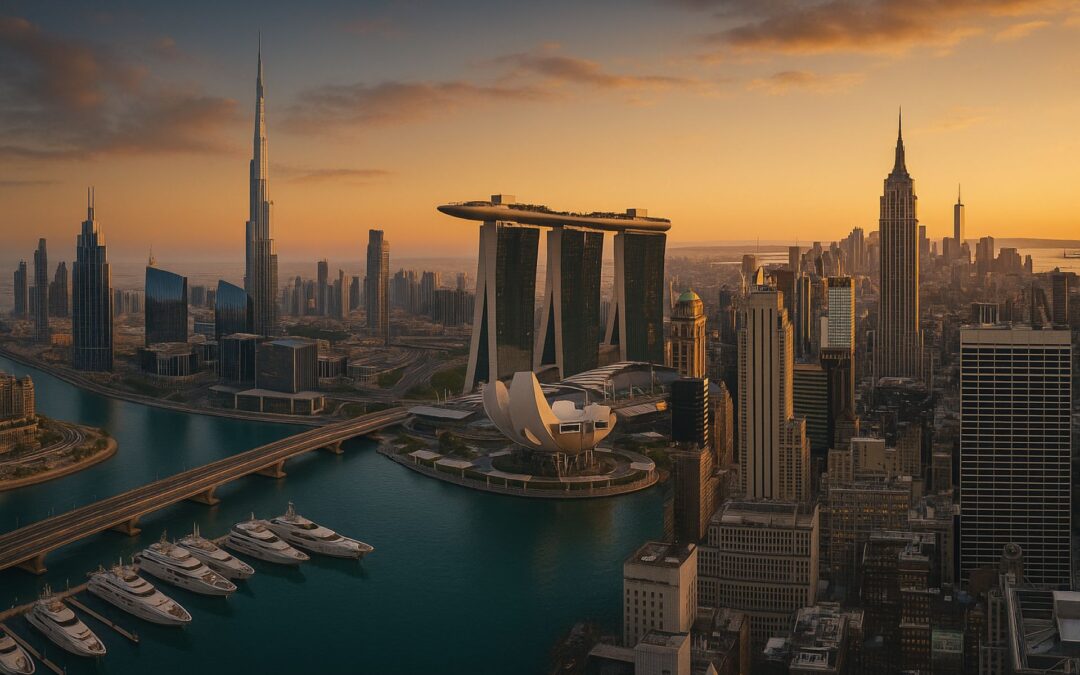
There’s a point where wealth stops behaving like money and starts behaving like gravity. It pulls talent, reshapes industries, and—most visibly—reconfigures cities. At the billionaire level, where fortunes are measured not in millions but in billions, location is no longer a matter of lifestyle preference. It becomes a strategic decision. Cities are not just places to live; they are instruments that either accelerate wealth, protect it, or quietly erode it.
This is why billionaire capitals exist at all.
They are not defined simply by how many ultra-wealthy individuals reside within their borders. Instead, they emerge where a specific set of conditions converge—where capital can grow rapidly, remain secure, and be positioned within networks of influence that amplify its power. These conditions evolve over time, and with them, the map of global wealth is constantly redrawn. Cities rise to prominence, reach saturation, and, in many cases, decline under the weight of their own success or shifting geopolitical realities.
What makes this dynamic particularly fascinating is how recent it is. The idea of a “billionaire” is barely a century old. Yet in that short span, entire urban hierarchies have formed around this class—New York’s enduring dominance, Tokyo’s fleeting surge, Silicon Valley’s explosive ascent, and the emerging gravitational pull of places like Dubai and Mumbai.
Understanding where billionaires choose to live is ultimately about understanding how modern power is structured. It reveals where industries are forming, where legal systems are trusted, where influence circulates, and where the future is quietly being built.
Because if money talks, at this level, it doesn’t just speak—it decides where the world’s center of gravity will be next.
The Rise of the Billionaire City
From Land and Titles to Liquid Wealth
For most of human history, wealth wasn’t counted—it was embodied. It lived in land ownership, noble titles, military power, and proximity to the throne. A king didn’t need a balance sheet to prove dominance. Control over territory and people was the currency that mattered, and it was largely immobile.
This meant wealth was tied to place in a very different way. You didn’t choose a city because it optimized your returns. You inherited your position within a hierarchy that was slow to change and even slower to quantify. The idea that wealth could be measured precisely, compared globally, and moved across borders with ease is a distinctly modern phenomenon.
The shift began when wealth became liquid—when it could be stored, transferred, and multiplied through financial systems rather than physical assets. Once money could move, so could power. And once power became mobile, location started to matter in an entirely new way.
The Birth of the Modern Billionaire Class
The modern billionaire is a product of this transition. The moment often cited as the beginning of this era is 1916, when John D. Rockefeller became the first recorded dollar billionaire. His wealth wasn’t just vast—it was measurable in a way that made it comparable, trackable, and, most importantly, replicable.
From that point forward, wealth began to cluster around the systems that enabled its growth. Industrialization concentrated fortunes in cities tied to production and logistics. Later, financialization shifted that center toward banking hubs. By the late 20th century, the formalization of wealth rankings—most notably through Forbes’ billionaire list—turned the distribution of extreme wealth into something visible and competitive.
Cities were no longer just economic centers; they became scoreboards of global wealth.
Why Cities Became the Center of Wealth
As wealth became more abstract and more mobile, cities evolved into the natural habitats of billionaires. Not because they were pleasant, but because they were efficient.
Cities concentrate everything wealth needs:
- access to capital
- proximity to decision-makers
- legal systems that enforce contracts
- infrastructure that enables scale
More importantly, cities create feedback loops. Wealth attracts more wealth. Once a critical mass of capital, talent, and opportunity forms in a single place, it becomes increasingly difficult for other locations to compete.
This is how New York transformed into a global financial nerve center. It wasn’t just where money was—it was where money was made, multiplied, and legitimized. And once that cycle began, it reinforced itself decade after decade.
The billionaire city, then, is not an accident. It is the inevitable outcome of mobile capital seeking the most efficient environment to grow, protect, and project itself.
The Three Forces That Define a Billionaire Capital
Wealth Must Grow: Following the Engine of Money
At its core, wealth is restless. It cannot remain static without eroding, and at the billionaire level, stagnation is equivalent to decline. This is why the primary driver behind any billionaire capital is not comfort or prestige, but growth.
Where wealth is created determines where it concentrates.
In the early 20th century, that meant industrial centers—cities tied to railroads, oil, manufacturing, and global shipping routes. Later, the center of gravity shifted toward financial hubs, where capital could be multiplied through markets, banking systems, and real estate. By the 2000s, the axis moved again, this time toward technology, where innovation scaled faster than any previous industry.
Each era produced its own billionaire geography:
- industrial wealth anchored in production cities
- financial wealth concentrated in global banking hubs
- tech wealth clustered around innovation ecosystems
The pattern is remarkably consistent. Billionaires do not arbitrarily choose where to live. They position themselves as close as possible to the systems generating new wealth—whether that’s Wall Street, Silicon Valley, or emerging tech corridors in Asia.
Because proximity is leverage. It means earlier access to opportunities, faster information flow, and tighter integration into the networks that actually create value.
Wealth Must Be Protected: Stability Over Everything
If growth is the first requirement, protection is the second—and it is non-negotiable.
Once wealth is accumulated, the priority shifts from expansion to preservation. Billionaires are less concerned with maximizing returns at all costs and more focused on ensuring that what they’ve built cannot be easily taken away. This is where cities compete not through opportunity, but through stability.
Protection takes multiple forms:
- predictable legal systems
- enforceable property rights
- political stability
- favorable or flexible tax structures
Interestingly, the lowest-tax environments are not always the most attractive. A zero-tax jurisdiction means little if the legal system is unreliable or subject to political interference. This is why cities like New York and London continue to hold immense appeal despite higher taxes—they offer something far more valuable: certainty.
At the same time, a parallel ecosystem has emerged. Cities like Monaco, Singapore, and Dubai have built entire frameworks designed to attract global wealth by reducing friction—lower taxes, simplified regulations, and systems tailored to capital mobility.
The result is a strategic split. Billionaires often generate wealth in one location, store it in another, and structure it across multiple jurisdictions to optimize both growth and protection.
Wealth Must Be Seen: Status, Access, and Influence
The third force is less obvious, but equally powerful: visibility.
Contrary to popular belief, most billionaires do not seek mass attention. What they seek is targeted visibility—recognition within the circles that matter. Influence is rarely exercised in public. It is built in private rooms, curated environments, and tightly controlled networks.
Certain cities excel at this in ways that are difficult to replicate.
They offer:
- access to elite social circles
- proximity to cultural institutions
- environments where capital, influence, and reputation intersect
This is why places like London and Paris retain their gravitational pull. It’s not just about finance or tax policy—it’s about social capital. Private clubs, exclusive neighborhoods, art galleries, and invitation-only events create ecosystems where billionaires meet other billionaires, exchange information, and shape decisions that ripple across industries.
Owning property in the right neighborhood or being present at the right gathering is not about lifestyle—it’s about signaling. It reinforces status, opens doors, and embeds individuals within networks that compound both influence and opportunity.
Together, these three forces—growth, protection, and visibility—form the foundation of every billionaire capital. Remove any one of them, and the city’s appeal begins to weaken.
The Hidden Fourth Factor: Freedom and Lifestyle
Mobility as a Modern Luxury
If the first three forces explain why wealth concentrates, the fourth explains why it no longer stays in one place.
At the billionaire level, the ultimate luxury is not material—it is mobility. The ability to move seamlessly across borders, shift operations between jurisdictions, and access global markets without friction has become one of the defining advantages of extreme wealth.
This is why infrastructure matters in ways that are often overlooked. Cities that function as billionaire hubs are not just economically powerful—they are logistically efficient.
They offer:
- world-class international airports
- private aviation access
- streamlined visa and residency programs
- frictionless financial systems
In practical terms, this means a billionaire can have breakfast in Dubai, close a deal in London, and attend a private event in New York—all within a compressed timeframe that would be impossible without the right urban ecosystems in place.
Mobility transforms geography into a toolkit rather than a constraint.
The Rise of Multi-City Living
This has led to a structural shift in how the ultra-wealthy relate to cities. Instead of choosing a single base, they assemble a portfolio of locations, each serving a specific function.
One city for finance.
Another for tax efficiency.
Another for lifestyle.
Another for strategic access to emerging markets.
New York might anchor financial operations. Dubai might optimize taxation. Singapore might provide a gateway to Asia. Meanwhile, Los Angeles or Miami offers a more relaxed, lifestyle-oriented environment.
This multi-city strategy reduces risk while maximizing opportunity. It allows wealth to flow toward growth while remaining anchored in jurisdictions that ensure its protection.
More importantly, it reflects a deeper truth: billionaire capitals are no longer exclusive. They are interconnected nodes within a global network.
Why Lifestyle Comes After Power
Interestingly, lifestyle—what most people would prioritize first—comes last in the hierarchy.
That doesn’t mean it’s irrelevant. Billionaires still seek:
- safety and privacy
- high-quality education for their children
- clean environments
- exclusive residential enclaves
But these factors only come into play after the core requirements of growth, protection, and access have been satisfied.
In many cases, lifestyle is something they engineer rather than inherit. With enough capital, entire environments can be customized—private compounds, gated communities, and curated living spaces that replicate comfort regardless of the surrounding city.
What truly matters is not how pleasant a city is, but how much freedom it provides. Freedom to move, to operate, to allocate capital, and to remain untethered.
And in a world where wealth is increasingly global, that freedom has become one of the most decisive factors shaping where billionaires choose to be.
The Evolution of Billionaire Capitals Over Time
Industrial Wealth and the Rise of New York
Every era produces its own geography of wealth, and in the early 20th century, that geography was industrial.
Fortunes were built on oil, steel, railroads, and shipping—industries that required physical infrastructure and centralized coordination. Cities that sat at the intersection of these systems became natural accumulation points for wealth, and none capitalized on this better than New York.
It wasn’t just a port or a production hub. It was where capital, logistics, and decision-making converged. As industrial empires scaled, so did the financial mechanisms required to support them—banks, stock exchanges, and investment firms—all of which deepened New York’s dominance.
By the time Rockefeller became the world’s first recorded billionaire, Manhattan had already begun transforming into something more than a city. It was becoming the operating system of modern capitalism.
Financialization and the Global City Era
As the 20th century progressed, the center of wealth shifted from production to financialization.
Money was no longer made primarily through building things, but through structuring, trading, and leveraging capital itself. This change elevated cities that could facilitate global finance—places with sophisticated banking systems, international connectivity, and regulatory frameworks that enabled cross-border transactions.
New York remained dominant, but it was no longer alone.
London reasserted itself as a global financial hub, leveraging its historical ties, legal systems, and time-zone advantage between Asia and the Americas. Hong Kong emerged as a critical gateway between Western capital and Chinese markets. Tokyo briefly surged during Japan’s asset bubble, becoming a symbol of how quickly wealth could concentrate—and how quickly it could disappear.
These cities formed a network of financial power, each reinforcing the others while competing for capital flows.
The Tech Boom and the Shift to Innovation Hubs
The early 21st century introduced a new driver of wealth: technology.
Unlike industrial or financial capital, tech wealth scaled at unprecedented speed. It didn’t rely on physical assets or traditional institutions in the same way. Instead, it depended on talent, intellectual property, and venture ecosystems.
This gave rise to a new kind of billionaire capital—one built around innovation rather than infrastructure.
Silicon Valley became the epicenter of this shift, with cities like San Francisco and Palo Alto attracting engineers, founders, and investors into a tightly integrated ecosystem. Similar patterns began to emerge in places like Shenzhen and Beijing, where state support and entrepreneurial momentum combined to accelerate growth.
What distinguished these hubs was not just the amount of wealth they generated, but the velocity at which they produced it.
The implication was clear: billionaire capitals are not fixed. They evolve alongside the mechanisms of wealth creation. As industries rise and fall, so do the cities that host them.
And the faster those industries change, the more fluid the map of global wealth becomes.
Why Billionaire Capitals Rise, Saturate, and Decline
Asset Bubbles and Sudden Wealth Concentration
Not all billionaire capitals are built slowly. Some emerge almost overnight—fueled by asset bubbles that inflate wealth at an unsustainable pace.
Japan in the late 1980s is one of the clearest examples. Loose monetary policy and speculative real estate markets created enormous paper wealth in a very short period. Tokyo became the center of global wealth concentration, and for a brief moment, Japanese magnates dominated global rankings.
But the same forces that accelerate wealth creation can just as quickly reverse it.
When the bubble burst, valuations collapsed, fortunes evaporated, and Tokyo’s position as a dominant billionaire capital faded almost as quickly as it had risen. The lesson is consistent: cities built on fragile or artificially inflated wealth lack the resilience needed to sustain long-term dominance.
Billionaire capitals require more than rapid growth—they require durable systems that can withstand shocks.
Political Risk and Capital Flight
If bubbles represent internal instability, political risk represents external pressure.
Wealth, especially at scale, is highly sensitive to uncertainty. When legal protections weaken, regulations become unpredictable, or political tensions rise, capital begins to move—and it moves fast.
Cities like Moscow and, at times, Beijing have experienced this dynamic. While they have generated significant wealth, much of it has been closely tied to political structures. This creates an inherent vulnerability. When the political environment shifts, so does the security of that wealth.
The response from billionaires is rarely ideological. It is pragmatic.
They relocate assets to jurisdictions with:
- stronger legal protections
- more predictable governance
- greater separation between politics and private capital
This is why wealth often flows out of high-risk environments into cities like London, Monaco, or Singapore. These destinations offer something that volatile regions cannot: confidence in continuity.
When Success Becomes a Liability
Paradoxically, a city’s success can also become its greatest weakness.
As billionaire populations grow, so do the pressures associated with them:
- rising housing costs
- increasing inequality
- political scrutiny
- regulatory tightening
At a certain point, the concentration of wealth begins to trigger pushback—both from governments and from the broader population. Taxes increase, policies shift, and the environment becomes less accommodating.
This creates a saturation effect. The very factors that made the city attractive—its density of wealth, influence, and opportunity—begin to generate friction.
In response, billionaires adapt. They diversify their locations, reduce exposure, and, in some cases, exit altogether.
The lifecycle is remarkably consistent:
- a city rises as a center of opportunity
- wealth concentrates rapidly
- pressures build
- capital redistributes
No billionaire capital is immune to this cycle. The only difference is how long it can sustain its position before the balance shifts.
And in a world where capital is increasingly mobile, those shifts are happening faster than ever before.
The Cities That Dominate Today
New York: The Perpetual Power Center
If there is one city that has consistently defied the rise-and-decline cycle, it is New York.
What sets it apart is not just its ability to generate wealth, but its ability to reinvent the mechanisms through which wealth is created and legitimized. From industrial capital to financial markets to global media and philanthropy, New York has repeatedly adapted to new economic realities without losing its central position.
Wall Street remains one of the most powerful financial engines in the world. The legal system provides a level of predictability that few cities can match. But beyond that, New York offers something far more difficult to replicate—institutional depth.
Museums, universities, cultural institutions, and media networks create an environment where wealth is not just accumulated, but validated. Billionaires don’t just make money here—they embed themselves into systems that extend their influence across generations.
Even when other cities briefly surpass it in raw billionaire numbers, New York retains something more enduring: structural power.
London and Paris: Legacy and Social Capital
London and Paris operate on a different axis. Their strength lies not only in finance or policy, but in history, culture, and social infrastructure.
London has long served as a bridge between global markets. Its financial sector, legal frameworks, and international connectivity make it a natural hub for cross-border wealth. At the same time, its private clubs, elite neighborhoods, and institutional networks provide access to circles where influence is quietly negotiated.
Paris, meanwhile, offers a different form of capital—cultural legitimacy. Fashion houses, art institutions, and high society create an ecosystem where wealth is displayed, refined, and integrated into a broader narrative of status and taste.
In both cities, visibility is not about exposure—it’s about belonging to the right networks. That distinction is what keeps them relevant, even as newer, more aggressive wealth hubs emerge.
Dubai and Singapore: The New Wealth Havens
If legacy cities represent continuity, Dubai and Singapore represent adaptation.
These cities have been deliberately engineered to attract global wealth. Their appeal is not accidental—it is the result of policy decisions designed to reduce friction and maximize mobility.
Dubai offers:
- zero income and capital gains taxes
- business-friendly regulations
- strategic geographic positioning between major global markets
Singapore complements this with:
- strong legal protections
- efficient governance
- direct access to Asia’s fastest-growing economies
Together, they embody a new model of billionaire capital—one that prioritizes efficiency, flexibility, and global connectivity over tradition.
However, there is a trade-off. While these cities excel at protecting wealth, they are still in the process of building the deeper cultural and institutional layers that define older capitals. Growth and protection are firmly in place. Long-term legacy is still being constructed.
Los Angeles and Miami: Lifestyle Magnets
Not all billionaire capitals are driven purely by economics. Some thrive because they offer something equally valuable: quality of life.
Los Angeles and Miami have emerged as key destinations for what might be called lifestyle billionaires—individuals who have already secured their financial position and are optimizing for environment rather than expansion.
Los Angeles offers proximity to entertainment, creativity, and a more relaxed pace compared to New York. Miami, on the other hand, combines favorable tax conditions with a climate and cultural energy that has increasingly attracted finance and tech figures.
These cities illustrate an important shift. Once wealth reaches a certain threshold, priorities begin to change. Growth and protection remain important, but they are no longer the only drivers.
Lifestyle becomes a strategic choice—one that complements, rather than replaces, the broader global network in which billionaires operate.
And in that network, no single city holds all the advantages.
The Next Billionaire Capitals
Mumbai and the Rise of Emerging Economies
If the past was shaped by Western financial hubs and the present by a mix of legacy and engineered cities, the future is increasingly being written in emerging markets.
Mumbai stands out as one of the clearest examples of this shift.
Its rise is not accidental—it mirrors the broader trajectory of India’s economic expansion. A large, young population is entering the workforce, driving consumption, productivity, and demand across multiple sectors. At the same time, industries like technology services, finance, and manufacturing are scaling rapidly, creating new channels for wealth generation.
What makes Mumbai particularly important is its role as a concentration point. Major conglomerates and financial institutions anchor their operations there, ensuring that as national wealth grows, a significant portion of it flows through the city.
This is how billionaire capitals are born—not just from growth, but from centralized economic gravity within a country that is itself expanding.
Beijing and the Question of Control
Beijing represents a different kind of opportunity—and a different kind of risk.
On one hand, China continues to generate significant wealth, driven by its scale, industrial capacity, and technological ambitions. Cities like Beijing and Shenzhen have produced a new generation of billionaires tied to innovation, manufacturing, and digital platforms.
On the other hand, the relationship between private wealth and state control introduces a layer of uncertainty that is difficult to ignore.
When fortunes are closely linked to political structures, they become more vulnerable to shifts in policy or regulation. This doesn’t prevent wealth from being created—but it does influence where that wealth ultimately resides.
Many individuals who generate wealth in China choose to relocate or diversify their assets internationally, seeking jurisdictions that offer stronger legal protections and greater independence from political influence.
This dynamic highlights a broader reality: generating wealth and securing it are not always aligned in the same place.
The Fragmentation of Global Wealth
Perhaps the most important shift looking ahead is not which city will dominate, but whether dominance itself is becoming obsolete.
In previous eras, it was possible for a single city to emerge as the undisputed center of wealth. Today, that model is breaking down.
Several factors are driving this fragmentation:
- the globalization of capital
- advances in transportation and communication
- the rise of multiple economic power centers
- increased competition between jurisdictions to attract wealth
As a result, billionaire capitals are no longer singular—they are distributed.
New York remains a financial anchor. Dubai and Singapore optimize for mobility and tax efficiency. Mumbai and Beijing generate new wealth. London and Paris provide cultural and social capital. Miami and Los Angeles offer lifestyle advantages.
Each city fulfills a different function within a broader system.
The implication is profound. The future of billionaire geography is not about choosing the “best” city, but about assembling the right combination of cities.
And in that world, influence no longer belongs to a single location—it belongs to those who can navigate the network most effectively.
A World Without a Single Capital
The End of One-City Dominance
For much of modern history, wealth tended to orbit around a single dominant center. Whether it was New York during the industrial and financial eras or Tokyo during its brief economic surge, there was usually a clear focal point—a city that acted as the primary stage for global capital.
That model is weakening.
The conditions that once allowed a single city to dominate—limited mobility, slower information flow, and concentrated economic power—no longer exist in the same way. Capital moves faster. Opportunities emerge simultaneously across multiple regions. Governments actively compete to attract wealth by offering incentives, regulatory advantages, and access to markets.
As a result, dominance has become distributed rather than centralized.
No single city today offers everything. Each excels in specific areas, but none can fully replace the others. This has fundamentally changed how billionaires think about location—not as a fixed identity, but as a strategic variable.
The Portfolio Lifestyle of the Ultra-Rich
This shift has given rise to what can only be described as a portfolio approach to geography.
Instead of anchoring themselves in one place, billionaires allocate their presence across multiple cities, each chosen for a distinct purpose:
- one for generating wealth
- one for protecting it
- one for accessing networks
- one for lifestyle and personal comfort
This approach mirrors how they manage their capital. Just as they diversify investments to reduce risk and optimize returns, they diversify locations to maximize flexibility and resilience.
It also allows them to respond dynamically to change. If one jurisdiction becomes less favorable—due to regulation, taxation, or political shifts—they can reallocate their presence without disrupting the broader system that supports their wealth.
In this sense, geography itself becomes an asset class.
Choosing Cities Based on Function, Not Identity
Perhaps the most telling change is psychological.
For most people, where they live is tied to identity—culture, nationality, community. For billionaires, location is increasingly functional.
A city is evaluated not by what it represents, but by what it enables:
- How efficiently can capital move?
- How secure are assets?
- How strong are the networks?
- How easy is it to enter and exit?
This doesn’t mean identity disappears entirely, but it becomes secondary to utility.
The billionaire no longer belongs to a city in the traditional sense. Instead, they operate across a network of locations, each contributing to a broader system that supports their wealth and influence.
And in a world structured this way, the concept of a single “capital of wealth” begins to dissolve—replaced by a web of interconnected hubs, each playing a role in a much larger, more fluid ecosystem.
The Cost of Concentrated Wealth
Housing Inflation and Urban Inequality
Where billionaires go, prices follow.
The influx of extreme wealth into a city doesn’t just reshape skylines—it reshapes affordability. Prime real estate becomes a store of value rather than a place to live. Properties sit empty as assets, while demand from ultra-wealthy buyers drives prices far beyond what local populations can sustain.
This effect is most visible in global cities. Neighborhoods once defined by community gradually transform into enclaves of capital. Housing markets decouple from local incomes, and entire districts become inaccessible to the very people who keep the city functioning.
The result is a widening gap between those who benefit from the concentration of wealth and those who are priced out by it.
What begins as economic success often translates into spatial inequality.
The Social Impact of Billionaire Clusters
Beyond housing, the presence of concentrated wealth changes the social fabric of a city.
Local economies begin to reorient around high-net-worth consumption—luxury retail, fine dining, exclusive services—while everyday infrastructure struggles to keep pace with rising costs. Small businesses are displaced. Cultural spaces become commercialized. Public sentiment shifts as inequality becomes more visible.
This creates a tension that cities must constantly manage.
On one hand, billionaires bring investment, global attention, and economic activity. On the other, their presence can intensify disparities and place pressure on governance systems to respond—through taxation, regulation, or policy intervention.
Over time, this tension feeds back into the lifecycle of billionaire capitals. As inequality rises and political scrutiny increases, the environment becomes less accommodating. Regulations tighten. Public opinion shifts. And the very wealth that once fueled the city’s rise begins to look for alternatives.
In this way, the concentration of wealth is both a strength and a liability.
It drives growth, but it also sets the conditions for eventual redistribution—either through policy, market forces, or the quiet relocation of capital to more favorable environments.
Conclusion
Billionaire capitals are not accidents of geography. They are the outcome of a precise alignment between opportunity, protection, influence, and freedom.
At first glance, it might seem like these cities simply attract wealth. But in reality, they earn it—by creating environments where capital can expand, remain secure, and integrate into networks that multiply its power. When those conditions weaken, even the most dominant cities begin to lose their grip.
What makes this dynamic especially compelling today is how fluid it has become.
The era of a single, undisputed capital of wealth is fading. In its place, a networked system is emerging—one where different cities specialize in different functions, and where the ultra-wealthy move between them with increasing ease. New York may anchor finance, Dubai may optimize taxation, Singapore may connect markets, and emerging cities like Mumbai may generate the next wave of fortunes.
This fragmentation doesn’t signal instability. It signals evolution.
Wealth is no longer tied to a single place because the systems that create and sustain it are no longer confined to one location. They are distributed, interconnected, and constantly shifting.
And that, ultimately, is the real story behind billionaire capitals.
Not where the richest people live—but how the architecture of modern wealth continues to reshape the world around them.