
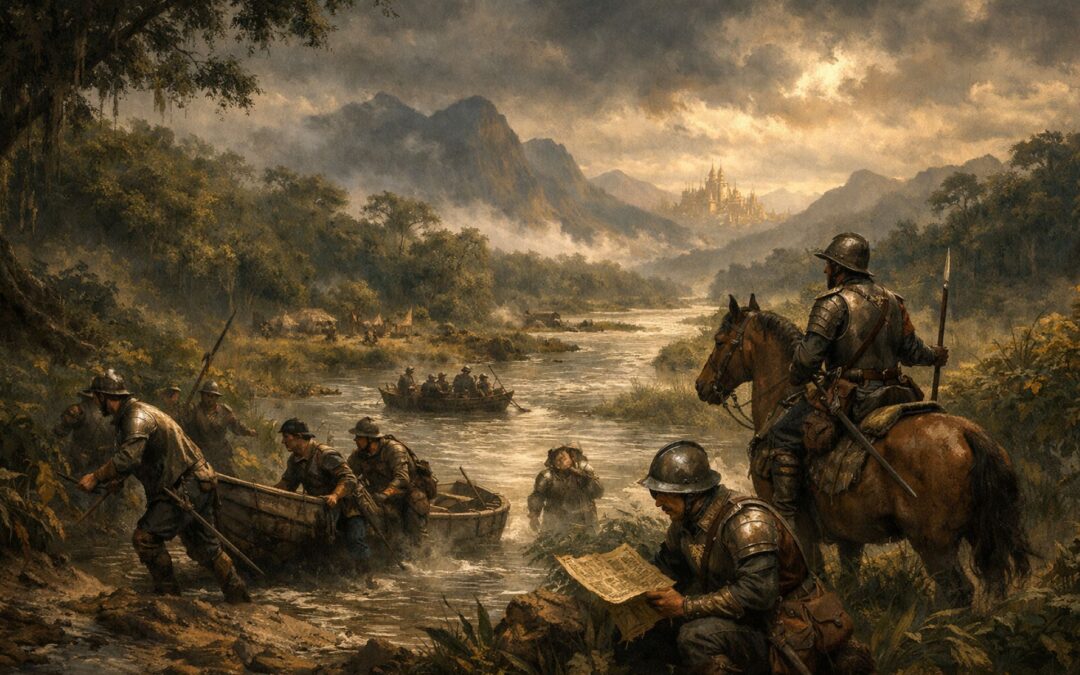
Introduction: The Myth of Gold and the Reality of Conquest
At the dawn of the 16th century, the world as Europeans understood it began to fracture. Beyond the Atlantic lay lands that were not merely new, but incomprehensibly vast—filled with civilizations, landscapes, and peoples that had developed entirely outside the orbit of Europe. What followed was not a simple story of exploration, but one of collision. Within a few decades, continents that had been isolated for millennia were violently and irreversibly drawn into a shared history.
Fueling this encounter was not careful curiosity, but obsession. Stories spread across Spain of cities paved with gold, rulers who covered themselves in precious dust, and empires whose wealth surpassed imagination. Names like El Dorado and Cíbola became less myth than promise—destinations that seemed just beyond the next mountain range, the next river, the next expedition. For a generation of ambitious men, the Americas were not unknown lands to be understood, but prizes to be claimed.
The conquistadors who set out to find these riches were not uniform figures. They were soldiers, minor nobles, fortune-seekers, and opportunists—many of them shaped by the wars of Europe and the final campaigns of the Reconquista. They carried with them not only weapons and horses, but a worldview defined by conquest, hierarchy, and divine justification. To them, the New World was both an opportunity and a test: a place where status could be remade, fortunes won, and names immortalized.
Yet the reality they encountered was far more complex—and far more unforgiving—than the stories that had drawn them across the ocean. Expeditions collapsed under the weight of hunger, disease, and distance. Landscapes resisted easy passage. Indigenous societies, far from passive, shaped the fate of these journeys at every turn—sometimes through resistance, sometimes through alliance, and sometimes through acts of unexpected mercy.
The stories of Álvar Núñez Cabeza de Vaca, Hernando de Soto, Francisco de Orellana, and Francisco Vázquez de Coronado reveal this reality in stark detail. None of them discovered the golden kingdoms they sought. None returned with the kind of wealth that had made earlier conquistadors legends. And yet, their journeys would leave a lasting imprint on the history of the Americas—not because they succeeded in the ways they intended, but because of what their failures revealed.
This is not simply a story of conquest. It is a story of illusion and endurance, of ambition colliding with reality, and of a world that was reshaped not by certainty, but by chaos.
A World Driven by Rumors of Gold
Long before most Europeans had any clear understanding of the Americas, they had already begun to imagine them. These imaginings were not cautious or grounded in evidence—they were extravagant, exaggerated, and fueled by a deep hunger for wealth. In taverns, royal courts, and ports across Spain, stories circulated of lands overflowing with riches, where gold was so abundant that it was worn casually, traded freely, or even discarded as trivial. The New World, in the European mind, became less a place and more a promise.
El Dorado and the Seven Cities of Gold
Among the most powerful of these stories was that of El Dorado—the “Golden One.” Originally, the legend referred to a ritual practiced by a ruler in South America, said to cover his body in gold dust before washing it away in a sacred lake. But as the story traveled across oceans and passed through countless retellings, it transformed. El Dorado ceased to be a man and became a city. Then it became a kingdom. Eventually, it became an entire region rumored to be saturated with unimaginable wealth.
Alongside it emerged tales of the Seven Cities of Gold, or Cíbola—vast settlements said to rival or even surpass the riches of the Aztec and Inca empires. These stories were rarely based on reliable evidence. More often, they were born from fragments of Indigenous accounts, misunderstood descriptions, or outright invention. Yet their power did not depend on their truth. They endured because they aligned perfectly with what Europeans wanted to believe.
These myths created a kind of gravitational pull. Each failed expedition did not dispel the illusion—it redirected it. If gold was not found in one region, it must lie just beyond the next horizon. The absence of evidence became, paradoxically, a reason to continue searching.
Spain’s Expansion and the Culture of Conquest
This obsession with wealth unfolded within a broader context of Spanish expansion. By the early 1500s, Spain had emerged from centuries of internal conflict and religious warfare, culminating in the completion of the Reconquista in 1492. The final defeat of Muslim rule in Iberia did not end the culture of conquest—it redirected it outward.
The same structures that had driven warfare within Spain now extended into the Americas. Ambitious men sought patronage, titles, and land. Victory in battle could elevate a man’s status dramatically, while failure could mean obscurity or ruin. The crown, for its part, encouraged exploration by granting rights and privileges to those willing to finance expeditions, effectively outsourcing risk while retaining ultimate authority.
This created a system where conquest was not only permitted but incentivized. Violence, territorial claims, and the extraction of wealth were not aberrations—they were expectations. The conquistador was not an anomaly, but a product of his time: shaped by a society that equated expansion with glory and divine favor.
Why Men Crossed the Atlantic
For many of these men, the journey to the Americas was as much about necessity as ambition. Spain’s rigid social hierarchy left little room for advancement, particularly for younger sons of noble families who stood to inherit nothing. The New World offered an escape from these constraints—a place where one’s fortunes could, in theory, be remade from nothing.
But this opportunity came with immense risk. Expeditions were expensive, dangerous, and often poorly organized. Many who set sail would never return. Those who did often came back with little to show for their efforts. And yet, the flow of men continued.
Part of this persistence can be explained by the rare but transformative successes of earlier expeditions. The conquests of the Aztec and Inca empires had demonstrated that extraordinary wealth was not just a fantasy—it was possible. These victories cast a long shadow, creating a powerful precedent that others sought to replicate, even when the conditions that had enabled those conquests were not present.
In this environment, rumor and reality became intertwined. The Americas were at once a place of genuine opportunity and profound illusion. It was into this world—driven by hope, shaped by myth, and sustained by ambition—that the conquistadors ventured, often with little understanding of what truly awaited them.
Álvar Núñez Cabeza de Vaca: Survival in a World Turned Upside Down
If the myths of gold drew men into the Americas, the experience of Álvar Núñez Cabeza de Vaca revealed what those myths concealed. His story is not one of conquest or triumph, but of collapse, endurance, and transformation—an account that stands in stark contrast to the image of the conquistador as a conqueror. Where others sought to dominate, Cabeza de Vaca was forced to adapt.
The Narváez Expedition and the Collapse in Florida
In 1527, Cabeza de Vaca joined the expedition of Pánfilo de Narváez, appointed as its royal treasurer and second-in-command. The mission was ambitious: to explore and claim La Florida for Spain, and, like so many expeditions of the time, to uncover wealth that might rival the riches found further south.
From the outset, the expedition was plagued by misfortune. Storms scattered ships, supplies dwindled, and desertions reduced their numbers even before they reached the mainland. When they finally landed near present-day Florida in 1528, they entered a landscape they did not understand—dense, unfamiliar, and far less hospitable than expected.
Narváez made a critical decision that would shape the expedition’s fate: he split his forces, sending part of the group inland while the ships followed the coast. Cabeza de Vaca opposed this move, recognizing the risk of separation in unknown territory. His objections were dismissed. The result was predictable. The two groups lost contact almost immediately, leaving the inland party isolated.
What followed was a slow unraveling. The men marched northward in search of gold that did not exist, seizing food from Indigenous villages and provoking hostility in return. Hunger set in. Disease spread. By the time they realized the futility of their search, they lacked the strength and resources to recover.
Starvation, Shipwreck, and the Edge of Death
With no ships to return to and no clear path forward, the expedition attempted a desperate escape. Using whatever materials they could salvage, they constructed makeshift boats—tools of survival rather than exploration. They melted down their own equipment to forge nails, stitched clothing into sails, and consumed their remaining horses for sustenance.
In September 1528, they set out along the Gulf Coast, hoping to reach Spanish settlements in Mexico. The journey was brutal. The boats were fragile, the seas unpredictable, and food scarce. Storms battered the vessels, and currents dragged them off course.
Eventually, the expedition was shattered. Ships were lost, men drowned, and the survivors were cast ashore along the coast of what is now Texas. Of the roughly 250 men who had begun this final leg of the journey, only around 80 remained. By the end of the winter, that number had dwindled to fewer than 20.
At this point, the expedition ceased to exist in any meaningful sense. There was no command structure, no objective—only the basic instinct to survive.
Captivity Among Native Tribes
The survivors, including Cabeza de Vaca, were taken in by local Native American tribes. At first, this meant captivity. The Spaniards, weakened and vulnerable, had little power to resist. They were absorbed into Indigenous communities, forced to adapt to entirely new ways of life.
Over time, however, the relationship evolved. Cabeza de Vaca learned the languages and customs of the people around him. He observed their social structures, their survival strategies, and their deep knowledge of the land—knowledge that far exceeded anything the Spaniards possessed.
This period marked a profound shift. The rigid hierarchies and assumptions that had defined his earlier life began to erode. Survival required cooperation, not domination. Authority came not from rank or title, but from usefulness and understanding.
Transformation into Trader, Healer, and Wanderer
After several years, Cabeza de Vaca and a small group of survivors managed to escape captivity. But escape did not mean a return to Spanish life. Instead, they entered a vast and unfamiliar world, moving from tribe to tribe across what is now the southern United States and northern Mexico.
They survived not as conquerors, but as intermediaries. Cabeza de Vaca became a trader, exchanging goods between different groups. He also took on the role of a healer, combining rudimentary medical knowledge with spiritual rituals. Among the Indigenous peoples he encountered, this earned him a reputation that bordered on the supernatural.
This transformation was as much psychological as it was practical. The man who had arrived in the Americas as a representative of Spanish authority now navigated a world in which that authority held no meaning. His survival depended entirely on his ability to adapt—to learn, to negotiate, and to coexist.
Return to Spanish Civilization and a Changed Perspective
After nearly eight years in the wilderness, Cabeza de Vaca and three companions finally encountered Spanish forces in northern Mexico in 1536. The moment was surreal. They appeared not as conquerors returning in triumph, but as figures transformed—dressed like the people they had lived among, accompanied by Indigenous followers.
Their return marked the end of an extraordinary journey, but not the end of its impact. Back in Spain, Cabeza de Vaca wrote an account of his experiences, offering one of the earliest and most detailed European descriptions of the Indigenous peoples of North America.
Unlike many of his contemporaries, his perspective had shifted. He advocated for more humane treatment of Native populations, recognizing their humanity and the role they had played in his survival. This did not make him a modern critic of empire, but it did set him apart in a period defined by conquest and exploitation.
His story reveals a different side of the conquistador experience—one in which ambition gives way to necessity, and domination is replaced by dependence. In a world driven by dreams of gold, Cabeza de Vaca found something far less tangible, but far more revealing: the limits of power itself.
Hernando de Soto: The Illusion of Wealth in the American Southeast
If Cabeza de Vaca’s journey exposed the fragility of conquest, Hernando de Soto’s expedition demonstrated its persistence. Where one man adapted to survival, the other doubled down on ambition. De Soto did not come to the Americas to endure—he came to conquer, to replicate the immense successes of earlier campaigns in Mexico and Peru. But in the dense forests and river systems of the American Southeast, the old formulas would fail.
From Peru’s Riches to Florida’s Promise
Hernando de Soto was not an inexperienced adventurer. By the time he set his sights on Florida, he had already taken part in one of the most profitable conquests in history—the Spanish overthrow of the Inca Empire. There, he had witnessed firsthand how a relatively small force could dismantle a vast civilization and extract immense wealth from it.
That experience shaped his expectations. To De Soto and men like him, the Americas were not a mystery—they were a pattern waiting to repeat. Somewhere in the interior, there had to be another empire, another ruler, another cache of gold waiting to be seized. Florida, though less explored, was simply the next frontier.
Backed by royal authority and substantial personal wealth, De Soto assembled a large and well-equipped expedition. In 1539, he landed on the west coast of Florida with hundreds of men, horses, and supplies—more organized and better prepared than many of the expeditions that had come before.
Yet preparation could not compensate for misunderstanding. The wealth he expected did not exist in the form he imagined, and the societies he encountered were not centralized empires that could be easily overthrown.
The March Through the Unknown Interior
From the moment they moved inland, De Soto’s expedition became a relentless march through unfamiliar territory. The landscape was varied and often unforgiving—swamps, forests, rivers, and mountains that slowed progress and strained resources.
Unlike the campaigns in Mexico and Peru, there was no single capital to target, no emperor whose capture would collapse an entire system. Instead, De Soto encountered a patchwork of Indigenous societies, each with its own leadership, alliances, and priorities. This decentralized reality made conquest far more difficult.
To sustain his expedition, De Soto relied heavily on coercion. Villages were raided for food. Local leaders were taken hostage to force cooperation. Guides were compelled to lead the Spaniards deeper into the interior, often toward places that offered little in return.
This strategy kept the expedition moving, but it also ensured constant resistance. Every act of violence created new enemies. Every demand for supplies pushed the expedition further into conflict. What might have been a journey of exploration became a cycle of confrontation and retaliation.
Conflict, Violence, and the Battle of Mabila
The tensions that defined the expedition reached a breaking point at Mabila, a fortified settlement in what is now Alabama. By this stage, the Spaniards were already worn down—short on supplies, far from any support, and increasingly vulnerable.
When they entered Mabila, something felt different. The town was filled not with civilians, but with warriors. Whether by miscalculation or necessity, De Soto allowed his men to proceed. What followed was one of the most intense battles of the expedition.
The fighting lasted for hours. At one point, the Spaniards were forced out of the settlement and nearly overwhelmed. But their weapons—steel blades, armor, and firearms—gave them a decisive advantage. They regrouped, counterattacked, and ultimately destroyed the town.
The cost, however, was enormous. Hundreds of Spaniards were killed or wounded. Much of their equipment was lost. And whatever fragile balance had existed between the expedition and the Indigenous populations was shattered completely.
Mabila was not a victory in any meaningful sense. It was a turning point that revealed the limits of Spanish power in this environment.
Crossing the Mississippi and the Limits of Power
Despite mounting losses and diminishing returns, De Soto refused to abandon the expedition. In 1541, his men reached one of the most formidable natural barriers they had yet encountered—the Mississippi River.
Crossing it required ingenuity and determination. The Spaniards constructed boats, ferried men and horses across, and continued westward. In doing so, they became the first Europeans known to have crossed the river—a moment of geographical significance that stood in stark contrast to their broader failures.
Beyond the Mississippi, the pattern continued. They encountered more communities, more resistance, and more landscapes that offered no trace of the wealth they sought. Supplies ran low. Morale declined. The promise of gold, once so vivid, now seemed increasingly distant.
At every stage, the expedition revealed a fundamental truth: the methods that had succeeded elsewhere could not simply be applied everywhere. The Americas were not a single entity to be conquered, but a vast and diverse set of worlds, each with its own dynamics.
Death, Failure, and the End of the Expedition
In 1542, after years of relentless movement and mounting hardship, Hernando de Soto fell ill and died near the banks of the Mississippi River. His death marked not just the loss of a leader, but the collapse of the expedition’s central purpose.
To prevent local populations from realizing that their leader was gone—and perhaps to preserve some illusion of authority—his men concealed his death, reportedly sinking his body in the river under the cover of night.
Leadership passed to his successor, but the expedition had already lost its direction. With no gold, no clear objective, and dwindling numbers, the remaining men made a final decision: to abandon the mission.
They constructed boats and traveled down the Mississippi, eventually reaching Spanish territories in Mexico. Of the hundreds who had set out with De Soto, only a fraction survived.
In the end, the expedition achieved none of its original goals. It found no riches, established no lasting settlements, and brought back no immediate rewards. Yet its impact was not negligible. It mapped vast regions, recorded encounters with numerous Indigenous societies, and left behind a legacy of violence that would shape future interactions.
De Soto’s journey stands as a stark reminder of the gap between expectation and reality. Driven by the illusion of wealth, he led one of the most ambitious expeditions of his time—only to discover that ambition alone could not overcome the limits of knowledge, environment, and human endurance.
Francisco de Orellana: The Journey That Discovered the Amazon
If Hernando de Soto’s expedition revealed the limits of conquest on land, Francisco de Orellana’s journey exposed something even more unsettling: that the greatest discoveries of the age often came not from control, but from losing it. His voyage down the Amazon was not a planned triumph of exploration, but the unintended consequence of an expedition collapsing under its own ambition.
The Quest for El Dorado in the Andes
The origins of Orellana’s journey lay in one of the most persistent obsessions of the conquistador age—the search for El Dorado. By the early 1540s, rumors of a golden kingdom somewhere east of the Andes had taken firm hold. These stories described a land so rich that its ruler coated himself in gold, a vision that blurred the line between ritual, myth, and fantasy.
Gonzalo Pizarro, brother of the conqueror of the Inca Empire, set out to find this elusive realm. His expedition was massive: hundreds of Spaniards accompanied by thousands of Indigenous porters, all tasked with crossing one of the most formidable environments on earth.
The journey quickly descended into chaos. The Andes gave way to dense rainforest, where progress slowed to a crawl. Supplies ran out. Food became scarce. The expedition began to consume its own resources, including its horses. Disease spread. Morale collapsed.
By the time they reached the banks of the Coca River, the expedition was already on the brink of disaster.
Separation from Gonzalo Pizarro
Faced with starvation and stagnation, a decision was made that would change the course of history. A boat was constructed to carry supplies and scout ahead along the river. Francisco de Orellana was chosen to lead this detachment, tasked with finding food and returning to the main party.
It was a mission defined by uncertainty. The river’s current was strong, and once Orellana’s group set off, they quickly realized a critical problem: turning back would be nearly impossible.
They attempted to regroup, waiting along the riverbank in hopes that Pizarro’s party would catch up. But no one came. Whether due to distance, miscommunication, or the sheer difficulty of the terrain, the two groups had effectively become separated.
At this point, Orellana faced a choice. Attempting to return upriver could mean certain death. Continuing downstream offered at least a chance of survival. He chose the latter.
This decision would later be interpreted by some as betrayal. In reality, it was the moment when the expedition ceased to follow any original plan and became something else entirely.
Descent Into the Amazon Basin
As Orellana and his men drifted deeper into the river system, they entered a world that no European had ever documented. The river widened, the forest thickened, and the scale of the environment became overwhelming.
At first, survival was precarious. The men were starving, weakened, and uncertain of what lay ahead. But gradually, they began to encounter Indigenous settlements along the riverbanks—some abandoned, others inhabited.
These encounters were critical. In some cases, the inhabitants fled, leaving behind food that the Spaniards desperately needed. In others, they stayed, offering assistance or at least tolerating the presence of the strangers.
For a time, Orellana’s expedition stabilized. They learned to navigate the river more effectively, to interact—however cautiously—with local populations, and to adapt to the rhythms of a landscape that dwarfed anything they had previously known.
Encounters with Powerful Indigenous Societies
One of the most striking aspects of Orellana’s journey was the scale and complexity of the societies he encountered. Contrary to European assumptions, the Amazon was not an empty wilderness. It was inhabited by organized communities with their own systems of governance, trade, and warfare.
Some of these encounters were peaceful. Others were not. As the expedition moved further downstream, resistance increased. The Spaniards found themselves under attack from groups that were not only capable of defending their territory, but doing so with coordination and strength.
It was during one of these confrontations that Orellana’s chronicler, Gaspar de Carvajal, recorded an extraordinary detail: women fighting alongside men in battle. This observation, filtered through European imagination, led to the naming of the river—the Amazon—after the warrior women of Greek mythology.
Whether the interpretation was accurate or not, it revealed something important about the mindset of the explorers. Faced with the unfamiliar, they reached for familiar myths to make sense of what they were seeing.
Reaching the Atlantic and the Birth of a Legend
After months of continuous travel, Orellana’s expedition achieved something unprecedented. They followed the river all the way to its mouth, emerging into the Atlantic Ocean. In doing so, they became the first Europeans known to have navigated the full length of the Amazon.
It was an extraordinary accomplishment—one that none of them had set out to achieve.
From there, they followed the coastline northward, eventually reaching Spanish-controlled territory. Of the men who had begun the journey, fewer than fifty remained. But they carried with them something far more valuable than gold: knowledge.
Their account of the river, its vastness, and the societies along its banks reignited the myth of El Dorado. If such large and organized communities existed in the Amazon, could one of them be the fabled golden kingdom?
Orellana himself believed it was possible. He later returned to the region with the intention of establishing a colony and claiming the land. That expedition, however, ended in failure. Disease, desertion, and poor planning once again proved fatal. Orellana died in the jungle, far from the recognition he might have expected.
Yet his unintended journey left a lasting mark. It revealed the scale of South America’s interior, challenged European assumptions about the region, and transformed the Amazon from an unknown expanse into a place of enduring fascination.
In the end, Orellana did not find El Dorado. But in searching for it—and in losing his way—he uncovered something far more significant: one of the greatest rivers on earth, and a world that Europe had only just begun to comprehend.
Francisco Vázquez de Coronado: Chasing Cities That Never Existed
If Orellana’s journey revealed the vastness of the unknown, Francisco Vázquez de Coronado’s expedition exposed something more troubling—the extent to which entire campaigns could be built on illusion. By the time Coronado set out into the northern reaches of the Americas, the myths of gold had evolved into something more structured, more specific, and in many ways more dangerous. The Seven Cities of Gold were no longer vague rumors. They were destinations.
The Legend of Cíbola and the Seven Cities of Gold
The story that set Coronado’s expedition in motion centered on Cíbola, one of the supposed Seven Cities of Gold. Reports described it as a wealthy urban center, filled with riches and comparable in scale to the great cities of the Spanish Empire. These accounts were based on secondhand observations, misunderstandings, and perhaps deliberate exaggerations—but they were persuasive enough.
When a scouting party returned with tales of a settlement to the north that appeared large and prosperous, it was enough. The absence of direct confirmation did not weaken the claim. Instead, it reinforced the sense that something extraordinary lay just out of reach.
For Coronado, this was an opportunity too significant to ignore. As a wealthy and influential figure in New Spain, he had both the means and the motivation to pursue it. Like those before him, he believed that one successful expedition could transform his status permanently.
The Expedition into the American Southwest
In 1540, Coronado set out with a large force—hundreds of Spanish soldiers accompanied by a far greater number of Indigenous allies, servants, and support personnel. The scale of the expedition reflected both ambition and expectation. This was not a tentative exploration. It was a campaign designed to secure and claim wealth.
The journey northward was long and demanding. The landscape shifted from the relative familiarity of Spanish-controlled territories into arid, rugged terrain that offered little in the way of easy resources. Supplies were stretched. Progress slowed.
When Coronado’s advance party finally reached what they believed to be Cíbola, the reality was immediate and unmistakable. Instead of a golden city, they found a modest Indigenous settlement—constructed from adobe, practical and functional, but entirely devoid of the wealth they had imagined.
The disappointment was profound. The gap between expectation and reality could not have been clearer.
War, Starvation, and the Tiguex Conflict
Despite this setback, Coronado did not abandon the expedition. Instead, he pressed onward, convinced that the true source of wealth lay further ahead. As the expedition moved deeper into the region, its dependence on local resources intensified.
At first, this dependence took the form of trade. But as supplies dwindled, the balance shifted. When Indigenous communities could no longer—or would no longer—provide food, the Spaniards began to take what they needed by force.
This led to escalating tensions, culminating in the Tiguex War. What began as strained relations turned into open conflict, with Spanish forces attacking and occupying Indigenous settlements. The violence was severe, and the consequences were lasting.
For the expedition, this was a critical moment. The search for gold had transformed into a struggle for survival, and the methods used to sustain that struggle only deepened the hostility they faced.
The Great Plains and the Illusion of Quivira
Even after months of hardship and mounting evidence that the myths were unfounded, Coronado continued to pursue new leads. One such lead pointed toward another wealthy land—Quivira—said to lie far to the east.
Guided by Indigenous informants, Coronado led a smaller detachment across the Great Plains. The journey itself was remarkable. The landscape opened into vast, featureless expanses, where enormous herds of buffalo roamed freely—an environment unlike anything the Spaniards had encountered before.
Yet once again, the promise of wealth proved illusory. When Coronado finally reached Quivira, he found not a golden kingdom, but another Indigenous community living without the material riches he had expected. There were no treasures, no precious metals, no evidence to justify the scale of the expedition.
At this point, the pattern was undeniable. The cities of gold did not exist—not in the form the Spaniards had imagined.
Return in Ruin and Reputation Lost
With no wealth to claim and no victories to secure, Coronado’s expedition had no choice but to turn back. The return journey was as difficult as the advance. Supplies remained scarce. Morale was low. The promise that had driven the expedition had evaporated.
By the time Coronado returned to New Spain, the consequences of failure were clear. The immense personal investment he had made in the expedition left him financially strained. His reputation, once tied to the expectation of success, suffered as well.
Although he avoided the kind of immediate disgrace that might have followed outright catastrophe, his career never recovered. The expedition had not only failed to find wealth—it had exposed the fragility of the assumptions that had justified it.
And yet, like the journeys of those before him, Coronado’s expedition was not without consequence. It mapped vast regions of the American Southwest and Great Plains. It recorded encounters with numerous Indigenous societies. It even brought Europeans to sights such as the Grand Canyon for the first time.
But these outcomes were incidental. They were not the goals that had driven the expedition, and they offered little consolation to those who had expected gold.
Coronado’s story is, at its core, a study in illusion. It reveals how powerful belief can be—even in the absence of evidence—and how far men were willing to go in pursuit of something that was never there.
The Conquistador Experience: Chaos, Violence, and Dependence
Taken together, the journeys of Cabeza de Vaca, De Soto, Orellana, and Coronado reveal a pattern that challenges the traditional image of the conquistador. These were not clean campaigns of conquest unfolding according to plan. They were unstable, improvisational, and often teetering on the edge of collapse. Behind the narratives of ambition and discovery lay a more complicated reality—one defined by chaos, violence, and an unexpected dependence on the very peoples they sought to dominate.
Why So Many Expeditions Failed
At the heart of these failures was a fundamental mismatch between expectation and reality. The Spanish entered the Americas with a model of conquest shaped by earlier successes in Mexico and Peru. In those regions, centralized empires with hierarchical structures had allowed relatively small forces to achieve outsized victories. Capture the ruler, control the capital, and the system could be dismantled.
But this model did not apply everywhere. In North America and much of the Amazon basin, the Spanish encountered decentralized societies—networks of communities rather than single political entities. There was no emperor to capture, no capital to seize, no clear center of power. The strategies that had once worked now produced only friction.
Logistics compounded the problem. Expeditions often operated at the limits of their supply lines, carrying insufficient provisions into environments that offered little in return. Hunger was a constant threat. Disease spread quickly among men already weakened by exhaustion. Equipment broke down. Horses died. Every setback made recovery more difficult.
Perhaps most critically, these expeditions were driven by hope rather than information. Decisions were often based on rumors, assumptions, or incomplete knowledge. When reality failed to align with expectation, the response was rarely to reassess—it was to press forward.
The Role of Indigenous Knowledge and Power
Despite their weapons and perceived superiority, the Spaniards were never fully in control of their environment. Survival depended on knowledge they did not possess—knowledge held by the Indigenous peoples they encountered.
Guides were essential for navigation. Without them, the Spanish risked becoming lost in landscapes that offered few recognizable landmarks. Food sources, water routes, seasonal patterns—these were not intuitive to outsiders. Even basic survival required adaptation.
In many cases, this created a paradox. The conquistadors relied on Indigenous assistance even as they sought to dominate or exploit those same communities. Alliances were formed out of necessity. Information was exchanged under pressure. And in some instances, as with Cabeza de Vaca, survival depended entirely on Indigenous generosity.
At the same time, Indigenous societies were not passive participants in these encounters. They made strategic decisions—whether to resist, cooperate, mislead, or withdraw. They could guide expeditions toward resources or away from them. They could provide aid or deny it. Their choices shaped the outcomes of these journeys in ways that European narratives often understate.
Hunger, Disease, and Geography as Enemies
If gold was the imagined prize of these expeditions, then hunger was their constant reality. Time and again, the accounts reveal men on the brink of starvation—eating horses, scavenging for roots, or relying on whatever could be taken or traded.
Disease compounded this fragility. European illnesses would later devastate Indigenous populations, but in the early stages of exploration, Spaniards themselves suffered from unfamiliar conditions. Exposure, malnutrition, and infection reduced their numbers steadily.
Geography, too, acted as an adversary. Rivers could both guide and trap. Forests slowed movement and obscured direction. Plains offered little shelter. Mountains blocked passage. Each environment imposed its own constraints, often forcing expeditions into decisions that carried long-term consequences.
In this context, success was not guaranteed by strength or determination. It was contingent, fragile, and often temporary.
Myth vs Reality in the Age of Exploration
Underlying all of this was a persistent gap between myth and reality. The conquistadors operated in a world where imagination filled the spaces left by ignorance. Stories of gold, powerful kingdoms, and hidden cities provided a framework for action, even when evidence was scarce.
These myths were not easily abandoned. Each failure was reinterpreted, each disappointment reframed. The absence of gold in one region suggested its presence elsewhere. The inability to find a city became proof that it had not yet been reached.
This dynamic sustained the cycle of exploration. It allowed expeditions to continue long after their original justifications had collapsed. It also ensured that the experience of the conquistadors would be defined not just by what they found, but by what they believed they might find.
In the end, the conquistador experience was not a straightforward story of dominance. It was a process shaped by uncertainty, driven by illusion, and constrained by forces that no amount of ambition could fully overcome.
The Native American Perspective: Survival, Resistance, and Collapse
For the conquistadors, the Americas represented opportunity, mystery, and wealth. For the Indigenous peoples who lived there, these expeditions marked the beginning of a profound and often catastrophic transformation. The arrival of the Spanish was not a single moment of conquest, but a series of encounters—each shaped by misunderstanding, negotiation, violence, and survival.
To understand this history fully, it is necessary to shift perspective. The story is not only about what the conquistadors did, but about how Native societies responded—and how those responses shaped the course of events.
First Contact and Misunderstanding
When Indigenous communities first encountered Europeans, they were not meeting a known enemy. They were encountering something entirely unfamiliar—men with different appearances, technologies, animals, and behaviors.
Initial reactions varied widely. In some cases, these encounters were cautious but peaceful. Trade took place. Food was exchanged. Information was shared, though often imperfectly. In other instances, suspicion quickly turned to hostility, especially when the intentions of the newcomers became unclear.
Much of this interaction was shaped by misunderstanding. The Spanish often interpreted Indigenous hospitality as submission. Requests for food or shelter, when refused, were seen not as reasonable limits but as defiance. Conversely, Indigenous groups struggled to interpret the motivations of these foreigners—particularly their fixation on gold, which held very different meanings in many Native cultures.
These early interactions set the tone for what followed. Misinterpretation was not a minor issue—it was a defining feature of the relationship.
Resistance, Warfare, and Strategic Alliances
Indigenous societies were not passive in the face of Spanish incursions. They resisted, adapted, and made strategic decisions based on their own interests.
In some cases, resistance took the form of direct conflict. Battles like Mabila demonstrated that Native groups could organize and mount significant opposition. They understood their terrain, coordinated their defenses, and inflicted serious losses on Spanish forces.
In other cases, resistance was more subtle. Guides could mislead expeditions, directing them away from resources or into difficult terrain. Communities could abandon settlements, denying the Spaniards access to food and shelter. Information could be withheld or manipulated.
At the same time, alliances were formed when it served local interests. Some groups cooperated with the Spanish to gain advantages over rival communities. These alliances were rarely stable or unconditional—they were tactical, shaped by shifting circumstances.
This complexity challenges the idea of a simple binary between conqueror and conquered. Indigenous peoples were active participants in these encounters, navigating a rapidly changing world with the tools available to them.
The Devastation of Disease
Perhaps the most profound impact of European arrival was not immediate violence, but disease. Although not always visible in the earliest expeditions, the spread of European illnesses would have devastating consequences in the years that followed.
Populations that had no prior exposure to these diseases lacked the immunity to withstand them. Entire communities could be reduced dramatically within a short period. Social structures were disrupted. Knowledge systems—often transmitted orally—were lost as elders died.
This demographic collapse altered the balance of power. Societies that had once resisted effectively found themselves weakened. The ability to sustain prolonged conflict diminished. In some regions, the effects were so severe that later European observers encountered landscapes that appeared sparsely populated, unaware that they were witnessing the aftermath of widespread loss.
Disease did not operate in isolation. It interacted with the pressures of displacement, conflict, and resource disruption, amplifying their impact.
Cultural Worlds Before and After Conquest
Before European contact, the Americas were home to a vast diversity of cultures, languages, and social systems. These were not static or uniform societies—they were dynamic, interconnected, and adapted to their environments in ways that reflected deep historical development.
The arrival of the Spanish disrupted these worlds. Some communities were destroyed outright. Others were transformed through sustained contact. Trade networks shifted. Power structures changed. Cultural practices were altered or suppressed.
And yet, survival did not mean disappearance. Many Indigenous societies adapted, preserving elements of their identity even as circumstances forced change. Traditions were reinterpreted. Knowledge was carried forward in new forms. Resistance continued, not only through conflict, but through persistence.
From this perspective, the history of the conquistadors is not only a story of expansion, but of resilience. It is a record of how societies confronted an unprecedented challenge—and how, despite immense loss, they endured.
Understanding this dimension does not simplify the narrative. It complicates it. It reveals that the transformation of the Americas was not a one-sided process, but a deeply entangled one, shaped by the actions, decisions, and experiences of all those involved.
The Legacy of the Conquistadors: A New World Order
By the mid-16th century, the age of the conquistadors had already begun to recede, but its consequences were only just beginning to unfold. The expeditions of men like Cabeza de Vaca, De Soto, Orellana, and Coronado did not always produce the immediate wealth or clear victories they had promised. Many ended in failure, disappointment, or obscurity. And yet, taken together, they reshaped the trajectory of the Americas—and, in doing so, helped create a new global order.
The Rise of the Spanish Empire
Although not every expedition succeeded, the broader pattern of Spanish expansion was undeniable. The conquests of Mexico and Peru had already established Spain as a dominant imperial power, and even the less successful ventures contributed to this expansion by mapping territory, identifying routes, and extending influence.
The cumulative effect was the creation of a vast empire stretching across the Americas. This empire was not built solely on gold and silver—though those played a crucial role—but also on systems of control, governance, and extraction that integrated new lands into a larger imperial framework.
The conquistadors themselves were often replaced by administrators, settlers, and officials. What had begun as a series of private ventures gradually became a more structured and institutionalized form of rule. The chaotic phase of conquest gave way to the slower, more enduring process of colonization.
The Beginning of Globalization
The impact of these expeditions extended far beyond the Americas. For the first time, previously isolated regions of the world were drawn into sustained contact. Goods, people, ideas, and diseases began to move across oceans on an unprecedented scale.
This exchange was not balanced or benign. It involved exploitation, displacement, and profound disruption. But it also marked the beginning of a connected world—one in which events in one region could have direct consequences in another.
Silver from the Americas flowed into Europe and then into Asia. Crops moved across continents, transforming diets and economies. Knowledge expanded, even as it was often filtered through the lens of European interpretation.
The conquistadors did not set out to create globalization as we understand it today. But their actions were part of a larger process that made it possible.
Exploration Without Immediate Conquest
One of the less obvious legacies of these expeditions is what they revealed about the limits of conquest. The failures of De Soto and Coronado, in particular, demonstrated that not all regions could be easily subdued or exploited.
In some areas, the cost of sustained conquest outweighed the potential rewards. This shifted the focus of Spanish expansion. Instead of pursuing uncertain campaigns deep into the interior, attention turned toward regions where wealth and control could be more reliably secured.
At the same time, the knowledge gained from these expeditions laid the groundwork for future exploration. Rivers, routes, and regions that had once been unknown were now part of a growing geographical understanding. Even failed expeditions contributed to this process.
Memory, Myth, and Historical Reassessment
Over time, the image of the conquistador has undergone significant reinterpretation. Early accounts often emphasized heroism, bravery, and discovery. These narratives reflected the values and priorities of the societies that produced them.
More recent perspectives have been more critical, highlighting the violence, exploitation, and destruction that accompanied conquest. The same figures who were once celebrated are now examined with greater scrutiny.
This reassessment does not erase the historical significance of the conquistadors. Instead, it places their actions within a broader context—one that acknowledges both their impact and their consequences.
Their stories persist not because they offer simple lessons, but because they embody the complexities of the period. They represent ambition and failure, discovery and destruction, illusion and reality.
In the end, the legacy of the conquistadors is not defined by the gold they sought or the cities they imagined. It is defined by the world they helped create—a world more connected, more unequal, and more intertwined than ever before.
Conclusion: Conquest Without Certainty
The story of the conquistadors is often told as a tale of triumph—of bold men crossing oceans, toppling empires, and reshaping continents. But when viewed through the journeys of Cabeza de Vaca, De Soto, Orellana, and Coronado, a different picture emerges. These were not stories of inevitable success. They were stories of uncertainty, miscalculation, and endurance.
Again and again, these expeditions set out with confidence and clarity of purpose, only to unravel in the face of realities they could neither predict nor control. Gold was not where they expected it to be. Societies did not collapse in the ways they had anticipated. Landscapes resisted movement. Hunger and disease proved more immediate threats than any enemy.
And yet, it was precisely within this uncertainty that their historical significance lies.
The conquistadors operated in a world where knowledge was incomplete and often unreliable, where myth filled the gaps left by ignorance. They acted on belief as much as evidence, driven by visions of wealth that were rarely realized. But in pursuing those visions, they moved through vast and unfamiliar regions, documenting, disrupting, and connecting worlds that had long existed apart.
Their journeys were not isolated events. They were part of a larger process—one that brought continents into sustained contact and set in motion changes that would unfold over centuries. The consequences of that process were profound and often devastating, particularly for the Indigenous societies who bore the brunt of its impact.
At the same time, these encounters revealed limits. Power was not absolute. Control was not guaranteed. The ability to conquer depended on conditions that were not always present. In many cases, survival required adaptation, cooperation, and an acknowledgment—however reluctant—of dependence on others.
In the end, the conquistadors did not simply shape the New World. They were shaped by it.
Their legacy is not found in the gold they failed to discover or the cities that never existed, but in the world that emerged from their actions—a world defined not by certainty, but by connection, conflict, and change.