
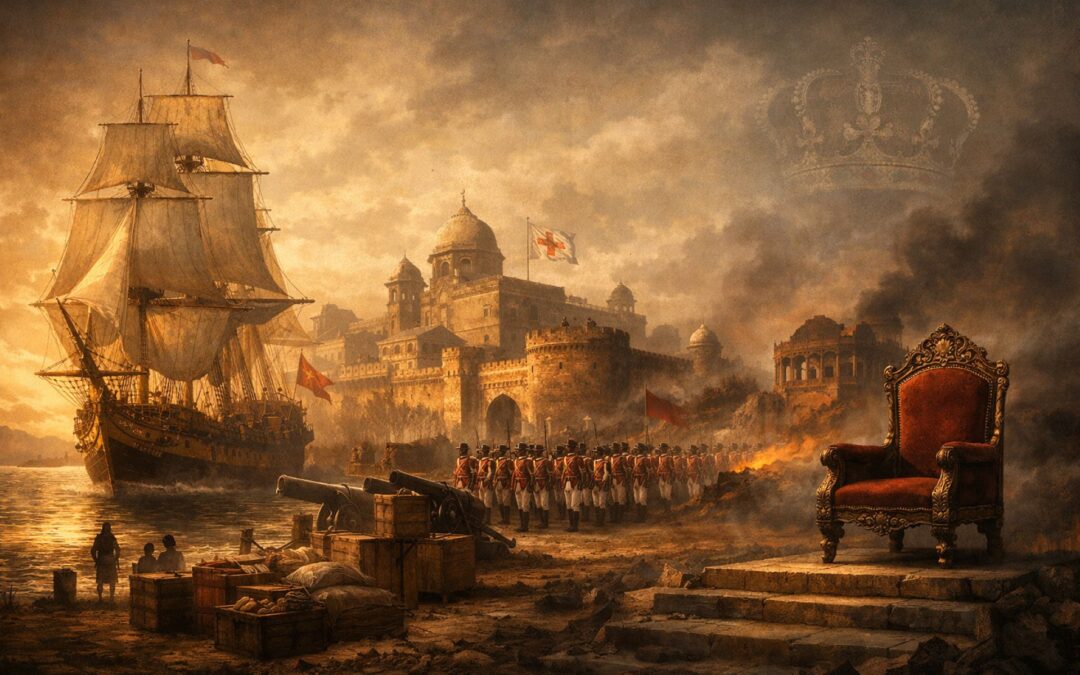
At its peak, it commanded armies larger than those of many European nations, controlled vast territories across the Indian subcontinent, dictated global trade flows, and generated immense wealth for investors sitting thousands of miles away in London. It was not a kingdom. It was not an empire—at least not in the traditional sense. It was a corporation.
The East India Company remains one of the most extraordinary—and unsettling—experiments in human history: a private enterprise that evolved into a territorial power, blurring the line between commerce and sovereignty. What began in 1600 as a joint-stock venture, designed to compete for access to the lucrative markets of the East, would, over the next two and a half centuries, transform into the de facto ruler of one of the richest and most populous regions on Earth.
Its rise was not inevitable. In its early years, the company struggled against stronger European rivals like the Dutch and Portuguese, surviving only through persistence, negotiation, and opportunism. But as the dynamics of power shifted—both within Europe and across Asia—the company adapted. It built alliances, raised private armies, and inserted itself into the political fractures of the Indian subcontinent. Trade gradually gave way to control. Influence hardened into authority. And before long, a commercial enterprise had become a governing force.
Yet the very mechanisms that fueled its rise also planted the seeds of its collapse. The relentless pursuit of profit, the absence of accountable governance, and the exploitation of both people and resources created a system that was immensely powerful—but fundamentally unstable. Famines, economic extraction, and political resentment eroded its legitimacy. And when rebellion finally came in 1857, it exposed a truth that had long been ignored: a corporation, no matter how powerful, was never meant to rule millions.
The story of the East India Company is not just a historical narrative—it is a case study in power. It reveals what happens when economic ambition is given political authority, when private interests are allowed to operate on a global scale without meaningful restraint, and when the pursuit of profit becomes indistinguishable from the exercise of rule.
To understand the modern world—with its multinational corporations, global supply chains, and debates over economic power—you have to begin here.
The Origins of Corporate Power
To understand how the East India Company became a territorial power, you have to start with a quieter but far more important revolution—the birth of the modern corporation.
In the centuries before its creation, long-distance trade was a dangerous and uncertain enterprise. Voyages to Asia could take years. Ships were lost to storms, piracy, or disease. Entire expeditions could fail without warning, wiping out fortunes overnight. No single merchant, no matter how wealthy, could reliably bear that level of risk alone.
The solution to this problem fundamentally changed the structure of economic power.
By the 16th century, European merchants—particularly in cities like London and Amsterdam—began experimenting with a new financial model: the joint-stock company. Instead of one individual funding a voyage, multiple investors could pool their capital, each owning a share of the enterprise. Risk was distributed. Losses were shared. And if a voyage succeeded, profits were divided proportionally.
This innovation did something profound. It transformed trade from an individual gamble into a scalable system. Capital could now be aggregated in unprecedented quantities. Larger fleets could be financed. More ambitious expeditions could be attempted. And perhaps most importantly, investors who never set foot on a ship could participate in global commerce.
The implications went far beyond trade.
Joint-stock companies were among the first institutions to separate ownership from management. Directors could be appointed to run operations. Decisions could be made collectively. Capital could be continuously reinvested. In effect, these companies became early versions of modern corporations—persistent entities that could outlive their founders and operate across generations.
European governments quickly recognized their potential. Overseas expansion was expensive, politically risky, and logistically complex. Instead of directly funding imperial ventures, monarchs could grant charters to these companies, giving them exclusive rights to trade in certain regions. In return, the state benefited indirectly—from increased wealth, strategic influence, and access to foreign goods—without bearing the full cost.
This arrangement created a powerful hybrid: private organizations with public authority.
The East India Company was born out of this exact system. In 1600, a group of London merchants petitioned Queen Elizabeth I for a royal charter granting them a monopoly over English trade with the East Indies. The request was approved, and with it, a new kind of entity came into existence—not just a trading company, but a state-backed commercial machine with legal privileges, financial backing, and global ambition.
It’s important to understand that at this stage, there was nothing inevitable about its future dominance. The company had no territory, no army, and no political authority beyond what was necessary to conduct trade. It was one competitor among many, entering a world already shaped by powerful rivals like Portugal and the Dutch Republic.
But it possessed something that would prove decisive over time: a structure that allowed it to accumulate capital, coordinate action, and adapt across decades.
The East India Company did not begin as an empire. It began as an idea—one that would eventually reshape the balance of power across continents.
The Race for Eastern Wealth
If the joint-stock company provided the mechanism, it was the promise of unimaginable wealth that provided the motive.
By the late 16th century, Europe had developed an insatiable appetite for goods from the East. Spices like pepper, cinnamon, and nutmeg were not just culinary luxuries—they were high-value commodities that could be sold at enormous markups. Textiles from India, particularly fine cotton and silk, were prized across European markets. Tea, though not yet the cultural staple it would later become, was beginning to emerge as a valuable import. In an age before industrial production, these goods represented both status and profit in their purest form.
The margins were staggering. A shipment purchased in Asia could be sold in Europe for many times its original cost, sometimes exceeding its weight in silver. Control over these trade routes, therefore, meant control over one of the most lucrative economic systems in the world.
But this wealth was not unclaimed.
For much of the 15th and 16th centuries, Spain and Portugal had dominated global exploration and trade. The Portuguese, in particular, had established a network of fortified ports stretching from Africa to India and Southeast Asia, allowing them to control key maritime chokepoints. Their fleets, backed by royal authority, had effectively monopolized European access to Eastern goods.
By the time England entered the race, it was already at a disadvantage.
The Dutch Republic posed an even greater challenge. Through the establishment of the Dutch East India Company (VOC) in 1602, the Netherlands created a rival organization that was, in many ways, more powerful and better organized than its English counterpart. The VOC commanded larger fleets, had stronger financial backing, and moved aggressively to dominate the spice trade in Southeast Asia.
The early decades of the 17th century were therefore defined by intense competition—commercial, naval, and sometimes outright military—between these European powers.
The English East India Company’s initial strategy reflected its relative weakness. Rather than directly confronting the Portuguese or the Dutch in their established strongholds, it sought alternative routes and opportunities. Early voyages focused on the East Indies—modern-day Indonesia and Malaysia—where spices could be sourced. But here, the Dutch presence was overwhelming, and English attempts to gain a foothold were repeatedly frustrated.
Gradually, the company began to shift its focus westward—to the Indian subcontinent.
This was a critical pivot.
Unlike the tightly controlled spice islands of Southeast Asia, India offered a different kind of opportunity. It was not a single unified state but a vast and diverse region made up of powerful empires, regional kingdoms, and coastal authorities. Trade here was not monopolized in the same way. Instead of seizing control outright, European merchants could negotiate access.
By the early 17th century, the East India Company began securing trading rights from local rulers along India’s coastline. These agreements allowed the company to establish “factories”—not industrial sites in the modern sense, but fortified trading posts where goods could be stored, processed, and exported.
This shift marked the beginning of a new phase.
The company was no longer just competing for access to goods—it was embedding itself within the economic fabric of the subcontinent. It was building relationships, learning local power structures, and establishing a physical presence that would, over time, become far more significant than anyone could have anticipated.
At this stage, however, the company remained what it had always been: a commercial enterprise navigating a crowded and competitive global marketplace. It had ambition, but not dominance. Opportunity, but not control.
That would come later—through a combination of strategy, circumstance, and force.
Early Struggles and First Footholds in India
The East India Company’s early presence in India was neither dramatic nor dominant. It was cautious, negotiated, and often precarious—a far cry from the sweeping authority it would later command.
When the company began turning its attention toward the Indian subcontinent in the early 17th century, it entered a world already governed by powerful political structures. The Mughal Empire, at its height, was one of the richest and most sophisticated states in the world, exercising authority over vast territories and complex trade networks. European merchants were, at best, peripheral actors—useful for commerce, but easily replaceable.
This reality shaped the company’s initial approach.
Rather than attempting to seize territory or impose control, the East India Company operated through diplomacy and concession. Its representatives sought permission from local rulers and imperial officials to conduct trade, often offering gifts, tribute, or favorable commercial terms in return. Success depended not on force, but on negotiation and patience.
By the 1610s, these efforts began to yield results.
The company secured permission to establish trading posts along India’s western and eastern coasts. These “factories” became the backbone of its operations—enclosed compounds where goods were stored, transactions were conducted, and a small number of English merchants lived and worked. Over time, these outposts grew into more permanent settlements, gradually expanding their economic and logistical importance.
One of the most significant early developments came in 1639, when the company acquired a stretch of land on the southeastern coast of India. Here, it established the settlement of Madras (modern-day Chennai), which quickly became a major center for trade. Unlike earlier trading posts, Madras represented something more durable—a territorial foothold that the company could develop and defend.
This pattern continued in the decades that followed.
In 1661, as part of a diplomatic alliance between England and Portugal, the island of Bombay was transferred to English control. The East India Company soon took possession of it, recognizing its strategic value as a natural harbor and commercial hub. Over time, Bombay would become one of the most important centers of British activity in India.
By the latter half of the 17th century, the company had established a network of coastal bases—Madras in the south, Bombay in the west, and later Calcutta in the east. These settlements were still limited in scope, but they provided something the company had previously lacked: permanence.
Yet despite these gains, the company remained a secondary player in the broader global trade system.
Its operations were overshadowed by the Dutch, who dominated the spice trade, and constrained by the political realities of India, where European merchants operated under the authority of local powers. The company had neither the military strength nor the political leverage to challenge these structures directly.
Instead, it adapted.
It focused on trade in Indian textiles, which proved highly profitable in European markets. It refined its logistics, improved its shipping networks, and strengthened its financial base. Slowly, almost imperceptibly, it began to accumulate the resources that would later enable a more aggressive expansion.
At this stage, there was no clear indication that the East India Company would become anything more than a successful trading enterprise. It had no grand imperial blueprint, no immediate ambition to rule.
But it had something far more important: a growing presence, a deepening understanding of local dynamics, and a foundation strong enough to support the next phase of its evolution—one that would transform it from a merchant organization into a political force.
From Trade to Territory
For decades, the East India Company had operated within the boundaries set by others—negotiating with rulers, adapting to local power structures, and focusing primarily on commerce. But by the early 18th century, the conditions that had once constrained it began to shift.
And with that shift came opportunity.
The most important change was not within the company itself, but within India.
The Mughal Empire, which had long provided a stable political framework across much of the subcontinent, was entering a period of decline. Central authority weakened. Provincial governors gained autonomy. Regional powers began to assert independence. What had once been a unified imperial system gradually fragmented into a patchwork of competing states, alliances, and rivalries.
This fragmentation altered the rules of engagement.
Where the company had once dealt with a strong, centralized authority, it now found itself navigating a far more fluid and unstable political landscape. Local rulers, facing threats from rivals, became more willing to seek external support. Alliances could be bought. Conflicts could be influenced. And crucially, power could be leveraged.
The East India Company began to adapt accordingly.
Trade was no longer its only objective—it became a tool. By offering military assistance, financial backing, or strategic support to certain factions, the company inserted itself into regional disputes. In return, it secured favorable terms: expanded trading rights, territorial concessions, and increasing influence over local governance.
This marked a fundamental transformation.
The company was no longer just participating in the economy—it was shaping the political environment in which that economy operated. And once it began to wield power in this way, the logic of expansion became difficult to resist.
Military capability followed naturally.
To protect its interests, the company had already begun maintaining small defensive forces around its trading posts. But as its involvement in regional conflicts deepened, these forces expanded in both size and sophistication. European officers trained troops in modern military techniques. Fortifications were strengthened. Logistics improved.
What started as protection evolved into projection.
The company now had the means to intervene decisively in conflicts—and increasingly, it did so not just to defend its position, but to expand it. Victories brought new concessions. New concessions required further protection. And each step forward made the next one more likely.
At the same time, competition with European rivals reinforced this trajectory.
The French, through their own trading company, were pursuing a similar strategy in India, particularly in the south. What had begun as commercial competition began to resemble geopolitical rivalry, with both sides backing opposing factions in local conflicts. These proxy struggles blurred the line between trade and war, accelerating the company’s transition into a military-political entity.
By the mid-18th century, the transformation was unmistakable.
The East India Company was no longer just a merchant organization operating at the edges of empire. It was becoming a power in its own right—one that could influence outcomes, control territory, and enforce its will.
But the moment that would truly define this shift was still to come.
In 1757, on the plains of Bengal, a relatively small force under the command of a company officer would defeat a much larger army—and in doing so, fundamentally alter the trajectory of both the company and the subcontinent.
That moment would turn possibility into reality.
The Rise of Robert Clive and the Battle of Plassey
If the East India Company’s transformation from trader to power was gradual, the Battle of Plassey in 1757 was the moment it became irreversible.
At the center of this turning point was Robert Clive—a figure whose career embodied the company’s evolving identity. He had arrived in India not as a soldier, but as a clerk. Like many young men of his time, he had been sent overseas in search of opportunity within the company’s commercial operations. But the instability of the period—and the growing entanglement of trade and conflict—quickly pulled him into a different role.
Clive proved to be more than capable.
By the late 1740s and early 1750s, he had distinguished himself in a series of engagements against both Indian and French forces, demonstrating a combination of boldness, strategic thinking, and a willingness to exploit political fractures. He understood something that would define the company’s success: in India’s fragmented political landscape, military strength alone was not enough—alliances, manipulation, and timing were just as decisive.
This understanding came to full effect in Bengal.
At the time, Bengal was one of the richest regions in the world—fertile, densely populated, and economically vital. It was governed by the Nawab Siraj ud-Daulah, who viewed the growing presence of the East India Company with increasing suspicion. Tensions escalated when the company began fortifying its positions without his consent and interfering in local politics.
Conflict became inevitable.
In 1757, Clive led a relatively small force—around 3,000 men, including British soldiers and Indian sepoys—against the Nawab’s army, which numbered tens of thousands. On paper, the outcome seemed obvious. In reality, it was anything but.
Clive’s victory at Plassey was not simply a matter of battlefield tactics. It was the result of careful political maneuvering. Prior to the battle, he had secured the support—or at least the neutrality—of key figures within the Nawab’s court, most notably Mir Jafar, one of Siraj ud-Daulah’s commanders. Promised power in exchange for cooperation, these internal actors weakened the Nawab’s position from within.
When the battle began, the imbalance in numbers was neutralized by a collapse in loyalty.
Large portions of the Nawab’s army failed to engage effectively, while the company’s forces, equipped with more advanced artillery and disciplined formations, capitalized on the confusion. The engagement itself was relatively brief, but its consequences were immense.
The Nawab was defeated. Mir Jafar was installed as a puppet ruler. And the East India Company gained control over Bengal—not just as a trading partner, but as the dominant political force.
This was the inflection point.
For the first time, the company had moved beyond influence into direct control over a major region. Bengal’s wealth—its agriculture, its trade networks, its revenue systems—was now effectively at the company’s disposal. And with that came something far more significant than profit: a sustainable source of power.
The implications were immediate.
Revenue from Bengal allowed the company to fund larger armies, finance further campaigns, and expand its operations without relying solely on investors in London. It had, in effect, unlocked a self-reinforcing system: conquest generated revenue, revenue funded further conquest.
Clive himself returned to Britain as a wealthy and celebrated figure, a symbol of what the company had become capable of achieving. But his success also set a precedent—one that others within the company would follow with increasing ambition.
After Plassey, the question was no longer whether the East India Company would expand its control.
The question was how far that expansion would go.
The Expansion of Company Rule Across India
The victory at Plassey did more than secure Bengal—it changed the operating logic of the East India Company.
Before 1757, expansion had been opportunistic and cautious. After Plassey, it became systematic.
With Bengal under its influence, the company gained access to one of the richest revenue bases in the world. This was not just commercial profit from trade, but direct taxation of land, production, and people. For the first time, the company was no longer dependent solely on investors in London to finance its ambitions. It could now fund its own expansion from within India itself.
This shift created a powerful feedback loop.
Territory generated revenue. Revenue financed armies. Armies secured more territory.
And with each cycle, the company’s capacity grew.
In the decades following Plassey, the East India Company expanded outward from its core holdings in Bengal. Its strategy was rarely one of straightforward conquest. Instead, it combined military force with political manipulation—supporting one ruler against another, enforcing treaties, and gradually converting influence into control.
Smaller states and regional rulers were often the first to fall under its dominance.
Many were already weakened by internal disputes or external pressures. The company positioned itself as an ally—offering protection or support in exchange for concessions. These concessions might begin as trading privileges or military access, but they often evolved into something far more binding: financial dependency, territorial loss, or direct administrative control.
Over time, this approach extended to larger powers.
Three major forces dominated much of India during the late 18th century: the Mughal remnants in the north, the Maratha Confederacy in central India, and the Kingdom of Mysore in the south. Each represented a significant obstacle to complete company dominance, and each would, in turn, be drawn into prolonged conflict.
The wars against Mysore, fought between 1767 and 1799, were particularly intense.
Under leaders like Haider Ali and his son Tipu Sultan, Mysore mounted one of the most serious challenges to the company’s expansion. These were not minor engagements but sustained military campaigns involving large armies, shifting alliances, and high stakes. Ultimately, however, the company’s superior resources, coordination, and access to reinforcements allowed it to prevail.
Tipu Sultan’s death in 1799 marked the end of Mysore as a major independent power.
Further north, the Maratha Confederacy posed an equally complex challenge. Rather than a single centralized state, it was a coalition of powerful regional leaders, capable of mobilizing significant military strength. A series of wars in the late 18th and early 19th centuries gradually broke this resistance, reducing Maratha influence and bringing vast areas of central India under company control.
Even the symbolic authority of the Mughal Empire was not immune.
In 1803, the East India Company captured Delhi, effectively placing the Mughal emperor under its influence. While the empire had long since declined in real power, its political and cultural significance remained immense. Controlling Delhi was not just a strategic victory—it was a statement.
By the early 19th century, the transformation was complete.
The East India Company was no longer a network of trading posts or a regional power operating at the margins. It had become the dominant authority across the Indian subcontinent, controlling or influencing territories that today include India, Pakistan, and Bangladesh.
What made this expansion remarkable was not just its scale, but its nature.
This was not a nation-state building an empire through centralized policy and national ambition. It was a corporation—driven by profit, governed by shareholders, and operated by employees—exercising sovereignty over millions of people.
And as its territorial reach expanded, so too did the demands of maintaining it.
Administration, taxation, law, infrastructure—these were no longer abstract concerns. They became daily realities. The company now had to function not just as a conqueror, but as a governing power.
It had built an empire.
The question was whether it could actually run one.
The East India Company as a Military Superpower
Empires are not sustained by trade alone. They are sustained by force—or at the very least, by the credible threat of it. By the turn of the 19th century, the East India Company had fully embraced this reality.
What had begun as small defensive contingents guarding trading posts had evolved into one of the largest standing armies in the world.
This transformation was driven by necessity. As the company expanded its territorial control, it found itself constantly engaged in conflict—against rival European powers, against regional Indian states, and increasingly, against resistance within the territories it governed. Each new acquisition required protection. Each political intervention risked escalation. Stability, in this context, could only be maintained through overwhelming military capacity.
The company responded by building a force unlike anything a private enterprise had ever commanded.
By the early 1800s, the East India Company’s army numbered well over 200,000 soldiers—larger than the national armies of many European states at the time. But what made this force particularly effective was not just its size, but its structure.
The vast majority of its troops were not European, but Indian.
These soldiers, known as sepoys, were recruited from across the subcontinent and trained in European military techniques. They were organized into disciplined units, commanded by British officers, and equipped with modern firearms and artillery. This hybrid structure allowed the company to maintain a large and relatively cost-effective army while leveraging local manpower.
It was, in many ways, a highly efficient system.
The company could project power across vast distances without the logistical burden of transporting large numbers of troops from Britain. It could adapt to local conditions more effectively. And it could sustain prolonged campaigns without exhausting its resources in the same way a traditional European army might.
But this efficiency came with inherent risks.
The company’s military dominance depended heavily on the loyalty of its sepoys—men who, while trained and paid by the company, were deeply embedded in the social, cultural, and political fabric of India. Their allegiance was not purely ideological or national, but transactional. As long as the system functioned—pay was reliable, conditions were stable, and grievances were manageable—the army held together.
If that balance broke, the consequences could be catastrophic.
In the meantime, however, the company’s military machine proved decisive.
It enabled the defeat of major powers like Mysore and the Marathas. It secured control over strategic regions. It enforced treaties and suppressed uprisings. And perhaps most importantly, it created a perception of invincibility—one that discouraged resistance and reinforced the company’s authority.
The presence of this army also altered the company’s internal dynamics.
Military considerations began to shape decision-making at every level. Expansion was no longer just a commercial calculation—it was a strategic one. Territories were evaluated not only for their economic value, but for their defensibility and their role within a broader system of control. Governance, too, became increasingly intertwined with military priorities.
In effect, the company had become something entirely new.
It was no longer just a commercial entity with political influence. It was a militarized state—one that raised armies, waged wars, enforced laws, and governed populations.
But unlike a traditional state, it lacked the institutional frameworks that typically accompany such power. Its ultimate objective was still profit. Its leadership was accountable not to citizens, but to shareholders. And its administrative systems were often improvised, inconsistent, and secondary to its economic goals.
This imbalance—between military strength and administrative capability—would become increasingly difficult to manage.
For a time, the East India Company could rely on force to maintain its position. But force alone is not a stable foundation for rule.
And as the demands of governance grew more complex, the limits of that model would begin to show.
Monopoly, Trade, and the Machinery of Profit
At the heart of the East India Company’s rise was not conquest alone, but something more fundamental: a system designed to extract wealth at an unprecedented scale.
From its earliest days, the company operated under a powerful advantage—a royal charter granting it a monopoly over English trade with the East. This meant that no other English merchants could legally compete in the same markets. Every shipment of spices, textiles, tea, or other Eastern goods entering Britain through official channels passed through the company’s hands.
This monopoly was the foundation of its commercial power.
It allowed the company to control prices, regulate supply, and capture the full margin of profit from its operations. European demand for Eastern goods was high and growing, and with limited competition at home, the company could operate with remarkable efficiency. Investors benefited. Share prices rose. And the company’s influence in London’s financial and political circles deepened.
But trade alone does not explain the scale of wealth the company accumulated in the 18th and early 19th centuries.
The real transformation came when commerce merged with governance.
After securing control over Bengal and expanding its territorial reach, the East India Company gained access to a second—and far more powerful—source of income: taxation. Millions of people living under its authority were now subject to its revenue systems. Land taxes, customs duties, and various forms of economic extraction began to flow directly into company coffers.
This fundamentally changed the nature of the enterprise.
The company was no longer simply buying goods in Asia and selling them in Europe. It was financing those purchases using revenue extracted from the very regions it controlled. In effect, it had created a self-sustaining financial machine—one where conquest enabled taxation, and taxation enabled further conquest.
The scale of this system was immense.
Bengal alone, one of the richest regions in the world at the time, generated enormous revenues. These funds were used to maintain the company’s armies, administer its territories, and continue its commercial operations. Profits were then transferred back to Britain, enriching shareholders and reinforcing the company’s position as one of the most powerful economic entities in the world.
At its peak, the East India Company was not just a participant in global trade—it was a central node within it.
It controlled key routes, dictated terms of exchange, and influenced the flow of goods across continents. Tea from India and China, textiles from Bengal, spices from Southeast Asia—all moved through systems shaped, if not directly controlled, by the company.
Yet the machinery that produced this wealth was not neutral.
It depended on systems of extraction that often prioritized profit over stability. Revenue demands could be inflexible. Local economies were reshaped to serve global markets. Traditional industries were disrupted or reoriented. The benefits of trade and expansion were unevenly distributed, with wealth flowing outward while pressures accumulated within.
In London, the company was celebrated as a symbol of commercial success.
In India, its presence was increasingly associated with control, taxation, and economic strain.
This dual reality—prosperity at the center, pressure at the periphery—was not immediately destabilizing. For decades, the system functioned. Revenues remained strong. Trade continued to grow. The company’s position appeared secure.
But beneath the surface, the imbalance was deepening.
A system built to maximize profit had taken on responsibilities far beyond its original design. It was managing economies, governing populations, and maintaining order across vast territories—tasks that required not just efficiency, but accountability, adaptability, and long-term stability.
And in these areas, the East India Company was far less effective.
The machinery of profit was powerful. But it was also fragile.
And when it began to break, the consequences would be severe.
Governance, Exploitation, and the Bengal Famine
Power is one thing. Governing responsibly is another.
By the late 18th century, the East India Company had acquired vast territories, immense revenues, and a formidable military apparatus. But it had not developed the institutional capacity—or perhaps the incentive—to govern effectively. Its administrative systems lagged far behind its expansion. And the consequences of this imbalance became painfully clear in one of the most devastating events of its rule: the Bengal Famine of 1770.
To understand the scale of the failure, you have to look at how the company approached governance.
At its core, the company remained a profit-driven organization. Its primary obligation was not to the people it governed, but to its shareholders in Britain. Revenue collection was therefore a central priority. Land taxes in Bengal were often set at high and inflexible levels, with little regard for local conditions or agricultural variability. The system was designed to ensure predictable income—not resilience.
This approach worked in years of stability.
It failed catastrophically in times of crisis.
In 1769, a combination of poor monsoons and crop failures began to affect large parts of Bengal. Food production declined sharply. Prices rose. What could have been managed as a regional shortage began to escalate into a full-scale famine.
Under a responsive and accountable administration, such a crisis might have triggered immediate intervention—tax relief, grain distribution, logistical support. But the East India Company’s governance structure was not designed for that kind of response.
Revenue demands continued.
Even as agricultural output collapsed and food became scarce, the company maintained its expectations of tax collection. Local officials, incentivized to meet revenue targets, often enforced these demands rigidly. At the same time, the company’s involvement in trade meant that grain markets were influenced by profit motives rather than public need. In some cases, supplies were hoarded or redirected for commercial gain.
The result was a systemic failure.
Between 1769 and 1773, the Bengal Famine claimed the lives of an estimated 10 million people—roughly a third of the region’s population. Entire villages were depopulated. Agricultural systems broke down. The economic base that the company depended on was itself severely damaged.
And yet, the immediate response from the company’s leadership was limited.
Reports of the disaster did reach Britain. Investigations were conducted. Criticism was voiced, including by figures within the company itself. Warren Hastings, who would later become the first Governor-General of Bengal, acknowledged the severity of the situation and the shortcomings in administration.
But structural change was slow.
The underlying issue was not simply mismanagement—it was misalignment. A system designed to extract revenue and maximize profit was being used to govern millions of people. The incentives did not support long-term stability or welfare. They prioritized short-term financial performance.
The famine exposed this contradiction in the starkest possible terms.
It also began to shift perceptions.
In Britain, the East India Company was no longer seen solely as a source of wealth and national prestige. It became a subject of political scrutiny. Questions were raised about its authority, its accountability, and its role in governing distant territories. Parliamentary oversight increased. The idea that a private corporation could exercise sovereign power without sufficient checks began to look increasingly untenable.
In India, the effects were even more direct.
The famine deepened resentment, weakened local economies, and highlighted the human cost of company rule. While resistance would take different forms in the decades that followed, the memory of such failures contributed to a growing sense that the system was not just exploitative, but unsustainable.
The East India Company had built a powerful machine for generating wealth.
But it had not built a system capable of managing the consequences of that power.
And that gap—between control and responsibility—would continue to widen.
The Opium Trade and Expansion into China
By the early 19th century, the East India Company had achieved something few entities in history ever had—dominance over a vast territory and a central role in global trade. But sustaining that position required more than control over India. It required access to another prize: China.
China represented one of the largest and most valuable markets in the world.
European demand for Chinese goods—particularly tea, silk, and porcelain—was immense. In Britain, tea had become a daily necessity, consumed across all levels of society. But there was a problem. China had little interest in European products. Trade was heavily restricted, limited to specific ports, and tightly controlled by the Qing dynasty. Payment was expected in silver.
This created a growing imbalance.
Silver flowed out of Britain and into China in exchange for goods, creating a persistent trade deficit. For the East India Company, this was not just an inconvenience—it was a structural problem. A system built on profit could not sustain a one-way flow of wealth.
The solution the company developed was as controversial as it was effective.
Opium.
Produced in large quantities in India—particularly in regions under company control like Bengal—the drug became the key to reversing the trade imbalance. The company oversaw its cultivation, regulated its distribution, and facilitated its sale to Chinese merchants. From there, it entered China through both official and illicit channels.
Demand grew rapidly.
Despite being illegal under Qing law, opium consumption spread across Chinese society. Addiction increased. Social and economic disruption followed. And with it, a steady stream of silver began to flow out of China—reversing the previous imbalance and restoring profitability to British trade.
For the East India Company, the system worked.
For China, it was devastating.
The Qing government recognized the scale of the problem and attempted to respond. Opium was confiscated. Trade was restricted. Harsh penalties were introduced for those involved in its distribution. But enforcement proved difficult, particularly in the face of external pressure.
Because by this point, the opium trade was no longer just a commercial issue—it had become a geopolitical one.
In 1839, tensions reached a breaking point. Chinese authorities seized and destroyed large quantities of opium held by foreign traders in Canton. In response, Britain—backed by the interests of the East India Company and the broader commercial establishment—declared war.
The First Opium War had begun.
It was a stark demonstration of the shifting balance of power between Europe and Asia. British forces, equipped with advanced naval technology and modern weaponry, quickly gained the upper hand. Chinese defenses, constrained by older systems and internal limitations, struggled to respond effectively.
By 1842, the war was over.
The Treaty of Nanking forced China to open additional ports to foreign trade, cede Hong Kong to Britain, and accept terms that significantly weakened its control over its own economy. It marked the beginning of a new era—one in which European powers could impose their will on China through a combination of military force and economic pressure.
For the East India Company, the outcome reinforced its position within the global trade network.
It had not only secured its interests in India, but had now become a key player in reshaping trade dynamics across East Asia. The flow of goods—tea from China, opium from India—was now part of an integrated system that the company helped sustain.
But once again, this success came with consequences.
The opium trade deepened the ethical contradictions of the company’s operations. It was no longer just extracting wealth or governing territories—it was actively facilitating a system that caused widespread social harm in another major civilization.
At the same time, its growing entanglement with the British state became more pronounced.
Military action on this scale could not be separated from national policy. The line between corporate interest and imperial strategy blurred further. The company’s activities were no longer just commercial ventures—they were shaping the geopolitical landscape.
By the mid-19th century, the East India Company stood at the center of a vast and interconnected system of power.
But the more expansive that system became, the more difficult it was to control.
And the more visible its contradictions became—to those it ruled, to those it traded with, and increasingly, to those who oversaw it from afar.
The Limits of Corporate Rule
By the mid-19th century, the East India Company had reached the height of its power. It controlled vast territories, commanded enormous armies, and sat at the center of global trade networks stretching from Britain to India to China.
On paper, it looked unstoppable.
In reality, the system was beginning to strain under its own weight.
The fundamental problem was structural. The East India Company had evolved into a governing authority without ever being designed to function as one. Its internal logic remained commercial—driven by profit, efficiency, and shareholder returns—while its external responsibilities had expanded into administration, law, infrastructure, and the management of millions of lives.
These two roles were not easily compatible.
Governance requires long-term thinking, institutional stability, and responsiveness to local conditions. It requires balancing competing interests, managing crises, and maintaining legitimacy among the governed population. The company, by contrast, operated through a framework that prioritized revenue generation and operational control.
As long as expansion continued and revenues remained strong, this imbalance could be managed.
But as the scale of operations increased, so did the complexity.
Administering vast and diverse territories like India required more than military dominance. It required coherent policies, consistent legal systems, and an understanding of social, cultural, and economic dynamics across regions. The company’s administrative structures, however, were often fragmented and inconsistent, shaped more by immediate needs than by long-term design.
Corruption and inefficiency added further strain.
Company officials, operating far from oversight in Britain, often exercised significant autonomy. Some accumulated personal wealth through questionable means. Others made decisions that prioritized short-term gains over sustainable governance. While efforts were made to introduce reforms and greater accountability—particularly as scrutiny from the British Parliament increased—these changes were gradual and uneven.
At the same time, discontent was growing within India.
The company’s policies had far-reaching effects on local societies. Traditional systems of authority were disrupted. Economic patterns were altered to serve global trade demands. Taxation systems placed pressure on agrarian communities. And cultural and religious sensitivities were not always understood—or respected—by those in power.
These tensions did not always manifest immediately as open resistance.
But they accumulated.
Within the company’s own military structure, underlying issues were also developing. The sepoys who formed the backbone of its army were subject to the same broader conditions affecting Indian society. They were disciplined and effective soldiers, but they were not disconnected from the world around them. Grievances—whether related to pay, conditions, or cultural concerns—could not be indefinitely contained.
The company’s reliance on this force was both its greatest strength and its greatest vulnerability.
Externally, pressure was also building in Britain.
The East India Company had long been a source of wealth and influence, but it had also become a subject of political debate. Its governance failures, particularly events like the Bengal Famine, had raised questions about its legitimacy. Parliamentary oversight increased. Regulatory acts were introduced to bring its operations under closer supervision.
The idea that a private corporation could wield sovereign power over millions of people was becoming increasingly difficult to justify.
By the 1850s, the East India Company still appeared powerful, but the foundations of that power were no longer stable.
Its military dominance masked underlying fragility. Its economic success concealed systemic imbalances. Its authority rested on a structure that lacked the flexibility and accountability required for long-term rule.
It had built an empire.
But it had not built a system capable of sustaining it indefinitely.
And when the breaking point came, it would not be gradual.
It would be sudden, widespread, and impossible to ignore.
The Indian Rebellion of 1857
The collapse of the East India Company’s rule did not begin with policy debates in London. It began on the ground—in barracks, in towns, and across vast stretches of northern India—where years of accumulated tension finally erupted into open rebellion.
In 1857, that tension reached its breaking point.
The immediate trigger was seemingly specific, almost technical. New rifle cartridges issued to sepoy soldiers were rumored to be greased with animal fat derived from cows and pigs—substances deeply offensive to both Hindu and Muslim religious practices. To use the cartridges, soldiers had to bite them open, which turned the issue into a direct cultural and religious violation.
But this was only the spark.
The deeper causes ran far beyond a single grievance. Within the army, sepoys had long-standing concerns about pay, conditions, and the erosion of traditional privileges. More broadly, across Indian society, dissatisfaction had been building for decades. Landowners had lost territories through annexation policies. Rulers had been displaced or reduced to symbolic figures. Taxation systems placed pressure on rural populations. And the company’s governance was increasingly seen as distant, extractive, and unresponsive.
When the rebellion began, it spread rapidly.
What started as a mutiny among soldiers in Meerut quickly escalated into a wider uprising. Sepoy regiments turned against their British officers. Civilians joined the movement in many areas. Key cities—including Delhi—became centers of resistance. In some regions, company authority collapsed almost entirely, replaced by a patchwork of local leadership and revived allegiances.
The symbolic heart of the rebellion was Delhi.
When rebel forces seized the city, they declared the aging Mughal emperor Bahadur Shah II as their leader—a move that, while largely symbolic, carried immense historical weight. It represented an attempt to restore a form of indigenous authority and reject the dominance of the company.
For the East India Company, the scale of the crisis was unprecedented.
This was no isolated disturbance. It was a widespread challenge to its rule, involving large sections of its own army and significant portions of the population in key regions. The very structure that had enabled its expansion—its reliance on sepoy forces—was now turning against it.
The response was swift and brutal.
British forces, reinforced from outside India, launched a systematic campaign to suppress the rebellion. Battles were fought across northern and central India. Cities were besieged and recaptured. The violence on both sides was intense, and the reprisals that followed were severe.
By 1858, the rebellion had been brought under control.
But the cost was enormous.
Thousands of British civilians and company employees were killed during the uprising. On the Indian side, the toll was far higher—hundreds of thousands died as a result of the conflict, as well as the famine and disease that followed in its wake. Entire regions were left devastated.
More importantly, the rebellion exposed a fundamental truth.
The East India Company could no longer be trusted to govern India.
Its authority had been undermined not just by external resistance, but by internal collapse. The loyalty of its army—once the foundation of its power—had proven unreliable. Its governance had failed to maintain stability. And its system, built on a combination of military control and economic extraction, had reached its limits.
In Britain, the conclusion was unavoidable.
The company’s role in India would have to end.
The rebellion did not just mark a crisis—it marked a turning point. A shift from corporate rule to direct state control. From a system driven by private interests to one overseen, at least in theory, by the institutions of the British government.
The East India Company had survived wars, competition, and internal failures.
But it could not survive this.
What followed was not reform, but replacement.
The End of Company Rule and the Birth of the British Raj
The Indian Rebellion of 1857 did not just shake the foundations of the East India Company—it shattered the illusion that it could continue to function as a governing authority.
In its aftermath, the British government moved decisively.
For years, Parliament had debated the company’s role in India, introducing regulatory measures and increasing oversight. But the rebellion made incremental reform impossible. The scale of the crisis, combined with the company’s evident inability to maintain stable control, forced a more fundamental solution.
In 1858, that solution took form in the Government of India Act.
This legislation marked a definitive transfer of power. All territories previously administered by the East India Company were brought under the direct control of the British Crown. The company’s political authority was effectively abolished. In its place, a new system of governance was established—one that would come to be known as the British Raj.
This was not just a change in administration. It was a transformation in the nature of rule.
Under the new system, India would be governed by officials appointed by the British government, rather than by a private corporation. A Secretary of State for India was created in London, supported by a council, to oversee policy and administration. In India itself, the position of Governor-General was elevated to that of Viceroy, acting as the Crown’s direct representative.
The structure was more centralized, more formalized, and—at least in theory—more accountable.
The British state now bore responsibility for governing one of the largest and most complex regions in the world. This brought with it a shift in priorities. Stability, order, and long-term control became more explicit objectives. While economic interests remained central, they were now framed within a broader imperial strategy rather than the narrower focus of corporate profit.
At the same time, the rebellion had left a lasting imprint on policy.
The British administration became more cautious in its approach. Efforts were made to avoid direct interference in certain cultural and religious practices, recognizing the role such issues had played in fueling unrest. The structure of the army was reorganized to reduce reliance on any single group, and to ensure tighter control over its composition and command.
But continuity was as important as change.
Many of the systems developed under the East India Company—taxation structures, administrative divisions, legal frameworks—were retained and adapted rather than completely replaced. The transition was not a clean break, but an evolution. The machinery of governance remained, even as the authority behind it shifted.
For the East India Company itself, this moment marked the end of its defining role.
It no longer governed territories. It no longer commanded armies. It no longer shaped the political landscape of India. Its transformation from a trading enterprise into a ruling power had been reversed—not gradually, but through decisive state intervention.
Yet the company did not disappear overnight.
Its corporate existence continued in a diminished form, bound by prior agreements and financial obligations. Shareholders still had claims. Certain functions remained to be wound down. The entity that had once dominated continents was reduced to a shadow of its former self—lingering, but no longer central.
The British Raj, meanwhile, would endure for nearly a century.
From 1858 to 1947, India remained under direct British rule, its administration shaped by the lessons—both learned and ignored—of the East India Company’s rise and fall.
The experiment of corporate rule had ended.
But its consequences would continue to shape the subcontinent, and the world, for generations.
The Final Dissolution of the East India Company
The transfer of power in 1858 marked the end of the East India Company as a governing force—but not as a legal entity.
Despite losing control over its territories, armies, and administrative authority, the company continued to exist for another fifteen years. This was not due to relevance or necessity, but obligation.
Years earlier, in 1833, an agreement had been reached between the British government and the company’s shareholders. As part of increasing state oversight and the gradual restructuring of its role, it had been decided that shareholders would receive a fixed annual dividend—10.5 percent—for a period of forty years. In return, the company had accepted greater government control over its operations.
This agreement created a constraint.
Even after the events of 1857 and the subsequent nationalization of its assets, the British government could not simply dissolve the company outright without addressing these financial commitments. The institution that had once governed millions was now bound by the technicalities of its own corporate structure.
And so, it lingered.
During this final phase, the East India Company was a shell of its former self. It no longer directed policy or exercised power. Its remaining functions were administrative and financial—managing residual operations, overseeing obligations, and facilitating the transition of responsibilities fully into the hands of the British state.
Its identity had been reduced to paperwork.
The contrast was striking. Within living memory, the company had commanded vast armies, dictated the fate of kingdoms, and shaped global trade. Now, it existed primarily to fulfill contractual obligations to investors—an entity defined not by power, but by its unwinding.
This drawn-out conclusion reflects something important about the nature of the organization.
The East India Company had been, from the beginning, a corporate structure. Even at the height of its territorial dominance, it remained legally a company—subject to agreements, governed by shareholders, and embedded within financial systems. Its fall, therefore, was not just political or military, but procedural.
In 1873, the process finally reached its conclusion.
The British Parliament passed the East India Stock Dividend Redemption Act, formally dissolving the company and terminating its remaining obligations. Shareholders were compensated. Legal structures were dismantled. And the institution that had once been the most powerful corporation in the world ceased to exist.
There was no dramatic finale.
No battlefield, no decisive confrontation, no symbolic collapse. Just legislation, settlement, and closure.
The East India Company did not fall in the way empires often do. It was not overthrown by a rival power or destroyed in a single moment of crisis. Instead, it was absorbed, dismantled, and ultimately erased through the very systems that had once enabled its rise.
Its power had been extraordinary. Its reach unprecedented.
But in the end, it remained what it had always been at its core—a corporation.
And like all corporations, it could be dissolved.
The Legacy of the First Corporate Empire
The East India Company did not survive the 19th century—but the system it helped create did.
Its legacy is not confined to the history of British India. It extends far beyond, shaping the modern relationship between commerce, power, and the state in ways that still define the world today.
At the most immediate level, the company laid the foundations for nearly two centuries of British influence in the Indian subcontinent. The administrative structures it built, the economic systems it imposed, and the political boundaries it reshaped did not disappear with its dissolution. They were inherited, modified, and expanded under the British Raj.
Even after independence in 1947, many of these structures persisted.
Legal systems, bureaucratic frameworks, patterns of land ownership, and trade networks all carried the imprint of company rule. The consequences—economic, political, and social—were complex and often deeply contested, but they were undeniably lasting.
More broadly, the East India Company redefined what a corporation could be.
Before its rise, businesses were limited in scope. They traded, they profited, and they operated within the boundaries set by states. The company blurred those boundaries. It demonstrated that a private enterprise, given sufficient capital, legal backing, and opportunity, could accumulate power on a scale comparable to—and at times exceeding—that of nation-states.
This was a turning point.
The idea that economic power could translate into political influence, and even territorial control, became embedded in the logic of global expansion. While no modern corporation governs territory in the way the East India Company once did, the broader principle—that large economic entities can shape policy, influence governments, and operate across borders with significant autonomy—remains highly relevant.
At the same time, the company’s history serves as a cautionary example.
It highlights the risks of concentrated power operating without adequate accountability. The incentives that drove its success—profit maximization, efficiency, expansion—also contributed to its failures. Governance suffered where it conflicted with revenue. Human costs were often treated as externalities. And the absence of effective oversight allowed systemic problems to grow unchecked.
These are not just historical issues.
They echo in contemporary debates about multinational corporations, regulatory frameworks, and the balance between economic growth and social responsibility. The East India Company represents an extreme case, but it is not an isolated one. It is part of a larger pattern in which economic systems evolve faster than the institutions designed to manage them.
There is also a deeper, more structural legacy.
The company played a central role in integrating distant regions into a single global economic system. Goods, capital, and labor moved across continents in increasingly organized ways. Trade routes became more interconnected. Markets became more interdependent.
In many respects, this was an early stage of globalization.
But it was a form of globalization shaped by unequal power dynamics—where one entity could dictate terms, control access, and extract value on a massive scale. The effects of this imbalance have continued to influence global economic relationships long after the company itself disappeared.
Perhaps the most important aspect of the East India Company’s legacy is the question it leaves behind.
What happens when private power becomes public authority?
It is a question that has no simple answer. The company’s history shows both the potential and the danger of such a transformation. It achieved levels of coordination, expansion, and influence that were unprecedented. But it also exposed the limits of a system where accountability does not match authority.
In that sense, the East India Company is not just a subject of history.
It is a lens through which to understand the present.
Because the structures it helped create—the fusion of economic ambition, political influence, and global reach—are still with us.
Only the scale has changed.
Conclusion
The East India Company began as a commercial experiment—a way to manage risk, pool capital, and compete for access to distant markets. Nothing in its origins required it to become an empire.
And yet, over the course of two and a half centuries, that is exactly what it became.
Its rise was not driven by a single moment or decision, but by a series of shifts—each one logical in isolation, but transformative in combination. Trade led to influence. Influence led to intervention. Intervention led to control. And control, once established, created its own momentum.
What makes the East India Company remarkable is not just the scale of its power, but its nature.
It was not a state acting through commerce. It was a corporation acting as a state.
That distinction matters.
Because the company was never designed to govern. It had no foundational mandate to balance competing interests, to ensure stability, or to act in the long-term interest of the populations it controlled. Its internal logic remained tied to profit, even as its external responsibilities expanded into administration and rule.
For a time, that contradiction could be managed.
Military strength enforced order. Revenue sustained expansion. Distance from oversight allowed flexibility. But these advantages were temporary. As the system grew larger and more complex, its weaknesses became harder to contain.
The Bengal Famine exposed its failure to respond to crisis. The opium trade revealed the ethical limits of its economic model. And the rebellion of 1857 demonstrated, definitively, that its authority was neither stable nor legitimate in the eyes of those it governed.
In the end, the company did not collapse under external conquest.
It was replaced.
The British state absorbed its territories, dismantled its authority, and took direct control of India. The experiment of corporate rule was over—not because it had run out of power, but because it had exceeded the limits of what such a system could sustain.
And yet, the story does not end there.
The East India Company left behind more than territory or administrative structures. It left behind a model—a demonstration of how economic power can scale, how institutions can evolve beyond their original purpose, and how the boundaries between private and public authority can blur.
That model continues to shape the modern world.
Today’s multinational corporations do not raise armies or govern territories. But they operate across borders, influence policy, and command resources on a global scale. The questions raised by the East India Company—about accountability, power, and the role of private enterprise—have not disappeared.
They have simply taken new forms.
The history of the East India Company is, in many ways, a history of firsts.
The first corporate empire. The first large-scale fusion of commerce and sovereignty. The first demonstration that a business could reshape the political and economic landscape of entire regions.
But it is also a warning.
Because it shows what can happen when power grows faster than the systems designed to regulate it—when ambition outpaces responsibility, and when profit becomes the primary lens through which complex human realities are managed.
To understand the modern global order, you do not just look at nations.
You look at entities like this.
And you begin at the moment when a company stopped being just a company—and became something far more powerful.