
The Moment We Almost Miss
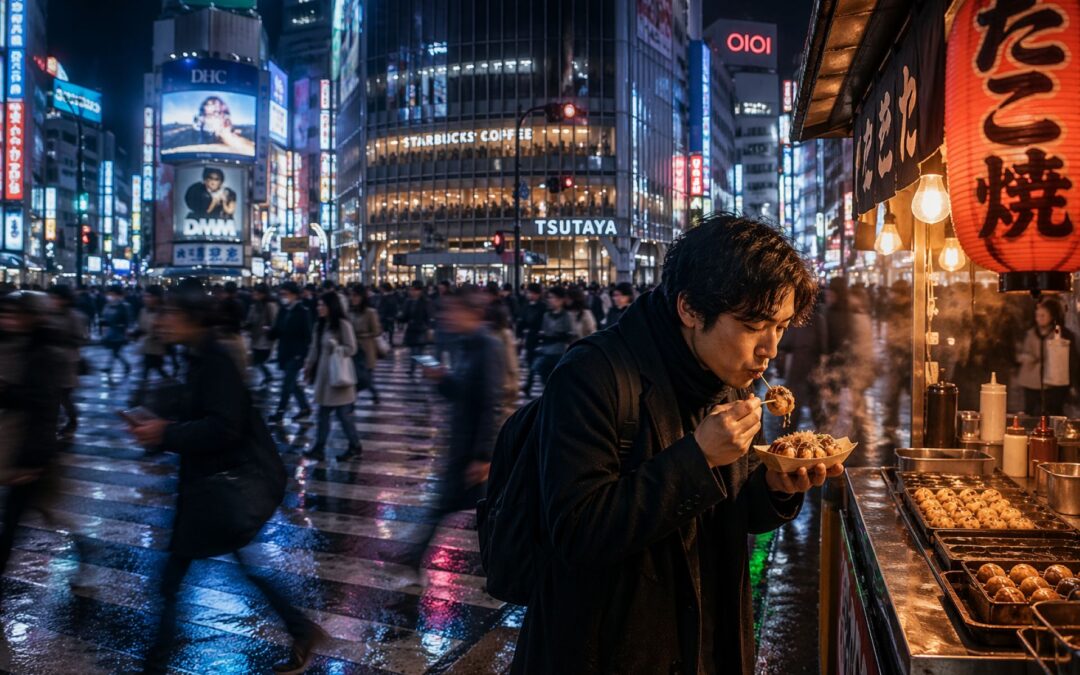
One evening in Tokyo, a man rushed through the crowded Shibuya crossing, his mind racing faster than the people around him. His phone vibrated relentlessly—messages from coworkers, reminders of deadlines, fragments of unfinished conversations—all demanding his attention at once. The city pulsed with urgency, and he moved in sync with it, absorbed in a future that had not yet happened.
He glanced at his watch.
Late.
Again.
The thought tightened something inside him. He pushed forward, weaving through the crowd, already imagining the consequences—disapproval, embarrassment, the quiet judgment of others. His destination was Shinjuku. His only chance was the Yamanote Line. If he missed it, everything would spiral.
By the time he reached the station entrance, breath slightly uneven, he checked his watch once more.
He had already missed the train.
The realization didn’t arrive dramatically. It sank in slowly, like a quiet collapse. His shoulders dropped. The urgency dissolved, leaving behind a strange emptiness. For a moment, he simply stood there, suspended between what had already happened and what he feared might come next.
Then, almost absentmindedly, he looked across the street.
A small food stand. Takoyaki.
It had been years—he couldn’t remember the last time he’d stopped for something so trivial. There was always something more important waiting. Something urgent. Something ahead.
Still, with nothing left to chase in that moment, he walked toward it.
He ordered a portion. The vendor handed it over, still hot, steam rising gently into the cool evening air. He took a bite.
And something shifted.
The noise of the city softened. The crowd blurred into the background. The endless chain of thoughts—meetings, consequences, expectations—fell silent, as if someone had quietly turned them off.
There was only the taste.
Warm. Savory. Familiar.
For the first time that evening, nothing else seemed to matter—not the train he missed, not the meeting waiting without him, not the imagined futures his mind had been rehearsing. Just this moment. Just this experience.
And then, as quickly as it arrived, it began to fade.
Because that moment—like all moments—would never happen again.
Sleepwalking Through Life
What happened to the man in Tokyo is not unusual. It’s not even particularly dramatic. In fact, it’s so ordinary that most of us wouldn’t notice anything remarkable about it—except for that brief interruption, that small moment of presence brought on by something as simple as food.
The rest of it? That’s how we live.
We move through our days physically present but mentally elsewhere. Sitting on a train, staring out the window, yet seeing nothing. Walking through a city, surrounded by movement and color, yet absorbing none of it. Even in conversation, we often listen just enough to respond, while our minds drift toward something unresolved—a comment from earlier, a task waiting later, a vague unease we can’t quite name.
It’s a strange condition. We are here, but not really here.
Instead, we inhabit a continuous stream of thought—replaying past events, anticipating future outcomes, constructing scenarios that may never unfold. The mind becomes a kind of parallel reality, one that feels urgent and important, even when it has little to do with what’s actually happening in front of us.
And so, life begins to pass in fragments.
A meal becomes something to finish rather than experience. A walk becomes a transition between two destinations. A moment of silence becomes something to fill. Even the presence of another person—something inherently rich and unpredictable—is reduced to background noise against the louder voice of our own thinking.
What makes this more unsettling is how normal it feels. There’s no clear signal that something is wrong. No obvious loss that demands our attention. The cost reveals itself only in retrospect, in the quiet realization that entire stretches of life have slipped by without ever being fully lived.
We remember that we were there—but not what it felt like to be there.
The landscapes we passed, the conversations we had, the fleeting expressions on someone’s face—all of them gone, not because they lacked meaning, but because we weren’t present enough to receive them.
In this sense, it’s not that life is uneventful. It’s that we are unavailable to it.
And perhaps that’s the deeper tragedy—not that moments disappear, but that we often fail to meet them when they arrive.
Ichigo Ichie: One Time, One Meeting
There is a phrase in Japanese that captures what we so often overlook.
Ichigo Ichie.
It is usually translated as “once in a lifetime” or “one time, one meeting.” But the meaning runs deeper than the words suggest. It is not about rare, extraordinary events. It is about the quiet recognition that this moment—whatever it is—will never happen again in exactly the same way.
Not later. Not tomorrow. Not even a second from now.
The concept emerged from the Zen-influenced tea culture of Japan, where even the simplest gathering was treated with a kind of reverence. The tea ceremony, on the surface, appears repetitive—same utensils, same gestures, same structure. But beneath that repetition lies a subtle awareness: no two ceremonies are ever the same.
Different light. Different mood. Different thoughts. Different people, even if they are the same individuals.
Sen no Rikyū, one of the most influential tea masters in history, emphasized this idea through his approach to the tea ceremony. He encouraged hosts and guests to treat each meeting as something unrepeatable—not because it was rare, but because it was alive. A gathering was not just an event; it was a moment that would dissolve the instant it passed.
Even if the same people were to meet again, under the same roof, performing the same ritual, it would not be the same meeting. Something subtle would have changed. Something always does.
Centuries later, Ii Naosuke gave this awareness a name: Ichigo Ichie. Living in a time of political instability and constant threat, he treated each tea gathering as if it might be his last. Not out of fear, but out of clarity.
If this truly were the last time, how would you show up?
How would you listen? How would you serve? How would you sit in that moment, knowing it will never return?
This is the essence of Ichigo Ichie. It is not asking us to chase special experiences. It is asking us to recognize that every experience is already special—simply because it cannot be repeated.
A conversation with a friend. A quiet evening alone. The taste of something familiar. The sound of distant traffic. Even moments we consider ordinary are, in truth, singular events in the unfolding of our lives.
And yet, most of them pass unnoticed.
Not because they lack value—but because we assume there will always be another one just like it.
The Illusion of Past and Future
If every moment is unrepeatable, then why do we spend so little time actually living it?
The answer lies in something deceptively simple: we are rarely where we think we are.
We believe we move through time—carrying the past behind us and stepping toward the future ahead. But when examined closely, both past and future reveal themselves as strangely absent. They do not exist anywhere except in the mind.
The past survives only as memory. A reconstruction. Fragments stitched together into a narrative that feels real, even though it no longer exists outside of thought. The future, on the other hand, is projection—an imagined landscape filled with expectations, fears, and possibilities that may never unfold.
And yet, both feel vividly alive.
This is where the confusion begins.
Eckhart Tolle expresses this with a kind of disarming clarity: there is never a time when your life is not this moment. Everything that has ever happened to you, and everything that will happen, is experienced only in the present.
Even when we revisit the past, we do so now. Even when we worry about the future, that worrying unfolds now.
The present is not just another point in time—it is the only place where anything actually occurs.
But the mind has a peculiar tendency to drift away from it. It replays what has already happened, trying to reinterpret or control it. It anticipates what might happen, attempting to prepare for outcomes it cannot guarantee. In doing so, it creates a kind of internal world that feels urgent and important, often more compelling than the reality in front of us.
We become absorbed in this mental activity, mistaking it for life itself.
A comment someone made days ago can replay endlessly, carrying the same emotional weight each time. A future scenario—losing a job, disappointing someone, failing in some way—can generate real anxiety, even though it has not happened and may never happen.
The body reacts. The emotions respond. And the mind continues its loop.
All the while, the present moment remains untouched, quietly waiting.
It’s not that thinking is inherently problematic. Memory and anticipation have their place. But when they dominate our attention, they begin to distort our relationship with reality. We no longer respond to what is actually happening—we respond to what we think has happened or what we fear might happen.
In this sense, much of our suffering is not rooted in the present, but in our thoughts about something that isn’t here.
And so, we find ourselves caught between two illusions—one behind us, one ahead—while the only thing that is real slips by, unnoticed.
The Hidden Cost of Living in the Mind
At first glance, living in our thoughts doesn’t seem like a problem. It feels productive, even necessary. We analyze, plan, anticipate, and reflect. These abilities give us a sense of control, a feeling that we are staying ahead of life rather than being caught off guard by it.
But there is a subtle shift that often goes unnoticed.
What begins as thinking gradually becomes overthinking. Reflection turns into rumination. Planning turns into worry. And before we realize it, the mind is no longer serving us—we are serving it.
The consequences are not abstract. They are felt.
Anxiety rarely comes from what is happening right now. It arises from what might happen. Regret does not exist in the present moment; it lives in the reconstruction of what has already passed. Anger lingers long after the event that triggered it, sustained not by reality, but by the mind’s ability to replay it again and again.
The man in Tokyo wasn’t anxious because of the moment he was in. In that moment, he was simply walking through a crowded street. His anxiety came from everything his mind projected onto that moment—the meeting he might miss, the judgment he might face, the consequences that might follow.
None of it had happened.
And yet, it felt real enough to tighten his chest, to rush his steps, to pull his attention away from everything around him.
This is the hidden cost of living in the mind: we begin to react not to life itself, but to our interpretations of it.
Over time, this creates a quiet disconnection.
Moments that could have been rich and textured become thin and forgettable. Experiences lose their depth because we are not fully present to receive them. Even pleasure becomes muted, as part of our attention remains entangled in something else—something unresolved, something anticipated, something imagined.
Life continues to unfold, but we experience only a fraction of it.
There is also a more subtle loss—one that is harder to detect. When we are constantly occupied with thought, we miss the small details that give life its character. The way light shifts through a room. The tone of someone’s voice. The rhythm of a familiar place. These are not dramatic experiences, but they are what make moments feel alive.
Without them, everything begins to blur together.
And perhaps that is why time seems to move faster the less present we are. Not because it actually does, but because fewer moments register deeply enough to be remembered. Days collapse into each other. Weeks disappear. Entire phases of life feel like they passed in an instant.
Not because they were empty—but because we were elsewhere.
The tragedy is not that life is short. It is that so much of it goes unnoticed, consumed by thoughts that are not even real in the way the present is real.
And in losing the present, we lose the only place where life can actually be lived.
Life as a Flowing River
If there is a way to understand the nature of our experience more clearly, it is through movement.
Life does not stand still. It does not wait for us to catch up, nor does it repeat itself for our convenience. It flows—quietly, continuously—carrying everything along with it.
A useful way to see this is through a simple image: a river.
You are not standing beside it, observing from a distance. You are in it. Always have been. Drifting forward, whether you resist or not. The surroundings change constantly—sometimes subtly, sometimes all at once. The people beside you appear, remain for a while, and then disappear, carried away by currents you cannot control.
Nothing stays.
The scenery that surrounds you now—the places, the routines, the faces—feels stable only because change happens gradually. But given enough time, everything shifts. What feels permanent reveals itself as temporary. What feels ordinary becomes something you can no longer return to.
This is not just a poetic idea. It is a direct description of how experience unfolds.
There was a version of your life that once felt normal, even unremarkable. A time when certain people were always around. When certain places were familiar to the point of invisibility. When certain moments felt like they would repeat endlessly.
But they didn’t.
They moved on. Or you did.
And now, those moments exist only as memory—if they exist at all.
The river never stopped.
This is what Ichigo Ichie points toward in a quiet, almost understated way. It does not demand that we hold onto moments more tightly. It reminds us that holding on is impossible to begin with.
Every experience passes the moment it appears.
A conversation ends while it is still happening. A season changes while we are still adjusting to it. Even as you read these words, the moment in which you began reading them has already vanished.
There is no way to step back into it.
This realization can feel unsettling at first. It confronts us with the fact that nothing can be preserved—not exactly, not completely. The idea that we can return to something, relive it, or recreate it as it was is, at best, an approximation.
And yet, there is something clarifying about it.
If nothing can be repeated, then everything becomes more vivid. Not because it lasts longer, but because it is seen for what it is—temporary, fragile, and therefore inherently valuable.
The river does not need to slow down for a moment to matter.
It is enough that the moment exists at all.
And perhaps the only real question is whether we are aware of it as it passes—or whether, once again, we let it drift by unnoticed.
This Too Shall Pass: The Double-Edged Truth
There is a story, often told in different forms, about a king searching for wisdom.
Despite his wealth and power, he felt restless—disturbed by how easily joy slipped away and how deeply suffering seemed to linger. Nothing satisfied him for long. Every victory felt temporary, and every hardship felt endless.
Desperate for clarity, he summoned a sage and demanded a piece of wisdom that would hold true in all situations—something that could steady him whether life was going well or falling apart.
Weeks later, the sage returned with a small box.
Inside it was a simple ring.
Engraved on it were a few words: “This too shall pass.”
At first, the message seemed almost trivial. But over time, the king began to understand its weight.
In moments of triumph, when everything aligned in his favor, the ring reminded him that this, too, would not last. The joy, the success, the admiration—all of it was temporary. Not in a cynical way, but in a grounding one. It softened his attachment, allowing him to appreciate what he had without clinging to it as if it could be preserved.
And in moments of suffering, when loss or hardship clouded everything else, the same words offered a different kind of relief.
This, too, would pass.
The pain that felt overwhelming, permanent, defining—it was none of those things. It was an experience moving through him, not a condition that would remain forever.
This is the double-edged nature of transience.
On one side, it asks us to confront a difficult truth: everything we value will eventually change, fade, or disappear. The people we love, the moments we cherish, the versions of ourselves we feel attached to—all are part of the same movement. For many, this realization brings a quiet grief. A sense of fragility that is hard to accept.
We want things to last. We want to hold on.
But on the other side of that same truth lies something unexpectedly liberating.
If everything passes, then nothing needs to be held onto so tightly. No moment needs to carry the burden of permanence. No experience—good or bad—defines the whole of life.
Epictetus pointed toward this with a kind of blunt clarity: much of our suffering comes from trying to control what is not ours to control. We want people to remain as they are, situations to unfold as we prefer, outcomes to align with our expectations.
But life does not operate that way.
To resist this is to place ourselves in constant tension with reality.
To accept it is to loosen that tension—not by withdrawing from life, but by meeting it more honestly.
Ichigo Ichie and “this too shall pass” are not separate ideas. They converge at the same point: the recognition that every moment is temporary, and precisely because of that, it deserves our full attention.
Not because we can keep it—but because we cannot.
The awareness of impermanence does not diminish life. It sharpens it.
It turns ordinary moments into something more vivid, not by changing what they are, but by changing how we see them.
And perhaps that is the shift that matters—not trying to make moments last longer, but learning to be fully present while they are here.
Learning to See What Is Already Here
Understanding something intellectually is one thing. Living it is something else entirely.
It’s easy to agree with the idea that the present moment matters. It’s much harder to remain in it, especially when the mind has been conditioned for years—sometimes decades—to wander.
Even with the clearest intention, attention slips.
You begin a walk, determined to notice your surroundings, and within minutes, you’re caught in a chain of thought. A memory leads to another, a concern branches into possibilities, and before you know it, you’ve traveled some distance without registering anything along the way.
The body moves. The mind drifts.
This isn’t a failure. It’s simply how the mind behaves.
But recognizing this tendency is where something begins to shift. Not immediately, not perfectly—but gradually.
There are moments, small and almost unremarkable, when attention returns.
You notice the sound of footsteps against the pavement. The texture of air as it moves across your skin. The subtle variations in people’s voices as they pass by. These details were always there, but they went unseen—not because they lacked significance, but because your attention was elsewhere.
When you begin to notice them, something changes.
The world doesn’t become extraordinary in a dramatic sense. It becomes quietly vivid.
A simple walk becomes something more than a transition from one place to another. It becomes an experience in itself. Waiting for a train is no longer just a pause between movements; it becomes an opportunity to observe, to listen, to be.
Even conversations begin to feel different.
Instead of thinking about what to say next, you find yourself actually listening. Not just to the words, but to the pauses, the tone, the subtle expressions that shape meaning. The interaction becomes less about performance and more about presence.
This shift is subtle, but it has weight.
It doesn’t remove difficulties. It doesn’t eliminate stress or uncertainty. But it changes your relationship to them. Instead of being consumed by thought, you begin to see it as one layer of experience—not the whole of it.
Moments open up.
This was something that became clearer in places where the surroundings naturally invite attention. Walking along a quiet river, for example, or moving through a city that feels alive in its details—the architecture, the movement, the rhythm of daily life.
Not because those places are inherently special, but because they make it easier to notice what is already there.
And yet, the same depth exists everywhere.
It is not dependent on location, circumstance, or even mood. It is available in ordinary moments—in the act of eating, walking, speaking, or simply sitting without distraction.
The challenge is not finding something meaningful.
It is seeing what is already meaningful, before it passes.
The Myth of “Once-in-a-Lifetime” Experiences
We tend to reserve our attention for what we believe are important moments.
The logic is subtle but deeply ingrained: some experiences matter more than others. Some are worth remembering, worth being present for—while the rest can pass unnoticed without consequence.
So we create a hierarchy.
At the top are the so-called “once-in-a-lifetime” experiences. Traveling to distant places. Standing before something grand and iconic. Witnessing rare events. These are the moments we anticipate, plan for, and promise ourselves we will fully appreciate when they arrive.
And often, we do.
But something curious happens.
Even in those moments, the mind can wander. Even there, we can find ourselves thinking about something else—taking photos instead of looking, planning what comes next instead of absorbing what is here. The experience is labeled as special, yet our attention remains fragmented.
And when it ends, we place it in memory, satisfied that we lived something meaningful.
But according to Ichigo Ichie, this way of seeing is fundamentally flawed.
It assumes that meaning is rare.
That value is reserved for exceptional circumstances.
That life becomes significant only when something unusual happens.
But if every moment is unrepeatable, then this distinction begins to collapse.
There is no such thing as an ordinary experience.
A conversation at the dinner table—never to happen in exactly the same way again. A quiet moment with someone you care about—shaped by countless subtle factors that will never align the same way twice. Even something as simple as looking out the window or walking through a familiar street carries a uniqueness that cannot be recreated.
Not because the activity is extraordinary, but because the moment itself is.
Once it passes, it’s gone.
Irretrievable.
This realization changes the question we ask.
Instead of wondering how to find more meaningful experiences, we begin to see that meaning is already present—waiting to be noticed.
The problem is not a lack of significant moments.
It is the habit of overlooking them.
We chase what is rare while neglecting what is constant. We wait for life to become memorable, unaware that it is quietly offering us something unrepeatable, again and again, in forms too simple to impress us.
And perhaps that is why so many people feel that life slips by too quickly.
Not because it lacks depth, but because that depth was never fully seen.
Ichigo Ichie does not ask us to abandon extraordinary experiences.
It asks something far more subtle.
To recognize that the extraordinary is not something we occasionally encounter.
It is something we are constantly passing through.
Conclusion
There is no moment in life that repeats itself.
Not in the way we imagine. Not in the way memory suggests. What appears familiar is never identical. The same place feels different. The same conversation unfolds differently. Even the same person is not quite the same, because time has already moved them—just as it has moved you.
And yet, we live as if there will always be another chance.
Another conversation. Another walk. Another ordinary evening we can afford not to fully notice.
Ichigo Ichie quietly challenges this assumption.
It does not ask us to change our lives dramatically. It does not demand that we seek out rare experiences or transform every moment into something profound. Instead, it points to something far simpler—and far more difficult.
To be here.
Not partially. Not distracted. Not divided between what has been and what might be. But fully present, even if only for a few seconds at a time.
Because that is all there ever is.
The man in Tokyo did not change his life in a grand way. He did not escape his responsibilities or resolve all his anxieties in that brief pause at the food stand. But for a moment, he experienced something he had been missing—not because it was hidden, but because his attention had been elsewhere.
And that moment was enough to reveal something essential.
That life does not wait for the right conditions to become meaningful.
It is already meaningful—quietly, continuously—within the moments we are most likely to overlook.
The question is not whether life offers us something worth experiencing.
It is whether we are present enough to receive it before it disappears.