
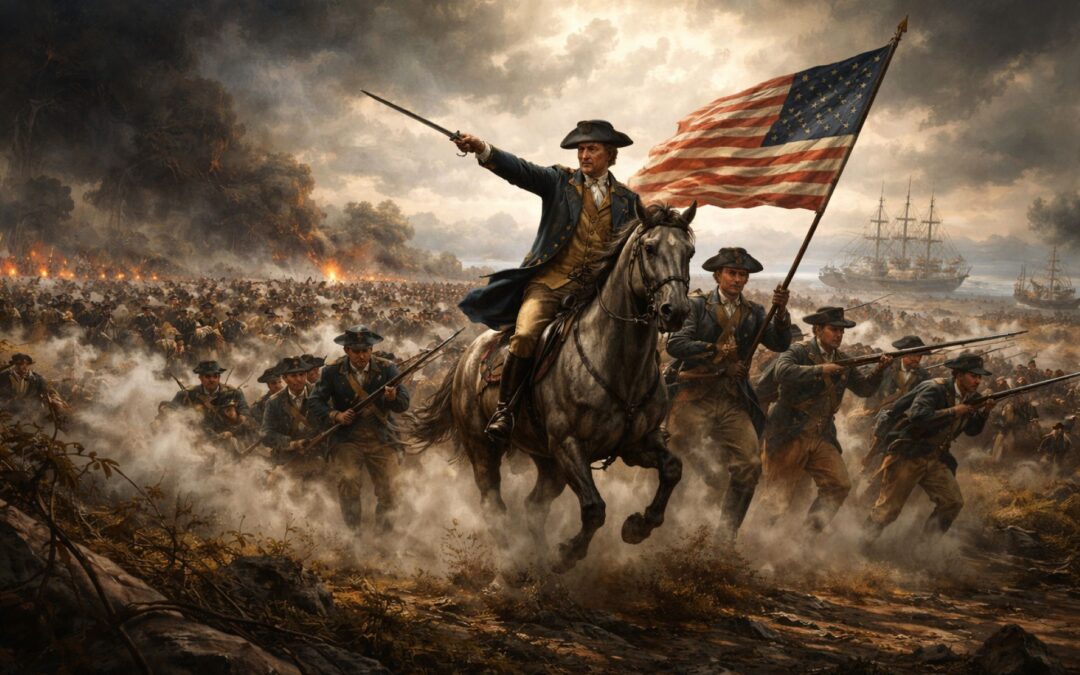
In the late eighteenth century, a cluster of thirteen British colonies on the eastern coast of North America launched a rebellion against one of the most powerful empires in the world. What began as a dispute over taxation and political authority soon escalated into a full-scale war that reshaped global politics. The conflict, known as the American Revolution, not only resulted in the creation of a new nation—the United States—but also triggered political and ideological transformations that would reverberate across Europe and the wider world.
To understand how this revolution unfolded, it is important to see it not as a sudden uprising but as the culmination of decades of imperial expansion, economic tension, and political disagreement between Britain and its colonies. By the mid-1700s, the British Empire had emerged as the dominant European power in North America following its victory over France in the Seven Years’ War. The war dramatically expanded British territory on the continent, but it also left Britain with enormous debt and new responsibilities for defending and administering its growing empire.
From London’s perspective, the solution seemed straightforward: the colonies that benefited from British protection should help pay for it. From the perspective of many colonists, however, the new taxes imposed by Parliament represented an unacceptable intrusion into their political rights. For decades the colonies had enjoyed a significant degree of self-governance, managing their own internal affairs through local assemblies. Suddenly, Britain was attempting to assert far greater control over colonial commerce, taxation, and administration.
What followed was a rapid escalation of tension. Economic protests evolved into organized resistance. Political disagreements turned into street confrontations. British attempts to enforce authority only deepened colonial anger, strengthening the belief among many Americans that their liberties were under threat. Within a generation, the relationship between Britain and its colonies had deteriorated so dramatically that armed conflict became inevitable.
The American Revolution was therefore not simply a war of independence; it was a complex struggle involving competing political visions, military strategy, international alliances, and internal contradictions. Colonial militias and an improvised Continental Army faced the most powerful professional military in the world. Foreign powers such as France and Spain entered the conflict, transforming a colonial rebellion into a global war. Meanwhile, Native Americans, enslaved Africans, and loyalist colonists were drawn into the turmoil, each group pursuing its own hopes and survival within the larger conflict.
Against this backdrop, the revolution unfolded through a series of dramatic turning points—moments of crisis, unexpected victories, strategic gambles, and international intervention. The story of how a loose collection of colonies managed to defeat the British Empire is one of the most remarkable episodes in modern history, shaped by political ideas as much as by battlefield success.
Understanding the origins of this conflict requires returning to the moment when Britain emerged victorious from a global war, only to discover that the peace had created problems of its own.
The Aftermath of the Seven Years’ War
Britain’s Expanding Empire
By the mid-eighteenth century, Britain and France were locked in a long struggle for global dominance. Their rivalry stretched from Europe to the Caribbean, from India to North America. In the American colonies, the conflict centered on control of the vast interior of the continent, particularly the Ohio River Valley. Both empires claimed these lands, and both viewed them as critical to their economic and strategic ambitions.
The tensions eventually erupted into a major global conflict known as the Seven Years’ War. In North America, the war is often called the French and Indian War, reflecting the alliances formed during the conflict: Britain and its colonies on one side, and France supported by many Native American tribes on the other.
The war proved to be one of the most significant turning points in colonial history. After years of fighting, Britain emerged victorious. In the 1763 Treaty of Paris, France ceded nearly all of its North American territory east of the Mississippi River to Great Britain. Spain, which had allied with France late in the war, transferred Florida to Britain as well. Overnight, Britain became the dominant imperial power across North America.
For the American colonists, the victory initially appeared to be an enormous success. The long-standing French threat that had loomed over the colonies for generations was gone. With French forts and settlements removed from the region, colonists believed the western frontier would soon open for expansion and settlement.
From the British government’s perspective, however, the victory created a very different set of problems. Britain had suddenly acquired vast new territories that needed to be defended, governed, and integrated into the empire. Maintaining military garrisons across the continent and managing relations with Native American tribes would require enormous resources.
At the same time, the war had left Britain with an enormous financial burden. The cost of the conflict had pushed the national debt to unprecedented levels. British leaders in London now faced the difficult question of how to pay for both the war itself and the ongoing costs of maintaining their newly expanded empire.
The Burden of War Debt
By the end of the Seven Years’ War, Britain’s national debt had ballooned to staggering levels. The war had cost the British government approximately £60 million—a massive sum for the time. Servicing this debt already consumed a large portion of the government’s annual revenue, and the cost of maintaining troops in North America only added to the strain.
British policymakers believed the solution was obvious: the American colonies should contribute financially to the defense of the empire that protected them. After all, the war had largely been fought to defend colonial interests from French expansion. In London’s view, it was reasonable to expect the colonists to help cover the expenses.
For many colonists, however, this reasoning was deeply unpopular. While they had benefited from British military protection, they also believed they had already contributed significantly during the war through local taxes, militia service, and logistical support. More importantly, the colonies had long been accustomed to managing their own internal taxation through their elected assemblies.
The new British policies threatened to overturn this tradition. Parliament began introducing legislation designed to regulate colonial trade more tightly and collect new revenue from the colonies. These measures were intended not only to raise money but also to assert Britain’s authority over its growing empire.
What British officials saw as reasonable imperial governance, many colonists saw as a dangerous expansion of distant political control. The stage was set for a confrontation that would soon escalate far beyond a simple disagreement over taxes.
Taxation and Colonial Resistance
The Sugar Act
In the years following the Seven Years’ War, British leaders began implementing policies designed to raise revenue from the American colonies. The first of these major measures was the Sugar Act of 1764, which placed duties on sugar, molasses, and other goods imported into the colonies.
At first glance, the law did not appear particularly severe. Taxes on molasses had technically existed before. However, the new act was different in two crucial ways. First, it lowered the official tax rate but significantly strengthened enforcement. Second, it expanded customs authority to prosecute smugglers through vice-admiralty courts rather than colonial juries.
For many colonists—especially merchants and traders—this represented a worrying development. The law threatened profitable trade networks that had operated with relative freedom for decades. It also signaled that the British government intended to exercise far tighter control over colonial commerce.
While the Sugar Act alone did not trigger mass protest, it marked the beginning of a new imperial approach. Britain was no longer merely regulating trade for the benefit of the empire—it was directly taxing the colonies to generate revenue.
The Stamp Act Crisis
The situation escalated dramatically in 1765 with the introduction of the Stamp Act, one of the most controversial laws ever imposed on the colonies.
Unlike earlier taxes that applied primarily to trade, the Stamp Act affected everyday life. It required that many printed materials—including legal documents, newspapers, contracts, licenses, and even playing cards—carry an official government stamp. Colonists had to purchase this stamp as proof that the required tax had been paid.
The reaction across the colonies was immediate and explosive.
Merchants, lawyers, printers, and ordinary citizens alike saw the law as a direct attack on colonial autonomy. Demonstrations broke out in major cities such as Boston, New York, and Philadelphia. Protest groups organized boycotts of British goods, hoping to pressure British merchants and manufacturers to oppose the policy.
One of the most influential protest organizations to emerge during this period was the Sons of Liberty, a loosely organized network of activists who used both political pressure and intimidation to resist British authority. Tax collectors found themselves threatened, harassed, or forced to resign. Effigies of British officials were burned in public demonstrations.
Colonial leaders also began coordinating their resistance. Representatives from several colonies met at the Stamp Act Congress in 1765, where they drafted petitions arguing that Parliament had no right to tax them without their consent.
“No Taxation Without Representation”
At the center of colonial resistance was a simple but powerful political principle: “No taxation without representation.”
Colonists argued that since they had no elected representatives in the British Parliament, Parliament had no legitimate authority to impose taxes upon them. Only their own colonial assemblies—elected by local citizens—had the right to levy taxes.
British officials rejected this argument. They insisted that Parliament represented all British subjects through a concept known as virtual representation, meaning that members of Parliament acted in the interests of the entire empire, not just the voters who elected them.
To the colonists, however, this argument seemed absurd. From their perspective, lawmakers thousands of miles away could not possibly understand or represent their interests.
The conflict quickly expanded beyond taxation itself. What had begun as a dispute over money was now becoming a debate about political rights, representation, and the nature of imperial authority.
Faced with growing protests and economic pressure from British merchants harmed by colonial boycotts, Parliament eventually repealed the Stamp Act in 1766. However, the British government simultaneously passed the Declaratory Act, asserting that Parliament still possessed the authority to legislate for the colonies “in all cases whatsoever.”
Rather than resolving the conflict, the crisis had only deepened the divide between Britain and its American colonies. The colonists had learned that organized resistance could force Britain to back down—but they had also learned that Britain had no intention of surrendering its authority over them.
Renewed British Control and Escalating Tensions
The Declaratory Act and Parliamentary Authority
Although the British Parliament repealed the unpopular Stamp Act in 1766, it had no intention of surrendering its authority over the American colonies. To make this clear, Parliament simultaneously passed the Declaratory Act, a law stating that it had the full right to legislate for the colonies “in all cases whatsoever.”
For British leaders, this was meant to restore imperial authority after the embarrassment of colonial protests. They viewed the repeal of the Stamp Act as a pragmatic decision rather than a concession of principle. Parliament still believed it possessed the legal right to govern and tax the colonies.
Many colonists, however, interpreted the Declaratory Act as a warning. Even though the immediate crisis had ended, the British government was clearly asserting that colonial self-government existed only at Parliament’s discretion. This raised a troubling question: if Parliament had unlimited authority over colonial affairs, what prevented it from imposing new taxes or regulations in the future?
The tension between imperial authority and colonial political rights remained unresolved, and it would soon return with renewed intensity.
The Townshend Duties
In 1767, Parliament once again attempted to raise revenue from the American colonies. The new policy, known as the Townshend Duties, placed taxes on several imported goods, including glass, lead, paint, paper, and tea.
British officials hoped this approach would avoid the controversy that had surrounded the Stamp Act. Unlike the previous tax, which applied directly to internal colonial activities, the Townshend duties were levied on imports. Parliament believed the colonists might accept these taxes as legitimate trade regulations.
Instead, the reaction across the colonies was swift and hostile.
Colonial leaders quickly recognized that the purpose of the duties was still to generate revenue without colonial consent. Once again, merchants organized boycotts of British goods, refusing to import taxed items. These non-importation agreements spread throughout major colonial cities, putting pressure on British merchants whose businesses depended on American markets.
At the same time, colonial assemblies issued statements condemning Parliament’s actions. Writers and pamphleteers argued that the taxes represented another violation of the principle that only colonial legislatures had the authority to tax the people living under them.
As resistance grew, Britain attempted to enforce its authority more aggressively.
The Boston Massacre
Boston had become one of the centers of colonial resistance. To maintain order and ensure that customs laws were enforced, the British government stationed troops in the city beginning in 1768. For many colonists, the presence of a standing army in peacetime felt like a military occupation rather than protection.
Relations between soldiers and civilians quickly deteriorated. Competition for jobs, constant political tension, and frequent street confrontations created a volatile atmosphere in the city.
This tension finally erupted on the night of March 5, 1770.
A crowd of Boston residents gathered near the Customs House, where a British sentry was standing guard. The crowd began taunting the soldier, throwing snowballs and other objects. Additional British soldiers arrived to support their comrade as the crowd continued to grow.
In the chaos and confusion that followed, shots were fired.
When the incident ended, five colonists had been killed. The event quickly became known as the Boston Massacre.
Patriot leaders used the incident as powerful propaganda against British rule. Newspapers and pamphlets described the event as a deliberate act of brutality committed by British soldiers against defenseless civilians. Engravings depicting the massacre circulated widely throughout the colonies, fueling anger toward British authority.
Although the British government eventually repealed most of the Townshend duties later that year, it deliberately kept the tax on tea in place to demonstrate that Parliament still possessed the power to tax the colonies.
Rather than calming tensions, this decision ensured that the conflict between Britain and its colonies would continue to escalate.
The Boston Tea Party and the Road to War
The Tea Act
By the early 1770s, tensions between Britain and its American colonies had not disappeared. Although Parliament had repealed most of the Townshend duties, it deliberately kept the tax on tea in place to reinforce its authority over the colonies. The issue was no longer just about money—it had become a symbolic struggle over the right of Parliament to govern and tax colonial subjects.
At the same time, the British East India Company was facing severe financial difficulties. The company possessed enormous quantities of unsold tea and was struggling to remain profitable. In response, the British government passed the Tea Act of 1773, designed to help the company recover financially.
The law allowed the East India Company to ship tea directly to the American colonies and sell it through selected colonial merchants, bypassing many intermediaries. This arrangement significantly reduced the price of tea. Even with the existing tax included, the tea would be cheaper than smuggled tea that colonists often purchased from Dutch traders.
From Britain’s perspective, the policy seemed practical and even generous. Colonists would receive cheaper tea, the East India Company would recover financially, and Parliament would maintain its authority to tax the colonies.
However, many colonists interpreted the act very differently. They saw it as an attempt to lure them into accepting the tea tax. If colonists purchased the cheaper tea, they would effectively acknowledge Parliament’s right to tax them. Merchants were also angered because the law granted the East India Company a powerful monopoly, threatening the livelihoods of colonial traders.
As shipments of tea began arriving in American ports, resistance spread rapidly across the colonies.
The Boston Tea Party
In several colonial cities, protests forced ships carrying British tea to turn back before unloading their cargo. Boston became the center of the most dramatic confrontation.
In late 1773, three British ships carrying large quantities of tea arrived in Boston Harbor. Colonial protesters demanded that the ships be sent back to Britain without unloading their cargo. However, the royal governor of Massachusetts refused to allow the ships to leave without paying the required tax.
The standoff continued for several weeks as tensions grew.
Finally, on the evening of December 16, 1773, a group of colonists decided to take direct action. A band of protesters, many associated with the Sons of Liberty, disguised themselves as Native Americans and marched to the harbor.
They boarded the British ships and began throwing the cargo of tea into the water.
By the end of the night, 342 chests of tea—worth thousands of pounds—had been dumped into Boston Harbor while thousands of spectators watched from the shore. The protest was carefully organized and disciplined. No other cargo was touched, and the participants focused entirely on destroying the taxed tea.
The event became known as the Boston Tea Party, and it quickly became one of the most famous acts of resistance in colonial history.
For the colonists involved, the destruction of the tea was a powerful symbol of defiance against what they saw as unjust taxation. For the British government, however, the act represented outright rebellion and destruction of private property.
The Coercive Acts
The British government responded to the Boston Tea Party with a series of punitive measures designed to restore imperial authority and punish the colony of Massachusetts.
These laws, known in Britain as the Coercive Acts but widely called the Intolerable Acts in the colonies, imposed severe restrictions on Massachusetts. The port of Boston was closed until the destroyed tea had been paid for. The colony’s charter was altered, limiting local self-government and increasing royal control. British officials accused of crimes in the colonies could be sent to Britain for trial, and additional troops were stationed in the region.
In effect, Massachusetts was placed under strict imperial supervision.
British leaders believed that harsh punishment would isolate Massachusetts and discourage further resistance. Instead, the measures had the opposite effect. Colonists across North America viewed the Intolerable Acts as a direct attack on colonial liberties.
Support for Massachusetts spread throughout the colonies. Supplies and aid were sent to Boston, and political leaders began coordinating their response to British actions.
What had once been a series of local disputes was rapidly evolving into a broader colonial movement. The next step would bring representatives from nearly all the colonies together to determine how to confront Britain’s escalating authority.
The First Continental Congress
Colonial Coordination
As news of the Intolerable Acts spread throughout North America, colonial leaders realized that the conflict with Britain had reached a new and dangerous stage. If the British government could impose such harsh measures on Massachusetts, many feared that other colonies might soon face similar punishment.
In response, representatives from twelve of the thirteen colonies agreed to meet in Philadelphia in 1774 to discuss a unified response. This gathering became known as the First Continental Congress, and it marked one of the most significant moments of political cooperation in colonial history.
Delegates who attended the Congress included some of the most influential figures in colonial society—lawyers, merchants, landowners, and experienced political leaders. The group included individuals who would later become central figures in the American Revolution, such as George Washington, John Adams, and John Jay.
Despite their shared concerns, the delegates were far from unanimous in their views. Some still hoped that the colonies could reconcile with Britain and restore their traditional rights within the empire. Others believed that the British government had already gone too far and that stronger resistance was necessary.
After intense debate, the Congress ultimately agreed on a series of coordinated actions designed to pressure Britain without immediately declaring independence.
Preparing for Conflict
The First Continental Congress organized a continental boycott of British goods, hoping that economic pressure would force Britain to reconsider its policies. Colonists were encouraged not only to stop importing British products but also to reduce consumption and promote local production.
At the same time, colonial leaders began preparing for the possibility that peaceful resistance might fail.
Local militias across the colonies began increasing their readiness. Volunteer forces trained regularly and stockpiled weapons and supplies. Many of these soldiers became known as Minutemen, a name reflecting their readiness to mobilize at a minute’s notice.
Although the Congress did not formally declare independence or call for war, it signaled that the colonies were now coordinating their political and military preparations on a continental scale. The relationship between Britain and its colonies had deteriorated to the point where armed conflict seemed increasingly likely.
In Massachusetts, the situation was particularly tense. British authorities were determined to prevent the colonial militias from gathering weapons and supplies, while colonial leaders were equally determined to defend their ability to organize and resist.
Within a matter of months, these competing efforts would collide in the countryside outside Boston. The confrontation would ignite the first battles of what would become the American Revolutionary War.
The Outbreak of the Revolutionary War
Lexington and Concord
By early 1775, the conflict between Britain and the American colonies had moved beyond political disputes and economic boycotts. Both sides were now preparing for the possibility of armed confrontation. Colonial militias were gathering weapons and organizing defensive networks, particularly in Massachusetts, where tensions with British authorities were highest.
British officials in Boston became increasingly concerned about the growing stockpiles of weapons held by colonial militias. General Thomas Gage, the British commander in Massachusetts, received orders to take decisive action. His goal was to seize and destroy rebel military supplies believed to be stored in the town of Concord, located about twenty miles from Boston.
In April 1775, Gage dispatched approximately 700 British soldiers on a nighttime march toward Concord. However, the colonial resistance had already developed an effective intelligence network. Riders such as Paul Revere and other messengers spread warnings through the countryside that British troops were on the move.
By the time the British soldiers approached the village of Lexington in the early morning hours of April 19, colonial militia members had already assembled. A small group of local militiamen faced the approaching British troops on the village green.
Neither side had expected the encounter to immediately erupt into violence. Yet in the tense and uncertain moment that followed, a shot was fired. To this day, historians debate which side fired first. What is certain is that the exchange of gunfire that followed left several colonial militiamen dead.
The confrontation at Lexington quickly escalated. British troops continued their march toward Concord, where colonial forces had gathered in larger numbers. Fighting soon broke out again as the British searched the town for weapons and supplies.
As the British troops began their return march to Boston, colonial militias from surrounding towns poured into the area. Along the roads leading back to Boston, these militia forces repeatedly attacked the retreating British soldiers from behind stone walls, trees, and buildings. What had begun as a small confrontation had turned into a running battle across the Massachusetts countryside.
By the time the British troops finally reached Boston, they had suffered significant casualties. The events at Lexington and Concord marked the first military engagements of the American Revolutionary War.
The Siege of Boston
Following the battles of Lexington and Concord, thousands of colonial militiamen gathered around Boston, effectively trapping the British army inside the city. What followed became known as the Siege of Boston, one of the earliest phases of the war.
Although the colonial forces surrounding the city were large in number, they were poorly organized and lacked the structure of a professional army. Many of the soldiers were local volunteers who had little formal training and were accustomed to serving only for short periods.
Nevertheless, their presence created a major strategic problem for the British. The army in Boston found itself surrounded by hostile forces, with limited ability to move beyond the city without risking attack.
Meanwhile, colonial leaders recognized that the conflict had now become a full-scale war. If the colonies hoped to resist the British Empire successfully, they would need to transform their loosely organized militias into a unified fighting force.
This realization would soon lead to one of the most important decisions made by the Continental Congress: the creation of a new national army and the appointment of a commander capable of leading it.
Early Battles and the Birth of the Continental Army
George Washington Takes Command
As fighting erupted in Massachusetts during the spring of 1775, colonial leaders understood that local militias alone would not be sufficient to confront the British Empire. If the colonies hoped to sustain the conflict, they would need a coordinated military structure capable of organizing and directing the scattered militia forces.
When the Second Continental Congress met in Philadelphia in May 1775, the situation in Massachusetts was already approaching open war. Thousands of militia soldiers had gathered outside Boston, effectively trapping British forces in the city. Yet these fighters lacked centralized leadership, consistent supply systems, and a unified command.
The Congress responded by creating a new military force known as the Continental Army. This army would bring together the various colonial militias under a single national command and represent the united effort of the colonies against British authority.
Selecting a commander-in-chief was a crucial decision. The Congress ultimately chose George Washington, a Virginian with military experience from the earlier French and Indian War. Washington’s appointment served both practical and political purposes. His reputation as a capable officer made him a credible military leader, while his southern background helped unify the colonies by showing that the conflict was not limited to New England.
Washington accepted the role with a sense of duty, though the task before him was immense. He inherited an army that lacked proper training, equipment, and organization. Many soldiers had limited discipline, short enlistment periods, and little experience fighting as part of a professional military force.
Nevertheless, Washington traveled north to take command of the colonial forces surrounding Boston. Under his leadership, the scattered militias began the difficult transformation into a structured army capable of confronting Britain’s professional soldiers.
The Battle of Bunker Hill
Even before Washington fully organized the Continental Army, the war produced one of its earliest and most dramatic battles.
In June 1775, British commanders in Boston planned to seize the high ground surrounding the city. Control of the hills overlooking Boston Harbor would give the British a strategic advantage and allow them to break the colonial siege.
Colonial forces learned of the British plan and moved quickly to occupy the hills first. During the night, they constructed defensive fortifications on Breed’s Hill, near Bunker Hill, overlooking the city.
When the British realized what had happened, they launched a direct assault on the colonial positions. The attack required British troops to march uphill across open ground while colonial defenders waited behind their fortifications.
As the British advanced, colonial soldiers held their fire until the enemy approached within close range. When they finally fired, the effect was devastating. The first British assault was repelled, and a second attack also failed under heavy colonial gunfire.
Only during the third assault did the British manage to capture the hill, and that victory came only after colonial forces ran out of ammunition and were forced to retreat.
Although the British technically won the Battle of Bunker Hill, the cost of the victory was staggering. Nearly 1,000 British soldiers were killed or wounded, compared to roughly 400 colonial casualties.
The battle demonstrated that colonial forces—even if poorly trained—could stand their ground against Britain’s professional army. For the British, the battle was a troubling sign that the rebellion would not be easily suppressed.
Fort Ticonderoga and the Artillery Campaign
While fighting continued around Boston, another important development occurred to the north.
In May 1775, colonial forces led by Ethan Allen and Benedict Arnold launched a surprise attack on Fort Ticonderoga, a British stronghold located on Lake Champlain in present-day New York. The fort contained valuable supplies of artillery and ammunition.
The colonial raiders captured the fort with almost no resistance, gaining control of a large number of cannons and other weapons.
However, the challenge remained: how to transport these heavy artillery pieces hundreds of miles to the colonial army outside Boston.
The solution came through the efforts of a young officer named Henry Knox. During the winter of 1775–1776, Knox organized an extraordinary logistical operation. Using sleds and teams of oxen, he hauled more than 100,000 pounds of artillery across frozen rivers, forests, and mountains from Fort Ticonderoga to the colonial forces in Massachusetts.
The journey took months and required remarkable determination and coordination. Yet the arrival of the artillery would soon provide Washington with a powerful advantage.
The British Evacuation of Boston
With Knox’s artillery finally in place, Washington saw an opportunity to break the stalemate around Boston.
In March 1776, colonial forces secretly moved the newly arrived cannons onto Dorchester Heights, a strategic position overlooking both the city and Boston Harbor. When British commanders saw the fortified heights and the artillery aimed directly at their positions, they immediately recognized the danger.
The British army in Boston was suddenly exposed and vulnerable to bombardment. Remaining in the city would risk devastating losses.
Faced with this threat, British forces made the decision to withdraw. In March 1776, approximately 9,000 British soldiers, along with thousands of loyalist civilians, evacuated Boston by ship and sailed away.
The evacuation marked the first major strategic victory for the Continental Army. Although the war was far from over, Washington had successfully forced the British to abandon one of their most important positions in North America.
The conflict, however, was only beginning. While the colonies had taken up arms against Britain, the question still remained: what exactly were they fighting for?
The Idea of Independence
Thomas Paine’s Common Sense
During the early stages of the conflict, many colonists were still uncertain about their ultimate goal. Even after fighting had begun, a large portion of the colonial population did not initially seek full independence from Britain. Instead, many hoped that the conflict might lead to reforms within the British Empire—perhaps restoring the colonies’ traditional rights while keeping them under the British Crown.
This hesitation began to change in early 1776 with the publication of a short but enormously influential pamphlet titled Common Sense.
Written by Thomas Paine, a recent immigrant from England, the pamphlet argued boldly and directly that the colonies should separate entirely from Britain. Paine rejected the idea that a distant monarchy should rule over a people living thousands of miles away. In clear and accessible language, he claimed that the political relationship between Britain and the colonies was both irrational and unjust.
Paine’s arguments resonated deeply with ordinary readers. Unlike many political writings of the time, Common Sense was written in straightforward language that could be easily understood by a wide audience. The pamphlet circulated rapidly throughout the colonies, selling hundreds of thousands of copies and being read aloud in taverns, town meetings, and public gatherings.
More importantly, it helped transform the political conversation. Independence, once considered a radical and dangerous idea, now began to appear both reasonable and necessary. Increasingly, colonists started to believe that reconciliation with Britain was no longer possible.
The Declaration of Independence
As support for independence grew, leaders in the Continental Congress began debating whether the colonies should formally break away from Britain.
In the summer of 1776, Congress appointed a small committee to draft a formal declaration explaining the colonies’ decision. The committee included several prominent figures, but the primary author of the document was Thomas Jefferson, a young lawyer from Virginia.
Jefferson’s draft presented a powerful argument grounded in Enlightenment political philosophy. It declared that all people possess natural rights, including the rights to life, liberty, and the pursuit of happiness. Governments, Jefferson argued, exist to protect these rights, and when a government becomes destructive of those rights, the people have the authority to alter or abolish it.
The document also listed a series of grievances against King George III, accusing him of repeatedly violating the rights of the American colonies through oppressive laws, taxation, and military actions.
On July 2, 1776, the Continental Congress voted in favor of independence. Two days later, on July 4, the Declaration of Independence was formally adopted.
With this decision, the conflict between Britain and the colonies was transformed. What had begun as a rebellion within the British Empire had now become a war for the creation of a new nation—the United States of America.
The declaration also carried enormous risks. From the British perspective, the colonial leaders had committed treason. If the revolution failed, many of them—including Washington and members of Congress—could face execution.
Yet the decision had been made. There was now no possibility of returning to the old relationship with Britain. The war would determine whether the new nation would survive.
British Counteroffensive and American Setbacks
The British Invasion of New York
After losing control of Boston in 1776, British leaders began planning a major military campaign to crush the rebellion. Determined to restore imperial authority, the British government assembled a massive expeditionary force to confront the Continental Army.
The British chose New York City as the center of their next operation. The city’s large harbor and strategic location made it an ideal base for military and naval operations. If Britain could seize New York and control the surrounding waterways, it would gain a powerful foothold from which to divide and isolate the colonies.
In the summer of 1776, a vast British fleet arrived off the coast of New York. The force included more than 130 warships and transport vessels, carrying approximately 25,000 soldiers, including British regular troops and Hessian mercenaries hired from German states.
For the Continental Army, the scale of the British military presence was overwhelming. Washington understood that his forces were outnumbered and less experienced than the professional British army. Nevertheless, he positioned his troops to defend New York, knowing that losing the city without a fight would damage morale and political support for the revolution.
The stage was set for one of the largest battles of the entire war.
The Battle of Long Island
In August 1776, British forces launched their attack on American defenses in Brooklyn, on the western end of Long Island. Washington had placed much of his army in defensive positions around Brooklyn Heights, expecting a direct assault.
British commanders, however, employed a more sophisticated strategy. While one portion of their army engaged the Americans in frontal combat, a much larger British force secretly maneuvered around the American flank.
This maneuver allowed the British to strike the Continental Army from behind, creating chaos among the American troops. The battle quickly turned into a major defeat for Washington’s forces. Large numbers of soldiers were killed, wounded, or captured as the Americans were pushed back toward Brooklyn Heights.
The Continental Army suddenly found itself trapped between the advancing British army and the East River, with little hope of escape.
However, a combination of caution on the British side and extraordinary luck allowed Washington to avoid disaster. Rather than immediately attacking the trapped Americans, British commanders chose to prepare for a siege.
During the night, under the cover of thick fog, Washington organized a daring evacuation. Using small boats, the Continental Army quietly crossed the East River and escaped to Manhattan without the British noticing.
The maneuver saved Washington’s army from destruction, but the campaign for New York was far from over.
The American Retreat
Despite escaping from Long Island, Washington’s army continued to suffer defeats throughout the remainder of the New York campaign. British forces advanced steadily, winning battles and forcing the Americans to withdraw again and again.
The Continental Army was pushed out of Manhattan and driven northward. Each engagement seemed to bring another setback. British military discipline, superior numbers, and naval power allowed them to maintain the initiative.
Washington’s forces were eventually forced to retreat across the Hudson River and through New Jersey, pursued by British troops.
The situation for the American cause became increasingly desperate. Soldiers deserted, enlistments expired, and morale plummeted. Thousands of American prisoners were captured, and many were held in harsh conditions.
By late 1776, the Continental Army had been pushed all the way into Pennsylvania. It appeared to many observers that the revolution might collapse before it had truly begun.
Yet Washington understood that if he could achieve even a single meaningful victory, he might restore confidence in the revolutionary cause. To accomplish this, he prepared one of the boldest military gambles of the entire war.
Washington’s Gamble
The Crossing of the Delaware
By the winter of 1776, the American Revolution appeared to be on the verge of collapse. After a series of defeats in New York and New Jersey, George Washington’s army had retreated across the Delaware River into Pennsylvania. Morale was extremely low, enlistments were expiring, and many soldiers had deserted. The Continental Army, already small and poorly supplied, seemed close to disintegration.
Meanwhile, British forces had spread across New Jersey and settled into winter quarters. Confident that the rebellion was nearly defeated, many British and Hessian troops relaxed their vigilance while waiting for the campaign season to resume in the spring.
Washington realized that if nothing changed, the revolution might not survive the winter. He needed a dramatic victory—something that could restore confidence in the cause and convince both soldiers and civilians that the war was still winnable.
He therefore planned a bold and risky operation.
On the night of December 25, 1776, during a severe winter storm, Washington led approximately 2,400 soldiers across the icy waters of the Delaware River. The crossing itself was extremely dangerous. Ice floes, freezing temperatures, and strong winds made the operation slow and difficult. Nevertheless, the soldiers managed to cross the river and begin a nighttime march toward the nearby town of Trenton, New Jersey.
The Battle of Trenton
Trenton was defended primarily by Hessian mercenaries, German soldiers hired by the British to fight against the American rebels. Washington had received intelligence suggesting that the Hessian garrison was unprepared for an attack and that their defenses were relatively relaxed during the winter holiday.
After marching through the night in freezing conditions, Washington’s troops reached Trenton early on the morning of December 26. The attack caught the Hessian soldiers completely by surprise.
The fighting was brief but intense. American forces quickly surrounded the town, overwhelming the Hessian defenders. Within a short time, hundreds of Hessian soldiers were captured, while the remainder fled or surrendered.
The victory at Trenton was one of the most important turning points of the early war. Although the battle itself was relatively small, its psychological impact was enormous. After months of defeat, the Continental Army had finally achieved a clear victory.
Restoring the Revolutionary Cause
Washington quickly followed the victory at Trenton with additional military maneuvers that further strengthened the American position. In early January 1777, American forces achieved another success at the Battle of Princeton, forcing British troops to withdraw from much of New Jersey.
These victories did not end the war, but they dramatically changed the mood of the conflict. Confidence in the revolutionary cause began to return. Soldiers who had considered leaving the army chose to reenlist, while public support for the war effort grew stronger.
Equally important, the victories demonstrated that Washington was capable of bold strategic thinking. Rather than confronting the British in large conventional battles where they held advantages, he had used surprise, mobility, and timing to strike vulnerable targets.
The revolution had survived its darkest moment.
However, the war was far from over. British leaders were already preparing a new strategy designed to break the rebellion by dividing the colonies and isolating the revolutionary strongholds in New England. This plan would lead to one of the most decisive campaigns of the entire war—and ultimately to a turning point that would transform the conflict into an international struggle.
Saratoga and the Turning Point
Burgoyne’s Strategy
Despite the setbacks caused by Washington’s victories at Trenton and Princeton, British leaders still believed the rebellion could be crushed with a well-coordinated military campaign. Their new strategy focused on isolating the rebellious colonies of New England from the rest of the colonies.
The British plan involved controlling the Hudson River Valley, a critical corridor running from Canada to New York City. If British forces could dominate this route, they would effectively cut the colonies in two, separating New England—considered the heart of the rebellion—from the southern colonies.
To accomplish this objective, British General John Burgoyne was ordered to lead an army south from Montreal through upstate New York. At the same time, British forces under General William Howe, stationed in New York City, were expected to move northward along the Hudson River and meet Burgoyne’s army.
If the two forces joined successfully, they would control the entire Hudson corridor and severely weaken the American resistance.
Initially, Burgoyne’s campaign appeared promising. His army captured Fort Ticonderoga in 1777 with relatively little difficulty, securing an important strategic position along the route south.
However, the campaign soon began to encounter serious problems.
The terrain through which Burgoyne’s army advanced was difficult and heavily forested, slowing the movement of troops and supply wagons. American forces repeatedly destroyed bridges, blocked roads, and harassed British units along their route. As Burgoyne moved deeper into hostile territory, his supply lines became increasingly strained.
At the same time, the second half of the British plan began to collapse.
Rather than marching north to meet Burgoyne as expected, General Howe decided to pursue a different objective. Hoping for personal glory and a decisive blow against the rebellion, Howe launched a campaign to capture Philadelphia, the American capital.
Although Howe succeeded in defeating Washington’s army at the Battle of Brandywine and occupying Philadelphia, his decision left Burgoyne isolated in the north.
The Battles of Saratoga
As Burgoyne’s army struggled southward, American forces began gathering to confront him. The American troops were led by General Horatio Gates, with the energetic and aggressive Benedict Arnold playing a crucial role in the fighting.
The two armies eventually clashed near Saratoga, New York, in a series of battles during the autumn of 1777.
American forces used defensive positions and coordinated attacks to steadily weaken Burgoyne’s army. In the decisive engagement at Bemis Heights, American troops launched aggressive counterattacks that shattered British lines and inflicted heavy casualties.
Facing mounting losses, dwindling supplies, and no hope of reinforcement from Howe, Burgoyne found himself surrounded by American forces.
In October 1777, Burgoyne was forced to surrender his entire army.
The victory at Saratoga was one of the most significant moments of the American Revolution. It demonstrated that the Continental Army was capable of defeating a major British force in open conflict. The defeat also destroyed Britain’s plan to divide the colonies and deal a decisive blow to the rebellion.
Yet the most important consequence of Saratoga would occur far beyond the battlefield.
France Enters the War
Before Saratoga, European powers had been watching the American rebellion with cautious interest. France, Britain’s longtime rival, had quietly provided some supplies to the American cause, hoping to weaken British power. However, French leaders were reluctant to enter the war directly unless the Americans proved they had a realistic chance of success.
The American victory at Saratoga changed everything.
The surrender of Burgoyne’s army convinced the French government that the American revolutionaries might actually defeat Britain. In 1778, France formally recognized the United States and entered the war as an ally.
French involvement transformed the conflict. What had once been a colonial rebellion was now part of a much larger global struggle between European powers.
France provided the Americans with money, weapons, troops, and—most importantly—naval power. This support would become a decisive factor in the later stages of the war.
The American Revolution had now expanded beyond the thirteen colonies. Britain was no longer fighting only American rebels—it was confronting a coalition of international enemies.
A Global War
French Support
France’s entry into the American Revolution in 1778 dramatically changed the balance of the conflict. Until that point, the Americans had been fighting largely on their own against the most powerful empire in the world. Although they had achieved important victories such as Saratoga, they still faced enormous disadvantages in terms of manpower, resources, and especially naval power.
France provided the assistance the Americans desperately needed.
French support came in several forms. The French government supplied money, weapons, military equipment, and trained officers to assist the Continental Army. French troops would eventually fight alongside American soldiers on the battlefield, strengthening the revolutionary forces.
Perhaps even more important was the French navy. Britain possessed the most powerful navy in the world, and this dominance allowed it to move troops and supplies across the Atlantic while controlling key coastal regions. The arrival of the French fleet created a serious challenge to British naval supremacy and forced Britain to divide its naval forces across multiple theaters.
French participation also transformed the war into a global conflict. Britain now had to defend its interests not only in North America but also in the Caribbean, Europe, and other parts of its empire.
Spanish and Dutch Involvement
France was not the only European power interested in weakening Britain.
Spain, another major European rival of Britain, entered the war in 1779 as an ally of France. Although Spain did not formally recognize the United States in the same way that France did, it provided important military support against British forces.
Spanish campaigns targeted British territories in the Gulf Coast and the Mississippi Valley, capturing important locations such as Baton Rouge, Natchez, and Pensacola. These operations helped weaken Britain’s strategic position in North America and diverted British resources away from the main fighting between the Americans and the British army.
The Dutch Republic also became indirectly involved in the conflict. Dutch merchants supplied financial assistance and goods to the American rebels, which angered Britain and eventually led to a separate war between Britain and the Netherlands.
As more nations entered the conflict, Britain found itself fighting on multiple fronts across the globe. The American Revolution was no longer just a colonial rebellion—it had become part of a wider international struggle among European powers.
Naval Warfare and John Paul Jones
Naval warfare played an increasingly important role as the conflict expanded. Although the American navy was small and poorly equipped compared to the British fleet, several American commanders carried out daring operations against British shipping.
One of the most famous naval figures of the revolution was John Paul Jones. A Scottish-born sailor who served in the Continental Navy, Jones gained a reputation for bold and unconventional tactics.
Jones launched raids against British shipping and coastal towns, sometimes sailing directly into British waters to attack enemy vessels. In one famous encounter in 1779, Jones commanded the American warship Bonhomme Richard in a battle against the British ship HMS Serapis. Despite suffering heavy damage during the fight, Jones refused to surrender.
When asked if he intended to give up, he reportedly declared that he had “not yet begun to fight.”
Jones ultimately captured the British ship after a fierce battle, creating one of the most celebrated naval victories of the war. Although the American navy remained small, actions like these helped boost American morale and challenged Britain’s reputation for naval dominance.
As the war expanded internationally and stretched British resources, the conflict continued to grow more complex. At the same time, the revolution was not only a struggle between empires—it was also a deeply divided conflict within American society itself.
Internal Conflicts of the Revolution
Native American Alliances
The American Revolution was not simply a war between Britain and the thirteen colonies. It also deeply affected the many Native American nations living across North America, many of whom were forced to choose sides in a conflict that threatened their lands and independence.
For many Native American tribes, the British appeared to be the lesser threat. Colonial settlers had been steadily expanding westward, often encroaching on indigenous territory. British authorities, at least in theory, had sometimes attempted to limit colonial expansion in order to maintain stability on the frontier. As a result, several Native American groups believed that a British victory might better protect their lands.
Because of this, many tribes—including factions of the Iroquois Confederacy—aligned themselves with the British during the war. However, Native American alliances were not uniform. Some tribes supported the Americans, while others attempted to remain neutral.
The war soon brought devastating consequences to these communities. Frontier regions became zones of violent raids and reprisals as both sides recruited Native allies to attack enemy settlements. In response to Native American raids supporting the British, American forces launched retaliatory campaigns.
One of the most destructive of these campaigns occurred in 1779, when George Washington ordered a large expedition into Iroquois territory in present-day New York. American troops burned villages, destroyed crops, and forced thousands of Native Americans to flee toward British-controlled Canada.
The revolution therefore inflicted enormous hardship on indigenous populations, accelerating the displacement and destruction of Native American societies in the region.
African Americans and the War
Another group deeply affected by the conflict was African Americans, both free and enslaved. Thousands of Black men participated in the war, fighting on both sides in hopes that military service might lead to freedom.
Initially, the Continental Army was reluctant to enlist African American soldiers. Many colonial leaders feared that arming enslaved people could disrupt the existing social order. However, as the war progressed and manpower shortages became severe, these policies gradually changed.
At the same time, the British government offered a powerful incentive. British authorities promised freedom to enslaved people who escaped from rebel masters and joined the British forces. This policy encouraged thousands of enslaved individuals to flee to British lines.
For many enslaved people, supporting the British offered the best chance of gaining personal liberty. As a result, African Americans fought in British units as well as in American forces.
However, the promises made during the war were often only partially fulfilled. Some formerly enslaved individuals who had fought for the British were evacuated to other parts of the empire after the war, such as Nova Scotia or the Caribbean. Others faced continued discrimination and hardship even after gaining freedom.
The revolution thus highlighted a profound contradiction within American society. The new nation proclaimed ideals of liberty and equality, yet many of its leaders—including Thomas Jefferson and George Washington—were themselves slave owners.
The Treason of Benedict Arnold
While the revolution was shaped by external enemies and internal social tensions, it was also affected by personal rivalries and political conflicts among the revolutionary leadership.
One of the most dramatic examples was the betrayal of Benedict Arnold.
Arnold had once been considered one of the most capable and courageous officers in the Continental Army. He had played a major role in the American victory at Saratoga and was widely respected for his aggressive leadership on the battlefield.
However, Arnold increasingly felt that his contributions were being overlooked. Disputes with other officers, financial difficulties, and accusations of misconduct damaged his reputation. After being placed in command of Philadelphia, Arnold faced criticism from local authorities who suspected him of sympathizing with British interests.
Frustrated and resentful, Arnold eventually decided to switch sides.
He secretly contacted British officials and offered to hand over the strategic American fortress at West Point in exchange for money and a commission in the British army. The plan was discovered when American forces captured a British officer carrying documents describing the plot.
Arnold managed to escape before he could be arrested and fled to British lines. He was soon commissioned as a British brigadier general and later led British raids against American towns.
Arnold’s betrayal shocked the American leadership and deeply angered George Washington, who had once trusted him as a capable officer. His name would eventually become synonymous with treason in American history.
While internal conflicts and betrayals tested the revolution, the war itself was entering a new phase. Frustrated by the stalemate in the northern colonies, British leaders began shifting their focus toward a region where they believed they could find stronger support: the American South.
The British Southern Strategy
British Expansion into the South
By the late 1770s, the war in the northern colonies had reached a strategic stalemate. Despite capturing major cities such as New York and Philadelphia at different points in the conflict, the British had failed to destroy the Continental Army or end the rebellion. American forces continued to survive and regroup, while the entry of France into the war forced Britain to divert resources to other global fronts.
Faced with this situation, British leaders adopted a new approach known as the Southern Strategy.
British officials believed that the southern colonies—particularly Georgia and South Carolina—contained a larger population of Loyalists, colonists who remained supportive of the British Crown. If the British could capture key southern cities and rally loyalist militias, they hoped to rebuild British authority in the region and gradually move northward to suppress the rebellion.
The strategy began with British military successes. In 1778, British forces captured the city of Savannah, Georgia, establishing a foothold in the South. The following year, American and French forces attempted to retake the city but failed, leaving Savannah firmly under British control.
The next major target was Charleston, South Carolina, one of the most important ports in the southern colonies. In 1780, British troops laid siege to the city. After weeks of pressure, the American defenders were forced to surrender. The fall of Charleston was one of the worst American defeats of the war, with thousands of Continental soldiers captured.
With these victories, it briefly appeared that the British Southern Strategy might succeed.
Brutal Backcountry Warfare
Following the capture of major cities, the British attempted to extend their control throughout the surrounding countryside. To accomplish this, they relied on loyalist militias and aggressive military patrols to suppress rebel resistance.
One of the most feared British commanders during this phase of the war was Banastre Tarleton, a cavalry officer known for his relentless pursuit of Patriot forces. Tarleton’s campaigns in the southern backcountry gained a reputation for harsh tactics and brutality.
At the same time, the southern countryside descended into a violent civil conflict. Loyalist militias and Patriot fighters clashed frequently, conducting raids and reprisals against each other’s settlements. Farms were destroyed, homes were burned, and families were caught in the middle of the fighting.
Rather than stabilizing the region, the British presence often intensified resistance. Heavy-handed tactics sometimes pushed previously neutral colonists into supporting the revolutionary cause.
Although Britain controlled several major southern cities, maintaining control of the vast rural interior proved far more difficult than British leaders had expected.
To counter the British advance, the American leadership turned to one of their most capable commanders—Nathanael Greene—who would soon implement a strategy designed to exhaust and weaken the British army in the South.
Nathanael Greene’s Campaign
The Strategy of Attrition
After the devastating American defeat at Charleston in 1780, the war in the South appeared to be turning decisively in Britain’s favor. British forces, under the command of Lord Charles Cornwallis, had established strong positions across much of South Carolina and Georgia. Patriot resistance seemed scattered and disorganized.
To reverse this situation, the Continental Congress eventually appointed Nathanael Greene to command American forces in the South.
Greene quickly realized that defeating the British in a single large battle would be extremely difficult. The British army was well-trained, well-equipped, and often superior in open-field combat. Instead of seeking one decisive confrontation, Greene adopted a different approach.
His strategy focused on mobility, harassment, and attrition. Rather than concentrating his entire army in one place, Greene divided his forces into smaller units that could move quickly across the countryside. These units would attack British supply lines, harass isolated detachments, and avoid being trapped by Cornwallis’s larger army.
By forcing the British to chase smaller American forces across difficult terrain, Greene hoped to stretch their supply lines and gradually wear down their strength.
Cowpens and Tactical Victory
One of the most important successes of this strategy occurred at the Battle of Cowpens in January 1781.
Greene had divided his forces, placing one portion of the army under the command of General Daniel Morgan. British commander Banastre Tarleton, eager to destroy Morgan’s troops, aggressively pursued them across the South Carolina countryside.
At Cowpens, Morgan prepared a carefully designed defensive position. He arranged his troops in multiple lines, using militia units in the front and more experienced Continental soldiers behind them. When Tarleton’s forces attacked, the militia fired several volleys and then deliberately withdrew, drawing the British deeper into the battlefield.
Believing the Americans were retreating, Tarleton’s troops rushed forward—only to run directly into the stronger Continental lines waiting behind them.
The result was a decisive American victory. British forces suffered heavy casualties, and Tarleton’s command was effectively destroyed.
The victory at Cowpens was one of the most tactically brilliant battles of the entire war and provided a major boost to American morale in the South.
Guilford Courthouse
Following the defeat at Cowpens, Cornwallis launched an aggressive pursuit of Greene’s forces through the Carolinas. Greene continued using his strategy of mobility, retreating when necessary while forcing the British army to march long distances and stretch their resources.
Eventually, Greene turned to confront Cornwallis near Guilford Courthouse in present-day North Carolina in March 1781.
The battle that followed was intense and chaotic. Greene again deployed his forces in multiple defensive lines, hoping to weaken the British before they could reach the main American troops.
Although Cornwallis ultimately managed to drive the Americans from the field, the victory came at an enormous cost. British casualties were extremely high, and many of the soldiers who remained were exhausted and short on supplies.
Cornwallis’s army had technically won the battle, but it had been severely weakened in the process. Greene’s strategy of attrition was working: each engagement was slowly draining British strength.
Realizing that continued fighting in the interior of the Carolinas might destroy his army, Cornwallis decided to change his strategy. He moved northward into Virginia, hoping to establish a strong coastal position where British naval support could supply his troops.
This decision would ultimately lead Cornwallis to the town of Yorktown, where the final and decisive chapter of the war would soon unfold.
Yorktown and the End of the War
Cornwallis Moves to Virginia
After the costly fighting in the Carolinas, British commander Lord Charles Cornwallis decided to shift his strategy. Rather than continuing the exhausting campaign against Nathanael Greene’s forces in the southern interior, he moved his army north into Virginia.
Cornwallis believed that controlling Virginia would weaken the American war effort. The colony served as an important supply base for the Continental Army, providing food, horses, and other resources. By disrupting these supply networks, Cornwallis hoped to undermine the American ability to continue the war.
During his march through Virginia, British troops raided farms and seized supplies from local communities. Cornwallis also freed large numbers of enslaved people, many of whom joined British forces in hopes of gaining freedom.
Eventually, Cornwallis selected the coastal town of Yorktown as the location for a fortified base. The position seemed strategically sound. Located on the York River near the Chesapeake Bay, Yorktown offered access to the sea, where the British navy could provide reinforcements and supplies.
Cornwallis expected that British naval power would protect his army and allow him to maintain control of the region.
However, the situation was about to change dramatically.
The French Naval Blockade
By this stage of the war, the American revolutionaries were receiving increasingly significant assistance from their French allies. French troops were operating alongside the Continental Army, and French naval forces were actively challenging British control of the seas.
When Cornwallis established his position at Yorktown, American and French commanders recognized an opportunity.
A large French fleet, commanded by Admiral François Joseph Paul de Grasse, sailed to the Chesapeake Bay in 1781. In a crucial naval engagement known as the Battle of the Chesapeake, French ships successfully prevented the British navy from reaching Yorktown.
This victory at sea proved decisive. Without naval support, Cornwallis’s army was effectively trapped.
Meanwhile, George Washington and French General Comte de Rochambeau secretly coordinated a massive movement of troops from the north. Pretending to threaten British forces in New York, they marched their combined armies south toward Virginia.
By the time the British realized what was happening, American and French forces were already converging on Yorktown.
The Siege of Yorktown
In the autumn of 1781, the combined American and French armies surrounded Cornwallis’s position at Yorktown. At the same time, the French fleet controlled the nearby waters, preventing British reinforcements from reaching the trapped army.
The allies began a systematic siege, gradually tightening their lines around the British defenses. Heavy artillery bombardments pounded British fortifications day and night. American and French soldiers steadily advanced their trenches closer to the British positions.
As the siege continued, the British situation became increasingly desperate. Cornwallis attempted to hold out while waiting for relief from British forces in New York, but the expected reinforcements never arrived.
After several weeks of intense bombardment and mounting casualties, Cornwallis recognized that his army could no longer continue the fight.
On October 19, 1781, the British army at Yorktown surrendered.
More than 7,000 British soldiers were captured. The surrender marked the most decisive victory of the American Revolution.
The Treaty of Paris
Although fighting did not immediately end everywhere, the defeat at Yorktown effectively convinced the British government that continuing the war was no longer worthwhile.
The conflict had become expensive, unpopular, and strategically difficult. Britain was also fighting other enemies around the world due to the broader international conflict.
Peace negotiations soon began in Paris between British and American representatives.
The resulting agreement, the Treaty of Paris of 1783, formally ended the war. Under the treaty, Great Britain recognized the independence of the United States and granted the new nation territory extending westward to the Mississippi River.
Spain regained control of Florida, while France gained little territorial reward but had succeeded in weakening its long-standing rival.
The American Revolution had ended with the creation of a new republic.
The final stage of the revolution would now focus on shaping the political leadership of this new nation—and on the role that George Washington would play in defining the future of the United States.
Conclusion
The American Revolution ended with the emergence of a new nation, but its significance extended far beyond the battlefield victories that secured independence. The war had transformed a loose collection of British colonies into the United States of America, a republic founded on political ideals that challenged traditional systems of monarchy and imperial rule.
The Treaty of Paris in 1783 formally recognized American independence and ended Britain’s attempt to restore control over the colonies. Yet the revolution had achieved something even more remarkable: it had demonstrated that a colonial population, lacking a professional army, extensive resources, or a powerful navy, could defeat one of the most formidable empires in the world.
Several factors contributed to this outcome. The leadership of figures such as George Washington, who managed to preserve the Continental Army during its most difficult moments, proved essential. Strategic victories at key moments—such as Trenton, Saratoga, and Yorktown—shifted the momentum of the war when defeat seemed possible. Equally important was the role of international alliances, particularly the support of France, which provided the military and naval strength necessary to challenge Britain’s global power.
At the same time, the revolution exposed deep contradictions within the new nation. The ideals expressed in the Declaration of Independence, particularly the belief that all people possess inherent rights to liberty and equality, stood in stark contrast to the continued existence of slavery and the displacement of Native American societies. These unresolved tensions would shape American history long after the war itself ended.
When the fighting concluded, George Washington resigned his military command and returned to his home at Mount Vernon, a decision that reinforced the revolutionary commitment to civilian government rather than military rule. A few years later, Washington would again answer the call of public service, becoming the first president of the United States in 1789 and helping establish many of the precedents that still define the American presidency today.
The American Revolution therefore marked not only the birth of a new nation but also the beginning of a powerful political idea—that governments derive their authority from the consent of the governed. This idea would inspire future revolutions and democratic movements across the world.
What began as a dispute over taxation and imperial authority had ultimately reshaped global politics, proving that the struggle for independence could fundamentally alter the course of history.