
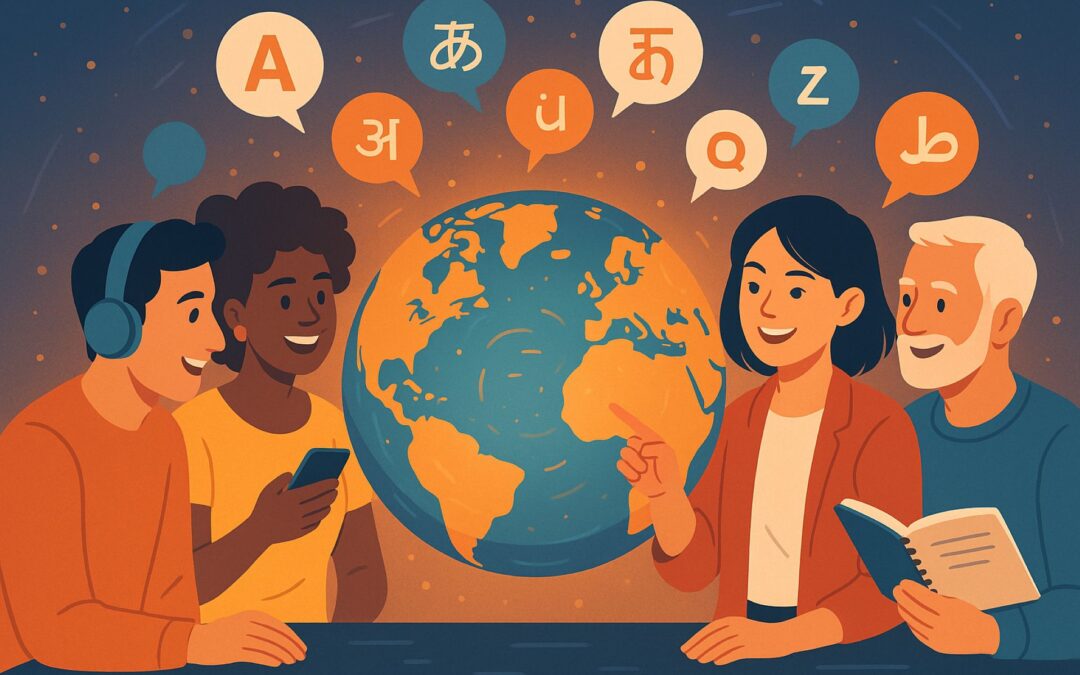
Every time someone says, “I wish I could learn another language,” what usually follows is a list of excuses — too old, too busy, too bad at memorizing, not the “type.” But these aren’t reasons; they’re mental barricades disguised as logic. The truth is, there has never been a better or easier time in human history to learn a new language. We have free resources, global communities, and endless exposure at our fingertips. What we lack isn’t opportunity — it’s conviction.
Language learning isn’t reserved for the gifted, the young, or the endlessly patient. It’s for anyone willing to start — and keep starting, one imperfect sentence at a time. The myths that hold most people back aren’t rooted in fact but in fear. Fear of sounding silly, of failing again, of not being “good enough.” But fluency isn’t a privilege; it’s a practice. It’s something built slowly, persistently, joyfully — not something granted by talent or luck.
If you’ve ever told yourself you can’t learn a language, this article is your wake-up call. Because not only can you — you already have everything you need to begin.
1. Aren’t Adult Language Learners at a Disadvantage?
This idea — that adults are doomed to fail at learning new languages — is one of the most persistent and destructive myths in education. It’s repeated so often that it feels like common sense, yet it collapses under scrutiny. Adults don’t lose the ability to learn languages; they lose the willingness to make mistakes.
Children appear to learn faster because they operate without ego. They blurt out words, mispronounce them shamelessly, and laugh at their errors. Every mistake becomes a lesson. Adults, meanwhile, are hyper-aware of judgment. They censor themselves, hesitate before speaking, and overanalyze grammar before uttering a word. The issue isn’t biology — it’s psychology.
Neuroscience has repeatedly debunked the idea that the adult brain can’t adapt. Studies in neuroplasticity show that adults form new neural connections throughout life. The difference is that adults must consciously engage with new information, whereas children absorb it unconsciously through immersion. But conscious engagement, paired with motivation and self-discipline, can actually accelerate progress. Adults learn smarter, not slower.
Think about what you already bring to the table as an adult learner:
- A built-in language system. You’ve already mastered one — your native language — which gives you a foundation for understanding grammar, structure, and syntax.
- A sense of logic and pattern recognition. You can connect linguistic dots that children can’t consciously see — root words, cognates, tenses, idiomatic parallels.
- Cultural and emotional context. You understand tone, sarcasm, politeness, and intent. These nuances are the bedrock of communication, and you’ve been decoding them your entire life.
Even the scientific comparisons between children and adults are skewed. When researchers say “children learn better,” they often refer to accent acquisition or native-like fluency. Yes, children can pick up pronunciation more naturally — but adults can achieve clarity, confidence, and expressive depth faster because they understand what communication means.
Children have the time advantage; adults have the mental and motivational one. A child might learn through play. You, however, can design your own immersion, choose your resources, travel, form friendships, or even change your environment intentionally. You have agency.
And that’s the ultimate secret weapon of adult learners — choice. You can decide why, how, and when you learn. You can pivot, optimize, and measure progress. Children can’t do that.
The truth? You’re not too old. You’re too self-conscious. The moment you stop comparing yourself to children and start using your adult advantages — focus, strategy, self-motivation — language learning becomes not only possible, but deeply fulfilling.
2. I Don’t Have the Language Gene
Ah yes, the “language gene” — the convenient genetic scapegoat for laziness, insecurity, and bad schooling. If you’ve ever told yourself, “I’m just not good at languages,” congratulations — you’ve fallen for one of the most self-defeating myths ever invented.
The truth is simple: there is no such thing as a language gene. No scientist has ever discovered a strand of DNA that determines who can roll their R’s or memorize verb conjugations faster. What does exist are habits, environments, and attitudes that either encourage or stifle learning.
If genetics dictated fluency, millions of people across multilingual nations would be anomalies. Take India, where switching between three or four languages in a single day is common. Or Switzerland, where children grow up mastering French, German, and Italian as part of daily life. Or Cameroon, where people speak tribal languages, French, and English interchangeably. None of these multilingual individuals were “born” with a language advantage — they were exposed to one.
So where does this myth come from? Usually from people who failed once, concluded they “weren’t built for it,” and stopped trying. It’s a self-fulfilling prophecy. “I don’t have the gene” becomes the permission slip to stop putting in effort. And when effort stops, progress stops — confirming the false belief.
Talent is a seductive illusion. When you see someone speaking five languages, what you’re witnessing is compounded time, not genetic destiny. They’ve simply spent more hours practicing, failing, and adjusting.
Here’s a more accurate formula:
Exposure + Consistency + Curiosity = Fluency
That’s it. No mystical genes, no divine talent. Just a brain doing what it was built to do — adapt to patterns, imitate sounds, and assign meaning.
Language learning is not a genetic lottery; it’s a behavioral discipline. Anyone who can memorize a song, follow a recipe, or learn to drive can learn to speak another language. The only difference is persistence.
You don’t need a “language gene.” You already have the only thing that matters — a human brain designed for communication. What you lack, perhaps, is belief. And belief, unlike genes, is completely within your control.
3. I Don’t Have the Time
Time — the most popular modern excuse and the least convincing one. When people say, “I don’t have time to learn a language,” what they really mean is, “I haven’t made it a priority.” Because the truth is, everyone has time — it’s just fragmented, invisible, and often squandered.
Language learning doesn’t demand a monastic life or hours locked in a study room. It demands intention. The trick isn’t finding time — it’s weaving it into the fabric of your day.
Consider this:
- Ten minutes during your commute.
- Five minutes while waiting for your coffee.
- Fifteen minutes before bed.
That’s thirty minutes. In one month, that’s fifteen hours. In one year, that’s nearly two hundred. Enough to reach conversational fluency in most languages.
The problem isn’t time; it’s attention. Modern life bleeds it dry through endless distractions — notifications, Netflix, newsfeeds. But those tiny, mindless moments could be transformed into micro-learning sessions. Flashcards while waiting for an elevator. Podcasts while driving. Text exchanges with a native speaker during lunch.
Even during full-time work, learning is possible. One of the world’s most successful polyglots, Benny Lewis, learned Italian while working sixty-hour weeks in Rome. He didn’t have endless leisure time — he had drive. He squeezed learning into the crevices of daily life: practicing phrases between guests at the hostel where he worked, chatting with locals in stolen minutes, reviewing vocabulary on his phone in queues.
Here’s a mindset shift: Don’t make time. Seize time.
Think about how you use your day: how many hours dissolve into digital noise, gossip, or passive entertainment? Reclaim even half of them and redirect that attention toward language, and you’ll progress faster than most people who study casually for years.
The magic of language learning lies in consistency, not duration. Thirty minutes a day beats three hours once a week — every single time. Because learning is less about memory and more about momentum.
You already have time. You just need to treat it as currency — invest it wisely, and fluency will compound like interest. The language you want to learn isn’t waiting for a free afternoon; it’s waiting for you to start in the next five minutes.
4. Language Programs Are Expensive
This excuse has been masterfully engineered by marketing departments, not educators. The belief that only those with deep pockets can learn languages is a myth that feeds billion-dollar corporations while starving genuine learners of confidence. The reality is that fluency isn’t a product — it’s a process. And that process costs far less than you think.
Language-learning companies have turned curiosity into commerce. They package hope into shiny software, add a few sleek slogans — “Master French in 30 days!” — and sell it for hundreds of dollars. But language isn’t something you buy; it’s something you build, one interaction at a time. You don’t need a platinum subscription or immersive retreat to make progress. What you need is creativity and consistency.
Let’s break it down practically. Books are cheap. Libraries are free. Duolingo, Memrise, Anki, Clozemaster — all free or nearly so. YouTube has thousands of fluent speakers offering lessons at no cost. Podcasts, films with subtitles, language exchange apps like HelloTalk or Tandem — all free entry points into real conversation.
Spending more money doesn’t make you a better learner; it makes you a better consumer. The language-learning landscape is full of people who’ve bought every course, downloaded every app, and still can’t hold a conversation because they’ve mistaken purchasing for practicing.
If you handed a motivated learner a $5 phrasebook and gave a less committed learner a $500 course, the one with the phrasebook would win every time. Why? Because one acts, the other hesitates.
Fluency is democratic — it rewards effort, not expenditure. Every successful polyglot on earth began the same way: with a notebook, a few basic resources, and an unwillingness to give up. If money was the deciding factor, the wealthiest people in the world would be the most multilingual — but they aren’t. It’s passion, not privilege, that creates polyglots.
Don’t buy the illusion that expensive equals effective. Invest in yourself — your habits, your consistency, your discipline. That’s the only investment that guarantees fluency.
5. I’m Waiting for the Perfect Language Course
Perfection is the polished mask that procrastination wears. People love to tell themselves they’re “researching options,” “waiting for the right program,” or “looking for the most efficient method.” In reality, they’re stalling. They fear failure, so they seek safety in endless preparation.
There is no perfect language course. No single method captures the infinite ways the human brain absorbs language. Every course — whether it’s a textbook, app, online tutor, or full immersion program — offers tools, not transformations. The transformation happens when you put those tools to work.
Here’s the harsh truth: even the best course won’t speak for you. It can’t teach you courage. It can’t eliminate discomfort. It can’t substitute real-world interaction. A course gives you structure; experience gives you fluency.
Stop hunting for the magic formula and start experimenting. Pick a beginner book, pair it with a free online program, and start speaking. Your mistakes will teach you more than any theory ever could. You’ll quickly discover what works for you — flashcards, audio drills, journaling, language exchanges — because language learning is deeply personal.
You’ll also learn something else: motivation grows through momentum. The more you do, the more you want to do. The act of starting creates its own energy. Waiting drains it.
Perfectionists rarely become polyglots because they never allow imperfection to exist. But languages are messy, fluid, and unpredictable — exactly like the humans who speak them. Don’t wait for flawless conditions. Start flawed, start clumsy, start now.
6. The Wrong Learning Method Will Doom Me Before I Start
This fear paralyzes learners before they’ve even uttered a word. They read reviews, watch tutorials, compare opinions, and build a mental cage of overthinking. But here’s the truth — there is no wrong method, only the wrong mindset.
Language learning isn’t surgery; it’s exploration. You can’t destroy your potential by choosing the “wrong” resource. You’ll simply learn what doesn’t work for you — which is, in itself, progress. Every misstep refines your personal blueprint for learning.
What really sabotages learners is inaction. They spend weeks deciding whether to focus on grammar or conversation first, whether to use Duolingo or Pimsleur, whether to watch TV shows or read short stories. And in that decision paralysis, the crucial first spark — momentum — dies.
Here’s what successful learners do differently: they start imperfectly and adjust continuously. They treat their study process like an evolving experiment, not a final verdict. They test, fail, tweak, repeat. Over time, they build a method shaped perfectly for them, not for the masses.
Think of your brain as an adaptive machine. It thrives on feedback, not fear. The wrong approach isn’t a dead end; it’s data. It teaches you what to change next. Every failed tactic, every dull textbook, every forgotten flashcard is a breadcrumb leading you toward what will work.
What matters is not how you begin but that you begin. Language learning is forgiving — it rewards persistence far more than precision. You can’t ruin your progress by experimenting; you can only ruin it by refusing to try.
Stop worrying about the perfect start. The perfect start is the one that happens today.
7. I Need to Study Before I Can Have a Conversation
This is one of the most widespread misconceptions in language learning — the idea that you must first “study enough” before daring to speak. It sounds reasonable. After all, you wouldn’t perform surgery or argue a case in court without training first. But language isn’t an academic subject. It’s a skill. And skills are learned through use, not theory.
If you wait until you’re “ready,” you’ll wait forever. There will always be a new list of words to memorize, a grammar rule to review, a pronunciation tweak to fix. Fluency doesn’t come from mastering vocabulary lists — it comes from fumbling through real conversations until the fumbling stops.
When you speak early, you make fast mistakes — and fast mistakes are the foundation of fast learning. Every awkward pause, every confused glance, every misused word gives your brain real feedback. You can feel the gaps in your understanding, and that sensation of “something’s missing” triggers active learning far better than passive study.
You don’t need to wait until your grammar is perfect to open your mouth. Communication isn’t about flawless syntax — it’s about meaning. Think of children again: they start speaking long before they understand grammar. Their speech is riddled with errors, yet their message gets across. And over time, those errors fade because they keep practicing.
Start small. Introduce yourself to someone. Order food in your target language. Compliment someone. Ask for directions. These little interactions do something powerful — they build confidence. You realize that even with limited words, you can still connect. And that’s the heart of language — connection, not correctness.
The best time to start speaking is not “after studying.” It’s now. You’ll never study your way into fluency. You’ll speak your way into it.
8. I Can’t Focus
In an age of constant pings, notifications, and information overload, focus feels like a lost art. Many people convince themselves that their attention span just isn’t what it used to be. But focus isn’t something you’re born with — it’s something you cultivate. And for language learning, it’s the single greatest multiplier of progress.
Most learners fail not because they lack intelligence or motivation, but because their attention is scattered. They study for fifteen minutes, check their phone, switch apps, then wonder why nothing sticks. The mind, like a muscle, needs uninterrupted tension to grow. You can’t build strength by lifting a weight once every few minutes — and you can’t build fluency by constantly resetting your concentration.
One of the best examples of disciplined focus comes from people like Scott Young — an entrepreneur and ultralearner who completed the entire MIT computer science curriculum in one year. When asked how he did it, his answer was simple: focus on one major project at a time. That’s it. No juggling. No half-efforts. Full immersion.
When you treat language learning as the project, not a project, progress accelerates. You begin to see language everywhere — in songs, signs, conversations, menus. Your mind starts connecting dots subconsciously because your attention is finally anchored.
The solution isn’t to eliminate distractions completely — that’s impossible. The solution is to structure your environment so that focus is the default. Turn your phone face down. Use noise-canceling headphones. Study in short, timed bursts — twenty-five focused minutes, five minutes of rest. Repeat.
And most importantly, remove multitasking from your vocabulary. You can’t learn while doing ten other things. Focus isn’t about intensity; it’s about exclusivity.
When you give language learning your full, undivided attention, even for brief periods, the results compound rapidly. Fluency isn’t built in hours — it’s built in moments of pure focus, repeated consistently.
9. Some Languages Are Just Too Hard
Every learner has said it: “This one’s impossible.” And yet, for millions of people around the world, that “impossible” language is the only one they know. The idea that some languages are too hard is not a fact — it’s a feeling. And feelings are not truth.
The myth of “difficulty” usually arises from unfamiliarity. English speakers look at Chinese characters, Arabic script, or Russian grammar and panic. It feels alien, so the brain resists. But that resistance isn’t an indication of impossibility — it’s the growing pain of learning something new.
Every language has its easy and hard parts. Chinese has no verb conjugations or tenses. Japanese grammar is logical once you grasp the structure. Russian’s cases seem daunting at first but follow clear patterns. English itself — with its silent letters, irregular verbs, and unpredictable pronunciation — is one of the hardest languages for foreigners to master.
The trick is to focus on patterns, not problems. Human language, in all its variety, shares common logic. Every tongue uses nouns, verbs, adjectives, questions, emotions. Once you learn to look for patterns instead of panicking at differences, every new language becomes a puzzle — not a punishment.
And remember: difficulty is emotional, not mathematical. It’s tied to motivation. When you care deeply — about a culture, a person, or a goal — the hard parts stop feeling like obstacles and start feeling like milestones.
When Benny Lewis announced he was learning Mandarin, countless people told him it was “the hardest language in the world.” Yet native Mandarin speakers told him the opposite — for them, English was far worse. The truth is simple: every learner struggles most with what’s unfamiliar. Once familiarity grows, difficulty dissolves.
So, stop ranking languages by fear. Stop listening to people who project their insecurities as “wisdom.” Whether it’s Arabic, Finnish, Korean, or Spanish — if someone can speak it, you can too.
The hardest language is always the one you’ve decided not to try.
10. Plateaus Are Inevitable
Every learner eventually hits the dreaded plateau — that frustrating stage when progress seems to halt, no matter how hard you study. You can understand most conversations, but still stumble expressing yourself. You can read paragraphs but freeze mid-sentence in real dialogue. It feels like running on a treadmill — moving constantly, yet going nowhere.
But here’s the truth: a plateau isn’t proof of failure. It’s proof of growth. You only plateau because you’ve climbed far enough to reach a higher level of challenge. What feels like stagnation is actually consolidation — your brain sorting, stabilizing, and integrating what you’ve already learned. The key is to recognize that the plateau isn’t the end of the road. It’s a pause before the next leap.
Most learners make the same mistake — they keep doing what worked before. The methods that got them from beginner to intermediate won’t get them to advanced. Early progress is fueled by novelty; later progress demands adaptation. You can’t just repeat the same exercises and expect transformation.
To break a plateau, you must deliberately change your input. If you’ve been studying alone, start speaking with others. If you’ve relied on apps, switch to native media — podcasts, movies, books. If your focus has been reading, shift to writing or speaking. The brain thrives on variety. Every new stimulus reawakens attention, forcing new neural connections to form.
Another powerful technique is to set micro-goals — small, achievable targets that create momentum. Translate your favorite song. Record a one-minute diary entry in your target language. Watch a short video and summarize it aloud. Each goal adds friction against monotony and reminds you of progress you can measure.
Plateaus don’t mean you’ve hit your limit — they mean your method has. And that’s fixable. Don’t fight the plateau; use it. Let it signal that it’s time to evolve your strategy. Every level of fluency requires a new approach. The plateau is simply the universe reminding you to keep climbing.
11. Perfect Mastery Is Impossible
Perfection — the phantom that haunts every learner’s mind. It whispers, “You’re not fluent yet. You still make mistakes. Your accent isn’t native enough.” And because of that whisper, many people give up before they even reach proficiency. But here’s a reality check: perfection doesn’t exist, not even among native speakers.
Even in your first language, you forget words, pause mid-sentence, or misuse grammar. You hesitate, stammer, and say “um” without thinking. If that’s acceptable in your native tongue, why expect divine precision in your second? The goal of language learning isn’t to eliminate mistakes — it’s to communicate despite them.
Perfect mastery isn’t only unrealistic; it’s unnecessary. Fluency doesn’t mean flawless grammar. It means freedom — the ability to express thoughts, emotions, and ideas fluidly without constant translation in your head. You can be fluent with an accent, with occasional errors, with imperfect phrasing — because fluency is about flow, not flawlessness.
The perfection trap kills progress. Learners obsess over every error, paralyzed by fear of sounding foolish. But the people who truly master languages are those who treat mistakes as allies. Every wrong conjugation, every awkward word choice is a signal from the brain saying, pay attention here. Perfectionists freeze; experimenters evolve.
Even the world’s most respected linguists and polyglots stumble sometimes. They just don’t let it stop them. They laugh it off, correct themselves, and move on — because perfection isn’t the prize; connection is.
So release the obsession with flawless speech. You’ll never reach a day when you “arrive” at total mastery — and that’s liberating. It means you can relax, enjoy the process, and keep improving without fear. Fluency is a journey with no finish line, and that’s exactly what makes it so beautiful.
12. Languages Are Boring
If learning feels dull, the problem isn’t the language — it’s the way you’re engaging with it. No language is inherently boring. Each is a window into how millions of people see the world. The boredom comes from how schools and textbooks have trained us to treat language like math — mechanical, repetitive, and disconnected from real life.
Languages live in the wild — in music, movies, humor, and human conversation — not in grammar drills. You didn’t learn your first language by memorizing rules. You learned it by living in it. To rekindle that spark, you have to bring life back into the process.
Here’s how you do that:
- Watch films and series in your target language, with or without subtitles. Storytelling triggers emotion — and emotion cements memory.
- Listen to music and translate the lyrics. Songs are linguistic shortcuts to rhythm, vocabulary, and cultural nuance.
- Read what you love. Whether it’s fantasy novels, news articles, or social media posts, interest fuels retention.
- Play games. Language-learning games, trivia, or even video games with dialogue can immerse you effortlessly.
- Find human connection. Talk to real people. Join online exchanges or local meetups. Nothing reignites enthusiasm like human laughter in another language.
If you ever catch yourself thinking, “This is boring,” change how you’re learning, not what you’re learning. Swap textbooks for stories. Replace flashcards with film scenes. Turn lessons into lived moments.
Language is a living, breathing organism. It carries jokes, metaphors, rhythm, and emotion. It shapes how people flirt, argue, dream, and grieve. Calling that boring is like saying life itself is boring.
You don’t study a language — you experience it. Once you understand that, every word becomes a spark, every conversation a thrill, and every mistake a reminder that you’re alive inside another world’s heartbeat.
13. Native Speakers Won’t Speak to Me
This is one of the most common fears that cripples learners before they even begin. The idea goes like this: “If I try to speak, I’ll sound stupid. I’ll make mistakes. People will laugh. Native speakers will get annoyed and switch to English.”
It’s an understandable fear — but it’s almost entirely fictional.
Most native speakers are delighted when someone makes the effort to learn their language. You’re showing respect for their culture, curiosity about their world, and courage to step outside your own comfort zone. They don’t expect you to sound perfect; they expect you to try. And that effort alone earns admiration.
Imagine someone visiting your country, struggling to speak your language but smiling as they do it. Would you laugh? Or would you help them, maybe even feel a quiet sense of pride that they’re trying? That’s how most people feel when you attempt to speak theirs.
The problem isn’t that native speakers won’t talk to you — it’s that you’re projecting your insecurities onto them. It’s not their judgment you fear; it’s your own. The internal critic says, “You’re not good enough yet,” and that voice drowns out every opportunity to connect.
There will be moments, yes, when someone switches to English. Not because they’re dismissing you, but because they’re trying to be helpful. Many people want to make communication easier. The trick is to stay calm and persistent. Smile and gently continue in the target language. Over time, your confidence will teach others to meet you halfway.
Here’s a simple truth: fluency isn’t a product of perfect study. It’s a product of imperfect conversations repeated endlessly until they become natural. The courage to speak badly is the first step toward speaking beautifully.
Stop waiting for permission. Start speaking, even when your grammar wobbles and your accent stumbles. Because the only person refusing to have a conversation with you — is you.
14. I’ll Always Have an Accent
So what if you do? Having an accent doesn’t make you less fluent — it makes you human. Your accent is a fingerprint of your journey, proof that you were brave enough to learn something new. The obsession with “sounding native” is one of the biggest misconceptions in language learning, and one that keeps countless learners from progressing.
Fluency and accent are not the same thing. Fluency is about flow — the ability to express yourself easily and naturally. Accent is just texture — a slight variation in how you sound. And often, that texture is charming. It’s distinctive. It tells a story about where you come from and what you’ve conquered to reach this point.
Even among native speakers, accents vary wildly. A Londoner sounds different from a Glaswegian, who sounds different from a New Yorker, who sounds different from someone in Sydney. Yet all are equally fluent. Why hold yourself to a stricter standard than native speakers hold each other?
Accent perfectionism stems from insecurity, not necessity. People fear being judged, not misunderstood. But the truth is, clarity matters far more than mimicry. A clear accent with confidence and rhythm will connect with people more deeply than a flawless imitation delivered nervously.
That said, accent improvement is possible if you want it. You can listen to native audio, repeat aloud (a technique called shadowing), and record yourself to identify subtle mispronunciations. Over time, your speech becomes smoother and closer to the sound you admire. But that pursuit should be rooted in curiosity, not shame.
Your accent isn’t a flaw to erase — it’s a bridge between cultures. It says, “I come from somewhere else, and I cared enough to meet you halfway.” Don’t silence that story in pursuit of perfection. Speak boldly, accent and all. Because confidence — not imitation — is what truly makes your words resonate.
15. My Friends and Family Won’t Support Me
This one hurts, because it touches something personal. You start learning a new language, excited and hopeful, expecting encouragement from the people closest to you — and instead, you get skepticism. “Why are you doing that?” “You’ll never use it.” “You’re wasting your time.” Sometimes they even mock your attempts. And slowly, that enthusiasm begins to fade.
But here’s something important to remember: their lack of support isn’t really about you. It’s about them. People often resist what they don’t understand. When you start doing something that challenges the status quo — improving yourself, breaking comfort zones — it makes others uncomfortable. It reminds them of what they aren’t doing. So they rationalize it away.
Some may see your efforts as a threat to the shared identity you’ve built. You’re growing in a direction they can’t follow, and that difference unsettles them. Others simply don’t value language learning because it doesn’t fit into their worldview. Either way, it’s not your job to shrink so others can stay comfortable.
You can, however, communicate your passion clearly. Tell them why this matters to you — not defensively, but sincerely. “I want to connect with people from another culture.” “I’m learning this language because it opens up opportunities for travel and understanding.” “It just makes me happy.” Sometimes honesty disarms resistance.
But if they still don’t support you, find people who will. The internet has made it easier than ever to find language-learning communities — on Reddit, Discord, Meetup, and specialized forums. These are people who get it, who cheer for your small wins, and who understand the grind. You’ll realize you’re not alone — you’re part of a global movement of curious, driven minds.
And here’s the best part: once your friends and family see your progress — when they hear you speak, when they watch you connect across cultures — the same people who doubted you will start to admire you. Sometimes, success speaks the only language people truly understand: results.
You don’t need universal approval to pursue something meaningful. You just need the courage to begin. And once you do, the support that truly matters — your own — will grow stronger than ever.
16. Everybody Speaks English
This excuse might sound reasonable on the surface — after all, English is the global lingua franca. You can travel to most major cities, check into hotels, order meals, or navigate airports without ever needing another language. But comfort and growth rarely coexist. Just because English can get you by doesn’t mean it can get you in.
Knowing only English is like seeing the world through a window instead of stepping outside. You might observe the scenery, but you’ll never feel the air. You’ll never taste the soul of a place unless you can communicate in the rhythm of its people. Learning a language isn’t about practicality — it’s about access. It opens secret doors, the kind that tourists never even notice.
When you rely on English everywhere, your experiences stay on the surface. Locals treat you as a visitor, not as one of their own. But when you make the effort — even with broken grammar or a thick accent — the dynamic shifts. Suddenly, people’s eyes light up. They lean in. They share their stories, their humor, their world. You stop being “the foreigner.” You become “the friend who tries.”
Fluency in the local tongue also saves you from the tourist trap economy. You’ll find cheaper rentals, better food, and genuine hospitality. The waiter who sees you speaking his language will hand you the real menu, not the overpriced English one. The cab driver might take you on a shortcut rather than the scenic scam route. These aren’t small perks — they’re a glimpse into authenticity.
And then there’s the argument that technology makes learning unnecessary. We now have translation apps that can transcribe in real time, and AI tools that claim to dissolve language barriers. But while machines can translate words, they can’t translate context. They can’t detect sarcasm, humor, or the emotional cadence in a sentence. They can’t replicate the subtleties that make human communication profound.
Language is more than information exchange — it’s empathy in motion. When you speak someone’s language, you enter their worldview. You stop being an observer of culture and start being a participant. Technology might help you survive a conversation, but only language will let you belong to it.
So no, not “everybody” speaks English. And even if they did, that would be all the more reason to stand out by learning something they don’t expect. Because the true reward of language learning isn’t comprehension — it’s connection.
17. I Can’t Keep Up with Other People’s Progress
Comparison — the silent killer of motivation. You open YouTube or Reddit and see people claiming to have learned Spanish in three months, or to have mastered Japanese while juggling two jobs. Instantly, your excitement curdles into self-doubt. “They’re faster, smarter, more disciplined. I’ll never catch up.”
But here’s what most people never show: the mess. The frustration, the forgotten words, the nights spent doubting themselves. The internet has turned learning into a highlight reel — curated, cropped, and filtered. You see their fluency, not their failures. You see the destination, not the detours. Comparing yourself to someone else’s timeline is like comparing a book you’re still writing to one that’s already edited and published.
Every learner has a different pace because every life has a different rhythm. Maybe you have a demanding job, or kids, or health issues, or simply less mental bandwidth at the end of a long day. That’s not weakness — that’s reality. The miracle isn’t learning quickly; it’s learning consistently. A few focused minutes each day beat hours of intensity followed by burnout.
And ironically, comparison slows you down. It redirects your focus outward when it should stay inward. Language learning thrives on momentum — tiny wins stacked patiently over time. When you measure progress by your own standards instead of others’, you stop sprinting and start evolving.
So, when you see someone who’s fluent while you’re still fumbling, don’t think “they’re ahead.” Think “they’ve just been at it longer.” Your journey isn’t late — it’s uniquely yours. And the beauty of languages is that there’s no finish line. You can always improve, refine, and rediscover.
Instead of envying someone else’s fluency, use it as evidence — proof that it can be done. They’re not your competition; they’re your confirmation. Every fluent speaker is living proof that what you want is possible.
Comparison is noise. Consistency is music. Stay tuned to your own rhythm.
18. Failure Begets Failure
Many people give up on learning languages because they’ve “failed” before. Maybe they took French in school and hated it. Maybe they tried Duolingo for a few months, forgot everything, and decided they “just aren’t good at languages.” But failure isn’t a verdict — it’s feedback.
The truth is, you didn’t fail at learning a language. You failed at a method that didn’t work for you. That’s a crucial distinction. The traditional school model — memorizing verb charts, filling in worksheets, obsessing over grammar before ever speaking — crushes curiosity. It’s not designed for fluency; it’s designed for exams. And exams don’t measure communication, they measure compliance.
Language learning is not one-size-fits-all. Some people thrive on structured lessons; others need full immersion. Some prefer flashcards and repetition; others learn best by reading stories or watching shows. The key is experimentation. Every time something doesn’t work, you’re one step closer to discovering what does.
Think of failure as calibration. It’s the process of fine-tuning your learning style. Maybe you need more auditory input, or more speaking practice, or a community to hold you accountable. The failure isn’t in trying — it’s in quitting before you discover your formula.
There’s also an emotional layer to this. Many of us carry the ghosts of past humiliation — that one time we mispronounced a word in class and everyone laughed. That memory morphs into avoidance. But the only way to silence that voice is to prove it wrong through action. You don’t erase failure by denying it; you overwrite it by succeeding despite it.
And remember — even the most fluent speakers forget words, mix tenses, and make blunders. They just don’t attach identity to it. They know that language isn’t a skill you “win.” It’s a skill you build, piece by piece, mistake by mistake.
The learners who ultimately succeed aren’t the ones who never fail. They’re the ones who fail forward — who see every setback not as proof of incapability, but as data for growth.
So if you’ve stumbled before, good. That means you’ve started. Now, pick a new approach, tweak your strategy, and start again — not from scratch, but from experience.
19. Once I Forget a Language, I Can’t Relearn It
Memory fades, yes — but it never disappears completely. Languages you once knew don’t vanish; they simply go dormant, waiting for the right spark to awaken them. Many people assume that if they’ve forgotten most of a language they once studied, the effort would be as hard as learning it again from scratch. In truth, relearning is like rekindling a flame. The wood is still there; you just need to strike a match.
This phenomenon has a scientific basis. Linguists call it savings in relearning. Even if you’ve forgotten most of a language, your brain retains traces of the structures, sounds, and patterns you once internalized. The moment you re-expose yourself to the language, those neural pathways begin to light up again. That’s why people who return to a forgotten language often progress far faster the second time around.
Take the story of someone who learned French for years in school, only to drop it for decades. The first few lessons back might feel clumsy, even embarrassing — until suddenly, phrases begin to resurface. “Je m’appelle…,” “Comment ça va?,” “Où est la gare?” These fragments of memory reconnect, forming bridges to long-lost fluency. It’s not magic; it’s neuroplasticity at work.
In fact, forgetting can be beneficial. The initial “rust” forces you to focus on essentials, discarding overcomplication. When you relearn, you do so with maturity, better methods, and stronger motivation. You know what didn’t work before, and you’re more strategic now. It’s the difference between being taught a subject and teaching yourself one.
The key to reawakening a sleeping language is immersion — not in the sense of moving abroad, but in surrounding yourself with living input. Listen to old songs you once loved in that language. Watch films with subtitles. Reconnect with native speakers or online tutors. Each exposure triggers recall. Within weeks, you’ll feel the old rhythm returning.
You never lose a language entirely; it lingers like an echo. And the moment you speak it again, you realize that your tongue still remembers the taste of its sounds.
20. Disabilities Make It Impossible to Learn a New Language
For many people with disabilities — whether physical, sensory, or cognitive — learning a new language might seem like an impossible challenge. Hearing loss, vision impairment, or learning differences like dyslexia appear, at first glance, to stand in the way of communication across tongues. But history — and countless modern examples — prove otherwise.
Consider Julie Ferguson, who is both severely deaf and partially blind. Despite these obstacles, she’s learned five languages and basic proficiency in several others. She’s proof that determination and adaptability can outmaneuver biology. Julie doesn’t hear like most learners, so she reads lips, studies written cues, and leverages visual aids. When her teachers understood her needs and adapted lessons accordingly, her progress skyrocketed.
Her story reveals something profound: the limits we perceive often come not from our bodies, but from our beliefs. When society tells someone with a disability, “You can’t,” that voice can become internalized. Yet when that person decides, “I’ll find another way,” the rules change entirely. The brain reroutes its pathways, creating new methods to process information. That’s not fantasy — it’s neuroscience.
Technology has made language learning more accessible than ever. Subtitled media, text-to-speech apps, speech recognition tools, and adaptive flashcard platforms can be customized for different needs. For example, visually impaired learners can use screen readers and Braille interfaces. Deaf learners can focus on written expression and lipreading, while dyslexic learners benefit from color-coded text or mnemonic patterns. The path may look different — but the destination is the same.
Moreover, people with disabilities often develop extraordinary compensatory strengths. Those who rely less on hearing may have heightened visual memory. Those who struggle with reading might have superior pattern recognition or emotional intuition. These strengths become assets in decoding a new language’s rhythm, tone, and structure.
The truth is, a disability doesn’t make language learning impossible — it simply changes the route you take. The journey might be slower, but it’s richer in resilience, creativity, and perspective. Every person who defies limitation adds to a universal truth: language isn’t learned by the body. It’s learned by the will.
Most Myths Are Just Excuses
In the end, every “reason” not to learn a language collapses under scrutiny. Too old, too busy, too broke, too distracted — none of it holds. The biggest barrier is not time, talent, or circumstance. It’s belief.
When people say “I can’t,” what they often mean is “I’m afraid.” Afraid of looking foolish, of failing again, of being judged. But language learning isn’t a test of intelligence — it’s a test of persistence. It’s the art of showing up, day after day, even when progress feels invisible.
Henry Ford put it perfectly: “Whether you think you can, or you think you can’t — you’re right.” That single sentence captures the psychology behind every myth we’ve dismantled. The brain follows belief. Tell yourself you can, and you’ll seek strategies, allies, and opportunities. Tell yourself you can’t, and your subconscious will find evidence to prove it.
Some of the most inspiring language learners on earth aren’t the gifted, the young, or the privileged — they’re the stubborn. The people who learn after 60. The ones juggling full-time jobs and families. The ones with disabilities, trauma, or zero resources. They succeed not because they’re special, but because they stopped waiting for permission.
Language learning is less about skill and more about identity. It’s about deciding that your voice — in any language — deserves to be heard. Once you make that decision, no excuse survives.
Momentum is the secret. Start small, stay consistent, and celebrate every micro-win. The first word. The first sentence. The first joke you understand in another language. Each one compounds, building into fluency.
So stop telling yourself stories about why you can’t. The only story worth telling now — is the one you’ll tell in another language.
Conclusion
At the end of the day, every obstacle to learning a new language boils down to a single lie: “I can’t.” It’s a lie that has kept millions silent in a world filled with voices. But the truth is simpler and far more powerful — you can, if you decide to. Every excuse, every doubt, every perceived limitation can be dismantled with patience, persistence, and a shift in perspective.
Languages aren’t just systems of words; they’re doorways to new worlds. They open friendships, unlock understanding, and remind you that growth is always possible, no matter your age or circumstances. The myths we’ve explored — about time, talent, age, difficulty, or support — all crumble when confronted by genuine desire. Because passion, not perfection, is what drives mastery.
So stop waiting for the perfect course, the perfect method, or the perfect moment. Start today. Start messy. Start scared. But start. Because once you do, you’ll realize that the only real barrier between you and fluency was the story you kept telling yourself — and the day you stop believing it, you start speaking.