
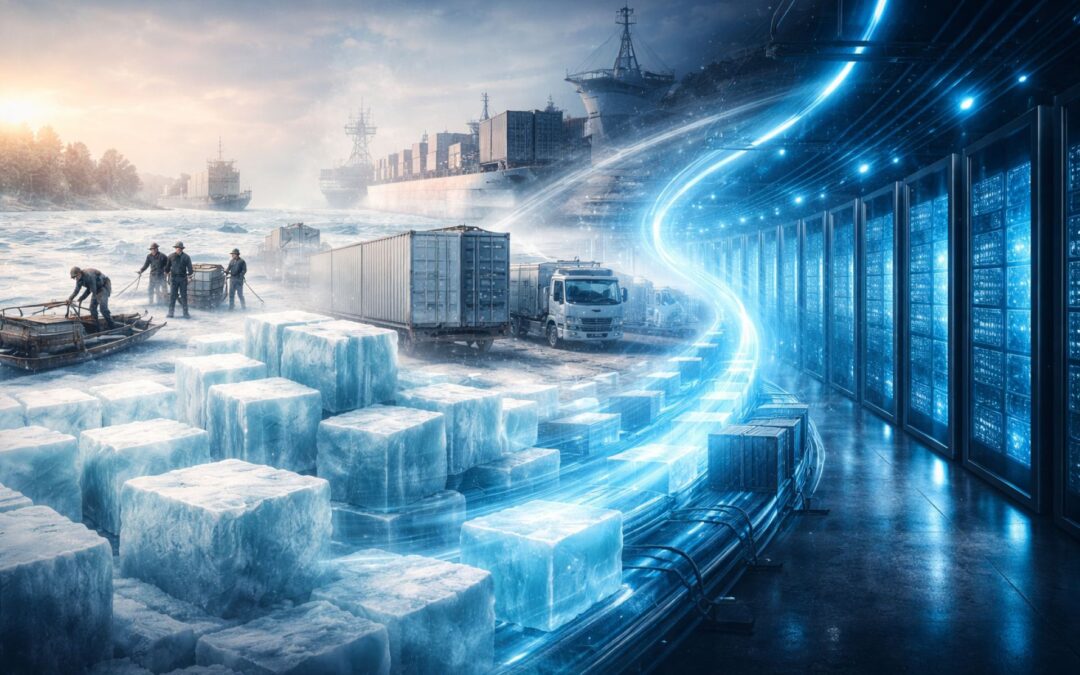
You’d think the race to dominate artificial intelligence began with code. Algorithms. Silicon. Data.
It didn’t.
It began with cold.
Long before we built machines that could think, we had to build systems that could preserve. Because intelligence, at scale, depends on something far more fundamental than computation: stability. And stability requires control over time, decay, and entropy.
For most of human history, we lived at the mercy of spoilage. Food rotted. Medicine degraded. Distance destroyed value. You consumed what was near, what was fresh, and what wouldn’t kill you by the next morning. Civilization moved at the speed of decay.
Then everything changed.
The moment we learned how to manufacture cold, we unlocked something far more powerful than refrigeration. We unlocked preservation. And preservation made scale possible.
You could store. You could transport. You could optimize. You could build systems that extended beyond geography and time. Entire industries emerged from that single capability. Global trade expanded. Cities grew in places they never could have survived before. Medicine advanced. Economies reorganized.
And eventually, that same principle—preserve what matters, scale it infinitely—became the foundation of the digital world.
Because data, just like food, is useless if it degrades. Intelligence, just like inventory, is meaningless if it can’t be stored, processed, and deployed reliably.
Artificial intelligence didn’t emerge in a vacuum. It emerged from infrastructure. And that infrastructure was built on one deceptively simple idea:
Keep it cool.
This is the story of how a 19th-century obsession with ice laid the groundwork for the 21st-century race for intelligence—and why the future belongs to those who can control temperature, energy, and scale better than anyone else.
The Moment Humans Learned to Manufacture Cold
For over a million years, humanity mastered fire.
We learned how to create it, control it, transport it, and build entire civilizations around it. Fire cooked our food, forged our tools, and powered early industry. It was the foundation of progress.
Cold, on the other hand, remained a mystery.
We understood what it did—we saw how it preserved food, slowed decay, and extended usefulness—but we had no idea how to create it. Cold wasn’t something you could produce. It was something you stumbled upon. A seasonal accident. A geographical privilege.
If you lived in colder climates, winter gave you access to ice. If you didn’t, you simply adapted. You salted meat. You smoked it. You consumed quickly and locally. There was no concept of storing abundance for later use beyond crude preservation techniques.
This limitation shaped everything.
Markets were hyper-local. Supply chains were short. Diets were seasonal. Even livestock had to “walk themselves” to market, losing weight and value along the way. Time and distance were enemies, constantly eroding what you produced.
The problem wasn’t that humans didn’t value cold. It’s that we couldn’t manufacture it.
Some of the brightest minds in history tried to understand it. There were theories that cold was a kind of invisible substance that flowed from the poles. Even pioneers of the scientific method couldn’t quite grasp it. Francis Bacon, in a tragic twist, died after catching pneumonia while experimenting with preserving meat using snow.
The science existed in fragments, but it lacked direction.
Then, in 1748, a Scottish scientist named William Cullen demonstrated something extraordinary. Using a vacuum process, he managed to artificially lower temperature and freeze water. For the first time in history, cold wasn’t just observed—it was created.
And yet, nothing happened.
There was no industry. No immediate application. No rush to commercialize it. Cullen’s discovery remained a curiosity—a scientific novelty rather than an economic breakthrough.
Because invention alone is never enough.
The world didn’t need just the ability to create cold. It needed a reason to invest in it. A system to distribute it. A market that demanded it.
The science was there.
But without a business model, and without accessible technology, cold remained exactly what it had always been—an interesting idea, waiting for someone to realize its true value.
The First Cold Economy: Ice as a Global Commodity
The breakthrough didn’t come from a scientist.
It came from a merchant who saw something everyone else ignored.
In 1805, a young Boston entrepreneur named Frederick Tudor traveled to the Caribbean. The heat was relentless. Drinks were warm. Food spoiled quickly. There was no concept of cooling—because there was no access to ice.
Back home in Massachusetts, lakes froze solid every winter. Ice was abundant, free, and completely taken for granted.
Tudor saw the gap instantly.
What if you could take something worthless in one place… and make it valuable somewhere else?
The idea sounded ridiculous. Ice melts. The journey took weeks. There was no refrigeration, no insulation technology, and no existing demand. People in tropical climates had never experienced cold drinks. They didn’t know what they were missing.
But Tudor wasn’t selling ice.
He was creating desire.
He cut massive blocks of ice from frozen lakes, packed them in sawdust, and shipped them across the ocean. Most of it melted. The losses were brutal. Early shipments were financial disasters.
But instead of quitting, he refined the system.
He improved insulation. Built specialized ice houses. Trained workers to handle the cargo more efficiently. And most importantly, when the ice finally arrived, he didn’t try to maximize profit.
He gave it away.
At bars, in public spaces, to anyone willing to try it.
Because Tudor understood something fundamental: people don’t demand what they’ve never experienced.
The moment someone tasted a cold drink in the middle of a tropical afternoon, the equation changed. Cold stopped being a novelty and became a necessity.
Demand was created.
Within a decade, Tudor was exporting thousands of tons of ice every year. By the 1840s, his shipments reached as far as India and Brazil. What started as an absurd idea turned into a global trade network.
He became known as the “Ice King.”
And more importantly, he proved something that would echo through every major industry that followed:
If you can preserve something, you can move it.
If you can move it, you can scale it.
And if you can scale it, you can build an entire economy around it.
Tudor didn’t invent refrigeration.
But he did something arguably more important—he turned cold into a commodity.
And once something becomes a commodity, innovation follows.
Engineering the Cold Chain: From Ice to Industry
Once cold became valuable, it stopped being a curiosity and became a problem to solve.
Natural ice had limits. It depended on geography. It depended on seasons. It melted. It was inefficient, unpredictable, and impossible to scale globally with precision. If cold was going to power entire industries, it couldn’t rely on frozen lakes.
It had to be engineered.
That shift began with inventors like Jacob Perkins, an American engraver who spent years experimenting with pressure, heat, and chemical systems. Instead of harvesting cold from nature, he focused on producing it mechanically—compressing and expanding gases to create controlled cooling.
In 1835, he secured one of the first patents for a working refrigeration system.
For the first time, cold wasn’t something you collected. It was something you generated on demand.
But invention alone still wasn’t enough. What pushed refrigeration into real-world application wasn’t theory—it was economic pressure.
And that pressure came from Argentina’s cattle industry.
Argentina had one of the largest populations of livestock in the world. Europe had massive demand for fresh meat. But there was a problem: by the time ships crossed the Atlantic, the meat had spoiled. The only viable exports were leather or heavily salted products.
Fresh meat—the most valuable version—was impossible to deliver.
So the Argentine government did something simple but powerful: it offered a financial reward to anyone who could solve the problem.
That incentive sparked innovation.
A French engineer, Charles Tellier, took on the challenge. He designed a refrigeration system and installed it on a ship. Then he loaded it with meat and set sail across the Atlantic.
The journey took over 100 days.
When the ship arrived, the meat was still cold. Still edible. Still valuable.
That moment changed everything.
Because it proved that cold could be controlled—not just stored, but sustained over distance and time. It transformed refrigeration from an experiment into infrastructure.
From there, the cold chain began to take shape.
No longer limited to ice blocks and insulated containers, industries started building integrated systems: refrigerated ships, storage facilities, transport networks. Cold was no longer a product—it was a continuous process.
And once that process existed, global trade accelerated.
Argentina could export beef. New Zealand could export lamb. Entire agricultural economies reorganized around what could now be preserved and shipped. Geography became less of a limitation. Distance became less of a cost.
The world didn’t just get access to cold.
It got access to consistency.
And consistency is what turns innovation into systems—and systems into global industries.
How Refrigeration Reshaped Everyday Life
Industrial breakthroughs tend to look dramatic from the outside—ships, factories, global trade routes. But the real transformation happens quietly, inside homes.
Refrigeration didn’t just change how goods moved.
It changed how people lived.
By the early 20th century, mechanical refrigeration had made its way out of ships and warehouses and into households. Companies like General Electric saw the opportunity immediately. If homes adopted electric refrigerators, electricity demand would surge. More appliances meant more consumption. More consumption meant more infrastructure.
Refrigeration wasn’t just a product.
It was a gateway to an entirely new economic model.
Before fridges, daily life revolved around perishability. You shopped every day. You cooked what you could consume immediately. Leftovers were a risk. Waste was constant and unavoidable.
The fridge broke that cycle.
Suddenly, time expanded.
You could store food for days, even weeks. You could plan meals instead of reacting to spoilage. You could buy in bulk, reduce costs, and smooth out daily routines. The simple act of preservation introduced efficiency into the most basic layer of life.
And that efficiency had compounding effects.
One of the most significant shifts happened inside the household. Less time spent sourcing and preparing fresh food meant more time available for other activities—including paid work. In many countries, this played a subtle but important role in increasing workforce participation, especially among women.
Refrigeration didn’t just preserve food.
It redistributed time.
And time, when freed, tends to be reinvested into productivity.
As incomes began to rise across the world, refrigerators became one of the first major purchases households made. Not because they were luxury items—but because they were leverage.
In countries like China, adoption skyrocketed. Within a single decade, fridge ownership surged from a minority of households to near ubiquity. It wasn’t just about convenience. It was about stepping into a different mode of living—one where scarcity was managed, not endured.
The ripple effects extended far beyond the kitchen.
Retail changed. Supermarkets emerged. Supply chains adapted to longer storage cycles. Food production shifted toward durability and transportability. Entire industries began optimizing not just for taste or quality—but for how well products could survive the cold chain.
Refrigeration introduced a new variable into decision-making:
Not just “Can we produce this?”
But “Can we preserve it long enough to scale it?”
And once that question entered the system, everything—from agriculture to retail to labor—began reorganizing around it.
The Cold Chain and the Global Economy
Once refrigeration moved from homes into infrastructure, it stopped being a convenience—and became a force multiplier.
Because the real power of cold isn’t storage.
It’s coordination.
Before refrigeration, economies were constrained by geography. You grew what your land allowed. You consumed what was nearby. Trade existed, but it was limited to goods that could survive the journey—grains, spices, dried products.
Everything else was trapped by time.
The cold chain broke that limitation.
Now, food didn’t have to be consumed where it was produced. It could be preserved, transported, and distributed across continents. That single shift rewired global trade.
Argentina could export beef. New Zealand could export lamb. California could ship lettuce across an entire country. Tropical regions could send bananas to cities thousands of miles away, turning what was once a rare delicacy into a daily staple.
Distance stopped destroying value.
It started expanding it.
But this didn’t just increase availability—it changed how things were produced.
When preservation becomes possible, optimization follows.
Farmers and producers began selecting crops not just for taste, but for durability. Iceberg lettuce didn’t win because it was the most flavorful—it won because it survived the journey. Entire agricultural systems started aligning with the logic of the cold chain: shelf life, transport resilience, and scalability.
The market stopped rewarding what was best.
It started rewarding what could last.
And that created a new kind of global specialization.
Countries began focusing on what they could produce most efficiently, exporting it, and importing everything else. The cold chain enabled this exchange at scale, allowing nations to integrate into a global system where production and consumption were no longer tied to the same place.
But like all infrastructure, it didn’t distribute benefits evenly.
In wealthier countries, food could be stored, shipped, and sold over weeks or months. Supermarkets stayed stocked. Waste became a logistical issue, not an existential one.
In lower-income regions, the lack of refrigeration meant something very different.
Up to 40% of food could be lost before it ever reached a plate.
Not because it wasn’t grown—but because it couldn’t be preserved.
The difference wasn’t productivity.
It was infrastructure.
And that gap created a new layer of inequality—one defined not by what you could produce, but by what you could keep.
Because in a system built on preservation, the winners aren’t just those who create value.
They’re the ones who can hold onto it long enough to scale it.
Cold as Infrastructure: Food, Medicine, and Survival
At a certain point, refrigeration stopped being about convenience, trade, or even efficiency.
It became about survival.
Because once a system depends on preservation, failure isn’t just inconvenient—it’s catastrophic.
Start with food.
In many low- and middle-income countries, the problem isn’t production. Fields produce enough. Supply exists. But without reliable refrigeration, that supply collapses before it can be used. Heat accelerates decay. Transport becomes a race against time. Entire harvests are lost not in farms, but in transit.
Up to 40% of food never makes it to a plate.
Not because it wasn’t grown—but because it couldn’t be kept.
In contrast, wealthier nations operate on an entirely different timeline. Food moves through cold storage facilities, refrigerated trucks, and climate-controlled retail systems. It can be stored for weeks, sometimes months, without losing value.
The difference between scarcity and abundance isn’t always production.
It’s preservation.
Then there’s medicine.
Here, the stakes are even higher.
Vaccines, insulin, antibiotics, and blood products all depend on strict temperature control. A few degrees too warm, and they lose effectiveness. In some cases, they become dangerous. Break the cold chain, and the medicine might as well not exist.
In remote villages, disaster zones, and conflict areas, portable refrigeration units are often the only thing standing between treatment and failure. Entire vaccination campaigns depend on maintaining temperature from manufacturing to injection.
Without cold, modern medicine doesn’t scale.
And beyond storage, refrigeration has opened entirely new frontiers in healthcare.
Cryosurgery uses extreme cold to destroy cancerous tissue. Cryotherapy enables targeted treatments. Stem cells, embryos, and biological materials are preserved at ultra-low temperatures, extending their viability indefinitely.
We’re not just preserving life.
We’re extending its possibilities.
What refrigeration did for food, it did for biology: it slowed time.
It allowed us to pause decay, intervene precisely, and operate on timelines that were previously impossible. Diseases that once progressed unchecked can now be treated, managed, or even reversed—because we can preserve the tools required to fight them.
At this level, refrigeration becomes invisible.
You don’t think about it when you open a fridge, receive a vaccine, or walk into a hospital. But it’s there—quietly maintaining the conditions that make all of it possible.
And that’s the defining trait of true infrastructure.
It disappears into the background.
Until the moment it fails.
Air Conditioning and the Geography of Productivity
If refrigeration taught us how to preserve things, air conditioning taught us how to preserve performance.
Because heat doesn’t just spoil food.
It breaks systems.
Before air conditioning, entire regions of the world were economically constrained by temperature. Work slowed down or stopped during extreme heat. Productivity dropped. Infrastructure degraded faster. Urbanization in hot climates was limited not by ambition—but by biology.
The human body has limits.
And for most of history, those limits defined where economies could thrive.
Air conditioning changed that.
It didn’t preserve goods—it preserved output.
Suddenly, work didn’t have to stop when temperatures rose. Offices could operate year-round. Factories could maintain consistent production. Hospitals, schools, and commercial buildings could function reliably, regardless of external conditions.
Entire cities became viable in places that were previously considered too hot to sustain large populations.
Look at the Middle East.
Much of its modern economic expansion—from high-rise cities to global business hubs—would have been impossible without large-scale cooling systems. Air conditioning didn’t just make life more comfortable. It made entire regions economically competitive.
The same applies across tropical and subtropical zones.
As countries develop and incomes rise, air conditioning is often one of the first major upgrades households and businesses invest in. Not as a luxury—but as infrastructure. Because once you control temperature, you stabilize performance.
And stability compounds.
Retail environments stay consistent. Tourism becomes predictable. Construction scales vertically. Labor becomes more efficient. Urban density increases. Economic activity becomes less dependent on weather patterns.
Cooling, in this sense, becomes a form of control over geography itself.
You’re no longer adapting to the environment.
You’re overriding it.
But this comes at a cost.
Air conditioning, like refrigeration, requires energy. And as global temperatures rise, demand for cooling rises with it. Heat waves are becoming longer, stronger, and more frequent. What was once a convenience is now, in many places, a necessity for survival.
Hospitals cannot function without it. Data systems cannot operate without it. Cities cannot sustain themselves without it.
Cooling is no longer optional.
It’s embedded into the core of modern civilization.
And as we move further into a world defined by technology and urban density, the ability to maintain controlled environments isn’t just about comfort or productivity.
It’s about continuity.
Because when systems overheat—whether biological, economic, or digital—they don’t just slow down.
They fail.
The Hidden Engine of the Digital Economy
By the time refrigeration reached its peak in food, medicine, and cities, something else had quietly taken its place at the center of the system.
Data.
And just like food before it, data came with a problem: it generates heat.
Every digital action—every search, every stream, every transaction—runs through physical machines. Servers stacked in rows, processing billions of calculations per second. And those machines don’t exist in the cloud.
They exist in buildings.
Buildings that get hot. Fast.
Without cooling, they shut down.
This is the part of the digital economy most people never see.
Behind every app, every platform, every AI system, there’s a network of data centers—massive facilities filled with hardware that requires constant temperature control. The more demand we place on these systems, the more heat they produce. And the more heat they produce, the more cooling they require.
Refrigeration didn’t disappear in the digital age.
It became its backbone.
When you stream a movie, cooling systems are running.
When you upload a file, cooling systems are running.
When you interact with AI, cooling systems are running.
Every digital interaction is, in part, a thermodynamic problem.
And solving that problem at scale has become one of the defining challenges of modern infrastructure.
Because unlike food or medicine, data doesn’t spoil in the traditional sense—but the systems that store and process it do. Overheating doesn’t degrade information gradually. It crashes systems instantly. It destroys hardware. It interrupts networks.
Failure isn’t slow.
It’s immediate.
That’s why modern data centers are engineered around cooling as much as computation. Advanced airflow systems, liquid cooling technologies, and climate-controlled environments are not optional features—they’re prerequisites.
In many cases, cooling consumes a significant portion of a data center’s total energy use.
Which creates a new kind of constraint.
The digital economy isn’t just limited by processing power or storage capacity.
It’s limited by how efficiently we can remove heat.
And as demand for cloud computing, streaming, and AI continues to grow, this constraint becomes more visible. Data centers are expanding. Energy requirements are increasing. And cooling is becoming one of the most critical variables in scaling digital infrastructure.
We often think of the internet as weightless.
But it isn’t.
It’s physical. It’s energy-intensive. And at its core, it depends on the same principle that powered the ice trade two centuries ago:
If you can’t keep it cool, you can’t keep it running.
Why AI Is Really a Cooling Problem
Artificial intelligence is often framed as a software revolution.
Better models. Smarter algorithms. More data.
But underneath all of that, there’s a harder constraint—one that has nothing to do with code.
Heat.
AI systems don’t exist in abstraction. They run on physical hardware—clusters of GPUs and specialized chips designed to process massive amounts of data at incredible speed. And the more powerful these systems become, the more heat they generate.
Training a single frontier AI model isn’t just computationally intensive.
It’s thermally intensive.
The process can consume as much energy as dozens, sometimes hundreds, of households use in an entire year. And a significant portion of that energy isn’t going into computation—it’s going into cooling the machines doing the work.
In many data centers, cooling accounts for 30% to 50% of total energy consumption.
That changes the equation.
Because if cooling becomes inefficient, the entire system becomes unsustainable. Costs rise. Performance drops. Infrastructure hits its limits. It doesn’t matter how advanced your algorithms are if your machines can’t stay operational.
Which means the future of AI isn’t just about who builds the smartest models.
It’s about who can run them at scale.
And running them at scale depends on three things: power, cooling, and infrastructure.
This is where the narrative shifts.
The competition in AI is no longer confined to research labs or software breakthroughs. It’s moving into physical systems—data centers, energy grids, and cooling technologies. The bottleneck isn’t just innovation.
It’s execution.
Companies and countries that can generate cheap, reliable energy and pair it with efficient cooling systems gain a structural advantage. They can train larger models, deploy them faster, and operate them at lower cost.
Everyone else falls behind—not because they lack ideas, but because they lack capacity.
AI, in this sense, is just the next iteration of a much older pattern.
First, we learned how to preserve food.
Then we learned how to preserve medicine.
Now, we’re learning how to preserve computation.
And each time, the same rule applies:
If you can stabilize the system, you can scale it.
Cooling is what stabilizes AI.
Without it, the entire intelligence stack—data storage, model training, real-time inference—collapses under its own heat. With it, intelligence becomes something you can expand, distribute, and industrialize.
So while the headlines focus on breakthroughs in capability, the real race is happening behind the scenes.
Not in code.
But in control over temperature.
The New Global Race: Energy, Cooling, and Control
Every major technological shift redraws the map of power.
The industrial revolution centered it around coal and steel. The oil age shifted it toward energy reserves and transportation routes. The digital era concentrated it in data and computation.
Now, the next shift is happening.
And it’s being drawn around energy and cooling.
Because if AI is a cooling problem, then the countries that can generate the most energy—and dissipate the most heat—will define the future of intelligence.
This is no longer theoretical.
It’s already happening.
Tech giants are no longer just building better software. They’re building infrastructure at an unprecedented scale. Data centers are expanding across the globe, but not randomly. They’re being placed with precision—where energy is cheapest, cleanest, and most reliable.
Regions like Iceland and Scandinavia have become prime locations, not because of their markets, but because of their climate and energy mix. Cold weather reduces cooling costs. Hydroelectric and geothermal energy provide stable, renewable power.
In these places, nature itself becomes part of the infrastructure.
At the same time, major economies are repositioning themselves.
The United States is doubling down on its advantage in AI companies and pairing it with massive investments in energy capacity—solar farms, wind corridors, and grid expansion in states like Texas and Arizona.
China is scaling faster than anyone else, building out enormous renewable energy infrastructure while maintaining tight control over industrial systems. Its goal isn’t just participation in the AI economy.
It’s dominance.
India, one of the fastest-growing energy markets in the world, is positioning itself as both a software hub and a future data center powerhouse. With aggressive targets for renewable capacity and a rapidly digitizing population, it’s aiming to become a central player in the next phase of global infrastructure.
The pattern is clear.
The AI race is becoming an energy race.
And energy, in this context, is inseparable from cooling.
Because generating power is only half the equation. The other half is managing the heat that power creates. The more computation you run, the more cooling you need. The more cooling you need, the more efficient your systems must become.
This creates a new kind of competitive advantage.
Not just who can build the smartest models—but who can sustain them.
And just like the shipping container once reorganized global trade around ports and logistics hubs, AI is reorganizing the world around data centers and energy networks.
New hubs are emerging. Old advantages are shifting. Geography is being redefined—not by natural resources alone, but by the ability to convert energy into controlled, scalable systems.
In this new landscape, control doesn’t come from ownership of land or labor.
It comes from control over infrastructure.
Power generation. Heat management. System stability.
Because the countries that can keep their machines running longer, cheaper, and at greater scale won’t just lead in AI.
They’ll shape the future of global influence itself.
The Hidden Cost of Keeping the World Cool
Every system that scales eventually reveals its cost.
And in the case of refrigeration, that cost is energy.
Today, cooling—everything from refrigerators and freezers to air conditioning and data centers—accounts for a staggering share of global electricity use. Roughly 17% of all electricity produced worldwide goes toward one task:
Moving heat from one place to another.
That number is already massive.
And it’s rising.
Because the more advanced and interconnected our world becomes, the more we depend on cooling. Cities are expanding. Digital infrastructure is growing. Temperatures are increasing. Each of these trends reinforces the others.
Hotter environments demand more cooling.
More cooling demands more energy.
More energy, if produced inefficiently, leads to more emissions.
And more emissions make the planet even hotter.
It’s a feedback loop.
A self-reinforcing cycle where the solution begins to amplify the problem.
By 2030, global demand for cooling is expected to triple. To meet that demand using current systems, we would need the equivalent of multiple national power grids operating solely to prevent overheating.
And that introduces a critical tension.
Cooling is essential. It preserves food, enables medicine, powers cities, and sustains the digital economy. Without it, modern life collapses.
But scaling it irresponsibly creates systemic risk.
Older cooling technologies—especially those relying on inefficient systems or high-emission refrigerants—exacerbate the problem. They consume more energy, leak harmful gases, and increase environmental strain.
Which means the challenge isn’t just to expand cooling.
It’s to reinvent it.
Because if the infrastructure that supports civilization becomes unsustainable, the system eventually breaks under its own weight. Not through sudden failure—but through gradual inefficiency, rising costs, and environmental pressure.
This is the paradox of progress.
The same innovation that unlocked global abundance now threatens to destabilize the conditions that made that abundance possible.
And resolving that paradox will define the next phase of industrial development.
Not just how we generate energy.
But how intelligently we use it.
The Next Industrial Shift: Smarter Cooling Systems
Every major constraint eventually becomes a catalyst for innovation.
And right now, cooling is that constraint.
We’ve reached a point where simply scaling existing systems is no longer viable. The demand is growing too fast. The costs—economic and environmental—are too high. The old model of “more cooling, more energy” is breaking down.
So the next phase isn’t about expanding cooling.
It’s about optimizing it.
And that shift is already underway.
One of the most promising developments is liquid cooling for high-performance systems. Instead of relying on air to dissipate heat, liquid cooling systems circulate specialized fluids directly around chips and components. This method is far more efficient, reducing energy use while allowing machines to operate at higher performance levels.
In the context of AI, this isn’t a marginal improvement.
It’s a necessity.
Then there’s AI-optimized climate control itself—a system using machine learning to regulate temperature dynamically. Instead of running cooling systems at fixed levels, these systems adjust in real time based on load, usage patterns, and environmental conditions. Less waste. More precision.
Cooling, ironically, is becoming intelligent.
Thermal energy storage is another breakthrough. Instead of generating cooling exactly when it’s needed—often during peak demand—these systems create and store “cold” during off-peak hours. That stored cooling can then be deployed when demand spikes, smoothing out energy usage and reducing strain on power grids.
It’s the same principle that defined the original ice trade.
Store when it’s cheap. Use when it’s valuable.
Even materials themselves are evolving.
New building technologies use phase-change materials that absorb and release heat as temperatures fluctuate, stabilizing indoor environments without constant mechanical cooling. Architecture is beginning to integrate temperature regulation at a structural level, reducing reliance on external systems.
And at the global level, this shift is being recognized as critical.
The United Nations has identified sustainable cooling as a development priority—placing it alongside access to food, water, and energy. Because without efficient cooling, progress in all those areas becomes fragile.
What’s emerging is a new paradigm.
Cooling is no longer a passive system running in the background. It’s becoming an active, optimized layer of infrastructure—one that interacts with energy systems, data systems, and environmental conditions in real time.
In other words, we’re moving from brute-force cooling…
To intelligent cooling.
And just like every transition before it—from natural ice to mechanical refrigeration, from storage to global distribution—this shift will redefine what’s possible.
Because once you make cooling more efficient, you don’t just reduce costs.
You expand capacity.
And expanded capacity is what unlocks the next wave of scale.
Conclusion
What started as a curiosity—freezing water in a laboratory—became one of the most powerful forces shaping modern civilization.
Refrigeration didn’t just change how we store food.
It changed how we think about systems.
It taught us that if you can preserve something, you can extend its usefulness beyond time and place. And once something can outlast decay, it can be transported, optimized, and scaled.
That single principle reshaped everything.
It turned ice into a global commodity. It enabled worldwide food distribution. It made modern medicine viable. It allowed cities to grow in hostile climates. It built the backbone of the digital economy.
And now, it’s powering artificial intelligence.
Because AI isn’t just a breakthrough in software. It’s the latest expression of a much older idea—the ability to stabilize something long enough to extract value from it at scale. Data must be stored. Systems must run continuously. Machines must operate without failure.
All of that depends on control.
Control over energy. Control over infrastructure. And ultimately, control over temperature.
The race for AI dominance isn’t just happening in research labs or codebases. It’s happening in power plants, data centers, and cooling systems spread across the globe.
The winners won’t just be the ones who build the smartest models.
They’ll be the ones who can keep those models running.
Because every layer of progress—from food to medicine to intelligence—follows the same rule:
If you can’t preserve it, you can’t scale it.
And if you can’t scale it, you don’t control the future.
So the next time you open a fridge, step into an air-conditioned room, or interact with an AI system, remember this:
You’re not just using technology.
You’re tapping into a system built on one of the most overlooked breakthroughs in human history.
The ability to keep things cool.