
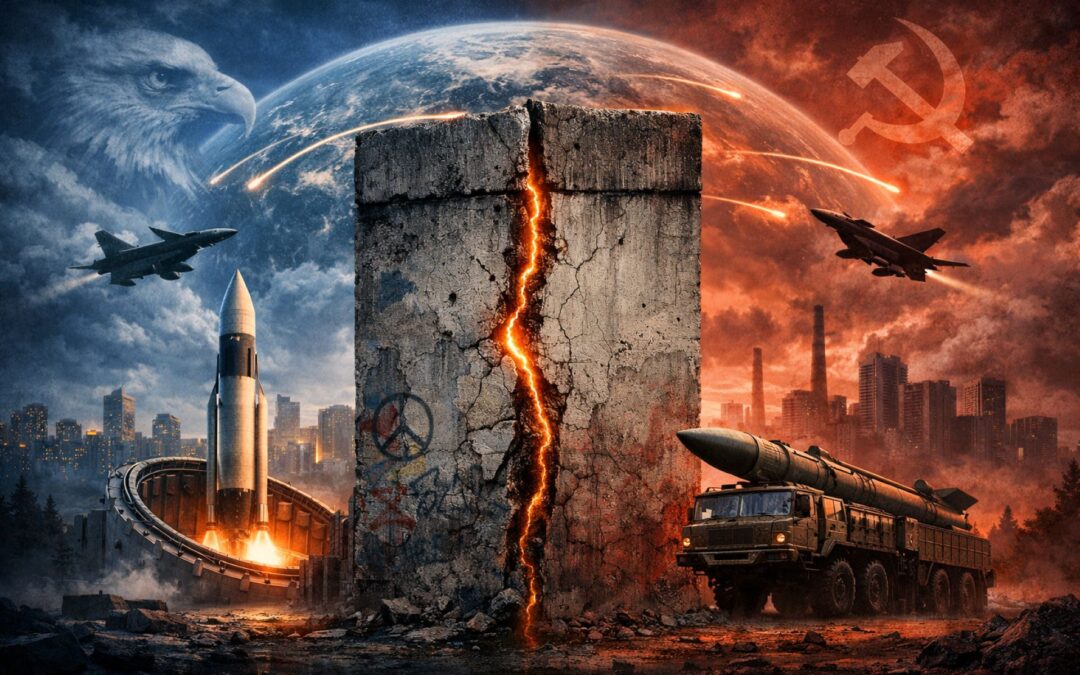
The Cold War was one of the most defining geopolitical struggles of the twentieth century. Lasting roughly from the end of World War II in 1945 to the collapse of the Soviet Union in 1991, it was not a traditional war fought directly between two armies on a battlefield. Instead, it was a prolonged global rivalry between two superpowers—the United States and the Soviet Union—each representing radically different political, economic, and ideological systems.
On one side stood the United States and its allies, promoting capitalism, democratic governance, and a global order based on market economies and political pluralism. On the other stood the Soviet Union, which championed a communist system built around state-controlled economies, one-party rule, and a revolutionary vision of global socialism. Both believed their system represented the future of humanity, and both feared the expansion of the other.
This ideological conflict shaped international politics for nearly half a century. Rather than engaging in direct warfare, the two superpowers competed through military alliances, economic aid programs, political influence, technological innovation, espionage, and propaganda. They built enormous nuclear arsenals capable of destroying the planet many times over, creating a fragile balance of terror that discouraged open war while raising the stakes of every confrontation.
Across the globe, smaller conflicts became arenas for Cold War competition. Wars in Korea and Vietnam, revolutions in Cuba, struggles in Africa and the Middle East, and political crises across Europe and Asia were all influenced by the rivalry between Washington and Moscow. At times, the world seemed to stand on the edge of nuclear catastrophe, most dramatically during the Cuban Missile Crisis of 1962.
Yet the Cold War was not simply a story of tension and confrontation. It was also a period of extraordinary technological progress, from the space race to advances in computing and communications. It reshaped economies, transformed societies, and defined the structure of global power throughout the second half of the twentieth century.
To understand how the Cold War emerged and why it lasted so long, it is necessary to look back to its ideological origins, the collapse of wartime alliances after World War II, and the chain of crises that gradually turned former partners into bitter rivals in a struggle that would shape the modern world.
The Roots of the Cold War: Revolution, Ideology, and Mutual Suspicion
The Bolshevik Revolution and the Birth of the Soviet State
The origins of the Cold War stretch back decades before the end of World War II. The ideological conflict that would eventually divide the world began with the Russian Revolution of 1917, an event that fundamentally transformed Russia and introduced a new political system that directly challenged the capitalist order of the Western world.
During the First World War, the Russian Empire was already collapsing under the weight of military defeats, economic crisis, and widespread political dissatisfaction. In early 1917, mass protests and unrest forced Tsar Nicholas II to abdicate the throne, bringing an end to centuries of imperial rule. A provisional government attempted to stabilize the country, but it struggled to maintain authority while continuing the unpopular war effort.
Later that same year, a radical socialist faction known as the Bolsheviks seized power in what became known as the October Revolution. Led by Vladimir Lenin, the Bolsheviks promised “peace, land, and bread,” appealing to war-weary soldiers, impoverished peasants, and industrial workers. Once in power, Lenin withdrew Russia from World War I and began implementing a revolutionary program that aimed to dismantle capitalism and replace it with a socialist state controlled by workers.
The Bolsheviks soon renamed their country the Union of Soviet Socialist Republics, or the Soviet Union. Their ideology—Marxism-Leninism—argued that capitalism was inherently exploitative and that the global working class would eventually overthrow capitalist systems everywhere. This revolutionary worldview immediately placed the new Soviet state in ideological opposition to Western powers such as the United States, Britain, and France.
Western governments viewed the communist revolution with deep suspicion and hostility. The Bolsheviks had openly called for worldwide revolution and had repudiated Russia’s debts to foreign investors. During the Russian Civil War that followed the revolution, several Western countries even sent military forces to support anti-communist factions, hoping to prevent the consolidation of a communist regime.
Although the Bolsheviks ultimately won the civil war and secured control over the Soviet state, the distrust between the communist government and the capitalist West had already been firmly established. The two sides represented fundamentally different visions of political and economic order, and neither trusted the intentions of the other.
Stalin’s Rise and the Transformation of the USSR
After Lenin’s death in 1924, a power struggle emerged within the Soviet leadership over who would control the direction of the new communist state. Out of this struggle emerged Joseph Stalin, a political operator who gradually consolidated authority through his control of the Communist Party bureaucracy.
By the late 1920s, Stalin had effectively eliminated his rivals and established himself as the dominant leader of the Soviet Union. Under his rule, the country underwent dramatic economic and social transformation. Through a series of ambitious Five-Year Plans, Stalin sought to rapidly industrialize the Soviet economy, turning a largely agrarian society into a modern industrial power capable of competing with the West.
The industrialization drive was accompanied by massive state control over agriculture, known as collectivization. Millions of small farms were merged into large, state-managed agricultural collectives. While these policies helped accelerate industrial growth, they also caused enormous human suffering, including famine, displacement, and widespread repression.
Stalin governed through a system of fear and control. Political opponents, perceived dissidents, and even ordinary citizens suspected of disloyalty were arrested, imprisoned, or executed during a series of purges throughout the 1930s. Millions were sent to forced labor camps known as gulags. By the time the Second World War began, Stalin had built a highly centralized state capable of mobilizing enormous resources—but at a devastating human cost.
To Western observers, the Soviet Union appeared both threatening and unpredictable. Its communist ideology openly criticized capitalism, while its authoritarian political system contrasted sharply with Western democratic traditions. Although the United States and the Soviet Union would later become temporary allies during World War II, the deep ideological divide and mutual suspicion between the two sides had already been firmly established.
These tensions, rooted in revolutionary ideology and reinforced by decades of mistrust, would eventually set the stage for the global rivalry that came to be known as the Cold War.
From Allies to Rivals: The Post–World War II Settlement
The Yalta and Potsdam Conferences
During World War II, the United States, the United Kingdom, and the Soviet Union were united by a common goal: defeating Nazi Germany. Despite their ideological differences, the wartime alliance between Franklin D. Roosevelt, Winston Churchill, and Joseph Stalin proved essential in bringing the war in Europe to an end. Yet even before victory was secured, tensions were already beginning to emerge over what the postwar world would look like.
As Germany’s defeat became inevitable, Allied leaders met to decide how Europe would be reorganized after the war. Two of the most important meetings took place at Yalta in February 1945 and at Potsdam in July 1945. These conferences were meant to determine the political future of Germany, the borders of Eastern Europe, and the general structure of the postwar international order.
At Yalta, Roosevelt, Churchill, and Stalin agreed that Germany would be divided into occupation zones administered by the victorious powers. The Soviet Union would control eastern Germany, while the United States, Britain, and later France would administer western regions. Berlin, located deep inside the Soviet zone, would also be divided among the four powers.
The leaders also discussed the future of Eastern Europe, particularly Poland. Stalin insisted that the Soviet Union needed friendly governments along its western border as a buffer against future invasions. Russia had suffered catastrophic losses during both World War I and World War II, and Soviet leaders were determined to ensure that hostile powers could never again attack through Eastern Europe.
Roosevelt and Churchill, however, emphasized the importance of self-determination and democratic elections. At Yalta, Stalin agreed in principle that Eastern European countries would hold free elections and form representative governments. Yet the vague language of the agreement left considerable room for interpretation, and the Western leaders soon began to suspect that Stalin had no intention of allowing genuine political freedom in the region.
By the time the leaders met again at Potsdam a few months later, the situation had already changed dramatically. Germany had surrendered, Roosevelt had died and been replaced by President Harry Truman, and the United States had successfully tested the world’s first atomic bomb. The atmosphere at Potsdam was far more tense than at Yalta, and the growing mistrust between the Allies became increasingly visible.
Competing Visions for the Postwar World
The deeper conflict between the former allies lay not only in territorial disputes but also in their fundamentally different visions for the future global order. The United States emerged from the war as an economic and military powerhouse. American leaders believed that long-term peace depended on open markets, international cooperation, and democratic governance.
In contrast, the Soviet Union had suffered immense devastation during the war. Entire cities had been destroyed, millions of soldiers and civilians had been killed, and vast regions of the country lay in ruins. For Soviet leaders, security was the primary concern. Stalin believed that controlling Eastern Europe would create a protective buffer zone that could shield the Soviet Union from future invasions.
To Western observers, however, Soviet actions increasingly appeared to be an attempt to expand communist influence across the continent. In country after country—including Poland, Hungary, Romania, and Bulgaria—communist parties backed by the Soviet Union began consolidating power. Opposition parties were weakened, elections were manipulated, and pro-Soviet governments gradually emerged throughout the region.
These developments alarmed leaders in the United States and Western Europe. They feared that Soviet expansion could spread further across the continent, threatening the fragile recovery of war-torn societies. What had begun as a wartime partnership was rapidly evolving into a rivalry defined by suspicion, ideological hostility, and competing strategic goals.
By the late 1940s, it was becoming clear that the alliance that had defeated Nazi Germany could not survive the profound differences between its members. The question was no longer how the victorious powers would cooperate after the war, but how they would manage the growing confrontation between two competing visions of world order.
The Division of Europe and the Emergence of the Iron Curtain
Soviet Control of Eastern Europe
In the years immediately following World War II, Europe was devastated. Cities had been reduced to rubble, transportation networks were shattered, and millions of people faced hunger, homelessness, and economic uncertainty. Amid this chaos, political systems across the continent were fragile and vulnerable to outside influence. Both the United States and the Soviet Union recognized that the future direction of Europe would determine the balance of power in the emerging postwar world.
As the Red Army pushed westward during the final stages of the war, it liberated large portions of Eastern Europe from Nazi occupation. However, liberation quickly turned into control. Soviet troops remained stationed across the region, and Moscow began shaping the political systems of the countries it occupied.
Communist parties, often small before the war, suddenly gained prominence with Soviet backing. In countries such as Poland, Hungary, Romania, Bulgaria, and East Germany, communist leaders gradually consolidated power. Initially, these governments often included multiple political parties in coalition arrangements. Over time, however, opposition parties were marginalized, suppressed, or eliminated entirely.
Through political pressure, intimidation, and manipulation of elections, communist regimes loyal to Moscow emerged across Eastern Europe. These governments aligned themselves closely with Soviet policies and adopted economic systems modeled on the Soviet command economy. Industries were nationalized, private property was restricted, and political dissent was tightly controlled.
To the Soviet leadership, these satellite states were essential for security. Russia had historically been invaded through the plains of Eastern Europe, and Stalin was determined that such a threat would never arise again. Friendly—or at least compliant—governments along the Soviet border would provide a strategic buffer against potential enemies.
To Western observers, however, these developments appeared less like defensive measures and more like aggressive expansion. The spread of Soviet-backed communist governments across Eastern Europe raised fears that communism might continue moving westward, potentially destabilizing fragile democracies across the continent.
In 1946, former British Prime Minister Winston Churchill famously described the situation with a phrase that captured the growing divide: an “Iron Curtain” had descended across Europe. Behind this curtain, the Soviet Union exercised tight control over political life, isolating Eastern Europe from the democratic and capitalist systems developing in the West.
The Truman Doctrine and the Marshall Plan
As tensions with the Soviet Union escalated, the United States began formulating a strategy to contain the spread of communism. American policymakers increasingly believed that economic instability and political chaos could create fertile ground for communist movements. If democratic governments failed to provide stability and prosperity, citizens might turn toward radical alternatives.
In 1947, President Harry Truman announced a new foreign policy framework that became known as the Truman Doctrine. In a speech to the U.S. Congress, Truman declared that the United States would support free peoples who were resisting attempts at subjugation by armed minorities or outside pressures. In practical terms, this meant providing political, economic, and military assistance to countries threatened by communist influence.
The doctrine was first applied in Greece and Turkey, where political instability and civil conflict raised fears of communist expansion. American aid helped stabilize both countries and signaled that the United States was prepared to actively oppose Soviet influence.
Around the same time, the United States launched an even more ambitious initiative to rebuild Europe’s shattered economies. Known as the Marshall Plan—named after U.S. Secretary of State George Marshall—the program provided massive financial assistance to help European nations recover from the devastation of the war.
Between 1948 and 1952, the United States distributed more than $12 billion in aid to Western European countries. The funds helped rebuild infrastructure, revive industrial production, and restore economic stability. As Western Europe recovered, living standards improved and democratic governments strengthened.
The Soviet Union viewed the Marshall Plan with deep suspicion. Stalin believed the program was not merely economic aid but a strategic effort to extend American influence across Europe and undermine communist movements. As a result, he forbade Eastern European countries under Soviet control from participating in the plan.
The result was a stark economic and political divide across the continent. Western Europe began recovering rapidly with American assistance, while Eastern Europe remained tied to the Soviet economic system. This division hardened the ideological boundary between East and West, setting the stage for decades of Cold War rivalry.
The Berlin Crisis and the First Major Cold War Confrontation
The Berlin Blockade
Few places symbolized the emerging Cold War tensions more clearly than the city of Berlin. Located deep within the Soviet occupation zone of Germany, Berlin itself had been divided into four sectors controlled by the United States, Britain, France, and the Soviet Union. Although the war had ended, the city remained a focal point of political and ideological competition between the former allies.
In the years following World War II, the Western powers began working to rebuild the economy in their zones of Germany. They believed that economic recovery was essential to stabilizing Europe and preventing the spread of political extremism. In 1948, the United States, Britain, and France introduced a new currency—the Deutsche Mark—in their occupation zones to help restore economic order.
The Soviet Union viewed this move as a direct threat to its influence in Germany. Stalin feared that a strong, economically integrated West Germany aligned with the Western powers could become a powerful rival on the Soviet border. In response, he decided to test the resolve of the United States and its allies.
In June 1948, the Soviet Union suddenly blocked all road, rail, and canal routes connecting West Berlin to the outside world. The goal of this blockade was simple: force the Western powers to abandon their sectors of Berlin. If the Western allies withdrew, the entire city would fall under Soviet control.
The blockade immediately created a humanitarian crisis. More than two million people lived in West Berlin, and the city depended heavily on supplies from the outside world for food, fuel, and basic necessities. With all land access cut off, the survival of the population was suddenly in question.
The Soviet leadership assumed that the Western powers would not risk a military confrontation over Berlin. But rather than withdrawing, the United States and its allies chose a bold alternative that would become one of the most dramatic logistical operations of the Cold War.
The Berlin Airlift
Instead of attempting to break the blockade by force, the Western allies decided to supply West Berlin entirely by air. Beginning in June 1948, a massive operation known as the Berlin Airlift was launched. Cargo planes from the United States and Britain flew around the clock, delivering essential supplies into the isolated city.
The scale of the operation was unprecedented. Aircraft landed at Berlin’s airports every few minutes, carrying food, medicine, coal, and other vital goods. At the height of the airlift, thousands of tons of supplies were delivered each day to sustain the city’s population.
The effort required extraordinary coordination and determination. Pilots flew in all weather conditions, and crews worked continuously to maintain the flow of flights. Over time, the airlift became not only a logistical achievement but also a powerful symbol of Western commitment to defending the city.
For nearly a year, the operation continued. The Soviet Union watched as the Western allies successfully maintained the supply lines without resorting to military confrontation. Eventually, it became clear that the blockade had failed to achieve its intended objective.
In May 1949, the Soviet Union lifted the blockade of Berlin. The city remained divided, but the Western powers had demonstrated that they were willing to defend their position in Europe. The Berlin Airlift marked the first major confrontation of the Cold War and solidified the growing division between the Soviet bloc and the Western alliance.
The crisis also had lasting political consequences. In the same year the blockade ended, the Western occupation zones were formally merged to create the Federal Republic of Germany, commonly known as West Germany. In response, the Soviet zone became the German Democratic Republic, or East Germany. Germany—and Berlin itself—had become the front line of the Cold War.
Nuclear Weapons and the Beginning of the Arms Race
The Soviet Atomic Bomb
At the end of World War II, the United States possessed a weapon unlike anything the world had ever seen. In August 1945, American forces dropped atomic bombs on the Japanese cities of Hiroshima and Nagasaki, bringing the war in the Pacific to a rapid conclusion. The destructive power of nuclear weapons immediately transformed the nature of global military strategy.
For several years after the war, the United States held a nuclear monopoly. This advantage gave American leaders enormous strategic leverage in the early stages of the Cold War. The Soviet Union, still recovering from the devastation of World War II, had no comparable weapon and appeared militarily weaker in this crucial area.
However, the Soviet leadership understood that this imbalance could not be allowed to persist. Under Joseph Stalin, the Soviet Union launched an intense effort to develop its own nuclear weapons. Soviet scientists worked rapidly to replicate and improve upon American atomic technology, aided in part by intelligence gathered through espionage networks operating in the United States and Britain.
In 1949, the balance of power shifted dramatically when the Soviet Union successfully tested its first atomic bomb. The test stunned American officials, who had believed it might take the Soviets much longer to achieve nuclear capability. The United States was no longer the sole nuclear power.
This development fundamentally changed the strategic landscape of the Cold War. The possibility that both superpowers could possess devastating nuclear weapons introduced a new and terrifying dimension to international relations. Any direct war between the United States and the Soviet Union now carried the potential for catastrophic destruction.
The Escalation to Hydrogen Weapons
The Soviet atomic test intensified fears in the United States and triggered a new phase of technological competition between the two superpowers. Rather than slowing the nuclear race, the development of atomic weapons accelerated it.
American leaders quickly approved research into even more powerful nuclear devices. Scientists began developing the hydrogen bomb, also known as the thermonuclear bomb, which relied on nuclear fusion rather than simple fission reactions. The resulting explosions were vastly more powerful than the atomic bombs used in World War II.
In 1952, the United States successfully detonated the first hydrogen bomb. The explosion released energy many times greater than the bombs dropped on Japan. Less than a year later, the Soviet Union tested its own thermonuclear weapon, demonstrating that it too could produce weapons of unprecedented destructive capability.
As nuclear technology advanced, both countries began building large stockpiles of weapons and developing new methods of delivering them. Long-range strategic bombers were followed by intercontinental ballistic missiles capable of carrying nuclear warheads across continents. Submarine-launched missiles further increased the reach and survivability of these arsenals.
By the mid-1950s, the nuclear arms race had become a central feature of the Cold War. Each side feared falling behind the other technologically, leading to a continuous cycle of military buildup. The destructive power of nuclear weapons meant that any future conflict between the superpowers could potentially destroy entire cities within minutes.
The world had entered an era in which technological progress was intertwined with existential risk. While nuclear weapons helped deter direct war between the United States and the Soviet Union, they also ensured that every confrontation between the two powers carried consequences far beyond traditional warfare.
Communist Expansion and the Korean War
The Division of Korea
In the aftermath of World War II, the Korean Peninsula became one of the first major arenas of Cold War competition. For decades Korea had been under Japanese colonial rule, but Japan’s defeat in 1945 suddenly left the future of the peninsula uncertain.
As Japanese forces surrendered, Allied planners hurriedly agreed on a temporary arrangement to manage the transition. Korea would be divided along the 38th parallel. Soviet forces would accept the Japanese surrender in the north, while American forces would do the same in the south. What was intended as a short-term administrative division soon hardened into a political boundary.
In the north, the Soviet Union helped establish a communist government led by Kim Il-sung. This regime adopted Soviet-style political structures, with a centralized economy and a single ruling party. In the south, the United States supported the creation of an anti-communist government under Syngman Rhee, who established a strongly nationalist and authoritarian administration.
Both governments claimed to represent the legitimate authority over the entire Korean Peninsula. Each leader envisioned reunifying the country under his own system. The situation quickly became a microcosm of the broader Cold War divide: a communist state aligned with Moscow in the north, and a Western-backed anti-communist regime in the south.
For several years, tensions simmered along the border as both sides strengthened their militaries and prepared for the possibility of conflict. The fragile peace would not last long.
The Korean War and the Stalemate
On June 25, 1950, North Korean forces launched a surprise invasion across the 38th parallel. Equipped with Soviet tanks and weapons, the North Korean army advanced rapidly into South Korea, capturing the capital city of Seoul within days. The sudden attack shocked the international community and marked the beginning of the Korean War.
The United States quickly rallied support through the United Nations. Viewing the invasion as a clear example of communist expansion, American leaders believed that failing to respond would encourage further aggression elsewhere. A multinational force under United Nations command—led primarily by American troops—was assembled to defend South Korea.
Initially, the North Korean offensive pushed South Korean and UN forces to the brink of defeat. They were forced into a small defensive perimeter around the southern port city of Busan. However, in September 1950, a daring amphibious landing at Incheon, led by General Douglas MacArthur, dramatically shifted the momentum of the war.
UN forces recaptured Seoul and pushed the North Korean army back across the 38th parallel. Encouraged by this success, the UN command advanced further north, hoping to reunify Korea under the South Korean government. But this advance triggered a new and unexpected intervention.
China, newly governed by a communist regime under Mao Zedong, feared that the presence of Western forces near its border posed a serious security threat. In late 1950, hundreds of thousands of Chinese troops crossed into Korea and launched a massive counteroffensive. The sudden Chinese intervention forced UN forces to retreat south once again.
The war soon settled into a brutal stalemate near the original dividing line. For the next several years, both sides fought costly battles without significant territorial gains. Meanwhile, the conflict carried dangerous implications for the broader Cold War. At several points, American military leaders even considered using nuclear weapons to break the stalemate, though the idea was ultimately rejected.
After three years of fighting, an armistice agreement was signed in 1953. The war ended roughly where it had begun, with Korea still divided near the 38th parallel. No formal peace treaty was ever signed, meaning the two Koreas technically remain at war even today.
The Korean War was the first major military conflict of the Cold War and set an important precedent. It demonstrated that while the United States and the Soviet Union would avoid direct confrontation, they were willing to support opposing sides in regional conflicts around the world. The era of proxy wars had begun.
De-Stalinization and the Limits of Reform
Khrushchev’s Secret Speech
When Joseph Stalin died in 1953, the Soviet Union entered a period of political uncertainty. For nearly three decades, Stalin had ruled through fear, repression, and absolute authority. His death created a power vacuum within the Soviet leadership and opened the possibility—however limited—of change within the communist system.
After several years of internal maneuvering among Soviet officials, Nikita Khrushchev gradually emerged as the dominant figure in the Communist Party. Unlike Stalin, Khrushchev believed that the Soviet Union needed to move away from the most extreme aspects of Stalin’s rule in order to stabilize the country and improve the lives of its citizens.
In 1956, Khrushchev delivered a dramatic address to members of the Communist Party leadership that would later become known as the “Secret Speech.” In this speech, he openly criticized Stalin’s leadership, condemning the mass purges, political repression, and cult of personality that had defined the previous era.
The speech was shocking for many within the Soviet political system. For years, Stalin had been portrayed as an infallible revolutionary hero. Khrushchev’s denunciation exposed the brutal reality of Stalin’s rule and signaled that the Soviet leadership was willing to reassess its own past.
This process, often referred to as de-Stalinization, included dismantling many of Stalin’s symbols of authority. Statues were removed, cities named after him were renamed, and some political prisoners were released from labor camps. The Soviet government also attempted to reduce the atmosphere of constant terror that had dominated public life.
Khrushchev hoped that these reforms would strengthen the legitimacy of the Soviet system by demonstrating that it could evolve and correct its own mistakes. However, the effects of de-Stalinization extended far beyond what the Soviet leadership initially anticipated.
Revolts in Eastern Europe
The criticism of Stalin’s rule encouraged many people in Eastern Europe to believe that meaningful political change might be possible. Across the Soviet-controlled bloc, reform movements began to emerge, demanding greater political freedom, economic reforms, and independence from Moscow’s control.
In several countries, these movements quickly escalated into major political crises. In 1953, workers in East Germany staged widespread protests against government policies. Soviet forces ultimately intervened to suppress the uprising and restore order.
Even more dramatic events unfolded in 1956 in Hungary. Reformist leaders attempted to establish a more independent government, withdraw from the Soviet-led Warsaw Pact, and introduce democratic reforms. For a brief moment, it appeared that Hungary might break free from Soviet domination.
The Soviet leadership, however, viewed these developments as an unacceptable threat to its control over Eastern Europe. If one country successfully left the Soviet sphere of influence, others might soon follow. Determined to maintain its authority, the Soviet Union sent tanks and troops into Hungary to crush the revolution.
The Hungarian uprising was violently suppressed. Thousands were killed, and many more fled the country as refugees. The message from Moscow was clear: while limited reforms might be tolerated within the Soviet Union itself, challenges to Soviet control over Eastern Europe would not be allowed.
These events revealed the fundamental limits of reform within the communist bloc. Khrushchev’s policies had reduced some of the brutality of Stalin’s era, but the Soviet Union remained committed to preserving its dominance in Eastern Europe. The Cold War rivalry with the West continued to shape the political decisions of both sides, ensuring that tensions between the superpowers remained high.
Espionage, Propaganda, and the Culture of Fear
The Red Scare in America
As tensions between the United States and the Soviet Union intensified during the early years of the Cold War, the conflict extended far beyond diplomacy and military competition. Both sides increasingly viewed the struggle as an ideological battle that could be fought not only abroad but also within their own societies. Fear, suspicion, and political paranoia became powerful forces shaping public life.
In the United States, anxiety about communist influence led to a wave of domestic political repression known as the Red Scare. Many Americans believed that communist agents were secretly working to undermine the country from within. Government officials, journalists, and politicians warned that spies and sympathizers might be operating inside universities, labor unions, cultural institutions, and even the federal government.
One of the most prominent figures associated with this atmosphere of suspicion was Senator Joseph McCarthy. In the early 1950s, McCarthy claimed that large numbers of communists had infiltrated the American government. Although many of his accusations were unsupported or exaggerated, they sparked a series of investigations that profoundly affected American political life.
Congressional committees launched hearings to identify suspected communist sympathizers. Individuals working in government agencies, the entertainment industry, and academic institutions were questioned about their political beliefs and associations. Many were pressured to testify against colleagues or risk losing their careers.
The entertainment industry in particular felt the impact of these investigations. Writers, actors, and directors accused of communist ties were placed on unofficial blacklists that prevented them from working in Hollywood. Careers were destroyed, reputations were damaged, and the fear of political suspicion spread widely across American society.
Although the Red Scare eventually faded as McCarthy’s credibility collapsed, the period left a lasting mark on American political culture. It demonstrated how the Cold War rivalry could influence domestic politics, creating an atmosphere where ideological conformity was often enforced through fear and public accusation.
Soviet Espionage Networks
While fear of communist infiltration in the United States was sometimes exaggerated, espionage was nonetheless a central feature of the Cold War. Both the United States and the Soviet Union invested heavily in intelligence operations, seeking to gain strategic advantages through information gathering and covert activities.
The Soviet Union developed an extensive intelligence apparatus through organizations such as the KGB. Soviet agents operated across Europe and North America, gathering political, military, and technological secrets. Some of the most important intelligence successes came during the early years of the nuclear arms race, when Soviet spies obtained valuable information about American atomic research.
These espionage networks helped accelerate the Soviet nuclear weapons program and contributed to the rapid development of the Soviet atomic bomb in 1949. The ability to acquire sensitive information from within Western scientific and government institutions gave the Soviet Union an important strategic advantage during the early Cold War.
At the same time, the United States also expanded its intelligence capabilities. The Central Intelligence Agency (CIA), established in 1947, became responsible for coordinating American intelligence operations around the world. The CIA conducted surveillance, recruited informants, and carried out covert operations aimed at countering Soviet influence.
Espionage activities extended far beyond traditional spycraft. Both superpowers engaged in psychological warfare, propaganda campaigns, and technological surveillance. High-altitude reconnaissance aircraft, such as the American U-2 spy plane, were used to photograph Soviet military installations and gather information about missile development.
These intelligence efforts were not without risk. In 1960, a U-2 spy plane piloted by Francis Gary Powers was shot down over Soviet territory, triggering a major diplomatic crisis between the United States and the Soviet Union. The incident exposed the extent of American surveillance operations and further strained relations between the two powers.
Throughout the Cold War, espionage remained a constant shadow conflict beneath the larger geopolitical rivalry. While armies and alliances represented the visible side of the struggle, intelligence agencies operated in secrecy, gathering information and conducting covert operations that shaped the balance of power behind the scenes.
The Space Race and the Technological Competition
Sputnik and the Shock to the West
By the late 1950s, the Cold War rivalry between the United States and the Soviet Union had expanded beyond military and political competition into a new arena: outer space. Advances in rocket technology—originally developed for long-range missile systems—made it possible to launch objects beyond the Earth’s atmosphere. Both superpowers quickly recognized that achievements in space exploration would carry enormous strategic and symbolic significance.
In October 1957, the Soviet Union stunned the world by successfully launching Sputnik 1, the first artificial satellite ever placed into orbit around the Earth. The small metal sphere emitted a steady radio signal as it circled the planet, demonstrating that the Soviet Union possessed rockets powerful enough to reach space—and potentially deliver nuclear weapons across continents.
The launch created shock and alarm in the United States. Many Americans feared that the Soviet Union had gained a technological lead that could translate into military superiority. If the Soviets could place satellites in orbit, they might also be capable of launching intercontinental ballistic missiles capable of striking the United States directly.
The so-called “Sputnik crisis” triggered a major reassessment of American scientific and technological capabilities. In response, the United States dramatically expanded funding for science education, engineering, and advanced research. New institutions were established to coordinate these efforts, including the National Aeronautics and Space Administration (NASA), which was created in 1958 to oversee America’s civilian space program.
The competition in space soon became one of the most visible aspects of the Cold War. Each achievement—whether launching satellites, sending animals into orbit, or testing new rockets—was portrayed as evidence of the superiority of one system over the other.
The Soviet Union continued to score early successes. In 1961, Soviet cosmonaut Yuri Gagarin became the first human being to travel into space and orbit the Earth. His flight was celebrated as a major triumph for Soviet science and technology, reinforcing the perception that the USSR was leading the race into the new frontier.
The Race to the Moon
Determined to regain technological prestige, the United States launched an ambitious effort to surpass the Soviet Union in space exploration. In 1961, President John F. Kennedy announced a bold national goal: before the end of the decade, the United States would send a human being to the Moon and return them safely to Earth.
This commitment triggered one of the most remarkable technological mobilizations in modern history. The Apollo program involved hundreds of thousands of engineers, scientists, technicians, and contractors working together to develop the rockets, spacecraft, and navigation systems required for lunar travel.
The space race became a powerful symbol of Cold War competition. Both sides viewed success in space not only as a scientific achievement but also as a demonstration of national strength, technological capability, and ideological superiority.
After years of testing and development, the United States achieved its objective in July 1969. The Apollo 11 mission successfully landed astronauts Neil Armstrong and Buzz Aldrin on the Moon, while Michael Collins remained in orbit above. Armstrong’s famous words as he stepped onto the lunar surface—“one small step for man, one giant leap for mankind”—captured the historic significance of the moment.
The Moon landing marked a major symbolic victory for the United States in the technological rivalry with the Soviet Union. While the Soviet space program continued to produce important scientific achievements, it never matched the dramatic impact of the American lunar missions.
More broadly, the space race demonstrated how Cold War competition could drive extraordinary advances in science and technology. Innovations developed during this period contributed to fields ranging from telecommunications and satellite navigation to computing and materials science.
Although the rivalry between the superpowers remained intense, the achievements of the space race also hinted at the possibility of cooperation. In later decades, joint projects between American and Soviet space programs would become small but meaningful signs that even during the Cold War, collaboration was not entirely impossible.
The Berlin Wall and the Symbol of a Divided World
Mass Defections from East Germany
Throughout the 1950s, the city of Berlin remained one of the most volatile flashpoints of the Cold War. Although Germany had been divided into two separate states—West Germany and East Germany—the city of Berlin itself was still split between Western and Soviet sectors. This unusual situation created a major problem for the Soviet-backed government in East Germany.
Unlike most of the Eastern Bloc, where borders were tightly sealed, East Berliners could still cross into West Berlin with relative ease. Once there, they could travel onward to West Germany and other Western countries. For many people living under communist rule, this open passage offered an opportunity to escape political repression and economic hardship.
As the 1950s progressed, the contrast between the two sides of Berlin became increasingly visible. West Berlin, supported by Western economic aid and integrated into the broader West German economy, experienced rising prosperity and improved living standards. East Berlin, tied to the Soviet economic system, struggled with shortages, slower economic growth, and stricter political controls.
The result was a massive wave of emigration from East Germany. Skilled workers, professionals, and young people left in large numbers, seeking better opportunities in the West. Doctors, engineers, teachers, and factory workers were among those who crossed the border and never returned.
By the early 1960s, millions of East Germans had fled through Berlin. This migration posed a serious threat to the East German economy and undermined the legitimacy of the communist regime. Factories lost workers, universities lost students, and the population increasingly viewed the West as a more attractive alternative.
For Soviet and East German leaders, the situation was becoming intolerable. If the flow of people continued, it could eventually destabilize the entire Eastern Bloc system in Germany. A dramatic solution was required to stop the exodus.
The Construction of the Wall
In August 1961, East German authorities took decisive action. Overnight, workers and soldiers began sealing off the border between East and West Berlin. Barbed wire barricades were erected across streets, railway lines were blocked, and checkpoints were established to prevent movement between the two halves of the city.
What began as a temporary barrier quickly evolved into a permanent structure. Over time, the barbed wire was replaced by a heavily fortified concrete wall stretching across the entire border surrounding West Berlin. Guard towers, floodlights, patrol routes, and minefields were added to prevent escape attempts.
The Berlin Wall physically divided families, neighborhoods, and communities that had previously been connected. People who lived on one side of the border suddenly found themselves separated from relatives, workplaces, and daily routines on the other side.
For many East Germans, the wall became a powerful symbol of repression. Crossing it without authorization was illegal, and guards were ordered to shoot anyone attempting to escape. Despite the danger, thousands of people attempted to flee to the West by climbing the wall, digging tunnels, or using other creative methods. Some succeeded, but many others were captured or killed.
Internationally, the Berlin Wall became one of the most visible symbols of the Cold War division between East and West. It represented the ideological boundary separating communist and capitalist systems, and it demonstrated the lengths to which the Soviet bloc was willing to go to prevent its citizens from leaving.
Although Western governments strongly condemned the construction of the wall, they were unwilling to risk military confrontation with the Soviet Union over the issue. As a result, the wall remained in place for nearly three decades, standing as a stark reminder of the political and ideological divide that shaped the Cold War world.
The Cuban Missile Crisis and the Edge of Nuclear War
The Bay of Pigs Invasion
In the early 1960s, the Cold War entered one of its most dangerous phases, centered on the small Caribbean island of Cuba. Just ninety miles off the coast of Florida, Cuba had long been politically and economically connected to the United States. That relationship changed dramatically after the Cuban Revolution of 1959.
The revolution brought Fidel Castro to power after he overthrew the authoritarian government of Fulgencio Batista. Castro soon began implementing socialist reforms, nationalizing industries and redistributing land. As his government moved closer to the Soviet Union politically and economically, relations with the United States deteriorated rapidly.
American leaders viewed the emergence of a communist government in the Western Hemisphere as a major strategic threat. During the final months of the Eisenhower administration and continuing under President John F. Kennedy, the United States supported a covert plan to remove Castro from power.
The operation relied on Cuban exiles who had fled the island after the revolution. These fighters were trained and armed by the United States with the goal of invading Cuba and sparking a popular uprising against Castro’s government. In April 1961, the invasion was launched at a location known as the Bay of Pigs.
The plan quickly collapsed. Cuban government forces responded rapidly, and the invading force was defeated within days. The failure of the Bay of Pigs invasion was a humiliating setback for the United States and strengthened Castro’s position within Cuba.
More importantly, the event pushed Cuba even closer to the Soviet Union. Castro now believed that the United States would attempt another invasion, and he sought stronger protection from Moscow.
Discovery of Soviet Missiles in Cuba
Soviet leader Nikita Khrushchev saw an opportunity in the growing alliance with Cuba. At the time, the United States had deployed nuclear missiles in several countries near the Soviet Union, including Turkey and Italy. These missiles could potentially strike Soviet territory within minutes.
To counter this imbalance, Khrushchev secretly approved a plan to place Soviet nuclear missiles in Cuba. From there, they would be capable of reaching major cities across the United States. The deployment was intended to strengthen the Soviet strategic position and deter any future American attempts to overthrow Castro.
The operation was carried out in great secrecy during the summer of 1962. Soviet ships transported missiles, launch equipment, and thousands of military personnel to the island. However, the secrecy did not last long.
In October 1962, an American U-2 reconnaissance aircraft flying over Cuba photographed what appeared to be missile launch sites under construction. Analysts quickly confirmed that the Soviet Union was installing nuclear missiles on the island.
The discovery triggered alarm in Washington. If the missiles became operational, they would dramatically alter the strategic balance between the superpowers. President Kennedy and his advisors now faced a critical decision about how to respond.
The Nuclear Standoff
The United States considered several possible responses, including air strikes against the missile sites and a full-scale invasion of Cuba. Both options carried enormous risks. A direct military attack could easily escalate into a confrontation with Soviet forces on the island—and potentially trigger a wider nuclear war.
Instead, Kennedy chose a more cautious strategy. On October 22, 1962, he announced that the United States would impose a naval blockade around Cuba, preventing any additional Soviet military equipment from reaching the island. The United States demanded that the Soviet Union remove the missiles already installed there.
The world suddenly found itself on the brink of nuclear catastrophe. Soviet ships carrying additional supplies approached the blockade line while American naval forces prepared to stop them. Both superpowers placed their militaries on high alert.
Behind the scenes, intense diplomatic negotiations were taking place. After several days of escalating tension, Khrushchev proposed a compromise: the Soviet Union would remove its missiles from Cuba if the United States pledged not to invade the island.
In addition to this public agreement, the United States secretly agreed to remove its own nuclear missiles from Turkey. Although this part of the deal was not publicly announced at the time, it helped provide Khrushchev with a face-saving way to resolve the crisis.
The Soviet missiles were dismantled and shipped out of Cuba, and the immediate danger of nuclear war passed. The Cuban Missile Crisis remains widely regarded as the closest the world has ever come to full-scale nuclear conflict.
The crisis profoundly affected the leaders of both superpowers. Recognizing how close they had come to disaster, the United States and the Soviet Union took steps to reduce the risk of accidental war, including establishing direct communication between Washington and Moscow. Yet despite these efforts, the Cold War rivalry continued, and the nuclear arms race would soon intensify even further.
Mutually Assured Destruction and the Nuclear Balance
By the mid-1960s, the Cold War had entered a new and unsettling phase. Both the United States and the Soviet Union possessed vast nuclear arsenals capable of destroying each other many times over. The Cuban Missile Crisis had demonstrated just how close the world could come to catastrophe, forcing leaders on both sides to confront a frightening reality: a direct war between the superpowers would almost certainly lead to global devastation.
Out of this realization emerged a strategic concept that came to dominate Cold War military thinking—Mutually Assured Destruction, often abbreviated as MAD. The principle behind MAD was grim but simple. If both sides possessed enough nuclear weapons to guarantee the destruction of the other, neither side would dare initiate a nuclear war.
For this deterrence to work, each superpower needed to maintain what was known as a second-strike capability. Even if one side launched a surprise nuclear attack, the other had to retain enough surviving weapons to retaliate with devastating force. This guarantee of retaliation made the idea of winning a nuclear war effectively meaningless.
To ensure this capability, both countries invested heavily in a range of delivery systems. Intercontinental ballistic missiles (ICBMs) were placed in underground silos capable of launching warheads across continents within minutes. Strategic bombers carrying nuclear weapons could remain airborne and ready for deployment. Nuclear-powered submarines patrolled the world’s oceans, capable of launching missiles from hidden positions beneath the sea.
This combination of land-based missiles, aircraft, and submarine-launched weapons became known as the nuclear triad, and it ensured that neither side could eliminate the other’s nuclear arsenal in a single attack. The result was a fragile balance of terror in which stability depended on the certainty of mutual annihilation.
Technological competition continued to push the arms race forward. Both superpowers developed increasingly powerful weapons and more sophisticated delivery systems. Innovations such as Multiple Independently Targetable Reentry Vehicles (MIRVs) allowed a single missile to carry several nuclear warheads, each capable of striking a different target. Anti-ballistic missile systems were also developed in an attempt to intercept incoming nuclear attacks.
Ironically, these technological advancements often increased instability rather than reducing it. Defensive systems could potentially undermine deterrence by making one side believe it might survive a nuclear exchange. As a result, the superpowers remained locked in an endless cycle of innovation and escalation.
Despite the terrifying nature of this balance, MAD played a crucial role in preventing direct war between the United States and the Soviet Union. The consequences of nuclear conflict were so catastrophic that both sides became extremely cautious when dealing with crises involving the other.
However, the existence of these massive nuclear arsenals did not bring peace to the world. Instead, the Cold War increasingly shifted toward indirect confrontation. Rather than fighting each other directly, the superpowers supported opposing sides in conflicts around the globe, turning regional wars into arenas for Cold War rivalry.
Proxy Wars and Global Competition
Cold War Conflicts in the Middle East and Africa
Although the United States and the Soviet Union avoided direct military confrontation, the Cold War was far from peaceful. Instead, the rivalry between the superpowers increasingly played out through proxy wars—conflicts in which each side supported opposing governments or movements in other countries. These wars allowed the superpowers to compete for influence without risking direct nuclear war with one another.
Many of these conflicts took place in newly independent nations across Africa, the Middle East, and Asia. After World War II, European colonial empires began collapsing, creating dozens of new states struggling to establish stable political systems. Both Washington and Moscow saw these regions as opportunities to expand their ideological influence.
In the Middle East, Cold War rivalries intersected with existing regional tensions. The Soviet Union frequently supported Arab states that opposed Western influence, while the United States often backed Israel and other pro-Western governments. During the Six-Day War of 1967, the Soviet Union supplied military equipment to Egypt and Syria, while the United States provided strong political and military support to Israel.
Similar patterns appeared across Africa. In Angola, a civil war broke out after the country gained independence from Portugal in 1975. Different factions within Angola received support from competing global powers. The Soviet Union and Cuba backed one side of the conflict, while the United States and South Africa supported the opposing forces. The result was a prolonged and destructive war that devastated the country for decades.
These regional conflicts demonstrated how Cold War rivalry could intensify local disputes. While many of these wars were rooted in domestic political struggles, superpower involvement often prolonged the fighting and increased the scale of violence.
Superpower Intervention Around the World
Cold War competition extended into many other regions as well. In Latin America, the United States worked aggressively to prevent the spread of socialist or communist governments in the Western Hemisphere. American policymakers feared that revolutions in one country could inspire similar movements throughout the region.
This concern led the United States to support anti-communist governments and insurgent groups across Central and South America. In Nicaragua, for example, the United States funded the Contra forces, who fought against the socialist Sandinista government during the 1980s. The conflict became another example of how Cold War rivalry could fuel internal political struggles.
Meanwhile, the Soviet Union supported revolutionary movements and governments that aligned with its ideology. Military aid, advisors, and economic assistance were used to strengthen friendly regimes and expand Soviet influence across the developing world.
One of the most complex Cold War conflicts occurred in the Horn of Africa, where the superpowers even switched sides during the fighting. In the war between Somalia and Ethiopia during the late 1970s, the Soviet Union shifted its support from Somalia to Ethiopia after political changes in the region altered the strategic balance.
Across the globe, these proxy wars became a defining feature of Cold War politics. They allowed the superpowers to pursue strategic goals while avoiding the direct confrontation that could lead to nuclear catastrophe. However, the consequences for the countries involved were often devastating.
Millions of people were displaced, economies were destroyed, and political instability persisted long after the Cold War ended. For many nations, the Cold War was not a distant geopolitical struggle but a brutal reality that shaped their histories for decades.
Vietnam and the Limits of American Power
The Domino Theory
Among all the proxy conflicts of the Cold War, none would have a deeper political and psychological impact on the United States than the Vietnam War. What began as a regional struggle for political control gradually escalated into one of the longest and most controversial wars in American history.
The origins of the conflict lay in the collapse of French colonial rule in Indochina. For decades, Vietnam had been governed as part of the French colonial empire. During World War II, Japanese occupation weakened French authority, and nationalist movements grew stronger. After the war, Vietnamese communist leader Ho Chi Minh led a revolutionary movement that fought to expel French forces from the region.
In 1954, the French were decisively defeated at the Battle of Dien Bien Phu. The resulting Geneva Accords temporarily divided Vietnam along the 17th parallel. The communist government led by Ho Chi Minh controlled North Vietnam, while an anti-communist government backed by the United States ruled South Vietnam.
American policymakers feared that if South Vietnam fell to communism, the consequences would extend far beyond a single country. This fear became known as the Domino Theory—the idea that the fall of one nation to communism would trigger a chain reaction across the region. If Vietnam became communist, American leaders worried that countries such as Laos, Cambodia, Thailand, and others might soon follow.
As a result, the United States became increasingly involved in supporting the government of South Vietnam. Initially, American assistance took the form of financial aid, military advisors, and equipment designed to strengthen the South Vietnamese army against communist insurgents.
The Escalation of the Vietnam War
By the early 1960s, the conflict in Vietnam had intensified dramatically. Communist forces in the south, known as the Viet Cong, launched a guerrilla campaign against the South Vietnamese government. These fighters were supported by North Vietnam, which supplied weapons, troops, and logistical support through a complex network of routes known as the Ho Chi Minh Trail.
The Viet Cong relied on guerrilla warfare tactics that made them difficult to defeat. They operated in dense jungles, blended into the civilian population, and launched sudden attacks before disappearing again. For conventional military forces, identifying the enemy and maintaining control over territory proved extremely difficult.
In 1964, the United States significantly expanded its involvement after the Gulf of Tonkin incident, in which American naval vessels reported being attacked by North Vietnamese forces. Congress responded by passing the Gulf of Tonkin Resolution, giving President Lyndon B. Johnson broad authority to use military force in Vietnam.
Large numbers of American combat troops were soon deployed to the region. By the late 1960s, more than half a million U.S. soldiers were stationed in Vietnam. The United States also launched an extensive bombing campaign against North Vietnam known as Operation Rolling Thunder, aimed at disrupting enemy supply lines and weakening communist forces.
Despite these efforts, the war became increasingly difficult for the United States. The enemy’s guerrilla tactics, combined with the difficult terrain and the complex political situation within South Vietnam, made it nearly impossible to achieve a decisive victory. The conflict grew more brutal and destructive as the years passed, causing enormous suffering for civilians and soldiers alike.
The American Withdrawal
While the war continued abroad, opposition to the conflict was growing at home. Television coverage brought the realities of the war directly into American living rooms, exposing the human cost of the fighting. As casualties mounted and progress seemed uncertain, public support for the war steadily declined.
The turning point came in 1968 during the Tet Offensive, a massive coordinated attack launched by North Vietnamese and Viet Cong forces across South Vietnam. Although the offensive was ultimately repelled militarily, it demonstrated that the communist forces remained capable of major operations despite years of American military involvement.
The shock of the Tet Offensive deeply affected public opinion in the United States. Many Americans began to question whether the war could ever be won. Large anti-war protests spread across universities and major cities, reflecting a growing divide within American society.
In 1969, President Richard Nixon introduced a strategy known as Vietnamization, which aimed to gradually transfer responsibility for the war to South Vietnamese forces while American troops withdrew. Over the next several years, U.S. military involvement steadily declined.
By 1973, American combat forces had largely left Vietnam. Two years later, in 1975, North Vietnamese forces captured the South Vietnamese capital of Saigon, bringing the war to an end. Vietnam was reunified under communist rule.
The Vietnam War marked a turning point in the Cold War. It revealed the limits of American military power and demonstrated the difficulties of fighting ideological conflicts in distant regions. The war also deeply affected American society, shaping political debates and foreign policy for decades to come.
Détente and Attempts to Stabilize the Superpower Rivalry
Nixon’s Diplomacy with Moscow and Beijing
By the late 1960s and early 1970s, the Cold War rivalry between the United States and the Soviet Union had become enormously expensive and increasingly dangerous. Decades of military competition had produced vast nuclear arsenals, and the possibility of catastrophic war still loomed over international politics. At the same time, both superpowers faced mounting economic pressures and growing domestic concerns.
These conditions encouraged a shift in strategy known as détente, a French term meaning the relaxation or easing of tensions. Rather than continuing the relentless escalation of the previous decades, leaders in both Washington and Moscow began exploring ways to reduce hostility and stabilize their relationship.
A key figure in this shift was U.S. President Richard Nixon. Nixon believed that the Cold War rivalry could be managed through diplomacy and strategic negotiation rather than constant confrontation. His administration pursued a policy aimed at improving relations not only with the Soviet Union but also with the People’s Republic of China.
Relations between China and the Soviet Union had deteriorated significantly during the 1960s, creating an opportunity for the United States to reshape the global balance of power. In 1972, Nixon made a historic visit to China, becoming the first American president to meet with Chinese leaders since the communist revolution of 1949.
The visit marked a dramatic turning point in international relations. By opening diplomatic communication with China, the United States introduced a new dynamic into Cold War geopolitics. The Soviet Union now faced the possibility of a strategic alignment between its two largest rivals.
In the same year, Nixon traveled to Moscow to meet Soviet leader Leonid Brezhnev. These meetings symbolized a major thaw in relations between the two superpowers and laid the groundwork for a series of agreements designed to limit the most dangerous aspects of the arms race.
Strategic Arms Limitation Treaties
One of the most significant outcomes of détente was the negotiation of agreements aimed at controlling nuclear weapons. Both the United States and the Soviet Union recognized that the continued expansion of their nuclear arsenals posed enormous risks and consumed vast economic resources.
In 1972, the two countries signed the Strategic Arms Limitation Treaty, commonly known as SALT I. This agreement placed limits on the number of intercontinental ballistic missiles and submarine-launched nuclear missiles each side could deploy. While it did not eliminate existing weapons, it represented the first major attempt to slow the growth of the nuclear arms race.
Alongside SALT I, the two countries also signed the Anti-Ballistic Missile (ABM) Treaty, which limited the development of defensive missile systems designed to intercept incoming nuclear warheads. The reasoning behind this agreement reflected the logic of mutually assured destruction: if one side developed effective defenses, it might believe it could survive a nuclear conflict, thereby destabilizing deterrence.
The period of détente also produced other diplomatic achievements. Cultural exchanges increased, scientific cooperation expanded, and communication channels between the superpowers improved. In 1975, the Helsinki Accords further promoted dialogue and recognized existing European borders while encouraging commitments to human rights.
Despite these improvements, détente did not eliminate Cold War tensions. Both superpowers continued to compete for influence around the world, and ideological differences remained profound. Nevertheless, the diplomatic efforts of the 1970s demonstrated that even during intense geopolitical rivalry, negotiation and cooperation were possible.
For a time, it appeared that the Cold War might gradually stabilize into a manageable balance between the two competing superpowers. However, events at the end of the decade would soon disrupt this fragile equilibrium and usher in a renewed period of confrontation.
Renewed Tensions and the Final Phase of the Cold War
The Soviet Invasion of Afghanistan
By the late 1970s, the fragile atmosphere of détente between the United States and the Soviet Union began to unravel. Despite diplomatic agreements and arms limitation treaties, competition between the two superpowers had never fully disappeared. Several international crises soon reignited tensions and pushed the Cold War into a new and volatile phase.
One of the most significant turning points occurred in 1979, when the Soviet Union invaded Afghanistan. The Soviet leadership feared that political instability in Afghanistan could lead to the collapse of a communist government that had recently taken power in the country. If that happened, Soviet officials worried that Afghanistan might fall under Western influence or become hostile to Soviet interests along its southern border.
To prevent this outcome, Soviet forces entered Afghanistan in December 1979 and attempted to stabilize the communist regime in Kabul. What Soviet leaders expected to be a short and manageable intervention quickly turned into a prolonged and costly war.
Afghan resistance fighters—known as the Mujahideen—launched a determined guerrilla campaign against Soviet forces. The mountainous terrain and decentralized nature of the resistance made it extremely difficult for the Soviet army to maintain control. Over time, the conflict began to resemble the United States’ experience in Vietnam.
The war soon became another Cold War proxy conflict. The United States, along with several allies, provided financial support, weapons, and training to the Mujahideen in order to weaken Soviet influence in the region. This assistance significantly strengthened the Afghan resistance and prolonged the conflict.
For the Soviet Union, the war became increasingly unpopular and economically draining. Thousands of Soviet soldiers were killed, and the prolonged conflict placed additional strain on an already struggling Soviet economy.
Reagan and the Renewed Arms Race
At the same time, political developments in the United States contributed to a renewed escalation of Cold War tensions. In 1980, American voters elected Ronald Reagan as president. Reagan adopted a much more confrontational approach toward the Soviet Union than the policies of détente that had characterized the previous decade.
Reagan believed that the Soviet system was fundamentally flawed and that the United States should adopt a position of strength in dealing with it. In a famous speech, he referred to the Soviet Union as an “evil empire,” sharply criticizing its human rights abuses and authoritarian political structure.
Under Reagan’s leadership, the United States significantly increased military spending and accelerated the development of new weapons systems. One of the most controversial proposals of this period was the Strategic Defense Initiative (SDI), sometimes referred to as “Star Wars.” This ambitious plan aimed to develop space-based systems capable of intercepting and destroying incoming nuclear missiles.
Although many scientists and policymakers doubted the feasibility of the program, Soviet leaders viewed the initiative as a potential threat to the strategic balance of nuclear deterrence. If the United States could effectively defend itself against nuclear missiles, it might gain a decisive advantage in the arms race.
The early 1980s therefore became another period of intense Cold War tension. Relations between the two superpowers deteriorated, military spending increased, and both sides prepared for the possibility of renewed confrontation.
Yet beneath this renewed rivalry, deeper structural problems were beginning to emerge within the Soviet system. Economic stagnation, political rigidity, and the growing costs of military competition were placing enormous pressure on the Soviet Union. Within a few years, these internal challenges would pave the way for dramatic changes that ultimately brought the Cold War to an unexpected end.
Gorbachev, Reform, and the Collapse of the Soviet Bloc
Glasnost and Perestroika
By the mid-1980s, the Soviet Union was facing a profound crisis. Decades of heavy military spending, economic inefficiency, and centralized planning had left the Soviet economy stagnant. Consumer goods were scarce, technological innovation lagged behind the West, and many citizens were increasingly frustrated with the lack of political freedom and economic opportunity.
In 1985, a new leader emerged who believed the system needed fundamental reform: Mikhail Gorbachev. Unlike many of his predecessors, Gorbachev recognized that the Soviet Union could not continue competing with the United States militarily while its economy struggled to provide basic prosperity for its people.
To address these problems, Gorbachev introduced a series of sweeping reforms. Two of the most important policies were perestroika (“restructuring”) and glasnost (“openness”).
Perestroika aimed to reform the Soviet economy by introducing limited market mechanisms into the rigid centrally planned system. Enterprises were granted greater autonomy, some private business activity was permitted, and efforts were made to improve productivity and innovation.
Glasnost focused on political and social openness. Restrictions on public discussion and criticism were relaxed, allowing citizens and journalists to speak more freely about government policies and social problems. Information about previously hidden historical events—such as the mass repression under Stalin—began to emerge in public discourse.
These reforms marked a dramatic shift in Soviet political culture. For decades, criticism of the government had been suppressed, and the state maintained tight control over information. Under glasnost, however, public debate expanded rapidly, exposing deep dissatisfaction with many aspects of Soviet life.
Gorbachev also believed that reducing tensions with the West was essential for economic recovery. Improved relations with the United States would allow the Soviet Union to reduce military spending and redirect resources toward domestic reforms. As a result, Gorbachev pursued a new diplomatic approach that emphasized negotiation and cooperation.
The Eastern European Revolutions
While Gorbachev hoped to reform the Soviet system, his policies had unintended consequences across Eastern Europe. For decades, communist governments in the Eastern Bloc had relied on Soviet military power to maintain their authority. When uprisings occurred in the past—such as in Hungary in 1956 or Czechoslovakia in 1968—Soviet troops had intervened to restore control.
Under Gorbachev, however, this policy began to change. The Soviet leader signaled that Moscow would no longer automatically use military force to maintain communist governments in Eastern Europe. Instead, each country would be allowed greater freedom to determine its own political future.
This shift had dramatic effects. Reform movements quickly gained momentum throughout the Eastern Bloc. In Poland, the independent labor movement Solidarity gained legal recognition and won major victories in partially free elections in 1989. Hungary began dismantling its border controls and moving toward political pluralism.
As reform spread across the region, the authority of communist governments began to collapse. Demonstrations and protests erupted in several countries, demanding democratic reforms and greater political freedom.
In East Germany, mass protests grew throughout 1989 as citizens demanded the right to travel freely and participate in political life. Faced with overwhelming public pressure, the East German government announced that restrictions on travel between East and West Berlin would be lifted.
The announcement triggered one of the most iconic moments of the twentieth century. Crowds of East Berliners rushed to the border crossings, overwhelming the guards and crossing freely into West Berlin. People from both sides gathered along the Berlin Wall, celebrating and beginning to dismantle the structure that had symbolized the Cold War division for nearly three decades.
The collapse of communist authority in Eastern Europe happened with remarkable speed. Within months, communist governments fell across the region. The Iron Curtain that had divided Europe for decades was rapidly disappearing.
These events also intensified political change within the Soviet Union itself, setting the stage for the final and dramatic phase of the Cold War.
The Fall of the Berlin Wall and the End of the Cold War
The dramatic events of 1989 marked the beginning of the end for the Cold War. Across Eastern Europe, communist governments that had ruled for decades began collapsing under the combined pressure of popular protest, political reform movements, and the shifting policies of the Soviet Union.
One of the most powerful symbols of this transformation was the fall of the Berlin Wall. For nearly thirty years, the wall had represented the stark division between the communist East and the democratic West. It had separated families, restricted movement, and stood as a physical embodiment of the ideological conflict that defined the Cold War.
As reform movements gained momentum throughout Eastern Europe, the government of East Germany faced growing unrest. Large demonstrations took place in cities across the country, with protesters demanding political freedom, economic reform, and the right to travel freely outside the country. The authorities attempted to maintain control, but the scale of public dissatisfaction made repression increasingly difficult.
On November 9, 1989, the East German government made a confusing public announcement regarding new travel regulations. The policy was intended to allow limited travel under controlled conditions, but the announcement was interpreted by many citizens as an immediate lifting of restrictions.
Thousands of East Berliners quickly gathered at border checkpoints along the wall. Overwhelmed and uncertain how to respond, border guards eventually allowed the crowds to pass. For the first time in decades, people could freely cross between East and West Berlin.
The moment quickly turned into a historic celebration. Crowds from both sides climbed onto the wall, embraced one another, and began tearing down sections of the barrier that had divided their city for a generation. Images of people celebrating atop the wall were broadcast around the world, symbolizing the collapse of the Cold War order in Europe.
In the months that followed, political change accelerated throughout the region. Communist governments fell in Bulgaria, Czechoslovakia, and Romania. Germany itself was reunified in 1990, bringing together the formerly divided East and West into a single democratic state.
Within the Soviet Union, the political system was also unraveling. Gorbachev’s reforms had weakened the authority of the Communist Party, and demands for independence grew stronger in many of the Soviet republics. In 1991, a failed coup attempt by hardline communist officials further destabilized the government.
Amid the growing chaos, the Soviet Union itself began to dissolve. Several republics declared independence, and the authority of the central government collapsed. By the end of 1991, the Soviet Union formally ceased to exist, replaced by a group of independent states led by the Russian Federation.
With the dissolution of the Soviet Union, the Cold War effectively came to an end. The ideological confrontation that had dominated global politics for nearly half a century was over, leaving the United States as the world’s sole superpower—for the moment.
The legacy of the Cold War continues to shape international politics today. The alliances, conflicts, and institutions formed during that period still influence global relations, and the geopolitical tensions that emerged during the Cold War era have left lasting marks on the modern world.
Conclusion
The Cold War was one of the longest and most consequential geopolitical struggles in modern history. For nearly half a century, the United States and the Soviet Union competed for global influence in a rivalry that shaped political systems, military strategies, technological development, and international alliances across the world.
Unlike traditional wars, the Cold War was defined by tension without direct confrontation between the two superpowers. Nuclear weapons made a full-scale war between them almost unthinkable, forcing the conflict into other arenas—proxy wars, ideological competition, economic influence, intelligence operations, and technological rivalry. From Berlin and Korea to Cuba and Vietnam, regional crises repeatedly threatened to escalate into global catastrophe.
The conflict also accelerated dramatic advances in science and technology. The nuclear arms race produced weapons of unprecedented destructive power, while the space race drove rapid progress in engineering, computing, and satellite technology. These developments reshaped both military strategy and civilian life in ways that continue to influence the modern world.
At the same time, the Cold War exposed the profound limitations of ideological confrontation. Proxy wars devastated entire regions, political repression spread across many countries, and millions of people lived for decades under the constant shadow of nuclear annihilation.
Ultimately, the Cold War did not end through military victory but through political transformation. Economic pressures, internal reform movements, and the leadership of figures such as Mikhail Gorbachev opened the door to change within the Soviet system. As communist governments across Eastern Europe collapsed and the Soviet Union itself dissolved in 1991, the global standoff that had defined international politics since the end of World War II came to an unexpected conclusion.
Yet the legacy of the Cold War remains deeply embedded in the structure of global politics. Many modern geopolitical tensions trace their origins to alliances, borders, and conflicts formed during this period. Understanding the Cold War therefore provides essential insight into the forces that shaped the contemporary world and continue to influence international relations today.