
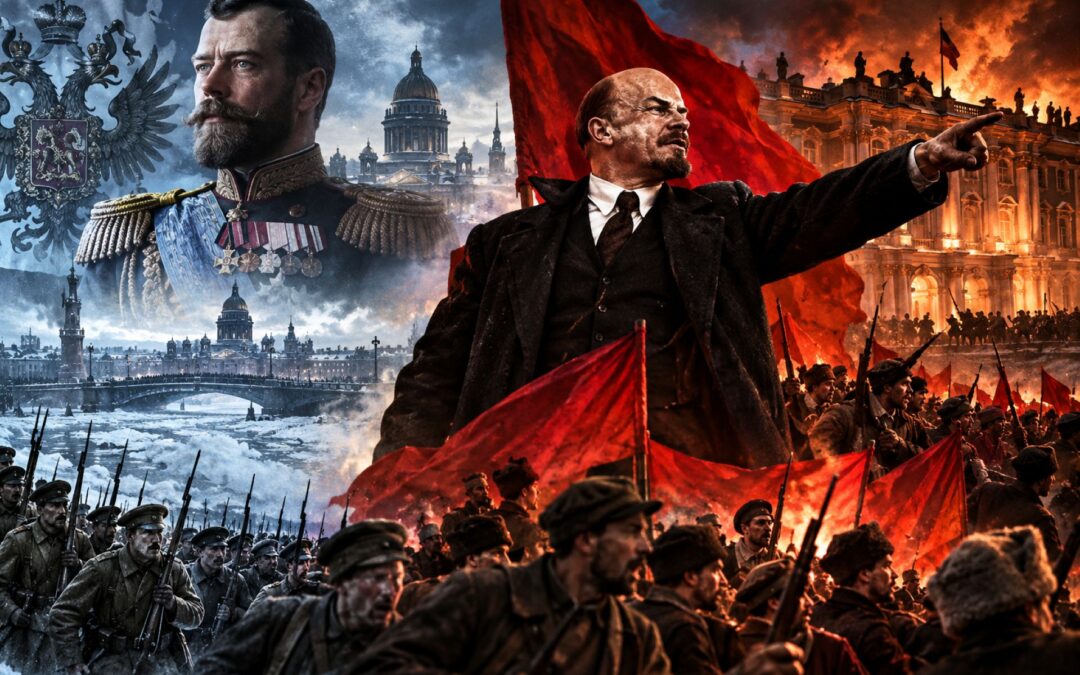
In March 1917, one of the world’s largest empires collapsed in a matter of days. The Romanov dynasty, which had ruled Russia for more than 300 years, lost its throne as workers filled the streets, soldiers abandoned their officers, and political leaders concluded that Tsar Nicholas II could no longer govern. What had seemed like an immovable monarchy proved remarkably fragile once the institutions that sustained it stopped cooperating.
But overthrowing the Tsar was only the beginning of the Russian Revolution. The new government inherited a country devastated by war, divided by competing political movements, and struggling with demands for land, food, peace, and political representation. Within eight months, Vladimir Lenin and the Bolsheviks had seized power, promising to replace the old social order with a government representing workers and peasants.
Their victory did not end Russia’s turmoil. The Bolsheviks dissolved an elected assembly, established a political police force, fought a devastating civil war, and progressively eliminated organized opposition. By the time Lenin died in 1924, the foundations of a centralized one-party state were firmly established, and Joseph Stalin was positioning himself to dominate it.
Understanding how this happened requires looking beyond the dramatic events of 1917. The Russian Revolution grew out of decades of incomplete reform, social inequality, political repression, industrial change, and military failure. Its history reveals how an autocratic empire lost the ability to govern and how the revolutionaries who replaced it struggled with the relationship between popular liberation and political power.
The Empire That Reform Could Not Save
During the nineteenth century, the Russian Empire was one of Europe’s great powers. It stretched across enormous territories in Europe and Asia, possessed substantial natural resources, and maintained a vast army. Its rulers governed a multinational population that included Russians, Ukrainians, Poles, Finns, Baltic peoples, peoples of the Caucasus and Central Asia, and numerous other communities.
Yet Russia’s international strength concealed significant internal weaknesses. While Britain and other Western European countries were industrializing, expanding railway networks, developing manufacturing industries, and experimenting with representative government, Russia remained overwhelmingly agricultural. Political authority rested with an emperor who claimed an almost sacred right to rule.
One of the clearest signs of this older social order was serfdom. Millions of peasants were legally bound to estates and subjected to obligations imposed by landowners. Serfs were not identical to enslaved people in other historical systems, but they lacked fundamental freedoms over their labor, movement, and economic lives. Their position reinforced a rigid hierarchy in which aristocratic landlords enjoyed privileges unavailable to most of the population.
The Crimean War of 1853–1856 exposed some of the empire’s weaknesses, particularly its military and administrative difficulties. Russia needed modernization if it hoped to maintain its position among Europe’s leading powers. When Alexander II became Tsar in 1855, he inherited a government increasingly aware that preserving the existing system without significant reform carried serious risks.
His most consequential measure was the emancipation of the serfs in 1861. Millions of peasants gained personal freedom, and the reform represented a major transformation in Russian society. However, ending legal serfdom did not automatically provide the resources necessary for economic independence.
The land settlement was especially contentious. Many former serfs received insufficient or unfavorable land allotments, while complicated arrangements involving village communities continued to restrict their choices. Peasants also faced redemption payments imposed after emancipation, intended to compensate landowners for land transferred to peasant communities. Although these obligations had originally been structured over decades, the remaining payments were abolished effective in 1907 rather than universally continuing for the entire original term.
Consequently, many peasants remained poor and dissatisfied despite their new legal status. They had gained freedom from landlords without receiving enough land, economic security, or political influence to transform their circumstances. The village commune could provide a measure of collective organization, but it could also constrain individual decisions about land and mobility.
Alexander II pursued other reforms as well. Changes to the judiciary, local administration, education, and military sought to make the empire more effective and modern. Nevertheless, these reforms did not establish a democratic political system or remove the Tsar’s ultimate authority.
This created an increasingly difficult political situation. Conservatives feared that reform would undermine the traditional monarchy, while liberals wanted constitutional limits on imperial power. More radical movements believed that the changes were insufficient and that Russia’s political and social system required fundamental transformation.
Some revolutionaries concluded that violence against the monarchy was necessary. In 1881, members of the revolutionary organization People’s Will assassinated Alexander II with a bomb in St. Petersburg. The emperor most closely associated with the abolition of serfdom died at the hands of opponents who believed his reforms had not gone far enough.
His assassination marked a turning point. Rather than demonstrating that Russia could never reform, it strengthened the determination of Alexander II’s successor to protect the monarchy through political repression. The fundamental tension remained unresolved: Russia needed further modernization, but its rulers feared the political demands that modernization increasingly encouraged.
Alexander III, Nicholas II, and the Failure of Autocracy
Alexander III inherited the throne in 1881 and responded to his father’s assassination by reaffirming autocratic government. He regarded the concentration of power in the monarchy as essential to Russia’s stability. Constitutional reform and revolutionary movements were treated as dangers to the state rather than legitimate responses to its weaknesses.
His government strengthened censorship, surveillance, and controls over political activity. The imperial political police, including the Okhrana, monitored opponents, infiltrated revolutionary organizations, and helped suppress dissent. Political activists, students, intellectuals, and critics of the regime risked imprisonment or exile to Siberia.
The government also pursued policies of Russification intended to strengthen the cultural and political dominance of the empire’s Russian center. Religious and ethnic minorities experienced varying forms of discrimination and pressure, including restrictions affecting Jewish communities and attempts to limit the autonomy of non-Russian populations. These policies were intended to reinforce imperial loyalty, but they could deepen resentment among communities whose languages, institutions, and identities were threatened.
Alexander III maintained the autocratic system until his death in 1894. His son Nicholas II then inherited an enormous empire facing economic change, social discontent, and increasing demands for political participation.
Nicholas was personally committed to his family and sincerely believed that monarchy carried a sacred responsibility. However, he lacked the political flexibility needed to manage an increasingly complex society. Rather than viewing constitutional restrictions as a possible means of preserving the monarchy, he generally regarded the surrender of autocratic authority as a betrayal of his duty.
His reign began with a tragedy that damaged his public image. During celebrations surrounding his coronation in Moscow in 1896, crowds gathered at Khodynka Field for food, drinks, and commemorative gifts. Confusion and crowd pressure produced a catastrophic crush in which more than a thousand people died.
Nicholas had not caused the disaster personally, but his decision to attend a previously scheduled diplomatic ball afterward attracted criticism. For those who already regarded the monarchy as distant from ordinary Russians, the episode reinforced an impression of an imperial court insulated from the suffering of its subjects.
Nicholas would repeatedly confront similar political dilemmas. He could acknowledge the need for reform without accepting the political consequences of meaningful power-sharing. This reluctance became increasingly dangerous as Russia’s society and economy changed around the monarchy.
Factories, Marxism, and the Rise of Lenin
Russia’s economy was not completely stagnant under Nicholas II. The late nineteenth century witnessed substantial industrial development, supported by state policies, foreign investment, and expanding transportation networks. Sergei Witte, an influential Russian statesman and finance minister, promoted industrialization as a means of strengthening the empire’s economic and military position.
Railway construction, including the Trans-Siberian Railway, helped connect distant regions and support commercial development. Coal, iron, steel, and manufacturing industries expanded, while growing cities attracted peasants seeking wages outside agriculture. Industrial modernization was transforming the country’s productive capacity even as its political institutions remained highly centralized.
These economic changes also created new social tensions. Factory workers frequently endured long hours, low wages, dangerous workplaces, and overcrowded living conditions. Many lived in dormitories or cramped urban housing where disease and poor sanitation compounded the hardships of industrial employment.
Unlike peasants scattered across thousands of villages, industrial workers were concentrated in factories and cities. They could organize strikes, share political literature, develop associations, and participate in coordinated protests. Industrialization therefore produced not only new economic resources for the empire but also new possibilities for collective political resistance.
Socialist ideas found an increasingly receptive audience among sections of this developing working class and Russia’s educated political opposition. The writings of Karl Marx and Friedrich Engels offered an explanation of capitalism built around class relations, economic exploitation, and conflict between owners of productive resources and wage laborers.
In Marx and Engels’ theory of class struggle, capitalism generated both extraordinary productive growth and deep conflicts between social classes. Marx expected the development of industrial capitalism to create a working class capable of challenging the capitalist order. For Russian revolutionaries, however, this raised a difficult question: how could a socialist revolution succeed in a country where most people were peasants rather than industrial workers?
Vladimir Lenin became one of the most influential figures attempting to answer that question. Born into an educated family in 1870, Lenin experienced the political violence of the Tsarist system at an early age. His older brother, Alexander Ulyanov, was executed in 1887 for involvement in a conspiracy against Alexander III.
Lenin became politically active as a student, embraced Marxism, and eventually experienced arrest and exile in Siberia. After leaving Russia, he spent years participating in revolutionary organizations abroad, writing political arguments, editing socialist publications, and helping smuggle revolutionary literature into the empire. His newspaper Iskra became an important instrument for connecting Marxist activists and organizing their political movement.
Lenin believed that revolutionary success required disciplined political leadership. Rather than assuming that economic hardship would automatically produce a successful socialist revolution, he argued that an organized party of committed revolutionaries was necessary to develop political consciousness and coordinate action.
His ideas contributed to divisions within the Russian Social Democratic Labour Party. At its 1903 congress, disagreements over organization and political strategy helped produce the factions known as Bolsheviks and Mensheviks. Their names came from the Russian words associated with majority and minority, reflecting a particular division during the congress rather than permanent numerical superiority.
The division developed into broader disagreements over revolutionary organization and Russia’s political future. Lenin’s Bolsheviks emphasized disciplined leadership and a centralized revolutionary party, while Menshevik leaders generally favored a broader movement and expected a substantial period of bourgeois-democratic development before socialist transformation. Neither faction was completely uniform, and their differences evolved over subsequent years.
Lenin’s organizational approach could be forceful and uncompromising, but his influence remained limited for much of the period before 1917. Revolutionary groups operated under police surveillance, faced internal ideological disagreements, and struggled to build mass political support.
Joseph Stalin also emerged within this underground socialist world. A Georgian revolutionary involved in Bolshevik organization, he participated in clandestine political activities and networks associated with raising party funds. Some fundraising operations involved criminal violence, including bank robberies, although accounts of Stalin’s personal role in individual incidents require caution.
For the moment, none of these revolutionaries possessed the power to overthrow the monarchy. Their opportunity would emerge from the government’s own failures, beginning with a disastrous conflict in East Asia.
Defeat in Japan and the First Revolution of 1905
At the beginning of the twentieth century, Russia and Japan were competing for influence in East Asia. Both powers had strategic interests in Manchuria and Korea, and negotiations failed to establish an arrangement acceptable to their governments. Russian officials underestimated Japan’s military capabilities and the extent of its modernization.
In February 1904, Japanese forces launched a surprise attack against the Russian fleet at Port Arthur, beginning the Russo-Japanese War. The conflict exposed serious weaknesses in Russian planning, logistics, and military leadership. Japan achieved major victories on land and at sea, culminating in the destruction of much of Russia’s Baltic Fleet at the Battle of Tsushima in May 1905.
Russia’s defeat was an international humiliation. Its rulers had entered the conflict with expectations of success against a supposedly weaker Asian state, only to discover that Japan’s modern armed forces could defeat a major European empire. The war consumed resources, undermined confidence in the government, and intensified existing domestic grievances.
By then, unrest had already erupted in the Russian capital. On 22 January 1905 according to the Gregorian calendar, a peaceful procession of workers and their families approached the Winter Palace in St. Petersburg. The march was associated with Father Georgy Gapon, an Orthodox priest who helped organize workers seeking improvements in their conditions.
The marchers intended to present a petition demanding measures including better working conditions, political freedoms, and relief from economic hardship. Many still regarded Nicholas II as a paternal figure who might respond sympathetically if he understood their suffering. Their protest therefore combined demands for change with expressions of loyalty to the monarch.
Nicholas was absent from the Winter Palace, and troops had been deployed to prevent demonstrators from reaching it. Soldiers opened fire on crowds at several locations, killing and wounding numerous civilians. The precise number of casualties remains disputed, but the massacre became known as Bloody Sunday.
Its political consequences were profound. A protest organized around an appeal to the Tsar had ended in bloodshed, undermining the belief that the monarchy would protect ordinary Russians against abuses by officials and employers. Workers who had previously sought relief through petitioning became increasingly receptive to broader political opposition.
The unrest spread across the empire throughout 1905. Factory workers organized strikes, peasants attacked landlords’ property, students participated in demonstrations, and liberals demanded constitutional government. Elements of the military also became unreliable, including the famous mutiny aboard the battleship Potemkin.
An important development was the emergence of workers’ councils known as soviets. These bodies brought representatives together to coordinate industrial action and political activity. In St. Petersburg, Leon Trotsky became an influential figure in the soviet movement, gaining experience in revolutionary organization that would later prove important.
The monarchy faced opposition from different groups with different objectives. Liberals wanted constitutional limits and representation, workers demanded improvements in their lives and political rights, peasants sought land, and revolutionary socialists challenged the existing order itself. Their grievances overlapped, but they did not constitute a single unified movement.
Sergei Witte recognized that concessions to constitutional reformers could weaken the opposition facing the monarchy. In October 1905, Nicholas issued the October Manifesto, which promised civil liberties and the creation of an elected legislative assembly, the Duma.
The manifesto appeared to offer Russia a path toward constitutional government. Some liberals accepted the concessions and moved away from revolutionary confrontation. With the war against Japan concluded, the government could also redirect military resources toward suppressing remaining unrest.
Nicholas nevertheless remained determined to preserve his authority. The Fundamental Laws of 1906 reaffirmed extensive imperial powers, and the Tsar retained considerable influence over legislation, ministers, and the operation of the Duma. Representative institutions existed, but they could not reliably compel the monarch to accept their preferred policies.
The 1905 Revolution therefore failed to overthrow the Tsarist system. Its significance lay partly in what it revealed: Russian workers could organize mass strikes, soviets could coordinate political action, parts of the military could mutiny, and a sufficiently serious crisis could force concessions from the monarchy.
It also demonstrated how the government might survive by dividing opponents and suppressing those who remained outside a compromise. These lessons would shape the choices of both the regime and its opponents during the next revolutionary crisis.
Stolypin, Rasputin, and the Monarchy’s Fragile Recovery
After 1905, the government attempted to restore stability through a combination of economic reform and political repression. Pyotr Stolypin, who became prime minister in 1906, believed that peasant dissatisfaction represented one of the greatest threats to the monarchy. His agricultural reforms encouraged peasants to establish more independent landholdings rather than remain dependent on traditional communal arrangements.
Stolypin hoped that secure private ownership would increase agricultural productivity and create a prosperous rural population with a material interest in political stability. The reforms achieved uneven results, but they represented a serious attempt to change the economic foundations of Russian village life.
His government simultaneously pursued harsh measures against revolutionary violence and political opposition. Special courts, arrests, and executions became associated with efforts to restore order, and the gallows acquired the grim nickname “Stolypin’s necktie.” The government treated reform and repression as complementary means of defending the monarchy.
In the years before World War I, Russia experienced economic improvement and renewed industrial growth. Revolutionary movements had been weakened by arrests, exile, factional disputes, and difficulties in organizing supporters. For Lenin and his associates, the prospect of revolution appeared uncertain, and the monarchy seemed capable of surviving.
Yet the relative recovery did not resolve fundamental political disagreements. Stolypin was assassinated in 1911, peasant land problems remained contentious, and Nicholas continued to resist meaningful constitutional limits. Meanwhile, the imperial household was becoming embroiled in a scandal that damaged public confidence.
Grigori Rasputin was a Siberian religious wanderer who gained access to the royal family through his apparent ability to help their son, Alexei. The young heir suffered from haemophilia, a hereditary blood disorder that made bleeding episodes potentially dangerous. Nicholas and Alexandra were intensely concerned about their son’s health and came to regard Rasputin as someone whose prayers and presence could assist him.
Rasputin appeared to calm Alexei during some medical crises, but the explanation for his apparent successes remains uncertain. One retrospective hypothesis suggests that discouraging certain treatments, potentially including aspirin, could have improved the child’s condition. This is not a proven account of Rasputin’s medical influence, and there is no reliable basis for attributing supernatural healing abilities to him.
The family’s reliance on Rasputin created a serious political problem. Rumors circulated about his private behavior, relationships with aristocratic women, influence over appointments, and closeness to Alexandra. Although sensational accounts frequently exaggerated his power and conduct, his position made an already unpopular court appear secretive and vulnerable to manipulation.
In December 1916, a group of aristocrats murdered Rasputin. Popular stories describing extraordinary resistance to poison and repeated attempts to kill him became part of his legend, but several details of these accounts are historically uncertain. His death did not restore the monarchy’s reputation.
Rasputin was not the central cause of the Russian Revolution. His significance was largely symbolic: a government already struggling with questions of competence and legitimacy appeared increasingly unable to maintain public trust even within its own ruling elite.
World War I and the Breakdown of Imperial Authority
Russia entered World War I in 1914 amid an initial surge of patriotism. The government supported Serbia during the international crisis following the assassination of Archduke Franz Ferdinand, and Russian mobilization became part of the escalating confrontation among Europe’s great powers. The empire ultimately found itself fighting Germany, Austria-Hungary, and their allies in a conflict far larger than its leaders had anticipated.
The patriotic atmosphere was visible even in symbolic decisions. St. Petersburg was renamed Petrograd in 1914 because its original name sounded too German. Many political groups that opposed the Tsar nevertheless regarded defending Russia against foreign enemies as an immediate priority.
Lenin took a different position. He viewed the conflict as an imperialist war between competing ruling classes and argued that its pressures could be transformed into revolutionary struggle. His opposition to Russia’s war effort separated him from socialists who supported national defense.
The war soon exposed the weaknesses of imperial administration. Russia possessed enormous manpower but struggled to equip, supply, transport, and coordinate its armies. Military campaigns produced catastrophic casualties and repeated defeats, while shortages of weapons, ammunition, clothing, and other necessities undermined soldiers’ morale.
The economic consequences spread beyond the battlefield. Inflation weakened purchasing power, transportation networks struggled to move supplies, and the needs of the army competed with civilian demand. Food-production problems were compounded by disruptions to distribution, creating increasingly severe shortages in towns and cities.
The conflict also damaged the authority of the government. Each defeat raised doubts about military leadership, while shortages and rising prices undermined confidence in the state’s ability to protect its population. Workers faced declining living standards, peasants resented wartime demands, and soldiers became increasingly exhausted by a struggle whose objectives seemed remote from their daily lives.
The interaction between war and revolutionary pressures, examined in the International Encyclopedia of the First World War, is crucial to understanding Russia’s collapse. The conflict did not create the underlying grievances of land hunger, political exclusion, worker dissatisfaction, or ethnic tensions. Instead, it placed extraordinary pressure on institutions that had struggled with those problems for decades.
Nicholas II compounded his political difficulties in 1915 by assuming direct command of the Russian armed forces. He moved to military headquarters, placing himself in a position where continuing defeats would increasingly be associated with his own leadership. Although professional officers still directed military operations, the Tsar could no longer distance his personal reputation from the army’s failures.
His absence from the capital also increased Alexandra’s political prominence. Her German background became a source of suspicion during the war against Germany, while her relationship with Rasputin encouraged rumors that imperial appointments and decisions were being influenced by an unaccountable outsider. Many accusations were exaggerated or unsupported, but the political damage was substantial.
By 1917, Russia’s mounting military losses, economic instability, shortages, and political dysfunction had created an exceptionally dangerous situation. The monarchy faced a crisis that could not be resolved through another limited concession or police crackdown. The broader course of Russia’s participation in World War I had made the survival of the existing government increasingly dependent on an army and population that were losing confidence in it.
February 1917: How the Romanovs Lost the Throne
The final crisis of the Romanov monarchy began in Petrograd in February 1917 according to the Russian calendar then in use. Russia still followed the Julian calendar, which was thirteen days behind the Gregorian calendar used in much of Western Europe. Consequently, the events called the February Revolution took place in March by the Western calendar.
On 8 March 1917 Gregorian, International Women’s Day, women textile workers participated in demonstrations demanding bread and protesting deteriorating living conditions. Their actions helped trigger a much larger wave of strikes and demonstrations across Petrograd. Industrial workers joined the protests, while demands expanded from food relief to peace and political change.
The revolutionary movement grew rapidly. Factories stopped operating, crowds occupied streets, and the authorities struggled to restore order. What began as protests against shortages developed into a broader confrontation with an increasingly discredited government.
Nicholas’s officials attempted to suppress the unrest through police and military force. Soldiers initially fired on demonstrators in some locations, but parts of the Petrograd garrison soon began refusing orders. Some units mutinied, attacked their officers, or joined the crowds.
This change was decisive because the monarchy depended on the armed forces to enforce its authority. Many soldiers were themselves peasants or workers in uniform, sharing the economic hardships and wartime exhaustion of the demonstrators. Their participation transformed a mass protest into a crisis of state power.
The role of women workers, broader popular mobilization, and the capital’s military garrison is central to scholarly accounts of the revolutions of 1917–1918. The collapse was not simply the result of an elite conspiracy or a single revolutionary party successfully organizing an uprising. It emerged from the interaction of mass protest, military breakdown, and political decisions made under extraordinary pressure.
Members of the Duma, Russia’s elected assembly, formed a committee as the government lost control of the capital. Political leaders increasingly regarded Nicholas’s abdication as necessary to restore stability and preserve the country’s ability to continue the war. Senior military commanders also came to believe that the monarchy could no longer command sufficient support.
Nicholas attempted to return to Petrograd by train, but the deteriorating situation prevented him from reestablishing authority. On 15 March 1917 Gregorian, he abdicated the throne. Rather than pass the crown directly to his young son Alexei, whose haemophilia made his future uncertain, Nicholas designated his brother, Grand Duke Michael.
Michael declined to accept the monarchy without approval from a future representative assembly. This effectively ended more than three centuries of Romanov rule, which had begun in 1613.
The speed of the monarchy’s collapse was remarkable. A dynasty that had governed an enormous empire for generations lost power once its military commanders, political elites, and large sections of the population ceased to defend it. Yet the removal of Nicholas answered only the question of who would no longer rule Russia; it did not establish who possessed legitimate authority to govern the country afterward.
Dual Power and Russia’s Unfinished Revolution
The February Revolution produced an opportunity for a more open political system, but it did not create a single uncontested government. Liberal and moderate political figures established a Provisional Government intended to manage the country until a representative Constituent Assembly could determine its future political arrangements.
The new administration introduced important reforms. Political prisoners were released, restrictions on speech and political activity were relaxed, and the old imperial secret-police apparatus was dismantled. The death penalty was initially abolished, although the government later restored it for certain military offenses, and preparations began for national elections.
These changes represented a genuine departure from Tsarist autocracy. Political organizations could operate more openly, workers could organize, and public debate expanded dramatically. Many Russians hoped that the revolution would lead to representative institutions capable of resolving problems the monarchy had left untouched.
However, another center of power existed alongside the Provisional Government. Workers and soldiers had reestablished the Petrograd Soviet, an elected council that claimed to represent revolutionary constituencies. Similar councils appeared in other cities and regions.
The Petrograd Soviet possessed substantial influence over workers and soldiers, including members of the capital’s garrison. Its orders and political authority could constrain the decisions of government ministers, particularly where soldiers’ committees and revolutionary organizations commanded local loyalty.
This arrangement became known as dual power. The Provisional Government exercised formal state authority, but the soviets possessed political legitimacy and organizational influence among important sections of the population. Neither could simply ignore the other.
The soviets themselves were not initially controlled by Lenin’s Bolsheviks. Mensheviks and Socialist Revolutionaries held considerable influence, and many favored cooperation with the Provisional Government during a period of democratic transformation. They differed over the speed and form of socialist change, but did not initially share Lenin’s insistence that the existing provisional administration should be displaced immediately.
Meanwhile, the population’s central demands remained unresolved. Soldiers wanted an end to the war, peasants wanted land redistribution, workers demanded better conditions and greater control over workplaces, and minority nationalities pressed for autonomy or independence. The government could offer new political freedoms without possessing the resources or authority to settle these competing questions quickly.
Its commitment to continue fighting World War I was particularly damaging. The Provisional Government believed that abandoning Russia’s allies or accepting a humiliating peace would threaten national interests and international obligations. Yet continued warfare required sacrifices from people who had already endured years of military and economic hardship.
The removal of the Tsar had therefore opened Russia’s political system without eliminating the crisis that destroyed the monarchy. This was the environment into which Lenin returned in April 1917.
Lenin Returns With Peace, Land, and Bread
When the February Revolution occurred, Lenin was living in exile in Switzerland. Germany, which was still fighting Russia, had an interest in encouraging revolutionary instability behind Russian lines. German authorities facilitated Lenin’s journey through their territory, allowing him to return to Russia in April 1917.
The decision reflected a wartime calculation. German leaders hoped that Lenin’s revolutionary activities would weaken Russia’s commitment to the war, potentially freeing German forces for other fronts. Lenin’s return served German strategic interests, but that did not mean every subsequent Bolshevik decision was directed by Berlin.
Lenin arrived in Petrograd at a moment when many socialists believed cooperation with the new political institutions was necessary. Rather than endorse this approach, he challenged both the Provisional Government and socialist leaders who supported it.
His position was expressed in Lenin’s April Theses. He argued against supporting the Provisional Government, condemned continued participation in the imperialist war, and called for power to pass to councils of workers’ and soldiers’ deputies. He also advocated revolutionary measures concerning land and economic control, linking Russia’s immediate political crisis to the prospect of socialist transformation.
These demands initially seemed extreme to many political activists, including some Bolsheviks. Russia had only recently removed an autocratic monarchy, and the new government had introduced reforms that socialists had long demanded. Lenin was asking revolutionaries to reject an existing political compromise before democratic institutions had been fully established.
His arguments nevertheless addressed grievances that remained unresolved. Soldiers wanted peace, peasants sought land, and urban workers needed affordable food and more secure livelihoods. The Bolsheviks increasingly connected these demands to the political message of “Peace, Land, Bread.”
Another prominent demand was “All Power to the Soviets.” The slogan appealed to workers and soldiers who regarded their councils as more responsive than government ministers. It did not simply mean transferring authority from one set of officials to another; it challenged the legitimacy of the Provisional Government itself.
The slogans were not detailed solutions to Russia’s immense problems. Ending the war could require territorial concessions, land redistribution could provoke resistance, and supplying food to cities demanded functioning transportation and agricultural production. Their political strength lay in expressing immediate popular demands more clearly than the government’s appeals for patience.
As the Provisional Government struggled to govern, Lenin’s message became increasingly influential. The Bolsheviks remained one faction within a larger revolutionary movement, but they were beginning to turn the failure to resolve Russia’s crisis into an argument for taking power themselves.
From the July Days to the Kornilov Affair
The Provisional Government’s commitment to the war became increasingly difficult to sustain during the summer of 1917. Alexander Kerensky, who emerged as one of its most prominent leaders and later became prime minister, supported a new military offensive intended to restore morale and demonstrate that revolutionary Russia could still achieve victory.
The offensive, launched in June according to the old Russian calendar and generally known as the Kerensky Offensive, initially made progress but soon collapsed. Military indiscipline, desertion, and enemy counterattacks produced another serious setback. Rather than strengthening the government, the failed campaign undermined its authority.
Popular anger intensified in Petrograd during the July Days, when armed workers, soldiers, and sailors participated in large demonstrations. Many marched under Bolshevik slogans and demanded the transfer of power to the soviets. The demonstrations exposed the government’s weakness, but they did not produce an immediate successful insurrection.
Bolshevik leaders were not uniformly enthusiastic about attempting to seize power at that moment. Some sought to influence the demonstrations while avoiding a premature confrontation that could fail. Government forces suppressed the unrest, and the authorities accused the Bolsheviks of dangerous revolutionary activity.
Several Bolshevik leaders were arrested, while Lenin fled to Finland to escape detention. The government also accused him of connections with Germany, exploiting the circumstances of his return and the Bolsheviks’ opposition to continued warfare. For a brief period, it appeared that the revolutionary left had been contained.
Another crisis soon reversed this apparent recovery. General Lavr Kornilov, appointed commander-in-chief of the Russian army, believed that military discipline and state authority had deteriorated dangerously. He opposed political arrangements that, in his view, weakened officers’ authority and threatened the armed forces’ effectiveness.
In August 1917 according to the Russian calendar, Kornilov’s forces moved toward Petrograd amid worsening tensions with Kerensky. Kerensky interpreted the movement as a threat to the government and called for resistance, fearing that military intervention could establish an authoritarian regime.
The affair is frequently described as an attempted counterrevolutionary coup, but historical interpretations of the Kornilov Affair are more complicated. Historians have debated Kornilov’s original intentions, the extent of prior communication with Kerensky, and whether a misunderstanding over proposed military measures contributed to the confrontation. What is clear is that the episode became a major political crisis and that Kornilov’s advance failed.
Railway workers obstructed troop movements, telegraph and communications personnel interfered with coordination, and revolutionary activists encouraged soldiers to resist or abandon the operation. Soviets, trade unions, and socialist organizations mobilized in defense of Petrograd. The threatened military intervention disintegrated without the major battle that many had feared.
For the Bolsheviks, the political consequences were especially favorable. Their involvement in resisting Kornilov allowed them to present themselves as defenders of the revolution against military reaction. Kerensky, meanwhile, appeared increasingly isolated and dependent on radical organizations he had recently attempted to suppress.
Bolshevik influence increased within the soviets of Petrograd and Moscow, where they gained majorities during the autumn. Leon Trotsky, who had joined the Bolsheviks, became chairman of the Petrograd Soviet and emerged as an influential organizer.
The government now faced a dangerous combination of military disorganization, public dissatisfaction, and increasingly powerful political opponents. Lenin, observing developments from hiding, argued that the Bolsheviks should prepare to seize power rather than risk losing the opportunity.
October 1917: Revolution, Coup, and the Seizure of Power
The October Revolution took place on 25 October 1917 according to the old Russian calendar, corresponding to 7 November in the Gregorian calendar. Unlike the February Revolution, which began through mass demonstrations and military mutinies, October involved a more deliberately organized operation directed by Bolshevik revolutionaries.
Lenin pressed his party’s leadership to prepare an armed uprising. Although some Bolsheviks opposed immediate action and feared that the party was moving too quickly, Lenin believed the Provisional Government’s weakness created an opportunity that might not return.
Trotsky played a central organizational role through the Military Revolutionary Committee of the Petrograd Soviet. The committee coordinated revolutionary soldiers, sailors, and armed workers, allowing the Bolsheviks to operate through institutions that already possessed substantial influence in the capital.
Bolshevik-led forces moved to control important locations across Petrograd. They occupied or secured bridges, railway facilities, communication centers, and government buildings, steadily reducing the Provisional Government’s ability to direct events. Much of this operation encountered relatively limited resistance.
Kerensky left Petrograd in an effort to obtain military assistance. The remaining government ministers gathered at the Winter Palace, where their defenders included military cadets and members of a women’s military unit. The defenses were inadequate against the forces mobilized by the revolutionaries.
The cruiser Aurora became associated with the operation against the palace, although later representations often exaggerated the military spectacle. Bolshevik forces eventually entered the Winter Palace and arrested the remaining ministers. The Provisional Government had been overthrown.
Subsequent Soviet art and political mythology frequently depicted October as an enormous heroic assault involving overwhelming revolutionary crowds. The actual seizure of central institutions was less dramatic and considerably less bloody than many later portrayals. That does not mean the broader revolution was peaceful or that political resistance elsewhere disappeared.
The relative ease of the Petrograd operation reflected the weakness of the government and the Bolsheviks’ strength in strategic locations. Workers, soldiers, and sailors in important urban centers had become increasingly radicalized, and the Provisional Government had lost credibility through its failure to resolve the war and other crises.
Whether October should be understood primarily as a revolution or a coup remains an important historical debate. The Bolsheviks did command genuine support among significant sections of Petrograd’s workers, soldiers, and soviet representatives. Their action was therefore not simply the intervention of a political group completely detached from society.
At the same time, the seizure of government power was organized by a disciplined revolutionary party rather than authorized by a national democratic election. Russia’s population was politically diverse, and Bolshevik influence in major industrial cities did not establish that the party represented a nationwide majority.
The October Revolution combined a wider social revolutionary movement with a coordinated takeover of central government institutions. Its success demonstrated the importance of political organization during state collapse, but it did not settle the question of who had the right to govern Russia.
That question would become central to the Bolsheviks’ next struggle: consolidating their authority after the overthrow of the Provisional Government.
How Bolshevik Rule Became a One-Party State
Following the October takeover, Lenin became chairman of the Council of People’s Commissars, commonly known as Sovnarkom. The new government claimed to represent the interests of workers, soldiers, and peasants through the soviet system. It announced measures addressing landownership, the war, and economic power.
The Bolsheviks initially governed in a fluid and contested political environment. Other revolutionary organizations remained active, and the Left Socialist Revolutionaries participated for a time in a coalition with the Bolsheviks. Nevertheless, Lenin and his party increasingly regarded independent political opposition as a threat to the survival of the revolution.
The most significant early conflict over political legitimacy concerned the Constituent Assembly. Elections had been planned before the Bolshevik takeover to create a representative body capable of determining Russia’s political future. Voting took place after October, and the results did not give the Bolsheviks a nationwide majority.
The Socialist Revolutionaries, whose support was particularly strong among peasants, won more votes and seats than the Bolsheviks. Electoral patterns were uneven: the Bolsheviks enjoyed considerable support in major industrial centers and among some soldiers, but the countryside remained politically distinct. The results demonstrated that controlling the capital and claiming revolutionary authority did not necessarily mean possessing a national electoral mandate.
Lenin argued that the Constituent Assembly no longer adequately represented the political realities created by the soviet revolution. When the assembly convened in January 1918 and refused to accept Bolshevik demands for subordination to soviet authority, it was dissolved by force.
The decision was a major turning point. The Bolsheviks had justified their seizure of power partly through claims of popular representation, yet they refused to permit a national elected institution to challenge their government. Opponents who protested against the closure also encountered coercive responses.
The government had already established the Cheka in December 1917. Formally created to combat counterrevolution and sabotage, this political police organization gradually acquired enormous powers over suspected enemies of the new regime. Arrests, detention, intimidation, and executions became instruments of revolutionary state security.
The archival history of Soviet political institutions and internal repression helps illustrate how revolutionary emergency measures became embedded in a more permanent system of power. The Bolsheviks justified coercion as necessary to defend the revolution against internal enemies and foreign-backed counterrevolution, while critics saw the systematic destruction of political opposition.
The process intensified during the Civil War, especially after an assassination attempt against Lenin in August 1918. Bolshevik authorities expanded repression in a campaign that became known as the Red Terror, targeting suspected opponents and groups considered dangerous to the revolutionary regime.
Violence against political opponents was not confined to Bolshevik forces, and the country was becoming engulfed in civil warfare. Nevertheless, the Bolshevik government’s increasingly institutionalized political coercion narrowed the possibilities for independent socialist, liberal, and other political movements.
The development of one-party rule was a process rather than a single announcement. The dissolution of the Constituent Assembly, establishment of the Cheka, suppression of opponents, and concentration of authority in party institutions gradually transformed the government’s relationship with the population.
The Bolsheviks had promised power through the soviets. In practice, political authority increasingly became concentrated within the leadership and organizational machinery of the Communist Party.
Brest-Litovsk and the Wars for Russia
Even after taking power, the Bolsheviks faced one of the central problems that had destroyed the previous governments: Russia was still fighting World War I. The army was disintegrating, desertion was widespread, and military resistance against Germany and the Central Powers was increasingly difficult.
Lenin believed that ending the war was essential to preserving the new government. Continuing a hopeless conflict would consume resources, intensify domestic opposition, and threaten the survival of Bolshevik rule. However, the terms demanded by Germany were severe.
Leon Trotsky, serving as Commissar for Foreign Affairs, participated in negotiations and pursued a policy summarized as “neither war nor peace.” Russia would stop fighting without accepting Germany’s proposed peace settlement, reflecting the hope that further military confrontation could be avoided or that revolutionary developments elsewhere would change the situation.
The strategy failed. German forces resumed their advance in February 1918 and encountered limited organized Russian resistance. The renewed offensive exposed the Bolsheviks’ military weakness and forced the government to confront even harsher demands.
In March 1918, Soviet Russia signed the Treaty of Brest-Litovsk with the Central Powers. The treaty imposed enormous territorial concessions affecting regions including Ukraine, the Baltic territories, and other areas formerly controlled by the Russian Empire. These losses represented substantial populations, agricultural resources, industrial capacity, and strategic territory.
For many Russians, the treaty was a national humiliation. Critics accused Lenin of sacrificing the country to protect his government, while some revolutionary socialists considered the agreement a betrayal of international revolutionary principles. Lenin defended it as a necessary retreat, arguing that the revolution could not survive if the Bolsheviks lost control of Russia.
The government also transferred its capital from Petrograd to Moscow, partly because the old capital had become dangerously exposed. Although Germany’s defeat later in 1918 undermined the Brest-Litovsk settlement, the Bolsheviks had already become entangled in a much broader struggle for control of the former empire.
Opposition to Bolshevik power emerged from several directions. Monarchists, conservative military officers, liberals, and other anti-Bolshevik groups formed armed movements commonly associated with the Whites. Some moderate socialist opponents also resisted Bolshevik rule, although their political goals were not identical to those of conservative and monarchist forces.
The collapse of imperial authority also encouraged national independence movements and regional governments. These could pursue their own objectives rather than simply join the White movement. Peasant armies, anarchist formations, Cossack organizations, and independent local forces further complicated the struggle.
Foreign governments intervened as well. Britain, France, the United States, Japan, and other powers became involved in different regions for varying strategic and political reasons. Their interventions reflected concerns about the war, supplies, regional security, anti-Bolshevik forces, and the spread of revolutionary ideology.
The Russian Civil War was therefore not a straightforward contest between two unified armies. It was a series of interconnected military and political struggles across the territories of a disintegrating empire.
The Bolsheviks nevertheless possessed important strategic advantages. They controlled much of the industrial heartland, major population centers, and essential railway connections. Their central geographic position allowed them to move forces between different fronts more effectively than several opponents operating from distant regions.
Trotsky became instrumental in organizing the Red Army into a disciplined military force. The Bolsheviks employed former imperial officers under political supervision, used transport networks effectively, and attempted to coordinate military operations through centralized command.
The White armies suffered from profound divisions. Their leaders disagreed about Russia’s political future, struggled to cooperate across vast distances, and frequently failed to develop a persuasive approach to the land question. Many peasants feared that a White victory could restore landlord privileges or reverse changes in rural property relations.
These weaknesses contributed to the eventual Bolshevik victory. The Reds’ organization and control of strategic territory helped them defeat major White offensives, although fighting, regional resistance, and instability continued in different areas beyond the principal campaigns.
The Civil War also determined the fate of the former imperial family. After Nicholas II’s abdication, he, Alexandra, their children, and accompanying attendants remained under detention. Their conditions became more restrictive as the political situation deteriorated.
In July 1918, with anti-Bolshevik forces approaching Yekaterinburg, Bolshevik guards executed Nicholas, Alexandra, their five children, and several attendants. The murders took place during the night of 16–17 July. The precise role of the highest Bolshevik leadership in authorizing the executions remains historically disputed and should not be treated as conclusively established.
The family’s death symbolized the violent destruction of the old dynastic order. Yet the conflict surrounding it was also reshaping the society and institutions that would replace the empire.
Terror, Famine, and Lenin’s Economic Retreat
The Russian Civil War devastated the country. Armed forces fought across enormous territories, transportation systems deteriorated, agricultural production and distribution were disrupted, and civilians faced violence from multiple competing authorities. The consequences extended far beyond battlefield casualties.
The Bolsheviks used the Cheka and other state institutions to suppress suspected counterrevolutionaries, political opponents, and groups considered hostile to their rule. During the Red Terror, many people were imprisoned or executed, often under conditions that offered little meaningful legal protection.
White forces also committed serious atrocities, including executions, reprisals, and antisemitic pogroms. Violence against Jewish communities became especially destructive in several areas affected by the Civil War. Different armed movements pursued different objectives, but civilians throughout the former empire suffered from the breakdown of security and authority.
Economic conditions deteriorated catastrophically. Factories closed or operated far below capacity, railway networks were damaged or overwhelmed, and inflation undermined the value of money. Urban populations declined as people left cities in search of food, shelter, or safer living conditions.
The Bolshevik government’s wartime economic policies contributed to these pressures. Under arrangements later known as War Communism, the state expanded control over major industries, restricted private trade, and requisitioned grain from peasants to feed the military and urban population.
Officials viewed these measures as necessary in an emergency, but requisitioning could be coercive and intensely unpopular. Farmers had little incentive to produce surpluses that might be seized, while the collapse of normal trade and transportation further disrupted food supplies. The relationship between wartime destruction, government policies, and agricultural crisis was complicated, but the combined consequences were severe.
Famine spread across large regions, particularly during 1921–1922, causing millions of deaths. Disease, displacement, and economic breakdown compounded the disaster. The revolutionary government’s survival had come at an extraordinary human cost.
Political unrest also continued after the main White armies had been defeated. Peasant uprisings challenged requisitioning and coercive administration, while strikes expressed dissatisfaction among workers who had once been central to the Bolsheviks’ revolutionary appeal.
One particularly significant confrontation occurred at the naval base of Kronstadt in 1921. Sailors and others associated with the rebellion demanded political and economic changes, challenging the growing concentration of power in Bolshevik hands. The government suppressed the uprising militarily, demonstrating its willingness to use force against former revolutionary supporters.
Lenin recognized that the existing economic arrangements were unsustainable. In 1921, the government introduced the New Economic Policy, commonly known as the NEP, replacing some coercive requisitioning practices with taxation and permitting limited private trade and small-scale business activity.
The policy represented an important retreat from the most restrictive emergency economic measures. Peasants gained greater opportunities to market agricultural surpluses, while some private commercial activity returned. The government retained control of major industries, banking, and essential economic institutions, however, and the political monopoly of the Communist Party remained intact.
The economic pressures behind the New Economic Policy illustrate the difference between revolutionary ideals and the practical challenge of governing a devastated country. The Bolsheviks had to restore production and exchange without surrendering the political authority they had fought to establish.
The NEP contributed to economic recovery, but it did not establish a competitive political system. Opposition parties remained suppressed, state security institutions retained extensive powers, and party leaders increasingly determined the permissible boundaries of political activity.
By the early 1920s, the Bolsheviks had survived foreign intervention, multiple military opponents, severe economic breakdown, and widespread rebellion. Their victory had secured the new government, but it had also produced institutions shaped by emergency rule, centralized command, and distrust of independent opposition.
Lenin’s Final Years and Stalin’s Rise
The Union of Soviet Socialist Republics was formally established in December 1922. It brought together Soviet republics under a new federal framework, presenting itself as a multinational socialist state rather than a continuation of the Romanov monarchy. In practice, central Communist Party institutions increasingly dominated the political system.
Lenin’s health was deteriorating at precisely the moment the Soviet state was being consolidated. He suffered a series of strokes beginning in 1922, progressively limiting his ability to participate in government and party affairs. His declining authority created uncertainty over the future leadership of the revolutionary movement.
Leon Trotsky appeared to possess many qualifications for a leading role. He had been central to the October takeover, served as an influential revolutionary speaker and organizer, and helped build the Red Army during the Civil War. His prominence made him an important contender in subsequent political struggles, although there was no automatic or universally accepted succession arrangement.
Joseph Stalin had different strengths. He was less celebrated as a theorist or public speaker, but he understood the administrative and organizational structures through which political influence could be exercised. His power emerged increasingly from his ability to build alliances and shape appointments within the party.
In April 1922, Stalin became General Secretary of the Communist Party. Although the position sounded administrative, it offered considerable influence over the party’s organizational machinery, including appointments and relationships among officials. Stalin used these opportunities to cultivate supporters and strengthen his position.
This form of power could be less visible than Trotsky’s revolutionary reputation, but it was highly consequential. Party officials increasingly depended on internal networks for advancement, access, and influence. Control over these networks helped Stalin shape political decisions and isolate opponents.
Lenin became concerned about Stalin’s behavior and accumulation of authority. In documents later associated with Lenin’s Testament, he criticized Stalin’s conduct and suggested that the party consider removing him from the General Secretary position. Tensions involving Stalin’s treatment of Lenin’s wife, Nadezhda Krupskaya, reinforced these concerns.
Lenin’s declining health prevented him from effectively directing the succession struggle. He died in January 1924, leaving behind a party leadership divided by ideological disagreements, personal rivalries, and competing ambitions.
Stalin did not immediately become an uncontested dictator upon Lenin’s death. His emergence required a prolonged series of political maneuvers in which he formed and abandoned alliances, exploited divisions among leading Bolsheviks, and gradually defeated rival factions.
Trotsky became increasingly isolated. He lost political influence, was expelled from the Communist Party, and was eventually forced into exile. In 1940, years after Stalin had consolidated his dominance, Trotsky was assassinated in Mexico by an agent acting on behalf of the Soviet security apparatus.
The significance of Stalin’s rise through the Communist Party machinery lies partly in the institutional foundations that already existed. A state governed through a centralized political party, supported by coercive security institutions and increasingly intolerant of independent opposition, created powerful instruments for whoever gained control of its leadership.
Stalin would eventually transform the Soviet Union through forced collectivization, rapid industrialization, political purges, and an increasingly personal dictatorship. These later developments were not simply inevitable consequences of October 1917, but they were influenced by the political institutions and concentration of authority that emerged during Lenin’s years in power.
The Soviet state also became one of the defining powers of the twentieth century. Its later confrontation with the United States and its allies developed into the Cold War, a global rivalry whose ideological foundations were connected to the revolutionary transformation of Russia.
By the time Stalin had established his dominance, the political movement that had once fought to overthrow an autocratic monarchy had created a state capable of exercising extraordinary authority over its own society.
The Russian Revolution began with the collapse of a political system that had repeatedly resisted meaningful limits on its authority. Tsarist rulers attempted to modernize their economy while preserving autocratic power, but the resulting social changes intensified demands that the monarchy proved unable to accommodate. World War I placed overwhelming pressure on these unresolved conflicts, turning longstanding dissatisfaction into a revolutionary crisis.
The fall of Nicholas II did not determine what would replace him. The Provisional Government introduced genuine political freedoms, but it could not resolve the war, redistribute land, stabilize the economy, or establish uncontested authority. Lenin and the Bolsheviks used these failures to build support, while disciplined political organization allowed them to act decisively when their opponents were divided and vulnerable.
Once in government, the Bolsheviks faced problems far more difficult than seizing power. They confronted foreign war, domestic opposition, economic collapse, and the challenge of governing an enormous multinational territory. Their response combined revolutionary commitments with increasingly coercive institutions, narrowing political pluralism even as they claimed to govern in the name of workers and peasants.
The Soviet state that emerged was therefore shaped by a complex interaction of historical circumstances, ideological convictions, institutional choices, and violent conflict. The revolution destroyed the Romanov autocracy, but it did not create the broadly democratic socialist society envisioned by many who had opposed the old regime.
Its lasting significance is found in that transformation. The Russian Revolution demonstrated how an apparently powerful political order could collapse when its institutions lost legitimacy and support, while also revealing how the struggle to defend revolutionary authority could produce a new concentration of power with consequences far beyond Russia itself.
Last Updated on October 22, 2026 by Aseem Gupta