
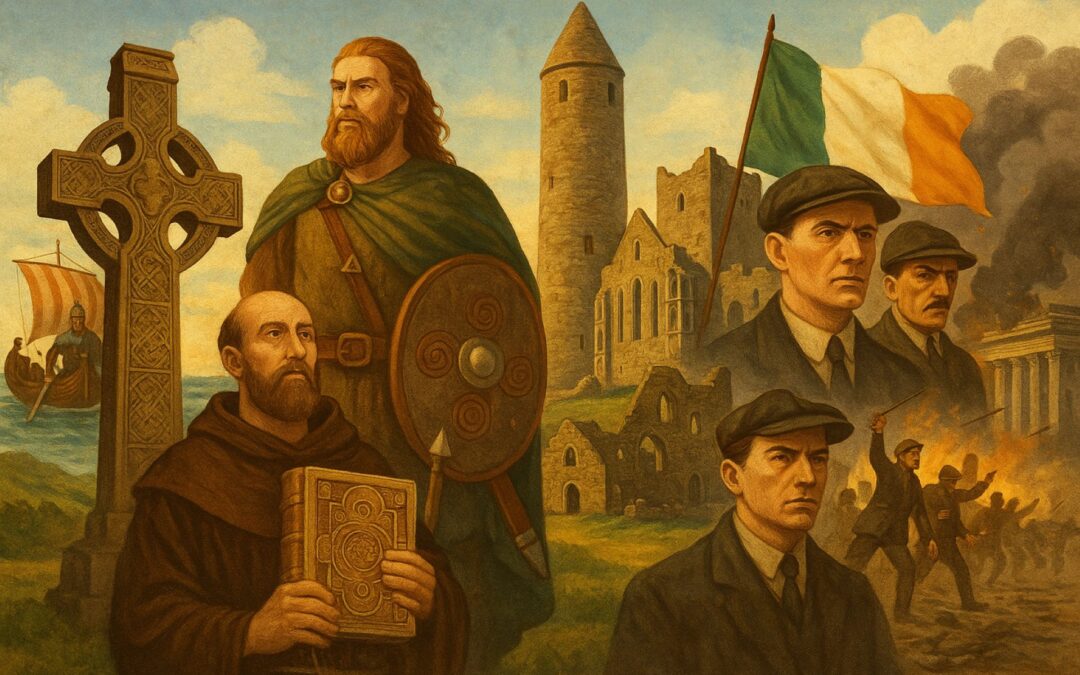
Ireland’s history is a saga of resilience. For thousands of years, the island has been shaped by waves of invaders, the endurance of Gaelic culture, the spread of Christianity, and the grinding weight of colonization. From Viking slave markets to Norman castles, from Tudor plantations to the horrors of famine, each era left behind scars that never quite healed.
Yet out of this turbulence, Ireland also produced brilliance—monastic learning that preserved Western civilization, revolutions that inspired generations, and a cultural identity that survived centuries of suppression.
The division of the island into north and south, which still defines its political map today, is merely the latest chapter in a story that stretches back to antiquity. To understand Ireland is to see not just its struggles but its tenacity—the way it has continually remade itself, often against impossible odds.
The Roots of Division
The division of Ireland into two states is often seen as a 20th-century phenomenon, but to understand it properly, one must look back across millennia of layered history. The border that today separates the Republic of Ireland from Northern Ireland did not spring into being out of thin air—it was the final manifestation of centuries of accumulated pressures: tribal rivalries, foreign conquests, religious fractures, and economic imbalances. Each new wave of conflict left behind legacies that hardened identities and bred mistrust between communities.
What makes Ireland’s story particularly poignant is that, unlike larger empires that could absorb internal tensions, the island’s compact size meant that every change, every upheaval, left visible scars on its society. Whether it was the cultural dominance of Gaelic clans, the sudden arrival of Viking raiders, or the colonization schemes of English monarchs, each era compounded differences rather than erasing them. Religion, too, became a defining wedge. Catholicism, woven tightly into Irish cultural life, came into bitter conflict with the Protestantism imported through English and Scottish settlers. By the 20th century, when the island was formally partitioned in 1921, the groundwork for division had long been set, etched into both the landscape and the psyche of its people.
The Gaelic World
Before Christianity, before Viking longships, before English lords arrived to stake their claims, Ireland was a Gaelic world defined by kinship, custom, and oral tradition. The Celts, who migrated to the island around the middle of the first millennium B.C., brought with them a worldview that shaped everything from religion to governance. They introduced the Gaelic language, which would become not just a mode of communication but a vessel of poetry, myth, and law. Unlike societies elsewhere in Europe, Ireland’s governance was not centralized. The island was divided into tuatha, small clan-based kingdoms, each led by a chieftain. These leaders might occasionally recognize a High King at Tara, but this authority was symbolic at best; in practice, Ireland was a patchwork of shifting alliances and rivalries.
This was a society that valued memory as much as might. Poets and bards—filí—were guardians of collective memory, entrusted with preserving genealogies, histories, and epic tales. Their words could immortalize a leader or condemn him to shame. The druids, meanwhile, acted as judges, priests, and scholars, overseeing rituals and maintaining oral law codes known as Brehon Law. These laws, sophisticated yet unwritten, governed land disputes, inheritance, and compensation for crimes. They reflected a society built not on rigid hierarchies but on negotiated relationships.
Gaelic Ireland was deeply spiritual, with a pantheon of gods tied to the natural world. Sacred groves, rivers, and stones were revered, and seasonal festivals like Samhain marked the rhythms of life. Warfare among clans was common, yet it rarely escalated into extermination. Raids and skirmishes were as much about honor and cattle as about territory. Despite its apparent fragmentation, Gaelic society maintained a cultural coherence that would outlast invasions, reforms, and even colonization. The Gaelic world, rooted in language, law, and lore, became the foundation of Irish identity, a bedrock so strong that even when armies and empires swept across the island, it endured in some form.
Christianity and the Monastic Age
The arrival of Christianity in Ireland during the 4th and 5th centuries was not merely a religious conversion—it was an intellectual and cultural revolution. Unlike much of Europe, where Christianity spread through imperial decree, Ireland’s conversion was organic, carried by missionaries, returning captives, and figures like St. Patrick. Patrick himself, once enslaved by Irish raiders, returned to the island with a mission: to replace pagan ritual with Christian faith. Over time, his efforts and those of countless others transformed Ireland from a land of druids and polytheism into a predominantly Christian society.
Christianity brought with it literacy, and literacy brought permanence. For a culture that had relied entirely on oral tradition, the ability to write down laws, stories, and scriptures changed everything. Monasteries sprang up across the island, not just as religious sanctuaries but as centers of learning, art, and preservation. Within their stone walls, monks recorded myths like the Táin Bó Cúailnge, blending pagan legends with Christian moral frameworks. They also produced masterpieces of illuminated art, the most famous being the Book of Kells, a breathtaking fusion of intricate Celtic design and Gospel text.
These monastic communities became beacons for all of Europe. While the continent stumbled through the so-called Dark Ages, Irish monks preserved not only their own traditions but also classical works from Greece and Rome. Some traveled abroad, re-evangelizing regions of continental Europe where Christianity had waned. In this way, Ireland—once considered a remote outpost—became a center of intellectual and spiritual life.
Yet these very achievements would eventually draw danger. The monasteries, repositories of wealth and knowledge, became tempting targets for marauders. The golden age of Irish monasticism was brilliant, but it also made Ireland a prize, one that would soon attract the prowling longships of the Vikings.
The Viking Age
The year 795 marked a violent shift in Ireland’s trajectory. Longships carrying Norse raiders struck monasteries along the coast, unleashing a wave of terror that would define the next two centuries. These early raids were swift and brutal: monks slaughtered, sacred treasures looted, and captives taken into slavery. But as time passed, the Vikings’ ambitions grew. They were not content with fleeting plunder—they sought permanence.
By the ninth century, fortified bases known as longphorts appeared on riverbanks and estuaries. These grew into Ireland’s first true towns: Dublin, Waterford, Cork, Wexford, and Limerick. For an island that had previously been defined by rural clan settlements, these urban hubs were revolutionary. They became bustling marketplaces where Irish goods—hides, wool, and slaves—were exchanged for silver, weapons, and exotic wares from as far away as Byzantium and the Middle East. Dublin emerged as the jewel of this Norse network, notorious as the largest slave market in Western Europe. Human beings—men, women, and children captured in raids—were sold and transported across Viking trade routes that reached as far as North Africa.
Yet the Vikings never truly conquered Ireland. The interior remained under the authority of Gaelic kings, who resisted foreign domination with relentless ferocity. Over time, many Norse settlers began to intermarry with the Irish, adopting the Gaelic language and customs. These hybrid communities, the Norse-Gaels, symbolized both the inevitability of cultural assimilation and the enduring pull of Irish identity. Still, hostility simmered. The Battle of Clontarf in 1014, led by the High King Brian Boru, was a pivotal moment. Although Boru himself was killed, the victory against the Norse-Irish alliance signaled the beginning of Viking decline in Ireland. Their political dominance faded, but their towns—centers of trade and cultural exchange—continued to flourish, leaving an indelible mark on Ireland’s landscape and economy.
Norman Conquest and English Authority
The Norman arrival in 1169 was not initially an act of empire but an invitation. Diarmait Mac Murchada, the exiled King of Leinster, sought military assistance in reclaiming his throne. He turned to Norman mercenaries from Britain, led by Richard de Clare, better known as Strongbow. Their arrival was transformative. Equipped with chainmail, cavalry, and advanced siege tactics, the Normans were unlike any force the Irish had faced. Within a short time, they seized significant swathes of Leinster, constructing castles that symbolized both military might and administrative control.
Their success alarmed King Henry II of England, who feared that these Norman lords might establish an independent realm beyond his influence. In 1171, Henry crossed the Irish Sea with an army, asserting his claim and formally binding Ireland to the English Crown. He declared his son John the Lord of Ireland, creating a precedent for English dominion that would shape the island’s future.
Despite this, conquest was incomplete. The Normans secured the area around Dublin—the Pale—and extended their reach into the south and east, but vast tracts of the island remained under Gaelic control. Over generations, many Norman settlers “went native.” They married into Irish families, adopted the Gaelic tongue, and governed in the manner of local lords rather than foreign conquerors. This assimilation alarmed the English Crown, which attempted to legislate against it through the Statutes of Kilkenny in 1367, forbidding intermarriage and the use of the Irish language. Yet the tide could not be reversed. By the 15th century, English authority had shrunk dramatically, reduced largely to Dublin and its environs, while Gaelic chieftains reasserted themselves elsewhere. The Normans had introduced new institutions and architecture, but the island remained politically fragmented, awaiting the next great upheaval.
Tudor Conquest and Collapse of Gaelic Ireland
The 16th century ushered in a far more aggressive phase of English expansion. The Tudor monarchs, intent on consolidating their rule, viewed Ireland as both a security threat and a colonial opportunity. The Protestant Reformation provided an additional layer of conflict. While England severed ties with Rome under Henry VIII, Ireland remained staunchly Catholic. This religious divide ensured that political submission would never come easily.
Henry VIII declared himself King of Ireland in 1541, replacing the medieval title of “Lord of Ireland” with a crown intended to signify complete sovereignty. English officials attempted to entice Gaelic chiefs into compliance by offering titles, land rights, and legal protection in exchange for loyalty. Some accepted, but many resisted fiercely. In Munster, the powerful Fitzgerald family staged repeated rebellions, only to be crushed. Their lands were confiscated and repopulated with Protestant settlers, a policy known as “plantation.”
The most significant resistance erupted at the close of the century. Hugh O’Neill, Earl of Tyrone, led the Nine Years’ War (1594–1603), rallying Irish lords in a last great attempt to preserve Gaelic independence. With the backing of Catholic Spain, O’Neill scored notable victories, including the famous ambush at Yellow Ford in 1598. For a moment, it seemed possible that Ireland might expel English rule. But the tide turned at the Battle of Kinsale in 1601, when English forces decisively defeated the Irish and their Spanish allies.
O’Neill’s surrender in 1603 marked the end of Gaelic Ireland. In 1607, the “Flight of the Earls” saw O’Neill and other Gaelic nobles depart for exile in continental Europe, abandoning their ancestral lands. This exodus signaled the collapse of the old order. What followed was the systematic colonization of Ulster, where English and Scottish settlers were planted on confiscated lands. Towns were renamed, landscapes reshaped, and the demographic foundation laid for centuries of sectarian division. The Tudor conquest did not merely extend English authority; it obliterated the structures of Gaelic society, replacing them with a colonial framework that would haunt Ireland’s history for generations.
Rebellion, Cromwell, and Penal Laws
The early 17th century saw Ireland transformed by the English Crown’s plantation schemes. Ulster, the stronghold of Gaelic resistance, became the focal point of mass colonization. Tens of thousands of Protestant settlers from Scotland and England were given confiscated lands, while native Catholics were pushed aside into marginal, less fertile areas. Towns were rebuilt with fortified walls, English architecture, and anglicized names—Derry was rechristened Londonderry to honor London investors. The new Protestant planter class quickly grew in wealth and influence, while the dispossessed Irish simmered in resentment.
This tension erupted in 1641, when Catholic lords and commoners alike rose in rebellion. The revolt began with attacks on Protestant settlers in Ulster and spread rapidly, escalating into massacres, reprisals, and open warfare. The chaos unfolded against the backdrop of the English Civil War, making Ireland both a battleground and a pawn in larger political struggles.
In 1649, Oliver Cromwell landed in Ireland at the head of a hardened parliamentary army. His campaign was ruthless. At Drogheda and Wexford, his troops massacred soldiers and civilians alike, searing his name into Irish memory as a symbol of brutality. Over the next four years, Cromwell’s forces reconquered the island with devastating efficiency. When the conflict ended, the punishment was severe: Catholic landownership collapsed to around 10%. The vast majority of fertile estates were transferred to Cromwell’s soldiers, creditors, and Protestant settlers.
The later defeat of Catholic King James II by Protestant William of Orange in 1690 sealed Protestant dominance. Battles such as the Boyne (1690) and Aughrim (1691) became defining moments in the sectarian narrative of Ireland—celebrated by Protestants as triumphs, mourned by Catholics as tragedies. After William’s victory, Parliament enacted the Penal Laws, stripping Catholics of basic civil rights. They could not sit in Parliament, vote, inherit land, or bear arms. Catholics, who formed the overwhelming majority of the population, were reduced to second-class status under a Protestant Ascendancy. Their faith, culture, and political power were pushed into the margins, surviving mainly among the rural poor. The Ireland of the 18th century was one of stark inequality, with wealth and privilege concentrated in the hands of a small Anglican elite, while resentment seethed beneath the surface.
Revolutionary Currents and Union
Despite the repression of Catholic Ireland, revolutionary ideals swept the island in the late 18th century. The American and French revolutions ignited imaginations, offering a vision of liberty, equality, and fraternity that transcended old divisions. For the first time, some Protestants and Catholics found common cause. In 1791, radical thinkers in Belfast—many of them Protestant Presbyterians disillusioned with the Anglican elite—founded the Society of United Irishmen. Led by figures like Wolfe Tone, their ambition was audacious: to unite Irishmen of all creeds under a republican banner and to sever Ireland’s ties with Britain.
By 1798, these ideas erupted into open rebellion. The uprising spread across the island, particularly in Wexford and Ulster. Initially fueled by hope, it soon descended into a bloody catastrophe. Poorly coordinated and brutally suppressed by British forces, the rebellion left tens of thousands dead. Mass executions, scorched earth tactics, and sectarian violence shattered the fragile unity that the United Irishmen had tried to build. Wolfe Tone himself was captured and died in prison, but his martyrdom etched him into the pantheon of Irish nationalism.
In the aftermath, the British concluded that the Irish Parliament in Dublin was unreliable and vulnerable to rebellion. Their solution was the Act of Union, effective in 1801, which formally merged Ireland with Great Britain to create the United Kingdom of Great Britain and Ireland. The Dublin Parliament was dissolved, and Irish representatives were now expected to sit in Westminster. To many, this was the final blow to Ireland’s autonomy. Yet it also laid the groundwork for future nationalist movements. Catholic emancipation, won in 1829 by Daniel O’Connell’s tireless campaigning, offered a glimmer of progress. Still, the union cemented Ireland’s subordination to Britain, ensuring that political struggles over identity and governance would dominate the 19th century.
The Great Famine
The mid-19th century brought devastation on a scale Ireland had never seen. By the 1840s, the island’s population had swelled to over eight million, with most of its people surviving as tenant farmers or landless laborers. For the rural poor, the potato was not just a staple—it was life itself. Nutritious, calorie-dense, and easy to grow, it sustained millions on small plots of land. But in 1845, a fungal blight swept through the potato fields, turning crops black and inedible. The blight returned year after year, triggering one of the deadliest famines in modern European history.
The British government’s response was disastrously inadequate. Relief efforts were slow, inconsistent, and undermined by rigid adherence to free-market ideology. Worse still, food exports from Ireland continued throughout the famine years, with grain, cattle, and butter shipped abroad while the local population starved. Between 1845 and 1852, approximately one million Irish died of hunger or famine-related diseases. Another million emigrated, many to America, Canada, and Australia, cramming into “coffin ships” where disease often claimed more lives before landfall.
Entire communities vanished. Families were broken apart forever as emigrants sent letters or remittances from across the Atlantic, never to return. The Irish language, once dominant among the rural poor, collapsed as survivors sought English-speaking lands and opportunities. The famine scarred Ireland’s psyche and deepened its hostility toward British rule. It was not simply a natural disaster—it was perceived as a man-made tragedy, exacerbated by neglect, indifference, and exploitation.
The demographic consequences were staggering. Ireland’s population plummeted by a quarter, and it would never fully recover. The famine transformed Irish nationalism, turning calls for reform into demands for independence. The memory of suffering and exile hardened a sense of injustice that would drive political movements for generations to come, while the diaspora carried both trauma and defiance to every corner of the world.
The Road to Independence
By the late 19th century, the memory of famine and dispossession had reshaped Irish politics. The campaign for Home Rule became the central cause of the era, seeking limited autonomy within the United Kingdom. Leaders like Charles Stewart Parnell mobilized the masses, pushing for an Irish parliament to govern domestic affairs while remaining under the British Crown. Home Rule bills were introduced in Westminster several times, but they met fierce resistance from Conservative politicians and, more significantly, from Ulster Unionists. The Protestant community in Ulster, deeply tied to Britain both economically and culturally, feared that Home Rule meant “Rome Rule”—domination by the Catholic majority. The division between north and south, though not yet formalized, was becoming clear.
By 1914, a Home Rule Act was finally passed, but its implementation was suspended with the outbreak of World War I. While over 200,000 Irishmen volunteered to fight for Britain in the trenches of Europe, nationalist sentiment was reaching a boiling point at home. In 1916, the Easter Rising erupted in Dublin. About 1,600 rebels seized key sites, proclaiming an Irish Republic. Militarily, it was doomed—British forces crushed the insurrection within a week, leaving much of Dublin in ruins. Yet politically, the Rising changed everything. The execution of its leaders—Patrick Pearse, James Connolly, and others—turned them into martyrs, galvanizing support for independence.
The 1918 general election sealed the transformation. Sinn Féin, running on a platform of independence, swept most of the Irish seats. Its MPs refused to sit at Westminster and instead formed their own parliament, the Dáil Éireann, in Dublin, declaring independence. The Irish Republican Army (IRA) was born, launching a guerrilla war against British forces. From 1919 to 1921, ambushes, assassinations, and reprisals defined the Irish War of Independence. By 1921, neither side could claim outright victory, but exhaustion and international pressure pushed both to the negotiating table. The result was the Anglo-Irish Treaty—a compromise that brought both triumph and tragedy.
Partition and the Troubles
The Anglo-Irish Treaty of 1921 granted dominion status to the Irish Free State, similar to Canada or Australia, but left Northern Ireland—six counties of Ulster with a Protestant Unionist majority—within the United Kingdom. Partition was a pragmatic solution for London, but for many Irish nationalists, it was a betrayal. In the south, the treaty sparked a brutal civil war between pro-treaty forces, led by Michael Collins, and anti-treaty Republicans under Éamon de Valera. Collins argued the treaty was a “stepping stone” toward full independence, but his assassination in 1922 highlighted the depth of division. The pro-treaty side ultimately prevailed, and by 1923 the Free State was secure, though scarred by fratricide.
In the north, the creation of Northern Ireland entrenched sectarian division. Unionist governments, dominated by Protestants, instituted policies that marginalized the Catholic minority. Gerrymandered electoral districts ensured Protestant dominance in politics, while Catholics faced systemic barriers in housing, education, and employment. Though Northern Ireland experienced relative quiet for decades, resentment simmered beneath the surface.
The storm broke in the late 1960s, when inspired by the U.S. civil rights movement, Catholics began peaceful protests demanding equality. These demonstrations were met with hostility from loyalists and heavy-handed crackdowns by the police. Riots followed, neighborhoods burned, and by 1969 the British Army was deployed to “keep order.” Initially welcomed by Catholics as protectors, the army soon became seen as an occupying force, especially after events like Bloody Sunday in 1972, when paratroopers shot dead 13 unarmed protesters in Derry.
The Troubles had begun. For the next three decades, Northern Ireland became the stage for a low-level civil war. The Provisional IRA waged an armed campaign for reunification, while loyalist paramilitaries retaliated to defend the Union. Bombings, assassinations, and sectarian killings became grimly routine, with civilians often caught in the crossfire. The violence spilled beyond Northern Ireland, with IRA attacks in mainland Britain and even continental Europe. By the 1990s, more than 3,500 people had been killed. Yet even in the darkest years, attempts at dialogue persisted, eventually paving the way for peace.
A Modern Ireland
The breakthrough came in 1998 with the Good Friday Agreement, a landmark peace settlement that redefined the political landscape of Northern Ireland. It enshrined the principle of consent—that Northern Ireland would remain part of the UK until a majority voted otherwise—while creating institutions to ensure shared power between unionists and nationalists. It also allowed Northern Irish citizens to hold British, Irish, or dual citizenship, recognizing the complex identities that coexisted within the region. Cross-border bodies with the Republic of Ireland symbolized a new era of cooperation.
The decades following the Agreement brought dramatic change. Northern Ireland, once synonymous with bombs and barricades, saw investment, tourism, and cultural revival. Belfast and Derry, cities once marked by division, transformed into vibrant urban centers. Murals that once glorified paramilitaries now celebrated peace, culture, and shared heritage. Sectarianism has not vanished, but the cycle of violence was decisively broken.
In the Republic, peace coincided with the rise of the “Celtic Tiger.” From the mid-1990s to the 2000s, Ireland’s economy surged, propelled by foreign investment, technology industries, and a young, educated workforce. Once among the poorest in Western Europe, Ireland became one of its richest. EU membership deepened ties to Europe, while the Irish diaspora helped globalize the nation’s reach. Socially, too, the Republic embraced modernity, with referenda on issues like same-sex marriage and abortion reflecting a liberalization that contrasted sharply with the country’s once deeply conservative image.
Today, Ireland stands at a crossroads. The wounds of history remain—partition still divides the island, and the question of reunification continues to surface, especially in the wake of Brexit, which has redrawn the political and economic map of the British Isles. Yet Ireland has also become a model of resilience: a nation that endured conquest, famine, and civil war, and emerged with a thriving economy, a confident identity, and a tentative peace. The dream of a united Ireland endures, but for the first time in centuries, it is a dream pursued not by the sword, but by the ballot box and dialogue.
Conclusion
The history of Ireland is not a straight line but a tapestry woven from conflict, faith, and survival. Its people endured conquest, famine, exile, and civil war, yet they never surrendered their sense of identity. The partition of the island created two distinct political entities, but in the last few decades, cooperation and peace have drawn them closer than centuries of war ever could.
The Good Friday Agreement and the Republic’s economic transformation have redefined what Ireland can be—a land no longer bound solely by its tragedies but also by its possibilities. And while the question of reunification remains unresolved, it is no longer asked only in the language of bloodshed but in the language of dialogue, democracy, and choice. Ireland’s past is heavy, but its future—shaped by resilience and imagination—remains unwritten.