
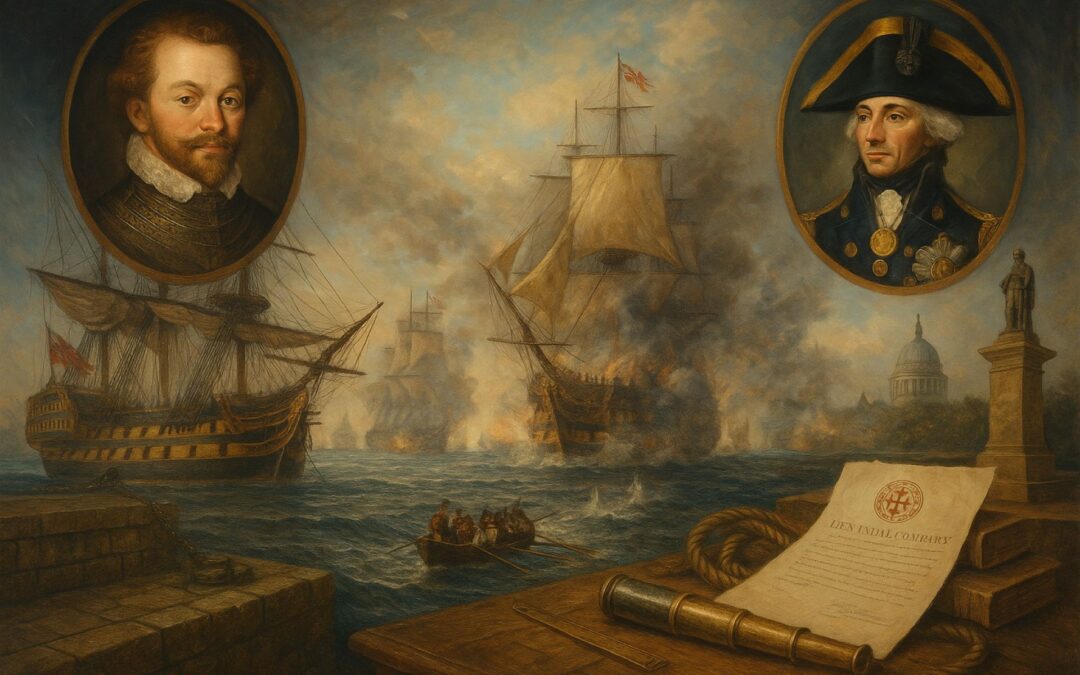
At first glance, Britain appears small—an island cluster on the edge of Europe, hemmed in by larger continents and greater populations. Yet for centuries, this modest land projected power across oceans, commanding territories so vast that the sun could never set on its dominions.
What began as tentative voyages of adventurers and merchants grew into the largest empire the world had ever seen, encompassing a quarter of the globe and shaping the destinies of countless peoples.
From the first failed colonies in North America to the jewel of India, from naval triumphs against Napoleon to the decolonization of the 20th century, the British Empire was both a marvel of ambition and a machine of exploitation. To trace its story is to trace the making of the modern world itself.
The Last Echoes of Empire
In the present day, Britain might appear on the map as little more than a modest collection of islands on the northwestern fringe of Europe, dwarfed by continental neighbors and overshadowed by modern superpowers. Yet if one shifts their gaze outward, across oceans and continents, the ghost of empire lingers in scattered fragments—14 overseas territories that remain under the jurisdiction of the British Crown. These are not contiguous lands that one could easily point to, but outposts stitched together by history and held by the weight of past ambition.
To the south, Gibraltar juts into the Mediterranean, its rock fortress guarding the narrow straits between Europe and Africa. Across the Atlantic, the Falkland Islands stand as a windswept reminder of imperial rivalry, once contested violently by Argentina. Bermuda lies further north, a subtropical isle that became both a naval bastion and a modern financial hub. Tiny specks like Ascension and Tristan da Cunha dot the vast oceanic expanses, known less for population than for their strategic importance in centuries past. Even the Caribbean still whispers with imperial echoes—Montserrat, the British Virgin Islands, and the Cayman Islands among them.
Though each of these territories is today small in landmass and limited in population, their symbolic weight is immense. They testify to the once-global sweep of British authority, to an era when London dictated laws and levies for lands thousands of miles away. At its zenith in the early 20th century, the British Empire ruled nearly 25% of the Earth’s surface and nearly a third of its people—hundreds of millions spread across continents. The boast that “the sun never sets on the British Empire” was no idle phrase but a statement of reality: as daylight faded in one colony, it rose in another. The modern world, in many respects, still carries the imprint of that reach—from international law to shipping routes, from parliamentary structures to the English language itself. These final territories are but sparks from a fire that once illuminated half the world.
Foundations Before a Nation
The origins of Britain’s empire lie not in unity, but in fragmentation. Before there was a “Britain” in the political sense, there was England—a kingdom that had grown stronger and more centralized than its neighbors in the British Isles. Wales had already been subdued and incorporated, Ireland was partially conquered, yet Scotland remained fiercely independent. Throughout the medieval period, England pressed northward with repeated invasions, but Scottish resilience and occasional French alliances thwarted conquest. The British Isles were a patchwork, but within this patchwork, England became the dominant thread.
By the reign of Elizabeth I in the late 16th century, the kingdom began to look beyond its shores. Europe was entering the age of exploration, and Spain and Portugal had already claimed vast dominions in the Americas, Africa, and Asia. England, smaller and less wealthy, could not remain a bystander. Seafarers like Sir Francis Drake and Sir Walter Raleigh embarked on daring voyages. Drake circumnavigated the globe, raiding Spanish treasure fleets and returning to England with holds full of plunder. Raleigh planted the ill-fated colony at Roanoke, which vanished without explanation. These ventures were precarious, marked more by audacity than stability, but they sowed the seeds of imperial ambition.
The real machinery of empire, however, emerged not from explorers alone but from commerce. Elizabeth granted royal charters to joint-stock companies, fusing the financial ingenuity of merchants with the authority of the Crown. The Levant Company (1592) opened markets in the eastern Mediterranean. More consequential still was the East India Company, founded in 1600, which secured a monopoly over English trade in Asia. These companies built trading posts, fortified enclaves, and networks of exchange that gradually transformed into territorial possessions. Their profits funded further expeditions, while their political influence seeped into Parliament itself.
Meanwhile, closer to home, Ireland became the proving ground of English colonization. The plantation of Ulster in the early 17th century forcibly displaced Catholic landholders, replacing them with Protestant settlers from England and Scotland. This experiment in organized colonization—complete with transplanted communities, local councils, and military enforcement—established a blueprint for how England would later govern colonies abroad. The Irish experience revealed both the promise and peril of empire: wealth for the colonizers, resistance and dispossession for the colonized.
By the early 1600s, the outlines of an empire were beginning to take shape. England was not yet a global power, but the combination of naval daring, commercial enterprise, and colonial experimentation had laid the foundations for expansion. It was an empire in embryo, awaiting the political union of Britain and the opportunities of global conflict to propel it onto the world stage.
The First Colonies and Hard Lessons
The early attempts at English colonization were ventures into the unknown, fraught with hardship and miscalculation. Roanoke Island, established in 1585 off the coast of present-day North Carolina, has become the stuff of legend. More than a hundred colonists vanished without trace, leaving only the cryptic word “CROATOAN” carved into a tree. For contemporaries, it was a sobering reminder that the New World could swallow entire communities whole. Yet even in failure, lessons were learned—about the need for supply lines, agricultural sustainability, and secure relations with indigenous peoples.
By the early 1600s, the English had begun to apply these hard-won lessons. Jamestown, founded in 1607, became the first permanent English settlement in North America, though it, too, staggered on the edge of collapse. Disease, starvation, and conflict with native Powhatan tribes nearly doomed the colony until the cultivation of tobacco transformed it into a profitable enterprise. This marked a turning point: English colonies could endure if tied to lucrative cash crops.
At the same time, in the Caribbean, islands like Barbados and Jamaica became centers of sugar production, feeding the insatiable sweet tooth of Europe. Plantations spread across the tropics, their labor supplied by enslaved Africans shipped through the infamous Middle Passage. The Royal African Company, established in 1660 under royal charter, formalized England’s role in the slave trade, exporting tens of thousands of Africans each year to the Americas. The profits were staggering. Sugar, tobacco, and cotton poured into English ports, enriching merchants and financing further expansion. Cities such as Bristol, Liverpool, and London became hubs of this grim commerce, their wealth built on human misery.
Beyond the Atlantic, the East India Company planted fortified factories along the coasts of India and Southeast Asia. These were not colonies in the traditional sense but trading enclaves, defended by private armies. They were the footholds of a commercial empire that would, in time, evolve into outright conquest.
Thus, the first century of English colonization was defined by contradiction. Settlements teetered between survival and collapse; trade promised immense riches but depended on the suffering of enslaved laborers. The empire was still in its infancy, marked less by grandeur than by experiment, risk, and ruthless pragmatism.
Scotland’s Missteps and Union
While England carved out colonies and trading networks, Scotland looked on with envy and frustration. The smaller kingdom lacked the naval power and capital of its southern neighbor, yet it hungered for its own overseas empire. Early Scottish attempts in Nova Scotia, Cape Breton, and the Carolinas fizzled almost as soon as they began, undone by harsh conditions and limited support.
The boldest effort came in 1698 with the Darien Scheme. Backed by feverish public investment, Scots sought to establish a colony on the Isthmus of Panama, envisioning it as a choke point for trade between the Atlantic and Pacific. The project consumed nearly a fifth of Scotland’s wealth—a colossal gamble for a nation of its size. Ships set sail with thousands of settlers, founding a settlement called New Edinburgh in the bay of Caledonia. But the dream unraveled swiftly. Tropical disease ravaged the settlers; supply ships failed to arrive; Spanish forces harassed the colony. Within a year, hundreds were dead, and the survivors abandoned the project. A second expedition fared no better. By 1700, the colony was gone, and with it Scotland’s hope of building an empire alone.
The disaster plunged Scotland into economic despair. Families who had invested their savings were ruined, and national confidence was shaken. The collapse of Darien was more than a colonial failure—it was a national trauma. Out of this calamity emerged a sobering realization: Scotland’s best chance of securing wealth, stability, and global influence lay not in going it alone but in joining England.
This paved the way for the Acts of Union in 1707. England and Scotland, long rivals, became a single kingdom—Great Britain. For England, union provided security from French-aligned Scottish threats on its northern border and the infusion of Scottish talent into imperial projects. For Scotland, it offered access to England’s flourishing colonies and trade routes, a chance to recoup losses and share in the wealth of empire. The partnership was not born of harmony but of necessity, forged from failure and ambition alike.
The union marked a turning point. What had been the ambitions of two kingdoms became the collective endeavor of one. From this moment, “British” rather than merely “English” power would spread across the seas. The empire’s next phase would be larger, more aggressive, and increasingly unstoppable.
Wars for Supremacy
The 18th century was a crucible in which the British Empire was forged into a global power. Conflict was constant, and empires rose or fell on the outcomes of wars fought not only in Europe but across oceans and continents. Britain’s great rival in this age was France, whose colonial ambitions clashed with Britain’s at almost every corner of the globe. Spain, too, loomed as both competitor and occasional ally, its empire still vast though increasingly fragile.
The War of the Spanish Succession (1701–1714) set the stage. When the Spanish crown fell into Bourbon hands, Britain feared that a united France and Spain would dominate Europe and its overseas territories. British forces fought across Europe and in the colonies, while the Royal Navy expanded its reach. Victory secured key prizes: Gibraltar, an impregnable rock fortress guarding the Mediterranean, and Menorca, another strategic outpost. In North America, Britain gained Newfoundland and Acadia from France, laying the groundwork for future dominance in the region. These gains were more than territorial—they gave Britain control over naval choke points, ensuring it could project power deep into the Mediterranean and Atlantic.
The mid-century brought even greater contests. The War of the Austrian Succession (1740–1748) saw Britain clash again with France, but it was the Seven Years’ War (1756–1763) that truly altered the global balance. Fought across Europe, the Caribbean, Africa, North America, and Asia, it was the first war to span the entire globe. Britain, under the leadership of figures like William Pitt the Elder, poured resources into its navy and overseas campaigns.
In India, the East India Company’s forces under Robert Clive defeated the French and their local allies at the Battle of Plassey in 1757, securing Bengal—one of the richest provinces in Asia. In North America, British forces captured Quebec in 1759, a decisive blow that effectively ended French colonial power on the continent. The Treaty of Paris in 1763 crowned Britain the victor: Canada, Florida, several Caribbean islands, and Senegal fell into British hands, while in Asia, the East India Company expanded rapidly.
By the end of the century’s middle decades, Britain had emerged as the world’s leading maritime and colonial power. Its navy controlled the seas, its colonies stretched across continents, and its commercial networks funneled wealth into London. Yet with this dominance came strain. Managing far-flung possessions, keeping trade routes open, and balancing colonial ambitions against the rights and expectations of settlers would soon test the empire to its core.
Revolution and Reorientation
The triumphs of the Seven Years’ War left Britain with vast new territories but also vast new problems. The American colonies, once loyal partners, began to bristle under the burden of imperial taxation. Parliament, facing heavy debts from war, imposed taxes such as the Stamp Act and the Tea Act on the thirteen colonies. To London, this was a reasonable expectation that colonists contribute to the empire’s defense. To the colonists, it was tyranny—taxation without representation, a violation of their rights as Englishmen.
Tensions spiraled. Boycotts, protests, and violent clashes erupted across the colonies. In 1775, war broke out at Lexington and Concord. The following year, colonial leaders convened the Second Continental Congress and issued the Declaration of Independence, proclaiming the birth of the United States of America. Britain poured troops and resources into crushing the rebellion, but the vast geography of North America, combined with French and Spanish intervention on behalf of the colonists, turned the war against Britain. After eight years of costly fighting, Britain conceded defeat in 1783, recognizing American independence in the Treaty of Paris.
The loss of the thirteen colonies was a profound shock. It stripped Britain of some of its wealthiest and most populous territories and exposed the limits of imperial authority. Many in Britain feared that the empire itself might collapse. Yet the reaction was not retreat, but reinvention. Britain shifted its gaze to other parts of the world where opportunity beckoned and resistance was less entrenched.
In the Pacific, Captain James Cook’s voyages in the 1770s mapped Australia, New Zealand, and countless Pacific islands. These discoveries offered new horizons at a time when the American door had closed. Australia, in particular, became a solution to the problem of overflowing prisons in Britain. Beginning in 1788, convicts were transported to New South Wales, establishing penal colonies that gradually expanded into thriving settlements.
At the same time, Britain expanded deeper into Asia and Africa. The East India Company consolidated its control over Indian territories, while traders probed the interior of Africa and the fur-rich regions of Canada that remained under British authority. What was lost in America was more than compensated for in other regions.
Thus, out of the ashes of defeat rose a new empire. The Revolution forced Britain to rethink its strategy, pivoting toward Asia, Africa, and the Pacific. Far from diminishing the empire, the loss of America reshaped it, preparing Britain for an even greater phase of global dominance in the century to come.
Napoleon and the Naval Century
The dawn of the 19th century brought the greatest threat Britain had faced since the Spanish Armada: Napoleon Bonaparte. Rising from the turmoil of the French Revolution, Napoleon forged a continental empire that sought to challenge Britain’s dominance not only in Europe but across the seas. The stakes were existential. Britain, an island nation with a growing overseas empire, depended on its navy for survival. Without command of the seas, the empire would collapse like a house of cards.
The defining moment came in 1805 at the Battle of Trafalgar. Off the coast of Spain, Admiral Horatio Nelson led the Royal Navy against the combined French and Spanish fleets. In a daring maneuver, Nelson broke through enemy lines, decimating their ships in a ferocious engagement. Though Nelson himself fell to a sniper’s bullet, his victory ensured British naval supremacy for more than a century. Trafalgar was not just a battle—it was a turning point. It extinguished any hope of Napoleon invading Britain and elevated the Royal Navy to the status of an unrivaled global force.
As the Napoleonic Wars dragged on, Britain poured vast resources into the struggle. Its navy blockaded French ports, strangling continental trade, while expeditions struck at French and Spanish colonies abroad. By the war’s end in 1815, the Congress of Vienna confirmed Britain’s ascendancy. Victories had secured key outposts across the world: Malta in the Mediterranean, the Cape Colony at Africa’s southern tip, Ceylon in the Indian Ocean, and islands in the Caribbean such as Trinidad and Tobago. These acquisitions were more than spoils of war—they were stepping stones, anchoring Britain’s control of global trade routes.
Meanwhile, the Industrial Revolution at home amplified Britain’s power. Coal, steam engines, and mechanized factories churned out goods in unprecedented volumes. The empire’s navy, already dominant, became the iron shield of this industrial economy, ensuring British products flowed outward and raw materials flowed inward. By the mid-19th century, Britain was both the workshop and the policeman of the world, its navy patrolling oceans like highways, its flag planted on every shore.
Abolition and Industrial Wealth
Amidst this surge of imperial might, a profound moral and economic transformation was unfolding. For centuries, Britain had been a central participant in the transatlantic slave trade, transporting millions of Africans to the Americas to labor on sugar, tobacco, and cotton plantations. The profits had enriched ports like Bristol and Liverpool, financing the rise of banks, insurance companies, and merchants. Yet by the early 1800s, the tide of opinion was turning.
The abolitionist movement gathered momentum, spearheaded by figures such as William Wilberforce, Olaudah Equiano, and Thomas Clarkson. Campaigns mobilized public opinion through petitions, pamphlets, and emotional appeals. The horrors of the Middle Passage and the cruelty of plantation life were laid bare, awakening consciences in a society increasingly shaped by evangelical religion and Enlightenment ideals. The economic logic was also shifting. With the Industrial Revolution in full swing, Britain’s wealth was no longer dependent solely on plantation crops. Industrialists saw greater profit in manufacturing textiles, machinery, and iron goods for global export.
In 1807, Parliament passed the Abolition of the Slave Trade Act, outlawing the transport of enslaved Africans within the empire. The Royal Navy, now unrivaled, enforced this ban, patrolling the coasts of Africa and intercepting slave ships. Yet slavery itself persisted in the colonies until 1834, when emancipation was enacted. Even then, freedom came with conditions—enslaved people were compelled into “apprenticeships” before gaining full liberty, while former slave owners were compensated with vast sums by the British state.
The abolition of slavery reshaped the empire’s economy. Plantations, though still important, no longer stood at the heart of imperial wealth. Instead, the focus turned inward to the factories and foundries of Britain and outward to colonies that supplied raw materials for industry. Cotton from India, wool from Australia, and later rubber from Malaya became the lifeblood of industrial production. Railways, steamships, and telegraph lines extended the empire’s grip, ensuring resources reached British mills and finished goods reached markets around the globe.
Thus, the early 19th century marked a paradox: Britain presented itself as a moral leader in abolishing the slave trade, while simultaneously tightening its grip on colonies through industrial exploitation. It was an empire that proclaimed humanitarian ideals, even as it pursued profit with relentless intensity.
The Jewel in the Crown
Among Britain’s far-flung possessions, none equaled India in wealth, size, or symbolic importance. What began as a handful of fortified trading posts along the coast, controlled by the East India Company, grew into an enormous territorial dominion. The Company had secured Bengal after the Battle of Plassey in 1757, and over the following decades, it tightened its grip on vast swathes of the subcontinent. Private armies—larger than those of most European states—enforced its rule, while local rulers were either co-opted through treaties or crushed by force.
This system reached breaking point in 1857, when resentment exploded in the Sepoy Rebellion. Sparked by grievances over religious insensitivity—rumors that new rifle cartridges were greased with cow and pig fat offended both Hindu and Muslim soldiers—the mutiny quickly escalated into a nationwide revolt. It was brutally suppressed, but the uprising shattered faith in Company governance. The following year, the British Crown assumed direct control. India became a Crown Colony, administered by a Viceroy who represented the monarch, with the East India Company dissolved.
Under the Raj, India was cast as the “jewel in the crown” of the empire. Its resources were indispensable: cotton for the mills of Manchester, tea for the tables of London, indigo and opium for export, and manpower for imperial armies. Railways, telegraph lines, and canals were built to integrate the subcontinent into the imperial economy, presented as gifts of modernity but designed to funnel goods outward and maintain control. English education systems were introduced, creating a class of Indian elites conversant in British law and culture, yet often alienated from their own traditions.
India’s significance was not only material. It was psychological—a symbol of imperial grandeur, the living proof that Britain could govern hundreds of millions across continents. Yet beneath this façade, discontent brewed. Famines, economic exploitation, and racial hierarchies fueled resentment. By the late 19th century, the Indian National Congress had been founded, planting the seeds of eventual independence. Still, for Victorian Britain, India remained the centerpiece of empire, both its greatest prize and its greatest challenge.
The Great Game and the Scramble for Africa
While India glittered as Britain’s most prized possession, new theaters of imperial rivalry emerged. Chief among them was Central Asia, where Britain confronted the expanding ambitions of the Russian Empire. This contest—dubbed the “Great Game”—was not just about land but about influence, espionage, and strategic supremacy. Russia sought warm-water ports and access to the Mediterranean, while Britain feared any encroachment that might threaten the road to India.
The Crimean War (1854–1856) epitomized these anxieties. Britain and France allied with the Ottoman Empire to block Russian advances into the Black Sea. The war was costly and brutal, yet it ended in Russia’s defeat, affirming Britain’s naval and diplomatic clout. Still, the rivalry lingered. In 1878, Britain secured Cyprus from the Ottomans, presenting it as a defensive bulwark against Russian influence in the eastern Mediterranean. Agreements followed to delineate “spheres of influence” in Central Asia, but the mistrust remained.
Meanwhile, another scramble was underway—this time for Africa. For centuries, Britain’s interests in the continent had been confined largely to coastal trading posts and the Cape Colony. But the late 19th century brought a frenzied race among European powers to seize African territories. Fueled by industrial demands for raw materials and a desire for strategic advantage, Britain expanded aggressively. The Cape Colony became a magnet for British settlers, pushing Dutch-descended Boers into the interior. They established republics—the Transvaal and the Orange Free State—but these would eventually be absorbed into the empire after bitter wars.
Further north, the opening of the Suez Canal in 1869 transformed global trade. By linking the Mediterranean to the Indian Ocean, it shortened the route to India dramatically. Britain recognized its strategic importance and in 1882 occupied Egypt, nominally leaving it under Ottoman suzerainty but effectively turning it into a British protectorate. Control of the canal secured the lifeline to India and underpinned British dominance in the Middle East.
In East Africa, Britain acquired territories stretching from Kenya to Uganda, while in the south, Cecil Rhodes and others envisioned a grand imperial railway running from Cape Town to Cairo—a dream that symbolized Britain’s ambitions but was never realized. Across the continent, red ink on maps came to represent swathes of land under the Union Jack. By the century’s end, Britain controlled nearly a third of Africa, ruling directly or indirectly over millions of people.
The Great Game in Asia and the Scramble for Africa together revealed the dual nature of late-Victorian imperialism: a geopolitical chess match with rival powers, and a relentless push for economic and territorial expansion. It was empire at its most ambitious, and at times, its most ruthless.
Dominions and Rising Nationalism
By the late 19th century, the British Empire had grown into an unwieldy mosaic, and not all of its parts looked alike. Some colonies were raw frontiers under the firm grip of the Crown; others, particularly those with large settler populations of European descent, began to evolve into something different—self-governing dominions. These were colonies that retained loyalty to the monarchy yet increasingly charted their own political course.
Canada was the first to take this step. In 1867, the British North America Act created the Dominion of Canada, a federation of provinces with its own parliament and prime minister. Britain still oversaw foreign policy and defense, but day-to-day governance was left to Canadians. Australia followed in 1901 with the federation of its six colonies, while New Zealand gained dominion status in 1907. South Africa, forged from the ashes of the Anglo-Boer Wars, joined the ranks in 1910. These dominions were still part of the empire, but they represented a gradual loosening of London’s grip. Their loyalty was symbolized in ceremonies, flags, and shared monarchs, but their autonomy was undeniable.
Not all parts of the empire enjoyed this trajectory. Ireland, for instance, seethed under British rule. Efforts to pass “Home Rule” bills in Parliament repeatedly failed, blocked by fears that Irish autonomy would fracture the empire’s unity. Tensions escalated into open conflict, culminating in Ireland’s partition and partial independence after the First World War. Similarly, in India, nationalist movements began to challenge the empire more openly. What Britain touted as gradual evolution in settler colonies, it denied to the vast majority of its non-European possessions, where demands for self-rule were treated as threats rather than aspirations.
Nationalism was not confined to colonies either—it rippled within Britain itself. The idea of an empire bound by voluntary association was beginning to form, foreshadowing the Commonwealth. Yet in the 19th century, the empire still projected itself as a family where Britain was the unquestioned patriarch. The cracks were visible, though, as dominions claimed equality, Ireland resisted subjugation, and India sowed the seeds of mass resistance. The British Empire was more powerful than ever, but its political fabric was starting to fray.
The World Wars and the Winds of Change
The early 20th century tested the empire in ways it had never known before. The First World War erupted in 1914, dragging Britain into a continental conflict of unprecedented scale. The empire became both shield and sword—Canada, Australia, New Zealand, India, and African colonies all supplied troops, resources, and food. Over 2.5 million men from outside Britain fought in the war, many never to return. The battles of Gallipoli, Ypres, and the Somme etched the sacrifices of colonial troops into imperial memory.
Victory brought rewards but also exhaustion. Britain gained former German colonies in Africa and Ottoman territories in the Middle East under League of Nations mandates. Palestine, Iraq, and Tanganyika were added to the imperial portfolio. Yet the war had shaken faith in empire. Colonies that had bled for Britain began asking why their sacrifices had not earned them greater self-determination. In India, the massacre at Amritsar in 1919 galvanized nationalist sentiment, convincing many that British rule was not reformable but must be overthrown.
The Second World War, beginning in 1939, compounded these strains. Once again, Britain leaned heavily on the empire. Indian soldiers fought in North Africa and Burma, Australians defended the Pacific, Canadians stormed the beaches of Normandy, and Africans supported campaigns across the globe. The collective effort was monumental, but the war also bankrupted Britain. The United States and the Soviet Union emerged as superpowers, and Britain, despite being victorious, found itself diminished, its global influence slipping away.
After 1945, the winds of change blew fiercely. India achieved independence in 1947, the empire’s greatest jewel slipping from the crown. Partition created Pakistan and unleashed one of the largest and bloodiest migrations in history. Across Asia, Africa, and the Caribbean, independence movements gained strength. Britain could no longer suppress them—it lacked both the resources and the moral authority. Decolonization became not just inevitable but unstoppable. By the 1960s and 70s, one after another, colonies were granted independence.
This period marked the unraveling of four centuries of empire. Yet the withdrawal was not abrupt—it was managed through diplomacy, compromise, and often bitter conflict. The “wind of change,” as British Prime Minister Harold Macmillan called it, swept across continents. What remained was no longer an empire but something new: a Commonwealth of nations, bound by language, trade, and history rather than conquest. The wars had exposed both the strength and fragility of empire, and in their aftermath, the age of British global dominance came to an end.
The Commonwealth and the Legacy of Empire
As the empire dissolved in the mid-20th century, Britain faced an identity crisis. For centuries, its greatness had been measured in colonies and conquests. Now, with independence movements reshaping the globe, Britain had to reimagine its place in the world. The answer came in the form of the Commonwealth—a voluntary association of nations, many of them former colonies, united not by force but by shared history, language, and institutional frameworks.
The Commonwealth was not an empire in disguise but an attempt to salvage connection from the ruins of domination. India, newly independent in 1947, chose to remain within this community, a symbolic gesture that reassured Britain that the empire’s end did not mean total isolation. Over time, dozens of nations across Africa, Asia, the Caribbean, and the Pacific joined. Some, like Canada, Australia, and New Zealand, retained the British monarch as their head of state, forming a symbolic “Commonwealth realm.” Others embraced full republicanism yet maintained ties through trade, culture, and diplomacy.
The creation of the Commonwealth was Britain’s way of softening the blow of imperial retreat, but it was also pragmatic. English, now embedded as a lingua franca across continents, became a unifying thread. British-style parliamentary systems, legal codes, and educational structures persisted long after independence, ensuring a continuity that often benefited both sides. Even sports like cricket and rugby, once colonial pastimes, became markers of shared identity, fiercely embraced by nations that had once resisted British rule.
Yet the legacy of empire was double-edged. The Commonwealth could not erase the memory of colonial exploitation, racial hierarchies, and economic extraction. Critics saw it as a nostalgic club for Britain to maintain relevance. But for many nations, it provided a platform for cooperation, development, and a degree of solidarity in the postcolonial world. The Commonwealth’s endurance—still counting over 50 members today—testifies to the strange afterlife of empire: an institution born of domination reshaped into one of partnership.
The Empire That Lives On
Although the British Empire formally ended in the 20th century, its influence remains woven into the fabric of modern life. English has become the dominant global language of business, diplomacy, science, and culture, spoken by billions either as a native tongue or as a second language. Former colonies like the United States, India, Canada, and Australia are now major powers in their own right, yet their legal systems, political institutions, and educational models trace back to Britain’s imperial framework.
Global commerce, too, still carries imperial fingerprints. Shipping lanes first secured by the Royal Navy remain the arteries of world trade. Financial institutions in London—once fueled by colonial profits—continue to serve as global hubs. Even the time zone system and standardized measurements, once imposed for imperial efficiency, persist as invisible reminders of Britain’s reach.
Culturally, the empire’s legacy is inescapable. From Caribbean music to Indian cuisine, from African literature to Australian film, the fusion of local traditions with British influence has created a rich tapestry of global culture. Ironically, what was once imposed as a unifying imperial identity has evolved into a diverse, pluralistic exchange. London itself stands as the embodiment of this transformation: a city where communities from South Asia, the Caribbean, Africa, and beyond live side by side, their presence a living testament to the empire’s reach.
At the same time, the darker legacies of empire remain unresolved. The drawing of arbitrary borders in Africa and the Middle East sowed conflicts that persist today. Economic inequality between former colonies and the Western world reflects centuries of extraction. Debates about reparations, the return of looted artifacts, and the role of empire in British history continue to stir political and cultural battles.
And yet, despite these contradictions, the empire lives on—not in dominion, but in influence. Its reach can be traced in every courtroom that cites common law, every student learning English in a far-off classroom, every nation competing in the Commonwealth Games. What began as the ambition of a small island nation became a system that reshaped the world. The empire has faded, but its imprint endures, etched not just on maps but on the very structure of the modern age.
Conclusion
The empire has long since receded, its red-painted maps now relics of another age. Yet its imprint lingers—on language, on law, on global trade routes, and even in the multicultural makeup of modern Britain. Four centuries of conquest, commerce, and colonization left behind a complicated legacy: one of innovation and infrastructure, but also of dispossession and inequality.
Today, the Commonwealth carries echoes of that shared past, reframed as partnership rather than domination. The British Empire is gone, but its shadow still stretches across continents, a reminder that the story of a small island nation has remade the world in ways that are still unfolding.