
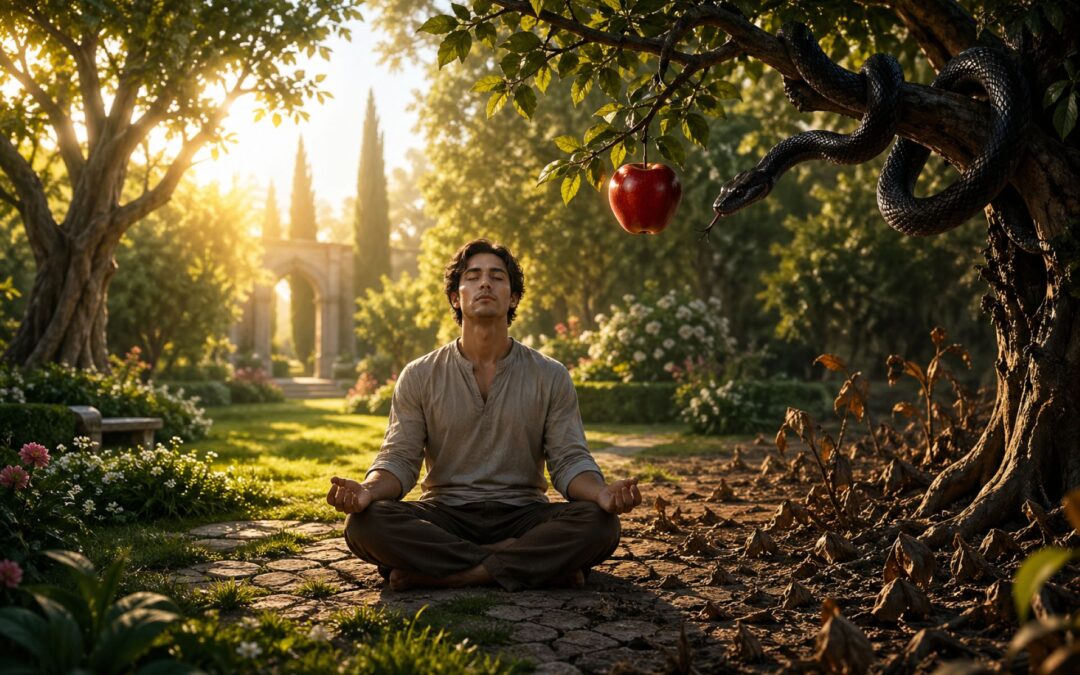
Few stories have endured across cultures and centuries quite like the tale of Adam and Eve. Found in the traditions of Christianity, Islam, and Judaism, it’s often presented as a moral warning—disobedience leads to suffering, temptation leads to downfall. But if we step outside its religious framing for a moment, something more interesting begins to emerge.
What if this story isn’t really about the origin of humanity, but about the nature of being human?
Strip away the theology, and what remains is a remarkably accurate map of the human mind. A story about desire, self-sabotage, inner conflict, and the quiet voice that tries to guide us in the right direction. The Garden of Eden becomes more than a physical place—it becomes a state of mind. The snake is no longer just a creature—it becomes a pattern of thought. And the forbidden fruit? It starts to look a lot like the very things we know we shouldn’t do, yet find ourselves doing anyway.
We don’t need to believe in a literal paradise or a divine command to recognize the truth embedded in the narrative. Every day, in small and subtle ways, we reenact this story. We are pulled between contentment and craving, between clarity and impulse, between what we know is right and what feels immediately gratifying.
This article isn’t about religion. It’s about interpretation.
By looking at the story of Adam and Eve through a secular lens, we can begin to see it not as a distant myth, but as a reflection of our own inner world. And more importantly, as a guide—one that helps us identify the patterns that lead to suffering, and the awareness that might help us avoid it.
The Garden of Eden as the Human Mind
If we move away from the idea of Eden as a physical place, it begins to make much more sense as a psychological state. The Garden of Eden represents a mind that is in order—balanced, stable, and at peace.
Think of a well-maintained garden. It doesn’t grow into harmony by accident. It requires attention, care, and boundaries. Left unattended, it quickly becomes overrun with weeds, disorder, and decay. The same is true of the human mind. When it is properly “tended,” it feels calm, clear, and content. When it is neglected, it becomes chaotic, restless, and prone to suffering.
In the story, Eden is often imagined as a paradise where everything one needs is already present. This detail is crucial. A peaceful mind is not one that constantly seeks more—it is one that feels complete as it is. Contentment is the natural state of a well-ordered mind. There is no urgent craving, no desperate need to escape the present moment, no sense that something essential is missing.
The “walls” of the garden can be understood as the boundaries that separate order from chaos. These boundaries are not restrictions in a negative sense; they are what make stability possible. Without them, anything can enter—impulses, distractions, destructive patterns—and the garden loses its structure.
This interpretation shifts the entire story. Paradise is not something lost in the distant past; it is something that exists whenever the mind is in a state of balance. And exile from Eden is not a one-time event—it is something that happens whenever that balance is disturbed.
From this perspective, the goal is not to return to a mythical place, but to maintain the conditions that allow the “garden” within us to remain intact.
God as Conscience and Inner Guidance
Once the garden is understood as the mind, the figure of God also begins to shift in meaning. Instead of an external authority issuing commands, God can be seen as something internal—your conscience.
This isn’t a mystical voice or a dramatic force. It’s subtle, almost quiet. It’s the part of you that already knows what leads to stability and what leads to trouble. It’s the awareness that nudges you away from choices that will disturb your inner balance, even when those choices seem tempting in the moment.
In the story, God gives Adam and Eve a simple boundary: everything is available except one thing. Interpreted psychologically, this reflects a deeper truth—life offers an abundance of experiences, but not everything is beneficial. The role of conscience is to help us recognize where to draw the line.
What’s interesting is that this guidance doesn’t feel oppressive when the mind is in order. It feels natural. When you’re clear and content, you don’t experience restraint as deprivation. You don’t feel like you’re missing out. The idea of crossing certain boundaries simply doesn’t appeal to you.
But as soon as that clarity weakens, the same guidance can start to feel restrictive. The voice of conscience becomes something we argue with, negotiate with, or ignore altogether. And this is where the first cracks in the garden begin to appear.
Ignoring conscience isn’t just about breaking a rule—it’s about disrupting internal harmony. It’s the moment when we prioritize short-term desire over long-term stability. And while nothing dramatic may happen immediately, the consequences begin quietly, beneath the surface.
Seen this way, the story isn’t about obedience to a higher power. It’s about alignment with an inner one.
The Forbidden Fruit: The Nature of Self-Destructive Desires
At the center of the story lies a strange paradox. Adam and Eve are surrounded by abundance. Everything they need is already available to them. And yet, their attention becomes fixated on the one thing they cannot have.
This is not just a narrative device—it reflects a deeply human tendency.
The forbidden fruit represents those desires that we know, on some level, will lead to harm, yet feel irresistibly drawn toward. Not because they are necessary, not because they improve our lives, but precisely because they are off-limits. The restriction itself gives them power.
In modern terms, this “fruit” takes many forms. It could be substance abuse, compulsive behaviors, unhealthy relationships, or even subtle habits like procrastination and overindulgence. What unites them is not their form, but their pattern: they promise relief, pleasure, or escape in the moment, while quietly eroding stability over time.
What makes this especially compelling is that awareness doesn’t seem to protect us. People often know exactly what their “forbidden fruit” is. They understand the consequences. They’ve experienced them before. And still, the desire persists.
This is where the story becomes less about morality and more about psychology.
Desire intensifies when something is perceived as restricted. The mind begins to assign it exaggerated value. It becomes not just an option, but the option—the thing that will finally satisfy, finally resolve discomfort, finally provide what is missing. Of course, this is rarely true. But in the moment, it feels convincing enough.
Over time, repeated indulgence can transform desire into something more rigid and difficult to control. What begins as a choice slowly turns into a pattern, and eventually, into a dependency. At that point, it’s no longer just about wanting the fruit—it’s about feeling unable to function without it.
This is why the metaphor is so powerful. The forbidden fruit is not inherently magical or evil. Its danger lies in the relationship we develop with it. It becomes the focal point of dissatisfaction, the object we turn to whenever the present moment feels insufficient.
And the more we rely on it, the further we drift from the balance that once made the “garden” feel complete.
The Snake in the Mind: Thoughts That Lead Us Astray
If the forbidden fruit represents the object of desire, then the snake represents something even more subtle—the mechanism that makes that desire feel justified.
The snake doesn’t force Adam and Eve to act. It persuades. It suggests. It plants an idea and lets it grow. This is exactly how many of our most destructive decisions begin—not with action, but with thought.
In a psychological sense, the snake is the stream of inner dialogue that nudges us toward what we already know is unwise. It rarely appears as something obviously harmful. Instead, it speaks in half-truths and rationalizations.
“It won’t hurt just this once.”
“You deserve this.”
“You can handle it.”
These thoughts don’t feel like deception. They feel reasonable. And that’s precisely why they’re effective.
The mind has a remarkable ability to justify what it already wants. Once desire is present, thought begins to organize itself around that desire, building a case for why giving in is acceptable, even necessary. The snake doesn’t create the craving—it gives it a voice.
What makes this more dangerous is how convincing this voice can be. It doesn’t present the full picture. It highlights the immediate reward while quietly ignoring the long-term cost. It frames indulgence as harmless, temporary, or even beneficial, while downplaying the consequences we’ve experienced before.
Over time, this pattern becomes familiar. The same kinds of thoughts appear again and again, each time wearing slightly different disguises, but leading to the same outcome.
And this is where most people struggle. They try to fight these thoughts directly, arguing against them, suppressing them, or trying to eliminate them altogether. But the more attention we give them—even in resistance—the more active they become.
The snake thrives on engagement.
This doesn’t mean we are powerless against it. It simply means that the solution isn’t what it seems. The problem is not the existence of these thoughts—it’s the way we relate to them.
The Fall: How Small Choices Lead to Big Consequences
In the story, the fall happens in a single moment—one decision, one bite, and everything changes. But in real life, the process is rarely that dramatic. It unfolds gradually, almost invisibly, through a series of small choices that seem insignificant at the time.
No one decides to ruin their peace in one step. It begins with a minor compromise. A moment of giving in. Something that feels harmless enough to justify. And because the consequences are not immediate, the mind interprets this as proof that the decision was acceptable.
This is how patterns begin.
Each time we choose short-term gratification over long-term stability, we reinforce a pathway. The next time becomes easier. The resistance weakens. What once required justification starts to feel normal. And slowly, the line that once seemed clear begins to blur.
At some point, the shift becomes noticeable. The sense of control starts to slip. What was once occasional becomes frequent. What was once a choice begins to feel like a need. And this is where the real “fall” occurs—not as a sudden collapse, but as a gradual loss of autonomy.
From a secular perspective, there is no external punishment involved. There is no force imposing suffering from the outside. Instead, what we experience is the natural consequence of our actions.
A restless mind.
A constant need for stimulation.
A quiet dissatisfaction that lingers even when nothing is obviously wrong.
These are not punishments—they are outcomes.
The story captures this perfectly. The moment Adam and Eve eat the fruit, their reality changes. Not because the world itself has shifted, but because their relationship to it has. Awareness becomes distorted. Harmony is replaced with tension. The ease that once defined their existence disappears.
This is the true nature of the fall. It’s not about breaking a rule—it’s about breaking a state of being.
Exile from Eden: The Psychological Cost of Indulgence
After the fall comes exile. Adam and Eve are cast out of the garden, no longer able to return to the effortless harmony they once experienced. In a literal sense, this reads like a punishment. But psychologically, it feels more like a consequence.
When the mind loses its balance, the sense of “being at home” within yourself begins to disappear.
Exile from Eden is not about being sent somewhere else—it’s about no longer feeling at ease where you already are. The same life, the same surroundings, the same circumstances remain, but the inner experience has changed. What was once calm now feels restless. What was once enough now feels insufficient.
This is the hidden cost of indulgence.
At first, giving in to the forbidden fruit seems to offer relief. It distracts, numbs, or excites. But once the effect fades, something subtle lingers. A kind of unease. A background dissatisfaction that wasn’t there before. And the more frequently this pattern repeats, the more pronounced that unease becomes.
Over time, the mind begins to depend on the very thing that disrupts it. Instead of returning naturally to a state of calm, it looks outward for stimulation. It needs something to feel okay again. And ironically, the same behavior that created the disturbance becomes the go-to solution for escaping it.
This creates a cycle.
Indulgence → temporary relief → deeper dissatisfaction → stronger craving → repeated indulgence.
And with each cycle, the distance from that original state of balance grows.
In this sense, exile is not a dramatic event. It’s a slow drift. A gradual movement away from clarity and toward confusion. Away from contentment and toward constant seeking.
The story captures this loss symbolically, but in real life, it is something many people experience without realizing it. The feeling that something is off, even when everything seems fine on the surface. The inability to sit still without reaching for distraction. The sense that peace is always just out of reach.
That is what it means to be outside the garden.
Identifying Your Own Forbidden Fruit
Understanding the metaphor is one thing. Applying it is another.
If the story is a reflection of human behavior, then its value lies in recognition. Not in Adam and Eve, but in yourself. The question is no longer “What did they do wrong?” but “Where does this pattern show up in my life?”
Everyone has a version of the forbidden fruit. It rarely looks dramatic from the outside. In fact, it often hides in plain sight—disguised as a harmless habit, a coping mechanism, or even a reward. But its defining trait is simple: it consistently moves you away from clarity and stability, even if it feels good in the moment.
For some, it’s obvious. Substance abuse, compulsive behaviors, destructive relationships. For others, it’s more subtle. Endless scrolling, constant distraction, procrastination, emotional overreactions. The form doesn’t matter as much as the effect.
The key is honesty.
Not the kind of honesty that just acknowledges what you do, but the kind that observes what it does to you. How does this behavior affect your state of mind? Does it leave you clearer, calmer, and more in control—or more scattered, restless, and dependent?
This is where many people get stuck. They focus on whether something is “allowed” or “normal” instead of whether it is beneficial. But the story doesn’t revolve around social rules—it revolves around consequences.
Your forbidden fruit is not defined by external standards. It is defined by its impact on your inner state.
Another challenge is that these patterns often become normalized over time. What once felt like a deviation starts to feel like part of your routine. You adapt to the discomfort, and because it becomes familiar, it stops feeling like a problem—even though it continues to shape your experience.
That’s why awareness has to be deliberate.
It requires stepping back and observing your own behavior without immediate justification. Not defending it, not condemning it—just seeing it clearly. When do you feel the urge to escape the present moment? What do you turn to? And how do you feel afterward?
These questions are uncomfortable, but they are necessary.
Because once you can clearly identify your own forbidden fruit, the story stops being abstract. It becomes personal.
How to Deal with the Snake: Awareness Without Resistance
Recognizing the snake is only half the challenge. The more difficult part is learning how to deal with it.
The instinctive response is to fight. To push thoughts away, suppress them, argue against them. But this approach often backfires. The more you resist a thought, the more attention you give it. And attention is exactly what keeps it alive.
Try not to think about something, and it immediately becomes more present.
On the other hand, blindly following these thoughts is just as problematic. If you engage with them—if you start entertaining their logic or negotiating with them—you gradually lose your position of control. The thought stops being a suggestion and becomes a direction.
So if fighting doesn’t work, and engaging doesn’t work, what’s left?
Observation.
Instead of reacting to the thought, you simply notice it. You see it for what it is—a mental event, not a command. It arises, it presents its case, and if left alone, it fades. This shift sounds small, but it changes everything.
When you observe without reacting, you break the cycle.
The thought may still appear. The desire may still be there. But without your participation, it cannot turn into action. It loses its ability to influence behavior because it is no longer being reinforced.
This is where contentment becomes important.
The snake thrives on dissatisfaction. It feeds on the feeling that something is missing, that the present moment is not enough. When that feeling is strong, the suggestions it offers seem appealing. But when the mind is content—when it is at ease as it is—the appeal fades.
Contentment doesn’t mean the absence of desire. It means not being controlled by it.
And this is something that can be cultivated. Not by chasing a perfect state, but by repeatedly returning to awareness. By noticing when the mind starts to drift toward craving, and gently bringing it back without judgment or force.
Over time, this changes the relationship you have with your thoughts.
The snake may still appear, but it no longer has power over the garden.
Rebuilding the Garden: Cultivating Inner Stability
Once the pattern becomes clear—the garden, the snake, the fruit—the natural question is what comes next.
If the mind can fall into disorder, it can also be brought back into balance. But unlike the sudden fall described in the story, rebuilding the garden is a gradual process. It requires consistency, not intensity.
The first step is simple, but not easy: reducing what you already know disrupts your inner stability.
This doesn’t mean eliminating every source of pleasure or becoming rigid. It means recognizing the difference between what nourishes the mind and what destabilizes it. When you begin to limit the influence of your “forbidden fruit,” even slightly, you create space for clarity to return.
At the same time, the focus shouldn’t be entirely on removal. A garden doesn’t thrive just because weeds are pulled out—it thrives because it is actively cared for.
This is where daily habits come in.
Moments of stillness, even brief ones, help restore a sense of grounding. Time away from constant stimulation allows the mind to settle. Engaging in meaningful work or focused activity strengthens your ability to remain present. These aren’t dramatic changes, but they gradually rebuild the structure that keeps the mind in order.
Another important aspect is attention.
Where your attention goes, your mental environment follows. If it is constantly pulled toward distraction, comparison, or stimulation, the garden becomes fragmented. But if attention is directed more deliberately—toward what you are doing, toward what you are experiencing—the mind begins to regain coherence.
And then there is patience.
One of the reasons people struggle to rebuild stability is that they expect immediate results. But the mind doesn’t reorganize itself overnight. Just as disorder develops over time, so does order. Small, repeated actions matter more than occasional bursts of discipline.
What’s encouraging is that the process is self-reinforcing.
As the mind becomes more stable, the need for escape begins to weaken. The same impulses that once felt overwhelming start to lose their intensity. And gradually, the sense of contentment that defines the “garden” begins to return—not as something forced, but as something natural.
Rebuilding the garden is not about perfection. It’s about creating conditions where clarity, balance, and awareness can exist again.
Conclusion
The story of Adam and Eve has lasted for centuries not because of its literal details, but because of what it reveals about human nature. Beneath its religious surface lies a pattern that repeats itself in everyday life—a pattern of desire, temptation, indulgence, and consequence.
Seen through a secular lens, it stops being a distant myth and becomes something far more immediate. The garden is your mind. The snake is your thoughts. The forbidden fruit is whatever pulls you away from stability. And the fall is not a singular event, but a process that unfolds each time awareness gives way to impulse.
What makes this interpretation valuable is not its symbolism, but its practicality.
It suggests that suffering is not random. It follows patterns. And those patterns can be observed, understood, and gradually changed. Not by force, not by denial, but by awareness.
At the center of it all is a simple idea: the quality of your inner world depends on the relationship you have with your own thoughts and desires.
You don’t need to eliminate temptation to live well. You don’t need to control every thought. But you do need to see clearly—to recognize when the “snake” is speaking, when the “fruit” is being idealized, and when a small choice is quietly shaping your state of mind.
Because in the end, the story is not about what happened once.
It’s about what happens, in subtle ways, every day.
And the more aware you become of it, the less likely you are to repeat it.