
Introduction: A System Designed for Profit
Between the 16th and 19th centuries, more than 12 million Africans were forcibly transported across the Atlantic Ocean into slavery. It remains one of the most brutal and morally indefensible systems ever constructed. The scale alone is staggering. The suffering is almost incomprehensible.
But scale and suffering, while central, are only part of the story.
What makes the transatlantic slave trade uniquely disturbing is not just its cruelty, but its design. This was not a chaotic or incidental phenomenon. It was a system—deliberate, structured, and refined over centuries. A system that connected three continents. A system that synchronized ships, markets, financiers, and political power. A system that treated human beings not as people, but as units of labor, as inventory, as cargo.
From coastal forts in West Africa to auction blocks in the Caribbean, from counting houses in Liverpool to insurance desks in London, every stage of the process was engineered for one purpose: profit.
And that is the uncomfortable truth at the heart of this history. The transatlantic slave trade did not persist because people were unaware of its brutality. It persisted because it was economically efficient, institutionally supported, and socially normalized. Merchants invested in it. Governments regulated it. Religious authorities justified it. Entire cities rose on the back of it.
To understand this system, then, is not only to recount what happened, but to examine how it became possible in the first place. How older forms of slavery evolved into a vast Atlantic enterprise. How European expansion transformed existing trade networks into something far larger and far more destructive. How finance, law, and logistics made mass exploitation sustainable.
And ultimately, how such a deeply embedded system was challenged, resisted, and brought—at least in its legal form—to an end.
This is not just the history of slavery. It is the history of a machine built to extract wealth from human lives—and the world that allowed it to exist.
Slavery Before the Atlantic World
To understand the transatlantic slave trade, it is necessary to step back from the Atlantic entirely. Slavery did not begin with European expansion into the Americas. It was already deeply embedded in human societies across the world, long before the first slave ships crossed the ocean.
In the ancient world, slavery was not an anomaly—it was a norm. Civilizations as diverse as Egypt, Greece, Rome, Persia, China, and various African kingdoms all relied, to varying degrees, on enslaved labor. These systems differed in structure and severity, but they shared a common foundation: the ability of one group to dominate another and convert that dominance into economic output.
In many of these societies, slavery was not primarily defined by race. People became enslaved through war, debt, punishment, or birth. Prisoners captured in conflict were often absorbed into the labor systems of the victors. Others were sold into slavery to repay debts or as a result of legal judgments. The boundaries were harsh, but they were not yet rigidly racialized in the way they would later become.
The collapse of the Western Roman Empire did not end slavery in Europe, but it did begin to transform it. Over time, particularly in Western Europe, slavery gradually gave way to serfdom under the feudal system. Serfs were not free, but they were tied to land rather than owned outright as movable property. By the 14th century, much of Western Europe had shifted away from large-scale chattel slavery, at least within its own borders.
But this apparent decline was not universal. While slavery receded in parts of Europe, it remained active and profitable in other regions. The trade in human beings continued across the Mediterranean, the Middle East, and parts of Africa. In fact, it was in these interconnected regions that the foundations of the later Atlantic system were quietly taking shape.
This matters because it challenges a common misconception—that the transatlantic slave trade emerged out of nothing. It did not. It evolved out of older systems, older routes, and older habits of thought. What changed in the early modern period was not the existence of slavery, but its scale, its organization, and eventually, its justification.
The Atlantic world did not invent slavery. It industrialized it.
Religion, Trade, and the Medieval Slave Networks
By the late medieval period, slavery had not disappeared—it had simply shifted geography and logic.
Across the Mediterranean world, the trade in human beings remained active, but it operated along a different axis than what would later define the Atlantic system. Here, the dividing line was not race. It was religion.
The rule, in theory, was straightforward. Christians were not to enslave fellow Christians. Muslims were not to enslave fellow Muslims. In practice, this created a vast gray zone where both sides freely enslaved those outside their faith. The result was a constantly shifting frontier of human exploitation, where identity determined vulnerability.
Within this framework, powerful commercial networks emerged. Merchants from Italian city-states like Venice and Genoa built sophisticated trading systems that stretched deep into Eastern Europe and the Black Sea. From these regions, they sourced enslaved people—Slavs, Bulgarians, Circassians—who were transported across the Mediterranean and sold into both Christian and Muslim markets.
These were not isolated transactions. They were organized, repeatable, and profitable. Slave trading was integrated into broader commercial activity, moving alongside grain, textiles, and spices. Ports became hubs not just of goods, but of people being bought and sold.
However, these networks were not static. Over the course of the 14th and 15th centuries, the rise of the Ottoman Empire began to reshape the entire system. As Ottoman power expanded across southeastern Europe and into key trading zones, many of the older routes used by Venetian and Genoese traders were disrupted or closed off entirely.
But the trade itself did not vanish—it adapted.
The Ottomans developed their own systems of enslavement, often sourcing captives through Crimean Tatar raids into Eastern Europe. These captives were then funneled into markets across the Middle East. At the same time, North African states such as Algiers, Tunis, and Tripoli turned outward, raiding European coastal settlements and shipping lanes, capturing thousands and feeding another parallel system of slavery.
What emerges from this period is a critical pattern. Slavery was not tied to a single civilization or ideology. It was embedded in multiple systems, across multiple regions, sustained by different justifications but driven by the same underlying incentive: economic gain.
By the time European powers began looking beyond the Mediterranean and into the Atlantic, they were not entering an unfamiliar moral landscape. They were carrying forward an existing set of practices—ones that had already been normalized, systematized, and woven into the fabric of global trade.
What changed next was not the existence of these networks, but their scale—and the direction in which they would expand.
Africa and the Pre-Existing Slave Systems
Long before European ships began arriving on the West African coast, slavery already existed across much of the African continent. It was neither uniform nor identical to what would later emerge in the Atlantic world, but it was present, structured, and in many cases, economically significant.
In many African societies, people became enslaved through familiar mechanisms—warfare, debt, and judicial punishment. Captives taken in conflicts between kingdoms could be absorbed into households, used as laborers, or traded onward. In some regions, enslaved individuals could eventually integrate into society, marry, or even rise in status over time. The system, while coercive, was often more fluid than the rigid, hereditary chattel slavery that would later dominate the Americas.
Beyond internal systems, Africa was already connected to long-distance slave trades that predated European involvement by centuries. To the north, trans-Saharan trade routes carried captives across the desert into North Africa and the Middle East. To the east, networks along the Red Sea and the Indian Ocean transported enslaved people to Arabia, Persia, and South Asia. Arab traders and intermediaries played a major role in these systems, moving millions of people over generations.
These networks mattered because they created both supply chains and commercial habits. The capture, transport, and sale of human beings were already integrated into broader patterns of trade. Certain regions specialized in supplying captives. Certain routes became established corridors of movement. Certain goods became standard mediums of exchange.
When Europeans arrived on the Atlantic coast, they did not need to invent a system from scratch. They encountered one that already existed—fragmented, regionally varied, but functional. What they did was redirect and amplify it.
Rather than launching large-scale inland raids themselves, which would have been costly and dangerous, European traders formed relationships with coastal rulers and inland elites who controlled access to captives. These African intermediaries became essential partners in the trade, supplying enslaved people in exchange for European goods such as textiles, metal tools, firearms, and alcohol.
This arrangement fundamentally altered the dynamics of slavery within Africa. Demand increased dramatically. Warfare intensified in some regions as captives became a valuable export commodity. Political power, in certain cases, became tied to the ability to control and supply human beings to European traders.
It is important to be precise here. The existence of slavery in Africa did not make the transatlantic slave trade inevitable. What changed was not merely participation, but scale, direction, and permanence. Under the Atlantic system, millions of people would be removed entirely from their societies, transported across an ocean, and subjected to a form of slavery that was harsher, more racialized, and almost always lifelong.
The infrastructure was already there. The incentives would soon transform it into something far larger—and far more destructive.
Portugal and the Opening of the Atlantic Slave Trade
The shift from older slave systems to the Atlantic world began not with ideology, but with exploration.
In the early 15th century, Portugal emerged as the leading maritime power in Europe. Driven by a mix of commercial ambition, religious zeal, and geopolitical necessity, Portuguese navigators began pushing southward along the Atlantic coast of Africa. Their initial goal was not slavery. It was access—to gold, to trade routes, and ultimately to a direct sea passage to the markets of Asia.
But as these voyages extended further down the African coastline, a different opportunity began to present itself.
In 1441, Portuguese explorers, including Nuno Tristão and Antão Gonçalves, returned from the West African coast with a small group of captured Africans. These individuals were not acquired through established trade networks, but through raiding—acts closer to piracy than commerce. Yet the symbolic importance of this moment was profound. It marked the beginning of direct European involvement in the capture and transport of sub-Saharan Africans.
What began as opportunistic raiding quickly evolved into something more structured.
By the mid-15th century, the Portuguese had shifted away from direct enslavement raids toward negotiated trade. This was not a moral decision, but a practical one. Raids were dangerous, unpredictable, and difficult to sustain. Trade, by contrast, offered stability. By forming relationships with African rulers and intermediaries, Portuguese merchants could access a steady supply of captives without venturing inland themselves.
At the same time, the economic potential of enslaved labor was becoming increasingly clear. On Atlantic islands such as Madeira, the Azores, and Cape Verde, the Portuguese had begun experimenting with plantation agriculture, particularly sugar cultivation. These plantations required intensive, continuous labor—and enslaved workers proved both scalable and profitable.
To legitimize and expand these activities, Portugal also sought—and received—religious approval.
In 1452, Pope Nicholas V issued the papal bull Dum Diversas, granting the Portuguese crown the authority to subjugate and enslave non-Christian peoples. This was followed by Romanus Pontifex in 1455, which extended these rights and effectively sanctioned Portuguese expansion along the African coast. Later, in 1493, Pope Alexander VI reinforced the division of newly discovered lands between Spain and Portugal, embedding these practices within a broader framework of imperial and religious authority.
These declarations did more than justify actions already underway. They provided a moral and legal foundation that allowed the trade to expand without internal contradiction. Enslavement was no longer merely profitable—it was sanctioned.
By the late 15th century, Portugal had established a network of fortified trading posts, or “factories,” along the West African coast. These were not colonies in the traditional sense, but commercial outposts designed to facilitate exchange. From these points, enslaved Africans were purchased, held, and eventually transported.
At this stage, the system was still relatively limited in scale. But all the essential components were now in place: maritime capability, commercial partnerships, plantation demand, and ideological justification.
What remained was a catalyst large enough to bind them together into a single, expanding system.
That catalyst would come from across the Atlantic.
The Americas and the Birth of Industrial Slavery
The transformation of slavery into a vast Atlantic system did not happen on the African coast. It happened across the ocean.
When Christopher Columbus reached the Americas in 1492, he did more than open a new frontier for European expansion. He triggered a chain of events that would fundamentally reshape global labor systems. Spain and Portugal moved quickly to establish colonial footholds across the Caribbean, Central America, and South America, carving out territories rich in land but poor in one crucial resource—labor.
At first, European colonizers turned to the indigenous populations. Systems like the encomienda forced native communities into labor, extracting work in mines, plantations, and infrastructure projects. But this arrangement proved catastrophically unsustainable. Exposure to European diseases—smallpox, measles, influenza—decimated indigenous populations at an unprecedented rate. Entire societies collapsed within decades.
This created a crisis. The land was abundant. The crops—especially sugar—were immensely profitable. But there were not enough workers to sustain large-scale production.
The plantation economy, which began taking shape in the 16th century, demanded something new. It required a labor force that was not only large, but replaceable. Continuous. Controlled. And, from the perspective of colonial elites, expendable.
European indentured servants were one option, but they came with limitations. They were costly to transport, bound by contracts that eventually expired, and often unable—or unwilling—to endure the brutal conditions of tropical plantation work. They were not a scalable solution.
The answer, from the perspective of colonial powers, already existed.
Portugal had spent decades building trading relationships along the West African coast. These networks could supply enslaved labor in increasing quantities. The infrastructure was ready. The demand was now overwhelming.
In 1526, the first recorded shipment of enslaved Africans crossed the Atlantic to Brazil under Portuguese direction. This moment marked more than just another trade route. It marked the beginning of a system that would expand relentlessly over the next three centuries.
What followed was not an extension of earlier forms of slavery—it was a transformation.
In the Americas, slavery became harsher, more rigid, and more permanent. It evolved into a racialized system, where African origin became synonymous with enslavement, and where status was inherited across generations. Unlike many earlier systems, there was little possibility of integration or mobility. Enslaved people were treated as property in the most absolute sense.
The plantation model amplified everything. Sugar, tobacco, cotton, and coffee were not just crops—they were commodities tied directly to global markets. Their profitability depended on minimizing labor costs and maximizing output. Enslaved labor made this possible at scale.
And scale is what changed everything.
What had once been a collection of regional slave systems was now becoming something far larger: a transoceanic enterprise linking Africa, Europe, and the Americas into a single, interdependent network. A system where human beings were extracted from one continent, exploited in another, and financed and consumed by a third.
The Atlantic slave trade had begun to take its true shape—not as a side effect of empire, but as one of its central engines.
The Rise of a Global Slave Trading System
What began as a Portuguese-led enterprise did not remain one for long.
By the early 17th century, the profitability of the Atlantic slave trade was impossible to ignore. The plantation economies of the Americas were expanding rapidly, and with them, the demand for labor. Sugar in particular had become a high-value commodity across Europe, transforming from a luxury item into a mass-consumed product. And behind that transformation was an insatiable need for enslaved workers.
Other European powers took notice—and moved in.
The Dutch were among the first to challenge Iberian dominance. Backed by the formidable commercial machinery of the Dutch East India Company and its Atlantic counterpart, the Dutch West India Company, they began seizing key Portuguese trading posts along the West African coast. These were not symbolic victories. Control of forts meant control of supply. It meant access to the human cargo that sustained the plantation economies of the New World.
At the same time, the Dutch established their own colonies in Brazil, the Caribbean, and parts of North America, embedding themselves directly into both ends of the trade.
The French followed, developing plantation colonies across Caribbean islands such as Martinique and Guadeloupe. Their involvement further expanded the scale of the system, adding new demand centers and new shipping networks. Slavery was no longer tied to a handful of colonial ventures—it was becoming a foundational component of European imperial competition.
Spain, despite its vast holdings in the Americas, took a different approach. Rather than directly managing the slave trade, it outsourced the supply of enslaved Africans through a system known as the Asiento. This was effectively a contract, granting foreign merchants the right to supply slaves to Spanish colonies. Portuguese, Dutch, French, and later British traders all participated, turning the Spanish Empire into a major consumer within a system it did not fully control.
This outsourcing had an important consequence. It internationalized the trade even further. No single power dominated every stage. Instead, multiple empires became interdependent, each contributing to and benefiting from the same underlying system.
By the mid-17th century, the Atlantic slave trade had undergone a fundamental transformation. It was no longer an Iberian project. It was a pan-European enterprise.
Ships sailed under different flags, but they followed similar routes. Forts were controlled by rival nations, but they operated within the same logic. Merchants competed fiercely, but they all relied on the same basic structure: African suppliers, Atlantic transport, and American plantations.
The system was expanding not just in scale, but in complexity.
More ships. More investors. More ports. More coordination.
And with each expansion, the trade became harder to dismantle. It was no longer a single network that could be disrupted. It was a web—dense, profitable, and deeply embedded in the economic life of multiple continents.
What remained was the question of who would master it.
That answer, increasingly, would be Britain.
Britain and the Scaling of Human Commerce
By the time Britain entered the slave trade in a sustained way, the system was already established. What Britain did was not invent it, but scale it with a level of organization and intensity that reshaped its reach.
Early English involvement was tentative. In the mid-16th century, private merchants such as John Hawkins undertook a handful of slave trading voyages, operating on the margins of Spanish-controlled markets in the Americas. These expeditions demonstrated the profitability of the trade, but they remained irregular and constrained. England lacked both the colonial infrastructure and the political leverage to participate fully.
That changed in the 17th century.
As England expanded its presence in the Atlantic—establishing colonies in the Caribbean and consolidating control over territories like Virginia—the demand for labor became immediate and sustained. Plantation economies, particularly in sugar-producing islands such as Barbados and Jamaica, required a steady supply of enslaved workers. The trade was no longer optional. It became structurally necessary.
To manage this, the English state moved to formalize its involvement.
In 1660, the Crown granted a monopoly over the African trade to the Company of Royal Adventurers Trading to Africa. This was replaced in 1672 by the more powerful Royal African Company, which was given exclusive rights to trade along the West African coast. Its mandate was clear: secure supply, organize transport, and deliver enslaved Africans to English colonies in the Americas.
The company operated on a scale that earlier ventures had not achieved. It established fortified trading posts along the African coast, maintained fleets of ships, and coordinated the movement of tens of thousands of people across the Atlantic. Between 1672 and 1731, it transported an estimated 186,000 enslaved Africans.
But even this structure had limits.
The monopoly was consistently challenged by independent traders—often referred to as interlopers—who were drawn by the high margins of the trade. Plantation owners in the Caribbean, facing chronic labor shortages, complained that the company could not supply enslaved workers quickly enough. Demand was outpacing the capacity of a single, centralized institution.
In 1698, the monopoly was broken. The trade was opened to all English merchants willing to pay a fee.
The effect was immediate.
With barriers removed, participation expanded rapidly. Private merchants entered the trade in large numbers, financing voyages, building ships, and establishing their own commercial networks. The scale increased not through a single institution, but through competition. The trade became more dynamic, more aggressive, and more deeply integrated into the broader economy.
Ports began to specialize. Bristol emerged as a major center of slave trading activity in the early 18th century, its merchants organizing voyages and building connections across the Atlantic world. But it would soon be overtaken.
Further north, a relatively modest port was beginning to reorganize itself around the trade. Its rise would not just reflect the expansion of the slave system—it would come to define it.
That port was Liverpool.
Liverpool: The Engine of the Slave Trade
Liverpool’s rise was not accidental. It was structural.
At the start of the 18th century, Liverpool was a relatively modest port, overshadowed by older commercial centers like London and Bristol. Within a few decades, it would become the dominant force in the Atlantic slave trade. By the late 18th century, it controlled the majority of British slaving voyages and a significant share of the entire European trade.
This transformation was driven by a convergence of geography, industry, and organization.
Unlike London, Liverpool was positioned closer to the rapidly industrializing regions of northern England. The textile mills of Lancashire and the metalworking centers of the Midlands produced exactly the kinds of goods that were in high demand on the West African coast—cloth, tools, firearms, and manufactured items that could be exchanged for enslaved people. This proximity reduced costs, shortened supply chains, and allowed merchants to operate with greater efficiency.
Infrastructure followed.
Liverpool invested heavily in its docks, becoming one of the first ports in the world to develop enclosed wet docks capable of accommodating ships regardless of tidal conditions. This mattered. It allowed for faster turnaround times, better maintenance, and more predictable scheduling—advantages that compounded over time in a trade built on repetition and volume.
But infrastructure alone does not explain dominance. Relationships did.
Liverpool’s merchants spent decades cultivating direct, often exclusive, ties with African traders and coastal elites. These were not one-off transactions. They were sustained commercial partnerships. Ship captains became known figures along specific stretches of the West African coast, returning to the same ports and dealing with the same intermediaries. Trust, in this context, translated into access—access to supply, to better prices, and to more reliable exchanges.
This gave Liverpool a competitive edge that rivals struggled to match.
By the mid-18th century, the port had become deeply specialized. Ships were designed specifically for slaving voyages. Merchants organized their operations around predictable trade cycles. Capital flowed steadily into the trade, drawn by its returns. Entire sections of the local economy—from shipbuilding to finance—became aligned with its demands.
The scale reflects this integration.
By around 1790, Liverpool was responsible for roughly 80 percent of Britain’s slave trade and close to 40 percent of all European slaving activity. This was not dominance in a loose sense. It was concentration. A single port had become the central node in a vast, transatlantic system.
What made this possible was not just participation, but optimization.
Liverpool’s merchants reduced friction at every stage—sourcing goods efficiently, maintaining strong trading relationships in Africa, moving ships quickly through port, and reinvesting profits into subsequent voyages with minimal delay. The trade, in their hands, became faster, more predictable, and more scalable.
And as it scaled, it became more entrenched.
By this point, the slave trade was no longer a distant enterprise operating at the edges of society. In Liverpool, it was embedded in the fabric of everyday life. Investors, manufacturers, shipbuilders, and local officials were all, directly or indirectly, connected to it. The profits circulated locally, reinforcing the system that generated them.
What Liverpool perfected was not just participation in the slave trade.
It perfected its execution.
And at the center of that execution was a structure that defined the entire system—the triangular trade.
The Triangular Trade: How the System Worked
At the heart of the Atlantic slave trade was a structure that turned human exploitation into a repeatable commercial cycle. It is often described as the triangular trade—not because every voyage followed a perfect triangle, but because the system consistently linked three regions: Europe, Africa, and the Americas.
Each leg of the journey had a distinct function. Each was designed to convert one form of value into another. And together, they formed a continuous loop of profit.
The first stage began in European ports such as Liverpool or Bristol. Ships were outfitted not with precious metals, but with manufactured goods—textiles, metal tools, firearms, gunpowder, alcohol. These were not random cargo choices. They were specifically selected based on demand along the West African coast, where European traders had already established commercial relationships.
Once loaded, the ships sailed south toward Africa.
On arrival, the process slowed. A ship might remain anchored offshore or docked near a fortified trading post for weeks, sometimes months. During this time, captains negotiated with African traders and intermediaries, exchanging goods for enslaved people who had been captured inland and transported to the coast.
The transaction was methodical. Individuals were inspected, priced, and bargained over. The objective was not speed, but accumulation. A voyage only became profitable once the ship had secured a sufficient number of captives to justify the Atlantic crossing.
When that threshold was reached, the second stage began.
The Middle Passage was the most infamous leg of the journey. Enslaved Africans were transported across the Atlantic under conditions designed to maximize capacity, not survival. Ships had been modified internally to hold as many people as possible, with minimal space and ventilation. Mortality rates were high, but the system accounted for this. Losses were expected, calculated into the economics of the voyage.
Despite the brutality, the goal remained consistent: deliver as many people alive as possible to market.
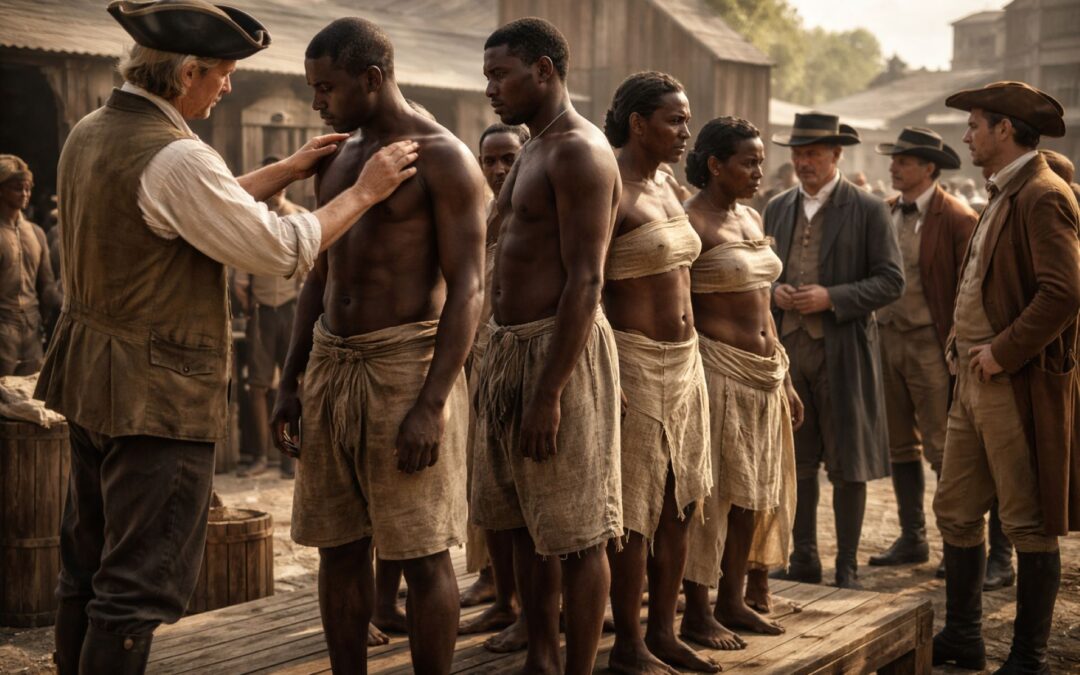
Upon reaching the Americas—typically the Caribbean or parts of mainland North and South America—the third stage commenced. Survivors of the crossing were brought ashore, cleaned, and prepared for sale. Auctions followed, where plantation owners purchased individuals or groups in exchange for local commodities.
These commodities—sugar, tobacco, cotton, coffee, and rum—were the output of plantation labor. They were also the final link in the chain.
Ships were loaded once again, this time with goods produced through enslaved labor, and began the return journey to Europe. There, the cargo was sold at significant profit or fed into domestic industries, particularly in textiles and manufacturing.
Then the cycle repeated.
What made this system powerful was not just its structure, but its continuity. Capital did not sit idle. Profits from one voyage were quickly reinvested into the next. Goods produced in Europe enabled the purchase of enslaved people in Africa. Enslaved labor in the Americas produced commodities. Those commodities generated wealth in Europe, which financed further voyages.
Each leg reinforced the others.
And within this system, human beings were reduced to a single function—linking stages in a chain of exchange. They were not incidental to the trade. They were the mechanism that made it possible.
The Middle Passage: The Human Cost
If the triangular trade explains how the system functioned, the Middle Passage reveals what it demanded.
This was the second leg of the journey—the transatlantic crossing from West Africa to the Americas. It was here that the abstraction of commerce collapsed into its most brutal reality. Everything that had been negotiated, purchased, and loaded onto ships was now subjected to weeks of confinement, deprivation, and calculated control.
Slave ships were not simply vessels of transport. They were engineered environments.
Below deck, space was divided with crude efficiency. Wooden platforms were installed to create multiple tiers, allowing more people to be packed into the hull. Each person was assigned a space so small that movement was severely restricted—often little more than the dimensions of a coffin. Men were typically shackled in pairs, confined in irons that limited even the smallest motions. Women and children were sometimes left unchained, but not uncontained.
Air was scarce. Light was minimal. Sanitation was almost nonexistent.
Under these conditions, disease spread rapidly. Dysentery, smallpox, and other infections moved through the confined space with lethal speed. The combination of malnutrition, dehydration, and physical trauma weakened bodies already subjected to extreme stress. Mortality rates averaged around 15 percent, though on some voyages they climbed far higher.
The crew suffered as well, but the structure of the system made a crucial distinction.
Enslaved people were treated as cargo—valuable, but replaceable. Their deaths were financial losses, not human tragedies within the logic of the trade. Captains were incentivized to preserve life where possible, but not at the expense of efficiency. Overcrowding, which increased profits when voyages succeeded, also increased mortality. The system accepted that trade-off.
Resistance was constant.
Despite chains, confinement, and surveillance, enslaved people resisted their captivity in every way available to them. Rebellions broke out on numerous voyages. Some were organized attempts to seize control of the ship. Others were smaller acts of defiance. Most were suppressed with violence. A few succeeded, at least temporarily.
There were also quieter forms of resistance—refusal to eat, withdrawal, self-harm. These acts were met with force-feeding or punishment, but they reveal something essential: even within the most restrictive conditions, the system was never fully uncontested.
By the time ships reached the Americas, the survivors had endured weeks of physical and psychological strain. They emerged disoriented, weakened, and often ill. What awaited them was not relief, but the next stage of the process.
The Middle Passage was not an aberration within the slave trade. It was central to it.
It exposed, in concentrated form, the underlying logic of the entire system: that human life could be measured, managed, and sacrificed within a framework designed to produce profit.
Sale and Labor in the Americas
The end of the Middle Passage was not an end. It was a transition.
When slave ships reached ports in the Caribbean or the mainland Americas, the survivors were brought ashore and prepared for sale. The process was deliberate. Before entering the market, enslaved people were often washed, shaved, and, in some cases, treated superficially for illness. The intention was not care, but presentation—to make them appear stronger, healthier, and therefore more valuable to potential buyers.
They were then taken to auction.
These sales varied in format, but the underlying principle remained the same: human beings were commodified and priced. Buyers—primarily plantation owners or their agents—inspected individuals closely, assessing physical condition, age, and perceived capacity for labor. Transactions could happen through open auctions or private sales, with individuals sold separately or in groups depending on demand.
Families, when they existed, were routinely separated.
Once purchased, enslaved people were transported to plantations, where they were absorbed into labor systems designed for continuous extraction. The nature of this labor depended on the region and the crop, but certain patterns were consistent across the Atlantic world.
Plantation agriculture operated on scale and repetition. Sugar, tobacco, cotton, and coffee required sustained, intensive work. Fields had to be cleared, planted, maintained, and harvested in cycles that left little room for rest. Processing—especially in sugar production—added another layer of labor, often carried out in dangerous conditions involving heavy machinery and extreme heat.
Work was organized, monitored, and enforced.
Enslaved people were assigned roles based on strength, skill, and perceived reliability. Some worked in field gangs under direct supervision, performing the most physically demanding tasks. Others were assigned to skilled positions—carpentry, metalwork, or domestic service—but these roles did not imply freedom or security. All remained subject to the same system of control.
Violence was not incidental. It was structural.
Punishment was used to enforce discipline, deter resistance, and maintain output. The threat of physical coercion underpinned the entire plantation system, ensuring that labor could be extracted at the required intensity. At the same time, plantation owners treated enslaved people as long-term assets. There was an economic incentive to preserve their ability to work, even as the conditions imposed on them often undermined it.
What distinguished this system from many earlier forms of slavery was its rigidity.
In the Americas, slavery became hereditary and racialized. Status was passed from parent to child, creating a self-reproducing labor force. African origin became the defining marker of enslavement, reinforced through legal codes and social structures. Movement, autonomy, and rights were systematically restricted, leaving little possibility of exit.
The plantation was not just a workplace. It was a closed system.
And it fed directly back into the broader Atlantic economy. The crops produced through enslaved labor—sugar, tobacco, cotton, and others—were exported in vast quantities to Europe, where they generated the wealth that sustained the trade itself.
By the time a single voyage was complete, the transformation was total.
People had been reduced to commodities, exchanged for goods, and converted into labor that produced further commodities. Each stage was linked. Each stage depended on the others.
And the system continued.
Finance, Insurance, and the Business of Slavery
Behind the ships, the ports, and the plantations sat something less visible, but just as essential—the financial system that made the entire trade possible.
The transatlantic slave trade was not sustained by individual merchants acting alone. It was underwritten, distributed, and stabilized through mechanisms that reduced risk and increased efficiency. In this sense, it functioned much like any other large-scale commercial enterprise of the early modern world—except that its central commodity was human life.
A single slaving voyage required significant capital.
Ships had to be built or purchased. Crews had to be hired and provisioned. Cargo—textiles, metal goods, firearms—had to be assembled before departure. The voyage itself could take months, tying up capital for extended periods while exposing it to numerous risks: disease, storms, shipwreck, rebellion, and market fluctuations.
To manage this, merchants rarely financed voyages alone.
Instead, they formed syndicates. A voyage would be divided into shares—often dozens of them—allowing multiple investors to participate. These investors were not limited to merchants. Manufacturers, lawyers, clergy, and local officials all bought into the trade, spreading both the risk and the reward across a wide segment of society. If a voyage failed, losses were absorbed collectively. If it succeeded, profits were distributed proportionally.
This structure did more than reduce financial exposure. It embedded the slave trade into the broader economy.
Returns from successful voyages flowed into other sectors—manufacturing, construction, local commerce—creating a feedback loop in which more and more people became indirectly tied to the system. The trade was no longer confined to ports and ships. It was woven into the economic fabric of entire regions.
Speed also mattered.
Liverpool’s merchants, in particular, developed ways to accelerate the circulation of capital. Rather than waiting for physical payment from the Americas, they used bills of exchange—financial instruments that allowed debts to be settled through credit networks, often centered in London. This meant that profits could be reinvested into new voyages even before previous ones had fully concluded.
The effect was compounding. Capital moved faster. More voyages were financed. The system expanded.
Risk, however, remained unavoidable. And this is where insurance entered the picture.
Maritime ventures of this scale required protection against loss, and by the late 17th century, London had developed a specialized market to provide it. At the center of this market was Lloyd’s of London, which had evolved from a coffee house into the leading hub for marine insurance.
Here, underwriters assessed and priced the risks associated with each voyage. Ships, cargo, and expected returns could all be insured for a premium. Crucially, enslaved people were listed on these policies as cargo. Their loss—whether through disease, accident, or other causes—could be financially compensated under certain conditions.
This formalized something already implicit in the system.
Human beings were not only treated as property—they were integrated into financial calculations in the same way as any other commodity. Their value could be quantified, insured, and, under specific circumstances, claimed.
Banks also played a role.
Institutions such as the Bank of England extended credit to merchants, enabling them to finance voyages and maintain liquidity. This connected the slave trade to the broader financial infrastructure of the British state, further entrenching it within the economy.
Taken together, these mechanisms created a system that was remarkably resilient.
Risk was distributed. Capital was mobile. Losses were mitigated. Profits were reinvested.
The brutality of the trade did not undermine its operation. In many ways, the system was designed to function despite it.
And that is what made it so difficult to challenge.
The Beginning of the End: Abolitionist Movements
By the late 18th century, the slave trade was still expanding—but it was no longer uncontested.
Opposition to slavery had existed in scattered forms for centuries, but it was during this period that it began to coalesce into a sustained and organized movement. What made this shift significant was not just moral objection, but coordination. Ideas, individuals, and institutions began to align against a system that had long been treated as economically necessary and socially acceptable.
One of the earliest and most consistent sources of opposition came from religious groups.
The Quakers, in particular, were among the first to condemn slavery outright, not just its excesses but its existence. Their argument was simple and absolute: slavery was incompatible with Christian belief. This position, initially marginal, began to spread beyond their communities, influencing broader public discourse.
At the same time, legal challenges were beginning to expose contradictions within the system.
A key moment came in 1772 with the case of Somerset v Stewart. James Somerset, an enslaved man brought to Britain, escaped his owner and was later recaptured. The case that followed raised a fundamental question: could slavery exist under English law? The ruling, delivered by Lord Mansfield, held that slavery was not supported by the common law in England. While limited in scope—it did not apply to the colonies—it carried symbolic weight. It suggested that slavery lacked a firm legal foundation at the heart of the empire.
Intellectual currents were shifting as well.
Enlightenment thinkers, who had spent decades articulating ideas about liberty, natural rights, and human equality, began to apply those principles more consistently. If all men were born with certain inalienable rights, the logic of slavery became increasingly difficult to defend, at least in theory. This did not immediately dismantle the system, but it weakened the arguments that sustained it.
Perhaps the most powerful voices, however, came from those who had experienced slavery directly.
Figures such as Olaudah Equiano brought firsthand testimony into public view. His 1789 autobiography detailed the realities of capture, transport, and enslavement with a level of clarity that could not easily be dismissed. These accounts did something statistics and abstractions could not—they made the system visible on a human level.
Political leadership began to emerge alongside these currents.
In Britain, William Wilberforce became the central parliamentary figure of the abolitionist cause. Beginning in 1791, he introduced motions to end the slave trade, arguing not only from moral grounds but also from economic and national interest. His efforts, initially unsuccessful, marked the beginning of a sustained legislative campaign.
Outside of Parliament, activism expanded.
Abolitionists developed new strategies to influence public opinion. Pamphlets, petitions, and organized campaigns brought the issue into everyday life. One of the most effective tactics was the boycott of slave-produced sugar, which attracted widespread participation. Consumers, for the first time, were being asked to recognize their role within the system—and to act on it.
What made this movement different from earlier opposition was its persistence.
It was not a single protest or isolated critique. It was a growing network of individuals and groups applying pressure from multiple directions—religious, legal, intellectual, and political. And while the slave trade remained deeply embedded in the economy, the certainty that had once surrounded it was beginning to erode.
The system still functioned.
But it was no longer unquestioned.
The Zong Massacre and Public Outrage
In 1781, a single voyage exposed the logic of the slave trade with a clarity that could not be ignored.
The British slave ship Zong set sail from the West African coast carrying over 440 enslaved Africans—far more than the vessel could safely accommodate. Overcrowding was not unusual. It was part of the system. More captives meant higher potential returns, even if some were expected to die during the journey.
But this voyage did not follow even the brutal norms of the trade.
After a series of navigational errors, the ship missed its intended destination in Jamaica. As the journey dragged on, water supplies began to run low. Faced with this situation, the crew made a decision that would later define the case: they began throwing enslaved people overboard.
Between late November and early December, approximately 132 individuals were deliberately killed.
This was not, in the crew’s reasoning, an act of desperation in the face of imminent death. It was a financial calculation.
The ship had been insured. Under the terms of the policy, if enslaved people died of illness during the voyage, the loss would fall on the ship’s owners. But if they were jettisoned as cargo to preserve the ship and the remaining “property,” the owners could claim compensation from the insurers.
The killings were carried out within that framework.
When the ship eventually reached port, the owners filed an insurance claim for the loss. The insurers refused to pay, and the dispute was brought before the courts in 1783. The case was heard under the authority of William Murray, 1st Earl of Mansfield.
The legal argument did not center on murder. It centered on property.
The court was asked to decide whether the loss of enslaved people fell within the terms of the insurance policy. In his ruling, Mansfield found that the insurers were not liable to pay. But more tellingly, no charges were brought against the crew for the killings. The matter was treated as a commercial dispute, not a criminal act. The loss of life was framed in the same terms as the loss of any other cargo.
The implications were stark.
The case revealed, in explicit terms, how the system functioned at its most extreme. Human beings were not only bought and sold—they were accounted for within financial instruments that could justify their deliberate destruction if it preserved profit.
When details of the case became public, the reaction was immediate.
Abolitionists seized on the incident as evidence of the moral bankruptcy of the trade. Here was a case that could not be explained away as excess or abuse. It was not a deviation from the system. It was an expression of its logic.
Public outrage grew.
The Zong massacre did not end the slave trade. But it shifted the conversation. It provided abolitionists with a concrete example that cut through abstraction and forced a broader audience to confront the realities of what the trade entailed.
From this point onward, opposition was no longer confined to principle.
It was fueled by evidence.
The Abolition of the Slave Trade
By the closing years of the 18th century, the slave trade stood at a point of tension. It remained deeply profitable and structurally embedded, yet the pressure against it—moral, political, and increasingly economic—was building.
The campaign to abolish the trade was not swift. It was contested at every stage.
In Britain, William Wilberforce became the most visible parliamentary advocate for abolition, introducing bills repeatedly from the 1790s onward. Each attempt faced resistance from those whose wealth and influence were tied to the trade—merchants, plantation owners, and political figures who argued that ending it would damage the economy and weaken Britain’s position in the Atlantic world.
These arguments were not trivial. By this point, the slave trade was connected to shipping, manufacturing, finance, and colonial production. To dismantle it was to disrupt a system that extended far beyond the ships themselves.
And yet, the opposition to it continued to grow.
Abolitionists had learned to operate not just within Parliament, but outside it. They mobilized public opinion on an unprecedented scale—organizing petitions, publishing accounts, and coordinating consumer boycotts of slave-produced goods. The movement became harder to ignore, not because it was universally accepted, but because it had become visible and persistent.
At the same time, the economic foundations of the trade were beginning to show strain.
Sugar prices fluctuated and, in some periods, declined. Caribbean plantations were increasingly burdened by debt. Some economists began to argue that enslaved labor was not only immoral, but inefficient—that a system based on coerced labor distorted markets and suppressed productivity. Among these voices was Adam Smith, whose broader arguments about free labor and market dynamics began to influence how the system was evaluated.
Even within government, there were signs of hesitation.
William Pitt the Younger, though personally sympathetic to abolition, had been cautious in pushing the issue during his time in office. Political realities, including war and competing priorities, had delayed decisive action.
That changed after his death.
In 1806, a new administration under William Grenville moved more decisively. With sustained pressure from abolitionists and shifting political conditions, legislation to end British involvement in the slave trade finally passed.
In 1807, the Slave Trade Act was enacted.
The law prohibited British ships from participating in the trade and made it illegal to transport enslaved Africans across the Atlantic under the British flag. It did not abolish slavery itself—that would come later—but it severed Britain’s direct role in the system that supplied it.
The passage of the act marked a turning point.
Britain had been one of the largest participants in the trade. Its withdrawal altered the balance of the system. It also set a precedent, encouraging—or in some cases pressuring—other nations to follow.
But the end of legal participation did not mean the end of the trade.
Demand for enslaved labor in the Americas remained strong. Other nations continued their involvement. And even where laws had been passed, enforcement was uncertain.
The system had been challenged at its core.
But it had not yet been fully dismantled.
Enforcement and the Fight Against Illegal Trade
Ending the slave trade in law was one thing. Ending it in practice was another.
The 1807 ban removed Britain from direct participation, but it did not eliminate the conditions that had sustained the trade. Plantation economies in the Americas still depended on enslaved labor. Demand had not disappeared. It had simply been displaced.
Portuguese and Spanish ships continued transporting enslaved Africans to Brazil and Cuba. In the United States, despite the formal ban on the trade in 1808, illegal shipments persisted for decades. The system adapted, shifting into illicit networks that were harder to track but no less real.
For abolition to have meaning, it required enforcement.
Britain took on that role with unusual intensity. The Royal Navy established a permanent patrol along the West African coast, known as the West Africa Squadron. Its mandate was clear: intercept slave ships, seize them, and liberate those on board.
This was not a symbolic effort.
The squadron operated continuously for decades, patrolling vast stretches of coastline under difficult and often deadly conditions. Sailors faced not only the hazards of the sea, but also tropical diseases that claimed thousands of lives. The cost—both human and financial—was significant.
And yet, the results were tangible.
Between 1807 and 1867, the squadron captured or destroyed over 1,600 slave ships and freed approximately 150,000 people. These numbers, while substantial, only hint at the scale of the effort required to disrupt a system that had been built over centuries.
Even so, enforcement had limits.
Slave traders adapted their methods. Ships were modified for speed, reducing their chances of interception. Routes shifted. Flags were changed to avoid detection. In some cases, enslaved people were transferred between vessels at sea to evade capture. The trade became less visible, but it did not disappear overnight.
International cooperation was also uneven.
While Britain pressured other nations to sign treaties banning the trade, compliance varied. Some governments lacked the capacity—or the will—to enforce their own laws. Others resisted what they saw as British interference in their economic affairs.
As a result, the suppression of the slave trade became a prolonged process rather than a decisive break.
Over time, however, the pressure had an effect. The risks increased. The profitability declined. The networks that had once operated openly were forced into narrower channels.
The trade contracted.
Not suddenly, and not completely, but steadily.
By the mid-19th century, the transatlantic slave trade had been significantly reduced from its peak. It persisted in pockets, sometimes in secret, sometimes in defiance of law. But the system that had once moved millions of people across the Atlantic each decade was no longer functioning at the same scale.
The machinery had been damaged.
What remained was the question of the institution it had sustained.
The End of Slavery and Its Contradictions
The suppression of the slave trade did not end slavery itself. It only removed the pipeline.
Across the Atlantic world, millions of people remained enslaved, still working within the same plantation systems that had driven demand for centuries. Ending the trade had made the system harder to sustain, but it had not dismantled it.
In the British Empire, that change came in 1833 with the passage of the Slavery Abolition Act.
The law formally ended slavery across most British colonies, freeing hundreds of thousands of enslaved people. On the surface, it marked a decisive break—a legal acknowledgment that the system itself could no longer be justified.
But the structure of the transition revealed its contradictions.
The British government allocated £20 million—an enormous sum at the time, roughly 40 percent of its annual budget—not to those who had endured enslavement, but to the slave owners. The payment was framed as compensation for the loss of “property.” The formerly enslaved received no financial restitution for generations of unpaid labor.
In some cases, they were required to enter transitional systems of “apprenticeship,” continuing to work under conditions that differed little from what had come before. Legal freedom did not immediately translate into economic independence or security.
Elsewhere, the timeline extended further.
In the United States, slavery persisted until the upheaval of the American Civil War, which ultimately led to its abolition through the Thirteenth Amendment to the United States Constitution. In Brazil, the last major slave society in the Americas, slavery was not abolished until 1888. Other regions, including parts of North Africa and the Ottoman world, maintained forms of enslavement well into the late 19th and early 20th centuries.
Even where slavery ended in law, its structures proved more durable.
Formerly enslaved people often found themselves trapped in systems that reproduced elements of coercion—debt bondage, sharecropping, restricted movement, and economic dependency. The legal category had changed, but the underlying imbalance of power had not disappeared.
At the same time, the economic legacy of slavery continued uninterrupted.
The commodities that had defined the plantation system—cotton, sugar, tobacco—remained central to global trade. Ports that had grown wealthy through the slave trade, such as Liverpool, continued to prosper as hubs of commerce and industry. The capital accumulated during the centuries of slavery did not vanish. It remained embedded in institutions, infrastructure, and financial systems.
The end of slavery, then, was not a clean break.
It was a transition—partial, uneven, and shaped by the same economic interests that had sustained the system for so long. Freedom was declared, but its meaning was constrained by the structures that surrounded it.
The institution had been abolished.
Its consequences remained.
Legacy: Wealth, Memory, and Consequences
The transatlantic slave trade did not end when the last ship sailed or when slavery was abolished in law. Its effects continued, embedded in economies, societies, and institutions that had been shaped by it for centuries.
In Europe, the legacy was visible in wealth.
Ports such as Liverpool, Bristol, and Nantes did not simply participate in the trade—they were transformed by it. The profits generated through the movement of enslaved people and the commodities they produced flowed into infrastructure, industry, and finance. Docklands expanded. Banks grew. Manufacturing scaled. Entire local economies were built on capital that originated, directly or indirectly, from the slave trade.
This wealth did not disappear with abolition. It compounded.
Investments made during the height of the trade continued to generate returns long after it ended. Families, institutions, and businesses that had benefited from the system often retained their advantages, passing them down through generations. The economic imprint of slavery became part of the foundation of modern industrial economies.
In the Americas, the consequences were structural.
Societies that had been organized around enslaved labor did not reset after emancipation. Instead, they carried forward many of the inequalities that slavery had created. Formerly enslaved people entered freedom without land, capital, or institutional support. In many cases, they were drawn into systems of labor that preserved elements of control—debt, restricted mobility, and economic dependency.
Racial hierarchies, formalized under slavery, persisted as social and political realities.
In Africa, the impact was different but no less profound.
The slave trade had redirected economic and political systems toward the extraction of people. Regions that had once balanced multiple forms of trade became increasingly oriented toward supplying captives. Warfare intensified in some areas. Social structures were disrupted. Populations were depleted.
When the trade declined, these systems did not immediately recover. The long-term effects—political fragmentation, economic distortion, and demographic loss—shaped the continent’s trajectory in ways that extended into the colonial period and beyond.
Memory, however, has been uneven.
For a long time, the institutions and societies that benefited from the slave trade were slow to confront their connection to it. The wealth remained visible. The origins of that wealth were often less so. Over time, this has begun to change. Public debates, historical research, and cultural movements have pushed for a more direct reckoning with the past.
But reckoning is not resolution.
The transatlantic slave trade was not a distant anomaly. It was a central component of the early modern global economy. It connected continents, shaped industries, and influenced the development of modern states.
Understanding its legacy requires more than acknowledging its existence. It requires recognizing how deeply it was integrated into the systems that followed—and how those systems continue to reflect its imprint.
Conclusion: A System, Not an Accident
The transatlantic slave trade was not an isolated horror, nor a temporary lapse in human judgment. It was a system—built deliberately, expanded methodically, and sustained over centuries by institutions that understood exactly what they were doing.
It drew on older forms of slavery, but reshaped them into something larger and more precise. A network that linked continents. A cycle that converted goods into people, people into labor, and labor into profit. At every stage, it was organized, financed, insured, and justified.
What made it endure was not ignorance, but acceptance.
Merchants invested in it because it generated returns. Governments regulated it because it strengthened empires. Religious authorities sanctioned it because it could be framed within existing belief systems. Ordinary individuals participated in it—directly or indirectly—because it was embedded in the economic life around them.
That is what made it so difficult to dismantle.
And yet, it was dismantled.
Not suddenly, and not completely, but through sustained pressure—moral, political, and economic. Abolition was not inevitable. It was the result of effort, resistance, and a gradual shift in what societies were willing to tolerate.
Even then, the end of the trade did not erase what it had created.
The wealth it generated remained. The inequalities it produced persisted. The systems it influenced continued to evolve. In many ways, the world that emerged after abolition still carried the imprint of the one that came before it.
To study the transatlantic slave trade, then, is not only to look back.
It is to understand how a system of immense cruelty could be constructed, normalized, and sustained—and how its consequences can extend far beyond its formal end.