
Introduction: Beyond Alexander’s Invasion
When most people think about the connection between ancient India and the Western world, their minds go straight to one dramatic episode: the invasion of Alexander the Great in the 4th century BCE. It’s a familiar story—armies marching across Persia, battles at the edge of the known world, and a young conqueror who briefly touched the fringes of the Indian subcontinent.
But here’s the thing: that story is only the opening chapter.
What followed Alexander’s campaign was not a clean break, but the beginning of something far more interesting—a long, layered, and surprisingly intimate relationship between ancient India and the Greco-Roman world. For centuries after his death, ideas, goods, people, and beliefs flowed back and forth across this vast cultural corridor, linking the Mediterranean to the Indian subcontinent in ways that feel strikingly modern.
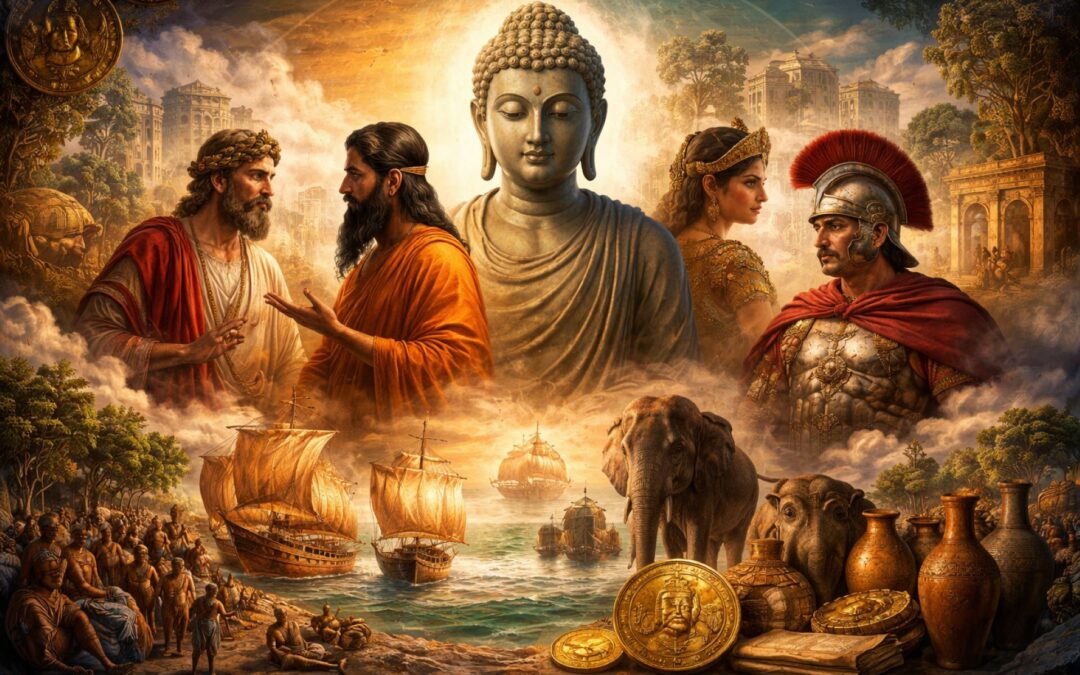
Greek kings ruled parts of India. Indian monks preached to Greek communities. Roman merchants sailed across the Arabian Sea using monsoon winds. Sculptors blended Greek realism with Indian spirituality to create entirely new artistic traditions. Philosophers, traders, slaves, and scholars moved between worlds, carrying with them fragments of their cultures and leaving behind traces that still puzzle historians today.
This was not a one-off interaction. It was sustained contact—economic, cultural, religious, and intellectual.
In fact, if you zoom out, what emerges is something that looks very much like an early form of globalization. Long before modern trade routes, long before colonial empires, and long before the idea of a “connected world” became a cliché, ancient India and the Greco-Roman world were already deeply intertwined.
And yet, this story is rarely told in full.
We tend to study civilizations in isolation—as if India, Greece, and Rome evolved in separate bubbles, occasionally brushing against each other but largely following their own paths. The reality is far messier—and far more fascinating.
This article explores that forgotten story. Not just the headline events, but the deeper connections: how Greeks embraced Buddhism, how Roman trade reshaped Indian economies, how art, science, and even astrology crossed cultural boundaries, and how people themselves—merchants, monks, slaves, and philosophers—lived between these worlds.
Because once you start looking closely, it becomes clear: ancient civilizations were never as isolated as we imagine.
The World After Alexander: Where East Met West
When Alexander the Great died in 323 BCE, his vast empire did not hold together for long. Instead, it fractured into multiple successor kingdoms ruled by his generals. What might seem like a political collapse, however, turned out to be the foundation for something far more enduring: a sustained bridge between the Mediterranean world and the Indian subcontinent.
In the eastern regions of Alexander’s former empire—particularly in areas like Bactria (modern Afghanistan) and the northwestern parts of the Indian subcontinent—Greek rule did not disappear. It evolved. Over time, these regions gave rise to a series of Indo-Greek kingdoms, where Greek rulers governed largely non-Greek populations while adapting to local traditions and cultures.
These kingdoms were not temporary outposts. They were stable, wealthy, and culturally dynamic states that lasted for nearly two centuries. Their rulers issued coins with Greek inscriptions on one side and Indian scripts on the other. Their courts blended Hellenistic political ideas with Indian administrative practices. And their territories became melting pots where languages, religions, and artistic styles coexisted and interacted.
Geography played a crucial role in sustaining this connection. The northwestern part of the Indian subcontinent sat at the crossroads of major overland routes linking Central Asia, Persia, and the Mediterranean world. This region functioned less like a boundary and more like a gateway—a place where cultures didn’t just meet, but overlapped and merged.
At the same time, maritime routes were becoming increasingly important. The Arabian Sea connected Indian ports to the Red Sea and, through it, to Egypt and the wider Roman world. With the discovery of predictable monsoon wind patterns, sailors could travel directly across the sea rather than hugging coastlines. This dramatically reduced travel time and increased the volume of trade, turning what had once been a difficult journey into a relatively reliable commercial route.
The result was a network—both overland and maritime—that allowed goods, ideas, and people to move with surprising frequency. Greek-speaking communities remained active in India. Indian merchants and travelers ventured westward. And over time, these repeated interactions began to reshape both worlds in subtle but profound ways.
What emerged from this post-Alexandrian landscape was not just a series of political entities, but a long-lasting zone of cultural exchange. It was here, in this interconnected frontier, that some of the most fascinating chapters of Indo-Greek and Indo-Roman history would unfold.
When Greeks Became Buddhists
One of the most surprising outcomes of this Indo-Greek interaction was not political or economic—it was religious. In the centuries following Alexander’s campaign, a significant number of Greeks living in and around the Indian subcontinent began adopting Buddhism, a transformation that challenges many of our assumptions about ancient cultural boundaries.
The roots of this shift can be traced back to the reign of Ashoka Maurya in the 3rd century BCE. After his conversion to Buddhism, Ashoka undertook one of the earliest large-scale missionary efforts in world history. His emissaries were not limited to the Indian heartland—they were sent far beyond, including to Greek-ruled territories that had emerged after Alexander’s empire fragmented.
Among these missionaries was a Greek Buddhist monk named Dharmarakshita, who was specifically tasked with spreading Buddhist teachings among Greek communities in regions like Gujarat and Sindh. According to historical accounts, his efforts were remarkably successful, reportedly converting tens of thousands of Greeks to Buddhism. While such numbers may be difficult to verify precisely, the broader pattern is clear: Buddhism was not confined by ethnicity or geography—it spread wherever networks of communication and exchange existed.
But the most dramatic moment in this story came a century later with the conversion of Menander I, one of the most powerful Indo-Greek rulers. Known in Indian sources as Milinda, Menander ruled a vast and prosperous kingdom centered in the Punjab region. His influence was so significant that ancient writers like Strabo compared his conquests favorably to those of Alexander himself.
Menander’s conversion to Buddhism was not a superficial political gesture—it appears to have been deeply personal and philosophical. This transformation is captured in the Milinda Panha (“The Questions of King Milinda”), a Buddhist text that records a series of dialogues between the king and the monk Nagasena. In these exchanges, Menander engages in rigorous philosophical inquiry, asking probing questions about the nature of the self, consciousness, and enlightenment.
The text presents a remarkable image: a Greek king participating in a deeply Indian philosophical tradition, not as an outsider, but as a sincere seeker. By the end of these dialogues, Menander is said to have embraced Buddhism fully, even declaring himself a lifelong follower of the faith.
His patronage had far-reaching consequences. Under his rule, and in the generations that followed, Buddhism flourished in Indo-Greek territories. Greek-speaking communities became integrated into Buddhist religious life, contributing to what historians now describe as a Greco-Buddhist cultural synthesis.
What makes this development especially significant is its longevity. Even after the decline of the Indo-Greek kingdoms, successor states in the region—such as the Kushan Empire—continued to support both Buddhist traditions and elements of Greek culture. This hybrid legacy persisted for centuries, influencing religious art, philosophy, and cultural practices across a wide geographical area.
In a world where we often imagine ancient civilizations as rigid and separate, the story of Greeks becoming Buddhists offers a powerful counterexample. It shows that ideas, especially religious ones, could cross linguistic, ethnic, and cultural boundaries with surprising ease—reshaping identities in the process.
Gandhara: Where Greek and Indian Art Became One
If religion reveals how deeply cultures can influence belief, art shows how they merge at a visual and emotional level. Nowhere is this more evident than in the region of Gandhara, where Greek and Indian artistic traditions fused to create one of the most distinctive styles in ancient history.
Located in what is today parts of Afghanistan and northwest India, Gandhara sat at the crossroads of multiple civilizations. Greek settlers, local Indian populations, Persian influences, and later Central Asian elements all converged here. The result was not a simple borrowing of styles, but the emergence of an entirely new artistic language—what we now call Gandharan art.
At first glance, Gandharan sculptures look strikingly Greek. Figures are rendered with realistic human proportions, detailed musculature, and flowing drapery that closely resembles the style of classical Hellenistic sculpture. Faces often carry a calm, idealized expression, reminiscent of Greek gods and heroes.
But look closer, and the subject matter tells a different story.
These sculptures are overwhelmingly Buddhist.
For the first time in Indian history, the Buddha began to be depicted in human form. Prior to this, early Buddhist art had avoided direct representations of the Buddha, instead using symbols like footprints, empty thrones, or the Bodhi tree to suggest his presence. Gandharan artists broke from this tradition, creating iconic images of the Buddha as a serene, human figure—often with features and stylistic elements clearly inspired by Greek art.
This shift was revolutionary. By giving the Buddha a recognizable human form, Gandharan artists made the religion more accessible and relatable to a wider audience. It’s no coincidence that Buddhism expanded significantly during this period—visual representation likely played a key role in that spread.
The blending of cultures didn’t stop there. Greek mythological figures were also reinterpreted within an Indian context. One of the most fascinating examples is the figure of Hercules, who appears in Gandharan art as a protector of the Buddha, often identified with the Buddhist guardian Vajrapani. Similarly, motifs like vine scrolls, Corinthian columns, and decorative patterns typical of Greek architecture were incorporated into Buddhist monasteries and stupas.
Even smaller details reflected this fusion. Coins from Indo-Greek rulers combined Greek portraiture techniques with Indian symbols and scripts. Artistic conventions flowed in both directions, influencing not just religious imagery but also everyday objects and statecraft.
What makes Gandharan art so remarkable is that it doesn’t feel like a compromise between two cultures—it feels complete in itself. Greek realism and Indian spirituality didn’t cancel each other out; they enhanced one another, creating a style that was both visually sophisticated and deeply symbolic.
In many ways, Gandhara represents the artistic face of ancient globalization. It shows what happens when cultures don’t just interact at a distance, but live together, influence each other, and create something entirely new.
Roman Influence in South India
While the northwestern regions of the subcontinent were shaped heavily by Greek political and cultural presence, southern India tells a slightly different story—one where the influence of the Roman world becomes more visible. Unlike the Indo-Greek kingdoms, Rome never ruled any part of India. Yet its cultural and economic footprint in the south was deep enough to leave behind unmistakable traces.
This influence was not imposed through conquest, but carried through commerce.
As maritime trade between India and the Roman Empire intensified, especially during the early centuries CE, Roman merchants, craftsmen, and goods began flowing into the ports of southern India. Regions like present-day Andhra Pradesh and Tamil Nadu became key nodes in this exchange, and over time, local artistic traditions began absorbing foreign elements.
One of the most striking examples of this can be seen in the art and architecture of Amaravati. The great Buddhist stupa at Amaravati contains sculptural details that, at first glance, feel distinctly Indian—but upon closer inspection, reveal subtle parallels with Roman artistic motifs. Certain representations of deities and figures resemble Roman counterparts in posture, composition, and stylistic treatment.
Nearby, at Nagarjunakonda, archaeological findings suggest even stronger visual connections. Relief carvings depicting battle scenes bear a resemblance to Roman imperial monuments such as Trajan’s Column and the Arch of Constantine. The narrative style—where action unfolds across a continuous visual field—is reminiscent of Roman storytelling through sculpture.
Even more intriguingly, the site includes what appears to be a Roman-style amphitheater—the only known example of its kind in India. Whether this structure was built by Roman craftsmen or inspired by imported ideas remains debated, but its very presence suggests a level of cultural interaction far beyond simple trade.
So how did these influences take root?
There are two plausible explanations. One is that Roman artisans and craftsmen may have traveled to India, either as part of merchant communities or as independent specialists, bringing their techniques and styles with them. The other is that Indian artists, exposed to Roman goods—sculptures, coins, decorative items—began adapting those visual elements into their own work.
Most likely, the truth lies somewhere in between.
What’s important is that southern India was not passively receiving foreign influence. It was selectively absorbing, adapting, and integrating it into its own artistic and cultural framework. The result was not a replica of Roman art, but a localized reinterpretation—Roman ideas expressed through Indian sensibilities.
This regional variation also highlights an important point: the Greco-Roman influence on India was not uniform. While the northwest experienced direct political and cultural blending with Greek traditions, the south engaged more through trade-driven cultural exchange with the Roman world.
Different routes, different mechanisms—but part of the same larger story of connection.
The Indo-Roman Trade Network: A Global Economy Before Globalization
At the heart of the connection between India and the Roman world was something far more tangible than art or religion: trade. And not just small-scale exchange, but a vast, highly organized network that linked two of the most powerful regions of the ancient world in a continuous flow of goods, wealth, and ideas.
This trade had existed in some form even before the rise of Rome, but it expanded dramatically after the Roman annexation of Egypt in 30 BCE. With Egypt under Roman control, the empire gained direct access to the Red Sea, which served as a gateway to the Indian Ocean.
The real breakthrough, however, came with the understanding of monsoon winds.
Greek and Roman sailors learned that by harnessing seasonal wind patterns, they could sail directly across the Arabian Sea rather than cautiously navigating along coastlines. This discovery transformed maritime trade. Journeys became faster, more predictable, and far more efficient, allowing for a dramatic increase in the volume of commerce.
Ancient sources give us a sense of just how extensive this trade was. The Greek geographer Strabo mentions that as many as 120 ships sailed annually from the Egyptian port of Myos Hormos to India. And that was just one port among several.
Meanwhile, the Roman writer Pliny the Elder complained bitterly about the economic consequences of this trade. According to him, Rome was losing vast amounts of gold—over 100 million sesterces every year—to pay for Indian luxury goods. Whether exaggerated or not, his complaint reflects a clear reality: the flow of wealth from Rome to India was substantial.
Indian ports became bustling hubs of international commerce. Muziris, located on the Malabar Coast, emerged as one of the most important trade centers, alongside others like Arikamedu and Kaveripattinam. These ports were not just points of exchange—they were dynamic spaces where merchants from different cultures interacted, negotiated, and built long-term relationships.
The range of goods traded was astonishing.
From the Roman side came wine, glassware, precious metals, coral, and finely crafted objects. From India came spices—especially pepper—along with ivory, gemstones, pearls, textiles, and exotic animals. Many of these goods were luxury items, consumed by the elite classes of Roman society.
But India was not just an exporter—it was also a middleman in a larger global network. Chinese silk, for example, often reached Rome through Indian markets. Southeast Asian goods followed similar routes. In this sense, India functioned as a central hub in an early form of global trade, connecting multiple regions through its ports.
Archaeological evidence supports this picture. Roman coins have been found in large quantities across southern India. Amphora fragments—used to transport wine and oil—have been unearthed at multiple sites. Even more telling are artifacts like the so-called “Pompeii Lakshmi,” an ivory statue of a Hindu goddess discovered in the ruins of Pompeii, suggesting that Indian goods reached deep into the Roman world.
This was not incidental trade. It was systemic, large-scale, and sustained over centuries.
And its impact went beyond economics. The wealth generated through this trade likely contributed to the rise and prosperity of powerful South Indian kingdoms during the Sangam period. Literary sources from the time describe bustling ports, foreign merchants, and ships arriving laden with gold.
In many ways, the Indo-Roman trade network represents one of the earliest examples of a truly interconnected economy—long before the modern concept of globalization existed.
Roman Communities in India
Trade, by its very nature, brings people together. And in the case of Indo-Roman commerce, the connection between India and the Roman world was not limited to goods moving across oceans—it involved people living, working, and building communities far from their homelands.
Historical and archaeological evidence strongly suggests that Roman citizens were not just visitors in India—they were residents.
One of the most important sources for understanding this is the Periplus of the Erythraean Sea, a 1st-century CE Greek navigational text that describes maritime routes and trading ports across the Indian Ocean. It provides detailed accounts of Indian coastal cities such as Barygaza (modern Bharuch), Muziris, and Arikamedu, highlighting their role in long-distance trade.
Excavations at sites like Arikamedu, near present-day Pondicherry, have revealed what appears to be a Roman trading settlement. Archaeologists have uncovered Roman-style pottery, amphorae, and other artifacts that point to a sustained foreign presence rather than occasional visits.
Muziris, perhaps the most famous of these ports, offers even more compelling evidence. Not only have large quantities of Roman coins and goods been found there, but historical accounts suggest that a Roman temple dedicated to Augustus Caesar once stood in the city. This temple was likely built to serve the spiritual needs of Roman merchants and officials stationed in the region, indicating a well-established expatriate community.
These Roman residents were primarily involved in trade. They acted as intermediaries, facilitators, and sometimes independent merchants, navigating both Roman and Indian commercial systems. Some may have been craftsmen or specialists, contributing skills that complemented local industries.
But beyond economics, their presence would have had social and cultural implications as well.
Imagine a bustling port city where Tamil-speaking traders negotiated with Latin-speaking merchants, where foreign goods were exchanged alongside ideas, customs, and stories. Over time, these interactions would have led to a degree of cultural blending—visible in language, dress, and daily practices.
Tamil Sangam literature even refers to foreign merchants—often called “Yavanas”—who lived and traded in the region. These texts describe them as wealthy and influential, suggesting that they were not marginal outsiders but integrated participants in local economies.
It’s also worth noting that Roman presence was not confined to coastal areas. Through river systems and inland trade routes, Roman goods—and possibly Roman individuals—reached deeper into the subcontinent. Wherever trade flowed, cultural exchange followed.
In this sense, Roman communities in India were not anomalies. They were a natural extension of a thriving trade network—a reminder that ancient globalization was not just about distant connections, but about people living at the intersection of multiple worlds.
Indians in the Greco-Roman World
If Roman merchants and settlers made their way into India, the movement was not one-sided. Indians, too, traveled west—sometimes as traders and scholars, sometimes as diplomats, and occasionally under far harsher circumstances. The Greco-Roman world was not unfamiliar with Indian faces; in fact, the presence of Indians across Mediterranean cities was more common than we tend to imagine.
One of the most important hubs of this interaction was Alexandria, the great cosmopolitan city founded by Alexander and later ruled by the Ptolemies and Romans. As a major center of trade, learning, and cultural exchange, Alexandria attracted merchants and intellectuals from across the known world—including India. Archaeological evidence, such as Indian-style artifacts and inscriptions, suggests that Indian communities lived and worked there over extended periods.
But the connection goes even deeper into the intellectual life of the Greco-Roman world.
Ancient accounts suggest that Indians were known in Greek philosophical circles as early as the time of Socrates. Some sources mention conversations between Socrates and Indian thinkers, indicating that Indian philosophical traditions were not entirely unknown in classical Athens. While such accounts must be treated cautiously, they point toward a broader awareness of Indian ideas in the Greek world.
More concrete is the story of Zarmanochegas, an Indian ascetic—likely from Gujarat—who traveled to Athens during the Roman period. In a dramatic and culturally shocking act, he is said to have immolated himself publicly as a demonstration of his spiritual beliefs. This event left a strong impression on Greek observers and was recorded by multiple writers, becoming a symbol of the exotic and philosophical East in Greco-Roman imagination.
Indian merchants also left their mark across the Red Sea and Mediterranean trade routes. Graffiti and inscriptions found in ports along the Red Sea indicate the presence of Indian traders who were part of the same commercial networks that linked India to Rome. These were not isolated travelers—they were participants in a regular, structured system of exchange.
There is also a compelling, though debated, intellectual connection. Some historians believe that Ammonius Saccas, a key figure in the development of Neoplatonism, may have had Indian origins. His student, Plotinus, expressed a strong interest in Eastern philosophy and even attempted to travel east in search of knowledge.
The philosophical parallels between Neoplatonism and Indian traditions like Vedanta have led some scholars to speculate about cross-cultural influence. While definitive proof remains elusive, the possibility itself highlights how ideas could travel alongside people, shaping intellectual traditions across vast distances.
Of course, not all Indians in the Greco-Roman world were there by choice. Historical records indicate that Indian slaves were present in Roman society, owned by both elites and intellectuals. This darker aspect of exchange reminds us that ancient globalization, like its modern counterpart, was not always equitable or voluntary.
Taken together, these threads reveal a world far more interconnected than we usually assume. Indians were not distant observers of the Greco-Roman world—they were active participants in its economic, cultural, and intellectual life.
The Dark Side of Exchange: Slavery and Status
For all its intellectual richness and cultural blending, the connection between India and the Greco-Roman world also had a darker, more uncomfortable dimension—one rooted in systems of slavery, exploitation, and social hierarchy.
Among the most striking examples is the presence of Greek slave women in India, referred to in ancient Indian texts as “Yavani” in the north and “Yavanar” in the south. These women were part of a broader network of slave trade that linked the Mediterranean to the Indian subcontinent, driven by demand for both labor and status symbols.
Unlike modern conceptions of slavery, which are often associated with plantation systems, slavery in the ancient world was deeply embedded in social and cultural structures. In this context, foreign slaves—especially those from distant lands—carried a certain prestige.
Greek women, in particular, were highly valued.
Their lighter skin, different physical features, and foreign origin made them desirable among elite circles in India. Owning such slaves was not merely about labor—it was a display of wealth, power, and access to global networks. The more exotic the origin, the greater the status it conferred.
These women served in a variety of roles. Some worked as musicians, dancers, or performers. Others were employed as attendants, concubines, or even bodyguards. The renowned Sanskrit poet Kalidasa mentions foreign women—likely of Greek origin—as desirable female guards, suggesting that their presence extended into elite and even militarized spaces.
What is particularly telling is that these women often retained elements of their original cultural identity. Descriptions in literary sources indicate that they wore clothing typical of their homelands, further enhancing their “exotic” appeal. Their foreignness was not erased—it was emphasized and commodified.
The mechanisms behind this trade were complex. Slaves could be captured through warfare, sold by merchants, or transported through maritime trade networks. Pirates, state actors, and independent traders all played a role in supplying this demand.
And this exchange was not one-directional. Just as Greek women were brought to India, Indians were taken westward as slaves, becoming part of households in Rome and Alexandria. Slavery, in this sense, was a grim but integral part of the same networks that facilitated trade and cultural exchange.
This darker side of Indo-Mediterranean interaction forces us to confront a difficult truth: connectivity does not always mean equality. The same routes that carried philosophy, art, and religion also carried human beings as commodities.
Understanding this dimension does not diminish the significance of cultural exchange—but it does make the picture more complete, and more honest.
Science Across Civilizations
Beyond trade, art, and religion, one of the most profound areas of interaction between the Greco-Roman world and India was in the realm of knowledge—particularly science, astronomy, and intellectual inquiry.
Unlike material goods, ideas do not travel in ships or caravans alone. They move through translation, dialogue, and sustained intellectual contact. And in the centuries following Alexander, such contact became increasingly common between Greek and Indian scholars.
One of the clearest examples of this exchange is found in astronomy.
During late antiquity, several astronomical texts of Greek origin were translated into Sanskrit and incorporated into Indian scientific traditions. Among these were the Romaka Siddhanta and the Paulisa Siddhanta, two of the five major astronomical canons studied in India. These works drew heavily from Hellenistic and Roman astronomical knowledge, reflecting the transmission of ideas from the Mediterranean into the Indian intellectual sphere.
What makes this particularly interesting is how Indian scholars responded to this foreign knowledge.
Texts like the Garga Samhita openly acknowledge the scientific expertise of the Greeks—referred to as “Yavanas”—even while maintaining a sense of cultural superiority. In one passage, the Greeks are described as “barbarians,” yet are still honored for their contributions to astronomy.
Similarly, the polymath Varahamihira, one of the most influential scientists of ancient India, wrote that although the Greeks were considered impure by Indian standards, they should be respected for their mastery of scientific disciplines.
This dual attitude—cultural distance combined with intellectual respect—is a fascinating feature of ancient knowledge exchange. It shows that while civilizations may have viewed each other as different or even inferior in certain respects, they were still willing to learn from one another when it came to practical and intellectual advancements.
A major conduit for this exchange was Alexandria, which served as a global center of learning. Scholars from different traditions—Greek, Egyptian, Persian, and possibly Indian—interacted in this intellectual melting pot, generating new ideas that could then travel eastward into India.
The presence of Greek-speaking kingdoms within or near India also made translation easier. Texts could be transmitted, interpreted, and adapted by bilingual scholars who operated at the intersection of cultures.
And this exchange was not limited to astronomy. Ideas in geography, medicine, mathematics, and philosophy also moved along these networks, contributing to a broader cross-pollination of knowledge.
In many ways, this scientific interaction represents one of the most meaningful forms of cultural exchange. Unlike trade goods, which are consumed, or political systems, which rise and fall, knowledge builds upon itself. The blending of Greek and Indian scientific traditions helped shape intellectual developments that would influence both regions for centuries.
It is yet another reminder that ancient civilizations were not isolated islands of thought, but participants in a shared, evolving conversation about the nature of the world.
When Greek Astrology Met Vedic Astrology
Among all the exchanges between the Greco-Roman world and India, few are as subtle yet enduring as the fusion of astrology. Unlike trade goods or political systems, astrology operates at the intersection of science, belief, and daily life—and its integration into Indian tradition reveals just how deeply foreign ideas could embed themselves into local systems.
Before contact with the Greeks, Indian astrology—what we now call Vedic astrology—already existed in a distinct form. It focused heavily on lunar constellations (nakshatras) and ritual timing, rooted in older Vedic traditions. But with the arrival of Greek influence, particularly during the period of Indo-Greek and later Western Satrap rule, a new layer was added: the zodiac.
The familiar twelve-sign zodiac—Aries, Taurus, Gemini, and so on—was not originally part of early Indian astrology. It was introduced through Greek astrological systems, which had been developed and refined in Hellenistic centers like Alexandria. These systems emphasized horoscopy—the casting of individual birth charts based on planetary positions—and brought with them a more mathematically structured approach to celestial interpretation.
This knowledge did not remain in Greek alone. It was translated.
One of the most important texts in this transmission is the Yavana Jataka—literally “The Saying of the Greeks.” Originally composed in Greek around the 2nd century CE, it was translated into Sanskrit by a figure known as Yavaneshwara, or “Lord of the Greeks,” who served under the Western Satraps in western India.
This translation was not a simple copy. It was an adaptation.
The Yavana Jataka integrates Greek astrological concepts into an Indian framework, blending foreign techniques with indigenous beliefs. It acknowledges Greek expertise in horoscopy while simultaneously embedding that knowledge within a broader Indian cosmological system. Later Indian astrologers would draw heavily from this text, incorporating its methods into what would become the classical tradition of Indian astrology.
What’s particularly interesting is how seamlessly this fusion occurred. Over time, the Greek origins of many astrological concepts became less visible. The zodiac signs, planetary interpretations, and horoscopic techniques were absorbed so thoroughly that they came to be seen as part of the Indian tradition itself.
This is cultural integration at its deepest level—not just adoption, but transformation.
The role of political power also played a part. The Western Satraps, who ruled parts of western India and were themselves of foreign origin, actively promoted the translation of Greek knowledge into Sanskrit. This was likely a strategic move, helping them gain legitimacy among local elites by supporting intellectual and religious traditions.
Ironically, this strategy may have contributed to their own cultural assimilation. Over time, these rulers became so Indianized that even their coinage began to lose authentic Greek language, retaining only stylized, pseudo-Greek lettering for visual effect.
In the end, what began as a foreign system of astrology became an integral part of Indian intellectual life—one that continues to influence millions of people to this day.
A Connected Ancient World: What This History Really Means
When you step back and look at the full picture—religion, art, trade, migration, science, and astrology—a clear pattern emerges. Ancient India and the Greco-Roman world were not isolated civilizations occasionally brushing against each other. They were part of a shared, interconnected system.
This connection was not built overnight, nor was it driven by a single empire or event. It evolved over centuries, sustained by geography, commerce, curiosity, and human movement. Trade routes became cultural highways. Political frontiers became zones of interaction rather than separation. And ideas flowed alongside goods, reshaping societies in ways that were often subtle but long-lasting.
What’s particularly striking is how multidimensional this interaction was.
Religion moved across boundaries, as Greeks embraced Buddhism and participated in its philosophical traditions. Art merged styles, creating entirely new visual languages like the Gandharan school. Trade networks linked distant economies, moving not just goods but wealth on a massive scale. People—merchants, monks, slaves, and scholars—traveled between worlds, carrying fragments of their identities with them. And knowledge itself crossed civilizations, influencing science, philosophy, and even astrology.
In many ways, this looks remarkably like a pre-modern version of globalization.
But unlike modern globalization, which is often driven by large-scale institutions and rapid technological change, this ancient network was slower, more organic, and deeply human. It relied on individuals—sailors navigating monsoon winds, translators bridging languages, rulers sponsoring cultural exchange, and communities adapting to new influences.
It also challenges a deeply ingrained assumption: that ancient civilizations developed in isolation.
The traditional way of studying history often divides the world into neat cultural units—“Indian civilization,” “Greek civilization,” “Roman civilization”—as if they existed independently. But the evidence tells a different story. These civilizations were constantly interacting, influencing, and reshaping each other.
And yet, this interconnected history is often overlooked.
Part of the reason is that it doesn’t fit neatly into national or regional narratives. It belongs to multiple histories at once, making it harder to categorize. Another reason is that these exchanges were gradual and cumulative, lacking the dramatic clarity of wars or conquests.
But in many ways, they were just as important—if not more so.
Because they show us how civilizations grow: not in isolation, but through contact, exchange, and adaptation.
Conclusion: Rethinking the Boundaries of Ancient Civilizations
The story of ancient India and the Greco-Roman world is not just a collection of fascinating historical facts—it’s a reminder of how interconnected human societies have always been.
Long before modern maps, passports, or global markets, people were already crossing cultural boundaries. They traded goods across oceans, debated philosophy across languages, and blended artistic and religious traditions in ways that created entirely new forms of expression.
This was a world where a Greek king could become a Buddhist, where Indian goods could be found in Roman cities, where foreign ideas could reshape local traditions, and where individuals could live between cultures rather than within just one.
It was a world that looks, in many ways, surprisingly familiar.
And yet, we often overlook it because it doesn’t align with the simplified narratives we’ve inherited—stories that emphasize separation over connection, difference over exchange.
But once you start to see these links, it becomes difficult to unsee them.
The boundaries between civilizations begin to blur. The idea of isolated cultural worlds starts to break down. And what emerges instead is a far more dynamic and interconnected picture of the ancient past.
A world where India, Greece, and Rome were not distant and disconnected—but part of the same unfolding human story.