
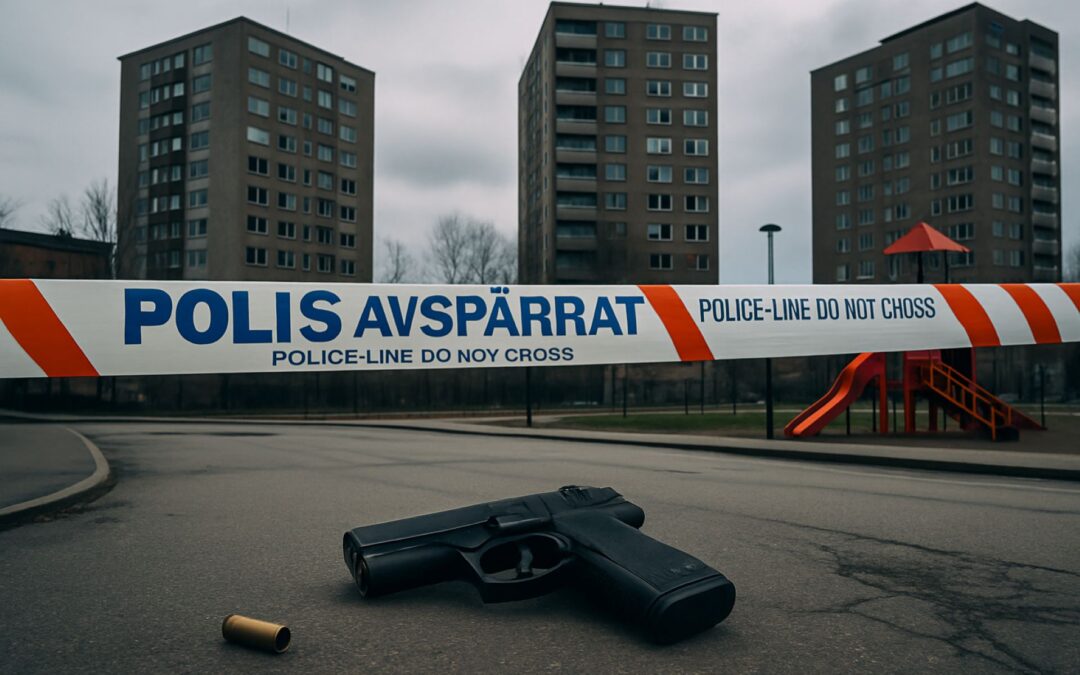
For decades, Sweden stood as Europe’s moral compass — a nation where crime was rare, equality was real, and trust was the unspoken law that governed daily life. It was the country that locked nothing and feared no one. But beneath this calm exterior, slow tectonic shifts were underway — economic crises, rapid migration, urban isolation, and a justice system built for saints rather than sinners.
Today, that same Sweden finds itself in a paradox: the most progressive country in Europe has become its gun crime capital. Grenades explode in playgrounds, teenage gangs film executions for social media, and neighborhoods once designed as symbols of welfare now resemble occupied territories. How did a nation of peace and prosperity transform into a landscape of fear and fragmentation?
The answer isn’t a single policy or event. It’s a long, painful unraveling of trust — the invisible currency that once made Sweden exceptional.
From a Model Nation to a Cautionary Tale
There was a time when Sweden was the gold standard of civilization — a country that perfectly balanced freedom and security, individualism and solidarity. It was a nation that others looked to and said, “This is how society should work.”
Imagine a country where children walked to school alone, bicycles were left unchained in public parks, and the idea of locking your door seemed paranoid. That was Sweden for most of the 20th century. Crime was virtually nonexistent, corruption was unheard of, and social trust ran so deep that bureaucracy was minimal — because no one thought to cheat the system.
This was not accidental. Sweden’s prosperity was built upon a meticulous social contract — high taxes, high trust, high welfare. Citizens willingly surrendered a large portion of their income because they believed, with near-religious conviction, that the state would redistribute it fairly. Education, healthcare, housing, and social security were universal rights, not privileges.
The moral core of the Swedish model rested on equality and community. A cleaner and a CEO used the same public hospitals, sent their kids to the same schools, and lived in neighborhoods that looked remarkably similar. The result was an unparalleled sense of cohesion — a shared destiny that blurred the boundaries between social classes.
By the 1980s, Sweden was more than a country. It was an idea — proof that humanity could evolve beyond greed and crime. International scholars, economists, and political theorists all praised the “Nordic miracle” as the most humane form of capitalism on Earth.
But under this picture-perfect surface, fragility hid in plain sight. Sweden’s strength was its sameness — a small, homogeneous population with shared values, language, and culture. Its social machinery worked precisely because everyone played by the same rules. The problem? When the world changed, Sweden didn’t.
Fast forward to the 2020s, and the nation that once epitomized peace became Europe’s gun crime capital. Streets that were once silent now echo with gunfire. Between 2023 and 2024, Sweden saw nearly 300 shootings, over 100 bombings, and dozens of deaths — figures more common in cartel-plagued Latin America than in Scandinavia.
The fall wasn’t sudden — it was gradual, silent, and systemic. It wasn’t caused by one event, but by a slow erosion of trust, cohesion, and shared responsibility. The very pillars that once sustained Sweden’s success had become brittle. The system designed for saints was suddenly asked to handle sinners — and it wasn’t ready.
The Fragile Foundation of Trust
Trust — that was Sweden’s true currency. Not the krona, not oil or iron ore, but a deep, almost spiritual trust between the citizen and the state. It was the invisible contract that made everything else work.
Swedes trusted that their taxes were used wisely. They trusted their institutions to be transparent. They trusted each other to act honestly, even when no one was watching. This collective faith created an ecosystem where laws could be lenient, surveillance minimal, and policing gentle.
The justice system embodied this trust to its core. Rather than focusing on punishment, it emphasized rehabilitation. The state believed in the moral recoverability of every citizen. Prisons were more like dormitories, designed not to break people, but to reintegrate them. The logic was simple: if society itself was good, then bad behavior was an anomaly — something to correct, not condemn.
For decades, this worked. Low inequality and universal welfare ensured that crime rarely had fertile ground to grow. Sweden’s legal and political systems were built for a country where deviance was rare — a place where compassion could afford to be the law.
But trust is like glass — strong when intact, fragile once cracked.
When economic pressures mounted and cultural divisions appeared, the system’s leniency began to look less like kindness and more like weakness. Rehabilitation made sense when criminals were citizens shaped by the same moral code. It was useless — even dangerous — when confronting people who operated under entirely different codes of loyalty, power, and fear.
Moreover, this trust wasn’t just institutional — it was psychological. Swedes were taught from childhood that the system was benevolent, that fairness was guaranteed, that violence was foreign. This national innocence became a kind of collective blindness. When organized crime crept in, most refused to believe it was real. When bombs began to detonate in suburban courtyards, the shock wasn’t just fear — it was betrayal.
Sweden had built its paradise on the assumption that everyone played fair. But once that assumption broke, so did the illusion of safety.
The Turning Point: Crisis and Migration
The early 1990s marked the beginning of Sweden’s long and painful descent from utopia to unrest. For the first time in decades, the country faced a deep financial crisis. Between 1991 and 1993, unemployment exploded from virtually zero to double digits. The welfare system — once limitless in generosity — suddenly strained under its own weight.
Government spending was slashed. Public institutions that had always seemed untouchable faced cuts. And just as Sweden was tightening its belt, the world began sending its refugees to its doorstep.
The Yugoslav Wars broke out, displacing millions across Europe. Tens of thousands fled to Sweden, where they were welcomed with open arms. At the same time, the Gulf War and Saddam Hussein’s crackdown on Kurds and Shiites drove more waves of refugees toward Scandinavia.
Sweden’s migration policy was among the most liberal in the world. From day one, newcomers were given free housing, healthcare, and education — all without the need to prove language skills, employment, or civic knowledge. The government believed integration would occur naturally — that people, when given stability, would absorb the national ethos of fairness and peace.
But this belief ignored the harsh reality of economics and culture.
Sweden’s job market, dominated by powerful unions and high minimum wages, made it extremely difficult for newcomers — especially low-skilled refugees — to find work. Credentials earned abroad weren’t recognized easily, and Swedish employers often relied on personal references, something new arrivals didn’t have.
As a result, thousands of refugees found themselves trapped in long-term unemployment. They became reliant on welfare not by choice, but by necessity. And dependence gradually morphed into disillusionment.
Culturally, integration faltered as well. The absence of language requirements or social obligations meant that immigrant communities developed in isolation. People lived in Sweden, but not necessarily of Sweden. Neighborhoods began to evolve where Swedish was seldom spoken, where local customs dominated, and where the rules of the state held little sway.
What began as compassion slowly turned into segregation — and segregation turned into resentment. Native Swedes began to feel alienated from the rapid demographic changes around them, while immigrants, feeling excluded from opportunity, created parallel societies to survive.
By the mid-1990s, the once-fluid Swedish identity had fractured into islands — each with its own norms, languages, and loyalties. The system that once prided itself on universal inclusion had inadvertently created its opposite: a patchwork of separation.
This was the quiet fracture point — the moment when Sweden’s unshakable trust began to wobble, not because of malice or racism, but because a well-meaning system refused to acknowledge its own limits.
It was a humanitarian heart colliding with economic and cultural reality — and the aftershocks of that collision still echo through Sweden’s streets today.
Urban Design and the Birth of Segregation
In Sweden’s story of decline, concrete played an unexpected role. The very architecture designed to symbolize equality would, decades later, become the physical embodiment of segregation.
During the 1960s and 1970s, the Swedish government launched an audacious project known as the “Million Program.” Its goal: to construct one million modern homes within a single decade. At a time when Sweden’s population was just eight million, this was nothing short of revolutionary. The program was rooted in noble intent — to replace outdated wooden houses, eliminate overcrowding, and provide every family, regardless of income, with clean, comfortable housing equipped with modern amenities.
Initially, it was a triumph. Working-class Swedes moved into bright, spacious apartments with central heating, running water, and playgrounds for their children. These new neighborhoods — Rinkeby, Rosengård, Biskopsgården, Tensta, and others — represented the social democratic dream in brick and concrete.
But as the decades passed, prosperity had an unintended side effect. The very working-class families that once populated these neighborhoods began to ascend economically. They moved into better suburbs and private homes, leaving behind vast clusters of cheap, state-owned housing. What had once been Sweden’s pride quietly decayed into ghettos-in-waiting.
When refugees and immigrants began arriving in large numbers during the 1980s and 1990s, these vacant apartments became the easiest solution. The government needed quick, affordable housing — and the “Million Program” complexes were ready. Thus began a process of urban clustering that would, in time, divide the nation’s social map along invisible fault lines.
The problem wasn’t just demographic — it was geographical. Many of these housing estates were built far from city centers, disconnected from the labor market and economic activity. Public transport was limited; local businesses were scarce. Residents lived in isolation from mainstream society. The architecture itself — towering, repetitive blocks surrounded by highways — discouraged community engagement.
The EBO Law of 1994 compounded the issue. It allowed asylum seekers to choose where they lived, rather than being distributed evenly across municipalities. Predictably, most chose areas where they already had cultural or familial connections. These neighborhoods, once designed for Swedish factory workers, became concentrated hubs of specific ethnic communities — Somali, Kurdish, Bosnian, Arab — each forming tight-knit networks that seldom intersected with broader Swedish society.
Then came the 1992 school reform, which introduced “school choice.” Parents could send their children to schools outside their local district. It was meant to improve education through competition, but it triggered an exodus. Swedish families fled schools in immigrant-heavy neighborhoods, leaving behind classrooms where Swedish was rarely spoken.
In less than a decade, parts of cities like Malmö, Gothenburg, and Stockholm had transformed into linguistic and cultural enclaves — neighborhoods where the state’s authority felt distant, and local norms dictated behavior. Crime began to incubate not because of inherent criminality, but because young people grew up without bridges — isolated, underemployed, and invisible to the larger nation around them.
The architecture of equality had turned into the geography of division.
The First Wave of Organized Crime
Sweden’s confrontation with organized crime didn’t start in the immigrant suburbs — it began among Swedes themselves.
In the mid-1990s, a violent turf war erupted across Scandinavia: the Nordic Biker War. Rival gangs — the Hell’s Angels and the Bandidos — fought for control of drug smuggling and protection rackets. Shootouts, car bombings, and public assassinations shook cities unaccustomed to violence. For the first time in modern memory, Swedes saw their streets turned into battlegrounds.
This conflict was a prelude to a much darker transformation. Around the same time, the collapse of Yugoslavia unleashed a flood of weapons into Europe. War-torn regions in the Balkans became black markets for automatic rifles, handguns, and grenades — sold cheaply, often smuggled into Sweden via Denmark and Germany.
Suddenly, firearms that had once been rarities in Sweden were abundant. For a few hundred euros, gangs could arm themselves with military-grade weaponry. The Nordic biker groups professionalized the business — running it like corporations, complete with hierarchies, logistics, and specialized roles.
Then came the second layer: immigrant-linked family clans that began to merge with these criminal networks. Unlike the bikers, these clans had territorial control — densely populated neighborhoods where police presence was weak and community loyalty was strong. The collaboration was symbiotic: the bikers handled imports and infrastructure; the clans provided manpower and street distribution.
Sweden’s geography, legal leniency, and rising drug consumption made it a lucrative hub for organized crime. The nation’s affluent population had a growing appetite for cocaine, cannabis, and synthetic drugs, and the absence of strict surveillance laws made it an ideal market. By the early 2000s, what had once been occasional violence had evolved into a sophisticated criminal economy.
Crime had gone from spontaneous to systemic. It was no longer the product of desperation — it was a business model. Money laundering, weapons trafficking, and welfare fraud became intertwined industries. Each operated within Sweden’s borders but beyond its laws.
By the mid-2000s, the Swedish police — fragmented into regional units with limited coordination — were outmatched. They were confronting a criminal underworld that was transnational, well-armed, and ruthlessly efficient.
The Scandinavian paradise had acquired its first underbelly.
A System Built for Trust Meets a Culture of Fear
Sweden’s institutions were designed for a nation where people obeyed laws by choice, not by fear. The justice system assumed that most criminals could be rehabilitated; that even the worst offenders would eventually reintegrate into society. It was a compassionate model — but catastrophically naive in the face of organized crime.
The Swedish police force was structured around decentralization. Each region operated with relative autonomy, leading to duplication of efforts and gaps in coordination. There was no unified national intelligence framework to track gangs that operated across cities. Meanwhile, prosecutors faced immense restrictions. The Swedish legal code prioritized civil liberties and privacy to such an extent that wiretaps, undercover operations, and secret surveillance were exceedingly rare.
To convict a criminal organization, you needed witnesses. But in neighborhoods ruled by fear, witnesses were nonexistent. Witness protection programs were weak, and “collaborating witnesses” — a standard practice in other nations where insiders testify against their groups — were virtually unheard of in Sweden. People who dared to speak risked death, while the state offered little safety in return.
Even when gang members were arrested, the system’s leniency neutralized deterrence. Juveniles involved in shootings were sent to “closed educational centers” instead of prisons. Many emerged from these centers as hardened criminals, having gained status in the eyes of their peers.
This leniency wasn’t a failure of empathy — it was a failure of context. Sweden’s justice system was still operating on assumptions from another era, one where deviance was rare, and moral rehabilitation was realistic. It hadn’t evolved to deal with systemic, profit-driven, militarized crime.
As a result, impunity became endemic. Between 2015 and 2020, nearly 80% of gang-related murders went unsolved. The public, once deeply trusting of the system, began to lose faith. Police officers reported being pelted with stones during operations. Firefighters needed escorts to enter certain areas. Ambulances avoided neighborhoods after dark.
The state had not only lost control — it had lost legitimacy.
Sweden’s model of high trust, high compassion governance had met its opposite: a culture of fear, built on silence, intimidation, and defiance. The country that once prided itself on the absence of fear was now defined by it.
And in that vacuum of faith and authority, the gangs didn’t just grow stronger — they became the new law.
The Breaking Point: The 2015 Migration Wave
By 2015, Sweden was already balancing on the edge of a social fault line. The welfare model was straining, integration was uneven, and organized crime had found fertile ground in the gaps between law and reality. Then came the European migration crisis, and with it, the moment that would push Sweden past the point of control.
That year, the country received 163,000 asylum seekers — the highest number per capita in all of Europe. For a nation of just 10 million people, this was an enormous demographic shock. The refugees came mostly from Syria, Iraq, and Afghanistan, fleeing war, dictatorship, and collapse. Their arrival was not the problem — the scale and speed of it was. Sweden’s institutions, already overstretched, were simply not built to absorb so many, so fast.
Importantly, these newcomers were not criminals. They were victims of conflict, persecution, and poverty. But they came from societies where trust in the state did not exist, where loyalty and survival depended on family, clan, and tribe — systems that operated parallel to authority, not under it. When these refugees arrived in Sweden’s marginalized suburbs, they found neighborhoods that felt familiar: informal justice, kin-based networks, and distrust of outsiders.
In these enclaves, family clans quickly assumed the role that government institutions should have played. They acted as de facto states, resolving disputes, enforcing discipline, and offering protection — in exchange for loyalty. Police presence was minimal, and the legal system was slow, bureaucratic, and foreign to many residents. The result was predictable: informal governance replaced official governance.
For second-generation youth — born in Sweden but feeling alienated from it — this system became both a refuge and a trap. They grew up between two worlds: a Swedish state that saw them as outsiders and a clan culture that offered belonging but demanded silence and loyalty. When opportunity disappeared, crime became identity.
Between 2017 and 2021, Sweden recorded nearly 1,700 shootings and 220 gun-related deaths. Gangs such as Shottaz and Death Patrol — composed largely of young men from Somali, Kurdish, and Middle Eastern backgrounds — turned suburban disputes into blood feuds. The violence wasn’t just about drugs or territory; it was about status and revenge, perpetuated by social media where humiliation was public, permanent, and deadly.
In 2017, riots erupted in Rinkeby, one of Stockholm’s most troubled suburbs. What began as a routine police arrest spiraled into a night of burning cars, looted stores, and violent clashes. The world watched as Sweden — the land once known for neutrality and peace — looked like a nation on the brink.
The moment that shattered the national illusion came in 2020, when 12-year-old Adriana was killed by a stray bullet while buying a pizza. She wasn’t the target. She wasn’t even near the gangs. She was simply in the wrong place, at the wrong time. Her death shocked the country. For the first time, Swedes realized that violence was not confined to “certain neighborhoods.” It could touch anyone.
A year later, in 2021, Einar, a 19-year-old Swedish rapper adored by teenagers across the country, was shot dead in Stockholm. His songs chronicled life in the suburbs — the drugs, the danger, the disillusionment. His murder proved that no one, not even the famous, was immune.
By then, the state had lost not just control of the streets, but control of the narrative. The myth of Swedish safety had collapsed.
When Crime Infiltrates the System
By the early 2020s, Sweden’s criminal networks had evolved into something far more insidious. They no longer just operated against the system — they had learned to operate within it.
In 2021, Swedish authorities officially acknowledged the existence of at least 40 active criminal clans across the country. But these weren’t street thugs running drug corners. They were sophisticated, multi-layered organizations with accountants, lawyers, and tech experts. Their goal was not only domination of territory — but control of capital flow.
The Swedish welfare state, with its vast bureaucracy and emphasis on trust, became their most lucrative target. Using identity theft, forged documents, and shell companies, these groups began siphoning billions from public funds. They created ghost citizens — fake individuals who “received” unemployment benefits, housing subsidies, or parental aid. They established phantom businesses that billed the government for services never rendered — cleaning, childcare, construction.
It is estimated that these networks extracted between 9 and 13.5 billion Swedish kronor (nearly a billion euros) annually through systematic fraud. Ironically, the state that had once been praised for protecting its citizens from poverty was now financing its own criminal class.
This marked the true metamorphosis: Sweden was no longer dealing with gangs as a street phenomenon — it was facing a parallel economy. Violence wasn’t just chaos; it was a mechanism of control. Criminal clans intimidated municipal officials, rigged contracts, and extorted local businesses under the guise of legitimate operations. They didn’t just challenge the state — they infiltrated it.
In classic narco-state fashion, welfare became a weapon. Subsidies designed for social safety nets turned into income streams for syndicates. These funds were reinvested in drug trafficking, arms smuggling, and money laundering abroad. The state’s generosity — once its moral signature — had been hijacked as a business model for organized crime.
This was Sweden’s deepest tragedy: it wasn’t the blood on the streets, but the corruption of the system itself. A welfare utopia had been weaponized by those it was meant to uplift.
The Political Shockwave
By 2018, the disillusionment had reached the voting booths. Ordinary Swedes — once fiercely protective of their liberal ideals — began to rebel against what they saw as decades of political denial. The country that had built its identity on tolerance now faced a populist awakening.
The Sweden Democrats, a nationalist and anti-immigration party long dismissed as fringe, capitalized on this growing unease. In the 2018 elections, they captured 17.5% of the national vote, becoming the third-largest party in Parliament. By 2022, after another year of record violence — 391 shootings, 62 firearm deaths, and dozens of bombings — they surged again, winning over 20% of the electorate and becoming the second most powerful political force in Sweden.
The shift was seismic. For decades, Swedish politicians across the spectrum had avoided linking crime to immigration, fearing accusations of xenophobia. But the public no longer cared for euphemisms. When grenades exploded outside residential buildings, when children were caught in crossfire, when bombings hit upper-class neighborhoods — ideology gave way to fear.
The government responded with an emergency plan: hiring 10,000 new police officers, tightening immigration and family reunification laws, increasing sentences for minors, and implementing welfare audits to curb fraud. It was the most punitive shift in Swedish policy in modern history — a departure from decades of lenient, trust-based governance.
Yet the new hardline approach came with unintended consequences. The pressure fractured the gangs from within, leading to a surge in internal executions and reprisal killings. Many criminal leaders fled abroad, taking refuge in Turkey and Dubai, from where they continued orchestrating operations through encrypted networks.
Meanwhile, platforms like TikTok and Snapchat became recruitment tools for teenagers. Gang life was glamorized with music, cash, and cars. Violence turned into a digital spectacle — a form of social currency among youth.
Sweden was fighting a war on two fronts: on the streets and online. The state could deploy more police, but it couldn’t control the cultural allure of rebellion.
By 2022, the national debate had changed completely. Law and order — once a marginal topic in Swedish politics — became the centerpiece of every campaign, every talk show, every family dinner. The welfare model that had once symbolized moral superiority was now openly questioned.
Sweden’s political stability, like its social trust, had fractured. The paradise of peace had transformed into a battleground of identity, ideology, and survival — and for the first time in living memory, no one could say with certainty that the old Sweden would ever return.
Fighting the Symptoms, Ignoring the Disease
Sweden’s response to its wave of violence and criminal infiltration was forceful, but ultimately shallow. The government’s instinct was to fight fire with fire — to harden penalties, expand police powers, and restrict immigration. These were visible actions that reassured the public, but they only addressed the surface. The real sickness ran far deeper, embedded in the nation’s social fabric.
The problem wasn’t just crime — it was disconnection. Entire generations of young men in the suburbs grew up feeling unwanted, unseen, and unrooted. They were citizens of a country that didn’t feel like theirs. Their parents had fled war and poverty for safety and stability, but the children inherited neither. Instead, they grew up in gray high-rises where unemployment was generational and aspiration was a foreign word.
Sweden’s welfare state provided comfort, but not purpose. When everything is handed to you — housing, food, education — but belonging is denied, resentment festers. These young men looked around and saw no path upward. No matter how fluent their Swedish or how Swedish their upbringing, they were still “the others.” So, they sought recognition elsewhere — in gangs that offered status, power, and brotherhood.
The tragedy is that the state’s reaction — more policing, harsher laws — only deepened this alienation. Crackdowns without community rebuilding turned the police into occupiers rather than protectors. The media painted entire neighborhoods as “no-go zones,” further stigmatizing those who lived there. Young people, already angry and disillusioned, internalized this rejection. The more society feared them, the more they embraced the identity of the feared.
At the same time, Sweden’s political class remained split. The left refused to acknowledge the link between failed integration and crime, while the right weaponized it for political gain. Between denial and exploitation, no one addressed the core issue: the loss of social trust.
For decades, Sweden had prided itself on equality. Now it was witnessing two parallel Swedens — one affluent, peaceful, and suburban; the other poor, anxious, and increasingly lawless. The state could double its police force, but if half the country didn’t feel part of it, law enforcement would never be enough.
Sweden’s current measures may suppress violence temporarily, but they cannot cure the malaise. The disease is not lawlessness — it is rootlessness. And until the nation rebuilds the invisible bonds of identity, belonging, and shared purpose, the violence will remain a recurring symptom of a deeper fracture.
Lessons from the Nordic Neighbors
Sweden’s story becomes even clearer when seen through the lens of its Nordic peers. The contrast with Norway, Denmark, and Finland is stark — and revealing.
All three countries faced the same historical forces: economic booms, globalization, and immigration waves from the Middle East and Africa. Yet none of them collapsed into the same spiral of shootings, bombings, and criminal clan dominance. Why? The answer lies not in luck but in design.
Denmark, for instance, pursued what critics called “strict compassion.” It welcomed refugees, but only under firm conditions. Immigrants were required to learn the language, find employment, and pass civic integration tests before receiving permanent residency. Welfare was not unconditional; it was tied to contribution. Neighborhood mixing was encouraged, and ghetto formation was prevented by housing quotas that limited the concentration of immigrants in certain areas.
Finland took a different but equally effective route. It prioritized early education and language immersion, ensuring that children of immigrants entered Finnish-speaking schools from the beginning. This prevented linguistic segregation and created shared cultural identity early on.
Norway, while generous with welfare, was rigorous about social control. It maintained strict border enforcement, high requirements for citizenship, and close community policing. The message was clear: inclusion was possible, but it came with responsibility.
Sweden, by contrast, built its policies on idealism rather than pragmatism. It believed that tolerance alone could sustain cohesion — that human goodness would naturally override differences. It refused to impose conditions, fearing that doing so would undermine equality. It avoided confronting cultural tension, labeling it xenophobia.
The irony is that in trying to be the most humane, Sweden created conditions that were structurally inhumane. By allowing the formation of ghettos, it condemned thousands of people — both immigrants and natives — to lives of exclusion. By shielding people from the responsibility to integrate, it robbed them of the empowerment that comes with participation.
Today, Denmark, Norway, and Finland still have strong welfare systems, but they function on reciprocity — the idea that rights and duties must coexist. Sweden’s welfare model, meanwhile, tilted too far toward generosity without accountability.
The result is not just economic disparity but moral asymmetry. In Denmark or Finland, citizenship is a shared project. In Sweden, it became a service — something provided by the state, not something built by its people.
Rebuilding Trust, or Accepting Change
Sweden now stands at a crossroads — not between left and right, or leniency and punishment, but between restoration and reinvention. Can it reclaim the trust that once defined it, or must it accept that the old Sweden is gone forever?
Rebuilding trust is no small task. Trust isn’t written into law or policy; it’s built through lived experience. It requires consistency, fairness, and shared values — things that cannot be legislated. For decades, Sweden’s social cohesion was inherited; now, it must be rebuilt deliberately, one relationship at a time.
This means confronting hard truths. The welfare model must evolve from one of entitlement to engagement — citizens, new and old, must feel that they have a stake in the nation’s success. Integration cannot remain passive; it must be reciprocal, demanding participation and contribution. Language, employment, and cultural understanding must be prerequisites for belonging, not optional gestures.
It also means reforming the justice system to reflect reality, not nostalgia. Sweden’s obsession with rehabilitation must coexist with deterrence. Compassion must have boundaries, and trust must be earned, not assumed. In neighborhoods where the state has vanished, it must return — not as an enforcer, but as a presence. Schools, youth programs, mentors, and local policing can rebuild credibility where fear once ruled.
But even beyond policy, Sweden faces a psychological reckoning. For generations, it saw itself as the moral beacon of Europe — the compassionate, peaceful, enlightened society. That self-image is gone, shattered by years of denial and disillusionment. To rebuild trust, Sweden must first accept this loss.
The old Sweden — homogenous, tranquil, and trusting — may never return. But perhaps a new Sweden can rise: more diverse, more complex, yet still bound by shared responsibility. It will take humility, honesty, and courage — qualities that built Sweden once and can, in time, build it again.
Because in the end, the question is not whether Sweden can defeat its gangs or control its borders. The real question is deeper: Can it rediscover what made it trust itself?
Only then can it move from fear back to faith — from fragmentation back to fellowship.
Conclusion
Sweden’s tragedy is not that it became violent, but that it forgot why it was peaceful in the first place. The nation that built paradise on trust assumed that goodness was self-sustaining — that cohesion didn’t need maintenance, that empathy didn’t need structure. But idealism without vigilance invited the chaos it sought to prevent.
The journey back will not be easy. More police and harsher laws can contain violence, but they cannot restore the moral architecture of trust. That requires rebuilding community by community — demanding accountability, enforcing fairness, and reimagining integration not as charity, but as participation.
The old Sweden — uniform, untroubled, and untested — may never return. Yet a wiser Sweden could emerge in its place: one that understands compassion must coexist with boundaries, that trust must be earned again, and that strength and kindness, properly balanced, are not contradictions but necessities.
Because the real battle for Sweden isn’t against gangs or grenades. It’s for the soul of the society that once believed — and must learn again — that safety begins with solidarity.