
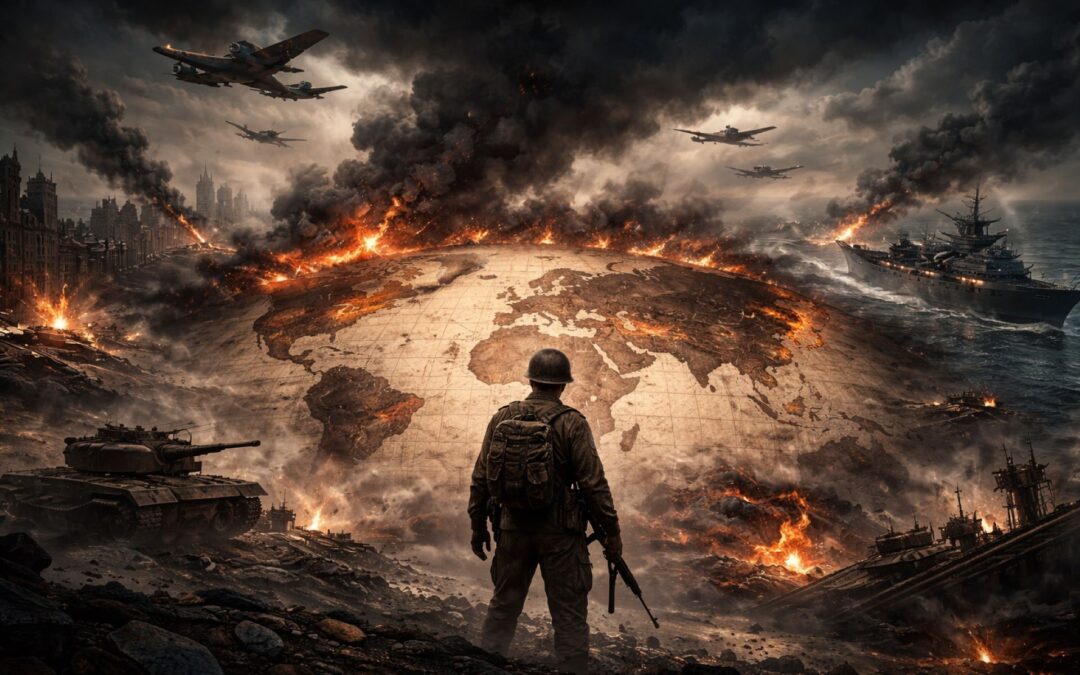
Introduction: The War That Reshaped the Modern World
The Second World War was the most destructive conflict in human history. Between 1939 and 1945, dozens of nations became entangled in a struggle that spanned continents, oceans, and entire societies. It was not merely a war between armies but a total war that mobilized entire populations, reshaped global economies, and redrew the political map of the world.
What began as a European conflict triggered by Germany’s invasion of Poland quickly expanded into a truly global war. Within a few short years, fighting erupted across Europe, North Africa, the Middle East, and Asia. Major powers including Germany, Italy, Japan, Britain, the Soviet Union, and eventually the United States committed massive military forces to a struggle that would determine the balance of power for the remainder of the twentieth century.
The roots of this conflict lay in the unstable aftermath of the First World War. The Treaty of Versailles had imposed harsh penalties on Germany, fueling resentment and political instability. Across Europe, economic crises and weak democratic governments created fertile ground for radical ideologies. In Italy, Benito Mussolini pioneered fascism—a political movement built around authoritarian leadership, nationalism, and militarism. In Germany, Adolf Hitler harnessed anger over national humiliation and economic collapse to build the Nazi regime.
At the same time, Japan was pursuing its own path of imperial expansion in East Asia. Driven by resource shortages and a growing belief in its regional dominance, the Japanese military sought to establish control over large parts of China and Southeast Asia.
By the late 1930s, these aggressive powers shared a common vision: territorial expansion, military dominance, and the overturning of the international order established after the First World War. Their ambitions would soon collide with the interests of Britain, France, the Soviet Union, and the United States, setting the stage for a conflict on an unprecedented scale.
The war that followed unfolded in dramatic phases. Rapid German victories shattered much of Europe. Britain fought alone against overwhelming odds. The conflict expanded globally with the invasion of the Soviet Union and the Japanese attack on Pearl Harbor. Eventually, the tide turned through a series of decisive battles that began to push the Axis powers back.
By the time the war ended in 1945, entire cities had been destroyed, tens of millions of people had died, and the global balance of power had fundamentally shifted. The aftermath of the conflict gave rise to new superpowers, new alliances, and a tense geopolitical rivalry that would dominate the second half of the twentieth century.
Understanding the Second World War is essential not only because of its scale and devastation, but because it shaped the modern world in profound ways—from international institutions and military alliances to the very structure of global politics.
The Rise of Fascism and the Collapse of the Post-World War I Order
The roots of the Second World War can be traced to the political and economic turmoil that followed the First World War. The treaties that ended that conflict were intended to create stability in Europe, but instead they produced deep resentment, economic disruption, and fragile political systems. Across the continent, democratic governments struggled to maintain control while populations faced unemployment, inflation, and social unrest.
In this unstable environment, new political movements emerged that rejected liberal democracy and promised national revival through authoritarian leadership and military strength. Among these movements, fascism would become the most influential and dangerous.
Mussolini and the Birth of Fascism in Italy
Italy emerged from the First World War on the winning side, yet many Italians believed their country had been cheated out of the territorial gains they had been promised. The postwar economy was weak, unemployment was widespread, and political coalitions proved unable to provide stability.
Amid this frustration, Benito Mussolini rose to prominence. Initially a socialist journalist and activist, Mussolini gradually abandoned socialist ideology and developed a new political vision centered on nationalism, authoritarian leadership, and the restoration of Italian power. He argued that Italy needed unity and strength rather than political division, promising to revive the glory of the Roman Empire and transform the country into a dominant Mediterranean power.
Mussolini organized paramilitary groups known as Blackshirts, who used violence and intimidation against political opponents. As political instability worsened, Mussolini leveraged the threat of mass mobilization to pressure the Italian monarchy. In 1922 he carried out the “March on Rome,” forcing King Victor Emmanuel III to appoint him prime minister.
Once in power, Mussolini dismantled democratic institutions and established a dictatorship. Political opposition was suppressed, the press was tightly controlled, and the state increasingly directed economic and social life. Italy had become Europe’s first fascist state.
Hitler’s Rise and the Collapse of the Weimar Republic
Germany faced an even more severe crisis after the First World War. The Treaty of Versailles imposed heavy reparations, territorial losses, and strict military limitations. Many Germans viewed the treaty as a national humiliation imposed by victorious powers.
During the 1920s, the democratic Weimar Republic struggled to maintain stability. Economic disasters such as hyperinflation and later the global Great Depression shattered public confidence in democratic institutions. Millions of Germans lost their jobs, savings, and hope for economic recovery.
Adolf Hitler emerged as a powerful political figure during this period of crisis. A former soldier in the First World War, he was deeply embittered by Germany’s defeat and obsessed with restoring the nation’s power. Through the National Socialist German Workers’ Party—commonly known as the Nazi Party—Hitler promoted an ideology combining extreme nationalism, militarism, anti-communism, and virulent racial hatred.
After a failed coup attempt in 1923, Hitler shifted strategy and sought power through political means. Over the next decade the Nazi Party expanded rapidly, exploiting economic despair and nationalist anger. By 1933 Hitler had gained enough political support to be appointed Chancellor of Germany.
Once in office, he quickly dismantled democratic institutions and consolidated power. Political parties were banned, dissent was suppressed, and the state became a totalitarian dictatorship centered entirely on Hitler’s authority. Germany had become Europe’s second major fascist regime.
Japanese Militarism and Imperial Expansion
While fascism was reshaping Europe, Japan was following its own path toward militarism and expansion. For centuries Japan had been relatively isolated, but in the late nineteenth and early twentieth centuries it rapidly modernized and emerged as a major industrial and military power.
Despite its growing strength, Japan faced significant challenges. The country possessed limited natural resources and depended heavily on imported raw materials to sustain its industrial economy. Many Japanese leaders believed that securing access to resources required territorial expansion across East Asia.
During the early twentieth century Japan fought wars against both China and Russia, gaining influence over Korea and parts of northeastern China. By the 1930s, the Japanese military had become increasingly dominant in politics. Civilian governments struggled to control the armed forces, and expansionist policies gained strong support among military leaders.
Japan invaded Manchuria in 1931 and later launched a full-scale invasion of China in 1937. These campaigns were marked by extreme brutality and widespread atrocities against civilian populations. The conflict in China became one of the earliest major theaters of the coming global war.
The Emergence of Aggressive Expansionist Powers
By the late 1930s, three powerful states—Germany, Italy, and Japan—shared several key characteristics. Each was governed by authoritarian regimes that rejected democratic governance and embraced militarism. Each believed its nation had been treated unfairly by the international system. And each pursued territorial expansion as a solution to economic, political, and ideological ambitions.
These regimes increasingly cooperated with one another, forming diplomatic and military partnerships that would later evolve into the Axis alliance. At the same time, the democratic powers of Europe—particularly Britain and France—struggled to respond effectively to the growing threat.
The stage was now set for a new and far more devastating conflict. Europe’s fragile peace was about to be tested by the ambitions of leaders determined to reshape the world order by force.
The Fragile Peace of the 1930s and the Failure of Appeasement
During the 1930s, Europe existed in a tense and unstable peace. The First World War had ended only two decades earlier, and the memory of its devastation still weighed heavily on political leaders and ordinary citizens alike. Governments across Europe were determined to avoid another catastrophic conflict at almost any cost.
At the same time, aggressive regimes in Germany, Italy, and Japan were steadily challenging the international order created after the First World War. Instead of confronting these challenges directly, many Western leaders attempted to preserve peace through diplomacy and compromise. This strategy became known as appeasement—the belief that granting limited concessions to aggressive powers might prevent a larger war.
In practice, however, appeasement encouraged further expansion by demonstrating that the international community was unwilling to take decisive action.
The Treaty of Versailles and German Resentment
The Treaty of Versailles had placed strict limitations on Germany following its defeat in the First World War. Germany lost significant territory, including land to Poland and France. The Rhineland region was demilitarized, preventing Germany from stationing troops along its western border. The German military was reduced to a small army of 100,000 men, and the country was prohibited from possessing tanks, heavy artillery, or an air force.
Perhaps most controversial of all were the massive financial reparations Germany was required to pay to the Allied powers. These payments placed enormous strain on the German economy and became a powerful symbol of national humiliation.
Adolf Hitler built much of his political movement around the promise of reversing these restrictions. He argued that Germany had been unjustly punished and that restoring the nation’s strength required rejecting the treaty entirely.
Once in power, Hitler began systematically dismantling the treaty’s provisions. Germany secretly rebuilt its military forces, introduced conscription, and established a modern air force known as the Luftwaffe. In 1936, German troops marched into the Rhineland in direct violation of the treaty.
This move carried significant risk. Hitler had ordered his forces to withdraw immediately if France responded militarily. Yet no action came. Britain and France, wary of provoking another war, chose to protest diplomatically rather than intervene.
The success of this gamble emboldened Hitler and convinced him that the Western powers lacked the will to stop German expansion.
Hitler’s Early Territorial Expansion
With Germany’s military power growing, Hitler began pursuing the next phase of his ambitions: territorial expansion. His ideological goal was to create Lebensraum, or “living space,” for the German people. This involved expanding Germany’s borders and bringing ethnic Germans living in neighboring countries under Nazi control.
The first major step occurred in 1938 with the annexation of Austria. German troops entered the country and incorporated it into the German Reich in an event known as the Anschluss. The takeover occurred without significant resistance, and once again the Western powers took no military action.
Encouraged by this success, Hitler turned his attention to Czechoslovakia. In particular, he demanded control of the Sudetenland, a region populated largely by ethnic Germans. Tensions escalated rapidly as Germany threatened military action if its demands were not met.
The Munich Agreement and the Illusion of Peace
In September 1938, Britain, France, Germany, and Italy met in Munich to negotiate a solution to the crisis. Notably absent from the negotiations was Czechoslovakia itself—the country whose territory was being discussed.
British Prime Minister Neville Chamberlain and French leaders believed that conceding the Sudetenland might satisfy Hitler’s ambitions and preserve peace in Europe. The resulting Munich Agreement allowed Germany to annex the territory in exchange for Hitler’s promise that he would make no further territorial demands.
Chamberlain returned to Britain declaring that the agreement had secured “peace for our time.” Many Europeans hoped the crisis had been resolved without war.
Those hopes proved short-lived. In March 1939, Hitler violated the agreement and ordered the complete occupation of Czechoslovakia. It was now unmistakably clear that German expansion would not stop voluntarily.
The illusion that appeasement could preserve peace had collapsed.
Europe Moves Toward War
By the end of the 1930s, Germany had dramatically increased its military strength and expanded its territory without facing meaningful resistance. At the same time, Italy and Japan were continuing their own aggressive campaigns abroad.
Britain and France began to realize that war might be unavoidable. They offered security guarantees to several Eastern European nations, including Poland, warning Germany that further aggression would trigger a military response.
Hitler, however, believed that his opponents remained weak and indecisive. Confident in Germany’s military power and emboldened by years of successful expansion, he prepared to take the next step.
The target was Poland.
When German forces crossed the Polish border in September 1939, the fragile peace of Europe finally collapsed, and the Second World War began.
The Invasion of Poland and the Beginning of World War II
By the late 1930s, Adolf Hitler had already reshaped the political landscape of Europe through a series of aggressive territorial moves. Germany had rearmed, reoccupied the Rhineland, annexed Austria, and absorbed Czechoslovakia. Each step had strengthened the Nazi regime and exposed the unwillingness of Britain and France to confront Germany directly.
The next target of German expansion was Poland.
Strategic Importance of Poland
Poland’s geographic position made it central to Hitler’s plans. The country separated mainland Germany from the German territory of East Prussia, creating a strategic division within the German state. The city of Danzig, located along the Baltic coast, had a largely German population but was governed as a semi-independent city under the terms of the Treaty of Versailles.
Hitler demanded that Poland allow Germany to annex Danzig and construct a transportation corridor across Polish territory to reconnect East Prussia with Germany. Accepting these demands would have severely weakened Polish sovereignty and placed the country under significant German influence.
Polish leaders refused.
Unlike previous targets of German expansion, Poland had secured diplomatic guarantees from Britain and France. Both nations had pledged to defend Poland if Germany attempted military aggression. For the first time in Hitler’s expansionist campaign, a direct invasion risked triggering a wider European war.
The Nazi–Soviet Pact
Despite these risks, Hitler was determined to move forward. His greatest concern was avoiding a repeat of Germany’s First World War experience—fighting a major war on two fronts simultaneously.
To prevent this scenario, Germany pursued an unexpected diplomatic agreement with the Soviet Union. In August 1939, the two countries signed a non-aggression treaty that stunned the international community. The pact promised that Germany and the Soviet Union would not attack one another.
Hidden within the agreement, however, was a secret arrangement that divided Eastern Europe into spheres of influence. Germany and the Soviet Union agreed that Poland would be partitioned between them if war broke out.
With the Soviet Union temporarily neutralized, Hitler removed the last major obstacle to invading Poland.
Germany Launches the Attack
On September 1, 1939, German forces crossed the Polish border. The invasion was conducted with overwhelming speed and coordination. German military strategy emphasized rapid advances supported by tanks, aircraft, and mechanized infantry.
This method of warfare—later known as Blitzkrieg, or “lightning war”—allowed German forces to break through defensive lines quickly and surround enemy units before they could reorganize. Air strikes disrupted communications, destroyed infrastructure, and weakened Polish resistance.
Although Polish troops fought with determination, they were outmatched by Germany’s modernized and highly coordinated military forces.
Britain and France Declare War
Two days after the invasion began, Britain and France issued ultimatums demanding that Germany withdraw its forces from Poland. When Germany ignored these demands, both countries declared war on September 3, 1939.
The Second World War had officially begun.
However, the declarations of war did not immediately lead to major combat between Germany and the Western Allies. Britain and France began mobilizing their armies and preparing defensive positions, but they did not launch a major offensive against Germany.
Poland’s Defeat
Poland’s position became even more dire when the Soviet Union invaded from the east on September 17, fulfilling the secret terms of its agreement with Germany. With two powerful armies advancing from opposite directions, the Polish military faced overwhelming pressure.
Within weeks, Polish resistance collapsed. Warsaw fell after heavy bombardment, and the country was divided between Germany and the Soviet Union.
The fall of Poland marked the official beginning of the Second World War. Yet despite the dramatic invasion and the declarations of war by Britain and France, the large-scale battles that many expected in Western Europe did not immediately occur.
Instead, the conflict entered a strange and uneasy phase of waiting—one that would soon give way to some of the most rapid and devastating military campaigns in modern history.
The Phony War and the Strategic Miscalculations of the Allies
After the invasion of Poland in September 1939, Europe officially found itself at war. Britain and France had declared war on Germany, and millions of soldiers were mobilized across the continent. Yet in the months that followed, the large-scale fighting many expected in Western Europe failed to materialize.
This strange and uneasy period became known as the Phony War. Despite the formal state of war, the Western Front remained largely quiet while both sides prepared for the next phase of the conflict.
Defensive Strategies and Cautious Leadership
The experience of the First World War deeply influenced Allied strategy. The devastating trench warfare of 1914–1918 had caused enormous casualties with very little territorial change. Determined to avoid repeating that disaster, both Britain and France adopted cautious and defensive military strategies.
France in particular relied heavily on the Maginot Line, a vast system of fortifications constructed along its border with Germany. These defenses included bunkers, artillery emplacements, underground railways, and reinforced defensive structures designed to stop any German invasion.
French leaders believed that if Germany attacked, the Maginot Line would slow the advance long enough for Allied forces to mobilize and counterattack. However, the defensive line did not extend all the way to the English Channel, leaving the heavily forested Ardennes region less protected.
Meanwhile, Britain sent the British Expeditionary Force (BEF) to France to support the Allied defensive position. While the British troops were well trained and equipped, the force initially consisted of only a few hundred thousand soldiers—far fewer than the massive armies mobilized by the continental powers.
Limited Allied Offensive Actions
Although Britain and France had declared war on Germany, they launched very little offensive action during this period. The French army conducted a small advance into Germany’s Saar region, but the operation was limited and quickly abandoned. The Allied leadership remained hesitant to provoke a large-scale confrontation.
Instead, both sides engaged primarily in preparations and limited operations. Aircraft from the Royal Air Force even dropped propaganda leaflets over German cities rather than conducting bombing raids. These actions had little strategic effect and reflected the continued reluctance to escalate the conflict.
This cautious approach allowed Germany valuable time to prepare for its next major campaign.
The Northern Strategy and the Norwegian Campaign
While the Western Front remained quiet, attention briefly shifted northward to Scandinavia. Neutral Sweden was exporting large quantities of iron ore to Germany, a resource that was essential for German steel production and military manufacturing. Much of this ore was transported through ports in neutral Norway.
Allied leaders recognized that cutting off this supply could weaken Germany’s war effort. Plans were considered to land troops in Norway and move them through Sweden to secure the iron fields.
However, Norway and Sweden both refused to allow Allied forces to enter their territory.
Germany soon recognized the strategic importance of Scandinavia as well. In April 1940, German forces launched a rapid invasion of Denmark and Norway. Denmark fell almost immediately, while Norway became the site of a more extended campaign.
Although British and French forces attempted to intervene, Germany quickly secured control of key Norwegian ports and airfields. German air superiority made it difficult for Allied troops to maintain their positions, and eventually the Allied forces were forced to withdraw.
The failure of the Norwegian campaign was a major embarrassment for the Allied governments and exposed weaknesses in their strategic planning.
A War About to Explode
The months of the Phony War created an illusion that the conflict might remain limited or slow-moving. In reality, Germany was preparing a massive offensive against Western Europe.
During this time, Hitler reorganized and strengthened his military forces, developing plans for a lightning-fast invasion that would bypass the heavily fortified French defenses.
When Germany finally launched its attack in the spring of 1940, the quiet stalemate of the Phony War would end abruptly. Within weeks, the balance of power in Europe would be dramatically transformed.
Blitzkrieg and the Fall of Western Europe
In the spring of 1940, the quiet stalemate of the Phony War ended suddenly. Germany launched a massive offensive against Western Europe that would unfold with shocking speed. Within weeks, the German military dismantled the defensive strategies of the Allied powers and brought much of Western Europe under Nazi control.
The campaign demonstrated the devastating effectiveness of Germany’s new military doctrine: Blitzkrieg, or “lightning war.” By coordinating armored divisions, mechanized infantry, and close air support, German forces could move rapidly through enemy defenses, isolate opposing armies, and collapse entire fronts before defenders had time to respond.
What followed was one of the most dramatic military campaigns of the twentieth century.
The German Invasion Through the Ardennes
In May 1940, German forces launched simultaneous invasions of Belgium, the Netherlands, and Luxembourg. This initial move appeared to confirm Allied expectations that Germany would repeat the strategy used during the First World War—advancing through Belgium to bypass the heavily fortified Franco-German border.
As a result, the main Allied armies rushed north into Belgium to meet the German advance.
However, this was only part of Germany’s plan.
The main German armored thrust moved through the Ardennes, a heavily forested region along the French border that Allied commanders believed was difficult for large armies to cross. Because of this assumption, the area had been left relatively lightly defended.
German commanders concentrated large numbers of armored divisions and forced them through the Ardennes with remarkable speed. Once they emerged from the forest, the German forces drove rapidly west toward the English Channel.
This maneuver split the Allied armies in two and trapped the main British and French forces in northern France and Belgium.
Dunkirk and the Escape of the Allied Armies
As German armored units advanced toward the coast, hundreds of thousands of Allied troops were encircled. The German advance threatened to destroy the British Expeditionary Force and a large portion of the French army.
With few options remaining, the Allies organized a massive evacuation from the French port of Dunkirk.
In one of the most dramatic episodes of the war, hundreds of military vessels and civilian boats crossed the English Channel to rescue the trapped soldiers. Fishing boats, ferries, and small private vessels joined naval ships in transporting troops from the beaches back to Britain.
Over several days in late May and early June 1940, approximately 330,000 Allied soldiers were evacuated. Although most heavy equipment had to be abandoned, the survival of these troops allowed Britain to continue the fight.
The evacuation at Dunkirk became a powerful symbol of resilience and determination in the face of disaster.
The Collapse of France
While the evacuation was underway, German forces continued advancing deeper into France. The rapid German breakthroughs had already shattered much of the French defensive system, and the loss of large numbers of troops in the north weakened France’s ability to mount an effective defense.
German armies pushed southward, capturing Paris in June 1940. With the capital fallen and military resistance collapsing, the French government sought an armistice.
France was divided into two zones. Germany occupied the northern and western regions, including the Atlantic coastline. The southern part of the country remained nominally independent under a government based in the city of Vichy, though it effectively operated under German influence.
In a matter of weeks, one of Europe’s most powerful nations had been defeated.
A New Balance of Power in Europe
Germany’s victory in Western Europe fundamentally changed the strategic situation of the war. The Netherlands, Belgium, Denmark, and Norway had fallen. France was defeated. Much of the continent was now either occupied by Germany or aligned with it.
Only one major power in Western Europe remained unconquered: Great Britain.
Hitler hoped that the collapse of France would convince Britain to seek peace. Instead, the British government under Prime Minister Winston Churchill resolved to continue the war.
For Germany to defeat Britain, however, it would first have to control the skies above the English Channel. The next phase of the war would unfold not on land, but in the air—during a battle that would determine whether Britain survived or fell under Nazi domination.
Britain Stands Alone: The Battle of Britain and the Survival of the United Kingdom
By the summer of 1940, the strategic situation in Europe had changed dramatically. Germany had defeated Poland, conquered Denmark and Norway, and overrun the Netherlands, Belgium, and France with astonishing speed. Much of continental Europe now lay under Nazi control or influence. Only one major power remained actively resisting Hitler in Western Europe: Great Britain.
For Adolf Hitler, defeating Britain was the logical next step in securing German dominance over the continent. As long as Britain remained in the war, it could continue to blockade Germany at sea, support resistance movements across Europe, and potentially serve as a base for future Allied offensives. Hitler initially hoped that the fall of France would persuade the British government to seek peace. Instead, the new British Prime Minister, Winston Churchill, made it clear that Britain would continue the fight regardless of the odds.
If Germany wanted to eliminate Britain as a threat, it would have to invade the British Isles. The planned invasion was known as Operation Sea Lion. However, carrying out such an operation posed enormous challenges. German troops would have to cross the English Channel while facing the powerful Royal Navy and British coastal defenses. For the invasion to succeed, Germany first needed to control the airspace above southern England and the Channel.
This requirement led to one of the most decisive air campaigns in history: the Battle of Britain.
The German air force, the Luftwaffe, began a large-scale campaign designed to weaken Britain’s defenses and force the country into submission. Initial attacks targeted shipping in the English Channel, coastal installations, and radar stations that were part of Britain’s early warning system. These radar stations were crucial because they allowed the Royal Air Force to detect incoming aircraft and organize defensive responses quickly.
Despite being outnumbered, the RAF possessed several advantages. Britain’s radar network allowed British commanders to direct fighter squadrons precisely where they were needed, preventing unnecessary patrols and conserving limited resources. British pilots flying aircraft such as the Spitfire and Hurricane engaged German bombers and fighters in intense aerial battles across southern England.
As the campaign intensified, the Luftwaffe shifted its focus toward RAF airfields and aircraft production facilities. Destroying these bases would have crippled Britain’s ability to defend its airspace and potentially opened the door for a German invasion. For a period, the pressure on British defenses became severe. Airfields were heavily bombed, aircraft were destroyed on the ground, and RAF pilots were forced to fly multiple missions each day.
At this critical moment, a small British bombing raid over Berlin provoked an emotional reaction from Hitler. Although the raid caused limited damage, it angered the German leadership and led to a strategic shift. Instead of continuing to focus on RAF infrastructure, the Luftwaffe redirected its attacks toward British cities, particularly London.
The bombing campaign against urban centers became known as the Blitz. Night after night, German aircraft attacked London and other major cities, targeting industrial facilities, transportation networks, and civilian neighborhoods. Air raid sirens became part of daily life. Millions of civilians took shelter in underground stations and reinforced shelters while bombs fell across the city.
Despite the destruction and the heavy civilian casualties, British morale remained remarkably strong. The government organized evacuations of children from major cities to rural areas, and the population adapted to life under constant threat of air raids.
Crucially, the shift in German strategy gave the RAF time to recover. Airfields were repaired, aircraft production continued, and fighter squadrons reorganized. When the Luftwaffe launched large-scale daylight attacks against London and other targets, British fighters were able to intercept them effectively.
Over time, German aircraft losses mounted while Britain continued to maintain a functioning air defense network. The Luftwaffe failed to destroy the RAF or gain the air superiority required for a cross-channel invasion.
Without control of the skies, Operation Sea Lion became impossible to execute. Germany indefinitely postponed its plans to invade Britain.
The outcome of the Battle of Britain represented the first major setback for Nazi Germany during the war. For the first time since the conflict began, Hitler’s expansion had been halted. Britain remained in the war, providing a critical base for Allied resistance and future offensives.
The survival of Britain ensured that the conflict would continue—and that the struggle against the Axis powers was far from over.
The War Expands: Axis Alliances and the Globalization of the Conflict
As the conflict in Europe intensified after the fall of France and the Battle of Britain, the war increasingly expanded beyond its original boundaries. What had begun as a regional European conflict gradually transformed into a global struggle involving multiple continents, empires, and alliances. The alignment of Germany, Italy, and Japan formalized the structure of the Axis powers, while fighting spread across the Mediterranean, North Africa, and southeastern Europe.
The Tripartite Pact
In September 1940, Germany, Italy, and Japan formally aligned their strategic interests through the Tripartite Pact. This agreement created a defensive alliance between the three powers and defined the structure of what would become known as the Axis coalition.
Under the terms of the pact, each nation recognized the others’ spheres of influence. Germany and Italy would dominate Europe and the Mediterranean region, while Japan would lead expansion in East Asia and the Pacific. The pact also carried an important warning to other global powers: any nation that joined the war against one of the Axis powers risked facing the combined opposition of all three.
Although the alliance did not immediately coordinate military operations across continents, it strengthened diplomatic and strategic cooperation among the Axis states. The agreement also served as a signal aimed particularly at the United States, discouraging American entry into the war by threatening a broader conflict.
The Mediterranean and North African Campaigns
The Mediterranean region soon became a major theater of war as Italy attempted to expand its influence. Mussolini, eager to match Germany’s successes, launched a series of military campaigns intended to establish Italian dominance across the region.
Italian forces initially moved against British territories in East Africa and the Mediterranean. Some early operations achieved limited success, but many of Italy’s campaigns quickly ran into difficulties. Attempts to advance into Egypt from Italian-controlled Libya stalled against British resistance, while other operations revealed weaknesses in Italian planning, logistics, and military coordination.
In response to these setbacks, Germany intervened to support its ally. German forces under General Erwin Rommel were sent to North Africa, where they became known as the Afrika Korps. These units helped stabilize the Axis position and turned the North African theater into a prolonged and strategically important campaign.
Control of North Africa carried significant implications. The region provided access to key shipping routes through the Mediterranean and offered potential pathways toward the Middle East and its vital oil resources. As a result, the fighting there became a crucial struggle between Axis and Allied forces.
Conflict in the Balkans
At the same time, southeastern Europe became another focal point of Axis expansion. Germany sought to secure its southern flank and ensure stability in the Balkans before launching further campaigns elsewhere.
Several countries in the region were pressured to align themselves with the Axis alliance. Hungary and Romania eventually joined the Axis powers, motivated partly by territorial ambitions and concerns about Soviet influence. Their cooperation provided Germany with additional strategic depth and resources.
Other nations resisted German pressure. Political instability and shifting alliances created uncertainty throughout the region, prompting Germany to intervene directly. German forces launched rapid military campaigns that brought additional Balkan territories under Axis control and secured the region as a strategic base for future operations.
The consolidation of Axis influence across the Balkans, combined with the expansion of fighting in North Africa and the strengthening alliance between Germany, Italy, and Japan, demonstrated that the war was no longer confined to a single region.
By the early 1940s, the conflict had become a truly global struggle. Multiple theaters of war were emerging, and the decisions made in Europe increasingly affected events across Africa, Asia, and beyond. The stage was now set for one of the most significant turning points of the entire war: Germany’s massive invasion of the Soviet Union.
Operation Barbarossa: Hitler’s Invasion of the Soviet Union
By 1941, Adolf Hitler had achieved remarkable success in Western Europe. France had fallen, Britain had survived but remained isolated, and much of continental Europe lay under German control or influence. Yet for Hitler, these victories were only a prelude to the war he had always intended to fight.
From the beginning, Nazi ideology had viewed the Soviet Union as both a political and racial enemy. Hitler believed that Germany needed vast amounts of Lebensraum, or living space, which he intended to carve out of Eastern Europe and Soviet territory. At the same time, the Nazi regime viewed communism and the Soviet state as ideological threats that had to be destroyed.
Despite the earlier non-aggression pact between Germany and the Soviet Union, Hitler never intended the agreement to last. It served only as a temporary measure to avoid fighting a two-front war while Germany defeated its enemies in the west. Once Western Europe had been subdued, Hitler turned his attention eastward.
In June 1941, Germany launched Operation Barbarossa, the largest land invasion in human history.
More than three million German soldiers, supported by thousands of tanks, aircraft, and artillery pieces, crossed the Soviet border along a massive front stretching from the Baltic Sea in the north to the Black Sea in the south. The scale of the invasion was staggering, involving not only German forces but also troops from several Axis-aligned nations.
The initial stages of the invasion were devastating for the Soviet Union. German forces advanced rapidly using the same fast-moving tactics that had brought victory in Western Europe. Massive encirclement operations trapped large Soviet armies, capturing hundreds of thousands of soldiers at a time. Entire Soviet formations were surrounded and destroyed in a matter of weeks.
Cities such as Minsk and Smolensk fell during the early stages of the campaign, and German forces pushed deep into Soviet territory. The German advance also placed the city of Leningrad under siege, cutting it off from the outside world and beginning a brutal blockade that would last for years.
Despite these dramatic successes, the invasion faced a critical challenge: the Soviet Union was vast, and its ability to absorb losses and continue fighting proved greater than German planners had anticipated.
Soviet forces suffered enormous casualties in the early months of the invasion, but they continued to resist fiercely. As the German armies advanced, Soviet leadership relocated factories and industrial infrastructure eastward, beyond the reach of the advancing front. These factories would eventually supply the Soviet war effort with enormous quantities of tanks, aircraft, and weapons.
By the autumn of 1941, German forces were approaching Moscow itself. Many believed that the fall of the Soviet capital would effectively end organized resistance. Yet the German advance began to slow as supply lines stretched across vast distances and Soviet resistance stiffened.
Then winter arrived.
The German army had not been properly equipped for a prolonged winter campaign. Hitler had expected the Soviet Union to collapse before the onset of cold weather. Instead, German soldiers found themselves fighting in freezing temperatures without adequate winter clothing or supplies. Equipment malfunctioned in the cold, and vehicles struggled to operate in the harsh conditions.
Meanwhile, the Soviet Union deployed fresh troops from Siberia—soldiers trained and equipped for winter warfare. These forces launched counterattacks against the exhausted German armies outside Moscow.
The German advance stalled and was eventually pushed back.
Although Germany still controlled enormous areas of Soviet territory, Operation Barbarossa had failed to achieve its most important objective: a quick and decisive victory. Instead of ending the war in the east, the invasion opened a massive new front that would consume enormous resources and manpower for the remainder of the conflict.
The war had now reached an unprecedented scale. Germany was fighting simultaneously against Britain in the west and the Soviet Union in the east. Soon, another major power would be drawn into the conflict, transforming the war into a truly global struggle.
The War Becomes Truly Global: Pearl Harbor and the Entry of the United States
By 1941, the Second World War was already raging across Europe, North Africa, and large parts of Asia. Germany had invaded the Soviet Union, Britain continued to resist in Europe and across its empire, and Japan had been fighting a brutal war in China for several years. Despite the scale of the conflict, one of the world’s most powerful nations—the United States—had not yet formally entered the war.
American public opinion in the early years of the conflict was strongly influenced by isolationism. Many Americans believed the United States should avoid involvement in another European war after the heavy losses suffered during the First World War. Political leaders were cautious about committing American troops overseas, and maintaining neutrality remained an important domestic priority.
Nevertheless, the United States was increasingly drawn into the conflict indirectly. President Franklin D. Roosevelt recognized that a German victory in Europe would threaten global stability and potentially American security. As a result, the United States began supplying Britain and other Allied nations with food, weapons, and industrial resources through programs such as Lend-Lease. While this support strengthened the Allied war effort, the United States still remained officially neutral.
Meanwhile, Japan was pursuing its own strategy of expansion across East Asia and the Pacific. The Japanese leadership believed that controlling resource-rich territories in Southeast Asia was essential for sustaining Japan’s industrial and military growth. However, many of these territories were controlled by European colonial powers such as Britain and the Netherlands, as well as by the United States.
Japan faced a major strategic obstacle: the powerful American Pacific Fleet based at Pearl Harbor in Hawaii. Japanese planners feared that if Japan expanded into Southeast Asia, the United States would intervene militarily and threaten Japanese operations across the Pacific.
To eliminate this threat, Japanese leaders devised a bold and risky plan. Instead of waiting for war to begin, they would launch a surprise attack designed to cripple the American fleet before it could respond.
On the morning of December 7, 1941, Japanese aircraft launched a sudden assault on the U.S. naval base at Pearl Harbor. Waves of bombers and torpedo planes struck battleships, airfields, and other military installations. The attack caused severe damage, sinking or disabling several American battleships and destroying large numbers of aircraft.
Although the attack achieved tactical surprise, it failed to eliminate several key American assets. The U.S. aircraft carriers were not present in the harbor at the time of the attack, and vital infrastructure such as fuel storage facilities and submarine bases remained intact.
The political impact of the attack, however, was immediate and decisive.
The following day, the United States declared war on Japan. Shortly afterward, Germany and Italy declared war on the United States in support of their Japanese ally. With these declarations, the United States formally entered the Second World War.
The entry of the United States transformed the conflict. America possessed enormous industrial capacity, vast natural resources, and the ability to mobilize millions of soldiers. Its participation strengthened the Allied coalition and shifted the long-term balance of power.
At the same time, Japan launched a sweeping campaign across the Pacific and Southeast Asia. Japanese forces captured numerous territories, including Hong Kong, the Philippines, Malaya, Singapore, and large parts of the Dutch East Indies. These rapid conquests gave Japan control of strategic resources and extended its empire across a vast region.
The war had now reached every major theater of the globe. Europe, Africa, Asia, and the Pacific were all engulfed in fighting, and the major powers of the world were fully engaged.
The conflict had become truly global.
Axis Expansion and the Height of Axis Power
In the early years of the war, the Axis powers appeared nearly unstoppable. Germany dominated much of Europe, Japan expanded rapidly across the Pacific and Southeast Asia, and Axis forces fought Allied armies across North Africa and the Mediterranean. By 1942, the Axis alliance controlled vast territories and commanded enormous military resources, giving the impression that victory might ultimately belong to them.
Germany’s invasion of the Soviet Union initially produced staggering results. German forces captured hundreds of thousands of Soviet soldiers in massive encirclement operations and advanced deep into Soviet territory. Major cities fell or came under siege, including Leningrad, which endured one of the longest and most brutal blockades in modern history. German armies also pushed southward toward the Caucasus region, hoping to capture vital oil fields that would strengthen the German war effort.
Across Europe, Nazi rule expanded over occupied territories. Many countries fell under direct German occupation, while others were governed by regimes aligned with or dependent on Berlin. Resistance movements began forming in several regions, but in the early stages of the war, German power across the continent appeared overwhelming.
At the same time, Japan achieved dramatic military successes in the Pacific. Following the attack on Pearl Harbor, Japanese forces launched coordinated offensives across the region. Within months they captured a vast chain of territories stretching from the western Pacific to Southeast Asia.
Japan seized strategic locations including Hong Kong, the Philippines, Singapore, the Dutch East Indies, and numerous island groups throughout the Pacific Ocean. These victories gave Japan control of valuable natural resources, including oil, rubber, and minerals that were essential for sustaining its military operations.
The speed of Japan’s conquests reinforced the belief among Japanese leaders that their empire was destined to dominate East Asia. Their early strategy relied on rapid offensives that overwhelmed opponents before they could mobilize effectively.
Meanwhile, fighting in North Africa continued as Axis and Allied forces struggled for control of the region. German and Italian troops fought British and Commonwealth forces across the deserts of Libya and Egypt. These battles often involved rapid advances and retreats across enormous distances, as each side attempted to gain control of strategic positions along the Mediterranean.
At the same time, Axis forces secured much of southeastern Europe, strengthening their strategic position on the continent. Germany’s influence extended across the Balkans, providing additional resources and military support for the broader Axis war effort.
By the middle of the war’s early phase, the Axis powers seemed to have achieved a dominant position. Germany controlled most of Europe, Japan commanded a vast Pacific empire, and Axis armies continued to challenge Allied forces across multiple theaters.
Yet beneath these dramatic successes, serious problems were beginning to emerge. The territories under Axis control were enormous, stretching supply lines and military resources across vast distances. Resistance movements were growing stronger in occupied regions, and the Allies were beginning to reorganize their forces for a sustained counteroffensive.
Within the next few years, a series of crucial battles would begin to reverse the momentum of the war. The period of Axis expansion would give way to the first major turning points of the conflict.
The Turning Points of the War
By 1942, the Axis powers appeared to be at the height of their strength. Germany dominated much of Europe and continued pushing deep into Soviet territory. Japan controlled vast regions across the Pacific and Southeast Asia. Axis forces were still fighting the Allies in North Africa and across multiple fronts.
Yet beneath this apparent dominance, the strategic situation was beginning to shift. A series of decisive battles across different theaters gradually halted Axis expansion and began turning the momentum of the war in favor of the Allies. These battles did not end the war immediately, but they marked the moment when Axis forces began losing the initiative they had held since the early years of the conflict.
Stalingrad and the Collapse of German Momentum
One of the most decisive turning points of the war occurred on the Eastern Front in the Soviet city of Stalingrad. After failing to capture Moscow in 1941, Hitler changed strategy and directed German forces toward the southern Soviet Union. The goal was to capture the oil-rich Caucasus region and weaken the Soviet Union’s ability to sustain its war effort.
As part of this campaign, German forces advanced toward Stalingrad, a major industrial city along the Volga River. The battle that followed became one of the most brutal urban conflicts in history. Fighting raged street by street and building by building as Soviet defenders resisted the German advance.
For months, the city became a battlefield of extreme destruction and hardship. Both sides suffered enormous casualties as they struggled for control of key positions within the ruins.
While German forces focused on capturing the city itself, Soviet commanders prepared a massive counteroffensive. Soviet armies attacked the weaker Axis forces positioned on the flanks of the German Sixth Army. In a maneuver similar to the encirclement tactics Germany had used earlier in the war, Soviet forces surrounded the German army trapped inside Stalingrad.
Cut off from supplies and reinforcements, the German forces inside the city were gradually exhausted. Despite requests from his commanders to retreat, Hitler ordered the army to hold its position. Eventually the encircled forces were forced to surrender.
The defeat at Stalingrad represented a catastrophic loss for Germany. It destroyed one of Germany’s most powerful armies and shattered the image of German invincibility on the Eastern Front. From this point onward, Soviet forces increasingly pushed westward against the German military.
Midway and the Shift in the Pacific War
While the tide was turning in the Soviet Union, another decisive battle occurred in the Pacific. After its rapid early conquests, Japan attempted to eliminate the remaining threat posed by the United States Navy.
In June 1942, Japanese forces planned an attack on the strategic island of Midway, hoping to lure the American fleet into battle and destroy it. However, American intelligence had successfully broken Japanese naval codes and learned of the plan in advance.
As a result, the United States Navy prepared an ambush.
When the Japanese fleet approached Midway, American aircraft launched surprise attacks that struck Japan’s aircraft carriers while their planes were being refueled and rearmed. Within a short period, several of Japan’s most important carriers were destroyed.
The loss of these carriers and their experienced crews dealt a devastating blow to the Japanese navy. The battle at Midway halted Japanese expansion across the Pacific and shifted the naval balance of power in favor of the United States.
From that point forward, American forces would increasingly take the offensive across the Pacific islands.
El Alamein and the End of Axis Ambitions in North Africa
Another crucial turning point occurred in North Africa. Axis forces under General Erwin Rommel had advanced deep into Egypt, threatening the Suez Canal and Britain’s strategic position in the Middle East.
The British army, reinforced with additional troops and equipment, reorganized its defenses near the Egyptian town of El Alamein. In late 1942, British forces launched a major offensive against the Axis armies positioned there.
The battle resulted in a decisive Allied victory. Axis forces were forced to retreat westward across North Africa as Allied armies steadily advanced.
At the same time, American and British troops landed in North Africa from the west during Operation Torch, placing Axis forces in the region under pressure from two directions. Eventually German and Italian forces in North Africa were trapped and forced to surrender.
The loss of North Africa deprived the Axis powers of a major strategic theater and opened the door for Allied operations in southern Europe.
The Momentum Shifts
Taken together, these battles fundamentally changed the direction of the war. Germany had suffered a devastating defeat in the Soviet Union, Japan had lost control of the initiative in the Pacific, and Axis forces had been pushed out of North Africa.
The period of rapid Axis expansion was over. The Allies now possessed growing military strength, increasing industrial production, and expanding cooperation between the United States, Britain, and the Soviet Union.
From this point forward, the Allies would begin launching major offensives designed to reclaim occupied territory and ultimately defeat the Axis powers.
The Allied Counteroffensive Begins
After the turning points at Stalingrad, Midway, and El Alamein, the strategic momentum of the war began shifting steadily toward the Allies. The United States, Britain, and the Soviet Union were now coordinating their efforts more effectively, combining their military strength and industrial capacity to launch a series of offensives designed to roll back Axis control across Europe.
These operations unfolded across multiple fronts. While the Soviet Union pushed German forces westward from the Eastern Front, the Western Allies began attacking Axis positions in southern Europe and intensifying bombing campaigns against Germany itself.
The Invasion of Italy and the Fall of Mussolini
With Axis forces defeated in North Africa, the Allies turned their attention to southern Europe. British Prime Minister Winston Churchill had long argued that attacking through the Mediterranean offered an opportunity to weaken the Axis powers while avoiding the enormous risks of a direct invasion of northern France.
In 1943, Allied forces launched an invasion of Sicily. The operation quickly succeeded, and Allied troops began advancing across the island. The invasion exposed the vulnerability of Italy and undermined confidence in Benito Mussolini’s leadership.
Facing growing public dissatisfaction and military setbacks, Mussolini was removed from power by Italy’s own Fascist Grand Council. The Italian government soon began negotiating with the Allies to withdraw from the war.
However, Germany anticipated this shift. German forces rapidly moved into northern Italy, disarmed Italian troops, and established control over large portions of the country. The Allies continued fighting their way northward through Italy, but difficult terrain and determined German defenses slowed their progress.
Although the Italian campaign did not immediately lead to Germany’s collapse, it forced the Axis powers to divert valuable troops and resources to defend southern Europe.
Strategic Bombing of Germany
While ground battles continued across Europe, the Allies also launched an extensive strategic bombing campaign against Germany. Allied aircraft conducted large-scale bombing raids targeting German industrial centers, transportation networks, and military infrastructure.
These bombing campaigns aimed to weaken Germany’s ability to sustain its war effort by disrupting production of weapons, vehicles, and supplies. Cities such as Hamburg, Berlin, and other industrial hubs were heavily bombed as the Allies attempted to erode German military capacity.
The raids also forced Germany to divert aircraft, anti-aircraft defenses, and resources toward defending its own territory, reducing the strength available for operations on other fronts.
Although strategic bombing alone could not defeat Germany, it played an important role in weakening the Axis war machine.
The Soviet Push Westward
At the same time, the Soviet Union continued its massive counteroffensive on the Eastern Front. Following the victory at Stalingrad, Soviet forces launched a series of large-scale operations that gradually drove German armies westward.
The Soviet military, rebuilt and reinforced by massive industrial production, increasingly gained the upper hand against German forces. Soviet offensives liberated large portions of occupied Soviet territory and pushed toward Eastern Europe.
These advances placed enormous pressure on Germany. Fighting on the Eastern Front consumed vast numbers of German troops and resources, leaving the German military stretched across multiple fronts.
By 1944, the Soviet Union had regained much of the territory lost during the early stages of Operation Barbarossa and was steadily advancing toward the heart of Eastern Europe.
Preparing for the Next Phase
While the Soviets advanced from the east and the Allies pushed through Italy in the south, preparations were underway for a major operation that would open a new front in Western Europe.
Millions of Allied troops were gathering in Britain, supported by massive industrial production and logistical planning. The Allies understood that defeating Germany would ultimately require a direct invasion of German-occupied France.
The stage was being set for one of the most ambitious military operations in history—an invasion that would mark the beginning of the liberation of Western Europe.
D-Day and the Liberation of Western Europe
By 1944, the Allied powers had regained the strategic initiative in the war. Soviet armies were pushing westward on the Eastern Front, Axis forces had been expelled from North Africa, and the Allies had established a foothold in Italy. Yet Nazi Germany still controlled much of Western Europe. To defeat Germany, the Allies needed to open a major front in the west and begin liberating the occupied territories of France and beyond.
Planning for such an operation required immense preparation. Millions of troops, vast quantities of equipment, and a complex logistical system were assembled in Britain. Allied leaders also recognized that success would depend heavily on surprise and deception. German commanders expected that any invasion would likely occur at Pas-de-Calais, the narrowest point of the English Channel, where German defenses were strongest.
To mislead the Germans, the Allies conducted an extensive deception campaign that convinced German intelligence that the invasion would occur at Calais. In reality, the Allied command selected the beaches of Normandy, where German defenses were weaker and the coastline offered better opportunities for landing forces.
The Normandy Landings
On the night of June 5–6, 1944, the long-awaited invasion began. Allied aircraft bombed German defensive positions along the French coast while thousands of paratroopers were dropped behind enemy lines. Their mission was to sabotage German defenses, secure key roads and bridges, and prevent reinforcements from reaching the landing zones.
At dawn on June 6, the largest amphibious invasion in history commenced. Allied naval forces bombarded German coastal fortifications while waves of landing craft carried troops toward five designated beaches along the Normandy coastline.
American forces landed at Utah Beach and Omaha Beach, British forces landed at Gold Beach and Sword Beach, and Canadian troops landed at Juno Beach.
The landings met fierce resistance in several areas, particularly at Omaha Beach, where heavily defended German positions inflicted significant casualties on the attacking forces. Despite the difficulties, Allied troops gradually secured the beachheads and established positions inland.
By the end of the first day, tens of thousands of Allied soldiers had successfully landed in Normandy, marking the beginning of the liberation of Western Europe.
The Collapse of German Forces in France
Following the successful landings, Allied forces began pushing deeper into France. The fighting was intense as German troops attempted to halt the Allied advance. However, the overwhelming scale of the Allied invasion—combined with control of the air and strong logistical support—allowed the Allies to steadily expand their foothold.
The capture of the port city of Cherbourg improved Allied supply lines, enabling additional troops and equipment to flow into France. As the Allied armies advanced, they executed encirclement maneuvers that trapped large German formations.
One of the most significant of these was the destruction of German forces in the Falaise Pocket, where Allied armies from different directions surrounded and crushed a large portion of the German army in France.
With German defenses collapsing, Allied forces advanced rapidly across the country. In August 1944, Paris was liberated, and German troops began retreating toward the borders of Germany.
By the end of the campaign, much of Western Europe had been freed from Nazi occupation. Allied forces continued advancing into Belgium and the Netherlands, bringing the war ever closer to Germany itself.
The successful invasion of Normandy marked a decisive turning point in the European theater. With Allied armies advancing from the west and Soviet forces pushing from the east, Germany now faced the overwhelming pressure of a two-front war that it could no longer sustain.
The Final Collapse of Nazi Germany
By late 1944 and early 1945, Nazi Germany faced an increasingly desperate situation. Allied armies were advancing from the west after the liberation of France, while Soviet forces continued pushing toward Germany from the east. The German military, once capable of launching rapid and devastating offensives across Europe, was now stretched thin, suffering from severe losses in manpower, equipment, and territory.
Despite the worsening situation, Adolf Hitler remained determined to reverse Germany’s fortunes.
In December 1944, Germany launched one last major offensive on the Western Front. The attack was directed through the Ardennes Forest, the same region Germany had used successfully during its invasion of France in 1940. Hitler hoped to split the Allied armies, capture the strategic port of Antwerp, and force the Western Allies to negotiate peace.
The German assault initially achieved surprise. German forces pushed through Allied lines, creating a large bulge in the front—an event that gave the battle its name, the Battle of the Bulge. Some Allied units were surrounded, including American troops defending the Belgian town of Bastogne.
However, the offensive soon ran into serious difficulties. German forces lacked the fuel and supplies needed to sustain a prolonged advance. Allied resistance stiffened, and reinforcements quickly arrived. American forces managed to hold key positions, and counterattacks gradually pushed the German army back.
The failure of the Ardennes offensive exhausted Germany’s remaining reserves. The German military could no longer mount large-scale operations capable of changing the course of the war.
At the same time, Soviet armies were advancing relentlessly from the east. After liberating large areas of Eastern Europe, Soviet forces launched massive offensives that pushed into German territory itself. Cities such as Warsaw fell to the advancing Red Army as German defenses collapsed across the Eastern Front.
By early 1945, the Allies were closing in on Germany from both directions. Western Allied forces crossed the Rhine River and advanced into western Germany, while Soviet forces moved toward Berlin.
Inside Germany, the situation grew increasingly chaotic. Allied bombing campaigns had devastated industrial centers and transportation networks. German cities were heavily damaged, and civilian life had become extremely difficult. Hitler himself had become increasingly isolated, issuing unrealistic orders and refusing to acknowledge the inevitability of defeat.
In April 1945, Soviet troops surrounded Berlin, the capital of Nazi Germany. Fierce fighting broke out as Soviet forces pushed through the city’s defenses. With defeat unavoidable, Hitler remained in his underground bunker beneath the city.
On April 30, 1945, Adolf Hitler committed suicide.
Within days, German resistance collapsed. German military leaders began surrendering their forces to Allied armies across Europe. On May 8, 1945, Germany officially surrendered to the Allied powers, marking the end of the war in Europe.
The defeat of Nazi Germany brought an end to years of devastating conflict across the continent. However, the war itself was not yet over. While Europe celebrated victory, fierce fighting continued in the Pacific as the Allies prepared for the final stage of the conflict against Japan.
The End of the War in the Pacific
While Germany was collapsing in Europe, the war in the Pacific continued with intense and brutal fighting. After the turning points earlier in the war, the United States and its allies had begun steadily pushing Japanese forces back across the vast Pacific Ocean. However, each step toward the Japanese mainland came at an enormous cost.
Island-Hopping Toward Japan
To defeat Japan, the United States adopted a strategy known as island-hopping. Instead of attempting to capture every Japanese-held island, Allied forces focused on seizing strategically important locations while bypassing others. This approach allowed the Allies to establish airfields and naval bases that could support further advances toward Japan.
The campaign required a series of amphibious invasions against heavily defended islands scattered across the Pacific. American forces had to fight their way ashore against determined Japanese defenders who often resisted to the very end.
As the Allies advanced, they gradually moved closer to Japan itself. Meanwhile, General Douglas MacArthur led a campaign to retake the Philippines, fulfilling his earlier promise to return after Japanese forces had captured the islands earlier in the war. These operations weakened Japan’s defensive perimeter and cut off many of its supply routes.
Iwo Jima and Okinawa
Two of the most intense battles of the Pacific War occurred at Iwo Jima and Okinawa, both located close to the Japanese mainland.
The battle for Iwo Jima began in February 1945. The island held strategic value because it could serve as an emergency landing site for American bombers conducting raids against Japan. Japanese defenders had constructed an extensive network of underground tunnels and fortified positions, making the battle extremely difficult.
American forces eventually captured the island after weeks of intense combat, but the victory came with heavy casualties.
The struggle for Okinawa proved even more devastating. Located only a few hundred miles from Japan, Okinawa was considered a critical staging point for any potential invasion of the Japanese home islands. Japanese forces defended the island fiercely, launching massive kamikaze attacks against American ships and fighting stubbornly on land.
The battle lasted for months and resulted in enormous losses on both sides. Civilians on the island also suffered heavily during the fighting.
The Atomic Bomb and Japan’s Surrender
As Allied forces advanced closer to Japan, military planners anticipated that invading the Japanese mainland would result in extremely high casualties for both sides. Japanese military doctrine emphasized fighting to the death rather than surrendering, and the resistance encountered in earlier battles suggested that a full invasion could become one of the bloodiest operations of the war.
At the same time, the United States had been developing a new and powerful weapon through the Manhattan Project. In July 1945, the first successful test of an atomic bomb took place in the New Mexico desert.
Shortly afterward, the United States decided to use the weapon against Japan in an effort to force a rapid surrender.
On August 6, 1945, an atomic bomb was dropped on the city of Hiroshima, causing massive destruction and loss of life. Three days later, a second atomic bomb was dropped on Nagasaki.
The unprecedented destructive power of these weapons shocked the world and created enormous pressure on the Japanese leadership to end the war. Facing continued devastation and the possibility of further attacks, Japan’s Emperor announced the country’s surrender.
In September 1945, Japan formally surrendered to the Allied powers, bringing the Second World War to an end.
The conflict that had begun six years earlier had involved nations across the globe and resulted in destruction on an unprecedented scale. Tens of millions of people had died, entire cities had been destroyed, and the global balance of power had been permanently altered.
Conclusion: The Legacy of the Most Destructive War in Human History
The Second World War fundamentally reshaped the modern world. Between 1939 and 1945, the conflict engulfed continents, mobilized entire societies, and resulted in destruction on a scale humanity had never witnessed before. Tens of millions of soldiers and civilians lost their lives, cities were reduced to rubble, and vast regions were left devastated by years of warfare.
Beyond the immediate human cost, the war transformed the global balance of power. The traditional European powers that had once dominated international politics emerged from the war weakened and exhausted. In their place, two new superpowers rose to prominence: the United States and the Soviet Union.
These two nations had fought together against Nazi Germany, but their political systems and ideological visions for the world were fundamentally opposed. The United States championed democratic governance and capitalist economic systems, while the Soviet Union promoted communist ideology and centralized state control.
As the war ended, this rivalry began to shape global politics. Europe itself was divided between Western democratic states and Eastern territories under Soviet influence. Germany, once the center of the conflict, was split into separate zones controlled by the Allied powers. The tensions between the United States and the Soviet Union would soon develop into a prolonged geopolitical struggle known as the Cold War.
The war also led to the creation of new international institutions designed to prevent future global conflicts. One of the most significant was the United Nations, founded in 1945 to promote cooperation among nations and provide a forum for resolving international disputes.
In addition, the war triggered sweeping political changes around the world. Colonial empires began to collapse as many nations in Asia, Africa, and the Middle East pushed for independence from European rule. At the same time, technological and scientific advances developed during the war—ranging from radar and jet aircraft to nuclear weapons—reshaped both military strategy and global politics.
Perhaps the most enduring legacy of the war lies in the lessons it revealed about the dangers of unchecked aggression, extremist ideology, and the fragility of international peace. The conflict demonstrated how rapidly regional tensions can escalate into global catastrophe when diplomacy fails and authoritarian regimes pursue expansion through force.
Even decades later, the memory of the Second World War continues to influence international relations, military alliances, and political thought. Understanding the origins, events, and consequences of this conflict remains essential for understanding the structure of the modern world and the challenges that continue to shape global stability today.