
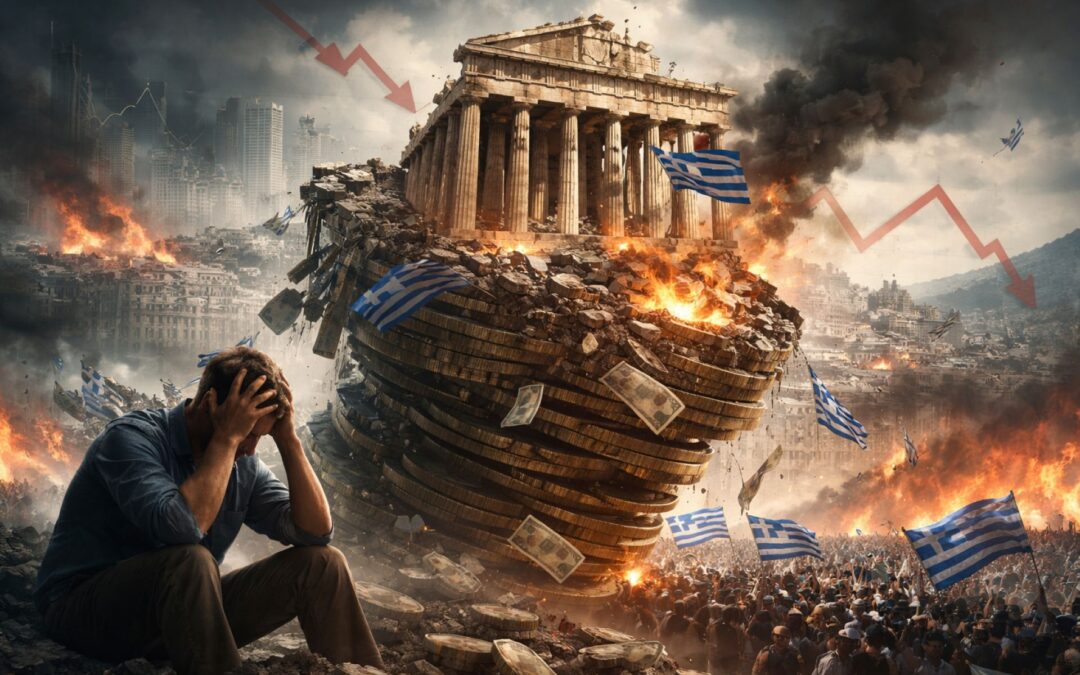
Greece is a country that once stood at the center of human civilization. It gave the world philosophy, democracy, and some of the most enduring ideas in history. For centuries, its legacy has symbolized intellectual and cultural greatness. And yet, in the early 21st century, this same nation became the epicenter of one of the worst economic crises in modern Europe.
The transformation was shockingly fast. Within a decade, Greece went from the optimism of joining the European Union’s most ambitious project—the euro—to hosting the 2004 Olympics as a symbol of national resurgence. But beneath the surface of this apparent success, deep structural weaknesses were quietly compounding. By the end of the 2000s, the illusion shattered. Greece was bankrupt in all but name, its economy collapsing, its society under strain, and the stability of the entire Eurozone suddenly at risk.
This wasn’t just a story of a country overspending. It was a story of layered failures. Governments manipulated data to meet political goals. Financial institutions engineered complex tools to mask reality. The European monetary system itself imposed constraints that made recovery harder. And when the crisis finally erupted, the policies meant to fix it often made things worse.
What unfolded in Greece was not a single mistake, but a chain reaction—one where short-term decisions, systemic flaws, and flawed economic thinking combined to create a full-blown catastrophe. Understanding how this happened is not just about Greece. It’s about how modern economies can fail, even in plain sight, when incentives, institutions, and policies fall out of alignment.
The Euro Dream: Why Greece Wanted In
At the turn of the millennium, Europe was riding a wave of optimism. The Cold War was over, borders were opening, and the European Union was moving toward deeper integration than ever before. At the heart of this vision was a bold experiment—the creation of a single currency, the euro. It wasn’t just an economic tool; it was a political statement. A unified Europe, bound together not just by treaties, but by shared financial destiny.
For countries like Germany and France, the euro promised stability and efficiency. For smaller or less competitive economies like Greece, it offered something even more powerful: credibility.
Before the euro, Greece struggled with high inflation, currency instability, and expensive borrowing costs. Investors saw Greek debt as risky, and the country often paid a premium to access global capital. Joining the euro would change that overnight. With the backing of a shared currency anchored by stronger economies, Greece could borrow more cheaply, attract investment, and accelerate growth.
But entry into this exclusive club came with strict conditions. Under the Maastricht criteria, countries had to demonstrate fiscal discipline. Budget deficits had to remain below 3% of GDP. Public debt needed to stay under 60% of GDP. Inflation had to be controlled. These rules were designed to ensure that only financially stable countries could join, preventing weaker economies from undermining the system.
For most of Europe, meeting these benchmarks was difficult but achievable. For Greece, it was a near impossibility.
Years of fiscal mismanagement had left the country with bloated public spending, widespread tax evasion, and a debt-to-GDP ratio that far exceeded the allowed limit. Structural reforms would have required painful cuts, political backlash, and years of disciplined governance—something no government was eager to undertake.
This left Greece with an uncomfortable choice. It could reform and risk short-term pain for long-term stability. It could stay out of the euro and face economic isolation. Or it could find a way to appear compliant without actually fixing the underlying problems.
In the end, the desire to belong—to be part of Europe’s future rather than left behind—proved too strong. And that pressure would set the stage for one of the most consequential decisions in modern European economic history.
The Original Sin: How Greece Qualified by Cheating
By the late 1990s, Greece faced a reality it couldn’t easily escape. Its finances were nowhere close to meeting the Eurozone’s entry requirements. Debt levels were far above the acceptable threshold, deficits were persistently high, and the state’s ability to collect taxes remained weak. On paper, Greece simply didn’t qualify.
But politically, staying out of the euro was unthinkable.
Joining the currency union wasn’t just about economics—it was about status, identity, and belonging. Being excluded would signal weakness and reinforce Greece’s position as Europe’s periphery. The pressure to get in, by any means necessary, became overwhelming.
This is where financial engineering entered the picture.
In the early 2000s, Greece turned to Goldman Sachs, one of the world’s most sophisticated investment banks, for a solution. What followed was a complex arrangement involving cross-currency swaps—financial instruments typically used to manage exchange rate risk. But in this case, they were used for something else entirely: hiding debt.
The mechanics were deceptively simple in concept, even if complex in execution. Greece would borrow money in foreign currencies, such as dollars or yen, and then use swaps to convert that debt into euros at artificially favorable exchange rates. These rates were structured in a way that made the debt appear smaller on official balance sheets.
In reality, nothing had disappeared. The obligations still existed. But they were now disguised—pushed into the future, buried in accounting structures that made Greece’s finances look healthier than they actually were.
This wasn’t technically illegal at the time. It operated within the gray areas of financial regulation. But it fundamentally violated the spirit of the Eurozone’s rules, which were designed to ensure transparency and fiscal discipline.
The result was exactly what Greece needed. On paper, its deficit and debt levels appeared close enough to the required thresholds. The illusion was convincing.
And so, on January 1, 2001, Greece officially adopted the euro.
For a moment, it seemed like a triumph. The country had secured its place in Europe’s economic core. But beneath that victory lay a fragile foundation—a system built not on reform, but on concealment.
The problem with hiding debt is not that it disappears. It’s that it waits.
The Illusion Years: Growth Built on Borrowed Money
With the euro came something Greece had never truly enjoyed before—trust.
Almost overnight, global investors began treating Greek government bonds as if they were nearly as safe as those of Germany. The logic was simple: if Greece shared a currency with Europe’s strongest economies, surely it couldn’t be allowed to fail. That assumption proved incredibly powerful.
Borrowing costs collapsed.
Money began flowing into Greece at unprecedented levels. The government suddenly had access to cheap credit, and it used it liberally. Public sector wages rose. Pension systems expanded. Infrastructure projects multiplied. Hiring in the public sector surged, often driven more by political incentives than economic necessity.
For the average Greek citizen, these were golden years.
Living standards improved rapidly. Consumption boomed. Credit became easily accessible. People bought homes, cars, and imported goods in volumes that would have been unthinkable just a decade earlier. Greece, long considered Europe’s economic underdog, finally felt like it had caught up.
Then came the 2004 Athens Olympics—a defining moment of national pride.
Hosting the Olympics was meant to signal Greece’s arrival on the global stage as a modern, capable economy. Billions were poured into stadiums, transport systems, and urban upgrades. The final cost exceeded €9 billion, far above initial estimates. But in the atmosphere of optimism and easy money, the overspending barely raised concern.
Everything seemed to be working.
But beneath this prosperity, the fundamentals remained deeply flawed.
Tax evasion continued on a massive scale, with a significant portion of economic activity going unreported. Government spending kept expanding without corresponding increases in revenue. Productivity lagged behind that of Northern European economies, meaning Greece was consuming far more than it was producing.
And most importantly, the debt never stopped growing.
It was simply easier to ignore now. Hidden behind accounting tricks and supported by cheap credit, the rising debt felt manageable—almost irrelevant. The euro had created a sense of security that dulled the urgency of reform.
What Greece experienced during these years wasn’t true, self-sustaining growth. It was an illusion—one fueled by borrowing, sustained by confidence, and disconnected from economic reality.
And like all illusions, it depended on one fragile condition: that confidence would never break.
The Trigger: The Global Financial Crisis of 2008
For years, Greece’s economic model had relied on one critical assumption—that cheap credit would always be available.
That assumption collapsed in 2008.
The global financial crisis, triggered by the meltdown of the U.S. housing market, quickly spread across the world. Banks failed, credit markets froze, and investors everywhere became far more cautious about risk. Suddenly, money that had once flowed freely began to dry up.
For Greece, the timing couldn’t have been worse.
Its economy was heavily dependent on sectors like tourism and shipping—both highly sensitive to global economic conditions. As recession hit major economies, international travel declined sharply. Tourists stayed home. Shipping volumes dropped as global trade slowed. Two of Greece’s most important revenue streams began to shrink at the same time.
At the same time, government finances came under pressure from multiple directions.
Tax revenues, already weakened by widespread evasion, fell even further as economic activity slowed. Businesses earned less, individuals spent less, and the state collected less. But government spending didn’t fall with it. In fact, it needed to increase to support a weakening economy.
This created a dangerous gap.
Greece had to borrow more money just to maintain its existing commitments—paying salaries, pensions, and servicing its growing debt. But global lenders were no longer as willing to lend. The environment had changed. Investors were now asking harder questions about risk, sustainability, and credibility.
And Greece had weak answers.
The country’s financial position, long obscured by accounting tricks and optimistic projections, began to look increasingly fragile under scrutiny. Investors started to worry: How much debt did Greece actually have? Could it realistically repay it? And if not, who would bear the losses?
These doubts didn’t immediately trigger a collapse. But they marked a turning point.
The crisis had done something critical—it had removed the illusion of safety. For the first time in years, Greece was no longer seen as just another Eurozone country. It was seen as a potential problem.
And once confidence begins to crack in financial markets, it rarely stops at the surface.
The Revelation: Greece Admits the Truth
The illusion didn’t collapse gradually. It shattered in a single moment.
In October 2009, Greece’s newly elected government made a stunning admission: the country’s financial situation was far worse than previously reported. What had been presented as a manageable deficit was suddenly revised upward—dramatically. The real deficit wasn’t around 6% of GDP, as earlier claimed. It was closer to 12.7%.
And that was only the beginning.
Years of “creative accounting” came under scrutiny. Hidden liabilities, off-balance-sheet arrangements, and optimistic projections were exposed for what they were—systematic misrepresentation. Greece hadn’t just miscalculated its finances. It had been actively masking the truth for years.
For investors, this changed everything.
Trust is the foundation of sovereign debt markets. Governments borrow money based on the belief that they are both willing and able to repay it. But once credibility is lost, that belief disappears almost instantly. And when it does, the consequences are brutal.
Credit rating agencies moved quickly. Greek government bonds were downgraded—first cautiously, then aggressively—until they were pushed into junk status. This signaled to global investors that Greek debt was no longer considered safe.
The reaction was immediate.
Borrowing costs surged as investors demanded higher interest rates to compensate for the increased risk. But the increases weren’t gradual—they were exponential. What had once been cheap, easy credit became prohibitively expensive almost overnight.
Greece found itself trapped.
It needed to borrow more money than ever before to cover its deficits and refinance existing debt. But it could no longer do so at sustainable rates. The market had effectively shut its doors.
This is the moment when a debt problem becomes a debt crisis.
Without access to affordable borrowing, Greece was no longer just struggling—it was facing imminent default. And because it was part of the Eurozone, the stakes were far higher than for a typical country. European banks held massive amounts of Greek debt. If Greece failed, the shock wouldn’t stay contained.
It would spread.
What had begun as a national accounting scandal was now threatening to become a continental financial crisis.
The Bailouts Begin: Saving Greece or Saving Banks?
By early 2010, Greece was effectively locked out of financial markets. It could no longer borrow at sustainable interest rates, yet it still had massive obligations—maturing debt, public sector wages, pensions, and basic government functions. Default was no longer a distant possibility. It was imminent.
But Greece’s collapse wouldn’t be contained within its borders.
European banks—especially in countries like France and Germany—held billions of euros in Greek government bonds. If Greece defaulted, those banks would suffer massive losses. And if those banks faltered, the crisis could cascade across the Eurozone, hitting other vulnerable economies like Portugal, Ireland, Spain, and Italy.
This wasn’t just about Greece anymore. It was about the survival of the euro itself.
To prevent a wider meltdown, a coalition stepped in: the European Union, the European Central Bank, and the International Monetary Fund—collectively known as the Troika. Together, they assembled a rescue package worth €110 billion, the largest bailout of its kind at the time.
On the surface, the objective was clear: keep Greece afloat and restore market confidence.
But the bailout came with strict conditions.
In exchange for financial support, Greece was required to implement sweeping austerity measures. Government spending had to be slashed. Public sector wages and pensions were cut. Taxes were raised. Structural reforms were mandated to improve efficiency and competitiveness.
The logic behind these measures seemed straightforward.
If Greece reduced its deficit and demonstrated fiscal discipline, investor confidence would return. Borrowing costs would fall. The economy would stabilize. And over time, the country would regain control of its finances.
In theory, it was a path back to sustainability.
In reality, it was the beginning of something far more dangerous.
Because the bailout wasn’t just about helping Greece recover—it was also about ensuring that creditors, particularly European banks, were repaid. The funds provided didn’t flow directly into revitalizing the Greek economy. A large portion was used to service existing debts, effectively transferring risk from private banks to public institutions.
This raised a critical question:
Was the bailout designed to save Greece—or to save the financial system built around it?
At the time, there was little room for debate. The priority was stability. The system had to be protected.
But the cost of that decision would soon become painfully clear.
The Death Spiral: How Austerity Made Things Worse
The logic of austerity was simple: cut spending, raise taxes, reduce deficits, and restore confidence.
But economies don’t operate in spreadsheets. They operate through people.
As Greece implemented austerity measures, the effects were immediate and severe. Government spending was slashed across the board. Public sector wages were reduced. Pensions were cut. Taxes were increased on a population already under strain.
This drained money out of the economy at the worst possible time.
Businesses began to struggle as consumer spending fell. With fewer customers, revenues declined. Companies started laying off workers or shutting down altogether. Unemployment began to rise rapidly, reducing household incomes even further.
This created a cascading effect.
With fewer people earning and spending, tax revenues fell instead of rising. The government, facing lower income, was forced to introduce even more austerity to meet its targets. Each round of cuts deepened the recession, which in turn made the fiscal situation worse.
What was meant to fix the problem was amplifying it.
Greece’s economy began to contract sharply. In 2011 alone, GDP fell by around 7%. Unemployment surged into double digits and kept climbing. Entire sectors of the economy shrank under the pressure.
And then came the most counterintuitive outcome of all.
The debt-to-GDP ratio—one of the primary metrics austerity was supposed to improve—actually worsened. Even if the government reduced its deficits, the overall economy was shrinking faster than the debt itself. As a result, the ratio increased, making Greece look even more indebted relative to its economic output.
This is the core paradox of austerity during a downturn.
Cut too much, too fast, and you don’t stabilize the system—you destabilize it further.
Greece was now caught in a vicious cycle. Austerity caused recession. Recession reduced tax revenues. Lower revenues led to more austerity. Each loop tightened the pressure, pushing the economy deeper into collapse.
The policy that was supposed to restore confidence had instead triggered a downward spiral—one that would prove incredibly difficult to escape.
A Familiar Pattern: The Argentina Parallel
Greece’s crisis felt unprecedented in Europe. But in reality, the pattern had played out before—most notably in Argentina just a few years earlier.
In the late 1990s and early 2000s, Argentina found itself in a situation strikingly similar to Greece. It had accumulated significant debt, lost investor confidence, and turned to the International Monetary Fund for assistance. In exchange for financial support, Argentina was required to implement austerity measures—cut spending, reduce deficits, and restore stability.
On paper, the strategy looked identical.
In practice, it produced the same results.
As Argentina slashed government spending and raised taxes, its economy contracted sharply. Businesses failed, unemployment rose, and tax revenues declined instead of improving. The government found itself trapped in the same vicious cycle—cutting more to compensate for falling revenues, only to deepen the recession further.
Eventually, the situation became unsustainable. In 2001, Argentina defaulted on its debt in one of the largest sovereign defaults in history. The economy collapsed, the currency was devalued, and the country entered a prolonged period of instability.
The key lesson from Argentina was clear: austerity during a deep recession can backfire dramatically.
Yet when Greece faced its own crisis, policymakers largely repeated the same approach.
Why?
Part of the answer lies in institutional thinking. Organizations like the IMF and European authorities were deeply concerned about fiscal discipline and the risk of moral hazard—the idea that if Greece were given leniency, other countries might follow the same path. Strict conditions were seen as necessary to maintain credibility.
Another factor was political.
Creditor nations, particularly in Northern Europe, were reluctant to appear as though they were bailing out what they perceived as irresponsible fiscal behavior. Austerity became not just an economic prescription, but a political requirement.
But in focusing on discipline, policymakers overlooked context.
Greece, like Argentina before it, was already in a fragile state. Its economy was shrinking, its institutions were under strain, and its ability to absorb further shocks was limited. Imposing aggressive austerity in such an environment didn’t restore stability—it accelerated collapse.
The tragedy wasn’t just that Greece fell into this trap.
It was that the warning signs had already been there.
The Second Bailout and Social Collapse
By 2012, it had become clear that the first bailout had failed to stabilize Greece.
The economy was shrinking faster than expected, unemployment was surging, and the country’s debt burden remained unsustainable. Despite years of austerity, Greece was no closer to recovery. Instead, it was deeper in crisis.
The solution, once again, was more intervention.
A second bailout package was arranged, worth €130 billion. This time, it included something unprecedented—a large-scale restructuring of Greece’s debt. Private creditors, including banks and investors holding Greek bonds, agreed to take a “haircut” of around 50%, effectively writing off half of what they were owed.
It was the largest sovereign debt restructuring in history.
On paper, this should have provided Greece with some breathing room. Reducing the debt burden was supposed to make repayment more manageable and restore confidence in the country’s long-term prospects.
But the relief came with familiar conditions.
Austerity measures were intensified. More spending cuts. More tax increases. Deeper reductions in pensions and public services. The logic hadn’t changed—fiscal discipline was still seen as the path to recovery.
The impact on Greek society was devastating.
Unemployment reached staggering levels, peaking at around 27%, one of the highest rates ever recorded in a developed country. For young people, the situation was even worse—youth unemployment climbed to nearly 60%. An entire generation found itself locked out of the workforce, with little hope for the future.
Poverty surged.
Nearly one in three Greeks fell below the poverty line. Families that had once been comfortably middle class struggled to meet basic needs. Soup kitchens became a common sight in Athens, feeding thousands who had never imagined needing such support.
Public services began to collapse under the strain.
Healthcare budgets were slashed, leading to shortages of staff and essential supplies. Schools closed. Infrastructure deteriorated. The social safety net, already under pressure, began to unravel.
And with economic hardship came political instability.
Protests and riots erupted across the country. Anger was directed in every direction—toward the government, toward European institutions, toward banks, and toward the entire system that had brought Greece to this point. Traditional political parties lost credibility, while more extreme movements on both the left and right gained traction.
Greece was no longer just facing an economic crisis.
It was facing a social collapse.
The numbers told one story—GDP contraction, unemployment rates, debt ratios. But on the ground, the reality was far more human. Lives were being upended. Futures were being erased.
And despite everything, the crisis was still not over.
The Breaking Point: Default and Capital Controls
By 2015, Greece had endured five years of relentless austerity, economic contraction, and social upheaval. The patience of its people had run out.
That anger translated into political change.
In January 2015, Greek voters elected Syriza, a left-wing party that campaigned on a simple but powerful promise: end austerity and renegotiate the bailout terms. The message resonated deeply. For many Greeks, the existing path had delivered only hardship with no visible recovery. Something had to change.
But changing course was far more complicated than winning an election.
Greece’s new government entered tense negotiations with European leaders and the IMF, demanding debt relief and an easing of austerity measures. From their perspective, the existing policies had failed. The economy had collapsed, unemployment was still extraordinarily high, and the debt burden had only grown worse.
Europe saw things differently.
Creditor nations were unwilling to set a precedent that might encourage other indebted countries to demand similar concessions. There was also a deep mistrust—after years of misreported data, Greece’s credibility was still fragile. As a result, negotiations stalled.
Uncertainty spread quickly through the financial system.
Greek citizens, fearing the worst, began withdrawing their savings from banks. Deposits started to hemorrhage as confidence evaporated. The banking system, already weakened, came under immense pressure.
To prevent a complete collapse, the government imposed capital controls.
Banks were temporarily shut down. Withdrawals were limited to €60 per day. For ordinary citizens, this was a stark and immediate sign that the crisis had reached a critical point. Access to their own money was suddenly restricted.
Then came the moment that seemed unthinkable for a developed nation.
In June 2015, Greece missed a €1.6 billion payment to the International Monetary Fund, becoming the first advanced economy to default on an IMF loan. It was a symbolic and practical breaking point—a clear signal that the existing system was no longer functioning.
Europe now faced a difficult choice.
Allow Greece to collapse and risk triggering a broader financial crisis across the Eurozone, or step in once again with another rescue package. The stakes were enormous. A Greek exit from the euro—often referred to as “Grexit”—could have destabilized the entire monetary union.
After intense, all-night negotiations, a third bailout was agreed upon.
This package, worth €86 billion, came with even stricter conditions than before. Despite its anti-austerity mandate, the Greek government had little choice but to accept the terms. The alternatives—financial collapse and potential exit from the euro—were seen as even more dangerous.
The dream of breaking free from austerity had collided with reality.
Greece remained in the system. But the cost of staying in it had become painfully clear.
The Aftermath: A Lost Decade
By the time the crisis began to stabilize, the damage had already been done.
Greece’s economy had shrunk by nearly 25%—a contraction comparable to the worst years of the Great Depression. Entire industries had collapsed, thousands of businesses had disappeared, and the country’s productive capacity had been permanently weakened.
The scale of the decline was staggering.
Unemployment, though it eventually began to fall from its peak, remained persistently high for years. For many, especially the young, stable employment never returned. A generation that should have been building careers and accumulating wealth instead spent its prime years navigating uncertainty, underemployment, or joblessness.
Many chose to leave.
Hundreds of thousands of Greeks emigrated in search of better opportunities abroad. This “brain drain” deprived the country of skilled workers, further slowing its recovery. The loss wasn’t just economic—it was demographic, social, and deeply personal.
And despite all the sacrifices, the debt problem remained.
Greece’s debt-to-GDP ratio peaked above 180%, higher than when the crisis began. Years of austerity had failed to meaningfully reduce the burden. Instead, they had reshaped it—extending maturities, restructuring terms, but not eliminating the core issue.
Recovery, when it came, was slow and fragile.
By 2018, Greece officially exited its bailout programs, marking the end of an era. There were signs of stabilization—modest growth returned, financial conditions improved, and confidence began to rebuild. But the scars of the crisis remained visible everywhere.
Public services were still strained. Wages had not fully recovered. Inequality had widened. And trust—in institutions, in leadership, in the system itself—had been deeply shaken.
This wasn’t just an economic downturn.
It was a lost decade.
An entire period of progress had been erased, replaced by hardship, uncertainty, and long-term consequences that would continue to shape Greece’s future for years to come.
What Really Went Wrong: The Deeper Causes
By the end of the crisis, it was clear that Greece’s collapse couldn’t be explained by a single mistake. It was the result of multiple failures—each reinforcing the other, each turning a manageable problem into a systemic disaster.
The first and most obvious was fiscal mismanagement.
For years, Greece operated with chronic deficits, inefficient tax collection, and an expanding public sector. Instead of addressing these structural weaknesses, successive governments chose to mask them. Data was manipulated. Debt was hidden. Short-term political goals were prioritized over long-term stability. This created a fragile foundation—one that could not withstand external shocks.
But Greece’s failures alone don’t tell the full story.
The design of the Eurozone itself played a critical role.
By adopting the euro, Greece gave up control over its monetary policy. It could no longer devalue its currency to regain competitiveness or print money to manage its debt. Instead, it was bound to a one-size-fits-all system designed around stronger economies like Germany. When the crisis hit, Greece had limited tools to respond, making adjustment far more painful.
Then there was the issue of timing.
Austerity, in theory, can help stabilize public finances. But in practice, its effectiveness depends heavily on when and how it is applied. Implementing aggressive spending cuts and tax increases during a deep recession drained demand from the economy, accelerating the downturn. Instead of restoring confidence, it deepened uncertainty and prolonged the crisis.
Another critical factor was the prioritization of financial stability over social stability.
The bailout programs were structured in a way that ensured creditors—particularly European banks—were repaid. But this came at a significant cost to ordinary citizens. Public services were cut, unemployment soared, and living standards declined sharply. The system was stabilized, but society was destabilized.
Finally, there was a failure of incentives and accountability.
Politicians delayed reforms to avoid short-term pain. Financial institutions profited from complex arrangements without bearing long-term consequences. European leaders enforced strict conditions to maintain credibility, even when those conditions proved counterproductive. At every level, decisions were shaped by immediate pressures rather than sustainable outcomes.
What happened in Greece was not inevitable.
It was the result of choices—made over years, across institutions, and under competing priorities. And once those choices aligned in the wrong way, the outcome became almost impossible to avoid.
The crisis wasn’t just about debt.
It was about how systems fail when transparency, discipline, and adaptability are missing.
Conclusion
Greece’s debt crisis wasn’t just an economic collapse—it was a systemic failure that exposed the fragility of modern financial and political systems.
At one level, the story is straightforward. A government spent beyond its means, hid the truth, and eventually ran out of options. But beneath that simplicity lies a far more complex reality. Financial institutions enabled deception. A shared currency removed critical economic tools. Policymakers applied solutions that worsened the very problem they were trying to solve. And throughout it all, the burden fell disproportionately on ordinary citizens.
What makes Greece’s crisis especially important is how preventable it was.
At multiple points, different choices could have changed the outcome. Stronger fiscal discipline in the early years could have reduced vulnerability. Greater transparency could have preserved trust. More flexible policy responses during the downturn could have softened the collapse. Instead, short-term thinking dominated, and each decision compounded the next.
The consequences were severe.
An economy shrank by a quarter. A generation lost its prime years. Social stability gave way to unrest and uncertainty. And even after recovery began, the scars remained deeply embedded in the country’s economic and social fabric.
But Greece’s story is not just about failure—it’s also a warning.
It shows how quickly confidence can evaporate when trust is broken. How interconnected systems can turn local problems into global threats. And how policies that look sound in theory can become destructive when applied without context.
In the end, the lesson is clear.
Economic stability is not built on appearances, shortcuts, or temporary fixes. It depends on transparency, sound institutions, and the willingness to confront problems before they spiral out of control.