
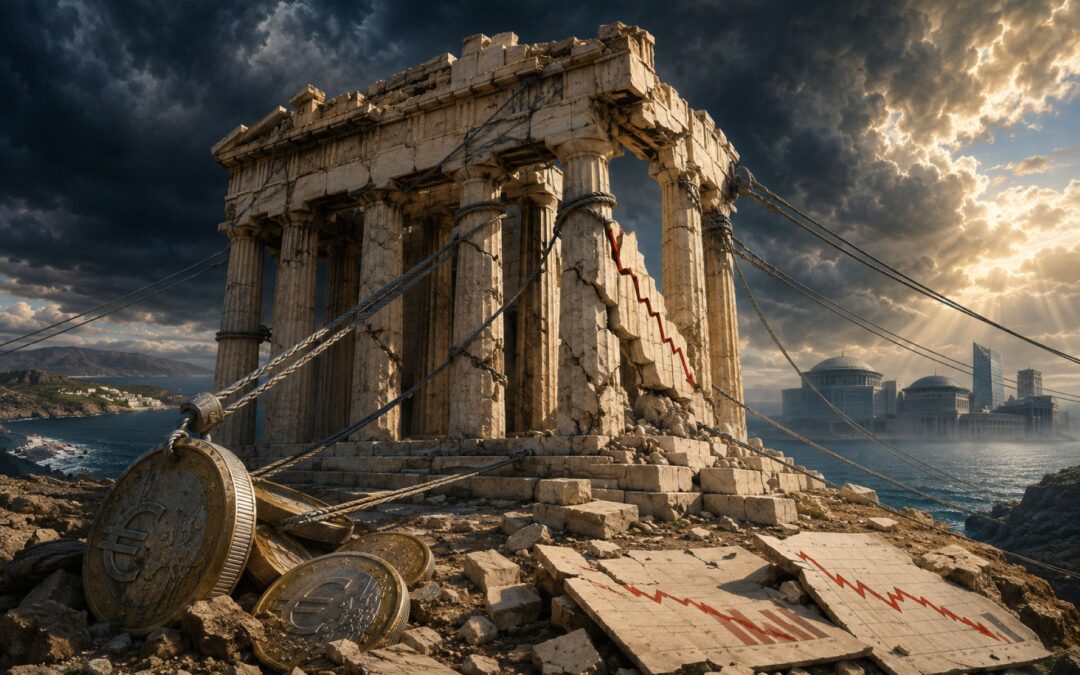
Greece did not wake up one morning and suddenly discover it was bankrupt.
For years, the country had been living inside an economic illusion. It had the spending habits of a state that could borrow cheaply, the institutions of a state that struggled to collect taxes, and the currency of a much stronger Europe. On paper, Greece looked like a normal member of the eurozone. In reality, its economy was carrying weaknesses that the euro had helped hide rather than fix.
When the global financial crisis hit in 2008, that illusion collapsed.
The numbers Greece had reported were worse than expected. The markets stopped trusting the government. Borrowing costs exploded. European banks and governments panicked. What first looked like a Greek problem quickly became a test of the entire eurozone.
Could a country inside the euro go bankrupt?
Could it leave the currency?
Could Europe rescue Greece without rewarding reckless borrowing?
And who would pay the price: Greek citizens, foreign creditors, European taxpayers, or the dream of European integration itself?
The Greek debt crisis became one of the defining economic disasters of modern Europe because it was never just about debt. It was about what happens when a weak state, a shared currency, fragile banks, political denial, and harsh rescue conditions collide.
Greece Looked Richer Than It Really Was
Before the crisis, Greece appeared to have joined the club of stable European economies.
When it adopted the euro, it gained access to a much stronger currency than the drachma had been. Investors treated Greek government debt as if it was far safer than before. Greek borrowing costs fell. The country could raise money more cheaply, and for a while, that made everything feel easier.
The government could spend more.
Banks could lend more.
Households could borrow more.
The state could postpone difficult reforms.
But cheap money is dangerous when it hides weak foundations.
Greece had long-running problems with tax collection, public administration, pensions, public-sector spending, and economic competitiveness. The country was not simply “lazy,” as the laziest versions of the crisis story often suggest. That stereotype misses the real point. Greece had serious institutional weaknesses, and the euro made those weaknesses easier to ignore.
The European Court of Auditors later identified a long list of vulnerabilities behind the crisis: public debt, external debt, weak competitiveness, pension pressures, fragile institutions, and unreliable fiscal statistics. In other words, Greece’s problem was not one bad budget. It was a system that had been allowed to drift.
The euro gave Greece credibility, but it did not give Greece German-style institutions. It gave Greece access to cheaper borrowing, but it did not magically make the Greek economy more productive. It helped Greece look financially safer than it really was.
That gap between appearance and reality was the heart of the danger.
A country can live with weak institutions for a long time if investors still trust it. It can run deficits if markets believe growth will continue. It can roll over debt if lenders are confident they will be repaid.
But once trust disappears, the same numbers become terrifying.
That is what happened to Greece.
The Euro Made Borrowing Easy and Escape Hard
The euro was supposed to bind Europe together. In Greece’s case, it also created a trap.
Before joining the euro, Greece had its own currency. That gave the country a painful but familiar escape route in times of stress: devaluation. If the drachma lost value, Greek exports and tourism could become cheaper, helping the economy adjust. Inflation could reduce the real burden of debt. The central bank could use monetary policy in ways tailored to Greece’s needs.
Inside the eurozone, those tools disappeared.
Greece shared a currency with Germany, France, the Netherlands, Italy, Spain, Portugal, and other economies that were very different from one another. They had different productivity levels, different political systems, different labor markets, different tax capacities, and different banking structures.
But they all had one currency.
That meant Greece could not simply devalue its way out of trouble. It could not print euros to repay its debts. It could not set its own interest rates. It had given up monetary sovereignty in exchange for membership in a stronger currency union.
This is why the Greek crisis was so dangerous. It was not just a country with too much debt. It was a country with too much debt inside a monetary union that had no simple crisis mechanism.
As Vox’s explanation of the euro and the Greek crisis argues, the euro made the crisis harder because countries like Greece no longer had the usual adjustment tools available to independent currency issuers. They were locked into a currency whose value reflected the strength of the eurozone as a whole, not Greece’s individual condition.
The euro also encouraged complacency before the crash. Investors assumed that because Greece used the euro, Greek bonds were not that different from other eurozone bonds. They were wrong. The currency was shared, but the debts were still national.
Germany was responsible for German debt.
France was responsible for French debt.
Greece was responsible for Greek debt.
The problem was that markets did not fully price that difference until it was too late.
Once they did, Greece was trapped. It had borrowed cheaply like a safe country, but when confidence vanished, it had to adjust like a vulnerable country without the currency tools vulnerable countries usually use.
The 2008 Crisis Exposed What Greece Had Hidden
The global financial crisis did not create all of Greece’s problems, but it exposed them.
After 2008, investors became much more sensitive to risk. They started asking harder questions about government debt, bank exposure, deficits, and the ability of countries to repay what they owed. Greece suddenly looked much more dangerous than it had during the boom years.
Then came the number that changed everything.
In 2009, Greece revealed that its budget deficit was far larger than previously reported. The fiscal position of the country was not merely bad. It had been misrepresented. The scale of the problem was worse than investors had believed.
That mattered because debt crises are not only mathematical events. They are confidence events.
A country can carry heavy debt if markets believe it is honest, stable, and capable of managing the burden. But once investors begin to doubt the numbers, the problem accelerates. They demand higher interest rates. Higher interest rates make the debt harder to service. That makes default more likely. The fear of default then pushes rates even higher.
This is the debt spiral.
Greece entered it quickly.
The Peterson Institute for International Economics describes the crisis as a collision between hidden borrowing, low-cost eurozone credit, and the sudden realization that Greece’s fiscal condition was much worse than expected. Once markets understood that, Greece’s access to affordable borrowing collapsed.
This is why the revelation of the deficit was so damaging. It was not simply that Greece owed too much money. It was that Greece had lost credibility.
And credibility is one of the most valuable assets a government has.
Without it, every promise becomes suspect. Every budget plan looks optimistic. Every reform pledge sounds temporary. Every bond auction becomes a referendum on whether the country can survive.
For Greece, the market verdict was brutal.
By 2010, Greece could no longer borrow normally from financial markets. It needed help.
Why Europe Panicked When Greece Could Not Borrow
If Greece had been alone, the crisis would still have been painful. But Greece was not alone.
It was inside the eurozone. Its debt was held by banks and investors across Europe. Its collapse could have triggered panic in other countries with weak finances. Portugal, Ireland, Spain, and Italy were all being watched closely. If Greece defaulted chaotically, investors might ask: who is next?
That fear of contagion turned a national debt crisis into a European emergency.
The eurozone had been designed for stability, but it had not been designed for a member-state rescue of this scale. There was no smooth, well-tested mechanism for dealing with a eurozone country that could no longer borrow. There was also no easy political answer.
If Europe rescued Greece too generously, it risked telling governments that they could borrow recklessly and expect a bailout.
If Europe refused to rescue Greece, it risked financial panic, bank losses, and possibly the breakup of the euro.
If Greece defaulted, creditors would take losses.
If Greece was rescued, Greek citizens would likely face harsh conditions.
Every option was ugly.
That is why the crisis became a moral, political, and institutional problem, not just a financial one. The eurozone had to decide what kind of union it really was. Was it merely a shared currency area where each country was responsible for itself? Or was it a deeper political project where members had to protect one another from collapse?
In practice, Europe improvised.
Greece asked for financial assistance in April 2010 after losing access to market funding. The first rescue package came from euro-area partners and the International Monetary Fund. More programmes followed in 2012 and 2015, with the European Commission’s financial assistance archive documenting the long sequence of support, surveillance, and programme conditions.
But the rescue was never simply a gift.
It came with conditions.
And those conditions changed Greece.
The Bailouts Saved Greece From Default but Trapped It in Austerity
The bailouts were designed to keep Greece from collapsing outright. They also protected the wider eurozone from panic.
But for ordinary Greeks, the rescue often felt like punishment.
The money came with demands from what became known as the Troika: the European Commission, the European Central Bank, and the International Monetary Fund. Greece had to cut spending, raise taxes, reform pensions, reduce public-sector costs, restructure parts of the economy, and restore credibility with creditors.
From the perspective of lenders, this was necessary. Why should other European taxpayers and institutions provide rescue loans unless Greece changed the behavior that had led to the crisis?
From the perspective of many Greeks, this was devastating. They were being asked to absorb enormous pain for mistakes made by politicians, creditors, banks, and a flawed eurozone system.
Both views contained part of the truth.
Greece did need reform. Its state finances were not sustainable. Its institutions needed repair. Its economy needed to become more competitive. Pretending otherwise would be dishonest.
But the timing and severity of austerity created a second disaster. Greece was forced to cut spending and raise taxes while the economy was already collapsing. That is like asking a patient who is bleeding to run a marathon because exercise is healthy in the long run.
In theory, austerity was supposed to restore confidence.
In practice, it deepened the recession.
When governments cut spending, public-sector workers lose income. When taxes rise, households have less money. When pensions are cut, retirees spend less. When the economy shrinks, businesses close, unemployment rises, and tax revenue falls. That can make the debt burden look worse, not better, because debt is measured against a shrinking economy.
This was one of the cruel mechanics of the Greek crisis.
The more Greece tried to satisfy creditors, the more its society strained under the burden. The more the economy contracted, the harder it became to escape the debt ratio. The numbers demanded discipline, but the discipline weakened the economy that was supposed to repay the debt.
The bailout prevented immediate default.
It did not prevent depression.
Austerity Turned a Debt Crisis Into a Depression
The social cost of the crisis was enormous.
Greece suffered one of the deepest peacetime economic contractions experienced by an advanced economy. Output collapsed. Unemployment surged. Youth unemployment became catastrophic. Wages fell. Pensions were cut. Public services came under pressure. Businesses closed. Families lost savings, income, and stability.
The crisis did not remain inside spreadsheets.
It entered kitchens, hospitals, schools, shops, and family conversations. It shaped whether young people could find work, whether older people could rely on pensions, whether families could pay bills, and whether citizens still believed the political system represented them.
A debt crisis is often discussed in the language of bond yields, bailout tranches, fiscal targets, and primary surpluses. Those terms matter. But they can hide the human reality.
Behind every “adjustment programme” was a society being forced to adjust.
This is why the Greek crisis became politically explosive. Many Greeks felt they had lost control of their own democracy. Elections changed governments, but the bailout conditions remained. Voters could reject austerity, but creditors still held the money. Greek politicians could promise resistance, but the banking system and the eurozone relationship limited what they could actually do.
That tension broke old political loyalties.
Mainstream parties lost credibility. Protest movements grew. Anger moved from the streets into parliament. Syriza rose by promising to fight austerity and renegotiate Greece’s relationship with creditors. Golden Dawn, a far-right party, also gained support during the crisis years, showing how economic collapse can create openings for dangerous politics.
This was one of the deepest lessons of the crisis.
Economic adjustment is never merely economic. When people feel that their future is being decided by distant institutions, technical committees, and creditor demands, the legitimacy of democracy itself comes under stress.
Greece was not only balancing a budget.
It was testing how much pain a democratic society could absorb before the political center cracked.
The Debt Was Restructured, but the Pain Remained
By 2012, it was clear that Greece’s debt burden could not be solved by austerity alone.
Private creditors took losses in what became one of the largest sovereign debt restructurings in history. This process, often referred to as private sector involvement, reduced part of Greece’s debt burden by imposing a haircut on private bondholders.
On paper, that sounded like relief.
In reality, it was complicated.
The restructuring came after much of the exposure had already shifted. European official institutions had become deeply involved. Greek banks, pension funds, and domestic institutions were also affected. The country still owed huge amounts, but the composition of the debt had changed.
This is one reason the bailouts remained so controversial. Critics argued that the early rescue programmes did not simply save Greece; they also gave foreign banks and creditors time to reduce their exposure. Supporters argued that without rescue loans, Greece would have faced a disorderly default with even worse consequences.
The truth is uncomfortable: the bailouts did several things at once.
They kept Greece inside the euro.
They prevented an immediate financial collapse.
They protected parts of the European banking system.
They imposed reforms Greece had long avoided.
They also transferred enormous pain onto Greek society.
Debt restructuring changed the financial map, but it did not erase the social damage. A haircut on bonds does not restore lost jobs. It does not reopen closed businesses. It does not undo years of uncertainty. It does not rebuild trust in institutions overnight.
For many Greeks, the crisis had already become a lost decade.
2015 Was the Moment Greece Almost Left the Euro
The crisis reached its most dramatic point in 2015.
Syriza came to power promising to challenge austerity and renegotiate Greece’s bailout terms. Yanis Varoufakis, Greece’s finance minister, became one of the most visible faces of the confrontation with creditors. The negotiations became a political theater watched across the world.
But beneath the drama was a simple question:
Would Greece stay in the euro?
The possibility of “Grexit” had haunted the crisis for years, but in 2015 it became more immediate. If Greece refused creditor conditions and creditors refused further support, the country could run out of money. Banks could collapse. Capital controls could become permanent. Greece might be forced to introduce a parallel currency or return to the drachma.
That would have been economically chaotic and politically historic.
A member of the eurozone leaving the currency would have shattered the assumption that euro membership was irreversible. Investors would then look at every other vulnerable eurozone country differently. If Greece could leave, why not another country in a future crisis?
This is why 2015 mattered far beyond Greece.
The referendum that year intensified the confrontation. Greek voters rejected the bailout terms on offer, but the country’s banking system was under severe pressure. Capital controls were imposed. The government faced a brutal choice between accepting harsh conditions or risking a break with the euro.
In the end, Greece accepted a third bailout.
The Council of the European Union records that the third programme began in August 2015 and ran until August 2018, with Greece receiving €61.9 billion under it.
For some, this was the moment Greece was saved.
For others, it was the moment Greece was forced to surrender.
Both interpretations reveal the same truth: by 2015, Greece’s economic sovereignty had been deeply constrained. It could vote against austerity, but it could not easily escape the financial architecture around it.
The euro had become both shield and cage.
Greece Recovered, but the Crisis Never Fully Disappeared
Greece formally exited its bailout programme in 2018.
That did not mean the crisis vanished.
For years afterward, Greece remained under special monitoring. Enhanced surveillance finally ended in August 2022, according to the European Commission. The symbolism mattered. Greece was no longer in the emergency phase of the crisis.
The economy also began to look much healthier.
Growth returned. Tourism recovered. Investment improved. Banks cleaned up their balance sheets. Public debt as a share of GDP fell sharply from its pandemic-era peak. The OECD’s 2024 Economic Survey of Greece noted that Greek growth had outpaced the euro-area average in the previous three years and that public debt had declined significantly.
The IMF’s 2025 Article IV consultation also pointed to major progress, noting that Greece’s debt-to-GDP ratio had fallen by more than 50 percentage points from its 2020 peak by the end of 2024.
That is real improvement.
But recovery is not the same as erasure.
Greece still carries the scars of the crisis. Debt remains high by European standards. Productivity challenges remain. Demographic pressures remain. Many young Greeks left during the crisis years, and not all returned. Trust in institutions was damaged. A generation experienced adulthood through unemployment, emigration, uncertainty, and lowered expectations.
Even the recovery story has to be told carefully. Greece did not recover because the crisis was painless or because austerity was obviously vindicated. It recovered after years of brutal adjustment, external support, debt relief measures, banking repair, reforms, tourism strength, and a more favorable European environment.
The crisis ended as an emergency.
It survived as memory.
The Real Lesson of the Greek Debt Crisis
The Greek debt crisis is often reduced to a simple warning: do not borrow too much.
That lesson is true, but incomplete.
Greece did borrow too much. It did misreport numbers. It did postpone reforms. Its political system did make promises the state could not afford.
But the crisis was bigger than Greek irresponsibility.
It also exposed the weaknesses of the eurozone. A monetary union without full fiscal union can create deep tensions when one member collapses. A shared currency can make borrowing cheaper during good times and adjustment harsher during bad times. A rescue programme can save a country from default while crushing its society. Austerity can restore creditor confidence while destroying the economy that is supposed to repay the debt.
The crisis showed that debt is not just a number.
Debt is trust.
Debt is politics.
Debt is institutional capacity.
Debt is who gets rescued, who gets blamed, and who is forced to pay when the optimistic assumptions fail.
Greece nearly broke Europe because it revealed a question Europe had not fully answered: what does solidarity mean when one member of a shared currency falls into crisis?
The answer, in practice, was messy. Greece was rescued, punished, reformed, monitored, and eventually stabilized. The euro survived. Europe adapted. New crisis tools were built. The feared collapse did not happen.
But the cost was enormous.
For Greece, the crisis was not simply a financial event. It was a national trauma. For Europe, it was not simply a bailout problem. It was a warning about building a currency union stronger than the political union beneath it.
That is why the Greek debt crisis still matters.
It was not just the story of a country that borrowed too much.
It was the story of what happens when a whole system pretends risk has disappeared, until suddenly everyone discovers it was only hidden.
Last Updated on June 25, 2026 by Aseem Gupta