
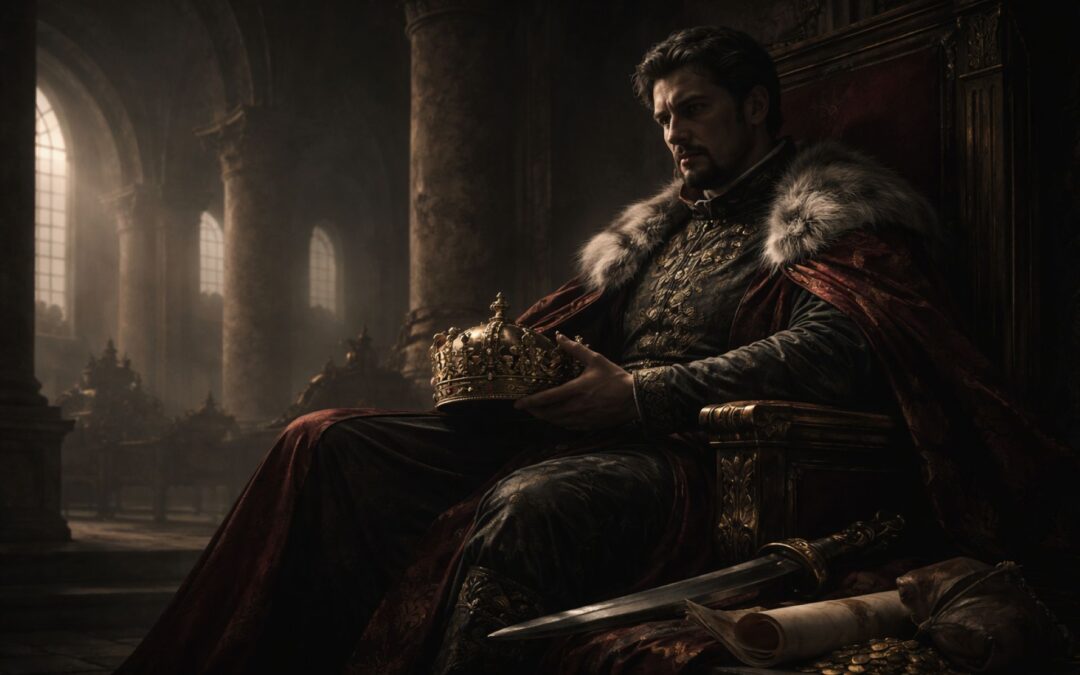
Power rarely announces itself politely. It emerges through fractures—through instability, opportunism, and the ability to act when others hesitate. In 15th-century Central Europe, few figures embodied this dynamic more completely than Matthias Corvinus.
He was not supposed to rule. Not by lineage, not by consensus, and certainly not by the established aristocratic order of Hungary. Yet, at just fifteen, he ascended to the throne—not as a ceremonial monarch, but as a political force who would reshape the kingdom around himself.
Matthias inherited more than a crown. He inherited a volatile frontier state, caught between internal noble rivalries and the relentless expansion of the Ottoman Empire. Hungary was not a stable kingdom waiting to be governed; it was a contested space that required control, discipline, and above all, resources.
What followed was not merely a reign—it was a project. Matthias did not just rule Hungary; he attempted to redesign it. He centralized authority in ways that antagonized the nobility, built one of Europe’s earliest standing armies, and turned his court into a hub of Renaissance culture far beyond Italy’s traditional sphere.
But power built this way carries a cost. The same mechanisms that allowed Matthias to dominate his era—heavy taxation, personal authority, and military dependence—also made his system fragile. When he died, much of what he created began to unravel with alarming speed.
This is not just the story of a king. It is a study in how power is constructed, how it functions at its peak, and how quickly it collapses when it lacks continuity.
The Making of a King: Origins, Legacy, and Early Influences
Power rarely begins with the individual. It begins with inheritance—of reputation, of enemies, of unfinished battles. Matthias Corvinus was born into exactly that kind of inheritance.
His father, John Hunyadi, was not just another noble. He was a military symbol—one of the most prominent defenders of Christian Europe against the Ottoman advance. Victories like the Battle of Varna and the defense of Belgrade turned the Hunyadi name into something larger than lineage. It became a brand of legitimacy forged through war.
But legacy cuts both ways.
The Hunyadis were not old Hungarian aristocracy. They were outsiders who rose too fast, gained too much influence, and built too much goodwill among common people. That combination made them admired by the masses and deeply resented by established noble families. From the beginning, Matthias inherited not just prestige, but hostility.
What makes his early formation particularly interesting is that it wasn’t purely martial. Unlike many rulers of his time, Matthias was shaped as much by intellectual influence as by battlefield legacy. Figures like Janus Pannonius exposed him to Renaissance humanism—an intellectual movement that emphasized learning, culture, and classical knowledge.
This dual exposure—warfare and humanism—created a rare combination. Matthias was not just being prepared to rule. He was being prepared to think about ruling differently.
And then came the instability.
The mid-15th century in Hungary was not a stable political environment waiting for a rightful heir. It was volatile, fractured, and opportunistic. Peasant unrest, noble rivalries, and external threats created a system where power was constantly contested rather than peacefully transferred.
Matthias didn’t grow up in a kingdom. He grew up in a power vacuum waiting to be filled.
The death of his father only intensified this uncertainty. Without John Hunyadi, the protective shield around the family disappeared. What followed was not a smooth transition, but a cascade of political betrayal, manipulation, and violence—events that would define Matthias’s understanding of power very early in life.
His older brother’s execution was not just a family tragedy. It was a message. Power in Hungary was not inherited safely—it was negotiated, contested, and, if necessary, taken.
By the time Matthias reached adolescence, the illusion of stable authority had already been stripped away. What remained was a far more useful lesson:
Power belongs to those who can secure it—not those who are entitled to it.
That lesson would define everything that followed.
A Crown Taken, Not Given: The Politics Behind His Ascension
Matthias did not inherit the throne. He was pulled into it—almost accidentally, and certainly not safely.
After the execution of his brother and the collapse of his family’s immediate power structure, Matthias himself became a political asset rather than a political actor. He was taken into custody and held under the watch of George of Poděbrady—not as a prisoner in chains, but as leverage in a rapidly shifting power game.
Then something unexpected happened.
The existing order began to fall apart.
The death of Ladislaus the Posthumous in 1457 created a vacuum at the very top. Hungary suddenly found itself without a clear ruler, without stability, and without consensus among its elites. In most systems, this is where established noble houses consolidate power.
But Hungary wasn’t operating as a clean hierarchy. It was fragmented. Distrust ran deep. No single faction had enough legitimacy to dominate the others without triggering backlash.
That is precisely what made Matthias viable.
At just 15 years old, he represented something unusual—a candidate powerful enough to unify factions through his family’s reputation, yet young enough to appear controllable. His uncle, Mihály Szilágyi, understood this perfectly. He pushed aggressively for Matthias’s election, not out of pure loyalty, but because a teenage king looked like an opportunity to rule from behind the throne.
The Hungarian estates agreed.
In 1458, Matthias Corvinus was elected king.
On paper, it looked like a compromise. In reality, it was a calculated gamble by the nobility—a belief that they could manage power indirectly through a young and inexperienced ruler.
They were wrong.
What followed was not passive kingship. Matthias moved quickly to dismantle the idea that he was a puppet. He did not allow power to settle around him—he pulled it inward.
The first major challenge came almost immediately from outside Hungary. Frederick III refused to recognize Matthias’s claim and declared himself the rightful king. This was not just a diplomatic dispute; it was a direct test of legitimacy.
Matthias responded not with hesitation, but with force.
The conflict was resolved within a year, forcing Frederick into negotiation. The resulting agreement was pragmatic, even if imperfect—Matthias secured recognition in exchange for concessions, including a clause that would later haunt his legacy: if he died without an heir, the Hungarian crown could pass to the Habsburgs.
Even at the moment of securing power, a weakness had already been embedded into the system.
But in the short term, Matthias achieved something far more important.
He transitioned from being a candidate to being a ruler.
Not through inheritance. Not through divine right. But through a combination of political maneuvering, military pressure, and strategic compromise.
This distinction matters.
Because a crown that is taken—rather than given—creates a different kind of ruler. One who does not assume stability, but expects resistance. One who does not rely on tradition, but builds control deliberately.
By the end of his ascension, Matthias Corvinus was no longer a boy placed on a throne.
He was a king who understood that power, once gained, had to be constantly defended—and actively expanded.
Power Consolidation: Crushing Rivals and Securing Authority
Taking the crown was only the beginning. Holding it—that was the real test.
Hungary in the late 15th century was not a unified state under a strong monarchy. It was a negotiated space where nobles, foreign powers, and regional actors all expected influence. Matthias stepped into a system that did not automatically obey the king. It had to be bent into shape.
And he wasted no time doing exactly that.
The first layer of resistance came from within. The same nobility that had elevated him expected access, influence, and concessions. They had not chosen Matthias to rule independently—they had chosen him to be manageable.
Instead, he turned against that expectation.
Matthias systematically reduced the political weight of powerful noble factions. He replaced reliance on aristocratic support with direct royal authority wherever possible. Positions that were traditionally dominated by entrenched families were restructured or reassigned. Loyalty, not lineage, became the currency of proximity to power.
This was not reform in the modern sense. It was control.
At the same time, he had to deal with external threats that could easily destabilize his fragile rule. Frederick III had already challenged his legitimacy. In the north, Czech mercenary forces under Jan Jiskra operated with relative autonomy, raiding and destabilizing border regions. In the south, the Ottoman Empire remained a constant pressure point.
Most rulers would have prioritized one front at a time.
Matthias didn’t have that luxury.
He adopted a strategy that was less about total victory and more about selective dominance. When necessary, he postponed one conflict to resolve another. He neutralized threats not always by destroying them, but by absorbing or redirecting them.
One of the clearest examples of this approach was his handling of Jan Jiskra. Instead of pursuing a prolonged campaign, Matthias chose a more efficient route—he brought Jiskra into his own system. The same mercenary force that had once threatened his borders would later become a foundational component of his military strength.
This pattern repeats across his early rule.
Rebels were suppressed quickly and decisively. Noble uprisings, such as those in Transylvania, were not allowed to escalate into prolonged conflicts. The message was clear: resistance would not be negotiated indefinitely—it would be neutralized.
Even within his inner circle, Matthias showed a willingness to assert dominance. Advisors who overstepped were confronted. Authority was centralized not just institutionally, but personally.
What emerges from this phase is not just a consolidation of power, but a redefinition of how power functioned in Hungary.
The kingdom began shifting from a feudal structure—where power was distributed among elites—to a more centralized model, where authority increasingly flowed from the crown.
This transition came at a cost.
It created resentment among the nobility. It strained relationships with traditional power brokers. And it required constant enforcement to maintain.
But it also achieved something critical.
By the end of this phase, Matthias Corvinus was no longer dependent on the system that had elevated him. He had reshaped it into something that depended on him instead.
And that distinction would define the strength—and eventual fragility—of his rule.
Building the Machinery of Power: Taxation, Reform, and Control
Power, once secured, has to be funded.
Military campaigns, political enforcement, administrative control—none of it sustains itself on reputation alone. Matthias understood this with unusual clarity. If he wanted independence from the nobility, he needed independence from their money.
So he rebuilt the financial core of the kingdom.
At the center of this transformation was a deliberate shift away from irregular, negotiated taxation toward a more consistent and centrally controlled system. Instead of relying on traditional feudal contributions—which were often delayed, diluted, or outright avoided—Matthias introduced new forms of direct taxation that flowed straight to the crown.
One of the most significant changes was the restructuring of the “porta” tax—a levy based on household units. What had once been a predictable but limited source of revenue was turned into a flexible instrument. It could be increased, repeated, and enforced with far greater frequency than before.
This wasn’t just a financial adjustment. It was a political one.
Because taxation determines who holds leverage.
Previously, Hungarian nobles had carved out exemptions and privileges that allowed them to avoid meaningful financial contribution while still exerting influence over the state. Matthias systematically dismantled many of these protections. The result was a redistribution of burden—away from negotiated aristocratic contributions and toward a broader, more enforceable tax base.
To implement this effectively, Matthias didn’t rely solely on traditional administrators. He brought in capable specialists, including financial experts like Johannes Ernuszt, who helped rationalize revenue collection and reduce inefficiencies.
The results were immediate and measurable.
Royal income reportedly increased from roughly 250,000 ducats to around 800,000 ducats annually. In relative terms, this didn’t make Hungary the wealthiest state in Europe—but it fundamentally changed what the crown could do with the resources it had.
It could act independently.
That independence translated directly into capability. Campaigns could be funded without waiting for noble approval. Mercenaries could be hired and retained. Administrative reforms could be implemented without compromise.
But there’s a trade-off embedded in every efficient system of control.
The more centralized the revenue, the more visible the burden.
For commoners, Matthias’s reforms were paradoxical. On one hand, he introduced legal improvements that made trials fairer and reduced arbitrary abuses. On the other, taxation became more frequent and more demanding. The same ruler who was remembered as “the just” was also the one who showed up, again and again, to collect.
For the nobility, the resentment ran deeper.
This wasn’t just about paying more. It was about losing leverage. Every exemption removed, every privilege reduced, every new tax enforced without negotiation—each of these chipped away at the traditional balance of power that had defined Hungarian politics for generations.
Rebellion was inevitable.
Transylvanian nobles, among others, pushed back against these reforms. But by this stage, Matthias had already built the enforcement capacity to deal with resistance quickly. Uprisings did not evolve into prolonged crises—they were contained before they could reshape the political landscape.
What Matthias created in this phase was not simply a stronger treasury.
He built a system where financial control reinforced political authority—and political authority ensured financial compliance.
It was efficient. It was effective.
And it tied the stability of the entire kingdom more tightly than ever to a single point of failure:
The king himself.
The Black Army: Europe’s First Modern Standing Force
Once revenue is secured, it has to be converted into something tangible. For Matthias, that meant one thing above all else:
A military that answered to him—and only him.
The traditional medieval model relied on feudal levies. Nobles were expected to supply troops when called upon, but those troops were temporary, inconsistent, and ultimately loyal to their local lords rather than the crown. That model works—until it doesn’t. Especially when the same nobles are also your political rivals.
Matthias replaced it.
What emerged was the Black Army—a permanent, professional fighting force funded directly by royal revenue. Not seasonal. Not negotiable. Not dependent on aristocratic goodwill.
This was a structural shift.
The army was composed largely of mercenaries—battle-hardened soldiers from across Central Europe, including former enemies like the forces of Jan Jiskra. Matthias didn’t prioritize origin or status. He prioritized effectiveness. If a soldier could fight, he could be used.
And if he could be paid, he could be controlled.
That last point is critical.
Unlike feudal troops, whose loyalty was fragmented, the Black Army’s loyalty was centralized through compensation. Their allegiance wasn’t ideological—it was contractual. That made them predictable in a way medieval armies rarely were.
It also made them dangerous.
Because a standing army is not just a tool of defense. It is a tool of enforcement.
Matthias could deploy the Black Army not only against external enemies, but also internally—against rebellious nobles, regional uprisings, or any faction that challenged his authority. The existence of such a force changed the political equation inside Hungary. Resistance was no longer a negotiation between equals. It became a risk with immediate consequences.
Operationally, the Black Army was ahead of its time.
It combined infantry, cavalry, and early artillery in coordinated campaigns. It could move quickly, sustain prolonged operations, and adapt to different theaters of war. Matthias didn’t just build an army—he built a system capable of projecting power consistently across regions.
This is why his campaigns in Austria and Bohemia were even possible.
Without a standing force, such sustained external expansion would have been unmanageable. With it, Matthias could operate offensively, not just defensively. He wasn’t reacting to threats—he was creating pressure.
But again, the trade-off is embedded in the structure.
A professional army requires constant funding. It does not disband when campaigns end. It does not reduce its demands during peacetime. It becomes a permanent expense tied directly to the stability of the treasury.
Which means the entire system loops back.
High taxation funds the army.
The army enforces taxation.
Both reinforce centralized power.
As long as Matthias was alive, this loop held.
But it also meant that the strength of the kingdom was no longer distributed across institutions or classes. It was concentrated—financially, militarily, and politically—around a single organizing force.
The crown.
And more specifically, the man wearing it.
War Without Illusions: Strategy Against Ottomans and Europeans
Most rulers of Matthias’s time framed their wars in ideological terms—defense of Christendom, crusades against heresy, divine legitimacy. Matthias did something far more practical.
He treated war as a problem of limits.
The greatest external threat to Hungary was the Ottoman Empire. This was not a rival that could be casually defeated or even consistently pushed back. The Ottomans had manpower, resources, and strategic depth that Hungary simply could not match on its own.
Matthias understood this early.
Instead of committing fully to a crusading posture, he made a calculated decision: containment over confrontation. He maintained defensive pressure, reinforced border regions like Bosnia and Croatia, and launched selective campaigns when necessary—but he avoided overextension.
At times, this even meant informal truces.
To many contemporaries, this may have looked like hesitation or compromise. In reality, it was prioritization. Matthias recognized that fighting the Ottomans at full scale would drain his resources and destabilize his internal reforms. So he chose not to.
This freed him to act elsewhere.
While the southern frontier remained under controlled tension, Matthias shifted his focus north and west—toward Bohemia and Austria. These were not existential threats in the same way as the Ottomans, but they were opportunities.
His conflict with George of Poděbrady began under the pretext of a papal-backed crusade against Hussite heresy. But ideology was secondary. The real objective was influence over Bohemia and its territories.
The campaign itself revealed the limits of brute force.
Matthias achieved early success, capturing regions like Silesia and Moravia. But Bohemia proper proved far more difficult. Terrain, defensive positioning, and political resistance turned the campaign into a costly stalemate. At one point, Matthias was even captured—only securing his release through negotiation rather than force.
This wasn’t a clean victory.
And Matthias adjusted accordingly.
Rather than pursuing total domination, he pivoted toward partial control and political recognition. He declared himself king of Bohemia in opposition to existing authority, creating a dual-claim situation that allowed him to maintain influence without fully conquering the region.
Again, strategy over idealism.
A similar pattern played out in his dealings with Poland and the broader Central European power structure. Alliances shifted, promises were made and broken, and conflicts were often resolved not through decisive battles, but through negotiated outcomes that preserved Matthias’s position.
This approach extended even to his personal conduct.
Matthias could be diplomatic when it served him, but he was equally willing to abandon agreements if they no longer aligned with his objectives. Loyalty, in this context, was conditional—shaped by utility rather than principle.
That made him effective.
But it also made him difficult to trust.
What defines Matthias’s military strategy is not a series of victories or defeats. It is a consistent refusal to engage in unwinnable fights. He avoided total war with the Ottomans. He accepted partial gains in Bohemia. He negotiated when necessary and escalated when advantageous.
He did not fight to prove strength.
He fought to preserve it.
And in doing so, he maintained a delicate balance—expanding influence without collapsing under the weight of overreach.
For a time, that balance held.
But it required constant adjustment, constant calculation, and constant control.
And systems built on constant control rarely outlast the person controlling them.
The Vienna Campaign and the Peak of Power
Power, once consolidated and stabilized, seeks expression. For Matthias, that expression came in the form of expansion—direct, unapologetic, and aimed at one of the most symbolic targets in Central Europe:
Vienna.
His conflict with Frederick III had never truly been resolved. Earlier agreements had bought time, not peace. Beneath the surface, both rulers understood the reality—Hungary and the Habsburgs were on a collision course.
By the early 1480s, Matthias decided to stop managing the tension and start exploiting it.
The campaign into Austrian territory was not a sudden gamble. It was the culmination of everything he had built—financial strength, military organization, and strategic flexibility. The Black Army, now fully operational, became the instrument through which this ambition could be realized.
And it moved with purpose.
Rather than rushing directly at Vienna, Matthias advanced methodically. Surrounding regions were captured first. Supply lines were secured. Pressure was applied gradually, turning Vienna from a stronghold into an isolated target.
This wasn’t medieval warfare driven by spectacle. It was calculated encirclement.
Frederick III, faced with the advancing Hungarian force, made a decision that would define the campaign—he withdrew. Instead of defending Vienna directly, he retreated, leaving the city to withstand the siege on its own.
That decision effectively handed Matthias the initiative.
The siege itself was not swift. Vienna did not collapse under a single assault. It was worn down—cut off, pressured, and slowly forced into submission. The Black Army’s discipline and persistence made the difference. This was not a temporary force that would dissolve after a few weeks. It could maintain pressure for as long as necessary.
On May 28, 1485, Vienna fell.
This was more than a military victory.
It was a statement.
Matthias Corvinus had done what few Central European rulers had achieved—he had projected power beyond defense and into domination. Vienna, a key Habsburg stronghold, was now under his control. He didn’t just raid or influence Austrian lands. He absorbed them.
He even went further.
Vienna was not treated as a conquered outpost. It was elevated—integrated into his system as a secondary capital alongside Buda. This move signaled something important: Matthias was no longer operating as a regional king defending borders.
He was acting like a continental power.
At this point, Hungary under Matthias had reached its peak. Militarily, it was formidable. Politically, it was centralized. Economically, it was functional enough to sustain expansion. Culturally, it was beginning to reflect Renaissance influence at a level rarely seen outside Italy.
Everything was aligned.
But alignment at this scale often hides underlying strain.
The very factors that enabled this peak—centralized control, heavy taxation, dependence on a standing army—also meant that the system had very little redundancy. It worked because Matthias was actively managing it.
Remove him, and the structure would be forced to support itself.
That problem hadn’t surfaced yet.
In 1485, standing in Vienna, Matthias Corvinus looked like a ruler at the height of his power—dominant, respected, and in control of one of the most strategically important regions in Europe.
But peak power is not the same as stable power.
And what comes next would begin to expose the difference.
A Renaissance Court Beyond Italy: Culture, Knowledge, and Patronage
Power alone does not define a ruler’s ambition. It defines their reach. What they choose to do with that reach is where legacy begins to take shape.
For Matthias, that meant turning Hungary into something more than a military state.
It meant turning it into a cultural center.
At a time when the Renaissance was still largely concentrated in Italy, Matthias made a deliberate effort to import its intellectual and artistic energy into Central Europe. This was not incidental patronage—it was a structured project.
He invested heavily in scholars, artists, architects, and humanists, bringing many of them directly from Italy into his court. The goal was clear: transform Hungary from a peripheral kingdom into a participant in Europe’s intellectual evolution.
At the center of this effort was the Bibliotheca Corviniana.
This was not just a royal library. It was a statement of intent.
Matthias commissioned the copying, illumination, and binding of manuscripts on a scale that was unprecedented outside Italy. Classical works, humanist texts, scientific treatises—these were not collected passively. They were curated as part of a broader vision of knowledge as power.
At its peak, the library held somewhere between 2,000 and 2,500 volumes.
Today, that number may seem modest. In the 15th century, it was extraordinary. For comparison, leading institutions like Oxford and Cambridge held only a fraction of that collection at the time. The Bibliotheca Corviniana was, for a period, one of the largest libraries in Europe.
And importantly, it was centralized.
Just like his military and administrative systems, Matthias concentrated cultural capital within the court. Knowledge, like power, was not dispersed—it was gathered, controlled, and elevated.
This created a court that was not only politically significant, but intellectually vibrant.
Humanist scholars engaged with classical texts. Artists contributed to architectural and aesthetic transformation. Palaces were redesigned, not just for defense or prestige, but for cultural expression. Hungary, under Matthias, began to reflect the visual and intellectual language of the Renaissance.
But this transformation was not purely aesthetic.
It reinforced his authority.
Patronage creates loyalty. Intellectual circles, like military ones, respond to support and protection. By positioning himself as a benefactor of culture and learning, Matthias extended his influence into domains that traditional rulers often ignored.
He became not just a king, but a curator of civilization.
At the same time, this cultural investment served a strategic purpose. It aligned Hungary with broader European currents, strengthening its legitimacy as a serious power rather than a frontier state defined only by conflict with the Ottomans.
However, like many of Matthias’s achievements, this too was tightly bound to his personal initiative.
The library, the patronage network, the influx of scholars—none of it was institutionalized in a way that could easily survive him. It depended on continued funding, continued interest, and continued protection.
Without those, it would not sustain itself.
And that is the underlying pattern that continues to emerge.
Matthias built systems of impressive scale—military, financial, cultural—but they were all anchored to a single point of continuity:
Him.
As long as he ruled, Hungary could function as both a military power and a cultural center.
But remove that anchor, and the question becomes unavoidable:
What remains when the builder is gone?
The Limits of Control: Authoritarian Drift and Internal Fractures
Centralization solves one problem and creates another.
By this stage, Matthias had achieved something rare—he had reduced the influence of the nobility, built a reliable military, stabilized revenue, and projected power beyond his borders. On the surface, the system worked.
Underneath, pressure was building.
The more authority Matthias concentrated, the more dependent the system became on his direct involvement. Decisions increasingly flowed from the center, and that center was not an institution—it was a person.
This began to change how power was exercised.
Earlier in his rule, Matthias balanced control with pragmatism. He negotiated when necessary, adapted when conditions shifted, and kept key stakeholders aligned enough to avoid systemic backlash. Over time, that balance started to erode.
Authority hardened into dominance.
Advisors who once influenced policy found themselves sidelined. Disagreements became confrontations. In some cases, Matthias reacted not with calculated restraint, but with visible displays of personal authority. The distance between the ruler and his inner circle widened.
This matters because governance at this scale is not sustained by force alone.
It requires cooperation—even from those whose power has been reduced.
Tensions with the nobility, already strained by taxation reforms and loss of privilege, did not disappear. They were contained. But containment is not resolution. It creates a quieter form of instability—one that waits for the right moment to surface.
Even within administrative structures, the reliance on loyalists over established elites introduced fragility. Loyalty can ensure short-term alignment, but it does not always translate into long-term institutional strength. Systems built on personal allegiance tend to weaken when that allegiance is no longer actively maintained.
And Matthias was stretching himself across multiple fronts.
Military campaigns, diplomatic negotiations, internal reforms, cultural patronage—each required attention. Each required enforcement. Each added to the complexity of managing the kingdom. The more he expanded his reach, the more difficult it became to maintain consistent control across all domains.
There is also a psychological dimension to this phase.
Rulers who build power through constant resistance often struggle to transition into stability. The mindset that secures authority—decisive, uncompromising, dominant—is not always the mindset that sustains it over time.
Matthias, by all indications, did not step back.
He continued to push, to enforce, to expand. Even as resistance became less visible, it did not disappear. It adapted. It waited.
By the later years of his rule, the kingdom was still functioning effectively. Campaigns continued. Revenues flowed. The Black Army remained operational. From the outside, little had changed.
But internally, the system had become increasingly rigid.
Less flexible. Less forgiving. More dependent on constant input from the top.
And that creates a specific kind of vulnerability.
Not immediate collapse—but delayed instability.
The kind that does not reveal itself during strength, but becomes unavoidable the moment that strength is removed.
The Fatal Weakness: Succession and the Problem of Legacy
For all his control, Matthias failed at the one problem no ruler can ignore:
What happens after you’re gone?
This is where the limits of a personality-driven system become unavoidable. Matthias had built an efficient state—centralized revenue, a standing army, administrative control, cultural prestige. But none of it was anchored to a stable line of succession.
And without that, everything else becomes temporary.
Matthias had no legitimate heir.
Despite his marriage to Beatrice of Naples, no child survived to carry forward his rule. That alone would have been a problem. But Matthias did not simply leave the issue unresolved—he tried to force a solution.
He attempted to position his illegitimate son, John Corvinus, as his successor.
On paper, this might seem workable. In practice, it collided directly with the political reality Matthias himself had created.
The same nobility he had weakened, taxed, and sidelined for decades now held the key to succession. And they had no incentive to support a continuation of his system—especially under a ruler who lacked both legitimacy and established authority.
Matthias tried to secure their loyalty.
He extracted promises. He pushed for recognition. He attempted to formalize John Corvinus’s position within the existing power structure. But promises made under pressure are not the same as commitments that survive opportunity.
The nobility agreed when it was convenient.
They had no intention of following through.
At the same time, the structural nature of Matthias’s rule made succession even more difficult. There were no strong institutions capable of absorbing the transition. No autonomous administrative systems that could maintain continuity regardless of who sat on the throne.
Everything led back to him.
The army was loyal to his funding.
The treasury was shaped by his reforms.
The court revolved around his patronage.
Remove Matthias, and these systems did not automatically transfer—they destabilized.
Even his closest circle was not unified.
Figures within the court, including those aligned with Queen Beatrice, had their own ambitions. Competing interests began to surface more openly as Matthias’s health declined. Without a clear, enforceable succession plan, the political environment started shifting even before his death.
This is the paradox.
Matthias had spent his entire reign reducing the power of competing factions, centralizing authority, and eliminating alternative power centers. In doing so, he removed the very structures that might have stabilized the kingdom after him.
He solved short-term instability by creating long-term fragility.
By the late 1480s, Matthias was no longer just managing a kingdom. He was holding together a system that had no clear path forward without him.
And there is no reform, no army, no amount of control that can compensate for that.
Because succession is not just about naming an heir.
It’s about building a system that can survive one.
Collapse After the King: How Everything Unraveled
When Matthias died in 1490, the system did not gradually weaken.
It broke.
The transition exposed exactly what had been building beneath the surface for years. Without a legitimate heir and without institutional continuity, the centralized structure he had created lost its anchor overnight.
The Hungarian nobility moved quickly.
Instead of supporting John Corvinus, they elected Vladislaus II as the new king. The decision was not based on strength or capability. It was based on convenience.
Vladislaus represented the opposite of Matthias.
Where Matthias centralized power, Vladislaus diluted it.
Where Matthias enforced taxation, Vladislaus relaxed it.
Where Matthias dominated the nobility, Vladislaus accommodated them.
This was not incompetence in isolation. It was a deliberate reversal.
The nobility had no interest in maintaining a system that had reduced their influence. With Matthias gone, they reclaimed that influence as quickly as possible. The mechanisms of control he had built—financial, military, administrative—were systematically weakened or dismantled.
The consequences were immediate.
The Black Army, once the backbone of Hungarian power, could not be sustained without consistent funding. It was disbanded. In some cases, unpaid soldiers turned into the very threat they had once been hired to suppress.
The treasury, no longer reinforced by aggressive taxation, declined. Revenue shrank. With it, the crown’s ability to act independently disappeared.
Defensive infrastructure suffered the same fate. Fortifications along the southern borders, critical for containing the Ottoman threat, were neglected or abandoned. The system that had once held external pressure at bay began to erode.
And the external threats were still there.
The Ottoman Empire had not weakened. It had simply been managed. With Hungary’s internal structure now compromised, that balance shifted rapidly. What had once been a controlled frontier became a vulnerability.
The cultural achievements of Matthias’s reign followed a similar trajectory.
The Bibliotheca Corviniana, once one of the most significant libraries in Europe, began to disperse. Books were sold, gifted, or lost. What had been a centralized repository of knowledge became fragmented—its survival dependent on chance rather than protection.
Even the broader Renaissance influence he had cultivated began to fade. Without sustained patronage, the intellectual and artistic momentum slowed. Hungary did not remain a cultural center—it reverted.
What makes this collapse particularly striking is not just its speed, but its predictability.
Every element that unraveled had been tied to Matthias personally:
The army depended on his funding.
The treasury depended on his reforms.
The court depended on his patronage.
Remove the source, and the system had nothing to stabilize itself.
Within a generation, Hungary was no longer the rising power it had been under Matthias. It was weakened, fragmented, and increasingly exposed. This decline would culminate in catastrophic consequences in the decades that followed, as Ottoman forces pushed deeper into Central Europe.
The phrase attributed to the people—“Matthias is dead, justice has fled”—captures more than nostalgia.
It captures the reality of what was lost.
Not just a ruler, but the structure that held everything together.
And once that structure was gone, there was nothing left to replace it.
Conclusion: Power, Illusion, and the Fragility of Greatness
Matthias Corvinus is often remembered as a “just king.” A builder. A Renaissance ruler who elevated Hungary beyond its limits. All of that is true.
But it’s incomplete.
Because his story is not just about what he built—it’s about how he built it, and why it didn’t last.
Matthias understood power at a level most rulers never reach. He didn’t rely on tradition. He didn’t wait for legitimacy to be granted. He constructed authority deliberately—through revenue, through force, through control. He reduced dependence on the nobility, created a standing army, and turned Hungary into a state that could act independently rather than react defensively.
He made Hungary matter.
Militarily, he projected strength beyond its borders. Politically, he centralized authority in a system that actually functioned. Culturally, he imported the Renaissance and positioned his court as a center of learning and influence. For a moment in time, Hungary was not peripheral—it was competitive.
But the same decisions that created that strength also defined its limits.
Everything was tied to him.
The treasury worked because he enforced it.
The army existed because he funded it.
The system held because he controlled it.
There was no buffer. No institutional depth that could absorb his absence. No succession plan strong enough to carry the structure forward.
This is the illusion at the core of his legacy.
A system can look stable while it is being actively held together. It can function efficiently, expand rapidly, and project power convincingly. But if that system depends entirely on one individual, its strength is conditional—not permanent.
Matthias didn’t fail as a ruler.
He succeeded too narrowly.
He built a state that worked under him—but not beyond him.
And that is why his legacy feels contradictory. He is remembered as both a great builder and the architect of a system that collapsed almost immediately after his death. Not because his achievements were insignificant, but because they were incomplete.
Power without continuity is momentum without direction.
It carries forward only as long as something is pushing it.
Once that force is gone, the system doesn’t slow down.
It stops.