
Empires like to remember themselves at their peak—expanding horizons, triumphant voyages, and names carved into maps that did not yet exist. Portugal was no different. It told its story through conquest, trade, and the myth of destiny. But beneath that polished surface, there were fractures forming long before the collapse became obvious.
Luís de Camões saw both versions.
He lived through the height of Portuguese expansion, but also through its slow unraveling. Not as a distant observer, but as a man caught in its machinery—soldier, exile, prisoner, debtor, and ultimately, poet. His life was not one of steady ascent. It was erratic, marked by violence, scandal, shipwrecks, and long stretches of hardship far from home. And yet, from that chaos, he produced Os Lusíadas, the single most important literary work in Portuguese history.
That contradiction defines him.
Camões wrote an epic that glorified Portugal’s greatest achievements, elevating explorers like Vasco da Gama into near-mythic figures. But embedded within that same work is something far less celebratory—a quiet awareness that the empire he praised was already beginning to decay. The triumph he described was real, but so was the decline he sensed.
His life followed the same arc.
A man who loved his country deeply, yet was repeatedly cast aside by it. A writer who immortalized national greatness while personally living through neglect, instability, and loss. By the time Portugal began to visibly fracture under political and military strain, Camões had already lived the consequences in miniature.
This is not just the story of a poet.
It is the story of a man shaped by an empire at its peak, who lived long enough to recognize that the peak had already passed.
A Life Born Into Legacy and Loss
Luís de Camões was born into a lineage that carried both prestige and instability. His family traced its roots to minor nobility—enough to grant him access to education and courtly circles, but not enough to guarantee security. It was a position that offered proximity to power without protection from its consequences.
That distinction would define his life.
His father, Simão Vaz de Camões, had served the Portuguese crown in overseas territories, part of the same imperial machinery that would later shape Luís himself. But that connection came at a cost. Simão died in a shipwreck near Goa, leaving his son to grow up without a father—a loss that was more than personal. It severed what little stability the family had, replacing it with uncertainty.
From an early age, Camões was forced into a world where legacy mattered, but survival mattered more.
He was raised under the influence of his uncle, Bento, a cleric who ensured that Luís received a strong literary education. This was no small advantage. He was exposed to classical Latin authors, as well as Spanish, Portuguese, and Italian literature—absorbing not just language, but structure, form, and the weight of tradition. These influences would later shape Os Lusíadas, grounding it in the epic conventions of antiquity while adapting them to a distinctly Portuguese narrative.
But education alone does not define a man.
Even in these early years, there are hints of the contradictions that would later dominate his life. He belonged to a world of refinement—books, poetry, intellectual discourse—but was never fully contained by it. The absence of a stable paternal figure, combined with the ambiguous status of his family, created a tension between expectation and impulse.
He was supposed to rise through discipline and patronage.
Instead, he would spend much of his life resisting both.
By the time he entered Lisbon as a young man, Camões carried with him two opposing inheritances: the cultural weight of classical learning and the instability of a life already marked by loss. It was only a matter of time before those forces collided.
Courtly Excess and the Making of a Troubled Man
When Camões arrived in Lisbon in the 1540s, he stepped into a world that rewarded charm, wit, and proximity—but punished overreach. The royal court was not just a center of power. It was a social battlefield, governed by reputation, alliances, and unspoken rules that could elevate or destroy a man overnight.
Camões fit into this world easily at first.
He moved along the fringes of courtly circles, mingling with lesser nobles and attaching himself to the rhythms of elite life—feasts, poetry, conversation, and intrigue. He had the education to belong, the talent to impress, and the personality to attract attention. But he lacked one crucial trait: restraint.
What began as participation quickly turned into excess.
He developed a reputation for drinking, brawling, and pursuing romantic entanglements that crossed social boundaries. These were not harmless indulgences. In a court environment, relationships—especially with prominent women—were politically charged. One misstep could offend the wrong patron, trigger scandal, or expose a man to retaliation.
Camões did not just misstep. He repeated the pattern.
At some point, one of these affairs went too far. The details remain unclear, but the consequence is not: he was banished from Lisbon. It was his first major fall, and it came not from lack of ability, but from an inability to navigate the constraints of the world he wanted to belong to.
Exile did not correct him. It redirected him.
He withdrew to the countryside for a time, but the underlying tension remained unresolved. The same qualities that made him compelling—impulsiveness, intensity, defiance—also made him unstable. The court had offered him a path to influence through patronage. He had traded it for a reputation that followed him.
And once that reputation was established, it became difficult to escape.
This phase of his life is often treated as a youthful detour, a period of indulgence before maturity set in. But that interpretation misses something important. The court did not merely expose his flaws—it amplified them. It revealed a man who struggled to operate within systems of power, even as he depended on them.
That contradiction would not disappear.
It would define everything that came next.
War, Violence, and the Birth of a Hardened Worldview
If the court exposed Camões’ instability, war refined it into something sharper.
After his exile, he turned to military service—less out of patriotic calling and more as a continuation of the only path still open to him. Service to the crown offered redemption, or at least a way back into relevance. But unlike the court, war did not tolerate illusion. It stripped away performance and left only consequence.
He was stationed in Ceuta, a Portuguese stronghold in North Africa, where conflict with Moroccan forces was constant. This was not ceremonial warfare. It was direct, brutal, and unforgiving. Camões was no longer navigating reputation. He was navigating survival.
It was here that he lost his right eye in combat.
The injury became one of the defining markers of his life—not just physically, but psychologically. It hardened him. Whatever remained of the young courtier, still shaped by literary ideals and social ambition, began to give way to something more severe. War imposed clarity. It replaced abstraction with experience.
And experience has a way of narrowing perspective.
The world Camões encountered in North Africa reinforced divisions—religious, cultural, civilizational. His later writings reflect a deep hostility toward Muslims, shaped not by distant ideology, but by direct confrontation. This was not uncommon for soldiers of the time, but in Camões’ case, it became part of a broader pattern: he internalized conflict, carried it forward, and allowed it to inform both his worldview and his writing.
Yet even here, the contradiction persists.
War gave him discipline, but not stability. It gave him purpose, but not direction. When he eventually returned to Lisbon, he did not come back transformed into a measured man. He returned as someone who had learned how to endure violence, but not how to avoid it.
The habits of the court resurfaced almost immediately.
Drinking, brawling, confrontation—only now they carried greater weight. He was no longer an impulsive youth testing boundaries. He was a soldier with a history, a visible scar, and a temperament shaped by conflict.
It escalated quickly.
In 1552, during a street fight, Camões wounded a member of the royal court. This was not a minor offense. It crossed from disorder into criminality. He was arrested and imprisoned, and this time, his status could not fully shield him.
But even here, consequence came with an escape.
He was pardoned—on one condition. He had to leave Portugal.
What had begun as exile through scandal now became exile by necessity. And this time, there would be no quick return.
Exile to the East: A Reluctant Servant of Empire
In 1553, Camões left Portugal as part of a fleet bound for Goa, the administrative heart of the Portuguese Empire in India. This was not a voyage of ambition. It was a forced departure—an escape disguised as service, a sentence framed as opportunity.
He would not see Portugal again for seventeen years.
The journey itself was a reminder of how fragile the empire truly was. The route around the Cape of Good Hope was notoriously dangerous, and survival was never guaranteed. Ships were lost. Crews disappeared. Entire expeditions could vanish between continents. Camões made the passage, but not without witnessing the risks that underpinned Portugal’s global reach.
Empire, from a distance, looked like control. Up close, it looked like exposure.
Once in Goa, he was immediately absorbed into military operations along the Malabar Coast. These were not isolated campaigns—they were part of a broader struggle to maintain Portuguese dominance over trade routes and coastal territories in the face of local resistance and competing powers. Camões served where he was needed, moving through the machinery of imperial expansion without ever fully belonging to it.
He was a participant, not a beneficiary.
Over time, his service extended beyond India. He saw action in regions stretching toward the Red Sea and Southeast Asia, encountering different fronts of the same underlying conflict. These experiences expanded his geographical understanding of the empire, but they also exposed its limits. Portuguese authority was not absolute. It was contested, stretched thin, and dependent on constant force.
Camões began to see the gap between imperial narrative and reality.
This is where something important starts to take shape.
The same man who would later write Os Lusíadas, an epic celebrating Portuguese exploration and conquest, was now living through the daily strain required to sustain that illusion. He saw corruption among officials, inefficiencies in governance, and the precariousness of holding distant territories together.
And, as expected, he did not remain silent about it.
Camões had a tendency to turn observation into critique, and critique into satire. He wrote about the corruption and hypocrisy he witnessed in the East, targeting governors and officials who misused their power. In a stable system, that kind of writing might have earned him recognition.
In this system, it earned him trouble.
Again.
The pattern followed him across continents. Different setting, same outcome. He had been removed from Portugal to serve the empire. Instead, he began to challenge it from within.
And the empire responded the only way it knew how.
With imprisonment.
Prison, Satire, and a Pattern of Defiance
By the time Camões found himself imprisoned in Goa, the pattern was no longer accidental. It was structural.
Wherever he went, he clashed with authority. Not because he lacked awareness, but because he refused restraint. He saw corruption, and instead of navigating around it—as most did—he confronted it. Through satire, through commentary, through the kind of writing that exposed rather than concealed.
In the Portuguese Estado da Índia, that was a dangerous habit.
The colonial administration was already strained—overextended, underfunded, and riddled with internal rivalries. Governors rotated in and out, loyalties shifted, and accountability was inconsistent at best. In such an environment, criticism was not treated as reform. It was treated as disruption.
Camões became that disruption.
He was jailed, likely on a combination of charges that reflected both his behavior and his writing: debt, disorderly conduct, and the irritation he caused among those in power. The exact details are fragmented, but the broader picture is clear. This was not a single misstep. It was the continuation of a life lived in friction with institutions.
And yet, even imprisonment did not silence him.
If anything, it sharpened his perspective. He had now seen the empire from multiple angles—court, battlefield, colony, and prison. Each layer revealed a different version of the same truth: power was inconsistent, often self-serving, and far less stable than it appeared from the outside.
Eventually, a change in governorship brought his release.
But release did not mean resolution.
He was placed back into service, this time moving further east, eventually reaching Macau. The empire did not reject him entirely. It recycled him. Camões was too capable to discard, too difficult to trust, and too persistent to reform.
That combination ensured one thing.
Wherever he went next, the pattern would follow.
Shipwreck and Survival: Saving the Manuscript
If there is a single moment that captures the essence of Camões’ life, it is not a battle, a poem, or a court scandal.
It is a shipwreck.
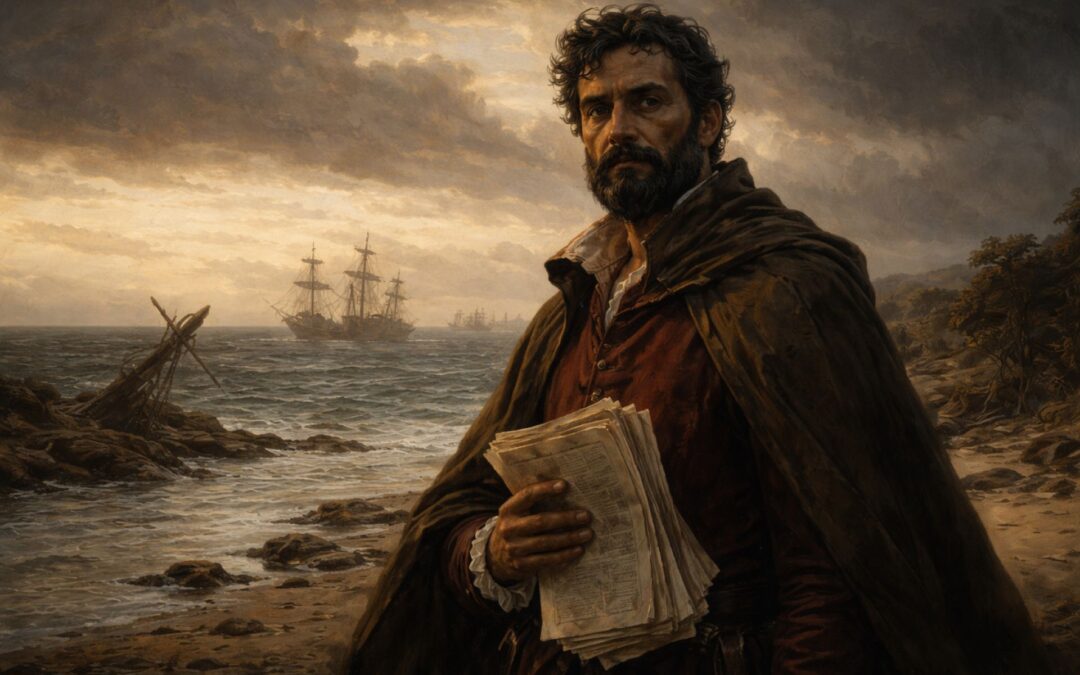
While returning from service in Southeast Asia, sometime in the early 1560s, Camões’ ship was wrecked near the mouth of the Mekong River. The details are sparse, but the outcome is not. The vessel was lost. Lives were likely lost. What remained was chaos—water, debris, and the immediate, instinctive fight to survive.
Camões made it to shore.
And according to long-standing accounts, he did so while keeping one arm raised above the water, holding a manuscript—the early draft of what would become Os Lusíadas. Whether the image has been embellished over time almost doesn’t matter. What it represents is entirely consistent with the man.
In a moment where survival should have been the only priority, he chose to preserve the work.
That choice is revealing.
By this point, Camões had already lived through exile, war, imprisonment, and repeated instability. He had seen the empire not as legend, but as lived experience—fragmented, difficult, and often indifferent to the individuals who served it. And yet, he was writing an epic about it. Not a fragmented account, but a structured, classical work that would elevate Portugal’s history into something mythic.
The manuscript was not just a collection of verses. It was an attempt to impose order on chaos.
To take scattered experiences—voyages, battles, encounters—and shape them into a coherent narrative of purpose and destiny. Saving it was not just an act of attachment. It was an act of commitment to that vision, even as everything around him suggested instability.
But survival did not bring relief.
After reaching land, Camões was eventually rescued, only to find himself once again entangled in administrative conflict. He was accused of mismanaging the assets of the deceased—funds and responsibilities entrusted to him during his service in Macau. Whether this was incompetence, misfortune, or another consequence of his inability to navigate authority is unclear.
What is clear is the outcome.
Another arrest. Another interruption. Another confirmation that no matter how far he traveled, the same cycle followed him.
By now, it was no longer just a pattern.
It was the structure of his life.
The Long Road Home and the Cost of Return
By the late 1560s, Camões had reached a breaking point.
Years of service, conflict, imprisonment, and instability had accumulated into something more than hardship—it had become exhaustion. The East had offered him experience, material for his writing, and a deeper understanding of the empire. But it had given him no stability, no lasting position, and no sense of resolution. Whatever purpose had once justified his exile had run its course.
He decided to return to Portugal.
The decision itself was simple. The execution was not.
Camões did not have the means to leave on his own. He borrowed money—reportedly from a colonial official—to finance his passage back. It was a practical necessity, but also a risk. His life had already shown a pattern: obligations were easy to incur, difficult to settle. This would prove no different.
He reached Mozambique, intending to continue his journey to Lisbon.
Instead, he became stranded.
Unable to repay the borrowed money, he was effectively held in place, his departure delayed not by fate or disaster, but by debt. For two years, he remained there—waiting, dependent on the support of friends who eventually helped him gather enough resources to move on.
It was a quieter kind of hardship, but no less revealing.
This was no longer the impulsive young man of Lisbon, nor the restless soldier moving between campaigns. This was a man worn down by accumulation—of mistakes, of circumstances, of unresolved consequences. Even his return home required negotiation, assistance, and time.
Eventually, in 1569, he managed to set sail again.
But even in this final stretch, loss followed him.
One of his close companions died during the journey, adding another layer to an already heavy return. By the time Camões approached Lisbon, he was not arriving as a triumphant figure returning from distant service. He was arriving diminished—financially strained, emotionally burdened, and carrying with him the weight of everything that had come before.
And yet, he carried something else as well.
The manuscript.
After years of exile, imprisonment, and survival, the work he had protected—through conflict, through shipwreck, through instability—was finally ready to take its place in the country it was meant to immortalize.
What remained to be seen was whether that country would recognize its value.
Os Lusíadas: Glory, Myth, and Hidden Warning
When Camões finally returned to Lisbon, he did not come back with wealth, status, or political leverage.
He came back with a manuscript.
Os Lusíadas was not just another literary work. It was an epic in the classical tradition, modeled after the great works of antiquity—Homer, Virgil—but repurposed for a distinctly Portuguese story. At its center was the voyage of Vasco da Gama, the expedition that had opened the sea route to India and symbolized Portugal’s rise as a global power.
On the surface, it was exactly what the nation would want.
A celebration of exploration. A mythologized account of courage, destiny, and divine favor. Camões elevated Portuguese sailors into heroes, framed their journeys as part of a larger cosmic narrative, and positioned Portugal as a chosen force shaping the world.
But the surface is only part of the story.
Camões was not writing from a position of distance. He had lived the empire he was describing. He had seen its administration, its conflicts, its corruption, and its fragility. That experience seeps into the work—not as overt criticism, but as tension beneath the praise.
The epic celebrates, but it also questions.
There are moments in Os Lusíadas where ambition is framed as dangerous, where moral decay is hinted at, where the cost of expansion becomes visible beneath the rhetoric of glory. The narrative does not collapse into cynicism, but it refuses to be purely triumphant. It carries an awareness that the very forces driving Portugal’s greatness could also lead to its decline.
This duality is what gives the work its depth.
It is both a monument and a warning.
When Camões presented the poem to King Sebastian, the young monarch recognized its significance. He ordered its publication in 1572 and granted Camões a pension—modest, irregular, but enough to acknowledge the value of the work.
Recognition came.
Stability did not.
The pension was inconsistently paid, and Camões, never particularly skilled at managing money, continued to struggle materially. The man who had written the defining epic of his nation was not transformed into a figure of comfort or security. He remained, in many ways, what he had always been—dependent, unstable, and at the margins of the very system he had immortalized.
And as his work entered the world, the nation it celebrated was beginning to change in ways he had already anticipated.
The warning embedded in the poem was no longer theoretical.
It was becoming visible.
A Nation in Decline and a Poet Left Behind
By the time Os Lusíadas was published, the illusion of permanent Portuguese dominance was already beginning to fracture.
The empire still existed—its territories stretched across continents, its fleets still moved between oceans—but the underlying structure was weakening. Resources were strained. Administration was inconsistent. Rival powers were no longer distant threats, but active challengers. What had once been expansion was now maintenance, and maintenance is always harder.
Camões could see it.
Not as a historian looking back, but as a participant who had lived the strain firsthand. He had seen how difficult it was to hold distant territories, how easily authority slipped into corruption, how fragile the entire system became when stretched too far. The epic he had written captured the height of Portuguese ambition. The reality around him reflected its limits.
Then came the turning point.
In 1578, King Sebastian led a military campaign into Morocco—a bold, almost reckless attempt to assert power beyond Portugal’s capacity. It ended in disaster. At the Battle of Alcácer Quibir, Sebastian was killed, along with a significant portion of the Portuguese nobility. The loss was not just military. It destabilized the entire political structure of the kingdom.
Portugal had lost not only its king, but its continuity.
The crisis that followed exposed just how vulnerable the state had become. With no clear successor, competing claims emerged, and the kingdom entered a period of uncertainty that would ultimately lead to foreign domination under the Spanish crown.
Camões lived through this moment.
Not as a figure of influence, not as an advisor or statesman, but as an observer—one who had already understood, long before the collapse became undeniable, that the empire’s strength was not as secure as it appeared.
There is a certain irony in this.
The man who had given Portugal its greatest literary expression of identity and achievement was now watching that identity begin to unravel. His work had captured the myth of permanence. His life was now surrounded by evidence of impermanence.
And through it all, his own position did not improve.
He remained financially unstable, dependent on an unreliable pension, and largely unsupported by the system he had served in multiple capacities—soldier, administrator, writer. The recognition he had received did not translate into security. It remained symbolic, not structural.
As the nation struggled to hold itself together, Camões was left where he had always been.
On the margins, observing, understanding, but never fully integrated into the world he had spent his life trying to define.
Death, Obscurity, and the Irony of Legacy
Luís de Camões died in 1580, not as a celebrated national figure, but as a man worn down by a lifetime of instability.
There was no grand ending. No recognition proportional to his contribution. No transformation of his circumstances after the publication of Os Lusíadas. He died in relative poverty, dependent on a pension that had never been reliable, in a country that was itself entering one of the most uncertain periods in its history.
Timing, in his case, feels almost deliberate.
Just months after his death, Spain moved to assert control over Portugal, initiating the Iberian Union. What followed was exactly the kind of strain Camões had already sensed—an empire pulled into conflicts not entirely its own, its resources stretched further, its autonomy compromised. The decline he had hinted at in his work became political reality.
He did not live to see the full consequences.
But he had already understood the direction.
There is an irony here that is difficult to ignore. Camões dedicated his greatest work to glorifying Portugal—its explorers, its achievements, its place in the world. He gave the nation a narrative of greatness, structured in the language of epic tradition, designed to endure beyond his lifetime.
And yet, in his own lifetime, that nation failed to sustain him.
He served it in multiple roles—courtier, soldier, colonial official, writer—and in each role, he remained peripheral. Useful, but not secure. Recognized, but not supported. His legacy was accepted. His life was not stabilized.
This contrast is central to understanding him.
Camões did not write from comfort. He wrote from experience—often difficult, often unstable, often in conflict with the very structures he depended on. That is what gives Os Lusíadas its depth. It is not the product of blind patriotism. It is the work of a man who saw both the greatness and the fragility of the system he was describing.
After his death, his reputation grew.
He became, over time, the defining literary figure of Portugal. His work was studied, celebrated, and placed at the center of national identity. The recognition that had been limited in life expanded in death, as it often does.
But that only sharpens the final irony.
The man who defined how a nation remembered itself was not fully recognized by that nation while he was alive.
He wrote its story.
He did not benefit from it.
Conclusion
Luís de Camões does not fit neatly into the category of a national hero.
He was too unstable for that. Too contradictory. Too difficult to contain within a clean narrative of greatness. His life resists simplification because it was never linear. It was fractured—marked by exile, conflict, survival, and repeated failure to secure a stable place within the very system he served.
And yet, he produced something enduring.
Os Lusíadas is not just a celebration of Portugal’s past. It is a reflection of a moment when belief in expansion, destiny, and permanence still held weight—but was already beginning to crack. Camões captured that moment from the inside. He understood the machinery of empire not as abstraction, but as lived reality.
That is why the work lasts.
It carries both admiration and awareness. It elevates Portuguese achievement, but it also recognizes the limits beneath it. It speaks in the language of epic, but it is grounded in experience that contradicts the illusion of effortless greatness.
His life mirrors that same tension.
A man of talent who never found stability. A patriot who was repeatedly sidelined by his own nation. A writer who immortalized an empire while personally living through its inconsistencies and decline. By the time Portugal’s weakening position became undeniable, Camões had already spent years navigating its consequences.
He saw the peak.
He also understood that it was already passing.
And in that understanding, he left behind something more valuable than praise.
He left behind clarity.