
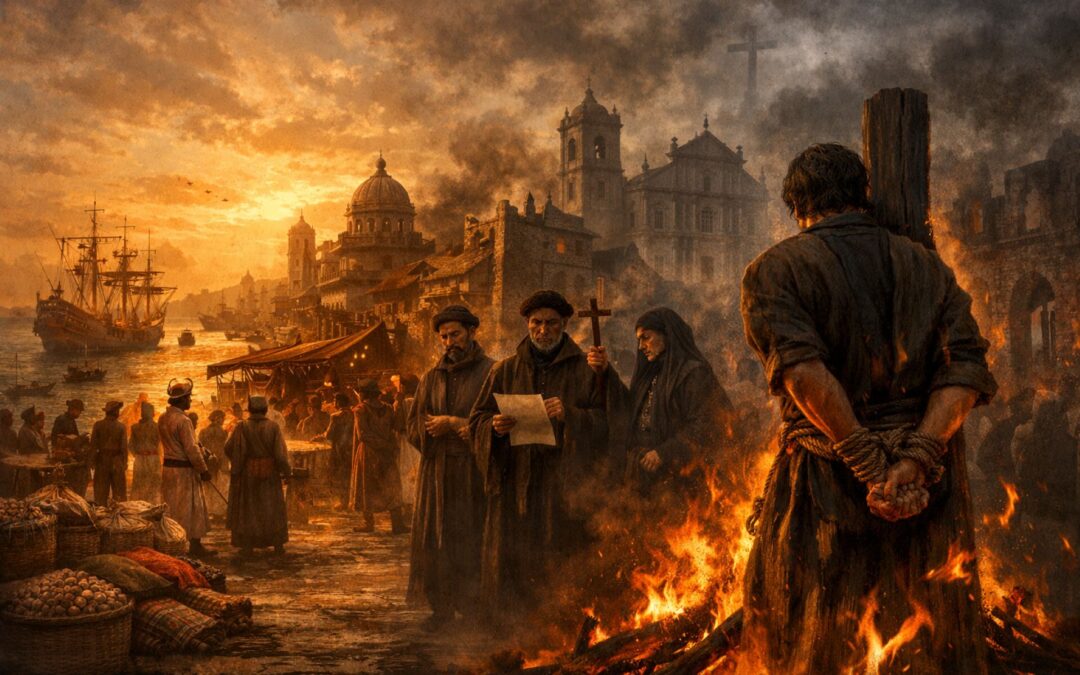
Introduction: A Colony Built on Trade, Broken by Faith
In 1510, when the Portuguese seized Goa from the Bijapur Sultanate, they did not just capture a coastal territory—they secured a gateway into one of the most valuable commercial systems in the world. The Indian Ocean was not an empty arena waiting for European dominance; it was already a dense, interconnected web of trade routes linking East Africa, the Middle East, India, and Southeast Asia. Arab merchants, Gujarati traders, Persian intermediaries, and local Indian networks had been operating within this system for centuries.
The Portuguese entered this world as outsiders—but ambitious ones.
Their early strategy in Goa reflected a kind of pragmatic realism. They understood that domination of trade did not come from brute force alone. It required cooperation, adaptation, and—perhaps most importantly—participation in existing systems. Goa, therefore, was not immediately transformed into a rigid colonial enclave. Instead, it evolved into a hybrid space where Portuguese authority coexisted with local practices, where cultural boundaries blurred, and where economic incentives overrode ideological rigidity.
For a time, this approach worked.
Goa flourished. It became the capital of Portuguese India, a vibrant port city where merchants from different backgrounds converged, where languages mixed, and where identities were more fluid than fixed. Portuguese settlers married local women, missionaries learned regional languages, and communities like the “New Christians”—recent converts from Judaism and Islam—found in Goa an escape from the suspicion and persecution they faced in Europe.
But this fragile equilibrium rested on a contradiction.
The Portuguese Empire was not merely a commercial enterprise—it was also deeply embedded in the religious transformations sweeping through Europe. The same state that pursued profit across oceans was also shaped by a growing obsession with religious conformity. In Portugal itself, the Inquisition had already begun to enforce orthodoxy, targeting those suspected of secretly practicing non-Christian faiths. Suspicion, surveillance, and the policing of belief were becoming institutionalized.
For a while, Goa remained insulated from these forces. Distance from Europe, combined with the practical demands of trade, allowed for a more flexible approach. But that distance could not hold forever.
Gradually, the balance began to shift.
As more missionaries and religious authorities arrived in Goa, the earlier tolerance of diversity started to be reinterpreted as moral failure. The cosmopolitan nature of the city—once its greatest strength—was now seen as a sign of corruption. Portuguese settlers who adopted local customs were criticized. Interactions between communities were viewed with suspicion. The very openness that had enabled Goa’s success became, in the eyes of religious hardliners, a problem to be solved.
By the mid-16th century, this shift culminated in a decisive and irreversible change: the establishment of the Goan Inquisition in 1560.
What followed was not simply a tightening of religious policy. It was the construction of a system that reached into every aspect of life—legal, social, economic, and cultural. It redefined what it meant to belong, to believe, and even to exist within Portuguese Goa. Communities that had once coexisted were now divided by suspicion. Practices that had once been ordinary became punishable crimes.
And in the process, the Portuguese Empire began to undermine the very foundation of its power in India.
The Portuguese Dream: Building a Trade Empire in the Indian Ocean
To understand why Goa mattered so much, it is essential to understand the scale of what the Portuguese were attempting.
At the turn of the 16th century, European powers were still peripheral to the main currents of global trade. The wealth of the world flowed through the Indian Ocean, where spices from Southeast Asia, textiles from India, and goods from China moved westward through established maritime networks. Control over these routes meant access to immense wealth—but it also required integration into a system that Europeans did not yet fully understand.
Portugal’s breakthrough came with its maritime explorations. By rounding the Cape of Good Hope and entering the Indian Ocean, the Portuguese bypassed traditional overland routes controlled by Middle Eastern intermediaries. But access alone was not enough. To convert access into dominance, they needed strategic footholds—ports that could serve as bases for trade, administration, and military projection.
Goa was one such foothold, and perhaps the most important.
Its natural harbor made it ideal for docking ships. Its location along the western coast of India placed it within reach of major trade routes. And its proximity to inland markets allowed for the movement of goods beyond the coast. When the Portuguese captured Goa in 1510, they recognized its potential immediately and elevated it to the status of their capital in Asia.
But turning Goa into a functional center of empire required more than infrastructure—it required people who could navigate local realities.
The Portuguese, despite their military successes, were a relatively small power operating far from home. They lacked the numbers and local knowledge needed to run a complex trading system on their own. This limitation forced them into a strategy that, at least initially, was marked by flexibility.
They relied heavily on intermediaries.
Local merchants, administrators, and translators became indispensable. New Christians—those who had been forcibly converted in Portugal—played a particularly important role. Many of them were already experienced in trade and administration, and in Goa, they found opportunities that were denied to them in Europe. Their presence helped bridge the gap between Portuguese authorities and local networks.
At the same time, the Portuguese encouraged cultural integration. Settlers were not isolated from the local population; they were encouraged to engage with it. Marriages between Portuguese men and Indian women were promoted, creating families that were culturally hybrid and socially connected to both worlds. Missionaries, rather than imposing their language, often learned local ones, recognizing that communication was essential for influence.
This approach was not driven by idealism—it was driven by necessity.
Trade demanded cooperation. Profit required stability. And stability, in a foreign land, could only be achieved by working with existing systems rather than trying to replace them overnight.
For a few decades, this model proved effective. Goa became a thriving center of commerce, attracting merchants from across the region. It was a place where different communities interacted regularly, where economic incentives created a shared interest in maintaining order, and where the Portuguese Empire seemed to have found a workable formula for overseas expansion.
Yet, embedded within this system was a tension that would eventually prove fatal.
The same openness that enabled trade also created ambiguity—about identity, loyalty, and belief. For an empire increasingly influenced by religious orthodoxy, such ambiguity was not sustainable. The more Goa succeeded as a cosmopolitan hub, the more it appeared, to certain elements within the Portuguese establishment, as a place where control was slipping.
And in empires, perceived loss of control often triggers overcorrection.
A Fragile Harmony: Goa Before the Inquisition
Before the imposition of the Inquisition, Goa existed in a state that can best be described as negotiated coexistence. It was not a utopia of equality, nor was it free of hierarchy or conflict. But it was a space where different groups—Portuguese settlers, New Christians, Hindus, Muslims, and local elites—were able to function within a shared framework shaped largely by economic necessity.
At the center of this arrangement were the New Christians.
In Portugal, they occupied a precarious position. Though officially converted to Christianity, they were often suspected of secretly practicing their former religions. This suspicion made them targets of discrimination and, eventually, persecution. For many, the expansion of the Portuguese Empire offered an escape—a chance to relocate to distant territories where scrutiny might be less intense.
Goa became one of those destinations.
In India, New Christians found a different kind of environment—one where the rigid social boundaries of Europe were less strictly enforced, and where their skills could be put to use. Many became merchants, administrators, or intermediaries, integrating themselves into the economic life of the colony.
For those of Jewish heritage, Goa also offered something more personal: proximity to long-established Jewish communities along the western coast of India, particularly in regions like Kerala. This allowed some New Christians to quietly reconnect with aspects of their ancestral identity, navigating a dual existence shaped by both public conformity and private belief.
Alongside them were local Hindu and Muslim communities, who were not merely passive subjects of Portuguese rule but active participants in the functioning of the colony. They contributed to trade, governance, and daily life, forming the backbone of Goa’s economic system.
Interactions between these groups were frequent and often practical. Portuguese settlers, especially in the early decades, adapted to local conditions. They formed relationships with native communities, adopted certain customs, and participated in a shared social environment that was defined less by rigid separation and more by overlapping roles.
Even the early missionaries reflected this pragmatism. Rather than immediately enforcing strict religious conformity, they sought to understand the societies they were engaging with. Learning local languages like Konkani was not just a tool for conversion—it was a recognition that influence required communication, and communication required adaptation.
This created a society that, while complex and imperfect, was functional.
Markets operated. Trade flowed. Communities coexisted—not because they were free of tension, but because the system incentivized cooperation over conflict. Diversity, in this context, was not an ideological commitment; it was a practical necessity.
However, this equilibrium depended on a delicate balance.
It required the Portuguese authorities to prioritize stability over uniformity, to tolerate ambiguity in matters of identity and belief, and to accept that their control was mediated through local realities. As long as trade remained the primary objective, this balance could be maintained.
But as the influence of religious authorities grew, the terms of this balance began to change.
What had once been seen as pragmatic adaptation was increasingly interpreted as moral compromise. The presence of multiple faiths, the blending of customs, and the fluidity of identity—all of which had sustained Goa’s prosperity—were now viewed as threats to religious purity.
And once diversity becomes a threat, coexistence becomes impossible.
The stage was set for a transformation—not gradual, but decisive—where the logic of trade would be replaced by the logic of control, and where the fragile harmony of Goa would give way to one of the most oppressive systems in colonial history.
Seeds of Intolerance: The Rise of Religious Extremism
The transformation of Goa from a cosmopolitan trade hub into a site of ideological enforcement did not happen overnight. It was not the result of a single decree or a sudden shift in policy. Rather, it emerged gradually—through a convergence of forces that were already reshaping Portuguese society back in Europe.
To understand this shift, one must look beyond Goa and into Portugal itself.
By the early 16th century, Portugal was undergoing a profound transformation in how it understood religious identity. In 1497, under King Manuel I, Muslims and Jews in Portugal were forcibly converted to Christianity. These converts, known as “New Christians,” were officially part of the Christian community—but in practice, they were treated as perpetual outsiders. Suspicion followed them everywhere. It was widely believed that many continued to practice their old faiths in secret, and this belief justified increasing levels of surveillance and discrimination.
In 1536, this suspicion was institutionalized with the establishment of the Portuguese Inquisition.
Modeled after similar institutions in Spain, the Portuguese Inquisition was not merely a religious body—it was an extension of state power. Though it operated under papal authority, it was deeply intertwined with the monarchy. The Grand Inquisitor was selected by the king, often from within the royal family, ensuring that the institution served both religious and political purposes.
Its mandate was broad and flexible.
Officially, the Inquisition existed to protect the integrity of the Catholic faith—to identify heresy, punish false doctrines, and ensure conformity. But in practice, it extended far beyond theology. It censored books, suppressed dissent, and targeted individuals whose beliefs or behavior deviated from accepted norms. It was as much about control as it was about faith.
This ideological framework did not remain confined to Portugal.
As the empire expanded, so too did the mindset that underpinned the Inquisition. The Portuguese did not simply export their administrative structures—they exported their anxieties. The fear of hidden heresy, the obsession with religious purity, and the belief that deviation must be punished began to influence how colonial territories were governed.
In Goa, this influence initially remained in the background.
The early administrators of Portuguese India were often practical men—soldiers, traders, and adventurers who understood that survival in a foreign land required flexibility. They relied on local cooperation, and for them, the complexities of Indian society were something to be navigated, not eradicated.
But this pragmatism began to erode as a different group gained prominence: the religiosos.
These were missionaries, clergymen, and religious officials who arrived in increasing numbers as the Portuguese presence in India stabilized. Unlike the earlier administrators, their primary concern was not trade or governance—it was spiritual transformation. They viewed Goa not just as a colony, but as a potential stronghold of Christianity in Asia.
And from their perspective, the situation they encountered was deeply troubling.
Portuguese settlers were adopting local customs. Relationships between Christians and non-Christians were common. New Christians were living alongside communities that allowed them to reconnect with their former beliefs. To the religiosos, this was not a sign of a successful colony—it was evidence of moral decay.
What had once been seen as adaptation was now condemned as corruption.
Figures like missionaries and religious reformers began to argue that Goa needed to be “purified.” The blending of cultures, the tolerance of multiple faiths, and the flexibility of early colonial policy were all reinterpreted as failures to uphold true Christianity. The colony, in their eyes, was drifting away from its rightful purpose.
This perspective gained traction at the highest levels of authority.
The Portuguese monarchy, already aligned with the goals of the Inquisition at home, was receptive to these concerns. The idea that Goa could serve as a bastion of Catholicism in Asia was appealing—not just for religious reasons, but for political ones as well. A colony unified under a single faith would, in theory, be easier to control.
And so, the priorities began to shift.
Trade was no longer the sole objective. Religious conformity became an equally important goal, and increasingly, the two were seen as intertwined. The presence of diverse communities, once an asset, was now framed as a threat to both spiritual and political stability.
This shift did not immediately result in the establishment of the Inquisition in Goa. But it did set the stage.
Policies began to change. Attitudes hardened. The groundwork was laid for a system that would not merely regulate belief, but actively reshape society.
The seeds of intolerance had been planted—and they were about to take root.
The Destruction Begins: Anti-Hindu and Anti-Muslim Policies
Long before the formal establishment of the Goan Inquisition in 1560, the Portuguese had already begun to experiment with policies that sought to reshape the religious landscape of their colony. These early measures reveal something important: the Inquisition was not an abrupt break from the past, but the culmination of a process that had already begun.
The shift from tolerance to coercion was gradual—but unmistakable.
One of the earliest strategies employed by the Portuguese authorities was the use of incentives for conversion. Hindus and Muslims were offered financial and social benefits if they embraced Christianity. On the surface, this approach appeared less violent than outright persecution. It relied on persuasion, or at least the appearance of it.
But these incentives operated within a system of unequal power.
Conversion was not simply a personal choice—it was shaped by economic pressures and social constraints. Those who converted could gain access to opportunities that were otherwise denied, while those who refused found themselves increasingly marginalized. Over time, what began as encouragement began to feel like coercion.
This approach soon escalated into more direct forms of intervention.
In 1546, the Portuguese king issued a sweeping order that marked a decisive turning point: the destruction of all Hindu temples within Portuguese-controlled territories. This was not a symbolic gesture—it was a systematic effort to dismantle the physical and cultural infrastructure of Hindu religious life.
Temples were not merely places of worship; they were centers of community, identity, and tradition. Their destruction sent a clear message: the old order was no longer acceptable.
By 1569, records indicate that over 760 temples in Goa alone had been demolished.
The scale of this destruction is difficult to overstate. Entire networks of religious practice were uprooted. Rituals, festivals, and community gatherings that had been part of everyday life were suddenly rendered impossible. What had once been public and visible was forced into secrecy—or abandoned altogether.
Muslim communities faced a different but equally restrictive set of pressures.
Unlike Hindu temples, mosques were not always outright destroyed in the early phase. Instead, the Portuguese imposed heavy taxes on Muslim institutions, making it financially difficult for them to function. This approach achieved a similar outcome: it weakened the institutional presence of Islam without necessarily resorting to immediate physical destruction.
The effect, however, was the same—gradual erosion of religious life.
These policies were not isolated acts of intolerance; they were part of a broader strategy to reshape Goa’s social fabric. By targeting the institutions that sustained non-Christian communities, the Portuguese were attempting to create conditions in which conversion would become not just attractive, but inevitable.
At the same time, these measures reflected a growing confidence among religious authorities.
The religiosos, emboldened by their increasing influence, began to push for more aggressive action. They argued that partial measures were insufficient—that as long as alternative religious practices continued to exist, the integrity of the Christian community would remain compromised.
Their vision was not one of coexistence, but of replacement.
And crucially, they found support from the state.
The Portuguese monarchy, already aligned with the logic of the Inquisition in Europe, endorsed these policies. The destruction of temples, the marginalization of Muslims, and the incentivization of conversion were not rogue actions—they were sanctioned at the highest levels.
By the time the Inquisition was formally established in Goa, much of the groundwork had already been laid.
Religious diversity had been weakened. Non-Christian communities had been destabilized. The idea that the state had the right to intervene in matters of belief had already been normalized.
In many ways, the Inquisition did not introduce a new system—it intensified an existing one.
What changed was not just the scale of enforcement, but its nature.
The earlier policies had focused on external structures—temples, mosques, and public practices. The Inquisition, however, would go further. It would turn inward, targeting not just what people did, but what they believed.
And in doing so, it would transform Goa into a society defined not by coexistence, but by fear.
The Man Who Lit the Fuse: Francis Xavier and the Push for Inquisition
By the mid-16th century, the transformation of Goa was no longer a slow drift—it was being actively pushed forward by individuals who believed that the colony had strayed too far from its intended purpose. Among the most influential of these figures was Francis Xavier, a co-founder of the Jesuit order and one of the most prominent missionaries in the Portuguese Empire.
When Francis Xavier arrived in Asia, he encountered a colonial society that, from his perspective, was deeply compromised. Portuguese settlers were not living as exemplars of Christian virtue. Instead, many had adapted to local customs, formed relationships with non-Christian women, and participated in a social environment that blurred religious boundaries. To earlier administrators, this had been a necessary accommodation to local realities. To Xavier, it was a failure of discipline and faith.
His concerns went beyond the behavior of settlers.
What troubled him more was the permeability of religious identity in Goa. Converts to Christianity—whether from Hindu, Muslim, or Jewish backgrounds—were not always abandoning their previous beliefs entirely. Some maintained elements of their old practices in private. Others moved between identities depending on context. To Xavier and other religious authorities, this ambiguity was intolerable. Christianity, in their view, demanded exclusivity. Anything less was heresy.
In 1546, writing from Malacca, Francis Xavier sent a letter to the Portuguese king, John III of Portugal. In it, he made a direct and urgent appeal: Goa needed an Inquisition.
The request was not framed as a matter of administrative reform, but as a moral necessity. Without a formal mechanism to investigate and punish heresy, Xavier argued, the colony would continue to drift into spiritual decay. Converts would relapse into their former beliefs. Settlers would continue to adopt local customs. The integrity of the Christian community would remain compromised.
What Xavier proposed was not merely stricter enforcement—it was systemic intervention.
The idea was to create an institution that could monitor belief, investigate suspicion, and enforce conformity. It would not rely on voluntary compliance or gradual persuasion. It would operate through authority, surveillance, and punishment.
For the Portuguese crown, this proposal aligned with broader developments back home. The Inquisition had already been established in Portugal, and its logic was well understood. Extending it to Goa was not a radical innovation—it was an application of an existing model to a colonial setting.
And yet, the decision was not immediate.
For over a decade after Xavier’s request, Goa continued without a formal Inquisition. This delay reflects the tension that still existed within the Portuguese administration. Trade remained important, and there were still those who recognized that excessive rigidity could undermine economic stability.
But the balance was shifting.
By 1560, the arguments in favor of religious enforcement had gained the upper hand. The crown approved the establishment of the Inquisition in Goa, and with that decision, the colony entered a new phase of its history.
The Inquisition was headquartered in a symbolic location—the former palace of the Bijapur Sultan. This was not accidental. It represented a transfer of authority, not just from one political power to another, but from one ideological framework to another. A space that had once been associated with regional governance was now repurposed as the center of religious control.
With its establishment, the underlying logic of Portuguese rule in Goa changed fundamentally.
What had once been a colony sustained by negotiation and adaptation would now be governed by suspicion and enforcement. And the system that Francis Xavier had advocated for would soon reveal just how far it was willing to go.
Inside the Goan Inquisition: A System Built on Fear
The Goan Inquisition was not a loose collection of religious courts or an occasional instrument of punishment. It was a structured, institutional system—one that combined religious authority with state power to create a mechanism of control that penetrated deeply into everyday life.
At its core was a simple but dangerous premise: that belief could—and should—be regulated.
The Inquisition operated under the authority of officials appointed through a hierarchy that linked Goa directly to the broader Portuguese system. While it was nominally a religious institution, its power was reinforced by the state. This dual backing gave it a level of influence that extended far beyond matters of doctrine.
Its reach was expansive.
The definition of heresy was deliberately broad and often vague. It could include practicing a non-Christian religion, certainly—but it could also encompass behaviors that appeared inconsistent with orthodox Christianity. Observing certain rituals, maintaining specific dietary habits, or even being suspected of privately holding unorthodox beliefs could trigger investigation.
This ambiguity was not a flaw; it was a feature.
A system that defines its boundaries loosely can expand them as needed. It allows authorities to act not just against clear violations, but against perceived threats. And in Goa, this flexibility created an environment where almost anyone could become a target.
Central to this system was the role of accusation.
The Inquisition relied heavily on information provided by individuals—neighbors, acquaintances, even family members. Citizens were encouraged to report suspected heresy, and in many cases, they were rewarded for doing so. A portion of the property confiscated from the accused could be granted to the accuser, creating a powerful financial incentive.
This transformed suspicion into currency.
Accusations were no longer solely about belief—they became tools for personal gain. Disputes, rivalries, and grievances could be reframed as matters of heresy. The system did not merely punish deviation; it created conditions in which deviation could be manufactured.
The officials of the Inquisition also benefited directly.
Confiscated property was often divided between the accusers and the authorities, giving inquisitors a material stake in the outcomes of their investigations. This blurred the line between justice and exploitation. The more convictions they secured, the more wealth and influence they accumulated.
Over time, this dynamic contributed to the emergence of a new kind of elite within Goa.
The religiosos—those who had initially positioned themselves as moral guardians—began to operate as a form of colonial aristocracy. They wielded power not just through religious authority, but through control over property and resources. Their position allowed them to maintain lifestyles that stood in stark contrast to the austerity they preached.
In this environment, the Inquisition became more than a religious institution. It became a system that shaped social hierarchies, redistributed wealth, and reinforced power structures.
And underpinning all of this was fear.
Fear of being accused. Fear of being watched. Fear of being misunderstood. The knowledge that even private actions could be scrutinized created a climate in which individuals were forced to regulate their own behavior constantly. Conformity was not just expected—it was internalized.
The Inquisition did not need to be omnipresent to be effective. It only needed to be unpredictable.
The Trial of Faith: How the Inquisition Worked
If the structure of the Goan Inquisition established its authority, its procedures revealed its true nature.
At the heart of its operations was a legal process that inverted many of the principles associated with justice. The accused were not presumed innocent—they were presumed guilty. From the moment an individual was charged with heresy, the burden was on them to prove otherwise.
The process began with accusation.
Once a person was reported to the Inquisition, they could be summoned or arrested. The charges against them were often not fully disclosed, leaving the accused uncertain about the specifics of their alleged offense. This uncertainty was itself a form of pressure, making it difficult to mount a coherent defense.
Upon being charged, the accused were given a limited window—typically around 40 days—to confess.
Confession, in this context, was not simply an admission of guilt. It was also a negotiation. Those who confessed early might receive lighter punishments, while those who resisted faced harsher consequences. This created a powerful incentive to admit wrongdoing, even in cases where no wrongdoing had occurred.
For those who did not confess, the process moved to trial.
Trials under the Inquisition were not conducted with the transparency or safeguards one might expect from a modern legal system. Evidence could include testimony from witnesses whose identities were not always revealed. The accused often had limited ability to challenge these testimonies or to present their own evidence effectively.
And then there was torture.
Torture was not used arbitrarily, but it was an accepted tool within the inquisitorial framework. It was applied to extract confessions or to clarify inconsistencies in testimony. The underlying assumption was that truth could be forced out of the body—that pain could reveal what the mind concealed.
In practice, this meant that resistance could be interpreted as guilt, and confession could be the result of unbearable suffering rather than actual culpability.
Once a verdict was reached, the process culminated in one of the most public and symbolic aspects of the Inquisition: the auto-da-fé.
The term, meaning “act of faith,” referred to a carefully orchestrated public ceremony in which sentences were announced and punishments carried out. These events were not merely administrative—they were performative.
They involved processions, prayers, and the presence of both religious and civil authorities. The condemned were brought before the public, their crimes declared, and their fates decided.
Punishments varied depending on the severity of the offense.
Some were fined or subjected to public whipping. Others were imprisoned or forced to perform acts of penance. But for those deemed most guilty, the punishment was execution—often by burning at the stake.
The spectacle of the auto-da-fé served multiple purposes.
It reinforced the authority of the Inquisition. It demonstrated the consequences of deviation. And it transformed punishment into a communal experience, ensuring that fear was not confined to the individual, but shared by society as a whole.
In this way, the process of the Inquisition was not just about determining guilt. It was about shaping behavior.
It created a system in which belief was policed not only by institutions, but by the ever-present awareness of what could happen if one failed to conform.
Targets of the Inquisition: Jews, New Christians, and Muslims
While the Goan Inquisition cast a wide net, not all groups were targeted equally. Its focus reflected both inherited anxieties from Europe and the specific realities of colonial Goa. Among its earliest and most persistent targets were the New Christians—those whose very existence embodied the fear that conversion did not necessarily mean transformation.
In Portugal, New Christians had long been viewed with suspicion. Officially Christian, they were nonetheless believed to secretly practice Judaism or Islam. This suspicion did not dissipate when they crossed the seas to India. If anything, distance made it worse. Removed from the oversight of European authorities and surrounded by diverse religious communities, they were seen as even more likely to “relapse.”
Goa, in particular, intensified this anxiety.
Unlike Portugal, India was not a religiously uniform society. Jewish communities had existed along the western coast for centuries. Muslim traders moved regularly between regions. Hindu practices were deeply embedded in everyday life. For New Christians, this environment made it easier to reconnect with their past—quietly, discreetly, and often invisibly.
From the perspective of the Inquisition, this was precisely the problem.
The fear was not just that New Christians might abandon Christianity, but that they might do so undetected. That they might live double lives—publicly conforming while privately dissenting. This possibility made them uniquely threatening within a system that depended on visible conformity.
As a result, the Inquisition devoted significant attention to identifying and prosecuting cases of “Judaizing” or “Islamizing.”
The signs it looked for were often subtle. Observing dietary restrictions, avoiding certain foods, lighting lamps in particular ways, or following specific rituals—all could be interpreted as evidence of hidden faith. Even behaviors that had multiple cultural explanations could be reframed as heretical if suspicion already existed.
This created a situation where ordinary actions became incriminating.
One of the most telling aspects of this system was how it interpreted ambiguity. In a diverse society like Goa, many practices overlapped across communities. But instead of acknowledging this complexity, the Inquisition treated overlap as deception. Similarity became evidence. Familiarity became suspicion.
The consequences were severe.
Individuals accused of secretly practicing Judaism or Islam could face the full weight of the inquisitorial process—interrogation, torture, and, in extreme cases, execution. Families were not spared. Accusations could spread across households, turning private suspicion into collective punishment.
The case of Garcia de Orta illustrates the reach of this system. A respected physician who had served regional rulers, he was posthumously implicated in accusations of Judaizing. His own sister was burned at the stake, and under interrogation, she named him as a fellow practitioner. Even death did not guarantee immunity from suspicion.
Beyond individuals, the Inquisition also targeted the networks that sustained these communities.
In 1565, the Portuguese authorities banned Jews from entering Goa altogether. The reasoning was clear: external influence was seen as a catalyst for internal deviation. By cutting off contact with Jewish traders and communities from the Malabar Coast and the Middle East, the authorities hoped to isolate New Christians and prevent them from reconnecting with their past.
But this policy had unintended consequences.
Many of those affected were not just religious minorities—they were also merchants, intermediaries, and key participants in trade networks. By excluding them, the Portuguese were not only enforcing religious conformity; they were disrupting the very systems that sustained their economic power.
Some left voluntarily, seeking more tolerant environments. Others were pushed out by increasing restrictions. The result was a gradual erosion of a class that had been central to Goa’s commercial vitality.
Muslim communities, while treated differently, faced their own set of pressures.
They were not always subjected to the same level of inquisitorial scrutiny as New Christians, but they were systematically marginalized. Economic restrictions, social limitations, and administrative pressures reduced their ability to operate freely. Their presence, once an integral part of the trading ecosystem, was increasingly constrained.
Taken together, these policies reveal a pattern.
The Inquisition did not simply target belief—it targeted connectivity. It sought to isolate individuals from their communities, communities from their networks, and Goa from the broader systems that had once made it thrive.
And in doing so, it began to unravel the very fabric that had held the colony together.
The Harshest Blow: Systematic Persecution of Hindus
If New Christians represented a problem of hidden belief, Hindus represented something else entirely: visible, undeniable difference. Their practices were not concealed; they were embedded in the public and cultural life of Goa. For the Inquisition and the broader colonial administration, this visibility made them the most immediate and persistent challenge.
The response was not subtle.
Where earlier policies had sought to encourage conversion through incentives or weaken institutions through targeted actions, the post-Inquisition period saw a shift toward comprehensive control. Hinduism was not just discouraged—it was systematically dismantled.
Public religious life was the first to be targeted.
Festivals, ceremonies, and communal rituals—events that had once defined the rhythm of social life—were outlawed. Participation in such activities could result in severe punishment, including death. What had once been collective expressions of identity were forced into secrecy, stripped of their public presence.
The goal was not merely to suppress practice, but to erase visibility.
Temples had already been destroyed in earlier decades, but the Inquisition ensured that rebuilding them was impossible. Hindus were forbidden from constructing new temples or even repairing damaged ones. Religious idols, which held deep cultural and spiritual significance, were criminalized. Ownership alone could lead to prosecution.
This extended beyond religion into the structure of society itself.
Hindus were excluded from positions of authority in areas dominated by Christians. They were barred from participating in village assemblies, limiting their role in local governance. In legal proceedings, their testimony was often considered invalid, creating a system in which justice was structurally biased against them.
Economic restrictions reinforced this marginalization.
Christians were prohibited from employing Hindus, reducing opportunities for livelihood. Additional taxes, such as the shendi, were imposed specifically on Hindu populations, increasing the cost of maintaining their identity. Over time, these pressures created a situation in which remaining outside the Christian fold became increasingly difficult.
But perhaps the most intrusive policy was the one that targeted families directly.
Under Portuguese law, a Hindu child whose father had died was classified as an orphan—even if the child was surrounded by extended family. These “orphans” were taken into the custody of Jesuit institutions and raised as Christians. The policy redefined family structures to serve religious objectives, transforming guardianship into a tool of conversion.
The implications were profound.
Families could be separated not because they lacked care, but because they lacked conformity. Property associated with these children could be seized, creating yet another layer of economic incentive within the system. In some cases, authorities reportedly demanded payment for the return of children, blurring the line between religious enforcement and extortion.
Even conversion did not guarantee acceptance.
Those who converted from Hinduism to Christianity—becoming New Christians in the local context—often found themselves caught between identities. They were expected to abandon their previous customs entirely. Native languages like Konkani, Marathi, and Sanskrit were suppressed, and traditional names were replaced with Christian ones. The goal was not just to change belief, but to sever continuity with the past.
And yet, these efforts did not produce uniformity.
Instead, they created layers of tension. Converts navigated complex identities, balancing imposed expectations with inherited traditions. Those who refused to convert faced increasing hardship. Many chose to leave altogether.
The cumulative effect was displacement.
Large segments of the Hindu population migrated to neighboring regions, particularly the Bijapur Sultanate, where policies were comparatively more accommodating. Goa, once a space of interaction, began to lose entire communities that had sustained its social and economic life.
What remained was not a unified society, but a fragmented one—shaped less by integration and more by exclusion.
Exodus and Economic Collapse: When Oppression Killed Trade
The consequences of the Inquisition were not confined to religion or society—they extended directly into the economic foundations of Portuguese power in India. The same policies that enforced conformity also disrupted the networks that had made Goa prosperous.
At first, these effects were gradual.
The departure of New Christians, Jewish traders, and Hindu merchants did not immediately collapse the system. Trade routes continued to function, ships continued to arrive, and the machinery of commerce remained in motion. But beneath the surface, the structure was weakening.
Trade is not sustained by infrastructure alone.
It depends on relationships—on trust, familiarity, and the ability to navigate complex networks across regions. The merchants who left Goa were not easily replaceable. They carried with them knowledge of markets, connections with suppliers, and an understanding of how goods moved across distances.
When they left, they did not just reduce the number of traders—they disrupted the system itself.
The exodus of Jewish New Christians, in particular, had a pronounced impact. Many of them had been deeply embedded in long-distance trade networks that extended beyond India into the Middle East and beyond. Their removal weakened Goa’s ability to compete in these broader systems.
Hindu and Muslim merchants, facing their own pressures, also relocated.
Many found refuge in the Bijapur Sultanate, which, despite being a rival political entity, offered a more accommodating environment for diverse communities. There, they could continue their trade without the same level of restriction or surveillance.
This shift had a compounding effect.
As more merchants left, the incentives for others to stay diminished. Networks that had once converged in Goa began to reconfigure elsewhere. Trade routes adjusted. New centers of commerce emerged.
At the same time, the internal environment of Goa became less conducive to economic activity.
The Inquisition’s emphasis on surveillance and control created uncertainty. Accusations, confiscations, and the threat of punishment made it difficult for individuals to operate freely. Wealth could be seized. Partnerships could be disrupted. Stability—essential for trade—became harder to maintain.
The transformation of the religiosos into a kind of colonial elite further distorted the system.
Resources were increasingly concentrated in the hands of those aligned with the Inquisition. Wealth was not always generated through trade, but through confiscation and redistribution. This shifted the economic focus from production and exchange to control and extraction.
Over time, the cumulative impact became visible.
Goa’s position as a dominant trading hub began to erode. Other European powers, particularly the Dutch, capitalized on this shift. They established their own networks, often with greater flexibility and fewer ideological constraints. Where the Portuguese imposed uniformity, their competitors embraced pragmatism.
The contrast was stark.
One system prioritized control over belief, even at the cost of economic vitality. The other prioritized trade, even if it meant tolerating diversity. In a global marketplace, the latter proved more sustainable.
By the late 16th and early 17th centuries, the consequences of earlier decisions were becoming unavoidable.
The Portuguese Empire had not been defeated in Goa by external conquest alone. It had weakened itself from within—by dismantling the very conditions that had allowed it to succeed.
What began as an effort to strengthen control had, paradoxically, reduced it.
And in that paradox lies the deeper lesson of the Goan Inquisition: that systems built on fear may enforce obedience, but they rarely sustain prosperity.
The End of the Inquisition: Too Late to Undo the Damage
By the early 19th century, the institution that had once defined Portuguese Goa for nearly three centuries was already a shadow of its former self. The broader world had changed. Enlightenment ideas had begun to reshape political thought in Europe, colonial priorities were shifting, and the rigid structures of earlier centuries were increasingly difficult to justify—even for those who had once defended them.
In 1821, the Goan Inquisition was formally abolished.
On paper, this marked the end of a long chapter—nearly 300 years of institutionalized religious enforcement. But in practice, the abolition was less a decisive turning point and more a delayed acknowledgment of a reality that had already set in motion long before.
The damage had been done.
By the time the Inquisition was dismantled, Goa was no longer the vibrant, interconnected hub it had once been. The communities that had sustained its economic and cultural life had been fragmented, displaced, or transformed. Trade networks had shifted elsewhere. Competing European powers had already established dominance in key areas. The strategic advantage that Goa once held had eroded, not through a single event, but through a gradual process of internal weakening.
One of the most telling aspects of this final phase was what the Portuguese chose to do with the record of their own system.
In the same year that the Inquisition was abolished, a large portion of its records was destroyed. The official explanation framed this as a routine administrative decision, but the implications are difficult to ignore. These records contained detailed accounts of trials, accusations, punishments, and the inner workings of the institution. Their destruction limited the ability of future generations to fully reconstruct what had taken place.
What remains, therefore, is incomplete.
Historians have been forced to piece together the story of the Goan Inquisition through fragments—surviving documents, external accounts, and scattered references. The absence of comprehensive records is itself part of the legacy, shaping how the past is remembered and understood.
Yet even without complete documentation, the outlines are clear.
The Inquisition had not simply enforced religious conformity; it had reshaped society in ways that outlasted its formal existence. Cultural practices had been suppressed or altered. Languages had been marginalized. Identities had been redefined under pressure. These changes did not vanish with the abolition of the institution—they continued to influence the region long afterward.
At the same time, memory persisted.
Accounts of persecution, displacement, and coercion were passed down through communities. Even in the absence of written records, the experience of the Inquisition remained embedded in collective consciousness. It became part of how the past was narrated, how identity was understood, and how the relationship between power and belief was remembered.
The end of the Inquisition, therefore, was not a clean break.
It did not restore what had been lost, nor did it undo the structural transformations that had taken place over centuries. It marked the conclusion of a system—but not the resolution of its consequences.
In many ways, it arrived too late.
Conclusion: When Power, Faith, and Fear Collide
The story of the Goan Inquisition is often told as a narrative of religious persecution—and it is that. But to view it only through that lens is to miss a deeper dynamic that runs through the entire episode.
At its core, this was a story about the relationship between power and control.
The Portuguese did not arrive in Goa as missionaries alone; they arrived as participants in a global system of trade. Their early success was built not on uniformity, but on flexibility. They adapted to local conditions, worked with diverse communities, and created a system that, while imperfect, was capable of sustaining economic growth.
That system depended on a simple principle: coexistence.
Not as an ideal, but as a practical necessity. Trade required interaction. Interaction required tolerance. And tolerance required a willingness to accept complexity.
The Inquisition disrupted this balance.
By attempting to impose a single, rigid framework of belief, it replaced flexibility with enforcement. Diversity, once an asset, became a liability. Communities that had contributed to Goa’s prosperity were recast as threats. Practices that had been part of everyday life were criminalized.
In the process, the Portuguese Empire began to prioritize control over sustainability.
This shift produced immediate effects—fear, conformity, and the appearance of order. But it also generated long-term consequences that were far less visible at first. Networks weakened. Talent migrated. Trust eroded. The foundations of economic life, which depended on stability and cooperation, began to fracture.
What makes this episode particularly revealing is that the decline did not come from a single external blow.
There was no decisive battle that ended Portuguese dominance in Goa. Instead, the weakening was gradual, internal, and cumulative. Policies designed to strengthen authority ended up undermining it. Measures intended to protect the integrity of the colony reduced its capacity to function.
In that sense, the Goan Inquisition offers a broader lesson—one that extends beyond its specific historical context.
Systems that rely on fear can enforce obedience, but they struggle to generate resilience. They can suppress difference, but they often do so at the cost of adaptability. And in environments that depend on connection—whether economic, social, or cultural—the loss of adaptability can be decisive.
Goa, in the early 16th century, had been a place where multiple worlds intersected. By the time the Inquisition ended, much of that intersection had been dismantled.
What remained was not just the memory of oppression, but the trace of a transformation—one that shows how the pursuit of absolute control can erode the very structures it seeks to protect.