
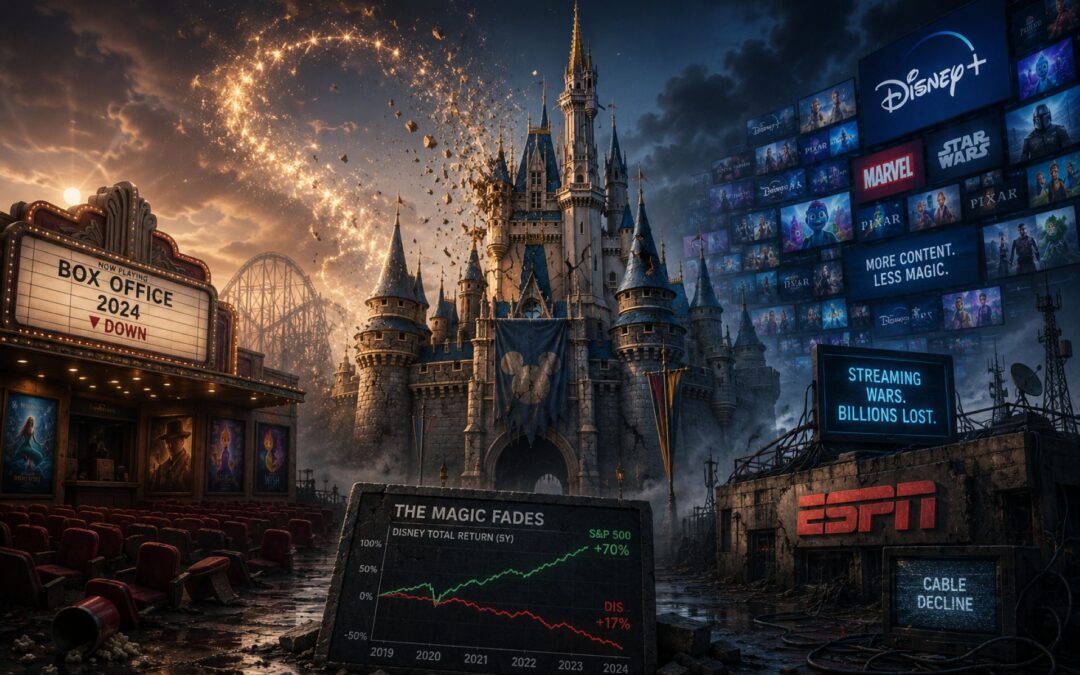
For a long time, Disney did not feel like a company.
It felt like a childhood memory machine.
A Disney film was not just another movie on the release calendar. It was an event. A Disney character was not just a piece of intellectual property. It was a companion. A Disney park was not just a tourist attraction. It was the physical version of a promise: step inside, and the ordinary world will briefly become more enchanted.
That promise made Disney one of the most powerful entertainment companies ever built.
Then something changed.
After a historic 2019, when Disney dominated the global box office and became the first studio to cross $10 billion in worldwide annual ticket sales, the company entered a much more confusing era. The films became less reliable. Marvel no longer felt automatic. Star Wars became more divisive. Live-action remakes began to feel less like magic and more like inventory. Disney+ grew quickly, but streaming came with brutal economics. ESPN remained valuable, but the cable bundle that made it so profitable began to weaken.
Suddenly, Disney looked less like an unstoppable entertainment empire and more like a giant trying to hold together several different business models at once.
The easy version of the story is that Disney lost its magic because audiences stopped caring.
The harder truth is more interesting.
Disney did not simply lose its audience. It trained audiences to experience Disney differently. It took a company built on scarcity, trust, theatrical ritual, and emotional memory, then pushed it into an age of endless content, subscription churn, franchise exhaustion, and corporate optimization.
Disney is not dying.
But the old Disney machine is.
The Company That Could Not Miss
The best way to understand Disney’s modern problem is to begin with its recent peak.
In 2019, Disney seemed almost absurdly powerful. It had Marvel, Pixar, Star Wars, Disney Animation, 20th Century Fox, ABC, ESPN, Hulu, theme parks, cruise ships, consumer products, and the imminent launch of Disney+. At the box office, it was operating on a level no studio had ever reached before. According to Axios, Disney crossed $10 billion in global box office revenue that year, powered by films like Avengers: Endgame, The Lion King, Frozen II, Toy Story 4, Captain Marvel, and Star Wars: The Rise of Skywalker.
That year made Disney look like the company that had solved entertainment.
It had beloved characters. It had franchises that could dominate theaters. It had parks where those franchises became real places. It had TV networks that generated steady cash. It had ESPN, one of the most valuable sports-media brands in the world. And it had Disney+, a streaming service that looked like the perfect answer to Netflix.
If Netflix had trained viewers to expect entertainment on demand, Disney seemed to have the one thing Netflix could never manufacture from scratch: a century of emotional attachment.
Parents did not need to be convinced that Disney mattered. They had grown up with Disney themselves. Children did not need to understand corporate strategy to want Elsa, Spider-Man, Simba, Buzz Lightyear, or Grogu. Investors did not need much imagination to believe that a company with Disney’s library could win streaming.
For a brief moment, Disney looked like it had the past, present, and future of entertainment in one hand.
But 2019 was not just a peak. It was also a trap.
The year made it easy to believe that Disney’s franchise machine could keep scaling forever. More Marvel. More Star Wars. More remakes. More spin-offs. More streaming originals. More content to feed the platform. More familiar names to reduce risk.
The problem was that Disney’s strength had never come from volume alone.
It came from making things feel special.
Disney’s Old Flywheel Was Built on Scarcity
Disney’s traditional entertainment model worked because each part of the company strengthened the others.
A film became a theatrical event. The theatrical event created characters and songs that lived in the culture. Those characters moved into toys, clothes, books, video games, television specials, cruise ships, and theme parks. The parks then made the characters feel more real. The emotional memory from the parks made families more likely to watch the next film.
It was not just a content strategy.
It was a flywheel of feeling.
Scarcity was a crucial part of that flywheel. A Disney movie did not arrive as one tile among hundreds on a streaming homepage. It arrived through trailers, posters, theatrical windows, school conversations, McDonald’s toys, music, and family plans. You had to go somewhere to see it. You had to wait. You had to participate.
That waiting mattered.
It gave Disney films weight. It made them feel less disposable. It allowed certain releases to become generational landmarks rather than algorithmic options.
For decades, Disney also benefited from a deep reservoir of trust. Parents believed the brand meant something. A Disney film would be visually polished. It would be emotionally accessible. It would probably have music, wonder, humor, and a lesson that did not feel too cynical. Even when individual films failed, the broader promise remained intact.
Then the company’s own success changed the incentives.
Once Disney became the owner of so much high-value intellectual property, the temptation was obvious: keep returning to what people already knew. Familiarity reduced risk. Existing fan bases could be reactivated. Theatrical releases could be connected to streaming shows. Streaming shows could maintain subscriber engagement between movies. Every character, side character, prequel, sequel, and alternate timeline could become part of the pipeline.
But magic does not scale like software.
A beloved story can expand. A mythic universe can deepen. A franchise can produce multiple great chapters.
But when the audience begins to feel that every emotional memory is being strip-mined for content, the spell starts to break.
The Franchise Machine Became Too Loud
Disney’s modern creative problem is not that it used franchises. Disney has always reused, adapted, and reimagined stories. Snow White, Cinderella, The Little Mermaid, Aladdin, and The Lion King were themselves adaptations, reinterpretations, or variations on older tales.
The problem is that the company began to feel less like a storyteller and more like a franchise manager.
Marvel is the clearest example.
For more than a decade, the Marvel Cinematic Universe was one of the most successful feats of blockbuster storytelling ever attempted. It turned second-tier comic book characters into global icons. It made serialized storytelling work at theatrical scale. It turned Avengers: Endgame into a genuine cultural event.
But after Endgame, Marvel faced a nearly impossible question: what do you do after the climax?
Disney’s answer was to keep expanding. More films. More shows. More timelines. More multiverse logic. More characters. More homework. What had once felt like a shared cinematic journey began to feel, for many viewers, like a syllabus.
The audience did not necessarily stop liking Marvel. It simply became harder to care with the same intensity.
Star Wars faced a different version of the same problem. The original trilogy had lived for decades as a mythic object partly because it was limited. The universe felt vast because so much of it was unseen. Once Disney began expanding the franchise through sequels, spin-offs, streaming shows, prequels to prequels, and lore-heavy side stories, Star Wars became more available but also less rare.
The same pattern appeared in Disney’s live-action remakes. At first, they made commercial sense. The animated classics were beloved. A new generation could encounter them with modern technology. Parents could revisit childhood favorites. Films like The Lion King, Beauty and the Beast, and Aladdin showed how powerful nostalgia could be.
But over time, the remakes began to raise a more uncomfortable question.
Were these films adding something essential, or were they simply reminding audiences of better memories?
That question matters because Disney’s brand depends on emotional trust. Audiences are willing to revisit old stories if the new version feels generous, imaginative, or necessary. They become more skeptical when the remake feels like a corporate extraction of childhood affection.
This is where the debate around Disney often becomes overheated. Some critics reduce the company’s struggles to politics, casting, or culture-war arguments. Those debates can influence audience perception, especially when fans feel that a remake is dismissive of the original. But they do not explain the entire problem.
The deeper issue is exhaustion.
Too many familiar properties were asked to do too much. Films became brand maintenance. Streaming shows became franchise connective tissue. Characters became assets to be redeployed across platforms.
Disney did not run out of stories.
It made too many of its stories feel like products.
The Box Office Stopped Behaving Like 2019
Disney’s creative overextension collided with a second problem: the theatrical market itself changed.
The company’s 2019 dominance depended on a box office environment that no longer exists in the same way. The pandemic accelerated changes that were already underway. Viewers became more comfortable waiting for films to arrive at home. Streaming services trained people to expect abundance. The cost of taking a family to the theater kept rising. The old habit of casually going to the movies weakened.
The result was not the death of cinema. It was a harsher theatrical marketplace.
Audiences still show up for films that feel urgent, communal, or culturally unavoidable. Top Gun: Maverick, Barbie, Oppenheimer, Avatar: The Way of Water, and other major successes proved that theaters still matter. But audiences became more selective. A recognizable brand was no longer enough.
That shift hit Disney hard because Disney’s film economics often depend on enormous budgets.
A $40 million disappointment is manageable. A $250 million blockbuster that underperforms creates a much bigger problem. Marketing costs add even more pressure. When a Disney tentpole misses, it does not merely disappoint creatively. It can damage investor confidence, franchise perception, and the economics of future releases.
The broader domestic box office data from Box Office Mojo shows the larger context. The North American theatrical market fell dramatically during the pandemic and has not returned to its 2019 level. That does not excuse every Disney misfire, but it explains why the old formula became riskier.
Before, Disney could rely on a combination of brand power, theatrical habit, and franchise momentum.
Now, the audience asks a sharper question:
Is this worth leaving the house for?
That question is brutal for a company built on event movies. If a Marvel film feels optional, if a remake feels unnecessary, if a Pixar film feels like it will arrive on Disney+ soon enough, the theatrical model weakens.
Disney helped create this problem by training audiences to expect its library at home.
That brings us to Disney+.
Disney+ Solved One Problem and Created Another
Disney had no real choice but to enter streaming.
Netflix had changed consumer expectations. Cable was weakening. Younger audiences were not going to organize their lives around broadcast schedules. If Disney wanted to own its relationship with viewers, it needed a direct-to-consumer platform.
When Disney+ launched in 2019, the logic looked unbeatable. Disney could place its greatest brands under one subscription: Disney, Pixar, Marvel, Star Wars, and National Geographic. It could stop licensing valuable content to competitors. It could gather customer data directly. It could build a global subscription business.
Wall Street loved the story because streaming growth looked like the future.
But streaming created a painful tradeoff.
Disney was moving from a world where other companies paid handsomely to distribute its content into a world where Disney had to spend heavily to attract and retain subscribers itself. The company was no longer just making content. It was funding a platform, marketing that platform, producing originals for that platform, handling churn, managing pricing, and competing against companies with very different economics.
Netflix had a head start. Amazon could treat video as part of a much larger Prime ecosystem. Apple could use entertainment to strengthen a hardware-and-services universe. Disney, by contrast, needed streaming to become a major profit engine because its legacy TV business was under pressure.
That made the streaming wars especially dangerous.
As Yale Insights has noted in its discussion of the media landscape, the industry’s streaming shift forced companies to rethink a model that had once relied on bundled distribution, licensing revenue, and scale. Growth was exciting, but profitability was harder.
Disney’s own numbers show the strain. In its 2024 annual report, the company reported that its Direct-to-Consumer segment improved from a major operating loss in fiscal 2023 to a small operating profit in fiscal 2024. By fiscal 2025, Disney’s annual report showed a much stronger improvement, with Direct-to-Consumer operating income rising significantly.
That matters because it updates the simplistic “Disney+ is a disaster” argument. Disney+ was extremely expensive to build, but it has not remained permanently unprofitable.
Still, profitability does not erase the strategic tension.
Streaming changes the way audiences value content. A theatrical film asks for a deliberate purchase. A streaming title competes with everything else in the subscription. If a new Pixar film appears beside old Pixar films, Marvel shows, Star Wars series, documentaries, and children’s programming, it risks becoming just another option.
The platform that solved Disney’s distribution problem also made Disney feel less scarce.
The Cable Bundle Was Disney’s Hidden Engine
For years, Disney’s public image was shaped by movies and parks, but one of its most important financial engines was television.
The cable bundle was a beautiful business if you owned must-have channels. Millions of households paid for cable packages. Disney received affiliate fees through networks like ESPN, Disney Channel, FX, and others. Advertisers paid to reach large audiences. Sports kept viewers attached to live TV. The economics were stable, recurring, and highly profitable.
ESPN was especially valuable.
It was not just a sports channel. It was one of the pillars of the American cable bundle. Even households that did not watch much sports often paid for ESPN indirectly through their cable subscriptions. That gave Disney a powerful stream of revenue.
But the bundle began to unravel.
Cord-cutting changed everything. As more households canceled traditional pay TV, the old economics weakened. Linear networks still generated cash, but the direction of travel became clear. Younger viewers were spending more time on YouTube, TikTok, streaming services, gaming, podcasts, and social platforms. Appointment television lost cultural centrality outside of live sports and major events.
Disney’s fiscal 2025 annual report reflects this pressure. Linear Networks revenue and operating income declined, showing that the old television business is no longer the dependable growth engine it once was.
This is the hidden reason Disney’s transition has felt so difficult.
The company was not simply adding a streaming business. It was trying to build the future while the past was still funding much of the company.
That is a hard corporate balancing act.
Move too slowly, and Netflix, Amazon, Apple, YouTube, and other platforms reshape audience habits without you. Move too quickly, and you damage the profitable legacy systems that still pay the bills.
Disney had to cannibalize parts of itself before someone else did.
ESPN Is Still Powerful, But Its Business Model Is Changing
ESPN is the most complicated piece of Disney’s old media empire because it is both vulnerable and incredibly valuable.
On one hand, ESPN is exposed to cord-cutting. If fewer people pay for the traditional cable bundle, ESPN loses some of the distribution advantage that made it so powerful. Sports-rights fees are also expensive. Leagues know that live sports are among the last forms of programming that audiences still watch in real time, so they charge accordingly.
On the other hand, that same fact makes ESPN one of Disney’s strongest assets.
In an entertainment world where scripted shows can disappear into the streaming void, live sports still command attention. They create urgency. They resist time-shifting. They generate conversation. They attract advertisers. They give subscribers a reason to show up now rather than later.
That is why Disney’s ESPN strategy matters so much.
The company has been moving toward a future where ESPN can live beyond the traditional cable bundle. Its challenge is to preserve the value of the existing business while preparing for a direct-to-consumer sports future. That is easier to say than to execute.
If ESPN goes too aggressively into streaming, it may accelerate the decline of the cable model. If it waits too long, it risks losing younger audiences who never built the habit of watching cable sports television in the first place.
This is not just a Disney problem. It is a media-industry problem.
But Disney feels it more intensely because ESPN has been such a major profit center. When the old sports-TV model changes, Disney’s entire financial architecture changes with it.
The company’s future depends partly on whether ESPN can become something more than a cable-channel giant. It has to become a sports platform for an era when the cable bundle is no longer the default household utility.
That transition is possible.
It is also expensive, risky, and unfinished.
The Parks Reveal What Still Works
If Disney’s movie and television businesses show the strain of modern entertainment, its parks show why the company remains so difficult to dismiss.
The parks are the strongest evidence that people have not stopped wanting Disney magic.
They have simply become more selective about where they feel it.
Disney’s Experiences division, which includes parks, resorts, cruises, and consumer products, remains one of the company’s great strengths. In its 2025 annual report, Disney reported that Experiences generated billions in operating income, making it one of the company’s most important profit engines.
That makes sense.
A theme park is not passive content. It is embodied entertainment. You walk through it. You wait in line. You smell the food. You take photos. You watch your children react. You turn characters into places and places into memories.
This is where Disney’s old magic still has an advantage over almost every competitor.
Netflix can produce a hit show. Amazon can fund an expensive series. Apple can win prestige awards. YouTube can dominate attention. TikTok can create endless micro-entertainment.
But none of them can easily reproduce the emotional and physical infrastructure of a Disney park.
The parks prove that Disney’s IP still has power when it is treated as experience rather than filler. A ride based on a beloved story can renew affection for that story. A character encounter can make a child care about a film released decades before they were born. A themed land can make a franchise feel bigger than the screen.
But even the parks carry a warning.
They work because they feel special. They work because people are willing to pay for something that feels meaningfully different from everyday entertainment. If Disney turns every part of its business into a volume game, it risks weakening the very emotions that make the parks so valuable.
The lesson from the parks is not that Disney should become only a parks company.
The lesson is that Disney still wins when it makes people feel they are entering a world, not consuming a product.
Disney Is Not Dying. It Is Being Forced to Choose.
The phrase “Disney is dying” is emotionally satisfying, but it is not accurate.
Disney is too large, too diversified, and too culturally embedded to be understood through a simple collapse narrative. Its streaming business has improved. Its parks remain powerful. Its intellectual property library is still extraordinary. ESPN still matters. Disney still has characters, stories, and worlds that other companies would spend decades trying to build.
But Disney is being forced to choose what kind of company it wants to be.
For years, it tried to be everything at once: a theatrical-event company, a streaming-growth company, a cable-TV company, a sports-media company, a franchise factory, a nostalgia engine, a technology platform, a parks business, and a global consumer-products machine.
That worked when every part of the flywheel reinforced the others.
It becomes harder when the parts start pulling in different directions.
Theatrical films need scarcity, but streaming needs regular supply. Franchise fans want continuity, but casual audiences want simplicity. Investors want streaming profits, but subscribers want constant new content. ESPN needs to preserve cable revenue, but younger audiences live outside cable. Parks benefit from beloved IP, but IP becomes less beloved when overused.
This is the real Disney dilemma.
The company does not need more content. It needs more conviction.
It needs fewer releases that feel like obligations and more releases that feel like events. It needs to protect the emotional value of its franchises instead of treating them as endlessly renewable resources. It needs Disney+ to be profitable without turning the service into a dumping ground for brand extensions. It needs ESPN to cross the bridge from cable to streaming without destroying the economics that made sports so valuable. It needs the parks to remain magical without becoming inaccessible symbols of price inflation.
Most of all, Disney needs to remember that magic is not the same as familiarity.
A familiar character can open the door.
Only a good story can keep people inside.
Conclusion
Disney lost some of its magic because it began to behave as if magic could be manufactured by volume.
More sequels. More remakes. More spin-offs. More streaming shows. More familiar brands. More ways to monetize the same emotional memories.
For a while, that looked like genius. In 2019, it made Disney seem unbeatable. But the same strategy that created dominance also created fatigue. The company trained audiences to see Disney not as a rare event, but as a constant feed.
That is a very different kind of relationship.
Disney’s future will not be decided by whether it can squeeze one more film, show, or remake out of its old library. It will be decided by whether it can make audiences feel that Disney still means something.
Not just content.
Not just nostalgia.
Not just intellectual property.
Something worth leaving the house for. Something worth subscribing for. Something worth remembering.
That was always the real magic.
And it was never supposed to feel ordinary.
Last Updated on June 9, 2026 by Aseem Gupta