
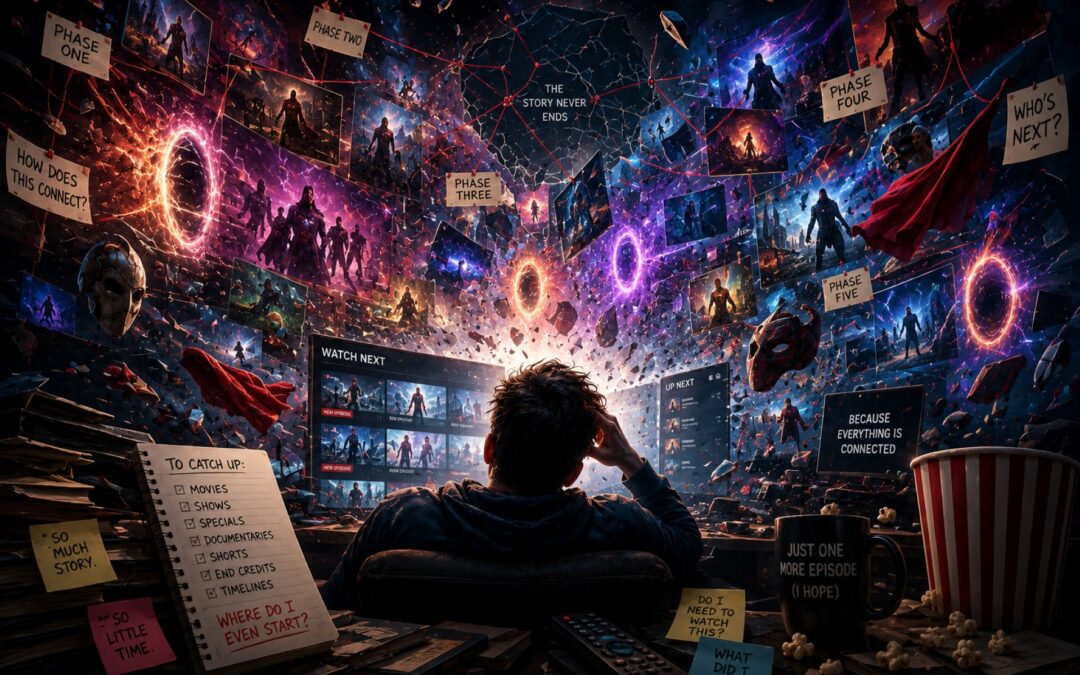
Marvel fatigue did not happen because audiences suddenly stopped liking superheroes.
That explanation is too easy.
If people were simply tired of capes, masks, powers, and comic-book worlds, then Spider-Man: No Way Home, Guardians of the Galaxy Vol. 3, and Deadpool & Wolverine would not have worked the way they did. Audiences still show up when the story feels alive. They still care when the characters matter. They still respond when a superhero movie feels like an event rather than an assignment.
The real problem is more specific.
Marvel fatigue happened because the Marvel Cinematic Universe changed the emotional contract it had with viewers.
For more than a decade, Marvel made interconnected storytelling feel exciting. Each film had its own identity, but it also pointed toward something bigger. Post-credit scenes felt like clues. Cameos felt like rewards. The shared universe made the audience feel smart, included, and invested.
Then came Avengers: Endgame.
It was not just another blockbuster. It was a cultural release valve. It paid off years of anticipation, said goodbye to central characters, and gave the MCU a natural emotional climax.
After that, Marvel faced a difficult question:
What comes after the ending?
The answer, for a while, seemed to be: more.
More films. More Disney+ shows. More characters. More timelines. More multiverse logic. More homework. More connective tissue. More setup for the next thing.
The MCU did not collapse. But its rhythm changed. What once felt like a carefully paced saga began to feel like a content pipeline. The audience was no longer simply invited to follow along. It was increasingly expected to keep up.
That is where fatigue began.
Not with superheroes.
With obligation.
Marvel Once Made Every Movie Feel Like an Event
The original MCU worked because it made scale feel personal.
It did not begin with the universe. It began with Tony Stark in a cave.
That mattered.
Before Marvel asked audiences to care about Infinity Stones, cosmic threats, alternate dimensions, and intergalactic teams, it gave them characters with clear emotional engines. Tony Stark was arrogant, brilliant, damaged, and funny. Steve Rogers was sincere in a cynical world. Thor was a prince who had to learn humility. Natasha Romanoff and Clint Barton brought human stakes into a world of gods and monsters. Bruce Banner carried the tragedy of being both man and monster.
The shared universe came later.
Marvel’s early genius was patience. It introduced characters one by one, allowed audiences to build attachments, then rewarded that attachment through crossovers. The first Avengers film felt thrilling because it brought together people viewers already knew. The crossover was not a substitute for character. It was the payoff.
This is why the post-credit scenes worked so well.
They were small promises. A tease here. A mysterious object there. A character cameo. A villain’s shadow. They gave viewers the feeling that the story was expanding without demanding too much too soon.
The MCU trained audiences to trust connection.
If something appeared in one movie, it might matter later. If a character changed, that change might carry forward. If a threat was hinted at, it might eventually arrive. For years, this made Marvel feel different from ordinary blockbuster filmmaking.
It was not just a sequence of movies.
It was a long-form relationship.
The key was balance. Most films still worked as individual stories. Iron Man was not only setup for The Avengers. Captain America: The Winter Soldier was not only franchise maintenance. Guardians of the Galaxy introduced an entirely new corner of the universe and still felt fresh, funny, and emotionally complete.
The larger universe made the films more exciting, but it did not always crush them.
That balance became harder to maintain as Marvel grew.
Endgame Was Not Just a Finale. It Was a Release Valve.
Avengers: Endgame was the kind of ending franchise studios spend decades trying to manufacture.
It had scale, nostalgia, sacrifice, spectacle, humor, grief, and closure. It gave long-term viewers the feeling that the time they had invested had mattered. The portals scene worked not merely because many characters appeared on screen, but because each arrival carried years of emotional memory.
Marvel had trained the audience to care.
Then it cashed in that care beautifully.
That is why Endgame was more than a box-office peak. It was an emotional peak. It resolved the Infinity Saga, closed Tony Stark’s arc, gave Steve Rogers a final grace note, and turned more than a decade of interconnected storytelling into a shared cultural moment.
According to Box Office Mojo’s Marvel franchise data, Avengers: Endgame became one of the highest-grossing films ever, but the numbers only tell part of the story. Its real power was that it felt earned.
That created a problem for everything that followed.
After a finale, continuation requires a new reason to care. Marvel could not simply keep expanding. It needed a new emotional center, a new narrative direction, and a new sense of inevitability.
Instead, the MCU entered a strange middle state.
The old saga was over, but the new saga did not immediately feel clear. The audience had said goodbye to several anchoring figures, but the replacements were scattered across films, shows, timelines, and tones. The multiverse promised scale, but scale alone was no longer enough.
After Endgame, Marvel did not just need more stories.
It needed a new heartbeat.
For many viewers, that heartbeat became harder to find.
The MCU Lost Its Core Characters
A shared universe can contain dozens of heroes, but audiences still need anchors.
For the first decade of the MCU, those anchors were clear. Iron Man, Captain America, Thor, Black Widow, Hulk, and later Black Panther, Doctor Strange, Spider-Man, and the Guardians gave viewers recognizable emotional entry points. Even when the universe became large, the core remained understandable.
Then several of those anchors disappeared or changed.
Tony Stark died. Steve Rogers left the main timeline. Natasha Romanoff died. Chadwick Boseman’s death created a tragic and unavoidable absence around Black Panther. Thor continued, but his character tone shifted repeatedly. Hulk became less central. The Guardians had their own emotional ending.
This is not Marvel’s fault in every case. Some changes were narratively earned. Some were forced by real-life tragedy. Some were the natural result of actors completing long arcs.
But from the audience’s perspective, the effect was real.
The MCU suddenly felt less centered.
New characters arrived, but many were introduced in quick succession. Shang-Chi, Moon Knight, Ms. Marvel, She-Hulk, Kate Bishop, America Chavez, the Eternals, Yelena Belova, Ironheart, Monica Rambeau, and others entered a universe already crowded with unresolved threads. Some were promising. Some were likable. Some deserved more room than they got.
But replacing emotional anchors is not the same as adding names to a roster.
Audiences do not transfer loyalty automatically. They need time, repetition, vulnerability, and strong standalone stories. The early MCU gave Tony Stark and Steve Rogers that space. The post-Endgame MCU often asked new characters to join a moving machine before they had fully become indispensable.
That is why the phrase “Marvel fatigue” can be misleading.
Viewers were not merely exhausted by new heroes. They were exhausted by being asked to care about many new heroes before the universe had made a strong enough case for them.
Connection stopped feeling earned.
It started feeling assigned.
Disney+ Turned Marvel Into a Content Machine
Disney+ changed Marvel’s rhythm.
Before streaming, Marvel was primarily a theatrical franchise. There were usually a few films per year. Even when the release schedule became busy, each movie still had the weight of a theatrical event. You saw the trailer. You bought a ticket. You discussed the post-credit scene. Then you waited for the next chapter.
Disney+ altered that cadence.
Suddenly, Marvel was not only making movies. It was making series. WandaVision, The Falcon and the Winter Soldier, Loki, What If…?, Hawkeye, Moon Knight, Ms. Marvel, She-Hulk, and other projects expanded the MCU onto television in a much more official way than earlier Marvel TV experiments.
At first, this seemed exciting.
WandaVision showed that Marvel could experiment with form, grief, sitcom history, and mystery. Loki expanded the multiverse mythology. The shows gave secondary characters more room and offered Disney+ the kind of premium franchise content every streaming service wanted.
But the strategy had a hidden cost.
Marvel became constant.
That was a major shift. The MCU’s earlier theatrical rhythm gave fans time to miss it. Streaming reduced the gaps. Instead of feeling like an event, Marvel started to feel like a standing appointment. The universe became less a series of peaks and more a continuous feed.
That matters because anticipation is part of pleasure.
When every month brings another show, trailer, cameo, finale, or setup, the audience has less time to absorb what happened. The sense of occasion weakens. Projects blur together. The question changes from “What happens next?” to “Do I need to watch this too?”
That is dangerous.
The streaming era made Marvel more available, but availability is not the same as importance. By turning the MCU into a major Disney+ engine, Disney helped transform Marvel from a cinematic event franchise into a content machine.
The machine needed fuel.
The audience needed a reason to keep caring.
Those are not always the same thing.
Connected Storytelling Became Homework
For years, Marvel’s interconnection was its secret weapon.
Then it became its burden.
The difference lies in how connection feels to the viewer. In the early MCU, connection often felt like a reward. If you had seen the previous films, you caught extra layers. You understood the significance of a line, a cameo, an object, or a post-credit scene. But many movies still worked on their own.
Over time, the balance shifted.
More projects began to depend on prior knowledge. A film might require familiarity with a Disney+ show. A show might set up a future film. A character arc might begin in one format and continue in another. The emotional payoff might be delayed across several titles. The universe became bigger, but the entry points became less clean.
This is where viewers began using the word “homework.”
Homework is not the same as depth. A long story can be rewarding. A complex universe can be exciting. Audiences are perfectly capable of following ambitious narratives when the payoff feels worth the effort.
The problem is when effort exceeds reward.
If a viewer feels they must watch a six-episode show to understand a movie, then watch another film to understand a cameo, then remember a post-credit scene from two years ago to understand a villain, the franchise begins to feel less like entertainment and more like maintenance.
Time’s analysis of how Marvel lost its way captured this issue well, pointing to the growing complexity, exposition, and difficulty of following the MCU after its original core story had ended.
The MCU once made viewers feel like insiders.
Later, some viewers began to feel like they were falling behind.
That emotional shift is crucial. Fans do not resent complexity when it deepens their investment. They resent complexity when it feels like a tax on enjoyment.
Marvel’s great strength was making connection exciting.
Its mistake was letting connection become compulsory.
The Multiverse Made Everything Bigger and Somehow Smaller
The multiverse should have been Marvel’s ultimate expansion tool.
It allowed alternate versions of characters, returning actors, surprising cameos, dead characters, variant timelines, and reality-breaking stakes. In theory, it gave Marvel infinite possibility.
In practice, infinite possibility can become a storytelling trap.
A good story needs limits. Death matters because it is final. Choices matter because they close some doors and open others. Identity matters because a character is this person, not one of endless interchangeable versions. When a universe introduces infinite timelines and variants, it has to work harder to preserve consequence.
Marvel did not always manage that balance.
The multiverse made everything bigger in scale, but sometimes smaller emotionally. If a character dies, can another version appear? If a timeline breaks, can it be repaired? If a villain is defeated, is there another variant waiting? If every world is at risk, why does any one world feel specific?
The multiverse also encouraged cameo thinking.
Instead of asking, “What does this character want?” the audience was often invited to ask, “Who might show up?” That can be fun. Spider-Man: No Way Home used nostalgia and multiverse logic effectively because the returning characters served Peter Parker’s emotional story. The cameos had weight because they sharpened the protagonist’s choices.
But when multiverse storytelling becomes mainly about recognition, it weakens drama.
A surprise appearance can make a theater cheer. It cannot, by itself, make a story matter.
The Kang storyline also created complications. Marvel positioned Kang as a major post-Endgame threat, but the character’s rollout became uneven, and later behind-the-scenes problems disrupted the larger plan. Even before that, many viewers struggled to feel the same dread they had felt with Thanos.
Thanos was simple to understand. He wanted to wipe out half of all life. He was built slowly. His threat became clearer over time.
The multiverse, by contrast, often required explanation before emotion.
That is rarely a good trade.
Smaller Heroes Were Asked to Carry Bigger Burdens
Not every Marvel character needs to carry the fate of the multiverse.
That sounds obvious, but it became one of the post-Endgame problems.
Part of the MCU’s early charm was tonal variety. Ant-Man worked because it was smaller, lighter, and more comedic. The stakes were personal. The film did not need to feel like an Avengers-level chapter. Its modesty was part of its appeal.
Then Ant-Man and the Wasp: Quantumania arrived with the burden of introducing Kang as a saga-level villain and pushing the multiverse story forward. The result was strange. A franchise that had worked best as a comic heist/family adventure was suddenly asked to carry major universe architecture.
That is the problem with franchise management.
When every film must serve the larger machine, individual stories lose their natural shape.
The Marvels faced a different but related challenge. It brought together Carol Danvers, Monica Rambeau, and Kamala Khan, but its emotional foundation depended partly on prior knowledge from Captain Marvel, WandaVision, and Ms. Marvel. For committed fans, that connection could be meaningful. For casual viewers, it raised the barrier to entry.
The box office reflected the problem. Variety reported that The Marvels opened with $47 million domestically, the lowest opening weekend in MCU history at the time. Investopedia similarly highlighted the weak opening as a sign of changing audience response to Marvel’s interconnected universe.
The issue was not that these characters could never work.
The issue was that they were placed inside a franchise environment that demanded too much too quickly. Smaller or newer heroes need clean stories that make audiences care on their own terms. They cannot simply be treated as moving pieces in a giant saga.
A character must become beloved before the universe asks them to carry its weight.
Marvel sometimes reversed that order.
The Quality Control Problem Became Visible
Marvel fatigue was not only about quantity.
It was also about trust.
For years, Marvel had a strong quality-control reputation. Not every film was great, but most were polished, entertaining, and coherent. Even weaker entries often had enough humor, character chemistry, or franchise momentum to satisfy audiences.
After Endgame, that trust became less secure.
Some projects felt rushed. Some scripts leaned heavily on exposition. Some villains were underdeveloped. Some endings became CGI-heavy battles with thin emotional stakes. Some shows began with interesting premises but ended in familiar spectacle. Some films seemed less like necessary stories and more like content obligations.
The visual effects conversation also became harder to ignore. Marvel’s production scale placed enormous strain on VFX pipelines, and audiences began noticing when the finish looked uneven. Once viewers start seeing the machinery, the magic suffers.
This is where Bob Iger’s public comments matter. Variety reported that Iger acknowledged Disney had made too many sequels and discussed problems affecting The Marvels. Whatever one thinks of the specific explanation, the broader admission is important: Disney itself recognized that volume and quality had become an issue.
Marvel’s brand had trained people to assume a baseline of entertainment.
When that assumption weakened, the entire interconnected model became more fragile. If every release is connected, then every weaker release affects confidence in the larger universe. A disappointing standalone film is one thing. A disappointing chapter in a supposedly essential saga creates doubt about the saga itself.
That is why fatigue compounds.
One mediocre project can be forgiven. Several in a row make audiences cautious. If viewers begin to suspect that the next release is not essential, they may wait for streaming. If they wait for streaming, the theatrical event weakens. If the event weakens, the brand feels less urgent.
The machine slows down.
Not all at once.
Then visibly.
The Audience Did Not Disappear
The strongest argument against a simplistic “Marvel is dead” narrative is that audiences still show up when Marvel gives them a strong reason.
Spider-Man: No Way Home worked because it turned nostalgia into emotional storytelling. It brought back familiar faces, but it used them to test Peter Parker’s morality, grief, and identity. The cameos were not just decoration. They mattered to the story’s emotional arc.
Guardians of the Galaxy Vol. 3 worked because it felt like a real ending. It gave Rocket a devastating backstory, honored the emotional bonds among the team, and allowed the characters to matter as characters rather than as franchise pieces.
Deadpool & Wolverine worked because it felt like an event with a clear identity. It was irreverent, self-aware, star-driven, nostalgic, and distinct from the more formulaic MCU entries around it. According to The Numbers’ MCU franchise data, it crossed $1.3 billion worldwide, showing that large audiences were still willing to reward Marvel when the film felt culturally alive.
These examples are important because they clarify the real diagnosis.
The audience did not reject Marvel automatically.
It rejected the feeling of obligation without payoff.
People still want humor, spectacle, characters, emotion, surprise, and shared theatrical moments. They still enjoy superhero stories when those stories feel specific. They still respond to endings, reunions, risks, and films that know what they are.
What they resist is franchise fog.
They resist being told that everything matters when too little feels meaningful. They resist being asked to follow every thread when the tapestry is unclear. They resist new characters being announced as important before they have been made emotionally important.
Marvel fatigue is selective.
That should be encouraging.
It means the problem can be fixed.
Marvel’s Way Back Is Less, But Better
Marvel does not need to abandon superheroes.
It needs to restore scarcity, clarity, and emotional necessity.
The solution is not simply fewer projects, although fewer projects would help. The deeper solution is fewer projects that feel like they exist only to keep the machine running. Every film or show should answer a basic question before it enters production:
Why does this story need to exist?
Not because it sets up a future crossover. Not because the character is available. Not because the platform needs content. Not because a phase needs filling. But because there is a compelling emotional, thematic, or cinematic reason for the audience to care.
Marvel’s future depends on rebuilding trust.
That means stronger scripts. More complete standalone stories. Clearer stakes. More patient character development. Less dependence on cameos as emotional shortcuts. Better pacing between releases. A multiverse that serves character rather than replacing consequence. New heroes who are allowed to become beloved before being asked to carry the saga.
It also means accepting that not everything has to be connected immediately.
Connection is powerful when it feels like discovery. It becomes tiring when it feels like administration.
The early MCU understood this better than people sometimes remember. It did not begin with a giant universe map. It began with characters who worked. The universe became exciting because the characters made it worth expanding.
That is the lesson Marvel needs again.
Audiences do not need the MCU to be small. They need it to feel intentional. They do not need every film to be an apocalypse. They need the stakes to be felt. They do not need endless reminders that the universe is connected. They need stories that are satisfying before they become chapters.
Less, but better, does not mean timid.
It means treating attention as something earned.
Conclusion
Marvel fatigue is not really fatigue with superheroes.
It is fatigue with being asked to keep caring without enough payoff.
For years, Marvel made connection feel thrilling. Every movie felt like a doorway. Every character had a place. Every tease suggested a future worth waiting for. The audience trusted that the larger universe would reward their attention.
After Endgame, that trust weakened.
The MCU became bigger, faster, and more complicated, but not always more meaningful. Disney+ turned Marvel into a constant presence. The multiverse expanded possibility while weakening consequence. New characters arrived before the audience had enough time to love them. Smaller stories were burdened with saga-level responsibilities. The machine became visible.
That is when connection stopped feeling magical.
It started feeling compulsory.
Marvel can still recover because the audience is not gone. The success of the strongest post-Endgame films proves that people still want superhero stories when they feel funny, emotional, surprising, and necessary.
But Marvel’s great challenge is to remember what made the MCU work in the first place.
It was never just the universe.
It was the feeling that the universe mattered.
Last Updated on June 10, 2026 by Aseem Gupta