
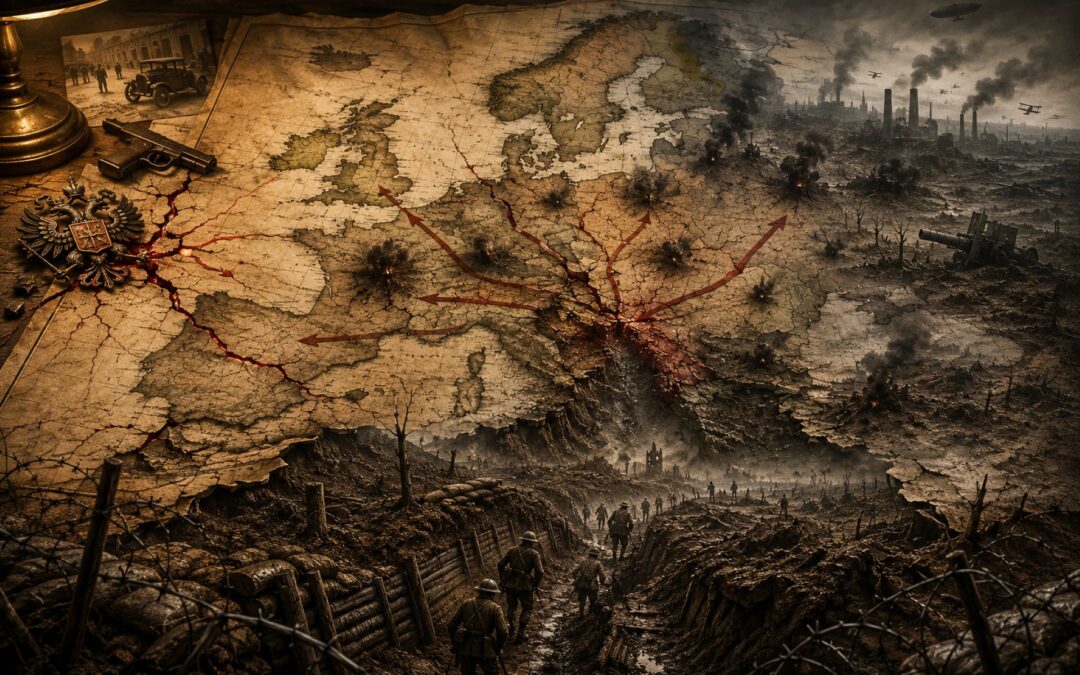
World War 1 is often remembered through a few familiar images: muddy trenches, gas masks, machine guns, barbed wire, and exhausted soldiers waiting to go “over the top.”
It is also remembered through a simple story: an archduke was assassinated, alliances activated, and Europe went to war.
That version is not exactly wrong.
But it is far too small.
World War 1 was not caused by one murder in Sarajevo. The assassination of Archduke Franz Ferdinand was the spark, but the continent was already filled with dry wood: rival empires, anxious governments, nationalist movements, military timetables, secretive diplomacy, imperial competition, and leaders who believed that backing down could be more dangerous than war.
The war began as a crisis between Austria-Hungary and Serbia. Within weeks, it had pulled in Germany, Russia, France, Britain, Belgium, and eventually empires and colonies across the world. By the time the fighting stopped in November 1918, the old European order had been shattered.
Four empires collapsed. Millions were dead. Borders were redrawn. Political extremism intensified. The United States emerged as a major world power. Russia became the first communist state. The Middle East was remade. Germany was humiliated but not destroyed. The peace settlement promised a new international order, but it also left behind anger, debt, instability, and unresolved grievances.
World War 1 did not simply end in 1918.
It created the world that followed.
This is the full story of how Europe’s crisis became a global catastrophe.
Europe Before World War 1: A Continent Waiting for a Crisis
To understand World War 1, we have to begin before the war.
Europe in 1914 did not look like a continent about to destroy itself. Its great powers were connected by trade, royal marriages, diplomacy, finance, and culture. Many people believed that a general European war would be too irrational, too expensive, and too destructive to actually happen.
That confidence was part of the danger.
Beneath the surface, Europe was unstable. The balance of power that had shaped the continent for decades was under pressure. Germany had become a unified empire only in 1871, after defeating France in the Franco-Prussian War. That victory created a powerful new state in the heart of Europe. It also left France humiliated and resentful, especially after Germany annexed Alsace-Lorraine.
France wanted security. Germany wanted recognition and protection. Britain wanted to preserve its empire and naval supremacy. Russia wanted influence in Eastern Europe and the Balkans. Austria-Hungary wanted survival. The Ottoman Empire was weakening, and its decline created power vacuums that other states wanted to fill.
The Balkans were especially dangerous.
Austria-Hungary was a vast multi-ethnic empire ruled from Vienna, but it contained Germans, Hungarians, Czechs, Slovaks, Poles, Croats, Serbs, Romanians, Ukrainians, Italians, and others. Nationalism threatened its unity. If one group demanded independence successfully, others might follow.
Serbia, meanwhile, had become an independent kingdom with ambitions to unite South Slavs, including Serbs living under Austro-Hungarian rule. To Serbian nationalists, Austria-Hungary was an imperial oppressor. To Austria-Hungary, Serbia was a direct threat to the empire’s survival.
Russia saw itself as a protector of Slavic peoples and had strategic reasons to support Serbia. Germany stood behind Austria-Hungary. France stood behind Russia. Britain was not formally bound in the same way, but it was increasingly aligned with France and Russia.
Europe was not a powder keg in the sense that war was automatic.
But it was a system in which a local crisis could spread very quickly.
The National WWI Museum and Memorial describes the war as a conflict that drew in nations across continents, but its roots were planted in this fragile prewar European order. The war became global because Europe’s empires were global. But the fuse was lit in a region where nationalism, imperial anxiety, and great-power rivalry overlapped.
That region was the Balkans.
The Alliance System Did Not Make War Inevitable, But It Made Crisis Dangerous
The alliance system is often explained as if it worked like a row of dominoes. One country went to war, its ally joined, then another ally joined, and the whole continent collapsed.
That is too mechanical.
The alliances mattered, but they did not remove human choice. Leaders still made decisions. Governments still calculated risks. Diplomats still had opportunities to slow events down. The tragedy of 1914 is not that alliances made war inevitable. It is that alliances made every decision feel more urgent, more dangerous, and more difficult to reverse.
By 1914, Europe was divided into two broad camps.
On one side was the Triple Alliance: Germany, Austria-Hungary, and Italy. In practice, Italy’s commitment was uncertain, and when war came, Italy initially stayed neutral before later joining the Allies.
On the other side was the Triple Entente: France, Russia, and Britain. This was not a single rigid alliance in the same way. France and Russia had a formal alliance. Britain had understandings with France and Russia, but British policy still left room for uncertainty.
That uncertainty mattered.
Germany did not know exactly what Britain would do. Britain did not want to be dragged into every continental crisis, but it also did not want Germany to dominate Europe. France feared Germany. Germany feared being encircled by France and Russia. Russia feared losing influence in the Balkans. Austria-Hungary feared appearing weak after the assassination of its heir.
The alliance system did not create these fears by itself.
It magnified them.
A crisis between Austria-Hungary and Serbia became dangerous because everyone wondered who else would move. If Austria punished Serbia, would Russia intervene? If Russia mobilized, would Germany strike? If Germany attacked France through Belgium, would Britain join?
In a calmer system, a regional assassination might have led to a limited conflict or a diplomatic settlement.
In 1914, each move seemed to threaten the entire balance of power.
Alliances also shaped psychology. Leaders did not want to abandon their partners. Germany feared losing Austria-Hungary, its most important ally. Russia feared losing credibility if it abandoned Serbia. France feared isolation if Russia weakened. Britain feared that if Germany defeated France and dominated the continent, British security would be permanently damaged.
The result was not automatic war.
It was a crisis in which every state believed delay might be fatal.
Militarism, Mobilization, and the Fear of Falling Behind
The years before World War 1 were marked by military buildup.
Germany expanded its army and navy. Britain protected its naval supremacy. Russia reformed and expanded its forces after its defeat by Japan in 1905. France extended military service. Austria-Hungary worried about its ability to fight both Serbia and Russia. Across Europe, general staffs planned for wars they hoped to win quickly.
The most dangerous idea was not simply that armies existed.
It was that military plans began to shape political decisions.
Modern armies were enormous. Moving them required railways, timetables, supply systems, mobilization orders, and coordination across huge distances. Once mobilization began, it was hard to stop without creating chaos. In some countries, mobilization was not just preparation for war; it was seen by rivals as a step toward war itself.
That created a trap.
If one country mobilized, another feared it would fall behind. If it waited too long, its enemy might strike first. If it mobilized too early, it might provoke the very war it feared.
This was especially true for Germany. German planners feared a two-front war against France in the west and Russia in the east. Russia’s army was huge but slower to mobilize. German strategy therefore depended on speed: defeat France quickly, then turn east before Russia could bring its full strength to bear.
Military logic began to compress political time.
Diplomacy works best when governments have room to negotiate, delay, compromise, and save face. Mobilization worked in the opposite direction. It turned hours and days into matters of national survival.
The arms race also encouraged fatalism. Some leaders believed that war was likely eventually, and if war was coming anyway, it might be better to fight sooner rather than later. This was not the only view, but it was a deeply dangerous one.
The result was a Europe where governments were armed for war, prepared for war, and afraid of being unprepared for war.
That did not make war inevitable.
It made peace fragile.
Imperial Rivalry and Nationalism Made Europe More Explosive
World War 1 was not only a European diplomatic crisis. It was also a crisis of empire and identity.
The great powers competed for colonies, trade routes, prestige, and strategic influence. Britain and France had vast empires. Germany, unified later than both, wanted its “place in the sun.” Russia pushed into Central Asia and sought influence in the Balkans and the Straits. Austria-Hungary wanted to preserve its multi-national empire. The Ottoman Empire was weakening, and its decline invited outside pressure.
Imperial rivalry did not directly cause the war in the simple sense. Britain and Germany did not go to war in 1914 over a colony. France and Germany did not fight because of Morocco. Russia and Austria-Hungary did not mobilize over Africa.
But imperial competition helped create the atmosphere in which mistrust became normal.
The Moroccan crises of 1905 and 1911 increased tension between Germany, France, and Britain. The naval race between Britain and Germany made British policymakers more suspicious of German ambitions. The decline of the Ottoman Empire intensified competition in southeastern Europe and the eastern Mediterranean.
Nationalism was even more explosive.
In France, nationalism was tied to the memory of defeat in 1871 and the loss of Alsace-Lorraine. In Germany, nationalism was tied to unity, power, and fear of encirclement. In Russia, nationalism mixed with Pan-Slavism and the idea of protecting fellow Slavs. In Serbia, nationalism carried the dream of uniting South Slavs. In Austria-Hungary, nationalism was a threat from within.
This is why the Balkans mattered so much.
The region was not just a borderland. It was where imperial decline, ethnic nationalism, and great-power rivalry collided. Austria-Hungary wanted control. Serbia wanted expansion and national unity. Russia wanted influence. Germany backed Austria. The Ottoman retreat left behind contested territories and unstable borders.
Nationalism made compromise harder because it turned political disputes into questions of honor, identity, and survival.
For Austria-Hungary, tolerating Serbian-backed nationalism looked like weakness that could encourage rebellion inside the empire.
For Serbia, resisting Austria-Hungary looked like national destiny.
For Russia, abandoning Serbia looked like surrendering influence in the Slavic world.
For Germany, abandoning Austria-Hungary looked like strategic isolation.
Each side had reasons to fear humiliation.
And humiliation, in 1914, could be treated as more dangerous than war.
Sarajevo: The Assassination That Triggered the Crisis
On June 28, 1914, Archduke Franz Ferdinand, heir to the Austro-Hungarian throne, visited Sarajevo, the capital of Bosnia-Herzegovina.
Bosnia had been occupied by Austria-Hungary in 1878 and formally annexed in 1908. Many South Slavs resented Austro-Hungarian rule. Some wanted Bosnia to join Serbia or become part of a larger South Slav state.
Franz Ferdinand’s visit was politically sensitive. It came on a date of deep meaning for Serbian national memory. For Bosnian Serb nationalists, the archduke represented imperial power.
A group of young conspirators prepared an assassination attempt. One of them, Gavrilo Princip, shot Franz Ferdinand and his wife, Sophie, after a series of mistakes and accidents brought the archduke’s car near him.
The assassination shocked Europe.
But assassinations were not unknown in that era. Political violence had killed rulers and public figures before. The murder in Sarajevo became world-changing because of what it triggered inside an already unstable system.
Austria-Hungary believed Serbia was connected to the plot or, at minimum, had tolerated nationalist networks that threatened the empire. Vienna wanted to punish Serbia and break its influence. But Austria-Hungary knew that Serbia might have Russian support.
So the question became larger than murder.
Could Austria-Hungary crush Serbia without Russia intervening?
Would Germany support Austria-Hungary if Russia did intervene?
Would France support Russia?
Would Britain stay out?
The assassination did not cause the war alone.
It gave Austria-Hungary a reason to act against Serbia. Everything after that depended on decisions made by governments.
That is where the July Crisis began.
The July Crisis: How Diplomacy Failed
The July Crisis was the decisive bridge between assassination and world war.
After Sarajevo, Austria-Hungary did not immediately attack Serbia. Its leaders debated what to do. They wanted to use the assassination to solve the Serbian problem, but they feared Russia. Before acting, they sought German support.
Germany gave Austria-Hungary what became known as the “blank cheque.” The phrase refers to Germany’s assurance that it would support Austria-Hungary even if action against Serbia led to a wider crisis. The 1914–1918 Online encyclopedia describes this support as vital in strengthening Austro-Hungarian leaders’ willingness to move toward war against Serbia.
This was one of the crucial decisions of the crisis.
Germany hoped Austria-Hungary could act quickly and localize the conflict. But Austria-Hungary delayed. By the time it sent its ultimatum to Serbia on July 23, European attention had sharpened.
The ultimatum was deliberately harsh. Serbia accepted many demands but rejected or qualified those that threatened its sovereignty. Austria-Hungary treated the response as insufficient.
On July 28, Austria-Hungary declared war on Serbia.
That declaration did not yet make the conflict a world war. But Russia now faced a choice. If it did nothing, Serbia might be crushed and Russian influence in the Balkans would collapse. If it mobilized, Germany might respond.
Russia moved toward mobilization.
Germany demanded that Russia stop. It also demanded assurances from France. When those assurances did not come, Germany declared war on Russia and then France. German war planning required an attack on France through Belgium, whose neutrality Britain had pledged to respect.
Britain might have stayed out of a continental war under different circumstances. But the invasion of Belgium transformed the issue. Britain declared war on Germany.
The crisis had moved from Sarajevo to Vienna, from Vienna to St. Petersburg and Berlin, from Berlin to Paris and Brussels, and from Brussels to London.
The tragedy of July 1914 is that leaders were not trying to create the exact war that followed.
Austria-Hungary wanted to punish Serbia.
Germany wanted to support Austria-Hungary and avoid strategic encirclement.
Russia wanted to protect Serbia and its own great-power status.
France wanted to stand by Russia and resist Germany.
Britain wanted to prevent German domination of Europe and defend Belgian neutrality.
Each step had its own logic.
Together, they produced catastrophe.
From Balkan War to World War
World War 1 began as a war between Austria-Hungary and Serbia.
It became a European war because the great powers connected that local conflict to their own security.
It became a world war because those powers were empires.
When Britain entered the war, its empire entered with it. Canada, Australia, New Zealand, India, South Africa, and other imperial territories became part of the conflict. France mobilized troops and labor from its empire. Germany had colonies in Africa and the Pacific that became targets. The Ottoman Empire later joined the Central Powers, opening fronts in the Middle East, the Caucasus, and the Dardanelles. Japan entered on the Allied side and seized German possessions in East Asia and the Pacific.
This is why the term “world war” matters. The central decisions were made in Europe, but the fighting, labor, resources, money, and consequences spread far beyond Europe. The International Encyclopedia of the First World War emphasizes that the conflict was not only European but global in reach.
Still, in August 1914, many people did not understand what kind of war had begun.
Crowds cheered in several capitals. Soldiers expected adventure, duty, glory, or at least a short campaign. Governments believed they could still control events. Military planners believed decisive victories were possible.
Few imagined four years of industrial slaughter.
The first illusion to die was the idea of a quick war.
Germany’s Schlieffen Plan and the Gamble for a Quick Victory
Germany’s strategic nightmare was a two-front war.
To the west was France. To the east was Russia. France wanted to recover from the humiliation of 1871. Russia had enormous manpower but needed more time to mobilize. German planners believed that if they waited passively, they would eventually be crushed between the two.
The solution was speed.
The German plan, commonly associated with Count Alfred von Schlieffen, aimed to defeat France quickly before Russia could fully mobilize. To do this, Germany would move through Belgium, swing around French defenses, capture Paris, and force France out of the war. Then German forces could turn east against Russia.
It was bold.
It was also dangerous.
The plan depended on many assumptions: that Belgium could be crossed quickly, that Britain might not intervene decisively, that France could be defeated in weeks, that German logistics could sustain a massive right-wing advance, and that Russia would mobilize slowly enough to give Germany time.
The invasion of Belgium brought Britain into the war. Belgian resistance slowed the German advance. The German army moved fast but stretched its supply lines. French and British forces retreated but did not collapse.
At the First Battle of the Marne in September 1914, the German advance was stopped. Paris did not fall. France remained in the war.
Germany’s gamble had failed.
But the failure did not produce peace. It produced stalemate.
Once the great armies could not outmaneuver each other, they tried to outflank each other. Their lines extended northward in what became known as the Race to the Sea. Eventually, the Western Front hardened into a long line of trenches from the North Sea to Switzerland.
The war of movement was over.
The war of attrition had begun.
1914: The War of Movement Becomes a War of Trenches
The first months of World War 1 were not yet the trench war of popular memory.
They were fast, chaotic, and brutal.
Germany advanced through Belgium and northern France. France launched offensives under Plan XVII, hoping to recover Alsace-Lorraine, but suffered devastating losses. Britain sent a small professional army to support France. Russia invaded East Prussia more quickly than Germany expected, forcing Germany to shift attention eastward.
On the Eastern Front, Germany won a major victory against Russia at Tannenberg. But in the west, Germany failed to defeat France. The Marne stopped the German advance. Afterward, both sides tried to maneuver around each other’s flank. Each attempt failed because the other side extended its own line.
Eventually, there was no open flank left.
Armies dug in.
At first, trenches were temporary. Soldiers dug to survive artillery and rifle fire. But as the front stabilized, temporary holes became elaborate systems: front-line trenches, support trenches, reserve trenches, communication trenches, dugouts, barbed wire, machine-gun positions, and artillery zones.
The National WWI Museum’s trench warfare overview explains how trenches on the Western Front were built from sandbags, planks, woven sticks, mud, and barbed wire. They were defensive structures, but they became the symbol of a strategic deadlock.
The core problem was simple.
Modern firepower made attacking far more dangerous than defending.
Artillery could destroy men before they reached enemy lines. Machine guns could cut down infantry crossing open ground. Barbed wire slowed attackers under fire. Trenches protected defenders enough to survive bombardment and return to their positions before the attack arrived.
The battlefield had changed faster than military doctrine.
Armies still wanted breakthrough and movement.
Technology produced slaughter and stalemate.
Trench Warfare: Why the Western Front Became a Killing Machine
Trench warfare was not just a military system. It was an environment.
Soldiers lived in mud, cold, damp, fear, boredom, noise, and death. They endured rats, lice, disease, rotting bodies, collapsing walls, flooded dugouts, and constant artillery. They slept poorly and waited endlessly. Then, after days or weeks of waiting, they might be ordered to climb out and cross no man’s land.
No man’s land was the shattered space between opposing trench systems. It was filled with shell holes, mud, corpses, broken equipment, barbed wire, and machine-gun fire. To attack, soldiers often had to move across this exposed ground after an artillery bombardment that was supposed to destroy enemy defenses.
Often, it did not.
Defenders sheltered in dugouts during the bombardment, then emerged with machine guns when the shelling stopped. The bombardment also warned them that an attack was coming. If the artillery failed to cut barbed wire, attackers became trapped in front of enemy lines.
This is why the Western Front became a killing machine.
The defense had enormous advantages. The offense had to solve several problems at once: destroy enemy wire, suppress machine guns, cross open ground, seize trenches, hold captured ground, move supplies forward, and survive counterattack. For much of the war, armies could sometimes capture ground, but they struggled to exploit success.
The result was attrition: wearing down the enemy through casualties, exhaustion, and material loss.
Verdun and the Somme became symbols of this logic. They were not simply battles for territory. They were tests of endurance.
Life in the trenches also changed how people understood war. Older ideas of heroic combat did not disappear, but they were buried under artillery fire and industrial killing. Courage still mattered. Discipline still mattered. But individual bravery could not overcome barbed wire, shells, mud, and machine guns.
The Imperial War Museums’ material on trench life is valuable because it shows that trench warfare was not only about tactics. It was about daily existence under conditions that wore down bodies and minds.
This is one reason World War 1 has such emotional force.
It was not just that men died.
It was that so many died for so little visible movement.
The Eastern Front: A Different Kind of War
The Western Front dominates memory of World War 1, but the Eastern Front was enormous, violent, and politically decisive.
It was also different.
In the west, dense armies, industrial firepower, and geography created trench stalemate. In the east, the front was much longer. Armies had more space to maneuver. The war was still brutal, but it did not freeze into the same continuous trench system.
Russia had a huge army, but it struggled with logistics, equipment, leadership, and infrastructure. Germany was more efficient militarily, while Austria-Hungary often performed poorly and suffered major defeats. The Russian army could absorb losses that would have destroyed smaller states, but those losses put enormous pressure on Russian society.
Early in the war, Russia invaded East Prussia. Germany responded with a decisive victory at Tannenberg in August 1914. The battle became a major German triumph and a Russian humiliation. But Russia continued fighting, tying down German and Austro-Hungarian forces.
Austria-Hungary struggled badly against both Serbia and Russia. Its weakness increased Germany’s burden. Germany was not simply fighting alongside Austria-Hungary; it was often propping it up.
In 1916, Russia launched the Brusilov Offensive, one of the most successful Allied offensives of the war. It inflicted huge damage on Austria-Hungary and showed that innovation was still possible. But Russia could not fully exploit the success. Its own losses were severe, and the strain on the Russian state deepened.
The Eastern Front matters because it shaped the fate of Russia.
The war exposed the weaknesses of the Tsarist regime. Soldiers lacked supplies. Civilians faced hardship. Confidence in the monarchy collapsed. By 1917, military failure, economic crisis, and political anger helped push Russia into revolution.
The Eastern Front did not produce the same trench imagery as the west.
It produced something equally consequential: the collapse of an empire.
The Ottoman Empire Enters the War
The Ottoman Empire entered World War 1 on the side of Germany and Austria-Hungary.
This decision expanded the war dramatically.
The Ottoman Empire controlled territory that connected Europe, Asia, and the Middle East. Its entry threatened British and Russian interests, opened new fronts, and brought the war into regions far from the original crisis in the Balkans.
One of the most famous campaigns was Gallipoli. The Allies hoped to force the Dardanelles, open a route to Russia, and knock the Ottoman Empire out of the war. Instead, the campaign became a costly failure. British, French, Australian, New Zealand, Indian, and other forces suffered heavily. For Australia and New Zealand, Gallipoli became central to national memory through the Anzac tradition.
The Ottoman war was not limited to Gallipoli. There was fighting in the Caucasus between Ottoman and Russian forces. British imperial forces fought in Mesopotamia and Palestine. The Arab Revolt challenged Ottoman authority in the Middle East. The war also overlapped with one of its darkest crimes: the Armenian genocide, in which Ottoman authorities deported and killed vast numbers of Armenians. The United States Holocaust Memorial Museum provides a careful historical overview of this violence.
The Ottoman front matters because World War 1 did not only destroy the German, Austro-Hungarian, and Russian empires.
It also destroyed the Ottoman Empire.
The postwar settlement in the Middle East created new mandates, new borders, and new conflicts. Britain and France gained influence over former Ottoman lands. Arab hopes for independence were only partly recognized. Promises made during the war collided with imperial interests after it.
A full history of the Ottoman Empire in World War 1 deserves its own article.
But the main WWI story cannot be told without it.
The war was not just fought in Flanders and France.
It helped remake the Middle East.
War at Sea: Blockade, Submarines, and the Battle for Supply
World War 1 was also a naval war.
Britain’s greatest strength was sea power. The Royal Navy protected Britain, connected the empire, and allowed the Allies to control global trade routes. Germany could challenge Britain at sea, but it could not easily defeat the Royal Navy in a traditional surface war.
The most important naval weapon Britain used was blockade.
The British blockade restricted goods from reaching Germany and its allies. Over time, this created shortages, hunger, and economic pressure. It blurred the line between military and civilian targets because modern war depended on entire economies, not just armies.
Germany responded with submarines.
U-boats could attack merchant shipping and threaten Britain’s supply lines. But submarine warfare created a diplomatic problem. If German submarines sank neutral ships or killed civilians, they risked provoking countries that were not yet in the war, especially the United States.
The sinking of the Lusitania in 1915 caused outrage, though the United States still did not enter the war. Germany later restricted submarine warfare under pressure. But by 1917, desperate to break Britain before American power could matter, Germany resumed unrestricted submarine warfare.
This decision was one of the great gambles of the war.
Germany hoped it could starve Britain into surrender. Instead, it helped bring the United States into the conflict.
The naval war also included the Battle of Jutland in 1916, the largest naval battle of the war. Tactically, both sides claimed something. Strategically, Britain retained control of the seas. Germany’s surface fleet did not break the blockade.
The sea war shows how World War 1 was not only about trenches.
It was about supply, trade, food, hunger, finance, and the ability of states to keep fighting.
In a modern war, the front line could be hundreds of miles from the factory, the farm, or the shipping lane.
But all of them were connected.
The War Beyond Europe
World War 1 was global because empires made it global.
When European powers went to war, they mobilized people and resources from across the world. Soldiers from India, Africa, Canada, Australia, New Zealand, the Caribbean, and other imperial territories served in different theaters. Colonial laborers built roads, carried supplies, unloaded ships, and supported armies. Resources flowed from colonies to imperial capitals.
The National Army Museum describes the First World War as the first truly global conflict, fought across continents, at sea, and in the air. That global reality is essential to understanding the war properly.
In Africa, Allied forces attacked German colonies such as Togoland, Kamerun, German South West Africa, and German East Africa. These campaigns involved European officers, colonial troops, African soldiers, carriers, and civilians. Disease, hunger, forced labor, and displacement made the war devastating even in places far from the Western Front.
In Asia and the Pacific, Japan entered the war on the Allied side and seized German possessions. In the Middle East, British imperial forces fought the Ottomans in Mesopotamia, Palestine, and elsewhere. Indian troops served in Europe, the Middle East, and Africa. Australian and New Zealand troops fought at Gallipoli and on the Western Front. Canada fought in major battles including Vimy Ridge and Passchendaele.
The global war also changed politics.
Colonial subjects were asked to sacrifice for empires that did not treat them as equals. They fought for freedom, civilization, or imperial loyalty, depending on the rhetoric used by their rulers. But after the war, many returned to societies still denied political equality.
This tension mattered.
World War 1 did not immediately end empire. In some places, empire expanded through mandates and territorial transfers. But the war weakened imperial legitimacy. It showed that European powers were not invincible. It exposed the hypocrisy of talking about self-determination while ruling over colonized peoples.
The consequences would unfold for decades.
Total War: When Entire Societies Became Part of the Battlefield
World War 1 became a total war.
That does not mean every person fought in a trench. It means the war demanded the mobilization of entire societies.
States needed soldiers, weapons, shells, food, ships, uniforms, coal, steel, money, railways, hospitals, propaganda, and public obedience. Armies could not fight without factories. Factories could not run without workers. Workers needed food. Food needed transport. Transport needed fuel. Fuel needed labor and finance.
War became a national system.
Governments took more control over economies. They regulated production, censored information, borrowed huge sums, raised taxes, and used propaganda to maintain morale. Civilians were encouraged to save food, buy war bonds, support soldiers, and distrust the enemy.
Women entered war work in large numbers, especially in factories, offices, transport, nursing, and agriculture. This did not create immediate equality, but it changed social expectations and strengthened arguments for women’s political rights in several countries.
The home front became part of the war effort.
Blockades caused hunger. Air raids brought violence to civilians. Propaganda shaped public opinion. Grief entered nearly every community. The war was not experienced only by soldiers at the front; it entered households, workplaces, schools, churches, newspapers, and political movements.
Total war also made ending the conflict harder.
When states had sacrificed so much, leaders found it difficult to accept compromise. How could they justify millions of casualties without victory? How could governments tell grieving families that the war had ended with no clear gain? The scale of sacrifice created its own momentum.
The more the war consumed, the harder it became to stop.
That is one of the darkest patterns of World War 1.
Nations continued fighting partly because they had already lost too much.
New Weapons and Old Assumptions
World War 1 is often described as the first modern war.
That is partly true, but it needs precision.
Many technologies used in the war existed before 1914. Machine guns, artillery, railways, telegraphs, barbed wire, and submarines were not entirely new. What made the war so destructive was the scale at which industrial states deployed them and the difficulty armies had in adapting quickly.
The machine gun strengthened the defense. Heavy artillery caused most battlefield casualties. Barbed wire slowed infantry attacks. Railways moved armies and supplies. Telephones and signals helped command but were vulnerable under shellfire. Poison gas introduced a terrifying new form of battlefield suffering. Aircraft began the war mostly as reconnaissance tools but developed into fighters and bombers. Tanks appeared later as an attempt to break trench stalemate.
The problem was not that generals were simply stupid, though many decisions deserve criticism.
The deeper problem was that technology had changed the battlefield faster than armies had changed their methods.
Before the war, many military thinkers still believed in offensive spirit, decisive battle, and the moral power of attack. But courage could not easily overcome machine guns and artillery. Infantry attacks often failed because defensive firepower was too strong, communications broke down, and commanders could not control events once troops crossed no man’s land.
Over time, armies did adapt.
Artillery became more sophisticated. Creeping barrages helped infantry advance behind moving walls of shellfire. Small-unit tactics improved. Tanks, aircraft, and better coordination began to change the battlefield. By 1918, the war was no longer exactly the same as it had been in 1914 or 1916.
But adaptation came slowly and at immense cost.
World War 1 became a laboratory for modern warfare.
The experiments were paid for in human lives.
1915–1916: The War Becomes a Test of Endurance
By 1915, the hope of a short war had died.
The question became endurance.
Could Britain and France hold the Western Front while using their empires and naval power to strangle Germany? Could Germany defeat Russia or force France to collapse? Could Austria-Hungary survive repeated shocks? Could the Ottoman Empire hold its fronts? Could civilians endure hunger, censorship, grief, and sacrifice?
The war widened in 1915. Italy entered on the Allied side, opening a brutal front against Austria-Hungary. The Gallipoli campaign failed. Fighting continued in the Middle East, Africa, and Eastern Europe. On the Western Front, offensives produced heavy casualties and limited gains.
In 1916, the war reached new levels of attrition.
At Verdun, Germany sought to bleed France white. The battle became a symbol of French endurance and national suffering. It lasted for months and consumed lives on a massive scale.
At the Somme, Britain and France launched an offensive partly to relieve pressure on Verdun. The first day became one of the worst in British military history. The battle continued for months, with enormous casualties and limited territorial gains.
On the Eastern Front, the Brusilov Offensive inflicted huge damage on Austria-Hungary and showed that carefully planned attacks could succeed. But even success came at terrible cost.
By the end of 1916, the war had become a contest of societies, economies, and morale.
Victory no longer meant one brilliant battle. It meant outlasting the enemy.
This changed the moral structure of the war. Every side had to explain why the suffering must continue. Every government had to promise that sacrifice would eventually mean victory. Every army had to find replacements for the dead and wounded. Every civilian population had to be persuaded that hunger, loss, and fear were necessary.
The war had become bigger than strategy.
It had become a test of whether modern states could endure the consequences of their own decisions.
1917: The Year the War Changed Direction
If 1914 was the year of illusion and 1916 was the year of attrition, 1917 was the year the war changed direction.
Not because it ended.
Because the balance of the war shifted.
Russia was breaking. The strain of war had exposed the weakness of the Tsarist regime. Soldiers were exhausted. Civilians faced shortages. Faith in the monarchy collapsed. In the February Revolution, Tsar Nicholas II abdicated. A provisional government continued the war, but it could not solve Russia’s deeper crisis.
Later that year, the Bolsheviks seized power in the October Revolution. They promised peace, land, and bread. For Germany, this created an opportunity: if Russia left the war, German forces could shift west.
But 1917 also brought the United States into the war.
Germany’s decision to resume unrestricted submarine warfare was central. So was the Zimmermann Telegram, in which Germany proposed that Mexico join a war against the United States if America entered the conflict. The National WWI Museum’s Zimmermann Telegram timeline traces how unrestricted submarine warfare and the telegram intensified the crisis between Germany and the United States.
President Woodrow Wilson asked Congress for war in April 1917. The United States entered as an Associated Power, not formally as one of the old European Allies in every sense, but its entry changed the psychology and material balance of the war.
America brought manpower, money, industry, food, and morale. Its troops would take time to arrive in decisive numbers, but its potential mattered immediately.
The year was also marked by exhaustion elsewhere. French army mutinies followed the failure of the Nivelle Offensive. Britain suffered at Passchendaele. Germany faced shortages. Austria-Hungary was weakening. Civilians across Europe were tired of sacrifice.
1917 did not make Allied victory inevitable.
But it changed the logic of endurance.
Russia was leaving.
America was arriving.
Germany now faced a closing window.
Russia Leaves, America Arrives
The Treaty of Brest-Litovsk in March 1918 ended Russia’s participation in the war.
The terms were harsh. Russia lost huge territories, population, resources, and influence. For the Bolsheviks, peace was necessary to survive. For Germany, it seemed like a triumph. The two-front war was over, at least temporarily.
Germany could now move forces from the east to the Western Front.
But the opportunity came with urgency.
American troops were arriving in growing numbers. American industry and finance were strengthening the Allied side. If Germany waited too long, the balance would become impossible. If it struck quickly, it might defeat Britain and France before the United States fully mattered.
This created the logic of Germany’s final gamble.
The war had become a race between German military opportunity and American mobilization.
For the Allies, America’s arrival did not erase the exhaustion of the previous years. France had suffered deeply. Britain had paid heavily. Italy had nearly collapsed after Caporetto in 1917. Russia was gone. The Allied position was not easy.
But the direction of time had changed.
Before 1917, Germany could hope that Britain and France might tire first.
After American entry, Germany had to win before American power transformed the battlefield.
That pressure shaped 1918.
Germany’s Final Gamble in 1918
In spring 1918, Germany launched a series of offensives on the Western Front, often associated with General Erich Ludendorff.
The goal was to break the Allies before American troops arrived in overwhelming numbers.
At first, the offensives seemed successful. German forces broke through parts of the Allied line and advanced farther than they had in years. The return to movement shocked the Allies and raised German hopes.
But breakthrough was not the same as victory.
German troops advanced, but they became exhausted. Supply lines stretched. The army suffered casualties it could not replace. The offensives lacked a clear strategic endpoint. They hit hard but did not destroy the Allied armies. Germany gained ground, but not decision.
Then the Allies counterattacked.
The Hundred Days Offensive began in August 1918. Allied forces, now increasingly supported by American troops, pushed Germany back. Coordination between infantry, artillery, tanks, aircraft, and logistics had improved. German morale weakened. The army was not simply defeated in one battle; it was worn down by the realization that victory was no longer possible.
Germany’s allies were collapsing too.
Bulgaria sought an armistice. The Ottoman Empire was failing. Austria-Hungary was disintegrating under military defeat and nationalist pressure. Germany was increasingly alone.
At home, Germans faced hunger, unrest, and political crisis. The naval blockade had caused severe hardship. The promise of victory no longer sounded believable.
Germany’s final gamble had failed.
Now the question was not whether Germany could win.
It was how the war would stop.
The Armistice: Why the Fighting Stopped
World War 1 ended with an armistice, not an unconditional surrender.
That distinction mattered.
By autumn 1918, Germany’s military position was deteriorating rapidly. Its allies were collapsing. Its army was retreating. Its civilians were exhausted. Its political system was under pressure. But Allied armies had not marched into Berlin. Germany had not been occupied in the way it would be in 1945.
This created one of the most dangerous legacies of the war.
Many German military leaders knew the war was lost. But by transferring responsibility to a new civilian government, they helped create the conditions for a later myth: that Germany had not truly been defeated in the field but had been betrayed by politicians, socialists, Jews, or revolutionaries at home. This “stab-in-the-back” myth would become politically poisonous in the years after the war.
In November 1918, revolution spread in Germany. Kaiser Wilhelm II abdicated. A republic was proclaimed. The new German government sought an armistice.
The fighting stopped on November 11, 1918.
The date became one of the most solemn in modern history.
But the armistice did not solve the problems that had caused the war. It did not settle borders. It did not decide reparations. It did not determine the fate of empires. It did not reconcile Germany to defeat. It did not restore Europe’s economy. It did not bring back the dead.
It stopped the guns.
The peace still had to be made.
The Human Cost of World War 1
The human cost of World War 1 is difficult to grasp because the numbers are too large and the suffering too varied.
Millions of soldiers died. Millions more were wounded. Civilians died from invasion, hunger, disease, deportation, massacre, and blockade. Families lost sons, fathers, brothers, husbands, and friends. Many bodies were never identified. Many men returned with missing limbs, damaged lungs, disfigured faces, or psychological trauma that was then poorly understood.
Shell shock became one of the war’s haunting terms. Soldiers broke under artillery, fear, exhaustion, and prolonged exposure to death. Some were treated with sympathy. Others were accused of cowardice. The war revealed wounds that were not always visible.
The scale of grief changed societies.
Memorials appeared in villages, towns, cities, schools, churches, railway stations, and workplaces. The dead were not abstract. They were named. Communities could see, carved into stone, the scale of what had happened.
The war also changed the meaning of heroism. Soldiers had shown extraordinary courage, but the war made it harder to romanticize battle. The poetry, memoirs, letters, and art that emerged from the conflict often carried bitterness, irony, grief, and disbelief.
The phrase “lost generation” can be overused, but it captures something real: the sense that a whole cohort had been physically, emotionally, and morally marked by the war.
World War 1 did not only kill.
It damaged the survivors.
The Treaty of Versailles and the Problem of Peace
Making peace after World War 1 was almost as difficult as ending the war.
The Paris Peace Conference opened in 1919. The victorious powers had different goals. France wanted security against future German aggression. Britain wanted balance, stability, and imperial advantage. The United States, under Woodrow Wilson, spoke the language of open diplomacy, self-determination, free trade, disarmament, and collective security. Italy wanted territorial rewards. Smaller nations wanted recognition. Colonized peoples hoped self-determination might apply to them too.
Wilson’s Fourteen Points, announced in January 1918, became a major reference point for peace negotiations. They promised a new kind of international order. But the final settlement reflected compromise, punishment, fear, and imperial interest as much as idealism.
The Treaty of Versailles was signed on June 28, 1919, exactly five years after the assassination of Franz Ferdinand. The Library of Congress guide to the Treaty of Versailles notes that the treaty formally ended the war between Germany and the Allied nations.
Its terms were severe.
Germany lost territory. Its army was limited. Its colonies were taken. It was excluded from the League of Nations at first. It had to accept Article 231, the famous “war guilt” clause, which assigned responsibility to Germany and its allies for the loss and damage caused by the war. The text of Article 231 became one of the most controversial parts of the settlement.
The treaty also required reparations. France, devastated by invasion and destruction, wanted Germany to pay. Britain also expected compensation. Germany saw the terms as humiliation.
The problem was not simply that Versailles was “too harsh” or “too soft.” It was both punitive and unstable. It angered Germany without permanently removing German power. It promised self-determination but applied it inconsistently. It created new states but left minority problems unresolved. It created the League of Nations, but the United States never joined.
The U.S. State Department’s overview of the Paris Peace Conference and Treaty of Versailles emphasizes the League of Nations as a central part of Wilson’s vision for preventing future wars. But the League was weakened from the beginning by the absence of the very country whose president had championed it.
The war had been fought, in part, to create security.
The peace did not feel secure.
The Collapse of Empires
World War 1 destroyed empires.
The German Empire fell. Kaiser Wilhelm II abdicated, and Germany became a republic.
The Austro-Hungarian Empire disintegrated. Its many nationalities moved into new or expanded states, including Austria, Hungary, Czechoslovakia, and Yugoslavia. But the new borders did not neatly solve ethnic tensions. Many people found themselves as minorities inside new countries.
The Russian Empire collapsed into revolution, civil war, and eventually the Soviet Union. The Bolshevik victory created a radically new ideological force in world politics.
The Ottoman Empire collapsed after centuries of rule. Its Arab provinces were divided into mandates and zones of influence. The modern Middle East began to take shape under British and French power, with consequences that would last for generations.
This collapse of empires is one of the biggest reasons World War 1 matters.
It did not just change governments.
It changed the map.
But the end of empire did not automatically produce freedom or stability. In Europe, new nation-states inherited border disputes and minority conflicts. In the Middle East, imperial rule often changed form rather than disappearing. In colonies, wartime promises and sacrifices intensified demands for political rights.
The rhetoric of self-determination had power.
But its application was selective.
That contradiction would shape the 20th century.
How World War 1 Reshaped the 20th Century
World War 1 reshaped nearly every major force of the 20th century.
It helped create the conditions for communism’s rise in Russia. Without the strain of war, the Tsarist regime might not have collapsed when it did. Without Russia’s collapse, the Bolsheviks might not have seized power. The Soviet Union became one of the defining powers of the century.
It weakened liberal democracy in Europe. New democracies emerged after the war, but many were fragile. Germany’s Weimar Republic was born from defeat, revolution, and humiliation. Austria and Hungary were reduced states. Italy, though on the winning side, felt cheated by the peace settlement. Across Europe, veterans, nationalists, socialists, conservatives, and revolutionaries fought over the meaning of the war.
It contributed to the rise of fascism. World War 1 did not make fascism inevitable, but it created conditions in which militarized politics, resentment, fear of communism, and hatred of liberal weakness could grow.
It changed the United States. America entered the war late, but its financial, industrial, and military power became impossible to ignore. The U.S. did not fully embrace Wilson’s internationalist vision after the war, but it had crossed a threshold. It was now central to world politics.
It exhausted Britain and France. They won the war, but victory came at enormous cost. Their empires survived, but their confidence and finances were weakened.
It transformed the Middle East. The Ottoman collapse and postwar mandates shaped Iraq, Syria, Lebanon, Palestine, Jordan, and other territories. Wartime promises, imperial bargains, and postwar settlements left deep conflicts unresolved.
It intensified anti-colonial nationalism. Colonized peoples had fought and labored for empires. After the war, many asked why self-determination should apply only to Europeans.
And, most famously, World War 1 helped create the conditions for World War 2.
But that sentence must be handled carefully.
World War 2 was not caused by Versailles alone. It was caused by a later combination of economic crisis, political extremism, fascist ideology, failed security systems, appeasement, militarism, racism, and aggressive expansion. Still, the unresolved consequences of World War 1 formed much of the ground on which those later disasters grew.
The war that was supposed to end war did not end war.
It made the next crisis even more dangerous.
Why World War 1 Is So Hard to Explain Simply
World War 1 is difficult to explain because it resists simple moral structure.
There was no single cause.
There was no single decision that explains everything.
There was no one country whose actions alone created the entire catastrophe, even though some decisions were more reckless and consequential than others.
The assassination mattered, but it was not enough by itself. Alliances mattered, but they did not act automatically. Militarism mattered, but armies did not mobilize without political orders. Nationalism mattered, but nationalism took different forms in different places. Imperialism mattered, but the war did not begin as a direct colonial war. Germany’s blank cheque mattered greatly, but Austria-Hungary’s choices, Russia’s mobilization, France’s commitments, Britain’s calculations, and Serbia’s nationalist networks also mattered.
The war feels accidental because many leaders did not want exactly what happened.
But it also feels structural because the system made escalation so likely once a crisis began.
That is the unsettling lesson.
History is not only made by villains with clear plans. It is also made by insecure governments, rigid systems, bad assumptions, delayed decisions, prestige politics, military timetables, and leaders who think they are managing risk when they are actually multiplying it.
World War 1 was not inevitable in the sense that nothing could have stopped it.
But it was not random either.
It emerged from a world that had become very good at preparing for war and very bad at stepping back from it.
What World War 1 Teaches About Modern History
World War 1 teaches that modern systems can be more fragile than they look.
Before 1914, Europe was economically connected, culturally confident, and technologically advanced. Many believed that progress had made large-scale war irrational. Yet those same advances made the war more destructive when it came.
The war also teaches that military planning can trap politics. Plans designed for security can create pressure for speed. Mobilization can narrow diplomatic choices. The fear of being late can become more powerful than the desire to avoid war.
It teaches that nationalism can make compromise look like betrayal. Leaders who fear humiliation may choose escalation over restraint. Public opinion, prestige, and identity can turn a manageable dispute into a test of national survival.
It teaches that technology does not automatically make societies wiser. Europe had railways, industry, artillery, machine guns, telegraphs, submarines, and modern bureaucracy. These tools did not prevent disaster. They industrialized it.
It teaches that wars create consequences beyond the intentions of those who start them. Austria-Hungary wanted to punish Serbia. Germany wanted security. Russia wanted influence. France wanted survival. Britain wanted balance. None of them intended to destroy four empires, produce communist revolution, destabilize Europe, remake the Middle East, and set up the conditions for another world war.
But that is what happened.
World War 1 is therefore not only a story about the past.
It is a warning about systems under stress.
A crisis does not need to be large at the beginning to become catastrophic. It only needs leaders who misread the danger, institutions that reward escalation, and a world already divided into rival camps.
Conclusion
World War 1 began with an assassination, but it was not caused by the assassination alone.
It began in the Balkans, but it did not remain a Balkan war.
It was fought by European powers, but it became a global conflict.
It was expected by many to be short, but it became four years of attrition, blockade, revolution, hunger, technological experimentation, and mass death.
It ended with an armistice, but the armistice did not heal the world it had broken.
The deepest story of World War 1 is the collapse of an old order. Before 1914, Europe’s empires believed they could manage rivalry, nationalism, war planning, and imperial ambition. By 1918, that confidence was gone. Germany had been defeated. Austria-Hungary had disappeared. Russia had become revolutionary. The Ottoman Empire was collapsing. Britain and France had won but were weakened. The United States had entered world politics on a new scale.
The peace that followed promised a better international order, but it carried too many contradictions. It punished without reconciling. It redrew borders without resolving identity. It spoke of self-determination while preserving empire. It created the League of Nations but left it too weak to guarantee peace.
World War 1 changed the world because it showed what modern civilization could do to itself.
It was not a medieval war fought with modern weapons.
It was a modern war fought by industrial states, mass societies, global empires, and governments that discovered too late that they could start a catastrophe more easily than they could stop it.
That is why World War 1 still matters.
Not only because of what happened between 1914 and 1918.
But because of the world it destroyed, the world it created, and the warning it left behind.
Last Updated on July 2, 2026 by Aseem Gupta