
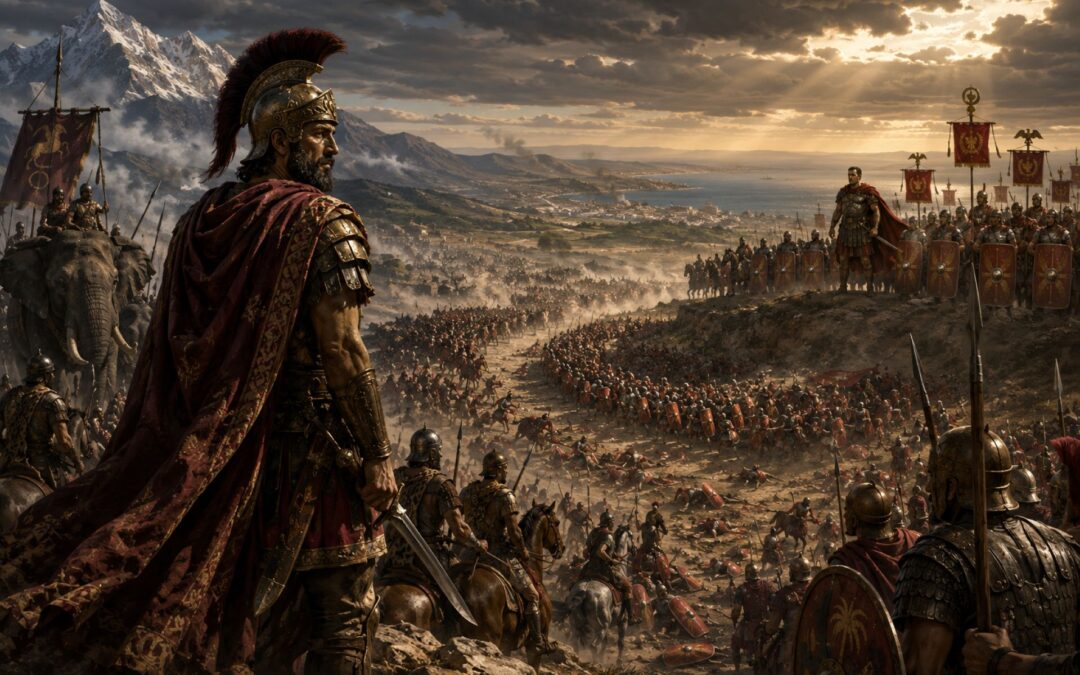
On an August day in 216 BC, Rome suffered one of the worst military defeats in its history.
Near the small town of Cannae in southern Italy, Hannibal Barca surrounded the largest army the Roman Republic had ever assembled. For hours, Carthaginian troops cut down Romans trapped so tightly together that many could barely raise their weapons. By the end, tens of thousands lay dead, including a consul, senior officers, and scores of senators.
Rome appeared finished.
Its armies had been defeated repeatedly. Important allies were beginning to defect. Hannibal had invaded Italy, marched almost the length of the peninsula, and proved that no Roman commander could match him in open battle.
By the conventions of ancient warfare, Rome should have negotiated.
It refused.
Instead, the Republic raised new armies, changed its strategy, contained Hannibal in southern Italy, attacked Carthage’s sources of strength elsewhere, and eventually carried the war into North Africa. There, another exceptional commander, Scipio Africanus, defeated Hannibal at Zama.
The Second Punic War was therefore more than a contest between two military geniuses. It was a struggle between battlefield brilliance and institutional resilience.
Hannibal showed how armies could be destroyed.
Rome showed how a state could survive their destruction.
From the First Punic War to a Second Collision
The Second Punic War grew out of the unresolved grievances of the first.
Rome and Carthage had fought from 264 to 241 BC for control of Sicily and the surrounding seas. Carthage began that conflict as the dominant naval power of the western Mediterranean, while Rome had little experience fighting at sea. Yet Rome built fleets, absorbed catastrophic losses, and eventually forced Carthage to surrender.
The peace settlement stripped Carthage of Sicily and imposed a large indemnity. Before the defeated state could fully recover, it faced another crisis.
Carthage had relied heavily on mercenaries and foreign troops during the war. When it struggled to pay them, the dispute erupted into the Mercenary War, a savage rebellion that threatened Carthage itself. Hamilcar Barca, one of Carthage’s most capable commanders, eventually suppressed the revolt.
Rome then exploited Carthage’s weakness.
When rebellious mercenaries on Sardinia sought Roman protection, Rome occupied the island. It also demanded an additional payment from Carthage after threatening renewed war. Even by the aggressive standards of ancient diplomacy, the seizure was difficult to defend.
Carthage had lost Sicily, Sardinia, prestige, revenue, and freedom of action.
It now needed a new source of wealth and military power.
Hamilcar found it in Iberia.
Beginning in the 230s BC, he expanded Carthaginian influence across the peninsula. Iberia offered fertile land, recruits, trading opportunities, and, above all, rich silver deposits. The territory gradually became the economic and military base from which Carthage rebuilt its strength.
Hamilcar was accompanied by his young son Hannibal. Later Roman tradition claimed that the boy swore an oath never to be a friend of Rome. The story may preserve a genuine family memory, but it also suited the Roman image of Hannibal as an enemy shaped from childhood by hatred.
His motives were probably more complicated.
The Barca family had seen Carthage humiliated, its territory taken, and its political choices constrained. Iberia gave its commanders considerable independence from politicians at home and the resources needed to restore Carthaginian power.
After Hamilcar’s death, command passed to his son-in-law Hasdrubal the Fair. Hasdrubal expanded Carthaginian control through diplomacy as well as warfare, founded New Carthage on the southeastern Spanish coast, and concluded an agreement with Rome concerning the River Ebro.
When Hasdrubal was assassinated in 221 BC, the army acclaimed Hannibal as its commander.
He was still in his twenties.
Within a few years, he would take the conflict his father had anticipated directly into the Roman heartland. Modern histories such as J. F. Lazenby’s Hannibal’s War emphasise that the coming struggle would be fought not only in Italy but across Iberia, Sicily, Greece, Africa, and the wider Mediterranean.
Saguntum and the Disputed Road to War
The immediate crisis began at Saguntum, a prosperous Iberian city south of the Ebro.
Under the agreement between Rome and Hasdrubal, Carthage was not to extend its power north of the river. Saguntum, however, lay well to the south, apparently within the region where Carthaginian expansion remained permitted.
Yet Saguntum had developed a relationship with Rome.
Exactly when and under what terms remains uncertain. Rome treated the city as a friend or ally, while Hannibal regarded Roman involvement there as interference inside Carthage’s recognised sphere.
The situation became more dangerous when Saguntum clashed with neighbouring communities friendly to Carthage. Hannibal eventually besieged the city in 219 BC. After eight months of resistance, Saguntum fell and was brutally sacked.
Rome demanded that Carthage surrender Hannibal and those responsible for the attack. Carthaginian leaders refused, arguing that Rome had no right to protect a city south of the Ebro at Carthage’s expense.
War followed in 218 BC.
The dispute has never produced a simple verdict. The surviving accounts were written from Greek and Roman perspectives, and even they reveal uncertainty over the sequence of alliances and treaty obligations. A Cambridge history of relations between Rome and Carthage notes that the date of Saguntum’s connection with Rome is itself unclear.
Hannibal certainly knew that attacking Saguntum could provoke Rome. Rome, meanwhile, had inserted itself into a city situated inside the zone where Carthage believed it had freedom to operate.
Neither side stumbled innocently into war.
Both had reasons to test the other, and neither was prepared to retreat without losing authority.
Hannibal’s Strategy for Defeating Rome
Hannibal did not plan to destroy Rome by occupying every part of its territory.
That would have been impossible with the army and resources available to him.
Rome’s power rested on a network of alliances extending across Italy. Allied communities supplied troops, food, taxes, and strategic access. Roman armies could suffer enormous losses because the Republic could call on the manpower of this wider Italian federation.
Hannibal’s real target was that system.
He intended to invade Italy, defeat Roman armies dramatically, and convince Rome’s allies that the Republic could no longer protect them. If enough communities changed sides, Rome would lose the manpower and legitimacy that sustained its expansion.
The strategy depended on political effects rather than conquest alone.
Every victory had to send a message.
To Rome’s enemies, Hannibal would present himself as a liberator. To Rome’s allies, he would demonstrate that loyalty brought destruction while defection offered security. To the Roman Senate, repeated military disasters would make a negotiated settlement appear preferable to continued war.
Such a settlement might return Sardinia and Sicily, restrict Roman expansion, and restore Carthage as the leading power of the western Mediterranean.
The plan was ambitious but rational.
It also required Hannibal to do something the Romans did not expect.
Rather than wait for Rome to invade Iberia or North Africa, he would take the war to Italy by land.
Crossing the Alps
Hannibal began his march in 218 BC, moving north from New Carthage with a large, multinational force.
Before leaving Iberia, he had to secure recently conquered territory and detach troops to defend it. He then crossed the Pyrenees and entered Gaul, where his army faced hostile communities, difficult negotiations, desertions, and the constant challenge of feeding thousands of soldiers and animals.
Near the Rhône, Roman forces almost intercepted him.
The consul Publius Cornelius Scipio had sailed toward Iberia expecting to confront Hannibal there. When he learned that the Carthaginian army was already moving through Gaul, he attempted to block its advance.
Hannibal crossed the river before the Romans could stop him.
Scipio immediately understood the danger. Hannibal was not merely defending Carthaginian territory. He was attempting to reach Italy from the north, where Rome’s recently conquered Celtic enemies might join him.
The Alpine crossing that followed became one of the most famous marches in military history.
Ancient sources describe steep paths, snow, landslides, hunger, attacks from mountain communities, frightened animals, and men falling from narrow ledges. Hannibal’s army included cavalry, pack animals, and war elephants, making every obstacle more difficult.
The precise route remains disputed. Researchers have proposed several mountain passes, using ancient descriptions, terrain, environmental evidence, and archaeological discoveries to support competing theories. A Smithsonian examination of the mystery illustrates both the ingenuity of modern investigations and the continuing uncertainty.
The army that emerged into northern Italy was much smaller than the one that had left Spain. Not every missing soldier had died in the mountains—some had been detached, dismissed, lost earlier, or left behind—but the expedition had still exacted a terrible cost.
Hannibal had accepted that risk because the crossing delivered two vital advantages.
The first was surprise. Rome had expected to carry the war into Carthaginian territory and now found an enemy army descending into Italy.
The second was access to the Celts of northern Italy, many of whom resented recent Roman conquest.
Hannibal had reached Italy with a battered force and no secure supply line.
But he had also reached a land full of potential recruits.
Ticinus and Trebia: Rome Underestimates Hannibal
The first confrontation on Italian soil occurred near the River Ticinus.
It was primarily a cavalry engagement, and Hannibal’s horsemen proved superior. His Numidian cavalry—fast, flexible, and skilled at skirmishing—would become one of the most important elements of his army.
The Roman consul Scipio was wounded in the fighting. Later tradition credited his teenage son, the future Scipio Africanus, with helping to save him.
The battle was not large, but its psychological effect was significant.
Northern Italian Celts saw that Hannibal could defeat Roman forces. Some began joining him, while Celtic troops serving Rome deserted or became unreliable.
Rome responded by bringing another consular army north under Tiberius Sempronius Longus. The Romans now possessed a substantial combined force and expected to overwhelm Hannibal before his position became stronger.
Hannibal studied his opponents.
He knew Scipio had become cautious after Ticinus. He also understood that Longus was eager for a decisive victory. Rather than merely wait for battle, Hannibal shaped the conditions under which it would occur.
Before dawn, his Numidian cavalry harassed the Roman camp and drew the Romans into pursuit. Longus sent his troops out hurriedly, reportedly before they had eaten. They crossed the freezing River Trebia and reached the battlefield wet, cold, tired, and hungry.
Hannibal’s men had rested, eaten, and prepared themselves.
He had also concealed a force under his brother Mago in a hidden position near the battlefield.
When the armies engaged, the Roman infantry initially fought with determination. But Hannibal’s cavalry and elephants pressured the wings, while Mago’s hidden troops emerged behind the Roman line.
The Romans were attacked from several directions. Although part of the infantry broke through and escaped, much of the army was destroyed or scattered.
Trebia revealed the pattern that would define Hannibal’s greatest victories.
He did not rely on one brilliant manoeuvre at the last moment. He gathered information, anticipated the enemy’s behaviour, controlled the timing, exploited the weather and terrain, and accumulated small advantages before the main fighting began.
By the time the Romans understood the trap, they were already inside it.
Lake Trasimene and the Rise of Fabius Maximus
After wintering in northern Italy, Hannibal moved south in 217 BC.
His army crossed the flooded marshes of the Arno, enduring days of mud, disease, exhaustion, and little opportunity to sleep on dry ground. Hannibal himself developed an infection that cost him the sight in one eye.
The march allowed him to bypass Roman positions and enter the rich lands of Etruria.
There, he burned farms and devastated the countryside, partly to supply his army and partly to provoke the Roman consul Gaius Flaminius into following him.
Flaminius took the bait.
Hannibal led the Romans along the northern shore of Lake Trasimene, where a narrow route ran between the water and the surrounding hills. During the night, he concealed troops on the heights and placed forces to block the Roman advance.
In the morning, mist from the lake reduced visibility. Flaminius’s column entered the passage without discovering the enemy positions.
Hannibal then launched one of history’s largest ambushes.
Carthaginian forces descended from the hills while other troops closed the exits. The Romans had little time or space to form a proper battle line. Many were killed where they stood; others were driven into the lake and drowned beneath their armour.
Flaminius died with much of his army.
Rome had now lost two major battles in less than a year. Panic spread through the city, and the Republic resorted to an emergency office used in moments of exceptional danger.
Quintus Fabius Maximus was appointed dictator.
Fabius recognised what previous commanders had not: Hannibal was too dangerous to confront on ground of his own choosing.
Instead of seeking another decisive battle, Fabius shadowed the Carthaginian army from defensible positions. He harassed foraging parties, restricted movement where possible, and protected Roman forces from traps.
The approach was deeply unpopular.
Roman political culture celebrated aggression, courage, and decisive combat. Avoiding battle appeared cowardly. Fabius was mocked as Cunctator—the Delayer.
Yet delay was precisely what Rome needed.
Hannibal was deep inside enemy territory, dependent on local supplies and uncertain allies. Time favoured Rome as long as it preserved its armies. The method of avoiding a superior battlefield commander while gradually exhausting his position would later become known as the Fabian strategy.
Hannibal understood its danger. He burned Roman land in sight of Fabius, threatened allied communities, and repeatedly attempted to provoke him.
Fabius refused.
For the first time since entering Italy, Hannibal had found a Roman commander who would not behave as expected.
Cannae: Hannibal’s Greatest Victory
Fabius’s strategy preserved Roman strength, but it did not satisfy Roman anger.
When his dictatorship ended, Rome returned to a more aggressive policy. The Republic assembled an enormous army under the consuls Lucius Aemilius Paullus and Gaius Terentius Varro.
Ancient estimates differ, but the Roman force may have approached 80,000 infantry, supported by cavalry and allied contingents. It was the largest army Rome had yet placed in the field.
The plan was straightforward.
Roman infantry normally fought in a formation arranged in depth, allowing units room to manoeuvre. At Cannae, the formations appear to have been packed more densely than usual. Rome intended to use its superior numbers to drive through Hannibal’s centre with overwhelming force.
Hannibal arranged his army differently.
He placed Iberian and Celtic infantry in a curved formation projecting toward the Romans. His more experienced African infantry stood farther back on both sides. His cavalry occupied the wings, with the stronger heavy cavalry positioned to defeat the Roman horse quickly.
When the Roman infantry advanced, Hannibal’s centre gradually yielded.
The outward curve flattened and then bent inward. Believing the Carthaginian line was collapsing, the Romans pressed forward, becoming increasingly compressed as more men pushed into the narrowing space.
Meanwhile, Hannibal’s cavalry routed its Roman opponents. Instead of pursuing indefinitely, the victorious horsemen returned to the battlefield.
At the centre, Hannibal’s African infantry turned inward against the Roman flanks.
The cavalry struck from behind.
The Roman army was enclosed.
Cannae became the classic example of double envelopment: a smaller army surrounding a larger one by drawing its centre forward and closing around it from the sides and rear. Polybius’s surviving account of Hannibal’s Italian campaign remains one of the central ancient sources, although every reconstruction depends on interpreting incomplete and sometimes conflicting evidence.
The killing lasted for hours.
Casualty estimates vary sharply, but there is no doubt that the Roman losses were catastrophic. Tens of thousands were killed or captured. Paullus died, as did numerous former magistrates, military tribunes, and senators.
Hannibal had used Rome’s numerical superiority against it. The deeper the Romans drove into his centre, the more tightly they trapped themselves.
It was his masterpiece.
Yet Cannae also exposed the limits of tactical victory.
Hannibal had proved that he could annihilate a Roman army.
He had not proved that Rome would admit defeat.
Why Rome Refused to Surrender
After Cannae, Hannibal expected negotiations.
That expectation was not unreasonable. In the ancient world, a sequence of defeats on this scale commonly forced states to seek terms. Rome had lost multiple armies, experienced mass casualties among its political class, and watched important Italian communities reconsider their loyalties.
Hannibal offered to discuss peace. He also permitted captured Romans to send representatives home to arrange their ransom.
The Senate rejected both approaches.
As Polybius records in his discussion of Roman institutions and character, Rome refused to ransom the prisoners taken after Cannae. The decision was cruel to the captives, but politically powerful: Rome would not finance its enemy or behave as though the war had been decided.
The Republic instead prepared to continue fighting.
It lowered normal recruitment standards, enlisted younger men, armed slaves with promises of freedom, and drew on emergency reserves. Religious rituals attempted to restore confidence, while political leaders suppressed talk of abandonment.
Rome’s response worked because the Republic was more than the army Hannibal had destroyed.
Its Senate continued meeting. Magistrates continued taking office. Taxes and levies continued to be collected. Latin colonies and many allied communities continued supplying soldiers.
Some important cities defected, most notably Capua. Several communities in southern Italy also joined Hannibal.
But the alliance system did not collapse.
Much of central Italy remained loyal. Most Latin colonies held firm. Rome still controlled strategic roads, fortified positions, ports, and a large pool of allied manpower.
Loyalty was not based on affection alone. Some allies feared Carthage, some benefited from Roman connections, some distrusted neighbouring communities, and others doubted whether Hannibal could protect them permanently.
Rome’s willingness to absorb losses also changed the political meaning of Cannae.
Hannibal had designed his victories to demonstrate that resistance was futile.
Rome responded by making surrender unthinkable.
Hannibal’s Victory Becomes a Trap
Cannae delivered many of the political results Hannibal had wanted.
Capua, one of Italy’s largest and wealthiest cities, joined him. Other communities in the south followed. Philip V of Macedon later formed an alliance with Carthage, while Syracuse shifted away from Rome after internal political upheaval.
But new allies created new obligations.
Hannibal’s army had survived by moving through enemy territory, gathering supplies, defeating Roman forces, and encouraging defections. Once cities joined him, they expected protection.
Rome exploited the problem.
Rather than confront Hannibal directly, Roman armies attacked communities that had changed sides. When Hannibal approached, they withdrew or moved elsewhere. When he left to defend another ally, they returned.
Hannibal could defeat almost any Roman army willing to fight him.
Rome increasingly refused to provide one.
The situation turned southern Italy into a strategic prison. Hannibal had to remain close enough to protect his allies, but his presence consumed their food and exposed them to Roman retaliation. He could not be everywhere at once, and the longer the war continued, the more uncertain his coalition became.
Capua eventually came under Roman siege.
Hannibal attempted to relieve pressure by marching toward Rome itself in 211 BC. His appearance near the capital created panic and helped produce the enduring expression “Hannibal at the gates.”
But the movement was a diversion, not a serious attempt to storm the city. Rome’s fortifications, remaining defenders, and Hannibal’s lack of heavy siege equipment made a successful assault doubtful.
More importantly, the Romans did not abandon the siege of Capua.
The city fell and was punished severely.
The famous claim that Hannibal knew how to win a battle but not how to use victory rests on hindsight. Marching on Rome immediately after Cannae would not necessarily have ended the war. His troops were exhausted, the city was fortified, and Rome had already demonstrated that threatening its capital did not automatically destroy its government.
Hannibal’s deeper problem was not that he failed to make one obvious move.
It was that Rome had learned how to deny him the kind of war he needed.
The Second Punic War Beyond Italy
While Hannibal dominated the drama, the Second Punic War was never confined to his Italian campaign.
Rome and Carthage fought across multiple regions, and events in those theatres gradually determined what each side could sustain.
In Sicily, the death of King Hiero II destabilised Syracuse, a longstanding Roman ally. Political factions eventually aligned the city with Carthage. Rome responded by besieging it under Marcus Claudius Marcellus.
The mathematician Archimedes reportedly designed defensive machines that disrupted Roman attacks, including cranes capable of lifting or overturning ships. Later tradition credited him with using mirrors to burn the Roman fleet, but the story appeared centuries after the siege and is treated sceptically by historians. An analysis hosted by New York University’s Archimedes project traces how late the burning-mirror story entered the record.
Syracuse fell in 212 BC, and Archimedes was killed during the capture despite orders that he be spared. Rome subsequently restored control over Sicily, securing a vital source of grain and preventing Carthage from rebuilding a major base there.
Rome also suppressed a Carthaginian-supported uprising in Sardinia.
Across the Adriatic, Hannibal’s alliance with Philip V threatened to open another major front. Rome responded by supporting Philip’s Greek opponents, preventing Macedon from concentrating fully on Italy. The resulting First Macedonian War remained indecisive, but it kept Philip from providing Hannibal with the intervention he needed.
Northern Italy remained unstable, and Celtic forces continued resisting Rome. Yet even there, Rome could raise new armies and rebuild its position over time.
The pattern was becoming clear.
Hannibal was unmatched when Rome placed an army directly in his path.
Elsewhere, Carthage was struggling to turn local successes into a coordinated strategy.
Spain and the Rise of Scipio Africanus
Iberia remained central to the war because it supplied Carthage with silver, soldiers, commanders, and strategic depth.
Roman forces under the brothers Publius and Gnaeus Cornelius Scipio had campaigned there from the beginning of the conflict. They restricted Carthaginian movement, cultivated local allies, and prevented Hannibal’s brothers from sending large reinforcements to Italy.
In 211 BC, however, both Roman commanders were defeated and killed in separate battles.
Many Roman gains collapsed.
The Republic needed someone to restore the situation, but experienced commanders were reluctant to accept a difficult posting far from the prestige of the Italian war.
Publius Cornelius Scipio, the young son of one of the dead generals, volunteered.
He was only in his mid-twenties and had not held the offices normally required for such a command. Nevertheless, the Roman people entrusted him with extraordinary authority.
Scipio arrived in Spain and refused to follow the obvious approach.
Three Carthaginian armies operated in the peninsula. Attacking them individually risked allowing the others to unite against him. Instead, Scipio targeted New Carthage, the administrative and logistical centre of Carthaginian Spain.
The city stored money, supplies, weapons, hostages, and political influence. It was also protected by fortifications, water, and a lagoon that appeared to make it difficult to assault.
Scipio marched rapidly and concealed his destination for as long as possible.
In 209 BC, he reached New Carthage before the main Carthaginian armies could intervene. While Roman troops attacked the principal defences, another force crossed the lagoon at low water, scaled a less-protected section of the walls, and entered the city.
New Carthage fell in a single day.
The victory gave Scipio far more than a fortress. He captured war material, treasure, ships, and hostages belonging to influential Iberian communities.
He used those hostages politically.
Rather than treating them as prisoners from hostile peoples, Scipio returned many of them and presented Rome as a more reliable partner than Carthage. Iberian leaders began changing sides.
Scipio later defeated Hasdrubal Barca at Baecula, although Hasdrubal escaped and marched toward Italy. In 206 BC, Scipio won his decisive Spanish victory at Ilipa.
For several days before the battle, he had deployed his strongest Roman troops in the centre and his Iberian allies on the wings. When the final engagement began, he reversed the arrangement. The Carthaginians had prepared to confront Roman legions in the middle and instead found them advancing against their weaker flanks.
Scipio also attacked early, forcing the enemy to form without adequate preparation or food.
His wings advanced aggressively while his centre moved more slowly, preventing the strongest Carthaginian troops from joining the decisive fighting.
The victory ended Carthage’s effective control of Iberia.
In only a few years, Scipio had captured its main base, weakened its alliances, defeated its armies, and removed one of the principal foundations supporting Hannibal’s war.
Scipio Learns from Hannibal
Scipio’s rise did not merely give Rome another courageous commander.
Rome had possessed courageous commanders before. Hannibal had destroyed them.
Scipio was different because he understood that military action had to serve a larger political and strategic purpose.
At New Carthage, he did not attack the nearest army. He attacked the centre that allowed those armies to operate.
In dealing with Iberian communities, he did not rely only on fear. He used mercy, hostages, diplomacy, and personal relationships to weaken Carthage’s alliances.
At Ilipa, he manipulated the enemy’s expectations, controlled the timing of battle, and arranged his troops so that Carthaginian strength could not be applied effectively.
These methods resembled Hannibal’s.
Both commanders relied on intelligence and local knowledge. Both understood the political value of treating selected communities generously. Both concealed intentions, altered conventional formations, and forced opponents to respond under unfavourable conditions.
Scipio was not simply copying tactics.
He was learning a way of thinking.
Hannibal had shown that battlefields could be shaped before the armies collided. Scipio applied that insight to entire campaigns.
A study published by the National Defense University Press argues that Scipio’s particular strength was his ability to integrate military and political objectives rather than treating victories as isolated events.
Hannibal had become Rome’s greatest teacher.
Scipio became its most successful student.
Hasdrubal’s Defeat and Hannibal’s Isolation
After Baecula, Hannibal’s brother Hasdrubal left Spain and marched toward Italy.
He crossed the Alps more successfully than Hannibal had, benefiting from improved conditions, better preparation, and the psychological impact of his brother’s earlier achievement.
His objective was to unite with Hannibal.
Had the brothers combined their armies, Rome might once again have faced a concentrated force capable of producing another Cannae. Hannibal desperately needed reinforcements, experienced troops, and renewed momentum.
The Romans intercepted Hasdrubal’s communications before the brothers could meet.
In 207 BC, Roman commanders concentrated against him near the River Metaurus. Hasdrubal’s army was defeated, and he was killed.
The Romans reportedly threw his severed head into Hannibal’s camp.
Whether every detail of the episode occurred as later writers described it, the strategic meaning was unmistakable. The reinforcements Hannibal had awaited would never arrive.
His position continued to deteriorate.
Capua had been lost. Syracuse had fallen. Carthage had been driven from Spain. Roman armies had learned to avoid decisive battle with him while steadily recovering rebellious communities.
Hannibal still won local engagements and remained dangerous. In 208 BC, he ambushed a Roman force and killed both consuls.
But such successes could no longer reverse the direction of the war.
The commander who had once moved freely from northern Italy to Campania was gradually confined to the far south.
He had not been defeated in a great Italian battle.
He had been isolated.
Scipio Takes the War to Africa
Scipio returned from Spain as one of Rome’s most celebrated commanders and was elected consul for 205 BC.
He proposed invading North Africa.
Fabius Maximus opposed the plan. The older statesman feared that Scipio was risking Roman resources while Hannibal remained in Italy. He preferred continued containment and a cautious reduction of Carthaginian power.
Scipio saw the war differently.
Hannibal could not be removed easily by fighting him in southern Italy. But Carthage itself could be threatened. An invasion of Africa would force the enemy to recall armies, defend its capital, and abandon the initiative it had held for so long.
Scipio prepared in Sicily, gathering volunteers and retraining troops, including survivors of Cannae whose earlier defeat had left them socially disgraced.
He also pursued a crucial diplomatic objective.
Numidian cavalry had played a decisive role in Hannibal’s victories. North Africa was divided among rival Numidian rulers, especially Syphax and Masinissa. Carthage secured Syphax’s support, while Scipio allied with Masinissa, promising to strengthen his position.
Scipio landed in Africa in 204 BC.
Carthage and Syphax assembled a larger opposing force, but Scipio used negotiations to gather intelligence about their camps. Learning that many of the enemy shelters were made from flammable materials, he launched a night attack.
The camps erupted in fire.
Men fleeing without weapons or formation were cut down by Roman troops. Scipio followed the victory with another at the Great Plains in 203 BC.
Masinissa pursued Syphax, captured him, and emerged as Rome’s dominant Numidian ally.
Carthage now faced the kind of threat Rome had endured for years: an enemy army operating near its homeland, supported by local cavalry and strengthened by defections.
The Carthaginian government recalled Hannibal from Italy.
After roughly fifteen years on the peninsula, he abandoned the campaign that had defined his life.
Rome had never forced him out in battle.
Scipio had made his presence there strategically irrelevant.
Zama: Hannibal and Scipio Face Each Other
Hannibal returned to Africa with the veterans who had followed him through years of campaigning.
Before the decisive battle, he and Scipio reportedly met to discuss peace. The surviving accounts present the conversation dramatically, and the exact words cannot be recovered. Hannibal warned that fortune in war could change suddenly. Scipio believed Rome’s position was already too strong to justify generous terms.
The armies met at Zama in 202 BC.
Hannibal possessed a large infantry force and around 80 war elephants, according to Polybius’s account of the battle. His army, however, was uneven. It included recently raised troops, former mercenaries, Carthaginian and African soldiers, and veterans from Italy who formed his strongest line.
Scipio held the advantage in cavalry because Masinissa’s Numidians now fought for Rome.
To counter the elephants, Scipio altered the normal Roman formation. He left open lanes running through the infantry, screened by lighter troops. When the elephants charged, Roman soldiers used noise and missiles to frighten them, while others moved aside and channelled them through the gaps.
Some animals passed harmlessly through. Others turned toward the Carthaginian wings, adding to the disorder.
Roman and Numidian cavalry then drove Hannibal’s horsemen from the battlefield.
The infantry struggle was harder.
Hannibal had arranged his troops in successive lines. The Romans fought through the earlier formations before confronting the veterans he had brought from Italy. Both sides reorganised for the final clash, which appears to have been fiercely contested.
Once again, cavalry decided the battle.
After pursuing the Carthaginian horsemen, the Roman and Numidian cavalry returned and struck Hannibal’s infantry from behind.
The reversal from Cannae was complete.
There, Hannibal’s cavalry had enclosed the Romans.
At Zama, Scipio and Masinissa enclosed Hannibal.
The Carthaginian army collapsed. Hannibal escaped, but he advised his government to seek peace.
Seventeen years after the conflict began, the Second Punic War was over.
Why Hannibal Lost and Rome Won
The temptation is to explain the war through one decision.
Hannibal should have marched on Rome. Carthage should have sent more troops. Rome simply possessed more manpower. Scipio copied Hannibal and beat him at his own game.
Each explanation contains part of the truth.
None is sufficient by itself.
Hannibal lost because his battlefield victories failed to produce the political collapse his strategy required, while Rome adapted across multiple theatres and gradually dismantled the system supporting him.
Hannibal Could Win Battles but Could Not Compel Surrender
Hannibal’s strategy assumed that catastrophic defeats would force Rome to negotiate.
That assumption was reasonable, but wrong.
Rome’s leaders separated military disaster from political defeat. They could lose consuls, senators, armies, and allied territory without accepting that the Republic itself had been beaten.
This refusal denied Hannibal the outcome his victories were meant to create.
He could destroy the army Rome sent against him.
Rome kept sending another.
Rome’s Alliance System Bent Without Completely Breaking
Hannibal succeeded in persuading important communities to defect, especially after Cannae.
But he needed a much wider collapse.
Most Latin colonies remained loyal, as did many central Italian communities. Rome’s allies continued supplying troops and maintaining strongholds that restricted Hannibal’s movement.
The alliance system survived partly because Rome possessed deep political and economic ties across Italy and partly because Hannibal could not protect every community that joined him.
Defection was dangerous.
Cities that abandoned Rome risked siege, confiscation, execution, and political destruction if Hannibal could not save them.
Rome Stopped Giving Hannibal the Battles He Needed
Hannibal’s Italian strategy depended on visible victories.
Each destroyed Roman army weakened Rome’s authority and encouraged another wave of defections. Fabius understood that refusing battle deprived Hannibal of his most powerful political weapon.
After Cannae, Rome adopted that insight more consistently.
Roman forces harassed Hannibal, restricted his supplies, recovered allied cities, and fought weaker Carthaginian commanders elsewhere.
They no longer treated defeating Hannibal personally as the only path to victory.
Rome Fought the Entire War, Not Merely Hannibal
The outcome was shaped in Sicily, Sardinia, Macedonia, Spain, Numidia, and Africa as well as Italy.
Rome recovered Syracuse, contained Philip V, defeated Carthaginian forces in Iberia, prevented Hasdrubal from joining his brother, allied with Masinissa, and ultimately invaded the Carthaginian homeland.
Every success narrowed Hannibal’s options.
Spain’s loss deprived Carthage of wealth and troops. The Metaurus removed reinforcements. Masinissa’s defection transferred the best Numidian cavalry to Rome. Scipio’s invasion forced Hannibal to abandon Italy.
Rome won by turning one terrifying campaign into a wider war that Carthage could not coordinate effectively.
Carthage Failed to Coordinate Its Theatres Effectively
It is too simple to say that jealous Carthaginian politicians deliberately abandoned Hannibal.
Carthage did send armies and resources into the wider war. It fought in Spain, Sicily, Sardinia, Italy, and Africa. Hannibal’s brothers attempted to reinforce him, while Mago later opened another campaign in northern Italy.
But Carthaginian efforts were fragmented.
Resources sent to one theatre could not be used in another. Roman control of important sea routes complicated reinforcement. Local commanders pursued separate campaigns, and no unified strategy consistently connected Hannibal’s operations with those elsewhere.
Political factionalism probably worsened the problem, but geography, logistics, Roman naval power, and competing emergencies mattered just as much.
Hannibal remained Carthage’s greatest weapon.
Carthage never found a reliable way to build the rest of the war around him.
Scipio Transformed Roman Strategy
Scipio did not defeat Hannibal by becoming a better version of the traditional Roman commander.
He succeeded by abandoning the limitations Hannibal had exploited.
He used surprise at New Carthage, diplomacy with Iberian leaders, deception at Ilipa, intelligence during the African campaign, and alliance-building with Masinissa.
Most importantly, he attacked sources of power rather than chasing symbols of glory.
Spain mattered because it sustained Carthaginian armies. Numidia mattered because its cavalry shaped battles. Africa mattered because threatening Carthage could remove Hannibal from Italy.
Scipio connected each campaign to the next.
His final victory at Zama was not an isolated triumph over Hannibal. It was the conclusion of a strategy that had already deprived Hannibal of Spain, reinforcements, allies, mobility, and the freedom to choose where the war would be fought.
The Consequences of the Second Punic War
The peace imposed on Carthage in 201 BC was severe.
Carthage surrendered its territories outside Africa, gave up most of its fleet and war elephants, accepted another large indemnity, and lost the right to wage war without Roman permission.
It remained wealthy and recovered economically faster than many Romans expected.
But it was no longer an independent great power.
Rome gained control of Spain and emerged as the dominant state in the western Mediterranean. Its attention increasingly turned east toward Macedon, the Hellenistic kingdoms, and a wider series of interventions that would transform the Republic into a Mediterranean empire.
Masinissa became the leading Numidian ruler and expanded his kingdom with Roman support, often at Carthage’s expense.
The war also elevated its two great commanders into legend.
Scipio received the name Africanus for his victory. He became one of Rome’s most admired figures, although political rivalry and accusations against members of his family later contributed to his withdrawal from public life.
Hannibal entered Carthaginian politics and pursued financial and constitutional reforms. Pressure from his domestic opponents and fear of Roman intervention eventually drove him into exile.
Roman sources continued to portray him as a dangerous enemy even in old age. Pursued through the eastern Mediterranean, he finally took poison rather than fall into Roman hands, probably around 183 BC.
Scipio died at roughly the same time.
Both men became symbols larger than their lives: Hannibal as the brilliant invader who brought Rome close to destruction, Scipio as the commander who absorbed his methods and turned the war against him.
Modern portrayals of Hannibal remain shaped by the fact that his enemies wrote most of the surviving history. Eve MacDonald’s biography of Hannibal places him within Carthaginian and Hellenistic society rather than treating him only as the monstrous opponent constructed by Roman memory.
Rome’s anxiety about Carthage did not disappear after victory.
Decades later, Roman leaders would again insist that Carthage represented an intolerable threat. The resulting Third Punic War ended not with another negotiated settlement but with the destruction of the city itself.
Conclusion
Hannibal entered Italy by a route Rome believed almost impossible.
He recruited enemies inside Roman territory, manipulated successive commanders, and won at Trebia, Lake Trasimene, and Cannae. He destroyed armies larger than his own and forced the most powerful state in Italy to abandon its preferred way of fighting.
Yet Rome survived.
It survived because its strength did not rest on one army, one consul, or one battle. Its political institutions continued functioning. Its alliances continued producing troops. Its leaders eventually learned to avoid Hannibal, attack weaker positions, and fight across the entire Mediterranean.
Then Scipio changed the direction of the war.
He took Spain, won Iberian allies, secured Numidian cavalry, invaded Africa, and forced Hannibal to leave the country he had spent most of his adult life trying to conquer.
The Second Punic War was not ultimately decided by the brilliance of one manoeuvre, even one as extraordinary as Cannae.
It was decided by which state could survive disaster, retain allies, learn from defeat, and continue fighting after victory seemed impossible.
Hannibal demonstrated how a great commander could bring Rome to the edge of destruction.
Rome demonstrated why destroying its armies was not the same as defeating it.
Last Updated on July 12, 2026 by Aseem Gupta