
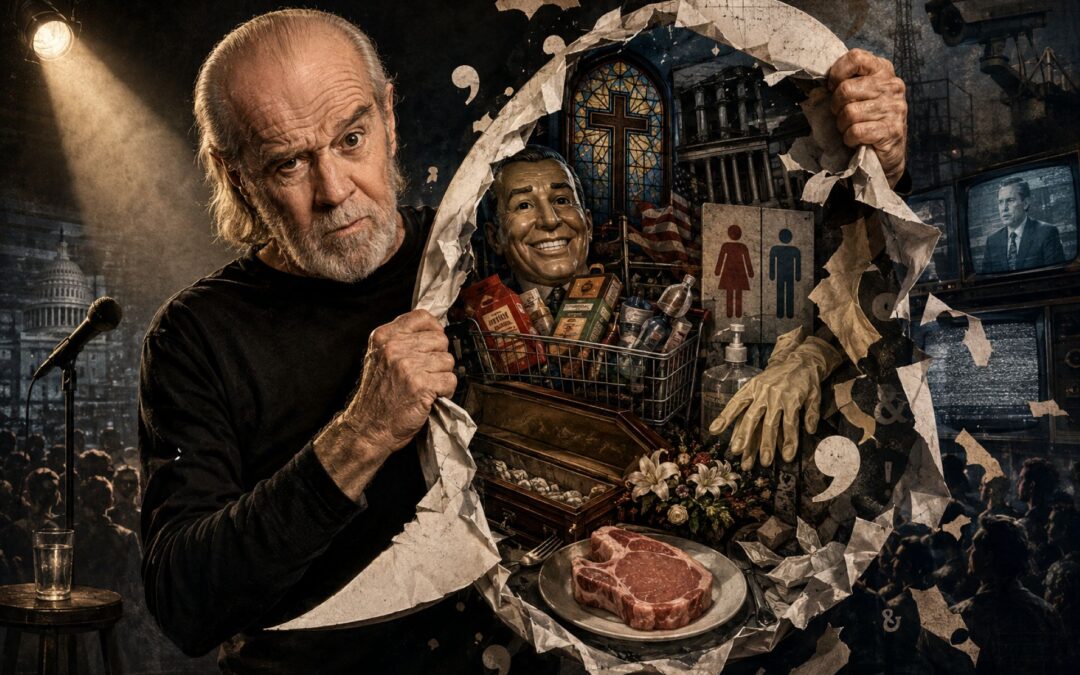
George Carlin’s When Will Jesus Bring the Pork Chops? does not behave like a conventional nonfiction book. It has no sustained thesis that advances neatly from chapter to chapter, no program to follow, and no narrative whose momentum depends on what happens next. Instead, it presents Carlin’s mind in motion: long comic essays give way to one-paragraph observations, invented television programs collide with arguments about politics and religion, language exercises sit beside grotesque stories about bodies, and recurring sequences on euphemisms, gender, work, death, media, and social ritual repeatedly interrupt one another.
That apparent disorder is part of the design. Carlin’s subjects change constantly, but his way of looking at them changes much less. Again and again, he takes a phrase people use without thinking, removes the assumptions that make it sound normal, and asks what it would mean if treated literally. He dislikes softened terminology, ceremonial language, prestige titles, political slogans, sentimental formulas, and any expression that seems to protect its speaker from an unpleasant reality. Much of the comedy comes from making familiar words sound strange enough that the reader has to hear them again.
The book therefore works best not as a coherent philosophy but as an extended demonstration of a comic habit. That habit can be extraordinarily revealing when Carlin exposes political evasions, inflated corporate language, advertising clichés, empty social rituals, or the verbal machinery used to disguise responsibility. It is less reliable when he assumes that bluntness is automatically more truthful, treats complexity as a sign of dishonesty, or turns the same aggression toward people whose circumstances cannot be reduced to euphemism or social pretense.
Published in 2004, the book followed the prose format Carlin had already developed in Brain Droppings and Napalm & Silly Putty. The George Carlin Estate describes these books as mixtures of long and short essays, observations, serious commentary, silly material, and language comedy, which is a much better guide to When Will Jesus Bring the Pork Chops? than the idea of a normally chaptered book. The result is messy by design, but not random. Its coherence comes from Carlin’s voice, his repeated methods, and his deep suspicion that people use language not merely to describe reality but to hide from it.

What Kind of Book Is When Will Jesus Bring the Pork Chops?
When Will Jesus Bring the Pork Chops? was published in 2004, late enough in George Carlin’s career that the basic contours of his comic persona were already well established. He had long since moved beyond the relatively conventional observational comedy associated with his early television appearances and toward a darker, angrier style built around language, politics, religion, death, consumer culture, and human stupidity. The book carries that sensibility onto the page without trying to turn it into a conventional memoir or political manifesto.
Its architecture is deliberately unstable. A substantial argument about euphemism may be followed by a tiny word game; a long gender routine may be interrupted by fake news; a section about terrorism may sit near an observation about tea or supermarket behavior. Recurring labels such as “Euphemisms,” “Guys & Dolls,” “Politician Talk,” “Body of Work,” “Bits and Pieces,” and the surreal portraits of fictional uncles create some continuity, but even those sequences are scattered rather than arranged into self-contained parts.
That fragmentation matters because the book is trying to reproduce something close to Carlin’s working comic consciousness. He hears phrases, notices contradictions, collects examples, exaggerates tendencies, invents scenarios, and keeps following an idea after ordinary conversation would have abandoned it. Sometimes a thought becomes a fully developed routine; sometimes it remains a miniature premise. The reader is not moving through a formal argument so much as through a large warehouse of verbal pressure points.
A contemporary Publishers Weekly review recognized that the collection ranges widely but ultimately keeps returning to language. That is the most useful organizing insight. Religion, politics, war, jobs, aging, death, disability, television, advertising, gender, sports, children, food, grief, patriotism, and consumer behavior may appear unrelated, but Carlin repeatedly approaches them by asking who gets to name things, what words conceal, and how quickly a familiar phrase collapses when subjected to literal scrutiny.
The book also depends heavily on Carlin’s outsider identity. In the Preface, he portrays himself as partly detached by temperament and partly driven away by systems he finds corrupt, absurd, hypocritical, or dishonest. That distinction is important. His stance is not simply that all collective life is worthless. He implies that belonging might be appealing if institutions were trustworthy enough to deserve loyalty. Because he rarely finds them so, detachment becomes both moral posture and comic advantage.
His antagonism is unusually indiscriminate. Religious believers, politicians, journalists, advertisers, activists, parents, children, men, women, disabled people, celebrities, drivers, athletes, soldiers, shoppers, grieving families, and television audiences can all become targets. Carlin often treated the refusal to exempt a category from ridicule as a form of intellectual equality. Yet the book also demonstrates why that principle cannot settle every critical question. Equal permission to joke about everyone does not guarantee equal insight, and a satire of a powerful institution does not function in quite the same way as contempt directed at a vulnerable individual.
That tension gives the book more critical interest than a simple collection of jokes would have. Its strongest passages demonstrate how comic literalism can expose evasive language that has become socially invisible. Its weakest passages show what happens when the same instrument is treated as infallible.
When Will Jesus Bring the Pork Chops?: Complete Walkthrough of the Collection
A complete summary of When Will Jesus Bring the Pork Chops? cannot work like a plot synopsis or a standard chapter-by-chapter nonfiction breakdown. Many pieces are extremely short, while others develop ideas across several pages, and some recurring sequences are deliberately separated from one another. The best way to preserve the actual experience of the collection is therefore to follow its order while grouping neighboring material into broader movements.
What emerges is not a hidden linear thesis but a gradual accumulation. The early material establishes Carlin’s fascination with words, religion, gender, and authority; the middle expands that method into politics, employment, disability, consumer life, media, and social ritual; the later sections increasingly return to death, the body, morality, and the formulas through which society describes itself. The final pieces bring the book back to language so decisively that the collection’s apparent randomness begins to look like a long orbit around the same concern.
The Opening Assault on Language, Religion, Gender and Authority
Even the front matter refuses to remain purely functional. The acknowledgments become comic material, and an epigraph built around Hermann Göring’s remarks on how leaders can mobilize populations for war introduces a serious thread beneath the jokes: Carlin is interested in the relationship between authority, fear, patriotism, and language. The Preface then establishes the outsider stance that governs the book. He does not present alienation as noble in itself; he describes it as a response to systems he sees as unworthy of loyalty.
“George’s Holiday Message” immediately demonstrates one of his favorite inversions. A conventional seasonal greeting is forced to accommodate accidents, disease, death, and ordinary misery until the emotional machinery of holiday reassurance collapses. “A Note of Appreciation” similarly turns an expected publishing convention into a fake endorsement, while the tiny provocation “What are you lookin’ at?” acts almost like a confrontational glance before the collection gets fully underway.
“A Modern Man” is the first major performance of the book’s linguistic method. Carlin constructs a supposedly contemporary identity out of corporate terminology, lifestyle jargon, technological vocabulary, psychological labels, cultural catchphrases, and status signals. The accumulation creates rhythm, but it also suggests that modern identity can be assembled from language produced by institutions and markets. The individual speaking sounds distinctive because he possesses so many labels, yet the labels themselves are standardized.
The first “Euphemisms” installment makes that concern explicit. Carlin argues that people continually replace direct language with softer, grander, more fashionable, or less emotionally uncomfortable terms. His examples move across bodily functions, consumer terminology, professional labels, and ordinary speech. The underlying suspicion is that language often changes not because reality has changed, but because speakers want distance from what the old words forced them to confront.
From there, the book moves rapidly between cultural stereotypes and literal reinterpretations. “Stiff Upper Lip, You Know” imagines airline passengers from different national cultures reacting according to exaggerated stereotypes in the face of disaster. “Hand Me My Purse” strips boxing of its ceremonial legitimacy and describes it as organized head trauma interrupted by formal rules. “Remember Your Uncle John?” introduces the recurring grotesque-relative form, where an apparently nostalgic family anecdote becomes a catalogue of increasingly appalling events.
“Count the Superfluous Redundant Pleonastic Tautologies” turns inflated phrasing into a comic object. The point is not simply that redundancies exist but that official-sounding language can become so padded that verbal volume substitutes for information. “The Control Freaks” expands this suspicion into politics by imagining rulers who openly admit that surveillance, identification, tracking, and administrative control are exactly what they want. Carlin’s joke removes the reassuring rhetoric and leaves only the domination he believes it conceals.
“They Came From Out of the Sky” applies a similar operation to religion. Carlin contrasts cultural mockery of belief in UFOs with the institutional respect granted to traditional supernatural claims about God and Christianity. He is not seriously establishing UFO belief as equally probable; he is asking why age, cultural authority, and institutional prestige change the social status of one extraordinary claim while another is treated as ridiculous.
“The Two Commandments” is one of the collection’s central religious routines. Carlin takes the Ten Commandments as an editing problem, grouping rules that seem redundant and discarding those he regards as expressions of divine vanity or social control. The joke depends on shrinking sacred law into a small number of practical moral principles. Its deeper move is characteristic of the book: inherited authority is subjected to the same editorial impatience Carlin applies to bureaucratic jargon.
“The Filthy, Dirty News” transfers that aggression to television form. The authoritative tone and structure of broadcast news remain recognizable, but the content is filled with indecorous bodily and sexual material. “That’s the Spirit” challenges the notion of a professional spiritual adviser, arguing that if spirituality is meaningful it should not require an intermediary whose institutional status grants special access. “Guys Called Junior” treats naming a son after his father as a form of paternal possession rather than simple family tradition.
The first large gender sequence, “Guys & Dolls: Part 1” or “Ladies First,” begins with the crude proposition that women are “crazy” because men are “stupid,” but the routine is more complicated than its slogan. Carlin moves through physical vulnerability, appearance pressures, hair, skin, clothing, jewelry, cosmetic procedures, marriage, sex, and motherhood. Some passages acknowledge burdens placed on women by male expectations; others depend on broad stereotypes and physical caricature. That mixture—partial social insight combined with aggressively simplified generalization—will recur elsewhere in the book.
“It’s a Female Problem” pushes the body material into grotesque medical imagery, while “Smooth Flight” changes tone by imagining an airline trip from which every predictable inconvenience has been removed. The comedy depends on the reader knowing ordinary travel well enough that a perfectly functioning experience sounds almost surreal. “If Looks Could Kill” then returns to appearance, treating cosmetic surgery as deceptive packaging rather than self-fashioning, another example of Carlin preferring what he considers the blunt original over the improved surface.
“The Continuing Story of Mary & Joseph: ‘It’s a Boy’” takes the Christian Nativity out of sacred narrative and relocates it inside the emotional logic of an ordinary relationship. Joseph is asked to respond to a supernatural pregnancy explanation without the benefit of theological reverence, which makes the story sound like an implausible domestic excuse. Carlin’s religious satire frequently works this way: he does not offer elaborate theology; he removes ritual framing and asks how the claim sounds in colloquial language.
“Guys & Dolls, Part 2,” or “Man, Oh Man!,” shifts from women to men. Men are presented as trapped by competitiveness, hierarchy, aggression, emotional restriction, the pressure to know what they are doing, and submission to other men in the forms of kings, generals, priests, bosses, and institutional authorities. Read together, the two gender sections suggest that Carlin sees both sexes as shaped by social absurdities, although his mode of expressing that idea remains highly stereotyped.
“Ninety-Nine Things You Need to Know” mocks the authority of numbered wisdom by undermining its own promise. The joke anticipates the modern culture of packaged “essential” knowledge: once knowledge is reduced to a definitive count, the form becomes more important than the substance. The opening movement then culminates in “Euphemisms: Shell Shock to PTSD,” one of Carlin’s best-known language arguments.
He traces the language of combat trauma from “shell shock” through later terms such as “battle fatigue,” “operational exhaustion,” and post-traumatic stress disorder. For Carlin, each transformation makes the suffering sound more abstract and administrative. The sequence powerfully demonstrates his ear for emotional distance in language, although the larger claim requires qualification: a term can lose dramatic vividness while simultaneously gaining clinical specificity. That distinction does not undermine the joke, but it matters if Carlin’s observation is treated as a general theory of language.
Reality, Politics, Work, Euphemisms and the Illusion of Control
After establishing its basic methods, the collection widens its field. “Elegy for ‘Millennium’” personifies a word whose cultural usefulness has suddenly disappeared after years of overexposure. “Who, Me? Hate?” looks at tolerant bumper stickers and suspects that declarations of moral virtue often function partly as advertisements for the person displaying them. “Jacko Beats Them All” takes a deliberately provocative attitude toward Michael Jackson, demonstrating Carlin’s instinct to attack the expected moral ranking of topics even when doing so risks sounding less analytical than contrarian.
“Let’s Get Real, Here” is more substantial. Carlin takes reality television’s promise of authenticity and asks how far the logic would have to go before viewers were watching genuine suffering, catastrophe, starvation, or death. His imagined programs are grotesque because the premise extends television’s appetite for spectacle beyond the boundary at which entertainment usually pretends to stop. “We Just Wanna Watch” makes the related argument that public horror at violence coexists with fascination; people condemn massacres and disasters while still wanting to see the footage.
The book continues its rapid changes of scale. “Get the Fuck Oot” is largely a pronunciation joke about Canadian speech. “Uncle Sam Wants You” treats the FBI’s most-wanted rankings as if criminals themselves experienced advancement, status, and competition. “Too Many People” attacks large families and pronatalist sentiment through overpopulation rhetoric, extending Carlin’s larger refusal to treat children or parenthood as automatically sacred.
“An L.A. Street Problem” begins with irritations about skateboarders, Rollerbladers, and scooters before spilling into “Bits and Pieces,” a notebook-like sequence of premises and observations. These miscellanies are important to the reading experience because they prevent the collection from settling into essay form for long. Carlin often appears less interested in finishing a grand argument than in preserving the pressure of a newly noticed inconsistency.
“Tired of the Handi-Crap” is one of the book’s most revealing and difficult passages. Carlin attacks accommodations, special treatment, and disability-related language with the same hostility he uses against euphemistic politics. The piece illustrates his determination to deny any group immunity from comedy, but it also reveals a weakness in the method: not every accommodation is merely a verbal attempt to deny reality, and ridiculing the person affected by a barrier is analytically different from exposing an institution’s empty terminology.
The next euphemism installment, “The March of Time,” moves back to safer linguistic territory by tracking changes in everyday consumer language. Ordinary products, bodily references, and household objects acquire newer names that sound cleaner, more technical, or more marketable. Carlin’s interest is not nostalgia for every old term so much as suspicion toward the assumption that renaming something counts as improving it.
“Tips for Serial Killers” then adopts the procedural voice of advice literature and applies it to murder. The joke treats serial killing as an optimization problem: vary victims and methods, think strategically, avoid detectable patterns. The moral inversion is deliberate. Carlin repeatedly discovers comedy by placing the audience inside a viewpoint conventional discourse would never permit as the organizing voice.
“Crippled, Ugly and Stupid” returns directly to political correctness. Carlin argues that changing labels for disability, unattractiveness, or intellectual limitation does not change underlying conditions. The strongest part of the argument is his warning against confusing linguistic improvement with material improvement. The weaker part is his tendency to assume that a blunter or older label is inherently more accurate, as though language could not simultaneously describe reality and alter how people are socially treated.
“Location Location Location” shifts away from politics and explores words such as “here,” “there,” “where,” “place,” and “space.” This kind of piece is crucial because it shows that Carlin’s obsession with language is not reducible to ideological grievance. He enjoys linguistic classification for its own sake. He can become interested in a preposition or spatial term simply because repeated use has made its strangeness invisible.
The “Politician Talk” trilogy turns language back toward power. “Term Limits” catalogues verbs and circumlocutions politicians use instead of plain declarations. Politicians “indicate,” “suggest,” “outline,” “serve,” and otherwise inhabit a vocabulary that sounds active while often avoiding direct responsibility. “Trouble on the Hill” follows the language of scandal through familiar stages: misunderstanding, miscommunication, context, exaggeration, legal qualification, denial, and eventually controlled contrition.
“Senator Patriot Speaks” then links political language with patriotic theater. The performance of national loyalty, especially around war, becomes another vocabulary through which leaders convert policy into ritual emotion. Carlin’s broader suspicion is that political language works not simply by lying but by pre-arranging the moral frame through which listeners are expected to interpret events.
“Zero Tolerance” is one of the stronger compact arguments in the collection. Carlin dislikes the phrase because it announces inflexibility as virtue, erases circumstances, and allows institutions to present a slogan as proof that they have addressed a problem. The piece illustrates his best institutional criticism: he notices when a phrase converts administrative convenience into moral seriousness.
“Enjoy a Pleasant Diurnal Experience” expands the cliché “Have a nice day” into increasingly exact alternatives. Carlin’s irritation is not only with the phrase’s repetition but with its hidden absurdity: one person cannot command another person’s emotional outcome. The more precise the wish becomes, the clearer the original formula’s emptiness appears.
“Let’s Kill a Tree for the Kids” literalizes the Christmas tree tradition by describing it as the ritual killing and decoration of a living organism. “A Sore Point” defends the idea of being a sore loser while discussing the disputed 2000 presidential election and the broader cultural expectation that losers should accept results gracefully. As elsewhere, Carlin’s political assertions are part of the comic persona and should not automatically be treated as demonstrated history.
The next two euphemism sections turn to work. “Write If You Get Work” examines terms such as workforce, job action, work stoppage, replacement workers, and the managerial language of firing. The linguistic theme intersects directly with class because bureaucratic terminology can make decisions affecting people’s livelihoods sound impersonal, inevitable, or technical.
“What Do You Do for a Living?” attacks inflated occupational titles. Jobs are renamed, upgraded, or professionalized linguistically without necessarily gaining pay, autonomy, or dignity in material terms. Carlin is especially sharp when he identifies status language as a substitute for status itself. A title can allow an institution to grant symbolic prestige at little cost.
“In the Future” is a large list of speculative absurdities touching technology, medicine, education, agriculture, religion, language, and human life. Its purpose is less predictive than combinatory: Carlin uses the future as permission to connect ideas that would otherwise have no common frame. “Dig This!” turns mass graves into grotesque logistical material, while “Fall Down, Go Boom!” addresses land mines and the enduring human ingenuity devoted to destructive technologies.
“Who Knows?” compresses language into a looping dialogue about knowing, meaning, and conversational certainty. “A Continuing News Story All in One Place” parodies local news by repeatedly discovering body parts and escalating the same sensational story. Another “Letter to a Friend” juxtaposes an inappropriate hospital message with absurd cooking material, showing how the collection often creates comedy simply by violating the expected emotional register of a form.
A new sequence of imaginary relatives—Uncle d’Artagnan, Uncle Tonto, Uncle Judas, and Uncle Montezuma—extends the grotesque anti-biography device. These figures are not characters with arcs so much as containers for implausible professions, crimes, sexual details, disasters, and historical references. Their repetition becomes a formal joke: every familiar family reminiscence is an opportunity for Carlin to manufacture a life that could never belong in respectable genealogy.
“Euphemisms: Hotel Lingo” closes this movement by turning the same skeptical ear toward the “hospitality industry.” Hotels, service jobs, and occupational titles are linguistically upgraded until familiar commercial relationships sound like specialized systems. The basic principle remains unchanged: Carlin suspects that when ordinary activity acquires ornate terminology, someone is often trying to sell status, soften hierarchy, or create prestige.
Food, Shopping, Television, Activism, War and Death
The next run of pieces begins with food and consumer language. “Gimme a Burger” imagines customers ordering meals using restaurants’ own elaborately descriptive menu prose, making advertising language sound ridiculous when spoken back to the institution that created it. “Roll ’Em” briefly refuses normal film criticism by suggesting that the successful coordination required to make a movie at all is impressive, another example of Carlin reversing an accepted evaluative scale.
“Nothing Changes” is much more consequential. Addressing political activists, Carlin argues that voting, protesting, marching, and boycotting mostly create an illusion of participation while large systems continue operating according to entrenched interests. The passage deepens the outsider stance from the Preface into something close to political fatalism. It is important to the book’s worldview, but it is also one of the places where Carlin’s appetite for sweeping demolition exceeds what the argument can establish.
A new “Bits and Pieces” sequence returns the book to miniature observations before “As the Turd Whirls” parodies the emotional dysfunction of daytime soap operas. “The Farming Racket” treats agricultural subsidies as a protected arrangement in which farmers receive support regardless of conditions. “Cellular Chitchat” complains about casual public mobile-phone conversations, reflecting an early-2000s moment when public mobile use still felt socially novel enough to become a distinct irritation.
“Is Anyone There?” turns a call to a philosophy department into a word game about names, identity, and what it means for someone to be “there.” “It’s No Bullshit!” parodies magazines and media products that package dubious or absurd claims as authoritative “facts.” The mechanism is familiar: presentation and tone confer credibility on statements whose content should make them suspect.
“Smart Shopper” treats hospitality offers as opportunities to request household goods one actually wants. “Fruit-Flavored Teas” subjects consumer categories to literal scrutiny, arguing that if fruit flavor is the goal, fruit itself seems more logical than tea. “Leave My Chocolate Alone” similarly turns a preference for unadulterated chocolate into categorical warfare against fruit intrusions. These pieces are minor in argument but important in rhythm because they remind the reader that Carlin’s anti-compromise instinct applies just as happily to dessert as to theology.
The next pair of euphemism sections turns food service and advertising into language laboratories. “Food and Restaurants” mocks professionalized titles in hospitality, while “Buy This and Eat It” dismantles adjectives such as “old-fashioned,” “homemade,” “home-style,” “gourmet,” “hearty,” “natural,” and various forms of “flavored.” Carlin notices that food marketing rarely describes only what a product is; it wraps the object in emotional associations that imply authenticity, abundance, care, tradition, or health.
“Retail Blues” widens the consumer irritations to gloves worn by food workers, telephone manners, escalator and elevator conventions, and people who obstruct the movement of shoppers by failing to decide what they are doing. “Fly the Friendly Skies” is a tiny thought experiment about an insect moving inside an airplane, while “Please Don’t Say That” returns to a much larger concern: prefabricated social language.
The section targets formulas such as saying that an action is worthwhile “if it saves just one life,” insisting that every child is special, describing the dead as smiling down from above, claiming that tragedy puts things in perspective, mourning lost innocence, or declaring that healing must begin. Carlin treats these expressions as verbal substitutes for thinking. His complaint is less that consolation is always dishonest than that public language often reaches for phrases whose emotional correctness protects them from scrutiny.
“The Fanatics Will Win” moves into religion and political violence. Carlin argues that religious extremists possess an advantage because willingness to die creates asymmetry against societies oriented around comfort, consumption, and survival. The piece reflects the early-2000s atmosphere of terrorism anxiety, but its broader interest lies in Carlin’s recurring belief that extreme conviction can overpower institutions built on ordinary self-interest.
“The Channel Seven Editorial Reply” parodies broadcasting’s ritual of balance by allowing a supposedly corrective response to become another hostile performance. “Keep TV Family-Free” attacks the sentimental fixation on relatives of hostages and victims in television coverage. Carlin repeatedly interprets family-centered media as a form of emotional simplification: tragedy is made legible by narrowing it to a familiar unit.
“Seems Like Old Times” transforms nostalgic reunion conversation into an inventory of dead acquaintances. The gradual accumulation turns the idea of reconnecting with the past into evidence that the past is disappearing. “Real Realism for Realists” then gives one of the clearest statements of Carlin’s preferred rhetorical posture. He imagines brutally explicit alcohol warnings, harsher language about death, and public communication stripped of what he regards as protective softness.
“Early Boarding: Children” extends his resentment of preferential treatment to families traveling with children. Like the disability material, it is important not because the argument is especially sophisticated but because it exposes a recurring structure in his thinking: accommodations are easily redescribed as unjust privileges when the situation is viewed only through the inconvenience of the person who does not need them.
“Traffic Accidents” is one of the collection’s more personal comic narratives. Carlin uses reckless driving, collisions, blame, insurance, legal expectations, and post-accident etiquette to attack the moral language surrounding ordinary road behavior. The story allows his general hostility toward institutional responsibility to become concrete because the narrator is implicated rather than merely observing other people.
“A Cry for Help” parodies fundraising language by turning charitable solicitation into naked emotional manipulation. “Bob Calling,” followed by another “Bits and Pieces” cluster, pushes empty communication into pure repetition: Bob repeatedly telephones people primarily to announce that he is Bob. The joke becomes almost experimental because meaning disappears while the social form of a telephone call remains.
The two “Political-Interest Groups” euphemism sections broaden Carlin’s critique beyond politicians and corporations. Activists and advocacy movements also choose language strategically, using terms that smuggle moral interpretation into the noun itself. Competing labels around guns, abortion, and other political disputes demonstrate one of the book’s strongest insights: naming is often an early stage of argument because the vocabulary determines what kind of object the listener thinks is under discussion.
“How Goes It?” does something similar with small talk, inventing elaborate answers to questions such as “How are you?” until the original conversational ritual appears absurdly under-specified. “Too Many Thank-Yous” attacks reciprocal gratitude on interviews and phone calls, where expressions of thanks generate still more thanks until politeness becomes detached from any substantive reason for gratitude.
“Further Thoughts on Exploding Heads” imagines a world in which spontaneous head explosions are the ordinary cause of death and argues that people would eventually normalize even that. The piece belongs to Carlin’s broader fascination with social adaptation: almost any horror becomes mundane when it becomes familiar enough. “Just a Stone’s Throw” applies sports vocabulary to political violence during the Palestinian Intifada, using baseball language to create distance from a real conflict in a way that is intentionally tasteless.
“Buried Alive at 65” imagines compulsory live burial at retirement age and explores how social normalization might make even such a practice seem routine. “Moment of Silence” questions why certain deaths receive ceremonial recognition at sporting events while innumerable others do not. Following the egalitarian logic of commemoration eventually produces an impossible requirement to memorialize everyone, suggesting that public grief is necessarily selective even while presenting itself as universal.
“Terrorism Misnomers” returns directly to political vocabulary. Carlin examines phrases such as domestic terrorism, terrorism expert, suicide bomber, human shield, coward, and hero, asking what assumptions each term carries. Some of his definitions are deliberately argumentative rather than technically authoritative, but the section is important because it makes explicit his belief that moral framing enters politics through language before factual disagreement even begins.
“War, God, Stuff Like That” condenses several major preoccupations into a small space. Anti-war activism is treated as superficial because Carlin sees religion and deeper human systems of belief as more fundamental sources of organized violence. It is not a developed historical theory, but it demonstrates how his linguistic skepticism has expanded into a general suspicion of collective certainty.
Television Games, Childhood Fear, Bodies and Everyday Language
The next movement begins with “…And the Horse You Rode In On,” where Carlin attacks John Wayne’s iconic image while preferring less celebrated supporting actors in old Westerns. The specific taste judgment matters less than the familiar anti-icon mechanism: prestige itself makes a figure suspicious. “Don’t Ask the Doctor” then turns medical television into nonsense by giving irrelevant answers while ignoring the actual health problems supposedly being discussed.
“It’s No Use” returns to vocabulary, examining “use,” “usage,” “making a difference,” “links,” “stoppage,” “outage,” and similar formulations. Unlike his political language routines, this piece mostly documents personal irritation with word choice. “Uncalled-for Editorial Comments” is more institutional, identifying phrases in journalism that appear descriptive but contain assumptions about credibility, responsibility, or motive.
“The Explicit TV Channel” is one of the book’s most fully developed fantasies. Carlin invents an entire television environment in which financial news, talk shows, documentaries, public-service programming, historical programs, and other familiar formats abandon euphemism and decorum. The exercise extends his central fantasy to mass media: what would public communication sound like if people simply said the crude thing he believes they mean?
“Memo to Self” takes anti-celebrity graffiti as a puzzle about why a stranger would believe such an opinion deserved public display. “Answer This, You Prick” transforms the conventionally genial television game-show host into someone openly contemptuous of contestants. The removal of politeness is again the joke: television depends on ritual friendliness even when the actual structure is competitive and exploitative.
“Three Short Conversations” includes sketches built around confession, Thanksgiving, and pedestrian signals. Each takes a routine exchange and introduces an interpretation that conventional conversation excludes. A fresh set of imaginary relatives—Uncle Lochinvar, Uncle Sherlock, Uncle Dagwood, and Uncle Lucifer—continues the grotesque anti-family album, keeping the book’s surreal miniature-biography device alive.
“News Report: The Death of Humpty Dumpty” is especially effective because it translates a nursery rhyme into rolling television coverage. Reporters, updates, location shots, expert language, and media solemnity are applied to an absurdly familiar children’s story. The joke depends less on Humpty Dumpty than on how quickly broadcast conventions can manufacture gravity around any event placed inside the correct format.
“Goodnight, Timmy,” followed by another “Bits and Pieces” sequence, reverses the parental bedtime ritual. Instead of reassuring a frightened child, the parent elaborates the possibility of the Boogie Man and adds further horrors. The piece is cruel by design, but the cruelty exposes how much childhood security depends on adults agreeing not to articulate every frightening possibility their imagination can generate.
“Euphemisms: It’s Gettin’ Old” returns to one of the book’s deepest anxieties: death. Carlin tracks the language used for old age, from straightforward descriptions to more flattering terms such as senior citizen, mature adult, and similar status-preserving labels. To him, the renaming reflects an American discomfort with admitting that aging is not merely another lifestyle category but movement toward physical decline and death.
“Body of Work: Part 1” begins a trilogy devoted to bodily debris and the embarrassment civilization places around physical processes. Carlin examines things such as material on the lips and other minor bodily substances with obsessive precision. The body sections matter because they provide a physical counterpart to his euphemism theory: just as polite language hides uncomfortable realities, civilized self-presentation hides the constant production of sweat, secretions, clippings, crusts, smells, waste, and decay.
“Strap It On and Pump Me Up” defends performance-enhancing drugs in sport by comparing them with improvements in equipment and training technology. The provocation works by treating the distinction between chemical and mechanical enhancement as less obvious than sports institutions claim. It does not settle the ethical issue, but it does identify how appeals to “natural” competition become unstable once sport is already saturated with technology.
“It’s Not Polite to Point” mocks athletes who point to heaven after winning, interpreting public religious gestures as self-righteous performance. “Attitude Check” contrasts the modern dilution of the word “attitude” with a story from Carlin’s youth that he presents as a more authentic example. “Good Cheer” revisits an obscene sports cheer Carlin had encountered and performed, using the memory partly as evidence of how profanity can acquire communal rhythm.
“One at a Time, Please” offers a mundane rule about buying similar clothes: one will inevitably become the preferred item, rendering the other redundant. “Keepin’ It Real in the Ring” rewrites formal boxing announcements in blunt descriptions of the violence the fighters intend to inflict. “Well-Wishing” attacks phrases such as “Be well” by pointing out that health cannot be guaranteed and that permanent wellness is impossible.
“Prepositional Phrases” then reminds the reader how much of Carlin’s pleasure comes from language independent of ideology. He catalogues constructions built from “out,” “off,” “in,” “on,” “up,” “down,” “under,” and related words, discovering how ordinary English continually recombines a small vocabulary into an enormous range of meanings. The impulse is almost taxonomic: the pleasure comes from seeing patterns other speakers overlook.
“Pass Me a Damp Towel” turns to Thailand’s sex-tourism industry using factual claims that were already time-specific when the book was written. “Putting the Cat Out” takes the domestic phrase literally by imagining the animal literally burning before extending the absurd premise. The recurring mechanism is obvious by this stage: expressions that usually operate figuratively are made physical.
“Body of Work: Part 2” focuses on toenail clippings and the fascination people have with materials removed from their own bodies. Carlin notices the strange status of such objects: while attached to the body they are unquestionably “us,” but once removed they become debris people may nevertheless inspect, preserve briefly, or manipulate. The joke turns disgust into philosophical curiosity about the boundary between self and waste.
“The Birthday Party” uses dialogue between bachelors discussing a fortieth-birthday surprise, mothers, masculinity, and social expectation. The form allows embarrassment to emerge indirectly because the men reveal dependence and discomfort through what they say to each other rather than through an essay about male psychology. “Merry Christmas, Lil” recalls receiving a railroad book from Aunt Lil when Carlin wanted a toy, converting childhood disappointment into exaggerated retrospective resentment.
“Turn Down the Radio!” attacks commercial radio formats and corporate standardization. Carlin contrasts music as art with an industry that reduces songs to predictable rotations, categories, and programming decisions. “Oh Say, Can You Hear?” questions sign-language interpretation of the national anthem through an overly literal premise about deaf audiences, one of several passages where his formal interest in language fails to account adequately for the practical function of accessibility.
“Practice, Practice, Practice” imagines medieval fanfare musicians conducting ordinary rehearsal behind ceremonial spectacle. “Jump, Don’t Scream” treats singing as evidence that words have failed and exaggerates that preference into hostility toward musical expression. “Can You Hear Me Now?” points out the absurdity of shouting into a microphone designed precisely to amplify speech.
“Cars as Personal Billboards” is much more substantial. Bumper stickers, proud-parent declarations, political slogans, affiliations, and vanity plates turn private identity into unsolicited public broadcasting. Carlin dislikes not only the message but the assumption that strangers should care. The passage connects social identity with advertising: people use their vehicles to market themselves.
“Body of Work: Part 3” closes the body trilogy by returning to scabs and other physical remnants while extending the grotesque imagination more broadly. Taken together, the three sections insist that civilized dignity is a fragile narrative imposed on organisms that are constantly shedding, secreting, decaying, and producing material we prefer not to discuss. Their comic significance is larger than their grossness because they provide a biological version of Carlin’s anti-euphemistic worldview.
Religion, Communication, Mortality and the Final Secret News
“A Toast to the Classics” briefly reveals a less combative Carlin. Watching an orchestra, he reflects on the fact that a hundred separate people began the day individually and eventually assembled to perform as a coordinated whole. In a book suspicious of collective behavior, the moment stands out because organization becomes admirable rather than oppressive.
“Fuck You, Father, for You Have Sinned” responds to clerical sexual abuse with anger toward priests and fantasies of children violently resisting their abusers. The anti-clerical impulse fits easily within Carlin’s longstanding hostility toward religious authority, although the idea that abused children should simply fight back risks shifting responsibility toward victims who may have little realistic power.
“Three Short Stories”—“The Velvet Hat,” “Not Martha Stewart,” and “Garnish”—show that Carlin occasionally works in compressed narrative rather than stand-up argument. “…Finish Your Sentences?” turns the romantic or conversational cliché of people completing each other’s thoughts into invasive absurdity. “If It Ain’t Dirty, Why Clean It?” asks why churches are rarely seen being cleaned and invents divine maintenance as an explanation.
“Our Lady of the TV” combines religion with broadcasting by treating a Marian apparition like a television performer who must accommodate studio logistics. The sacred and the commercial become interchangeable once both are forced into the same production language. Another long “Letter to a Friend” then turns correspondence itself into a logical trap, repeatedly contradicting the assumptions required for letters to be sent, received, and answered.
“Tell Pierre I Said Hello” develops the recursive logic of greetings as two men arrange messages to one another through intermediaries before any actual encounter occurs. “Guys Will Be Guys” applies a forgiving cliché about male behavior to Jeffrey Dahmer, deliberately taking the phrase beyond any morally tolerable range. “You’re Not Funny” turns Carlin’s own profession into the target by listing the awkward things people say when they meet comedians.
“Pow! Smack! Bam!” notices anti-violence and anti-abuse bumper stickers and imagines dysfunction inside the cars displaying them. The idea resembles “Who, Me? Hate?”: moral declarations are treated with suspicion because public virtue-signaling may coexist with private contradiction. “Count to a Billion” then invents a game show in which contestants receive attention and reward for the absurd feat of counting toward one billion, mocking television’s ability to manufacture achievement from arbitrary rules.
“Euphemisms: Death and Dying” brings the recurring language project to the reality most likely to inspire softened speech. Carlin examines phrases such as “passed away,” “crossed over,” “expired,” and more professionalized funeral vocabulary. His argument is that death, already frightening enough, becomes surrounded by verbal cushioning because direct naming feels emotionally unbearable.
“I’ve Got a Train to Catch” ridicules people struck by trains by pointing out that trains are confined to predictable tracks. “Get Down!” contrasts pastoral beauty with the sudden practical terror of soldiers under fire. “On My Honor” looks back at Boy Scout ideals and humorously claims that Carlin embodied the opposite virtues. “Pass the Mustard” turns permissible contaminants in processed food into a deliberately disgusting dining thought.
“You’ve Got a Nice Voice, Do You Have Insurance?” imagines a heavy-metal band that kills its vocalist after every performance, forcing an endless recruitment cycle. “Nuts!” complains about airline peanut restrictions created to protect people with severe allergies, again revealing Carlin’s tendency to interpret accommodation principally through the annoyance it causes others. “Instructions: Follow Carefully” converts procedural writing into an impossible series of directions whose individual commands sound plausible while their combination becomes meaningless.
“Actors, Not Activists” argues that performers should keep political opinions private, reflecting Carlin’s distrust of celebrity authority as well as his broader hostility to unsolicited public identity. “Dear Ma” addresses his dead mother with deliberately irreverent career news. “Teams Suck!” compresses the book’s individualist worldview into a rejection of team-player ideology, conformity, and systems that expect loyalty to a collective identity.
“In the Groove” turns a driving accident into escalating black comedy. “Pride Goeth…” returns to proud-parent bumper stickers, questioning why ordinary affiliations require public congratulation. “I’m in the Moral Minority” is more philosophical, arguing that morals, values, ethics, and legal codes are human constructions rather than external entities existing independently of people.
That argument does not automatically prove that morality is arbitrary or meaningless. It does, however, fit Carlin’s wider anti-authoritarian project: moral vocabulary gains less force for him when stripped of divine or metaphysical backing. He prefers to see rules as things humans make, defend, enforce, and revise rather than as commandments descending from an unquestionable source.
“Just Die, Motherfucker” attacks the tendency to praise public figures for dying gracefully, focusing on Cardinal Joseph Bernardin and the moral expectations placed on people facing death. “True Stuff” offers a sequence of claims that play with the reader’s willingness to trust confident assertion. A final group of fictional relatives—Uncle Blitzen, Uncle Pinocchio, Uncle Shadrack, and Uncle Shemp—closes the recurring anti-family-album device with more impossible lives, neuroses, sexual absurdities, and grotesque endings.
“Tumor Humor: Guys, Gals & Cancer” combines several of the book’s recurring interests at once. Cancer and tumors become the basis for contrasting stereotyped male and female speech, with women imagined through one set of metaphors and men through another. It turns mortality into linguistic classification while also returning to the gender essentialism established much earlier in “Guys & Dolls.”
The final three pieces bring the book into unusually clear thematic focus. “Soaring and Plunging in the Media” catalogues the verbs journalists repeatedly use for numerical movement: prices soar, figures plunge, deficits balloon, values skyrocket, conditions tumble. Carlin notices that journalistic language presents itself as fresh while depending on a very small stock of formulas.
“Problems and Issues” then reduces the euphemism project almost to its essence. A “problem,” Carlin argues, is increasingly redescribed as an “issue,” as though changing the noun makes the underlying difficulty less direct or less threatening. After a book filled with professional titles, political phrasing, death euphemisms, food advertising, disability terminology, therapeutic language, and media formulas, the distinction feels like a summary of the entire linguistic suspicion.
“The Secret News” provides the closest thing the collection has to an ending. A whispering announcer delivers a sequence of pessimistic propositions: people are afraid, institutions are unreliable, no one really knows what they are doing, systems are unfair, money is insecure, other people may not like you, God is not arranging events for your benefit, and life refuses to become fully controllable. The final joke is that this is the news beneath the news—the blunt information public language supposedly exists to keep from being said too plainly.
Carlin ends without a program for fixing any of it. That absence is not accidental. His specialty is exposure rather than reconstruction, and When Will Jesus Bring the Pork Chops? closes by imagining a broadcast in which the euphemisms, rituals, and reassurances have finally disappeared, leaving only the uncomfortable statements he believes people already suspect.
Carlin’s Core Method: Making the Familiar Sound Strange
Carlin’s most important technique is not profanity, political outrage, or even cynicism. It is defamiliarization: he takes something whose familiarity protects it from scrutiny and describes it from an angle that makes it seem newly absurd. The technique can operate on a religious story, a restaurant menu, a game show, a greeting, a political slogan, or a phrase as small as “Have a nice day.”
Literalism is the tool he uses most often to achieve that effect. Figurative expressions are treated physically, euphemisms are compared with the realities they soften, rituals are described without the emotional assumptions that make them meaningful, and institutions are imagined speaking openly about motives that respectable discourse would never admit. “Putting the cat out” becomes a burning animal; a Christmas tree becomes a killed tree; boxing becomes people inflicting neurological damage on one another under ceremonial rules.
This literalism is especially effective when the conventional description is doing genuine ideological work. Calling fired workers “resources,” presenting politicians as “servants,” describing a slogan as a policy, or wrapping ordinary food in nostalgic adjectives can alter how people perceive the underlying transaction. Carlin’s comedy forces the reader to compare the official wording with the material reality and notice the gap.
He also relies heavily on accumulation. “A Modern Man” would not work if it contained only three pieces of contemporary jargon. “Prepositional Phrases” depends on the growing mass of linguistic examples. His political and media routines often become funny because five repetitions become ten, ten become twenty, and the reader begins to experience the pattern rather than merely understand the claim.
Another recurring technique is moral reversal. Carlin routinely chooses the viewpoint that social convention forbids: the serial killer receives practical advice, the parent frightens the child, the game-show host insults contestants, the solemn news broadcast becomes filthy, and the grieving ritual is examined as though the speaker has no obligation to participate emotionally. The forbidden viewpoint is not always meant as a literal ethical recommendation. Its function is to break the audience’s automatic alignment with the approved response.
Carlin’s lists and classifications serve a similar purpose. He wants to name categories other people overlook: different varieties of political denial, different euphemisms for dying, different phrases built from small prepositions, different verbs journalists use when numbers rise or fall. His humor often begins where another person would stop noticing.
The limitation is that a technique this satisfying can start producing predetermined answers. Once Carlin decides that polite language is hiding something, nearly every new term can become evidence of concealment. Once he assumes institutions are dishonest, any institutional vocabulary can sound like proof. Literalism can reveal contradictions, but it can also flatten distinctions that figurative language, technical language, ceremony, or politeness exist to preserve for good reasons.
The difference between diagnostic and reductive literalism is therefore central to reading the book. Carlin is at his best when literal description reveals a material reality hidden by prestige or habit. He is less persuasive when the literal description merely ignores context and then treats the context as dishonesty.
Euphemisms, Political Correctness and the Ethics of Naming
The recurring “Euphemisms” sections form the closest thing When Will Jesus Bring the Pork Chops? has to a sustained intellectual project. Carlin returns repeatedly to the belief that Americans use language to make difficult realities softer, occupations grander, commercial products more desirable, institutions more humane, and unpleasant truths less emotionally immediate.
His examples range widely because he thinks the same process appears everywhere. Combat trauma moves from blunt imagery toward clinical terminology. Old people become senior citizens or acquire other dignified labels. Workers enter a “workforce,” jobs become “positions,” service roles receive professionalized titles, and firing is described through managerial abstractions. Restaurants become part of a “hospitality industry,” while ordinary food receives adjectives suggesting tradition, craftsmanship, health, nostalgia, and authenticity.
The political examples are particularly strong because naming can genuinely structure disagreement. The “Politician Talk” trilogy shows officials moving through prepackaged stages of assertion, qualification, denial, context, misunderstanding, and apology. The political-interest-group sections then demonstrate that activists do something similar: rival sides select terms that make their preferred moral conclusion seem embedded in the description itself.
This insight remains valuable because many political disputes are partly battles over nouns. A group that successfully establishes the normal name for an issue has already influenced how people think about it. Carlin is right to insist that language is rarely a transparent window onto politics. Vocabulary can assign innocence, blame, legitimacy, violence, expertise, victimhood, or normality before a full argument has begun.
“Shell Shock to PTSD” demonstrates both the strength and the weakness of Carlin’s model. His ear catches the loss of visceral force as “shell shock” becomes progressively more clinical. “Shell shock” sounds like a body and mind shattered by an explosion; “post-traumatic stress disorder” sounds like a diagnostic classification. Emotionally, his observation is powerful.
Yet medical terminology does not exist only to preserve emotional vividness. Diagnostic language may need to describe causes beyond artillery, distinguish symptoms, standardize treatment, and communicate across institutions. A term can become less dramatic while becoming more precise. Carlin’s argument works when it asks what emotional information has disappeared; it becomes weaker when it implies that technical complexity is itself evidence of dishonesty.
The same problem becomes more serious in the disability material. Carlin is correct that replacing a label does not automatically remove discrimination, poverty, physical barriers, or illness. Renaming without material improvement can become symbolic politics. But that does not mean names are irrelevant or that affected groups have no legitimate interest in how they are described.
Language participates in social treatment even when it does not determine it. A respectful term cannot create accessibility, but a degrading term can reinforce contempt. An accommodation cannot be dismissed as euphemism simply because it makes another person’s experience less convenient. Carlin’s strongest principle—that words should not substitute for material change—does not require the much broader conclusion that older or harsher terminology is usually more truthful.
His attack on “problems” becoming “issues” near the end of the book distills this tension. Sometimes “issue” really does function as a softer noun that avoids the urgency of “problem.” In other contexts, the words carry different meanings or levels of neutrality. Carlin hears semantic drift primarily as evidence of evasion because evasion is what he is trained to notice.
That bias makes the euphemism sections simultaneously illuminating and incomplete. Carlin is exceptionally good at asking what a new word allows a speaker to stop feeling. He is less interested in asking what the new term allows a speaker to describe more accurately, whom it enables to participate in a conversation, or whether social meaning itself is part of the reality language must represent.
The ethical value of the project therefore lies less in preserving supposedly pure old words than in cultivating suspicion toward verbal substitutes for action. A renamed job is not a raise. A slogan is not a policy. A dignified label is not accessibility. A patriotic phrase is not evidence. A comforting description of death is not immortality. At that level, Carlin’s argument remains powerful because it asks readers to verify that changes in language correspond to changes in the world.
Religion, Politics, War and the Authority Carlin Refuses to Respect
Carlin’s hostility toward religion, government, patriotism, military culture, political language, and institutional expertise comes from a shared suspicion: he dislikes systems that demand obedience while presenting their authority as natural, sacred, inevitable, or morally self-justifying. The Preface establishes that stance before the book begins distributing it across specific targets.
Religion is especially useful to him because religious claims combine extraordinary metaphysical assertions with immense cultural prestige. “They Came From Out of the Sky” asks why one supernatural belief becomes ridiculous while another becomes respectable. “The Two Commandments” treats divine law as badly edited policy. “That’s the Spirit” rejects professionalized spirituality, while the Mary and Joseph routine forces sacred narrative through the skepticism of ordinary domestic life.
These routines are less interested in disproving theology systematically than in stripping it of ceremonial protection. Carlin wants religious claims to survive the same ridicule and plain-language scrutiny applied to advertising or politics. The method is powerful against hypocrisy and inflated authority, but it does not amount to a full philosophical argument against religion. Making a belief sound strange after removing its own conceptual framework is not the same as demonstrating that the belief is false.
Politics receives similar treatment. The “Politician Talk” pieces show how public officials use verbal distance, while “Zero Tolerance” exposes slogan-based administration. “Nothing Changes” then radicalizes the critique into political fatalism, suggesting that participation mainly gives citizens the feeling of agency while entrenched interests continue to rule.
That cynicism suits Carlin’s outsider persona, but it is also one of the book’s least defensible generalizations if taken literally. Political institutions can be slow, compromised, unequal, and heavily influenced by concentrated power without every vote, protest, boycott, legal challenge, or organizing effort being meaningless. Carlin’s comedy gains emotional force by collapsing a messy spectrum into a simple conclusion: the system is rigged, so participation is theater.
War allows religion, politics, patriotism, propaganda, and institutional authority to converge. The Göring quotation in the front matter establishes a concern with leaders manufacturing consent. “Senator Patriot Speaks,” “Terrorism Misnomers,” “Fall Down, Go Boom!,” and “War, God, Stuff Like That” all examine the language used to describe violence and moralize participation in it.
Carlin is particularly alert to the way words such as hero, coward, terrorist, patriot, sacrifice, and security can turn description into judgment. His suspicion is valuable because wartime language often compresses moral complexity into rallying categories. Yet the opposite danger also exists: refusing official language does not automatically produce neutral language. Carlin’s preferred blunt terms carry judgments of their own.
His individualism ultimately binds these themes together. “Teams Suck!” is not a detailed political philosophy, but it makes explicit the emotional preference behind much of the book. Carlin distrusts collective identities because teams ask individuals to inherit loyalties, assumptions, enemies, rituals, and rules created by someone else.
That independence gives his comedy freedom. He can ridicule institutions without worrying about preserving coalition loyalty or ideological consistency. It also leaves him with little interest in the practical question that politics always returns to: if collective institutions are unavoidable, how should people build better ones? Carlin rarely answers because reconstruction is not his comic vocation.
Gender, Bodies, Disability and the Limits of Equal-Opportunity Offense
Carlin’s gender, body, disability, and accommodation material is where his theory of universal comic permission receives its hardest test. He often operated from the premise that declaring a subject off-limits grants it precisely the kind of sacred status comedy should attack. When Will Jesus Bring the Pork Chops? follows that rule aggressively.
The “Guys & Dolls” sections initially seem to divide the sexes into caricatures. Women are associated with appearance, insecurity, clothing, cosmetic pressure, relationships, and emotional complexity; men are associated with stupidity, dominance, competition, hierarchy, emotional suppression, and aggression. Yet both routines also contain an underlying social observation: people are shaped by roles they did not individually invent.
“Ladies First” recognizes burdens placed on women by appearance standards and male judgment even as it reproduces crude stereotypes about women. “Man, Oh Man!” portrays masculinity itself as a trap in which men are expected to compete, dominate, suppress uncertainty, and submit to male hierarchies. The problem is not that Carlin notices no social structure. It is that he frequently jumps from a recognizable tendency to an exaggerated claim about an entire sex without maintaining the distinction.
“Tumor Humor” revisits the same strategy late in the book, applying stereotyped gender speech to cancer. By then, the reader has seen enough of Carlin’s method to understand that he is not writing sociology. He exaggerates patterns until they become performable. The critical question is not whether every joke is empirically representative but whether the exaggeration reveals enough to justify its simplification.
The “Body of Work” trilogy functions differently. Here the targets are not demographic categories so much as human pretensions to cleanliness and dignity. Lips produce crud, toenails become fascinating once clipped, scabs and bodily fragments create ambiguous boundaries between “me” and “not me.” Carlin’s biological material is often gross, but it is conceptually consistent with his anti-euphemistic worldview.
The body refuses linguistic improvement. People can redesign titles, beliefs, rituals, and social identities, but everyone remains an organism that sweats, sheds, excretes, decays, ages, and dies. Carlin’s fixation on bodily debris is therefore not merely adolescent shock. It is the physical version of his larger insistence that civilized vocabulary cannot abolish material reality.
The disability passages are more difficult because the target is less clearly hypocrisy or self-deception. “Tired of the Handi-Crap,” “Crippled, Ugly and Stupid,” “Oh Say, Can You Hear?,” and later complaints about allergies and priority treatment treat accommodation and respectful terminology as manifestations of social overcorrection. Carlin sees a culture he believes is frightened of direct description.
Some of that criticism can identify genuine excesses in symbolic language. But the method often ignores the reason accommodations exist. A sign-language interpreter, priority boarding rule, mobility accommodation, or allergy policy is not merely a verbal attempt to flatter someone. It may respond to a concrete barrier or serious physical risk.
That distinction exposes the limit of “equal-opportunity offense” as a critical defense. A comedian can reasonably claim the right to joke about any subject, but the quality of the joke still depends on what it notices. Satire aimed upward at an institution can reveal concealed power. Satire aimed at someone already dealing with a physical limitation may reveal little beyond the observer’s impatience.
The strongest way to read these sections is therefore neither to excuse them automatically as products of Carlin’s persona nor to dismiss the entire book because they are offensive. They show what happens when a genuinely useful anti-sentimental method becomes too confident in itself. Carlin is excellent at detecting situations in which politeness hides bullshit, but he sometimes treats politeness, compassion, access, and precision as though they were all varieties of the same concealment.
Media, Consumer Culture and Everyday Ritual
Carlin’s suspicion of language extends naturally into media and consumer culture because both industries depend on repetition. Advertising needs phrases that can be recognized instantly, television needs formats that can be reproduced reliably, journalism needs familiar narrative structures, and everyday social interaction relies on scripts that prevent every encounter from becoming a fresh negotiation.
The book repeatedly exposes those scripts. Food is “home-style,” “gourmet,” “natural,” “hearty,” or “old-fashioned.” Political scandals move through predictable stages of denial. Financial figures “soar” and “plunge.” Television presenters speak with manufactured solemnity. Game shows create artificial friendliness around competition, while reality programming claims authenticity through increasingly invasive spectacle.
Carlin’s mock programs are especially effective because he preserves form while replacing content. “The Filthy, Dirty News” retains broadcast authority but fills it with indecorous material. “The Explicit TV Channel” imagines familiar programming after the polite vocabulary has been removed. “News Report: The Death of Humpty Dumpty” turns a nursery rhyme into rolling media coverage, revealing how strongly the machinery of news itself creates importance.
His criticism of reality television follows the same logic. If “real” means less scripted and more authentic, he asks, why stop before actual suffering? The horrific imaginary programs in “Let’s Get Real, Here” make the entertainment industry’s claim to authenticity sound morally unstable. The joke works because television wants emotional intensity while also maintaining enough distance to call what happens entertainment.
Consumer language provides a more mundane version of the same process. Restaurant descriptions attach emotional narratives to food. Occupational titles reframe service relationships. Retail rituals determine how people move, wait, speak, and perform politeness around strangers. Carlin’s eye for these details is one reason the book can move from war to chocolate without feeling completely disconnected: he is watching how standardized language tells people what kind of experience they are having.
“Cars as Personal Billboards” and the recurring bumper-sticker material add another layer. Individuals do not merely consume messages; they reproduce them as self-description. Political slogans, proud-parent stickers, moral declarations, and vanity plates turn private identity into public advertisement. Carlin is suspicious of this because he dislikes the assumption that affiliation deserves recognition simply because someone has announced it.
His attacks on small talk, thank-yous, well-wishing, memorial silences, and grief formulas are similarly aimed at rituals that make social life easier. The weakness of his approach is that ritual is not necessarily empty simply because its wording is conventional. People may say “I’m sorry for your loss” precisely because there is no original sentence capable of fixing death.
Still, Carlin usefully asks what happens when ritual language becomes automatic enough that nobody hears it. The book’s media and consumer satire is strongest when it restores friction to expressions designed to pass smoothly through consciousness.
How Carlin’s Stand-Up Mind Works on the Page
Carlin’s prose is inseparable from his performance instincts even when a particular passage was not simply transcribed from a stage routine. The George Carlin Estate’s account of his books emphasizes their mixture of essays, observations, commentary, and language pieces, and that variety is essential to the reading experience. The page becomes a substitute stage on which pacing has to be generated through syntax, repetition, capitalization, lists, dialogue, and escalation.
Parallel structure is one of his most reliable tools. A phrase appears, then reappears with a small change, then expands into a sequence. The reader begins predicting the rhythm just before Carlin violates it. This makes long catalogues readable even when the conceptual point could have been stated much earlier.
His lists are rarely neutral inventories. They build pressure. “A Modern Man,” the euphemism sequences, “Prepositional Phrases,” “Ninety-Nine Things You Need to Know,” and “Soaring and Plunging in the Media” all rely on a critical mass of examples. Carlin wants the reader to experience repetition until the category itself starts looking absurd.
Dialogue gives him a different kind of rhythm. “The Birthday Party,” “Who Knows?,” “…Finish Your Sentences?,” and various short conversations allow language to malfunction between people rather than inside an essay. Misunderstanding, recursion, over-literal interpretation, and inappropriate candor become miniature dramatic structures.
Mock documents and broadcasts let Carlin inhabit institutional voices. News reports, game shows, letters, editorials, instructions, commercials, and advisory programs provide ready-made formats that the reader already understands. He can therefore create comedy by changing only one element: the host becomes hostile, the news becomes obscene, the letter contradicts itself, or the instructions become impossible.
The recurring fictional uncles work by repetition of another kind. Each miniature biography begins with the familiarity of family reminiscence but quickly becomes impossible. Because the reader knows the form by the second or third appearance, later Uncle pieces need less setup. The title itself becomes a cue that respectable biography is about to collapse.
Profanity also has structural rather than merely transgressive value. Carlin uses obscene language for force, rhythm, contrast, and abruptness. A crude term can puncture a sentence filled with professional vocabulary or destroy the elevated tone of a sacred subject. Because he uses profanity so frequently, however, it can lose the disruptive force it would possess in a more restrained writer.
The page inevitably changes the material. Carlin’s voice could make repetition feel musical, while facial expression and timing could signal irony that print has to carry more explicitly. Some fragments feel more like notebook premises when separated from performance. Others benefit from print because the reader can linger over patterns of vocabulary that would move past quickly onstage.
The best prose pieces therefore do more than preserve Carlin’s sound. They exploit the page’s capacity for classification and accumulation. When he is working carefully with language, the book becomes something different from a souvenir of stand-up: a large verbal cabinet in which American phrases have been collected, labeled, rearranged, and made strange.
The Secret News and the Meaning of the Ending
“The Secret News” is not a narrative conclusion in any conventional sense, but its placement gives the collection thematic closure. After hundreds of pages devoted to euphemism, ritual, political phrasing, advertising, polite conversation, religion, morality, media formulas, and avoidance of death, Carlin imagines what news would sound like if every reassuring layer were removed.
The resulting announcements are pessimistic. People are frightened, institutions are unreliable, systems are unfair, expertise is limited, money does not provide permanent security, social approval cannot be guaranteed, and the universe does not appear organized around individual needs. The “secret” is not hidden factual information so much as a worldview that public language supposedly prevents people from stating directly.
This ending clarifies why Carlin is so hostile to verbal reassurance throughout the book. He believes much of social language functions as insulation. Euphemisms protect people from physical facts, patriotism protects them from political doubt, religious language protects them from cosmic uncertainty, consumer language protects them from ordinary products, and sentimental ritual protects them from mortality.
Yet “The Secret News” also reveals the incompleteness of Carlin’s project. Once all comforting language has been stripped away, he offers no replacement beyond skepticism and comic recognition. He rarely distinguishes an illusion from a useful convention, a dishonest reassurance from a humane one, or unjustified hope from the ordinary psychological structures that make collective life possible.
That is why the ending feels appropriate rather than disappointing. Carlin is not trying to design a society after the bullshit has been removed. His artistic role is to whisper that the official broadcast is not the whole story and then leave the audience to decide how much of the secret news they actually believe.
Critical Review — Where Carlin Is Brilliant and Where the Method Breaks Down
When Will Jesus Bring the Pork Chops? should be judged as a comic collection rather than as a formal philosophical or political treatise. Its success depends on whether the individual pieces remain funny or intellectually stimulating, whether the fragmented structure produces cumulative meaning, and whether Carlin’s central habits reveal enough about language and society to survive the book’s many dated references and deliberate provocations.
The answer is uneven but substantially positive. Carlin’s language work remains the book’s strongest achievement, while his most sweeping political, gender, disability, and social judgments expose the limitations of treating suspicion as a complete worldview.
What the Book Does Exceptionally Well
Carlin notices language at a level most people do not. He hears the difference between a word’s dictionary function and its social function, notices when an institution upgrades a term without upgrading reality, and recognizes how repetition can make astonishing phrases sound neutral. That attentiveness gives the book its continuing value.
His best euphemism routines do more than complain that language changes. They ask who benefits from the new description. Is a worker being given dignity or merely a grander title? Is a political slogan clarifying a policy or replacing one? Does an advertising adjective tell the buyer anything about the food, or does it manufacture emotional associations around a commodity?
The same strength appears in political-interest language. Carlin understands that arguments begin before anyone presents evidence because the available vocabulary has already divided the world into categories. Once one side’s preferred noun becomes normal, some of its assumptions become difficult to see. That observation remains highly relevant even when individual examples belong clearly to the early 2000s.
His comic architecture is also more sophisticated than the book’s apparent disorder suggests. Lists create momentum, dialogues create recursive traps, fake broadcasts expose institutional form, grotesque mini-biographies provide recurring texture, and the sudden shifts from war to food to bodily debris prevent the prose from becoming a lecture. The reader encounters a sensibility rather than a syllabus.
Carlin is particularly good at refusing false seriousness. A respected title, national ritual, religious institution, television format, or moral slogan does not receive protection simply because society has agreed to speak solemnly about it. At his best, that refusal is liberating. It reminds readers that authority partly depends on people consenting to its tone.
The book also benefits from Carlin’s willingness to follow premises much farther than ordinary taste allows. He does not stop when a thought becomes uncomfortable. Reality television becomes real suffering; euphemism becomes death language; a bedtime conversation becomes psychological terror; a sacred story becomes domestic suspicion. The excess is often the mechanism that reveals the hidden premise.
Most importantly, Carlin has a recognizable intelligence even when his opinions change subject every page. The collection does not feel like generic contrarianism because its verbal habits are so specific. He classifies, literalizes, reverses, strips status, follows formulas, and listens for words people have stopped hearing.
Where Carlin’s Method Overreaches
The central weakness of Carlin’s method is that it can mistake linguistic harshness for epistemic clarity. A blunt phrase may feel more real because it produces a stronger emotional image, but that does not make it more accurate in every context. Technical, respectful, or qualified language often becomes more complicated because reality itself is complicated.
The PTSD routine illustrates the problem gently. “Shell shock” is vivid, while a clinical term sounds abstract. But vividness and diagnostic usefulness are different virtues. Carlin often notices the first difference and assumes it explains the second.
The problem becomes larger in the disability and accommodation material. Carlin’s suspicion of political correctness encourages him to interpret social changes as attempts to make people feel better through vocabulary. That can expose empty symbolic reform, but it can also ignore situations in which terminology and access practices reflect real changes in how institutions understand barriers.
His gender routines similarly move too easily from observation to essence. Men can be pressured toward dominance, competition, and emotional suppression without all men being psychologically identical. Women can face intense appearance expectations without the resulting differences in behavior proving broad claims about “women” as a type. Carlin knows he is exaggerating, but exaggeration does not always reveal more than it obscures.
The political fatalism of “Nothing Changes” also demonstrates how cynicism can become self-sealing. Evidence of corruption proves the system is rigged; evidence of participation becomes evidence that citizens are being distracted by participation. Once the conclusion is built into the frame, contrary examples have little chance to matter.
This is the philosophical cost of Carlin’s outsider pose. Refusing membership helps him detect group hypocrisy, but it also frees him from the responsibility of explaining how collective action could ever work. He can demolish patriotism without designing political solidarity, mock morality without building an ethical framework, and attack religious authority without distinguishing among the many functions religious communities perform.
The relentless refusal of sentiment can become equally predictable. Grief rituals may be formulaic, but formula does not prove insincerity. People repeat familiar phrases around death partly because death leaves language inadequate. A cliché can be intellectually empty and emotionally sincere at the same time.
Carlin is funniest when he discovers an unexpected contradiction. He is less effective when the reader can predict the machinery in advance: someone has used a newer term, therefore Carlin will prefer the older one; an institution has accommodated a group, therefore he will describe the accommodation as indulgence; people care about something publicly, therefore he will suspect performance. Once those moves become predictable, skepticism begins to resemble another formula.
What Has Aged Well—and What Hasn’t
The strongest material has aged remarkably well because Carlin’s main subject was never a particular technology or political administration. Euphemism, branding, institutional jargon, inflated job titles, moralized political naming, media cliché, corporate language, and formulaic public emotion remain ubiquitous. If anything, the volume of language people encounter through social media, corporate messaging, political communication, advertising, and algorithmic media makes his instinct to examine wording even more useful.
“A Modern Man” inevitably reflects the jargon of its era, but its underlying point remains current: identity can be assembled from trends, technologies, therapeutic vocabulary, consumer choices, and prefabricated cultural labels. “Soaring and Plunging in the Media” still works because journalism continues to rely on stock verbs. The political-interest language sections remain relevant because disputes over terminology have hardly diminished.
Other material is unmistakably anchored in the early 2000s. Individual celebrity references, mobile-phone irritation, television formats, political personalities, and specific public controversies can require cultural memory that a younger reader may not possess. These passages are not necessarily bad, but some have become historical artifacts rather than immediate observations.
The gender material has aged more unevenly. Some observations about male hierarchy, emotional repression, appearance pressure, and social performance remain recognizable. The categorical language around men and women often feels much narrower now because contemporary readers are more accustomed to distinguishing social patterns from fixed gender essence.
The disability and accommodation jokes have aged worse. The issue is not simply that contemporary norms are more cautious. Some routines depend on treating access needs as indulgence without seriously considering the material problem the accommodation addresses. That limitation was already present in the logic of the joke; changing norms have merely made it easier to see.
Religious satire remains more durable because its mechanism does not depend on new evidence. Carlin asks sacred claims to survive ordinary skepticism and attacks clerical authority when it claims moral privilege. Readers sympathetic to religion may reject his conclusions, but the method is still intelligible.
The book’s pessimism has also aged in an interesting way. Distrust of institutions, political language, advertising, expertise, and media framing no longer feels culturally marginal. What once helped define Carlin as an outsider has become common enough to create a new problem: skepticism itself can be industrialized, marketed, and turned into group identity.
That development makes the book worth reading critically rather than reverentially. Carlin teaches suspicion brilliantly, but suspicion is not the same as judgment. A reader who learns only to distrust official language can become as easy to manipulate as one who trusts it automatically.
Is When Will Jesus Bring the Pork Chops? Still Worth Reading?
When Will Jesus Bring the Pork Chops? remains worth reading because George Carlin possessed an unusually disciplined ear for verbal habits hiding inside ordinary life. He could hear a restaurant adjective, political slogan, funeral phrase, occupational title, television formula, patriotic label, or polite greeting and recognize that repetition had made its assumptions invisible. Few comedians have turned that sensitivity into such a large body of sustained language comedy.
The book is not equally successful when it moves from noticing language to explaining society. Carlin’s hostility toward euphemism sometimes becomes hostility toward qualification itself. His preference for bluntness can ignore the difference between naming reality and treating people decently, while his distrust of collective action can make political cynicism sound more complete than it is.
Readers who want a systematic philosophy will therefore find the collection frustrating. Carlin contradicts himself, exaggerates, changes scale without warning, and often values the sharper comic formulation over intellectual completeness. That is not a defect that can simply be edited out, because it is inseparable from how he works.
Readers who enjoy language, stand-up comedy, satire, anti-authoritarian writing, black humor, or aggressive skepticism are more likely to find the book rewarding. Those who dislike profanity, religious mockery, sexual humor, grotesque bodily material, or jokes about vulnerable groups should know that these are not occasional interruptions; they are integral to Carlin’s refusal to grant subjects immunity from ridicule.
The best way to read the book is neither as scripture from a fearless truth-teller nor as a museum piece whose offenses have rendered it useless. Carlin deserves more serious engagement than either response permits. His strongest observations remain strong precisely because they teach readers to interrogate language—including his own.
That ultimately makes the contradiction at the center of When Will Jesus Bring the Pork Chops? productive rather than fatal. Carlin’s refusal to let accepted wording pass unexamined is his greatest gift, because it exposes how easily human beings confuse a new name with a new reality. The same refusal becomes his greatest limitation when he assumes that every layer of politeness, complexity, accommodation, or abstraction must be bullshit.
“The Secret News” leaves the reader with a world stripped of comforting phrasing but not replaced by a better system. That is appropriate. Carlin’s enduring contribution was never a set of answers. It was the impulse to hear the sentence everyone else has stopped hearing, ask what it is really doing, and refuse to let familiarity settle the question.
Last Updated on August 13, 2026 by Aseem Gupta