

Procrastination is easy to describe badly. It is often treated as laziness, poor scheduling, weak discipline, or an inability to appreciate deadlines. Timothy A. Pychyl’s Solving the Procrastination Puzzle begins from a more precise and psychologically useful premise: people frequently procrastinate even when they know exactly what they intend to do, understand that delay will hurt them, and genuinely want the future outcome. The puzzle is not simply why people fail to organize their time. It is why they voluntarily abandon an intention they still endorse.
Pychyl’s answer shifts attention from the clock to the emotional experience of action. Difficult, boring, uncertain, frustrating, or threatening tasks make us feel bad in the present, while avoiding them makes us feel better almost immediately. That short-term emotional payoff can overpower goals whose rewards and consequences remain somewhere in the future. Procrastination therefore becomes a problem of self-regulation in which present mood repeatedly defeats longer-term intention.
That framing allows Pychyl to move beyond explanation into behavior change. His best-known prescription—“just get started”—is not meant as a motivational slogan telling readers to try harder. It sits inside a broader system of noticing emotional triggers, anticipating excuses, making specific predecisions, defining concrete first actions, removing predictable distractions, protecting work once it has begun, and restarting after setbacks. Action often has to come before motivation improves rather than waiting for improved motivation to make action possible.
Published by Tarcher/Penguin in 2013, Solving the Procrastination Puzzle was a revised version of Pychyl’s earlier self-published The Procrastinator’s Digest. The publisher describes it as a revised edition of that earlier work, and the book’s compact structure reflects a deliberate practical choice: a guide for procrastinators should not itself become an enormous project that readers postpone finishing. That brevity is one of the book’s greatest strengths, although it also means that some research is compressed more confidently than a current scientific treatment would allow. This matters especially in the chapter on willpower, where parts of the 2013 evidence have aged considerably.
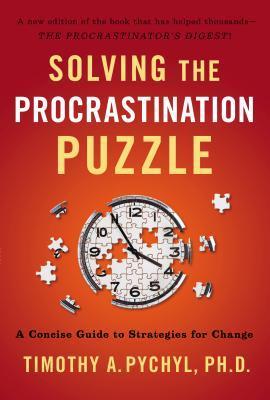
What Solving the Procrastination Puzzle Is Trying to Do
Pychyl is not attempting to write an encyclopedic academic history of procrastination research. He is trying to take the psychological mechanisms he considers most useful and turn them into a short intervention a general reader can actually use. The book repeatedly moves through the same rhythm: a memorable idea, a recognizable example, an explanation drawn from psychological research, and a concrete strategy that asks the reader to behave differently when a familiar procrastination cue appears.
That practical orientation begins with an important limitation. Techniques cannot solve a problem created by the absence of a real goal. If someone does not genuinely intend to perform an action, their failure to do it is not necessarily procrastination. A person might decide that a project no longer matters, that another obligation deserves priority, or that the original intention was unrealistic. Pychyl’s strategies assume that the reader still values the goal but is failing to act in accordance with that intention.
This distinction separates the book from productivity systems that begin by organizing calendars, inboxes, or task lists. Pychyl is interested first in what happens psychologically between “I intend to do this” and the moment the person chooses something else. That gap can involve unpleasant emotion, distorted expectations about future motivation, rationalization, temptation, fatigue, personality, and an environment designed to supply endless alternatives. The book’s ten chapters gradually add those layers rather than presenting procrastination as the result of one defective habit.
The compact design is especially well suited to the intended reader. Long theoretical digressions would conflict with Pychyl’s purpose because the reader’s real challenge is not acquiring unlimited knowledge about procrastination; it is converting understanding into behavior. The recurring exercises and implementation intentions continually push the reader toward that conversion. Even the conclusion warns that endlessly reading about procrastination can become another way of postponing the task that matters.
At the same time, the book’s research-based identity creates expectations that differ from those applied to an ordinary motivational guide. Pychyl repeatedly invokes studies, experimental findings, personality research, and psychological constructs to explain why his advice should work. That gives the book more explanatory depth than a collection of productivity tips, but it also means that later changes in the evidence matter. The central framework remains compelling, yet not every piece of supporting psychology has aged equally well.
Detailed Summary: How Pychyl Explains Procrastination and Change
The book develops in a deliberate sequence. Pychyl first defines the behavior and establishes its costs, then explains the emotional and cognitive mechanisms that maintain it. Only after that does he turn to initiation, persistence, willpower, personality, digital distraction, and the difficult reality that changing a chronic pattern requires repeated recommitment rather than one decisive breakthrough.
Chapters 1–2: What Procrastination Is and What It Costs
Pychyl begins by separating procrastination from delay. This appears simple, but it prevents a great deal of confusion. Every act of procrastination contains delay, yet many delays are rational, necessary, or outside a person’s control. Someone may postpone one task because another is genuinely more urgent, because a family emergency intervenes, because necessary information has not arrived, or because circumstances make action temporarily impossible. None of those situations automatically qualifies as procrastination.
The example of Maria, a busy working mother managing several responsibilities, helps establish the distinction. From the outside, it may be easy to look at an unfinished task and conclude that she is procrastinating. Pychyl insists that the judgment depends on the relationship between intention, opportunity, and voluntary choice. If Maria is dealing with a more important obligation or lacks the practical opportunity to act, delay can be entirely reasonable.
Procrastination is narrower and more paradoxical. It occurs when a person voluntarily delays an intended action despite expecting the delay to make things worse. The irrationality is built into the definition. The person is not simply revising a plan after receiving better information; they continue to value the goal and know that postponement is likely to be disadvantageous, yet they postpone anyway.
That definition removes one of the easiest excuses people use against themselves and others. A large pile of unfinished work does not prove someone is a chronic procrastinator, just as a carefully planned delay does not represent a failure of self-regulation. Pychyl wants readers to identify the specific cases in which they had both an intention and a realistic opportunity to act but chose unnecessary delay.
This self-observation matters because procrastination often becomes a broad identity label. Someone says, “I’m a procrastinator,” and begins interpreting every imperfectly completed plan as evidence of a fixed personal defect. Pychyl’s narrower definition encourages a more useful question: which actions am I actually delaying irrationally, and what happens immediately before I make that choice?
Chapter 2 establishes why answering that question matters. Pychyl rejects the idea that procrastination is merely an eccentric work style whose costs are limited to the inconvenience of finishing near a deadline. Chronic delay can affect performance, increase stress, produce guilt and regret, damage health-supporting routines, postpone financial decisions, and transfer burdens to other people.
The performance cost is straightforward. When a person deliberately gives themselves less time, they reduce the room available for revision, reflection, problem-solving, or recovery from unexpected difficulties. A task that could have been completed under manageable conditions becomes compressed into a stressful interval. Even when the final result is acceptable, the process can be needlessly unpleasant.
The emotional consequences may be just as important. Procrastination often produces guilt because the person remains aware of the intention they are violating. The temporary relief gained from avoidance can therefore coexist with a background awareness that the problem is getting worse. The person escapes the task for the moment but does not escape the knowledge that it remains unfinished.
Pychyl also emphasizes health. Chronic procrastination can increase stress directly, but it can also affect health behavior when people postpone sleep, exercise, medical appointments, nutrition decisions, or other forms of self-care. This is not merely a speculative concern. Later longitudinal research on procrastination and health has continued to find associations between chronic procrastination, stress, and poorer health behaviors, although such associations do not prove that procrastination is the sole cause of every observed health outcome.
Financial decisions provide another version of the same problem. Saving for retirement is easy to postpone because the reward lies far in the future while the sacrifice is immediate. Every individual delay can feel small, but repeated postponement changes what compounding and time can accomplish. The cost of procrastination therefore accumulates even when no single moment feels catastrophic.
Relationships can also absorb what Pychyl describes as secondhand effects. When one person delays a shared responsibility, another person may inherit extra work, anxiety, uncertainty, or inconvenience. A pattern that feels private to the procrastinator can gradually become a source of conflict because the cost is distributed across other people.
The deepest part of Chapter 2 moves beyond productivity and asks readers to consider regret. People often regret important actions they never took, not simply tasks they completed imperfectly. This gives procrastination an existential dimension. If a person repeatedly postpones writing, studying, creating, saving, applying, repairing a relationship, pursuing a meaningful project, or taking care of their body, they are not merely delaying an item on a list. They are delaying parts of the life they say they value.
Pychyl therefore asks readers to connect goals with meaning rather than treating productivity as an end in itself. A strong intention becomes easier to defend when the person remembers why the goal matters. This does not guarantee action, but it clarifies what is being sacrificed when short-term avoidance wins.
Chapters 3–5: Mood Repair, Tomorrow, and Self-Deception
Chapter 3 contains the book’s most important explanatory idea. Pychyl describes procrastination as a failure of self-regulation, but the mechanism he emphasizes is emotional. People frequently procrastinate because the task makes them feel bad now, whereas avoiding it makes them feel better now.
A task can be aversive for many reasons. It may be boring, frustrating, confusing, difficult, uncertain, repetitive, socially threatening, or connected to fear of failure. A report can trigger anxiety because the writer does not know where to begin. Studying can trigger boredom. A difficult conversation can evoke fear. Exercise can feel physically unpleasant. A creative project can expose the gap between what someone imagines producing and what they are currently capable of making.
When those feelings arise, avoidance offers an immediate reward. The person opens another website, checks a message, cleans the kitchen, chooses a simpler task, watches something entertaining, or decides that tomorrow will be a better time. The unpleasant emotional state decreases, at least temporarily. Because avoidance has successfully repaired mood, the behavior becomes easier to repeat the next time the task produces the same feeling.
Pychyl captures this process with the idea of “giving in to feel good.” The phrase does not mean procrastinators are pursuing deep happiness. They are often choosing immediate emotional relief at the expense of a valued longer-term outcome. The exchange is attractive because the reward of avoidance is psychologically close while the cost of delay remains relatively distant.
Martin, one of the book’s illustrative figures, helps make this mechanism concrete. The details of the task matter less than the behavioral pattern: an unpleasant feeling appears, avoidance removes that feeling, and the person learns that disengagement works as a short-term coping strategy. The later consequences may be worse, but the immediate reinforcement has already occurred.
This explains why pure time-management advice can fail. A calendar cannot remove boredom. A prioritized list cannot automatically reduce fear. A deadline reminder may even make anxiety stronger. If the actual trigger is an aversive emotional state, adding more information about time does not necessarily change the learned relationship between discomfort and escape.
Pychyl’s first countermeasure is awareness. Readers need to notice the feeling they are trying to escape and recognize that the feeling does not have to determine behavior. The aim is not to eliminate anxiety, boredom, resentment, or frustration before acting. The person can acknowledge the emotion while choosing behavior on the basis of a longer-term intention.
This is an important distinction because people often make motivation a prerequisite for action. They assume that successful action should begin when they feel ready, confident, interested, energized, or focused. Pychyl argues that such conditions are unreliable. If action depends on the arrival of the right internal state, aversive tasks acquire enormous power because any unpleasant feeling becomes a legitimate reason to postpone.
Chapter 4 develops one of the most common ways people preserve that system: they imagine that tomorrow will feel different. The bargain is familiar. Today is tiring, stressful, boring, or inconvenient, but tomorrow seems cleaner. Tomorrow’s self will be more energetic, more disciplined, more inspired, and less distracted.
Pychyl connects this belief to affective forecasting, the imperfect way people predict their future emotional states. Present conditions shape imagination, while the future self remains abstract. A person who feels exhausted in the evening can easily imagine tomorrow morning as a fresh beginning without adequately appreciating that tomorrow morning may contain its own fatigue, stress, resistance, and competing demands.
Delay therefore produces a double benefit in the present. The person escapes today’s discomfort and gains the reassuring fantasy of competent future action. They have not abandoned the goal; they have merely assigned it to a supposedly superior version of themselves.
The problem is that tomorrow eventually becomes today. The imagined motivational advantage repeatedly disappears because the task is once again immediate, concrete, and emotionally aversive. The same reasoning can then be repeated. A person does not necessarily decide to postpone something for a month; they may postpone it one apparently harmless day at a time.
This is why future visualization is useful but insufficient. Pychyl considers the possibility that making future consequences vivid could strengthen motivation. A person might imagine retirement without adequate savings or visualize the long-term cost of repeatedly neglecting health. Such exercises can make distant outcomes more psychologically real.
Yet imagining the future can also become another substitute for acting. A vivid picture of future success may feel satisfying without producing a first step, while a frightening picture of future failure may intensify the negative emotion already driving avoidance. The more reliable strategy is to stop treating future motivation as fundamentally different from present motivation.
Chapter 5 turns from emotional forecasting to the stories people tell themselves about delay. Allan, an habitual excuse-maker, illustrates the ease with which procrastination can be made to sound reasonable. “I still have plenty of time,” “I work better under pressure,” “I’m too tired to do this properly,” or “I need to be in the right mood” can all contain enough plausibility to shield the person from recognizing the actual behavior.
Pychyl connects these excuses to temporal discounting. Human beings tend to give greater weight to outcomes that are psychologically or temporally close. The immediate reward of entertainment, rest, or emotional relief can therefore feel more valuable than a benefit months away, even when the person would endorse the future goal if asked in the abstract.
The planning fallacy compounds the problem. People often underestimate how long future tasks will take while imagining their future schedule as more flexible than it is likely to be. The procrastinator can therefore tell themselves that postponement is safe because the task will supposedly require less time than it actually does and because tomorrow will supposedly contain fewer obstacles.
Self-handicapping creates another layer. When performance threatens self-esteem, delay can provide protection. If the final result is poor, the person can attribute the failure to insufficient time rather than ability. This is costly because procrastination simultaneously reduces the chance of good performance while supplying an excuse for bad performance.
Pychyl also discusses intransitive preferences: a succession of locally attractive choices can create a globally unwanted result. At 8 p.m., working at 9 may seem almost as good as working now. At 9, starting at 10 may seem harmless. Each individual postponement looks small, but the chain produces an outcome the person would have rejected if asked earlier whether they wanted to lose the entire evening.
Cognitive dissonance helps explain why excuses become persuasive. When behavior conflicts with intention, psychological discomfort arises. One way to reduce that discomfort is to change the behavior and begin the task. Another is to change the interpretation of the behavior by trivializing the problem, denying responsibility, comparing oneself with someone who procrastinates more, inventing justifications, or convincing oneself that the delay is beneficial.
The claim that “I work better under pressure” is especially important because it can convert a chronic problem into a flattering identity. Pychyl does not deny that people can perform under pressure. His objection is that being accustomed to urgent work does not prove that creating the urgency improved the quality of the work. People may have learned to work only when delay has removed every remaining alternative.
The practical insight emerging from Chapter 5 is that excuses should become cues. Instead of debating whether “I have plenty of time” is true every time the thought appears, the person can recognize it as a familiar part of their procrastination sequence. The excuse itself can trigger a predecided response: when this thought appears, I will begin the first concrete action.
Chapters 6–7: Starting the Task and Protecting Progress
Chapter 6 turns the book from diagnosis toward intervention. Pychyl’s central recommendation is deceptively simple: get started. The advice matters because the emotional prediction made before beginning is often worse than the experience of actually working.
Pychyl draws on experience-sampling research in which people reported how they felt about tasks before and after they finally began them. Avoided tasks were often rated as stressful, unpleasant, difficult, or threatening before initiation. Once people started, their evaluations frequently became less negative. The task in imagination had acquired emotional weight that changed once direct action replaced anticipation.
Starting generates information. Before beginning, a person may experience an entire project as one undifferentiated burden. After opening the document, reading the instructions, gathering the materials, or writing the first few lines, the project becomes more concrete. The person learns what is actually required and may discover that the first step is manageable.
Action also produces a sense of control. Procrastination creates passivity because the task remains unresolved while continuing to occupy mental space. Even a small beginning can change the relationship between person and project. The task is no longer something merely happening to them; they are interacting with it.
Pychyl therefore distinguishes “just get started” from the much larger demand to “just do it.” Telling someone to finish a thesis chapter, complete a tax return, reorganize an entire house, or run a full workout can reproduce the very aversiveness that fuels avoidance. Starting should be defined as the smallest meaningful behavior that moves the task forward.
For a writing task, the first action might be opening the document, creating the title page, locating relevant notes, or drafting one rough paragraph. For an exercise goal, it might be changing clothes and beginning the warm-up. The point is not that tiny actions magically finish large projects. It is that initiation changes the psychological situation in which subsequent decisions are made.
Implementation intentions make this advice more reliable. Rather than forming an abstract intention such as “I really need to work on this tomorrow,” the person specifies when, where, and how action will begin. An if–then formulation connects a recognizable cue with a predetermined behavior: if it is 9 a.m. and I sit at my desk, then I will open the report and work on the first section.
The strength of such a plan lies partly in reducing negotiation. Procrastination often thrives in repeated moments of choice: should I work now, after coffee, after checking messages, when I feel more prepared, or later tonight? A predecision moves some of that deliberation to an earlier moment when the person is less emotionally entangled with the immediate discomfort of the task.
Specificity matters. “Work on project” remains abstract, while “open the draft and write the first three bullet points for the introduction” describes observable behavior. Pychyl favors concrete actions because vagueness leaves room for delay and makes it harder to determine whether the intention has actually been enacted.
Breaking tasks down can therefore help, but it carries its own danger. Planning can become another form of avoidance. Someone can spend an hour designing a perfect task system, restructuring folders, adjusting an app, or creating color-coded lists without touching the work that generated the plan. The purpose of task decomposition is to make action easier, not to build an elaborate substitute for action.
Getting started may also have to happen repeatedly. A person can begin successfully in the morning, become interrupted, and then face the same emotional barrier when returning later. Pychyl’s advice is not based on a single heroic act of initiation. The practical skill is learning to restart whenever the sequence has been broken.
Chapter 7 corrects the possibility that readers will turn “just get started” into the entire theory. Hans starts working on a report and appears to have solved the initiation problem, but then receives an appealing invitation to play squash. The opportunity provides both temptation and justification. He has already done some work, the activity is attractive, and continuing the report can be postponed.
The example reveals that initiation and persistence are distinct problems. Starting alters the emotional relationship with the task, but it does not eliminate competing rewards. Once work is underway, the person still has to protect the goal against interruptions, social invitations, notifications, fatigue, boredom, or newly available alternatives.
Pychyl therefore extends implementation intentions from starting cues to obstacle cues. A person can decide in advance what to do when predictable temptations occur. If a message arrives while working, it will remain unanswered until the scheduled break. If the urge to check a website appears, the person will write it down and continue for another fixed period. The exact rule varies, but the principle remains the same: decide before the tempting moment rather than improvising inside it.
Environmental design becomes equally important. If a distraction can be removed before work begins, the person no longer has to defeat it through repeated acts of restraint. Turning off unnecessary notifications, closing irrelevant programs, putting the phone elsewhere, or changing location can make continued action the path of least resistance.
This broadens the book’s behavioral message. The goal is not to prove moral strength by resisting every possible temptation. It is to reduce the number of temptations that require resistance and to make responses to the remaining ones more automatic. Starting is powerful, but protecting progress completes the intervention.
Chapters 8–10: Willpower, Personality, and Digital Distraction
Chapter 8 asks why readers sometimes understand every preceding strategy and still fail to use it. Rachel intends to exercise after meeting professional and family obligations but reaches the treadmill exhausted and gives up. Pychyl interprets the episode through the then-prominent theory that self-control operates like a limited resource that becomes temporarily depleted through prior exertion.
The ego-depletion model proposed that acts of self-control could reduce performance on subsequent self-control tasks. Pychyl describes experiments in which participants first had to regulate themselves in one way—such as resisting tempting food or suppressing emotional reactions—and then appeared less persistent or controlled on a later task.
Within that framework, procrastination becomes partly state-dependent. A reader may have good plans but be more vulnerable after a day filled with demanding choices, emotional regulation, social restraint, or other forms of self-control. The problem is no longer simply knowing what to do; it is having sufficient regulatory capacity available at the moment action is required.
Pychyl uses the muscle metaphor that was common in this literature. Self-control may become temporarily tired, but it may also strengthen through repeated use. He therefore suggests exercising self-regulation in manageable ways and paying attention to states such as fatigue and poor sleep that make difficult actions harder.
Timing follows naturally from this model. If a person knows that a task requires unusual discipline, it may be sensible to schedule it when they tend to have more energy rather than placing it at the end of an exhausting day. This practical advice can remain useful even if the underlying limited-resource theory is not accepted in its original form.
Positive emotion also enters the chapter as a possible resource for renewed regulation. Pychyl considers how feeling better may restore persistence, although this sits in interesting tension with the earlier warning against short-term mood repair. The difference is whether mood improvement is being used to support re-engagement or to justify continued avoidance.
Implementation intentions again reduce reliance on moment-to-moment willpower. When behavior has already been linked to a cue, the person does not need to conduct the full motivational debate every time the cue appears. Pychyl’s larger system increasingly shifts from “be stronger in the moment” toward “make fewer important decisions in the moment.”
The chapter’s most scientifically vulnerable material concerns glucose. Pychyl presents research suggesting that self-control depends partly on glucose availability and that acts of self-control may draw upon a physiological resource in a relatively direct way. He does acknowledge uncertainty, but the discussion reflects a research environment in which the glucose explanation was receiving considerably more support than it does today.
That does not make every practical suggestion in Chapter 8 useless. Sleep, fatigue, motivation, task timing, and repeated effort clearly influence whether people follow intentions. The modern problem concerns the specific theoretical story that bundles those experiences into a simple depletable resource, especially one substantially driven by glucose.
Chapter 9 moves from temporary states to personality. Pychyl introduces the Big Five framework and asks whether relatively stable dispositions make some people more vulnerable to procrastination than others. Conscientiousness is especially relevant because it concerns organization, reliability, persistence, and goal-directed behavior, while emotional instability can increase the negative feelings that make aversive tasks harder to approach.
Impulsiveness matters because procrastination often involves choosing an immediately rewarding alternative over a valued delayed outcome. Someone highly sensitive to immediate opportunities may find digital distraction, social invitations, entertainment, or spontaneous activities particularly difficult to resist when a demanding task is available.
Self-efficacy also enters the picture. A person who doubts their capacity to complete a task may experience stronger aversion and uncertainty before beginning, making avoidance more attractive. Low self-esteem can likewise interact with self-handicapping if performance feels closely tied to personal worth.
Pychyl discusses perfectionism carefully enough to avoid the common claim that all perfectionists procrastinate in the same way. Socially prescribed perfectionism—the belief that others expect unrealistically high standards—can create anxiety and threat that encourage delay. The important issue is not simply having high standards but how those standards interact with fear, self-worth, and perceived evaluation.
The chapter includes a rough personality self-assessment, but Pychyl explicitly warns readers not to treat it as a validated diagnostic instrument. Its function is reflective. Someone may recognize that disorganization, emotional reactivity, impulsivity, or low confidence repeatedly appears in their own procrastination pattern.
The practical message is anti-fatalistic. Personality influences probability rather than destiny. A person who is naturally disorganized can create external structure. Someone prone to impulsive distraction can remove temptations. A person vulnerable to anxiety can make more specific plans for beginning before the anxious state becomes overwhelming.
Pychyl also warns that personality knowledge can become a sophisticated excuse. “I’m just not a conscientious person” can sound psychologically informed while performing exactly the same function as “I’ll do it tomorrow.” Self-knowledge is useful only when it changes strategy rather than absolving the person from action.
Chapter 10 turns to the environment in which many contemporary procrastination episodes occur: networked digital technology. Ari sits at a computer intending to work but checks Facebook for a moment. One small detour leads to another, and an activity expected to consume almost no time expands into a substantial period of avoidance.
The mechanism is not that the internet created procrastination. Digital tools are powerful because they provide immediate, low-friction rewards at precisely the moment an aversive task creates the desire for escape. A person can move from demanding work to social contact, novelty, entertainment, information, shopping, news, or communication in seconds.
The temporal structure resembles the intransitive preferences described earlier. One more minute online seems trivial. One more message seems harmless. One more link can plausibly be described as relevant. The problem emerges from accumulation: a sequence of individually defensible micro-delays becomes an hour the person never consciously chose to lose.
Pychyl includes the example of someone beginning with a seemingly legitimate online search related to an assignment and gradually following branches far beyond the original purpose. This matters because digital procrastination does not always announce itself as entertainment. It can disguise itself as research, organization, communication, or preparation.
The recommended responses are intentionally simple. Disconnect when internet access is unnecessary, close applications unrelated to the task, schedule breaks instead of allowing constant interruption, and leave open only the tools required for the current work. Each intervention adds friction to the escape route.
The technological details inevitably reflect the period in which the book was written, but the psychological mechanism has aged better than the examples. Smartphones, algorithmically selected feeds, short-form video, persistent notifications, and increasingly personalized recommendation systems make low-friction mood repair even more accessible. Pychyl’s central point therefore does not depend on Facebook remaining the dominant distraction.
The chapter ends where the book’s explanatory core began. Cyberslacking is compelling because it offers immediate emotional relief. The digital environment amplifies procrastination by making that relief abundant, varied, and almost effortless to obtain.
Conclusion: Self-Change, Setbacks, and Self-Forgiveness
The concluding section refuses to promise a clean transformation. Marianna experiences a period of successful behavior and then returns to familiar patterns. Pychyl uses the setback to emphasize that understanding procrastination does not permanently remove the vulnerability to it.
Different people also procrastinate for different combinations of reasons. One reader may be driven primarily by anxiety, another by boredom, another by impulsiveness, another by disorganization, and another by constant digital temptation. Most will probably have several mechanisms interacting at once.
Pychyl therefore discourages readers from trying to reform every aspect of themselves simultaneously. A more realistic strategy is to identify the one or two factors that most reliably produce procrastination and intervene there. Someone whose main problem is task initiation may need concrete first actions and implementation intentions. Someone whose main problem is distraction may benefit more from environmental restructuring.
Progress is likely to be uneven. The reader may act effectively for several days, lapse, recover, and lapse again. This makes the ability to restart more important than maintaining a fantasy of perfect consistency.
The conclusion introduces self-forgiveness as a corrective to the shame that can follow procrastination. At first this can sound permissive. If someone has already failed to act, why would forgiving themselves make them more responsible rather than less?
Pychyl’s answer is that shame can become another aversive emotional state, which then fuels the same avoidance cycle the book has been describing. If thinking about the delayed task now evokes not only boredom or anxiety but also self-condemnation, returning to it becomes even harder. Forgiveness can reduce that emotional burden and allow renewed engagement.
The distinction between forgiveness and excuse-making is therefore crucial. Excuses reinterpret the delay so that no change seems necessary. Forgiveness accepts that the delay happened, acknowledges responsibility, and refuses to turn the mistake into a permanent identity. The behavioral consequence should be renewed action.
Pychyl closes by applying the book’s own logic to the act of reading it. A person could finish this guide and immediately search for another productivity book, another system, another article, or another piece of advice. Learning about procrastination would then become procrastination.
The final message returns to initiation because no conceptual insight changes behavior until the reader acts. Begin the task, expect resistance rather than waiting for its disappearance, and begin again when the sequence is interrupted. The book’s circular structure is deliberate: the solution eventually leaves explanation behind and becomes behavior.
The Core Theory: Procrastination as Self-Regulation and Mood Repair
The ten chapters cover many mechanisms, but the book is most coherent when they are understood as extensions of one central cycle. A person forms an intention toward a valued future outcome. The action required by that intention produces an unpleasant present emotion. Avoidance reduces the emotion quickly, which rewards the decision not to act.
That sequence explains why procrastination can persist even when its long-term costs are obvious. The problem is not lack of information. A student can know that beginning an assignment tonight would be wiser than waiting. A professional can understand that a report will become more stressful if delayed. A person can know that postponing exercise conflicts with their health goals. Knowledge about the future does not automatically defeat a reward delivered in the present.
Mood repair also clarifies why procrastination frequently recruits rational thought in its defense. The person does not usually experience the decision as “I am sacrificing a goal I value so that I can reduce discomfort for thirty minutes.” They generate a more respectable explanation: now is not the right time, preparation is incomplete, the work will be better under pressure, tomorrow will provide more energy, or a smaller task should be completed first.
Cognition therefore becomes part of the regulatory failure rather than its opposite. Planning fallacy makes future completion look easier. Temporal discounting reduces the felt weight of distant consequences. Cognitive dissonance encourages stories that make current behavior compatible with a positive self-image. These processes protect the emotional reward of avoidance from being immediately overturned by the person’s own better judgment.
The cycle also explains why procrastination often makes its own trigger worse. Avoidance reduces discomfort now, but the delayed task may later become more urgent, more complex, more consequential, and more closely associated with guilt. When the person returns to it, the task can feel even more aversive than before. Procrastination therefore creates conditions that increase the temptation to procrastinate again.
Pychyl’s model is strongest when it avoids reducing this process to a moral failure. Calling someone lazy does not explain why they may work intensely on many tasks while avoiding one particular project. Mood regulation explains the selectivity. The person may be perfectly capable of effort when work is interesting, clear, urgent, socially rewarding, or emotionally safe, yet repeatedly avoid actions that evoke a particular pattern of negative feeling.
The same model can explain productive procrastination. Someone may suddenly become enthusiastic about cleaning, answering routine email, reorganizing files, or completing minor administrative tasks because those activities offer both relief and a sense of accomplishment. They feel productive while avoiding the more important task. The issue is not inactivity but misalignment between behavior and the intention that matters most.
Still, mood repair should not be treated as a universal single-cause theory. Some delays reflect unrealistic workloads, unclear priorities, genuine ambivalence, conflicting commitments, inadequate resources, poor task definition, or broader problems with executive functioning. Pychyl himself preserves part of this complexity by distinguishing procrastination from legitimate delay and by adding personality, willpower, and environmental factors later in the book.
The most defensible interpretation is therefore that mood repair is a powerful organizing mechanism rather than a complete explanation of every procrastination episode. It shows why many people knowingly act against long-term interests without requiring us to assume they have forgotten those interests. Present emotional regulation can temporarily become more compelling than future self-regulation.
This interpretation also changes what an effective intervention should target. If the problem were primarily poor time awareness, more scheduling information would be enough. If the problem were primarily ignorance, education would be enough. If the problem is partly the learned use of avoidance to regulate emotion, the intervention has to change what the person does when aversion appears.
That is why Pychyl repeatedly asks readers to recognize emotional cues rather than debate them indefinitely. Anxiety can be present without becoming a command to postpone. Boredom can be acknowledged without requiring entertainment. Uncertainty can coexist with a concrete first action. The goal is not to feel ideal before beginning; it is to stop making ideal feeling the price of beginning.
The Practical System: Predecisions, Implementation Intentions, and Getting Started
Pychyl never presents a formal numbered system, but the practical advice across the book forms a coherent sequence. It begins with accurate diagnosis. Before trying to overcome procrastination, the reader has to distinguish it from strategic delay, changing priorities, or goals they no longer genuinely endorse.
Once the person identifies real procrastination, the next step is to notice the emotional and cognitive cues surrounding it. What feeling appears when the task becomes immediate? What excuse reliably follows that feeling? Someone might repeatedly feel overwhelmed and think, “I need a clearer plan first,” while another feels bored and thinks, “I’ll be more focused later.”
The third step is remembering the larger intention. Pychyl’s emphasis on values in Chapter 2 matters because behavior change requires a reason to tolerate immediate discomfort. The point is not to manufacture inspirational intensity. It is to make the long-term goal sufficiently explicit that present emotion is not the only factor influencing the decision.
Predecisions then translate intention into a behavioral rule. Instead of waiting for the difficult moment and asking, “Should I start now?” the reader decides in advance when, where, and how the action will begin. This removes some of the opportunity for mood-dependent negotiation.
Implementation intentions sharpen the predecision by linking a cue with a response. The form can be simple: if situation X occurs, I will perform behavior Y. The value lies in specificity. “I will exercise more” leaves almost every important decision unresolved, whereas “when I finish work on Monday, Wednesday, and Friday, I will change clothes and begin the first ten minutes of my workout before doing anything else” defines a recognizable behavioral sequence.
Later intervention research provides some support for this broader approach, although it should be interpreted carefully. Two randomized trials on bedtime procrastination found benefits from mental contrasting combined with implementation intentions. Because those studies combined techniques, they do not prove that every implementation intention works automatically or that Pychyl’s precise version has identical effects in every context. They do, however, fit the larger principle that converting vague intentions into specific cue-linked action plans can help narrow the gap between wanting and doing.
The next step is making the first action concrete and small enough to begin. Pychyl’s “just get started” advice works best when stripped of motivational grandiosity. The reader is not being told to complete the entire valued goal through force of will. They are being asked to stop treating the entire project as the unit of action.
A project might consist of dozens of decisions, hours of work, missing information, and uncertain outcomes. The first action should not. Opening the relevant document, writing a crude outline, placing the required materials on the table, reading the first page of instructions, or making the first necessary phone call converts an abstract project into present behavior.
The importance of action preceding motivation is one of the book’s most durable insights. People frequently assume they need to become motivated enough to start. Pychyl reverses the sequence: starting can change the emotional and cognitive conditions from which motivation is experienced. A task that feels enormous in anticipation can feel more manageable after contact with its actual requirements.
This does not mean action always becomes enjoyable. Some work remains tedious after it begins, and some fears are justified. The point is narrower: the pre-task forecast should not automatically be trusted as an accurate description of the working experience. Beginning produces evidence unavailable during avoidance.
Once action starts, the reader has to protect it. Chapter 7 shows why initiation is only one stage. A person who begins work but leaves every notification active, every website accessible, and every social invitation open has solved the first decision while leaving dozens of later decisions exposed.
Pychyl’s solution is obstacle planning. If a distraction is predictable, decide on the response before encountering it. Someone who always checks email when a difficult paragraph appears can close the email client before beginning. Someone repeatedly drawn to a phone can place it in another room. Someone tempted by unrelated research can keep a note of questions to investigate later rather than opening new browser tabs immediately.
Environmental design is important because it reduces the need to prove willpower repeatedly. A temptation that has been removed does not require resistance. This is especially useful for procrastination because every act of resistance creates another moment in which the person’s immediate mood can influence the decision.
The system also needs a relapse rule. If the reader assumes success means never procrastinating again, one failure can become psychologically devastating. A missed session or abandoned plan can trigger shame, which increases aversion and makes returning to the task harder.
Self-forgiveness protects the restart. The person acknowledges the failure without turning it into evidence that change is impossible or that they are fundamentally defective. Responsibility remains intact because the next move is behavioral: reform the intention, identify what went wrong, and begin again.
This makes Pychyl’s practical model more sophisticated than its famous slogan suggests. “Just get started” is the visible center, but it depends on a larger architecture: identify genuine procrastination, notice the emotional cue, anticipate the excuse, reconnect with the valued goal, create a cue-linked predecision, define a concrete first action, begin before feeling ready, remove foreseeable escape routes, and restart after interruption.
The system also has clear limits. It cannot turn an impossible workload into a possible one, compensate for missing skills indefinitely, resolve genuinely conflicting goals, or establish that a person ought to pursue a goal they do not value. Severe or persistent procrastination connected with a broader clinical condition may likewise require more individualized assessment than a short self-help guide can provide.
Those limits do not weaken the method when it is applied to the problem Pychyl actually targets: the person who knows what they intend to do, has a realistic opportunity to act, but repeatedly substitutes immediate emotional relief for movement toward the goal. For that problem, reducing the size and number of decisions separating intention from action is a sensible and practical strategy.
How Time Biases, Personality, and Distraction Fit the Model
Pychyl’s later chapters prevent the mood-repair theory from becoming too psychologically flat. Procrastination does not occur inside emotion alone. Our perception of time changes how strongly future outcomes compete with present rewards, personality changes vulnerability to particular triggers, and the environment determines how easy it is to escape when discomfort appears.
Temporal discounting explains why intention can remain genuine without controlling behavior. A person may sincerely prefer being financially secure in retirement to spending every available rupee today, yet the immediate purchase is vivid while retirement is abstract. The same structure applies to studying, health, creative work, and administrative tasks. Future benefits have to compete against present experiences that are psychologically closer.
Affective forecasting adds another distortion because people imagine tomorrow’s motivation as though time itself will solve current resistance. The future self becomes an idealized worker who is not tired, anxious, bored, or distracted. When tomorrow arrives, the person discovers another ordinary present self and can repeat the postponement.
The planning fallacy then makes delay appear practical rather than risky. The task will supposedly take less time than it actually will, while the future schedule will supposedly contain more free space than it actually will. Anyone interested in how these patterns connect with broader cognitive biases that distort planning and decision-making can see the same larger phenomenon: human judgment is systematically shaped by shortcuts and asymmetries that feel reasonable from inside the decision.
Personality determines which parts of this structure are most dangerous for a particular person. Low conscientiousness may make organization and persistence harder. High impulsiveness can make immediate alternatives unusually attractive. Emotional instability can increase the intensity of unpleasant feelings generated by demanding tasks. Low self-efficacy can transform uncertainty into a stronger expectation of failure.
Socially prescribed perfectionism demonstrates how personality-related patterns interact with emotion. If someone believes other people expect flawless performance, beginning becomes psychologically risky because action exposes them to evaluation. Procrastination can then serve as temporary protection from the possibility of being judged inadequate.
Pychyl’s most useful conclusion is that these tendencies should inform strategy rather than identity. Someone who recognizes high impulsiveness can reduce access to tempting alternatives. A person who struggles with organization can externalize structure through schedules and prepared work environments. Someone prone to anxiety can define smaller first actions and predecide responses before the anxious state intensifies.
This keeps personality from becoming fatalistic. Traits help explain why certain situations are harder for one person than another, but they do not automatically determine behavior. The practical question is not whether someone’s personality makes procrastination understandable; it is which environment and plan make acting more likely given that personality.
Digital distraction adds the environmental layer. The internet and smartphones do not merely provide attractive alternatives. They reduce the friction required to move from discomfort to reward. If a difficult paragraph produces frustration, relief may be one tap away.
That matters because the procrastination cycle often unfolds quickly. The person does not need to formulate a conscious decision to abandon a project for an hour. They only need to permit a series of tiny deviations, each of which feels too small to matter.
Modern digital systems intensify this structure because many are designed to continue presenting novel material without requiring a fresh search. Infinite feeds, personalized recommendations, notifications, messaging, short-form video, and algorithmic ranking dramatically expand the range of available micro-rewards. Pychyl’s examples are technologically dated, but the behavioral mechanism is arguably more relevant now than when the book appeared.
This is why environmental design belongs inside the theory rather than being treated as a generic productivity trick. The easier the escape route, the more frequently the person must choose between a valued goal and immediate mood repair. Removing the escape route changes the number and character of those decisions.
Taken together, time bias, personality, and environment explain why procrastination can vary dramatically across situations. The same person may work consistently when a task is interesting, socially structured, and free from distraction, then procrastinate badly when the task is ambiguous, privately performed, emotionally threatening, and surrounded by tempting alternatives. That variability fits Pychyl’s model better than the idea that procrastination reflects a fixed quantity of laziness.
What Has Aged in the Science Since 2013
A book grounded in psychological research should be judged partly by how its evidence survives. Much of Pychyl’s practical framework does not depend on one controversial experiment, but some specific scientific claims have aged far better than others. The fairest modern reading separates areas where later work remains broadly compatible with the book from Chapter 8’s more disputed account of willpower.
What Later Research Has Strengthened
Pychyl’s argument that procrastination is associated with meaningful well-being costs remains plausible. More recent longitudinal research examining procrastination, stress, and health behaviors found that chronic procrastination was positively associated with stress and negatively associated with health behaviors across measurement points. This does not establish a simple causal chain in which procrastination independently produces every health problem, but it supports Pychyl’s insistence that the consequences can extend beyond deadlines.
The broader intervention literature also remains compatible with the book’s emphasis on converting intentions into more specific action plans. Research using mental contrasting together with implementation intentions has reported improvements in behaviors such as bedtime procrastination. The important qualification is methodological: when techniques are combined, the results cannot be attributed entirely to one component.
That nuance matters because self-help books often turn moderate research findings into universal rules. Pychyl is generally more restrained than that, but readers can still overinterpret the advice. An implementation intention increases structure; it does not guarantee that the planned action is feasible, valuable, emotionally tolerable, or protected from every competing demand.
The continued usefulness of the mood-regulation perspective is also strengthened indirectly by the broader development of procrastination research emphasizing emotion regulation and the intention–action gap. Even without treating every instance of procrastination as identical, contemporary discussion has moved far beyond the older caricature of procrastination as mere laziness or scheduling incompetence.
The most durable aspects of the book therefore survive because they operate at the level of behavior and regulation: aversive tasks can prompt avoidance, avoidance offers immediate relief, vague intentions are easier to violate than concrete plans, and beginning can change one’s experience of a task. None of these claims requires accepting the most controversial elements of the 2013 willpower literature.
Where the Willpower Model Needs Qualification
Chapter 8 is the clearest place where readers should separate the historical scientific context from what can responsibly be stated now. Pychyl presents the classic ego-depletion model, according to which exercising self-control draws on a limited internal resource, leaving less available for subsequent acts of regulation.
The model became highly influential partly because many experiments seemed to show a sequential effect. Participants resisted temptation, suppressed emotion, or performed another effortful regulatory task and then persisted less on a later challenge. The muscle analogy was intuitive: self-control could become tired after use while perhaps becoming stronger through training.
The reliability and magnitude of that effect later became a major topic of replication research. A large preregistered multilaboratory test involving dozens of laboratories found evidence that complicated the strong classic interpretation of ego depletion. Results from this broader replication era have made it much harder to describe a large, dependable limited-resource effect as settled fact.
The glucose explanation has fared even worse. The book reflects research proposing that acts of self-control reduce available glucose and that restoring glucose can improve subsequent regulation. A later meta-analysis specifically testing the glucose account of self-control reported evidence against that model. The physiological story should therefore not be repeated today as though it represents an established mechanism explaining ordinary failures of willpower.
This does not justify replacing one overstatement with another. The everyday observation that fatigue, prior demands, poor sleep, emotional strain, and motivation influence persistence remains entirely credible. What is disputed is the specific theoretical claim that those experiences are best explained by consuming a singular limited self-control resource in the classic manner.
There also remains a genuine competing interpretation within the literature. Proponents of a refined ego-depletion model argue that earlier replication failures do not eliminate the phenomenon and that better experimental designs, stronger manipulations, and a model emphasizing conservation of resources rather than simplistic exhaustion can preserve important parts of the theory. Their position deserves representation because the scientific debate is not accurately summarized as “ego depletion was completely disproven.”
For a modern reader, the safest conclusion is narrower. Chapter 8’s simple resource-and-glucose account is much less secure than Pychyl’s 2013 discussion suggests, while the practical idea that difficult self-regulation becomes harder under some states and conditions remains reasonable. Readers can therefore retain advice about sleep, task timing, motivation, environmental design, and predecision without needing to accept glucose depletion as the mechanism.
This distinction also reveals something important about the strength of the book as a whole. Pychyl’s central framework does not collapse when ego depletion is qualified. The definition of procrastination, short-term mood repair, distorted future expectations, implementation intentions, task initiation, obstacle planning, personality vulnerability, and digital temptation all stand independently of the glucose theory.
The scientific aging is nevertheless significant because the book presents itself as research informed. A current reader should not come away believing every psychological mechanism described in 2013 carries equal evidentiary confidence in 2026. The best way to preserve the book’s value is to update its weaker science rather than either dismissing the entire project or repeating outdated claims uncritically.
Style, Structure, and the Advantages—and Costs—of Brevity
Pychyl’s writing strategy is unusually well matched to the behavior he is trying to change. Solving the Procrastination Puzzle is short, conversational, repetitive in a deliberate way, and built around recognizable moments of failure rather than abstract theoretical exposition. A reader can quickly identify their own versions of the people and situations Pychyl describes.
The fictional or composite-style vignettes give each mechanism an ordinary human context. Maria shows that not every delay is irrational. Martin illustrates mood repair. Allan embodies excuse-making. Hans demonstrates that starting does not eliminate temptation. Rachel connects exhaustion with self-control difficulty. Ari shows how digital distraction grows through a chain of tiny deviations, while Marianna represents relapse after apparent improvement.
These examples are effective because they prevent the research from floating above behavior. Instead of introducing temporal discounting as an isolated technical term, Pychyl shows how someone repeatedly prefers a small present benefit to a larger future one. Instead of treating implementation intentions as a laboratory construct, he turns them into decisions about what a person will actually do when a predictable cue appears.
The mantras serve the same purpose. “Just get started” is memorable enough to function under pressure, when a reader is unlikely to retrieve a detailed theoretical explanation. Short phrases can become cognitive handles that connect a familiar emotional state with a different behavior.
Humor and cartoons soften material that could easily become moralizing. Chronic procrastinators often know they are behaving irrationally and may already carry significant shame. A harsh tone would risk increasing the negative emotional state that, under Pychyl’s own theory, can encourage further avoidance.
The book’s brevity also creates momentum. Chapters do not spend dozens of pages qualifying every theoretical nuance before reaching application. For readers who have abandoned longer productivity books, the accessibility is a serious practical advantage rather than merely a commercial feature.
The cost is compression. Research findings drawn from different literatures can appear more uniform in strength than they really are because the book has little space for methodology, effect sizes, replication history, boundary conditions, or competing interpretations. This is especially visible in retrospect when considering ego depletion.
The same compression can make causal pathways appear cleaner than ordinary life. A person may procrastinate because of emotion, unclear priorities, organizational failures, skill deficits, fatigue, social conditions, unrealistic workloads, or several causes operating at once. Pychyl acknowledges multiple contributors, but the short form naturally rewards a coherent central explanation over exhaustive heterogeneity.
Repetition is another mixed feature. The recurring emphasis on implementation intentions, starting, and awareness can feel redundant for readers accustomed to dense nonfiction. Yet repetition is pedagogically defensible because the book is trying to change a habitual response, not simply transmit information once.
Most importantly, Pychyl rarely mistakes complexity for usefulness. He knows that a complete theoretical account of procrastination could become so elaborate that the intended reader never reaches the behavioral intervention. The book therefore accepts explanatory incompleteness in exchange for practical clarity.
That tradeoff is largely successful. The reader receives enough psychological structure to understand why the advice differs from generic discipline rhetoric without being forced through an academic review. The scientific limitations become problematic only when concise explanation hardens into stronger certainty than the evidence deserves.
Critical Review: What the Book Achieves and Where It Falls Short
Solving the Procrastination Puzzle succeeds first because it defines its subject precisely. The distinction between strategic delay and irrational voluntary delay prevents the book from moralizing every unfinished task. This matters more than it might seem because many productivity systems encourage readers to treat all incomplete intentions as failures, even when priorities legitimately change.
Its second major strength is the mood-regulation model. The idea that procrastination offers short-term emotional relief explains behavior that otherwise looks absurd. People can know the cost of delay perfectly well while continuing to choose it because the immediate function of the choice is not solving the long-term problem; it is reducing today’s discomfort.
That insight also helps explain why procrastinators can be extremely busy. Someone may work intensely on easier tasks while avoiding a meaningful one, which contradicts the stereotype of simple laziness. Pychyl’s framework captures the selective nature of avoidance far better than a purely motivational account.
The practical intervention is equally strong because it is built from the mechanism. If aversive emotion makes deliberation unreliable, decide important behavioral details earlier. If the whole project feels overwhelming, define the smallest concrete action. If temptation predictably appears after starting, remove it or predecide a response. If a lapse creates shame, use forgiveness to facilitate re-engagement rather than allowing self-criticism to become a new reason to avoid.
“Just get started” is therefore useful precisely because Pychyl does not leave it as a slogan. He explains why beginning can change task perception, generate information, increase perceived control, and reduce the discrepancy between an imagined project and the first actual behavior. The distinction between starting and finishing also reduces the emotional burden of initiation.
Implementation intentions provide the book with a practical backbone. Many self-help books encourage commitment without specifying how commitment survives contact with a tempting situation. Pychyl repeatedly moves the decision backward in time so that the person does not have to renegotiate the goal at the moment discomfort appears.
The emphasis on environmental design further improves the system. Treating every distraction as a test of character is inefficient. If an avoidable temptation can be removed, removing it is more reliable than repeatedly proving one’s willpower.
The book’s treatment of relapse deserves particular credit because it protects the method from perfectionism. Behavior change rarely proceeds in a straight line, yet self-help narratives often imply that adopting the right framework should produce permanent consistency. Pychyl allows for deterioration, interruption, and return.
Self-forgiveness completes that approach without collapsing into permissiveness. The book distinguishes between excusing the behavior and refusing to compound it with shame. That distinction is psychologically coherent with the mood-regulation theory: if shame makes the task more emotionally aversive, punishing oneself can strengthen the conditions that produced avoidance.
The short format is another genuine achievement. The book respects the cognitive situation of its intended reader. It does not require someone already struggling with avoidance to master a large productivity architecture before attempting change.
Yet the same brevity produces the book’s main limitations. Pychyl moves quickly from research findings to practical implications, sometimes without enough room to distinguish robust evidence from provisional theory. A reader unfamiliar with psychology may reasonably assume that the scientific footing beneath each chapter is equally firm.
Chapter 8 is the clearest example. The classic limited-resource and glucose accounts of willpower had considerable influence when the book appeared, but subsequent replication work and meta-analysis make the original formulation much harder to defend with the same confidence. This weakens that chapter as science, even though several behavioral recommendations remain sensible for independent reasons.
The broader model can also appear more universal than it should. Short-term mood repair is powerful, but procrastination is heterogeneous. A person may fail to act because a project is poorly defined, because commitments are genuinely incompatible, because expectations are unrealistic, because necessary skills are missing, or because a clinical condition affects executive functioning. Not every intention–action gap is best treated with a smaller first step and an implementation intention.
The book is especially limited as a guide for severe or clinically embedded procrastination. It is not a diagnostic or treatment manual and should not be read as one. Someone whose procrastination is intertwined with significant depression, anxiety, ADHD, trauma, or other conditions may need a level of individualized assessment the book neither attempts nor claims to provide.
Its discussion of personality is useful but necessarily compressed. Conscientiousness, impulsiveness, emotional instability, self-efficacy, and perfectionism all help explain variation, yet the short chapter cannot fully explore how these traits interact with context. Readers should resist turning correlations or tendencies into deterministic identity statements.
The digital chapter has aged superficially because the named technologies belong to an earlier phase of online life. This is mostly cosmetic. The underlying description of endless immediate alternatives, accumulated micro-delays, and frictionless mood repair has become more relevant rather than less.
The book’s originality also requires a nuanced judgment. Pychyl does not invent every construct he uses. Implementation intentions, affective forecasting, temporal discounting, the planning fallacy, self-regulation theory, personality psychology, and ego-depletion research belong to larger literatures. His achievement lies in synthesis: he organizes those ideas around the specific behavioral experience of procrastination and repeatedly translates them into decisions a reader can make.
That synthesis is more valuable than novelty for novelty’s sake. Readers generally do not need a new psychological law; they need a coherent explanation that changes what they do at 9:30 p.m. when they are avoiding the report they promised themselves they would start at 8.
The central project survives the book’s limitations because its strongest claims do not depend on its weakest science. One can reject the glucose model of willpower and still find the distinction between delay and procrastination precise. One can remain cautious about ego depletion while recognizing the importance of sleep, fatigue, motivation, and environmental design. One can acknowledge heterogeneous causes while still finding short-term mood repair a highly useful explanation for many episodes.
The book has also aged well ethically. Pychyl avoids reducing procrastination to moral weakness while preserving agency. He neither tells readers that they are simply lazy nor absolves them from changing behavior. The recurring message is that emotional difficulty is understandable but does not have to dictate action.
Its strongest contribution is therefore the connection between emotional understanding and behavioral specificity. Many productivity books emphasize systems without explaining resistance, while many psychological discussions explain resistance without giving the reader a usable response. Pychyl attempts both.
Its most important limitation is the risk created by scientific compression. Because research enters quickly and confidently, later readers need to know that parts of the supporting evidence have changed. A new edition could preserve almost the entire practical architecture while substantially revising Chapter 8 and adding more differentiation among clinical, structural, and ordinary forms of procrastination.
Even with those qualifications, the book remains unusually efficient. It gives readers a definition that improves self-observation, an explanation that reduces moralism, a practical method that minimizes dependence on motivation, and a realistic model of relapse. Few books need to be exhaustive when they identify the right leverage points this clearly.
Who Should Read It and What Is Worth Keeping
Solving the Procrastination Puzzle is best suited to readers who already know what they want to do but repeatedly fail at the transition from intention to action. Students, writers, professionals, entrepreneurs, and knowledge workers may recognize themselves particularly quickly because their important tasks often involve uncertainty, delayed rewards, self-directed scheduling, and easy digital escape routes.
It is also well suited to readers who have found elaborate productivity systems counterproductive. Pychyl does not require a complicated application, extensive tracking system, or total redesign of daily life. His central interventions can be used with very little infrastructure: recognize the cue, decide the response beforehand, define the first action, reduce distraction, and begin.
Readers whose procrastination is strongly emotional may gain the most from the book’s reframing. If someone repeatedly says, “I know exactly what I should do, so why am I still not doing it?”, mood repair provides an answer that does not depend on pretending they lack knowledge. The immediate problem may be the way the task feels, not the absence of a plan.
The book is less sufficient for someone whose apparent procrastination is actually produced by impossible workloads, genuinely conflicting priorities, unclear goals, inadequate resources, or missing skills. In such situations, forcing earlier action may not solve the underlying problem. The first requirement may be renegotiating commitments, changing expectations, learning the necessary skill, or deciding that a goal should be abandoned.
It is likewise not a substitute for a clinical treatment manual. Severe and persistent difficulty initiating or sustaining action can occur inside conditions that require more individualized understanding. Pychyl’s strategies may still be useful components, but the book does not provide a comprehensive clinical framework.
Readers seeking a fully current review of self-control science should also look beyond the 2013 text. Chapter 8 reflects a period when the ego-depletion model, particularly the glucose interpretation, was presented with greater confidence than later evidence justifies. That scientific aging should be remembered rather than ignored.
What remains worth keeping is more fundamental. Procrastination is not the same thing as every delay. It often persists because avoidance improves mood immediately. Tomorrow’s motivation is less reliable than we imagine. Excuses can function as cues rather than arguments. Beginning a concrete action is psychologically different from contemplating an entire project. Predictable temptations should be designed around rather than endlessly resisted. A lapse does not require surrender.
Most of all, Pychyl challenges the assumption that motivation must come first. People often wait to feel ready and interpret the absence of readiness as evidence that they should delay. His stronger alternative is behavioral: establish what matters, define the next action, and let action change the psychological situation.
That is why Solving the Procrastination Puzzle remains worth reading despite the parts of its science that need updating. Its best ideas are neither grand nor mysterious. They reduce procrastination from a vague character flaw to a sequence of understandable decisions and then ask the reader to interrupt that sequence at the smallest point where behavior can actually change.
The durable lesson is not to become a person who never experiences resistance. It is to stop requiring the disappearance of resistance before acting. Make the decision before the excuse becomes persuasive, make the first step concrete enough to perform, remove the escape routes you already know you use, and when the pattern returns, treat restarting as part of the method rather than evidence that the method has failed.
Last Updated on August 18, 2026 by Aseem Gupta