

When David J. Peterson created Dothraki for Game of Thrones, he had to solve a problem that most viewers would never notice. George R. R. Martin had already invented several Dothraki words and names, actors needed to pronounce them convincingly, and the resulting language had to sound consistent across hundreds of lines of dialogue. Peterson could not simply invent foreign-sounding words whenever a script required them. He needed a linguistic system capable of producing new sentences without contradicting what had already been established.
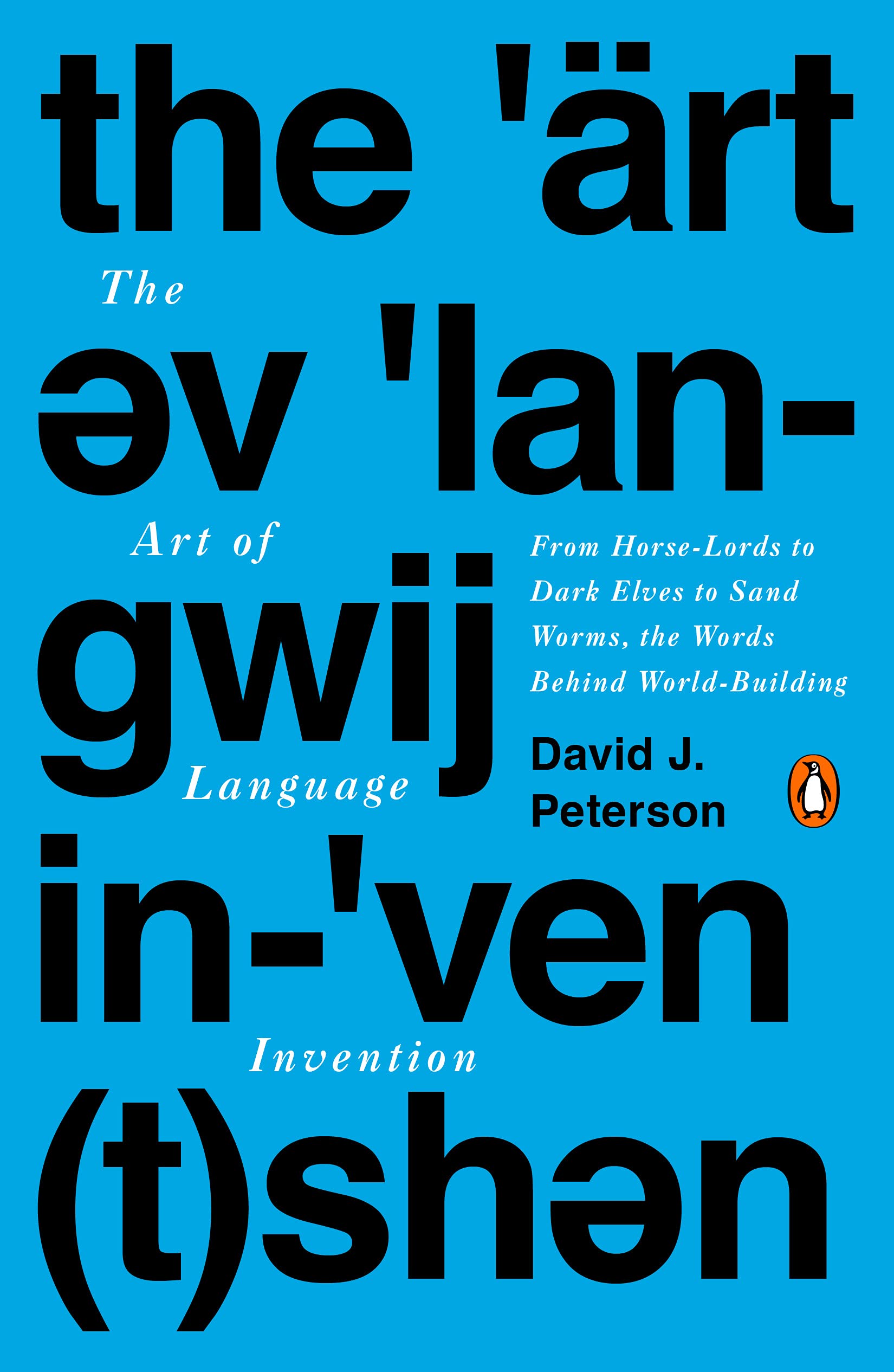
Published in 2015 by Penguin Books, The Art of Language Invention: From Horse-Lords to Dark Elves, the Words Behind World-Building explains how such systems are created. Drawing on linguistics, historical language development, and his experience working in film and television, Peterson shows how an invented language acquires sounds, grammar, vocabulary, a history, and sometimes a writing system.
The book is both a practical introduction to constructing languages and a defense of language creation as an artistic discipline. Its four main chapters progress from sounds to words, linguistic evolution, and writing systems, each accompanied by a detailed professional case study. Together, they demonstrate why convincing fictional languages require more than imaginative vocabulary, and why the technical decisions behind them can be as creative as the fictional worlds they help bring to life.
Why Invented Languages Need More Than Vocabulary
Peterson begins with his experience attending an early screening of Game of Thrones. Hearing Dothraki spoken on-screen should have been a moment of uncomplicated satisfaction, but he initially worried that an actor had used the wrong form of a greeting. He later realized that he had misremembered his own translation, yet the incident reveals something important about his approach: even when viewers cannot understand a language, its creator must care whether it is being used correctly.
A fictional language may initially sound like an uninterrupted stream of unfamiliar syllables. With repeated exposure, however, audiences can begin recognizing words, identifying recurring expressions, and noticing when certain forms appear in similar situations. A language used consistently can support that growing familiarity. Randomly assembled dialogue cannot provide the same experience because there is no underlying system to learn.
Peterson illustrates the distinction by recalling the alien dialogue in Return of the Jedi, where repeated recordings and limited invented material sometimes stand in for a coherent alien language. Such dialogue may communicate foreignness effectively within an individual scene, but repetition can expose its limitations. Once audiences begin noticing the same sounds being used without consistent meaning, the illusion of a functioning language becomes harder to sustain.
The first challenge, therefore, is distinguishing a language from a collection of invented words. A language must have rules for organizing meaningful units, expressing grammatical relationships, and generating statements that have never been spoken before. A few names, greetings, and memorable phrases may create atmosphere, but they do not establish how speakers would discuss unfamiliar events, disagree about something, describe a hypothetical situation, or communicate complicated instructions.
Peterson places contemporary fictional languages within a much longer history of deliberate language creation. One of the earliest surviving examples is Hildegard von Bingen’s twelfth-century Lingua Ignota, which consisted largely of an invented vocabulary used alongside Latin. Its purpose appears to have been religious and artistic rather than everyday communication. Although it did not constitute a complete independent language in the modern sense, it demonstrates that inventing words for expressive purposes has a long history.
Other language creators pursued different ambitions. Philosophical-language projects attempted to organize concepts systematically, sometimes seeking a more logical relationship between words and meanings than natural languages seemed to offer. International auxiliary languages, meanwhile, aimed to facilitate communication among people who did not share a mother tongue.
Volapük, created by Johann Martin Schleyer in 1879, attracted an international following before disputes and practical difficulties contributed to its decline. Esperanto, introduced by L. L. Zamenhof in 1887, developed a more enduring community of speakers. Its success also demonstrates an important distinction between inventing a language and determining what eventually happens to it. Once people begin using a language, they develop conventions, preferences, cultural practices, and expressions that may extend beyond the original creator’s plans.
Peterson contrasts these practical or reformist ambitions with artistic language creation. An artistic language, often called an artlang, may exist principally because its creator enjoys its sounds, grammar, aesthetics, or imagined history. It does not necessarily need to become an international means of communication. Its purpose can be creative exploration.
J. R. R. Tolkien occupies a particularly important place in this history. Unlike writers who develop a handful of unfamiliar expressions to decorate an existing fictional world, Tolkien spent years creating related languages with detailed historical development. His languages influenced the cultures, names, and histories of Middle-earth, making linguistic invention an important part of the imaginative foundation of his fiction.
Tolkien demonstrated that a language could possess a history extending beyond the immediate needs of a story. Related languages could descend from common ancestors, undergo different sound changes, preserve older grammatical features, and reveal historical relationships among fictional peoples. Language became one of the means through which an invented world acquired depth.
Later popular culture created additional opportunities for professional language invention. Marc Okrand’s development of Klingon for Star Trek helped establish that a film production could employ a specialist to create something more systematic than alien-sounding dialogue. The subsequent popularity of Klingon also showed that audiences might want to learn and use a fictional language beyond its original appearances.
The growth of the internet transformed language creation further. The Conlang Listserv, established in 1991, brought together people who had often practiced their hobby independently. Online communities made it easier to exchange grammatical ideas, compare linguistic designs, discuss historical languages, and receive criticism from people familiar with the discipline.
Peterson’s own development as a language creator occurred within this community. His publisher’s author profile documents his linguistic training and role in founding the Language Creation Society, which became part of a broader effort to connect language creators and promote their work.
Having established this history, Peterson introduces the terminology needed to distinguish different kinds of linguistic invention. Conlang is a shortened form of constructed language, while natlang refers to a naturally developed language. Artistic languages, auxiliary languages, and engineered languages reflect different motivations, and the boundaries between these categories are not always absolute.
He also distinguishes conlangs from codes, ciphers, and jargon. Pig Latin, for example, operates by transforming English words according to a recognizable procedure. It does not independently determine how sentences are structured or how grammatical meanings are expressed. Its rules depend on an existing language.
A constructed language can instead possess its own grammar, even when it borrows vocabulary or draws inspiration from existing languages. The essential difference is that its structure does not simply encode an already formed English sentence.
The introduction closes by explaining technical conventions that recur throughout the book, including phonetic transcription, translation, and interlinear glossing. A transcription represents pronunciation, while a translation expresses a sentence’s overall meaning. An interlinear gloss identifies how individual elements contribute to that meaning, allowing readers to see grammatical distinctions that a smooth English translation may conceal.
These distinctions prepare the reader for Peterson’s central method. Constructing a language requires identifying what information the language expresses, how that information is organized, and what patterns speakers would recognize as part of their language.
From Speech Sounds to a Naturalistic Phonology
Peterson begins the practical instruction with sounds because pronunciation influences nearly every subsequent decision. A language’s sounds determine the possible forms of its words, affect how grammatical markers behave, and contribute strongly to the impression that it belongs to a particular culture. Although language creators can begin elsewhere, Peterson prefers establishing a sound system before developing extensive vocabulary.
The chapter begins with an unusual professional instruction: the producers of Game of Thrones wanted Dothraki to sound harsh. Peterson explains why such descriptions are difficult to translate into objective linguistic requirements. Judgments about whether a language sounds harsh, elegant, musical, or threatening depend partly on cultural associations and listeners’ familiarity, rather than properties that belong inherently to particular languages.
Nevertheless, a creator can select sounds, rhythms, and word structures that produce a recognizable aesthetic effect. Doing that consistently requires understanding what speech sounds are and how languages organize them.
The Sounds Humans Can Make
Peterson first distinguishes phonetics from phonology. Phonetics concerns the physical production and properties of speech sounds, while phonology concerns how a language organizes sounds into meaningful patterns. A human mouth can produce far more distinguishable sounds than any individual language ordinarily uses.
To explain the physical possibilities, he introduces the structures involved in speech production. Air normally travels from the lungs through the vocal tract, where the tongue, lips, teeth, alveolar ridge, palate, velum, and other articulators shape it. Moving these structures changes the kind of sound produced.
Consonants are classified principally through place of articulation, manner of articulation, and voicing. Place identifies where airflow is obstructed or modified. Manner describes how that obstruction occurs, while voicing indicates whether the vocal folds vibrate.
For example, the sounds represented by English p and b are both bilabial stops: they involve closing the lips and briefly blocking airflow. Their principal difference is voicing. Other consonants are produced by bringing the tongue near the teeth or palate, directing air through narrow openings, or allowing it to pass through the nose.
Peterson discusses stops, fricatives, affricates, nasals, approximants, and other sound classes, explaining how their articulatory characteristics distinguish them. The International Phonetic Alphabet provides a notation system for representing these sounds more precisely than ordinary spelling usually allows.
The chapter also introduces distinctions that English speakers may overlook because their language does not use them in the same way as other languages. Aspiration, for example, is the audible burst of breath that can accompany a stop consonant. English often aspirates the initial p in pin, but the corresponding consonant in spin is generally unaspirated.
In Hindi, aspiration can distinguish words, making the difference between aspirated and unaspirated consonants phonologically significant. A distinction that English speakers regularly produce without consciously recognizing it can therefore function as an independent contrast in another language.
Peterson extends the discussion to less familiar consonants, including ejectives and clicks. These sounds may seem unusual to English speakers, but they are ordinary components of the languages that use them. Their inclusion demonstrates the range of possible sound inventories available to a conlanger.
Vowels require a different approach because they are usually produced without substantial obstruction of airflow. Their qualities depend on factors including tongue height, tongue position, and lip rounding. Peterson explains vowel charts as representations of a continuous articulatory space from which languages select contrasting categories.
Some languages distinguish vowel length, while others use relatively small or large vowel inventories. A language creator must therefore decide both which vowel qualities exist and which distinctions speakers recognize as meaningful.
The practical purpose of this extensive phonetic introduction is to expand the creator’s possibilities. Someone who relies entirely on the pronunciation conventions of English will tend to reproduce English-like sound systems, even when inventing unfamiliar spellings.
Understanding articulation allows a creator to move beyond native-language habits without selecting unusual sounds merely for novelty.
Sound Systems, Syllables, and Allophony
Once Peterson has introduced individual sounds, he turns to the relationships among them. A language’s sound inventory is not simply a list of everything its speakers can pronounce. It is a system of contrasts that speakers recognize and use to distinguish meaning.
The distinction between phones and phonemes illustrates this principle. Two pronunciations may be physically different yet treated as examples of the same underlying sound category.
Peterson uses English consonants to show how this works. The t in tall is typically pronounced with more aspiration than the t in stall, but English speakers ordinarily interpret both as instances of the same phoneme. The difference generally does not change the word’s identity.
In another language, a comparable distinction might be used to differentiate words. The same physical contrast can therefore play different grammatical roles depending on the language.
Constructing a phonology requires selecting an inventory of phonemes and considering how its components fit together. Peterson discusses tendencies in natural-language sound inventories, including the presence of commonly occurring sounds and relationships among articulatory categories.
The goal is not to reproduce a universal template. Languages differ greatly, and unusual inventories can be entirely natural. A creator should nevertheless recognize that sound systems often display internal relationships rather than arbitrary collections of unrelated features.
The next problem is phonotactics: the rules governing how sounds combine.
English speakers accept a word beginning with the consonant cluster in strong, but the same sounds cannot be rearranged into every theoretically possible sequence while still producing something that feels like an ordinary English word. Languages impose restrictions on syllable beginnings, syllable endings, and permissible consonant combinations.
Peterson explains how syllables can be analyzed into components such as an onset, nucleus, and coda. Languages differ in whether syllables can begin or end with consonants, how many consonants may appear together, and what kinds of sequences are permitted.
The principle of sonority offers one way to understand common syllable patterns. Sounds differ in their relative openness or acoustic prominence, and many languages favor syllables that become more sonorous toward the vowel and less sonorous afterward. Actual languages contain exceptions, but the general tendency gives creators a useful starting point.
These restrictions influence a language’s recognizable sound. A language permitting elaborate consonant clusters will produce different word shapes from one that strongly favors alternating consonants and vowels, even if both use similar phoneme inventories.
Peterson recommends constructing words that obey a coherent set of phonotactic rules rather than inventing each word independently. This creates recurring patterns without requiring every word to sound identical.
The chapter then introduces allophony, the systematic variation of a phoneme’s pronunciation according to its environment. A sound may be pronounced differently before certain consonants, between vowels, or at the end of a word without acquiring a separate grammatical identity.
These variations matter because they create predictable differences within a language’s speech. A naturalistic phonology can contain considerable surface complexity while remaining governed by relatively simple underlying rules.
Allophony also prepares the reader for historical sound change. A pronunciation difference that begins as a predictable environmental variation may later develop into a meaningful contrast if the conditions responsible for it disappear or change.
Stress, Tone, Sign, and Alien Communication
Peterson next examines aspects of pronunciation that extend beyond individual consonants and vowels. Speech has rhythm, pitch, prominence, and conventional melodic patterns, all of which influence how listeners perceive a language.
Intonation describes pitch movement across spoken expressions. A language can associate particular intonational patterns with questions, emphasis, uncertainty, politeness, or other communicative functions. Peterson distinguishes such patterns from the grammatical organization of individual speech sounds.
He also explains pragmatic intonation, including how speakers convey intentions that may not be fully expressed by the words themselves. Someone can use the same sentence to make a genuine request, express disbelief, or communicate sarcasm, with intonation helping listeners interpret the intended meaning.
Stress introduces another organizing principle. A syllable may become prominent through increased duration, pitch, loudness, or some combination of these features.
Some languages assign stress according to predictable rules, while others allow its position to distinguish words. Even predictable systems can become complicated when stress depends on syllable weight, the structure of surrounding syllables, or morphological changes.
A conlanger must decide whether stress is fixed, sensitive to syllable structure, or determined lexically. These choices influence the language’s rhythm and can affect how words change when grammatical endings are added.
Tone languages use pitch contrasts to distinguish lexical or grammatical meanings. Peterson distinguishes tone from ordinary intonation: both involve pitch, but tone operates as part of the language’s system of contrasts.
He introduces contour-tone systems, in which rising, falling, or more complex pitch movements are important, and register-tone systems, in which relative pitch levels play a central role. He also discusses interactions among tones and the changes that can arise when tonal patterns occur next to one another.
For constructed languages, tone requires more than assigning arbitrary pitch labels to individual words. Peterson emphasizes historical processes and systemic constraints, particularly when discussing the development of contour-tone languages.
The chapter then broadens its scope beyond speech. Signed languages possess their own linguistic organization, using handshape, location, movement, orientation, facial expression, and other articulatory features. Their grammar cannot be adequately understood as a translation of spoken language into gestures.
Peterson treats the subject briefly because a detailed account of signed-language linguistics would require far more space. Nevertheless, its inclusion challenges the assumption that all languages must be organized around sound.
The closing discussion considers alien communication systems. A fictional species with a different body or sensory capacity might communicate through sound patterns unlike anything humans can produce, or through visual, tactile, chemical, or other signals.
Peterson argues that such designs must begin with the creature’s actual capabilities. An alien language becomes more convincing when its communication system follows from the fictional species’ physiology, environment, and social needs.
The chapter has therefore moved from the human vocal tract to a wider understanding of linguistic structure. Its governing principle is consistency: whatever medium a language uses, the creator must decide which distinctions matter and how those distinctions are organized.
The Sound of Dothraki and the Constraints of Adaptation
Peterson’s first major case study demonstrates how theoretical principles become practical design decisions. When he began creating Dothraki, he did not have the freedom to choose every sound from scratch. The language already existed in George R. R. Martin’s novels through names, titles, and a limited vocabulary.
Peterson identifies fifty-six existing words and names, twenty-four of which were proper names. Although this was insufficient to establish a complete language, it imposed constraints that his new system had to respect.
The first problem was pronunciation. Martin had not supplied a comprehensive guide explaining how every Dothraki word should be spoken. Peterson therefore had to infer how readers, particularly American English speakers, would probably interpret the existing spellings.
He decided to preserve the spellings wherever possible while regularizing a few inconsistencies. He also wanted differently spelled forms to correspond to different pronunciations rather than treating the written material as a loose approximation.
This decision led him to examine which letters and combinations actually appeared in the source vocabulary. He initially noticed that u did not seem to occur independently as a vowel, and that p and b appeared to be absent.
He subsequently acknowledged exceptions he had overlooked, illustrating an important difficulty in working from incomplete evidence. Even a relatively short inherited vocabulary can contain details that complicate an apparently neat design.
Peterson assigned pronunciations to potentially ambiguous spellings. He interpreted kh as a velar fricative rather than the ordinary English sequence of k followed by h, and distinguished other letter combinations in ways that supported a coherent phonemic inventory.
He also decided that neighboring vowels would generally remain separate rather than automatically forming diphthongs. The treatment of r, including the use of trilled pronunciations, contributed further to the language’s identity.
The pronunciation of khaleesi created a revealing conflict. Peterson’s rules implied that the two written e vowels should be pronounced separately, producing a four-syllable form. Yet the pronunciation familiar to actors and audiences treated the word differently.
This discrepancy could not be resolved simply by insisting that every performance follow the system perfectly. The established popular pronunciation had become part of how the fictional language was experienced, while Peterson’s underlying design still needed internal consistency.
The Dothraki stress system introduced another set of choices. Peterson decided that words ending in consonants would be stressed on their final syllable. Words ending in vowels would normally look to the penultimate syllable, with syllable weight affecting the final result.
These rules made the language’s rhythm more systematic while allowing its stress patterns to differ from ordinary English expectations. Even where existing proper names did not align comfortably with the proposed system, Peterson could distinguish their treatment in English speech from their theoretical Dothraki pronunciation.
He also wanted certain consonants to appear frequently enough to shape the language’s overall acoustic character. Merely including a sound in the inventory would not guarantee that an audience noticed it.
To increase the prominence of particular sounds, Peterson incorporated them into common words and productive morphological patterns. A sound appearing regularly in noun or derivational endings will recur across many utterances, even when a sentence’s vocabulary changes.
For example, an ending such as -ikh allows related words to share a recognizable consonant, while other productive forms give the language recurring patterns involving r. Peterson also uses consonant length and affixation to influence the distribution of sounds.
These decisions reveal that the perceived sound of a language depends on more than its inventory. Frequency, word structure, morphology, and stress all contribute to the result.
The case study concludes by acknowledging the role of performance. A creator may design an exact phonological system, but viewers encounter that system through actors with varying linguistic experience, rehearsal time, and pronunciation habits.
Dothraki is therefore the outcome of multiple constraints: inherited fiction, inferred reader expectations, phonological design, grammatical productivity, and actual performance. Peterson’s achievement lies in turning a small body of inconsistent or incomplete material into a language capable of supporting much more extensive communication.
How Words Become a Grammar
After establishing the sounds from which words can be built, Peterson turns to the structures that make those words meaningful. The second chapter begins by challenging a deceptively simple assumption: that a word is an obvious unit with clear boundaries.
Peterson discusses languages such as Inuktitut, where a single complex word can express information that English might distribute across an entire phrase or sentence. This complicates the idea that languages differ mainly because they assign different sounds to familiar concepts. They can also differ in how they divide meaning into grammatical units.
The main subject is morphology, the study of word structure. Peterson explains how roots, affixes, grammatical categories, and derivational processes allow a language to express relationships systematically rather than inventing an unrelated word for every possible meaning.
Morphology, Noun Classes, and Case
Peterson begins by distinguishing inflection from derivation. Inflection changes the grammatical form of a word without usually creating a new lexical item. English cat and cats, for example, are forms of the same noun distinguished by number.
Derivation creates a related word, often changing its meaning or grammatical category. A language may use an affix to form a noun from a verb, an adjective from a noun, or a new verb from an existing root.
The distinction matters because it determines how a language’s vocabulary and grammar interact. A creator can design productive processes that allow many related expressions to be generated from a limited number of roots.
Peterson introduces prefixes, suffixes, and other types of morphological processes. Languages can place grammatical material before a root, after it, within it, or express distinctions by modifying the root itself. Some processes involve repetition of part of a word, changes in vowels, or forms that cannot be predicted from the ordinary stem.
Suppletion is a particularly striking example. English uses went as the past tense of go, even though the form bears no obvious resemblance to the present-tense verb. Such irregular relationships show that word paradigms can preserve complex historical developments.
Peterson then explains allomorphy, which concerns different forms of the same morpheme. English plural endings provide a familiar example: the plural marker is pronounced differently in cats, dogs, and horses, although speakers treat these forms as expressions of the same grammatical category.
Some variations arise predictably from sound environments, while others are conditioned by grammatical or lexical factors. For a conlanger, the challenge is to create regularity at the appropriate level without requiring every surface form to look identical.
Nominal inflection brings these ideas into a larger system. Nouns may encode number, grammatical class, case, or other distinctions that English speakers often express through separate words.
Grammatical number is more complicated than a simple singular-plural distinction. Languages may distinguish singular, dual, paucal, collective, or other categories, and these distinctions need not correspond neatly to how English expresses quantity.
The difference between count and mass nouns is also important. English treats water differently from bottle, but languages vary in how they classify entities for counting and what grammatical operations they require.
Peterson demonstrates that noun-number systems should be designed as coherent sets of distinctions. A conlanger needs to determine which quantities matter grammatically, how forms are marked, and how the language handles entities that do not fit straightforwardly into ordinary counting categories.
Grammatical gender introduces another major area of variation. Although the term suggests connections with biological sex, linguistic gender often functions as a system for classifying nouns and controlling agreement.
A language might distinguish masculine and feminine categories, but it might also classify nouns by animacy, shape, semantic function, or other properties. Some systems contain many noun classes rather than a small number of familiar genders.
These classifications can influence adjectives, verbs, pronouns, and other elements of a sentence. Consequently, assigning a noun to a class is not merely a matter of labeling vocabulary; it can affect grammatical structure throughout an utterance.
Peterson also discusses how noun classes can reflect associations that are partly semantic and partly historical. Their patterns need not remain perfectly transparent. A category originally connected to one meaning may acquire additional members through analogy, metaphor, or earlier grammatical changes.
Case marking concerns the grammatical roles nouns play in sentences. English relies heavily on word order and pronoun forms to distinguish subjects, objects, and possessors, but many languages use more extensive case systems.
A case marker can identify who performs an action, who receives it, who owns something, or how an entity relates spatially or conceptually to another. Different languages may organize these relationships through different alignments and grammatical strategies.
Peterson introduces the possibility that a language does not treat subjects and objects according to the familiar English pattern. Some systems organize grammatical relations around distinctions other than those most obvious to English speakers.
He also explains that a single ending can express multiple grammatical categories simultaneously. A noun form may encode number and case together, while another language might use separate markers for each category.
This property, often discussed in terms of exponence, means that constructing a paradigm requires decisions about how information is distributed across a word. Two languages can express the same grammatical distinctions while using very different morphological structures.
Verbs, Word Order, and Derivation
Verbs introduce a greater range of possible grammatical distinctions. Depending on the language, a verb may encode information about its subject, object, time reference, aspect, mood, and other relationships.
Peterson begins with agreement, which occurs when one element changes form according to grammatical properties of another. English verbs show limited subject agreement, most visibly in forms such as walk and walks. Other languages may distinguish multiple persons, numbers, noun classes, or object properties within the verb itself.
For constructed languages used in film and television, this has a practical consequence. If a verb already identifies its participants, a sentence can sometimes omit separate pronouns or nouns while retaining enough information to be understood.
Peterson uses this possibility to show how grammatical design influences translation length. A language’s structure can determine whether dialogue becomes longer, shorter, or more flexible when translated from English.
The chapter then distinguishes tense, aspect, and modality. These categories are frequently confused because they interact in ordinary language.
Tense primarily locates a situation relative to a temporal reference point. Aspect concerns how an event is viewed internally, such as whether it is ongoing, completed, habitual, or considered as a whole.
Modality deals with meanings such as possibility, necessity, obligation, permission, and related attitudes toward a proposition. The English word must, for example, can express different kinds of necessity depending on context.
A language may encode these distinctions through verb endings, auxiliaries, particles, or combinations of strategies. It may also group meanings together differently from English.
Peterson makes clear that designing verbal morphology requires deciding which categories exist before selecting forms for them. A creator who simply translates English tenses one by one risks reproducing English grammatical assumptions in unfamiliar-looking words.
The discussion of valency examines how verbs organize the participants in an event. A verb such as sleep ordinarily requires a different arrangement of participants from a verb such as give.
Languages possess grammatical constructions that can alter this arrangement. Passive constructions may change which participant occupies a central grammatical position, while causative or applicative constructions can introduce additional participants or reorganize their relationships.
These processes allow speakers to describe the same situation from different perspectives. They also provide a conlanger with opportunities to create grammatically distinctive ways of expressing events.
Peterson emphasizes that such constructions should be understood as systems rather than judged according to English stylistic preferences. The grammatical possibilities of one language are not necessarily errors when considered through the conventions of another.
Word order creates another major structural choice. English typically places subjects before verbs and objects afterward, but languages can prefer different arrangements.
Peterson also discusses ordering within phrases: whether adjectives precede or follow nouns, how possessors are positioned, and where related modifiers appear. These choices can be connected through broader tendencies such as head-initial or head-final organization.
Although languages do not always display perfect consistency across all constructions, a creator can use these patterns to develop a coherent syntactic character.
The chapter returns to derivation as a means of expanding vocabulary. Instead of inventing an independent root for every possible concept, a conlanger can develop morphological operations that produce related meanings.
A verb might acquire an ending that produces a noun denoting an action, an agent, a result, or an instrument. Another process might create an adjective or alter the meaning of a noun through an association established within the language.
Productive derivational systems generate connections throughout the lexicon. Those connections can make vocabulary easier to learn while also creating opportunities for meanings to develop in unexpected directions.
By the end of the chapter, Peterson has demonstrated that grammar determines how a language packages information. The apparent individuality of words depends on a much larger network of rules governing their relationships, forms, and uses.
Irathient and the Design of Compact Alien Words
The second case study comes from Defiance, a science-fiction television series for which Peterson developed several alien languages. The producers wanted Castithan and Irathient to sound as different from one another as possible.
For Irathient, Peterson pursued a particular auditory impression: it should seem slower and more deliberate than the other language. He found inspiration in his experience watching Atanarjuat: The Fast Runner, a film performed in Inuktitut.
The steady, clearly distinguishable syllables of Inuktitut had created an impression of measured speech. Peterson wanted to reproduce something of that impression without simply copying the language.
The difficulty was that television dialogue must fit within specific durations. If a line takes much longer to deliver in the invented language than in English, actors and editors may struggle to accommodate it. Peterson therefore needed a grammar that could communicate substantial information while preserving the desired sound.
His solution involved distributing meaning across the clause so that some elements could be removed without destroying its essential interpretation.
He illustrates the system through an Irathient sentence translated as “The warrior noticed the thief.” Its structure places an auxiliary before the verb, followed by the object and subject.
The ordering is strict, but information about participants also appears in verbal or auxiliary marking. Depending on the context, removing certain words can leave enough grammatical information to identify who is acting upon whom.
This redundancy creates practical flexibility. A line can be shortened for performance without necessarily losing every important grammatical relationship.
The noun system plays a crucial role because Peterson wanted nouns to contain considerable information while remaining relatively compact.
He adopted short roots and developed a system of noun-class prefixes. These prefixes indicate the semantic category to which a noun belongs, making its classification visible near the beginning of the word.
Irathient ultimately received eighteen noun classes. Some were influenced by semantic distinctions Peterson considered appropriate for the fictional species, while others reflected more abstract or historically developed classifications.
He was particularly interested in the way real languages sometimes distinguish categories unfamiliar to English speakers. A noun-class system can differentiate kinds of plants, objects, beings, or culturally significant entities according to principles that become meaningful within the language.
Number was handled through vowel suffixes rather than changes to the class prefix. Peterson drew inspiration from the auxiliary language Afrihili, adapting its vowel-based number distinctions to suit Irathient’s smaller vowel inventory.
The combination of a short root, class prefix, and number ending allowed words to encode grammatical information economically. The design therefore responded directly to the original production problem.
Its most interesting effect, however, appeared during vocabulary creation. Once a root existed, Peterson could ask what meanings might emerge if it appeared in different noun classes.
This process generated expressions that were not obvious from the original English concept. A root associated with one physical object or situation could acquire related meanings through changes in classification.
Peterson mentions words such as nunone, associated with a safe or customary way of doing something, and utenye, describing a particular kind of dirt mound. These examples illustrate the creativity produced by a systematic classification scheme.
The language begins generating possibilities that its creator may not have anticipated when inventing the original root.
Irathient demonstrates how grammatical organization can serve aesthetic, practical, and cultural goals simultaneously. Its compact words and flexible information distribution address television constraints, while its noun classes provide a distinctive way of organizing experience.
Sound Change, Meaning Change, and Grammaticalization
Peterson’s third chapter addresses a problem created by the apparent regularity of the systems developed so far. A newly designed phonology and grammar may be perfectly consistent, yet still lack many of the irregularities, unexpected relationships, and historical traces characteristic of naturally developed languages.
His solution is linguistic evolution. Rather than inserting arbitrary exceptions into a completed system, a creator can imagine an earlier language and apply changes that explain how its modern forms developed.
The chapter opens with a professional problem from Star-Crossed. Peterson had to accommodate a particular word required by a production while maintaining consistency with an existing fictional language. Instead of simply inserting an unrelated form, he considered how established vocabulary and linguistic development could make the requested expression plausible.
The incident introduces the chapter’s governing idea: a language’s history provides a resource for solving contemporary design problems.
Peterson divides linguistic development into three interacting areas—phonological, lexical, and grammatical evolution. Each produces different kinds of change, but their combined effects can explain why modern languages contain apparently inconsistent patterns.
Phonological Change and Ordered Rules
Phonological evolution concerns changes in pronunciation over time. Peterson begins with the principle that sound change can be systematic rather than random.
A sound may change in a particular environment, such as between vowels or before another consonant. If the relevant conditions are present, the change may affect many words that share the same structure.
This is important because it allows irregular-looking modern forms to emerge from regular historical rules. Words that originally had similar structures may develop differently when their surrounding sounds differ.
Peterson explains that sound changes must also be ordered. If one change creates the environment required by another, reversing their order can produce a different result.
Imagine a language in which a consonant becomes voiced between vowels, followed later by a process that removes certain unstressed vowels. The resulting language may contain voiced consonants in positions where the original conditioning environment is no longer visible.
Modern speakers would encounter the final forms without necessarily knowing why those consonants had changed. What appears irregular synchronically may have a clear historical explanation.
Peterson uses invented linguistic developments and examples from natural languages to demonstrate how such processes accumulate. The creator begins with a relatively simple system, applies a series of changes, and examines the results.
The technique can generate new consonant contrasts, alter syllable structures, produce irregular paradigms, and create differences among related languages.
It can also explain why certain word forms retain older features while others change. Borrowings, analogy, and differences in morphological environments can complicate the relationship between regular historical development and contemporary grammar.
An additional possibility is dialect divergence. If related speech communities undergo different changes, their languages can develop distinct sound systems while preserving evidence of their common origin.
Peterson’s approach encourages the conlanger to record changes carefully rather than treating each new form as an independent invention. A credible historical sequence should explain many forms together.
This method can make a language more complex without requiring the creator to design every modern irregularity separately. Historical rules become productive tools that generate consequences.
Lexical Change and Reusing Meanings
Lexical evolution concerns changes in the meanings of words. Peterson argues that one of the most common mistakes made by inexperienced language creators is inventing an entirely new root whenever a new concept is needed.
Natural languages regularly develop new meanings from existing vocabulary. Peterson therefore recommends examining the semantic possibilities of established words before introducing unrelated material.
Metaphor allows a word associated with one domain to describe something in another. Words originally referring to physical actions, positions, or objects can acquire abstract meanings through perceived similarities.
Metonymy involves associations based on proximity or connection rather than direct resemblance. A word for an object may come to refer to an activity, institution, or group associated with it.
Synecdoche involves relationships between a part and a whole. A term for one component of an entity may eventually refer to the entire entity, or the reverse.
Peterson also discusses semantic broadening and narrowing. A word that originally referred to a restricted category may acquire a more general meaning, while another may become specialized over time.
Words can change in evaluative meaning as well. Amelioration describes a development toward a more favorable meaning, while pejoration describes movement toward a less favorable one.
These changes are not necessarily planned by speakers. They arise through repeated use, changing social circumstances, reinterpretation, and ordinary patterns of association.
For a conlanger, semantic history creates a more interconnected vocabulary. Two expressions that appear unrelated in English may share a root in the invented language because their meanings developed from an earlier concept.
Conversely, two modern words that seem closely related might descend from different sources.
Peterson treats this flexibility as an opportunity for creativity. Once the creator understands a language’s vocabulary and cultural context, new expressions can be developed through associations that fit the speakers’ imagined experience.
The method also guards against simple word-for-word translation from English. If every English word receives a single corresponding invented root, the result may preserve the semantic boundaries of English even when its sounds and grammar differ.
A more naturalistic lexicon allows concepts to overlap, diverge, and develop their own histories.
Grammatical Change and the History of Structures
Grammatical evolution explains how entire grammatical systems can develop through processes involving ordinary words and constructions. Peterson treats this as especially important because the mechanisms behind grammatical change can be difficult to recognize in a completed language.
A common process is grammaticalization, through which lexical expressions acquire grammatical functions.
A word originally describing movement, position, possession, or another concrete relationship may become an auxiliary, tense marker, case marker, or other grammatical element.
For example, an expression involving movement toward an action can develop a future-oriented interpretation. Through repeated use, its original meaning may weaken until speakers understand it mainly as a grammatical marker of future reference.
This reduction in lexical meaning is often described as semantic bleaching. A once-specific expression becomes more abstract and grammatical.
Phonological reduction can accompany the process. Frequently used grammatical expressions may become shorter, lose stress, or attach themselves more closely to neighboring words.
Over time, a previously independent word can become an affix. Its earlier meaning may no longer be recognizable to modern speakers.
Peterson also discusses reanalysis, which occurs when speakers interpret an existing construction differently from the way it was originally organized. The surface sequence may initially remain similar, but its grammatical structure changes.
Repeated reanalysis can create new boundaries between words and morphemes, new agreement patterns, and new grammatical categories.
Such developments help explain why grammatical forms are not always symmetrical or transparent. One tense may have developed from an old auxiliary, another may preserve an inherited ending, and a third may result from several interacting processes.
Consequently, a modern verb paradigm can contain patterns that would seem unnecessarily complicated if designed all at once.
Peterson argues that inventing the historical pathways behind these forms is often more productive than manufacturing irregularity directly. Once a creator establishes earlier structures and applies plausible developments, complex relationships arise as consequences of the process.
The three forms of evolution are deeply connected. A grammaticalized expression may undergo sound reduction, while its new grammatical function may encourage additional semantic change. Changes in pronunciation can alter distinctions within an inflectional paradigm, and speakers may subsequently reorganize that paradigm through analogy.
Linguistic history therefore provides a way of connecting the book’s earlier subjects. Sounds, words, and grammatical structures are no longer independent design decisions. They become successive stages in a developing system.
How High Valyrian Verbs Were Built From Two Phrases
Peterson’s third case study demonstrates historical construction under unusually strict constraints. When he was asked to create High Valyrian for the third season of Game of Thrones, the language already contained proper names and a small number of established words.
Two phrases were particularly important: valar morghulis, translated as “All men must die,” and valar dohaeris, translated as “All men must serve.”
Peterson could not change these phrases without contradicting the source material. Instead, he had to determine what grammatical structure could plausibly produce both forms.
His first problem concerned valar. If it simply meant “all men,” how should its relationship to singular and plural forms be represented?
Peterson developed a number system in which vala represented an individual man and valar functioned as a collective. A collective refers to a group as a unified entity rather than merely expressing plurality.
He also added a paucal category, creating a broader numerical system around the inherited expression.
This decision had consequences for verbal agreement. The collective could be treated grammatically as a singular entity, meaning that the verb form associated with valar did not necessarily need to carry ordinary plural agreement.
Peterson then examined morghulis and dohaeris. Their matching endings suggested a common grammatical pattern that could be incorporated into a larger conjugation system.
The English translation presented an additional difficulty. The word must can express several kinds of necessity.
A person may be required to perform an action by a rule, may be compelled by physical circumstances, or may describe something that follows inevitably from the nature of the world. These meanings overlap in English but can be distinguished by grammatical systems.
Dying can be described as a universal condition of human life. Serving, however, does not have the same status as an unavoidable biological event.
The two phrases therefore place different interpretive pressures on the same grammatical construction. Peterson needed a verbal system flexible enough to accommodate their established translations without assuming that identical English words always represent identical grammatical meanings.
He developed distinctions involving tense, aspect, and a timeless or general interpretation of events.
The historical construction of the verb system drew inspiration from features of Latin conjugation. Peterson established imperfect and perfect stems, then imagined earlier stages in which the perfect developed through an expression associated with completion.
He connected the development to an earlier verb meaning “to finish,” whose reduced forms eventually became part of the morphology of other verbs.
Further historical processes introduced tense and agreement endings. Peterson developed regular, past, and gnomic endings, then considered how changes in the language could produce the modern combinations.
The gnomic forms express general or timeless statements rather than simply locating an action in the present. This distinction helps explain why a statement about dogs barking habitually differs from a statement describing dogs that are barking at a particular moment.
The same distinction becomes important when interpreting valar morghulis. Combined with the collective noun, a general verbal form can express a proposition concerning humanity as a whole.
Additional historical developments involved auxiliaries and the creation of past imperfect and perfect-related constructions. Some combinations emerged naturally within the invented history, while others remained absent because their proposed source constructions had never developed together.
This is one of the case study’s most revealing details. Instead of treating every logically imaginable tense combination as necessary, Peterson allowed historical development to determine which forms existed.
The resulting paradigm contained irregularities and gaps that followed from the fictional history.
He also had to reconcile the grammatical system with the pronunciations already heard in Game of Thrones. A sound or stress rule that worked for the language generally could conflict with the way an established expression had been delivered on-screen.
Peterson therefore adjusted aspects of the system to accommodate the available evidence, including the stress and vowel structure of important inherited words.
High Valyrian demonstrates how two fixed expressions can influence an entire language’s grammar. The creator begins with canonical material, identifies grammatical possibilities consistent with it, constructs a historical explanation, and then uses that explanation to generate additional forms.
The case study is especially valuable because it reveals that language creation is frequently a process of constrained reasoning. Peterson’s freedom lies partly in deciding which coherent system can best explain material that cannot be changed.
From Writing Systems to Digital Fonts
The fourth chapter turns from spoken language to its written representation. Peterson’s experience creating scripts for Defiance provides the starting point, because the series offered opportunities to place invented writing throughout a fictional society.
A script used on buildings, signs, objects, and documents must do more than look attractive. It should function according to identifiable principles, accommodate the language’s structure, and suit the fictional culture’s technological and historical circumstances.
Peterson explains that writing systems need not correspond directly to individual sounds. Different societies have developed different ways of representing language, and those approaches create distinct possibilities for a conlanger.
Alphabets, Abjads, Abugidas, Syllabaries, and Complex Systems
Peterson begins with orthography, the system of conventions used to represent language in writing. An orthography includes the relationships between written symbols and linguistic units, as well as conventions governing spelling and representation.
He distinguishes an invented script from a romanization, which uses the Latin alphabet to represent another language. Romanization can be convenient for readers and actors without being the fictional language’s own writing system.
An alphabet principally represents consonants and vowels through individual characters. Although alphabetic systems can be relatively straightforward in their basic organization, their spelling conventions may preserve many historical irregularities.
English demonstrates this complexity. Its alphabetic writing system does not provide a simple one-to-one correspondence between letters and sounds, partly because pronunciation has changed while spelling has remained comparatively conservative.
An abjad is organized primarily around consonants. Arabic and Hebrew provide familiar examples, although their actual orthographic conventions involve additional complexity.
An abugida typically uses consonantal characters associated with an inherent vowel, modifying them to represent other vowel combinations. Peterson discusses the importance of this distinction when comparing writing systems used in India and Southeast Asia with alphabetic and abjadic systems.
The basic unit is different from that of a conventional alphabet. Rather than giving every vowel and consonant an equivalent independent symbol in all contexts, an abugida often represents vowels through changes associated with consonantal characters.
A syllabary uses symbols representing syllables. Its structure may require many symbols because different consonant-vowel combinations can receive distinct characters.
Peterson explains how the number of possible syllables in a language affects the practicality of such a system. A language with relatively simple syllable structures may be well suited to a syllabary, while one with numerous complex clusters presents different challenges.
He also examines writing systems that combine several strategies or have developed extensive conventional complexity. Real orthographies frequently resist neat classification because they have accumulated changes across centuries of use.
A script’s organization may therefore reflect borrowing, historical adaptation, and developments that were never designed as part of a single rational plan.
Peterson also discusses practical conventions that extend beyond individual characters. Writing systems differ in direction, spacing, grouping, punctuation, and the organization of written units.
Some scripts place characters into larger blocks, while others use continuous sequences or arrangements that require specialized typographic handling.
These decisions determine how written language appears on a page and how users interact with it. A constructed orthography must establish conventions for actual use rather than merely display a decorative set of symbols.
Historical Scripts, Letterforms, and Typography
Peterson next explains how a creator can develop a writing system through an imagined history. The process begins by considering how the fictional society might first have recorded information.
A proto-writing system should fit the culture’s available materials, technologies, and communicative needs. Symbols carved into stone will develop under different physical constraints from symbols painted with a brush or impressed into soft clay.
The chapter examines how writing surfaces and instruments influence graphic form. Straight strokes may be easier to carve in certain materials, while curves and connected forms may become practical when writing tools change.
Peterson discusses historical examples including cuneiform and developments in the Tamil script to illustrate how visible letterforms can preserve traces of changing technologies and practices.
He also emphasizes borrowing. Writing systems often develop when an existing script is adapted to represent a language for which it was not originally designed.
Such adaptation may produce awkward correspondences between symbols and sounds, encourage the invention of new marks, or preserve distinctions inherited from the source system.
Over time, standardized spelling can become separated from pronunciation. As spoken language changes, written forms may continue representing earlier sound patterns.
This provides a historical explanation for apparently irregular orthography. Rather than inventing exceptions arbitrarily, a conlanger can create a sequence in which writing is standardized at one stage and pronunciation continues evolving afterward.
The chapter also describes ways of transforming proto-forms into modern scripts. Simplification, cursive writing, altered stroke direction, and graphic differentiation can gradually change a character’s appearance.
If two characters become too similar, writers may introduce additional marks to distinguish them. Conversely, commonly used forms may become shorter or more connected because speed and convenience influence handwriting.
The development of a script can therefore resemble linguistic sound change: consistent processes act on earlier forms, and the interaction of those processes produces historically layered complexity.
Peterson’s discussion becomes especially technical when he turns to typography. Designing a writing system requires more than drawing individual glyphs if the script is intended for use in a digital environment.
A font must make characters available through a computer, and those characters must appear appropriately when combined. This involves decisions about character mapping, glyph shapes, spacing, and typographic relationships.
Some scripts require multiple visual forms of a character depending on its position or neighboring characters. Others require characters to combine, overlap, or change their appearance according to contextual rules.
Kerning, the adjustment of spacing between particular character combinations, becomes important when shapes do not fit together neatly using uniform spacing.
Peterson discusses the practical challenges of turning an invented script into a usable font, including the relationship between graphic design and software limitations. A script that looks convincing in a drawing may require substantial additional work before someone can type ordinary sentences with it.
This material broadens the book beyond introductory linguistics. Language creation can involve graphic design, historical reconstruction, typography, and technical implementation, each presenting its own creative problems.
For Peterson, the satisfaction comes partly from seeing a script become functional. The language can be written, reproduced, incorporated into fictional environments, and used to create documents that appear to belong to a coherent culture.
The Evolution of the Castithan Script
The final case study shows how Peterson applied historical design principles to the Castithan writing system developed for Defiance.
The fictional setting contains several alien peoples with different cultures and social positions. Peterson therefore designed their scripts according to different assumptions about the societies that used them.
The Indogene writing system illustrates one extreme. Because the fictional Indogenes possess extraordinary technological capabilities and bodily modifications, Peterson created a highly systematic script built around interlocking geometric forms. Its precision would be difficult for ordinary human hands to reproduce.
Castithan required a different approach. Peterson wanted its writing system to develop in a more naturalistic fashion, preserving traces of historical change.
Within the world of Defiance, Castithans occupy an influential political, commercial, and cultural position. Their language functions as a widely used means of communication among the Votan peoples, making the script comparable in social reach to the Latin alphabet’s role in many contemporary human societies.
This meant that Castithan writing needed to function across numerous contexts. It could not be so elaborate that it became impractical for ordinary signs, administrative documents, and everyday communication.
Peterson began by imagining Proto-Castithan, an earlier linguistic stage with a different sound system. He then created a corresponding historical script.
The earliest developed writing system in his reconstruction was an abjad suited to inscription on surfaces resembling stone or clay. Its characters were comparatively simple, reflecting the practical demands of the materials and tools imagined for its users.
As the language and its writing practices developed, the script began incorporating conventions resembling an abugida. Consonantal characters could serve as the basis for syllabic units, with vowel information represented through modifications.
The invention of new writing materials and instruments changed the graphic forms. Peterson imagined a transition toward faster handwriting, including the rounding of certain strokes and the development of forms that could be completed with fewer pen movements.
Small loops became prominent features of the script. They were not introduced merely as decorative elements; Peterson gave them a developmental explanation involving the simplification or reinterpretation of earlier strokes.
Additional marks evolved to distinguish characters that had become too similar. Changes to vowel modifications and the treatment of diphthongs expanded the system further.
A crucial development involved the relationship between standardized spelling and subsequent pronunciation changes. The written language preserved distinctions from earlier linguistic stages even when the corresponding sounds had changed or disappeared.
Consequently, modern Castithan spelling could become difficult to predict from pronunciation alone. What might initially look like unnecessary inconsistency acquired a historical explanation.
Peterson connects this difficulty to the fictional society’s social structure. In a culture where linguistic competence and education contribute to status, mastery of complicated orthography can become a marker of institutional power.
The writing system eventually contained more than eight hundred glyphs, with individual consonants appearing in numerous forms. Peterson also mentions additional systems involving punctuation and numbers that he does not examine in comparable detail.
He acknowledges that a far simpler script could have satisfied the immediate needs of the television production. A small set of invented characters might have been adequate for background signs and fictional documents.
Instead, he created a system with historical stages, grammatical relationships, technological influences, and cultural consequences.
The result demonstrates his broader philosophy of world-building. A fictional object becomes more convincing when its characteristics are consequences of an imagined history rather than isolated aesthetic decisions.
What the Postscript and Phrasebooks Add
The postscript returns to the larger purpose of the book. Peterson acknowledges that even after four substantial chapters, he has introduced only part of what language creators can explore.
Important subjects remain outside the guide’s detailed treatment, including additional grammatical constructions, more extensive syntactic systems, and other aspects of linguistic structure. The omission is not presented as evidence that these areas are unimportant, but as a consequence of how much complexity language contains.
Peterson also addresses the artistic status of conlanging. If constructing a language requires sustained creativity, technical skill, and aesthetic judgment, then it deserves consideration as a distinct form of artistic production.
The question becomes more complicated when one asks what the artwork actually is. A painting can be displayed, and a piece of music can be performed, but a language is an abstract system with potentially unlimited expressions.
Its grammar may be beautiful to someone who understands the design, while an unfamiliar listener may appreciate only the sound of spoken examples. A person encountering the language through fiction may value the atmosphere it creates without knowing anything about the underlying morphology.
Peterson recognizes that constructed languages can be appreciated at several levels. Their creators may enjoy the development of intricate systems, speakers may enjoy using them, and audiences may appreciate their contribution to an imaginative world.
He also considers the practical difficulties of pursuing language creation professionally. The market is limited, and creating a substantial language requires time and specialized knowledge.
The growth of speculative fiction has nevertheless created opportunities for collaboration. Peterson encourages writers and other creators to recognize that hiring an experienced conlanger can be more effective than attempting to construct an elaborate language without the necessary background.
This does not diminish independent language invention. Personal projects allow creators the freedom to develop linguistic systems for their own enjoyment, without the schedules and restrictions of commercial production.
The book concludes with supplementary phrasebooks that demonstrate how constructed languages can be used in everyday expressions. These include Dothraki, High Valyrian, Shiväisith, Castithan, Irathient, Indojisnen, Kamakawi, and Væyne Zaanics.
The phrasebooks present short expressions, greetings, and other conversational material. Their value lies in showing these languages as usable means of communication rather than abstract collections of paradigms.
The selection also demonstrates the range of Peterson’s work. Some of the languages were developed for commercial fictional worlds, while others emerge from his independent creative practice.
The glossary serves a different purpose. It collects technical terminology used throughout the book, allowing readers to revisit concepts such as affixes, phonemes, grammatical categories, and writing-system terminology without searching through the chapters.
The index completes the book’s role as a reference resource. Readers working on their own languages can return to particular topics rather than treating the text solely as something to read from beginning to end.
Together, these supplementary sections reinforce the book’s practical character. Peterson wants readers to understand linguistic principles, but he also wants them to create, speak, write, and revise languages of their own.
Why Linguistic History Creates the Illusion of Reality
The most important principle connecting Peterson’s technical chapters is his use of history as a creative method. A language constructed entirely in its modern form can be internally consistent, but natural languages rarely resemble systems designed simultaneously by a single person.
Their contemporary structures reflect many generations of usage, reinterpretation, social interaction, and change. Pronunciations shift while spellings remain stable, grammatical endings lose their original meanings, and words develop associations that are not obvious from their present forms.
Peterson’s method attempts to reproduce the consequences of these processes. Instead of adding irregularities to make a language appear realistic, he invents earlier conditions from which irregularities can emerge.
High Valyrian provides a particularly clear example. Its verbal system contains distinctions that Peterson explains through changing auxiliaries, inherited forms, and sound reduction. The resulting complexity has an internal history.
Castithan offers a parallel example in writing. Its modern script preserves older distinctions and graphic conventions, even when these no longer correspond neatly to contemporary pronunciation.
These examples reveal a difference between simple consistency and historical plausibility. A perfectly regular language can function according to explicit rules, but a historically developed language may contain several overlapping layers of regularity.
One grammatical ending might belong to an older system, while another arose through a more recent auxiliary construction. A word may have an unexpected meaning because an earlier metaphor gradually became conventional.
From the perspective of a modern speaker, some relationships may seem irregular or arbitrary. From the perspective of the invented history, they follow from identifiable developments.
This approach also improves the creative process. Once a creator has developed a proto-language and a series of sound changes, many modern forms can be generated rather than invented individually.
The historical system becomes a source of constraints and possibilities. A new word must fit the language’s inherited patterns, but those patterns may produce outcomes the creator would not have independently imagined.
Irathient’s noun classes achieve something related through synchronic grammar. Their classifications generate semantic possibilities, allowing an established system to suggest new words.
History provides a similar generative function across time. It allows the creator to ask what a modern language would inherit from earlier stages and what would happen if different parts of the system changed at different rates.
However, Peterson’s emphasis on naturalism should be understood as a particular artistic choice rather than an absolute requirement for all constructed languages.
Some creators deliberately pursue logical regularity, philosophical classification, experimental aesthetics, or communication systems that have no close equivalent among human natural languages. Their success need not depend on imitating ordinary historical linguistic development.
A fictional language intended for a nonhuman intelligence might also require principles of organization that depart substantially from human linguistic patterns. In such cases, applying familiar naturalistic history without considering the imagined speakers could undermine the design.
Peterson partly acknowledges this flexibility through his treatment of alien communication and the unusually engineered Indogene script. These examples show that the appropriate design method depends on the work’s purpose.
His central contribution is therefore strongest when understood as a method for creating naturalistic languages. He explains why believable irregularity should have causes, why grammatical systems benefit from interacting constraints, and why an invented history can generate more interesting complexity than arbitrary exceptions.
This makes linguistic reconstruction one of the book’s most useful creative tools. Rather than decorating a system after its construction, history becomes an organizing principle that influences its development from the beginning.
How Fictional Cultures and Production Demands Shape Language
Peterson’s case studies also reveal that creating languages for fictional worlds differs from designing systems in complete isolation. A professional conlanger works within constraints established by writers, producers, actors, budgets, schedules, and the fictional material that already exists.
The Dothraki project required Peterson to preserve Martin’s recognizable words while establishing consistent pronunciations and grammatical patterns. Irathient demanded a particular sound within the time constraints of television dialogue. High Valyrian had to explain phrases whose wording and translation were already canonical.
Castithan presented a different challenge: its writing system needed to serve an entire fictional society while remaining practical for television production.
These problems shaped the final languages. Had Peterson been working on independent projects, he could have selected different sounds, grammatical categories, or writing conventions without needing to accommodate external requirements.
In professional work, the challenge is to turn those requirements into opportunities for coherent design.
Irathient illustrates this process especially well. The request for slow-sounding speech might initially appear to concern pronunciation alone, but Peterson addressed it partly through morphology and information distribution.
By encoding substantial information within short noun forms and allowing some sentence elements to become contextually unnecessary, he connected an auditory goal with grammatical architecture.
The result shows that linguistic design can be more effective when problems are approached across several levels rather than solved through isolated surface changes.
High Valyrian demonstrates another kind of creative constraint. Two existing expressions required Peterson to construct a grammatical explanation after the forms had already been determined.
His decisions about collective number, timeless verbal meaning, and historical conjugation were responses to that inherited material. The language’s structure developed through an effort to preserve continuity with the fictional source.
The Castithan writing system reveals how imagined cultural institutions can influence linguistic design. Because Castithan functions as a politically and commercially important language, its writing system must be useful across a wide range of social contexts.
Peterson’s historical account of the script also allows orthographic complexity to reinforce social distinctions. Literacy can become a specialized skill, and mastery of difficult writing conventions may support existing hierarchies.
Such relationships between language and culture are more convincing when they develop through specific institutions and practices rather than broad assumptions about national or ethnic character.
A fictional society’s writing materials, administrative needs, technologies, and educational structures can all influence the design of its script. These concrete conditions offer more useful guidance than assigning a language a vaguely harsh, noble, primitive, or sophisticated sound.
Peterson’s own experience with the producers’ request for harsh Dothraki illustrates why cultural judgments about linguistic aesthetics require caution. Listeners often associate unfamiliar sounds with qualities they have learned to attach to particular groups or fictional stereotypes.
A conlanger can work toward a requested auditory impression while recognizing that the impression is not an objective property of the language.
The case studies also illuminate the relationship between linguistic accuracy and performance. Actors may struggle with unfamiliar contrasts, particularly when they have limited preparation time and must deliver emotionally demanding dialogue.
Pronunciations can become established through performance even when they differ from the creator’s preferred system. Once an audience recognizes a phrase, that performance may impose further constraints on later material.
Professional language creation is therefore collaborative. Peterson supplies linguistic coherence, but the final language experienced by viewers also depends on screenwriting, direction, acting, sound production, and visual presentation.
His approach is unusually rigorous because he often develops far more information than a production immediately requires. An extensive linguistic system gives writers and performers the ability to introduce additional dialogue without repeatedly inventing isolated expressions.
The extra work may also improve continuity. When different scenes require words for unfamiliar concepts, an established system provides a method for generating them.
Nevertheless, the professional circumstances described in the book are not universal. An independent author might need only a small amount of linguistically coherent material, while a hobbyist might enjoy constructing grammar without ever intending to use the language in fiction.
Peterson’s case studies demonstrate what becomes possible when professional productions invest in detailed language creation. They do not establish that every fictional world requires the same degree of development.
Conlanging as Art Rather Than a Language Code
Peterson’s argument for conlanging as art rests partly on the distinction between transforming existing language and creating an independent expressive system.
A code or cipher depends upon a prior message and a procedure for converting it into another representation. A constructed language, by contrast, establishes its own possibilities for expressing meaning.
Its creator makes decisions about sound, grammar, classification, metaphor, historical development, and cultural associations. These decisions shape how the language can be used and what kinds of patterns emerge.
The artistic object is therefore more difficult to identify than a finished sentence or word list. A conlang may consist of rules, vocabulary, historical relationships, texts, recordings, and conventions that together form a system capable of producing unlimited expressions.
Peterson’s professional examples demonstrate why this process involves creative judgment. Dothraki could have been built with several different plausible sound systems, and High Valyrian could have developed alternative grammars consistent with its inherited phrases.
There is rarely a single objectively correct solution to a conlanging problem. The creator selects among possibilities according to the intended aesthetic, linguistic plausibility, fictional context, and practical requirements.
Those choices resemble artistic composition, even when they are informed by technical knowledge.
Peterson also recognizes that language creation has an unusual relationship to audiences. A person unfamiliar with linguistics might appreciate the rhythm of Dothraki dialogue without recognizing the decisions governing stress or consonant distribution.
Someone who understands morphology might appreciate the organization of Irathient noun classes. Another conlanger might find the imagined historical development of High Valyrian especially satisfying.
These are different forms of engagement with the same work. The fact that an audience cannot immediately perceive every detail does not necessarily make those details artistically irrelevant.
Complexity can also have practical effects that viewers experience indirectly. A well-developed grammar makes it easier to create additional dialogue consistently, even when the underlying rules remain invisible.
Peterson’s discussion raises a related question about whether the artwork belongs entirely to its creator. Natural languages continually develop through their speakers, and constructed languages can acquire communities that use, adapt, and extend them.
Esperanto offers a prominent example of a language whose social life extends far beyond the work of its original inventor. Fictional languages may also develop communities of learners who contribute interpretations, new expressions, and usage conventions.
This complicates conventional notions of authorship. A conlanger can establish the initial structure, but widespread use may create forms of participation that the creator cannot fully control.
Peterson’s enthusiasm for conlanging communities reflects the importance of that possibility. Language creation can be an individual art, but it can also become collaborative.
The distinction between independent and commissioned work introduces another complexity. A language created for personal artistic satisfaction may have no deadlines or external requirements. A professionally commissioned language may need to accommodate decisions made by other artists.
Yet these constraints do not eliminate creativity. They change the problem the creator must solve, much as a composer working for a film or a designer working within an established visual identity must respond to a larger project.
Peterson’s argument also invites the question of how constructed languages should be evaluated. Linguistic naturalism, complexity, originality, usability, aesthetic appeal, and cultural appropriateness are possible criteria, but they do not all apply equally to every project.
A deliberately regular auxiliary language and a historically layered fictional language pursue different goals. It would be misleading to judge one entirely according to the other’s objectives.
This problem remains relevant beyond the original book. In a later academic discussion, David and Jessie Peterson proposed a methodology for evaluating constructed languages, reflecting continued interest in how the discipline can be assessed as an art form. That later work extends the broader discussion rather than forming part of the book’s 2015 argument.
The strongest interpretation of Peterson’s position is that language creation merits artistic recognition because it involves creating systems with distinctive possibilities for expression. Its technical character is part of the medium rather than an obstacle to artistic identity.
Peterson’s Humor, Diagrams, and Technical Teaching Style
Peterson writes from the perspective of a practitioner who is deeply enthusiastic about linguistics but aware that many readers will find the subject intimidating. His prose frequently combines technical explanation with jokes, personal anecdotes, references to popular culture, and expressions of frustration or excitement about particular grammatical phenomena.
This informal style matters because the material can become exceptionally dense. The chapters introduce specialized terminology, phonetic symbols, grammatical paradigms, historical processes, and writing-system classifications, sometimes in rapid succession.
Peterson attempts to make these concepts more approachable by connecting them to familiar experiences. English pronunciation provides a starting point for discussing aspiration and phonemic contrasts, while everyday grammatical constructions help introduce morphology and verbal categories.
He also uses deliberately unusual comparisons and playful commentary to keep the exposition from resembling a conventional textbook.
The approach is especially effective when the humor emerges from a genuine linguistic problem. Peterson’s difficulty reconciling the pronunciation of khaleesi with his Dothraki phonology, for example, illustrates the tension between consistency and established usage while making the explanation memorable.
His professional anecdotes also provide narrative continuity. The reader encounters not only an abstract discussion of noun classes or writing systems but a particular problem that required Peterson to use those concepts.
This structure gives the technical chapters a practical orientation. The concepts are introduced because they help explain how actual language-design decisions are made.
Diagrams, tables, and paradigms are equally important. Phonetic classification becomes more intelligible when presented spatially, and morphological relationships are often easier to understand when forms are arranged systematically.
The same is true of historical sound changes and writing-system evolution. Visual comparisons can reveal relationships that would be cumbersome to describe entirely in prose.
However, these visual and symbolic tools also demand considerable attention from readers. Someone unfamiliar with linguistic notation may need to examine a diagram repeatedly before understanding the surrounding argument.
Peterson often explains difficult subjects clearly, but he does not eliminate their underlying complexity. The transition from familiar examples to detailed morphological structures can be demanding, particularly when several new concepts interact.
The book’s arrangement partly compensates for this difficulty. Sounds come before words, allowing phonetic knowledge to inform morphology. Historical evolution follows grammar, enabling the reader to understand what kinds of structures can change. Writing systems then extend the historical approach into graphic representation.
The case studies reinforce the sequence by demonstrating how the principles from each chapter function in an actual project.
Yet the structure also creates a cumulative learning burden. Readers who skip the phonological material may struggle with later explanations of sound change, while those unfamiliar with morphology may find the High Valyrian case study difficult.
The book is therefore more accessible in voice than in intellectual demands. Peterson can be funny, conversational, and welcoming while still expecting readers to work through challenging material.
Its best passages combine technical precision with a concrete design problem. The weakest moments, from a beginner’s perspective, are those in which the amount of terminology and notation risks obscuring the larger purpose of the explanation.
That tension is inseparable from the book’s ambition. Peterson is trying to introduce readers to the actual complexity of language rather than offering a simplified illusion of expertise.
Strengths, Blind Spots, and the Limits of a One-Volume Guide
The book’s greatest strength is the relationship it establishes between linguistic explanation and practical construction. Peterson does not merely identify the components of language; he demonstrates how choices involving those components produce consequences elsewhere in a system.
His explanations of phonotactics, noun classes, verbal morphology, historical sound change, and orthographic evolution are valuable because they connect principles with decisions a language creator must actually make.
The case studies are particularly effective. Each begins with a different problem, and Peterson explains the reasoning that led him toward a solution.
Dothraki demonstrates how to build from inherited material. Irathient shows how grammatical structure can address performance requirements. High Valyrian illustrates the construction of paradigms from canonical expressions, while Castithan demonstrates how writing systems can acquire historical and cultural depth.
These examples provide something that a purely theoretical guide might struggle to offer: evidence of how a professional designer moves between linguistic possibilities and practical constraints.
They also reveal that language creation involves revision and compromise. Peterson acknowledges mistakes, unexpected restrictions, and conflicts between his preferred rules and established pronunciations.
That openness makes the creative process more useful to aspiring practitioners. A reader sees that constructing a language is not a matter of choosing a flawless system on the first attempt.
Another major strength is the book’s treatment of historical development. The chapter on evolution gives readers a method for producing complexity without relying on arbitrary exceptions.
By explaining how sound changes, semantic shifts, and grammaticalization interact, Peterson provides a coherent way of creating linguistic depth. His method can be adapted to many kinds of naturalistic conlanging projects.
The writing-systems chapter is also unusually practical in its scope. Many introductory discussions of fictional languages stop at spoken grammar or treat scripts as decorative additions.
Peterson considers both the historical development of orthographic conventions and the technical work needed to implement a script digitally. This makes the chapter especially useful for creators who want their languages to function visibly within fictional environments.
The book also has substantial value as an introduction to linguistics. Readers who initially arrive because of Dothraki or High Valyrian encounter phonetics, morphology, typology, historical linguistics, and orthography.
The unfamiliar subject provides motivation for learning concepts that might otherwise seem abstract.
The principal limitation is the difficulty of the technical material. The book introduces an enormous range of linguistic concepts within a relatively compact structure, and not every reader will be equally prepared to follow the explanations.
Some subjects receive extensive treatment, while others must be compressed into a few pages. The section on signed languages, for example, acknowledges that its subject deserves far more space than the book can provide.
Similarly, the treatment of grammar is necessarily selective. A complete account of syntactic organization, discourse structure, pragmatics, and other linguistic domains would require additional substantial chapters.
This selectivity should not be mistaken for a failure to cover every conceivable linguistic topic. No single-volume introduction could reasonably provide a complete account of human language and all methods of constructing it.
The more important question is whether readers understand what the book is equipped to teach.
Peterson is particularly effective at explaining naturalistic language construction, especially when he can draw on historical development and his own professional practice. Readers pursuing very different artistic goals may need to adapt his advice rather than follow it directly.
The emphasis on linguistic naturalism can sometimes make historical complexity appear to be the most important measure of a constructed language’s quality. It is an excellent method for producing certain effects, but other kinds of conlanging may value regularity, experimental design, philosophical organization, or ease of acquisition.
The book does acknowledge alternative possibilities, particularly when discussing auxiliary languages and nonhuman communication. Nevertheless, the professional case studies naturally favor the objectives Peterson has pursued in his own work.
Another limitation concerns the relationship between explanation and instruction. Peterson provides numerous principles and examples, but the book is not organized as a sequence of exercises in which a beginner constructs a complete language through progressively guided assignments.
A motivated reader can adapt the explanations into a personal project, but doing so requires independent decisions and a willingness to revisit earlier material.
This is especially relevant for readers who expect an immediately usable recipe for creating a fictional language. They may discover that Peterson first wants them to understand why languages behave as they do.
The difficulty is reflected in contemporary critical reception. The Kirkus Reviews assessment recognizes the subject’s specialized character while indicating that the detailed material may challenge readers without substantial prior interest.
That criticism is reasonable, but it should be weighed against the book’s purpose. A guide that removed the technical explanations would become easier to read while losing much of what distinguishes it from a collection of creative-writing suggestions.
Peterson’s depth is therefore both an achievement and a barrier. It gives serious readers genuine tools for thinking about language, but it demands more attention than the book’s conversational tone may initially suggest.
The text also reflects the professional and linguistic circumstances in which it was written. Some examples concern productions and technical tools associated with the early 2010s, and later developments have expanded the range of media projects involving constructed languages.
Those changes do not invalidate the underlying explanations. The principles governing phonological contrast, morphological organization, historical change, and script development remain useful independently of any particular television series or software workflow.
The book’s strongest contribution is its demonstration that language invention is an integrated intellectual and artistic activity. Peterson consistently treats linguistic structure as something that shapes creative possibility, rather than a technical burden added after the important imaginative work is finished.
Its most significant limitation is that the reader must already possess, or develop, the patience needed to work through substantial linguistic complexity. The book can introduce that complexity engagingly, but it cannot make the work unnecessary.
Who Will Benefit Most From Reading This Book
The Art of Language Invention is most valuable for readers who want to understand how a constructed language actually functions and are willing to learn linguistic concepts in the process.
Aspiring conlangers are the clearest audience. Peterson supplies a broad foundation for choosing sounds, organizing grammar, developing vocabulary, creating historical changes, and designing scripts.
A beginner should not expect to complete a polished language simply by reading the book once. It is better approached as a guide that can be revisited while working on a project, with individual chapters becoming more useful as practical problems arise.
More experienced language creators may find the professional case studies especially valuable. Even readers familiar with phonology and morphology can learn from the way Peterson handles inherited vocabulary, unexpected production demands, and linguistic systems shaped by fictional history.
Fantasy and science-fiction writers will benefit from understanding how language can influence world-building. They may not need to construct a complete grammar themselves, but the book can help them recognize which linguistic details require consistency and when professional collaboration might be worthwhile.
Students interested in linguistics can approach the book from another direction. Constructed languages provide concrete opportunities to examine why natural languages possess different structures and how linguistic categories interact.
Readers primarily interested in Game of Thrones, Defiance, or other fictional worlds will find substantial behind-the-scenes material, although they should be prepared for technical explanations rather than an entertainment-focused account.
Those seeking a casual introduction to invented languages may find parts of the book difficult. Its conversational style helps, but the density of phonetic notation, inflectional paradigms, and historical reconstruction requires sustained concentration.
The book remains worth reading because its methods extend beyond the particular productions it describes. Peterson shows how a language can be constructed through interdependent systems whose details influence one another in plausible and sometimes surprising ways.
His account is also persuasive as a defense of the creative discipline itself. Language invention demands imagination, but its distinctive possibilities emerge through constraints, patterns, and decisions that an audience may never consciously recognize.
A reader who completes the book may still be unable to speak Dothraki or construct an elaborate grammar independently. What they can gain is a much stronger understanding of why such languages work, how their creators make decisions, and why an invented language can be appreciated as an artistic achievement in its own right.