
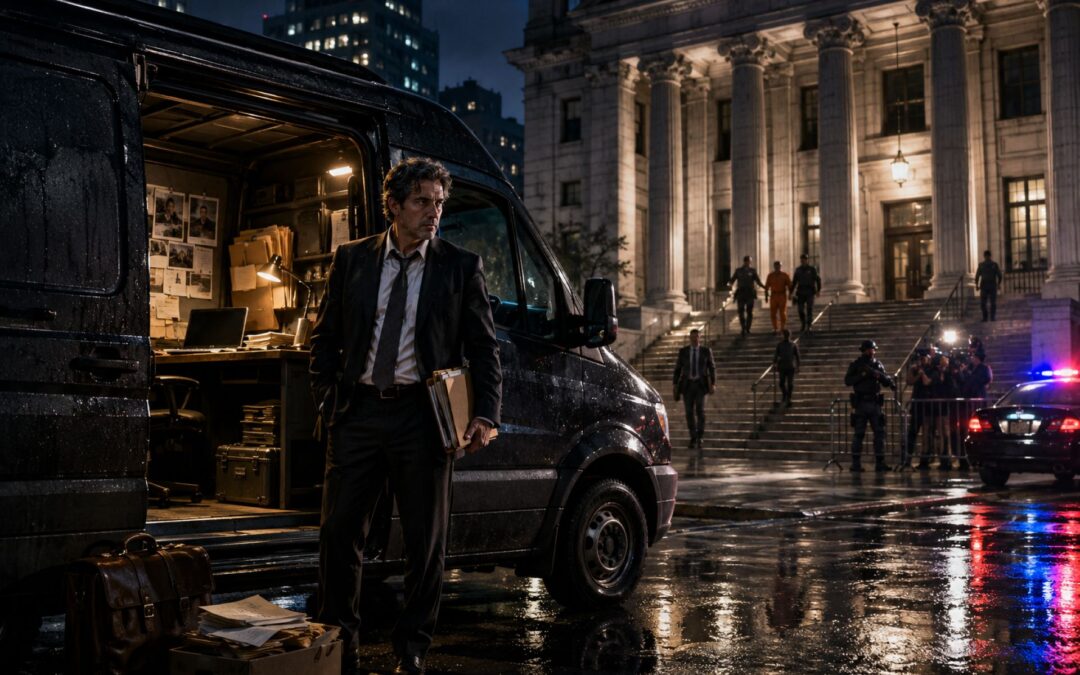
John Grisham’s Rogue Lawyer, published in 2015, begins with a familiar legal-thriller proposition and then steadily complicates it. Sebastian Rudd is a criminal-defense lawyer who represents people other attorneys do not want: defendants already condemned by public opinion, violent criminals, desperate men, and clients whose cases place him in direct conflict with police, prosecutors, judges, politicians, and sometimes his own conscience. He does not work from a respectable downtown office. He practices from a bulletproof van, carries a gun, employs a former client as his bodyguard and paralegal, and regards many of the institutions around him with open contempt.
What makes Rogue Lawyer unusual within Grisham’s legal fiction is that it is not built around one central trial. The novel consists of six linked parts and dozens of short chapters, with cases disappearing and returning as Sebastian’s professional problems accumulate. A wrongful murder prosecution leads into a death-row escape, a disastrous police raid, an MMA killing, the disappearance of a young woman, the kidnapping of Sebastian’s son, a corruption scandal, a sex-trafficking investigation, and finally a murder trial in which Sebastian cannot simply expose a dishonest system and save his client.
The connecting force is Sebastian himself. He believes that legal institutions frequently protect power instead of justice, and the novel repeatedly gives him reasons to think so. Yet he also steals evidence, arranges violence to obtain DNA, manipulates a judge assignment, threatens officials with scandal, deals with criminals, and considers how far he can bend professional rules without becoming indistinguishable from the people he condemns. The deeper question of Rogue Lawyer is therefore not merely whether the justice system can be corrupt. It is whether a lawyer can repeatedly fight corruption with corruption and still claim a morally superior position.
Spoiler warning: This article covers the entire novel, including every major case, the identity of the murderer in the Gardy Baker case, Starcher’s kidnapping, Jiliana Kemp’s fate, Tadeo Zapate’s trial and verdict, and Sebastian Rudd’s final departure.

Complete Plot Summary of Rogue Lawyer
The novel is divided into six named parts, and the chapter numbering begins again within each part. At first, these sections can appear almost like separate legal stories connected only by Sebastian Rudd, but cases and relationships gradually cross into one another. By the final part, his courtroom work, criminal contacts, political enemies, family problems, and personal compromises have become difficult to separate.
Part One: Contempt — Gardy Baker and a Rigged Murder Trial
Sebastian Rudd introduces himself while defending eighteen-year-old Gardy Baker in the small town of Milo. Gardy has been accused of murdering two young girls, and practically everyone around the courthouse already believes he is guilty. Sebastian does not. The prosecution’s case is weak on physical evidence but powerful as a public narrative: Gardy is socially marginal, the crime is horrifying, and rumors involving satanism and deviance have made him an ideal target for communal fear.
Sebastian immediately establishes himself as the opposite of a conventional courtroom professional. He has no permanent law office because his previous office was destroyed. Instead, he works from a heavily modified, bulletproof Ford van driven by a man he simply calls Partner. Partner is not merely a chauffeur. He is Sebastian’s bodyguard, investigator, paralegal, confidant, and the only person Sebastian appears to trust without qualification. Their precautions are not theatrical affectations. Sebastian represents dangerous people, antagonizes police departments, and has accumulated enough enemies that physical security has become part of practicing law.
Inside the Milo courthouse, the prosecution’s witnesses help create a story more emotionally persuasive than evidentially rigorous. Jailhouse informants claim Gardy confessed or made incriminating statements. Other testimony strengthens the image of a disturbed young man associated with sinister beliefs. The courtroom is crowded with spectators who treat the proceedings almost as communal ritual. Sebastian understands that he is not simply arguing evidence; he is fighting a conclusion that many people reached before the trial began.
A local criminal lawyer known as the Bishop quietly becomes important. He cannot openly align himself with Sebastian without antagonizing his community, but he hints that another suspect has circulated in local conversation from the beginning. That man is Jack Peeley, a former boyfriend of the murdered girls’ mother. Peeley had access, a questionable history, and proximity to the victims, yet investigators focused on Gardy instead.
While the trial pauses for the weekend, the novel shifts to Sebastian’s personal life. He meets his ex-wife, Judith Whitly, for one of their regular drinks. Their marriage ended badly, and Judith has primary custody of their son, Starcher. She believes Sebastian’s dangerous profession and chaotic habits make him an unsuitable influence. Sebastian resents her restrictions, but the scenes also establish that he is far from an ideal father. He loves Starcher, yet his work repeatedly takes priority, and he often seems more interested in preserving the right to remain part of his son’s life than in building an ordinary parental routine.
The same section introduces Sebastian’s other major obsession: mixed martial arts. He is financially backing an ambitious young fighter named Tadeo Zapate, whose career Sebastian hopes will become lucrative. Sebastian enjoys the violence, atmosphere, strategy, and raw competition of cage fighting. That attraction later becomes one of the novel’s important contradictions, because Sebastian criticizes institutional violence while enthusiastically participating in violence as entertainment.
His connection to Tadeo becomes useful in the Gardy case. The crime-scene evidence includes a black hair found in the shoelaces used to bind one of the murdered girls, Jenna Fentress. Sebastian asked the trial judge to permit DNA testing, but the request was denied. Rather than accept the ruling, he secretly stole part of the hair while examining the evidence. He now needs a sample from Jack Peeley.
Sebastian therefore arranges something plainly illegal. Tadeo and Miguel Zapate provoke Peeley in a bar, creating a fight that allows Tadeo to hit him and return with Peeley’s blood on his hand. Sebastian sends the stolen hair and illegally obtained blood sample to a private laboratory. The tactic reveals the moral method that will define him throughout the novel: when Sebastian believes formal procedure is preventing the truth from emerging, he feels entitled to violate procedure himself.
The trial becomes even more chaotic when Sebastian is accused of improper contact involving a juror’s family member. Marlo Wilfang, the daughter of juror Glynna Roston, submits an affidavit after encountering Sebastian at a cage fight. Sebastian insists that she approached him rather than the reverse. Judge Kaufman and prosecutor Dan Huver treat the incident as a serious impropriety. Sebastian responds not with conciliation but escalation. His confrontation with Kaufman ends with him being jailed for contempt.
From jail, Sebastian continues fighting. He invokes federal judicial pressure and drags Judge Arnold Samson into the dispute, creating enough procedural and institutional embarrassment to challenge Kaufman’s decision. The episode shows that Sebastian’s strongest weapon is often not conventional legal persuasion. He prefers pressure points: publicity, jurisdictional conflict, threats of appeal, professional embarrassment, and whatever leverage forces an opponent to reconsider.
Back in court, the prosecution rests. Sebastian begins presenting witnesses who place Gardy elsewhere at the relevant time. The difficulty is that many come from the Pit, a socially marginalized environment that allows Huver to attack their credibility by emphasizing drugs, poverty, criminal backgrounds, and instability. Sebastian may have an alibi, but he understands that jurors can discount accurate testimony when they dislike the people giving it.
Then the DNA results arrive. Jack Peeley’s blood matches the hair from Jenna’s bindings.
Sebastian now has what the official investigation failed to obtain: physical evidence connecting another suspect to the murder. He confronts Kaufman and Huver with the result and openly admits how he got the samples. His strategy is brutally simple. They can continue prosecuting Gardy and allow Sebastian to expose the DNA before the jury, subpoena Peeley, create a national scandal, and destroy any conviction on appeal, or they can confront the fact that they have the wrong defendant.
The authorities choose retreat. Jack Peeley is arrested, and Gardy’s case is dismissed, but the dismissal happens privately rather than in the packed courtroom where the prosecution’s failure would be most visible. Sebastian helps Gardy leave Milo, gives him money, and gets him away from a community that had been ready to condemn him.
The outcome establishes the strongest argument in favor of Sebastian’s rogue methods. The formal process failed. Police ignored a viable suspect, a judge blocked testing, prosecutors pursued a weak case, and public prejudice helped push an innocent young man toward conviction. Sebastian broke the rules and found the truth. The victory is real, but so is the precedent he has established for himself: once legality becomes an obstacle to justice, Sebastian feels free to decide which rules no longer deserve obedience.
Part Two: The Boom Boom Room — Link Scanlon’s Execution and Escape
Part Two shifts from an innocent defendant to a client whose guilt and brutality are not seriously in doubt. Link Scanlon is a powerful organized-crime figure on death row. His criminal organization has been associated with trafficking, intimidation, murder, and violence against people connected with his prosecution. Sebastian took over Link’s representation after the previous defense lawyer was murdered, and his work has largely consisted of trying to delay or prevent the execution.
The contrast with Gardy matters. Gardy demonstrates why aggressive defense is necessary when the state has the wrong man. Link demonstrates why the principle that everyone deserves representation becomes much less emotionally comfortable when the client is genuinely dangerous.
Execution night at Big Wheeler prison becomes a carefully staged spectacle. Protesters gather outside. Journalists wait. Officials prepare for the procedure. Sebastian and Partner arrive to perform the final legal work even though the appeals appear exhausted.
Then explosions begin.
Targets associated with Link’s prosecution and imprisonment are struck on a schedule that makes coincidence impossible. Fires break out. Prison facilities experience disturbances. Link remains remarkably calm, suggesting that he knows much more than he says. Officials discover that he has access to a cellphone, but events escalate faster than they can regain control.
A prison riot breaks out after a staged medical emergency. Inmates attack guards and create widespread confusion. Fires spread, outside security resources are mobilized, and pressure builds for the governor to intervene. The governor refuses to grant Link a reprieve.
As authorities move toward the execution, the prison experiences a larger breakdown involving smoke, power disruption, noise, confusion, and aerial activity. In the middle of the chaos, Link disappears.
Sebastian becomes an obvious suspect. If a death-row inmate has escaped during an execution, the inmate’s lawyer is an easy person to detain and question. Yet Sebastian has not orchestrated the escape. Authorities gradually reconstruct an elaborate plan involving outside assistance, coordinated distractions, access to vulnerable areas of the prison, and logistical preparation far beyond anything Sebastian controlled.
Link’s disappearance transforms the execution from an assertion of state power into a humiliation of the state. A later report places him in Mexico, but the sighting is never confirmed. More important for the rest of the novel, Link’s organization remains active and eventually turns its attention toward Sebastian.
The narrative then moves to Old Roseburg, another prison, where Sebastian and Partner visit Jameel, Partner’s nineteen-year-old son. The visit allows Sebastian to explain Partner’s history. Partner was once Sebastian’s client, accused of killing an undercover narcotics officer. Sebastian won his acquittal, after which Partner effectively rebuilt his life around Sebastian’s practice. He educated himself, learned legal work, and became indispensable.
His own son has not escaped the criminal system. Jameel is serving a long sentence, and the prison visit exposes the emotional difficulty between father and son. Partner loves him but struggles to communicate with him. Their strained relationship parallels Sebastian’s problems with Starcher, although the circumstances are very different.
Sebastian’s narration during the prison material broadens into criticism of drug enforcement, incarceration, race, recidivism, and the huge machinery of imprisonment. These passages reveal much about how he understands his profession. He does not see criminal defense merely as a contest between individual lawyers. He sees himself operating within a system structurally inclined toward punishment, institutional self-preservation, and the processing of marginalized people.
The part closes more loosely with Sebastian recalling another organized-crime client, Dewey Knutt, and participating in an illicit nighttime golf event called Dirty Golf. These episodes are less important to the plot than to characterization. Sebastian is repeatedly drawn toward subcultures with rules that everyone knows are being bent. Whether in court, MMA, gambling-adjacent recreation, criminal representation, or private deals, he seems most comfortable near the border between formal order and transgression.
Part Three: Warrior Cops — The Renfro Raid and Tadeo’s Fall
Part Three brings one of the novel’s most politically charged cases. Doug and Kitty Renfro are retired, middle-class homeowners living an ordinary life. Unbeknownst to them, a young neighbor named Lance has been using their unsecured Wi-Fi connection to sell Ecstasy online. Police trace the electronic activity back to the Renfros’ address and prepare a heavily armed SWAT raid.
The raid is disastrously wrong.
Police enter the Renfro house at night in tactical gear. Doug, an Army veteran, wakes to what appears to be an armed home invasion. Believing criminals are breaking in, he takes up a gun and fires in self-defense. One officer is hit. Police return fire, and Kitty is shot and killed.
Doug survives but is immediately trapped inside a grotesque reversal. His wife is dead because police raided the wrong house, yet authorities begin considering criminal charges against him for shooting at officers. The same institutions responsible for the operation control much of the early information about what happened.
Sebastian learns about the incident quickly and sends Partner to reach the family. He warns Doug’s adult children—Thomas, Fiona, and Susanna—that police departments and prosecutors will close ranks, control the narrative, and seek to minimize their own exposure. His advice is not to wait passively for official accountability.
Events soon confirm that the Renfros were not involved in drug dealing. Police identify Lance, who admits using their Wi-Fi. Nate Spurio, a police contact Sebastian regards as unusually trustworthy, quietly provides information suggesting that officers know how badly the operation failed even as the department publicly defends itself.
The Renfro children hire Sebastian. Doug is still hospitalized, grieving, angry, and confused about how a law-abiding homeowner can be treated as the offender after police kill his wife in his own house. Sebastian explains that criminal prosecution of the officers is unlikely and that civil litigation may be the more realistic instrument for forcing disclosure, creating financial pressure, and challenging the official story.
Kitty’s funeral deepens the political meaning of the case. Her community is not naturally predisposed to distrust law enforcement. Many of the mourners come from the kind of respectable, law-and-order environment in which police power is normally assumed to be protective. Her death forces them to confront an abuse they cannot easily dismiss as something that happens only to other kinds of people.
Sebastian then commits another serious ethical violation. He wants the federal civil suit assigned to Judge Arnold Samson, whom he believes will handle the case aggressively and fairly. Rather than trust random assignment, Sebastian pays courthouse insider Okie Schwin $3,000 to steer the case toward Samson.
The act is especially revealing because Sebastian’s cause is strong. The Renfros genuinely have been wronged, but even with favorable facts, he is unwilling to rely on neutral procedure. He manipulates the system before it can manipulate him.
Sebastian files a $50 million lawsuit against the City, police department, chief, and eight SWAT officers. Samson prevents authorities from freezing Doug’s assets, and Sebastian uses Doug’s property to help secure his release. The civil case and criminal case begin advancing simultaneously, allowing Sebastian to use discovery in one arena to prepare for the other.
Meanwhile, his family problems continue. During court-ordered visitation, Sebastian takes Starcher to a women’s university soccer match. Their time together reveals both affection and distance. Sebastian wants to remain significant in his son’s life, but he does not know enough about the rhythms of Starcher’s everyday world, and even family outings are frequently invaded by his legal obsessions.
The novel then returns to MMA. Tadeo is gaining prominence, and Sebastian’s financial interest in him appears increasingly promising. During a bout, however, events turn chaotic. After a disputed result and rising tension, Tadeo attacks referee Sean King. He continues striking even after King is effectively defenseless.
A riot breaks out around the cage. Starcher is present and witnesses the violence.
Video of the attack spreads rapidly online. King falls into a coma, Tadeo is arrested, and Sebastian suddenly becomes the defense lawyer for a fighter in whom he also has a personal and financial stake. The case is qualitatively different from Gardy’s. There is no mystery about whether Tadeo attacked King. The event is captured on camera.
Judith reacts immediately to Starcher’s exposure to the cage-fight chaos. She returns to family court seeking to restrict Sebastian’s visitation, arguing that his choices repeatedly place their son around inappropriate danger. Sebastian regards Judith as controlling and overprotective, but the episode weakens his ability to portray her concerns as irrational.
Then Sean King dies.
Tadeo now faces homicide charges. Sebastian understands that the viral video will be devastating evidence. Yet Tadeo, surrounded by family loyalty, athletic pride, and the peculiar celebrity created by the attack, does not fully appreciate how bad his legal position is.
The Renfro case moves forward at the same time. Judge Samson pushes civil discovery aggressively, and Sebastian takes depositions from the SWAT officers. His purpose is partly strategic: by obtaining their sworn accounts before Doug’s criminal trial, he can lock them into details that can later be attacked.
The family-court dispute also reaches a hearing before Judge Stanley Leef. Judith wants Sebastian’s visitation rights terminated. The judge refuses to remove him from Starcher’s life but orders Sebastian to keep the boy away from combat sports and to teach him that violence is not an acceptable method of resolving disputes.
The decision is a limited victory for Sebastian, but it also imposes an external moral boundary he does not naturally impose on himself.
As Doug’s criminal trial approaches, prosecutors offer a deal designed to end both the criminal risk and the civil litigation. Doug could obtain favorable treatment if his family abandoned its lawsuit. He refuses. For Doug, the civil action has become less about money than about refusing to let the institutions that killed Kitty define the event and move on without consequence.
Sebastian chooses to keep the criminal trial in the City rather than seek another venue. Public opinion has shifted toward Doug, and Sebastian prefers operating on familiar territory. The prosecution tries to frame the case through the officers’ perspective, explaining electronic drug enforcement, tactical planning, and the dangers police believe SWAT units face.
Sebastian attacks the story through Lieutenant Chip Sumerall and the other officers. His cross-examinations focus on planning, assumptions, training, identification, tactics, and the failure to verify who actually lived at the address. Instead of allowing the officers to appear as authoritative professionals responding to danger, he gradually makes the raid look like an institutional chain of careless decisions protected after the fact by police solidarity.
Judge Ponder eventually tells the prosecution in chambers that its case is terrible and that Doug appears to be the wrong person on trial. Yet the judge believes he cannot simply erase the prosecution under the law as presented. The jury must decide.
The remaining police testimony deteriorates. One officer becomes unavailable; another disappears. Sebastian begins to think the prosecution is doing so badly that Doug should not testify at all. Doug refuses. He needs the jury to hear what happened from him.
On the stand, Doug describes his military background, ordinary life, the nighttime intrusion, his belief that armed criminals were entering the house, and the moment his wife was killed. His grief is not polished courtroom strategy. It is raw enough to affect the jurors directly.
The prosecution cannot recover. The jury returns almost immediately with a unanimous not-guilty verdict. The foreman goes further, openly questioning why Doug was prosecuted while the officers involved in the raid were not.
For Sebastian, it is another triumph over institutional injustice. Yet elsewhere in his life, Tadeo’s case is moving in the opposite direction. The contrast between the two clients will become increasingly important. Doug is a victim of official error. Tadeo’s problem begins with something he himself chose to do.
Part Four: The Exchange — Arch Swanger and Starcher’s Kidnapping
After the Renfro acquittal, Sebastian briefly disappears. He drives away with golf clubs, books, and bourbon, moving through cheap motels and public golf courses. These retreats function almost like decompression after trial: when his professional world becomes unbearable, he temporarily leaves rather than reorganizing his life.
The next major case centers on Jiliana Kemp, a young woman who vanished from a hospital parking garage. Her disappearance produced an enormous investigation. With no body and no clear resolution, public attention eventually concentrates on Arch Swanger, a suspicious and evasive man whom police cannot fully connect to the crime.
Swanger specifically asks for Sebastian Rudd.
Sebastian knows the case is dangerous. He has recently humiliated the police through the Renfro trial, and representing the man believed to have harmed Jiliana will make him even less popular. The danger attracts rather than repels him. A notorious client, a difficult evidentiary problem, and hostile authorities are exactly the conditions under which Sebastian feels professionally alive.
Swanger is controlled, manipulative, and careful about what he says. He wants to understand the protections created by a lawyer-client relationship before revealing anything significant. Sebastian eventually agrees to represent him after Swanger writes a $5,000 retainer check and signs an agreement.
Then Swanger claims he knows where Jiliana’s body is buried.
The claim creates an immediate conflict. Sebastian has information that may help the victim’s family and police, but it comes through someone seeking legal representation. Matters become murkier when Swanger’s retainer check bounces. Sebastian cannot simply resolve the problem by pretending the conversation never occurred.
Swanger later contacts Sebastian in the middle of the night and directs his attention to a billboard advertising Dr. Woo’s vasectomy-reversal services. He implies that Jiliana is buried nearby. Sebastian begins wrestling with whether the story is true and how much he can disclose.
Rather than immediately involve police, he investigates the location himself. He uses an inconspicuous vehicle and visits the billboard site, where the terrain seems plausible enough that he cannot dismiss Swanger’s story as meaningless provocation.
The problem becomes personal when Assistant Chief Roy Kemp, Jiliana’s father, enters the confrontation. Detective Landy Reardon brings Sebastian to police headquarters, where Kemp presses him for information. Sebastian refuses to disclose what Swanger told him.
The choice is legally defensible within Sebastian’s understanding of professional secrecy, but the novel refuses to leave it as an abstract ethics question. For Roy Kemp, the information may concern his missing daughter. For Sebastian, disclosure could destroy a client relationship and expose him to professional consequences. Swanger has engineered the situation so that every option carries moral damage.
Sebastian’s personal life briefly interrupts the pressure. Starcher turns eight, and Sebastian receives only two hours with him. Their relationship becomes unexpectedly warmer when Sebastian teaches him backgammon. The scene is small but significant because Sebastian normally relates to Starcher through contested visitation schedules and arguments with Judith. The game gives them a simple shared activity without law or danger intruding.
That fragile domestic possibility collapses soon afterward.
Sebastian takes Starcher and Sebastian’s mother to City Park. Starcher plays with a remote-controlled boat. Gunfire suddenly creates a diversion, drawing attention elsewhere. In the short confusion, Starcher disappears near a restroom.
At first, the possibility remains that he wandered off. Police search the park, and Detective Lynn Colfax reconstructs the timeline. As minutes stretch into hours, the evidence increasingly suggests that someone deliberately took him.
Sebastian calls Judith. She arrives furious and terrified, assuming control as the custodial parent while the police expand their search. Sebastian spends the day and night wandering the park, imagining what may be happening to his son and confronting a degree of helplessness that none of his courtroom battles has produced.
The disappearance strips away much of his professional bravado. Sebastian has spent the novel believing he can create leverage whenever institutions corner him. Now the person being used as leverage is Starcher.
Reardon eventually contacts him privately. Starcher is alive and safe.
The kidnapping was not a conventional ransom crime. Roy Kemp and police officers sympathetic to him orchestrated the abduction to force Sebastian to reveal what Swanger told him about Jiliana’s supposed grave. They intend to exchange Sebastian’s son for his professional secret.
The logic of Sebastian’s world has finally been turned directly against him. He regularly uses pressure, threats, manipulated procedure, and morally questionable leverage against institutions he thinks are unjust. Now police officers who believe they are serving a desperate father have decided that their own morally justified goal entitles them to break the rules.
Part Five: U-Haul Law — Retaliation, Extortion, and Jiliana’s Trail
Sebastian does not hesitate for long once Starcher’s safety is at stake. Whatever professional rule or ethical principle protected Swanger’s statement is suddenly secondary to recovering his son. He gives the police the Dr. Woo location.
They search the site.
There is no body.
Swanger’s clue appears to have been false or deliberately misleading, but Sebastian has already surrendered the information demanded from him. Reardon directs him to a truck stop at Four Corners, where Starcher is waiting unharmed.
Starcher’s account confirms that the kidnappers did not physically abuse him. He was cared for and held as leverage rather than treated as a conventional hostage. That does not make the crime less consequential. Police officers used a child to force a lawyer to disclose confidential information.
Sebastian returns Starcher to Judith but does not immediately explain everything. He insists that the story needs to be told in the presence of federal investigators. He eventually meets with Judith and FBI agents and describes Swanger, the alleged burial site, Roy Kemp’s role, and the exchange.
Judith reacts with a complicated mixture of relief and fury. Her repeated claim has been that Sebastian’s professional life places Starcher in danger. The kidnapping has now proven that fear in the most extreme possible way. Sebastian cannot dismiss her as merely hostile or controlling.
At the same time, Link Scanlon’s organization reenters the story. Tubby Fango, acting for Link, confronts Sebastian and demands money. The encounter turns physical, and Partner helps Sebastian fight off Link’s men. Sebastian threatens to involve the FBI if the pressure continues.
The conflict escalates further when Sebastian’s black bulletproof van is destroyed by a bomb. Partner is burned. Sebastian assumes Link’s organization is retaliating.
Angry and frightened, Sebastian turns again to informal criminal power. He tells Partner to contact Miguel Zapate and use criminal associates to frighten Tubby Fango and Razor Robilio. Sebastian explicitly wants intimidation rather than murder, but the decision is still dangerous. Once violence has been delegated into an underworld network, his ability to control the outcome is limited.
The loss of the van has symbolic as well as practical consequences. Sebastian’s mobile office has been his professional fortress and public identity. Without it, he and Partner temporarily work from a rented U-Haul, producing the title “U-Haul Law.” The image is comic, but it also captures Sebastian’s precariousness. His unconventional independence is not glamorous when the physical structure that protects him can be blown apart.
A more conventional possibility enters his private life through Naomi Tarrant, Starcher’s teacher. Sebastian is attracted to her, and she eventually agrees to go out with him. To his delight, she is willing to attend a cage fight. Their relationship gives Sebastian access to a kind of intimacy not based on adversarial law, although his danger and weapons quickly make clear that he cannot simply separate romance from the life he has built.
The Renfro civil case now becomes entangled with the Starcher kidnapping. Doug remains devastated after his acquittal. He wants to settle, sell his house, leave the area, and escape the place where Kitty died.
Sebastian recognizes that the City has a much larger vulnerability than the botched SWAT raid. If it becomes public that police officers kidnapped a defense lawyer’s son in order to extort privileged information, the scandal could be enormous.
Judith ultimately decides she does not want the FBI to pursue Roy Kemp and the other officers. She fears that escalating the conflict could again put Starcher at risk. Sebastian agrees, which is striking because his normal instinct is escalation.
He does not, however, abandon the information as leverage.
Sebastian meets Mayor Woody Sullivan and city attorney Moss Korgan. He begins with the Renfro matter, demanding the maximum settlement he believes can be extracted under the relevant rules and insisting that the police chief and SWAT officers lose their jobs. Then he introduces the much more dangerous issue: Starcher’s kidnapping.
Sebastian effectively offers to bury the scandal in exchange for another $1 million for Doug Renfro.
He understands that what he is doing can be described as extortion. The moral structure is classic Sebastian Rudd. The police committed a serious crime. Public exposure could produce prosecutions and institutional upheaval. Sebastian instead turns the secret into bargaining power for another client whom the City wronged.
Doug ultimately receives a $2 million settlement. Sebastian voluntarily reduces his own contractual fee, recognizing the unusual suffering behind the case. Mayor Woody publicly apologizes, the police chief is removed, and all eight SWAT officers involved in the Renfro raid are fired.
The legal system has produced neither conventional criminal accountability nor a clean moral reckoning. It has produced a negotiated political solution partly secured through blackmail.
Then the consequences of Sebastian’s criminal contacts return.
Tubby Fango and Razor Robilio are found dead.
Detective Reardon confronts Sebastian because he had recently fought with the men and had obvious motives for wanting them stopped. Sebastian immediately fears that his instruction to have them frightened has spiraled into murder. Partner insists that he clearly told Miguel’s people that no one was to be hurt.
Sebastian did not order the killings, but the distinction does not absolve him completely. He chose to solve a threat through people whose methods he could not control. The deaths expose the danger of his recurring belief that he can enter corrupt systems temporarily, use their tools for a supposedly limited purpose, and remain outside their consequences.
Arch Swanger then returns.
His new story contradicts the earlier claim that Jiliana was buried near the billboard. Swanger now says she is alive. According to him, Jiliana was abducted into a trafficking operation, survived, became pregnant, gave birth while in captivity, and had the baby taken and sold. She is now being sexually exploited.
Swanger names another missing young woman, Heather, as evidence that the organization is moving victims across state lines. His story may still contain manipulation, but it provides details specific enough that Sebastian can no longer dismiss him as merely playing games.
The case has changed. The question is no longer whether Sebastian should reveal the location of a corpse. It is whether living women may remain trapped while he protects information coming from a deeply compromised client.
Part Six: The Plea — Jiliana’s Rescue and Tadeo’s Trial
Part Six brings the novel’s major strands toward resolution. Tadeo’s murder trial is approaching, and Sebastian’s jury consultant, Cliff, analyzes the enormous public exposure surrounding the case. The video of Tadeo beating Sean King is widely known. Many prospective jurors have already seen it and formed opinions.
Sebastian’s goal is initially defensive. If he cannot find a jury inclined toward acquittal, perhaps he can find one or two jurors willing to hold out and prevent unanimity. His strategy reflects how desperate the case has become.
Tadeo remains far more confident than the evidence warrants. Jailhouse conversations, family support, his former status as a rising fighter, and his own ego have convinced him that Sebastian can somehow win. Sebastian sees the situation much more clearly. There is video. There is a dead man. The prosecution does not need to manufacture a case.
At the same time, Sebastian is still thinking about Jiliana. His relationship with Naomi has become sexual and emotionally significant enough to hint at a different life, but professional danger remains dominant. Swanger’s information suggests that victims may still be alive, making inaction increasingly difficult to justify.
Sebastian constructs one of his most elaborate deals. Through Moss Korgan and police contact Nate Spurio, he proposes a political bargain connecting several unrelated problems. If the authorities cooperate, Tadeo will receive an extraordinarily favorable plea arrangement. Police interest in Sebastian over the Tubby and Razor murders will fade. In return, Sebastian may be able to produce actionable information about Swanger and Jiliana.
The bargain becomes possible only because the City’s political actors now have overlapping incentives. Mayor Woody wants scandals contained. Roy Kemp wants his daughter back. Sebastian wants Tadeo saved and himself protected. Prosecutor Max Mancini resists but eventually accepts the arrangement.
The proposed sentence for Tadeo is remarkable: roughly five years at a county penal farm, with the possibility that he could serve much less. Given the video evidence and King’s death, Sebastian considers it the deal of a lifetime.
Before Tadeo can accept, Sebastian must deliver something meaningful on Jiliana.
Swanger agrees to cooperate for $50,000. The money comes through the authorities, but Swanger insists that Sebastian travel alone and avoid visible police involvement. Sebastian drives with him while agents monitor the situation indirectly.
During the trip, Swanger changes the geography of the investigation. Jiliana is not buried beneath the Dr. Woo billboard. The trafficking operation has moved her and other women through multiple locations, eventually to the Atlanta area. Swanger identifies a shopping center in Vista View and a seemingly legitimate business called Atlas Physical Therapy.
At the old billboard location, Swanger also admits a deeper role in what happened. He was involved in Jiliana’s abduction, abuse, and sale. He takes the money and disappears into a cornfield, leaving Sebastian with enough information to act but once again escaping personal accountability.
Sebastian relays the Atlanta location. Federal agents begin surveillance, confirm suspicious activity, and raid the operation.
Jiliana is rescued alive.
Other women are also recovered, and the investigation expands to additional trafficking locations. Jiliana returns home severely traumatized. Her rescue is not a neat restoration of the life she lost; her child remains missing after allegedly being sold, and the psychological consequences of captivity cannot be undone simply because law enforcement has finally reached her.
Swanger remains at large. Authorities prioritized the rescue of victims rather than immediate capture of the man who led Sebastian to them, and evidence suggests Swanger received help leaving the area.
With Jiliana found, Sebastian’s bargain for Tadeo is ready.
He goes to Tadeo expecting gratitude.
Tadeo refuses the plea.
The decision astonishes Sebastian. A defendant facing a long homicide sentence has been offered an almost unbelievably favorable outcome, yet Tadeo treats acceptance as an admission of weakness. He accuses Sebastian of lacking faith in the defense.
This is the crucial difference between Tadeo and many of Sebastian’s earlier clients. Gardy desperately needed Sebastian to overcome a false accusation. Doug needed him to challenge institutional self-protection. Tadeo needs Sebastian to save him from the consequences of something the evidence strongly indicates he actually did, but he refuses to listen to the lawyer trying to protect him.
The court takes unusual care to establish that Tadeo understands what he is rejecting. Judge Fabineau and Mancini put the plea terms on the record. Sebastian protects himself against a future claim that he failed to advise his client properly. Tadeo still says no.
The trial therefore begins.
Mancini presents the killing directly. The video is shown. Medical testimony explains Sean King’s fatal brain injuries. Sebastian makes the strategically disciplined decision not to attack evidence that cannot credibly be disputed. Tadeo dislikes this. He wants his lawyer to fight every point, even when doing so would only make the defense look dishonest.
Sebastian’s principal theory is legal insanity. Dr. Taslman testifies that Tadeo’s mental condition during the attack prevented him from functioning normally. The defense emphasizes blows Tadeo had taken, emotional intensity, possible neurological impairment, and the chaotic atmosphere.
The difficulty is visible in the footage. Tadeo repeatedly attacks a man who is no longer meaningfully defending himself. Prosecutor Mancini presses Taslman on whether that behavior proves mental derangement or simply uncontrolled rage. The expert holds to his diagnosis, but the defense never fully escapes the intuitive power of the video.
A new corruption problem enters from Miguel Zapate.
Miguel tells Sebastian that juror Esteban Suarez can allegedly be bought for $10,000. Sebastian is tempted by the possibility of a guaranteed holdout but refuses to provide money or authorize the scheme.
His refusal is morally significant, although not entirely pure. Sebastian later explains that Mancini is trying the case honestly. Within Sebastian’s personal ethics, counter-cheating against a corrupt opponent is easier to justify than becoming the first person to corrupt a fair contest.
Miguel also confirms something Sebastian feared. The people contacted to intimidate Tubby Fango and Razor Robilio were responsible for their deaths. Sebastian never ordered murder, but his earlier decision helped start the chain that ended with two men dead.
The consequences of using criminal intermediaries have now become undeniable.
Sebastian’s personal relationships continue developing while the trial moves forward. Naomi remains in his life. During a dinner, they unexpectedly encounter Judith. Later, Sebastian admits something important about Starcher: he does not want full custody because he does not believe he is capable of being a good full-time father.
What he wants is relevance. He hopes to remain present enough that Starcher will eventually choose a meaningful relationship with him.
It is one of Sebastian’s more honest moments because he stops portraying the custody conflict solely as Judith denying him what he deserves. He recognizes a limitation in himself.
Back in court, Tadeo insists on testifying despite Sebastian’s written advice that he should remain silent. Mancini uses the opportunity effectively. He introduces footage of an earlier fight in which Tadeo also lost control after the competition should have ended.
That evidence badly damages the insanity argument. If Tadeo has previously reacted with uncontrolled post-fight aggression, the attack on King looks less like a singular neurological break and more like a recurring behavioral pattern.
The State also presents psychiatric rebuttal evidence. Sebastian now understands that the case has deteriorated further.
Mancini renews the extraordinary plea offer.
Tadeo refuses again.
His confidence is no longer based only on faith in Sebastian. Miguel has secretly proceeded with the plan to bribe Suarez. Tadeo believes the jury cannot convict unanimously because one juror has been purchased.
Neither he nor Miguel understands that Suarez is cooperating with investigators.
Judge Fabineau indicates privately that a conviction could produce a sentence in the range of twenty years. Both sides close. Sebastian asks the jurors to consider whether the evidence supports acquittal or a lesser outcome, but his room for argument is narrow.
The jury returns a unanimous guilty verdict for second-degree murder.
Outside the courtroom, police arrest Miguel for obstruction, bribery, and jury tampering. Suarez had been wearing a wire. The supposedly corrupted juror was part of the investigation.
Sebastian and Partner drink after the loss. Sebastian admits that the bribe tempted him but emphasizes that he refused because Mancini had not cheated. The explanation reveals the code Sebastian has been following throughout the novel: he does not believe rules possess absolute authority, but he does believe in a kind of retaliatory proportionality. If opponents corrupt the process, he feels entitled to respond. If they play fairly, initiating corruption crosses a line even he recognizes.
He refuses to represent Miguel.
Then Sebastian leaves.
Naomi is unavailable. The Zapate family and reporters are calling. Arch Swanger has also tried to reach him, implying that yet another dangerous story may still exist. Sebastian packs clothes, golf gear, and bourbon into his replacement van and drives out of the City.
He flips a coin and chooses north.
Earlier in the novel, Sebastian disappears after exhausting cases and eventually returns. This time, he reaches a motel without knowing whether he wants to come back at all.
Sebastian Rudd: Rogue Lawyer and Moral Problem
Sebastian Rudd is most interesting when the novel refuses to let either “hero” or “corrupt lawyer” fully describe him. He genuinely believes in the necessity of criminal defense, especially when police and prosecutors have converted suspicion into certainty before evidence has been tested. Gardy Baker and Doug Renfro prove that this conviction is not merely self-serving rhetoric. Sebastian’s aggression saves one innocent young man from a likely wrongful conviction and helps another man survive prosecution after police kill his wife.
At the same time, Sebastian repeatedly turns his belief in systemic unfairness into a license for personal rule-breaking. He steals physical evidence, orchestrates a bar assault to obtain DNA, bribes a courthouse employee to manipulate judge assignment, uses the secret of his son’s kidnapping to extract a larger civil settlement, and recruits people connected to organized crime to frighten enemies. His methods work often enough that he has developed a theory of himself as a necessary corrective to institutional dishonesty.
That theory becomes the central moral problem of the novel. Sebastian believes he cheats because the system cheats first, but several of his decisions take place before he can know whether a particular opponent will behave corruptly. Paying Okie Schwin to steer the Renfro civil case toward Judge Samson is a clear example. The underlying case is strong, yet Sebastian still corrupts procedure because he assumes procedural neutrality is too dangerous to trust.
His approach to Arch Swanger exposes another difficulty. Sebastian’s legal obligations are real, but his personal explanations of them are often compressed and categorical. In actual professional ethics, confidentiality rules can contain exceptions and jurisdictional differences; ABA Model Rule 1.6 is a useful reminder that Sebastian’s account should not be treated as a universal statement of American law. Because Grisham never identifies Sebastian’s state, the novel is better read as dramatizing an ethical conflict than as providing a technical manual on disclosure.
Sebastian’s self-image also depends on independence. He has no traditional office, dislikes bar-association respectability, distrusts judges and prosecutors, carries a weapon, wears unconventional courtroom clothes, and mocks professional rituals. Independence gives him flexibility, but it also makes institutional accountability easy to reject. When there is no organization above him and almost no colleague beside Partner whose judgment he respects, Sebastian becomes the principal authority on whether Sebastian’s own conduct is justified.
His attraction to violence complicates his politics further. He condemns brutal raids, prison systems, coercive police tactics, and the state’s ability to use force, yet he loves MMA and profits from Tadeo’s career. He is entertained by controlled violence until Tadeo’s inability to stop turns entertainment into homicide. The distinction between lawful violence, unlawful violence, and socially celebrated violence is therefore not simple even within Sebastian’s own life.
Fatherhood exposes limits that courtroom argument cannot conceal. Sebastian loves Starcher but is inconsistent and self-involved. He sees Judith as an adversary because she restricts visitation, yet Starcher is eventually kidnapped precisely because one of Sebastian’s cases has made him a target. Judith’s fear is not paranoia. Sebastian’s later admission that he does not want full custody because he is not equipped to be a good full-time father is one of the few moments when his self-assessment becomes more severe than his criticism of everyone else.
Tadeo finally confronts Sebastian with a problem he cannot solve through exposing corruption. The evidence is real. The prosecutor behaves comparatively fairly. The plea offer is extraordinarily generous. Tadeo rejects the advice and chooses trial. Sebastian cannot manufacture innocence where there is none, and he cannot force a client to make a rational decision.
That case exposes the true boundary of his profession. A defense lawyer can attack false evidence, police abuse, bad procedure, and prosecutorial overreach. He cannot guarantee justice in the sense of producing the outcome he wants, especially when his own client is guilty of serious conduct and refuses rescue.
Sebastian leaves the novel neither vindicated nor defeated in a simple sense. He has saved people, exposed wrongdoing, harmed others indirectly, endangered his son, watched corruption escape his control, and lost a client he could have saved from a long sentence. His exhaustion feels less like remorse than accumulated recognition that living permanently in opposition changes the person doing the opposing.
Character and Relationship Analysis
Sebastian describes himself as someone who needs very few people, but his relationships reveal more about him than his speeches about justice. The people closest to him continually test the difference between the independent figure he imagines himself to be and the man whose survival depends on trust, loyalty, forgiveness, and practical help.
Partner, Jameel, and Miss Luella
Partner is the novel’s most stable relationship. Sebastian once defended him against a murder charge involving an undercover narcotics officer and won an acquittal. Partner then became Sebastian’s employee, educated himself in legal work, and evolved into bodyguard, driver, investigator, paralegal, and confidant.
The fact that Sebastian never gives readers Partner’s ordinary name reinforces how completely he understands the man through their working relationship. “Partner” is not merely a job description. It is the nearest Sebastian comes to naming someone as an equal. He distrusts institutions and most colleagues, but Partner can carry money, protect Starcher, investigate cases, navigate dangerous situations, and challenge Sebastian without being treated as an outsider.
Partner’s relationship with Jameel complicates the image of competence. Jameel is imprisoned, and their visit at Old Roseburg exposes a father who does not know how to reach his son. The emotional silence between them parallels Sebastian and Starcher, although Partner’s pain is quieter and less combative.
Miss Luella, Partner’s mother, represents another small island of domestic stability. Through Partner’s family, Sebastian has access to relationships not based on legal combat, yet he remains slightly peripheral to them. Even his closest bond has been created by a criminal case.
Partner is also implicated in Sebastian’s moral compromises. When Sebastian wants Tubby and Razor frightened, Partner becomes the intermediary to Miguel. He clearly insists that murder was never the instruction, but the resulting deaths implicate both men in the consequences of operating through criminal networks.
Their loyalty survives because it is practical rather than idealized. Partner knows exactly what Sebastian is like. Sebastian knows Partner has his own painful history. Neither requires the other to be morally pure.
Judith, Starcher, and Naomi Tarrant
Judith Whitly initially appears largely through Sebastian’s irritated perspective. She is the ex-wife who limits visitation, pursues family-court litigation, criticizes his lifestyle, and treats his work as a danger to their son. Sebastian’s sarcasm encourages readers to find her controlling.
The novel gradually undermines that one-sided presentation. Starcher sees a brutal MMA incident because Sebastian takes him there. Sebastian’s enemies surround his work. His van is bombed. Criminals confront him. Eventually police officers kidnap Starcher specifically to pressure Sebastian over the Swanger case.
Judith has strong evidence for fearing his world.
That does not make Sebastian indifferent to Starcher. His grief during the disappearance is genuine and destabilizing. He roams the park after the search produces nothing, emotionally collapsing under a kind of helplessness he normally avoids through action. When the choice becomes professional secrecy or his child, Sebastian chooses Starcher immediately.
The relationship becomes more interesting after Starcher returns. Sebastian does not suddenly transform into a conventional father. He eventually admits that he does not want full custody and does not believe he would manage full-time parenting well. His goal is more modest: he wants to remain important enough in Starcher’s life that their relationship can deepen later.
Naomi Tarrant offers a different kind of connection. Because she is Starcher’s teacher rather than a client, criminal, police officer, judge, or legal adversary, she belongs to a world Sebastian might theoretically enter without combat. Their attraction suggests that Sebastian is capable of intimacy, humor, and companionship.
Yet Naomi also sees the practical cost of his life almost immediately. Guns, bombings, hostile clients, and constant professional danger are not easily compartmentalized. By the end of the novel, she remains a possibility rather than a solution. Sebastian leaves without resolving whether he can build a life in which another person is not simply waiting for his next crisis.
Gardy Baker and Doug Renfro: When Sebastian’s Methods Save the Vulnerable
Gardy Baker and Doug Renfro provide the strongest moral justification for Sebastian’s profession. Both are placed in danger by systems that have already constructed stories about them before the truth is properly tested.
Gardy is socially vulnerable. The prosecution can exploit his marginal status, community fear, jailhouse informants, and satanic rumors because the town wants an explanation for a horrific crime. Sebastian’s illegal DNA operation is ethically troubling, but it reveals the actual suspect and stops an apparent wrongful conviction.
Doug belongs to a very different social world. He is older, respectable, a veteran, and initially inclined to trust institutions. That makes his experience especially destabilizing. Police raid his home based on someone else’s activity, kill Kitty, and then prosecute him for defending himself against unidentified armed intruders.
Doug’s case shows Sebastian at his most effective. He understands that legal victory requires controlling several arenas at once: civil discovery, criminal defense, public narrative, political pressure, and judicial procedure. His methods are again compromised, particularly the manipulated judge assignment and later use of the Starcher kidnapping as settlement leverage, but Doug receives an acquittal, substantial compensation, and some degree of public accountability.
Neither case proves that every Sebastian client is an innocent victim. Instead, they explain why he finds it so easy to believe that his own misconduct is justified. He has seen what can happen when he follows the rules and the other side does not.
Link Scanlon, Tadeo Zapate, and Arch Swanger: Clients Sebastian Cannot Control
Link Scanlon, Tadeo Zapate, and Arch Swanger each challenge Sebastian’s belief that superior tactics can control dangerous situations. Link is already an enormously powerful criminal when Sebastian becomes his lawyer. His execution-night escape demonstrates that a client can possess resources, loyalties, and plans completely outside counsel’s knowledge.
Link later becomes an enemy. His organization pressures Sebastian, and the resulting conflict contributes to the bombing of Sebastian’s van and the chain of events surrounding Tubby and Razor. The lawyer-client relationship therefore does not necessarily create loyalty. Sebastian can defend a man without controlling what that man will later do.
Tadeo presents a different problem. Sebastian knows him socially, invests in his career, and believes he understands how to manage him. After Sean King’s death, however, Tadeo becomes increasingly resistant to advice. Sebastian secures an extraordinary plea, repeatedly explains the danger of trial, and even puts the rejection on the record. None of it matters because Tadeo’s pride and reliance on Miguel’s corrupt scheme are stronger than his trust in counsel.
Arch Swanger is the most manipulative of the three. He understands legal confidentiality well enough to exploit Sebastian’s obligations while withholding the truth. He lies about Jiliana’s supposed grave, disappears, returns with another story, and eventually provides information that saves victims while admitting that he participated in their abuse.
Swanger is simultaneously criminal, source, client, manipulator, and partial rescuer. Sebastian never achieves a stable moral or professional position in relation to him. Even at the end, Swanger remains free and is still calling.
Together, these three clients demonstrate a limit that Sebastian often resists acknowledging: representing someone does not make that person part of the lawyer’s strategy. Clients have independent desires, secrets, resources, loyalties, and capacities for self-destruction.
The City and Its Criminal-Justice Ecosystem
Grisham leaves Sebastian’s principal City and state unnamed. That choice gives Rogue Lawyer an almost composite quality. The institutions feel recognizably American without being tied to one real jurisdiction whose specific procedural rules would govern every event.
The world Sebastian moves through is defined less by geography than by overlapping systems of power. Courthouses, police headquarters, prisons, City Hall, family court, media outlets, private law practices, organized-crime networks, MMA venues, and Sebastian’s mobile office all form parts of the same social landscape.
Milo shows what happens when a small community, police force, prosecution, and public opinion converge around a preferred suspect. Gardy’s legal danger does not arise only from bad evidence. It arises because everyone around the evidence wants it to mean the same thing.
The City operates on a larger scale but often through similar incentives. Police departments protect officers. Prosecutors defend prosecutions. Politicians fear scandal. Judges exercise enormous procedural discretion. Reporters amplify leaks and public narratives. Defense lawyers survive by understanding not only statutes and evidence but personalities, informal relationships, institutional fears, and publicity.
The Renfro case is the clearest example. A technological clue points to a house. SWAT officers transform the clue into an armed operation. A homeowner responds to what looks like an invasion. An innocent woman dies. The department then has incentives to characterize the raid as reasonable and Doug as dangerous because admitting the opposite exposes the institution to liability and disgrace.
Sebastian’s response is not institutional reform. He builds a counter-network. Nate gives him inside information. Okie manipulates case assignment. Judge Samson provides a favorable forum. Civil discovery supplies evidence for criminal defense. Public sentiment changes the trial environment. The Starcher kidnapping later becomes leverage against City Hall.
That pattern recurs across the novel. Formal justice exists, but informal power repeatedly determines what formal institutions are willing to do.
Prisons extend the same logic. Big Wheeler is supposed to represent maximum state control, yet Link Scanlon’s organization can destabilize the facility from inside and outside. Old Roseburg is less spectacular but shows punishment as routine bureaucracy, with Partner and Jameel caught in the emotional consequences.
The media operate as another institution of judgment. Gardy’s town constructs guilt socially. Swanger becomes the presumed killer of Jiliana before proof emerges. Doug is initially discussed through the language of a drug raid even though he knew nothing about the drugs. Tadeo’s case complicates the pattern because the public evidence is genuinely devastating. His viral video can prejudice a jury, but it also records what he did.
The novel therefore does not argue that public narratives are always false. It argues that once institutions and audiences settle on a narrative, reversing it becomes extraordinarily difficult. Sebastian’s professional identity is built around disrupting that certainty.
His bulletproof van belongs within this world-building. Because he refuses a fixed office, he occupies no stable institutional territory. He works between courthouse, jail, parking lot, road, motel, and crime scene. The van makes him physically mobile and symbolically difficult to absorb into any professional establishment.
Yet mobility also means instability. When the van is destroyed, Sebastian does not have a secure institution to fall back on. His independence protects him from some pressures while exposing him to others.
Major Themes
The novel’s themes emerge through contrasts among cases rather than through one continuous argument. Gardy, Doug, Link, Tadeo, Swanger, and Sebastian himself repeatedly occupy different positions inside the same questions about law, guilt, violence, and institutional power.
Justice Versus Legality
The central tension of Rogue Lawyer is the difference between something being legally processed and something being just.
Gardy Baker’s trial is procedurally recognizable. There is a judge, prosecutor, defense lawyer, jury, witnesses, exhibits, and formal argument. Yet almost every element is distorted by the community’s prior belief in his guilt. Legal form exists without reliable justice.
Sebastian corrects that problem illegally. The DNA that helps free Gardy comes from stolen evidence and blood obtained through an arranged assault. If justice means producing the true murderer and preventing an innocent conviction, Sebastian succeeds. If justice requires lawful process, his method is deeply compromised.
Doug Renfro’s case poses the same problem from another direction. The raid originates in a legitimate law-enforcement purpose but is executed on the wrong house. Police authority makes the invasion legally different from an ordinary burglary, yet Doug experiences armed strangers breaking into his home. His defensive response becomes criminalized because the intruders carry state authority.
Judge Ponder’s frustration makes the tension explicit. He effectively recognizes that Doug is the wrong person to prosecute but believes the relevant legal structure does not allow him simply to substitute his own sense of justice for the case before him. The jury must correct the mismatch.
Tadeo provides the essential counterexample. Sebastian cannot reduce every prosecution to state injustice because Tadeo actually committed the violent act being prosecuted. The process may contain bias, publicity, and imperfect legal categories, but the factual core is strong.
That difference is why Tadeo’s trial matters so much to the book. Sebastian’s skill is most heroic when institutions have created a false reality. It becomes far less powerful when the central problem is not institutional error but a client’s own conduct.
Dirty Hands: When Fighting Corruption Becomes Corruption
Sebastian’s governing belief is that clean methods cannot always defeat dirty systems. The novel repeatedly makes that belief plausible and repeatedly demonstrates its danger.
His manipulation of Gardy’s DNA evidence is the clearest success. A legal request for testing fails, so Sebastian manufactures an alternative route. The result identifies Peeley.
The judge-assignment bribe in the Renfro case is harder to defend. Sebastian has no proof that the random process will produce injustice. He simply wants a judge he trusts. His action corrupts the neutrality he claims institutions have already lost.
The Renfro settlement pushes him further. Police officers kidnapped Starcher. Sebastian and Judith decide not to pursue the scandal publicly, partly for Starcher’s safety. Sebastian then uses the secret to force the City to pay Doug more money.
The outcome can be described as restorative. Doug receives compensation from the institution that harmed him. The police chief and SWAT team lose their positions. Yet the mechanism is extortion rather than transparent accountability.
Tubby and Razor reveal the darkest consequence. Sebastian wants them intimidated, not killed. By asking criminal intermediaries to solve the problem, however, he gives up control over how force is applied. When the men die, he cannot say he directly ordered murder, but neither can he pretend his decision was irrelevant.
The attempted juror bribe finally draws a line. Sebastian considers it. He understands its tactical value. He refuses.
His reason is revealing: Mancini is trying the case fairly.
Sebastian’s ethics are therefore retaliatory rather than absolute. He believes corruption can be justified as counter-corruption. The problem is that he is usually the person deciding whether the other side has crossed the threshold.
Violence as Spectacle
Violence in Rogue Lawyer is rarely private. It is watched, discussed, televised, recorded, staged, or politically interpreted.
Link Scanlon’s scheduled execution is a public ritual surrounded by protesters, journalists, officials, and security. His escape transforms that spectacle into another kind of show: explosions, prison disturbances, and a humiliating demonstration of criminal power.
MMA makes the connection even clearer. Sebastian loves cage fighting precisely because violence occurs within a structure of rules. Fighters agree to the contest. Referees and judges regulate it. Audiences pay to watch.
Tadeo’s attack on Sean King destroys that distinction. Once the referee becomes the target and Tadeo continues striking after legitimate competition has ended, sport becomes assault. The crowd’s entertainment becomes evidence in a murder prosecution.
Police violence is represented through a different institutional framework. The Renfro SWAT team enters a house believing it is executing a law-enforcement mission. Doug experiences the same event as armed intrusion. The moral meaning of force therefore changes according to who is using it, what information they possess, what authority they claim, and whether they stop when circumstances change.
Sebastian himself is drawn to violent environments while insisting on distinctions among justified, unjustified, lawful, and unlawful force. The novel does not entirely resolve those distinctions. Instead, it repeatedly asks whether the presence of rules makes violence legitimate or merely easier to rationalize.
Fatherhood, Loyalty, and the Cost of Sebastian’s Work
The novel contains several troubled father-child relationships that complicate its legal conflicts.
Sebastian’s relationship with Starcher is the most important because his professional choices eventually place his son directly in danger. He wants to remain part of Starcher’s life, but his idea of fatherhood is frequently aspirational rather than practical. Judith handles ordinary parenting while Sebastian fights for access.
Starcher’s kidnapping changes the emotional balance. Sebastian is forced to confront the possibility that his work has transformed his son into a weapon that enemies can use against him. He chooses Starcher over confidentiality immediately, proving the depth of his attachment even as the kidnapping validates Judith’s concerns.
Partner and Jameel provide a quieter parallel. Partner is dependable, disciplined, and loyal in Sebastian’s professional life, yet he cannot repair the distance with his imprisoned son simply through competence. The prison visit is painful precisely because no legal strategy can solve the emotional problem.
Roy Kemp represents the opposite extreme of paternal desperation. He participates in the kidnapping of another man’s child because he believes it may help him recover his own daughter. His motive is understandable; his method is monstrous.
The parallel matters. Sebastian repeatedly justifies misconduct by appealing to a morally urgent goal. Roy does the same thing to him. Once every person is permitted to break rules whenever the cause feels sufficiently important, competing moral emergencies become indistinguishable from power struggles.
Presumption, Public Narrative, and the Media
Sebastian’s profession requires him to fight not only prosecutors but stories.
In Milo, Gardy becomes guilty in the public imagination because the murder is horrific and he fits the community’s desired explanation. Weak evidence acquires power because it enters a story people already believe.
Swanger experiences something similar after police leaks and media attention turn suspicion into assumed guilt. The important complication is that Swanger really is involved in terrible crimes. Public presumption may be procedurally unfair even when the suspected person is not innocent.
Doug Renfro is initially absorbed into the language of a drug raid despite having no connection to the drug dealing. His identity changes in public discussion because police terminology defines the event before the facts are clear.
Tadeo’s case reverses the pattern. The media exposure is prejudicial, but the viral video is not fabricated. It captures his behavior.
That distinction prevents the novel from becoming a simplistic argument that publicity always creates false guilt. Cameras can distort public judgment, but they can also preserve evidence that a defendant desperately wishes jurors could forget.
Sebastian’s own relationship with publicity is equally complicated. He criticizes media trials but uses reporters and public embarrassment when they help his clients. He opposes narratives imposed by powerful institutions while constructing counter-narratives of his own.
Symbols and Motifs
The most important recurring object in Rogue Lawyer is Sebastian’s van. At the beginning, the black bulletproof vehicle is office, armor, transportation, conference room, and professional identity. Sebastian’s refusal to rent conventional premises becomes physically embodied in a mobile workplace that can move away from threats and refuses permanent attachment to any respectable legal district.
Its destruction therefore means more than losing a vehicle. The bombing demonstrates that Sebastian’s defensive precautions cannot fully protect him. His enemies can still penetrate the structure he has built around himself.
The U-Haul that temporarily replaces it is comic but revealing. Sebastian’s practice continues even when reduced to a rented moving truck. His law firm is not a place; it is an arrangement among Sebastian, Partner, files, weapons, and mobility.
The eventual replacement van is disguised as a contractor’s vehicle rather than announcing itself as Sebastian’s distinctive fortress. The change suggests adaptation. He remains mobile but becomes less conspicuous, shifting from visible defiance toward camouflage.
The MMA cage operates as a parallel to the courtroom. Both are enclosed arenas containing formal rules, opposing sides, referees or judges, strategic performances, audiences, and winners. Sebastian thrives in both environments because conflict has a structure he believes he can master.
Tadeo’s attack on King occurs when the cage no longer contains violence within its intended rules. That breakdown mirrors Sebastian’s legal philosophy. Rules work until someone decides the rules are no longer adequate, at which point force escapes the structure meant to govern it.
Sebastian’s pool table functions differently. He plays in private, thinking through problems in a world of angles and predictable physical reactions. A ball struck in a particular way follows consistent rules. Courts and people do not.
The attraction is understandable. Pool offers the controllability Sebastian wants from his cases but rarely gets. Tadeo rejects pleas, Swanger lies, police retaliate, criminals kill people they were only supposed to frighten, and jurors remain uncertain. Billiards obeys mechanics where law obeys human motives.
Guns and armor appear so routinely that danger becomes part of Sebastian’s ordinary environment. He carries a weapon; his vehicle is protected; police enter homes in tactical gear; organized criminals threaten lawyers. Violence is not an exceptional rupture in this world but something institutions and individuals prepare for constantly.
Cash carries its own recurring meaning. Money in envelopes and private payments bypasses formal accountability. Sebastian uses cash to manipulate judge assignment. Swanger demands money for information. Miguel tries to buy a juror. Legal and illegal systems repeatedly meet through transactions that cannot survive public scrutiny.
Cameras and recordings complicate Sebastian’s suspicion of institutions. Media can spread prejudice, but recording can also preserve truth. Tadeo’s video weakens his defense precisely because it limits everyone’s ability to reconstruct the event differently.
Golf, finally, functions as Sebastian’s escape ritual. After extreme professional stress, he drives away, plays anonymous courses, stays in cheap motels, drinks, and temporarily abandons the City. By the ending, the same ritual no longer feels restorative. He leaves with golf equipment, but he does not know whether this trip is another break or something closer to abandonment.
Structure, Narrative Voice, and Style
The unusual architecture of Rogue Lawyer was noticed immediately by contemporary critics. In Maureen Corrigan’s Washington Post review, she observed that the early case material can initially resemble a succession of self-contained legal-suspense stories before Grisham reveals a larger connective design.
That first impression is accurate. Part One could almost function as a compact wrongful-prosecution novella. Part Two changes defendants and atmosphere completely. Part Three introduces another major case while continuing Tadeo and Sebastian’s family problems. Only gradually does the reader realize that continuity comes less from one legal mystery than from the accumulation of Sebastian’s consequences.
The six-part structure allows Grisham to explore different pressures on criminal defense without forcing them into one case. Gardy tests wrongful prosecution. Link tests the ethics of defending a genuinely brutal criminal. Doug tests police power. Swanger tests confidentiality. Tadeo tests the limits of advocacy when the client’s own choices are the central problem.
The drawback is fragmentation. Some readers may feel that the novel repeatedly starts over just as a case becomes satisfying. Link’s escape, for example, generates enormous spectacle but is not followed by a conventional pursuit-and-resolution arc. Instead, Link disappears and returns indirectly through later threats.
The short chapters reinforce speed. Scenes frequently end on discoveries, calls, arrests, confrontations, or strategic decisions. Grisham uses brevity to keep multiple cases circulating without allowing one to completely stall the others.
That pace can also create an episodic television quality. Characters enter for a functional role, cases produce a sharp legal dilemma, and the narrative moves rapidly onward. Readers seeking deep psychological development may find the efficiency limiting.
Sebastian’s first-person narration solves some of the structural problem by giving every episode the same voice. He is sarcastic, cynical, judgmental, observant, self-confident, and often funny. His commentary creates coherence even when the cases change completely.
The voice is also the novel’s principal source of unreliability. Sebastian usually gives readers enough information to understand what literally occurs, but his interpretations are far from neutral. He makes sweeping judgments about police, prosecutors, judges, prisons, journalists, spouses, criminals, and social institutions.
The distinction between factual and interpretive reliability matters. Readers have strong reason to believe that Sebastian accurately reports Gardy’s DNA result, Doug’s raid, Starcher’s kidnapping, and Tadeo’s verdict. They have less reason to accept every general conclusion he draws from those events.
His bias is not a flaw that must be corrected out of the novel. It is part of the characterization. Sebastian’s entire identity depends on believing that he sees through institutions more clearly than people who still trust them.
Grisham also uses legal explanation in a deliberately conversational manner. Sebastian tells readers how he thinks judges, pleas, discovery, prosecutors, jail systems, jury selection, immunity rules, and defense strategy work. These passages make the thriller accessible without turning it into a doctrinal treatise.
The risk is that exposition occasionally becomes sermon. Sebastian’s broader complaints about prison, policing, or legal culture can feel less like a character thinking through one case and more like a channel for generalized criticism. The effect will depend heavily on whether a reader enjoys his voice.
Tone shifts are another defining feature. Rogue Lawyer moves from murdered children to jokes about clothing, from an execution to Dirty Golf, from a grieving widower to cage fighting, from a kidnapped child to political bargaining. The mixture keeps the book fast and unpredictable, but it can also make tragedy feel quickly absorbed into Sebastian’s next problem.
At its best, the structure resembles Sebastian’s own working life. Cases do not arrive as a clean novelistic sequence. Clients overlap. Emergencies interrupt preparation. Personal relationships intrude on trials. Old clients become new threats. Small decisions made dozens of chapters earlier return with consequences.
The book’s apparent fragmentation therefore eventually becomes part of its meaning. Sebastian believes he can compartmentalize each tactical compromise. The structure gradually demonstrates that he cannot.
Ending Explained: Why Tadeo Loses and Why Sebastian Leaves
The ending of Rogue Lawyer works because Tadeo’s case denies Sebastian the kind of victory that defined the novel’s opening.
Gardy Baker is saved by discovering the truth. Doug Renfro is saved by exposing how badly the police acted. Jiliana Kemp is rescued by following information that institutions did not originally possess. In each case, Sebastian can improve the outcome by uncovering something hidden or creating leverage against people protecting themselves.
Tadeo’s case contains no equivalent revelation.
The video shows the attack. Sean King is dead. The defense can debate Tadeo’s mental state, but Sebastian cannot produce another murderer or expose a fabricated crime scene.
More importantly, Sebastian actually succeeds in solving the practical legal problem. He negotiates an extraordinarily favorable plea. Tadeo could receive roughly five years in a relatively favorable institution and potentially serve substantially less.
Tadeo rejects it repeatedly.
His refusal gives the ending a tragic structure that does not depend on institutional injustice. Sebastian does everything a lawyer could reasonably hope to accomplish, and the client chooses the worse path.
Tadeo’s faith in Miguel’s bribery scheme makes the failure more severe. Instead of trusting legal advice, he trusts corruption. The irony is precise: Sebastian has spent the book arguing that formal institutions are often dishonest and that survival sometimes requires unconventional tactics. Tadeo takes that logic to an absurd extreme and believes a bought juror can replace a good plea.
Sebastian refuses to participate, but his refusal is not presented as a sudden conversion to ethical purity. He considers the opportunity. What stops him is that Mancini is behaving fairly.
That detail reveals Sebastian’s moral code more clearly than almost anything else in the novel. He is willing to cheat against cheaters because he views it as restoring balance. He is much less comfortable initiating corruption when the opponent is following the rules.
The obvious weakness in this code is that Sebastian himself decides who qualifies as corrupt. Nevertheless, the distinction matters to him.
Suarez’s cooperation with investigators destroys Miguel’s scheme. The jury convicts Tadeo unanimously, proving that the supposed safety net never existed. Miguel is arrested for jury tampering and bribery.
The verdict also settles something larger. Sebastian cannot always control the justice system, but sometimes the system produces a defensible result despite his dissatisfaction. Tadeo killed Sean King, rejected an extraordinary opportunity to limit the consequences, weakened his own defense by testifying, and trusted a criminal scheme.
His conviction is not morally equivalent to Gardy’s threatened conviction.
Sebastian’s departure afterward is therefore more significant than his earlier vacations. He has not simply lost a case. He has reached the end of several overlapping experiences that challenge his belief in tactical mastery.
His van was bombed. His son was kidnapped. Two men were killed after he tried to have them frightened. Tadeo rejected his advice. Miguel corrupted a juror and was caught. Swanger remains free. Judith’s fears about his life have been validated. Naomi offers a different future, but Sebastian does not know how to enter it.
He does not confess that his worldview was wrong. He does not decide to become respectable. He does not renounce criminal defense or promise to follow every rule.
Instead, he becomes uncertain.
That uncertainty is the ending’s real change. Sebastian has spent most of the novel knowing what he thinks about everyone and everything. Judges are corrupt, prosecutors self-protective, police dangerous, criminals manageable if understood correctly, and Sebastian himself necessary because ordinary lawyers lack courage.
Driving north, he no longer knows whether he wants to return.
Swanger’s unanswered call ensures that the world he is leaving has not actually finished with him. There is still another client, another secret, another possible crisis. Sebastian’s departure is therefore not resolution through reform. It is temporary separation from a cycle he can no longer pretend is cost-free.
Critical Review: What Rogue Lawyer Does Well—and Where It Strains Credibility
Rogue Lawyer succeeds most clearly when judged as an unconventional legal thriller rather than as a rigorously naturalistic study of American criminal procedure. Its pleasures come from speed, tactical reversals, morally messy cases, and Sebastian’s ability to move between courtroom argument, street-level danger, political bargaining, and personal crisis without ever becoming a conventional heroic attorney. Its weaknesses arise from the same design: exaggeration, episodic plotting, broad characterization, and situations that sometimes stretch credibility in order to give Sebastian another impossible problem.
What the Novel Does Best
The strongest achievement is Sebastian Rudd’s narrative presence. Whether readers admire him or dislike him, he is distinct. His mobile office, weapons, contempt for professional decorum, passion for MMA, hostile relationship with institutions, and readiness to defend despised clients give the novel an identity separate from the more conventional respectable-lawyer framework common to legal thrillers.
His contradictions are more valuable than his eccentricities. A character who merely breaks rules would become a gimmick. Sebastian instead breaks rules in cases where doing so sometimes produces obviously better outcomes.
Gardy’s exoneration gives the novel moral force because Sebastian’s illegal evidence operation uncovers a fact the system should have discovered itself. The reader cannot comfortably condemn his methods without confronting the possibility that a young man might otherwise have been convicted of murdering two girls.
The Renfro material is similarly effective. Grisham gives the case enough procedural development to show how one catastrophic police mistake can generate a series of institutional incentives. Once Kitty is dead and Doug has fired at officers, police, prosecutors, city officials, and defense lawyers all begin acting within different legal and political pressures.
The courtroom sequence is satisfying because Sebastian does not reveal one secret that instantly wins the case. He freezes police testimony through depositions, studies tactics, cross-examines officers, uses Doug’s credibility, and slowly shifts the trial’s moral center.
Tadeo’s arc is perhaps the novel’s most important structural decision. If every Sebastian client were an innocent person persecuted by corrupt authorities, Rogue Lawyer would become much flatter. Tadeo is responsible for the act at the center of his case, and his own arrogance destroys an extraordinary opportunity.
That contrast gives Sebastian’s profession complexity. Criminal defense is necessary not because every defendant is innocent but because guilt does not eliminate the need for counsel, procedure, proportional punishment, or competent representation.
The linked-case architecture also improves as the novel progresses. Link’s men return. Tadeo’s MMA story becomes a murder trial. Sebastian’s family conflict becomes relevant when Starcher is kidnapped. The Renfro case becomes leverage in the police scandal. Swanger’s lies eventually produce information that rescues Jiliana.
This cumulative design is one reason Maureen Corrigan praised the novel’s construction. The early sections can appear nearly self-contained, but the larger novel gradually reveals itself through returning consequences.
Grisham is also very good at practical courtroom tension. Jury selection, plea negotiations, witness preparation, strategic decisions about cross-examination, judicial temperament, media pressure, and the psychology of defendants all produce suspense without requiring elaborate legal doctrine.
The most convincing legal moments are often psychological rather than technical. Tadeo refusing an excellent plea is believable because defendants do sometimes view compromise as betrayal. Sebastian choosing not to cross-examine evidence that obviously hurts his client reflects mature trial strategy: a lawyer does not help by emphasizing devastating facts merely to appear aggressive.
The novel’s moral ambiguity is another strength. Sebastian is often right about institutional self-interest but wrong to imagine that being right gives him unlimited moral authority. Roy Kemp’s kidnapping of Starcher makes this point particularly effectively because Roy can construct a justification structurally similar to Sebastian’s own.
Roy’s daughter is missing. Sebastian has potentially lifesaving information. Formal professional rules prevent disclosure. Roy decides that saving Jiliana matters more than obeying the law.
Sebastian despises the act because he is its victim.
The parallel does not make their behavior identical, but it exposes the danger in any ethic that allows individuals to suspend rules whenever they regard their objective as sufficiently righteous.
Where the Novel Falls Short
The main limitation is credibility. Grisham deliberately amplifies almost every institution Sebastian encounters. Small-town prosecutors pursue a spectacularly weak murder case. A death-row criminal escapes through a coordinated operation involving prison chaos and outside support. A SWAT raid kills an innocent homeowner’s wife. Police officers kidnap a lawyer’s child. City Hall resolves scandal through coercive backroom bargaining. A trafficking suspect repeatedly manipulates both lawyer and police.
Each event can work within thriller logic. In accumulation, they create a world so saturated with corruption, incompetence, and spectacular misconduct that Sebastian’s paranoia often appears less like a psychological trait than simple realism within the novel.
That weakens one of the book’s potentially richest ambiguities. Sebastian would be more difficult to evaluate if institutions were sometimes trustworthy before he corrupted them. Instead, many opponents are sufficiently compromised that his cynicism receives continual confirmation.
Publishers Weekly’s review raised a related concern about Rudd’s characterization, arguing that he can remain closer to a stereotype than a fully realized figure while some later developments push plausibility. That criticism has force.
Sebastian has a powerful voice but not always corresponding psychological depth. He tells readers what he dislikes, whom he distrusts, what he enjoys, and how he rationalizes his choices. His inner life beyond those attitudes is thinner.
Starcher’s kidnapping briefly deepens him because fear overwhelms professional performance. His later admission about not wanting full custody does the same. More moments of comparable vulnerability would have made the moral conflict stronger.
Secondary characters are often functional. Judges, cops, prosecutors, criminals, and clients arrive with vivid characteristics but may not receive enough interior complexity to challenge Sebastian’s framing of them. Judith is a partial exception because events gradually prove some of her criticisms correct.
Tadeo becomes more interesting as he refuses Sebastian’s advice, but his stubbornness can verge on plot machinery. The plea offer is so favorable, and the evidence against him so severe, that repeated refusal requires unusually extreme arrogance and faith in corruption.
Swanger is compelling because he destabilizes legal ethics, but his role becomes increasingly melodramatic. He lies about the burial site, disappears, returns, reveals a trafficking network, accepts $50,000, admits involvement, and vanishes again. The sequence creates momentum while also feeling engineered to keep one dangerous client alive for future complications.
Kirkus Reviews was considerably harsher, criticizing predictability, exposition, clichés, and uneven pacing. The pacing complaint is especially understandable despite the short chapters.
Fast chapters do not automatically mean continuous narrative momentum. Because the novel repeatedly switches cases, some subplots pause at moments when readers may want immediate continuation. Digressions involving Sebastian’s hobbies, meals, travel, or generalized social commentary occasionally delay the more compelling legal conflicts.
The exposition can similarly become heavy when Sebastian moves from explaining a particular case to explaining what he believes is wrong with policing, prisons, prosecution, family court, or society more generally. His worldview is essential to the novel, but repetition sometimes turns characterization into editorial insistence.
The tone can also be unstable. Grisham moves rapidly between dead children, jokes, execution, Dirty Golf, a grieving widow, brutal MMA violence, kidnapping, political extortion, sexual trafficking, and romantic banter. Sebastian’s sarcastic voice provides continuity, but the speed with which he moves away from tragedy can blunt emotional weight.
Jiliana’s rescue illustrates the issue. Her ordeal is among the darkest material in the book, involving abduction, forced sexual exploitation, pregnancy, and the loss of her baby. Yet because Sebastian is the narrative center, her experience primarily functions as a legal and investigative problem he helps solve. The novel recognizes her trauma but does not inhabit it deeply.
The same is true of Kitty Renfro. Her death powers one of the book’s best cases, but Doug receives more sustained emotional development because he becomes Sebastian’s client.
This focus is understandable in a first-person legal thriller. It nevertheless places limits on the novel’s claim to explore the human consequences of institutional violence.
Reception and Lasting Value
Contemporary reaction to Rogue Lawyer was divided rather than uniformly enthusiastic. Corrigan’s Washington Post review praised the book’s construction and regarded Sebastian as a refreshing variation within Grisham’s legal fiction, while Publishers Weekly and Kirkus were more skeptical about characterization, plausibility, predictability, and narrative excess.
The book nevertheless had enough contemporary appeal to appear among NPR’s recommended books of 2015. That range of reaction fits the novel unusually well because many of its strengths and weaknesses are inseparable.
Readers who enjoy Sebastian’s voice are likely to find the episodic structure energetic. Readers who find him smug may experience the same structure as a long sequence of cases filtered through an exhausting narrator.
Readers comfortable with heightened thriller logic can enjoy Link’s escape, the kidnapping, secret political bargains, and Swanger’s trafficking revelations as escalating entertainment. Readers who demand procedural realism may find the accumulation increasingly difficult to accept.
What has aged best is the novel’s refusal to make criminal defense synonymous with defending innocent people. Gardy, Doug, Link, Swanger, and Tadeo require completely different moral responses, yet each still raises a legitimate question about what lawyers owe clients and what institutions owe defendants.
The book is also stronger when it explores systemic incentives rather than simply declaring institutions corrupt. Police protecting a failed raid, prosecutors reluctant to admit weakness, defendants refusing sensible bargains, media amplifying premature conclusions, and politicians trading transparency for settlement all feel more persuasive than cartoon villainy because no single mastermind is required.
Sebastian himself remains the determining factor in whether the novel works for a reader. He is intentionally abrasive. He enjoys being disliked, thinks highly of his own instincts, and rarely doubts the broad premises of his worldview.
That personality distinguishes Rogue Lawyer from more anonymous procedural fiction. It also prevents the novel from disappearing into its cases. Even when the plot strains plausibility, Sebastian’s voice keeps the book recognizably his story.
Is Rogue Lawyer Worth Reading?
Rogue Lawyer is worth reading for readers who want John Grisham in a more episodic, morally disreputable, and deliberately unconventional mode. It is not his most realistic legal novel, nor is Sebastian Rudd his deepest psychological character, but the book contains several excellent courtroom sequences, unusually varied legal dilemmas, and a protagonist whose methods create genuine ethical tension rather than merely colorful eccentricity.
Its strongest contribution is the way it separates the necessity of criminal defense from the innocence of the client. Gardy Baker deserves rescue because he appears to be wrongly accused. Doug Renfro deserves protection because police created the catastrophe for which he is prosecuted. Link Scanlon is dangerous and still entitled to counsel. Arch Swanger is manipulative and still capable of possessing information that can save victims. Tadeo Zapate is responsible for terrible violence and still deserves competent representation.
That range prevents Sebastian’s philosophy from becoming entirely self-congratulatory. Sometimes the system is wrong. Sometimes the client is wrong. Sometimes both are corrupt. Sometimes the lawyer makes things worse while trying to correct them.
The novel’s largest weakness is that Grisham often loads the environment so heavily against conventional institutions that Sebastian’s extremism receives more validation than challenge. Police kidnapping his son, the spectacular prison escape, political extortion, organized-crime retaliation, and the sprawling trafficking subplot push the story toward heightened thriller territory rather than plausible everyday legal practice.
For readers who accept that register, the exaggeration produces speed and entertainment. For readers who want a tightly realistic courtroom novel centered on one case, the six-part structure and accumulating melodrama may frustrate.
The ending is what ultimately gives the book more weight than a string of rogue-lawyer adventures. Sebastian does not defeat the system one final time. He cannot save Tadeo from Tadeo’s own choices, cannot control what happens after he recruits criminals to intimidate enemies, cannot protect Starcher simply by being clever, and cannot eliminate Swanger from his life.
He leaves because the method that has defined him still works often enough to remain seductive, but no longer cleanly enough to feel triumphant.
That unresolved contradiction is the fairest way to understand both Sebastian Rudd and Rogue Lawyer. Grisham’s novel is at its most interesting when it asks not whether rules should ever be broken in the service of justice, but what happens after a person becomes accustomed to believing that he is the one qualified to decide when the rules no longer apply.
Last Updated on August 18, 2026 by Aseem Gupta