
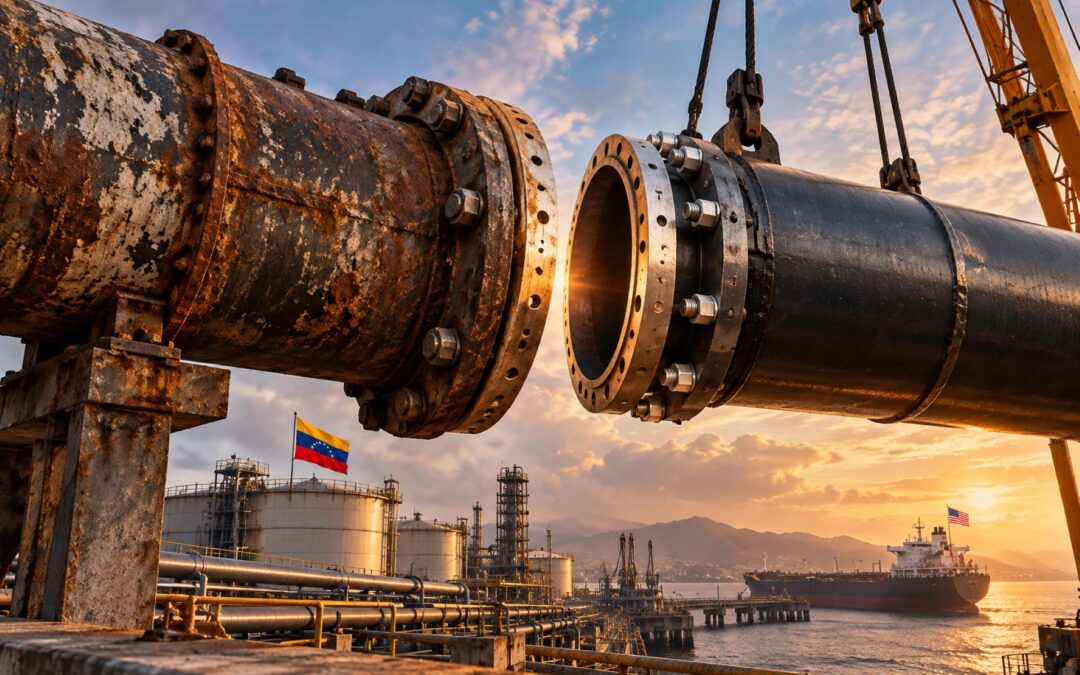
Venezuela sits on approximately 303 billion barrels of proven oil reserves, more than any other country in the world. In theory, that extraordinary natural wealth should have given the country the financial resources to build a prosperous, stable economy. Instead, Venezuela has endured one of the most devastating economic collapses in modern Latin American history, marked by hyperinflation, widespread poverty, deteriorating public services, and the departure of millions of its citizens.
The contradiction becomes even more remarkable when considering that Venezuela was once among the wealthier economies in Latin America. Its oil industry attracted major international companies, financed extensive public spending, and provided the government with a substantial share of its revenue. Yet the same resource that supported the country’s prosperity eventually became central to its economic and political vulnerabilities.
In January 2026, the United States removed President Nicolás Maduro from power. Eight months later, Donald Trump’s administration announced an extraordinary agreement granting Washington extensive economic and governance rights connected to some of Venezuela’s most valuable oilfields.
The agreement promises investment, greater production, and a possible route toward economic recovery. But it also raises questions about sovereignty, political legitimacy, and whether Venezuela is exchanging one form of dependence for another.
The World’s Largest Oil Reserves—and a Broken Oil Economy
Venezuela’s extraordinary oil wealth is concentrated largely in the Orinoco Belt, an enormous petroleum-producing region stretching across the eastern part of the country. The belt contains some of the world’s largest deposits of extra-heavy crude oil, helping explain why Venezuela accounts for approximately 17% of global proven oil reserves.
According to the US Energy Information Administration’s analysis of Venezuela’s energy sector, the country possessed approximately 303 billion barrels of proven crude oil reserves in 2023. Yet despite holding the world’s largest reported reserves, Venezuela accounted for less than 1% of global crude oil production that year.
The distinction between reserves and production is essential. Oil reserves represent quantities of petroleum considered commercially recoverable under specified technical and economic conditions. They do not represent barrels that can be immediately extracted, transported, refined, or sold.
Venezuela’s problem is particularly complicated because much of its petroleum is extra-heavy crude. Unlike lighter varieties that flow relatively easily through wells and pipelines, extra-heavy crude is dense and viscous. Extracting it requires specialized equipment, while transporting it often involves mixing it with lighter hydrocarbons called diluents.
Processing this oil is also more demanding. Refineries must possess the equipment necessary to handle heavier crude and remove contaminants such as sulfur. These additional requirements increase costs and can make Venezuelan production less competitive when international oil prices are low.
Oil analysts therefore distinguish Venezuela’s enormous reported reserves from the smaller quantity that can be economically developed under prevailing conditions. The amount worth extracting depends on prices, available technology, infrastructure, operating costs, and political stability.
During the late twentieth century, Venezuela possessed an oil industry capable of producing more than three million barrels per day. By the beginning of 2026, production had fallen to roughly one million barrels daily, despite the country’s reserves remaining largely intact.
This illustrates the fundamental paradox of Venezuela’s economy: having oil underground is not the same as possessing a functioning oil industry. Converting that resource into national prosperity requires investment, technical expertise, infrastructure, and institutions capable of managing the resulting wealth.
For decades, Venezuela struggled to maintain that combination.
How Chávez Turned Oil Wealth Into a Political Bargain
Venezuela’s economic dependence on petroleum began long before Hugo Chávez entered politics. Oil became the country’s dominant export during the twentieth century, generating enormous government revenues while leaving public finances vulnerable to fluctuations in international energy markets.
The government nationalized the industry in 1976, establishing Petróleos de Venezuela, commonly known as PDVSA. Although the company remained state-owned, it developed considerable technical expertise and operated with substantial commercial autonomy. Foreign partnerships later helped finance more demanding projects, particularly in the Orinoco Belt.
The arrangement generated wealth but did not eliminate Venezuela’s longstanding problems with inequality, corruption, and economic instability. Oil revenues helped finance government spending, while other productive sectors struggled to match the petroleum industry’s importance.
By the 1990s, economic hardship and dissatisfaction with established political parties created an opportunity for Chávez, a former military officer who had led an unsuccessful coup attempt in February 1992. After winning the presidential election in December 1998, he assumed office in February 1999, promising to redistribute national wealth and fundamentally transform Venezuelan politics.
Chávez introduced a series of social programmes known as the Bolivarian Missions. These expanded access to healthcare, education, subsidized food, and housing, particularly among poorer communities that had felt neglected by previous governments.
The early results were significant. During the oil boom of the 2000s, poverty declined, social expenditure increased, and many Venezuelans experienced material improvements in their lives. Chávez’s popularity was not simply the product of ideology or political messaging; his government delivered benefits that many citizens could recognize.
However, these programmes operated within an increasingly fragile economic model. As the Council on Foreign Relations explains in its history of Venezuela’s rise and fall as a petrostate, the country’s dependence on petroleum revenues intensified its exposure to oil-price fluctuations and contributed to recurring institutional and fiscal weaknesses.
High international prices allowed the government to expand spending without resolving those underlying vulnerabilities. Rather than building a sufficiently diversified productive economy, Venezuela increasingly relied on continued oil revenue to support both its public commitments and the political system surrounding them.
This created a difficult relationship between government spending and national production. The state needed petroleum revenue to maintain popular programmes, but the petroleum industry itself required capital, technical expertise, and ongoing reinvestment to remain productive.
As long as production remained strong and oil prices were high, the weaknesses could be obscured. Once those conditions changed, the financial foundations of the system became increasingly unstable.
The problem was not that Venezuela spent money on healthcare, education, or poverty reduction. It was that the government made growing and politically important commitments without establishing a sufficiently resilient economic base to sustain them.
How Venezuela’s Oil Industry Fell Apart
The decline of Venezuela’s petroleum industry was not caused by a single decision. It emerged through a series of political confrontations, changes in ownership and management, lost technical expertise, declining reinvestment, and eventually severe operational deterioration.
One of the earliest turning points occurred during the confrontation between Chávez and PDVSA’s leadership. Although the company was publicly owned, many senior managers defended its commercial autonomy and resisted greater political intervention.
The conflict intensified during the political crisis of 2002 and the nationwide strike that extended into early 2003. Oil operations were severely disrupted, and the government subsequently dismissed thousands of PDVSA employees.
The consequences extended beyond the immediate loss of production. Venezuela lost experienced engineers, geologists, managers, and other specialists whose knowledge had accumulated over decades. Replacing that expertise was especially difficult in an industry dependent on complex extraction and refining operations.
The Chávez administration increasingly subordinated PDVSA to government priorities. Political loyalty gained greater influence in personnel decisions, while the company’s revenues were used extensively to support public programmes and other state obligations.
A state-owned oil company can legitimately transfer profits to its government. The difficulty arises when those transfers and political demands interfere with the investment necessary to maintain production, replace equipment, develop new fields, and sustain technical competence.
Venezuela’s relationship with foreign oil companies also changed dramatically. International firms had previously invested substantial sums in projects requiring specialized technology and large amounts of capital, particularly the development of heavy crude in the Orinoco Belt.
During 2006 and 2007, the Chávez government required foreign operators to accept restructuring arrangements that gave PDVSA majority ownership in important ventures. Some companies accepted the new terms, while others, including ExxonMobil and ConocoPhillips, resisted and lost their interests in major projects.
The government justified the changes as a restoration of national control over strategic resources. Supporters regarded them as necessary corrections to arrangements they believed had granted excessive benefits to foreign corporations.
From an investment perspective, however, the measures demonstrated that previously negotiated commercial arrangements could be fundamentally altered by political decisions. Companies that had committed large sums to long-term projects now faced heightened uncertainty over whether their investments would remain protected.
The consequences were not uniform. Some foreign firms continued operating under revised arrangements, and production did not collapse immediately after the restructuring. Nevertheless, the combination of greater state control, reduced managerial independence, uncertainty over investment terms, and inadequate reinvestment weakened the industry’s long-term prospects.
As revenue from PDVSA became increasingly important to government finances, the company also struggled to retain sufficient resources for its own operations. Maintenance requirements accumulated, equipment deteriorated, and new exploration and development became harder to finance.
These problems were particularly damaging because Venezuelan oil production is technically demanding. Heavy-crude extraction depends on reliable electricity, functioning pipelines, specialized processing facilities, consistent supplies of diluent, and experienced personnel.
A disruption in one part of that system can affect several others. When pipelines deteriorate or processing facilities operate below capacity, extracting additional crude does not automatically translate into increased exports. Production facilities may lack the infrastructure necessary to move the oil to market.
By the Maduro years, declining investment and accumulated operational failures had become mutually reinforcing. Lower production reduced revenue, which made maintenance and investment more difficult, further limiting production.
Corruption, weak management, and political interference compounded those financial problems. Skilled workers continued leaving, while international companies became increasingly reluctant to commit capital under uncertain legal and commercial conditions.
The deterioration was therefore both institutional and physical. Venezuela did not simply lose access to foreign investors; it weakened the organizational and technical capacity necessary to operate one of the world’s most complicated petroleum industries.
This history matters because the companies now being invited to rebuild Venezuela remember what happened to earlier investments. The country’s enormous reserves remain attractive, but the political decisions that undermined confidence in the past have become central to evaluating its future.
From Oil-Price Collapse to Economic Catastrophe
Venezuela’s economic weaknesses became impossible to ignore when international oil prices fell sharply in 2014. The expansion of American shale production contributed to a global supply increase, while changing market conditions brought an end to the unusually favourable prices that had supported government finances.
For a country heavily dependent on petroleum exports, the consequences were severe. Lower prices reduced the foreign currency available to pay for imports, service obligations, maintain public spending, and support the domestic economy.
At the same time, Venezuela was facing its own production problems. The combination of falling prices and declining output meant the government was earning less money from each barrel while also having fewer barrels available to sell.
Rather than making the structural adjustments necessary to restore fiscal stability, the authorities increasingly relied on monetary financing to meet spending obligations. Expanding the money supply in an economy suffering from falling production and shortages contributed to accelerating inflation.
Currency controls, price controls, exchange-rate distortions, and restrictions on private economic activity made the situation worse. Businesses struggled to obtain imported materials and foreign currency, while artificially controlled prices weakened incentives to supply certain goods.
Inflation eventually developed into hyperinflation, destroying the purchasing power of wages and savings. Shortages of food, medicines, fuel, and basic necessities became widespread, and the deterioration of public infrastructure made daily life increasingly difficult.
The resulting collapse cannot be explained entirely by domestic decisions, however. American sanctions also imposed increasingly serious constraints on Venezuela’s economy.
The United States had introduced targeted sanctions against Venezuelan individuals and entities before the worst economic collapse. Broad financial sanctions followed in 2017, while major restrictions targeting PDVSA were imposed in January 2019.
These distinctions matter because Venezuela’s economic deterioration and falling oil production were already underway before the most consequential petroleum sanctions took effect. Domestic mismanagement, declining investment, and the oil-price shock had substantially weakened the economy.
Yet the sanctions subsequently created additional difficulties. They restricted access to financing, complicated international transactions, disrupted established trading relationships, and made it harder for PDVSA and its partners to obtain equipment, services, and investment.
Treating sanctions as the sole cause of Venezuela’s collapse ignores the chronology of the crisis. Treating them as economically irrelevant ignores how additional restrictions damaged an industry already struggling to function.
The human consequences were immense. Millions of Venezuelans left the country in search of employment, safety, healthcare, and more reliable living conditions, creating one of the world’s largest displacement crises.
The United Nations High Commissioner for Refugees documents the scale of Venezuela’s refugee and migration emergency, which has affected communities throughout Latin America and beyond. Families were separated, skilled workers departed, and the country lost people whose expertise would later be essential to rebuilding its institutions and industries.
Maduro’s government also faced accusations of electoral manipulation, political repression, and the systematic weakening of democratic institutions. The disputed 2024 presidential election further undermined confidence in the government’s legitimacy.
By the beginning of 2026, Venezuela was no longer merely an oil-dependent economy suffering through a difficult commodity cycle. It was a country whose productive capacity, monetary stability, democratic institutions, and international relationships had all been severely damaged.
Trump’s Oil Deal: What the United States Actually Gets
On January 3, 2026, American forces captured Nicolás Maduro and transferred him to the United States to face criminal charges. The operation ended his presidency but did not immediately replace Venezuela’s political establishment with a democratically elected government.
Instead, Maduro’s vice president, Delcy Rodríguez, assumed power as acting president. Her administration inherited a deeply damaged economy, an oil industry requiring enormous investment, and a political system whose legitimacy remained heavily contested.
The Trump administration subsequently pursued an arrangement designed to secure American access to Venezuelan petroleum while encouraging the rehabilitation of the country’s energy industry.
On August 31, the White House announced what it described as a historic oil agreement. At the centre of the arrangement was North American Blue Energy Partners, or NABEP, a privately held company operating in Venezuela.
According to the announcement, Venezuela’s interim authorities granted NABEP rights described as 100-year concessions covering 17 oilfields with approximately 65 billion barrels of proven reserves.
That represents a substantial resource base, equivalent to more than one-fifth of Venezuela’s reported national proven reserves. However, the agreement does not mean that 65 billion barrels are immediately available for extraction or that the United States has physically acquired the territory containing them.
The distinction becomes clearer when examining Washington’s economic rights.
The American government obtained rights to a 35% equity stake in NABEP’s parent company. Such an interest would provide exposure to the commercial value and potential profits of the enterprise, rather than transferring sovereign ownership of Venezuela’s underground oil.
The agreement also gives the US government the right to purchase 20% of NABEP’s oil production at cost, after PDVSA receives its contractual share. Washington additionally receives the right of first refusal on the remaining production, giving it an opportunity to purchase that oil before other potential customers.
These purchasing arrangements could offer the United States a preferential and potentially valuable supply of heavy crude. However, a right to purchase oil is not identical to receiving it for free, and the precise economic benefit depends on how costs, volumes, and contractual obligations are determined.
The agreement also includes significant corporate governance provisions. Washington receives veto powers over specified company decisions, while American citizens must constitute a majority of the company’s board.
Taken together, these provisions give the United States considerable influence over the commercial development and marketing of petroleum associated with the agreement. They make the arrangement unusual because Washington is not merely facilitating investment by American companies; the American government itself is seeking a direct economic and governance position.
NABEP has presented plans to attract investment approaching $100 billion and substantially expand production from the fields under its control. But an investment target is not equivalent to financing already secured and spent. Developing fields on that scale would require private-sector participation, technical expertise, infrastructure improvements, and long-term confidence.
There is also a major legal complication.
The Venezuelan authorities have introduced reforms intended to expand private participation in oil production. Under the framework described by legal specialists, however, private companies generally operate through production participation contracts rather than receiving outright ownership of petroleum deposits.
These contracts are substantially different from traditional concessions. They can grant rights to perform production activities and receive agreed commercial benefits without transferring ownership of the oil underground.
The distinction becomes especially important because the White House described 100-year concessions, while Venezuelan production participation arrangements have been discussed in terms of shorter contractual periods, including 25 years.
Without complete clarity about how those arrangements fit together, it is difficult to determine exactly which rights could survive future changes in government or legal challenges.
The agreement may therefore be commercially extraordinary without being legally straightforward. Washington has secured preferential purchasing rights and substantial influence over an enterprise associated with enormous reserves, but those rights remain subject to the underlying contractual and institutional framework.
For Venezuela, the proposed benefit is access to capital, technical assistance, and export markets that could revive production. For the United States, the attraction lies in gaining influence over a significant source of heavy crude while reducing the role of competing powers.
The question is whether those benefits can be delivered under terms that remain credible to investors and acceptable to Venezuelans.
Why Washington Wants Venezuela’s Oil—and Where China Fits In
The United States already produces enormous quantities of petroleum, so its interest in Venezuela is not simply a matter of needing more barrels. The type of oil matters, as does the location of the refineries equipped to process it.
American shale production is dominated by relatively light crude, while many large refineries along the Gulf Coast were designed or upgraded to process heavier varieties imported from countries such as Venezuela, Mexico, and Canada.
Venezuelan crude can therefore be particularly valuable to American refiners. It is geographically close, compatible with existing processing equipment, and capable of supplying a segment of the market that cannot always substitute lighter domestic oil without operational adjustments.
In Rystad Energy’s assessment of Venezuela’s production and international oil-market prospects, geopolitical analyst Jorge León explains why these characteristics make Venezuelan heavy crude attractive despite the high costs and technical difficulties involved in producing it.
There is also a strategic dimension. Increasing American influence over Venezuela’s oil exports could strengthen US energy security, diversify available supplies, and provide additional options for replenishing strategic reserves.
At the same time, Washington wants to reduce China’s influence over a major resource-producing country in Latin America.
During the years when Venezuela became increasingly isolated from Western financial institutions and energy companies, China emerged as one of its most important international economic partners.
Chinese banks extended substantial loans to Venezuela, including arrangements involving repayment through future oil deliveries. Chinese companies also participated in petroleum projects, while Chinese refiners purchased large quantities of Venezuelan crude, sometimes at discounts associated with sanctions and commercial risks.
This relationship made China particularly important to Venezuela. Oil exports provided revenue and helped service financial obligations, while Chinese customers offered an alternative market during periods of strained relations with Western governments.
The dependence, however, was unequal.
Venezuela represented a major source of oil for some Chinese buyers, but Venezuelan crude accounted for less than 5% of China’s overall crude inputs, according to Rystad’s January 2026 assessment. China could potentially replace much of that supply through purchases from other producing countries, although not necessarily on equally favourable terms.
Venezuela would find it considerably more difficult to replace its major buyers without changes to sanctions, shipping arrangements, and commercial relationships.
Redirecting substantial Venezuelan oil exports toward the United States could therefore weaken Beijing’s influence over Caracas without creating a comparable crisis for China’s overall energy supply.
The arrangement is also unlikely to transform American gasoline prices in the short term. Even several hundred thousand additional barrels daily would represent a relatively small share of US petroleum consumption, while global crude prices depend on far larger supply-and-demand conditions.
The longer-term effects could become more meaningful if Venezuela successfully restored production to several million barrels per day. But that would require years of reconstruction rather than an immediate increase following a political agreement.
For Washington, the principal attraction is therefore strategic and commercial: access to a suitable type of crude, greater control over regional energy relationships, and the possibility of future supply growth.
For Venezuela, the calculations are more consequential because oil remains central to the country’s economic recovery.
The Price Venezuela Pays—and the Democracy Problem
The American agreement raises an unavoidable question: how much of the value generated by Venezuela’s oil will actually remain in Venezuela?
The Rodríguez administration has presented projections under which the Venezuelan government would receive approximately $19 per barrel in royalties and taxes, assuming an oil price of $65. The figure suggests that petroleum production could generate meaningful public revenue, especially if output expands substantially.
However, it would be misleading to conclude that the remaining $46 automatically becomes American government revenue.
The difference between an oil barrel’s selling price and the royalties or taxes paid to the producing country is not pure profit. It must account for extraction, transportation, processing, operational expenses, capital investment, contractor payments, and the contractual allocation of production among the parties.
Nor is NABEP identical to the US Treasury. Washington’s equity and purchasing rights could generate significant economic benefits, but they do not mean the American government automatically collects every dollar left after Venezuela receives its fiscal share.
Determining whether the agreement is fair requires understanding the complete distribution of revenue, costs, risks, investment obligations, and profits. Public announcements alone do not establish that balance.
The more serious complication concerns the authority of the government negotiating the arrangement.
Delcy Rodríguez assumed power after Maduro’s removal, not through a new presidential election. Although her administration has introduced economic reforms and engaged with Washington, it continues to face questions about its constitutional authority and democratic legitimacy.
Those questions become particularly important when an interim government enters agreements that could shape the country’s most valuable industry for generations.
In his analysis of the US–Venezuela oil agreement for the Center for Strategic and International Studies, Venezuelan legal scholar José Ignacio Hernández argues that the announced 100-year concessions are not authorized by the country’s existing hydrocarbons framework. He distinguishes such concessions from production participation contracts and warns that ambiguity over their legal foundation could deter the very investment the agreement seeks to attract.
This is not merely a technical legal objection. An oil company investing billions of dollars needs confidence that its rights will remain enforceable if political circumstances change.
A future Venezuelan government might challenge contracts negotiated by the interim authorities, particularly if it considers them unconstitutional, financially unfavourable, or lacking democratic approval.
That creates a paradox for Washington. The United States wants international companies to commit enormous sums to Venezuelan oil production, but the political arrangement through which those investments are being negotiated could increase uncertainty over their long-term security.
The democratic transition therefore matters directly to the economics of the agreement.
Since Maduro’s removal, the Rodríguez administration has promised elections, while government and opposition representatives have participated in negotiations concerning institutional reforms.
Those discussions have included changes to Venezuela’s electoral authority and Supreme Court, both of which have been central to longstanding concerns about political independence and electoral fairness.
In October 2026, Washington lifted sanctions against Jorge Rodríguez, the acting president’s brother and the head of Venezuela’s National Assembly. As Reuters reported on October 14, he has played a prominent role in government-opposition negotiations supported by the United States.
Yet no presidential election date had been established by mid-October, and María Corina Machado, one of Venezuela’s most prominent opposition leaders, remained outside the central negotiating process.
That exclusion is politically significant because available polling suggests substantial public support for her.
The AtlasIntel LatAm Pulse survey released on October 14, 2026, based on interviews conducted from October 2 to October 7, placed Machado at 52% presidential voting intention compared with 19% for Delcy Rodríguez in a multi-candidate question.
Polling is not an election result, and political preferences may change as circumstances develop. Nevertheless, the findings illustrate the gap between the interim administration’s control of government institutions and the electoral support indicated for its principal opposition rival.
There are competing interpretations of Washington’s approach. Supporters argue that working with the authorities currently controlling Venezuela allows economic reconstruction to begin while negotiations gradually create conditions for democratic elections.
Critics argue that granting valuable economic opportunities to those authorities without a firm transition timetable could strengthen their political position and reduce pressure for genuine change.
Both arguments raise a practical question about the sequence of recovery. An immediate election conducted without credible institutions could produce another disputed outcome, but an indefinite transition managed by unelected authorities would also struggle to establish lasting legitimacy.
Elections alone cannot guarantee that contracts will be honoured or that the petroleum industry will be competently managed. Independent courts, transparent rules, enforceable agreements, and political acceptance are necessary as well.
For the new oil arrangement to endure, Venezuela needs more than an administration willing to sign it. It needs institutions capable of making those commitments lawful, accountable, and credible beyond the tenure of any particular government.
Can Venezuela Rebuild Its Oil Industry Without Repeating the Past?
Even if the political disputes were resolved, restoring Venezuela’s petroleum industry would remain an enormous undertaking.
The country once produced more than three million barrels of oil per day, but returning to that level requires far more than reopening abandoned wells. Years of underinvestment have damaged pipelines, refineries, storage facilities, electricity systems, and specialized equipment.
Some fields can produce more oil relatively quickly if operators repair equipment, restore maintenance programmes, and secure reliable supplies of diluent. These improvements could deliver meaningful near-term increases without requiring entirely new projects.
However, sustained production growth on a much larger scale would require extensive drilling, additional processing capacity, infrastructure development, and the restoration of a skilled workforce.
The loss of technical expertise is especially difficult to reverse. Engineers and specialists who left Venezuela during the economic collapse cannot be replaced simply by purchasing equipment. Rebuilding industrial capacity also means attracting experienced workers, developing new talent, and restoring competent management.
The scale of the financing requirement reflects these challenges.
In January 2026, Rystad Energy’s Jorge León outlined a conditional scenario in which Venezuela could increase production to approximately two million barrels per day by the early 2030s and return to three million barrels daily around 2040. That scenario required an estimated $183 billion in investment.
Other forecasts have used different assumptions and longer recovery timelines, illustrating how sensitive the outlook is to political conditions, oil prices, and the pace of infrastructure reconstruction.
None of these projections should be treated as guaranteed. They describe what might become possible if sufficient investment arrives and the country’s operating conditions improve.
The distinction between announced ambitions and actual financing is therefore crucial.
Trump’s administration has spoken of attracting approximately $100 billion to Venezuela’s oil industry, while NABEP has presented similarly ambitious development plans. Such proposals demonstrate the scale of the opportunity being pursued, but they do not establish that the capital has already been committed.
There have been more concrete developments. On September 2, 2026, Chevron announced updated Venezuelan agreements supporting plans to invest more than $7 billion over five years. The company’s stated ambition is to more than double production from its Venezuelan ventures to approximately 600,000 barrels per day.
Chevron’s plans are separate from NABEP’s arrangement, and they represent intended expenditure rather than an immediate increase in production. Nevertheless, they demonstrate that some established operators see commercial opportunities under the changing regulatory environment.
Chevron also possesses an advantage that newcomers may lack: decades of experience operating in Venezuela, existing partnerships, and familiarity with its oilfields and infrastructure.
Other international companies face a more complicated decision.
Developing Venezuelan petroleum requires investments that may take many years to recover. A company must therefore evaluate not only how much oil exists or how cheaply it might eventually be produced, but whether it can operate profitably throughout the life of a project.
Potential investors must consider the possibility of renewed sanctions, changes in government, contractual disputes, currency instability, and interference in commercial decisions.
Previous expropriations and unresolved claims make these concerns more than hypothetical. Companies that experienced major losses during earlier changes in Venezuelan petroleum policy have reasons to approach new commitments cautiously.
Long-term profitability also depends on international oil prices. Heavy-crude projects become less attractive when prices fall, especially if extraction, transportation, and processing costs remain high.
This means Venezuela cannot rely entirely on the size of its reserves to persuade investors. The country must compete for capital against alternative petroleum projects around the world, many of which operate under more predictable legal and political conditions.
Restoring investor confidence would require transparent contracts, credible dispute-resolution systems, consistent fiscal rules, and protection against arbitrary changes in commercial arrangements.
At the same time, Venezuela must ensure that the terms offered to foreign companies produce sufficient benefits for its population. Excessively restrictive terms may discourage investment, but agreements widely perceived as exploitative or politically illegitimate may provoke future resistance and become equally unstable.
A durable settlement would need to balance both concerns: making projects attractive enough to finance while ensuring that Venezuelans receive an accountable and reasonable share of the wealth generated.
The country’s broader economic recovery would also require more than increased crude exports. Greater petroleum production could strengthen government finances, improve access to foreign currency, create employment, and support infrastructure repairs.
But without responsible public financial management, a functioning monetary system, stronger institutions, and investment beyond the oil sector, renewed export revenues could reproduce the same dependence that made earlier prosperity vulnerable.
The challenge is therefore not simply to restore the oil industry that Venezuela once possessed. It is to establish a political and economic system capable of managing that industry without allowing the country’s future to become hostage to another cycle of petroleum revenues and political intervention.
Venezuela has the resources to make a substantial recovery possible. What remains uncertain is whether its institutions and international partnerships can create the conditions necessary to sustain one.
Venezuela’s economic catastrophe was never the result of insufficient natural wealth. Its enormous reserves survived the collapse of its currency, the deterioration of its oil industry, the departure of millions of people, and the breakdown of political confidence. The resources remained underground even as the institutions needed to convert them into prosperity weakened.
The 2026 agreement with the United States could represent an important opportunity to reverse some of that damage. American market access, foreign investment, and renewed production may help restore revenues and rebuild industrial capacity. But an arrangement that strengthens Washington’s strategic position will not necessarily secure Venezuela’s economic future, particularly if its legal foundation and political legitimacy remain contested.
The lasting measure of recovery will not be how many barrels Venezuela produces or how much influence a foreign government obtains over their sale. It will be whether Venezuelans gain reliable institutions, meaningful political representation, and a fair share of the wealth beneath their country. Without those foundations, even the world’s largest oil reserves cannot guarantee prosperity.
Last Updated on October 18, 2026 by Aseem Gupta