

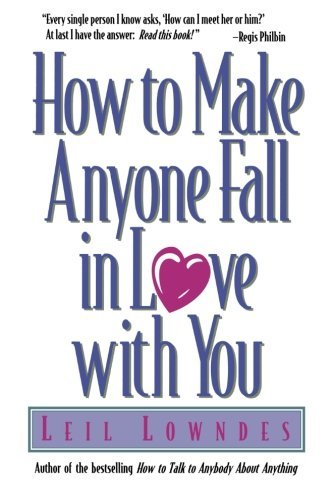
Few relationship books make a promise as audacious as How to Make Anyone Fall in Love with You. Leil Lowndes does not merely offer advice about becoming more attractive, communicating better, or improving a promising relationship. She proposes that falling in love is sufficiently patterned for a knowledgeable person to reproduce many of the psychological conditions that encourage it. If attraction follows recognizable principles, she argues, those principles can be studied and deliberately used.
Published by Contemporary Books in 1996, the original edition develops that premise across 51 chapters and 85 named techniques. What initially looks like a collection of dating tricks is actually organized as a progressive system. Lowndes begins with opportunity and first impressions, moves into similarity and psychological compatibility, then turns to validation, perceived romantic value, communication between men and women, sexual compatibility, and finally the limits of technique itself.
That structure makes the book more interesting than its sensational title suggests. Lowndes is often perceptive about attention, conversation, memory, praise, self-disclosure, reciprocity, and the importance of learning what an individual partner actually values. At the same time, she repeatedly turns tendencies associated with attraction into strategies for causing attraction, and she frequently treats men and women as more psychologically uniform than modern research justifies. Her vocabulary of “hunters,” “huntresses,” and “quarries” also exposes a fundamental tension running through the book: many of the behaviors she recommends are ingredients of genuine intimacy, but the same behaviors can become manipulative when used primarily as instruments for controlling another person’s feelings.
The fairest way to evaluate How to Make Anyone Fall in Love with You is therefore to take the whole book seriously. Its useful observations should not be dismissed merely because its title overpromises, but neither should the language of psychology and science be allowed to convert plausible relationship advice into a proven technology of love.
How Lowndes Builds Her Theory of Falling in Love
The first five chapters establish the theory that makes the remaining 46 chapters possible. Lowndes begins by rejecting the idea that romantic love must remain entirely mysterious. She describes examining psychological studies, communication research, observations about courtship, interviews, seminar experiences, and other material in search of recurring conditions associated with falling in love. The method is eclectic from the beginning: academic findings, anecdotes, personal observations, popular psychology, and tactical extrapolations frequently appear alongside one another.
Chapter 1, “Anyone? Yes, Practically Anyone,” supplies the book’s governing assumption. If researchers can discover patterns in attraction, then a person who understands those patterns may be able to increase the probability that a chosen romantic prospect will respond favorably. Lowndes is not content with using research descriptively. Her distinctive move is to convert observed tendencies into instructions. If people tend to like those who make them feel understood, learn how to make someone feel unusually understood. If similarity tends to foster attraction, make similarity more visible. If physiological excitement can influence attraction, design dates that generate excitement.
Chapter 2 formalizes the method by identifying six broad elements that supposedly contribute to falling in love: first impressions; similar character and complementary needs; equity; ego; early-date gender differences; and sexual compatibility. Lowndes’s own description of the book still presents it in terms of six crucial factors and 85 techniques. There is a small organizational wrinkle in the printed book: the conceptual list introduces Equity before Ego, while the actual major parts place Ego first and Equity second. The distinction does not fundamentally alter the theory, but it shows that the framework is more practical than rigorously systematic.
The six elements describe an escalating process. A possible partner must first notice you and respond positively. The interaction must then produce a sense of familiarity, psychological resemblance, or complementary fit. The other person should come to feel especially recognized and valued in your company. They must perceive the relationship as sufficiently rewarding relative to what they themselves contribute. Communication should avoid mistakes Lowndes believes arise from male-female differences, and sexual interaction should eventually become tailored to the person’s individual desires.
Chapter 3, “The Physical Side of Falling in Love,” gives this psychological model a biological foundation. Lowndes discusses the bodily sensations of infatuation through substances such as phenylethylamine, dopamine, and norepinephrine, connecting romantic obsession with heightened energy, excitement, preoccupation, and physiological arousal. Her larger purpose is tactical: if falling in love involves bodily states, circumstances that create excitement may become part of courtship strategy.
This biological treatment is one of the places where the book’s confidence exceeds what its explanation can support. Romantic love clearly does involve biological reward and motivation systems, but a modern review of the biology of romantic love describes a complex interaction among neural, hormonal, motivational, attachment, and reward processes. Lowndes’s emphasis on a small set of chemicals, especially the popular association of phenylethylamine with romantic euphoria, is too simple to carry the explanatory weight she sometimes gives it.
Chapter 4, “Where Are All the Good Men and Women?,” shifts from chemistry to opportunity. Attraction cannot arise between people who never encounter one another. Lowndes therefore encourages readers to increase their exposure to environments containing plausible partners rather than waiting passively for romance to appear. This is less glamorous than the techniques that follow, but it is logically necessary: all later strategies assume that the reader has first created enough social opportunity for attraction to become possible.
Chapter 5, “Does Love at First Sight Exist?,” completes the opening movement. Lowndes distinguishes an immediate surge of attraction from the deeper attachment normally implied by the word love. People may later reinterpret a powerful first response as love at first sight, especially when a relationship succeeds, but the initial event is better understood as attraction, fascination, or emotional salience. Even so, the strength of the first impression matters because it determines whether the other person wants enough contact for anything deeper to develop.
The first five chapters therefore establish the logic of everything that follows. Lowndes cannot guarantee that a particular person will fall in love, but she believes attraction is sufficiently predictable to be influenced at multiple points. Part One begins with the earliest of those points: the few moments in which a stranger decides whether another stranger deserves further attention.
Part One: First Impressions — Creating Romantic Possibility
Part One contains Chapters 6 through 11 and the first 24 techniques. Its concern is not yet love in any deep sense. Lowndes is trying to solve the preliminary problem of romantic selection: how do you make a person notice you, become curious, begin talking, enjoy the interaction, and leave a first date wanting another one? The techniques move sequentially from visual presence to conversation and then to the design of an initial date.
Being Seen: Readiness, Gaze, Approach, and Body Language
Chapter 6, “How to Make a Dynamite First Impression,” starts with readiness. Technique #1, EVERYWHERE, tells readers not to imagine that romance occurs only at singles events, bars, parties, or arranged dates. Potential partners may appear during ordinary life, and somebody who looks chronically withdrawn or unavailable may miss opportunities before a conversation begins. Technique #2, STAY PSYCHOLOGICALLY “FIT TO KILL,” extends the idea inward: confidence, energy, openness, and emotional preparedness shape the impression people project.
Lowndes then spends Chapter 7, “How to Ignite Love at First Sight,” on the eyes. INTENSE GAZE (#3) recommends sustained eye contact intended to make the other person feel singled out. BEDROOM EYES (#4) adds sexual warmth to the look, while STICKY EYES (#5) means maintaining contact slightly longer than ordinary social etiquette requires, even as the conversation changes. A VISUAL VOYAGE (#6) is more explicitly sensual, encouraging the gaze to communicate physical interest rather than remaining exclusively facial and conversational.
The underlying intuition is not absurd. Mutual gaze can heighten awareness and emotional intensity, and experimental work has found circumstances in which sustained reciprocal looking changes reported feelings. The problem lies in the title Lowndes gives the chapter and in the causal leap from “eye contact can intensify an interpersonal experience” to “eye contact can ignite love.” Her strongest practical point is simpler: ordinary looking says that you see another person, whereas focused looking can make that person feel specifically chosen.
Chapter 8, “Your First Approach,” asks what happens after two people recognize reciprocal interest. Lowndes divides the answer by sex. Male readers receive MOVE FAST (#7), which tells them not to let a promising signal evaporate through hesitation. Female readers receive MOVE FIRST (#8), encouraging clearer initiative rather than waiting indefinitely for a man to overcome uncertainty. The gender framing is dated, but the shared principle is sensible: ambiguous attraction often goes nowhere because each person is waiting for stronger evidence from the other.
Chapter 9, “Your First Body Language,” broadens the signal beyond the eyes. Technique #9, HEART, packages several behaviors that communicate openness: facing the person, keeping the body accessible rather than closed, responding visibly, moving closer where appropriate, and allowing posture and rhythm to become more synchronized. Lowndes is interested in the feeling created when two people begin to move as though they belong in the same interaction.
That idea becomes important later. Part Two will turn similarity into an explicit romantic tool, but here Lowndes introduces it nonverbally. A comfortable conversation is not produced only by what people say. Orientation, timing, facial response, proximity, and movement can either create ease or make an interaction feel strangely misaligned.
Conversation, Intimacy, and the First Date
Chapter 10, “Your First Conversation,” is one of the densest chapters in the book because Lowndes treats speech as both information gathering and intimacy creation. EYEBALL CONVERSING (#10) asks the reader to watch the other person’s reactions while talking, not merely wait for their own turn to speak. The goal is to discover what topics create visible energy, curiosity, pride, discomfort, or boredom.
CHERRY PICKING (#11) builds on that observation. When a person mentions a topic that clearly matters to them, Lowndes advises “picking” it out of the conversation and developing it. Rather than mechanically running through questions, the reader follows emotionally significant clues. This gives the other person the impression—sometimes accurately—that they are talking to someone unusually interested in what matters to them.
Technique #12 is presented in the primary text through what Lowndes calls a “premature we.” Rather than remaining indefinitely at the level of biographical small talk, the reader begins using feeling-oriented questions and occasional “we” language that resembles the speech of people who already possess some shared identity. The tactic is designed to create psychological acceleration: two relative strangers begin speaking as though a tiny alliance already exists between them.
That leads naturally to EARLY-BIRD DISCLOSURE (#13). Lowndes believes carefully chosen personal disclosure encourages reciprocal openness and gives an interaction emotional depth before it becomes routine. She does not mean indiscriminate confession. The strategy is to reveal enough to demonstrate trust and individuality while observing whether the other person responds in kind.
There is meaningful research behind the general connection between disclosure and interpersonal liking. A meta-analysis of self-disclosure and liking found several reciprocal patterns: people tend to disclose more to those they already like, people who disclose can become better liked, and intimate disclosure can affect perceived closeness. None of that proves that a sufficiently clever disclosure sequence can reliably manufacture romantic love, but it does support Lowndes’s broader intuition that intimacy usually requires people to move beyond impersonal facts.
Technique #14, NUTSHELL RESUME, asks the reader to present personal information selectively rather than dumping an undifferentiated autobiography into the conversation. What you emphasize should connect to what the other person has shown they value. At its best, this is ordinary conversational relevance. At its worst, it shades into constructing whatever version of yourself seems most useful for the current target.
Chapter 11, “Your First Date,” turns the first 14 techniques into a test of mutual interest. LET YOUR QUARRY PASS THE AUDITION FIRST (#15) tells the reader not to invest heavily before receiving evidence that the prospective partner is genuinely interested. Lowndes wants readers to remain selective instead of becoming overeager simply because someone attractive has appeared.
I’M HARD TO GET (BUT, FOR YOU, BABY . . .) (#16) develops that selectivity into strategy. The reader should seem desirable enough to have alternatives while allowing the chosen person to feel that they are receiving special access. The useful principle is maintaining self-respect and avoiding desperation; the manipulative version is deliberately engineering scarcity to increase another person’s pursuit.
Lowndes then returns to physiological arousal. GIVE FIRST-DATE BUTTERFLIES (#17) recommends activities with some excitement rather than treating every first date as a static interview. FIRST-DATE BONDING (#18) extends this by encouraging experiences that create a shared emotional episode, something the pair can remember as belonging specifically to them. The assumption is that stimulation and shared novelty can become associated with the person who was present during it.
The next techniques are more practical. “I KNOW A GREAT LITTLE PLACE” (#19) encourages choosing an environment where the initiator feels comfortable and competent. SPRING FOR A NICE RESTAURANT (#20) argues that setting affects perceived value and effort. P’S AND Q’s (#21) emphasizes basic manners, while NEVER SAY BUTTERFINGERS (#22) tells the reader not to embarrass a date for minor accidents or clumsiness. Early dating, Lowndes recognizes, is a period of unusually intense self-consciousness, so generosity over small mistakes can create safety.
The part closes with presentation. DRESS AFFLUENTLY (#23) advises clothing that signals quality and social competence. DRESS ALLURINGLY (#24) adds deliberate sexual attractiveness. These recommendations foreshadow Part Four, where Lowndes will make social value and status much more explicit.
Part One therefore moves from mere availability to concentrated romantic salience. Lowndes wants the reader to be socially present, visually expressive, willing to initiate, responsive in conversation, selectively revealing, memorable on a first date, and attractive enough to encourage another encounter. The system cannot yet produce love, even on its own terms, but it tries to create the psychological conditions in which the next stages can operate.
Part Two: Similarity and Complementary Needs — Creating the Feeling of “Us”
Part Two contains only four chapters, but it supplies one of Lowndes’s most important ideas: attraction grows when another person feels both familiar and useful to one’s emotional life. Chapter 12, “It’s You and Me, Baby, Alone Against This Mad, Mad World,” frames romance as the formation of a small alliance. Two people begin separating themselves from everyone else by developing an “us” that contains shared tastes, reactions, language, memories, and expectations.
Lowndes addresses the apparent contradiction between “birds of a feather flock together” and “opposites attract” by assigning similarity and difference different roles. Shared values and recognizable traits create comfort. Complementary characteristics become attractive when one person’s strength satisfies a need in the other. A person may want a partner with similar attitudes and social background while also valuing qualities—decisiveness, spontaneity, calmness, ambition, warmth—that compensate for something they lack.
Chapter 13, “How to Establish Subconscious Similarity,” makes this deliberately tactical. ECHOING (#25) tells readers to notice a person’s characteristic vocabulary and reuse some of it. People often have preferred words for experiences, feelings, objects, or situations; when another person naturally speaks in similar language, communication can feel unusually easy.
COPY THEIR CLASS ACT (#26) extends matching into behavior, posture, pacing, style, and social manner. Lowndes is effectively describing mirroring, but she packages it as a conscious romantic technique. If done subtly and genuinely, behavioral synchronization can help people feel coordinated. If performed as imitation, it can become conspicuous or deceptive.
Chapter 14, “How to Establish Conscious Similarity,” wants the prospective partner not merely to feel similarity but to notice it. RIDE YOUR QUARRY’S WAVES (#27) directs the reader toward activities and interests the other person values. CO-REACT (#28) tells the reader to notice emotional reactions and identify genuine areas where their responses coincide. Lowndes is trying to move from “we happen to enjoy talking” to “this person experiences the world the way I do.”
The next two techniques investigate romantic philosophy itself. WHAT IS LOVE? (#29) asks readers to discover what the other person believes love should feel like. Some people define love through security, others through passion, companionship, admiration, excitement, loyalty, sacrifice, or intellectual connection. WHAT SHOULD I SAY LOVE IS? (#30) then advises expressing one’s own view in a way that highlights genuine overlap with the prospective partner’s conception.
Later evidence gives the similarity idea substantial but qualified support. A meta-analysis of actual and perceived similarity found that both can be associated with attraction, while perceived similarity is especially important to understanding ongoing relationships. That finding fits one of Lowndes’s sharpest observations: what matters romantically is not merely whether two people are objectively similar on a questionnaire, but whether they experience one another as psychologically familiar. It does not, however, justify faking beliefs or interests in order to create that impression.
Chapter 15, “How to Establish Complementary Needs,” prevents the entire theory from collapsing into sameness. I GOT JUST WHAT YOU NEED (#31) tells readers to investigate what qualities a prospective partner has admired in previous partners and what needs remain especially important to them. If the reader genuinely possesses relevant strengths, those strengths should be made visible.
This is a more nuanced idea than the phrase “opposites attract.” Lowndes does not claim that arbitrary difference produces love. Difference becomes attractive when it answers something meaningful in the other person. The best version of Part Two is therefore not “pretend to be similar and then become whatever they lack.” It is “discover whether real compatibility exists, understand what kind of compatibility matters to this person, and make genuine overlap and complementary strengths easier to see.”
Part Three: Ego — Making Someone Feel Uniquely Seen
Part Three contains Chapters 16 through 23 and Techniques 32 through 46. Lowndes calls the governing force “ego,” but that word can make the section sound shallower than it is. The deeper mechanism is responsiveness: people become attached to those who notice them closely, remember what they say, appreciate qualities they themselves value, and make them feel unusually understood.
From Silent Praise to the “Killer Compliment”
Chapter 16, “The World Revolves Around You, My Quarry,” introduces a five-stage escalation. Lowndes assumes that everybody possesses psychological areas where recognition matters more than ordinary politeness. The romantic task is to discover those areas and make the other person feel that, in your presence, their most valued traits are not merely visible but deeply appreciated.
Chapter 17, “Step One: Silent Praise,” begins without words. BODY PRAISE (#32) uses attention, gaze, posture, expression, and visible responsiveness to communicate that the other person is interesting. Lowndes understands that explicit compliments can feel cheap if they arrive before enough attention has been paid to make them credible. Silent approval creates the emotional groundwork.
Chapter 18, “Step Two: Empathy,” substantially expands the idea. EMPLOY EMPATHIZERS (#33) means verbally acknowledging the feeling or significance behind what somebody says instead of giving only factual responses. KEEP THE SPOTLIGHT ON YOUR QUARRY (#34) tells readers not to seize every topic as an excuse to redirect the conversation toward themselves.
TRACKING (#35) may be one of the simplest and strongest techniques in the entire book. Remember the details another person has told you and refer back to them later. If someone mentioned an important meeting, family problem, creative project, or private worry, asking about it at the next encounter demonstrates that the earlier conversation actually registered. Lowndes recognizes that memory can function as evidence of care.
PRIVATE JOKE (#36) creates a different kind of intimacy. Shared humor, recurring references, nicknames for situations, and little stories that make sense only to the two people give a relationship its own internal culture. Such material strengthens the emerging “us” identity first introduced in Part Two.
These ideas align more closely with later intimacy research than the book’s language of “ego” implies. Research on intimacy as an interpersonal process emphasizes not only self-disclosure but perceived partner responsiveness—the experience that another person understands, validates, and cares about what has been disclosed. Lowndes’s best techniques repeatedly try to create exactly that experience.
Chapter 19, “Step Three: Admiration,” introduces CONFER KUDOS (#37). Compliments should be specific enough to show observation. Saying somebody is “great” communicates very little; recognizing the discipline behind their work, the generosity behind a decision, the imagination behind an idea, or the courage involved in a difficult action tells them what you actually admire.
Chapter 20, “Step Four: The Implied Compliment,” makes praise less direct. THE IMPLIED COMPLIMENT (#38) allows admiration to emerge through an observation rather than a declaration, which Lowndes believes makes it more credible. THE BULL’S-EYE COMPLIMENT (#39) goes further by identifying the area of identity where praise carries the greatest emotional force.
That “bull’s-eye” idea matters throughout the section. Compliments are not interchangeable units. Praise for appearance may be pleasant to somebody who values beauty, but almost irrelevant to a person desperately hoping to be recognized as intelligent, competent, kind, original, courageous, or artistically gifted. Lowndes wants readers to identify the specific quality the other person most wants to have seen.
Chapter 21, “Step Five: The Big Guns,” culminates the sequence with THE KILLER COMPLIMENT (#40). The reader delivers an unusually personal, sincere acknowledgment of a distinctive quality at a moment when it can carry maximum emotional weight. Lowndes warns against constant use because the compliment’s power depends partly on rarity and specificity.
The ethical ambiguity is already visible. There is nothing inherently manipulative about appreciating someone carefully enough to praise what genuinely matters to them. Yet when the same behavior is planned primarily as an instrument for creating attachment, the recipient’s emotional vulnerability becomes part of the strategy. Part Three repeatedly occupies that border.
Calibrating Praise and Keeping Affection Alive
Chapter 22, “Fine-Tuning the Ego Machine,” acknowledges that praise must be calibrated to the individual. SHORT ON ASSETS? GO LONG ON PRAISE (#41) suggests that people who feel insecure or undervalued may respond especially strongly to genuine recognition. The phrasing is characteristically transactional, but the observation beneath it is that people differ greatly in how emotionally hungry they are for acknowledgment.
THE KNEE-JERK COMPLIMENT (#42) encourages an immediate positive response when the other person does something admirable rather than withholding approval until later. HAVE THE FIRST LAUGH (#43) asks readers to respond generously to the other person’s humor. Laughing readily communicates social acceptance and makes the speaker feel effective.
CONFER PET-NAME STATUS (#44) uses affectionate or private names to signal relational uniqueness. BOOMERANGING (#45) concerns receiving compliments: instead of reflexively rejecting praise, the reader should accept it gracefully and allow the positive exchange to continue. Lowndes recognizes that constantly batting away appreciation can make another person feel that their attempt to connect has failed.
Chapter 23, “Keeping the Love Coals Warm,” moves beyond acquisition and into maintenance. SPOCKING (#46) asks established partners to keep noticing specific things they value rather than allowing familiarity to erase appreciation. The name comes from the idea of an observant outsider noticing qualities that long-term partners have begun taking for granted.
This chapter quietly changes the moral character of the system. Continuing to recognize a partner’s efforts, remembering what matters to them, maintaining affectionate language, and expressing specific appreciation are not merely seduction techniques. They are ordinary practices of relationship maintenance. Lowndes’s most valuable insight in Part Three may be that behaviors that create closeness during courtship should not automatically disappear once the relationship feels secure.
Part Four: Equity — Love as a Marketplace of Value
Part Four changes the tone significantly. In Chapters 24 through 29, Lowndes stops emphasizing emotional experience and describes romance in the language of exchange, assets, and perceived value. The framework is blunt enough to be uncomfortable, but it reveals an assumption that has been operating throughout the book: people do not evaluate possible partners only according to attraction. They also evaluate what life with that person seems likely to provide.
Romantic Assets, Looks, and Social Value
Chapter 24, “Everybody’s Got a Market Value, Baby,” presents six broad categories of romantic assets: physical appearance, possessions or money, status and prestige, information or knowledge, social grace and personality, and inner nature. Lowndes argues that people consciously or unconsciously consider some combination of these when deciding how desirable a partner appears.
The metaphor of “market value” can easily become dehumanizing if taken literally. Yet Lowndes is also making a more ordinary point: desirability is multidimensional. A person who is not conventionally beautiful may be unusually funny, intelligent, kind, socially skilled, wealthy, admired, knowledgeable, adventurous, or emotionally stable. Different people assign different weights to those qualities.
Chapter 25, “How Can I Use the Equity Principle to Find Love?,” applies the model to perceived fairness. Relationships can become unstable when one person believes they contribute far more than they receive, but imbalance can also trouble the person who appears to be receiving more. They may fear abandonment, become suspicious of motives, or feel pressure to compensate.
Lowndes therefore encourages readers to understand not only what they themselves value but what the prospective partner values. A person’s “worth” cannot be calculated independently of the observer. Someone indifferent to status will not rank prestige the way somebody socially ambitious might; somebody who values emotional safety may prioritize kindness over appearance or income.
Chapter 26, “How Important Are Looks?,” confronts the asset most obviously associated with attraction. Lowndes does not deny the power of physical appearance, especially early in courtship, but she argues that movement, grooming, style, posture, and confidence affect how appearance is perceived. MOVE LIKE A 10 (#47) and MOVE LIKE A HUNK (#48) encourage readers to embody attractiveness rather than treating beauty as static anatomy.
MIRROR, MIRROR, ON THE WALL (#49) invokes the tendency for couples to pair with people of roughly comparable perceived desirability. Lowndes uses this to reinforce the idea of equity, though the language of numerical attractiveness risks making socially shaped judgments sound more objective than they are.
Status, Intangibles, and Psychological Investment
Chapter 27, “Pursuing Rich and Famous Prey,” is one of the most obviously dated sections. Lowndes tells readers interested in wealthy or high-status partners that they must understand the social signals of those environments. LET YOUR RAGS SHOW RICHES (#50) emphasizes clothing. LET YOUR TONGUE SHOW RICHES (#51) turns to verbal behavior, and THE SOUND OF CLASS (#52) stresses pronunciation and vocal style.
DON’T ASK “WHAT DO YOU DO?” (#53) warns against opening with questions that make the reader sound impressed by professional status or unfamiliar with elite social settings. YOUR PERSONAL THESAURUS (#54) recommends expanding vocabulary so that conversation signals education and social competence.
There is a useful social observation underneath the snobbery: every subculture has codes, and people who understand a group’s conversational norms tend to move through it more comfortably. Lowndes’s error is allowing fluency in upper-status codes to merge with the idea of human “class,” as though pronunciation, dress, and vocabulary reveal intrinsic quality rather than social background, education, aspiration, and performance.
Chapter 28, “Upping Your Ante in Other Assets,” partially corrects the emphasis on money, looks, and prestige. UP YOUR ANTE IN INTANGIBLES (#55) asks readers to develop qualities such as knowledge, flexibility, social skill, honesty, humor, reliability, warmth, and character. This expands self-improvement beyond surface signaling. Rather than merely learning how to look valuable, the reader can become a better conversationalist and partner.
Chapter 29, “Help Them Convince Themselves That They Love You,” takes the equity principle into more controversial territory. LET HIM OR HER DO FAVORS FOR YOU (#56) relies on the idea that people sometimes infer attitudes from their own actions. If they voluntarily invest effort in someone, they may come to regard that person as more important because their own behavior needs to make psychological sense.
Lowndes does not advocate endless exploitation. Her equity model would eventually condemn a relationship in which one person continually takes without reciprocating. Nevertheless, the technique is unusually clear evidence of the book’s control-oriented side. Reciprocal investment naturally strengthens many relationships; deliberately arranging favors because investment may cause someone to rationalize stronger affection turns ordinary reciprocity into psychological leverage.
Part Four is therefore both revealing and uncomfortable. Lowndes is right that relationships involve perceived value, fairness, effort, and exchange. Her weakest move is treating those realities too literally as a marketplace in which people possess measurable assets and can strategically alter another person’s calculation.
Part Five: Early-Date Gender-Menders — Lowndes’s Rules for Men and Women
Part Five contains ten chapters, 30 through 39, and Techniques 57 through 72. It is also the section that has aged most visibly. Lowndes assumes that men and women often communicate according to different psychological rules, and she tries to teach each sex enough of the other’s “language” to prevent promising early relationships from collapsing over misunderstandings.
The part should not simply be dismissed as obsolete. Several underlying communication problems are real: people vary in how much detail they enjoy, whether they want advice or empathy, how directly they make requests, how comfortable they are discussing emotion, and whether unsolicited help feels caring or intrusive. The problem is Lowndes’s tendency to assign those differences confidently to sex rather than treating them as individual or contextual patterns.
“Man Talk,” “Woman Talk,” and Emotional Conversation
Chapter 30 introduces the central fear: “I Hope He or She’s Not a Jerk Like All the Others.” Early dating is fragile because people have little history with which to interpret one another generously. A single frustrating habit can be read not as an isolated mismatch but as evidence that the new partner belongs to an entire category of disappointing men or women.
Chapter 31, “What Is ‘Man Talk’ and What Is ‘Woman Talk’? (Does It Exist?),” formalizes the dichotomy. BRUSH UP ON MAN-TALK (#57) tells women to become more comfortable with the subjects and conversational modes Lowndes associates with men: objects, information, activities, status, facts, and problem-solving. BRUSH UP ON “WOMAN-TALK” (#58) tells men to become more comfortable talking about relationships, people, feelings, and personal experience.
Chapter 32, “How Do You Feel About That?,” makes the distinction more explicitly emotional. “HOW DO YOU FEEL ABOUT THAT?” (#59) encourages men to ask women about emotional reactions rather than treating conversation as a purely factual exchange. Women receive the opposite warning through DON’T EXPLORE “FEELINGS” TOO EARLY IN A RELATIONSHIP (#60), based on Lowndes’s belief that pressing a man for emotional analysis before he is ready may make him withdraw.
Even within Lowndes’s binary system, the advice is not symmetrical because she assumes men need to learn greater emotional responsiveness while women need to regulate the amount and timing of emotional inquiry. A more defensible modern version would remove the gender labels and ask what degree of emotional discussion a particular person welcomes at a particular stage of intimacy.
Chapter 33, “Excuse Me, Could You Tell Me Where . . .,” takes on the famous stereotype about men refusing to ask for directions. STAY LOST! (#61) tells women not to undermine a man’s sense of competence by insisting that he seek help. JUST ASK! (#62) tells men that women may experience the refusal as needless stubbornness rather than independence.
The literal problem is dated by technology, but the emotional mechanism survives. People differ in whether receiving help feels cooperative or threatening to competence. Lowndes notices the difference; she simply attributes it too rigidly to male and female psychology.
Chapter 34, “Please, Spare Me the Details,” addresses narrative style. JUST THE FACTS, MA’AM (#63) advises women to shorten stories when speaking with men who prefer a quicker point. PAINT A PRETTY PICTURE (#64) encourages men to supply more context and detail when speaking with women who supposedly experience conversation more relationally.
Once again, the useful lesson is listener adaptation. Some people want the headline first; others enjoy the sequence, motivations, side characters, and emotional context. Treating that difference as a conversational preference can improve communication. Treating it as an almost automatic property of sex is much less reliable.
Chapter 35, “Tell Me (Don’t Tell Me) About It,” turns to what people want when distressed. TELL ME ABOUT IT (#65) advises men that a woman describing a problem may want listening, validation, and companionship rather than an immediate solution. WHEN HE’S MAD, STAY MUTE (#66) tells women that an upset man may want temporary space rather than questioning.
This is one of the most salvageable parts of Part Five once the binary framing is removed. People genuinely vary between wanting emotional validation, practical advice, collaborative problem-solving, distraction, or solitude. The mistake is assuming that sex gives an adequate answer before the individual has been asked.
Hints, Help, Requests, and Apologies
Chapter 36 compares direct and indirect communication. DON’T HINT—SAY IT STRAIGHT (#67) tells women to make requests explicit rather than expecting a man to infer them from hints. PUT SOME SOFT CURVES IN YOUR CONVERSATION (#68) tells men to recognize that extreme bluntness can feel insensitive and that not every conversational intention needs to arrive in the shortest possible sentence.
Chapter 37, “Could You Give Me a Hand with This?,” examines help. ZIP YOUR LIP AND LET HIM BOTCH IT ALL BY HIMSELF (#69) tells women that unsolicited correction can make a man feel incompetent. UNZIP YOUR LIP AND LEND A HELPING HAND (#70) tells men that offering assistance may communicate care to women rather than insult their competence.
The deeper issue is autonomy. Some people experience intervention as support; others experience it as evidence that they are not trusted to handle the situation themselves. Lowndes’s practical instinct—notice how help is interpreted—is useful even when the male-female map she supplies is unreliable.
Chapter 38, “Little Words to Win Your Quarry’s Heart,” narrows the focus to tiny verbal habits. ASK WOULD NOT COULD (#71) recommends phrasing requests in a way Lowndes regards as less confrontational or capability-testing. I’M SORRY (#72) encourages apologizing when appropriate rather than treating an apology as defeat. The second technique is especially straightforward: a relationship becomes unnecessarily adversarial when preserving pride matters more than repairing a hurt.
Chapter 39, “Are There Dangerous Waters Ahead in the Gender Gap?,” closes the section by emphasizing how easily early relationships can fail. Lowndes believes established couples eventually accumulate enough affection and context to tolerate stylistic differences, but new couples do not yet have that reserve. Her advice is therefore unusually strategic: avoid becoming the latest example of a behavior the prospective partner already resents in the opposite sex.
Modern psychological evidence gives good reason to resist the section’s categorical framing. The gender similarities hypothesis argues, on the basis of large bodies of research, that males and females overlap substantially on many psychological variables even where average differences exist. That does not mean every sex or gender difference is imaginary. It means that “men do X, women do Y” is usually a poor substitute for discovering how the individual person in front of you communicates.
Part Five is therefore best read as a set of communication mismatches trapped inside a dated gender theory. Strip away the universal claims, and several questions remain valuable: Does this person want empathy or solutions? Direct requests or indirect tact? Help or autonomy? Detail or brevity? Emotional discussion now or later? Lowndes is often asking useful questions while supplying answers that are too predetermined.
Part Six: Rx for Sex — From Gender Rules to Individual Desire
Part Six is the longest and most internally contradictory section of the book. Across Chapters 40 through 51 and Techniques 73 through 85, Lowndes alternates between sweeping statements about male and female sexuality and one of her strongest ideas: sexual compatibility cannot be understood through universal rules because individual desire is highly specific.
The section is explicit but not merely decorative. Sexual compatibility is the final element in Lowndes’s theory because she sees sex not as an isolated physical event but as a source of emotional reinforcement. A person who feels unusually understood sexually may experience the relationship itself as unusually significant.
The Brain, the Golden Rule, and Gendered Sexual Advice
Chapter 40, “Your Quarry’s Hottest Erogenous Zone,” identifies the brain as the most important site of sexual arousal. Lowndes emphasizes anticipation, fantasy, interpretation, emotional meaning, words, and mental attention. The quality of sexual interaction depends partly on what an act means to the person experiencing it.
This is also one of the places where the book’s instrumental language becomes especially uncomfortable. Lowndes is not merely advising partners to become better lovers for mutual benefit; she explicitly connects a powerful sexual experience with the goal of strengthening romantic attachment. The same act can therefore be read in two ways: as attentive sexual generosity or as an influence strategy.
Chapter 41, “No Two Sexualities Are Alike, as No Two Snowflakes Are Alike,” introduces the idea that will eventually become the strongest principle in the entire section. Two people can experience the same words, fantasies, pace, touch, scenario, or degree of explicitness very differently. General advice becomes inadequate once individual preference enters the picture.
Chapter 42, “Forget the Golden Rule Between the Sheets,” follows logically. Treating another person exactly as you would want to be treated can fail sexually because your own preference is not evidence of theirs. Lowndes effectively replaces the Golden Rule with individualized responsiveness: discover what this person wants rather than using yourself as the model.
That principle is remarkably modern compared with much of what surrounds it. Its weakness is that the following chapters immediately return to gender-wide assumptions before the book later rediscovers individuality.
Chapter 43, “Hunters, Make Love to a Woman as a Woman Wants It,” addresses male readers. LEARN STEAMY SENSUALITY FROM LADY PORN (#73) urges men to examine erotic material created for women, while READ A HARLEQUIN ROMANCE (#74) uses romantic fiction as a window into supposedly female fantasy. Lowndes believes these sources reveal an emphasis on atmosphere, anticipation, narrative, emotional attention, sensuality, and being desired in a relational context.
Chapter 44 reverses the exercise. “Huntresses, Have Sex with a Man as a Man Wants It” tells women to examine male-oriented sexual media. LEARN “RAW SEX” FROM MEN’S FLICKS (#75) and READ THEIR RAGS (#76) use pornography and men’s magazines as evidence for supposedly male preferences for visual stimulation, immediacy, explicitness, novelty, and directness.
These two chapters illustrate the book’s historical context more clearly than almost anything else. Lowndes recognizes that lovers should not assume their own preferences are universal, but then recommends mass-market gendered media as a shortcut for learning what the opposite sex wants. Commercial fantasy can certainly reveal something about an audience, but it cannot function as a reliable template for every member of that sex.
Chapter 45, “A Quiz: Who Loves More, Men or Women?,” complicates the stereotype. Lowndes presents research and observations suggesting that men may sometimes fall in love faster, idealize romantic relationships more strongly, or suffer deeply when relationships end. Her purpose is partly corrective: the culturally familiar idea that women are inherently more romantic and men inherently less emotionally invested is too simple.
This chapter matters because it shows Lowndes doing something more nuanced than reinforcing stereotypes. She is willing to challenge a gender cliché when she believes evidence points elsewhere. The problem is not that every statement she makes about sex differences must be wrong; it is that she often turns average tendencies, selective findings, and cultural patterns into confident instructions about individual men and women.
The Sexual “Thumbprint” and Learning a Partner’s Desires
Chapter 46, “Your Quarry’s Sexual Desires Are as Individual as a Thumbprint,” is the intellectual center of Part Six. Lowndes describes relationships in which one partner assumes that a technique, style, fantasy, or form of affection that worked before should automatically work again. The resulting mismatch can be confusing because both people may believe they are behaving generously.
The “sexual thumbprint” resolves the problem by insisting that each individual brings a particular combination of fantasies, meanings, sensitivities, inhibitions, preferred language, pace, roles, and expectations to sex. A behavior that feels intimate to one person can feel awkward or irrelevant to another. What matters is not knowing the universally correct technique but discovering the person’s pattern.
This chapter also introduces a relational requirement that is more important than any erotic trick: safety. People cannot reveal unusual or vulnerable desires if they expect ridicule, disgust, humiliation, or moral panic. A partner who wants truthful information must become someone to whom truth can be told.
Chapter 47, “Huntresses, Become a Sexual Sleuth,” turns that principle into a method. WHAT TURNS YOU ON? (#77) encourages direct curiosity instead of assumption. THE HOT PURR RESPONSE (#78) asks the listener to respond warmly when the partner reveals a preference, reducing the chance that honesty will be punished.
THE X-RATED INTERVIEW (#79) develops disclosure into deliberate conversation about fantasies. TRIGGER WORDS (#80) tells the reader to notice words carrying unusual erotic charge for the partner. BED RAP (#81) encourages sexual conversation itself as a way of learning what excites the person psychologically rather than relying only on physical trial and error.
The useful core is difficult to deny. Curiosity, communication, and a nonjudgmental response are better guides to a partner’s preferences than stereotypes. The manipulative element remains in Lowndes’s purpose: this knowledge is repeatedly framed not just as a way to build mutually satisfying intimacy but as a way to become sexually unforgettable enough to strengthen the person’s attachment.
Chapter 48, “Hunters, Do These Techniques Work with Women?,” adapts the inquiry method for male readers. RELATIONSHIP TRIGGER WORDS (#82) assumes that women may connect sexual and emotional language more closely and therefore encourages men to listen for words and ideas carrying special relational meaning. Lowndes still applies a gender filter, but the direction of travel is increasingly individualized: learn the particular person’s emotional and erotic vocabulary.
Fantasies, Jealousy, Scent, and the Book’s Final Qualification
Chapter 49, “Finally, Snaring the Confirmed Bachelor,” pushes individualized sexuality into more controversial territory. Lowndes discusses people whose persistent fantasies or unconventional erotic interests may make conventional relationships difficult when those needs remain hidden or incompatible with a partner’s expectations. One of the central examples is Jerry, whose private sexual preferences help explain behavior that might otherwise be interpreted simply as unwillingness to commit.
The chapter addresses dominance, submission, fetishistic interests, cross-dressing, and other desires with a mixture of tolerance and dated interpretation. Its most defensible claim is that deeply rooted sexual preferences cannot simply be assumed away because a new partner dislikes or fails to understand them. Compatibility sometimes depends on accepting that a person’s erotic life differs from what another person expected.
Its weakest material concerns causes and categories. Some explanations of fetishistic behavior, sexual development, and orientation reflect older popular sexology and should not be treated as established contemporary psychology. The chapter remains important because it illustrates Lowndes’s movement away from generic advice toward a difficult but necessary question: can these two particular people actually accommodate one another’s desires?
Chapter 50, “On Looking at Other Women,” returns abruptly to broad gender assumptions. NO LOOKEE-DISHEE (#83) tells male readers not to visibly ogle other women when with a partner because the behavior can communicate disrespect or comparison. LOOKEE-DISHEE (#84) gives women almost the reverse recommendation in some circumstances, suggesting that casually acknowledging attractive women can reduce tension and make male partners feel less policed.
The advice reveals how much Lowndes assumes male and female jealousy operate according to different rules. The stronger general point is simpler: couples differ in what they consider respectful behavior toward attractive third parties, and guessing incorrectly can trigger insecurity. Explicit norms are more reliable than sex-based assumptions.
Chapter 51, “The Final Stone Unturned,” turns to scent. WHO NOSE? (#85) discusses pheromones, odor, attraction, and the possibility that chemical cues play some role in human sexual behavior. To Lowndes’s credit, she does not simply endorse commercial pheromone products as proven love potions. Her practical recommendation becomes much more modest: learn which scents the particular partner likes.
The science requires substantial caution. A major review of the search for human pheromones argues that popular candidates have often been treated as human pheromones without the kind of prior identification and validation used in rigorous chemical ecology. Human odor clearly affects social perception in various ways, but the claim that a known substance can reliably operate as a romantic pheromone remains far stronger than the evidence justifies.
The afterword then changes the tone of the entire book. After 85 techniques, Lowndes effectively acknowledges that studying attraction does not eliminate the artistic, instinctive, unpredictable side of love. Knowledge can help someone recognize patterns and avoid obvious mistakes, but conscious technique cannot substitute indefinitely for spontaneous human interaction.
That final qualification is essential because it makes the ending less deterministic than the title. Lowndes does not withdraw the argument that attraction can be influenced, but she retreats from the fantasy that romance can be reduced to a flawless sequence of psychological buttons. At some point, the “hunter” must stop hunting and allow two people to discover what actually exists between them.
How the Six-Part Attraction System Fits Together
Taken separately, the 85 techniques can look like an eccentric assortment of eye-contact tricks, conversational moves, compliments, social signals, gender rules, and sexual advice. Taken together, however, they form a recognizable causal sequence. Lowndes is trying to shepherd a relationship from mere possibility toward increasing psychological significance.
The first requirement is exposure. Chapters 1 through 5 establish that a compatible person must first enter your social field. Part One then creates salience: be ready, look interested, initiate contact, synchronize body language, discover conversational hooks, disclose selectively, and design a first date memorable enough to justify repetition.
Part Two converts repeated interaction into familiarity and perceived compatibility. Linguistic echoes, shared reactions, common interests, similar beliefs about love, and complementary strengths all contribute to the emerging feeling that this relationship has special fit. Whether Lowndes is discovering or manufacturing that fit becomes one of the book’s central ethical questions.
Part Three makes the relationship emotionally rewarding. By tracking details, recognizing feelings, remembering conversations, creating private jokes, and giving highly specific praise, the reader attempts to become the person who most reliably makes the prospective partner feel understood and valued. The word “ego” makes the process sound like flattery, but the strongest techniques depend less on praise than on attention.
Part Four introduces exchange. Lowndes assumes that attraction is insufficient if the relationship seems lopsided, low-value, or socially costly. Appearance, money, status, competence, personality, knowledge, character, and effort all become forms of contribution. Even the favor technique fits this logic: once somebody begins investing, the relationship acquires greater psychological weight.
Part Five attempts to protect that developing investment from conversational friction. Lowndes believes men and women routinely misread one another, so she teaches anticipatory accommodation. Although the sex-specific rules are overly broad, the structural purpose is clear: once attraction exists, avoid accidentally destroying it through interaction styles the partner experiences as insensitive, intrusive, evasive, or controlling.
Part Six moves into the most private level of partner-specific knowledge. Sex initially appears as another domain of male-female difference, but the argument gradually becomes more individualized. The reader is ultimately told to learn a person’s unique fantasies, language, sensitivities, jealousies, and desires rather than assuming that any generic technique will work.
The whole system therefore moves from information available to anyone toward information available only to a close partner. At first, the reader needs to know how a person looks back across a room. Later, they need to know what that person values, remembers, fears, believes about love, needs from intimacy, and desires sexually. Lowndes’s deepest insight is hidden inside the manipulative packaging: romantic significance grows as people acquire increasingly specific knowledge of one another.
The afterword places a boundary around the sequence. Techniques can create opportunities, improve communication, and perhaps increase attraction, but they cannot remove another person’s agency, incompatible preferences, lack of chemistry, values, orientation, existing commitments, or simple unwillingness. Once that limitation is admitted, the title becomes indefensible literally but the book becomes more sensible practically.
What the Book Gets Right About Attraction, Intimacy, and Responsiveness
The easiest way to criticize How to Make Anyone Fall in Love with You would be to point to the title, the “quarry” vocabulary, and some spectacularly dated gender advice and dismiss everything as manipulation. That would miss why parts of the book remain recognizable nearly three decades later. Many of Lowndes’s strongest recommendations concern mechanisms that later relationship research continues to take seriously, even if the evidence supports weaker claims than she makes.
Similarity, Disclosure, and the Growth of Intimacy
Part Two’s emphasis on similarity has a substantial empirical foundation, but Lowndes sometimes oversimplifies what the evidence means. Research synthesizing actual and perceived similarity suggests that people can indeed be more attracted to those they perceive as similar, while the importance of actual measured similarity varies with context and relationship stage. Feeling that another person understands the world similarly may matter more to everyday relationship experience than matching on every objective trait.
That supports the constructive side of techniques such as discussing shared interests, recognizing common reactions, and exploring what each person believes love should mean. It does not validate deliberately pretending to possess values or preferences that the reader does not actually have. Perceived similarity can foster attraction, but deception eventually creates a different relationship from the one the other person believes they entered.
The same distinction applies to self-disclosure. A meta-analysis of self-disclosure and liking found that disclosure and liking are related in several directions: people tend to disclose more to people they like, disclosures can increase liking, and people who disclose can become better liked. Lowndes is therefore on solid ground when she argues that endless surface conversation does not create the same intimacy as meaningful personal exchange.
What she cannot legitimately infer is that disclosure functions like a chemical dose that reliably produces romance. Timing, reciprocity, trust, appropriateness, personality, culture, and existing attraction all matter. A person who shares something personal without receiving responsive interest may feel exposed rather than closer.
That is why the concept of responsiveness improves Lowndes’s model. Research on intimacy as an interpersonal process emphasizes that disclosure becomes intimate partly when the listener responds in a way that makes the speaker feel understood, validated, and cared for. Lowndes’s techniques for empathy, tracking, spotlighting, private jokes, and specific praise repeatedly attempt to create that very experience.
Attention, Validation, and Partner-Specific Knowledge
Lowndes is especially good at noticing how rare undivided attention can feel. TRACKING works not because remembering facts is inherently seductive but because remembering communicates significance. When someone follows up on what you told them days earlier, they demonstrate that your experience continued to exist in their mind after the conversation ended.
The same is true of the “bull’s-eye” compliment. Generic praise can be pleasant, but psychologically precise appreciation feels different because it says the observer has learned which qualities actually matter to you. This principle applies far beyond romance. People generally prefer being understood accurately to being praised indiscriminately.
Lowndes is also right that conversational adaptation matters. A person who rigidly communicates exactly as they themselves prefer forces every partner to perform the adjustment. Learning whether someone likes detail, bluntness, emotional processing, problem-solving, reassurance, humor, space, or direct questions is ordinary interpersonal competence.
Her sexual “thumbprint” develops the same principle more explicitly. The best route to satisfying intimacy is not assuming that a technique worked with a previous partner, reading a generic rule about men or women, or projecting one’s own preferences. It is discovering what this individual person likes, dislikes, fears, fantasizes about, and feels comfortable discussing.
The book also deserves credit for extending courtship behaviors into relationship maintenance. SPOCKING recognizes a common deterioration: people often give new partners intense attention and established partners habitual attention. Continuing to notice effort, character, humor, competence, affection, and change can preserve the experience of being seen rather than merely possessed.
These useful ideas share a common structure. The more Lowndes tells readers to observe the individual rather than rely on a category, the stronger her advice becomes. Her best techniques reduce assumption. Her worst ones replace observation with a theory of what the other person must want.
What Has Aged Poorly: Control, Gender, Class, and Scientific Overreach
The most serious problems with How to Make Anyone Fall in Love with You are not cosmetic. They affect the book’s central promise and some of its most important assumptions. The issue is not simply that the vocabulary sounds dated. Lowndes frequently blurs the difference between conditions associated with attraction and a reliable technology for causing another person’s attachment.
Influence Versus Manipulation
All courtship involves influence. People choose clothing, plan dates, tell stories, flirt, reveal information selectively, attempt to be funny, demonstrate interest, and highlight qualities they hope another person will value. Calling every intentional act manipulative would make ordinary social life impossible.
The important distinction is between helping another person perceive something genuine and manufacturing a misleading psychological signal. Making real shared interests visible is different from pretending to share interests. Listening carefully because you care about someone is different from memorizing vulnerabilities so that praise can be strategically aimed at them. Allowing reciprocal investment to grow naturally is different from soliciting favors primarily because the other person may rationalize the effort by becoming more attached.
The “premature we” illustrates the ambiguity particularly well. Shared language can naturally emerge when two people begin feeling close, and playful “we” statements can create warmth. But using intimacy-signaling language specifically to make a stranger feel that a bond already exists risks creating the emotional appearance of a relationship before the relationship has actually earned it.
Part Three creates the same problem around praise. Identifying what another person values and expressing sincere appreciation can be deeply intimate. Deliberately searching for an ego vulnerability so that precisely targeted approval will make the person psychologically dependent on your recognition is a different project, even though the outward sentence might sound identical.
The favor technique crosses the line more clearly because its mechanism explicitly depends on using another person’s behavior to alter their self-perception. Lowndes is telling the reader to arrange investment partly because the investor may conclude that their effort means they care. That is psychologically clever, but it is difficult to describe as merely authentic self-presentation.
Sex raises the stakes further. Learning a partner’s preferences, creating safety around fantasy, and becoming responsive to individual desires are excellent relationship practices. Treating sexual satisfaction primarily as a mechanism for “snaring” someone converts intimacy into leverage. The behavior can be mutually enjoyable while the underlying purpose remains ethically questionable.
The book would therefore be considerably stronger if its promise were reframed from “make anyone fall in love” to “understand conditions that can make attraction and intimacy more likely.” The first formulation implies control over another person’s emotional outcome. The second recognizes influence while preserving agency.
Men, Women, and the Problem with Two-Species Psychology
Part Five and large sections of Part Six repeatedly organize communication through binary male-female rules. Men supposedly prefer facts, solutions, autonomy, directness, competence, visual sexual stimulation, and less emotional probing. Women supposedly prefer feelings, relationship talk, narrative detail, support, indirect cues, contextual romance, and greater emotional processing.
Some average differences may appear in particular populations, contexts, or behaviors. The mistake is treating average tendencies as reliable instructions for individual encounters. Janet Hyde’s gender similarities hypothesis synthesizes extensive evidence showing substantial overlap between males and females across many psychological dimensions, even while allowing meaningful differences in some areas.
This matters because variation within each sex can be larger and more relevant than the average difference between sexes. Plenty of men want emotional processing rather than solutions. Plenty of women prefer concise factual stories. Some men communicate indirectly; some women dislike hints. Some women want space when angry; some men want immediate reassurance. Sexual interests vary even more dramatically.
Lowndes eventually demonstrates the flaw in her own framework. After telling readers what male and female sexuality supposedly looks like in Chapters 43 and 44, she declares in Chapter 46 that sexual desire is as individual as a thumbprint. The second proposition undercuts the first. If erotic preferences are genuinely individual, pornography marketed to men or romance fiction marketed to women can at most suggest possibilities, not reveal what a particular partner wants.
The book is therefore at its strongest when it asks, “What does this person prefer?” and weakest when it answers, “Because this person is a man or woman, we already know.” A modern reader can rescue much of Part Five by converting every gender instruction into a question about communication style. Doing so preserves the useful observation while abandoning the unsupported certainty.
Class, Sexuality, and the 1990s Dating World
The class assumptions in Part Four are harder to rehabilitate. Lowndes openly teaches readers how to signal wealth, education, sophistication, vocabulary, pronunciation, and familiarity with high-status environments. Some of this is straightforward social intelligence: unfamiliarity with a group’s norms can make interactions awkward, while cultural fluency makes them smoother.
The problem is the equation of elite-coded behavior with “class” as though one social group’s norms represent superior human quality. Clothing, accent, vocabulary, and occupational conversation are signals shaped by money, education, geography, profession, and social environment. They may matter to a particular dating market, but they do not measure character.
Lowndes partially corrects herself by treating honesty, personality, knowledge, flexibility, humor, social grace, and inner nature as relational assets. Those intangible qualities make the equity system less materialistic than its language initially suggests. Even so, the “market value” metaphor encourages readers to evaluate themselves and others as bundles of tradable advantages rather than people whose desirability depends on complex interpersonal fit.
The sexual chapters reveal similarly dated assumptions. The idea that women can learn male desire by studying pornography while men can learn female desire through romance novels compresses enormous individual variation into commercial stereotypes. These media may reveal culturally produced fantasies, but they are not diagnostic tools for an entire sex.
Chapter 49 requires even more caution. Lowndes is commendably less judgmental about unconventional fantasies than many popular books of the era, and she recognizes that shame makes honest sexual communication difficult. However, some causal stories about fetishes, cross-dressing, sexual development, and orientation belong to an older popular-psychology framework and should not be treated as established contemporary explanations.
The heterosexual structure of the entire book is equally obvious. “Hunter” and “huntress” advice presumes male-female pairings and repeatedly assigns each side different responsibilities. Many underlying interpersonal mechanisms—attention, similarity, validation, reciprocity, communication, curiosity—can apply far more broadly, but the book itself does not develop an inclusive theory of relationships.
Where the Science Is Too Certain
Lowndes frequently uses scientific research effectively as a source of interesting hypotheses, but less reliably as a basis for strong causal prescriptions. A study showing that two variables are associated does not establish that deliberately manipulating one will reliably produce the other in real dating situations. Even experimental effects can depend on sample, context, timing, expectations, measurement, and individual differences.
The biochemical discussion in Chapter 3 illustrates the problem. Romantic love unquestionably has biological components, but modern scholarship on romantic love describes interacting reward, motivation, attachment, neuroendocrine, and cognitive systems. The popular idea that one substance such as phenylethylamine provides a simple chemical explanation for falling in love is too reductive.
Eye-contact research presents another example. Finding that sustained gaze can intensify feelings under experimental conditions does not mean that “sticky eyes” constitute a portable love switch. Existing attraction, comfort, cultural norms, personality, and whether the gaze feels welcome all influence the experience. The same look can feel intimate to one person and unnerving to another.
The arousal logic behind exciting first dates also requires restraint. Physiological activation can affect emotional interpretation under some circumstances, but a stimulating activity cannot substitute for attraction, trust, compatibility, or consent. Lowndes too often converts “may affect evaluation” into “use this to create a desired romantic result.”
The same caution applies to Chapter 51. Human scent clearly plays roles in perception and social behavior, but the scientific search for human pheromones has been far less conclusive than popular culture suggests. Lowndes is actually more careful here than many commercial claims, but the larger lesson applies to the whole book: invoking scientific vocabulary does not mean the complete 85-technique system has itself been scientifically tested.
That distinction is fundamental to a fair review. Some individual principles in the book are plausible, some have meaningful supporting evidence, some are speculative, and some are dated. There is no evidentiary basis for treating the entire sequence as a validated method capable of making an arbitrary chosen person fall in love.
Style and Structure — Why the 85 Techniques Are So Memorable
Lowndes’s greatest strength as a writer is packaging. She takes ordinary interpersonal behaviors—remembering details, looking someone in the eyes, adapting conversation, giving specific compliments—and gives them memorable names. “Sticky Eyes,” “Cherry Picking,” “Tracking,” “Bull’s-Eye Compliment,” and “Spocking” are easier to remember than abstract advice about attention and responsiveness.
The short chapters reinforce that memorability. A chapter typically introduces a problem, supplies an anecdote or research finding, interprets it conversationally, and ends with a named behavioral rule. The result feels actionable even when the underlying evidence is more ambiguous than the command suggests.
That method also creates a false sense of precision. Numbering 85 techniques can make romantic attraction look as though it has been decomposed into 85 independently established mechanisms. In reality, many techniques overlap. Several are different expressions of attention, validation, similarity, reciprocity, conversational adaptation, or sexual responsiveness.
The “hunter,” “huntress,” and “quarry” vocabulary gives the book energy but also shapes how readers interpret every recommendation. Courtship becomes a pursuit in which one person has an objective and the other is the object of strategy. Lowndes occasionally softens this by discussing reciprocity and long-term maintenance, yet the hunting metaphor keeps pulling the book back toward control.
Her prose is deliberately informal. She uses humor, exaggeration, memorable scenarios, and imperatives rather than cautious academic qualification. Research findings become stories, stories become techniques, and techniques become labels a reader can retrieve later. This approach makes a 51-chapter book surprisingly easy to navigate.
The same basic writing method would later appear throughout Lowndes’s communication system in How to Talk to Anyone, where small social behaviors are likewise turned into memorable named techniques. In both books, her real talent is not discovering a completely new psychology of human interaction. It is noticing micro-behaviors, dramatizing why they matter, and giving them names that make them difficult to forget.
The organization of How to Make Anyone Fall in Love with You is stronger than the title might suggest. It moves outward to inward: strangers see one another, begin speaking, discover resemblance, become emotionally rewarding, assess relationship value, learn communication patterns, and finally acquire highly private sexual knowledge. Even where individual claims fail, that escalating architecture gives the book genuine coherence.
Critical Review — A Sharp Guide to Attention Wrapped in an Overconfident Theory of Control
A fair critical judgment of How to Make Anyone Fall in Love with You has to resist two temptations. The first is accepting the book on its own promotional terms and treating 85 named techniques as a scientifically proven technology of love. The second is laughing at the title and dated language so thoroughly that the genuinely perceptive observations disappear.
What the Book Does Exceptionally Well
Lowndes observes small social behaviors unusually well. She understands that attraction is not produced only by grand gestures or physical beauty. Tiny signals—whether someone remembers what you told them, follows the emotional direction of a conversation, notices what you value, laughs generously, responds to a vulnerability, or asks about something important later—can dramatically change how an interaction feels.
Her advice is also concrete. “Be a better listener” is correct but vague. “Track” what the person told you and follow up later is behaviorally specific. “Give meaningful compliments” is generic; identify the quality that matters most to this person’s self-concept and acknowledge it precisely gives the reader something to observe and practice.
The book is particularly strong when it treats intimacy as cumulative. Private jokes, shared experiences, repeated references, affectionate names, mutual disclosure, favors, memories, and sexual language gradually produce a relational world that exists only between two people. Lowndes’s terminology can make this sound like engineering, but the underlying observation is psychologically plausible: relationships become significant partly because they accumulate unique shared material.
Part Six contains another important strength. Despite earlier gender generalizations, the sexual-thumbprint argument encourages readers to stop assuming that previous experience provides a universal manual. Asking what a partner likes, responding without ridicule, and learning their individual erotic vocabulary are far healthier strategies than treating sexual expertise as the ability to repeat a fixed technique.
The book is also entertaining. Lowndes rarely allows conceptual explanation to become dry, and the short modular structure makes it easy to read selectively. A reader may disagree with the theory while still remembering dozens of observations after finishing.
Where the Book Fails Its Own Promise
Its most serious flaw is the promise itself. Attraction can be influenced, but another person’s love is not an outcome one individual can guarantee through competent execution. The chosen person may lack attraction, want somebody else, value different things, have incompatible goals, dislike the reader’s personality, possess an incompatible orientation, or simply not want a relationship.
Lowndes occasionally acknowledges these realities, especially in the afterword, but the tactical voice continually pushes in the opposite direction. Words such as “quarry,” “snare,” and “killer compliment” encourage the reader to think in terms of successful psychological capture. That rhetoric matters because it converts relationship skills into instruments aimed at producing a predetermined emotional response.
The scientific framing compounds the problem. Lowndes often begins with a genuine study or plausible psychological tendency and then travels farther than the evidence permits. Similarity may foster attraction, but fabricated similarity is not therefore advisable. Disclosure can deepen closeness, but strategically accelerated disclosure does not guarantee love. Physiological arousal can affect perception, but an exciting date cannot manufacture compatibility.
The gender framework is the largest area of obsolescence. The useful interpersonal problem—people have different conversational styles—is turned into a catalogue of male and female rules that sometimes read as though every heterosexual date involves representatives of two opposing psychological species. Modern readers should retain the questions and discard much of the categorical certainty.
The equity section poses a different problem. Relationships certainly involve reciprocity, fairness, perceived value, and practical considerations. Yet the vocabulary of romantic assets, numerical attractiveness, “class,” and high-status signaling sometimes encourages a transactional mindset precisely where the book elsewhere praises emotional recognition and individual connection.
The sexual chapters are similarly uneven. The insistence on individual sexual preferences is excellent. The attempts to infer male and female desires from gendered commercial media are much weaker. The chapter on unconventional sexuality is often less judgmental than might be expected from a 1996 dating manual, but some explanations of sexual development are too dated to carry scientific authority today.
These flaws do damage the book’s central project, but they do not destroy everything beneath it. What fails is the claim that science can be converted into a dependable system for making a chosen person fall in love. What survives is a large collection of observations about becoming more attentive, socially responsive, emotionally perceptive, and adaptive in relationships.
What Has Aged Well—and What Has Not
The strongest ideas have aged well because they do not depend on the book’s most controversial assumptions. Look at the person you are talking to. Notice what excites them. Remember previous conversations. Find genuine common ground. Reveal enough of yourself for intimacy to become possible. Appreciate specific qualities instead of distributing generic praise. Learn whether someone wants advice, empathy, or space. Continue noticing your partner after courtship ends. Ask what they like sexually instead of presuming that you already know.
Those practices do not enable control. They increase the probability that another person will experience you as attentive, interested, responsive, and emotionally safe. If attraction is already possible, those qualities can help it grow. If attraction is absent, they cannot legitimately be used to override that absence.
What has aged poorly is precisely what tries to shortcut individuality. Male and female communication scripts, assumptions drawn from pornography and romance novels, class-coded romantic value, simplified biochemical explanations, speculative sexual psychology, and any implication that scientifically informed technique can reliably overcome incompatibility all deserve substantial skepticism.
The hunter-and-quarry language has aged badly for a related reason. Modern relationship ethics places greater emphasis on mutual agency, whereas the metaphor positions one person as the planner and the other as the target. Lowndes’s own strongest advice ultimately contradicts that model because genuine responsiveness requires the other person to be understood as a separate individual, not merely as an outcome to be achieved.
The book’s enduring value therefore lies in reading against its most literal promise. A reader who asks, “How do I make this particular person love me?” may learn the wrong lesson. A reader who asks, “What behaviors make another person feel noticed, understood, valued, and comfortable enough for real intimacy to develop?” can still find a surprising amount of useful material.
Is How to Make Anyone Fall in Love with You Still Worth Reading?
How to Make Anyone Fall in Love with You remains worth reading, but not as the scientific seduction manual its title appears to promise. No collection of gaze techniques, compliments, conversational strategies, date designs, favors, or sexual insights can guarantee another person’s love. Romantic attachment depends on too many independent variables, including the other person’s desires and choices, for any responsible account to claim that level of control.
It is more valuable as a dated but unusually observant book about interpersonal attention. Lowndes repeatedly notices things that weaker relationship books flatten into slogans: praise works differently when it recognizes something central to identity; remembering details communicates significance; people need different kinds of support; genuine similarity can create comfort; private language strengthens an emerging “us”; continued appreciation matters after courtship; and sexual compatibility requires discovering the individual’s preferences rather than assuming that experience with other partners provides a universal answer.
Readers interested in communication, dating behavior, or the psychology of attraction can therefore still find useful ideas here, provided they separate observation from overclaim. The scientific references should be treated as clues to mechanisms rather than proof of the complete system. The gender rules should be tested against the individual rather than applied automatically. The class and sexuality material needs historical perspective, and the “quarry” mindset should be rejected wherever it turns another person’s autonomy into an obstacle to overcome.
The fairest modern interpretation of Lowndes’s book is almost the reverse of its title. Its best techniques do not teach readers how to manufacture another person’s emotions. They teach readers how easily relationships improve when people stop behaving as though everyone wants the same thing and begin paying close attention to the person actually in front of them.
That shift also explains the importance of the afterword. After spending hundreds of pages naming, numbering, and systematizing romantic behavior, Lowndes finally concedes that technique has limits. Social knowledge can help someone recognize opportunity, communicate interest, avoid preventable mistakes, and become a more responsive partner, but eventually strategy has to give way to relationship itself.
For readers willing to make that distinction, How to Make Anyone Fall in Love with You is still an entertaining and sometimes insightful guide to attraction. Its strongest contribution is not a formula for making anyone fall in love. It is the much more defensible lesson that intimacy grows when another human being experiences your attention as specific rather than generic—when they feel not merely admired, but accurately seen.
Last Updated on August 13, 2026 by Aseem Gupta