
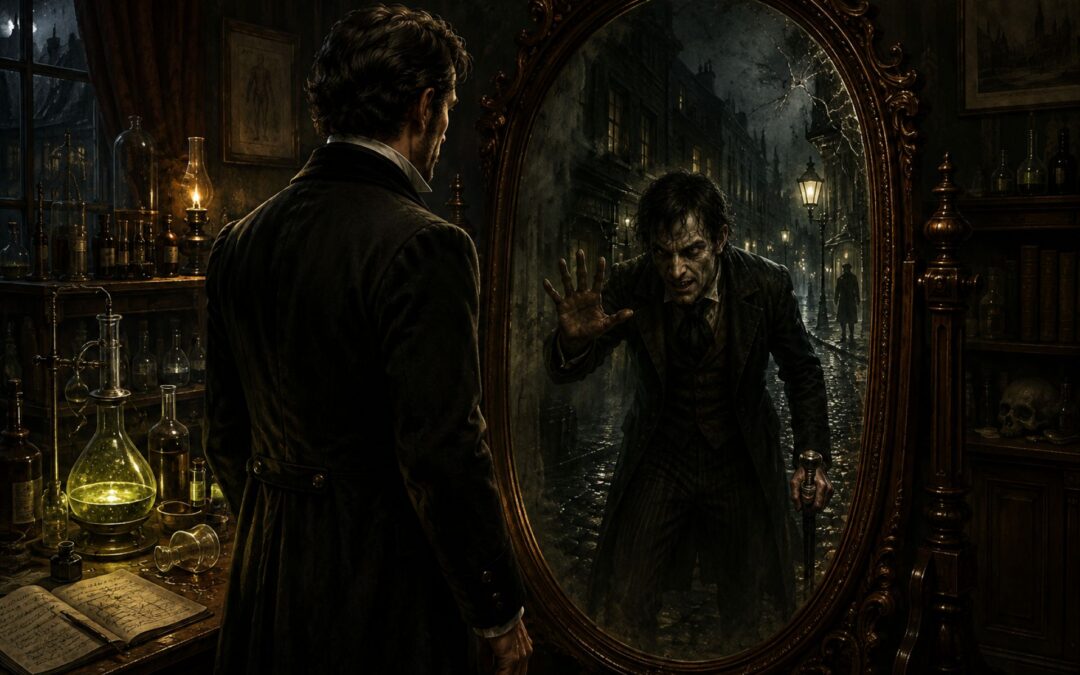
Robert Louis Stevenson’s Strange Case of Dr Jekyll and Mr Hyde has become so deeply embedded in popular culture that many readers approach it already knowing its central secret. “Jekyll and Hyde” has become shorthand for a person with dramatically opposed sides, while countless adaptations reveal from the beginning that the respectable physician Henry Jekyll and the monstrous Edward Hyde occupy the same body. Stevenson’s original novella is more complicated than that familiar formula suggests, and its power depends not merely on the transformation itself but on what Jekyll believes the transformation allows him to escape.
Published in the 1886 first edition, the novella initially presents itself as a mystery. For most of the story, lawyer Gabriel John Utterson tries to understand why his respected friend Dr Henry Jekyll is connected to an ugly, frightening younger man named Edward Hyde. Only after murder, unexplained disappearances, a dying scientist’s testimony, and a locked-room crisis does Stevenson reveal the experiment that created Hyde. The work’s ten-chapter structure, preserved in the complete public-domain text, is therefore essential to understanding what Stevenson is doing: he makes readers first imagine evil as something attacking respectable society from outside, then reveals that Hyde was deliberately produced, protected, financed, and repeatedly chosen by one of that society’s most respectable members.
The result is not simply a story about a good man who has an evil alter ego. Jekyll is morally mixed before the experiment begins, and he remains responsible for creating the conditions in which Hyde can act without ordinary restraint. His scientific mistake is to believe that conflicting parts of a personality can be separated into independent identities; his moral mistake is to believe that giving forbidden impulses another face and another name can separate pleasure from accountability.
Spoiler warning: This article discusses the complete plot, including Jekyll and Hyde’s identity, the murders, and the ending.

What Happens in Strange Case of Dr Jekyll and Mr Hyde
Stevenson does not begin with Jekyll developing a potion or transforming into Hyde. He restricts the reader largely to Utterson’s perspective, allowing ordinary explanations such as blackmail, criminal manipulation, illness, and forgery to compete with an increasingly impossible body of evidence. Only after the external mystery reaches its physical climax does the novella turn backward through two documents—first Dr Lanyon’s eyewitness account, then Jekyll’s confession—to reconstruct what was really happening.
The Door, Hyde, and Jekyll’s Will
The novella opens by introducing Gabriel John Utterson, a London lawyer whose personality is dry, restrained, and deliberately undemonstrative. He is not easily shocked, and he has a reputation for remaining loyal to friends whose lives have become morally compromised. His closest regular companion is Richard Enfield, a distant relative with whom he takes Sunday walks through London. Their friendship is itself characteristically restrained: they enjoy one another’s company without demanding emotional confession or intrusive explanations.
On one of their walks, Enfield draws Utterson’s attention to an ugly, neglected door set into a building that contrasts sharply with the respectable shops around it. The door reminds him of an incident he witnessed very early one morning. A small man moving quickly through the street collided with a young girl and, rather than stopping, calmly trampled over her body and continued walking.
Enfield pursued him, and other people gathered around. What strikes everyone is not merely the man’s cruelty but the almost instinctive disgust he produces. No witness can point to a single precise deformity, yet each feels that something about him is profoundly wrong. The group threatens him with a scandal unless he compensates the child’s family, and the man agrees to pay £100.
He enters the mysterious door with his own key and returns with money that includes a cheque signed by a highly respectable person. Because the cheque proves genuine, Enfield assumes that the ugly stranger must possess damaging information about the distinguished man whose name appears on it. In his mind, the explanation is blackmail: a respectable gentleman has somehow fallen under the power of a disreputable outsider.
The stranger’s name is Edward Hyde.
Utterson’s unease is immediate because the story connects with a document already in his possession: the will of his friend Dr Henry Jekyll. According to its disturbing terms, Jekyll’s estate is to pass to Edward Hyde upon Jekyll’s death. Even more strangely, if Jekyll disappears for more than three months, Hyde is to take Jekyll’s place and inherit without delay.
Utterson has always disliked the will, but Enfield’s story transforms his legal discomfort into fear. He begins to suspect that Hyde has discovered some scandal from Jekyll’s past and is forcing him to provide money and inheritance rights. If Hyde benefits from Jekyll’s death, Utterson also realises, blackmail could eventually become murder.
Seeking information, Utterson visits Dr Hastie Lanyon, an old friend of both Jekyll and himself. Lanyon knows nothing about Hyde, but he reveals that his friendship with Jekyll has cooled because Jekyll’s scientific interests have taken what Lanyon considers an irrational direction. Lanyon represents conventional empirical medicine; Jekyll has become fascinated by questions that seem to blur experimental science with metaphysics. Their intellectual disagreement has become personal estrangement.
Utterson then begins watching the neglected door. He waits at different times and in different conditions until he finally encounters Hyde. Their meeting confirms rather than explains the unease surrounding him. Hyde is small, pale, and somehow repellent, yet Utterson, like Enfield, cannot identify the exact physical feature that makes him seem deformed.
Hyde gives Utterson his Soho address, then enters through the door with a key. Utterson walks around the block to the respectable main entrance of Jekyll’s house, where the butler, Poole, explains that Hyde has authority to enter the laboratory section whenever he wishes. Jekyll has instructed the servants to obey him.
The architecture deepens the mystery. Hyde appears to enter through the neglected rear portion of the same property whose front belongs to Jekyll’s comfortable, cultivated household. Stevenson has not yet explained why the respectable doctor and the disturbing stranger share access to the same building, but the physical arrangement already anticipates the division at the centre of the story.
Utterson finally confronts Jekyll after a dinner party. Jekyll is everything Hyde seems not to be: prosperous, socially respected, physically impressive, generous, and apparently benevolent. Yet Stevenson gives him a slight suggestion of secrecy that prevents the contrast from becoming morally simple.
When Utterson raises Hyde’s name, Jekyll becomes uncomfortable. He refuses to explain the relationship, but he insists that he is not helpless. He claims that he can be rid of Hyde whenever he chooses. At the same time, he asks Utterson to respect the will and to ensure that Hyde receives what Jekyll has promised him if something happens.
That combination is important. Jekyll presents himself as fully in control while simultaneously taking elaborate precautions for Hyde’s future. Utterson continues to imagine that his friend is protecting a dangerous man because of some hidden obligation, but the reader has already been given reason to wonder whether Jekyll’s relationship to Hyde is more voluntary than Utterson suspects.
Carew’s Murder and the Evidence Against Hyde
Nearly a year later, Hyde’s violence escalates dramatically. A maid looking from a window at night watches an elderly gentleman approach Hyde in the street. The older man behaves politely, apparently asking for information or directions, but Hyde suddenly erupts.
He attacks the gentleman with a heavy walking cane, knocks him to the ground, and continues beating him with savage force. The maid is so horrified that she faints. When the police investigate, the victim is identified as Sir Danvers Carew, a prominent and respected man.
Carew had been carrying a letter addressed to Utterson, which brings the lawyer into the investigation. At the crime scene, Utterson recognises part of the broken murder weapon as a cane he had once given Jekyll. The material connections among Hyde, Jekyll, and the murder are becoming increasingly difficult to dismiss.
Utterson accompanies Inspector Newcomen to Hyde’s house in Soho. Stevenson turns the journey into one of the novella’s most atmospheric sequences: fog shifts through the city, light appears and disappears, and familiar London becomes strangely unstable. The uncertainty of the investigation is reproduced in the landscape itself.
Hyde’s rooms complicate expectations. They are not the crude den of an impoverished criminal but are comfortably and tastefully furnished, suggesting both money and cultivated resources behind his life. Hyde himself has disappeared. The police find evidence that papers have been burned and discover the remaining half of the cane used to murder Carew, but they cannot find the murderer.
The police believe Hyde will eventually be caught because he has money deposited in a bank. Yet even identifying him proves difficult. Witnesses agree that he inspires horror and appears somehow deformed, but their descriptions do not combine into a clear, stable portrait. Hyde seems intensely memorable as an emotional experience while remaining strangely resistant to objective description.
Utterson next visits Jekyll. He finds his friend looking physically ill and deeply shaken. Jekyll swears that his connection with Hyde is finished and tells Utterson that Hyde will never be heard from again.
To reassure him, Jekyll produces a letter supposedly written by Hyde. The letter thanks Jekyll for his kindness and suggests that Hyde has his own means of escape. Jekyll claims uncertainty about what to do with it, partly because he fears how the affair might affect his reputation.
Utterson takes the letter away. Later, he consults his clerk Mr Guest, who has an interest in handwriting. Guest compares Hyde’s letter with another sample written by Jekyll and notices that the two hands are remarkably similar except for the angle or slant.
Utterson draws the wrong conclusion for understandable reasons. He believes that Jekyll has forged a letter in Hyde’s handwriting to protect a murderer. This interpretation makes the doctor morally compromised but still preserves the assumption that Jekyll and Hyde are separate men. Stevenson repeatedly gives Utterson enough evidence to sense the truth without providing him with a conceptual framework capable of imagining it.
Jekyll’s Return, Lanyon’s Terror, and the Window
After Hyde disappears, Jekyll undergoes a striking improvement. For more than two months he returns to social life, entertains friends, renews his charitable activities, and seems healthier and more peaceful. Utterson and Lanyon again dine with him, and it appears that the crisis has passed.
Then Jekyll suddenly shuts himself away.
Utterson is denied entry on repeated visits. Concerned, he goes to Lanyon and is shocked by the change in his old friend. Lanyon, previously a vigorous and confident man, has aged dramatically and looks as though he is dying.
Lanyon says that he has suffered a terrible shock from which he will never recover. He refuses to discuss Jekyll and reacts strongly even to hearing his name. Something has happened that has not merely ended their friendship but shattered Lanyon’s confidence in the world as he understood it.
Within weeks, Lanyon dies. Before his death, he leaves Utterson a sealed document with instructions that it should not be opened until the death or disappearance of Henry Jekyll. The restriction echoes the strange language of Jekyll’s will, but Utterson resists his curiosity and honours Lanyon’s instructions.
Soon afterward, Utterson and Enfield once again pass the rear of Jekyll’s property. They see Jekyll sitting at an upstairs window looking miserable and confined. They speak with him from below, and Utterson suggests that he come outside for a walk.
Jekyll says that he would like to join them but cannot. For a moment he smiles, reconnecting briefly with his old friends. Then his expression suddenly changes into such overwhelming terror and despair that Utterson and Enfield are stunned.
Jekyll immediately shuts the window.
The men leave without discussing what they witnessed. Later information makes the scene intelligible: Jekyll is no longer fully able to control when his body changes. At the time, however, the image remains unexplained—a respectable man trapped behind his own window, frightened by something that seems to be happening inside the room and inside himself at once.
The Last Night in the Laboratory
The external mystery reaches its climax when Poole unexpectedly arrives at Utterson’s home. The usually controlled butler is deeply frightened and asks the lawyer to come immediately to Jekyll’s house.
When Utterson arrives, he finds the servants gathered together in terror. Poole explains that the person shut inside Jekyll’s laboratory no longer seems to be his master. For days, the hidden figure has been sending written instructions demanding a particular chemical salt. Samples are obtained and repeatedly rejected as insufficiently pure, and the messages become increasingly desperate.
Poole has briefly seen the person moving through the laboratory. The figure was small, unlike the physically larger Jekyll, and wore a mask. Poole has become convinced that the man inside is Hyde.
Utterson initially tries to preserve a rational explanation. Perhaps Jekyll is suffering from a disease that has altered his appearance or voice. Yet the evidence increasingly resists such an interpretation, especially when Utterson hears the voice behind the laboratory door and recognises something wrong in it.
He and Poole decide to force their way inside. Stevenson slows the scene through waiting, footsteps, whispered discussion, and the knowledge that something is moving behind the locked door. Utterson finally demands entry.
The voice inside pleads with him not to break in. Utterson identifies it as Hyde’s.
Poole attacks the door with an axe until it gives way. Inside, they find the body of Edward Hyde, dressed in clothing much too large for him. Hyde appears to have poisoned himself shortly before they entered.
Jekyll is nowhere to be found.
Utterson and Poole search the laboratory and surrounding rooms. They find evidence of frantic chemical experimentation and quantities of the salt that the hidden occupant had been desperately trying to replace. A large mirror becomes particularly disturbing because Poole realises how often Jekyll—or whoever occupied the room—must have looked into it.
On Jekyll’s desk, Utterson discovers several documents. One is a revised will that now names Utterson rather than Hyde as beneficiary. Another directs him to read the statement left by Lanyon. There is also a sealed confession written by Jekyll.
The physical action of the mystery is over, but its explanation has only begun. Hyde is dead, Jekyll has vanished, and the documents left behind promise to reveal how both facts can be true.
Lanyon’s Narrative: The Transformation Revealed
Lanyon’s posthumous account rewinds the narrative and finally gives an eyewitness explanation for the impossible relationship between Jekyll and Hyde.
Lanyon describes receiving an urgent letter from Jekyll containing elaborate instructions. He is asked to go to Jekyll’s house, enter the laboratory with Poole’s help, remove a specific drawer containing chemicals and papers, and take it home. At midnight, a man will arrive to collect it.
Lanyon believes the request is evidence that Jekyll has become mentally unstable, but loyalty to an old friend persuades him to comply. He retrieves the drawer and waits.
At midnight, his visitor appears. The man is Edward Hyde.
Hyde is dressed in clothes that are far too large for him and behaves with a mixture of fear, impatience, and intense anticipation. He demands the drawer, checks its contents, and begins preparing a chemical mixture.
The ingredients react dramatically. Hyde then turns to Lanyon and offers him a choice. Lanyon can allow him to leave without explanation, or he can remain and witness something that will overturn everything he thinks he knows about human existence.
Lanyon’s scientific curiosity is stronger than his caution.
Hyde drinks the mixture.
His body begins to change in front of Lanyon. The transformation is horrifying and physically convulsive, but the greater shock comes when the process ends.
Henry Jekyll is standing where Edward Hyde had been.
The event destroys Lanyon because it violates the intellectual limits within which he has organised his life. Jekyll then tells him more about what he has done, making the revelation morally as well as scientifically intolerable. Lanyon can no longer dismiss Jekyll’s research as mere eccentricity, but accepting its reality is psychologically devastating.
His narrative solves the central identity mystery. Jekyll and Hyde are not merely accomplices, blackmailer and victim, or two men sharing access to the same laboratory. They are transformations of the same embodied person.
Yet important questions remain. Why did Jekyll create Hyde? Why is Hyde physically different? Why did the transformations become involuntary? Why was Hyde loose in London as an independent social identity, and why did the chemical eventually stop working? Those answers belong to the final document.
Jekyll’s Confession: How Hyde Was Created and Took Control
Jekyll begins his confession long before the events Utterson has been investigating. He was born into privilege, possessed intelligence and professional ability, and strongly desired the respect of serious and honourable people. At the same time, he had a lively appetite for pleasures that he believed did not fit the dignified identity he wanted the world to see.
The crucial issue is not that Jekyll begins as secretly monstrous. His problem is the gap between desire and self-image. Because he places unusually high value on appearing grave, reputable, and morally serious, he conceals parts of his life rather than integrating them into an honest identity.
Over time, this habit of concealment becomes an intellectual problem. Jekyll comes to believe that human personality is fundamentally divided. He famously concludes that a person is “truly two,” although he later imagines that the self may contain far more than two components.
His scientific work becomes an attempt to turn that psychological intuition into physical reality. If the conflicting elements inside a person could be chemically separated, he imagines, each might inhabit an independent body and be freed from interference by the other.
Jekyll develops a drug that he believes can alter the relationship between these elements. He knows the first experiment may kill him, but ambition and curiosity overcome caution. He drinks.
The transformation is agonising. His body changes violently, but the pain is followed by a feeling of extraordinary freedom. Jekyll experiences the new condition not merely as physical alteration but as liberation from the restraints that have governed his public identity.
When he looks into a mirror, he sees Edward Hyde for the first time.
Hyde is smaller and younger than Jekyll. Jekyll interprets this difference as evidence that the impulses embodied by Hyde had been exercised less extensively than the respectable habits that shaped his ordinary adult existence. Whatever the scientific validity of that interpretation, it shows how Jekyll immediately turns bodily transformation into a moral theory.
He also recognises something important that the popular “good half versus evil half” version often loses. Jekyll himself is not pure goodness. He remains a mixed human being containing generosity, selfishness, discipline, appetite, affection, vanity, remorse, and desire. Hyde is the more concentrated expression of impulses Jekyll normally restrains.
The experiment can initially be reversed. Jekyll drinks another preparation and returns to his familiar body.
At this point, he could stop.
Instead, he creates the infrastructure necessary for Hyde to live independently.
Jekyll furnishes a house in Soho for Hyde and employs a housekeeper who will not ask inconvenient questions. He gives Hyde access to his main property through the laboratory entrance and instructs his servants to obey him. He arranges money, develops a distinct signature, and creates legal protection through the strange will that so alarms Utterson.
Jekyll has therefore done much more than discover an involuntary disorder. Hyde’s social existence is deliberately engineered. Jekyll creates a body, a name, a residence, money, legal protection, and freedom of movement for the identity through which he intends to indulge desires without exposing Dr Henry Jekyll to disgrace.
The arrangement works precisely because Jekyll believes moral responsibility can be divided along with physical identity. When Hyde commits shameful acts, Jekyll thinks of them as belonging to Hyde. When Jekyll returns, he can behave generously and preserve his respectable conscience.
The episode in which Hyde tramples the child becomes dangerous because it pierces the separation. Hyde is detained and forced to make compensation, so he goes through the laboratory entrance and obtains funds linked to Jekyll. Enfield sees the respectable cheque and assumes blackmail because the real explanation would be almost impossible to imagine.
Jekyll continues transforming. The freedom becomes attractive, and Hyde becomes more familiar.
Then the relationship changes.
One morning, Jekyll wakes in his own bed and notices something wrong. Looking at his hand, he realises that he has become Hyde without drinking the drug.
The event terrifies him. Until then, Hyde existed because Jekyll deliberately summoned him. Now the transformation has begun to occur spontaneously, suggesting that the balance within the shared body has shifted.
Jekyll understands that continuing may eventually leave him trapped permanently as Hyde. He attempts to choose between his two modes of life and initially chooses Jekyll. For a period, he refuses the potion and returns to his professional and social existence.
Yet his renunciation is incomplete. He does not destroy every means by which Hyde might return, and his desire for the forbidden identity remains active.
After resisting for roughly two months, Jekyll gives in. He takes the drug again.
The relapse produces a Hyde intensified by deprivation. During this period of renewed freedom, Hyde encounters Sir Danvers Carew and murders him with extraordinary violence. The murder is not a separate crime mysteriously committed by an unrelated monster; it is the consequence of Jekyll deliberately reopening the pathway he already knew was becoming dangerous.
When Jekyll later transforms back, he is horrified. Carew’s death forces him to confront a level of violence he can no longer treat as a manageable private indulgence.
He destroys evidence connected to Hyde and commits himself to remaining Jekyll. Because the police are now searching for Hyde, another transformation would also expose him to arrest and execution. Morality and self-preservation suddenly point in the same direction.
For a time, Jekyll appears genuinely reformed. He practises medicine energetically, helps others, participates in charity, and convinces himself that his good actions compensate for his past.
But the underlying division has not been resolved.
One day, while sitting in Regent’s Park, Jekyll reflects with satisfaction on his improved conduct and compares himself favourably with other people. In the middle of that self-congratulation, he suddenly begins to change.
He becomes Hyde without taking the drug.
The situation is now catastrophic. Hyde is wanted for Carew’s murder, and Jekyll cannot safely return home in Hyde’s body because servants or police might recognise him. He must somehow obtain the chemicals that can restore his usual appearance.
This is why he writes the desperate instructions described by Lanyon. Using intermediaries, he has the laboratory drawer delivered to Lanyon and then visits him as Hyde. The transformation Lanyon witnesses is not a demonstration performed for scientific pride alone; it is an emergency return to the body Jekyll needs in order to survive publicly.
After that episode, the changes accelerate. Jekyll increasingly becomes Hyde without choosing to do so, sometimes requiring larger or repeated doses merely to regain his original form. Sleep becomes dangerous because he may awaken as Hyde.
Jekyll feels himself weakening while Hyde seems stronger. The identity he created as an escape from restraint now requires constant effort to suppress.
The chemical supply becomes the final trap. Jekyll eventually exhausts the particular batch of salt used in the original experiments. He sends desperately for replacements, but new samples fail to reproduce the same result.
Only then does he understand how little control he ever possessed.
Jekyll concludes that the first salt must have contained an unknown impurity and that this accidental contamination, rather than the pure substance itself, made the transformation possible. His apparent scientific breakthrough depended on a component he never identified.
That revelation completes the collapse of his original fantasy. Jekyll believed he had discovered a controllable technology of the self, but he cannot even reproduce the key material on which it depended.
As the last effective doses disappear, Jekyll writes his confession during the increasingly brief periods in which he can still occupy his familiar body. He expects Hyde eventually to become permanent.
He does not know exactly how the final confrontation will end. Hyde fears death and capture, yet the police will execute him if he is caught. Jekyll imagines the possibility that Hyde may kill himself rather than submit.
By the time Utterson and Poole break into the laboratory, they find Hyde dying from poison in Jekyll’s oversized clothes. Jekyll’s confession ends before that moment, but the reader can now reconstruct the entire chain: Jekyll created Hyde intentionally, repeatedly chose him, lost control of the transformations, became dependent on an accidentally effective chemical, and finally reached a point at which neither identity could continue to live safely.
Character Analysis: Jekyll, Hyde, and the Men Around Them
The mystery works because Stevenson surrounds Jekyll with men trained to interpret evidence but emotionally and intellectually inclined toward restraint. Lawyers, doctors, servants, and respectable gentlemen all see fragments of the truth, yet each initially forces those fragments into familiar categories such as blackmail, illness, forgery, or criminal conspiracy. Characterisation therefore operates alongside the mystery structure: who each man is determines what he is capable of seeing.
Henry Jekyll and Edward Hyde
Henry Jekyll is the novella’s central psychological problem, and the most important mistake is to treat him as the innocent half of a simple moral equation. Jekyll is generous, accomplished, socially valued, and capable of sincere remorse, but he is also proud, secretive, self-indulgent, and skilled at turning responsibility into explanation. His confession is revealing partly because he understands himself deeply and partly because he continues rationalising even when he is supposedly telling the complete truth.
His original conflict arises from respectability. Jekyll wants two incompatible advantages at once: he wants the social authority of a disciplined gentleman and the freedom to pursue desires that might damage that identity. Instead of accepting that one person must bear responsibility for both kinds of behaviour, he dreams of separating them.
Hyde is the practical solution to that dream. As Hyde, Jekyll can move through another neighbourhood, use another name, inhabit another body, and return afterward to the protected reputation of Dr Jekyll. He does not merely discover Hyde; he constructs an entire system that makes Hyde usable.
This is why responsibility remains with Jekyll even as the transformations become harder to control. He chooses the first experiment. He chooses repeated transformations after discovering Hyde’s character. He arranges Hyde’s residence and finances, gives him access to the laboratory, creates a signature for him, and writes a will designed to preserve him.
After Hyde’s violence becomes unmistakable, Jekyll still returns to the potion. The Carew murder occurs after Jekyll has already experienced an involuntary transformation and understood that the experiment may escape his control. His later helplessness is real, but it develops out of earlier voluntary choices.
Hyde nevertheless becomes more than a mask in a simple sense. Jekyll experiences the transformed state as having its own impulses, emotional rhythms, fears, and growing strength. Hyde despises Jekyll’s dependence on conscience, while Jekyll increasingly hates Hyde for threatening his survival.
Their relationship therefore moves through several stages. At first Jekyll uses Hyde. Then Jekyll begins fearing him. Eventually each appears to depend on the destruction or suppression of the other while still sharing the same body.
Hyde’s physical smallness reinforces this development. Initially Jekyll interprets it as evidence that the tendencies represented by Hyde have been less developed. Later, as Hyde becomes increasingly dominant, Jekyll perceives him as stronger. The body becomes a visible measure of repeated use.
Yet Hyde does not cleanly absorb every morally troubling impulse while leaving Jekyll virtuous. Jekyll’s vanity survives in his respectable form. His pride in his charitable improvement immediately precedes one spontaneous transformation, and his confession repeatedly shifts pronouns and moral responsibility between “I” and “he.” The language exposes a man still trying to decide which actions count as his.
That instability is what makes the character richer than the cultural stereotype. Jekyll is both the victim of Hyde’s growing domination and the architect of the conditions that allowed Hyde to dominate him.
Gabriel John Utterson
Utterson is sometimes overshadowed by the more sensational Jekyll and Hyde, but he occupies most of the novella for a reason. Stevenson chooses an investigator whose defining qualities are loyalty, discretion, patience, and limited imagination.
His virtues make the investigation possible. Utterson takes Enfield seriously, examines Jekyll’s will, watches the laboratory door, consults Lanyon, studies documents, accompanies the police, and eventually joins Poole in breaking into the laboratory. He continues gathering evidence long after a less loyal friend might have withdrawn from Jekyll’s increasingly disturbing affairs.
The same qualities also delay understanding. Utterson belongs to a culture in which respectable men avoid exposing one another unnecessarily. His first instinct is not public accusation but private protection. Even when evidence becomes alarming, he prefers explanations that preserve familiar categories.
His blackmail theory is reasonable because it reflects the social world he understands. So does his belief that Jekyll forged Hyde’s letter. What Utterson cannot initially imagine is not a missing fact but a missing possibility: the idea that Jekyll and Hyde could literally be transformations of the same body.
Utterson therefore functions as the reader’s guide through uncertainty. His limited knowledge preserves the mystery, but his moral seriousness also prevents the story from becoming an exercise in sensational horror alone. He keeps returning to the question of what one friend owes another when secrecy begins to hide genuine danger.
Lanyon, Poole, Enfield, Guest, and the Supporting Characters
Dr Hastie Lanyon represents a form of scientific confidence opposite to Jekyll’s. He is not anti-scientific; he believes Jekyll has abandoned proper science for speculative nonsense. His destruction therefore carries particular force because he does not merely witness something frightening. He witnesses experimental evidence that violates the boundaries he had considered fundamental.
Lanyon’s reaction also provides a warning about Jekyll’s achievement. Discovering something unprecedented does not automatically make the discovery wise or admirable. Jekyll proves that his transformation works, but what he has proved carries consequences that destroy both the experimenter and one of its most qualified witnesses.
Poole occupies a different social position but becomes equally important near the end. His knowledge is practical rather than theoretical. He knows Jekyll’s habits, size, voice, movements, and household routines well enough to recognise that the person inside the laboratory is not behaving like his master. Where professional gentlemen spend much of the novella interpreting documents, Poole trusts accumulated familiarity.
Enfield establishes the culture of discretion at the beginning. He witnesses something disturbing, follows it far enough to ensure compensation for the child, then adopts the gentlemanly rule that asking too many questions about strange circumstances often makes them worse. His attitude protects privacy but also helps create the social environment in which double lives can remain hidden.
Mr Guest contributes forensic evidence through handwriting, while Inspector Newcomen represents formal criminal investigation. Sir Danvers Carew and the maid who witnesses his death have relatively limited psychological development, but their narrative function is decisive: Carew’s murder converts Hyde from a private scandal into a public killer, and the witness gives the police a crime they can pursue.
The supporting cast is therefore often functional rather than deeply developed. Stevenson sacrifices breadth of characterisation for compression, arranging the secondary figures around different forms of knowledge—legal, scientific, domestic, social, and criminal—without allowing any single one to understand the whole truth until Jekyll’s documents assemble it.
London as a Divided Gothic City
London does more than provide the backdrop for the story. Stevenson repeatedly turns physical space into an external version of Jekyll’s divided life, using streets, houses, doors, laboratories, fog, and neighbourhood contrasts to make secrecy visible. The supernatural experiment occurs inside a city otherwise governed by familiar institutions such as medicine, law, banking, domestic service, and policing, which makes the impossible elements feel disturbingly close to ordinary life.
Jekyll’s house is the clearest example. Its respectable front belongs to a prosperous physician who entertains friends and maintains a distinguished household. The neglected door through which Hyde comes and goes provides access to the laboratory section from another side. One property has two social faces, just as one man maintains two identities.
The laboratory itself intensifies that symbolism. It is a place of scientific experimentation but also a former dissecting theatre, connecting knowledge with bodily violation. Jekyll increasingly retreats into this rear space as his control collapses, until the area that once enabled Hyde’s secret freedom becomes a prison.
The window scene develops the same idea differently. Jekyll is visible to Utterson and Enfield, yet physically separated from them. He can speak across the barrier but cannot safely cross it. When terror suddenly overtakes his face and he closes the window, the architecture turns psychological isolation into an image.
Soho operates as another component of Jekyll’s double geography. Hyde’s residence gives Jekyll a place separate from his respectable domestic identity, allowing anonymity and concealed behaviour. The novella draws on Victorian associations of neighbourhood, class, danger, and moral reputation, but those associations should not be mistaken for objective truths about place. Hyde brings violence with him; Soho does not manufacture Hyde.
Fog repeatedly makes London difficult to read. During the journey to Hyde’s rooms after Carew’s murder, familiar urban space alternates between visibility and obscurity, sometimes brightening unexpectedly before closing again. Knowledge in the novella works similarly: characters see enough to construct explanations but not enough to understand what the evidence means.
The descriptions of Hyde’s body also belong to historical assumptions that need contextualising. Modern scholarship on Victorian ideas about degeneration and atavism has shown how the novella participates in nineteenth-century anxieties about evolutionary regression, criminality, civilisation, and supposedly primitive bodily traits. When characters describe Hyde as animalistic or somehow less evolved, the language tells us something important about the period as well as about Hyde.
That context matters because one of the novella’s unsettling features is its insistence that no observer can identify Hyde’s exact deformity. His body is repeatedly treated as evidence of moral corruption, yet the evidence remains subjective. Everyone feels that he is deformed, but no one can clearly say how.
The city and body therefore mirror one another. London is obscured by fog but never wholly hidden; Hyde seems physically legible as evil but cannot be precisely described. Stevenson repeatedly puts characters in situations where they believe appearance must reveal truth while simultaneously denying them a stable appearance from which truth can be confidently read.
Major Themes: Duality, Repression, Responsibility, and the Limits of Control
The novella’s most famous idea is duality, but Stevenson repeatedly complicates the very binary division for which the book later became shorthand. Jekyll’s experiment begins with a desire to separate parts of himself, yet the consequences suggest that personality cannot be divided without distortion. The attempt to escape internal conflict ultimately creates a more dangerous form of it.
Duality Is the Starting Point, Not the Final Answer
Jekyll begins from the conviction that human beings contain contradictory tendencies. He experiences respectable ambition and forbidden desire as though they belong to different selves, and his scientific imagination converts that moral experience into a theory of human nature.
His claim that a person is “truly two” is memorable because the plot appears to materialise it. Jekyll and Hyde possess different bodies, physical proportions, emotional states, and social identities. The potion seems to prove the theory.
Yet Jekyll’s own confession undermines the simplicity of that conclusion. He speculates that the self may contain many components rather than exactly two, and he acknowledges that Jekyll remains mixed while Hyde represents a more concentrated state. The experiment therefore does not divide a perfectly good man from a perfectly evil one.
This distinction is ethically decisive. If Jekyll were entirely good and Hyde an unrelated evil consciousness forced upon him, responsibility would be comparatively simple. Instead, Jekyll deliberately creates a condition in which impulses already present can operate without the ordinary restraints attached to his name and reputation.
Hyde becomes increasingly autonomous in experience, but that autonomy develops from Jekyll’s repeated cultivation of him. The novella therefore allows two truths to coexist: Hyde feels like a distinct self, and Jekyll cannot use that distinctness to erase his responsibility for giving Hyde power.
This is why the story remains philosophically interesting even after the transformation secret is known. The deeper question is not whether one body can contain two identities but whether a person can meaningfully divide agency in order to avoid responsibility for chosen actions.
Respectability, Secrecy, and the Double Life
Jekyll’s crisis begins with respectability rather than chemistry. He wants to be regarded as a serious, honourable, accomplished man, and he feels that some of his pleasures are incompatible with that identity. Instead of accepting moral complexity publicly or privately, he conceals what does not fit.
The result is a double life before Hyde physically exists. Jekyll’s laboratory merely gives bodily form to a pattern already present in his psychology.
Respectability in the novella is therefore neither meaningless hypocrisy nor simple virtue. Utterson’s loyalty, Lanyon’s professional integrity, and Jekyll’s medical work show that social standards can support genuine responsibility. The problem arises when reputation becomes more important than moral integration.
Jekyll does not initially want to become better. He wants to preserve the appearance and benefits of goodness while separating certain pleasures from the identity that bears consequences. Hyde is attractive because he offers anonymity.
The will, the Soho house, the signature, the laboratory entrance, and the servants’ instructions all make secrecy institutional. Jekyll turns concealment into a system.
The gentlemen around him also practise a milder form of secrecy. Enfield dislikes asking questions. Utterson hesitates to expose a friend. Lanyon seals his testimony until Jekyll’s death or disappearance. Such restraint can be honourable, but Stevenson shows how a culture built on discretion can also allow dangerous behaviour to remain protected.
Temptation, Habit, and Addiction-Like Loss of Control
Jekyll’s relationship with Hyde develops in a pattern that strongly resembles dependency. The early transformations are voluntary, pleasurable, and controlled. Jekyll takes the drug because Hyde offers an experience of freedom unavailable to his respectable identity.
Repeated use changes the relationship. Hyde becomes easier to access, appears to grow stronger, and eventually emerges without the drug. Jekyll’s attempt to stop is followed by relapse, and the relapse is more violent because desire has intensified during abstinence.
The British Library’s discussion of the novella’s divided self has noted the addiction-like pattern in Jekyll’s escalating dependence. That comparison is useful as an interpretation, although the story should not be reduced to a literal modern medical diagnosis. Stevenson is describing compulsion, appetite, and lost control through Gothic transformation rather than writing a clinical case history.
The addiction-like reading also clarifies why Jekyll’s remorse is not enough. He repeatedly feels genuine horror after Hyde’s actions, but remorse does not automatically remove desire. After Carew’s murder, fear and guilt briefly reinforce his decision to stop, yet the underlying psychological structure remains unchanged.
His good works therefore coexist with unresolved temptation. Jekyll tries to compensate for evil rather than understand why he repeatedly creates opportunities for it.
The Regent’s Park transformation exposes the weakness of that strategy. Just before losing control, Jekyll feels morally superior because of his recent good behaviour. His pride shows that the respectable self has its own moral flaws even without Hyde.
The transformation that follows collapses the comfortable belief that he has returned to uncomplicated goodness. Jekyll has changed his behaviour, but he has not integrated the parts of himself he tried to divide.
Science, Ambition, and the Limits of Knowledge
Science in the novella is not condemned simply because an experiment produces supernatural results. The conflict between Jekyll and Lanyon is more subtle. Lanyon represents disciplined conventional science, while Jekyll pushes beyond accepted boundaries into questions about identity, consciousness, and the body.
Jekyll’s achievement is extraordinary. He discovers a method capable of producing a radical physical transformation linked to psychological state. Lanyon’s eyewitness experience demonstrates that the phenomenon is real within the fictional world.
The problem is Jekyll’s interpretation of what he has accomplished. He moves quickly from experimental success to metaphysical certainty, assuming that the transformation proves his theory about separable selves. He also assumes that because he can trigger and reverse the process, he controls it.
Both assumptions deteriorate.
The transformation does not produce symmetrical moral halves. Hyde is a concentrated expression of tendencies Jekyll wants to liberate, while Jekyll remains morally complex. The experiment therefore fails to validate the clean binary Jekyll hoped to establish.
More devastatingly, the chemistry itself turns out to be unstable. Jekyll cannot reproduce the effect once his original salt is exhausted. After repeated failures, he concludes that an unknown impurity in the first batch must have been essential.
The discovery reveals how much of his supposed mastery was accidental. Jekyll designed the broader experiment, but the crucial enabling condition was something he never identified.
That final chemical irony is one of Stevenson’s sharpest criticisms of Jekyll’s ambition. The scientist believes he has acquired technological control over human identity while depending on a contaminated ingredient whose mechanism he does not understand. His intellectual overconfidence parallels his moral overconfidence: in both cases, he mistakes temporary ability for mastery.
Law, Reputation, Silence, and Social Order
Law is woven through the plot from the beginning because Utterson is a lawyer and Jekyll initially tries to make his double life legally sustainable. The will is not incidental paperwork. It is Jekyll’s attempt to ensure that Hyde can inherit and survive if the transformation becomes permanent or Jekyll’s ordinary identity disappears.
The cheque in Enfield’s story performs a similar function. Money connects the anonymous Hyde to the respectable Jekyll, creating evidence that outsiders interpret as blackmail. Banking makes two supposedly separate identities harder to keep apart.
After Carew’s murder, the criminal justice system begins closing in. Police search Hyde’s rooms, inspect evidence, track his money, and wait for him to reappear. Jekyll’s personal experiment is no longer a private matter because Hyde’s actions have produced public victims.
Handwriting becomes quasi-forensic evidence. Guest’s comparison of Jekyll’s and Hyde’s scripts reveals that the two are closely connected while still failing to reveal how. Written identity appears objective, yet interpretation remains uncertain.
Letters and sealed documents dominate the later story for the same reason. Characters use writing to preserve evidence across time when direct communication has become impossible. Lanyon can testify after death; Jekyll can explain himself after disappearing.
Yet documents do not eliminate ambiguity. Jekyll’s confession is the fullest account available, but it is written by the person most invested in explaining his own responsibility. The law can determine who owns property or who committed a murder in public terms; it is less capable of resolving what responsibility means when one embodied person repeatedly divides himself into competing identities.
Symbols and Motifs: Doors, Mirrors, Fog, Handwriting, and the Body
Stevenson repeatedly turns the novella’s abstract questions into physical objects. Identity is represented through entrances, handwriting, clothing, mirrors, architecture, and bodily size; knowledge is represented through light, fog, letters, and chemical reactions. These motifs matter because the story is obsessed with whether hidden internal realities can be read from external signs.
Doors, Windows, Keys, and Divided Spaces
The neglected door appears before Jekyll does, making secrecy architectural from the opening chapter. Enfield knows it as the place from which Hyde obtains money. Utterson later discovers that it provides access to Jekyll’s laboratory.
The same property therefore presents different identities depending on where it is entered. The respectable front belongs to Dr Jekyll; the rear access becomes associated with Hyde. The building does not merely contain the secret but physically resembles it.
Keys represent controlled access. Hyde has a key because Jekyll grants him freedom. Jekyll imagines that he can decide when the hidden identity enters or leaves his life just as he controls doors and laboratory equipment.
Eventually those systems reverse. Jekyll becomes trapped inside the laboratory, Poole and Utterson must break the door open, and the supposedly controlled private space becomes a prison. The door that once enabled secrecy now prevents rescue.
The window scene offers another variation. Jekyll can see his friends and they can see him, but the barrier prevents ordinary contact. His sudden terror and retreat turn the window into a boundary between social identity and private catastrophe.
The progression from freely used doors to a violently broken final door mirrors Jekyll’s movement from chosen secrecy to loss of control.
Mirrors, Handwriting, Clothes, and Unstable Identity
The mirror is essential because Jekyll uses it to recognise Hyde. The transformation becomes psychologically real when he sees another face looking back at him.
Unlike many horror stories in which a transformed character recoils from the monster in the mirror, Jekyll initially welcomes what he sees. Hyde appears ugly and morally repellent, but Jekyll experiences the body as his own liberated possibility. The mirror therefore reveals not only physical difference but the disturbing ease with which Jekyll accepts it.
Later, the mirror becomes horrifying to Poole and Utterson because they understand that it has witnessed transformations they cannot yet explain. An ordinary domestic object has become the silent recorder of unstable identity.
Handwriting performs a related function in public life. A signature establishes legal and social identity, so Jekyll deliberately develops another script for Hyde. Yet Guest notices the underlying similarity between the two hands.
The disguise is therefore almost successful but not complete. Identity leaves traces even when Jekyll tries to separate it.
Clothing makes the shared body impossible to ignore. Hyde is smaller than Jekyll, so when transformation occurs unexpectedly, Jekyll’s clothes hang awkwardly from Hyde’s body. Lanyon’s mysterious midnight visitor arrives dressed in garments that do not fit, and Hyde’s corpse is eventually found inside Jekyll’s oversized clothes.
Names and signatures can be duplicated, but clothing remains calibrated to the physical body that normally wears it. Each spontaneous transformation produces material evidence that the supposedly independent identities occupy one biological existence.
Fog, Light, Chemicals, and the Difficulty of Knowing
Fog is one of the novella’s most obvious Gothic motifs, but it works because it changes rather than simply obscures. During the journey through London after Carew’s murder, visibility improves and disappears unpredictably. Characters move through alternating patches of knowledge and uncertainty.
The investigation follows the same rhythm. Enfield’s story reveals a connection but hides its meaning. Hyde’s key reveals access but not identity. The handwriting reveals similarity but encourages a false conclusion. Lanyon reveals the transformation but not its origin.
Knowledge appears in partial illuminations.
The potion provides a more dramatic visual equivalent. It changes colour and reacts visibly when ingredients are combined, turning an invisible psychological theory into a physical process. Yet the final revelation about the salt shows that visible reaction does not equal complete understanding.
Jekyll knows that the mixture works before he knows why. When it stops working, he discovers that he never understood the most important component.
The unknown impurity is therefore more than a plot mechanism. It exposes the epistemic weakness underneath Jekyll’s confidence. The experiment that seems to give him extraordinary access to hidden human nature ultimately depends on something hidden even from him.
How Stevenson Tells the Story: Mystery, Documents, and Delayed Revelation
The cultural fame of Jekyll and Hyde can obscure how unusual the original reading experience was designed to be. Stevenson does not treat the transformation as the premise readers are expected to know from page one. He builds a detective-like mystery in which each new piece of evidence creates a plausible explanation that later proves incomplete.
Utterson’s Limited Point of View
For much of the novella, the narrative remains close to Utterson. He is not a first-person narrator, but readers generally learn what he learns and remain trapped within the same interpretive limits.
This creates suspense without requiring the narrator to lie. Stevenson withholds information because Utterson does not possess it.
Utterson’s personality is especially useful for this structure because he is rational and cautious rather than imaginative. He sees the strange will and thinks blackmail. He sees handwriting similarities and thinks forgery. He sees Jekyll withdrawing and suspects illness or criminal coercion.
Each conclusion is sensible given the available evidence.
The true explanation becomes powerful because it is not merely hidden information; it belongs to a category Utterson does not consider possible. He does not fail to solve an ordinary puzzle through stupidity. The world of the story changes the rules under which he believes puzzles can be solved.
That design also gives the novella a distinctive rereading experience. Once readers know the secret, early scenes become filled with dramatic irony. Jekyll’s claim that he can get rid of Hyde whenever he chooses no longer sounds reassuring. Hyde’s key, the cheque, the handwriting, the oversized clothes, and the laboratory entrance all become direct evidence rather than mysterious connections.
Letters, Wills, and Embedded Testimony
Documents structure the entire novella. Jekyll’s will launches Utterson’s concern; Hyde’s apparent letter creates suspicion of forgery; Lanyon seals his testimony; Jekyll leaves a final written confession. Legal papers and private letters carry information that characters cannot safely speak aloud.
The final two chapters transform the narrative by changing who is allowed to tell the story. First, Lanyon supplies eyewitness testimony. He can state that Hyde transformed into Jekyll because he saw it happen.
His account establishes external evidence. Jekyll cannot dismiss the transformation as a private hallucination because another physician witnessed it.
Jekyll’s confession then goes further by supplying internal history. Only he can explain why the experiment began, what Hyde felt like from inside, why the Soho arrangements existed, what happened after Carew’s murder, and how the drug eventually failed.
The sequence matters. If Jekyll confessed first, readers might wonder how much of his account was delusion or self-exculpation. Lanyon’s preceding testimony establishes the physical transformation independently before Jekyll interprets its meaning.
The structure therefore moves from investigation to verification to confession. Utterson gathers evidence without understanding it, Lanyon confirms the impossible fact, and Jekyll explains the hidden chain of causes.
Yet the final document does not become absolute truth simply because it is last. Jekyll remains an interested narrator. His account is indispensable, but his attempts to separate himself morally from Hyde must still be judged against the choices he admits making.
Why the Reveal Still Matters When Everyone Knows the Secret
The British Library’s analysis of Stevenson’s narrative construction emphasises how important the delayed revelation was to the original work. Modern readers rarely receive the same surprise because the phrase “Jekyll and Hyde” already gives away the relationship.
That loss changes the experience, but it does not destroy the structure.
Foreknowledge converts mystery into dramatic irony. Instead of asking “Who is Hyde?”, a modern reader can ask why Utterson repeatedly fails to imagine the answer, how Stevenson plants evidence, and how Jekyll manipulates the social systems around him.
The shift can actually sharpen the moral reading. Once we know Hyde is Jekyll, every attempt to imagine Hyde as an external predator becomes revealing. The blackmail theory, for example, turns into an ironic reflection of Jekyll’s actual condition: he is indeed endangered by Hyde, but the danger comes from a self he deliberately created.
Similarly, the forged-letter theory is simultaneously wrong and perceptive. Jekyll has effectively manufactured Hyde’s identity, including his handwriting, so Utterson senses fabrication without understanding its scale.
The delayed reveal also prevents the story from becoming a simple laboratory cautionary tale. Stevenson first makes Hyde appear to be an alien presence invading respectable life. Only later does he force the reader to reinterpret that image.
The monster was never merely outside the house. He always had a key.
The Ending Explained: Who Dies, Who Chooses, and What the Final Confession Means
The ending becomes clearer when the physical events and the psychological interpretation are separated. Utterson and Poole break into the laboratory and find Edward Hyde dying or newly dead from poison, dressed in Jekyll’s oversized clothes. They never discover a separate body belonging to Henry Jekyll because the two identities have never possessed independent bodies at the same time; they are alternating physical states of one embodied life.
Jekyll’s confession explains why Hyde is present permanently enough to be found. By the final days, spontaneous transformations have become increasingly frequent, and Jekyll requires the drug not to become Hyde but to restore Jekyll. The direction of dependence has reversed.
The chemical failure makes the situation irreversible. Jekyll’s original supply of salt apparently contained an unidentified impurity that allowed the potion to work. Once that supply is exhausted, replacement salts fail because the impurity is absent.
Jekyll therefore faces an approaching point at which Hyde will become permanent. There is no known scientific procedure left to recover Jekyll reliably.
The question of who commits suicide is more complicated. Physically, the body Utterson and Poole discover is Hyde’s, and the evidence indicates that the poison was taken immediately before they entered. Hyde also has powerful reasons to kill himself because capture for Carew’s murder would lead to punishment and likely execution.
Yet saying simply “Hyde kills himself” risks reproducing the very separation the novella has spent complicating. Hyde and Jekyll are embodied in one life, and Jekyll’s final statement repeatedly alternates between treating Hyde as another being and acknowledging that Hyde emerges from his own nature.
The ambiguity is therefore not merely about whose hand holds the poison. It concerns agency itself.
By the end, Jekyll has become both responsible and helpless. He initiated the experiment and repeatedly chose Hyde, but he can no longer control when Hyde appears. Hyde has become psychologically distinct enough to fear Jekyll’s restraint and anticipate his own destruction, yet he remains inseparable from the body and history Jekyll created.
Jekyll’s final language tries to preserve one last boundary. He imagines that Henry Jekyll’s life is ending while Hyde’s fate belongs partly to Hyde. The distinction may offer emotional comfort, but the corpse in Jekyll’s clothes makes the material truth difficult to evade.
The ending therefore completes the novella’s argument about failed separation. Jekyll wanted two identities so that one could act without compromising the other. He ends with neither identity able to survive independently.
His scientific project fails because the selves cannot be cleanly stabilised, and his moral project fails because consequences cross the boundary he tried to create. Hyde’s crimes destroy Jekyll’s friendships, reputation, freedom, body, and future.
The unknown impurity provides the final irony. Jekyll’s grand attempt to master the hidden architecture of human identity ends because the chemistry itself depended on a hidden element he never understood. The man who believed he could separate the mysteries within himself dies because he cannot reproduce the mystery within a packet of salt.
Critical Review: What the Novella Achieves—and Where It Falls Short
Strange Case of Dr Jekyll and Mr Hyde is extraordinarily compact for a work that has generated such a large cultural afterlife. Its reputation sometimes makes it seem simpler than it is, especially because adaptations often turn the story into a straightforward transformation narrative. Read in its original form, it is a tightly constructed Gothic mystery whose psychological and ethical questions remain more ambiguous than the phrase “Jekyll and Hyde” suggests.
What Stevenson Does Exceptionally Well
The novella’s greatest achievement is structural. Stevenson withholds the central fact while continuously placing evidence in front of the reader, allowing ordinary explanations to remain plausible until the final documents make them impossible. The result is a mystery that changes meaning after it is solved.
The early chapters are not wasted setup for a famous twist. They establish the interpretive habits that the revelation later overturns. Blackmail, forged letters, hidden vice, inheritance, criminal manipulation, and illness all seem possible because they belong to the social world Utterson understands.
When Jekyll’s confession finally appears, it does more than answer a question. It reorganises every previous chapter.
The symbolic economy is similarly strong. Stevenson uses a small number of recurring objects and spaces—doors, windows, handwriting, clothing, mirrors, fog, chemicals—with remarkable efficiency. Each participates simultaneously in plot and meaning.
The door is a literal entrance Hyde uses and an image of divided identity. Handwriting provides forensic evidence and demonstrates the difficulty of inventing an entirely separate self. Oversized clothes help reveal physical transformation while symbolising the mismatch between social identities occupying one material life.
Stevenson also achieves unusual psychological force through strategic vagueness. Jekyll never fully specifies the pleasures he wants to hide. That omission has generated countless interpretations, some sexual, some criminal, some simply hedonistic, but the text itself refuses to reduce his conflict to one secret vice.
The vagueness broadens the story’s moral reach. Jekyll’s central problem is not one forbidden act but his desire to separate appetite from accountability.
Hyde is likewise powerful partly because he cannot be described precisely. Characters react to him with almost unanimous horror while struggling to identify what is physically wrong. Stevenson makes moral intuition feel bodily immediate while simultaneously making the body unreliable as evidence.
The prose is another strength. Much of the external narrative is controlled, sober, and professional, fitting Utterson’s world of lawyers, physicians, servants, and documents. Violence and transformation become more disturbing because they erupt inside that restrained language.
Jekyll’s final confession changes register. The prose becomes more intimate and emotionally volatile as the narrator describes pleasure, fear, guilt, compulsion, and bodily dissolution. The stylistic change makes the final chapter feel like entry into a consciousness the earlier narration could only observe from outside.
The novella also remains morally sharper than many simplified adaptations. Stevenson never allows Jekyll to become a straightforward innocent possessed by an alien demon. The story acknowledges his suffering without erasing his choices.
That balance gives the work continuing ethical power. Jekyll’s tragedy is not that he discovers he contains undesirable impulses; it is that he creates an elaborate mechanism for pretending those impulses can act without belonging to him.
Limitations and What Has Aged
The novella’s compression comes with costs. Most secondary characters serve structural functions more strongly than they develop as independent personalities. Utterson receives meaningful characterisation, and Lanyon leaves a powerful impression, but Carew, Guest, Newcomen, Enfield, and even Poole exist largely because the mystery requires witnesses, evidence, institutions, and points of access.
The treatment of women is even narrower. Women appear as witnesses, victims, servants, or background figures, but the central world is overwhelmingly male and professional. The novella therefore explores secrecy, respectability, friendship, and reputation primarily through networks of Victorian gentlemen.
That limitation may partly reflect the particular social sphere Stevenson chose to dramatise, but it narrows the emotional and social range of the story. Jekyll’s hidden life is discussed almost entirely in relation to male status and self-conception rather than family intimacy or romantic relationships.
The bodily coding of Hyde has also aged uneasily. Characters repeatedly associate his ugliness, smallness, animality, and apparent deformity with moral corruption. In its historical context, that imagery intersects with Victorian theories of degeneration, criminal type, and evolutionary regression that modern readers should not accept as reliable accounts of character or biology.
Stevenson partly complicates those assumptions because Hyde’s deformity cannot be objectively specified. Nevertheless, the association between supposedly primitive appearance and wickedness remains embedded in the text’s imaginative vocabulary.
Jekyll’s unspecified pleasures are simultaneously a strength and a limitation. Their vagueness allows the novella to avoid becoming trapped in one moral controversy, but it also means the exact relationship between Jekyll’s initial behaviour and Hyde’s later brutality remains difficult to measure. Readers know that Jekyll seeks freedom from respectable constraint, yet Stevenson deliberately leaves much of what that freedom originally contains unstated.
The final confession also creates a structural risk. After eight chapters of mystery and dramatic incident, the novella devotes much of its conclusion to retrospective explanation. Jekyll tells the reader what happened rather than allowing every stage to unfold as a fully dramatised scene.
That choice is necessary to the architecture and often brilliant because it reinterprets the whole book, but it can also feel disproportionately expository. The final chapter bears an enormous burden: origin story, philosophical statement, hidden chronology, psychological analysis, scientific explanation, and pre-death confession all arrive through one voice.
Modern familiarity with the twist adds another complication that is not Stevenson’s fault but affects contemporary reading. A reader who already knows Jekyll is Hyde cannot experience the original mystery in the same way as an unspoiled reader in 1886.
Some suspense disappears. What replaces it, however, is not necessarily inferior. Dramatic irony reveals how carefully the clues were arranged and makes Jekyll’s evasions more morally visible.
Why It Remains Worth Reading
The novella remains worth reading because the cultural shorthand has flattened it. “Jekyll and Hyde” usually implies two equally distinct personalities, one good and one evil. Stevenson’s actual story presents something more uncomfortable.
Jekyll is never simply good. Hyde is not an unrelated invader. The experiment does not absolve the experimenter.
That complexity allows the story to survive changes in psychological theory. It does not require readers to believe in a literal nineteenth-century model of dual personality, nor should Jekyll be retroactively diagnosed with a modern disorder. The transformation works as Gothic fiction because it materialises a recognisable moral fantasy: the wish to enjoy an action while separating oneself from the person who must answer for it.
The book is also unusually effective for readers interested in how narrative structure creates meaning. Knowing the secret beforehand does not make the early chapters irrelevant because the mystery itself is part of the argument. Society looks for an external criminal named Hyde because it is easier to imagine evil as belonging to someone else.
Stevenson then reveals that the threatening outsider has been generated inside the respectable house.
Readers seeking elaborate world-building, extensive supporting-character arcs, or a highly detailed scientific system may find the novella too compressed. Readers who want Gothic atmosphere, moral ambiguity, a carefully engineered mystery, and a story whose symbolic architecture rewards rereading will find that its brevity works largely in its favour.
Its strongest contribution is not the invention of a memorable monster. It is the relationship it creates between secrecy and responsibility. Hyde becomes frightening because Jekyll builds a life in which actions can be assigned to another name, another address, another face, and eventually another pronoun.
Its most important limitation is that the same compression that gives the story force leaves parts of Jekyll’s hidden life and much of the surrounding social world underdeveloped. That ambiguity has invited rich interpretation, but it also means that some readings become more definite than the text itself can support.
The fairest judgment is therefore that Strange Case of Dr Jekyll and Mr Hyde is not merely an influential premise preserved by cultural memory. It is an exceptionally constructed Gothic novella whose formal design, ethical ambiguity, and psychological suggestiveness remain strong even after its central revelation has become common knowledge.
Jekyll’s catastrophe finally comes from a fantasy that is more ordinary than his chemical experiment. He wants to believe that a person can divide life into compartments so successfully that the consequences of one compartment will never reach the others. The potion merely makes that wish physically possible for a time.
What destroys him is the discovery that responsibility is harder to divide than identity. Hyde’s actions affect Jekyll’s friends, legal affairs, body, freedom, reputation, and future because the two lives were never genuinely independent, no matter how different they felt from inside.
That is why the novella remains worth reading rather than merely knowing. The famous transformation is only the mechanism. The lasting horror lies in watching Jekyll create another self so that he can say, in effect, that was not me—and discovering too late that changing the face of an action does not change who must live with its consequences.
Last Updated on August 19, 2026 by Aseem Gupta