

Richard Bach’s Jonathan Livingston Seagull is often remembered as a simple inspirational fable about refusing to conform and pursuing what you love. That description captures its most visible idea, but it misses the larger movement of the book. Jonathan begins as an obsessive student of flight, becomes an outcast because he refuses the limitations accepted by his Flock, discovers increasingly metaphysical ideas about freedom and perfection, and eventually learns that mastery means little if it cannot be shared with others.
The later history of Jonathan’s teaching makes that progression even more complicated. In the 2014 Complete Edition, Bach restores a fourth part in which Jonathan’s followers gradually turn a philosophy of direct experience and freedom into ritual, hierarchy, and religious orthodoxy. The story therefore does not end simply by celebrating an exceptional individual. It moves from individual mastery to responsibility, from responsibility to teaching, and from teaching to the danger that any liberating idea can become another system of conformity when people preserve its language but abandon its practice.
Full spoiler warning: this article explains the entire story, including Jonathan’s exile, his movement into another level of existence, Fletcher’s apparent death and return, Jonathan’s departure, the original Part Three ending, the restored Part Four, Anthony Seagull’s crisis, and the Complete Edition ending.
The Three-Part Original and the Complete Edition
Understanding which version of Jonathan Livingston Seagull you are reading matters because the book has two significantly different shapes. The original 1970 Macmillan edition contained three parts and ended with Fletcher Lynd Seagull beginning his own career as a teacher after Jonathan disappeared. That version creates an essentially upward movement: Jonathan learns, transcends his Flock’s limitations, returns to teach others, and successfully passes the work onward.
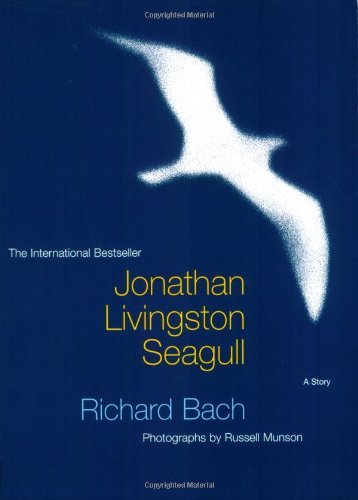
The book was also conceived as a visual object rather than as text alone. Russell Munson’s black-and-white photographs of gulls accompany Bach’s prose, giving the fable a spacious visual rhythm and reinforcing the connection between literal flight and philosophical possibility. The relative simplicity of the narrative works partly because the photographs allow the physical reality of wings, sea, sky, speed, distance, and solitude to remain present even when the prose becomes increasingly metaphysical.
In 2014, Scribner published Jonathan Livingston Seagull: The Complete Edition, adding a previously unpublished fourth part as well as a short section called “Last Words.” The restoration was not merely a marketing addition to an old bestseller. Bach’s return to the fourth part created a substantially different ending and changed the philosophical structure of the whole book.
The original three-part version asks whether a person who has discovered greater freedom can return to those who rejected him, teach them, and prepare another teacher to carry on. The Complete Edition asks a more difficult question: what happens after the teacher succeeds? If followers admire the teacher more than the practice, the language of freedom can become doctrine, the memory of rebellion can become ceremony, and a movement created to destroy limits can acquire officials, sacred objects, and rules of its own.
That fourth movement makes the Complete Edition the more revealing version of Bach’s fable. The original ending remains emotionally cleaner because Fletcher inherits Jonathan’s work at the moment when the cycle of teaching appears to be functioning. Part Four deliberately disturbs that satisfaction by showing that no teaching can permanently protect itself from misunderstanding. Freedom must be rediscovered by each generation rather than inherited as a finished set of answers.
Jonathan Livingston Seagull: Complete Plot Summary
The four parts form a continuous progression even though the story changes dramatically in scale. Part One is grounded in unusually concrete descriptions of aviation and repeated physical failure; Part Two moves into metaphysics; Part Three tests Jonathan’s ideas inside the society that rejected him; and Part Four examines what happens generations later when the living practice has hardened into tradition.
Jonathan’s development depends on that sequence. He does not begin as a spiritual teacher announcing abstract truths about freedom. He begins as a gull who cannot stop experimenting with the way wings work, and almost everything that follows grows from his refusal to accept an answer that cannot survive experience.
Part One: Learning to Fly Beyond the Flock
The story opens in the morning near a fishing boat. Hundreds of gulls descend on the water, fighting for scraps in what the book calls the Breakfast Flock. This is ordinary gull life: flying exists because it helps a bird reach food, defend food, and survive until the next day.
Jonathan Livingston Seagull is elsewhere.
While the Flock fights around the boat, Jonathan practises low-speed flight alone. He experiments with the angle of his wings, deliberately approaches a stall, loses control, falls, recovers, and tries again. What separates him from the other gulls is not initially some grand theory about individuality; it is an intense interest in what flying itself can become.
His experiments worry his parents. Jonathan spends so much time practising that he becomes thin, and his mother cannot understand why he does not simply behave like the rest of the Flock. His father is less emotional but equally practical. Winter will come, fishing boats will become scarce, and a gull needs to know how to eat. Flying, in his father’s view, is a means of survival rather than an end worth studying for itself.
Jonathan tries to comply. For several days he joins the ordinary struggle for scraps, shouting and fighting around boats like everyone else. He discovers that he can imitate the behaviour but cannot make himself believe in it. The life feels pointless because every hour spent competing for discarded food is an hour he could have spent learning something he does not yet know.
He therefore returns to solitary practice.
The next problem is speed. Jonathan begins climbing high above the sea and diving toward the surface, but he repeatedly discovers that ordinary gull wings become unstable when he tries to flap at high velocity. At around seventy miles per hour he loses control, spins, and crashes into the water.
Bach describes the attempts almost like an engineering problem. Jonathan observes what happens, modifies the technique, and tries again. When repeated failure shows that flapping is the problem, he hypothesises that he should accelerate first and then hold his wings motionless during the dive.
The modification works. Jonathan passes his previous limit and reaches roughly ninety miles per hour, only to lose control when he changes his wing angle during the pullout. The resulting crash is far worse. He hits the sea with enormous force and later finds himself floating in darkness, exhausted and psychologically defeated.
This is one of the most important moments in the story because Jonathan genuinely considers surrender. He tells himself that he is limited by his nature. If gulls were meant to fly at tremendous speed, they would possess the short wings of falcons; if they were meant to solve complex aerodynamic problems, they would have different minds. His father, he concludes, was right.
Jonathan decides to return to the Flock and become ordinary.
Even on the flight home, however, the problem refuses to leave him. A thought enters his mind: gulls do not fly in darkness. Then another comparison appears. If he were supposed to fly in the dark, perhaps he would have the eyes of an owl; if he were supposed to fly at high speed, perhaps he would have a falcon’s short wings.
The phrase “short wings” changes everything.
Jonathan suddenly realises that he does not need to possess permanently short wings. He can fold most of his wings against his body and fly using only the tips. Instead of treating anatomy as an absolute prohibition, he can change how he uses the anatomy he already has.
He climbs into the night and tests the idea.
The difference is immediate. He passes seventy miles per hour, then ninety, then well beyond the speeds that previously destroyed his control. The same conditions that seemed to prove an absolute natural limit become manageable once he discovers a different technique.
The following morning Jonathan pushes the experiment further. Diving from thousands of feet, he reaches more than two hundred miles per hour. The speed is dangerous because he does not yet know how to turn effectively, and at one point he races directly through the Breakfast Flock. No bird is killed, but the incident demonstrates both the brilliance and the recklessness of his progress.
Jonathan next learns that enormous high-speed turns require tiny movements. A slight adjustment of a single wingtip feather can change direction without destabilising the whole body. From there he begins exploring aerobatic manoeuvres that no other gull has attempted.
By the end of the day he believes he has discovered something much larger than personal achievement. The Flock no longer has to spend its entire existence fighting over scraps near fishing boats. Gull life could contain exploration, beauty, intelligence, skill, and freedom.
Jonathan returns expecting excitement.
Instead, the Council summons him.
At first he imagines that the Elders may honour the breakthrough. What he hears is the opposite: he is ordered to stand at the centre for shame. His experiments are described as irresponsible because they violate the dignity and tradition of the Gull Family.
Jonathan protests. In his view, responsibility should mean discovering what gulls are capable of and sharing that knowledge. The Flock’s idea of responsibility means preserving the practices that have kept gull society stable.
The disagreement is therefore deeper than whether Jonathan flew too fast. Jonathan defines life by discovery; the Council defines it by survival and continuity.
The Flock rejects his argument and declares the brotherhood broken. Jonathan is banished to the Far Cliffs.
His exile initially appears to confirm the social cost of individuality, but it also demonstrates the practical value of what he has learned. Because he understands high-speed diving, Jonathan can catch fish that ordinary gulls cannot reach. He learns to fly through fog, travel long distances, move at night, and use powerful winds.
The techniques the Council condemned as irresponsible actually make him less dependent on fishing boats and stale scraps.
Jonathan’s greatest sorrow is not loneliness. He can live alone. What grieves him is the thought that thousands of other gulls could experience the same freedom but refuse even to investigate it.
Years pass as he continues learning.
One evening two brilliant gulls appear beside him. Their precision is immediately obvious, and Jonathan tests them by slowing almost to a stall, diving at tremendous speed, and rolling through the air. They match him effortlessly.
They tell him that they are his brothers and have come to take him higher. Jonathan initially objects that he has no Flock and no home, but they explain that he has completed one school and is ready for another.
Jonathan understands.
He leaves the world he knows and rises into the sky with them.
Part Two: Perfection, Heaven, and the Decision to Return
Jonathan assumes at first that the new realm must be heaven. His body has changed, his feathers appear brilliant, and his new wings perform far better than his old ones. Even here, however, he quickly discovers measurable limits.
That discovery disappoints him.
If this is heaven, he thinks, why should there still be a maximum speed?
The question leads toward the central argument of Part Two. Jonathan has spent his earthly life breaking one limit after another, but he still imagines perfection as the endless enlargement of measurable performance. He thinks that if 214 miles per hour is extraordinary, then 300 must be closer to perfection, and 1,000 closer still.
The gulls in this new place are different from the Breakfast Flock. There are relatively few of them, and each cares deeply about learning. Rather than using flight only to survive, they treat refinement of flight as the most important work of existence.
Sullivan becomes Jonathan’s instructor.
He explains that most gulls develop slowly through many successive lives or worlds. They repeat roughly the same patterns because they do not yet understand that existence can be about more than eating, fighting, and power. Only after many lives do most begin to seek perfection.
Jonathan has progressed unusually quickly because his appetite for learning is unusually strong.
The metaphysics are now explicit. A gull’s next world corresponds to what that gull has learned in the present one. Failure to learn reproduces the same limitations; deeper understanding opens a different level.
Jonathan continues practising advanced manoeuvres, but eventually he seeks out the Elder Gull named Chiang.
Chiang possesses the mastery Jonathan respects most. Unlike an enfeebled elder, he has become more capable with age and can outfly the younger birds. Jonathan asks him whether this realm is truly heaven.
Chiang says it is not.
Heaven, in Chiang’s teaching, is neither a location nor a moment in time. Heaven is perfection.
Jonathan immediately interprets that answer through speed. He is, after all, the gull whose earthly breakthrough came from pushing beyond accepted velocity limits. Chiang therefore asks him to reconsider what perfect speed would actually mean.
Any numerical speed, Chiang explains, remains a limit. One thousand miles per hour is still a number; so is a million. Even the speed of light is measurable.
Perfect speed means being there.
Chiang demonstrates by disappearing from Jonathan’s side and reappearing elsewhere instantaneously.
Jonathan is thrilled. What had looked like a philosophical paradox becomes a new skill to learn.
The lesson, however, requires him to reconsider identity itself. Chiang tells Jonathan that he cannot achieve this form of movement while thinking of himself as a finite physical object whose existence is confined to a particular body. His true nature, according to Chiang, is an unlimited idea that is not fundamentally trapped by ordinary space or time.
Jonathan practises obsessively but initially gets nowhere.
Chiang tells him not to depend on faith. Jonathan did not master flying because he merely believed he could; he understood how flight worked. The same distinction is supposed to apply here.
Eventually Jonathan experiences the shift in understanding Chiang has been trying to produce. Instead of hoping that he might somehow become unlimited, he experiences himself as already belonging to that condition.
He and Chiang immediately appear on another world.
The achievement changes Jonathan’s conception of possibility, but Chiang has not finished with him. He tells Jonathan that mastery of place and time is not the final task. The most difficult lesson will be learning the meaning of kindness and love.
That transition is essential to the book.
Until this point, Jonathan’s achievements have been primarily self-directed. Even when he wants the Flock to learn, he remains the exceptional individual whose attention is fixed on mastery. Chiang introduces the possibility that excellence reaches completion only when it becomes a relationship with others.
Later Chiang disappears in an extraordinary blaze of light. His final instruction to Jonathan is to keep working on love.
Jonathan begins thinking increasingly about Earth.
The memories he once left behind return with a different meaning. Somewhere among the old gulls, he imagines, there may be another bird testing limits, another bird being mocked or punished because ordinary life feels insufficient. If Jonathan possesses something that could help such a gull, remaining comfortably among advanced students begins to look incomplete.
Sullivan disagrees.
He points out that the gulls on Earth rejected Jonathan before. Why teach birds who do not want to learn when there are willing students here?
Jonathan eventually recognises the flaw in that argument by thinking about Chiang himself. Chiang did not restrict his teaching to those already at his own level. He helped Jonathan precisely because Jonathan still had much to learn.
Jonathan decides to return.
His first new student is Fletcher Lynd Seagull.
Fletcher is young, furious, and newly Outcast. He believes the Flock has treated him unjustly and imagines proving its members wrong through superior flying.
Jonathan enters his thoughts with a different challenge. He asks Fletcher whether he wants to fly badly enough to forgive the gulls who expelled him and eventually return to help them understand.
Fletcher says yes.
Jonathan begins, appropriately, not with metaphysics but with level flight.
Part Three: The Students, the Flock, and Fletcher’s Inheritance
Fletcher becomes Jonathan’s most important student, but he is not simply a younger version of his teacher. He possesses enormous talent and determination, yet his desire to improve is mixed with anger, impatience, and self-contempt whenever he fails.
Jonathan therefore teaches Fletcher technique and temperament together.
During a difficult aerobatic manoeuvre, Fletcher loses control and condemns himself as too stupid to succeed. Jonathan does not comfort him with vague encouragement. He identifies the technical problem: Fletcher is entering the manoeuvre incorrectly and bleeding away too much speed.
They try again.
The scene preserves an important connection with Part One. Jonathan may now speak about unlimited consciousness, but his teaching still depends on careful observation and repeated physical practice.
Within several months Jonathan has gathered more students, all of them Outcasts. They are drawn initially to advanced flying rather than to the philosophy beneath it. High speed, low speed, aerobatics, storms, altitude, and difficult manoeuvres are exciting; Jonathan’s explanations of the unlimited self sound far more abstract.
He tells them that their physical bodies represent their thoughts in visible form and that limitations must be put aside.
The students often fall asleep during these talks.
That gap between practice and doctrine anticipates Part Four. Even Jonathan’s best students understand what they can do more easily than they understand what Jonathan believes those achievements mean.
Eventually Jonathan announces that they will return to the Flock.
The students are frightened. Flock law says that an Outcast does not return.
Jonathan’s answer exposes the contradiction in their position. If they truly believe they are free, why should a law created by the Flock determine where they may fly?
Jonathan leaves for the old territory, and the others follow rather than allow him to face the hostile Flock alone.
Their arrival is spectacular.
Jonathan and the students cross the Council Beach in formation at high speed, execute coordinated manoeuvres, and land with extraordinary control. Ordinary Flock life stops as thousands of gulls stare.
The very existence of the group creates a logical crisis. They are Outcasts, and Outcasts are forbidden to return. Yet they have returned, and they can fly in ways the supposedly responsible Flock has never imagined.
The Elders respond by ordering the Flock to ignore them.
Anyone who speaks to an Outcast will become Outcast. Even looking at them violates the law.
Jonathan proceeds as if the command does not matter.
He holds lessons directly over the Council Beach.
Each student begins revealing a distinctive strength. Martin William Seagull becomes exceptionally skilled at low-speed flight. Charles-Roland Gull explores extreme altitude. Fletcher continues developing extraordinary aerobatic control.
Jonathan presses them because demonstration is more powerful than argument. The Flock can turn its back on speech, but it cannot completely ignore what is happening in the sky above it.
Curiosity slowly weakens obedience.
At first gulls listen secretly at night. They do not want to be seen, but they want to understand.
Then Terrence Lowell Seagull openly crosses the line and asks to become a student. By doing so, he accepts the status of Outcast.
Kirk Maynard Gull follows under very different circumstances. His damaged wing cannot move, and he approaches Jonathan believing that he may never fly again.
Jonathan tells him that his true nature is freedom.
Maynard spreads his wings and rises into the air.
This episode is one of the clearest places where Bach moves beyond flight as metaphor and asks the reader to accept, within the fable, a literal connection between consciousness and bodily capacity. Earlier Jonathan worked around physical limitations through technique; Maynard appears to overcome disability by recognising a metaphysical truth about himself.
The event transforms the atmosphere around Jonathan.
More gulls begin listening.
Jonathan teaches that freedom belongs to the nature of a gull and that anything opposing genuine freedom must be set aside, whether the obstacle is ritual, superstition, inherited law, or some other imposed limitation.
The Flock begins dividing in its interpretation of him.
Some gulls treat Jonathan as divine.
Others see him as a threat.
Jonathan rejects both categories.
When Fletcher tells him that the Flock believes Jonathan may be the Son of the Great Gull, Jonathan is frustrated by the misunderstanding. The whole point of his teaching is that the potential demonstrated by his students is not unique to him.
The narrative then pushes that problem to a crisis.
While Fletcher is demonstrating high-speed flight, a young gull crosses his path. To avoid killing the youngster, Fletcher snaps into a violent turn and collides with a granite cliff at enormous speed.
From Fletcher’s perspective, the impact becomes a transition into another level of consciousness.
Jonathan is there.
Fletcher asks whether he has died. Jonathan answers in a way consistent with the metaphysics Chiang taught: Fletcher has changed levels rather abruptly.
Fletcher has a choice. He can remain there and continue learning, or he can return to the Flock and keep teaching.
He immediately chooses to go back.
Fletcher awakens at the base of the cliff in front of thousands of gulls.
The Flock reacts with hysteria.
Some insist Jonathan has restored the dead and must therefore be divine. Others call him a devil who has come to destroy the Flock.
The same event produces worship and hatred because both responses assume Jonathan belongs to a category fundamentally different from ordinary gulls.
A mob closes in.
Jonathan asks Fletcher whether he would prefer to leave, and they instantly appear far away.
Fletcher is stunned by the movement, but he has a more difficult question. How can Jonathan talk about loving gulls who have just tried to kill them?
Jonathan distinguishes love from approval.
He is not asking Fletcher to love hatred or violence. He wants Fletcher to learn to perceive the better potential within each gull and help that gull perceive it too.
Jonathan reminds him that Fletcher himself once responded to exile with rage. If someone had looked only at that anger, Fletcher would have seemed like an enemy. Jonathan instead saw a possible student and future teacher.
The lesson brings Fletcher’s development into focus. His task is no longer simply to become a brilliant pilot. He must learn to relate to imperfect students as Jonathan related to him.
Jonathan then announces that he is leaving.
Fletcher protests that he cannot lead the Flock because Jonathan is the true instructor.
Jonathan rejects the distinction. Fletcher does not need to depend permanently on him; he must continue discovering the unlimited self that Jonathan has been trying to make visible.
Jonathan also warns against turning him into a god.
Then he disappears.
Fletcher is left facing a new class of students.
At first he repeats Jonathan’s metaphysical explanation about the unlimited nature of a gull. The young students look confused. They want to learn how to fly.
Fletcher recognises the problem.
He begins again with level flight.
The original three-part edition ends there. Fletcher has not become Jonathan by memorising Jonathan’s language. He becomes a teacher when he understands how Jonathan actually taught: meet the student where the student is, begin with something that can be practised, and allow understanding to grow from experience.
Part Four: When Jonathan’s Teaching Becomes a Religion
The restored fourth part begins after Jonathan’s departure and follows the long-term consequences of his apparent success. The earliest period is hopeful. Fletcher and the other students teach new gulls, the practice spreads, and more birds begin exploring possibilities once thought impossible.
Eventually some of the most advanced students move beyond the ordinary world just as Jonathan did.
That should represent the triumph of the teaching.
Instead, success produces a new vulnerability.
The next generations become increasingly interested in Jonathan himself.
Fletcher repeatedly tries to explain that Jonathan was a gull like anyone else. What made him remarkable was not supernatural privilege but his willingness to practise, question, and understand.
Followers prefer a more flattering and less demanding story.
Jonathan gradually becomes the Divine Gull.
The original students become sacred figures because they knew him directly.
As those students disappear, no living teacher remains with enough authority to correct the mythology.
The very argument Jonathan rejected in Part Three becomes the foundation of the tradition built in his name.
Practice begins to decline.
Instead of learning difficult flight, gulls preserve stories about extraordinary flight. Instead of testing Jonathan’s claims, they repeat them.
Places associated with the early teachers acquire sacred importance. Pebbles accumulate near memorial sites as offerings and symbols of devotion. Language about unity and transcendence survives, but familiarity with the words is increasingly detached from the discipline that originally gave the words meaning.
Religious officials emerge.
Status becomes connected with ceremonial forms and inherited authority.
The transformation is especially ironic because Jonathan’s earliest conflict with the Flock concerned precisely this substitution of tradition for investigation. The old Elders said that gull life had always been organised in a particular way and therefore should remain that way. Jonathan’s later followers eventually make an equivalent claim about Jonathan’s own teaching.
A philosophy of freedom becomes another institution telling gulls what freedom means.
Over many generations, the contradictions become increasingly visible.
Some gulls begin questioning the official religion. They are sceptical of miracle stories, ceremonial obligations, sacred objects, and claims that Jonathan belonged to an inaccessible divine category.
Without realising it, these doubters move closer to Jonathan’s original method than the believers do.
They want to test things for themselves.
The restored section’s narrative has been documented in detailed treatments of Part Four, including the rise of ritual around Jonathan and the eventual appearance of Anthony Seagull.
Anthony belongs to a world in which Jonathan’s name is everywhere but Jonathan’s spirit of inquiry is difficult to find.
He questions whether Jonathan even existed.
He doubts the reported speeds and miraculous feats.
His instinct is empirical: if the stories are true, where is the gull who can demonstrate such things?
At first this scepticism is healthy. Anthony refuses to confuse inherited testimony with knowledge.
His crisis begins when he extends the rejection too far.
If the official answers are false or hollow, Anthony begins to think perhaps there are no meaningful answers at all. The collapse of religious certainty becomes a collapse of purpose.
He reaches the point of deciding that life is not worth continuing.
Anthony dives toward the sea intending to kill himself.
During the descent, another gull flashes past him at a speed that should be impossible.
The sight interrupts the suicide attempt.
Anthony follows.
The stranger performs astonishing manoeuvres casually, without the pomp that Anthony associates with stories about sacred figures.
Anthony is faced with exactly what he demanded: not an institution telling him what to believe, but an experience that does not fit the limits he currently accepts.
He asks the other gull who he is.
The gull says Anthony can call him Jon.
The restored ending therefore brings the book back to its beginning.
Jonathan once lived in a society that insisted there was nothing important to discover beyond accepted gull life. Anthony lives in a society that insists the discoveries have already been made and preserved in sacred form.
Both conditions kill inquiry.
Jonathan’s answer to both is the same: do not begin with worship. Begin with flight.
The Flock, the Far Cliffs, and Bach’s World
Bach builds a deliberately simplified world because Jonathan Livingston Seagull functions as a fable rather than as realistic animal fiction. The economic, political, and social systems exist mainly to create pressure around the central question of how much freedom an individual possesses when the surrounding culture treats inherited limits as natural facts.
Ordinary gull society is organised around food. The fishing boat is therefore more than background scenery. It represents a survival economy in which enormous amounts of energy are spent competing over scarce scraps, and the Flock takes that arrangement so completely for granted that alternative uses of flight appear irresponsible.
The Council gives this practical order moral authority. Gull behaviour is not merely habitual; it is protected by ideas such as dignity, responsibility, and tradition. Jonathan’s experiments threaten the Council because they make the distinction between “natural limitation” and “socially accepted limitation” unstable.
Outcast status is the Flock’s strongest disciplinary tool.
The punishment is effective only because membership matters. A gull who fears exclusion will regulate behaviour long before the Council needs to impose direct force. That is why Jonathan’s return with a group of successful Outcasts is so disruptive: their existence proves that expulsion does not necessarily destroy a gull’s life.
The Far Cliffs initially represent exile but gradually become a place of independence. Jonathan is sent there to experience the consequences of violating Flock norms, yet he discovers that life outside the institution gives him room to improve further. The geographical margin therefore becomes an intellectual centre.
Part Two enlarges the world beyond ordinary gull society.
Successive levels of existence replace the single physical world with a hierarchy of consciousness. Jonathan discovers that his earlier life was only one stage in a longer process of learning and that death does not function as a final boundary within Bach’s fictional metaphysics.
The world beyond Earth nevertheless remains recognisably educational. Jonathan still has instructors, exercises, mistakes, and more advanced students. Bach imagines transcendence not as passive bliss but as another school.
That choice prevents “heaven” from becoming a reward for obedience.
Even higher existence contains work.
Part Four brings the structure back down to institutional society.
The later Officials, ceremonies, sacred places, and ritual objects resemble the old Council in a new vocabulary. The great irony of the Complete Edition is that the Flock first suppresses Jonathan by treating tradition as absolute and later suppresses Jonathan’s actual method by treating Jonathan himself as absolute.
Bach therefore constructs two kinds of orthodoxy around the same central character. One says, “You must not investigate because our ancestors already established how gulls should live.” The other says, “You must not investigate because Jonathan already discovered the truth for you.”
Jonathan’s world is sparse, but that symmetry gives it coherence.
Jonathan Livingston Seagull: Character Analysis
The characters in Jonathan Livingston Seagull are intentionally simpler than characters in a psychologically realistic novel. Bach gives them enough personality to embody different responses to learning, authority, failure, and freedom, but they primarily function within a parable-like structure in which development matters more than social detail or interior complexity.
That simplicity is both useful and limiting. It allows Jonathan’s transformation to remain immediately legible, but it also means that the Flock often behaves more like an ideological collective than a society of individually complicated birds.
Jonathan: From Mastery to Teaching
Jonathan begins with curiosity rather than rebellion.
He does not initially decide that the Flock is morally corrupt or that he wants to prove himself superior. He simply cares about flying more than the other gulls do. Conflict follows because a passion that seems private eventually challenges the assumptions organising communal life.
His defining trait is not talent but sustained experimentation.
Jonathan repeatedly fails. He stalls, loses control, crashes, nearly drowns, and eventually persuades himself that his father was right. The breakthrough arrives only because he continues thinking about the problem even after deciding to surrender.
That pattern is important because it distinguishes Jonathan from a conventional “chosen one.” He is extraordinary, but Bach initially grounds the extraordinariness in practice rather than destiny.
Jonathan also possesses pride.
When he returns after his speed breakthroughs, he expects the Flock to recognise the significance of what he has done. He says he does not want honours, but he does assume that discovery will be welcomed once others see its value.
His exile teaches him that being right about a possibility does not make communication easy.
The transition in Part Two is therefore not merely from slower flight to faster flight. Jonathan has already mastered extraordinary physical flight by then. His deeper development concerns what excellence is for.
Chiang forces him to abandon the idea that perfection simply means pushing numbers higher.
The lesson about love changes Jonathan more substantially than the lesson about instantaneous travel.
A purely individualist Jonathan could remain among advanced gulls forever, pursuing one higher skill after another. Instead he begins thinking about the gulls who are least prepared to understand him.
His return to Earth marks the moment when achievement becomes responsibility.
Jonathan’s relationship with Fletcher then changes him from master into teacher.
Teaching requires a different kind of patience from solitary practice. Jonathan can control his own wings, but he cannot simply transfer understanding into another mind.
He therefore moves between demonstration, correction, challenge, explanation, and forgiveness.
Part Three also reveals Jonathan’s resistance to charisma.
The more extraordinary he becomes, the more other gulls want to interpret his ability as proof that he belongs to a special divine category. Jonathan sees that interpretation as a failure because it turns evidence of possibility into an excuse for impossibility.
If Jonathan is a god, ordinary gulls do not have to imitate him.
His departure from Fletcher completes the arc of the original edition.
A weak teacher creates permanent dependence. Jonathan leaves because Fletcher must stop defining himself through proximity to Jonathan and begin acting from his own understanding.
Part Four makes Jonathan’s resistance to deification tragically perceptive.
He warned the gulls against turning him into a god, yet that is precisely what later generations do.
His final reappearance with Anthony restores the character to his first identity. The institutionalised Jonathan is a sacred name, but the actual Jonathan appears as a gull doing something astonishing in the air.
He remains, fundamentally, a student of flight.
Fletcher: Anger, Apprenticeship, and Succession
Fletcher begins where Jonathan might have ended if exile had produced bitterness instead of freedom.
He has been rejected by the Flock and is furious. He imagines becoming an outlaw and making the others regret what they did to him.
Jonathan sees ability beneath the anger.
The first requirement he places on Fletcher is therefore moral rather than technical. Fletcher must want flight badly enough to forgive the Flock and eventually help it.
That demand prevents mastery from becoming revenge.
Fletcher’s greatest weakness is impatience with himself.
When he cannot perform a difficult manoeuvre, he interprets failure as evidence that he is stupid. Jonathan repeatedly redirects him from judgment toward diagnosis: what exactly went wrong, and what should change on the next attempt?
Fletcher gradually learns to treat failure as information.
His collision with the cliff represents the culmination of his loyalty to others. He changes course because a young gull has entered his path, choosing immediate danger to himself rather than allowing the youngster to die.
His return from the higher level then turns him into a living challenge to the Flock’s worldview.
Yet Fletcher remains emotionally less advanced than Jonathan.
After the mob tries to kill them, he cannot understand why anyone should continue loving those gulls.
Jonathan’s answer takes Fletcher back to his own past. Fletcher himself was once full of hatred, and Jonathan did not reduce him to that hatred.
The final challenge is succession.
Fletcher thinks he is merely an ordinary gull while Jonathan is the true master.
Jonathan refuses that hierarchy.
When Fletcher finally begins teaching new students, his first attempt fails because he repeats Jonathan’s abstract explanation. He corrects himself by beginning with level flight.
That small moment is the strongest evidence that he is ready.
Fletcher has learned not simply what Jonathan said but how Jonathan helped another being learn.
Part Four gives the success a tragic afterlife.
Fletcher becomes one of the sacred figures he would never have wanted to become.
His story therefore demonstrates how little control a teacher has over the institution built from the teacher’s memory.
Chiang and Sullivan: Two Kinds of Teacher
Sullivan and Chiang represent two complementary forms of mentorship.
Sullivan is the practical instructor. He trains Jonathan, repeats difficult exercises, corrects technique, and provides companionship within the new realm.
He also voices a reasonable objection when Jonathan wants to return to Earth.
Why invest effort in gulls who rejected him when there are eager students already available?
The argument is not cruel. It is efficient.
Jonathan ultimately rejects that efficiency because teaching the already prepared cannot be the whole meaning of love.
Chiang operates at a different level.
He is the teacher who breaks Jonathan’s conceptual framework.
Jonathan approaches perfection through increasingly impressive numbers, and Chiang shows him that a larger finite measurement remains finite.
The lesson of “perfect speed” therefore performs the same function philosophically that the short-wing insight performed aerodynamically: Jonathan discovers that the problem cannot be solved while remaining inside his previous assumptions.
Chiang’s most important teaching, however, concerns love.
Without it, his metaphysics could produce an endlessly self-improving elite of advanced gulls who become increasingly detached from those below them.
His final instruction forces Jonathan to connect transcendence with service.
The difference between Sullivan and Chiang is therefore not that one is wrong and the other right. Sullivan teaches Jonathan how to improve inside a system of advanced practice. Chiang teaches him when the system itself must be reconceived.
Anthony Seagull: Scepticism After the Revolution
Anthony is essential to the Complete Edition because he prevents the book from ending with a simple celebration of Jonathan’s legacy.
He inherits a world saturated with that legacy.
Unlike Jonathan, who was told there was nothing beyond ordinary gull life, Anthony is told that the great truths have already been discovered by sacred predecessors.
His rebellion therefore takes the form of scepticism.
He doubts miracles, sacred histories, ceremonial authority, and inherited claims.
This makes him structurally similar to young Jonathan even though his temperament is different.
Both refuse to accept tradition as evidence.
The danger appears when Anthony confuses the failure of inherited answers with the failure of meaning itself.
His scepticism destroys beliefs that do not deserve confidence, but it does not automatically provide a reason to live.
Bach therefore separates two positions that can easily be confused.
Rejecting false certainty is not the same as knowing that nothing matters.
Anthony’s suicidal dive represents the extreme consequence of that collapse.
The intervention of the mysterious fast gull is significant because Anthony is not converted by a sermon.
He sees something.
His experience contradicts his current assumptions and reopens investigation.
The revelation that the stranger can be called Jon completes the book’s circular design.
Anthony does not encounter Jonathan first as a god, prophet, icon, or founder.
He encounters him as a problem worth pursuing.
Flight, Freedom, Perfection, and Love
Bach’s major ideas develop through the changing meaning of flight. What begins as a specialised skill becomes a model for intellectual independence, then for metaphysical transcendence, and finally for teaching and direct experience. The strongest interpretation of the book therefore has to preserve both sides of that progression: Jonathan seeks freedom from inherited limits, but Bach ultimately refuses to let freedom mean simple detachment from everyone else.
The Complete Edition adds another complication. Even a philosophy built around freedom can create new limitations when its followers stop practising and begin preserving symbols of what someone else once discovered.
Freedom Is More Than Rebellion
Part One makes rebellion unavoidable because the Flock treats conformity as responsibility.
Jonathan cannot pursue flight seriously without violating social expectations.
His exile therefore creates an obvious individualist message: institutions often confuse familiar behaviour with natural law, and a person may have to separate from a group in order to discover what the group considers impossible.
That message is real, but it is incomplete.
Jonathan does not remain on the Far Cliffs congratulating himself for being different.
The decisive movement of the story occurs when he chooses to return.
Freedom therefore has two stages.
First, Jonathan must become independent enough to investigate without the Flock’s permission. Later, he must become secure enough in that independence that he can re-enter the society that rejected him without becoming either obedient or vengeful.
Fletcher makes the distinction clearer.
His initial form of rebellion is defined by the Flock. He wants to become an outlaw because the Flock has hurt him, which means the Flock still controls his identity through opposition.
Jonathan wants him to become freer than that.
Forgiveness breaks the dependence.
The Outcasts’ return dramatizes the same point socially.
They have already escaped the Flock, but Jonathan forces them to confront whether they are still obeying the Flock’s rules from outside. If an Outcast truly believes in freedom yet remains permanently absent because an Elder once declared return illegal, exile has become another kind of obedience.
Part Four then turns the argument against Jonathan’s own followers.
They revere a rebel so completely that reverence becomes conformity.
This is the Complete Edition’s most important expansion of the original message.
The enemy is not one particular institution.
The deeper danger is allowing any inherited system to substitute authority for discovery.
Practice, Failure, and the Meaning of Perfection
The opening of the book works so well because Jonathan’s achievement is earned.
He does not simply believe himself into higher speed. He experiments, crashes, adjusts his wings, notices patterns, changes technique, and repeats the process.
Failure has informational value.
The seventy-mile-per-hour crashes reveal a mechanical problem. The disastrous ninety-mile-per-hour pullout reveals another. Even the moment when Jonathan decides he is biologically incapable of flying like a falcon produces the comparison that gives him the short-wing solution.
The narrative therefore offers a compelling account of mastery before it offers metaphysics.
Jonathan is not fearless.
He learns despite fear.
This distinction matters because inspirational readings often simplify the book into a message about believing in yourself. Bach’s early Jonathan behaves more like a researcher or athlete than a positive thinker.
He wants to know what works.
Chiang later transforms the concept of perfection.
Jonathan has spent his life assuming that greater mastery means greater measurable performance.
Chiang argues that no quantity can equal perfection because any quantity remains bounded.
This philosophical move expands the story beyond technical aviation, but it also creates a tension.
The early sections define progress through observable correction. The later sections increasingly define progress through metaphysical insight.
The transition is emotionally coherent even when the reasoning is not equally rigorous.
Bach tries to preserve the earlier model by having Chiang insist that understanding matters more than faith.
Yet the nature of what must be “understood” changes.
Jonathan can investigate aerodynamics through repeated flight.
The claim that his true self exists beyond space, time, and physical limitation cannot be tested in the same straightforward manner outside the fictional world.
The distinction does not invalidate the fable, but it matters when deciding what kind of truth the book can reasonably claim.
As metaphor, the idea is powerful: people frequently internalise limits that deserve investigation.
As a literal principle that thought can overcome bodily reality, it becomes much harder to defend.
Love Turns Individual Achievement Into Responsibility
Love enters relatively late in the story but changes everything that came before it.
Until Chiang’s final teaching, Jonathan’s journey could plausibly be read as the story of an exceptional individual escaping ordinary people is not equally rigorous.
Bach tries to preserve the earlier model by having Chiang insist that understanding matters more than faith.
Yet the nature of what must be “understood” changes.
Jonathan can investigate aerodynamics through repeated flight.
The claim that his true self exists beyond space, time, and physical limitation cannot be tested in the same straightforward manner outside the fictional world.
The distinction does not invalidate the fable, but it matters when deciding what kind of truth the book can reasonably claim.
As metaphor, the idea is powerful: people frequently internalise limits that deserve investigation.
As a literal principle that thought can overcome bodily reality, it becomes much harder to defend.
Love Turns Individual Achievement Into Responsibility
Love enters relatively late in the story but changes everything that came before it.
Until Chiang’s final teaching, Jonathan’s journey could plausibly be read as the story of an exceptional individual escaping ordinary people.
Chiang refuses that conclusion.
If Jonathan’s greater understanding simply carries him farther from the Flock, then mastery has become another form of separation.
Jonathan begins to understand love not primarily as affection but as recognition.
To love another gull is to perceive what that gull might become and to help make that possibility visible.
This is why his return to Earth matters more than his instantaneous travel.
Teleportation demonstrates power.
Returning demonstrates responsibility.
Fletcher becomes the test case.
Jonathan encounters him at his most bitter and sees something Fletcher does not yet see in himself.
He does not deny Fletcher’s anger or tell him the Flock behaved well. Instead, he refuses to treat the injury as Fletcher’s permanent identity.
The same principle explains Jonathan’s response to the mob.
He does not tell Fletcher to love violence.
He asks him to distinguish destructive behaviour from the deeper possibility of the individuals participating in it.
That is a demanding idea because it rejects both sentimental forgiveness and permanent condemnation.
Love, in Bach’s model, means helping another being discover freedom without pretending that hatred itself is admirable.
The teaching relationship also keeps love from becoming purely emotional.
Jonathan loves by instructing.
Chiang loves by teaching Jonathan.
Jonathan loves Fletcher by demanding more from him.
Fletcher eventually loves new students by beginning again at the level they can actually understand.
This makes apprenticeship one of the book’s strongest models of human connection.
The teacher does not manufacture the student’s freedom.
The teacher creates conditions in which the student can discover it.
The Unlimited Self and Bach’s Metaphysics
The metaphysical system of Jonathan Livingston Seagull rests on the claim that the deepest identity of a being is not identical with the visible body.
Chiang teaches Jonathan that his true nature is unlimited.
Space, time, and physical form therefore become expressions of consciousness rather than final boundaries.
Within the fictional world, the claim receives literal confirmation.
Chiang appears instantly in different places.
Jonathan learns to do the same.
Characters move between different levels of existence.
Fletcher’s collision with the cliff does not end his consciousness.
Maynard appears to overcome a physically unusable wing when Jonathan tells him that freedom belongs to his true nature.
These events place the book inside a spiritual and metaphysical tradition rather than ordinary psychological self-help.
Bach’s language sometimes resembles ideas found across several religious and philosophical systems, including reincarnation, mystical unity, transcendence of ordinary identity, and the distinction between appearance and deeper reality. The book does not, however, build a precise systematic theology, and it is misleading to force it into a single established tradition.
The “Great Gull” functions as loose spiritual language rather than a rigorously defined deity.
Similarly, “heaven” is redefined as a condition of perfection rather than a permanent geographical afterlife.
The metaphysics work most persuasively when treated as an imaginative extension of the book’s central metaphor.
A person may behave as though a socially learned limitation were an absolute feature of reality.
Changing the underlying idea can change what seems possible.
The argument becomes more problematic when the fable blurs psychological limits with material ones.
Not every disability, illness, social barrier, economic constraint, or physical law can be overcome through a change in consciousness.
A literal reading of the unlimited-self doctrine can therefore turn inspiration into blame: if someone remains constrained, perhaps they simply failed to understand their freedom.
The book never fully addresses that implication.
Its metaphysics are best read as part of the fable’s symbolic world rather than as established claims about human bodies or physical reality.
Doctrine, Ritual, and the Need to Rediscover Truth
Part Four changes the philosophical balance of the book because it shows that correct ideas can become harmful when preserved incorrectly.
Jonathan repeatedly rejects worship in Part Three.
He tells the Flock that his students are not different in kind from anyone else.
He prepares Fletcher to continue without him.
He specifically resists being treated as divine.
None of that prevents deification.
Later generations prefer a sacred Jonathan because a sacred Jonathan is easier to admire than to imitate.
If he was fundamentally unlike ordinary gulls, no one has to spend years practising difficult flight or challenging inherited assumptions.
The belief that appears to honour Jonathan therefore neutralises his teaching.
Ritual intensifies the process.
Memorial places, pebbles, formulas, ranks, and ceremonies create tangible forms through which followers can express loyalty.
The problem is not that every ritual is automatically meaningless.
The problem is that the ritual becomes detached from the experience it supposedly commemorates.
The Flock can perform devotion to flight without seriously flying.
The transformation resembles a recurrent problem in intellectual and religious history: followers often preserve the conclusions of a founder more successfully than the founder’s method.
Jonathan’s method is inquiry.
Once the institution treats the conclusions as unquestionable, it has reversed the method while retaining the vocabulary.
Anthony provides the necessary counterargument.
His scepticism is not portrayed as evil.
He is right to distrust hollow ceremony and unsupported claims.
The danger begins only when scepticism becomes nihilism.
Bach therefore avoids replacing religious orthodoxy with another easy answer such as “believe nothing.”
The final model is harder.
Inherited belief is insufficient.
Automatic disbelief is also insufficient.
The individual must encounter experience, investigate, practise, and remain willing to change.
That is why Jonathan returns to Anthony through flying rather than through doctrine.
The story ends where its deepest method began.
Symbols and Motifs
The symbols in Jonathan Livingston Seagull are unusually effective because most begin as physical realities before acquiring philosophical meaning. Flight is genuinely flight before it becomes freedom; speed is an aerodynamic problem before it becomes a philosophical limit; and the sea is a literal environment before it becomes part of the story’s contrast between settled life and open possibility.
Part Four adds a different symbolic language. The early symbols invite movement, while the later sacred objects reveal what happens when movement becomes memory.
Flight, Wings, and the Sky
Flight is the book’s central metaphor, but Bach gives it enough technical detail that it never becomes purely decorative.
For ordinary gulls, flight is instrumental.
A bird flies to food and back.
Jonathan makes flight intrinsically valuable.
That change parallels the distinction between merely using an ability and cultivating it as a form of excellence.
Wings therefore represent both physical capacity and the assumptions governing capacity.
Jonathan cannot exchange his gull body for a falcon’s body, but he can discover a way of using his wings that nobody else considered.
The short-wing breakthrough is symbolically effective precisely because it does not initially abolish biology.
Jonathan works creatively within what he has.
Later Bach makes wings metaphysical.
The body becomes an outward expression of thought.
At that point the symbol expands from adaptation to transcendence.
The sky similarly develops from environment into possibility.
The Flock remains near boats and shore because its priorities keep it there.
Jonathan moves upward, outward, through darkness, fog, wind, and eventually beyond the limits of Earth.
The open sky contains both danger and freedom because discovery requires entering conditions where inherited rules provide less security.
Speed, Height, and Distance
Speed initially provides the clearest measurable sign of progress.
Jonathan knows he has discovered something because he can perform feats that previously seemed physically impossible.
The numbers matter because they give the early narrative precision.
Yet Chiang later destabilises the significance of measurement.
No matter how impressive Jonathan’s speed becomes, a finite number cannot represent limitless perfection.
Speed therefore changes symbolic function.
At first, greater speed means a larger field of possibility.
Later, obsession with greater speed becomes one more attachment to quantitative limitation.
Height works similarly.
The story repeatedly associates greater altitude with broader perception.
Jonathan practises from thousands of feet above the sea, advanced gulls inhabit higher levels, and Sullivan’s proverb about the gull who flies highest suggests a relationship between perspective and understanding.
Bach does not use height consistently enough to make it a rigid code, but the pattern reinforces the vertical direction of transcendence.
Distance eventually becomes something to overcome.
Jonathan begins as a bird separated from the Flock by physical space.
Later he learns that space itself need not determine relationship.
His conversation with Sullivan before returning to Earth makes this explicit: if friendship depends entirely on space and time, then overcoming space and time should not destroy friendship.
The movement from miles to “Here” and from duration to “Now” turns physical distance into a philosophical problem about separation.
Light and Disappearance
Light marks advanced states of consciousness throughout the later sections.
The two gulls who come for Jonathan appear radiant.
Chiang grows brilliantly luminous before disappearing.
Jonathan eventually becomes transparent when leaving Fletcher.
These moments give transcendence a visible form.
They also create the conditions for later mythology.
A gull who disappears in light is easy to remember as divine.
Part Four therefore gives the earlier symbolism an ironic afterlife.
Experiences that demonstrated the possibility of transformation become evidence used to establish hierarchy.
The community remembers the spectacle but loses the method.
Disappearance has another important function.
Teachers must leave.
Chiang leaves Jonathan.
Jonathan leaves Fletcher.
The departure is necessary because permanent physical dependence would contradict the idea that the student possesses the same fundamental possibility as the teacher.
The irony is that disappearance can produce exactly the dependence it was meant to prevent when followers replace the absent teacher with an idealised sacred image.
Pebbles, Cairns, and Ritual
The pebbles of Part Four are the inverse of wings.
Wings are valuable because they are used.
Pebbles become valuable because they are associated with memory, sacred place, and inherited meaning.
Their accumulation around memorial sites illustrates the transformation of living practice into ceremonial possession.
A pebble is easier to carry than mastery.
A ritual is easier to repeat than inquiry.
The symbolism works because Bach does not need to make the objects sinister.
The gulls presumably place them with sincere reverence.
That sincerity is exactly what makes the development interesting.
The problem is not hypocrisy alone.
People can genuinely love a tradition and still preserve the least important part of it.
Cairns, shrines, and sacred places therefore represent the weight of memory.
Jonathan once tried to remove the “lead weights” of limitation from consciousness.
Later generations construct new symbolic weights in his honour.
How Richard Bach Tells the Story
Bach writes Jonathan Livingston Seagull as a fable rather than a conventional novella of psychological realism. The prose is direct, the social world is simplified, and characters often embody attitudes toward freedom, learning, authority, resentment, and belief more clearly than they exhibit the unpredictable contradictions of fully realistic personalities.
That simplicity gives the book much of its accessibility.
Jonathan’s desire is immediately understandable.
The Flock’s opposition is immediately legible.
Readers do not need extensive world-building before the central conflict begins.
The most distinctive stylistic element is Bach’s use of aviation detail.
The early descriptions of stalls, wing positions, dives, pullouts, speed, altitude, and aerobatic control give unusual physical specificity to what could otherwise have been a vague inspirational parable.
Jonathan’s discoveries feel compelling because the reader sees him solving problems.
This is especially effective in Part One.
The prose changes as the narrative becomes metaphysical.
Technical experimentation increasingly gives way to telepathic conversation, philosophical propositions, instantaneous movement, and statements about consciousness.
For some readers this development creates a natural expansion from physical mastery to spiritual possibility.
For others it marks the point where the story becomes more didactic and less convincing.
Dialogue carries much of the philosophy.
Chiang explains perfection.
Jonathan explains freedom.
Fletcher asks questions that allow Jonathan to refine the idea of love.
This method keeps the concepts accessible but can also make characters sound like vehicles for doctrine.
Bach often announces metaphysical principles rather than dramatising enough situations to test their limits.
The mentor-student structure provides stronger narrative continuity.
Jonathan begins without a teacher and learns through experiment.
He later receives teaching from Sullivan and Chiang.
He becomes Fletcher’s teacher.
Fletcher becomes the teacher of a new generation.
Anthony then becomes another potential student when institutional transmission has failed.
That repeated structure creates a chain of learning while also showing why no link in the chain can simply copy the previous one.
The illustrated design is important to the book’s identity.
The official Complete Edition continues to credit Russell Munson’s photography, and the photographs keep actual gulls and actual flight in the reader’s visual field even when the prose moves toward abstraction.
The empty space of sea and sky also suits the contemplative tone.
Part Four gives the structure a new circularity.
The three-part edition resembles ascent: Jonathan goes higher and leaves Fletcher prepared to continue.
The Complete Edition turns the ascent into a cycle of discovery, institutionalisation, decay, scepticism, and rediscovery.
That architecture is intellectually stronger because it applies Jonathan’s own suspicion of inherited limits to the tradition created in Jonathan’s name.
Two Endings: Fletcher, Anthony, and What Changes
The original ending and the Complete Edition ending are not simply two stopping points in the same story. Each produces a different interpretation of what Jonathan has accomplished.
At the end of Part Three, succession works.
Jonathan leaves after convincing Fletcher that he does not need permanent dependence on his instructor.
Fletcher faces new students, initially repeats Jonathan’s abstract metaphysics, notices their confusion, and begins again with level flight.
The moment is quietly optimistic.
Jonathan’s deepest teaching has survived because Fletcher understands that a student must discover rather than merely receive.
The original ending therefore completes a generational pattern.
Jonathan once learned alone.
Chiang later taught Jonathan.
Jonathan taught Fletcher.
Fletcher will now teach others.
The structure implies that understanding can propagate through genuine apprenticeship.
Part Four complicates that confidence.
The teaching spreads widely, but time changes its form.
Later gulls increasingly remember teachers rather than practise what the teachers practised.
Fletcher becomes a sacred figure.
Jonathan becomes divine.
The institution survives while the experiential core declines.
This does not mean Fletcher failed in any simple sense.
No individual teacher can control how distant generations interpret a tradition.
The restored fourth part instead argues that successful transmission always contains the possibility of distortion.
The ending with Anthony is therefore more sceptical than Fletcher’s ending, but it is not pessimistic.
The institution has failed to preserve Jonathan’s method, yet the method can reappear through direct encounter.
Anthony demands evidence, sees something that violates his expectations, and follows the phenomenon.
Jonathan meets him not at a shrine but in motion.
The comparison between Jonathan and Anthony clarifies the circular structure.
Young Jonathan is surrounded by gulls who say ordinary life is enough.
Anthony is surrounded by gulls who say sacred tradition is enough.
Jonathan is told not to ask because there is nothing more to know.
Anthony is implicitly told not to ask because everything important has already been explained.
Both forms of certainty close inquiry.
The Complete Edition therefore produces a stronger final claim than the original three-part story.
Truth cannot be permanently stored in an institution, teacher, book, ritual, or inherited formula.
A tradition may preserve clues, but understanding must be renewed through experience.
That idea also changes how we read Jonathan’s disappearance at the end of Part Three.
He does not leave behind a finished doctrine.
He leaves behind a method.
Part Four shows what happens when the followers confuse the two.
Critical Review: Does Jonathan Livingston Seagull Still Hold Up?
The enduring strength of Jonathan Livingston Seagull lies in the unusual concreteness of its central metaphor. Many inspirational books tell readers to reject limitations, pursue excellence, or believe in possibilities. Bach makes those ideas memorable by giving them wings, wind resistance, stalls, altitude, fear, physical exhaustion, and repeated crashes.
Part One remains the strongest narrative writing in the book.
Jonathan’s progress has texture.
He does not succeed because he announces a superior identity.
He studies a problem until he understands something other gulls have not discovered.
The short-wing breakthrough works especially well because it emerges from the very argument that almost makes Jonathan surrender.
The limitation is not denied; it is reconsidered.
Bach also deserves credit for refusing to leave the story at individual rebellion.
A weaker version of Jonathan Livingston Seagull would end with Jonathan proving the Flock wrong and living independently.
Instead, Part Two insists that excellence eventually raises an ethical question: what are you going to do with what you have learned?
Jonathan’s return gives the book more moral substance.
Fletcher then prevents teaching from becoming a purely abstract virtue.
He is difficult.
He is proud, impatient, wounded, and sometimes furious.
Jonathan must teach a particular student rather than simply announce universal truths.
The distinction between love and approval is another genuine strength.
Jonathan does not tell Fletcher that the mob’s attempted violence is acceptable.
He asks him to see that a person is larger than the worst behaviour currently controlling that person.
That idea is difficult enough to avoid becoming simple sentimentality, even though Bach sometimes expresses it sentimentally.
The restored Part Four improves the book intellectually.
It is easy for a fable about nonconformity to flatter its readers: the protagonist is brave, the crowd is foolish, and those who identify with the protagonist can leave feeling superior.
Part Four attacks that comfort.
Jonathan’s followers become the next establishment.
They preserve his image while betraying his method.
The development is a strong piece of self-criticism because it recognises that inspirational movements are not automatically immune to dogmatism merely because their founders opposed dogma.
Anthony adds another valuable complication.
Bach does not portray scepticism as the enemy.
Anthony is right to be suspicious of empty ceremony and unsupported claims.
The danger comes when the collapse of false certainty becomes a conviction that meaning itself does not exist.
The final encounter with Jonathan therefore avoids both unquestioning belief and total nihilism.
Anthony is asked, implicitly, to investigate.
The book’s limitations are equally clear.
The Flock is often too simple.
Ordinary gull life is reduced mainly to hunger, conformity, fear, and institutional obedience, which makes Jonathan’s alternative easier to celebrate.
There is little serious exploration of why collective rules might sometimes protect real goods or why survival concerns deserve more than contempt.
Jonathan’s father has a reasonable point when he worries about food and winter, but the narrative largely outgrows the practical problem rather than integrating it.
Characterisation is similarly schematic.
Jonathan develops substantially because he changes from solitary perfectionist into teacher, but most other gulls exist primarily to represent attitudes toward him.
The Council embodies conformity.
Sullivan embodies advanced instruction.
Chiang embodies metaphysical wisdom.
Fletcher receives more emotional complexity, yet the story still remains closer to parable than to realist fiction.
That is not inherently a flaw.
Fables depend on compression.
The limitation appears when readers expect the characters to support the full psychological or social weight of Bach’s philosophical conclusions.
The later prose also becomes increasingly didactic.
Chiang and Jonathan often explain the meaning of events directly.
Ideas such as perfect speed, unlimited identity, love, and freedom arrive through dialogue that sometimes functions less like conversation than philosophical instruction.
Readers sympathetic to Bach’s worldview may find the clarity appealing.
Readers who prefer ambiguity, dramatic conflict, or argument supported through observation may find the book increasingly heavy-handed.
The biggest intellectual weakness lies in its metaphysics.
The early distinction between socially assumed limits and actual limits is valuable.
Human beings do regularly underestimate what practice, experimentation, creativity, or courage can change.
The problem arises when Bach extends that insight toward the claim that bodily limitation, space, time, and even death can be overcome through correct understanding.
Within the fictional universe, those claims are simply true.
Outside it, they are metaphysical assertions rather than demonstrated conclusions.
The Maynard episode is particularly revealing because it risks collapsing an important distinction.
A belief can certainly affect behaviour, confidence, performance, and perception.
That does not mean physical disability is merely a mistaken idea about the self.
Taken too literally, Bach’s language can imply that people remain limited because they have failed to understand their own unlimited nature.
That interpretation can become unfair or even cruel when applied to realities that cannot be transformed by attitude alone.
The book is therefore strongest when its metaphysics are read symbolically and weakest when they are treated as descriptions of physical reality.
“Break the chains of thought” is useful when the chain genuinely consists of fear, custom, learned helplessness, or an untested assumption.
It is not a universal explanation of every constraint.
Bach’s spiritual synthesis also lacks philosophical precision.
The book evokes reincarnation, mystical unity, immortality, transcendence of space and time, divine identity, and perfection without carefully defining how these ideas relate.
Its language is suggestive rather than systematic.
Readers should not expect a rigorous metaphysical argument.
This looseness partly explains both the book’s accessibility and its vulnerability to criticism.
A tightly defined philosophical system would have narrowed its audience.
Bach instead creates language broad enough for many readers to map their own spiritual assumptions onto the fable.
The same openness that made the book widely resonant can make it feel intellectually evasive.
The photography and compact form remain major advantages.
Russell Munson’s images give the book a distinctive visual atmosphere and prevent the narrative from becoming entirely abstract.
The sea and sky provide silence around the philosophical language.
That matters because the text itself can become emphatic.
The photographs restore distance.
Historically, the book’s cultural impact is impossible to separate from the remarkable scale of its popularity.
Contemporary coverage of the Jonathan Livingston Seagull phenomenon reflects how quickly this strange combination of aviation story, spiritual parable, and photographic book became a mass-market event.
Its popularity, however, has always exceeded its academic prestige.
That gap is understandable.
The book does not offer the stylistic complexity of major literary fiction or the argumentative rigour of serious philosophy.
Its accomplishment lies elsewhere.
Bach created an exceptionally portable metaphor.
Readers who encounter Jonathan at the right moment can recognise something immediately useful in his behaviour: inherited consensus is not proof, failure can provide information, mastery requires practice, and independence eventually becomes hollow if it never develops into responsibility for others.
The Complete Edition deserves preference over the three-part version.
The original ending with Fletcher is cleaner and probably more emotionally satisfying.
Jonathan leaves, the student becomes the teacher, and the cycle continues.
Part Four weakens that neatness deliberately.
Its world of shrines, Officials, pebbles, sacred stories, and declining practice is more interesting because it subjects Jonathan’s own legacy to the suspicion Jonathan once directed toward the Flock.
The restored ending also protects the book from one of the easiest criticisms of inspirational individualism.
Jonathan does not establish the final truth.
Even Jonathan can become an obstacle when later followers treat his name as a substitute for investigation.
That insight has aged well.
Institutions repeatedly preserve the language of transformative ideas while changing their function.
Movements formed against hierarchy can generate hierarchies.
Teachers who insist that students think for themselves can acquire followers who quote the teacher instead.
A symbol of rebellion can become a badge of belonging.
Part Four understands that contradiction.
What has aged less well is the certainty with which the story moves from psychological freedom to metaphysical freedom.
Contemporary readers are more likely to distinguish motivational insight from claims about bodies, death, consciousness, and physical law.
That distinction does not make the fable obsolete.
It simply changes the fairest way to read it.
Jonathan Livingston Seagull succeeds exceptionally well as a story about practice, inquiry, and refusing to mistake convention for necessity. It succeeds well as a story about teaching because Jonathan eventually learns that freedom must include other people. It becomes intriguing but much less rigorous as metaphysics.
Readers looking for psychologically complex literary fiction may find the characters too schematic.
Readers allergic to spiritual language may struggle with Parts Two and Three.
Readers seeking evidence-based philosophy should not mistake Bach’s fictional demonstrations for proof.
Yet readers interested in mastery, individuality, mentorship, institutional conformity, or the difference between a living practice and a dead doctrine may find considerably more here than the book’s motivational reputation suggests.
The fairest overall judgment is that Jonathan Livingston Seagull is a limited but unusually durable philosophical fable. Its simplicity sometimes becomes simplification, and its spiritual confidence regularly exceeds what its reasoning can support. But the book’s best ideas are embedded in images and scenes strong enough to survive those weaknesses: Jonathan falling into the sea after another failed dive, discovering how to reshape his wings, returning after exile, beginning Fletcher with level flight, and eventually appearing before Anthony not as a monument but as a gull in motion.
That final distinction is what makes the Complete Edition worth choosing.
The most important Jonathan is not the Divine Gull preserved by institutions. It is the bird who keeps testing what he thinks he knows.
For readers approaching the book today, the Complete Edition offers the fullest version of Bach’s argument because it does not stop once rebellion succeeds. It follows freedom through mastery, teaching, memory, corruption, scepticism, and rediscovery.
The book remains worth reading when its spiritual claims are held with appropriate caution and its practical metaphor is taken seriously. Its deepest lesson is not that every limit is imaginary or that exceptional people should disregard everyone around them. It is that inherited answers should be tested, genuine mastery requires disciplined practice, and whatever is learned must remain alive enough to be questioned again.
That is why Part Four ultimately strengthens the story. Jonathan’s achievement is not the creation of a perfect doctrine that later generations can simply inherit. His achievement is showing another gull how to begin learning—and then, when even that lesson has hardened into ritual, appearing once more to make learning possible again.
Last Updated on August 13, 2026 by Aseem Gupta