
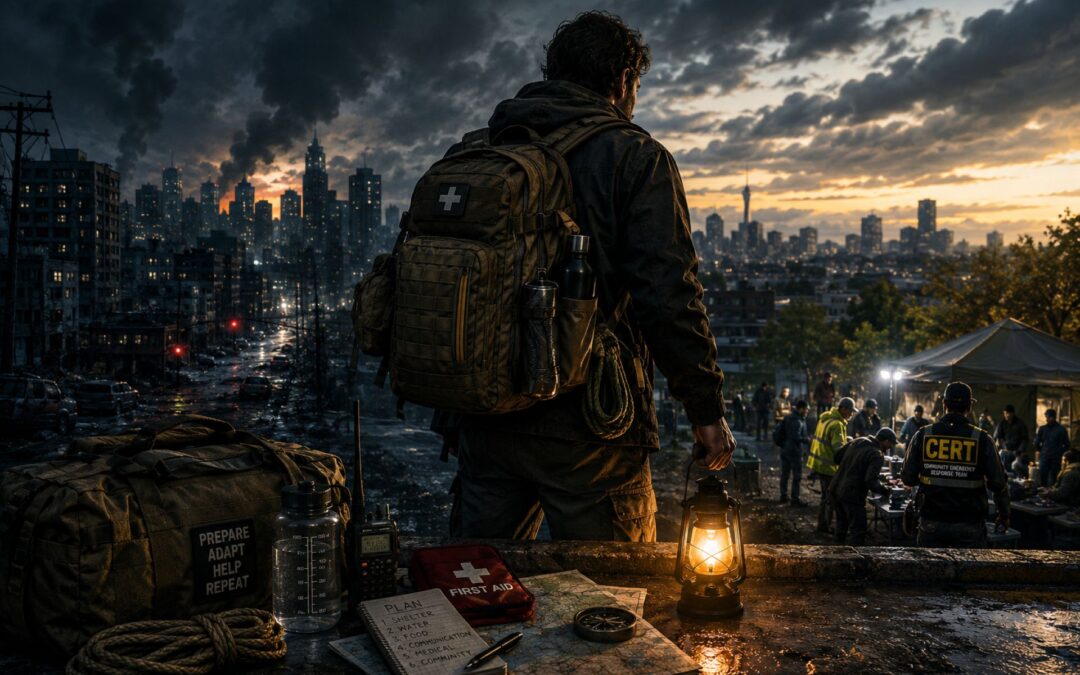
Neil Strauss begins Emergency: This Book Will Save Your Life with a problem that seems practical but is ultimately psychological. He has begun looking at ordinary life through what he calls “apocalypse eyes.” Airports become potential bombing sites, cities become systems that could stop functioning, political conflicts become precursors to social collapse, and conveniences such as electricity, supermarkets, telecommunications, hospitals, banking, and police protection suddenly look less like permanent features of civilization than arrangements that work only while the larger system continues working.
Strauss’s response is not to write abstractly about risk. He decides to change himself. Over several years, he investigates offshore banking and second citizenship, learns to shoot, trains in wilderness survival and tracking, studies urban escape and disaster response, tests himself by shutting off the systems that support his ordinary life, qualifies as an emergency medical technician, and joins an emergency-response organization. The project begins with a simple ambition: if everything goes wrong, he wants to be the person who gets away.
What makes Emergency more interesting than its sensational subtitle suggests is that Strauss gradually discovers that escape is not the same as security. A passport cannot teach him how to find water. A gun cannot make him calm. A stockpile cannot tell him whether he has prepared enough. Each solution reveals another vulnerability until the problem changes completely. The deeper story becomes one man’s movement from fear to escape, from escape to competence, and from competence to service.
This article follows the 2012 enhanced digital edition, which preserves the complete main narrative and adds a disaster-survival cheat sheet, Strauss’s bug-out-bag material, ten preparedness myths, and two chapters omitted from the original print version. It contains full spoilers, including Strauss’s second citizenship, the train-crash response, the final blackout, the epilogue, and the enhanced-edition material.

What Kind of Book Is Emergency?
Emergency was first published in 2009, after Strauss spent roughly three years immersing himself in survivalism, disaster preparedness, offshore planning, and emergency response. The author’s own description of the project presents it as an attempt to become self-sufficient after years of terrorism, war, hurricanes, economic uncertainty, and political anxiety convinced him that even a technologically sophisticated country could not guarantee his safety.
That makes the book sound like a survival manual, and it does contain a great deal of survival material. Yet its primary form is memoir and participatory narrative nonfiction. Strauss is less interested in systematically teaching every skill he acquires than in documenting what happens to him as he acquires them. Readers accompany him into cryonics facilities, offshore-finance seminars, firearms schools, wilderness programs, disaster-response classes, ambulance ride-alongs, and an actual mass-casualty emergency. The book is organized as a sequence of short numbered “Lessons,” but the real lesson is the cumulative change in Strauss himself.
Its most important structural division is contained in the titles of the final three main parts: Escape, Survive, and Rescue. At first Strauss thinks the problem is geographic. If America becomes dangerous, he needs somewhere else to go. Then he recognizes that reaching another country would mean little if he remains dependent on functioning infrastructure. He therefore tries to become capable of surviving without those systems. Finally, he discovers that personal capability changes his relationship to emergencies so radically that he no longer imagines catastrophe solely as something to escape. He begins imagining what he could do for other people.
The enhanced edition strengthens that movement. Its practical supplements reveal how far Strauss carried the preparedness project, while the restored permaculture chapter develops an idea that the shorter print narrative can only imply: individual self-sufficiency has severe limits, and durable resilience usually depends on networks, communities, division of labor, and reciprocal responsibility.
Strauss nevertheless does not become a simple evangelist for collective institutions. He keeps his backup citizenship, equipment, training, and emergency plans. The book’s final position is more complicated than either survivalist individualism or faith in the system. Strauss wants options, skills, and supplies, but he eventually understands that the purpose of preparedness is not to withdraw permanently from other people.
That distinction is crucial because Emergency can otherwise be misread in opposite directions. It is neither an uncomplicated endorsement of survivalism nor a book-length joke about paranoid people. Strauss takes systemic vulnerability seriously, gains skills he genuinely values, and retains many of his preparations. At the same time, his own story repeatedly exposes the psychological trap of preparing for every conceivable threat.
The Complete Story of Emergency
Strauss structures his transformation as a sequence of increasingly demanding encounters with risk. The early sections explain why he becomes frightened enough to build an escape plan, while the later sections test whether the things he has accumulated—documents, money, tools, training, credentials, relationships, and judgment—actually make him more capable. The resulting story is less a straight ascent toward mastery than a series of corrections in which every answer changes the question.
Orientation and Five Steps: How Fear Becomes a Plan
The book opens far ahead of its chronological beginning. Strauss receives an early-morning call from a survival instructor known as Mad Dog, who asks whether his axe and knife are sharp. Strauss knows what the question means: that day, as part of learning to procure and process his own food, he is supposed to kill a goat.
The contrast between his clothing and his temperament establishes the premise immediately. Strauss is carrying a pistol and knife and dressing like someone prepared for hard use in the outdoors, yet the previous night he could not bring himself to kill a fly. When he sees the goat, his discomfort becomes worse. The animal is gentle and domesticated, his girlfriend Katie becomes attached to it, and Strauss begins questioning whether learning to survive requires crossing moral boundaries that ordinary consumer life allows him to ignore.
Mad Dog gives him the brutal practical answer: meat already requires an animal to die. Industrial society simply separates the consumer from the act. Strauss understands the argument, but understanding does not eliminate the revulsion. The scene ends before the act itself and the book rewinds, leaving the goat as a promise that Strauss’s survival experiment will eventually require more than purchasing impressive equipment.
“A Brief Confession” then introduces the mental state that brought him there. Strauss has begun imagining the destruction hidden inside apparently permanent cities. He thinks of Hiroshima, Bosnia, Rwanda, Baghdad, New Orleans, ancient civilizations that disappeared, and all the ways a modern urban system could suddenly stop delivering the services on which its residents depend. He does not claim that catastrophe is certain. His anxiety comes from accepting that it is possible.
His own biography makes the problem worse. Strauss grew up without the skills associated with traditional self-sufficiency. His family did not hunt, farm, camp, repair machinery, or live close to the land. His adult expertise was equally specialized: as a journalist, he could navigate musicians, celebrities, interviews, publishing, and culture, but he could not necessarily build shelter, grow food, defend himself, treat an injury, or live without the infrastructure that made his professional life possible.
The first of the “Five Steps” begins on December 31, 1999. Strauss has been assigned to investigate potentially dangerous millennial groups as fears about Y2K peak. He speaks with people who believe the turn of the millennium could bring technological collapse, divine judgment, violence, or some combination of all three. At first, he approaches them as a journalist examining extremists from a safe distance.
Even here, however, the boundary between observer and participant begins to weaken. A childhood memory of serial killer John Wayne Gacy becomes part of Strauss’s larger lesson that normal appearances are unreliable. Dangerous people do not always identify themselves as dangerous, and ordinary surroundings cannot guarantee ordinary outcomes. The possibility of violent millennial groups therefore seems more troubling than eccentric theology alone would.
Strauss contacts apocalyptic Christians and other people preparing for the new year. Their certainty is often strange enough to invite ridicule, but he also starts quietly preparing. He acquires supplies and becomes more attentive to whether systems elsewhere in the world survive midnight. He does not fully believe the disaster predictions, yet he behaves differently because of them.
An invitation to Washington, D.C., changes where he spends New Year’s Eve. Rather than wait among survivalists, he attends the official millennium celebration around the White House and Lincoln Memorial. The setting initially appears to represent the opposite of fringe paranoia: political power, public ceremony, famous performers, government security, and confidence about the next American century.
Before the celebration, however, Strauss visits the United States Holocaust Memorial Museum. The visit reframes the entire Y2K assignment. A failed computer system suddenly seems trivial next to the fact that industrialized modern societies have repeatedly descended into organized mass violence. Strauss’s attention moves from whether the electricity will fail at midnight to a much more unsettling question: how quickly can the social contract fail?
The examples extend beyond Nazi Germany. He thinks about Stalinist terror, Cambodia, Rwanda, Bosnia, riots, racial violence, and other moments when neighbors, professionals, institutions, and governments became participants in brutality. What frightens Strauss is not only that such things happened. It is that they happened inside societies whose inhabitants had previously experienced everyday life as normal.
Midnight arrives without catastrophe. The lights remain on, systems keep functioning, and Strauss feels relieved that he did not surrender to millennial panic. Yet the security around the celebration leaves him with an irony he cannot ignore. The supposedly sensible people are also surrounded by armed protection, contingency plans, checkpoints, and escape routes. The survivalists were wrong about Y2K, but the broader idea that societies prepare for dangerous possibilities is hardly irrational.
Another thread enters through Strauss’s preoccupation with mortality. He remembers childhood attempts to bargain intellectually with death and confronts the obvious limit to every survival plan: no amount of preparation makes a human being immortal. The desire to survive therefore contains an impossible demand. Every successful precaution merely moves the encounter with death into the future.
The second major date comes in 2000, during travel that exposes Strauss to political hostility toward the United States. In Iran and Serbia, he encounters the apparent contradiction of people who dislike American power while consuming American entertainment and culture. More importantly, he hears arguments that American foreign policy has generated resentment and consequences that many Americans do not see from inside the country.
Looking back from the post-9/11 world, Strauss interprets his earlier confidence as part of the complacency of an American generation that assumed history’s worst convulsions belonged somewhere else. The possibility of “blowback” enlarges his conception of danger again. A threat no longer needs to originate with irrational outsiders who hate America for inexplicable reasons; it might also emerge from histories, interventions, grievances, and conflicts that his comfortable life allowed him to ignore.
September 11 transforms these abstractions into immediate action. Strauss begins contacting people, obtaining cash, considering routes, and gathering supplies. The attacks are followed by the anthrax scare, which extends the anxiety beyond airplanes and skyscrapers into mail, offices, biological agents, and invisible contamination.
One of the book’s most important early lessons comes from Strauss’s attempt to solve the problem by buying a gas mask. He discovers that protective equipment is only as useful as the knowledge behind it. Different hazards require different protection, equipment can be used incorrectly, filters have limitations, and possessing something that looks reassuring does not automatically produce safety.
That realization anticipates almost everything that follows. Strauss’s first instinct is to convert fear into ownership: buy the object that protects against the threat. The book repeatedly dismantles this impulse by showing that equipment without competence can provide psychological reassurance without corresponding capability.
The emotional origin of Strauss’s eventual escape plan lies even earlier, in a sixth-grade classroom. His teacher, Mrs. Kaufman, taught the Holocaust and explained how rapidly Jewish life in Europe could move from discrimination to exclusion, persecution, confiscation, entrapment, and mass murder. Strauss remembers asking the obvious childhood question: why did people not simply leave before matters became so terrible?
The answer stays with him. People rarely experience history with the clarity available in retrospect. They hope the situation will improve, remain attached to homes and communities, underestimate how much worse conditions can become, or discover that leaving has become difficult only after the need is obvious. Strauss takes from this a private rule: if his own country ever begins moving toward a condition he finds unacceptable, he wants to leave before everybody else realizes they should.
The 2004 presidential election becomes another psychological step. Strauss begins investigating emigration to places such as Australia and New Zealand and discovers that other Americans are asking similar questions. His concern is not simply partisan disappointment. He increasingly sees political polarization, security measures, foreign wars, and domestic changes as evidence that the country may be moving somewhere he does not want to follow.
During this period he also identifies something fundamental about himself. Under stress, Strauss says, he is “a runner.” Flight is not merely one strategy among others; it is his instinctive relationship to danger. Once he names it, the rest of the book can be read as an extended test of whether that identity is fixed.
Hurricane Katrina provides the fifth and decisive step. Strauss watches New Orleans flood and sees people stranded without water, shelter, transportation, sanitation, medical help, or immediate rescue. For him, Katrina destroys the comforting assumption that advanced institutions will necessarily reach everyone quickly when the scale of a disaster overwhelms normal operations.
The book reflects the casualty estimates circulating when Strauss wrote it, including the older figure of 1,836 deaths. Later official work substantially revised the total: the National Hurricane Center’s updated Katrina report gives 1,392 direct, indirect, and indeterminate fatalities. The correction does not change Katrina’s narrative function in Emergency. What matters to Strauss is seeing an American city experience a breakdown severe enough to leave residents dependent on their own preparations and on whatever assistance could reach them.
Economic fears reinforce the shock. At a launch event for The Game, Strauss hears predictions about financial instability and becomes increasingly receptive to the idea that political, economic, natural, and security crises could overlap. His five psychological steps are complete. The next problem is no longer whether he is worried. It is what a worried person should actually do.
Escape: Building a Backup Country
Part Three begins with the most extreme possible version of escape: avoiding death itself. Strauss visits the Alcor Life Extension Foundation in Arizona, where people have arranged for their bodies or brains to be preserved after legal death in the hope that future technology may eventually revive them. He sees James Bedford, the first person to undergo cryonic suspension, preserved in anticipation of a future that may never arrive.
Strauss does not turn Emergency into an argument for cryonics. The visit instead serves as an absurdly literal extension of his underlying desire. If the problem is death, perhaps one can simply outmaneuver death. If the problem is political collapse, perhaps one can outmaneuver nationality. The pattern is the same: find the loophole that allows an informed person to escape the condition everyone else accepts.
The cryonics world also introduces Strauss to new networks of unconventional thinkers. One contact leads eventually to Spencer Booth, a wealthy entrepreneur who becomes Strauss’s most important ally in the escape phase. Strauss formulates a principle from the encounter: persistence and social curiosity create opportunities because if he talks to enough people and follows enough clues, someone will eventually know the person or system he needs.
Spencer is valuable because he takes contingency planning seriously without looking like the stereotypical isolated survivalist. He belongs to a world of wealthy people for whom diversifying homes, jurisdictions, investments, transportation, and citizenship can be treated as an extension of ordinary financial planning. Strauss discovers that fear of systemic instability exists among billionaires and financiers as well as people with compounds in the woods.
The difference is resources. Wealth allows risk to be translated into options. A poor person may worry about evacuation; a rich person can consider a second residence, private transport, multiple currencies, international accounts, and residency rights. This social world expands Strauss’s imagination while quietly revealing one of the book’s limitations: the first version of his Plan B is available only to people with considerable money.
Spencer encourages long-term planning. Rather than react to each frightening headline, Strauss should construct a life with multiple possibilities. A backup country begins to look less like an emotional fantasy and more like a project that can be broken into legal, financial, geographic, and logistical problems.
Reading Paul Kennedy’s The Rise and Fall of the Great Powers deepens Strauss’s conviction that no dominant nation remains dominant forever. He becomes interested in historical “imperial overstretch,” declining powers, and the possibility that the United States may be entering a period of relative deterioration. Whether or not every political conclusion Strauss draws is convincing, the reading has a practical effect: he stops treating citizenship as an identity that must define his entire future.
A passport, in this new logic, becomes technology. It determines where a person may legally travel, live, work, enter, and sometimes conduct business. If governments use documents to regulate movement, then possessing more than one nationality may create options unavailable to somebody whose fate is tied to a single state.
Strauss travels to an offshore-finance conference in Puerto Vallarta. The event introduces him to people interested in financial privacy, asset protection, alternative jurisdictions, precious metals, overseas companies, tax planning, second passports, and the broader ideology of reducing dependence on any single government. Some participants treat state power not as a protective institution but as a threat from which wealth and personal freedom must be defended.
He explores the concept sometimes associated with the “permanent traveler”: arranging life across several countries so that no single jurisdiction controls every aspect of one’s finances, residence, citizenship, or business. The fantasy appeals perfectly to Strauss because it converts geopolitical anxiety into administrative engineering. Instead of asking whether America will decline, he can ask where his money, home, company, passport, and physical body should be located if it does.
He quickly discovers that the fantasy is cleaner than the law. U.S. citizenship creates obligations that cannot simply be wished away by moving abroad. Financial transactions leave records, banks require identification, governments exchange information, and international accounts create reporting obligations. Even in the mid-2000s, the offshore world is full of complexity, and Strauss’s attempt to become less dependent on bureaucracy requires him to become increasingly knowledgeable about bureaucracy.
The search for a second citizenship produces another set of possibilities. Strauss investigates ancestry, marriage, residence, conversion, parentage, and programs through which nationality may be acquired. Many theoretical shortcuts are irrelevant to him. He has no qualifying ancestry for several routes, does not want to restructure his life around lengthy residency, and is not going to manufacture family relationships merely to collect passports.
Money therefore becomes the most realistic path. Some countries offer forms of citizenship or residency linked to qualifying investment. Strauss’s attention eventually settles on St. Kitts and Nevis, where he believes he can obtain citizenship through an approved real-estate investment.
Before committing, however, the book gives him one of its most important counterarguments through Tomas, the assistant working in Strauss’s office. Tomas has gone through an elaborate process to obtain American citizenship and sees the United States not primarily as the country Strauss may need to escape but as a place worth considerable effort to enter.
The irony is obvious without becoming simplistic. Strauss has enough security to regard American nationality as one option among many; Tomas values that same nationality as protection, mobility, and opportunity. The scene does not prove Strauss’s fears are irrational, but it exposes how perspective and privilege shape what counts as a trap and what counts as freedom.
Strauss nevertheless continues. Reading Robert F. Kennedy’s account of the Cuban Missile Crisis reinforces his belief that large populations can approach catastrophe without knowing how close the danger came. He talks to family members about his contingency plan and offers to include them, only to discover that people he loves do not necessarily share his conclusions or want to reorganize their lives around his anxieties.
This creates a problem that will become central later. A survival plan designed around individual mobility may separate Strauss from the people whose survival supposedly motivates the plan. His desire to protect family collides with their right not to participate.
In St. Kitts, Strauss meets lawyer Maxwell Webb and begins the citizenship process. The plan involves purchasing qualifying property, assembling records, undergoing scrutiny, arranging financing, and trusting a bureaucratic procedure in another country. Strauss has come looking for an escape from institutional dependence and finds himself filling out more forms.
The island itself slowly becomes more than an abstract jurisdiction. Strauss learns about its colonial history, social life, Carnival, local rhythms, property market, and expatriate community. The more real St. Kitts becomes, the more complicated his fantasy of a neutral refuge appears. He is not buying a square on a geopolitical board; he is entering a country with its own history, laws, inequalities, people, and interests.
The process also becomes expensive and uncertain. Additional demands and delays make Strauss wonder whether he is being manipulated. Yet he has already invested enough money, time, and emotional energy that abandoning the project becomes difficult. Fear creates sunk costs just as easily as any other obsession.
As he waits, the larger conceptual weakness of the passport project becomes harder to ignore. Citizenship may permit him to enter St. Kitts, but it cannot guarantee that airports are functioning, that flights are available, that borders remain open, or that he can reach the island during the very kind of crisis for which he wants it. Even if he arrives, legal status will not supply water, medical care, food, electricity, or practical competence.
A blackout in his St. Kitts apartment finally turns that realization into experience. The systems around him stop working, and Strauss confronts the humiliating simplicity of the problem. His expensive Plan B has delivered him to another country without teaching him what to do when basic infrastructure fails.
The passport is not useless. It is simply not sufficient.
That distinction sends Emergency into its second major transformation. Strauss has spent Part Three trying to make geography safe. Part Four asks whether the person standing inside that geography is capable of surviving there.
Survive: From Buying Security to Building Competence
Strauss now begins investigating people who have spent their lives preparing for exactly the kind of breakdown he fears. He encounters the vocabulary of survivalism: bugging in, bugging out, bug-out bags, escape vehicles, survival retreats, caches, shelters, food storage, weapons, communications, and systems designed to function when normal infrastructure does not.
The history and culture are not politically neutral. One of Strauss’s early contacts is Kurt Saxon, a prominent survivalist writer with an extremist and racist past. Strauss is repelled by much of Saxon’s worldview but interested in his knowledge. The encounter establishes an uncomfortable question that runs through the whole survival section: can useful technical knowledge be separated cleanly from the ideology of the person teaching it?
Strauss refuses simply to endorse Saxon, but neither does he dismiss every practical observation because of its source. This makes the episode more disturbing than a caricature would. Survivalism contains people whose preparation may be competent while their picture of society is ugly, exclusionary, conspiratorial, or violent.
Strauss’s own gear is another problem. He already owns a firearm, but possessing it has not made him skilled with it. The gap resembles the gas-mask lesson: ownership can become a substitute for training. He therefore travels to Gunsite Academy in Arizona for formal instruction.
The firearms material is less important for its tactical details than for what happens to Strauss’s identity. He enters a culture he once regarded from the outside and discovers that structured training demands discipline, repetition, safety procedures, judgment, and emotional control. The gun ceases to be a magic object that makes him protected merely because he owns it.
At the same time, the experience demonstrates how preparedness changes perception. The more Strauss trains for violent encounters, the more ordinary spaces can be interpreted in terms of potential threats, cover, escape, and confrontation. Skill reduces one kind of fear while supplying a vocabulary through which even more scenarios can be imagined.
His investigations expand into transportation. Living in Los Angeles creates an obvious problem: if millions of residents decide to flee simultaneously, roads may become useless. Strauss considers motorcycles, aircraft, unusual vehicles, and other ways of escaping congestion. He is trying to engineer around every bottleneck.
Motorcycle training then produces one of the book’s best corrective moments. Strauss injures himself preparing for a hypothetical emergency. The irony is impossible to miss. A person can increase exposure to ordinary danger while attempting to reduce exposure to extraordinary danger.
This is the first major sign that preparedness cannot be evaluated by asking only whether a technique might someday help. Every preparation carries costs—money, time, risk, attention, relationship strain, and sometimes physical injury. Rational preparedness therefore requires choosing among risks rather than eliminating risk itself.
The Community Emergency Response Team program changes the direction of Strauss’s education. CERT teaches civilians basic disaster preparedness and response so that communities have additional trained capacity when professional services are overwhelmed or delayed. The institutional logic remains visible in FEMA’s CERT Basic Training material: citizens learn skills intended to help meet immediate community needs after disasters when normal emergency services may not be immediately available.
Strauss enters CERT partly because it offers useful skills, information, credentials, and a better understanding of how public response actually works. He learns about disaster organization, basic triage, fire safety, hazards, search and rescue, and the priorities that govern emergency action.
The surprising lesson is contained in the program’s first word: community. Strauss has been building an individual escape plan. CERT assumes that preparedness is inherently social. A neighborhood containing people who know what to do is safer than an equally well-stocked neighborhood in which everyone acts alone.
Further training exposes Strauss to simulations that require organization rather than solitary improvisation. A disaster is not merely a contest between an individual and nature. It produces multiple injured people, damaged structures, uncertain information, limited resources, competing priorities, and the need to coordinate.
This leads Strauss to reduce survival to a more basic hierarchy. Many dramatic fantasies become irrelevant if a person cannot secure water, shelter, food, warmth, sanitation, or medical care. The glamorous image of the armed survivalist gives way to problems as simple as dehydration, exposure, infection, and loss of utilities.
Wanting deeper practical competence, Strauss investigates military survival programs but discovers that systems designed for military personnel are not simply civilian courses waiting to be purchased. He instead attends the Tracker School founded by Tom Brown Jr., one of the best-known figures in wilderness tracking and survival education.
Strauss arrives expecting expertise and encounters a culture that initially makes him uncomfortable. Brown is charismatic, revered by devoted students, intensely critical of modern life, and surrounded by stories that Strauss does not always know how to evaluate. Strauss’s instinct is increasingly different from the one that drove him toward offshore gurus: he no longer assumes that confidence proves authority.
The physical experience of wilderness training is harder to dismiss. Strauss is cold, wet, exhausted, uncomfortable, and confronted with how thoroughly city life has protected him from basic environmental conditions. Knowledge that looks manageable in a book becomes different when his body is tired and the weather refuses to cooperate.
This humiliation is useful. Survival ceases to be an identity he can purchase and becomes something his body has to learn. The gap between knowing that fire is important and making fire when cold, between understanding shelter conceptually and needing it in bad weather, or between recognizing food theoretically and identifying it safely in the wild is the gap between information and competence.
Losing his BlackBerry during the experience becomes symbolically convenient. The device represents the networked world Strauss depends on for contacts, information, logistics, entertainment, and work. Without it, he is pushed further into a landscape he once experienced mainly as inconvenience or threat.
Tracking changes his relationship to that landscape. Strauss learns to notice signs he previously could not read. Footprints, disturbed vegetation, animal movement, water, plants, weather, and terrain begin carrying information. The forest becomes less frightening not because it becomes safer but because it becomes more legible.
That transformation matters throughout Emergency. Fear often flourishes where Strauss perceives dependence combined with ignorance. Every real skill reduces a portion of that ignorance. The psychological benefit of training therefore does not depend on the apocalypse arriving.
Back in California, Strauss intensifies his education with Mad Dog, a knife-maker and survival instructor whose personality is almost a parody of the hard, self-reliant masculinity Strauss feels he lacks. Mad Dog can build, forge, hunt, butcher, repair, improvise, and confront physical tasks without the hesitation that defines Strauss at the beginning of the book.
Strauss practices with tools and reorganizes more of his life around training. Katie increasingly sees the downside. From her perspective, ordinary domestic space is being colonized by weapons, contingency equipment, survival projects, and a constant orientation toward things going wrong.
The goat episode now returns. Mad Dog brings Strauss a live goat and tells him he must kill and butcher it if he wants to understand what obtaining meat independently actually entails. Strauss’s earlier discomfort has not disappeared.
The animal’s gentleness makes the task worse. Katie names it Bettie, turning Strauss’s attempt at emotional distance into something more intimate. He tries to rationalize the act through the same logic Mad Dog uses: if Strauss eats meat from a supermarket, animals already die for him. The difference is that industrial systems hide the killing from the consumer.
Strauss eventually kills the goat, processes the carcass, and eats the meat. The scene demonstrates competence, but it is not presented as an uncomplicated triumph. Katie’s observation that the animal trusted him leaves a moral wound the practical lesson cannot erase.
This is one reason the goat functions as more than stunt journalism. Strauss has wanted to remove intermediaries between himself and survival. The goat shows what happens when an intermediary disappears. Self-sufficiency can mean taking direct responsibility for acts that modern specialization normally performs somewhere else.
Strauss continues learning fire-making, water acquisition, shelter, food procurement, first aid, physical conditioning, navigation, and related survival skills. His body changes. His confidence grows. Problems that once looked mysterious become tasks with procedures.
Christopher Nyerges expands his ability to identify edible plants and useful resources in the landscape. Strauss becomes increasingly aware that his old urban worldview divided the environment into things sold for consumption and things that were merely scenery. Survival knowledge reveals resources where he previously saw weeds, dirt, wood, and empty space.
Yet competence generates another paradox. Every teacher reveals another domain he has not mastered. Learning to find wild food suggests he should understand plants better; learning first aid suggests deeper medicine; learning escape suggests navigation; learning communications suggests radio; learning firearms suggests tactics; learning shelter suggests construction. Preparedness has no obvious endpoint.
Strauss’s home begins becoming a laboratory for this escalating knowledge. Supplies accumulate. Gear is organized. Skills are practiced. He thinks about food storage, water, power, communication, transportation, and what would happen if services fail for days, weeks, or longer.
The project also becomes more specifically urban. Many classic survival skills assume wilderness, but Strauss lives in Los Angeles. A collapsed city presents problems that a forest does not: buildings, roads, crowds, official barriers, damaged infrastructure, social conflict, surveillance, vehicles, communications systems, and millions of other people seeking the same resources.
Training with Kevin Reeve therefore focuses on urban escape, improvisation, awareness, and the ability to move through an environment under pressure. Strauss learns to think of cities less as fixed systems and more as collections of resources, routes, people, obstacles, and opportunities.
Some exercises involve evasion, disguise, restraint escape, or other operational techniques that are less important than the larger lesson. Strauss has previously imagined survival as the possession of enough objects. Urban training emphasizes adaptability: the ability to solve a problem with what is actually available.
It also reinforces the importance of people. A person alone has only his own knowledge and supplies. Someone with a network may gain transportation, information, shelter, tools, expertise, communication, and access that no backpack could contain.
Strauss eventually stages two examinations designed to answer whether his preparations function outside training.
The first is a shelter-in-place test. Tomas unexpectedly initiates the exercise so Strauss cannot optimize the timing. Strauss cuts himself off from ordinary utilities and attempts to live from the systems and supplies he has built.
The result is neither disaster nor effortless success. Much of his preparation works, but inconveniences and overlooked dependencies appear immediately. Small assumptions become visible only when he removes electricity, water, or other services from the background of life.
That is the value of the test. Checklists tend to represent emergencies as inventories: have water, have food, have a light, have a radio. Living through even a simulation reveals relationships among those objects. Food may require preparation; equipment needs power; waste must go somewhere; water is needed for more than drinking; temperature changes; boredom matters; information matters; supplies are useful only if accessible.
The second examination requires Strauss to bug out. He leaves the support of his normal home and tries to function from his portable preparations and acquired skills. Again, he performs far better than the untrained man introduced at the beginning of the book.
But successful simulation exposes the final weakness of Part Four. Strauss knows it is a test. No one he loves is dying. The city is not actually collapsing. Nobody is shooting at him. Help remains available outside the artificial boundaries of the exercise.
He has acquired skill, but he still does not know who he will be in a real emergency.
That question takes the book into its final phase.
Rescue: From Lone Wolf to Emergency Responder
Strauss begins Part Five by learning more about the systems responsible for managing real emergencies. Earlier he tended to speak of “the government” as though it were one centralized apparatus that either works or fails. Training exposes him to something much more complicated: layers of agencies, responders, jurisdictions, communications systems, command structures, protocols, volunteers, hospitals, police, firefighters, emergency managers, and specialized teams.
The National Incident Management System becomes particularly important because it provides a shared structure through which otherwise separate organizations can coordinate. This part of the book has aged better institutionally than some of Strauss’s political commentary. The National Incident Management System remains an active framework used across government, nongovernmental organizations, and the private sector to coordinate prevention, mitigation, response, and recovery.
Strauss is impressed by the logic of the system without becoming naïve about it. Katrina has already demonstrated that plans, agencies, and resources can fail under pressure. What changes is his belief that institutional imperfection makes institutions irrelevant.
At the same time, the 2008 financial crisis appears to vindicate some of the catastrophe talk that once belonged largely to survivalist circles. Major financial institutions fail or require rescue, housing values collapse, unemployment rises, debt becomes more frightening, and economic anxiety becomes mainstream.
Spencer continues escalating his contingency thinking. The important pattern is no longer whether any individual fear is plausible. It is that every contingency generates another contingency. If banks are risky, diversify banks. If currencies are risky, diversify currencies. If governments are risky, diversify citizenship. If countries are risky, acquire property elsewhere. If property is risky, consider transportation, remoteness, or even more extreme alternatives.
Strauss realizes the logic has no natural stopping point. Absolute security would require absolute control over an uncontrollable world.
A conversation with Leonard Cohen helps redirect him. Cohen asks a different kind of question: what happens to the spirit while a person spends his life protecting the body? The concern is not whether survival skills are useful but whether preparing to live has displaced living.
This is the moment when Strauss’s problem begins moving from preparedness to purpose. He has learned enough to perform increasingly elaborate simulations. What he lacks is meaningful exposure to emergencies involving people who genuinely need help.
Emergency medical technician training provides that exposure. The textbook is enormous because bodies fail in countless ordinary ways. Strauss studies trauma, illness, assessment, anatomy, stabilization, transportation, childbirth, psychiatric crises, environmental emergencies, and the chaotic variety of conditions to which ambulances respond.
The material changes his understanding of danger. For years he has imagined spectacular events: terrorism, war, collapse, riots, biological attacks, economic breakdown. EMT training confronts him with the fact that people die every day from car crashes, medical emergencies, falls, violence, heart disease, accidents, and events too ordinary to inspire a survivalist conference.
His risk perception begins rebalancing. The catastrophic possibilities were never imaginary simply because they were rare, but rarity matters. A life organized entirely around the most vivid imaginable disaster may neglect the mundane hazards statistically more likely to matter.
Ride-alongs put Strauss in an ambulance. Initially he expects dramatic emergencies and instead encounters ordinary calls—elderly patients, minor injuries, psychiatric cases, and people whose crises do not resemble the apocalypse. The anticlimax is educational because it strips rescue of cinematic glamour.
Helping actual patients feels different from rehearsing how to escape imaginary enemies. The skills are no longer evidence that Strauss can protect himself. They are useful because another person is frightened, injured, confused, or ill.
Meanwhile, news arrives that the St. Kitts citizenship process is finally moving toward completion. The achievement once represented the climax of Strauss’s entire plan. Now it arrives while a different identity is forming.
Strauss learns about the California Emergency Mobile Patrol, C.E.M.P., a volunteer search-and-rescue organization working in support of Los Angeles police and fire agencies. Joining offers exactly what he once wanted—training, emergency access, knowledge of response systems, communications, practical experience—but the meaning has inverted. Instead of obtaining access so he can get himself through a roadblock and flee, he is joining the people who may be called beyond the roadblock because others need assistance.
The organization also gives Strauss a hierarchy of responsibility that resolves much of the individual-versus-community problem. His first duty during a disaster remains to himself and the people closest to him. Once they are safe, responsibility expands outward to neighbors and then to the team.
This is not self-sacrifice as an alternative to self-reliance. It is self-reliance as the condition that makes wider responsibility possible.
Strauss acquires a ham radio and begins learning emergency communications. The choice has obvious survival value: if ordinary telephone networks fail or become overwhelmed, radio networks may provide information and coordination. Yet the deeper change is again relational. Communication equipment matters because it connects him to other people.
An earthquake eventually tests his new response pattern. Earlier in the book, an unexpected event would have sent Strauss immediately into escape planning. Now he follows priorities. He checks himself, contacts Katie, checks his immediate surroundings, and asks whether C.E.M.P. needs him.
The event is not catastrophic, but Strauss notices something significant: knowledge produces calm. Instead of consuming the entire emergency as a story about what could happen next, he can ask what has happened and what needs to be done.
Katie’s experience learning to drive becomes a quieter parallel to Strauss’s transformation. Driving initially frightens her because the vehicle feels powerful and dangerous. Once she earns a license and begins using the skill, her world expands. She can reach school, interviews, appointments, and other places without depending on someone else.
For Katie, self-reliance is not a fantasy of escaping civilization. It is freedom to participate in ordinary civilization more fully. Her experience gives Strauss a less dramatic model of what useful preparedness looks like: learn the thing that once made you helpless, then use the competence to live more rather than fear more.
Strauss faces a similar choice when obtaining the credentials necessary to work more fully as an EMT. Earlier, he resisted fingerprints and official records because he valued privacy and imagined future government abuse. Now he accepts the tradeoff.
This marks one of his clearest ideological reversals. The possibility of a dystopian future has not disappeared, but it no longer outweighs the immediate value of being capable of helping people. Preparation based on remote possibilities has finally yielded to judgment about present reality.
Then the real examination arrives.
On September 12, 2008, a Metrolink commuter train collides with a freight train in Chatsworth, Los Angeles. Strauss receives a C.E.M.P. call and responds to what becomes one of the largest disasters he has encountered since moving to the city.
The psychological significance is immediate. The man who spent years learning how to get away from catastrophes is driving toward one.
The scene lacks the controlled boundaries of his earlier exercises. People have been killed and badly injured. Emergency organizations are active. Roads are restricted. Information changes. The scale exceeds anything Strauss could create for himself as a test.
His preparation now functions as part of a larger system. The badge, equipment, medical knowledge, radio experience, team structure, emergency protocols, relationships, and hours of training are valuable not because they make him sovereign but because they make him useful.
Afterward, Strauss notices that something fundamental has shifted. He no longer thinks of C.E.M.P. as a clever way to gain access, accumulate credentials, experience stress, or improve his odds during a future collapse. He thinks about what he would do if he were first at the scene of the next crash.
Ordinary sounds begin triggering a new readiness. When he hears brakes screech outside his home, he is prepared to grab his medical kit and run toward the street if the sound is followed by impact. The “runner” identity has not disappeared in the sense that Strauss has become fearless. Its direction has changed.
The St. Kitts project finally reaches completion around the same period. Spencer receives his passport, and Strauss later returns to the island to finish the process. The document that once represented salvation now feels different before Strauss even holds it.
He has spent so long becoming capable that nationality no longer carries the same psychological weight. He still wants the passport. He still values an apartment in St. Kitts, geographic diversity, mobility, and the legal option to live elsewhere. But he no longer believes the booklet itself makes him safe.
Strauss even begins thinking about how his emergency knowledge could contribute to St. Kitts rather than merely how St. Kitts could protect him. The change completes the inversion of Part Three. A country that began as a refuge from other people becomes another community in which he might have obligations.
When his passport finally arrives, Strauss is delighted. He can legitimately identify himself as both American and Kittitian, and the achievement creates opportunities beyond emergency escape. Yet he explicitly recognizes that the second citizenship has changed from something he feels he desperately needs into something he wants.
That difference measures his psychological progress more accurately than the passport itself.
The final numbered lesson occurs in St. Kitts on the night of the 2008 U.S. presidential election. Strauss, Katie, Spencer, and hundreds of local residents are watching the returns when the electricity suddenly fails.
The scene deliberately repeats the earlier St. Kitts blackout that destroyed Strauss’s confidence in the passport plan. The external event is essentially the same: the lights go out and infrastructure stops working.
Strauss, however, is not the same person.
He has a flashlight. He knows what resources are available. His apartment has backup power. He has experience, supplies, relationships, communication skills, medical training, and the habit of solving practical problems rather than immediately imagining the entire civilization collapsing.
The group discovers another nearby place with a generator and continues watching the election. The emergency becomes an inconvenience rather than a psychological catastrophe.
Strauss’s final conclusion is not that preparation prevents bad things from happening. It is that preparation can change his own response when they do. The real payoff of the preceding years is peace of mind produced by competence.
He also rejects hope when hope means passive dependence on somebody else fixing the situation. The book’s preferred alternative is action. Strauss remains in Los Angeles much of the time, participates in search and rescue, trains in emergency communications, works as an EMT, practices with CERT, and continues maintaining practical skills.
The survivalist who wanted to run away from catastrophe has become a responder who wants to remain useful when catastrophe arrives.
The epilogue strips even that transformation of any fantasy that competence conquers death. C.E.M.P. is called after a nineteen-year-old woman is struck and killed by an SUV while crossing a street. There is no war, hurricane, terrorist attack, riot, financial collapse, or government breakdown.
There is simply an ordinary day that becomes the last day of someone’s life.
The placement is essential. Strauss spent years preparing for spectacular dangers, but mortality does not require spectacle. Skills can improve odds, reduce helplessness, and sometimes save lives. They cannot turn the world into a place where tragedy follows rules.
What the Enhanced Edition Adds
The enhanced edition extends Emergency in two directions. Some material turns the memoir into a more explicit reference guide, while the restored chapters reveal ideas and ethical complications that the main narrative compresses.
“Extra Credit” first clarifies how much material Strauss left outside the narrative. He thanks additional instructors and identifies other training that could not be accommodated without making an already sprawling experiment even larger. More importantly for evaluating the book as memoir, Strauss discloses that identifying characteristics of some people were changed, two characters are composites, and some events were rearranged to improve narrative continuity.
The “Disaster Survival Cheat Sheet” gathers Strauss’s notes into short responses to dozens of emergency scenarios. It covers serious events such as floods, storms, disease outbreaks, injuries, extreme temperatures, earthquakes, fires, and attacks alongside deliberately comic possibilities. The section is useful for understanding how completely Strauss converted experience into procedures, but it should not be treated as an authoritative 2026 emergency manual.
“The Bug-Out Bag” does something similar with equipment. Strauss lists a large emergency pack and a smaller portable kit containing food, water-related tools, first-aid supplies, clothing, navigation equipment, communications gear, fire-making supplies, documents, tools, hygiene materials, and many other items. The obsessive specificity demonstrates the material side of his preparedness project better than any abstract discussion could.
The list also reveals the weakness of equipment-centered thinking. A person could spend indefinitely refining the contents of a bag because every new scenario suggests another useful object. Portability eventually conflicts with comprehensiveness, items expire, medical knowledge matters more than possession of unfamiliar equipment, and some specialized tools create legal or safety issues of their own.
“Ten Emergency-Preparedness Myths That Can Kill You” addresses advice Strauss believes people often absorb from movies, television, folklore, or the internet. The larger principle remains sensible: survival folklore should not be trusted merely because it sounds memorable. Some specific recommendations in the 2012 material, however, have aged or differ from current authoritative guidance, making the section a strong example of why preparedness information requires periodic updating.
The first deleted chapter, presented jokingly as “The Lost Chapter?”, is more troubling. Strauss describes an experiment in which he may or may not have constructed a false Canadian identity using the records of a child who died young. The deliberately evasive phrasing becomes a literary device that allows him to narrate the experiment while emphasizing its legal and moral danger.
The procedural details are not the important part. What matters is that Strauss’s survival logic has taken him to a point where fear of hypothetical future government action helps him rationalize abusing the identity of a real dead child and potentially hurting a family that already suffered a loss.
He ends the chapter with regret and an apology. The conclusion is simple: he should have trusted the legitimate process already underway in St. Kitts rather than crossing that boundary. The experiment therefore functions as one of the clearest examples of preparedness becoming ethically corrosive when the imagined emergency is permitted to justify present wrongdoing.
The second restored chapter is intellectually more important to the book as a whole. It expands Strauss’s encounter with permaculture after edible-plant training with Christopher Nyerges. A participant resists the label “survivalist” because he associates conventional survivalism with hoarding, weapons, selfishness, and an us-versus-them mentality. He is instead interested in communities trying to build sustainable systems before a crisis arrives.
Strauss visits permaculture practitioners and examines ideas about food production, waste, soil, energy, water, local resilience, resource cycles, and communities organized around reduced dependence on large external systems. Some participants are motivated by peak-oil fears or ecological collapse scenarios that Strauss does not automatically accept, but their solution fascinates him because it differs from the survivalist model.
The traditional survivalist prepares individually for a system that may fail. The permaculturist tries to build a different local system now.
Strauss remains skeptical of some environmental rhetoric and develops his own provocative argument about humanity, nature, ecological damage, and the distinction between what is “unnatural” and what is harmful to human beings. Not every philosophical leap is convincing, but the chapter’s most important discovery comes elsewhere.
Self-sufficiency is almost always overstated.
A person may grow food but still need medicine. Someone may know medicine but need builders. A farmer may require tools, seeds, transport, knowledge, protection, water, labor, or communication. Even a highly skilled individual has finite time and cannot master every function performed by a complex society.
The serious alternative to dependence is therefore not complete independence. It is more resilient interdependence.
That restored material makes the final “Rescue” section feel less like an abrupt moral conversion. Strauss’s path toward community has already been developing through CERT, foraging networks, teachers, neighbors, communication systems, and encounters with people trying to organize resilience collectively. The permaculture chapter simply makes the insight explicit.
Neil Strauss: From Runner to Rescuer
Strauss is both narrator and principal character, and Emergency works only if those roles are separated mentally. The narrator already knows what the younger Strauss will become. The character inside the early chapters does not. His journey therefore has the clean shape of memoir even when the lived experience must have been messier.
The starting condition is not cowardice in any simple sense. Strauss has already traveled widely, entered unusual social environments, worked as a journalist, and taken professional risks. His weakness is a specific kind of dependence: when confronted with physical, infrastructural, medical, or violent danger, he assumes somebody else must possess the competence he lacks.
Calling himself a “runner” captures the psychological pattern. Strauss’s instinct is to preserve optionality and avoid entrapment. The same trait can be adaptive or dysfunctional depending on context. Leaving a genuinely dangerous situation early may be intelligent; organizing an entire life around always having somewhere else to flee can become another form of captivity.
His first response to fear is informational. Strauss reads, interviews, investigates, and follows networks of experts. This is his existing professional strength, and it lets him enter survivalism more effectively than somebody who begins with no research skills.
The problem is that information initially becomes a mechanism for generating more fear. Every book reveals another historical collapse. Every instructor describes another vulnerability. Every seminar introduces another way governments, markets, infrastructure, or social order could fail. Strauss’s intelligence allows him to imagine scenarios faster than he can secure himself against them.
Money creates the second response. If systems are unreliable, Strauss can purchase redundancy: property, citizenship, equipment, training, supplies, accounts, transport, and tools. This materially improves his options, but it also encourages the belief that every insecurity can be converted into another acquisition.
The St. Kitts blackout proves otherwise because what Strauss lacks in that moment cannot be bought quickly enough. He lacks a practiced relationship to systems failure. The realization pushes him from consumer to student.
The transformation accelerates when training becomes embodied. Shooting, riding, tracking, shelter-building, fire-making, foraging, first aid, radio, emergency medicine, and disaster response require repetition. Strauss begins inhabiting his body differently because competence is no longer merely something he knows exists in another person.
A contemporary Los Angeles Times profile of Strauss captured the incongruity that gives the memoir much of its energy: the slight, intellectual music journalist had become someone who killed and butchered a goat, stored emergency supplies, learned firearms, planned escape routes, and continued acquiring practical skills. The transformation is visually comic because Strauss never fits the archetype he is trying to inhabit.
That mismatch is also one of the book’s strengths. Strauss does not begin with a lifelong fantasy of being a rugged outdoorsman. He begins as exactly the sort of highly specialized urban professional who benefits enormously from civilization’s division of labor. His incompetence makes the learning process visible.
Yet becoming more capable does not automatically make him wiser. The goat, the motorcycle injury, the offshore obsession, and the false-identity experiment show that competence can coexist with poor judgment. A person can learn more skills while allowing fear to distort the purposes for which those skills are used.
Strauss’s deepest development therefore occurs after he has become impressive by the standards that once fascinated him. By the end of Part Four, he has already accumulated an extraordinary catalogue of capabilities. If Emergency were a conventional self-improvement book, that would be the triumphant ending.
Instead, Part Five asks whether any of those accomplishments have solved the original problem. Strauss can imagine one more emergency after every course. He can always buy another object, learn another skill, or construct another fallback. Preparation has increased confidence, but the search for final security remains impossible.
The train crash becomes decisive because it gives his skills a purpose that does not depend on making Strauss invulnerable. In a real emergency, nobody asks whether he has mastered every possible contingency. There are simply tasks that need doing.
That changes the emotional economy of preparedness. A skill no longer needs to eliminate Strauss’s fear in order to justify the time spent learning it. It can be valuable because it makes him useful.
The late chapters therefore transform his identity without pretending fear disappears. Strauss still owns equipment, maintains plans, travels, thinks about risk, and keeps his second citizenship. He has not converted into a person who believes institutions will always work or that nothing terrible can happen.
What changes is his default relationship to uncertainty. Earlier, uncertainty creates a question about escape. Later, it creates a question about response.
That difference explains why the two St. Kitts blackouts are such an effective framing device. The first reveals helplessness behind expensive preparedness. The second reveals composure created by practiced capability.
Strauss’s transformation is not from frightened to fearless. It is from frightened and dependent to frightened but functional.
That is a much more credible achievement.
The People Who Change His Idea of Survival
Strauss presents self-reliance as something he deliberately acquires, but almost every important improvement comes through another person. Teachers, partners, volunteers, professionals, bureaucrats, survivalists, wealthy friends, medics, police officers, radio operators, naturalists, and neighbors all supply knowledge he could not generate alone. The apparent story of independence is therefore built from dependence on increasingly useful relationships.
That contradiction is not a flaw in the memoir. It is one of its most important discoveries. Strauss becomes more self-reliant by learning whom to trust, what expertise to seek, when to cooperate, and how to become useful enough that other capable people will also trust him.
Katie: The Cost of Obsession and the Meaning of Everyday Life
Katie functions as the most important domestic counterweight to Strauss’s catastrophe logic. She does not need to defeat every argument about terrorism, government power, financial instability, or disaster in order to challenge him. She simply experiences the cost of living with someone whose attention is increasingly organized around emergencies.
Weapons, tools, supplies, courses, practice, plans, and hypothetical disasters enter their daily life. From Strauss’s perspective, each object has a rational explanation. From Katie’s perspective, the accumulation can make ordinary life feel increasingly shaped by events that have not happened.
The goat scene makes her moral role especially clear. Strauss tries to understand the animal as a protein source because that framing makes the survival lesson possible. Katie names it. By doing so, she forces the ethical relationship back into the scene.
Her observation that the goat trusted Strauss is more difficult to answer than Mad Dog’s argument about the food chain. Both claims can be true. Eating meat implicates consumers in killing, but direct responsibility can still generate moral questions that industrial distance normally obscures.
Katie’s later struggle to learn driving provides the more constructive side of her function. She fears driving, practices, fails tests, keeps trying, qualifies, and discovers that the skill expands her independence. The pattern resembles Strauss’s own transformation but without apocalyptic ideology.
She does not learn to drive so she can escape civilization. She learns so she can participate in life more freely.
That comparison quietly redefines self-reliance. The value of a skill is not proportional to the drama of the scenario in which it might be used. A mundane competence that enlarges daily life can be more valuable than an exotic technique reserved for catastrophe.
Katie also gives Strauss something his survival teachers rarely provide: a reason to ask what survival is for. A life in which he has perfectly secured himself but alienated the people he loves would represent a strange form of success.
Her presence keeps pulling the book from the abstract future back into the lived present.
Spencer Booth: Wealth, Exit, and the Logic of Plan B
Spencer is the person who most validates Strauss’s early escape project. He demonstrates that sophisticated, wealthy people also think about geopolitical and economic risk, and he treats contingency planning as strategy rather than embarrassment. This matters enormously to Strauss because it removes survival planning from the cultural world of fringe bunkers and places it inside the world of high-level entrepreneurship.
Spencer’s central idea is optionality. Do not allow a single country, institution, asset, currency, or plan to determine your future if you can build alternatives. This is a reasonable principle in limited form and closely resembles ordinary diversification.
The problem is scale. Once uncertainty becomes the enemy, diversification can expand without limit. A second residence suggests a second citizenship; financial risk suggests multiple jurisdictions; political risk suggests transportation; geographic risk suggests remoteness; infrastructure risk suggests independent systems.
Spencer therefore embodies both the intelligence and the absurdity of Plan B. His resources genuinely permit forms of resilience that most people cannot afford. At the same time, those resources make ever more elaborate solutions imaginable.
His presence exposes the class dimension running through Emergency. Strauss can spend substantial money experimenting with mobility, courses, equipment, property, and international planning. A reader living paycheck to paycheck cannot copy the literal journey.
That does not make the psychological story irrelevant, but it changes which lessons can reasonably be generalized. Learning first aid is broadly available. Buying foreign property is not.
Spencer also never completely disappears from the ending. Strauss does not triumph by proving his friend foolish. Instead, Spencer eventually receives his St. Kitts passport too, and both men retain the options they created.
The distinction is one of emphasis. Strauss stops expecting the option to answer every fear.
The Survival Teachers: Skill, Authority, and Ambivalence
Strauss meets enough teachers that they form a secondary cast representing different philosophies of competence. Some are professional instructors, some survivalist personalities, some naturalists, and some people whose politics or personal myths make their knowledge difficult to evaluate.
Kurt Saxon represents the most obvious problem. His extremist and racist background prevents Strauss from treating him as a neutral practical authority. Yet Saxon’s presence forces the uncomfortable recognition that technical competence and moral character are separate dimensions.
Knowing how to preserve food, build something, or survive hardship does not make a person’s politics wise. Conversely, despising someone’s politics does not automatically falsify every factual skill that person possesses.
The challenge is epistemic judgment. Strauss has to learn how to extract testable knowledge without inheriting an entire worldview.
Gunsite offers a more institutional form of expertise. Strauss enters expecting firearms culture and finds structured training built around repetition, safety, control, and performance under pressure. The value lies less in ideology than in disciplined practice.
Tom Brown Jr. presents a different authority problem. Brown has enormous charisma, an elaborate philosophy of nature, devoted followers, and a reputation for extraordinary tracking ability. Strauss is simultaneously impressed, irritated, skeptical, and teachable.
His skepticism represents progress. Earlier in the book, finding an expert often meant eagerly following the next lead. At Tracker School, Strauss is increasingly capable of saying that a teacher may know something valuable without being infallible.
Mad Dog is more intimate because Strauss spends repeated time training with him. He embodies the physical competence Strauss lacks and becomes the agent who forces Strauss through the goat episode. His worldview treats harsh realities as things that become easier when confronted directly.
Christopher Nyerges opens a different route. Edible plants and urban foraging connect survival not to combat but to ecological literacy. Strauss discovers that self-reliance can involve recognizing overlooked abundance rather than defending scarce supplies.
Kevin Reeve emphasizes adaptability and urban problem-solving. His training reveals that cities themselves contain resources and that survival under pressure requires improvisation, social intelligence, and the ability to solve unfamiliar problems rather than simply recall procedures.
Across these instructors, Strauss gradually becomes less interested in finding the survival guru. No person possesses all the answers because no person can master every environment and emergency.
The mature skill is therefore not obedience to an expert. It is learning how to learn.
Emergency Responders: Why Community Changes the Book
CERT instructors, EMT personnel, C.E.M.P. members, police, firefighters, and other responders provide an entirely different model of expertise from the individual survivalist. Their competence is designed from the beginning to function inside coordinated systems.
That difference matters. A survival instructor often asks how an individual can keep functioning after systems fail. Emergency management asks how many people and organizations can restore function together.
Strauss’s CERT experience is the bridge. The FEMA model of Community Emergency Response Teams explicitly assumes that trained volunteers can assist their communities when professional emergency services are temporarily unable to meet every need. The goal is neither heroic individualism nor passive dependence.
C.E.M.P. pushes Strauss further because participation carries responsibilities. He has to train, meet standards, follow procedures, answer call-outs, coordinate, and accept a place inside a hierarchy.
The badge and access would once have appealed to him mainly as tools for getting around restrictions. By the train crash, their value lies in allowing him to reach people who need help.
This is how the book civilizes its “lone wolf.” Strauss does not lose individuality. He discovers that capability becomes more powerful when it can interlock with other capability.
A radio is better when somebody is listening. Medical knowledge is better inside a chain of care. Search-and-rescue training is better when teams coordinate. Neighborhood preparation is better when neighbors know one another.
Community is not sentiment added to survival after the practical work is complete. It becomes part of the practical work itself.
Fear, Control, and “Apocalypse Eyes”
“Apocalypse eyes” is the book’s most useful psychological concept because it describes perception rather than prediction. Strauss does not need a disaster to occur for catastrophe to alter his life. Once he begins scanning ordinary systems for failure points, every functioning object contains the image of its failure.
An airport becomes a target. A skyscraper becomes an evacuation problem. Electricity becomes a dependency. A supermarket becomes a fragile supply chain. A passport becomes a political permission slip. A bank becomes a counterparty risk. A freeway becomes a trap if millions of people flee simultaneously.
This way of seeing is not irrational in itself. Engineers, emergency planners, security professionals, doctors, insurers, and governments all think about failure modes. Resilience depends partly on imagining what might go wrong before it does.
The psychological problem appears when possibility loses proportion.
Strauss repeatedly encounters vivid low-frequency threats that dominate attention because their consequences are dramatic. Terrorism, nuclear conflict, riots, systemic collapse, pandemics, dirty bombs, and authoritarian government action are emotionally powerful scenarios. Once imaginable, they can feel like demands for immediate preparation regardless of probability.
The book eventually recognizes this through EMT training. Strauss has spent years imagining exceptional disasters only to discover how much human suffering comes from statistically ordinary causes. Car crashes, medical emergencies, accidental injuries, and sudden illness lack the grandeur of apocalypse but are far more likely to require practical competence on an ordinary day.
This correction does not invalidate disaster planning. It exposes a cognitive imbalance. Rational preparedness must consider both severity and likelihood.
Strauss’s early strategies are attempts to convert uncertainty into control. Each has an intuitive logic. Cash reduces dependence on electronic payments. Supplies reduce dependence on stores. A second passport reduces dependence on one nationality. Training reduces dependence on experts. A radio reduces dependence on telephone networks.
The trouble is that no finite set of preparations can eliminate uncertainty. Protecting against one failure exposes another layer beneath it. Food requires water, water requires storage or treatment, equipment requires maintenance, mobility requires routes, routes depend on conditions, medical supplies require knowledge, knowledge decays without practice, and every plan contains assumptions about the environment in which it will be used.
The resulting loop resembles compulsive reassurance. Fear generates preparation; preparation provides temporary relief; new information reveals another threat; the threat generates another preparation. The individual may become objectively more capable while feeling subjectively unfinished.
Emergency is strongest when it dramatizes this problem rather than diagnosing Strauss from a distance. His preparations are often genuinely useful. That is precisely why the cycle is difficult to recognize. He is not accumulating obviously worthless objects.
The gas mask could matter in some circumstances. The passport creates real mobility. First aid is valuable. Radio skills can help during outages. Food and water storage are sensible. The error comes from asking these tools to create certainty rather than improve resilience.
The first St. Kitts blackout and the final blackout offer a controlled comparison. In both cases, infrastructure fails. The early Strauss experiences the failure as evidence that his whole safety strategy may be inadequate. The later Strauss treats it as a problem with several available responses.
Confidence therefore emerges not from controlling the external event but from having practiced responses to uncertainty.
That is the healthier form of preparedness the book discovers. Strauss does not need to know which disaster will happen. He needs broad capabilities—calm, communication, medical knowledge, basic supplies, improvisation, social networks, physical competence—that remain useful across many scenarios.
The distinction also changes his relationship to mortality. Early survivalism is haunted by the fantasy that enough preparation might somehow keep death indefinitely outside the perimeter. The epilogue destroys that fantasy completely.
The nineteen-year-old pedestrian does not die because she failed to acquire a foreign passport or because society collapsed. She dies because ordinary life contains irreducible risk.
Preparedness can alter probabilities. It cannot repeal mortality.
Once Strauss accepts that limit, survival becomes less about defeating death and more about being capable while alive.
Escape, Self-Reliance, and Community
The three major movements of Emergency can be understood as competing definitions of freedom. In “Escape,” freedom means the ability to leave. In “Survive,” it means the ability to function without systems. In “Rescue,” it becomes the ability to choose useful action rather than helplessness.
The passport is the central symbol of the first definition. Strauss’s childhood Holocaust lesson taught him that political freedom can disappear and that escape becomes harder after everyone recognizes the danger. A second nationality therefore seems like insurance against entrapment.
There is rational substance beneath the anxiety. Borders, immigration status, residency rights, and citizenship can have enormous consequences during wars, persecution, political crises, or economic instability. People with legal access to multiple countries genuinely possess options others do not.
Yet Emergency gradually reveals the privilege hidden in Strauss’s version of mobility. Millions of refugees flee crises precisely because they lack the advantages his money can buy. Strauss can spend years arranging an elegant Plan B before an emergency occurs.
Tomas’s quest for American citizenship keeps this contrast visible. The nationality Strauss fears being trapped inside is a nationality another person values enough to reorganize his life to obtain.
The book’s strongest insight is not that either man is correct. Security is positional. The same institution can look like protection from one side and restriction from another.
Part Four complicates freedom further. Strauss realizes that legal mobility is hollow if he cannot function without familiar systems. This produces a more classical ideal of self-reliance: know how to provide food, water, shelter, defense, transportation, medical care, and practical problem-solving.
The appeal is powerful because skills travel better than possessions. A person who knows how to improvise shelter possesses something a second home cannot provide if he never reaches it.
But complete self-sufficiency becomes another impossible ideal. Strauss learns each skill from somebody. His food depends on ecosystems and knowledge accumulated by others. His medical capability depends on institutional training. His radio matters because networks exist. His firearms training depends on manufactured weapons and ammunition. His vehicle depends on fuel and parts. His passport depends on states.
Even the most self-reliant person is standing on layers of collective knowledge and infrastructure.
The restored permaculture chapter makes this explicit. Communities experimenting with local food systems, ecological design, resource cycling, and shared competence are not trying merely to stockpile enough goods to outlast a collapse. They are trying to reorganize dependencies so that more needs can be met locally and collaboratively.
Strauss does not become a permaculture ideologue, and several predictions he encounters are speculative. The conceptual breakthrough is more durable: resilience can be designed socially.
That idea resolves a contradiction present from the beginning. Strauss says he wants to save himself and his loved ones, but many early strategies require him to persuade or abandon people who do not share his plan. The more individualistic the strategy becomes, the more difficult it is to protect actual relationships.
Community provides another answer. Instead of trying to turn every loved one into a survivalist, Strauss can become one capable node inside a network of people with different strengths.
CERT formalizes the model. EMT work expands it. C.E.M.P. makes it operational. Ham radio embodies it technically. The St. Kitts community eventually enters it geographically.
By the end, Strauss can still leave America if he chooses. The passport has not been repudiated. What changes is that departure is no longer the only form of agency he recognizes.
He can stay.
That possibility would have frightened the man who identified himself as a runner. Staying once meant passively trusting a failing system. The later Strauss understands that staying can mean participating in the response.
This is why calling Emergency an argument for community does not mean it becomes anti-individualist. Strauss’s final philosophy is layered. Prepare yourself first because helplessness limits what you can do. Protect the people for whom you are directly responsible. Know your neighbors and local systems. Develop networks. Train with organizations. Contribute beyond your own household when capable.
The result is closer to interdependence than independence.
That conclusion also gives the book a more realistic theory of civilization. Early Strauss sometimes imagines “the system” as something artificial standing between an individual and authentic survival. Later chapters reveal that systems are largely accumulated cooperation.
The water utility, hospital, communications network, supermarket, fire department, bank, road system, electrical grid, and emergency command structure can all fail. Their fragility does not make them unnecessary. Their complexity is evidence of how many human functions no isolated individual can reproduce.
The sensible goal is therefore neither blind trust nor fantasies of total withdrawal. It is redundancy, local competence, institutional literacy, and the ability to cooperate when normal systems are strained.
Violence, Ethics, and the Limits of Survivalism
Violence runs through Emergency even when nobody is actively attacking Strauss. The fear of violence justifies weapons, escape routes, defensive thinking, urban-evasion training, and the assumption that social breakdown may convert strangers into threats.
Strauss coins or adopts a “Fliesian” image of catastrophe drawn from Lord of the Flies: remove the structures maintaining order and human beings may become predatory. Much survivalist preparation depends on some version of this assumption because supplies are less useful if other people can simply take them.
The book never fully resolves whether this anthropology is correct. Historical breakdowns produce both violence and extraordinary cooperation. Disaster can generate looting, exploitation, panic, and institutional failure, but it can also produce mutual aid, volunteerism, improvisation, and social solidarity.
Strauss himself encounters both tendencies. His early imagination concentrates on mobs, criminals, extremists, officials, and unknown people who might block his escape. His later experience of emergencies brings him into teams.
Kurt Saxon’s presence gives the darker worldview a political face. A person can take legitimate questions about preparedness and combine them with racism, extremism, or fantasies of enemies. Technical competence does not prevent moral failure.
Firearms training creates another ambiguity. Strauss begins from genuine incompetence, so formal instruction can be understood as harm reduction around an object he already owns. Learning safety, judgment, and control is more responsible than believing a gun magically provides protection.
Yet the book also captures the way defensive tools can reshape the world around them. Once someone spends enough time training for violent confrontation, scenarios involving violent confrontation become cognitively available everywhere. Preparedness can sharpen awareness while also feeding threat perception.
The goat is where these questions become intimate. Strauss is not defending himself or another person. He is learning to kill for food.
Mad Dog’s argument is difficult to dismiss: people who eat meat participate in a system in which animals are killed whether they witness it or not. Strauss’s disgust may therefore reveal distance from the consequences of his own consumption rather than moral purity.
Katie’s response complicates the conclusion. The goat is not merely “protein.” It is a living animal capable of trust and fear. Self-sufficiency makes Strauss responsible for the act in a way purchasing packaged meat does not.
The scene’s power comes from refusing to resolve the contradiction neatly. Strauss learns the skill and feels worse, not better.
The urban-evasion material pushes toward another boundary. Instructors teach techniques for operating under conditions where normal rules may be unreliable, but tools intended for exceptional circumstances can also be used irresponsibly in normal ones. Knowledge does not arrive with a built-in moral governor.
The deleted identity chapter makes the danger explicit. Strauss’s fear of future vulnerability leads him into conduct he later admits was wrong. The imagined emergency is not actually occurring, yet its possibility provides psychological permission to violate another person’s identity in the present.
That is one of the most serious criticisms Emergency makes of its own project.
Survivalism often asks what ordinary moral rules might need to change during an extreme emergency. There are situations in which breaking into shelter, taking abandoned resources, trespassing, or making life-and-death decisions may indeed require different ethical judgments from those used on an ordinary day.
The dangerous move is allowing a hypothetical future emergency to suspend present ethics before anything has happened.
Strauss eventually develops a better rule through emergency response. Real responders operate under constraints, triage systems, professional standards, laws, hierarchies, and duties precisely because emergencies create moral pressure. The solution to chaos is not simply unlimited personal discretion.
This is another reason the book’s movement into organized rescue matters philosophically. Competence becomes accountable.
Strauss’s late preparedness is not merely about what he can do. It becomes about what he is authorized, trained, responsible, and ethically prepared to do.
What Emergency Gets Right—and Wrong—About Preparedness Today
A book about emergency preparedness inevitably ages faster than a purely literary memoir because laws change, programs evolve, medical recommendations improve, technologies disappear, and once-plausible advice may be superseded. Emergency remains useful in 2026, but readers should distinguish durable principles from period-specific details.
The book has aged best where it emphasizes broad resilience rather than specialized tricks. Current FEMA Ready guidance still centers on familiar principles: understand likely hazards, make a plan, maintain emergency supplies, arrange communication, and prepare for disruptions before they occur. Strauss’s central move from buying random gear toward thinking systematically about needs remains sound.
The distinction between equipment and capability has aged particularly well. A sophisticated emergency kit cannot replace knowing how to use its contents. Medical supplies without appropriate training may create false confidence. Communication tools require compatible networks and practice. Food and water storage require rotation, maintenance, and realistic planning.
Strauss is also right that emergencies may temporarily exceed normal professional response capacity. The continued existence of Community Emergency Response Team training reflects the same basic principle he learns in Los Angeles: citizens can prepare to meet some immediate needs safely while professional resources are stretched.
His discovery of structured incident management has also held up. NIMS remains part of U.S. emergency coordination, providing shared systems and terminology intended to help government, nonprofit organizations, and private-sector participants work together. Strauss’s eventual respect for organizational competence therefore should not be read as enthusiasm for a program that vanished with the political era in which he encountered it.
The modern lesson is not that every bureaucracy works. It is that large emergencies require coordination beyond what individual improvisation can provide.
Katrina remains a powerful example of institutional failure and system overload, but factual details should be updated. As noted earlier, the later National Hurricane Center assessment puts the total number of direct, indirect, and indeterminate fatalities at 1,392 rather than the higher figure commonly cited when Strauss wrote.
The St. Kitts material requires even stronger qualification because citizenship-by-investment rules are legal programs subject to ongoing regulatory change. St. Kitts and Nevis still operates a citizenship program, but the current Citizenship Unit’s official requirements include structured due diligence, authorized-agent procedures, interviews, and investment routes that differ from the historical process Strauss describes.
Anyone interested in modern citizenship planning should therefore treat Emergency as a memoir of one applicant’s experience in the 2000s, not as an application guide.
The offshore-tax discussion has aged similarly. Strauss learns within the book that changing residence or obtaining another passport does not magically release an American from U.S. financial obligations. Current IRS guidance for U.S. citizens and resident aliens abroad continues to state that U.S. citizens are generally subject to tax on worldwide income and may have reporting obligations involving foreign financial accounts.
This matters because the cultural mythology surrounding “going offshore” can be much simpler than the law. Strauss is useful when his fantasy runs into administrative reality. He becomes less useful when readers treat historical strategies as current rules.
Some practical material in the enhanced-edition cheat sheets also deserves caution. Emergency medicine, chemical exposure, public-safety advice, disaster communications, and recommendations about how to respond to attacks can change significantly as evidence and protocols evolve.
The safest way to read those sections is therefore as evidence of Strauss’s preparedness system and as prompts for questions, not as a substitute for current instructions from appropriate emergency, medical, weather, or public-safety authorities.
The “myths” section makes the point unintentionally well. Strauss correctly understands that memorable folk advice can be dangerous, yet any book that corrects one generation’s folklore risks becoming the next generation’s outdated folklore if readers never verify it again.
The bug-out-bag material remains most useful conceptually. A portable kit can provide essentials when evacuation is necessary, but the correct contents depend on local hazards, climate, health needs, family composition, transportation, legal environment, and likely duration of disruption.
Strauss’s enormous list therefore should not be copied item for item. Its real lesson is that preparedness has categories: water, food, communication, first aid, identification, power, lighting, clothing, sanitation, navigation, and whatever specialized needs apply to the individual.
The book also correctly recognizes that “bug out” and “shelter in place” are not competing identities. They are decisions dependent on the hazard. Some emergencies make evacuation necessary; others make leaving more dangerous than remaining sheltered.
That flexibility is more useful than adopting the cultural identity of someone who always flees or always fortifies.
Where Emergency has aged poorly is in the immediacy of some political and economic predictions. Strauss writes from the aftermath of 9/11, the Bush administration, Hurricane Katrina, wars in Afghanistan and Iraq, expanding security measures, and the financial crisis. Those circumstances understandably shape his interpretation of what might happen next.
The article’s fairest reading is neither to mock those fears because American society did not experience the total collapse Strauss imagined nor to treat every later crisis as proof that the predictions were correct. Catastrophe forecasting is vulnerable to retrospective cherry-picking.
What has survived more convincingly is the general proposition that modern systems can experience shocks: pandemics occur, grids fail, wildfires force evacuations, storms disrupt infrastructure, communications go down, supply chains become strained, financial institutions fail, and public services can be overwhelmed.
The practical conclusion does not require believing civilization is about to end.
The strongest preparation in Emergency is therefore boring by survivalist standards: knowledge of local risks, communication plans, first aid, basic supplies, practical household resilience, maintaining health, knowing neighbors, understanding emergency systems, and being able to remain calm enough to use what one has.
Strauss spends much of the book pursuing extraordinary insurance and eventually rediscovers ordinary competence.
How Emergency Is Written: Structure, Humor, and Memoir Reliability
Strauss approaches Emergency with the same basic immersive technique that made his earlier work effective: enter a subculture, learn its language, submit to its practices, become enough of an insider to understand its appeal, and then write from the unstable position between participant and observer. Readers familiar with Strauss’s earlier immersive transformation in The Game will recognize the pattern immediately.
In both books, Strauss begins with a perceived inadequacy. He discovers people who appear to possess knowledge he lacks, studies them obsessively, rebuilds parts of himself through their methods, and eventually discovers that mastery of the system cannot answer the psychological question that drove him into it.
The method works particularly well for Emergency because survivalism would be easy to caricature from outside. A detached journalist could collect amusing characters with bunkers, guns, canned food, and catastrophic predictions and produce a predictable portrait of American paranoia.
Strauss makes the subject more interesting by allowing himself to be persuaded.
He repeatedly discovers that an extreme community may have noticed something true even when its larger worldview is questionable. Governments do fail. Infrastructure is vulnerable. People are overly dependent on systems they do not understand. Basic emergency supplies are sensible. Skills can reduce helplessness. Disasters can overwhelm professional responders.
Because Strauss genuinely learns from the people he meets, readers understand why survival culture is attractive rather than simply being told that it is strange.
His numbered “Lessons” reinforce the sense of rapid acquisition. Chapters are often brief and carry comic titles that promise a trick, rule, joke, or provocative revelation. The format makes the book move quickly despite the sheer number of topics.
That same speed is one of its limitations. A skeptical contemporary review by Steven Poole in The Guardian argued that the book often races through courses and announces acquired skills without explaining them deeply enough to satisfy readers who expected a practical survival manual. The criticism is fair if the subtitle and packaging lead readers to expect systematic instruction.
As memoir, however, the compression is purposeful. Strauss does not need to teach the reader every maneuver he learned at a firearms school for the scene to change him. He needs to explain what entering that school did to his assumptions.
The most effective structural device is the goat prologue. Strauss begins at the moment when survival training has become morally and physically real, then rewinds to the anxious journalist who could not plausibly have predicted that destination.
This creates a question more interesting than whether he will learn survival skills. Readers know he will. The suspense comes from understanding why.
The Escape–Survive–Rescue architecture then gives an enormous number of episodes direction. Without those three movements, the book could feel like disconnected stunt journalism: cryonics one week, passports the next, guns after that, then plants, motorcycles, goats, radios, EMTs, and so on.
The structure reveals that each cluster represents an attempted answer to the same fear.
Strauss’s humor also matters because the material could otherwise become unbearable. He uses self-deprecation, sexual jokes, grotesque chapter titles, absurd juxtapositions, and deliberately inappropriate comparisons to puncture both survivalist solemnity and his own tendency toward grandiosity.
The best jokes make Strauss less authoritative. He repeatedly depicts himself as the least naturally heroic person in the room, which allows the reader to experience his progress without being asked to admire a macho persona.
The humor can also become juvenile or tonally jarring. A joke that works in a celebrity profile does not automatically work beside genocide, fatal accidents, political violence, or serious medical emergencies. Strauss sometimes treats provocation as a default rhythm even when the subject would benefit from restraint.
His first-person voice creates another advantage: he can expose contradictions without writing an essay announcing them. The man who distrusts government eventually wants government-recognized credentials. The man seeking independence builds networks. The man buying escape learns rescue. The man preparing for violent collapse becomes most fulfilled through medical aid and organized public service.
Because these reversals occur in action, the book rarely needs to lecture the reader about its thesis.
Memoir reliability nevertheless requires qualification. Strauss acknowledges in the enhanced edition that identifying details were altered for some people, that two characters are composites, and that some events were rearranged for narrative continuity.
Those disclosures do not turn Emergency into fiction, but they tell readers what kind of nonfiction they are reading. The book is a shaped retrospective narrative rather than a contemporaneous transcript.
Dialogue may be reconstructed. Scenes have been selected because they fit the movement of the finished story. Chronology can be compressed or reordered. Composite characterization sacrifices documentary precision for narrative economy.
Strauss’s account is therefore strongest as evidence about his own experience, the subcultures he entered, the practices he undertook, and the psychological meaning he assigns them. It is weaker when a colorful anecdote is treated as proof of a general social rule.
The structure also creates retrospective neatness. “Runner to rescuer” is persuasive because the book is organized to make that arc legible. Actual psychological change rarely occurs in such orderly stages.
The final chapters themselves prevent the interpretation from becoming too tidy. Strauss keeps the passport. He keeps preparing. He keeps thinking about risk. He has not transcended the anxieties that began the project so completely that they disappear.
What changes is their authority over him.
That is why the book’s narrative construction ultimately serves rather than distorts its most important idea. Strauss does not claim that preparation cured mortality or uncertainty. He shows how a person can gain enough competence that fear no longer has to dictate the first move.
Critical Review: How Well Does Emergency Work?
Emergency is easiest to underrate when judged as the wrong kind of book. Readers expecting a rigorous technical preparedness manual will find it scattered. Readers expecting detached reporting may find Strauss too involved. Readers expecting a purely comic tour of eccentric survivalists may be surprised by how seriously he takes their concerns. Its real achievement lies in combining all three modes into a memoir about what fear does to a person who decides to obey it long enough to see where it leads.
The resulting book is uneven because the experiment itself is uneven. Yet that irregularity gives Emergency more intellectual life than a neat list of preparedness principles would have. Strauss repeatedly discovers that a good practical idea can sit beside a bad political idea, that a useful skill can become obsessive, and that a person can prepare intelligently for the wrong reason.
What the Book Does Best
The strongest quality is narrative momentum. Strauss can move from history to absurdity, from political anxiety to a strange character, from practical training to self-mockery, without making the book feel like a textbook. Sixty-nine lessons sound exhausting in outline; in practice, the short sections produce speed.
His access is equally valuable. Strauss does not merely read survivalist forums and summarize them. He enters physical spaces where different forms of preparedness are practiced: offshore conferences, St. Kitts offices, firearms training, wilderness schools, CERT classes, ambulances, rescue teams, and emergency scenes.
This lets the book capture preparedness as a culture rather than a list of techniques.
Strauss is also willing to embarrass himself. He does not construct his transformation as the revelation of a hidden alpha male waiting to emerge. He is frightened, physically uncomfortable, credulous, obsessive, injured, morally confused, and sometimes ridiculous.
That self-implication makes the eventual competence more credible.
The goat episode is especially effective because Strauss does not pretend that learning a difficult skill makes him morally superior. He completes the task and remains disturbed by it. The scene allows survivalism to become an ethical question rather than merely a practical challenge.
The St. Kitts storyline is similarly strong because Strauss permits his own solution to fail conceptually. A less self-critical narrative could have treated the second passport as the triumphant culmination of sophisticated preparedness. Instead, the first blackout exposes how little the document can do when Strauss himself remains dependent.
That failure gives Part Four a reason to exist.
The book’s best transformation occurs through rescue work. Strauss does not simply announce that community is important after spending hundreds of pages on individual survival. He arrives there through CERT, EMT training, radio, C.E.M.P., an earthquake, and the train crash.
The Chatsworth response is therefore an earned climax. Strauss has accumulated skills for chapters, but this is the first time many of them become part of a real event he did not design.
His changing relationship to fear is more convincing because the outside world does not become less threatening. The financial crisis is unfolding, emergencies continue, and random death remains possible. Strauss changes even while uncertainty remains.
That is psychologically stronger than a book in which the protagonist simply discovers he had been worrying about nothing.
Emergency also deserves credit for recognizing one of preparedness culture’s most important contradictions: preparedness can make people safer and more frightened simultaneously. The more one learns, the more failure points become visible.
Strauss never develops this into a formal psychological theory, but his narrative demonstrates it repeatedly.
The restored permaculture chapter improves the enhanced edition because it offers a conceptual alternative before the rescue material fully develops. Strauss begins seeing that the opposite of fragile dependence is not necessarily solitary independence. It can be a web of smaller, more knowledgeable, more redundant dependencies.
That insight gives the entire book greater coherence.
Where the Book Falls Short
The title This Book Will Save Your Life creates an expectation the narrative cannot and should not meet. Strauss repeatedly learns interesting skills, but the book often summarizes the fact of learning more thoroughly than the skill itself. Readers seeking technical mastery must go elsewhere.
Poole’s Guardian criticism that the book can feel like frenetic stunt journalism therefore identifies a real weakness. Strauss’s pace makes complicated fields resemble items on a personal curriculum. Firearms, medicine, tracking, communications, urban escape, offshore law, ecology, and disaster management are all disciplines in which genuine expertise takes far longer than a few chapters can represent.
The enhanced edition partly compensates by adding practical reference material, but that creates another problem: technical advice ages. A memoir can remain accurate about what Strauss learned in 2007 even when a recommendation he recorded in 2012 should no longer guide a reader in 2026.
The book is consequently more durable when read as a story of acquiring competence than as a repository of emergency procedures.
Strauss’s political analysis is also uneven. He writes from a highly charged period and sometimes moves too quickly from troubling events to sweeping conclusions about the direction of American society. Historical examples of collapse establish that societies can fail; they do not prove that a specific contemporary society is near failure.
The same problem appears in some economic and geopolitical thinking. Strauss is skilled at collecting plausible dangers, but possibility can slide rhetorically toward probability.
To the book’s credit, the later chapters correct this tendency through ordinary-risk thinking. EMT training forces Strauss to confront how much attention he has given dramatic threats relative to common dangers.
Still, readers have to make some of that correction themselves.
Privilege is another substantial limitation. Strauss’s project begins with resources unavailable to most readers. International travel, professional flexibility, expensive courses, foreign property, second citizenship, equipment, and the time required for repeated training make the literal experiment highly class-specific.
The problem is not that wealthy people should never write about preparedness. It is that the book occasionally presents expensive optionality with the emotional urgency of a general solution.
The best lessons are fortunately much cheaper: first aid, knowing one’s environment, practicing with existing equipment, keeping reasonable supplies, improving physical capability, understanding local emergency systems, communicating with neighbors, and building networks.
The book becomes more universal as it moves away from offshore escape.
Its treatment of survivalist ideology can also be frustrating. Strauss is often perceptive enough to recognize racism, extremism, paranoia, or grandiosity in people whose skills interest him, but the fast-moving structure sometimes allows those contradictions to pass before their implications are fully examined.
Kurt Saxon deserves more than the conclusion that a reprehensible person can know useful things. Expertise circulates socially, and adopting a threat framework can influence whom people perceive as threatening.
The ethical issue is therefore not confined to whether an individual technique works.
The deleted false-identity chapter demonstrates the stakes more powerfully than much of the main text. Strauss’s own fear-based logic carries him into behavior he eventually recognizes as wrong. That is exactly the kind of consequence that deserves extended reflection because it shows how hypothetical emergencies can distort present morality.
Humor is similarly double-edged. Strauss is funny, and the book would lose much of its appeal without that irreverence. Yet the constant pressure to produce a joke sometimes makes people, cultures, danger, and death feel like material being harvested for entertainment.
The tonal problem is most noticeable when the subject is already carrying significant human suffering.
The memoir construction creates a final limitation. Composite characters, modified identifying details, and rearranged chronology are disclosed, but they reduce the degree to which the narrative can be treated as a literal documentary record.
For a transformation memoir, that is not fatal. The central arc does not depend on believing that every conversation happened with transcript-level precision.
It does mean that Emergency should be read as crafted narrative nonfiction, not as raw field notes.
Who Should Read Emergency Now?
Emergency remains a strong choice for readers who enjoy immersive nonfiction in which the writer changes by entering an unfamiliar subculture. Anyone interested in survivalism, disaster psychology, preparedness culture, self-reliance, emergency response, expatriation fantasies, or the tension between individualism and community will find substantial material here.
Readers of Strauss’s other transformational books will recognize the recurring structure. He identifies a domain in which he feels inadequate, discovers people who appear to have solved it, immerses himself deeply enough to acquire their techniques, and eventually learns that technical mastery cannot by itself resolve the insecurity that made the techniques so attractive.
The book is particularly useful for somebody who finds preparedness culture either obviously ridiculous or obviously correct. Strauss inhabits both positions long enough to make each less comfortable.
People inclined to mock emergency preparation will encounter real vulnerabilities and genuinely useful forms of competence. People inclined toward endless preparation will encounter a memoir about how every new contingency can create another reason to remain afraid.
It is less suitable for readers whose primary need is a current survival handbook. Medical procedures, laws, citizenship programs, communications technology, equipment recommendations, and disaster protocols change. Current authoritative sources are more appropriate for operational guidance.
Nor is it a systematic evidence-based treatment of risk psychology. Strauss understands his own fear through experience rather than controlled research, and some of his generalizations remain anecdotal.
As narrative nonfiction, however, Emergency remains highly effective. Its best insight has aged better than many of its individual tips: the goal of preparedness is not to construct a life in which nothing can go wrong. That life does not exist.
The goal is to become less helpless when something does.
The meaning of Emergency finally comes into focus through its two blackouts. During the first, Strauss has already spent an extraordinary amount of money and effort creating an escape route, yet a simple power failure reveals how dependent he remains. The passport plan can move his legal identity across borders, but it cannot provide the competence he hoped the document would symbolize.
During the second blackout, the infrastructure fails in essentially the same way. This time Strauss does not need the world to behave differently in order to feel different. He has light, backup power, training, people around him, experience solving problems, and enough understanding to treat the outage proportionately.
That is the book’s real definition of security.
Strauss never finds the perfect bunker, country, passport, weapon, vehicle, bag, investment, or survival system. Every supposed final answer turns out to have another dependency behind it. What he acquires instead is a portfolio of imperfect capabilities and relationships.
The distinction matters because the first project is endless. A person trying to eliminate uncertainty can always imagine another contingency. A person trying to become broadly capable can eventually reach a point where ordinary preparation is enough to act.
The epilogue gives that conclusion its necessary limit. A nineteen-year-old woman dies during an ordinary crossing of an ordinary street. Nothing in the previous hundreds of pages can make such randomness disappear.
Survival skills cannot guarantee survival.
What they can do is change what a person is capable of before the outcome is known.
That is why Emergency remains worth reading even though much of its practical and legal information belongs to a specific historical moment. Its lasting subject is not apocalypse. It is the human desire to become safe in a world that cannot promise safety.
Strauss begins by believing that the clever person survives by recognizing danger early enough to escape everyone else. He ends with something more demanding. He wants to be able to take care of himself and the people he loves, but until the moment when that private survival becomes necessary, he would rather use what he has learned to help whoever needs him.
The runner does not become invulnerable.
He becomes useful.
Last Updated on August 27, 2026 by Aseem Gupta