
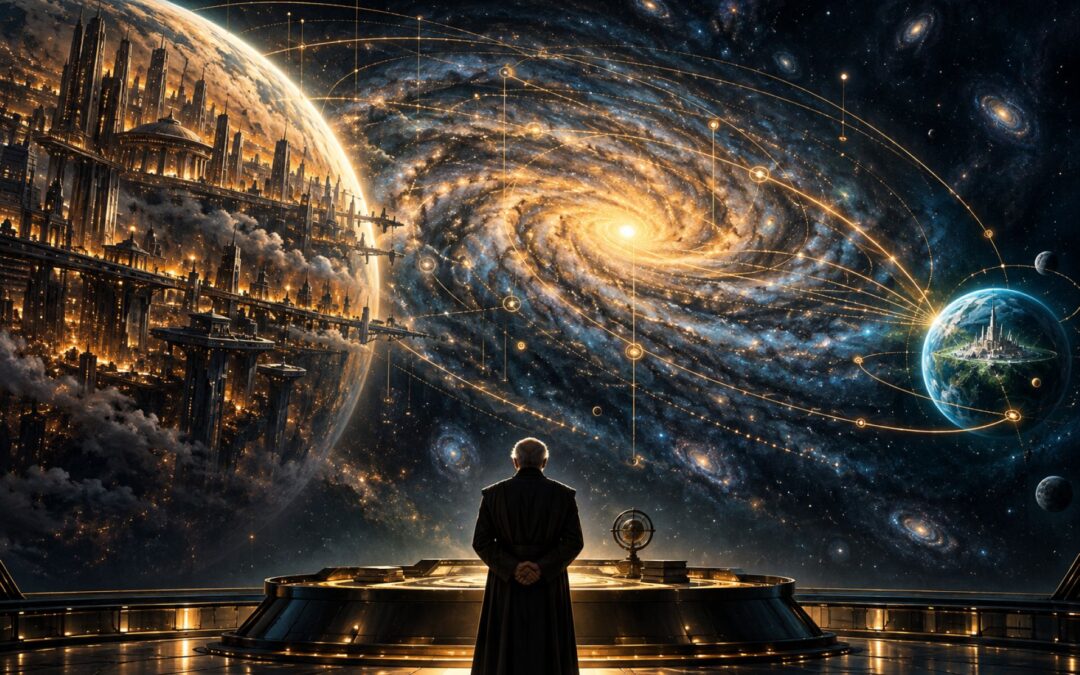
Isaac Asimov’s Foundation (1951) begins with an extraordinary prediction: the Galactic Empire, which has governed millions of inhabited worlds for thousands of years, is dying. Its collapse will plunge humanity into 30,000 years of political fragmentation, technological regression, and suffering. Hari Seldon, a mathematician who has developed a science capable of predicting large-scale human behavior, believes he can shorten this dark age to just 1,000 years.
Seldon’s solution is the Foundation, a scientific community established on a remote planet at the edge of the galaxy. Its members initially believe they have been sent there to compile an encyclopedia preserving humanity’s accumulated knowledge. They do not know that they are participants in a much larger historical experiment, one that will force successive generations to confront political crises and discover new ways of exercising power.
Unlike a conventional novel, Foundation follows no single protagonist from beginning to end. Its five interconnected stories unfold across roughly a century and a half, tracing the transformation of a vulnerable settlement into an emerging interstellar power. Through the experiences of Hari Seldon, Salvor Hardin, Limmar Ponyets, and Hober Mallow, Asimov explores the collapse of civilizations, the relationship between knowledge and authority, and the changing instruments through which societies influence one another.
First published as a book in 1951, with much of its material originating in magazine stories from the 1940s, Foundation became one of science fiction’s defining works of historical imagination. Its central achievement is not simply the invention of a futuristic empire but the depiction of history as a process shaped by institutions, material conditions, economic relationships, and collective behavior.
Spoiler warning: This article contains a complete summary of Foundation, including all five stories, their major revelations, and the ending, followed by an analysis and critical review.


The Psychohistorians: Hari Seldon Predicts the Fall
The story begins with Gaal Dornick, a young mathematician from the relatively provincial planet Synnax, traveling to Trantor to join the research organization of the celebrated Hari Seldon. Gaal has never visited the imperial capital, and his excitement allows Asimov to introduce the astonishing scale of the Galactic Empire through the eyes of someone unfamiliar with its greatest achievement.
Trantor is unlike any other planet Gaal has encountered. Nearly its entire surface is covered by an immense interconnected city, much of it enclosed beneath metal and artificial environments. Its population numbers approximately forty billion, and its vast transportation networks, administrative institutions, and technological systems make it appear to be the permanent center of human civilization.
Yet the planet’s apparent perfection conceals a fundamental weakness. Trantor produces little of what its enormous population needs to survive, depending on agricultural shipments and resources transported from other worlds. Its success relies on the continuing operation of a vast political and economic network, and any serious disruption could threaten the population on a catastrophic scale.
Gaal initially sees only the Empire’s extraordinary accomplishments. From his spacecraft, he hopes to glimpse Trantor as a complete world, but its scale and the circumstances of his arrival prevent him from doing so. Even after reaching the planet, his movements take place largely within enclosed spaces, tunnels, hotels, and transportation systems. His first experience of the imperial capital is therefore both impressive and strangely confined.
At his hotel, Gaal becomes aware that his association with Hari Seldon attracts unwanted attention. A man named Jerril questions him about the famous mathematician, displaying an interest that seems more political than scholarly. Gaal is inexperienced in imperial affairs, but he begins to realize that scientific research on Trantor can have dangerous political consequences.
Seldon himself visits Gaal and introduces him to the implications of psychohistory, the mathematical discipline that has made him famous.
Psychohistory applies mathematical methods to the behavior of enormous populations. It cannot reliably predict the actions of particular individuals, but Seldon believes that sufficiently large groups respond to social and economic pressures according to patterns that can be studied statistically. In principle, the discipline allows its practitioners to calculate the probable development of entire societies.
Seldon has used this method to investigate the future of the Galactic Empire. His calculations indicate that the imperial system is undergoing irreversible decline. Its institutions have grown rigid, its administrative structure has become unstable, and its dependence on increasingly fragile arrangements makes eventual collapse unavoidable.
Gaal initially struggles with the conclusion. The Empire seems too powerful, too technologically advanced, and too deeply established to disintegrate. Seldon explains that visible grandeur does not guarantee structural strength. A civilization may continue displaying the outward signs of prosperity long after the conditions sustaining that prosperity have begun to deteriorate.
The predictions have attracted the attention of the Commission of Public Safety, the powerful political body that effectively controls the imperial government. Following the assassination of Emperor Cleon I, the Commission has become one of the principal institutions maintaining order behind the appearance of traditional imperial authority.
To its members, Seldon’s research represents a threat. His conclusions undermine public confidence in the Empire and suggest that the existing political order is approaching its end. The government cannot easily tolerate an influential scientist publicly declaring that its authority is doomed.
Gaal and Seldon are arrested, and the young mathematician experiences the imperial legal system firsthand. Gaal is questioned about the research organization and warned about the gravity of his association with Seldon. His lawyer, Avakim, operates under restrictions that reveal the extent of political surveillance.
The trial that follows resembles a political interrogation more than an impartial judicial proceeding. The Commission challenges Seldon’s predictions, demands explanations of his research, and attempts to determine whether his organization represents a conspiracy against the Empire.
Seldon remains composed. He does not deny his conclusions or attempt to reassure the authorities that the Empire can be saved. Instead, he explains the true scale of the danger.
The collapse will not merely replace one ruling dynasty with another. The loss of political unity, scientific institutions, economic coordination, and technological knowledge will produce a prolonged period of barbarism. Without intervention, Seldon’s calculations indicate that approximately 30,000 years will pass before a new Galactic Empire emerges.
However, psychohistory also suggests the possibility of reducing the duration of the coming interregnum. Humanity cannot avoid the fall, but it may be possible to preserve enough knowledge and institutional continuity to shorten the dark age to approximately 1,000 years.
Seldon’s organization is presented as the instrument of this intervention. He proposes creating the Encyclopedia Galactica, a comprehensive record of human knowledge that will survive the Empire’s destruction and provide future generations with the intellectual resources necessary for reconstruction.
The Commission remains suspicious. Seldon has assembled tens of thousands of scholars, technicians, and supporting personnel, and such an organization could conceivably acquire political influence. His predictions also contain an implicit threat: if the authorities destroy the project, they may accelerate the collapse they hope to prevent.
During the trial, Seldon carefully distinguishes long-term statistical prediction from the uncertain actions of particular people. He can calculate the broad historical pressures surrounding the Commission, but he cannot guarantee the personal decision of its chief, Linge Chen. Even a sophisticated historical theory must account for uncertainty when individual choices become decisive.
The confrontation eventually moves into private negotiations. The Commission does not want to execute Seldon and risk creating further instability, but it also refuses to permit his organization to continue operating at the heart of imperial politics.
The solution is exile.
Seldon and his followers will be allowed to establish their encyclopedic project on Terminus, a remote world at the extreme edge of the galaxy. The planet is distant from Trantor’s political struggles, possesses few valuable natural resources, and appears to offer little prospect of becoming an independent center of power.
Seldon accepts the arrangement, apparently choosing survival over execution.
Gaal initially regards this as a defeat. The Commission has succeeded in removing the mathematician and his organization from Trantor, placing them far from the intellectual and technological centers of the Empire. The encyclopedia can continue, but under conditions dictated by the authorities.
After the trial, however, Seldon reveals that the apparent defeat was precisely the outcome he intended.
His organization has been preparing for relocation for years. Although the exact planet could not be guaranteed in advance, Seldon and his colleagues had anticipated the Commission’s likely response and arranged their activities to make exile a politically attractive solution.
The encyclopedia project is real enough to occupy the scholars, but it conceals the more important purpose of placing a scientifically capable population in a location where it can influence the development of the post-imperial galaxy.
Seldon also explains that the project involves two Foundations, positioned at opposite ends of the galaxy. The settlement on Terminus is only one part of a larger historical plan.
Most of the organization will depart for Terminus, but a smaller group will remain behind. Seldon’s own work is nearing completion, and he expects the future of the project to depend on generations he will never meet.
This revelation changes the meaning of the entire opening story. What appeared to be a conflict between a persecuted scientist and a powerful government was, in substantial part, an event that Seldon had deliberately encouraged. The Commission believed it was solving a political problem, while Seldon had maneuvered it into helping establish the conditions required by his plan.
The section ends without showing the Foundation’s eventual success. Instead, it establishes the central problem that will govern the remainder of the novel: whether a carefully prepared institution can guide historical developments across centuries, even when its members do not understand the larger purpose behind their circumstances.
The Encyclopedists: Terminus Faces Its First Crisis
Approximately fifty years after the Foundation’s establishment, the narrative moves to Terminus, where the original settlers have developed a functioning community dedicated to the compilation of the Encyclopedia Galactica.
The settlement has grown, but its position has become increasingly precarious. Terminus is geographically isolated, possesses limited mineral resources, and depends on its advanced technical knowledge to compensate for its material weaknesses.
Meanwhile, the Galactic Empire’s control over the distant Periphery has weakened dramatically. Former imperial provinces have fragmented into competing kingdoms, each attempting to establish authority over territories that the imperial government can no longer administer effectively.
The most immediate danger comes from Anacreon, a powerful neighboring kingdom interested in bringing Terminus under its influence.
The Foundation’s governing Board of Trustees is led by Lewis Pirenne, a scholar whose principal concern is the completion of the encyclopedia. Pirenne regards the settlement as an academic institution protected by the authority of the Emperor. He assumes that its official imperial status makes meaningful political interference impossible.
Salvor Hardin, the mayor of Terminus City, takes a different view.
Hardin recognizes that the Foundation has become a society with economic needs, political interests, and responsibilities extending far beyond scholarship. Its inhabitants cannot survive merely by insisting that they are engaged in an important intellectual project.
He also understands that imperial protection may exist only on paper.
Hardin’s influence comes partly from his role in organizing Terminus City as a municipality and partly from his ability to interpret political realities that the trustees prefer to ignore. Although he lacks direct control over the encyclopedia administration, he possesses growing support among the settlement’s inhabitants.
The crisis intensifies when Anselm haut Rodric, a representative of Anacreon, arrives on Terminus.
Rodric’s diplomatic language barely conceals his kingdom’s ambitions. He questions the Foundation’s political position and makes it clear that Anacreon expects concessions. The encounter also reveals something more important than the immediate territorial dispute.
Anacreon no longer possesses the scientific capabilities that were commonplace during the Empire’s period of strength.
In particular, Hardin discovers that nuclear technology has disappeared from important parts of the Periphery. Anacreon possesses ships, armies, and political influence, but its technical development has regressed to the point where the Foundation’s knowledge represents an extraordinary advantage.
Hardin begins to recognize that the power relationship between Terminus and Anacreon is more complicated than their relative military strength suggests.
Anacreon could potentially conquer the settlement, but doing so might destroy or compromise the very scientific resource that makes Terminus valuable.
Pirenne is unconvinced. He continues to believe that the Emperor’s authority will prevent Anacreon from acting against the Foundation.
To clarify the matter, an imperial representative, Lord Dorwin, arrives from Trantor.
Dorwin is outwardly civilized, knowledgeable, and reassuring. He speaks confidently about the Empire’s interests and discusses the importance of maintaining order in the Periphery. However, when Hardin presses him for concrete commitments, his answers become evasive.
Hardin investigates what Dorwin’s statements actually mean rather than accepting their reassuring tone. He discovers that the official language offers no reliable guarantee of protection.
The episode exposes a fundamental problem with imperial diplomacy. Its representatives continue speaking as though Trantor exercises unquestioned authority over the galaxy, even where the material foundations of that authority have largely vanished.
Dorwin also reveals the intellectual stagnation affecting the imperial elite.
During a discussion of ancient human history, he describes a scholarly method based on comparing earlier authorities rather than investigating original evidence. For Dorwin, the respected opinions of established writers constitute the proper material of scholarship.
Hardin finds this attitude deeply revealing. The Empire has become so accustomed to relying on inherited authority that even its educated classes may no longer distinguish the preservation of knowledge from the active pursuit of understanding.
This intellectual weakness mirrors Pirenne’s political blindness. Both men place excessive confidence in established institutions because those institutions have been authoritative for generations.
As Anacreon’s demands become more threatening, Hardin examines the relevant treaties and diplomatic arrangements. He establishes that the Empire has effectively withdrawn from the region and that Terminus cannot rely on military assistance.
The Board continues to resist his conclusions.
Its members are not unintelligent, but their training and assumptions prevent them from responding adequately. They understand the encyclopedia, scholarly procedure, and imperial protocol. They do not understand the political consequences of a collapsing imperial order.
Hardin becomes increasingly suspicious of Hari Seldon’s original intentions.
Why would Seldon place a small scientific community on a vulnerable planet lacking vital raw materials? Why arrange for it to be surrounded by technologically declining neighbors? Why establish an institution so apparently unsuited to defending itself?
Hardin also notices that the Foundation’s original population contained almost no advanced psychologists. If psychohistory was the science underlying Seldon’s plans, the absence of people trained to understand those plans seems deliberate.
He begins to suspect that the Foundation has been designed to confront situations in which ordinary institutional routines become impossible.
As Anacreon’s ultimatum approaches, Hardin prepares to remove the Board from effective political control.
His trusted associate Yohan Lee helps organize the takeover. The plan relies on surprise, disciplined execution, and the trustees’ inability to imagine that their formal authority can be challenged.
Yet Hardin is privately less confident than he appears. He does not know whether he has correctly interpreted Seldon’s intentions, and a failed intervention could leave Terminus exposed to Anacreon’s demands without the protection of its traditional institutions.
The crisis coincides with the scheduled opening of the Time Vault, an installation created by Seldon’s organization.
Inside the Vault, Hardin and the trustees witness a recorded appearance of Hari Seldon, who has been dead for decades.
Seldon’s message reveals that the encyclopedia was never the Foundation’s ultimate objective.
The scholars have been brought to Terminus as part of a historical process intended to create the conditions for a new Galactic Empire. Their immediate dilemma is the first major crisis of the plan, a situation in which the surrounding pressures have reduced the range of viable alternatives.
The Foundation is isolated, scientifically advanced, materially weak, and threatened by stronger neighboring states. Its survival depends on recognizing how those conditions can be turned to its advantage.
Seldon does not personally intervene or issue a sequence of detailed instructions. His recorded message confirms the larger framework and leaves the living inhabitants responsible for responding to their circumstances.
The revelation destroys the intellectual basis of the Board’s authority.
Pirenne and the trustees now understand that their cherished encyclopedia has been a means of occupying the Foundation’s attention while historical pressures developed around it. Their supposed protection under imperial authority has also proved illusory.
By the time the meeting ends, Lee’s associates have already taken control of the government.
Hardin’s political victory is therefore complete, but the more important problem remains the future relationship with the surrounding kingdoms.
The next story explains the solution retrospectively. Hardin prevents any one kingdom from gaining exclusive control of Terminus by encouraging a balance among the competing powers. He makes the Foundation’s scientific assistance available in ways that ensure each kingdom values its continued independence.
Terminus becomes useful to all its neighbors, while conquest would threaten that usefulness and provoke opposition from rival states.
The first crisis thus establishes a principle that will recur throughout the novel. The Foundation does not need to possess the greatest army if it can understand the political relationships that make military action undesirable.
It also marks a decisive transformation. The Foundation is no longer merely a scientific colony carrying out an assigned project. It has become a political community whose leaders must exercise independent judgment, negotiate with neighboring governments, and use knowledge as a means of survival.
The Mayors: Salvor Hardin Turns Religion into Power
Three decades after the first crisis, Salvor Hardin remains the dominant political figure on Terminus. His earlier strategy has protected the Foundation from conquest, but the system he created has also generated new problems.
The Four Kingdoms continue competing for regional influence. Each possesses the capacity to threaten Terminus, yet each is reluctant to permit another kingdom to absorb the Foundation and monopolize its scientific knowledge.
Hardin has exploited this rivalry by providing technological assistance, education, scientific medicine, and commercial opportunities. Instead of encouraging the kingdoms to destroy one another, he has made the Foundation valuable to each of them.
This arrangement has preserved peace for thirty years, but it is not enough to guarantee continued security.
The kingdoms remain politically independent and potentially hostile. Their rulers also face domestic pressures, military ambitions, and succession struggles that could disrupt the balance of power.
Hardin’s most important innovation has been the creation of a religion organized around advanced technology.
As nuclear power and other scientific achievements have disappeared from the surrounding societies, the Foundation’s machines have become mysterious and extraordinary. To people who no longer understand their principles, they can appear almost miraculous.
Hardin and his associates use this situation to establish religious institutions through which Foundation technology is distributed, maintained, and interpreted.
The Church of the Galactic Spirit possesses its own hierarchy, rituals, doctrines, and priestly offices. Technical specialists receive religious training and perform functions that ordinary people understand as sacred duties.
Scientific equipment is incorporated into temples and ceremonies. Nuclear energy, advanced medicine, and technological conveniences become associated with spiritual authority.
The religion also supports the legitimacy of local rulers.
Kings can present themselves as divinely sanctioned authorities, with ceremonies and technological demonstrations reinforcing their status in the eyes of their subjects. In exchange, they permit the Foundation’s religious organization to establish itself within their territories.
The arrangement appears to strengthen the monarchies, but it also makes them dependent.
The priesthood possesses technical expertise that the rulers themselves lack. Power stations, communications systems, transportation infrastructure, and other essential technologies can function only because Foundation-trained personnel understand how to operate them.
The Foundation therefore controls a network of institutions that are physically located inside other political systems but remain ultimately loyal to Terminus.
Poly Verisof, the Foundation’s representative on Anacreon, embodies this system.
Officially, he serves as a high priest, exercising religious authority among people who regard Foundation science with reverence. In practice, he is also a political representative responsible for protecting Terminus’s interests.
Verisof recognizes both the effectiveness and the uncomfortable implications of his position. He must participate in rituals that he knows have been constructed around scientific knowledge, while dealing with populations that sincerely believe in their sacred meaning.
His conversations with Hardin reveal how deeply the religion has penetrated Anacreonian society.
Yet the same success produces growing tension on Terminus.
A political movement known as the Action Party, led by Sef Sermak, challenges Hardin’s leadership. Its supporters argue that the mayor has become too cautious, too secretive, and too dependent on indirect methods.
They believe the Foundation should respond more forcefully to threats from neighboring states.
Hardin rejects their preference for direct military action. He regards political and social influence as more reliable than a conventional war that Terminus might not be capable of winning.
The disagreement is not simply a clash between intelligence and stupidity. Sermak and his allies correctly perceive that the Foundation’s position is dangerous. What they fail to understand is how deeply the surrounding kingdoms have become dependent on institutions that Hardin can influence.
The impending crisis centers on Anacreon.
The kingdom is ruled by the young King Lepold, but effective authority belongs to his uncle, Regent Wienis. Ambitious and ruthless, Wienis wants to end Anacreon’s dependence on Terminus and establish military dominance over the region.
He has obtained a powerful warship dating from the Galactic Empire’s period of technological superiority.
The cruiser is potentially far more formidable than the vessels normally available to the peripheral kingdoms. With its weapons and protective systems, it could give Anacreon a decisive military advantage.
However, the ship requires substantial repairs.
Wienis pressures the Foundation into restoring it, believing that Terminus is foolish enough to strengthen the very power preparing to attack it.
Hardin permits the repairs.
To Wienis, this confirms that the Foundation is weak or intimidated. He assumes that military possession determines political control and that the restored cruiser will enable him to impose his will.
Hardin understands that the ship’s technological systems remain subject to forms of control that Wienis does not recognize.
The regent’s plans are also tied to Lepold’s coronation. A grand public ceremony will display royal legitimacy while providing the occasion for a decisive confrontation with Terminus.
The young king himself is less secure than his uncle appears to believe.
Lepold enjoys the privileges of royalty but does not fully control the forces acting in his name. His relationship with Wienis contains an undercurrent of fear, particularly because the regent and his sons stand close to the succession.
The monarchy is therefore internally divided even as it prepares for external aggression.
Hardin decides to confront the crisis personally.
Before leaving Terminus, he entrusts Yohan Lee with maintaining political stability and managing the Action Party’s pressure. The opposition interprets his journey to Anacreon as further evidence of weakness or betrayal.
Hardin, however, has already arranged for the Foundation’s religious organization to prepare a response.
He reaches Anacreon shortly before the coronation, having visited other important systems along the way.
The ceremony is designed to overwhelm participants with the symbols of royal authority. Technological devices support the spectacle, including the equipment that allows Lepold to display apparently supernatural privileges.
Wienis expects the display of military and ceremonial power to intimidate Hardin.
Instead, Hardin reveals that the Foundation has declared a religious interdict against Anacreon.
The technological infrastructure associated with the Church begins to fail or cease functioning. Systems whose reliability had been taken for granted are withdrawn from the service of a government accused of attacking the sacred center of its own religion.
The coronation itself becomes a demonstration of the monarchy’s vulnerability.
As the expected technological effects fail, the distinction between royal authority and dependence on Foundation-controlled systems becomes suddenly visible.
Wienis attempts to counter Hardin with the threat of military force.
His principal weapon is the restored imperial cruiser, now leading a fleet toward Terminus under the command of his son, Prince Lefkin.
But Hardin has anticipated this development.
The ship carries Foundation-trained religious personnel, including Theo Aporat, a high-ranking priest responsible for the vessel’s spiritual and technical functions.
When Aporat discovers that the fleet has been ordered to attack the Foundation, he interprets the operation as an assault on the central institution of his faith.
He uses the ship’s communications and technical systems to confront the officers and crew.
The Anacreonian sailors are not merely employees following military orders. Many are believers whose understanding of authority has been shaped by years of Foundation religious influence.
Aporat therefore possesses a source of legitimacy that Prince Lefkin cannot simply override.
The confrontation leads to the collapse of the military expedition. Lefkin loses control, the crew turns against the planned attack, and the fleet is ordered to abandon its mission.
The restored cruiser, which Wienis believed would guarantee victory, becomes the setting for the defeat of his strategy.
Hardin has effectively made the Anacreonian military dependent on a religious organization loyal to the very planet it has been ordered to attack.
Back on Anacreon, Wienis receives the news and realizes that his plan has failed.
His government cannot command its own technological infrastructure, the population’s religious commitments undermine his authority, and the fleet he intended to use against Terminus is no longer a reliable instrument of force.
In desperation, Wienis attempts to kill Hardin with a nuclear weapon.
Hardin is protected by a personal force field, another technological advantage that the regent has failed to anticipate. The weapon’s energy is neutralized, leaving the mayor unharmed.
Wienis then turns the weapon on himself and dies.
His death completes the defeat of Anacreon’s attempted rebellion. The country retains its monarchy, but its rulers have learned that military ambitions cannot easily overcome the Foundation’s influence over the systems on which their authority depends.
The episode concludes with another scheduled appearance of Hari Seldon in the Time Vault.
Seldon’s message places the development of religious power within the larger historical plan. It confirms that the Foundation is moving through successive stages as surrounding societies decline and become increasingly dependent on its specialized capabilities.
The second Foundation, located somewhere at the other end of the galaxy, remains an important but unexplained part of the scheme.
Seldon’s recording also emphasizes that much of the thousand-year plan still lies ahead.
Hardin’s success does not end the Foundation’s problems. It demonstrates that one historical crisis has been resolved through a form of power appropriate to its circumstances.
The section closes with Hardin vindicated against both external enemies and domestic critics, but the broader consequences of his religious system remain unresolved.
The Foundation has survived by creating a network of dependencies extending beyond its borders. That network has protected Terminus from conquest, but it also demonstrates how scientific knowledge can be transformed into an instrument of political control.
The Traders: Limmar Ponyets Opens Askone
As the Foundation’s influence spreads beyond the Four Kingdoms, its expansion increasingly depends on independent merchants.
These traders travel across the Periphery, exchanging advanced technological goods for valuable materials, commercial opportunities, and political access. They often operate far from Terminus, making decisions without immediate supervision from the Foundation’s government.
Their work extends the Foundation’s influence into societies that have not accepted its religious institutions.
Limmar Ponyets is one such trader, but his immediate interests are personal and commercial rather than explicitly ideological.
While preparing to complete his annual trading quota, Ponyets meets another trader, Les Gorm, who brings troubling news. Eskel Gorov, a fellow trader, has been imprisoned on the planet Askone, a society whose religious authorities prohibit the use of nuclear technology.
Ponyets understands the situation to be more serious than Gorm realizes.
Gorov is not merely a merchant who has violated a local prohibition. He is an agent of the Foundation, engaged in a mission intended to open Askone to its technological and commercial influence.
His imprisonment threatens that objective.
Ponyets travels to Askone and encounters a government suspicious of outsiders, determined to preserve its religious traditions, and unwilling to permit unrestricted technological imports.
The Grand Master, Askone’s ruler, regards nuclear machinery as a forbidden influence. The problem is not simply that Foundation goods are expensive or unfamiliar. Their use challenges established beliefs and political authority.
Ponyets initially attempts to negotiate Gorov’s release through conventional diplomatic and religious arguments.
He presents himself as someone familiar with spiritual responsibilities and appeals to the ruler’s concern for the imprisoned man’s soul. These tactics allow him to continue discussions, but they do not resolve the fundamental opposition to Foundation technology.
When Ponyets speaks privately with Gorov, he learns more about the mission.
The Foundation wants Askone to begin accepting technological devices that will eventually make the country dependent on outside expertise. The existing religious-commercial model relies on establishing initial demand for advanced goods, followed by the introduction of institutions capable of maintaining them.
Gorov’s objective is therefore much larger than securing permission for one merchant to conduct business.
Ponyets approaches the problem differently.
Rather than attempting to overturn Askone’s beliefs through direct argument, he looks for an incentive powerful enough to make influential people willing to violate them.
He discovers that Askone uses gold as an important medium of exchange.
Ponyets constructs a device capable of temporarily transforming metal into gold. The mechanism is technologically inefficient, but it creates a spectacular demonstration that appears to offer immense wealth.
He presents the device before the Grand Master and his council.
The demonstration provokes a conflict between religious prohibition and material desire. The ruler and his advisers are unwilling to abandon their beliefs, yet they are fascinated by the possibility of obtaining gold through a process they do not understand.
Ponyets exploits the tension.
He suggests that the gold can be placed before the ancestral spirits and held for a period to determine whether its creation has offended them. This proposal allows the council to accommodate its desire for wealth without openly declaring that its religious restrictions have been abandoned.
The device has now entered the political imagination of Askone, but Ponyets still needs to secure a lasting advantage.
He identifies Pherl, an ambitious councilor who wants to rise to greater political power.
Ponyets privately offers Pherl access to the transmutation device. Pherl recognizes that control over a new supply of gold could finance his ambitions and improve his prospects of succeeding the current Grand Master.
The councilor’s ambition is strong enough to overcome his public commitment to technological prohibition.
Yet Pherl also understands that Ponyets is vulnerable.
Because selling forbidden devices is a capital offense, Pherl can threaten to expose the trader after obtaining the machine. He expects to benefit from the technology while retaining the ability to denounce the man who supplied it.
Ponyets appears to accept this unequal bargain.
In reality, he has concealed a recording device inside the machine and obtained evidence of Pherl’s willingness to violate Askone’s religious laws.
When Pherl attempts to exploit his advantage, Ponyets reveals the recording and reverses the situation.
The councilor can no longer safely denounce him. Exposure would threaten Pherl’s political future and possibly his life.
Ponyets uses this leverage to secure a much larger commercial transaction involving his cargo of nuclear devices. He also arranges to receive valuable tin, making the operation financially profitable.
Gorov is eventually released after thirty days of confinement, and the two men depart Askone.
During their journey, Ponyets explains how he turned an apparently impractical demonstration into a commercial opening.
The transmutation device itself is not particularly valuable as an industrial technology. Its energy consumption makes large-scale gold production uneconomical, and Ponyets has no intention of building an enterprise around it.
Its actual value lies in the political circumstances it creates.
Pherl now has access to forbidden technology, a personal incentive to acquire more of it, and a financial reason to cooperate with Foundation traders. His likely rise to power could make Askone increasingly receptive to the Foundation.
Gorov remains uneasy about Ponyets’s methods.
The operation has succeeded, but it has relied on deception, exploitation of personal ambition, and blackmail. Ponyets does not pretend that his principal motivation was moral idealism.
He wanted to complete a profitable sale, and he recognizes the Foundation’s strategic benefit as an additional advantage.
The story illustrates how commercial incentives can overcome ideological barriers that direct argument cannot easily penetrate.
It also exposes the increasingly complicated relationship between the Foundation’s historical mission and the conduct of those who advance it. Political expansion is being carried forward by individuals whose ambitions are not necessarily identical to those of the institutions they serve.
The Merchant Princes: Hober Mallow and the Korell Crisis
The final and longest part of Foundation concerns Hober Mallow, a successful trader whose commercial experience brings him into conflict with the Foundation’s established political and religious authorities.
By this point, the traders have become an increasingly wealthy and influential class. Their vessels travel beyond the Foundation’s immediate political territory, opening markets and developing commercial relationships with societies that may remain suspicious of its religious institutions.
Their independence creates a problem for the government on Terminus.
The established authorities have grown accustomed to exercising influence through the Church and its associated technological hierarchy. Independent merchants can become powerful without relying on that system, threatening the balance between religious authority, political office, and commercial wealth.
Jorane Sutt, an influential government official, regards the traders with suspicion.
He believes their independence may weaken the Foundation’s unity and interfere with the historical role of its established institutions. Together with Publis Manlio, a figure possessing substantial religious and political authority, he considers ways of restricting the merchants’ growing influence.
Sutt’s immediate concern is a developing crisis involving Korell, a neighboring republic.
Several Foundation trading vessels have disappeared, and reports suggest that Korell possesses weapons powered by nuclear technology. This is alarming because such capabilities should be beyond the independent manufacturing resources of the surrounding worlds.
Sutt summons Hober Mallow and assigns him to investigate.
Mallow is a Master Trader from Smyrno, a world outside Terminus itself. His commercial success, confidence, and independence distinguish him from the officials who dominate the Foundation’s government.
Sutt does not fully trust him, but the assignment offers an opportunity to discover whether the trader is loyal and capable.
Mallow accepts the mission and begins preparing his ship, the Far Star.
Before his departure, he is approached by Jaim Twer, an older man who presents himself as a supporter of political representation for the trader class.
Twer encourages Mallow to enter politics and offers to accompany him on the expedition.
Mallow agrees, although his interactions suggest that he does not completely trust the man’s motives.
The expedition reaches Korell, where Mallow discovers a politically restrictive and economically underdeveloped society.
The country is formally a republic, but its ruler, Commdor Asper Argo, exercises powers more closely resembling those of an absolute monarch. Political institutions provide the appearance of republican government without meaningfully limiting his authority.
Argo is particularly hostile to the Foundation’s missionaries.
He fears that allowing religious institutions into Korell will eventually undermine his independence, as similar processes have occurred elsewhere in the Periphery.
Mallow understands the danger.
Although the Foundation’s religious system can create powerful dependencies, it has also acquired a reputation that makes some governments unwilling to accept its goods.
For approximately a week, Mallow remains at the spaceport without receiving permission to meet the Commdor.
His companions grow impatient, but he refuses to force the issue.
The delay becomes a contest of political nerve. Korell does not know exactly what Mallow has discovered or what he intends to do, while Mallow cannot determine whether the government possesses the nuclear weapons rumored to be responsible for the missing ships.
He recognizes that an impatient move could expose his ship to attack.
The situation changes when a man claiming to be a Foundation missionary appears at the vessel.
The supposed missionary, Jord Parma, is being pursued by Korellian authorities and requests sanctuary aboard the Far Star.
The crew is disturbed by his condition and by the apparent conflict between religious duty and political danger.
Mallow, however, orders the stranger returned to the authorities.
His decision appears extraordinarily harsh. If Parma is a genuine Foundation missionary, he may face execution or severe punishment for violating Korell’s religious prohibitions.
Mallow knows that his actions may later be condemned on Terminus, where the protection of missionaries is considered an important obligation.
Nevertheless, he refuses to sacrifice his mission, crew, and ship.
Soon after Parma is returned, the Korellian government finally grants Mallow an audience.
Mallow interprets the timing as significant. His willingness to surrender the supposed missionary has demonstrated that he will not use the expedition to smuggle religious influence into Korell.
He meets Commdor Argo and presents himself as a businessman interested in mutually profitable trade.
Argo immediately raises the danger of religious infiltration.
He knows that elsewhere in the Periphery, Foundation traders have introduced technological products, followed by missionaries and religious institutions responsible for their maintenance.
The products create a demand for expertise, and the expertise becomes a route to political dependence.
Mallow proposes a different arrangement.
He offers advanced technology without compulsory religious supervision.
The goods can be sold commercially, providing immediate economic benefits to Korell without requiring its government to accept Foundation priests or religious institutions.
This proposal appeals to Argo’s desire for both wealth and political independence.
Mallow demonstrates commercially useful devices and explains how their introduction could improve industrial production. He also offers personal technological luxuries that can appeal to the ruling household.
The Commdora, Licia, becomes particularly interested in advanced jewelry that uses miniature nuclear power systems.
Her enthusiasm reveals how consumer desire can create political opportunities even in societies whose rulers oppose the Foundation’s broader influence.
Licia also possesses connections to the surviving Galactic Empire through her family.
Her background is important because it suggests that Korell’s military equipment may not be the product of local technological development.
Mallow continues his investigation while maintaining the appearance of an ordinary commercial negotiation.
During a visit to an industrial foundry, he demonstrates the usefulness of Foundation equipment and observes the weapons carried by Korellian guards.
The weapons bear the Spaceship-and-Sun emblem associated with the Galactic Empire.
Mallow immediately understands the significance.
The Empire still exists as an active political and military power somewhere beyond the Periphery, and it has begun supplying advanced weapons to Korell.
The Foundation is therefore facing a much more dangerous situation than a local dispute with a technologically backward state.
For generations, Terminus has benefited from its superior scientific capabilities. If the surviving Empire can supply its rivals with powerful weapons, that advantage may no longer guarantee security.
Mallow decides to investigate the Empire personally.
He leaves the Far Star under the command of Senior Lieutenant Drawt and provides instructions for the preservation of his reports if he does not return.
He then departs in a smaller vessel, traveling toward the inner regions of the galaxy.
His destination is Siwenna, a planet with a long imperial history.
There he encounters Onum Barr, an elderly former patrician living in relative isolation after years of political turmoil.
Barr has experienced the destructive consequences of the Empire’s decline firsthand.
His family and social position have been damaged by corrupt administration, violence, and imperial power struggles. Although Siwenna remains within the Empire’s sphere of influence, the continuity of imperial rule has not protected it from instability.
Barr describes the political events that have transformed the region.
His account reveals a state still capable of exercising coercive power but increasingly unable to govern effectively or preserve public confidence.
The Empire has not disappeared. Its institutions, fleets, and administrative systems remain formidable. Yet their capacity to support a healthy and advancing civilization has deteriorated.
Mallow learns enough from Barr to continue investigating the condition of imperial technology.
His most important discovery concerns the people responsible for maintaining the Empire’s nuclear infrastructure.
He encounters a technical specialist belonging to a hereditary professional caste.
The technician possesses status and specialized responsibility, but his knowledge is limited by the conventions of his occupation.
Mallow demonstrates a compact personal force field and other devices produced through the Foundation’s scientific methods.
The imperial specialist is astonished.
The Empire possesses nuclear technology on an enormous scale, including powerful generators and shields capable of protecting immense structures. However, its technical culture has not developed the compact devices that the resource-poor Foundation has learned to manufacture.
Mallow uses the personal shield as an inducement to obtain access to one of the Empire’s great nuclear installations.
Inside the generating facility, he sees machinery of extraordinary size and sophistication.
The equipment demonstrates that the Empire continues possessing immense material resources and technological infrastructure. It has not become powerless simply because its political institutions are declining.
The decisive issue is whether its technicians genuinely understand what they maintain.
Mallow discovers that the specialist cannot explain how to repair the central generator if its essential components fail.
The machinery is operated according to inherited procedures, while the knowledge needed to redesign or reproduce it has largely disappeared.
The distinction is crucial.
The Empire can still construct an impressive display of power using systems inherited from an earlier technological civilization. But its ability to advance beyond those systems has weakened.
By contrast, the Foundation has been forced to develop smaller, more efficient devices because Terminus lacks the resources necessary for enormous installations.
Material disadvantage has encouraged scientific innovation.
Mallow returns to Terminus with a clearer understanding of the political crisis.
Korell possesses imperial weapons, but its access to advanced military technology does not make it technologically self-sufficient. The Empire supplying those weapons is itself limited by an increasingly stagnant scientific culture.
Mallow begins to recognize that the Foundation’s advantage lies not merely in possessing nuclear technology but in producing forms of technology that its rivals cannot easily replace.
Meanwhile, his political difficulties intensify.
Sutt confronts him about the Korell mission and challenges his failure to protect Jord Parma.
From the perspective of the Foundation’s established religious authorities, Mallow has apparently abandoned a missionary to a hostile government.
Sutt recognizes the political usefulness of the incident.
If Mallow can be portrayed as someone willing to sacrifice a Foundation priest for personal commercial advantage, his influence among the traders may not protect him from public outrage.
Ankor Jael, an experienced political strategist, warns Mallow that the controversy could destroy his prospects.
Mallow’s decision may have been defensible on strategic grounds, but the public will judge it according to its understanding of religious loyalty and civic responsibility.
The controversy culminates in a highly publicized trial.
The prosecution presents Mallow’s actions as evidence of cowardice, disloyalty, and deliberate abandonment.
Witnesses describe the supposed missionary’s arrival and Mallow’s decision to return him to Korellian custody.
Mallow does not attempt to deny the basic sequence.
Instead, he changes the meaning of the evidence.
He points out that Parma’s behavior was inconsistent with what one would expect from a genuine Foundation missionary operating secretly in a hostile society.
The man’s conspicuous clothing, arrival at precisely the wrong moment, and convenient pursuit by local authorities suggest that the episode was arranged as a trap.
Mallow also exposes the suspicious conduct of Jaim Twer.
Although Twer presented himself as an experienced trader and political reformer, his background contains significant inconsistencies.
In particular, he displays ignorance of concepts that should be familiar to a person educated within the Foundation’s secular political and intellectual environment.
Mallow concludes that Twer was acting as an agent of Sutt and Manlio, and that his supposed commercial identity concealed religious and political connections.
The evidence Mallow has preserved during the expedition allows him to reconstruct the events surrounding Parma.
He demonstrates that the supposed missionary was actually a Korellian secret-police agent disguised to provoke precisely the reaction that Mallow refused to provide.
The trap had been designed to force Mallow into a politically disastrous choice.
If he sheltered Parma, he risked the mission and perhaps the safety of the Far Star. If he surrendered him, he appeared to violate the Foundation’s religious obligations.
Mallow avoided the immediate strategic danger and later used the recorded evidence to expose the deception.
The revelation reverses public opinion.
The man accused of betraying the Foundation is transformed into a figure who outwitted a hostile government and survived an effort to manipulate him.
The trial becomes a dramatic political victory.
Mallow’s growing popularity provides the foundation for his entry into formal politics, and he decides to seek the mayoralty.
Jael warns that enthusiasm generated by a spectacular public reversal may not translate automatically into stable political authority.
Mallow nevertheless believes that he must obtain control of the government before the next major crisis.
He expects that Korell’s relationship with the Empire will eventually lead to war.
The question is how the Foundation can survive a confrontation involving weapons far more powerful than its own military resources.
Mallow’s answer appears almost absurdly passive.
He intends to do nothing that resembles conventional warfare.
Rather than attacking Korell, he will allow the economic relationships created by his earlier commercial negotiations to produce the decisive pressure.
The conflict begins when Korell moves openly against the Foundation.
Argo has received powerful weapons from the Empire and believes they provide the means to resist Foundation influence.
Licia’s imperial connections have encouraged the belief that Korell can rise in power through association with the older civilization.
Yet Argo’s ambitions are not identical to those of his wife or her imperial relatives.
He wants political independence and personal dominance, and the possession of military equipment appears to offer a shortcut to those objectives.
A brief encounter between a Foundation vessel and an enormous imperial warship demonstrates the seriousness of the danger.
The Foundation’s ships cannot easily defeat such weapons in conventional battle.
Mallow, now mayor, refuses to commit his forces to a disastrous confrontation.
His critics accuse him of weakness and indecision.
Sutt is particularly hostile, arguing that a government incapable of defending itself militarily cannot maintain public confidence.
Mallow explains that the conflict is being fought on different terms.
During the years of trade preceding the war, Korell has become increasingly dependent on Foundation technology.
The imports are not limited to military equipment or prestigious scientific installations.
They include consumer conveniences, industrial machinery, tools, domestic appliances, and compact nuclear generators that have been integrated into everyday life.
When war interrupts commercial relations, the Foundation stops supplying these products and maintaining the systems already installed.
The consequences do not appear immediately.
A society can endure shortages and inconvenience for a time, especially when its inhabitants believe they are participating in a patriotic struggle.
But the Foundation’s products gradually begin failing.
Domestic appliances stop working properly, homes become less comfortable, and the conveniences associated with modern prosperity disappear.
These problems do not produce a heroic military confrontation. They produce irritation, dissatisfaction, and a growing awareness that ordinary life was easier before the war.
The situation becomes more serious when industrial machinery begins breaking down.
Factories that adopted Foundation equipment have become accustomed to greater efficiency and higher profits. Returning to earlier methods would require investment, disruption, and a substantial reduction in productivity.
As machinery fails, industrialists and financiers begin suffering losses.
Their economic interests increasingly conflict with Argo’s determination to continue the war.
Mallow expects these pressures to undermine the government more effectively than a direct military attack.
Sutt objects that Korell can simply obtain replacement technology from the Empire.
Mallow explains why this is unlikely.
The Empire possesses powerful nuclear generators, enormous ships, and sophisticated installations, but its equipment has been developed for a civilization accustomed to immense material resources.
The Foundation’s goods rely on miniaturization, efficiency, and technical innovations that imperial specialists have not learned to reproduce.
A gigantic imperial generator cannot conveniently replace a compact power source built into a household appliance or commercial machine.
Nor can a hereditary technician who barely understands a massive installation suddenly reproduce the Foundation’s specialized technology.
Korell therefore faces a choice between continuing a strategically unnecessary conflict and restoring the economic relationships that have become essential to its prosperity.
Mallow believes ordinary citizens, industrialists, and financiers will ultimately make the continuation of war politically impossible.
His reasoning also applies to the Foundation itself.
The merchant class has created substantial wealth through trade, and the prosperity of Terminus increasingly depends on commercial relationships.
Mallow controls or influences important sections of this economic network.
He warns that attempts to overthrow him could be met with economic pressure inside the Foundation, damaging prosperity wherever opposition gains strength.
Jael recognizes the political implication.
Mallow is establishing a government dominated by merchants and commercial wealth: a plutocracy in which economic power increasingly determines political authority.
Mallow does not deny the significance of the transformation.
He argues that every historical stage possesses its own dominant mechanism of influence. Religious power once protected the Foundation, but the changing circumstances have made economic relationships more decisive.
He expects future generations to confront crises in which commercial power may also become inadequate.
His task is to solve the present crisis, not to devise a permanent political system suitable for every possible future.
The story closes with a retrospective entry from the Encyclopedia Galactica.
After three years of conflict conducted largely without conventional battles, Korell surrenders unconditionally.
Mallow’s reputation rises to the level of the Foundation’s earlier great figures, Hari Seldon and Salvor Hardin.
The victory completes the novel’s progression from intellectual preservation through political balancing and religious authority to commercial dominance.
The Foundation has survived another crisis, but the means of its success have transformed the society it was originally intended to protect.
The Galactic Empire, Terminus, and the Worlds of the Periphery
The galaxy of Foundation is not merely a futuristic setting for political adventures. Its different worlds represent distinct stages of institutional development and decline, allowing Asimov to explore how civilizations can possess remarkable technology while losing the knowledge and social conditions necessary to sustain it.
At the beginning of the novel, the Galactic Empire encompasses millions of inhabited worlds under a political system that has existed for thousands of years. Its longevity creates an appearance of inevitability. Characters raised within the imperial order struggle to imagine that something so extensive and familiar could actually disappear.
Trantor embodies both the achievements and vulnerabilities of this civilization.
Its planet-wide urban environment represents extraordinary coordination. Maintaining forty billion inhabitants requires reliable transportation, energy, food distribution, communications, and administrative systems linking countless regions of space.
Yet this very complexity makes Trantor vulnerable.
Because the imperial capital depends on resources transported from other worlds, it cannot easily survive a breakdown of the larger economic network. Its population, institutions, and infrastructure are products of the Empire’s success, but they also create a dependence that could make decline catastrophic.
This vulnerability connects directly to the novel’s understanding of civilization as an interconnected system rather than a collection of powerful individuals.
The Empire’s decline also appears unevenly across the galaxy.
In the Periphery, the political order has already fragmented. Anacreon and the other kingdoms retain elements of imperial culture, but their technical knowledge has deteriorated. Their rulers imitate the structures and symbols of greater powers without possessing the scientific capabilities that originally sustained them.
The resulting societies are not entirely primitive. They retain spacecraft, political institutions, inherited machinery, and complex social hierarchies. However, their ability to maintain or advance the technological systems they possess has weakened.
This distinction is essential to the novel.
A civilization can continue using advanced equipment after losing the scientific understanding necessary to reproduce it. Technological decline is therefore not always immediately visible as the disappearance of machines. It may begin as a narrowing of knowledge, a dependence on specialists, and the replacement of investigation with ritual.
The Foundation initially occupies an unusual position within this declining environment.
Terminus is scientifically advanced but materially poor. Its lack of valuable minerals makes it less attractive as a conventional military prize, while forcing its inhabitants to develop efficient uses of the resources available to them.
The settlement cannot follow the Empire’s practice of solving problems through enormous installations and abundant material expenditure.
Its scientists must innovate.
By the time Mallow investigates Siwenna, the consequences of this difference have become visible. The Empire still possesses immense generators and powerful protective systems, but its technical culture has become hereditary and conservative.
Foundation engineers, by contrast, can produce miniature devices that perform valuable functions with far fewer resources.
The contrast between large and small technological systems is also a contrast between inherited greatness and continuing intellectual vitality.
Askone and Korell introduce further variations.
Askone resists technological imports because they conflict with religious traditions and established political interests. Its reluctance is ideological and institutional rather than simply a consequence of ignorance.
Korell is different. Its ruler recognizes the commercial value of technology but fears that accepting Foundation priests will weaken his independence. Mallow succeeds because he understands that Korell’s objections concern political control rather than machinery itself.
Siwenna presents another aspect of decline. It remains within the Empire’s orbit, yet its inhabitants have suffered from administrative corruption, violent political struggles, and the breakdown of effective governance.
The survival of imperial authority does not guarantee justice, stability, or prosperity.
Through these different worlds, Asimov creates a galaxy in which technological development, political power, economic strength, and institutional knowledge do not necessarily advance together.
This world-building gives the Foundation’s growth its distinctive logic. Terminus does not simply conquer a series of weaker planets. It discovers the different vulnerabilities of societies undergoing uneven historical change and develops forms of influence suited to those vulnerabilities.
The setting is deliberately schematic, however. Most societies are described through their institutions, political interests, and technological capacities rather than their languages, artistic traditions, or ordinary cultural diversity.
That limitation reduces the density of everyday life in the fictional universe, but it also supports Asimov’s central interest: explaining civilization through the relationships among knowledge, institutions, material resources, and power.
The Major Characters and Their Conflicts
Foundation distributes its major dramatic responsibilities among characters separated by decades. Rather than following a single person’s growth, Asimov introduces different kinds of leaders at successive moments of institutional transformation. Each protagonist confronts a particular historical problem, and the differences among them reveal how the Foundation changes as its circumstances evolve.
This structure gives the characters considerable intellectual and political importance, although it limits the opportunities for sustained psychological development. Most are defined primarily by their methods of reasoning, their relationships with institutions, and the decisions through which they influence events.
Hari Seldon and Gaal Dornick
Hari Seldon is the novel’s intellectual architect. His principal achievement is the creation of psychohistory and the recognition that the Empire’s collapse can be anticipated even though it cannot be prevented.
Seldon possesses extraordinary confidence in mathematical analysis, but his actions reveal that he is more than a detached scientist. He understands political pressure, institutional self-interest, and the ways governments respond to threats against their legitimacy.
His trial demonstrates this combination of theoretical and practical intelligence.
Seldon does not simply announce an unpopular conclusion and suffer the consequences. He deliberately creates a situation in which the Commission finds exile more attractive than execution, thereby helping establish the Foundation in the circumstances required by his plan.
His methods are manipulative, even when motivated by a desire to reduce future suffering.
The encyclopedia project conceals a more consequential purpose from many of the people participating in it. Seldon treats a large scholarly community as part of a historical arrangement whose full meaning its members are not permitted to understand.
This raises questions about the relationship between expertise and consent. Seldon’s superior understanding allows him to influence others without necessarily obtaining their informed agreement.
After his death, he remains present through the Time Vault recordings.
These appearances transform him from a living scientist into an authority whose intentions shape successive generations. His influence increasingly resembles that of a founding figure whose predictions are treated as evidence of a larger historical purpose.
Gaal Dornick serves a different narrative function.
Young, intelligent, and inexperienced, he allows readers to encounter Trantor and Seldon’s ideas without already possessing their implications.
His excitement about the imperial capital gradually gives way to an understanding of its vulnerabilities. Similarly, his initial belief in the apparent defeat represented by exile is replaced by recognition that Seldon has manipulated the political process.
Gaal is not a central actor in the later development of the Foundation. His principal importance lies in making the novel’s enormous scale accessible through individual experience.
The relationship between Seldon and Gaal also establishes a recurring pattern: an apparently knowledgeable character discovers that someone else possesses a more comprehensive understanding of the situation.
Salvor Hardin, His Allies, and His Opponents
Salvor Hardin is the first major figure to demonstrate how the Foundation can survive through political rather than purely scientific intelligence.
Unlike the encyclopedia trustees, he recognizes that institutions cannot remain effective simply because their authority is formally acknowledged.
His conflict with Lewis Pirenne illustrates this difference.
Pirenne is committed to an important intellectual project, but he fails to understand that the conditions necessary for that project have changed. His loyalty to imperial authority makes him incapable of responding adequately to the collapse of imperial power.
Hardin is more adaptable.
He studies the motives of neighboring governments, considers the balance among rival states, and recognizes the strategic value of the Foundation’s scientific capabilities.
He also understands that openly possessing military power is not the only way to influence political decisions.
The development of the technological religion reveals both the ingenuity and the ambiguity of his leadership.
Hardin creates an arrangement in which the rulers of neighboring kingdoms receive religious legitimacy while becoming dependent on an institution controlled by Terminus. He does not need to remove those rulers directly because he can limit the conditions under which they exercise authority.
Yohan Lee provides essential practical support.
Their relationship combines trust with occasional anxiety about Hardin’s secrecy. Lee accepts the need for disciplined political action but is not always comfortable with the mayor’s willingness to conceal his intentions.
Poly Verisof performs a related function outside Terminus.
He understands the gap between the religious explanations offered to ordinary believers and the political purposes served by the priesthood. His discomfort makes him more than a mechanical extension of Hardin’s authority.
Sef Sermak represents an important form of domestic opposition.
His impatience with Hardin and preference for more direct action are strategically misguided in the second crisis, but his criticisms raise legitimate questions about political transparency and the concentration of authority.
Hardin’s success depends partly on withholding information from his own society. His supporters are asked to trust a leader whose reasoning is not always publicly available.
Wienis offers the strongest contrast to Hardin’s political intelligence.
The regent assumes that control over armed forces and royal institutions determines political power. He misunderstands the deeper dependence created by the Foundation’s religious and technological networks.
His relationship with Lepold also reveals the weakness of an authority system built around dynastic ambition.
Lepold’s position gives him formal legitimacy, but he remains vulnerable to his uncle’s control. His own suspicions about Wienis’s ambitions suggest that the monarchy contains internal divisions even before its confrontation with Terminus.
Theo Aporat’s intervention aboard the imperial cruiser demonstrates the practical consequences of Hardin’s strategy.
The priest’s religious authority proves more effective than the military chain of command because the crew’s beliefs have become integral to its understanding of legitimate action.
Hardin’s achievements establish him as a formidable political strategist, but Asimov gives comparatively little attention to his private emotional life. He is most vivid when confronting opponents, interpreting evidence, or exposing the assumptions behind another character’s decisions.
Limmar Ponyets and the Politics of Askone
Limmar Ponyets represents a more commercially motivated form of intelligence.
He possesses little of Seldon’s grand historical vision or Hardin’s public responsibility. His immediate concern is completing profitable transactions, surviving dangerous negotiations, and satisfying the expectations of his profession.
Yet his methods advance the Foundation’s larger objectives.
Ponyets understands that political and religious prohibitions do not eliminate personal ambition. People who publicly defend an institution may privately desire wealth and influence strongly enough to violate its rules.
His manipulation of Pherl depends on this insight.
The councilor wants the advantages of technological innovation without accepting the public consequences of technological reform. Ponyets exploits the contradiction, first tempting him with gold and then using concealed evidence to prevent betrayal.
Eskel Gorov provides an ideological and institutional contrast.
Gorov is concerned with the Foundation’s long-term mission and the necessity of establishing commercial relationships that can eventually support political influence.
Ponyets initially appears less interested in these objectives, but his practical methods accomplish what a more direct appeal to the mission could not.
The episode also presents Ponyets as morally flexible to a degree that complicates admiration.
His actions are clever, but blackmail remains blackmail. He treats Pherl’s vulnerability as a commercial asset, and his final success does not erase the coercive character of the transaction.
Asimov’s portrayal is nevertheless energetic and entertaining. Ponyets’s bargaining encounters create tension through rapidly changing leverage, demonstrating how the capacity to recognize human incentives can substitute for conventional power.
Hober Mallow, His Rivals, and the Merchant Class
Hober Mallow is the most extensively developed protagonist in the novel and the clearest representative of its final historical transformation.
His background as a trader from Smyrno distinguishes him from the established political elite of Terminus. He possesses wealth and experience, but not the automatic legitimacy associated with membership in the traditional governing class.
Mallow’s intelligence is practical, investigative, and political.
He is willing to tolerate uncertainty, wait for information, and accept short-term reputational risks in pursuit of strategic objectives.
His handling of Jord Parma demonstrates these qualities.
Mallow understands that an apparent moral emergency can be constructed to manipulate someone into making a strategically disastrous decision. He refuses to accept the surface meaning of the incident without considering who benefits from it.
At the same time, his behavior has genuine moral consequences. If Parma had been an authentic missionary, returning him to Korellian authorities could have been indefensible to many members of the Foundation.
Mallow’s later revelation does not make his initial decision psychologically comfortable, which gives the trial a more complicated moral structure than a straightforward vindication of cleverness.
Jorane Sutt is his principal political opponent.
Sutt fears the growing independence of the traders and believes that the Foundation requires unity under established authority. His concerns are not entirely irrational. A powerful merchant class can become a rival source of government and influence.
However, Sutt is increasingly unable to recognize that the old religious mechanism of control has lost its effectiveness.
Publis Manlio strengthens this conservative alliance by connecting religious prestige with political ambition.
Their attempt to defeat Mallow through the Parma controversy demonstrates both their understanding of public opinion and their dependence on institutional habits that Mallow can exploit.
Jaim Twer serves as an instrument of this political operation.
His apparent identity as a trader allows him to approach Mallow, but his inconsistencies eventually expose his connection to the forces attempting to control the expedition.
Ankor Jael provides Mallow with political advice and a sounding board for his increasingly ambitious plans.
Jael is especially important because he does not simply admire Mallow’s cleverness. He recognizes the dangers associated with public enthusiasm, political overconfidence, and the concentration of economic power.
Mallow’s relationship with Commdor Argo reveals another aspect of his abilities.
Argo believes he can separate commercial gain from political vulnerability by rejecting Foundation missionaries. Mallow understands that economic dependence can arise even without a religious hierarchy.
Licia’s enthusiasm for technological luxuries and her imperial connections help expose the conflicting interests inside Korell’s ruling household.
Onum Barr, meanwhile, broadens Mallow’s understanding of the Empire.
His personal suffering provides evidence that imperial decline is not simply an abstract mathematical phenomenon. It involves the destruction of established lives, institutions, and social relationships.
By the conclusion, Mallow has become more than a successful trader.
He is the political representative of a new ruling class, possessing the capacity to influence both foreign governments and domestic opposition through economic pressure.
His success is intellectually convincing within the novel’s historical framework, but his final confidence in commercial control also reveals a disturbing concentration of power.
Like Hardin, Mallow understands the institutions of his age better than his opponents. Unlike Hardin, his dominance is increasingly inseparable from private wealth and economic influence.
Psychohistory, the Seldon Plan, and the Limits of Prediction
Psychohistory is the central speculative idea organizing Foundation. It allows Asimov to imagine a kind of historical knowledge capable of identifying large-scale social developments before the people experiencing them understand what is happening.
Seldon’s discipline combines mathematics, statistical reasoning, and the study of social and economic behavior.
Its fundamental assumption is that sufficiently large populations can display predictable patterns even when their individual members remain unpredictable.
The distinction resembles the difference between forecasting the average behavior of a large physical system and determining every movement of every component within it.
Seldon does not claim that he can reliably predict what a particular person will decide tomorrow. His models concern the collective behavior of populations containing immense numbers of individuals.
This limitation is visible during his confrontation with the Commission of Public Safety.
Although he has prepared the political circumstances surrounding his arrest, Seldon acknowledges uncertainty about Linge Chen’s personal response. His long-term calculations do not eliminate the risks associated with a single decision-maker.
Psychohistory also depends on the relevant populations not possessing comprehensive knowledge of the predictions governing them.
If people begin deliberately responding to a forecast, their actions may alter the conditions on which the forecast depends. This helps explain why Seldon’s plans involve secrecy and why the original settlers on Terminus are not trained to understand the full psychohistorical scheme.
The Foundation itself is an attempt to introduce carefully positioned influences into the future.
Seldon believes the Empire’s collapse is inevitable, but its consequences are not fixed in every detail. By establishing appropriate institutions, preserving specialized knowledge, and positioning those institutions within vulnerable regions of space, he hopes to create a more favorable historical trajectory.
The Seldon crises are moments when accumulated social and political pressures make the existing order unsustainable.
In the first crisis, the Foundation cannot continue relying on imperial protection because the Empire has effectively abandoned the Periphery.
In the second, Hardin must respond to the ambitions of a neighboring monarchy whose population and military have become dependent on Foundation religious institutions.
In the later episodes, the growing importance of commercial relationships produces new opportunities and conflicts that the old religious system cannot adequately resolve.
The crises are therefore not arbitrary tests imposed by Seldon.
They arise from the changing historical conditions surrounding Terminus.
Yet the concept creates an important philosophical difficulty.
If the large-scale outcome is already predictable, how much do the decisions of individual leaders matter?
Hardin’s political courage, Ponyets’s ingenuity, and Mallow’s investigative intelligence appear essential to the events that produce the Foundation’s victories.
Without Hardin, the Board might have surrendered to Anacreon or failed to establish an effective regional balance. Without Mallow, the Foundation might have fought a disastrous military conflict.
The novel encourages readers to admire these individuals while also suggesting that the historical forces surrounding them make appropriate solutions increasingly probable.
One possible interpretation is that psychohistory predicts the emergence of individuals capable of responding to particular social needs, even if it cannot identify them by name.
Another is that Asimov uses the Seldon Plan primarily as a narrative framework, allowing protagonists to demonstrate how understanding historical conditions creates advantages over those who mistake appearances for reality.
The story does not completely resolve the tension.
Seldon’s recordings offer retrospective confirmation of the plan, but the actual mechanisms often depend on decisions that readers experience as contingent.
The theory’s credibility is also limited by the immense complexity of the phenomena it claims to model.
Real societies cannot be represented as simple physical systems without confronting difficulties involving culture, institutions, political decisions, information, innovation, and unpredictable disruptions.
The Encyclopedia of Science Fiction discusses psychohistory as an important science-fiction concept, rather than a validated discipline that can calculate political developments across millennia.
Asimov’s achievement is therefore not the discovery of a genuine mathematical method for forecasting civilization.
It is the imaginative extension of statistical and scientific reasoning into historical narrative.
Psychohistory allows the novel to tell a story in which the central object of interest is not merely what individuals want but how societies change under pressures that no individual completely controls.
The idea is most effective when the Foundation’s victories emerge from recognizable political and economic mechanisms.
It is less convincing when the narrative seems to treat successful outcomes as proof that a larger predictive theory must be correct.
This distinction matters because a plausible explanation of one historical event does not automatically establish the possibility of predicting thousands of years of future development.
Nevertheless, psychohistory gives Foundation its distinctive intellectual scale. It transforms a series of political adventures into an imagined account of the long-term evolution of human civilization.
Science, Religion, Trade, and the Changing Nature of Power
One of Foundation’s most important achievements is its depiction of political power as something that changes according to the institutions and material conditions of a society.
The Foundation does not acquire influence through a single permanent advantage. Its successive leaders identify different forms of dependence and construct political strategies around them.
At first, scientific knowledge is its principal resource.
Terminus possesses advanced technical capabilities that neighboring societies have largely lost. However, knowledge alone does not provide military security.
During the first crisis, Hardin recognizes that a scientifically advanced settlement can still be conquered by a larger and more powerful neighbor.
His solution is to transform the Foundation’s scientific usefulness into a diplomatic advantage.
By assisting several competing kingdoms, he ensures that each has a reason to preserve Terminus’s independence rather than allow a rival to monopolize its resources.
The Foundation’s influence initially rests on the value others attach to its survival.
The next stage is more ambitious.
Hardin constructs religious institutions through which Foundation technology becomes embedded in the societies of the Periphery.
The Church of the Galactic Spirit does not merely persuade people that advanced machines are impressive. It gives those machines a place within a wider social and political order.
Priests maintain technological systems, rulers receive religious legitimacy, and ordinary citizens understand scientific benefits through sacred language and ritual.
The arrangement creates several overlapping forms of dependence.
Governments need the technology to maintain prosperity and military capability. Populations accept the priesthood as a source of spiritual authority. The clergy itself remains linked to Terminus through training and institutional allegiance.
The religious system is therefore both a means of providing genuine benefits and a mechanism of indirect domination.
Hardin’s victory over Wienis demonstrates its power.
Anacreon’s government can command troops and possess an imperial warship, yet those resources become ineffective when the technological and religious institutions sustaining them refuse cooperation.
The victory also shows that possessing an object is not equivalent to controlling the knowledge and social organization required to operate it.
The development of trade introduces a different relationship.
Ponyets succeeds on Askone because he does not attempt to establish religious authority before discovering what local decision-makers want.
He recognizes that wealth, personal ambition, and political competition can create openings where formal ideology resists outside influence.
Commercial relationships begin altering political arrangements from within.
The final transformation comes through Mallow.
Unlike earlier traders, he argues that commerce need not be merely the first stage of religious expansion.
Trade can become an independent source of power.
When Korell imports Foundation technology, its government initially believes it is obtaining useful goods without surrendering political autonomy.
The problem is that economic relationships themselves can create dependencies.
As households and industries become accustomed to machines that only the Foundation can supply or repair, Korell loses the ability to break commercial relations without damaging its own prosperity.
Mallow recognizes that this dependence may become more powerful than religious influence.
The mechanism differs from Hardin’s system in an important respect.
The Foundation does not need Korellians to regard Terminus as sacred or politically legitimate. It needs them to value the goods and services that commercial relationships make available.
When those relationships disappear, the social and economic consequences create political pressure.
This is the basis of Mallow’s victory.
The importance of technological innovation remains constant across the stages, but its institutional meaning changes.
Under the encyclopedists, science is knowledge to be preserved. Under Hardin, it becomes diplomatic leverage and religious authority. Under Ponyets, it becomes merchandise that can overcome political resistance. Under Mallow, it becomes the foundation of an interconnected economic system.
The transition is not presented as a simple progression from primitive to enlightened forms of power.
Religious influence proves extraordinarily effective under certain circumstances, while commercial influence creates its own forms of coercion and inequality.
Mallow’s willingness to undermine the prosperity of regions supporting his political opponents demonstrates that economic dependence can restrict freedom as effectively as religious institutions.
The Foundation’s changing methods therefore reveal an underlying continuity.
Its leaders survive by understanding that power depends on relationships, not merely on military strength or technological possession.
As the societies surrounding Terminus change, the form of influence most appropriate to those relationships changes with them.
The book ends with commercial power ascendant, but Mallow himself recognizes that it may eventually become obsolete.
This insight prevents the novel from presenting any particular institution as the permanent solution to the problems of civilization.
Knowledge, Authority, Freedom, and the Ethics of the Foundation
Although Foundation is structured around the successful resolution of historical crises, its events also raise difficult questions about who should possess authority and how that authority should be exercised.
The first concerns the difference between knowledge and institutional prestige.
Lewis Pirenne is a scholar responsible for preserving information that may be essential to future civilization. His commitment is genuine, and his work is not inherently foolish.
His mistake is to assume that scholarly importance guarantees political protection.
He confuses the formal legitimacy of the encyclopedia project with the practical conditions required for its survival.
Lord Dorwin exhibits a related weakness.
His approach to scholarship emphasizes the reconciliation of respected authorities rather than direct investigation. He can discuss research and intellectual tradition without recognizing the deterioration of the society that supports them.
The Empire’s hereditary technicians carry this problem into the realm of practical technology.
They maintain advanced machines without possessing the knowledge necessary to reproduce or improve them.
In all three cases, Asimov distinguishes an institution’s possession of information from its continuing capacity to understand and use that information.
Civilization depends on living intellectual practices, not merely on the preservation of inherited achievements.
Yet the Foundation’s alternative is ethically complicated.
Seldon claims superior knowledge of historical necessity and uses that knowledge to manipulate the political circumstances surrounding other people.
His followers are not always permitted to understand the purposes of the institutions they help establish.
This creates an implicit argument for rule by expertise.
If a sufficiently capable intellectual elite can forecast disastrous historical developments, it may appear justified in guiding society through methods that ordinary people cannot evaluate.
But the book does not establish a clear limit on that authority.
The same logic used to justify Seldon’s secrecy could potentially be used to excuse almost any political manipulation claimed to serve a desirable future.
Hardin’s religious system raises an even more direct problem.
The Foundation creates beliefs and rituals that enable its representatives to exercise control over populations that do not understand the scientific basis of the technology they use.
The priesthood provides real benefits, including medicine, infrastructure, and access to technological capabilities that local societies could not otherwise maintain.
However, those benefits come through a system that preserves dependence and restricts independent understanding.
Hardin’s success therefore has a double meaning.
He protects the Foundation and helps stabilize the surrounding region, but he does so by constructing an institution that can manipulate the beliefs and behavior of other societies.
Ponyets’s dealings on Askone reveal a smaller version of the same ethical difficulty.
He overcomes resistance to technology through commercial intelligence, but his methods include deliberately exploiting Pherl’s ambition and using compromising evidence to coerce cooperation.
The resulting arrangement may advance the Foundation’s long-term interests, yet its immediate mechanism is not morally neutral.
Mallow’s final strategy is even more ambiguous.
His approach avoids a disastrous conventional war, potentially saving many lives. Rather than attempting to defeat Korell’s powerful military forces directly, he uses the consequences of commercial isolation to undermine the political basis of the conflict.
Nevertheless, his strategy depends on the suffering of civilians and the disruption of ordinary economic life.
The same methods can also be turned inward against political opposition on Terminus.
This raises the question of whether the Foundation’s survival is gradually producing a new form of imperialism.
The original objective was to shorten humanity’s dark age by preserving the conditions for a renewed civilization. As the Foundation becomes more powerful, it increasingly imposes relationships that other societies cannot easily reject.
Its leaders frequently describe their actions through the language of historical necessity, but the consequences include the concentration of authority in the hands of those who understand the relevant systems of dependence.
A related scholarly interpretation of the Foundation trilogy by Jari Käkelä connects its historical imagination to American frontier expansion as well as the decline of Rome. This perspective suggests that the Foundation’s outward growth can be examined as a form of civilizational expansion, not merely as the benevolent restoration of order.
Such an interpretation does not require treating the Foundation as simply villainous.
Its achievements are significant, and many societies benefit materially from the technology and stability it introduces.
The important issue is whether those benefits justify the methods through which they are obtained.
Asimov does not develop a sustained philosophical defense of the Foundation’s political legitimacy. His narrative generally emphasizes the intelligence and effectiveness of its leaders, leaving readers to examine the moral consequences of their victories.
That gap is part of the book’s continuing interest.
A society may possess extraordinary scientific knowledge and still use that knowledge to establish coercive institutions. Technological progress does not automatically resolve questions of freedom, political accountability, or justice.
Symbols, Motifs, and the Encyclopedia Galactica
Foundation is not primarily a symbolic novel in the conventional literary sense. Its prose is more concerned with ideas, institutional relationships, and political explanations than with elaborate imagery. Nevertheless, several recurring objects and narrative devices acquire significance through their relationship to the book’s central concerns.
The most important is the Encyclopedia Galactica itself.
At the beginning, the encyclopedia appears to represent the Foundation’s entire purpose. Preserving knowledge seems a rational response to the predicted collapse of civilization, and the project provides the scholarly community with a clear institutional identity.
The first Seldon crisis changes this interpretation.
The encyclopedia is revealed to have served as a means of establishing the Foundation under conditions that its members would otherwise have been unlikely to accept.
Yet the text continues using encyclopedia excerpts to introduce narrative periods, historical figures, and significant political developments.
These passages create a retrospective perspective.
Events that seem uncertain, dangerous, or unprecedented to the characters are presented as established history by the later encyclopedia.
The contrast reinforces the novel’s central tension between historical prediction and lived experience. Individuals must make decisions without knowing the future, even as the narrative frames their actions within an apparently intelligible historical sequence.
The Time Vault serves a related function.
Its recorded appearances of Seldon allow the past to intervene symbolically in the present. The dead mathematician cannot change his message in response to events, yet the recordings appear at moments when the Foundation’s leaders most urgently need to understand their circumstances.
The Vault therefore represents both the authority of the plan and its dependence on historical conditions unfolding as anticipated.
Nuclear technology is another recurring motif.
Early in the novel, its disappearance from the Periphery demonstrates the regression of surrounding societies. Later, control over nuclear systems enables the Foundation’s religious hierarchy to influence governments and populations.
Under Mallow, miniature nuclear devices become ordinary consumer and industrial products.
The same underlying scientific capability changes its political meaning as the Foundation’s institutions develop.
The Spaceship-and-Sun emblem is important because it links Mallow’s discovery to the surviving Empire.
Its appearance on Korellian weapons reveals that the Foundation’s rivals have access to an older source of military power. The symbol transforms the meaning of the weapons from evidence of local technological revival into evidence of imperial involvement.
Religious ceremonies and priestly offices similarly illustrate the conversion of technical expertise into sacred authority.
Finally, the domestic appliances and commercial products central to Mallow’s strategy demonstrate how power can become embedded in everyday habits.
Their importance is not symbolic alone. The dependence they create is the material mechanism through which the novel’s final crisis is resolved.
Structure, Narrative Voice, and Writing Style
Foundation has an unusual construction that is essential to understanding both its achievements and its limitations.
The novel developed from a series of stories originally published in Astounding Science-Fiction. As the publication history documented in the Gnome Press bibliography shows, four of the five constituent stories first appeared during the 1940s, while the introductory episode, “The Psychohistorians,” was written for the 1951 book.
The resulting work is commonly described as a fix-up novel: a book constructed from previously published or separately conceived stories that have been connected to form a larger narrative.
This form explains several distinctive characteristics.
The novel repeatedly introduces new protagonists, establishes a political problem, develops a conflict through dialogue and strategic observation, and concludes with a reversal that demonstrates the importance of understanding historical circumstances.
The pattern creates a sense of intellectual continuity even though the human characters change.
Hari Seldon disappears from the living action after the opening story. Salvor Hardin dominates two subsequent episodes. Ponyets occupies a shorter commercial adventure, and Mallow becomes the central figure of the concluding section.
The continuity comes from the Foundation itself.
Instead of following an individual through a lifetime, the novel follows an institution through successive stages of development.
The time jumps reinforce this historical perspective.
A person who appears indispensable in one section may have become a celebrated name from the past by the next. Strategies once regarded as innovative become established practices, and those practices eventually create new limitations.
This structure allows Asimov to dramatize historical change without requiring a narrator to explain every intervening year.
The Encyclopedia Galactica excerpts strengthen the impression of an account written from a later historical perspective.
They frequently introduce characters and events with the authority of established scholarship, giving readers a sense that they are encountering selected episodes from a much larger history.
This creates an unusual relationship between suspense and inevitability.
The characters experience uncertainty, but the retrospective framing suggests that their struggles belong to a recognizable historical progression.
Asimov’s prose is direct, explanatory, and heavily dependent on dialogue.
Many important scenes consist of characters discussing political circumstances, presenting arguments, challenging assumptions, and revealing information.
The climaxes are often intellectual rather than physical.
Hardin’s victory over the Board depends on his understanding of political authority. The defeat of Wienis depends on the revelation that military power has become subordinate to religious and technological dependence. Ponyets succeeds by discovering a rival’s vulnerability, while Mallow wins by explaining the economic consequences of commercial isolation.
Asimov frequently withholds a crucial piece of information until a protagonist reveals it.
This technique makes the stories resemble political mysteries or intellectual puzzles.
Readers are encouraged to consider the available evidence, recognize contradictions, and anticipate the explanation that will resolve the crisis.
The method is particularly effective in the Mallow story, where the meaning of the supposed missionary’s appearance changes dramatically during the trial.
However, the repeated structure can also make the plot feel predictable.
Once readers understand that a Foundation crisis will probably be resolved through an overlooked social or technological relationship, they may begin expecting an ingenious explanation rather than fearing that the protagonist will fail.
The novel’s dialogue also carries much of its exposition.
Characters sometimes speak less like ordinary people revealing their personalities and more like advocates presenting competing theories of politics, economics, or social organization.
This gives the novel clarity and intellectual momentum but limits emotional subtlety.
Descriptions of private relationships, cultural life, and personal experience are relatively sparse.
The story is more interested in what people understand about civilization than in the full texture of their individual lives.
Even so, the form is extraordinarily well suited to Asimov’s principal ambition.
A conventional single-protagonist narrative might have provided greater psychological intimacy but would have struggled to convey the same sense of institutional development across generations.
The five-story structure turns historical change into the novel’s main source of drama.
Its most important character, in a sense, is the Foundation itself.
The Ending of Foundation Explained
Foundation ends with Hober Mallow’s victory over Korell, but the meaning of that victory extends beyond the defeat of a hostile government.
Korell has entered the conflict believing that possession of imperial warships and advanced weapons will enable it to resist Foundation influence.
Mallow recognizes that this military advantage is real.
He does not pretend that Foundation vessels can simply overcome the Empire’s enormous ships through courage or superior tactics.
Instead, he identifies a separate vulnerability.
Korell’s economy has become dependent on commercial products that the Foundation alone can efficiently supply and maintain.
The war interrupts those relationships.
At first, the consequences are inconvenient rather than catastrophic. Appliances malfunction, conveniences disappear, and consumers begin experiencing the gradual deterioration of systems they had incorporated into everyday life.
As the disruption continues, industrial machinery begins failing.
Factories lose efficiency, profits decline, and influential economic groups become increasingly unwilling to support a conflict that provides them with no compensating benefit.
The Empire cannot easily solve the problem by providing replacements.
Its technology remains powerful on a large scale but cannot reproduce the Foundation’s compact, specialized systems with comparable efficiency.
Korell therefore possesses impressive weapons without possessing the broader technological independence necessary to sustain its economy.
The result is a political defeat produced by economic pressure rather than military conquest.
After three years of war, Korell surrenders unconditionally.
The Encyclopedia Galactica confirms that Mallow joins Seldon and Hardin among the Foundation’s most celebrated historical figures.
Yet the ending also transforms the reader’s understanding of the Foundation.
The original settlement was a scientific community whose members believed they were preserving knowledge for future generations.
Under Hardin, it became a political power capable of influencing neighboring kingdoms through technological and religious institutions.
Under Mallow, it has become a commercial system whose economic relationships can determine the fate of other governments.
This development fulfills the broad historical purpose established by Seldon, but it raises new questions about the society being created.
Mallow’s own description of his domestic power is particularly revealing.
He believes the Foundation’s prosperity depends so heavily on commercial organizations that he can use economic pressure to discourage internal political rebellion.
His victory therefore establishes a form of authority that can operate without either religious legitimacy or direct military coercion.
The Foundation has become a society in which merchants and industrial interests possess enormous political influence.
Mallow also recognizes the temporary nature of this arrangement.
He does not claim that commercial power will remain effective forever. Just as religious authority eventually became inadequate, economic dominance may one day cease to provide suitable answers to the Foundation’s problems.
Future generations will have to discover new methods.
This acknowledgement gives the ending an open-ended quality.
Korell’s surrender resolves the immediate crisis, but the Seldon Plan remains far from complete. The new Galactic Empire has not emerged, the larger Empire has not entirely disappeared, and the second Foundation remains mysterious.
The final victory also does not prove every claim made by psychohistory.
Mallow succeeds through careful observation, commercial foresight, political ambition, and a willingness to exploit economic relationships. The story presents his success as consistent with Seldon’s historical framework, but it does not demonstrate that such a detailed outcome could genuinely have been calculated generations earlier.
The strongest interpretation is that the ending completes a historical stage.
The Foundation survives because its leaders understand a form of power that their opponents do not. However, that understanding produces new institutions and dependencies that future generations may themselves need to overcome.
The novel closes not with the achievement of a permanent political solution but with the recognition that civilizations continue changing, even when they appear to have found the secret of their success.
Critical Review: What Foundation Achieves and Where It Falls Short
Foundation is one of the most intellectually ambitious works of mid-twentieth-century science fiction. Its greatest achievement lies in imagining the future not simply as a collection of advanced machines and distant worlds but as a vast historical process shaped by political institutions, technological development, social beliefs, and economic relationships.
The novel’s premise gives it an unusually broad perspective.
Most adventure stories are concerned with whether particular people can overcome an immediate threat. Foundation asks how civilizations decline, how institutions survive beyond the lifetimes of their founders, and how new political arrangements emerge from the weaknesses of older ones.
Asimov’s historical imagination makes these questions dramatically accessible.
The Galactic Empire’s decline is not presented as an inexplicable catastrophe. It emerges from institutional rigidity, intellectual stagnation, economic dependence, and the inability of established authorities to recognize changing circumstances.
Trantor’s extreme urbanization and reliance on external resources provide a particularly effective example.
The planet’s grandeur becomes evidence of vulnerability once Seldon explains the conditions required to sustain it.
The same intellectual strength appears in the Foundation’s successive crises.
Hardin’s political victories depend on understanding relationships among rival powers and recognizing that technological dependence can be transformed into religious authority.
Ponyets’s adventure demonstrates how commercial incentives can overcome ideological resistance.
Mallow’s victory offers the most sophisticated example, contrasting spectacular military strength with the more persistent influence of economic integration.
These situations are convincing because their resolutions emerge from mechanisms established earlier in the narrative.
Asimov generally allows readers to understand why a strategy succeeds rather than merely announcing that an ingenious protagonist has won.
The structure also creates a powerful sense of historical scale.
By changing protagonists and advancing through generations, the book depicts the Foundation as an evolving institution rather than a possession of any particular individual.
Hardin’s successful political methods become part of the established order that later figures must reconsider.
The cumulative effect is unusual for a relatively compact novel.
Readers encounter not simply a sequence of adventures but the apparent evolution of an entire political civilization.
However, the book’s strengths are closely connected to its most serious limitations.
The first is characterization.
Asimov’s principal figures are often compelling because of their intelligence, confidence, and strategic methods, but they rarely achieve the psychological complexity expected from more character-centered literary fiction.
Seldon is defined principally by his intellectual authority and capacity for planning. Hardin is memorable for his political pragmatism and mastery of indirect strategy. Mallow is characterized through commercial insight, independence, and political ambition.
These qualities distinguish them, but the narrative provides relatively little sustained attention to their emotional vulnerabilities, intimate relationships, or inner contradictions.
Readers may admire the protagonists without feeling deeply connected to their personal experiences.
This limitation is not entirely accidental.
The novel’s historical framework requires successive generations to replace one another, preventing any individual character from occupying the story for very long.
Nevertheless, the form does not make richer characterization impossible, and the book sometimes relies too heavily on intelligence as a substitute for personality.
The supporting characters are even more frequently defined by their narrative functions.
Pirenne embodies scholarly rigidity, Wienis military arrogance, Sutt institutional conservatism, and Argo the political desire for independence without surrendering economic advantage.
These are effective roles within intellectual conflicts, but they can make the characters feel designed primarily to demonstrate the protagonist’s superior understanding.
The representation of women is another conspicuous weakness.
Although women exist in the fictional societies and occasionally occupy visible positions, they are largely absent from the scientific, political, and commercial leadership driving the novel’s major events.
Licia, the Commdora, is among the more prominent female characters, but her role is closely tied to domestic conflict, luxury consumption, and her relationship with male political figures.
This narrow representation limits the social complexity of a novel otherwise interested in explaining the behavior of entire civilizations.
The male-dominated institutional world also reflects assumptions associated with the period in which the stories were written.
It is possible to recognize this historical context without treating the limitation as irrelevant.
The novel asks readers to imagine enormous changes in technology, social organization, and political history, yet many of its everyday gender arrangements remain surprisingly conventional.
Its treatment of social diversity more generally is limited.
The galaxy contains countless inhabited worlds, but differences among societies are usually expressed through political systems, religious institutions, and levels of technological development.
Asimov gives comparatively little attention to linguistic differences, artistic traditions, family structures, or the varied cultural experiences that might be expected across such an immense civilization.
This makes the setting easier to understand as a political system but less convincing as a richly inhabited social universe.
A further limitation concerns the scientific plausibility of psychohistory.
The distinction between predictable aggregate behavior and unpredictable individual behavior is intellectually suggestive, but the novel extends the principle much further than its arguments can justify.
The behavior of large populations may exhibit statistical regularities, yet historical developments depend on changing institutions, technological inventions, political decisions, and social interpretations that cannot necessarily be reduced to stable mathematical relationships.
Asimov acknowledges some uncertainty surrounding individual behavior, but the broader historical predictions remain remarkably successful.
The Seldon Plan therefore requires a substantial willingness to accept the central speculative premise.
This is not automatically a literary defect.
Science fiction frequently builds its narratives around inventions or discoveries that do not exist in reality.
The more important question is whether those inventions generate interesting and internally coherent stories.
In this respect, psychohistory largely succeeds.
It allows Asimov to explore the relationship between human agency and structural forces in a way that would be difficult without a speculative device.
However, the repeated confirmation of Seldon’s predictions sometimes reduces suspense.
Readers may begin expecting that every apparently impossible situation will contain a predetermined route to success.
The protagonists still encounter danger, but the larger pattern encourages confidence that their problems can be resolved through a sufficiently clever interpretation of historical circumstances.
A related issue is the frequent reliance on explanatory dialogue.
Some of the novel’s strongest scenes involve intellectual confrontation, but important outcomes are often described through conversations rather than dramatized through a wide range of experiences.
Hardin’s political reasoning, Mallow’s economic strategy, and the operation of psychohistory are communicated through extended discussions in which the characters explain the logic of their situations.
This approach can be exhilarating for readers who enjoy ideas and strategic puzzles.
For readers who prefer action, emotional tension, or richly dramatized social interactions, it may feel static.
The episodic structure also produces uneven pacing.
The opening story establishes the novel’s premise efficiently, and the Hardin episodes provide clear political conflicts. “The Traders” is comparatively narrow and depends on a commercial trick that lacks the larger scope of the surrounding sections.
“The Merchant Princes” is more elaborate, incorporating investigation, deception, political struggle, and economic conflict.
Its complexity makes it a strong conclusion, but it can also feel disproportionately substantial compared with the earlier episodes.
Concerns about the generational structure were present from the beginning. The 1951 review of Foundation published by Kirkus Reviews provides a contemporary perspective on the unusual narrative form and its effect on readers.
The novel’s historical influence does not invalidate such criticisms.
Indeed, the very qualities that make it distinctive can also make it less satisfying as conventional dramatic fiction.
Another important question is how seriously Asimov examines the ethics of the Foundation’s expansion.
The protagonists generally employ their superior understanding to defeat less perceptive opponents, and the narrative often presents their strategic successes as evidence of historical progress.
Yet the institutions they create are not necessarily democratic, transparent, or respectful of the autonomy of other societies.
Hardin manipulates religious beliefs to control technological infrastructure. Ponyets relies on blackmail to secure commercial access. Mallow uses economic dependence to defeat Korell and threatens comparable pressure against domestic opposition.
These actions are not without justification within the narrative.
Hardin protects a vulnerable society, Ponyets advances a mission that may eventually improve Askone’s technological development, and Mallow prevents a potentially destructive conventional war.
Nevertheless, successful outcomes do not automatically resolve the moral problems involved.
The novel is more interested in demonstrating the effectiveness of these strategies than in examining their consequences for those subject to them.
This creates an ambiguity that modern readers may find more troubling than Asimov’s protagonists appear to.
The Foundation is working toward the establishment of a new civilization, but the political order it creates may reproduce some of the inequalities and coercive practices associated with older empires.
The absence of a sustained moral reckoning weakens the book’s treatment of political legitimacy while simultaneously leaving room for compelling critical interpretation.
Despite these limitations, Foundation remains an extraordinary achievement of speculative storytelling.
Its originality lies less in any individual device or political conflict than in the cumulative argument produced by its five episodes.
Asimov shows how a civilization’s dominant institutions can evolve from scientific preservation to political diplomacy, from religious authority to commercial power.
He also recognizes that each successful system may eventually become inadequate.
The novel’s greatest intellectual strength is this refusal to imagine historical stability as permanent.
Civilizations survive through institutions, but those institutions can become obsolete when the circumstances supporting them change.
The leaders who succeed are those capable of recognizing a transformation that others continue resisting.
As a work of character-centered literary fiction, Foundation is limited. Its emotional range is relatively narrow, its prose is more functional than evocative, and its society is less fully imagined than its political systems.
As a work of idea-driven historical science fiction, however, it is remarkably effective.
Its arguments are memorable because they are dramatized through situations in which different forms of knowledge and authority come into conflict.
The result is a novel whose intellectual imagination remains more compelling than many of its individual characters.
Foundation’s Legacy and Who Should Read It
Foundation helped establish a model of science fiction concerned with the long-term development of societies rather than only individual technologies or adventures.
Its fictional history of imperial decline, political fragmentation, and institutional reconstruction brought the scale of civilizational change into a genre often associated with technological speculation.
Asimov’s treatment of galactic history drew on traditions of historical explanation, particularly the idea that empires undergo recognizable processes of expansion, stagnation, and collapse. The Encyclopedia of Science Fiction’s discussion of Isaac Asimov situates the Foundation stories within the development of ambitious, historically oriented science fiction.
The novel also became the starting point for a much larger fictional universe.
Foundation and Empire and Second Foundation continued the original trilogy, while later books expanded its chronology and connected its events to other parts of Asimov’s speculative fiction.
The series’ reputation was recognized in 1966 when it received the special Hugo Award for Best All-Time Series. The distinction belongs to the series as a whole rather than exclusively to the 1951 novel, but it reflects the importance the Foundation stories had acquired within science fiction.
The original book remains valuable because its central concerns extend beyond the historical moment in which it was written.
Institutional decline, the relationship between scientific knowledge and political authority, the vulnerability of complex systems, and the use of economic interdependence as a source of power are questions that remain relevant even when the fictional science is implausible.
Readers interested in political strategy, history, economic systems, technological change, and the rise and fall of civilizations are likely to find the novel particularly rewarding.
Its appeal also extends to those who enjoy intellectual puzzles, especially stories in which victory depends on discovering an overlooked relationship rather than defeating an opponent through force.
Readers seeking a sustained emotional journey, complex interpersonal relationships, or an immersive single-protagonist adventure may find the episodic construction less satisfying.
Similarly, readers who prefer extensive cultural world-building may be disappointed by the relatively schematic treatment of the galaxy’s many societies.
The fairest expectation is to approach Foundation as a speculative history told through a sequence of political and intellectual crises.
Its primary pleasure lies in understanding how those crises develop and why their apparently obvious solutions remain invisible to the people most threatened by them.
Foundation ultimately succeeds because it imagines that the future of civilization depends not only on the knowledge people possess, but on whether their institutions can continue using that knowledge intelligently.
Seldon’s plan is grand in scale, but the novel’s actual drama emerges from the changing relationships among scientific expertise, political legitimacy, religious belief, and economic dependence. Its protagonists matter because they recognize those relationships more clearly than their opponents.
The book’s limitations are substantial, particularly in characterization, emotional depth, and the ethical examination of its protagonists’ methods. Yet those weaknesses do not erase the originality of its central vision or the force with which it dramatizes institutional change.
For readers interested in understanding how civilizations survive, decline, and reinvent themselves, Foundation remains a landmark of science fiction. Its most enduring insight is that even the most successful systems of power are temporary, and that the capacity to recognize change may matter more than the ability to preserve what already exists.
Last Updated on October 9, 2026 by Aseem Gupta