
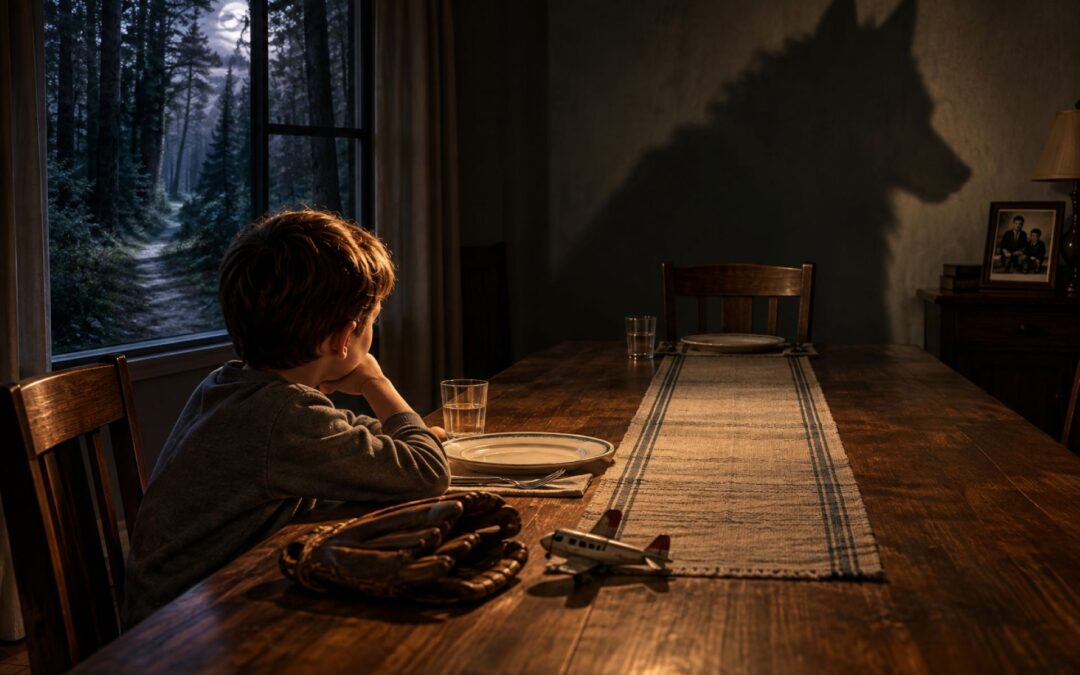
Augusten Burroughs’s A Wolf at the Table: A Memoir of My Father, published by St. Martin’s Press in 2008, reaches backward from the chaotic adolescence depicted in Running with Scissors to the childhood that came before it. Its central figure is Burroughs’s father, John, a philosophy professor whom the young Augusten desperately wants to love and be loved by, even as he gradually comes to experience him as distant, unpredictable, neglectful, and frightening. What begins as a child’s hunger for paternal attention becomes a memoir about fear, escape, inheritance, and the difficulty of separating yourself from someone whose absence has shaped you almost as powerfully as his presence.
Spoiler and content warning: This article discusses the entire memoir, including its ending. It also covers child abuse and neglect, animal deaths, alcoholism, domestic violence, threats of violence, suicidal thinking, murder fantasies, and other disturbing family material.
The book’s deepest question is not simply whether Augusten’s father was cruel. It is what happens when a child continues wanting love from a person he has learned to fear, and what happens later when that child becomes an adult who worries that the father’s darkness may have entered him. Burroughs eventually escapes his father physically, but the memoir argues that freedom from a parent is not the same thing as freedom from the need that parent never met. Its emotional resolution therefore arrives not with the father’s death, but with Augusten witnessing another father’s uncomplicated love for his son and finally understanding, from the outside, what he had been missing all along.

The Father He Cannot Remember: Longing Before Fear
Burroughs begins A Wolf at the Table with an image of danger. A young Augusten is running barefoot through the woods at night in his pajamas, convinced that his father is pursuing him. He can see the beam of a flashlight cutting through the trees behind him and calculates his chances by remembering his father’s damaged knee. The scene has the rhythm of a thriller: a child knows the terrain, knows the weakness of the man following him, and keeps moving until he believes he has escaped. Only later does the memoir return to this chase in its proper chronological position.
After that flash-forward, Burroughs moves all the way back to his earliest memories. He recalls sensory fragments from infancy with extraordinary confidence: looking through the hole in a cracker, the appearance of his mother, his crib, his older brother, the physical discovery of standing and walking. His father, however, is strangely missing. Burroughs can summon minute impressions of the world around him, yet the man who lived in the same house exists only as a vague form associated with the basement.
As an adult, he telephones his mother to confirm something that seems absurd to need confirming: was his father actually living with them then? She tells him that he was. This establishes the memoir’s first important paradox. Before the father becomes terrifying, he is absent—not physically absent, but emotionally and therefore mnemonically absent. The man who will later occupy enormous psychological space begins as a hole in the child’s remembered world.
At around five, Augusten travels to Mexico with his mother, Deirdre, her friend Hyacinthe, and Hyacinthe’s son Peter. The trip contains moments of childhood excitement and fear: climbing near a pyramid, Peter disappearing temporarily, a cave guide showing warmth toward Augusten, and Augusten injuring himself on a decorative radiator. These memories matter partly because other adults repeatedly provide forms of attention and physical reassurance that his father does not.
Eventually Deirdre explains that they have left because it is not safe to be around Augusten’s father. The statement gives a name to something the child has not yet been able to formulate. When they return to Massachusetts, mother and son do not immediately resume ordinary family life. They stay elsewhere, and Augusten becomes increasingly conscious that the adults around him are managing some kind of danger.
Uncle Mercer gives him a cardboard rocket, an object that becomes one of many examples of Augusten finding emotional investment in things adults give him. The household itself feels unstable, but school offers no simple refuge. Augusten experiences bullying, embarrassment, bodily insecurity, and a strong dependence on his mother. He takes violin lessons and begins to imagine that musical accomplishment might finally cause his father to notice him.
The desire becomes so painful that he destroys the violin himself by tightening its strings until they snap. The act is not simply childish mischief. It anticipates a pattern that recurs throughout the memoir: when Augusten cannot obtain the attachment he wants, he sometimes destroys the object onto which he has projected that hope.
When mother and son eventually return to the family house, Augusten discovers that his father has not been closely observing his development. One small incident captures the emotional distance. His father puts training wheels back on Augusten’s bicycle even though the boy already knows how to ride without them. The error is ordinary enough, but to Augusten it confirms something larger: his father does not know who he is or what he can do.
Augusten nonetheless wants him desperately. His older brother, John Elder, is much older and often feels like a separate presence within the family rather than a conventional childhood companion. The boys can be antagonistic, but there are also flashes of shared pleasure, such as playing in extraordinary winter snow around the family’s house in Shutesbury. Against this unstable human background, the family dogs become especially important to Augusten.
When his father insists that the dog Grover must live outside, Augusten begins wondering whether children can also be classified that way. If there can be an “outside dog,” perhaps there can be an “outside son.” His father’s decisions about animals therefore become inseparable from Augusten’s fear about his own place in the household.
He waits for his father to return from work and handles his possessions when he is absent. He smells his belongings, studies his radio cards, and treats material traces as substitutes for intimacy. At night, father and son exchange the phrase “Very much I love you,” but Augusten does not experience the words as the natural overflow of affection. They become a ritual whose emotional emptiness is increasingly painful.
Augusten makes his father a welcome-home collage, hoping to create a moment of recognition. His father initially reacts with anger before realizing the collage is a gift. The incident teaches Augusten again that affection is risky: even an attempt to please his father may provoke hostility before it produces anything resembling warmth.
The contrast becomes almost unbearable when Augusten notices how easily his father pets and touches a dog. He begins to imagine that if he could somehow become doglike, he might finally receive the same uncomplicated physical affection. He constructs a paper dog costume, a child’s strange and heartbreaking attempt to solve an attachment problem by changing species rather than expecting the parent to change.
Another small ritual also collapses. Augusten had interpreted the Certs his father gave him as special gifts, private tokens connecting the two of them. He eventually realizes they are merely his father’s ordinary breath mints. Once again, an object he has invested with paternal meaning turns out not to signify what he hoped.
Burroughs then reaches backward into his father’s own childhood. Photographs show a handsome young boy who seems to have been cherished by relatives. John initially grows up with doting extended family members, including his grandfather and aunts, before his biological parents reclaim him. According to the family history Burroughs reconstructs, his world becomes harsher after that move. His father drinks, punishment becomes physical, and the adored child enters a household where affection is less secure.
The information provides a possible lineage for the damage without excusing it. Augusten begins to see that the father who deprives him of tenderness may once have been a child who also experienced an abrupt loss of safety. A Wolf at the Table repeatedly returns to this question of transmission: what passes from one generation to the next, and what does not?
The father’s intellectual life offers occasional opportunities for connection. Augusten accompanies him to the university and is fascinated by the adult environment, although a minor incident involving writing or drawing on a chalkboard ends badly. Another domestic episode begins with something as trivial as balloon twisting. Augusten wants his father’s help with a kit, persists, and eventually provokes a disproportionate reaction in which his father grabs, shakes, and spanks him while accusing him of demanding everyone’s attention.
By this point, Augusten has learned that direct bids for affection can lead to rejection or anger. He nevertheless keeps testing the relationship. When he tries to enter his parents’ bed or sit on his father’s lap, he is repeatedly told to leave. He turns the pattern into something almost scientific, carrying a clipboard and recording how often his father says “go away” compared with the number of times he is invited closer.
The results confirm what he already feels. There is no reliable route to physical closeness with the real father, so Augusten creates one. He steals clothes belonging to his father, fills them with sheets and pillows, adds familiar masculine smells, and constructs a stuffed substitute body he can sleep beside. The artificial father does what the living one will not: it remains physically available.
His mother eventually dismantles the arrangement without realizing its importance. The episode distills the childhood portion of the memoir more clearly than almost anything else. Augusten does not begin by wanting revenge on his father. He begins by wanting the simplest possible thing: a body beside him that does not move away.
Ernie’s Death and the Turn from Love to Hatred
The emotional architecture of the memoir changes in the next group of chapters. Until now, rejection has hurt because Augusten continues to interpret his father as someone from whom love might still be obtained. With the death of his guinea pig Ernie, that hope begins to harden into something closer to hatred, and the father gradually becomes not merely unavailable but threatening.
One of the most important moments of genuine connection occurs during a walk. Augusten asks his father what the straightest thing in existence is. His father responds that it is a ray of light. For a brief interval, knowledge creates the relationship Augusten has been craving: the father is attentive, the son is curious, and the conversation moves naturally between them. The memory matters later because light becomes one of the memoir’s recurring images, but it also prevents the father from being reduced to uninterrupted monstrosity. Augusten remembers flashes of the man he wanted him to be.
For his ninth birthday, his father gives him a costly Wilson baseball glove. The gift initially seems like an invitation into a conventional father-son ritual, but there is no baseball and no game of catch. Augusten’s mother attempts to make up for the omission, but the glove becomes another object whose symbolic promise exceeds what actually happens.
Augusten eventually damages it deliberately so that it will look used. The logic resembles the destroyed violin. He cannot create the relationship represented by the object, so he manipulates the object itself. A glove that appears worn can at least mimic the history of father-son play that never occurred.
His mother then gives him a guinea pig named Ernest, or Ernie. The animal offers what the father does not: vulnerability, responsiveness, and uncomplicated dependence. Augusten can care for Ernie and receive affection without the anxiety that accompanies his attempts to approach his father.
A frightening confrontation between his parents eventually causes Augusten and Deirdre to flee to a hotel. His mother tells him that his father will look after Ernie while they are gone. That assurance carries emotional weight because it requires Augusten to trust his father with something defenseless and beloved.
When they return, Ernie is dead. The enclosure is filthy, and Augusten believes that the animal has been left without adequate food or water. His father’s behavior and comments convince him that the neglect was intentional. Whether the death can be independently reconstructed is impossible from the memoir alone, but what matters to the narrative is the conclusion Augusten reaches: he believes his father deliberately allowed something he loved to die.
That belief changes the relationship. Previously, Augusten has interpreted his father’s distance as evidence that he himself may be unworthy or insufficiently interesting. Ernie’s death allows a different interpretation. Perhaps the problem is not that Augusten cannot make himself lovable. Perhaps the father himself is dangerous.
Deirdre initially tells Augusten that Ernie died naturally. Her denial creates a second wound because it undermines the child’s confidence in his own perception. The memoir repeatedly depicts Augusten experiencing something as terrifying and then encountering an adult version of events that minimizes or contradicts what he believes happened.
His mother begins telling him more about her marriage. She recounts meeting John, the proposal, family expectations surrounding the relationship, the relocations that followed, his drinking and anger, and her growing isolation. These stories provide a prehistory for the conflict Augusten has known only from inside the household.
They also complicate Deirdre’s role. She can be Augusten’s closest emotional ally and the person who names danger, but she is herself becoming unstable. At one point she repeats part of the marriage story as if she does not remember having already told it, and Augusten becomes frightened not only of his father but of losing the parent on whom he relies.
The language of the household itself begins to carry fear. Augusten notices the proximity between the words “Dad” and “dead” in his own speech and imagination. The association is childish but revealing: paternal identity and mortality are already becoming fused.
Outside the house, relationships offer partial escape. Augusten befriends Damian, a bullied child whom he defends, and grows especially close to Greg Fanslow. Greg and the woods around them provide a separate world, one in which children can invent places and meanings that adults do not control. A secret cabin and other private landmarks become emotional counterweights to the family home.
The situation worsens when Deirdre is hospitalized for what the memoir describes as “nervousness.” John Elder is also away, leaving Augusten alone with his father for an extended period. Without mother or brother present, the house changes character.
His father keeps it dark and emotionally deadened, restricts the use of lights, and does not reliably provide normal meals. Augusten eats what he can manage. Hunger becomes another sign that the adult responsible for him is not performing the ordinary work of care.
A grocery trip gives him one of his clearest lessons in the difference between the father he experiences and the man outsiders encounter. His father tightly controls what Augusten may buy, then becomes charming and conversational with a cashier. The transformation is disturbing because it demonstrates social competence. The terrifying private father is capable of presenting a completely different face to strangers.
At home, Augusten watches his father’s physical decline and strange behavior. He sees him dealing with illness, hears him speaking incomprehensibly to himself, and observes him sharpening knives. In the child’s consciousness, ordinary domestic objects become charged with threat because he no longer trusts the adult who controls them.
Augusten also continues searching for substitute versions of fatherhood. When workmen come to deal with the septic system, he becomes fascinated by a large foreman whose masculine attention feels briefly gratifying. The man initially mistakes Augusten for a girl and then reacts differently after learning he is a boy, leaving Augusten humiliated and rejected once again.
Even paternal words that once signified affection become frightening. Brutus, one of the family dogs, growls when the father stands silently near Augusten’s room. In another encounter, Augusten sees his father chopping wood, and the familiar mouthed phrase “Very much I love you” feels more like a threat than reassurance.
When Deirdre returns from hospitalization, she seems diminished. Augusten clings to her assurance that she loves him, because maternal love is one of the few emotional certainties he still believes he possesses.
The next major animal episode involves Grover. The dog develops a serious growth in his mouth that increasingly interferes with eating. Augusten wants him taken to a veterinarian, but his father delays. The boy watches an animal he cares about deteriorate while an adult with the power to intervene fails to act.
When Augusten says that they “ought” to take Grover to the vet, his father turns the word into a philosophical discussion about obligation. Because he is a philosophy professor, the conversation might in another context be intellectually interesting. Here it becomes grotesquely ironic: the suffering animal is physically present while the adult capable of helping him shifts attention toward the abstract meaning of moral duty.
Grover dies. By this stage, animals have become more than pets within Augusten’s narrative. They are tests of whether adults will protect vulnerable beings, and they repeatedly produce answers that confirm his worst expectations.
Life as Prey: Violence, the Woods, and Escape
As Augusten grows older, fear becomes more active. He is no longer merely waiting for signs of love or trying to interpret neglect. The family begins operating as though violence may occur, and Augusten increasingly thinks in terms of defense, escape, weapons, and the possibility that he may have to save himself.
John Elder spends more time away from home, and his absence removes one of the household’s buffers. Although the brothers have not always been close, Augusten recognizes that his older brother absorbs and redirects some of the family’s danger simply by being present.
Augusten’s imagination expands outward toward space, nuclear war, infinity, and the possibility of catastrophe. Cosmic questions offer both terror and relief because they make the family drama feel simultaneously enormous and very small. His mind keeps searching for systems large enough to explain what is happening around him.
A major confrontation erupts between John Elder and their father. As the argument escalates, Augusten retrieves his brother’s rifle and gives it to him, urging him to kill their father. This is a profound threshold in the memoir: lethal violence, previously imagined, becomes physically available inside the family conflict.
John Elder points the rifle at his father and forces him to retreat, but he does not shoot. He then turns on Augusten for handling the weapon. The following day, however, he secretly takes Augusten into the woods and teaches him how to use the rifle safely.
The lesson is both protective and horrifying. John Elder understands that he will not always be home, and that his younger brother may need to know how to handle a gun in a household neither of them fully trusts. The brothers’ relationship has shifted from rivalry toward survival partnership.
The memoir then returns to the chase that opened the book. Augusten runs barefoot through the woods at night, believing his father is hunting him. He uses his intimate knowledge of the terrain and his awareness of his father’s injured knee to calculate how to get away.
The scene is central because it transforms the book’s predator imagery into literal action as Augusten remembers it. His father is no longer simply wolf-like in the child’s imagination; Augusten experiences himself as prey moving through darkness while an adult pursues him with a flashlight.
The same woods, however, also belong to his friendship with Greg. With Greg, Augusten explores, invents places, discovers a reservoir, and builds a geography outside the family’s emotional system. The woods therefore refuse a single meaning. They are where Augusten can be hunted and where he can be free.
The following morning, Augusten sees a pine needle in his father’s hair and interprets it as confirmation that the chase occurred. Within the memoir, that detail functions as proof for the child. Later questions about the scene’s literal status become important, but at this point the narrative remains inside Augusten’s certainty.
Religion becomes another field of conflict. Augusten prays for help, hoping for deliverance from his father even if that deliverance somehow requires the father’s death. His father discovers him praying and mocks the idea that God will intervene.
As an atheist and philosophy professor, the father argues that people must take responsibility for themselves rather than waiting for divine rescue. The exchange wounds Augusten, but it also produces an unexpected consequence. He begins adapting the argument to his own needs: perhaps help from God does not mean passive supernatural rescue; perhaps it means receiving the capacity to act.
The house meanwhile feels increasingly divided into private territories. Family members inhabit separate rooms almost like animals occupying caves. Doors, locks, hallways, and boundaries matter because emotional safety has become spatial.
Deirdre’s condition also becomes more unstable. She moves between despair and exhilaration, investing heavily in her identity as a poet while Augusten watches her emotional state change unpredictably. He recognizes that he and John Elder, separated by a large age gap, effectively grew up with different versions of the same parents.
His mother also tells him disturbing things about her marriage and his father’s behavior. The memoir presents these as claims Deirdre makes, and they contribute to Augusten’s understanding of his father, but they remain filtered through family testimony rather than independently established history.
A proposed holiday to Martha’s Vineyard becomes one of the memoir’s most important moral turning points. His father obsesses over routes, expenses, and logistics, and Augusten imagines the trip as another exercise in paternal control. At the cliffs, his mind develops an elaborate scenario in which he could push his father to his death and make it appear accidental.
What matters is that he ultimately refuses the fantasy. He realizes that killing his father would not free him. It would allow the father to determine the entire remainder of Augusten’s life by turning him into someone whose identity was permanently organized around murder.
In reality, the father does not accompany them to the cliffs. The scene therefore combines imagination with a more important internal decision. Augusten also confronts the possibility of throwing himself from the cliffs and begins instead to imagine that he might live into adulthood. Survival is slowly becoming conceivable as a future rather than merely a minute-by-minute escape from fear.
Back home, Brutus becomes another unstable element in family life. The dog grows intensely aligned with the father and hostile toward Augusten and his mother. As with the memoir’s other animals, Brutus is not merely decorative; he reflects and magnifies the household’s struggles over loyalty, territory, vulnerability, and power.
When Brutus threatens a neighbor, Augusten observes his father delaying intervention and responding with hostility. Eventually the parents decide the dog must be euthanized. The father returns afterward with Brutus’s collar and leaves it conspicuously behind, transforming an ordinary object into another charged relic.
That night Augusten overhears a deeply disturbing interaction between his parents involving anger, sex, humiliation, and his mother’s distress. Because he experiences the incident from elsewhere in the house, the memoir cannot offer an omniscient account of what occurs. What it can establish is the child’s terror as he listens and tries to understand adult behavior through incomplete information.
Before the final escape, a small silver cross assumes importance. While out with his mother, Augusten feels compelled to buy it and begins wearing it. The object does not signal a return to conventional religion so much as a personal attempt to claim protection and meaning in a world where ordinary sources of safety have repeatedly failed him.
The decisive physical break comes during a drive with his father to dispose of trash. His father becomes enraged while driving, and Augusten believes he is in immediate danger. He opens the door and jumps from the moving vehicle.
He makes his way home, and this time Deirdre acts without hesitation. She packs, takes Augusten, and drives away, telling him they are not going back. The decision ends the long cycle in which mother and son flee temporarily and then return.
They hide at a Howard Johnson under an assumed name. A psychiatrist involved with the situation describes the father as homicidal, but that characterization belongs to the psychiatrist and should not be mistaken for an independent diagnosis supplied by the memoir itself. For Augusten, however, the word confirms the scale of danger he already believes he has survived.
When he and his mother briefly return for belongings, Augusten finds Cream tied outside without adequate care and releases her. The act is small compared with escaping the household, but it matters symbolically. The child who has repeatedly watched vulnerable animals suffer finally becomes the person who opens a tether and lets one go.
Even after leaving, the father’s power does not disappear immediately. He telephones Augusten and threatens to come kill him. Augusten contacts the police, expecting adults to recognize the danger.
The police encounter a father who appears sober and reasonable, and they do not accept Augusten’s interpretation. He experiences the response as humiliation and another repetition of the public/private divide: the man outsiders see is not the man the child believes he knows. Deirdre later believes Augusten, restoring some of the validation he had been denied.
His parents eventually divorce, and he moves with his mother to a smaller home in Amherst. Yet escape from one unstable family structure leads toward another. Deirdre becomes increasingly dependent on her psychiatrist, whose unconventional household begins absorbing Augusten.
Augusten spends more time there and eventually becomes the psychiatrist’s legal ward. Chronologically, this is the threshold leading into the period later made famous in Running with Scissors. A Wolf at the Table therefore ends its main childhood struggle not by delivering Augusten into normality, but by transferring him from one extraordinary family environment into another.
After Childhood: Poverty, Alcoholism, and the Fear of Becoming His Father
The memoir then jumps forward because physical separation does not resolve the father’s psychological importance. At seventeen, Augusten has left the psychiatrist’s household and is living alone in a cheap apartment in Holyoke. He works as a waiter but is desperately poor, sometimes without enough food.
Eventually hunger overcomes pride, and he contacts his father for help. The request offers one more opportunity for the father to perform a basic act of care toward his son.
His father arrives with a meager supply of inexpensive food, including a partial loaf of bread, a small amount of bologna, and a damaged container of drink. Instead of responding primarily to Augusten’s hunger or vulnerability, he communicates disappointment with the life his son is living.
Augusten is overwhelmed by rage. Yet the anger eventually becomes something he can use. He invokes Newton’s Third Law—the principle that every action produces an equal and opposite reaction—and imagines his father’s rejection as a form of “rocket fuel.”
The metaphor is revealing because it does not turn rejection into something good. His father’s failure still hurts. But Augusten begins converting the energy of that failure into ambition: if his father will not rescue him, admire him, or believe in him, he will build a life that no longer depends on receiving those things.
By around thirty, that life looks successful from the outside. Augusten has developed a career in advertising and possesses the kind of professional accomplishment he once imagined might finally impress his father. Privately, however, he is unraveling.
He drinks heavily, lives in disorder, isolates himself, and experiences frightening dreams in which he kills people and conceals their bodies. The dreams trigger one of the memoir’s most important adult questions: has he inherited something from his father that he cannot control?
Burroughs repeatedly contacts his father, partly to announce his achievements. The old desire for recognition has not vanished simply because the child is now professionally successful. When Augusten decides to stop initiating contact as an experiment, years pass without his father calling him.
The silence confirms the pattern first established in infancy. Augusten can change careers, become financially independent, and move across decades, but his father remains capable of producing the original wound through absence alone.
A disturbing childhood image also continues haunting him. Augusten remembers or dreams of his father burying a body, but the memory is unstable and never becomes an established fact. It merges with his adult fascination with serial killers and his fear that violence may be hidden beneath ordinary appearances.
During a drunken telephone conversation, Augusten tests his father with a hypothetical scenario. He suggests a way his father might kill Deirdre by pushing her from a bridge. Instead of immediately rejecting the idea, his father discusses practical details such as the number of nearby windows and the possibility of witnesses.
To Augusten, the answer is chilling because it seems calculating rather than morally shocked. Yet the memoir ultimately refuses to convert the conversation into proof that the father actually wanted to kill anyone.
Augusten later visits the bridge himself and imagines pushing his mother. The fantasy becomes a test of his own nature. He knows that he could not do it.
That recognition matters more than solving the mystery of what his father might have been capable of. Augusten explicitly acknowledges that his father never pushed Deirdre from the bridge and that he may never know the full truth about his father’s inner life. What he can know is that he himself does not simply reproduce it.
He looks at his own body and notices its separateness: healthy skin, functioning knees, physical traits that remind him that inheritance does not equal duplication. He is his father’s son, but he is not his father.
The realization is not presented as complete healing. Augusten admits that while he now knows who he is not, he is “not quite” himself either. The father has ceased to define the outer boundary of identity, but Augusten still has work to do before he can inhabit a self built on something other than opposition.
Death, Diaries, and the Love He Never Received
Roughly a decade later, Augusten sees his father near the end of his life. John is dying at home under hospice care, physically diminished from the powerful and frightening figure who has dominated his son’s memory. Other family members gather, including John Elder.
An uncle tells affectionate stories about the dying man’s younger life and accomplishments. These accounts do not erase Augusten’s experience, but they remind both him and the reader that his father occupied roles outside the memoir’s central relationship. There were versions of John known to siblings, colleagues, relatives, and acquaintances that Augusten never possessed.
Augusten brings photographs to the bedside, apparently hoping that they might create some final form of recognition. His father turns away. The emotional pattern of childhood seems to persist even when death has stripped the older man of nearly everything else.
Then comes the scene Augusten interprets as the father’s final rejection. John tells John Elder that he has been a good boy and a good son. Augusten believes his father looks toward him as though he might say something similar but ultimately says nothing.
The moment devastates Augusten precisely because he has spent a lifetime pretending he no longer needs what he wanted as a child. Yet his later interpretation contains an important reversal. He does not finally regard himself as the person who failed to deserve a father’s love. He sees his father as the one who lost the chance to know his son.
John dies without a funeral. Augusten’s immediate feeling is not conventional grief but liberation. The source of so much fear is physically gone, and for a period that absence feels like freedom.
His stepmother later gives him a small inheritance containing family possessions and four of his father’s diaries. Augusten waits before reading them, aware that the notebooks may contain some explanation for a man he has never been able to understand.
When he finally opens them, the diaries are strikingly mundane. His father records prices, fuel, purchases, physical complaints, and other practical details. The pages seem to Augusten like the written equivalent of the public father: factual, orderly, and almost entirely devoid of the emotional reality the son experienced.
Then he finds a line about himself. His father writes that Augusten has become distant and attributes this change to “my games.”
The phrase is small, especially compared with everything Augusten wants from the notebooks, but it matters enormously. It suggests at least a fragment of awareness that the father’s own behavior contributed to the distance between them. It is not an apology, explanation, confession, or reconciliation, yet it punctures the idea that the father understood nothing.
The memoir could plausibly have ended there. The father is dead, the child has survived, and a diary provides a tiny acknowledgment. Burroughs instead adds an epilogue because those developments do not answer the book’s deepest emotional question.
Two years after his father’s death, Augusten is on a book tour in Boston. His usual media escort, Ginny, is replaced for a day by her husband, a warm and somewhat bumbling man whose son Sam is about to graduate from Harvard Medical School.
They accidentally enter a building where graduation robes are being stored. The man cannot resist looking for his son’s robe. His small excitement and equally small disappointment when he cannot find it reveal an intensity of paternal pride that suddenly overwhelms Augusten.
The scene contains none of the dramatic violence that dominates the childhood narrative. That is precisely why it has such power. Augusten is witnessing an ordinary father loving his son openly, reflexively, and without calculation.
For the first time, he does not merely know as an abstract fact that fathers can feel this way. He feels the force of another man’s pride and affection and understands what the absence of that emotion in his own relationship meant.
Grief therefore arrives indirectly. Augusten is not simply mourning the father who died; he is mourning a relationship that never existed and can no longer become possible.
The memoir ends by expanding outward into the cosmic imagery that has followed Augusten since childhood. He imagines another world, another version of himself, and another father who watches him with uncomplicated pride. In that imagined universe, the familiar phrase returns: “Very much I love you.”
Throughout the book, those words have moved through radically different meanings. They begin as a formula Augusten wants to believe, become hollow through repetition, acquire menace when associated with fear, and finally become capable of expressing real love only when Augusten imagines them spoken by the father he needed rather than the father he had.
The Burroughs Family: Character and Relationship Analysis
A Wolf at the Table depends on relationships more than isolated psychological portraits. Augusten remembers each major family member partly through the pressure that person exerts on everyone else: his father affects his mother, his mother’s instability changes his dependence on his brother, John Elder’s absence alters the danger inside the house, and friendships or animals become important because they offer alternatives to the family’s emotional economy.
The memoir is therefore strongest when its characters are understood relationally. Its central drama is not a simple contest between an innocent son and a monstrous father, even though the father is overwhelmingly frightening in Augusten’s narrative. It is the story of a family whose members respond differently to the same unstable center and carry those responses into different versions of adulthood.
Augusten Burroughs: The Child Who Wants to Be Chosen
The young Augusten is unusually observant, imaginative, sensitive to atmosphere, and desperate for signs that adults value him. His sensitivity makes him vulnerable to rejection, but it also becomes one of his primary survival tools. He notices changes in tone, objects, rooms, facial expressions, and routines because reading the environment may tell him whether he is safe.
His earliest strategy is self-modification. He tries to become interesting enough, talented enough, obedient enough, doglike enough, or physically available enough to make his father love him. When the world refuses to respond as he hopes, he uses imagination to create substitutes: a stuffed father, private geographical worlds with Greg, fantasies of escape, fantasies of murder, and eventually alternate universes in which paternal love exists.
This imaginative power can be creative and frightening at the same time. Augusten considers killing his father, helps introduce a rifle into a domestic confrontation, fantasizes about pushing him from a cliff, and later tests himself with violent thoughts about his mother. The memoir does not present those thoughts as proof that Augusten is secretly equivalent to his father. Instead, they show a child and later adult trying to understand whether imagining violence means possessing a violent nature.
His most important development is the gradual separation of identity from paternal recognition. At first he asks, in effect, “What must I become so my father will love me?” Later the question becomes “What if I have become my father?” By the end, he can answer both fears more clearly: his father’s refusal to love him adequately did not prove that he was unlovable, and resemblance does not mean destiny.
Yet Burroughs wisely avoids turning this into a neat triumph. Success in advertising does not cure him; money does not cure him; distance does not cure him; even his father’s death does not cure him. The epilogue offers a quieter form of growth in which Augusten can finally recognize love when he sees it, even though he cannot retroactively receive it from the person whose absence created the need.
John: Absence, Threat, and the Unknowable Father
The father in A Wolf at the Table is both the memoir’s dominant figure and its greatest absence. Augusten describes his actions, gestures, illnesses, possessions, moods, silences, drinking, academic interests, and treatment of animals in enormous detail, yet he never gains secure access to his inner life.
That gap begins in infancy, when the father is virtually missing from memory, and persists through the diaries, which offer facts without explanation. Even the final phrase about Augusten’s distance being caused by “my games” reveals awareness without telling the reader what John understood those “games” to be.
His own childhood creates one possible interpretive frame. Burroughs depicts a boy who was initially adored by extended family and then reclaimed into a harsher home marked by drinking and physical punishment. This history suggests that emotional damage may be transmitted rather than spontaneously created, but the memoir never argues that suffering in childhood excuses the suffering John later causes.
One of the most interesting contradictions is the father’s intellectual sophistication. He is a philosophy professor capable of discussing light, morality, God, and obligation. Yet the memoir repeatedly places that abstract intelligence next to failures of elementary care. The contrast is clearest when Grover is suffering and John redirects Augusten’s plea that they “ought” to help into a philosophical discussion of what “ought” means.
His public behavior creates another contradiction. Augusten sees him become socially normal and even charming with strangers while behaving very differently inside the family. That discrepancy makes him more frightening to the child because it suggests control rather than total incapacity. At the same time, the memoir cannot know how much of the contrast reflects a child’s sharply divided perception of public and private behavior.
John also possesses moments that resist a completely one-dimensional portrait. The conversation about a ray of light briefly gives Augusten the father he wants. Relatives later remember qualities and accomplishments that do not appear prominently in the childhood narrative. The diaries suggest some degree of self-awareness. These fragments do not overturn Augusten’s account, but they preserve the father as an ultimately inaccessible person rather than a fully solved psychological case.
For that reason, the book is strongest when read without armchair diagnosis. The memoir gives no responsible basis for declaring John a psychopath, narcissist, sociopath, autistic person, murderer, or any other clinical or criminal category. What it gives is Augusten’s experience of a father he perceived as emotionally withholding, neglectful, frightening, and at times potentially dangerous.
Deirdre Burroughs: Protector, Witness, and Unstable Parent
Deirdre occupies the opposite emotional position from John during much of Augusten’s childhood. She is the parent who tells him she loves him, takes him away when the household becomes dangerous, buys him pets, tries to compensate for paternal disappointments, and eventually makes the decisive choice to flee permanently.
Yet the memoir does not present her as a stable rescuer. Her own mental health deteriorates, she is hospitalized, she repeats stories, moves between despair and exhilaration, and becomes increasingly dependent on psychiatric treatment. Augusten’s safety therefore depends on someone whose ability to protect him is itself unstable.
This combination intensifies the child’s fear. If his father is dangerous and his mother is the person who can save him, every sign of her deterioration threatens the entire structure on which his survival depends. Her hospitalization leaves him alone with his father, while her later relationship with her psychiatrist eventually transfers Augusten into another highly unconventional household.
She is also a major source of information about the father. Much of what Augusten knows about his parents’ marriage, John’s behavior toward Deirdre, and the history of their relationship comes through her testimony. Because the memoir remains Augusten’s account, those allegations should be understood as things Deirdre tells him rather than independently established facts.
Her greatest moment of agency arrives after Augusten jumps from the moving car. She does not rationalize the incident or return after a temporary separation. She packs, takes him away, hides with him, and eventually ends the marriage. Whatever her failures elsewhere in the memoir, that decision changes the direction of Augusten’s life.
John Elder Robison: Brother, Buffer, Protector, and Competing Witness
John Elder is considerably older than Augusten, which means the brothers do not experience the family at the same developmental stage. Early in the memoir, he can seem teasing, distant, or simply occupied with his own life. As he spends more time away from home, however, Augusten increasingly recognizes how much his presence had buffered the household’s tension.
The rifle confrontation transforms their relationship. John Elder refuses to kill their father, reprimands Augusten for handling the gun, and then teaches him how to use it safely because he knows he cannot always be there. It is one of the memoir’s clearest expressions of sibling protection.
He is also important because he later becomes a competing witness to family history. In a CBS News discussion of Burroughs’s memoir and its truth claims, John Elder Robison described remembering their father differently in some respects and attributed part of that difference to the brothers’ age gap. The father Augusten knew as a young child was not necessarily identical to the father John Elder had encountered years earlier.
That difference does not require choosing one brother as correct and the other as wrong. Families often contain genuinely divergent experiences of the same person. In A Wolf at the Table, John Elder therefore has two functions: inside the story he becomes Augusten’s protector, while outside it he reminds readers that memoir is always a perspective rather than a complete archive of everyone’s experience.
Greg, Animals, and Surrogate Forms of Attachment
Greg offers companionship without the volatility of the family home. Their explorations transform the woods into a place of invention and autonomy, allowing Augusten to experience intimacy without constantly performing for it. Greg does not replace a father, but the friendship demonstrates what ordinary trust can feel like.
Animals perform an even more important emotional function. Ernie provides affection and vulnerability; Grover becomes an object of concern that exposes failures of adult care; Brutus moves from family dog to threatening territorial force; Cream becomes someone Augusten can finally free when the family escapes. The animals repeatedly dramatize the question of what stronger beings owe to weaker ones.
Augusten also responds intensely to occasional adult men who show him attention. A cave guide, a workman, and eventually the proud father in the epilogue all evoke forms of masculinity that differ from what he knows at home. The last of these surrogate encounters is decisive because it finally makes paternal love emotionally legible.
Abuse, Neglect, Attachment, and the Making of Fear
The psychological force of A Wolf at the Table comes from the fact that fear develops inside attachment rather than replacing it. Augusten does not initially approach his father as an enemy. He waits for him, smells his clothes, makes gifts for him, invents reasons to be touched, constructs a stuffed version of him, and interprets trivial objects as evidence that he might secretly be loved.
That longing makes rejection especially damaging because every attempt at closeness exposes Augusten to another test. A parent’s indifference is not experienced by a small child as an abstract flaw in the parent; it can become evidence that the child himself has failed. The clipboard experiment makes this dynamic almost literal as Augusten tries to quantify whether his father wants him nearby.
His dog costume and stuffed father are particularly revealing because both solve the problem by altering Augusten’s side of the relationship. If dogs receive affection, perhaps he can become a dog. If the father will not permit physical closeness, perhaps Augusten can build a body that will.
Ernie’s death marks the point where this attachment system changes. Augusten becomes convinced that the father has deliberately allowed a defenseless creature he loves to die. From that moment, the person from whom he wants affection also becomes someone capable, in his mind, of destroying what he loves.
Fear then organizes perception. Knives, darkness, dogs, car rides, bedroom doors, woods, the father’s body, and the sound of his voice acquire potential threat. The child becomes hyperattentive because ordinary ambiguity is intolerable when he believes danger may be present.
The repeated animal episodes reinforce that psychology. Augusten sees vulnerable creatures dependent upon adults and identifies with them. What happens to Ernie or Grover is therefore never merely about pets; each episode provides a model of what can happen when a weaker being depends on someone who does not care for it.
The rifle and the murder fantasies show what happens when fear evolves into imagined counterviolence. Augusten begins contemplating whether survival might require destroying the person he fears. Yet the Martha’s Vineyard sequence provides an essential moral development because he rejects that solution. If he becomes the person who kills his father, then his father still determines who he becomes.
The eventual escape offers physical safety but not emotional erasure. Adult Augusten remains organized around the old relationship through ambition, drinking, obsessive phone calls, violent dreams, and fear of inheritance. The memoir therefore portrays trauma less as a past event than as a system of expectations carried forward: who will abandon me, what am I capable of, and how much of the person I fear already lives inside me?
Burroughs never turns those questions into a clinical theory, and the article should not either. The memoir’s psychological power lies in how concretely it represents a child trying to build a coherent world from inconsistent caregiving, fear, love, and partial information.
Memory, Memoir, and the Problem of Truth
Memory is not an incidental controversy surrounding A Wolf at the Table; it is built into the book from its opening pages. Burroughs presents extraordinarily early sensory memories, sometimes from periods many adults could not recall with comparable detail. The memoir’s authority therefore depends heavily on the reader accepting that these experiences have remained available to him with unusual vividness.
Burroughs has publicly described his childhood memory as exceptionally strong. In a discussion of the nature of memory, he spoke about early recollections, the persistence of traumatic material, and the role journals can play in reopening remembered experience. His writing treats memory not as a neutral video recording but as something sensory, emotional, associative, and capable of resurfacing through objects or fragments.
That position is compatible with the form of literary memoir, which is necessarily reconstructed. No adult memoirist can reproduce the exact consciousness of a five-year-old without selecting, arranging, interpreting, and often recreating dialogue from remembered experience. The problem begins when literary certainty and historical certainty appear identical on the page.
The opening woods chase provides the clearest example. In the memoir, it is narrated with intense physical confidence: Augusten runs, his father pursues, the flashlight moves through the trees, and a pine needle in his father’s hair later confirms the child’s conclusion. Yet in the CBS News examination of Burroughs and “the art of memoir”, Burroughs acknowledged that he did not know for certain whether the chase literally happened.
That later uncertainty matters because the chase is not a minor decorative memory. It opens the book, gives literal form to its wolf-and-prey metaphor, and helps establish the father as hunter. A reader who encounters only the memoir would have little reason to suspect that the author himself was uncertain about the event’s factual status.
The body-burying memory or dream presents a related but more transparent case because the memoir itself allows uncertainty to remain visible. Augusten is haunted by an image involving his father and a buried body but cannot establish whether it was real. The narrative does not ultimately claim that his father was a murderer.
The deathbed scene is complicated in another way. Augusten interprets his father’s failure to speak to him after praising John Elder as a final rejection. John Elder later remembered the dying man’s condition differently and suggested that he may simply have been physically unable to continue speaking. Again, there is no need to declare one brother dishonest. Two observers can encounter the same dying parent and construct different meanings from the moment.
These differences highlight a useful distinction between subjective truth and externally verifiable history. A Wolf at the Table is exceptionally persuasive about what it felt like for Augusten to experience his father as frightening, withholding, and dangerous. That does not automatically verify every remembered action, motive, sequence, or reconstructed conversation.
The distinction becomes especially important because the memoir’s prose is so immersive. Burroughs rarely signals uncertainty by weakening the sensory force of a scene. The child’s perception becomes the reader’s immediate environment, which is one of the book’s great literary strengths and one of its ethical vulnerabilities.
A skeptical response, however, can go too far in the opposite direction. Discovering that one dramatic memory is uncertain does not logically establish that the entire childhood narrative is false, nor does John Elder’s different experience prove that Augusten’s experience could not have occurred. Families routinely contain different realities shaped by age, timing, temperament, alliances, and what adults show different children.
Burroughs’s own theory of memoir emphasizes remembered emotional experience rather than courtroom-style transcription. That is a defensible literary position, but it places greater responsibility on the memoirist to make uncertainty visible when uncertainty is known. Readers can accept reconstruction more easily when the text distinguishes “this is how I remember it” from “this is objectively what happened.”
The most balanced way to read A Wolf at the Table is therefore neither as an evidentiary dossier against John nor as a story invalidated by the instability of memory. It is a literary reconstruction of one son’s childhood consciousness. Its psychological and artistic claims can remain powerful even when some historical details cannot be settled.
Wolves, Dogs, Woods, Light, and “Very Much I Love You”: Symbols and Motifs
Burroughs builds the memoir around recurring objects and images that change meaning as Augusten’s relationship with his father changes. The motifs are effective because they emerge from childhood experience rather than arriving as abstract literary decoration.
The wolf implied by the title establishes the most obvious pattern. Augusten increasingly imagines the family relationship through predator and prey. In the woods chase, that metaphor becomes literal within his memory: he is the hunted child, his father the pursuing adult, and survival depends on knowing the landscape better than the predator.
Dogs complicate the same image. Early in the memoir, Augusten envies dogs because they receive physical affection from his father. His paper dog costume is an attempt to cross the boundary between unloved child and touchable animal. Later, dogs become associated with neglect, danger, loyalty, and territorial power.
Grover’s exile outdoors makes Augusten wonder whether he too could become an “outside son.” Grover’s illness turns moral responsibility into a test his father fails in Augusten’s eyes. Brutus becomes aligned with the father and threatening toward Augusten and Deirdre, while Cream becomes the animal Augusten physically releases during the final escape. The animal motif therefore tracks Augusten’s movement from identification with helpless dependence toward an ability to act.
The woods are similarly unstable. With Greg, they are imaginative territory, a place without parents where children can create names, rules, and secret spaces. During the chase, those same trees become a hunting ground.
This duality prevents nature from functioning as a simple symbol of freedom. The woods contain both the possibility of being found and the possibility of disappearing. Their meaning depends on who enters them with Augusten.
Light has its own transformation. The father’s answer that a ray of light is the straightest thing in existence belongs to one of their rare moments of intellectual connection. Later, the flashlight cutting through the woods becomes an instrument of pursuit.
Darkness fills the family home when Augusten is alone with his father. Lights are restricted, rooms become ominous, and the physical environment acquires the emotional quality of the relationship. The contrast between illumination and darkness therefore begins with knowledge and gradually becomes associated with safety and threat.
Photographs represent another form of attempted access. Augusten studies childhood photographs of his father because the images promise a version of John he cannot reconcile with the adult he knows. Near the end, he brings photographs to his dying father in the hope that shared images might create recognition, but the father turns away.
Houses, doors, rooms, and locks turn emotional boundaries into physical ones. The family eventually lives almost as separate creatures occupying isolated spaces. Escape requires changing geography, first temporarily through hotels or woods and finally permanently by leaving the house.
Weapons mark the point where imagined danger becomes actionable. The rifle is simultaneously a potential instrument of murder and a tool John Elder teaches Augusten to use for self-defense. The silver cross operates in the opposite register: it is not a practical weapon but an object through which Augusten claims psychological protection and responsibility.
The father’s body also becomes symbolic. His illness, skin, damaged knee, and physical deterioration are part of Augusten’s childhood perception of him. As an adult, Augusten studies his own body for evidence that he is not simply a continuation of his father. Healthy skin and functioning knees become small proofs of separateness.
The diaries provide a final version of the same problem. A written record should theoretically reveal the man from the inside, yet the notebooks mostly contain mundane logistical information. Like the father’s public persona, they offer surfaces. The phrase “my games” matters because it briefly breaks through that surface and suggests self-awareness.
No motif matters more than “Very much I love you.” Early on, Augusten wants the phrase to certify a bond. Repetition hollows it out because the surrounding relationship does not make the words emotionally credible. Later, the phrase can feel threatening when spoken or mouthed by the father during frightening moments.
The epilogue completes its transformation. After witnessing another father’s uncomplicated pride, Augusten can finally imagine what those words would mean if they came from genuine paternal love. Their emotional truth becomes available only after the original speaker is dead.
The final movement into stars, planets, and alternate worlds extends that idea. Augusten cannot change this life’s history, so imagination creates a universe in which the missing relationship exists. The fantasy does not pretend to repair reality; it gives emotional form to the possibility he was previously unable even to understand.
God, Philosophy, and Moral Responsibility
John’s profession as a philosophy professor creates one of the memoir’s most persistent ironies. He is associated with abstract reasoning about truth, morality, causation, obligation, and God, while Augusten experiences him as failing many of the practical duties that require no philosophical sophistication at all.
The Grover episode makes the contrast explicit. Augusten says that they “ought” to take the suffering dog to a veterinarian. His father responds by interrogating the concept of “ought,” transforming an urgent moral appeal into a problem of language and philosophy.
The intellectual question is legitimate in isolation: what grounds obligation, and what does it mean to say someone ought to act? Within the scene, however, abstraction becomes morally grotesque because the suffering creature remains present while the discussion continues. The gap between talking about duty and performing it becomes more important than the philosophical problem itself.
Religion produces a similar reversal. Augusten prays partly because he feels powerless, asking God to intervene in a family situation he cannot control. His father mocks that dependence and argues that people must accept responsibility for their own lives rather than wait for supernatural rescue.
The father intends the argument as a challenge to religious belief, but Augusten converts it into a survival principle. He begins to imagine divine help not as God magically removing his father but as the possibility that he himself has been given the capacity to act.
That reinterpretation becomes important when Augusten refuses murder. His fantasies of killing his father initially resemble a wish for an external event that will end the problem. At Martha’s Vineyard he realizes that genuine freedom requires not allowing his father to dictate his moral identity.
The same principle underlies the final escape. Augusten cannot wait indefinitely for the household to become safe or for an adult authority to solve it. When he jumps from the moving car and runs home, the abstract idea of responsibility becomes embodied action.
The memoir therefore gives John one of its strangest ironies. A father Augusten remembers as failing him morally nevertheless supplies fragments of thought—about light, obligation, and responsibility—that his son eventually transforms into tools for understanding the world and separating from him.
Structure, Voice, and Style: A Memoir Written Like a Thriller
Burroughs structures A Wolf at the Table very differently from a conventional chronological family memoir. The opening throws the reader into a chase before explaining who Augusten is, what the family is like, or why he fears his father. The rest of the childhood narrative gradually catches up with that opening image.
This flash-forward creates suspense, but it also establishes an interpretive frame. Before readers meet the emotionally absent father, they have already encountered him as the figure Augusten believes is hunting him. Everything that follows is therefore read under the shadow of future danger.
The memoir’s childhood scenes are intensely sensory. Burroughs remembers smells, textures, clothing, food, bodily sensations, rooms, animals, light, and objects with an almost obsessive concreteness. That sensory style makes the child’s world convincing because young Augusten often understands objects more securely than motives.
At the same time, the narration is clearly shaped by an adult writer. The metaphors, foreshadowing, structural parallels, and symbolic recurrences belong to a sophisticated literary consciousness looking backward. The book therefore does not attempt to simulate an unprocessed child’s diary; it reconstructs childhood through adult artistry.
Burroughs also deliberately reduces the comic tone that many readers associated with his earlier memoirs. The result is closer to Gothic domestic suspense. Doors, dark rooms, knives, forests, dogs, illnesses, and strange parental behavior acquire an almost horror-like atmosphere.
That style is extremely effective when it reproduces the child’s uncertainty. A young person who believes an adult may be dangerous cannot casually dismiss an ambiguous gesture. A father sharpening a knife or standing silently in a doorway becomes terrifying because the child lacks enough stable context to know what it means.
The same technique can become excessive. Burroughs frequently intensifies descriptions through elaborate metaphors and repeated signs of menace, sometimes leaving little tonal space between one frightening episode and the next. The relentless atmosphere risks making the father feel less like a contradictory human being than a figure engineered to sustain dread.
The memoir’s major time jumps are also structurally important. Ending with the childhood escape would have produced a simpler story of victimization followed by liberation. Moving into Augusten’s poverty, professional success, alcoholism, violent dreams, and continuing need for paternal recognition demonstrates that escaping the house is not the same thing as escaping the relationship.
The final jump into the father’s death and the book-tour epilogue then shifts the emotional register again. Suspense gives way to absence. The threatening father becomes a dying body, then a set of diaries, then a memory.
The circular ending is especially strong because it resolves motifs rather than plot. “Very much I love you” returns; paternal attention returns; the child’s longing returns; stars and alternate worlds return. None of these things undo the childhood narrative, but their meanings have changed.
Burroughs’s thriller-like construction is therefore inseparable from the memoir’s strength and its credibility problem. The same narrative control that makes the childhood fear so immersive can make uncertain recollections feel more historically settled than they are. Artistically, that confidence produces extraordinary momentum. As memoir, it also demands a more cautious reader.
The Ending Explained: Freedom, Inheritance, and Borrowed Love
The father’s death appears at first to provide the obvious ending. The person Augusten has feared, hated, pursued, resisted, and tried to understand is finally gone. Yet Burroughs refuses to treat death as emotional completion because the central wound was never simply the father’s presence.
The physical problem ends when John dies. Augusten no longer needs to fear a phone call, a confrontation, a threat, or the possibility that the relationship might suddenly resume. His initial feeling of freedom is therefore understandable and genuine.
The diaries offer a second form of closure. Augusten hopes they might finally explain the inaccessible man, but most of what he finds is mundane. The notebooks record ordinary transactions rather than emotional revelation.
The phrase “my games” changes that slightly. It suggests that John recognized some relationship between his own behavior and his son’s withdrawal. Yet the line remains frustratingly incomplete. It confirms awareness without explaining motive, remorse, or love.
The epilogue supplies the third and deepest form of closure. When Augusten watches another father search for his son’s graduation robe, he witnesses something he has never been able to feel directly: paternal pride functioning without demand.
The scene is almost trivial, which makes it devastating. This father does not have to make a speech about love. His eagerness to find the robe already contains it.
Augusten realizes that he has always intellectually known fathers could love sons, but knowledge is not the same as emotional comprehension. Seeing that pride embodied in another man allows him to experience, by proxy, what he had lacked.
That recognition creates grief rather than simple comfort. His own father is dead, which means there can be no late conversion, apology, or surprise reconciliation. The thing Augusten finally understands is precisely the thing he can no longer receive from him.
The ending therefore does not depict forgiveness. Burroughs never discovers that the father secretly loved him perfectly, nor does he decide that childhood suffering was necessary or beneficial. The diaries do not reveal a hidden saint, and death does not cleanse the past.
What changes is Augusten’s relationship to the absence itself. As a child, he had no secure emotional model for what paternal love should feel like, so he kept trying to extract proof from objects, rituals, gifts, dogs, and words. By the epilogue, he can finally recognize the real thing when it appears elsewhere.
That is why the alternate-universe fantasy matters. He imagines another version of himself living in a world where a father can look at him with pride and mean the old phrase completely. The fantasy does not rewrite the memoir’s factual ending; it supplies an emotional possibility that reality denied.
Inheritance is resolved in the same way. Augusten does not prove that he contains nothing of his father. He proves that inheritance does not eliminate choice. He can carry memories, traits, anger, and fear without allowing them to determine the limits of who he becomes.
The ending is hopeful precisely because it remains unsentimental. Augusten cannot recover the childhood he wanted. What he gains instead is the ability to name what was missing, distinguish himself from the person who withheld it, and imagine love without confusing it with fear.
Critical Review: What A Wolf at the Table Achieves—and Where It Falters
A Wolf at the Table succeeds most fully when judged as a literary memoir of childhood consciousness rather than an objective biography of John Burroughs. It is exceptionally good at showing how deprivation becomes psychologically enormous through repeated small experiences: a father who will pet a dog but not his son, a baseball glove without a game of catch, an invitation that never comes, a sick animal no adult will save, or a phrase of love whose surrounding behavior makes it impossible to believe.
Its limitations arise from the same intensity. Burroughs’s narrative stays so closely aligned with the frightened child that the father can become almost impossibly dark, and the adult writer’s control sometimes gives unstable memories the solidity of fully witnessed fact. The fairest assessment must preserve both truths: the book is emotionally and artistically formidable, and it is not a neutral historical record.
Emotional and Literary Strengths
The memoir’s greatest strength is its understanding of attachment. A less perceptive book might begin with hatred and organize the father entirely as an antagonist. Burroughs instead shows how hatred grows from the repeated injury of wanting someone.
The paper dog costume and stuffed father are stronger than pages of abstract psychological explanation because they make deprivation visible. The reader sees a child trying to solve paternal rejection materially: perhaps changing his appearance or manufacturing a body will produce affection.
The animals are equally effective. Ernie’s death works not because the guinea pig is merely a symbol but because Augusten’s attachment to the animal is established before the loss. Grover’s suffering exposes the gap between philosophical language and practical care, while Brutus turns the domestic landscape itself into contested territory.
Burroughs also understands escalation. The book moves convincingly from emotional absence to discomfort, from discomfort to suspicion, from suspicion to fear, and from fear to defensive violence. The rifle confrontation therefore does not appear from nowhere; it is the result of a household in which ordinary trust has already collapsed.
The adult sections are essential to the book’s seriousness. Without them, A Wolf at the Table could have become a grim catalogue of childhood incidents ending in escape. Poverty, alcoholism, ambition, violent dreams, and the bridge scene demonstrate how a parent can remain psychologically present long after physical contact becomes minimal.
The epilogue may be the finest structural decision in the memoir. It refuses the easy catharsis of the father’s death and replaces it with something both smaller and more emotionally precise. Augusten understands his loss by watching a stranger love his own son.
Contemporary criticism recognized both the intensity and the difficulty of this approach. A Washington Post review published when the memoir appeared noted the much darker register compared with Burroughs’s more comic autobiographical writing. That tonal choice costs the book some of the relief available in Running with Scissors, but it also prevents humor from becoming an escape hatch from the father-son relationship.
Repetition, Overstatement, and Memoir Authority
The memoir’s most obvious stylistic weakness is repetition. The father is repeatedly described through menace, emotional absence, bodily deterioration, threatening objects, animals, darkness, and predatory imagery. Each individual scene may work, but accumulated over the book they can flatten the range of emotional experience.
A sharply negative Kirkus assessment criticized the memoir’s length, repetition, and highly wrought prose. Those objections have merit even if one finds the book more effective overall. Burroughs can over-metaphorize moments that already carry enough emotional force on their own.
The father also remains structurally disadvantaged. Because the memoir is Augusten’s story, John receives very little interiority except through fragments of family history, reported behavior, relatives’ memories, and diaries. That is legitimate in a memoir, but it means the book cannot reasonably settle every question about who John was.
The reliability issue becomes more consequential when later commentary reveals uncertainty about a major scene such as the woods chase. The scene’s placement at the beginning and its vivid reconstruction encourage readers to treat it as foundational history. Learning later that Burroughs himself was unsure whether it literally happened changes how the scene must be evaluated.
That does not destroy the book. Even if the chase were partly dream, memory fusion, or imaginative reconstruction, it may still accurately represent the psychological reality of a child who experienced his father as someone from whom he needed to flee.
The problem is one of transparency. Literary memoir can accommodate ambiguity, reconstructed dialogue, incomplete memory, and conflicting family testimony. It becomes ethically more complicated when certainty of style hides uncertainty of knowledge.
John Elder Robison’s different recollections reinforce this point without overturning Augusten’s experience. His memories demonstrate that one father can leave different impressions on two sons separated by age and circumstance. The divergence is evidence for perspectival complexity, not a simple verdict against either brother.
The book is therefore least convincing when read as an exhaustive explanation of John and most convincing when read as an account of how John existed in Augusten’s emotional world. That distinction allows readers to take Burroughs’s suffering seriously without pretending they possess more historical certainty than the evidence allows.
Lasting Value and Who Should Read It
A Wolf at the Table remains valuable because it does something different from Running with Scissors. The later memoir’s bizarre surrogate household could easily overshadow the family life that preceded it. This book shows why Augusten arrived in that next environment already carrying such an intense need for attachment, attention, recognition, and escape.
Its strongest contribution is its depiction of the child’s double bind: Augusten cannot stop wanting the very person he increasingly believes he must fear. That contradiction gives the book more depth than a straightforward story of a cruel father because it explains why leaving is psychologically more complicated than simply recognizing mistreatment.
What has aged well is the memoir’s resistance to false reconciliation. Burroughs does not end by announcing that everything happened for a reason or that suffering made him stronger. Even the transformation of anger into ambition is presented as survival rather than proof that paternal failure was beneficial.
The book’s treatment of memory remains its central difficulty. Readers who expect memoir to function like documented biography may find the later uncertainty around significant episodes unacceptable. Readers comfortable with memoir as a shaped reconstruction of remembered experience may be more willing to separate emotional truth from literal certainty, although even they may reasonably wish the book signaled ambiguity more clearly.
Stylistically, readers who appreciate Gothic intensity, sensory detail, and psychologically claustrophobic prose are likely to find the memoir compelling. Those who preferred Burroughs’s darker humor elsewhere may find the unrelenting atmosphere exhausting, and readers sensitive to animal suffering or family violence should approach it with care.
The book is nevertheless worth reading because its greatest insights are not dependent on proving every disputed detail. Its portrait of longing, vigilance, emotional substitution, and the fear of becoming a parent one has spent a lifetime resisting remains powerful even when the historical record is incomplete.
The fairest overall judgment is that A Wolf at the Table is an unusually intense and often beautifully constructed memoir whose absolute immersion in Augusten’s childhood perspective is both its artistic achievement and its limitation. It makes the reader feel what it was like for him to inhabit that family, but feeling that reality should not be confused with possessing an unquestionable account of every person and event within it.
Augusten spends much of A Wolf at the Table trying to solve his father. As a child, he tries to discover what will make the man touch him, notice him, protect what he loves, or say words of affection that feel true. As an adult, he tries to discover whether the father’s darkness has somehow passed into him and whether understanding the man can finally release him.
The memoir ultimately refuses both solutions. Augusten never obtains a complete explanation of his father, and the relationship is not repaired before death. What changes is his understanding of himself: his father’s inability to love him adequately was not evidence that he was unworthy of love, and carrying his father’s history does not require reproducing it.
The epilogue gives that recognition its most precise form. By watching another father take uncomplicated pride in his son, Augusten finally experiences from the outside what he had spent childhood trying to manufacture for himself. “Very much I love you” can at last mean something because he now understands the feeling the words were supposed to contain.
That is why A Wolf at the Table remains worth reading despite its uncertainties and excesses. It is not ultimately a book about defeating a monster or forgiving a father. It is about surviving long enough to recognize the shape of a love you were denied, and learning that its absence does not have to determine the person you become.
Last Updated on September 9, 2026 by Aseem Gupta