
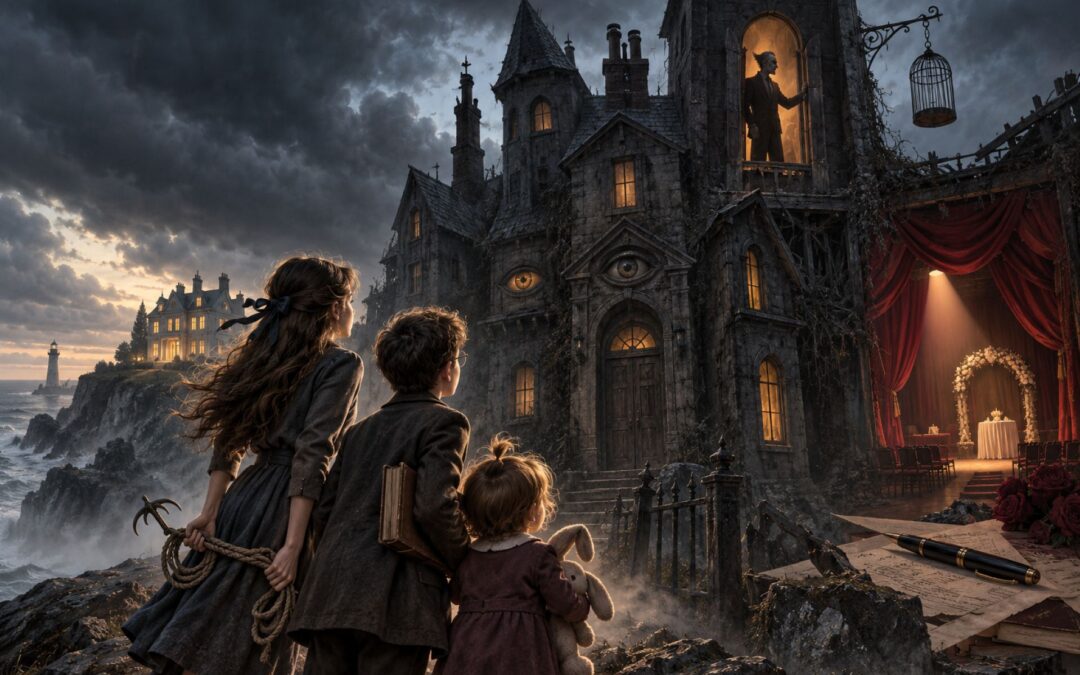
Published in 1999 as the first volume of A Series of Unfortunate Events, The Bad Beginning introduces Violet, Klaus, and Sunny Baudelaire by taking almost everything from them within its opening pages. Their parents die in a fire, their home is destroyed, and the fortune they will eventually inherit turns them into targets for Count Olaf, a distant relative whose legal status as their guardian gives him enormous power over children who understand his intentions far better than the adults supposedly responsible for protecting them. The 1999 HarperCollins first edition established the combination that would define the series: Gothic misery, elaborate wordplay, absurd bureaucracy, resourceful children, grotesque adults, and a narrator who treats catastrophe with unnervingly formal courtesy.
The novel works as a compact orphan adventure, but its central conflict is more unsettling than a simple contest between clever children and an evil guardian. Violet, Klaus, and Sunny repeatedly recognize danger correctly, yet recognition does not automatically give them power. The adults who possess legal authority either exploit that authority, as Count Olaf does, or misunderstand their responsibility, as Mr. Poe repeatedly does. The Baudelaires therefore survive by combining practical invention, reading, memory, linguistic precision, and loyalty to one another in a world where formal rules often protect institutions more effectively than they protect children.
Spoiler warning: This article covers the complete novel, including Count Olaf’s marriage scheme, Violet’s method of defeating it, Olaf’s escape, and the Baudelaires’ fate at the end.

The Bad Beginning: Complete Plot Summary
The plot unfolds with unusual efficiency across thirteen chapters. Each stage gives one of the Baudelaire siblings an opportunity to use a particular strength, but the novel never allows intelligence alone to solve the larger problem. Every immediate victory takes place inside a system that remains fundamentally unsafe, which is why even the climax cannot produce the conventional happy ending that the children—and the reader—briefly seem close to receiving.
Briny Beach, the Fire, and Count Olaf
The novel opens at Briny Beach, where the three Baudelaire siblings are spending a gray and foggy day together. Their different personalities and abilities are immediately established. Violet, fourteen, is an inventor who constantly examines ordinary objects for mechanical possibilities. When she is concentrating on an invention, she ties her hair back with a ribbon so that it cannot fall into her face. Klaus, a little older than twelve, is a passionate reader with an unusually strong memory; books are not simply entertainment for him but a way of understanding nearly everything around him. Sunny is an infant whose vocabulary is mostly incomprehensible to outsiders, but whose siblings generally understand her intentions. Her most obvious talent is biting things with her exceptionally strong teeth.
Their family life, before the novel begins, has apparently been loving, comfortable, and intellectually rich. Their parents encouraged Violet’s experiments, Klaus’s reading, and Sunny’s developing personality. The Baudelaire mansion contained an extensive library, and the children’s memories of their parents are associated not only with affection but also with curiosity, conversation, and freedom. That past matters because the novel is about more than the loss of material wealth. The children lose the environment in which their abilities were understood and encouraged.
While they are at Briny Beach, the children see a dark shape emerging from the fog. It first seems ominous, but the figure turns out to be Mr. Poe, a banker and family acquaintance. His presence is nevertheless the beginning of catastrophe. Poe tells the children that a terrible fire has destroyed their home and killed both of their parents.
The news transforms the scene instantly. Violet, Klaus, and Sunny are no longer merely children enjoying a gloomy day at the beach; they are orphans with no home to return to. Their parents’ deaths also create a legal problem that will govern the rest of the novel. The Baudelaire estate contains a substantial fortune, but the children cannot simply use it. Mr. Poe, as executor of the estate, controls the financial arrangements, and Violet will not gain access to the fortune until she reaches the required age.
The siblings initially have difficulty understanding that their parents are truly gone. They later visit the burned ruins of the Baudelaire mansion, where the destruction of familiar possessions makes the loss more concrete. The library, rooms, objects, and ordinary evidence of family life have all disappeared. Their grief is not treated as a temporary obstacle that vanishes once the adventure begins. In the days that follow, the children lose interest even in activities that normally define them: Violet does not feel like inventing, Klaus does not feel like reading, and Sunny does not behave with her usual energy.
They stay temporarily with Mr. Poe and his family. This arrangement is safe in the narrow sense that nobody is actively trying to steal their fortune, but the Poe household offers little emotional comfort. Mr. Poe remains preoccupied with banking business and frequently coughs into a handkerchief. Mrs. Poe provides food and clothing but does not become a substitute parent. Their sons, Edgar and Albert, resent having to share their room with the orphans. The Baudelaires are housed, but they do not feel cared for.
Mr. Poe eventually tells them that their parents’ will contains instructions about their guardianship. The children are supposed to be raised by a relative in the most convenient manner possible. Poe interprets convenience largely in geographical terms and has located a relative who lives nearby: Count Olaf.
The relationship between Olaf and the Baudelaire family is so distant that the children do not remember ever meeting him. That fact does not disturb Mr. Poe enough to reconsider the arrangement. Because Olaf qualifies as a relative and lives in the same city, the bureaucratic requirements appear to have been satisfied.
On the journey to Olaf’s home, the children pass through a city that is deliberately difficult to place in a precise historical period. Its streets, architecture, institutions, transportation, and customs feel partly old-fashioned and partly modern. The ambiguity contributes to the series’ strange atmosphere: the Baudelaires inhabit a recognizable world without belonging cleanly to a specific real-world time.
Before reaching Olaf’s residence, they encounter Justice Strauss, Olaf’s neighbor and a judge of the High Court. Her house is attractive and well maintained, immediately distinguishing it from the building next door. Strauss speaks warmly to the children, and her genuine pleasure at meeting them provides the first glimpse of what a kinder adult relationship might look like.
Count Olaf’s house destroys that hope almost as soon as they arrive. The building is filthy, dilapidated, and sinister, with a crooked tower rising above it. An eye is carved into the front door. When Olaf appears, his appearance reinforces the impression created by his home: he is tall, thin, unclean, and intimidating. Another eye appears as a tattoo on his ankle.
Olaf makes little effort to disguise his interest in the Baudelaire fortune. He quickly suggests that money could be used to improve the house. Mr. Poe explains that the inheritance cannot simply be spent because the fortune remains unavailable until Violet comes of age. Olaf’s reaction indicates that this information matters greatly to him.
Mr. Poe nevertheless leaves the children in Olaf’s custody. At this point the novel has established the structure of the conflict. The Baudelaires recognize immediately that something is wrong, Count Olaf understands that their money is legally protected from him, and Mr. Poe believes that the formal act of placing the children with a relative has completed his responsibility.
Life in Count Olaf’s House
Living with Count Olaf is worse than the children anticipated. Despite the size of the house, Violet, Klaus, and Sunny are forced to share a single filthy bedroom with only one bed. Violet and Klaus take turns sleeping on the bed and on the floor, while Sunny sleeps on a makeshift arrangement of curtains. Their belongings are kept in a cardboard refrigerator box. The house contains almost nothing intended to make children comfortable.
Olaf treats them less like adopted children than unpaid servants. He leaves extensive lists of chores and expects them to clean the house while he spends his time elsewhere, often with members of his theatrical troupe. The tower remains largely forbidden. Eyes appear repeatedly in the house, strengthening the sense that Olaf’s identity and power fill the building even when he is not physically present.
The children’s situation becomes especially clear when Olaf announces that members of his theatrical troupe are coming to dinner. He orders the Baudelaires to prepare a meal for a large group even though they have little cooking experience and have not been given proper instructions. Rather than accepting failure, they try to solve the problem with the resources available to them.
Their solution takes them to Justice Strauss. Her home becomes the opposite of Olaf’s almost immediately. It is clean, welcoming, and full of books. Strauss allows the children to use her library, and Klaus finds a cookbook that provides a recipe for puttanesca sauce. The library therefore becomes useful in a direct, practical way: a book solves an immediate problem that an adult has unfairly imposed on them.
Justice Strauss accompanies the children while they buy the necessary ingredients. For a brief period, preparing dinner together gives Violet, Klaus, and Sunny something resembling the cooperative domestic life they lost with their parents. They divide tasks, follow instructions, and create a meal they can reasonably be proud of.
Olaf deliberately makes success impossible. When he returns with his troupe, he angrily demands roast beef even though he never asked the children to prepare it. The complaint has nothing to do with food. He wants an excuse to humiliate them and demonstrate that the standards of his household can change whenever he chooses.
His theatrical associates make the atmosphere more threatening. Among them are a hook-handed man, two white-faced women, a bald man with a long nose, and a large member of the troupe whose gender the narration does not define. They are grotesque in appearance and casually cruel in behavior. The troupe functions less like a collection of colleagues than an organized extension of Olaf’s power.
The threat escalates when Olaf lifts Sunny into the air during the argument. The gesture makes clear that the infant’s age will not protect her. Later, when Klaus protests the siblings’ inadequate sleeping conditions, Olaf suggests that the children purchase another bed with their money.
Klaus reminds him that they cannot access the Baudelaire fortune. The correction enrages Olaf, who strikes Klaus across the face. What had previously been neglect and intimidation becomes direct physical violence.
The troupe does not react with moral outrage. Instead, one of Olaf’s associates makes a remark implying that Olaf may eventually discover a method of gaining the Baudelaire money. Olaf’s reaction suggests that he is already thinking in precisely those terms.
The siblings cry together afterward, but they also begin discussing how they might escape. Running away is one possibility, although they realize quickly that three young children without money or adult protection would face enormous danger. Living with Justice Strauss seems far better, but the Baudelaires understand that affection does not automatically create legal guardianship.
They therefore turn to the adult who is officially responsible for the financial and administrative aspects of their situation. The children travel to Mr. Poe’s bank and explain what has been happening. They describe the chores, the single bed, Olaf’s drinking, and the violence against Klaus.
Poe listens, but his interpretation of the problem is disastrously narrow. He is repeatedly distracted by telephone calls and bank business, which makes his office feel less like a place where children can seek protection than another institution in which their crisis competes with routine paperwork. He tells them that Count Olaf is acting in loco parentis, meaning that Olaf possesses the authority to make many parental decisions.
The phrase matters because Poe treats authority as if it were evidence of legitimacy. Instead of asking whether Olaf is abusing his power, he concludes that decisions about chores and discipline fall within the guardian’s rights. He reassures the children that the fortune itself remains securely protected, revealing the fundamental mistake in his priorities: the money is being guarded more carefully than the children who will inherit it.
Violet, Klaus, and Sunny leave frustrated and angry. They have done what children are normally told to do when something is wrong—they have reported the danger to a responsible adult—and the system has failed because the responsible adult interprets rules more literally than circumstances.
Their response is to return to Justice Strauss’s library. Violet reads about inventions, Klaus reads about wolves, and Sunny finds material suited to her own interests. The narrator uses this moment to distinguish physical escape from figurative escape. The children remain trapped in Olaf’s guardianship, but books allow them to enter other worlds temporarily and recover parts of themselves that grief and fear had suppressed.
That distinction becomes important later. Books in The Bad Beginning are not magical objects that solve every problem. They cannot remove Olaf from the house or force Mr. Poe to become competent. What they can do is preserve imagination, provide knowledge, and create opportunities that the children would not otherwise possess.
The Marvelous Marriage Plot
Count Olaf’s behavior changes abruptly one morning. Instead of immediately insulting or ordering the children about, he serves them oatmeal with raspberries. Because his previous treatment has established his character so clearly, the apparent kindness makes the Baudelaires suspicious rather than grateful.
Olaf claims that Mr. Poe has spoken to him about the children’s complaints and describes his earlier behavior in absurdly mild language. The narrator pauses over Olaf’s word choice, using vocabulary explanation as part of the comedy. His treatment of the children has involved neglect, threats, and violence, so reducing it to mere unfriendliness demonstrates how language can conceal reality rather than clarify it.
Olaf then announces that he wants the children to participate in one of his theatrical productions. The play is called The Marvelous Marriage. Klaus and Sunny will appear as members of the wedding crowd, while Violet will play the bride.
Olaf himself will be the groom.
More troublingly, Justice Strauss has agreed to participate as the judge who conducts the wedding ceremony. To Strauss, the role is exciting because she has always wanted to perform onstage. To Violet and Klaus, the combination of Olaf, marriage, a real judge, and the Baudelaire fortune immediately seems suspicious.
Violet would rather work backstage with the mechanical equipment, where her abilities might actually be useful. Olaf refuses. He does not want her merely involved in the production; he requires her to play the bride.
After he leaves, the siblings begin trying to understand what he intends. They already know that Olaf wants their fortune, but the mechanism remains unclear. If he simply killed them, he would not necessarily inherit the money. Something about the play must create a legal route to the estate.
Sunny contributes to the breakthrough by directing her siblings toward books. Violet and Klaus return to Justice Strauss’s library and begin searching for information about inheritance and marriage law.
The research is difficult. Unlike the cookbook, which provided a direct answer to a simple question, the legal books contain enormous quantities of irrelevant material. Violet and Klaus spend hours working through cases and technical language without knowing exactly what they are looking for.
Justice Strauss does not recognize the danger. She is genuinely enthusiastic about her role and delighted that the children are interested in her books. Her blindness is very different from Mr. Poe’s. Poe fails because bureaucracy matters more to him than interpretation; Strauss fails because her excitement about performing prevents her from imagining that the performance itself could be criminal.
The hook-handed man eventually arrives to summon the children back to Olaf’s house. When he sees what they are researching, he reacts with hostility and warns them to stay away from the library until the production is over.
The threat inadvertently gives Klaus the confirmation he needs. If legal books had nothing to do with Olaf’s plan, Olaf’s associate would have no reason to care about them.
Before leaving, Klaus secretly takes one of the law books.
That night he stays awake reading. The process matters because Klaus does not discover the plan through sudden intuition. He works through dense information, discards irrelevant material, and keeps searching despite exhaustion.
Eventually he finds the combination of rules Olaf intends to exploit. Within the fictional legal system of the novel, a marriage can become legally binding when the participants speak the proper words, the bride signs the appropriate document in her own hand, and a judge is present to officiate. A minor may marry if the legal guardian grants permission.
Olaf is Violet’s legal guardian.
Justice Strauss is a real judge.
If Violet says the required words and signs the document while Strauss conducts the ceremony, Olaf can transform a stage wedding into an actual marriage. Once he becomes Violet’s husband, he expects to gain legal control over her fortune.
The absurdity of the mechanism is deliberate. The Bad Beginning is not offering a realistic lesson in marriage or inheritance law; it is building a comic-Gothic trap in which legal literalism can be turned against a child. The important point is that Olaf has found a way to make institutions participate in his crime without the participants realizing what they are doing.
Klaus confronts Olaf the next morning. He expects that exposing the plan will give the children some leverage, but Olaf does not react like a villain whose secret has been destroyed. He is almost pleased that Klaus has worked it out.
His confidence suggests that Klaus has solved only part of the problem. Knowing the plan does not mean the children are free to resist it.
Klaus wakes Violet and explains everything. Their natural next step is to take the law book to Mr. Poe and expose Olaf before the performance can take place.
Then they discover that Sunny is missing.
Sunny’s Kidnapping and Violet’s Rescue Attempt
Count Olaf appears while Violet and Klaus search desperately for their sister. He directs their attention toward the tower, where the children see Sunny imprisoned in a birdcage suspended high above the ground.
The image changes the balance of power completely. Before this moment, Olaf has relied on legal authority, intimidation, neglect, and occasional violence. Now he uses an infant as a hostage.
Olaf explains that one of his associates is positioned in the tower and can release the cage whenever instructed. If Violet refuses to participate in the wedding, or if she attempts to expose the plan during the performance, Sunny can be dropped to her death.
Violet agrees to cooperate.
The decision is not surrender in the moral sense. She is choosing Sunny’s life over her own freedom, but she immediately begins thinking about ways to defeat the situation without provoking Olaf.
Olaf confiscates the law book and behaves as though his victory is guaranteed. He knows that Klaus has discovered the legal mechanism, but with Sunny suspended above the ground, information seems useless. The children now understand exactly what is happening and remain unable to stop it.
Violet turns toward the type of problem she understands best: a mechanical one. Looking at the tower, its height, and the location of the birdcage, she begins designing a way to climb up and rescue Sunny.
She ties back her hair.
The familiar gesture has appeared before as a sign that Violet has entered the mental state in which she can transform ordinary objects into machines. Here it carries greater emotional weight because invention is no longer a hobby supported by loving parents. It has become a survival skill.
Violet cannot simply visit a workshop or buy equipment. Olaf’s house offers almost nothing useful, so she improvises. She dismantles available household materials, bends pieces of metal into a makeshift grappling hook, and tears unwanted fabric into strips that can be tied together as a rope.
The construction is not magically perfect. Her first attempts to throw the device toward the tower fail. The hook strikes the building repeatedly, and Violet injures herself in the process.
She continues.
Her persistence matters as much as her technical ability. The novel does not portray intelligence as effortless genius. Klaus has to read through hours of irrelevant legal material before finding the marriage rules, and Violet has to test, fail, adjust, and try again before her invention works.
Eventually the hook catches on something above. Violet tests the line and begins climbing.
The scene briefly offers the possibility of a classic rescue. Violet has designed a tool, overcome the physical height of the tower, and reached the window through courage and ingenuity. If the novel followed a simpler adventure structure, this would be the moment in which the inventor’s talent saves the hostage.
Instead, Violet reaches the top and discovers that the hook has caught on the hook belonging to Olaf’s hook-handed associate.
Her invention has worked exactly as a machine while failing completely as a rescue.
The hook-handed man pulls her into the tower room and captures her. The room itself feels like an intensified version of Olaf’s house, full of grime, threatening objects, and repeated eye imagery. The stolen law book is there as another reminder that Olaf possesses both physical force and control over the information Klaus discovered.
Klaus is eventually brought to the tower as well. All three siblings are now imprisoned together.
Violet and Klaus begin testing possible solutions. They consider refusing to participate, fighting their captors, escaping physically, and finding another legal objection. Every option leads back to the same problem: Sunny’s life is under Olaf’s immediate control.
Olaf arrives dressed for the performance and explains the final precautions. The hook-handed man will remain responsible for Sunny while Olaf maintains communication through a walkie-talkie. If Violet or Klaus attempts anything unexpected onstage, the order to kill Sunny can be given immediately.
The children are taken down from the tower toward the theatre. At this point Violet’s mechanical rescue has failed, Klaus’s legal research has revealed the trap without preventing it, and Sunny remains a hostage.
Yet the failed attempts have produced something important. Klaus’s research has given Violet exact knowledge of the legal wording Olaf intends to exploit.
While descending the stairs, Violet reaches for the banister with her right hand. The motion triggers an idea connected to a phrase in the law.
She does not tell Olaf what she has realized.
The Wedding Performance and Count Olaf’s Escape
The theatre sequence brings nearly every major element of the novel together: performance, legal authority, adult inattention, mechanical stagecraft, language, coercion, and the difference between appearance and reality.
When the children arrive backstage, The Marvelous Marriage is already underway. Violet sees scenery, costumes, lights, makeup, ropes, and other equipment that would normally fascinate her. The machinery of theatre is designed to produce convincing illusions, making it the ideal environment for Olaf’s scheme. He does not want to hide a crime from an audience; he wants to commit it openly while persuading everyone that they are watching fiction.
Justice Strauss is delighted to be participating. To make the ceremony convincing, Olaf has instructed her to use authentic legal language and genuine documents. Her commitment to realism becomes part of the trap.
Violet and Klaus try to persuade her to alter the ceremony, but they cannot explain why without risking Sunny’s life. Strauss interprets their anxiety as ordinary nervousness about the performance.
Mr. and Mrs. Poe are also in the audience. Klaus attempts to alert Poe, but Olaf’s control over the walkie-talkie prevents him from saying enough. The man who previously refused to take the children’s warnings seriously is now physically present while the danger unfolds, yet the Baudelaires are unable to communicate with him safely.
When the wedding scene begins, Justice Strauss performs the legal ceremony. Olaf says the required words. Under threat to Sunny, Violet does the same.
She signs the marriage document.
For a moment, Olaf appears to have won completely.
He stops treating the event as theatre and announces to the audience that the marriage is real. The fictional play has been constructed so that every necessary legal action occurred during the performance. Justice Strauss, horrified, examines what has happened and realizes that her genuine judicial authority has been used to legitimize the ceremony.
Mr. Poe objects, but Olaf’s scheme has been designed around precisely the kind of literal legal reasoning Poe trusts. Olaf has guardian authority, Strauss is a judge, the proper words have been spoken, and Violet has signed.
Olaf therefore expects to gain control of the Baudelaire fortune.
Before Violet reveals what she has done, Sunny must be made safe. Olaf, believing that he no longer needs the hostage, allows her to be released from the tower.
Only then does Violet explain the flaw in the marriage.
The rule Klaus discovered requires the bride to sign the document in her own hand. Violet is right-handed. During the ceremony she deliberately signed with her left hand.
The solution is ridiculous in a realistic legal sense, but perfectly consistent with the linguistic logic the novel has established. Olaf’s plan depends on interpreting legal wording with absurd precision, so Violet defeats him by becoming even more precise.
She can demonstrate that her normal signature looks different when written with her dominant hand. Justice Strauss accepts the distinction and declares that the marriage is invalid.
The moment also completes a progression between the siblings’ abilities. Klaus discovers the legal rule through reading, but reading alone cannot save them. Violet first tries to solve the crisis through invention, but the grappling hook fails. Her final solution combines Klaus’s knowledge with her own observation and strategic thinking. Their talents are most powerful when used together.
Once the marriage is invalidated and Sunny is safe, Olaf’s actions can finally be treated openly as crimes. Justice Strauss points out that he kidnapped an infant, suspended her from a tower, threatened her life, and attempted to force Violet into marriage.
Mr. Poe moves toward arresting him.
Justice Strauss also makes the offer the children have wanted almost since meeting her: she would like to take Violet, Klaus, and Sunny into her home.
For a brief moment, the novel seems ready to reverse its own promise of unhappiness. Olaf has been defeated, a competent and affectionate adult wants the children, and the siblings might live together in a house containing a library rather than a tower.
Olaf’s troupe prevents the first part of that happy ending. One of his associates turns off the theatre lights, plunging the room into darkness. During the confusion, Olaf and his companions escape.
Before disappearing, Olaf makes it clear that he has not abandoned his intention to pursue the children.
The second part of the hoped-for ending is destroyed by Mr. Poe.
Justice Strauss is willing to become the children’s guardian, but she is not a relative. Poe returns to the wording of the parents’ will and concludes that the Baudelaires must be placed with another relative rather than with the adult who has demonstrated genuine affection and willingness to protect them.
The reasoning repeats the mistake that placed the children with Olaf. The problem is not simply that Poe once selected the wrong guardian. He continues to believe that fulfilling the formal wording of the will is more important than interpreting its purpose.
The Baudelaires therefore leave Justice Strauss behind. They will return temporarily to the Poe household while another relative is located.
The novel ends with Violet, Klaus, and Sunny together in the car, grieving another lost possibility of home. Count Olaf has failed to obtain the fortune, but he remains free. Justice Strauss loves them, but she cannot keep them. Mr. Poe remains responsible for placing them, but he has learned remarkably little from what has happened.
The children’s only reliable security is one another.
Setting and World-Building: A City Built for Uncertainty
The Bad Beginning does not build an expansive fantasy world in the conventional sense, yet its setting is essential to the novel’s effect. The Baudelaires live in an unnamed city recognizable enough to contain banks, judges, theatres, bookshops, automobiles, telephones, and legal institutions, but strange enough to resist placement in a precise historical period. Cobblestone streets, formal manners, Gothic buildings, elaborate legal customs, and modern technologies coexist without explanation.
That ambiguity allows the novel to borrow freely from older orphan stories without becoming a historical novel. Count Olaf resembles the wicked guardian of Victorian melodrama, while Mr. Poe belongs to a bureaucratic system modern enough to involve banking administration and telephone interruptions. The resulting city feels suspended between literary periods, which helps explain why its institutions seem simultaneously familiar and absurd.
The most important settings are domestic spaces. The destroyed Baudelaire mansion represents a lost world of family affection, intellectual freedom, and material security. Readers encounter most of that home through memory because the fire has already erased it, making the mansion less a physical setting than an emotional standard against which later homes are measured.
Count Olaf’s house is the opposite. It is filthy, deteriorating, uncomfortable, and dominated by the tower and repeated eye imagery. The children are given almost no private or functional space, and even their bedroom communicates contempt: three children are crowded into a room with one bed and a cardboard box for possessions. The architecture does not merely create Gothic atmosphere. It reveals the structure of Olaf’s guardianship, in which he possesses space while the children are permitted almost none of their own.
Justice Strauss’s home offers an alternative. It is orderly, welcoming, and, most importantly, contains a library. The difference between the two houses is not simply wealth or cleanliness. Strauss allows the children to use what she possesses. Olaf’s house concentrates power around himself; Strauss’s house makes resources available to others.
The bank and theatre extend this spatial symbolism into public institutions. Mr. Poe’s bank is organized, professional, and apparently respectable, yet it becomes a place where bureaucratic procedure blocks moral recognition. The theatre is dedicated to illusion, but it becomes the site where the truth about Olaf is finally exposed. In Snicket’s world, a place’s official purpose rarely guarantees what actually happens there.
The novel therefore creates a setting governed by unstable relationships between surface and reality. A legal guardian can be a criminal. A judge can accidentally help commit an injustice. A theatrical wedding can become legally real, while a legal marriage can be undone by a technical distinction between hands. The world is internally consistent less because its institutions resemble real ones than because nearly everything operates through the same principle: literal rules are dangerous when people stop interpreting what those rules are supposed to protect.
Character Analysis and Relationships
The characters in The Bad Beginning are deliberately drawn with strong, memorable traits, but those traits are not merely decorative. Violet’s inventiveness, Klaus’s reading, Sunny’s teeth, Poe’s cough, Strauss’s library, and Olaf’s theatricality all become functional parts of the narrative. The novel often prefers caricature to psychological realism, yet the relationships among these figures create a serious argument about who deserves authority and what genuine care looks like.
The Baudelaire Siblings as a Family
Violet, Klaus, and Sunny function less like three competing protagonists than a cooperative unit. Their abilities differ, but the story repeatedly refuses to rank them into a simple hierarchy. Violet can build what Klaus cannot, Klaus can discover information Violet does not know, and Sunny’s apparent limitations do not prevent her from participating in decisions or directing her siblings toward useful ideas.
Their strongest relationship is built on interpretation. Violet and Klaus understand much of Sunny’s unusual speech when adults do not, which turns family intimacy into a form of communication unavailable to outsiders. The siblings also take one another seriously. Klaus does not dismiss Violet’s inventions as impractical hobbies, Violet respects Klaus’s reading as useful knowledge, and both treat Sunny as a person rather than as luggage that happens to require protection.
Grief makes their bond even more important. The parents’ deaths leave them without an adult home, but the siblings continue to reproduce some of the emotional functions of family for one another. They comfort each other after Olaf’s violence, plan together, share information, and measure risks partly by how those risks affect the others.
Their cooperation also prevents the novel from turning resourcefulness into a fantasy of self-sufficiency. None of them can defeat Olaf alone. Klaus discovers the marriage mechanism but cannot stop it. Violet designs a rescue but is captured. Sunny is the hostage whose danger determines what her siblings can safely attempt. Their eventual victory comes from combining what each stage has taught them.
Violet Baudelaire
Violet begins the novel as an inventive fourteen-year-old whose technical ability was nurtured in a loving household. After the fire, grief initially disconnects her from that identity. She does not immediately respond to catastrophe by becoming a heroic engineer; for a period she barely feels like inventing at all.
Count Olaf’s danger gradually forces that part of her personality back into action. The familiar gesture of tying up her hair signals concentration, but its meaning changes as the novel progresses. What was once associated with curiosity becomes connected to survival.
The tower sequence gives Violet her most obvious demonstration of courage. She constructs a grappling device from poor materials, repeatedly attempts to throw it despite failure and injury, and climbs toward Sunny without knowing exactly what waits above. Her courage is practical rather than theatrical: she is frightened, understands the danger, and continues because her sister needs her.
Importantly, the invention fails as a rescue. That failure prevents Violet from becoming an implausible child genius whose machines always work perfectly. The grappling hook functions mechanically but delivers her directly into the hands of Olaf’s associate.
Her final success is subtler. By remembering the legal phrase Klaus discovered and connecting it to her own right-handedness, Violet defeats Olaf through strategic interpretation rather than mechanical force. She understands that the same obsessive literalism making the marriage possible can make it invalid.
As the eldest sibling, Violet also carries a particular burden of responsibility. Olaf’s scheme targets her directly because she is the closest to gaining legal control of the fortune, and he tries to convert that position into power over all three children. Violet’s willingness to participate in the ceremony to save Sunny therefore turns her legal vulnerability into an expression of familial loyalty.
Klaus Baudelaire
Klaus’s intelligence is rooted in reading rather than abstract cleverness. He does not simply “know things.” He has accumulated information through books and has developed the patience to search for information when he encounters something he does not understand.
The legal investigation is his defining contribution to the plot. He spends hours working through difficult material, recognizes the significance of the hook-handed man’s attempt to stop the research, secretly takes a legal book, and continues reading through the night until he finds the relevant rules.
His discovery also demonstrates the limits of knowledge. Klaus can explain Olaf’s plan perfectly and still be powerless to stop it once Sunny is kidnapped. This is one of the novel’s most important corrections to a simplistic “books solve problems” message. Knowledge creates possibilities, but knowledge must operate within circumstances shaped by power.
Klaus is also the sibling who most openly confronts adult irrationality. His arguments with Olaf and Poe come partly from his confidence that facts should matter. When he explains something correctly and an adult refuses to respond rationally, his anger is understandable because he believes that evidence should produce action.
The world repeatedly teaches him that this assumption is unreliable. Mr. Poe can hear accurate information and misinterpret its significance; Olaf can understand Klaus’s accusation and simply use violence. Klaus therefore has to learn that being correct is not the same as being believed or protected.
His relationship with Violet is particularly effective because their abilities complement rather than compete. Klaus provides the legal information that eventually makes Violet’s solution possible. The victory belongs to neither reading nor invention alone, but to the movement from one kind of intelligence into another.
Sunny Baudelaire
Sunny is the least realistic of the three siblings and deliberately so. Her extraordinary teeth, strange speech, and ability to participate in family reasoning make her part infant, part comic invention. Yet the novel generally avoids treating her as merely a joke.
Her siblings understand her even when other characters cannot, which makes Sunny’s language a recurring demonstration of familial intimacy. Her comments can redirect conversations, and her suggestion that they turn to books helps initiate the research that uncovers Olaf’s marriage scheme.
Sunny also embodies the vulnerability at the center of the story. Because she is physically the smallest and least capable of defending herself, Olaf uses her as leverage against Violet and Klaus. The birdcage is disturbing precisely because it converts an infant into an object that can be raised, suspended, and threatened.
Even during this sequence, however, Sunny should not be reduced entirely to a hostage. The emotional force of her kidnapping depends on the personality already established around her. Violet and Klaus are not trying to rescue an abstract innocent child; they are trying to save a sibling whose odd sounds, strong teeth, and participation in their lives have made her a full member of their family.
Count Olaf
Count Olaf is not a subtle villain in The Bad Beginning. He is dirty, cruel, greedy, violent, theatrical, physically intimidating, and surrounded by grotesque henchmen. His house looks sinister, his behavior is openly abusive, and even his appearance announces danger.
That obviousness is part of the point. The children do not fail to recognize the villain because Olaf deceives them with charm. The institutional failure occurs because adults continue granting him authority despite evidence that is visible to the children almost immediately.
Olaf is nevertheless more intelligent than a purely comic monster. His marriage scheme requires careful understanding of the fictional legal rules governing guardianship, marriage, and inheritance. He recognizes the weakness of the adults around the Baudelaires and builds his plan around those weaknesses.
His profession as an actor is especially important. Olaf does not merely perform onstage; he approaches social life as performance. Guardianship becomes a role he can invoke when convenient. The apparent reconciliation over oatmeal and raspberries is another performance. The Marvelous Marriage is the most literal version of his method because he uses theatre to turn fiction into law.
His violence emerges when performance is insufficient. He strikes Klaus, threatens Sunny, kidnaps her, and ultimately relies on the possibility of murder to force Violet’s compliance. The combination of theatrical cleverness and physical brutality makes him dangerous in two different registers: he can manipulate systems and terrorize individuals.
Psychological complexity is not yet the novel’s goal. Olaf functions partly as a fairy-tale ogre and partly as a melodramatic inheritance villain. What gives him thematic force is not hidden motivation but his ability to exploit the gap between legal authority and moral legitimacy.
Mr. Poe
Mr. Poe is more unsettling than Olaf in a different way because he is not deliberately malicious. He believes that he is performing his duties responsibly, and much of his behavior is formally correct. He manages the estate, reads the will, finds a relative, listens to complaints, and protects the fortune from unauthorized access.
The problem is that Poe repeatedly mistakes procedure for judgment.
When the children report Olaf’s abuse, Poe focuses on the guardian’s rights. He treats chores and household rules as matters within Olaf’s parental authority instead of considering the pattern those details reveal. Even Klaus’s visible injury fails to produce the urgency the children need.
His bank reinforces his character. Poe is constantly occupied by calls, paperwork, and business. The interruptions are comic, but they also demonstrate that the children’s lives enter his consciousness as one administrative matter among many.
His most revealing failure occurs at the end. Justice Strauss has demonstrated kindness, competence, and a desire to care for the Baudelaires. Poe nevertheless rejects the arrangement because she is not a relative. He obeys the wording of the will while ignoring the evidence produced by his previous interpretation of it.
Poe therefore embodies institutional failure without villainy. Olaf knows exactly what he is doing; Poe does not understand what his behavior enables. That makes him one of the novel’s most important adult figures because children in danger are often failed not only by predators but also by respectable people who refuse to think beyond procedure.
Justice Strauss
Justice Strauss offers the clearest evidence that the novel does not simply divide the world into bad adults and good children. She is intelligent, generous, accomplished, and genuinely affectionate toward the Baudelaires. Her library becomes one of the few safe spaces available to them.
Yet she also makes a serious mistake.
Her enthusiasm about acting in The Marvelous Marriage prevents her from interpreting the children’s anxiety correctly. Because she has always wanted to perform, she focuses on the pleasure of the experience. Olaf exploits her good faith just as he exploits Poe’s legalism.
The difference is what happens once Strauss understands the truth. She does not defend herself or hide behind procedure. She recognizes that Olaf manipulated her, accepts the implications, invalidates the marriage once Violet reveals the flaw, identifies Olaf’s crimes, and offers the children a home.
That offer matters because Strauss understands guardianship as care rather than mere legal possession. Her relationship with the Baudelaires is based on shared time, books, conversation, and affection. She behaves more like a guardian before possessing the title than Olaf ever does while legally holding it.
The novel nevertheless refuses to reward her goodness with an easy solution. Strauss is not a relative, so Mr. Poe will not permit the arrangement. Her failure to become guardian therefore reinforces the distinction between morality and legality running through the entire book.
Olaf’s Troupe
Olaf’s theatrical associates are characterized more as a collective than as psychologically complete individuals. Their grotesque appearances and casual cruelty enlarge Olaf’s world, making his danger feel organized rather than personal.
The hook-handed man receives the most direct involvement because he threatens the children during their legal research, guards Sunny, captures Violet, and participates in the coercion surrounding the wedding. His physical hook also becomes part of the novel’s recurring fascination with hands and agency.
The troupe’s role is important even when individual members remain thinly drawn. Olaf is not simply one abusive guardian acting alone; he possesses a network of adults willing to participate in intimidation, kidnapping, deception, and escape. Their presence reinforces how isolated the Baudelaire children are within the adult world.
Major Themes
The novel’s themes emerge through action rather than speeches. Snicket rarely stops the story to announce a moral lesson because the absurd events themselves repeatedly test the difference between what adults claim institutions are for and what those institutions actually accomplish. Beneath the jokes and melodrama, The Bad Beginning is particularly concerned with what children can do when knowledge is available to them but authority is not.
Misfortune, Grief, and Resilience
The title announces misfortune as the governing condition of the series, but the novel does not treat unhappiness as a temporary obstacle before eventual restoration. The Baudelaires’ first catastrophe is permanent. Nothing can bring their parents or home back.
Their grief initially interrupts the talents that will later help them. Violet stops wanting to invent, Klaus stops wanting to read, and the children move through the Poe household without the energy that previously defined them. This response gives emotional weight to the otherwise exaggerated plot. They are resourceful children, but resourcefulness does not make bereavement painless.
The novel’s version of resilience is therefore unsentimental. The children do not overcome grief and return to who they were before the fire. They begin using their abilities again because circumstances require them to keep functioning.
Their situation also continues getting worse even when they make good decisions. Reporting Olaf to Mr. Poe does not save them. Klaus’s research exposes the scheme but leads Olaf to tighten his control. Violet’s rescue device works mechanically and still results in capture. Defeating the wedding does not produce a safe home.
Resilience in The Bad Beginning means retaining the ability to think, care, and act when outcomes remain unfair. That is very different from the reassuring idea that effort guarantees reward.
Knowledge, Reading, and Resourcefulness
Books are among the novel’s most important practical objects. The Baudelaire mansion had a library, linking reading to the children’s lost family life, and Justice Strauss’s library becomes the safest place they discover after the fire.
The cookbook solves the dinner problem. Later, legal books reveal the mechanics of Olaf’s plan. Klaus’s reading is therefore not presented as decorative intelligence; it directly alters what the children know and what they can attempt.
The novel is equally interested in the use of physical knowledge. Violet examines materials, understands knots, improvises a grappling device, and notices the relationship between her dominant hand and the wording of the marriage rule. Intelligence is portrayed as something applied to circumstances rather than merely possessed.
At the same time, the story repeatedly demonstrates that knowledge is not power in any automatic sense. Klaus can know Olaf’s plan and still be unable to stop him while Sunny is a hostage. Violet can understand mechanics and still be captured after constructing a functioning device.
The most effective form of intelligence is collaborative. Klaus discovers the legal phrase; Violet sees how to exploit it. Sunny’s earlier direction toward books helps set that process in motion. The children survive not because one of them is a genius but because different forms of understanding reinforce one another.
Children, Adults, and Failed Authority
One of the most persistent comic patterns in the novel is that the children understand obvious facts that adults refuse to recognize. The Baudelaires know almost immediately that Count Olaf is dangerous. Mr. Poe does not.
This reversal of the conventional adult-child hierarchy produces humor, but it also creates the novel’s central anxiety. Children are expected to obey adults because adults possess experience, legal status, money, physical power, and institutional authority. The Bad Beginning asks what happens when those advantages are separated from good judgment.
Count Olaf represents the most extreme answer. He possesses legal guardianship without any moral right to the role. The law grants him power over children he openly intends to exploit.
Mr. Poe represents a quieter failure. He is respectable, employed, financially responsible, and apparently concerned about following instructions. Yet he repeatedly rejects the children’s interpretation of their own danger because the institutional framework matters more to him than their testimony.
Justice Strauss complicates the pattern because she is a fundamentally decent adult. She believes the children and cares about them once the scheme becomes clear, but her excitement over the performance prevents her from noticing the danger soon enough. Intelligence and kindness therefore do not make adults infallible.
The novel’s argument is not that children always know better. Rather, it rejects the idea that authority itself proves wisdom. Violet, Klaus, and Sunny deserve to be heard because they possess relevant evidence, not because childhood is magically superior to adulthood.
Family, Guardianship, and Genuine Care
After the Baudelaire parents die, the novel repeatedly asks who has the right to function as family.
Legally, Count Olaf becomes the children’s guardian. Emotionally and morally, he performs none of the responsibilities associated with parenthood. He provides inadequate sleeping arrangements, treats the children as servants, assaults Klaus, kidnaps Sunny, and tries to force Violet into marriage.
Justice Strauss possesses no legal family connection to the children, yet she feeds them, shares her library, speaks to them kindly, enjoys their company, and eventually offers them a home. The contrast reveals how weak legal categories become when separated from actual behavior.
Mr. Poe’s final decision brings this theme into focus. He believes that the parents’ will requires another relative, and therefore Justice Strauss cannot become guardian despite being the obvious humane choice. The law recognizes kinship while the novel asks the reader to recognize care.
Meanwhile, Violet, Klaus, and Sunny form the only family unit that remains stable. Their parents are gone, guardians change, houses disappear, and adults repeatedly fail. The siblings continue choosing one another.
That does not mean the novel romanticizes children raising themselves. The Baudelaires clearly need adult protection, housing, food, legal representation, and affection. Their sibling bond is powerful because it helps them endure institutional failure, not because institutional support is unnecessary.
Law, Justice, Performance, and Deception
The marriage scheme makes law one of the novel’s major comic mechanisms. Olaf succeeds as far as he does because several characters confuse formal validity with moral legitimacy.
He is legally a guardian, so his authority is initially respected. Justice Strauss is legally a judge, so her participation can transform a theatrical ceremony. Violet’s spoken consent occurs under threat, but the ritual initially appears to satisfy the formal requirements Olaf has identified.
The theatre intensifies the problem because every participant except Olaf and the children believes the ceremony is fictional. Costumes, scenery, performance, and audience expectation create a situation in which people witness reality while interpreting it as pretend.
Olaf’s scheme therefore depends on two contradictory ideas operating at once. He needs the audience to believe the wedding is fake, while he needs the law to treat it as real.
Violet defeats him by using his own logic. If legal meaning depends on exact wording, then the phrase requiring a signature in her own hand can be interpreted literally enough to invalidate a left-handed signature from a right-handed person.
The solution is intentionally absurd, but the absurdity is symmetrical. Olaf constructs a trap out of technical language, and Violet escapes through technical language.
Justice and law finally diverge completely at the end. Olaf’s marriage may be invalid, but his criminal behavior remains obvious. Justice Strauss immediately understands that kidnapping and threatening Sunny require consequences, while the bureaucratic system still cannot produce the larger justice of giving the children a safe home.
Symbols and Motifs
The novel’s symbols are unusually concrete because many of them also participate directly in the plot. Eyes appear as decoration and threat, books provide both refuge and information, hands become tools and legal devices, and theatre turns metaphorical deception into an actual mechanism of crime. The recurring objects make the book feel tightly constructed despite its intentionally exaggerated world.
Eyes and Surveillance
The eye is associated with Count Olaf from the moment the Baudelaires arrive at his house. An eye appears on the door, another is tattooed on his ankle, and similar imagery recurs throughout the building.
At the simplest level, the eye functions as Olaf’s personal emblem. It makes his house and body visually continuous, suggesting that the children have entered an environment organized around his presence.
The symbol also creates a feeling of surveillance. Violet, Klaus, and Sunny rarely possess privacy or control over where they can go. Olaf determines their chores, restricts access to the tower, uses henchmen to watch them, and later monitors the wedding plot through the threat against Sunny.
The eye therefore represents more than being literally watched. It embodies the imbalance between Olaf’s ability to observe and control the children and their inability to escape his authority.
Books and Libraries
Books represent the opposite kind of power. Unlike Olaf’s eye, which controls from above, books offer information that the children can choose to seek and interpret.
The destroyed Baudelaire library belongs to the lost world of their parents. Justice Strauss’s library partially restores that connection by giving the children free access to knowledge again.
Different books serve different purposes. A cookbook helps them prepare dinner. Legal books help Klaus identify Olaf’s plan. Other books provide temporary imaginative escape when their circumstances cannot immediately be changed.
That combination prevents the library from becoming a simplistic symbol of education. Books can solve practical problems, preserve emotional identity, and create mental freedom, but they cannot guarantee safety. The value lies in what readers do with knowledge under real constraints.
Hands, Hooks, and Signatures
Hands become one of the most tightly connected motifs in the book. Violet is an inventor whose hands physically transform materials. The hook-handed man represents a threatening distortion of the same bodily idea, while the grappling hook Violet builds becomes the object through which those two forms unexpectedly meet.
The motif reaches its climax in the marriage contract. Olaf believes Violet’s hand will transfer control of her future through a signature. Instead, Violet turns the physical fact of handedness into resistance.
Her dominant right hand represents ordinary agency: the hand she naturally uses to make, write, and interact with the world. Signing with her left becomes a deliberate performance of false compliance.
The plot therefore turns the hand into a meeting point between body, language, law, and autonomy. Olaf tries to reduce Violet to a legal signature, while Violet uses the physical act of signing to reclaim control over what that signature means.
Theatre, Houses, and Performed Reality
Theatre is Count Olaf’s profession, but it also describes his approach to power. He stages moods, relationships, and identities whenever doing so serves him.
His sudden kindness before announcing The Marvelous Marriage is a performance. His role as guardian is another performance in the sense that he invokes the title without accepting its responsibilities. The wedding plot simply makes the pattern literal by using an actual stage.
The theatre sequence depends on the audience misunderstanding what they see. Justice Strauss believes she is acting as a judge while actually exercising judicial authority. The audience believes it is watching fictional vows while witnessing an attempted legal marriage.
Houses provide a different relationship between appearance and truth. Olaf’s house is not deceptive; it looks exactly as unsafe as it is. Its filth, crooked tower, and eye imagery announce the moral environment inside.
Justice Strauss’s house also corresponds to its owner. Its library, order, and hospitality reflect generosity. The tragedy is that recognizing the better home does not give the children the legal right to live there.
Together, theatre and architecture create two different ways appearances can function. Sometimes surfaces deceive, as on Olaf’s stage. Sometimes surfaces tell the truth and institutions refuse to act on what is visible, as with Olaf’s house.
Lemony Snicket’s Narrative Style and Structure
The most distinctive character in The Bad Beginning may be the narrator. Lemony Snicket does not behave like an invisible storyteller who simply reports what happened to the Baudelaires. He addresses readers directly, warns them against continuing, explains vocabulary, digresses into comparisons, comments on the misery of the story, and presents himself as someone researching events that have already occurred.
That narrator changes how the novel’s darkness feels. A straightforward account of three recently orphaned children being abused, assaulted, kidnapped, and forced into a marriage plot would be unusually grim for middle-grade fiction. Snicket creates distance through irony without pretending that the events themselves are harmless.
The opening “Dear Reader” establishes the method before Chapter One. Instead of promising excitement, comfort, or eventual happiness, Snicket essentially advises readers who prefer pleasant stories to choose another book. The joke works because authors and publishers normally try to persuade people to keep reading. Snicket turns discouragement into a form of invitation.
This technique also creates a strange kind of trust. Because the narrator repeatedly insists that terrible things will happen, the novel rarely relies on false reassurance. Readers know that the Baudelaires will suffer; suspense comes from discovering the particular shape the misfortune will take and how the children will respond.
Vocabulary definitions are another signature device. Snicket frequently pauses to explain words or phrases that younger readers may not know, but the definitions are often deliberately contextual, comic, or emotionally loaded rather than neutral dictionary entries. The technique simultaneously teaches, parodies educational writing, and keeps attention focused on how language changes meaning.
That concern with language is not ornamental. The plot itself depends on wording. Mr. Poe interprets the will literally. Olaf exploits legal language. The wedding becomes dangerous because spoken phrases and written signatures possess formal consequences. Violet finally survives by interpreting the phrase about signing “in her own hand” more literally than Olaf does.
The narrator’s linguistic habits therefore prepare readers for the climax. A book that repeatedly interrupts itself to examine what words mean eventually makes a dispute about what words mean the difference between freedom and exploitation.
The prose also relies on elaborate contrast between formal diction and grotesque events. Snicket may describe misery with excessive politeness or explain an obvious emotional condition as if producing an academic definition. The gap between tone and event produces much of the black comedy.
Contemporary reviewers recognized this as central to the book rather than incidental decoration. Publishers Weekly’s contemporary review emphasized the formal vocabulary, intrusive commentary, literary parody, and complementary talents of the Baudelaire siblings. Those qualities help explain why the novel can appeal beyond the age group suggested by its surface plot.
Daniel Handler has likewise discussed the importance of irony to how children encounter the Snicket books. In an interview about Lemony Snicket and children’s responses to frightening stories, Handler described a stage at which children begin recognizing that something can be frightening and funny simultaneously. The Bad Beginning is built around exactly that double perception.
The novel also parodies Gothic and melodramatic conventions while genuinely using them. The orphaned heirs, mysterious fire, inheritance, wicked guardian, crumbling mansion, high tower, threatening associates, forced marriage, secret legal plan, and last-minute loophole could belong to an older sensational novel. Snicket does not reject those devices; he exaggerates them while allowing them to generate real suspense.
Count Olaf’s theatricality deepens the metafiction. The villain is literally an actor inside a novel narrated by a persona who constantly reminds readers that they are encountering a story. The climactic scheme is itself a play whose central danger arises from the collapse between fiction and reality.
The book even extends its fictional world into the surrounding paratext. The closing “To My Kind Editor” letter presents Snicket as an investigator documenting the Baudelaire case rather than simply an author inventing it. His instructions about retrieving information concerning the children’s next guardian turn the transition to The Reptile Room into part of the fiction.
This pseudo-documentary frame would become increasingly important to the series, but it already changes the first book’s relationship with its narrator. Snicket writes as though he is reconstructing tragic events from evidence, which gives his warnings and digressions an oddly mournful quality beneath their jokes.
The structure is otherwise remarkably tight. Thirteen chapters move from loss to guardianship, abuse, investigation, hostage crisis, performance, legal reversal, and escape with little wasted motion. Almost every important object introduced early returns functionally later: the library leads to legal research, Violet’s inventiveness leads to the tower attempt, Olaf’s profession leads to the wedding scheme, and attention to language leads to the loophole.
Even the book’s publishing history contains an amusing connection to its central mechanism. A Publishers Weekly account of material changed before publication notes that the project was originally associated with the title The Miserable Marriage. The eventual title, The Bad Beginning, is broader and more useful for a thirteen-book series, but the discarded title reveals how completely Book 1 is organized around Olaf’s wedding scheme.
Brett Helquist’s illustrations contribute to the same aesthetic. The exaggerated figures, angular architecture, dark domestic spaces, and Gothic caricature reinforce the feeling that the Baudelaires have entered a world resembling an old cautionary tale whose rules have been rewritten by an ironic modern narrator.
The narrative method is therefore more than a collection of jokes. Form and meaning continually reinforce one another. A narrator obsessed with definitions tells a story in which definitions matter. A book that warns readers not to expect justice repeatedly gives its characters technically correct adults who fail to produce justice. A story that parodies melodrama eventually makes a theatrical melodrama into the villain’s actual criminal strategy.
The Ending Explained
Count Olaf’s defeat can seem straightforward on a first reading: he tries to marry Violet, she signs with the wrong hand, Justice Strauss invalidates the ceremony, and Olaf escapes before he can be arrested. Yet the ending matters because each part resolves one problem while exposing another that remains unsolved.
Within the novel’s fictional legal system, Olaf constructs the ceremony to satisfy the formal conditions necessary for marriage. Violet is a minor, but Olaf is her guardian and can grant permission. Justice Strauss is an actual judge. The proper words are spoken, and Violet signs the document.
The marriage initially appears valid because nearly everyone focuses on whether the required actions occurred. Olaf’s confidence comes from believing that he has reduced the entire question to procedure.
Violet’s solution attacks exactly that assumption. Klaus’s research establishes that the bride must sign in her own hand. Because Violet is right-handed, she deliberately uses her left hand during the ceremony.
The distinction would not function as a realistic modern legal doctrine, and the novel does not need it to. The entire scheme operates according to deliberately exaggerated rules in which exact wording acquires absurd power. Violet wins by applying Olaf’s own interpretive method against him.
Her timing is equally important. She does not reveal the trick before Sunny has been released. If Olaf understood that the marriage was invalid while the infant remained suspended from the tower, he could still order Sunny’s death.
Violet therefore performs obedience long enough to neutralize the physical threat and only then reveals that the legal threat has also failed. Her apparent submission is actually strategic.
The victory also unites the siblings’ different abilities. Klaus provides the legal knowledge. Violet provides the interpretation and self-control needed to exploit it. Sunny’s safety determines the timing. What looks like Violet’s individual triumph is the final product of the siblings’ collective struggle.
Once Olaf’s scheme collapses, Justice Strauss immediately recognizes that the situation involves crimes far more serious than an invalid wedding. Sunny has been kidnapped and threatened, and the children have been coerced. The moral question is obvious.
The institutional response remains weaker. Olaf’s troupe creates darkness in the theatre, allowing him to escape. The villain who has just been publicly exposed therefore suffers no immediate legal consequence.
Justice Strauss’s offer to take the children appears to promise a different kind of resolution. She has the qualities Olaf lacks: affection, competence, stability, intellectual generosity, and genuine desire to care for them.
Mr. Poe refuses because Strauss is not a relative.
That decision is the real final blow of the book. Olaf’s escape matters because the antagonist remains dangerous, but Poe’s interpretation of the will demonstrates that the system which empowered Olaf has not corrected itself.
Poe still trusts category over evidence. “Relative” remains more important than “safe guardian.” The children are therefore removed from the adult who has actually cared for them so that another legally convenient relative can be found.
The closing car journey transforms the meaning of the apparent victory. Violet, Klaus, and Sunny have saved the fortune and one another, but they have not found security. Their parents remain dead, their home remains destroyed, Olaf remains free, and Justice Strauss remains behind.
What they possess is their sibling bond. The children huddle together as the car carries them toward an unknown guardian, creating a final image in which family has become something they preserve among themselves rather than something the adult world successfully provides.
The closing letter from Snicket to his editor then extends the story beyond the conventional ending. By presenting himself as someone gathering evidence about the Baudelaires’ next experience, Snicket turns the unresolved future into the structure of the series. The Bad Beginning ends both as a complete failed-guardianship story and as the first entry in a much larger record of misfortune.
Critical Review: How Well Does The Bad Beginning Work?
As a first volume, The Bad Beginning is remarkably efficient. It establishes three protagonists, a recurring villain, a distinctive narrative voice, a world of unreliable institutions, a coherent system of motifs, and the serial premise of changing guardians without allowing exposition to overwhelm the immediate plot.
The story itself is deliberately simple. Orphaned children are sent to a wicked relative who wants their money; they discover his scheme and narrowly defeat it. That simplicity gives the novel space to develop its more unusual qualities around the plot rather than constantly inventing additional twists.
The strongest of those qualities is the narrator. Lemony Snicket’s voice is not merely memorable branding placed around an ordinary children’s adventure. The vocabulary explanations, direct warnings, literal interpretations, formal diction, and gloomy digressions all participate in the novel’s larger argument about language.
This is why the left-handed-signature climax works better than its legal plausibility would suggest. In a different novel, the loophole would feel arbitrary. Here, readers have spent the entire book being trained to notice wording, definitions, literal meanings, and contextual distinctions.
The prose therefore prepares the mechanism of the plot.
The same integration appears in Count Olaf’s theatricality. Making the villain an actor initially seems like an eccentric character detail, but the profession becomes essential once Olaf uses a play to create a legally real marriage under the cover of theatrical fiction.
Similarly, the children’s talents are introduced in ways that later become structurally necessary. Klaus’s reading produces the legal discovery. Violet’s mechanical intelligence produces the rescue attempt, while her practical observation produces the decisive loophole. Sunny’s vulnerability drives the hostage crisis, but her participation in the sibling unit keeps her from becoming an entirely passive object.
This economical construction contributes to the pacing. The novel is short, and almost every chapter either introduces a necessary element or changes the children’s understanding of the situation. The original Kirkus Reviews assessment recognized the book’s unusual mixture of horror, humor, and brisk narrative movement, qualities that remain central to its appeal.
The emotional tone is more complicated than the plot summary suggests. The novel repeatedly jokes around experiences that are genuinely disturbing: parental death, neglect, physical assault, coercive control, kidnapping, forced marriage, and threats against an infant. The humor does not erase those events.
Instead, irony allows the book to acknowledge fear without becoming relentlessly oppressive. Snicket’s exaggerated warnings and definitions tell readers that the story understands its own unpleasantness. That creates a strange alliance between narrator and reader even when the narrator claims he would prefer that readers stop.
The Baudelaire siblings are also unusually effective protagonists because competence never becomes invulnerability. They are clever, but adults remain physically stronger, legally empowered, wealthier, and more connected. The children repeatedly make sensible decisions and still lose.
That imbalance prevents the novel from offering the easy fantasy that intelligence makes children independent of adults. Violet, Klaus, and Sunny need competent guardians. The tragedy is that competent guardianship is precisely what the surrounding system fails to provide.
The characterization outside the siblings is intentionally broader. Count Olaf is a melodramatic villain rather than a psychologically complex portrait of abuse. Mr. Poe is almost a personification of bureaucratic failure, complete with recurring cough and professional distraction. Olaf’s troupe consists largely of grotesque types.
For readers who want naturalistic characterization, these figures can feel thin. Yet their exaggeration suits the book’s literary method. The Bad Beginning operates partly like a distorted fairy tale in which social roles are made visible through caricature.
Justice Strauss benefits from somewhat greater complexity because she reveals that kindness alone does not guarantee perception. She cares about the children and eventually wants to protect them, yet she still becomes an unwitting participant in Olaf’s scheme. Her failure is temporary and correctable, unlike Poe’s persistent literalism, but it prevents the novel from becoming a simple story in which every good adult automatically understands everything.
The legal mechanics are the book’s most obvious contrivance. Olaf’s ability to create a valid marriage through a stage performance, and Violet’s ability to invalidate it by signing with her non-dominant hand, should not be confused with realistic jurisprudence. Readers who demand plausible legal procedure may find the climax absurd.
But absurdity is not accidental here. The law functions as one part of the novel’s larger caricature of institutions. Olaf’s scheme is possible because rules have been detached from the moral purposes those rules should serve, and Violet escapes because she manipulates that literalism more successfully than he does.
The device therefore succeeds symbolically and structurally even when it fails as realism.
The vocabulary explanations may be more divisive. For readers who enjoy Snicket’s voice, they become part of the pleasure: the narrator can turn a definition into a joke, delay, character observation, or piece of foreshadowing. For readers less receptive to the device, the interruptions can feel repetitive.
That repetition becomes more pronounced across the full series, but even within Book 1 the technique clearly announces what kind of reading experience is being offered. The Bad Beginning is not trying to disappear behind its story. It wants readers to notice the storyteller constantly.
The novel also deserves credit for refusing to sentimentalize its ending. A more conventional children’s book might allow Justice Strauss to adopt the Baudelaires after Olaf’s defeat and turn later volumes into unrelated adventures. Snicket instead preserves the consequences of institutional failure.
Olaf escaping keeps the external danger alive, but Poe refusing Strauss’s guardianship is arguably more important. The children have proven themselves, exposed the villain, and identified a compassionate adult, yet the system still removes them from the safest available home.
That refusal gives the book more thematic weight than its comic surface might initially suggest. The children are not unlucky merely because improbable catastrophes happen to them. They are unlucky because ordinary systems repeatedly respond badly to those catastrophes.
The book has aged well in its willingness to trust younger readers with tonal complexity. It does not insist that frightening subjects must be softened into simple reassurance, nor does it confuse darkness with maturity for its own sake. The story remains playful even when its stakes are serious.
Handler’s discussion of irony helps explain why this balance can work differently for different readers. Children who recognize the gap between what Snicket says formally and what he means comically may find the exaggerated misery liberating rather than overwhelming, while readers who do not enjoy that distance may experience the book as unnecessarily grim.
Its strongest achievement is therefore the integration of style and story. The narrator’s obsession with words is not separate from the plot; words determine the climax. Olaf’s theatrical identity is not decorative; theatre becomes the mechanism of his crime. The Baudelaires’ talents are not labels; each ability becomes part of their resistance.
The most important limitation is almost the reverse of that strength. Because the book commits so completely to caricature, contrivance, repetition, and irony, readers who dislike those devices will not find a more conventional novel hiding underneath them. The exaggeration is the novel’s method.
For readers receptive to that method, The Bad Beginning remains an unusually sharp opening to a children’s series. It is funny without pretending suffering is trivial, bleak without becoming hopeless, intellectually playful without requiring academic knowledge, and suspenseful despite a narrator who continually promises unpleasant outcomes.
It also succeeds as the first volume because it leaves the right things unresolved. Count Olaf remains free, the Baudelaires still need a guardian, the fire remains part of their grief rather than a solved mystery, and the narrator’s strange investigative persona points toward further stories without forcing later mythology into the first book.
The Bad Beginning is therefore worth reading not simply because it launches A Series of Unfortunate Events, but because it already contains the essential literary logic that makes the series distinctive. Its world is unfair, its adults are unreliable, and its legal systems can be absurd, yet Violet, Klaus, and Sunny never become passive victims of that unfairness.
Their victory over Count Olaf is temporary, and the ending refuses to pretend otherwise. What survives the novel’s bad beginning is not the Baudelaire home, their parental protection, or even the possibility of immediate justice. What survives is the children’s capacity to observe carefully, learn from one another, and remain a family when almost every external structure designed to protect that family has failed.
Last Updated on September 9, 2026 by Aseem Gupta