
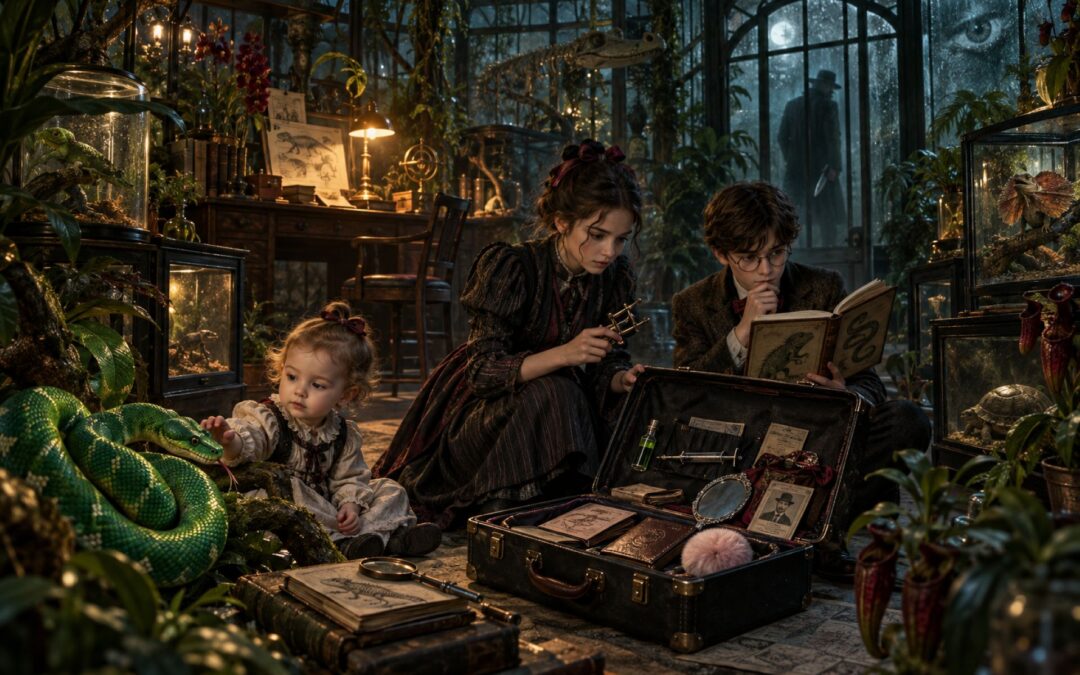
The Reptile Room, first published by HarperCollins in 1999 according to the first-edition bibliographic record maintained by WorldCat, is the second novel in Lemony Snicket’s A Series of Unfortunate Events. It begins soon after Violet, Klaus, and Sunny Baudelaire escape Count Olaf’s first attempt to steal their inheritance in The Bad Beginning. Their parents are still dead, their home is still gone, and their future still depends on adults who rarely understand what they need. Yet for a short time, Book 2 allows the children something that seemed almost impossible after their first guardian: a home in which they are wanted.
That change makes The Reptile Room more emotionally complicated than a simple repetition of the first novel. Dr. Montgomery Montgomery, usually called Uncle Monty, is kind, eccentric, intelligent, generous, and genuinely interested in the Baudelaires as people. His enormous collection of reptiles gives them work to enjoy, his planned expedition to Peru gives them something to anticipate, and his household begins to restore a sense of ordinary family life. Count Olaf’s return therefore threatens more than their fortune. This time, he threatens a good life that has already begun.
The novel is also built around a recurring problem of perception. The harmless Incredibly Deadly Viper possesses a terrifying name, while Count Olaf hides behind the ordinary name “Stephano.” The children know the truth almost immediately, but knowing something and proving it to an adult are not the same thing. Much of the story follows their movement from recognition to evidence, as Violet, Klaus, and Sunny learn that survival depends not only on seeing clearly but on demonstrating what they see.
Spoiler warning: This article discusses the complete novel, including Uncle Monty’s murder, Count Olaf’s scheme, the investigation, and the ending.

What Happens in The Reptile Room: Complete Plot Summary
The plot moves through several distinct stages. The Baudelaires first discover a surprisingly happy home with Uncle Monty, then watch Count Olaf infiltrate it under a disguise, fail to persuade the adults around them of the danger, lose Monty to murder, and finally conduct an investigation of their own. Their ultimate success is incomplete: they prove the crime and expose Olaf, but they cannot restore what has been lost or prevent him from escaping.
Uncle Monty and a Brief Taste of Safety
Mr. Poe takes Violet, Klaus, and Sunny Baudelaire away from the city to meet their new guardian, Dr. Montgomery Montgomery. The trip leads them along Lousy Lane, an appropriately miserable road surrounded by unpleasant scenery. They pass the Grim River, sickly fields, and an area contaminated by the smell of a horseradish factory. The route feels like another bad omen in a life that has recently been filled with them, and the children have no reason to assume their next guardian will be better than the last.
Their anxiety is understandable. Count Olaf, their previous guardian, had neglected and abused them while attempting to obtain the Baudelaire fortune through a fraudulent marriage scheme. Mr. Poe has removed them from Olaf’s custody, but the children remain dependent on a system in which adults decide where they will live. They know almost nothing about Dr. Montgomery Montgomery before arriving at his house.
The first impression is unexpectedly promising. Monty greets them warmly and offers them coconut cream cake. His friendliness is not the superficial politeness the children have learned to distrust. He appears genuinely pleased to have them in his home, encourages them to ask questions, and quickly asks them to call him Uncle Monty.
Monty is a herpetologist, which means he studies reptiles. His work has taken him around the world, and he has recently made an important discovery that he plans to present to the Herpetological Society. He also tells the children that they will be accompanying him on an expedition to Peru. His assistant Gustav has unexpectedly resigned, so a replacement assistant named Stephano will be joining the expedition, but otherwise Monty expects the children to become active participants in his work.
The difference between Monty’s household and Olaf’s is visible almost immediately. Each child receives a separate bedroom rather than being treated as an inconvenience. More importantly, Monty notices what they are good at. Violet, who loves mechanical problems and inventing devices, will help improve traps used for capturing reptiles. Klaus, whose greatest strength is reading and research, will learn about Peru. Sunny, whose unusually strong teeth allow her to bite through difficult materials, can help with rope.
The emotional center of the house is the Reptile Room, a vast glass-walled space that contains Monty’s collection. It serves simultaneously as a laboratory, library, greenhouse-like habitat, workplace, and family gathering place. The Baudelaires are fascinated by the reptiles and by the amount of information Monty has accumulated about them.
Monty eventually introduces the children to his latest discovery: a new species he has named the Incredibly Deadly Viper. The name appears to justify itself when the snake escapes and bites Sunny on the chin. Violet and Klaus are horrified, believing their younger sister has been poisoned.
Monty soon reveals the joke. The Incredibly Deadly Viper is not deadly at all. It is completely harmless, and Monty deliberately gave it a frightening name because he finds the contrast amusing. He plans to surprise his colleagues when he formally presents the species.
Sunny suffers no harm and quickly becomes friendly with the snake. The scene establishes one of the book’s most important reversals: a creature with a terrifying appearance and name can be safe, while danger may arrive under a much less threatening label.
For a short period, life with Monty becomes unusually happy. Violet works on mechanical problems, Klaus reads about Peru, Sunny helps with rope, and all three learn about reptiles. Monty tells stories about his travels, and the children gradually become comfortable enough to speak about themselves and their parents. The house begins to feel less like another assigned residence and more like a genuine home.
That sense of safety ends when Monty’s new assistant arrives.
The man introduces himself as Stephano, but the Baudelaires recognize him almost immediately. His appearance has changed: he has a beard, and the distinctive single eyebrow associated with Count Olaf is no longer visible. Yet his voice and eyes are familiar, and Sunny, being closer to the floor, notices the eye tattoo on his ankle.
Stephano is Count Olaf.
Stephano Arrives and the Threat Tightens
The Baudelaires understand the danger before Uncle Monty does. Klaus later regrets not immediately stopping the taxi that brought Stephano to the house, because once the driver leaves they are effectively trapped with Olaf again. The children know that the disguise does not matter to them. They have lived with Olaf, endured his cruelty, and seen his previous attempt to steal their fortune. They recognize him regardless of the beard or missing eyebrow.
Their first instinct is to tell Monty. Yet Olaf has anticipated that possibility.
Stephano stays close to the family and repeatedly prevents the children from speaking privately with their guardian. He behaves like a legitimate assistant whenever Monty is present while making his real intentions clear when the children are isolated. His greatest advantage is not that the disguise is convincing to the Baudelaires, but that he can control when and how they are able to communicate what they know.
The children briefly consider running away. The idea is tempting because remaining in the house means living beside a known murderer and criminal. Yet leaving would expose them to other risks. They are children without money, authority, or a secure destination, and Count Olaf has already shown that he has a network of accomplices who may be able to locate them.
They therefore continue trying to reach Monty.
Olaf responds with direct intimidation. At one point Klaus becomes separated from Violet and Sunny while helping with expedition preparations. Stephano produces a knife, and Violet understands the threat without needing it to be stated explicitly. If the children expose Olaf too quickly, he may hurt Klaus or one of the others before Monty can protect them.
Violet remains silent, not because she has become uncertain about Olaf’s identity, but because she is being coerced. The episode demonstrates how effectively Olaf manipulates adult assumptions about ordinary behavior. Monty sees an assistant helping with preparations; the children see a captor controlling their movements with a weapon.
The situation appears to improve when Monty eventually reveals that he also distrusts Stephano. He has noticed suspicious behavior and no longer wants his new assistant involved in the Peru expedition. For the Baudelaires, this initially sounds like the moment they have been waiting for.
Unfortunately, Monty has reached the wrong explanation.
He believes Stephano is a professional rival or spy associated with the Herpetological Society. Because the assistant has asked unusually detailed questions about Monty’s research and reptile discoveries, Monty assumes that he wants to steal scientific credit or sabotage the expedition. Monty correctly perceives that the man is dangerous but incorrectly identifies both his identity and his goal.
The children try to explain that Stephano is actually Count Olaf, but Monty is too confident in his own theory to absorb what they are saying. His error is important because it distinguishes him from adults such as Mr. Poe. Monty is neither uncaring nor stupid. He observes suspicious evidence but forces it into a theory he already believes.
Convinced that the danger concerns scientific rivalry, Monty destroys Stephano’s ticket aboard the Prospero, the ship intended to take the expedition toward Peru. He plans to leave the unwanted assistant behind.
Count Olaf immediately demonstrates why this is not enough.
Soon afterward, a heavy brass reading lamp from Klaus’s room falls from an upstairs window and strikes Monty. Klaus knows he did not leave the lamp in a position from which it could fall accidentally. The event is frightening because it shows that Olaf can create dangerous incidents while maintaining the appearance of chance.
Stephano later reinforces the message. He warns the children that plans can change when “accidents” happen. The implication is unmistakable. Monty may intend to remove him from the expedition, but Olaf is willing to remove Monty instead.
Uncle Monty’s Murder and Olaf’s Escape Plan
The household later goes to see a film called Zombies in the Snow. Under normal circumstances, a trip to the cinema might provide a pleasant distraction, but the Baudelaires are too frightened to enjoy it. Monty still intends to travel without Stephano, while Olaf has already demonstrated that he is prepared to use violence. The children spend the evening trying to understand what he might do next.
That night they sleep together rather than remain alone in their separate rooms. The gesture matters because the individual bedrooms had represented comfort and normality when they first arrived. Fear has now transformed the house, and the children instinctively retreat into the one form of security that has never disappeared: one another.
They try to reconstruct Olaf’s plan but cannot determine exactly how he intends to defeat Monty’s decision. They know the threat is real, but knowing that danger exists does not tell them when or how it will arrive.
The answer appears the next morning.
Stephano tells the children that it is time to leave for Peru and that Uncle Monty will not be joining them. Alarmed, they rush to the Reptile Room.
There they find Monty lying motionless near his library. His normally flushed face has become unnaturally pale. Two puncture marks appear beneath one eye, suggesting that a snake has bitten him.
Monty is dead.
The discovery is more than another frightening episode in the Baudelaires’ conflict with Count Olaf. Monty is the first guardian since their parents’ death who has given them a believable future. He has treated them as intelligent individuals, invited them into his work, and prepared to take them on an adventure in which they would participate rather than merely be transported from one adult’s custody to another.
His death destroys that possibility in an instant.
Stephano behaves as if the explanation is obvious. Monty, he claims, was accidentally bitten by one of his own dangerous snakes. Olaf attempts to convert murder into misfortune, using Monty’s profession as the perfect disguise for the crime.
He then orders the children into the jeep and tells them they are still going to Peru. The Baudelaires refuse, but Olaf produces his knife again and forces them to obey. If he can remove them from the house before another adult becomes involved, he may still be able to complete whatever plan he has constructed around the voyage.
While driving along Lousy Lane, however, Stephano crashes Monty’s jeep into another vehicle. The other driver is Mr. Poe.
The collision gives the children an unexpected opportunity. In private, Olaf can threaten them openly; in front of Mr. Poe, he must return to acting.
He introduces himself as Stephano, the grieving assistant of the late Dr. Montgomery, and immediately constructs a plausible explanation for the situation. The children counter by insisting that Stephano is really Count Olaf.
Mr. Poe does not immediately accept their claim. Stephano no longer has Olaf’s visible single eyebrow, and his beard alters his appearance. The children therefore remember what should be unmistakable proof: the eye tattoo on his left ankle.
They demand that he show it.
Stephano exposes the ankle.
The tattoo is gone.
For the first time, the children’s certainty seems to collide with physical evidence that favors Olaf. They know exactly who they are looking at, but the identifying feature that should prove it has disappeared.
The group returns to Monty’s house, where another adult soon arrives: Dr. Lucafont. His appearance includes an odd detail that the narration repeatedly draws attention to—his hands seem unusually stiff or solid.
Lucafont conducts an extremely brief examination of Monty’s body and confidently announces the cause of death. According to him, Monty was killed by the venom of a snake called the Mamba du Mal. The story requires the snake somehow to have escaped from its enclosure, bitten an experienced herpetologist, and then returned to its locked cage.
The explanation is implausible, and Violet challenges it. Stephano, however, cleverly strengthens his own apparent innocence by claiming ignorance. He insists that he knows almost nothing about snakes and therefore could not possibly have engineered a death involving venom.
Mr. Poe remains more willing to accept the adult doctor’s explanation than the children’s objections. Instead of investigating the murder seriously, the adults begin discussing practical arrangements for the now-orphaned orphans.
Those arrangements create another immediate danger. The proposed transportation plan would leave Violet, Klaus, and Sunny alone in a car with Stephano.
The children recognize what the adults do not. If Olaf gets them away from Mr. Poe and the house again, he will regain complete control of the situation. He may still be able to take them toward the Prospero and remove them from anyone who knows where they are.
At this point Violet understands that repeating the truth is useless. The children have already said that Stephano is Olaf. They need evidence.
The Children Investigate the “Snakebite”
Violet leads Klaus and Sunny back into the Reptile Room. The space that had once represented safety now contains the memory of Monty’s body, but it also contains the tools they need to investigate his death. Instead of relying on adults to determine what happened, the children begin doing the work themselves.
They divide the problem according to their abilities.
Klaus turns to Monty’s books. If Dr. Lucafont is claiming that the Mamba du Mal killed Monty, then the scientific characteristics of that snake may reveal whether the story is possible. Klaus searches through Monty’s herpetological material for information about how the species attacks.
Violet searches for physical evidence. She investigates Stephano’s room, hoping to find something that connects him directly to the murder or exposes his identity. Her first search is unsuccessful. Olaf has not carelessly left an obvious confession lying in plain sight.
Klaus eventually discovers the critical contradiction.
A true Mamba du Mal attack does not simply consist of two puncture marks and injected venom. The snake also strangles its victim. Such an attack would leave extensive dark bruising.
Monty’s body was pale.
That detail changes the entire case. Venom may indeed have entered Monty’s bloodstream, but the physical evidence shows that the Mamba du Mal did not deliver it in its normal manner. Someone has staged the appearance of a snake attack.
The children now possess a strong argument that Lucafont’s diagnosis is false, but they still need evidence connecting the false snakebite to Stephano. Meanwhile Mr. Poe continues with the transportation plan that threatens to place the children back under Olaf’s control.
Violet notices Stephano’s luggage and focuses on his locked black suitcase. If Olaf has hidden the tools of his disguise or murder somewhere, the suitcase is an obvious possibility. She decides she must open it.
To gain time, the children need to occupy the adults.
Sunny becomes central to the plan.
She releases the Incredibly Deadly Viper and begins screaming as if she is being attacked. The spectacle appears horrifying to anyone who believes the snake’s name. Mr. Poe, Dr. Lucafont, and Stephano rush into the Reptile Room, where Sunny allows the harmless snake to bite her again.
Klaus knows immediately that Sunny is pretending to be terrified. Their shared experience with the Viper allows the children to weaponize the adults’ mistaken assumptions.
The deception also gives Snicket an opportunity to complicate a familiar moral lesson. Stories for children often insist that lying inevitably produces disaster, but Sunny’s lie is designed to expose a much more dangerous liar. In this situation, a false appearance is used in the service of truth.
The plan works because Count Olaf cannot resist displaying knowledge that Stephano supposedly does not possess. He confidently explains that the Incredibly Deadly Viper is harmless and that its frightening name is misleading.
His explanation contradicts his earlier claim that he knows almost nothing about snakes.
Sunny recognizes the contradiction and responds triumphantly. Klaus then explains why Stephano’s knowledge matters. The alleged assistant has revealed familiarity with Monty’s reptiles that does not fit the identity he has presented to Mr. Poe.
The contradiction is useful, but it still does not prove everything. While the adults remain occupied, Violet turns to the suitcase.
She improvises a lockpick from ordinary objects, including parts of an electrical plug and a thumbtack. The first attempts fail because the mechanism will not move smoothly enough. Through the glass of the Reptile Room, she realizes that Stephano is watching her, which means she has very little time.
Violet does what she often does best: she modifies the invention rather than abandoning it.
She goes to the kitchen, coats the lockpick with soap to reduce friction, and returns to the suitcase. The revised device works.
Inside she finds the physical structure of Olaf’s plan.
One object is a vial taken from Monty’s venom supply. Another is a syringe. Together, they explain how venom could enter Monty’s body without an actual Mamba du Mal attack.
The suitcase also contains travel documents. Violet finds tickets for the Prospero, which means Olaf still intends to leave the country despite Monty having destroyed Stephano’s original ticket.
Another item is Monty’s identification connected with the Herpetological Society. Its presence reveals a possible solution to Olaf’s travel problem. If Stephano cannot accompany Monty to Peru, Olaf can attempt to become Monty.
The remaining objects include a powder puff and a hand mirror. They seem ordinary until the children connect them to the most puzzling piece of evidence: the vanished eye tattoo.
Violet returns to the Reptile Room, and the Baudelaires reconstruct the crime in front of the adults.
Klaus begins with the medical evidence. The Mamba du Mal could not have killed Monty in the manner Lucafont described because the body lacks the bruising that would accompany the snake’s strangulation. The two puncture marks alone are therefore misleading.
Violet explains the murder weapon. Olaf obtained venom from Monty’s collection and used the syringe to inject it directly into his victim. He then created puncture marks so that the death would resemble a snakebite.
This explains why venom could be present without the expected injuries.
The remaining objects explain the next stage of the scheme. Because Monty destroyed Stephano’s ticket, Olaf needed a different identity if he still wanted to board the Prospero. Monty’s membership card provides the basis for impersonating the murdered scientist, while the additional tickets show that Olaf had prepared to continue the journey.
The powder puff and mirror resolve the identity problem.
Olaf did not remove his eye tattoo.
He covered it.
Mr. Poe rubs Stephano’s ankle with a handkerchief. The makeup comes off, and the eye tattoo reappears.
Stephano is Count Olaf.
Olaf Is Exposed, but the Children Lose Another Home
Mr. Poe finally accepts what the Baudelaires have been saying from the beginning. Count Olaf has infiltrated Uncle Monty’s household, murdered their guardian, and attempted to take control of the children again.
The exposure also reveals that the plot began before Olaf ever arrived at the house. Klaus asks about Gustav, Monty’s original assistant, whose abrupt resignation had created the vacancy filled by Stephano.
Olaf reveals the truth.
Gustav did not resign willingly. Olaf killed him by drowning him in the Swarthy Swamp and forged the resignation letter. The assistant position was therefore not an opportunity Olaf happened to exploit after it appeared. He created the vacancy himself as part of a deliberate plan to enter Monty’s household.
Mr. Poe announces that Olaf is under arrest. For a moment, the situation appears finally to have reached the resolution that has repeatedly been denied to the children.
Dr. Lucafont offers to help transport the prisoner.
Sunny then bites Lucafont’s hand.
The hand comes off.
It is artificial, and beneath it is a metal hook. “Dr. Lucafont” is actually the hook-handed member of Olaf’s theatrical troupe, one of the accomplices who helped terrorize the Baudelaires in the previous book.
The false doctor immediately transforms the apparent arrest into another escape. Olaf and the hook-handed man flee through Monty’s snake-shaped hedges and drive away in Lucafont’s vehicle.
Mr. Poe does not pursue them personally. He decides to contact the police instead, preserving the pattern that has defined much of the children’s experience with him: he follows procedure even when immediate action might matter more. By the time authorities can respond, Olaf and his accomplice are gone.
The mystery has been solved, but justice has not been achieved.
The consequences continue after the criminals escape. Members of the Herpetological Society arrive to dismantle Monty’s collection. A man named Bruce, the organization’s director of marketing, supervises the process and explains that the reptiles will be redistributed to other scientists, zoos, retirement homes, or other destinations.
His attitude toward Monty is painfully casual. He dismisses some of Monty’s choices, including the naming of the Incredibly Deadly Viper, and makes light of Monty’s unusual name.
The Baudelaires defend their uncle because, to them, his eccentricities are now inseparable from his kindness.
During the conversation, Bruce uses the word “brilliant.” The word takes on a different meaning for the children. Earlier, brilliance might simply have meant intelligence or exceptional ability. Now they understand it as something closer to enduring brightness: Monty’s kindness continues to illuminate their memories even after his death.
They also recognize brilliance in one another.
Klaus discovered the scientific contradiction that disproved the snakebite story. Violet found and interpreted the physical evidence. Sunny created the distraction that forced Olaf to contradict himself and later exposed Dr. Lucafont’s artificial hand.
Their victory belongs to all three siblings.
Before the reptiles are taken away, the Baudelaires say goodbye. Sunny bids farewell to the Incredibly Deadly Viper, whose frightening name concealed a gentle creature and whose friendship had become part of the children’s brief happiness with Monty.
The trucks leave.
The Reptile Room is emptied, Monty is dead, and Count Olaf is free.
Yet the children are not in exactly the same position they occupied at the beginning. They have lost another home, but they have also learned more clearly how their abilities work together. They cannot depend on adults always to recognize the truth, so they have begun learning how to establish it themselves.
Lousy Lane, Uncle Monty’s House and the Reptile Room
The settings of The Reptile Room are deliberately exaggerated, but they are not merely decorative. Lousy Lane, Monty’s enormous house, the glass-walled Reptile Room, the distant promise of Peru, and the institutions surrounding Monty all help define the children’s emotional movement from uncertainty to security and then back into loss. The book’s world works through grotesque names, absurd geography, and institutions that feel simultaneously recognizable and unreal.
Lousy Lane establishes that logic immediately. Its Grim River, unpleasant landscape, sour atmosphere, and overpowering horseradish smell make the journey toward Monty’s house feel like entry into another hostile place. Yet the apparent omen proves misleading. The road is miserable, while the person waiting at its end is kind.
That reversal prepares the central irony of the novel. Readers are encouraged to distrust surface appearances from the beginning because Snicket repeatedly disconnects names from realities. A road called Lousy Lane really is lousy, but a snake called the Incredibly Deadly Viper is harmless, and a man called Stephano is a murderer operating under an invented identity.
Monty’s house becomes especially important because it gives the children individual and intellectual space. Their separate bedrooms signal that they are not being treated as a single inconvenient package. The arrangements Monty creates for their work show an even deeper respect: he sees differences among the children and makes those differences useful.
The Reptile Room is the clearest expression of Monty’s values. It is filled with living creatures, books, equipment, research, and curiosity. The children can read, build, ask questions, and participate in real work there, which makes it almost the opposite of Count Olaf’s household, where their abilities were either ignored or exploited.
Its glass walls contribute to the room’s distinctive atmosphere. A glass structure suggests transparency and visibility, yet the novel repeatedly shows how difficult seeing clearly can be. Count Olaf walks into the household in disguise. Monty senses the threat but misidentifies it. Mr. Poe sees Stephano’s altered appearance and accepts the disguise until physical evidence forces him to reconsider.
The meaning of the room also changes as the plot develops. It begins as a place of discovery, becomes the site where Monty’s body is found, then becomes the laboratory in which the children solve his murder. By the final chapter, it has become almost a memorial, a space that cannot remain intact once the person who created it is gone.
Peru functions differently. The children never reach it, so it remains more imagined than physical. At first, the planned expedition represents a future in which they will travel with an adult who values them, use their abilities, and experience something beyond grief and guardianship disputes. After Monty’s death, the same destination becomes part of Olaf’s threat, because he intends to take them aboard the Prospero under conditions they cannot control.
The Herpetological Society adds another layer to the book’s institutional world. It represents professional scientific life but does not preserve Monty’s household after his death. Bruce and the Society efficiently dismantle the collection, turning the children’s emotional refuge into property that must be redistributed. The process is not intentionally cruel, but its bureaucratic practicality contrasts sharply with the meaning the Reptile Room has acquired for the Baudelaires.
Snicket’s world is therefore not realistic in a conventional sense. Adults behave with exaggerated blindness, official systems are absurdly procedural, geography often resembles a Gothic joke, and names seem designed by someone determined to make misery conspicuous. That artificiality is deliberate. The setting turns the children’s experience into a kind of modern fairy tale in which institutions have recognizable functions but distorted behavior.
Character Analysis
The characters in The Reptile Room are defined not only by personality but by what they notice and how they respond under pressure. The three Baudelaire children function increasingly as a team whose individual abilities become more valuable when combined. Uncle Monty offers a rare example of benevolent adulthood, Count Olaf turns performance itself into a weapon, and Mr. Poe represents the frustrating gap between formal responsibility and practical protection.
Violet Baudelaire
Violet’s strength is often described simply as inventiveness, but The Reptile Room shows that invention is inseparable from judgment. She does not merely build objects for their own sake. She observes a problem, identifies what she has available, experiments, fails, modifies the design, and tries again.
The lockpick sequence demonstrates this process clearly. Violet first constructs an improvised device from ordinary materials, discovers that it does not move smoothly enough, then solves the problem by using soap as lubrication. Her ability therefore depends as much on persistence and adaptation as on technical creativity.
Violet also functions as the siblings’ strategic leader. Once she realizes that the adults will not act merely because the children insist Stephano is Count Olaf, she changes the problem from persuasion to proof. She assigns Klaus the research task, searches for physical evidence herself, and coordinates the effort to delay the adults.
Her leadership does not make her fearless. She remains frightened by Olaf, especially when he threatens Klaus with a knife. The novel is stronger because her courage consists of acting while afraid rather than behaving as if danger has no emotional effect.
By the end, Violet’s most important achievement is not simply opening a suitcase. She reconstructs the relationship among the objects inside it and explains what they reveal about the murder. Her inventiveness becomes investigative reasoning.
Klaus Baudelaire
Klaus’s defining ability is reading, but the novel makes clear that reading matters because he knows how to use information. His early research into Peru is pleasurable and anticipatory, part of the children’s happiness with Monty. After the murder, the same skill becomes forensic.
The Mamba du Mal research is the turning point. Klaus does not merely discover an interesting fact about a snake. He finds a detail that contradicts the official explanation of a death: a genuine attack should produce extensive bruising because the snake strangles its victim, yet Monty’s body is pale.
That distinction transforms knowledge into evidence.
Klaus therefore represents the value of precise information in a world dominated by confident adults making weak assumptions. Dr. Lucafont possesses the title of doctor and Mr. Poe possesses institutional authority, but Klaus possesses the relevant fact. Their formal status does not make their explanation correct.
His role also illustrates the difference between suspicion and demonstration. The children know Stephano is Olaf from the moment he arrives. Klaus’s research helps move them toward something more powerful than certainty: a falsifiable contradiction in the adults’ story.
Sunny Baudelaire
Sunny is still an infant, but The Reptile Room increasingly refuses to treat her as passive cargo. Her biting remains a comic defining trait, yet the novel gives that ability both emotional and investigative importance.
Her friendship with the Incredibly Deadly Viper is one of the earliest signs of the book’s appearance-versus-reality pattern. While the older children initially fear the snake because of its name, Sunny forms an immediate bond with it once its harmlessness becomes clear.
Her role in the investigation is even more important. Sunny deliberately stages a false emergency involving the Viper because the children need to occupy the adults while Violet opens Olaf’s suitcase. The plan requires her to understand both the snake’s real nature and the adults’ mistaken assumptions about it.
When Olaf cannot resist demonstrating his reptile knowledge, Sunny recognizes that he has contradicted his supposed ignorance. Her reaction shows that she understands the logic of the trap rather than merely participating accidentally.
Sunny also exposes Dr. Lucafont at the end by biting his hand and revealing that it is artificial. The discovery is comic, but it gives her a second decisive contribution to the children’s victory. She is not simply the youngest Baudelaire being protected by Violet and Klaus; she repeatedly changes the outcome herself.
Uncle Monty
Dr. Montgomery Montgomery matters because he is the first post-parental guardian who offers the Baudelaires something resembling healthy adult care. He is eccentric, but his eccentricities are playful rather than threatening. He enjoys his work, respects curiosity, and gives the children responsibilities suited to who they are.
His kindness also makes him distinct from a merely permissive guardian. He does not simply allow the children to entertain themselves while ignoring them. He brings them into his professional life, teaches them, gives them work, and plans a future that includes them.
The tragedy is that Monty is good without being infallible.
He recognizes that Stephano is suspicious. He notices the invasive questions and concludes that the new assistant cannot be trusted. Where he fails is interpretation: he assumes the threat concerns scientific rivalry rather than Count Olaf’s continuing pursuit of the Baudelaire fortune.
His confidence in that theory prevents him from fully hearing the children. This is a subtler form of adult failure than Mr. Poe’s bureaucratic blindness. Monty is intelligent and attentive but still vulnerable to the human tendency to force evidence into a preferred explanation.
His death also changes the emotional logic of the series. Escaping Count Olaf’s home was liberation. Leaving Monty’s home is bereavement.
Count Olaf as Stephano
Count Olaf’s Stephano disguise is not convincing to the Baudelaires, and that is precisely what makes it interesting. The suspense does not come from asking whether the children will discover who Stephano really is. They know immediately.
The real question is whether their knowledge will matter.
Olaf understands that adults tend to trust visible evidence and social roles. A beard, missing eyebrow, ordinary name, and fabricated employment history are enough to create doubt in Mr. Poe because Poe wants identity to be something that can be checked procedurally.
Olaf also uses performance constantly. He behaves differently depending on his audience, shifting from threatening captor to grieving assistant within moments. His theatrical background is therefore not just a recurring joke from Book 1; performance is the method by which he manipulates reality.
His violence becomes more calculated as well. The brass reading lamp appears to be an accident. Monty’s murder appears to be a snakebite. The eye tattoo appears to have disappeared. Each part of the scheme depends on creating an interpretation that is plausible enough to delay intervention.
The murder itself shows Olaf’s willingness to exploit Monty’s identity and profession. He uses reptile venom to make the death resemble an occupational accident, then prepares to appropriate Monty’s identification so that he can continue the journey. He does not merely kill people who obstruct him; he repurposes their lives as components of his disguises.
Mr. Poe and the Other Adults
Mr. Poe is responsible for the Baudelaire children but repeatedly mistakes procedure for protection. He is not actively malicious, and he does eventually accept evidence when it becomes overwhelming. The problem is how much evidence he requires before taking the children seriously.
His reasoning privileges external markers. Stephano has a beard, lacks Olaf’s visible eyebrow, and appears not to have the eye tattoo. These facts matter more to Poe than the certainty of three children who actually lived with Count Olaf.
Even after Monty’s death, Poe remains vulnerable to whoever occupies the most official-looking role. Dr. Lucafont is accepted as a doctor despite providing a weak explanation of the death. The children must do the scientific and forensic work that the responsible adults should have demanded.
Dr. Lucafont represents a darker version of the same problem because his authority is deliberately fraudulent. The hook-handed man understands that an official title and costume can make nonsense sound credible if the listener is inclined to defer to expertise.
Gustav barely appears directly, but his fate reveals the scale of Olaf’s preparation. His supposed resignation is the first piece of the infiltration plan, and the later revelation that Olaf murdered him shows that the conspiracy begins before the Baudelaires ever encounter Stephano.
Bruce, meanwhile, is not a villain. His failure is emotional rather than criminal. He treats Monty’s collection as an institutional responsibility to be redistributed efficiently, while the children experience its dismantling as the destruction of the last physical remains of their home with him.
Together, these adults demonstrate several different failures: mistaken interpretation, bureaucratic passivity, fraudulent authority, vulnerability to violence, and institutional insensitivity.
What The Reptile Room Is Really About
The novel’s plot is entertaining as a mystery, but its major ideas extend beyond identifying a murderer. Again and again, The Reptile Room asks how people distinguish truth from appearance, what happens when authority ignores evidence, and whether something good loses its meaning simply because it does not last. The children’s investigation turns those questions into practical problems rather than abstract lessons.
Appearance, Names and Misnomers
The most obvious example is the Incredibly Deadly Viper. Its name creates terror before anyone understands its actual nature. The snake then proves gentle enough to become Sunny’s companion and useful enough to help expose Olaf.
Stephano works in the opposite direction. His name sounds harmless, and his altered appearance provides just enough difference to make adults hesitate. Beneath those changes, he remains Count Olaf.
Dr. Lucafont extends the pattern. A professional title and medical role suggest authority, while the person occupying them is actually one of Olaf’s criminal accomplices. His artificial hands become a visual emblem of falseness: even his body participates in the disguise.
Monty’s mistake is another version of the same problem. He sees accurately that Stephano is dangerous but assigns the wrong name to the danger. In his mind, the man is a scientific spy rather than a fortune-seeking murderer.
The book therefore does not suggest that appearances are always false. Instead, it shows that names, roles, and visible surfaces are unreliable shortcuts. They may correspond to reality, but they require verification.
Snicket’s fascination with definitions reinforces the idea. Throughout the series, the narrator repeatedly pauses to explain what words mean. In The Reptile Room, that habit is especially appropriate because the plot itself depends on the difference between what something is called and what it actually is.
Knowledge, Evidence and the Failure of Authority
The Baudelaires recognize Count Olaf immediately, but recognition does not solve their problem. Their difficulty is institutional: the adults who possess the power to act do not regard the children’s knowledge as sufficient evidence.
This distinction between knowing and proving drives much of the investigation.
Mr. Poe wants visible confirmation. Monty wants a theory that fits his professional context. Dr. Lucafont supplies false expert testimony. Olaf understands these expectations and designs his disguise around them.
The children eventually succeed because they begin producing different kinds of evidence.
Klaus finds scientific evidence that contradicts the Mamba du Mal explanation. Sunny produces behavioral evidence when Olaf reveals knowledge that Stephano supposedly lacks. Violet discovers physical evidence in the suitcase.
Each method strengthens the others.
The book’s treatment of authority is therefore more precise than a simple claim that adults are stupid and children are smart. Monty is intelligent, Lucafont appears authoritative, and Poe possesses legal responsibility. None of those conditions guarantees correct reasoning.
The more important distinction is between authority and epistemic competence: having the power to decide does not mean having understood the evidence.
That idea gives the children’s eventual success unusual force. They do not defeat Olaf by becoming stronger than the adults. They become better investigators.
Grief, Temporary Safety and Memory
The emotional center of The Reptile Room is not Count Olaf’s disguise. It is Uncle Monty’s death.
The Baudelaires already understand grief because they have lost their parents and home. Monty introduces a different kind of loss: the destruction of something good that they had only recently begun to trust.
This matters because the novel could easily have treated Monty as another temporary obstacle between Olaf schemes. Instead, the children’s happiness with him is given enough substance to make his absence meaningful.
They work beside him, hear his stories, prepare for Peru, and begin adapting to the idea that this new arrangement might last. The individual bedrooms and expedition plans become signs of psychological recovery.
After the murder, those same spaces and objects change meaning. The Reptile Room is no longer merely fascinating. It becomes the place where Monty’s body was found. The reptiles are no longer just scientific specimens. They are part of the life the children shared with him.
The final use of “brilliant” resolves this theme without pretending that grief disappears. Monty’s goodness remains meaningful even though he could not protect himself or the children permanently. The relationship mattered because it existed, not because it lasted forever.
That idea is one of the novel’s most mature emotional claims. Temporary safety is still real safety, and brief kindness is still real kindness.
Sibling Cooperation and Moral Improvisation
Violet, Klaus, and Sunny survive because their abilities are different.
Violet understands mechanical problems and develops strategy. Klaus understands information and research. Sunny is physically capable in unusual ways and, increasingly, understands situations well enough to manipulate them herself.
The murder investigation gives all three abilities equal narrative importance.
Klaus’s scientific discovery would not expose Olaf by itself. Violet’s suitcase evidence would be harder to interpret without Klaus’s research. Violet cannot reach the suitcase without Sunny distracting the adults. Sunny’s trick becomes valuable because Klaus can explain the contradiction it produces.
Their cooperation therefore differs from stories in which one gifted protagonist solves everything while companions provide emotional support. The Baudelaires genuinely depend on one another.
Sunny’s deception also introduces a more complicated moral question. She pretends to be endangered by the Viper even though she knows it is harmless. The children also manipulate adult expectations in other moments because straightforward truth-telling has repeatedly failed.
The book does not turn lying into a virtue. It instead rejects the idea that moral rules can always be applied without context.
Count Olaf lies to exploit and harm. The children deceive temporarily to reveal a greater deception and prevent themselves from being taken by a murderer. The actions may share a superficial form, but their intentions and consequences are radically different.
Symbols and Motifs
Reptiles dominate the novel’s imagery, but their most important symbolic function is reversal. Snakes conventionally suggest danger, poison, betrayal, and fear. Snicket repeatedly frustrates those expectations by making the human beings more dangerous than the animals.
The Incredibly Deadly Viper is the clearest example. Its absurdly threatening name initially creates panic, yet it becomes Sunny’s friend and later an ally in the investigation. The creature does not change; only the characters’ understanding changes.
The Mamba du Mal works differently. Its venom is genuinely dangerous, but Olaf manipulates what that danger means. He uses real venom to create a false story about how Monty died. The symbol therefore becomes more complicated than “snakes are harmless.” The real issue is interpretation.
The eye tattoo is another recurring motif. It identifies Count Olaf, but it also connects him to the idea of watching and being watched. Olaf monitors the children constantly while disguised as Stephano, preventing private communication and using surveillance as a form of control.
The irony is that adults repeatedly fail to see him.
When makeup conceals the tattoo, the physical eye disappears at precisely the moment when Mr. Poe most needs to perceive the truth. Olaf’s symbol of vision becomes part of a story about defective seeing.
The glass Reptile Room supports the same pattern. Glass creates openness and visibility, yet the most important truths inside Monty’s household remain hidden or misunderstood. The room is visually transparent but epistemically uncertain.
It also changes symbolic meaning as the story progresses. At first it represents curiosity, learning, and belonging. After Monty’s murder, it becomes associated with death. During the investigation, it becomes a place of reasoning and resistance. At the end, its dismantling represents the physical disappearance of the life Monty created.
Names and definitions recur throughout the novel as verbal motifs. Snicket’s narrator frequently pauses to define words, while Monty deliberately misnames a harmless snake and Olaf deliberately renames himself Stephano. Language can clarify reality, but it can also conceal it.
The brass reading lamp carries a smaller but significant role. Its apparent fall demonstrates Olaf’s ability to create events that look accidental. Afterward, “accidents” become a recurring threat because the children understand that Olaf can manufacture chance.
The word “brilliant” provides the novel’s final and most emotionally important linguistic motif. At first, brilliance naturally suggests intelligence. By the end, the children understand the word through Monty’s memory as a kind of continuing brightness.
That interpretation should not be expanded into a rigid symbolic system the book never explicitly constructs. Its power comes from simplicity: the meaning of a familiar word changes because grief changes the people hearing it.
Lemony Snicket’s Narrator, Humor and Narrative Structure
The narrator is one of the most distinctive elements of A Series of Unfortunate Events, and The Reptile Room makes especially effective use of his habit of revealing danger before it occurs. Instead of preserving conventional suspense, Snicket frequently announces that something terrible will happen and then forces the reader to continue toward the known disaster.
The opening “Dear Reader” material establishes that method immediately. Readers are warned away from the story and given fragments of what awaits them, including danger, a serpent, a brass lamp, and the return of someone the Baudelaires hoped never to encounter again.
The narration therefore often produces anti-suspense. The question is not simply “What will happen?” but “How will the terrible thing we have been promised actually happen?” When the reader knows that happiness cannot last, every pleasant scene with Uncle Monty acquires additional sadness.
This technique also allows Snicket to combine comedy with genuinely frightening material. The novel contains murder, threats with knives, child endangerment, and the repeated failure of responsible adults. Yet it is constantly interrupted by elaborate definitions, linguistic jokes, bizarre names, exaggerated commentary, and absurd digressions.
A contemporary Publishers Weekly review noted the series’ formal vocabulary, intrusive commentary, broad satire, and the way its comic distance interacts with genuinely threatening events. That mixture is central to the novel’s appeal. The jokes do not eliminate danger; they create a style through which young readers can approach it.
Snicket’s definitions are particularly important because they operate on several levels at once. They can teach vocabulary, parody educational children’s literature, interrupt a tense scene for comic effect, and sometimes challenge ordinary meanings.
The book’s use of familiar stories works similarly. When Sunny stages the false Viper attack, the narrator considers the moral logic of stories such as “The Boy Who Cried Wolf.” Rather than accepting a simplistic rule that lying is always wrong, the narration asks readers to think about intention, circumstances, and consequences.
That is typical of Snicket’s larger method. The narrator sounds instructional while constantly undermining overly simple instruction.
The Gothic qualities of the novel are also deliberately exaggerated. The Baudelaires travel along Lousy Lane, pass the Grim River, live among strange reptiles, discover a murdered guardian, and confront a villain in disguise. The basic elements could belong to a nineteenth-century melodrama, but Snicket combines them with modern bureaucracy, scientific terminology, jokes about organizational titles, and self-conscious narration.
Count Olaf’s theatrical identity fits the form perfectly. He is an actor whose villainy depends on performance, costume, makeup, and invented roles. The story itself repeatedly draws attention to performance as a way of creating false reality.
The mystery structure becomes strongest after Monty’s death. At that point, the novel introduces a false explanation, physical clues, scientific contradictions, hidden objects, a disguised accomplice, and a final reconstruction of the crime.
The murderer’s identity is never in doubt, so the mystery is procedural rather than whodunit. Readers know Olaf is responsible. The satisfaction comes from watching the Baudelaires establish how the murder was committed and how the disguise works.
The thirteen-chapter structure supports a clear movement from refuge to infiltration, murder, investigation, exposure, and loss. The final editorial letter then extends the metafictional frame, presenting Snicket as someone continuing to research and document the Baudelaire story rather than as an ordinary omniscient novelist.
The technique can frustrate readers who prefer uninterrupted action. Definitions and narrative digressions sometimes delay scenes at moments when a more conventional adventure story would accelerate. Yet those interruptions are not accidental weaknesses of style. They are part of the book’s identity, and much of its humor depends on the narrator refusing to behave like a transparent storyteller.
The Ending of The Reptile Room Explained
The ending provides three different kinds of resolution, and they do not all succeed equally.
The first is intellectual resolution.
The children prove that Uncle Monty was murdered. Klaus demonstrates that the Mamba du Mal could not have caused the injuries described by Dr. Lucafont. Violet finds the venom, syringe, travel documents, identification, makeup materials, and mirror that reveal Olaf’s method and intended escape. Sunny helps expose both Olaf’s knowledge of reptiles and Lucafont’s false identity.
The truth is established.
The second form of resolution is legal, and it fails.
Mr. Poe finally identifies Stephano as Count Olaf and intends to have him arrested, but the hook-handed man’s disguise as Dr. Lucafont allows the criminals to escape. Olaf has been exposed without being captured.
This distinction matters because it prevents the investigation from producing conventional satisfaction. The children can prove what happened but still cannot force the adult world to deliver justice.
Gustav’s fate deepens that failure. Olaf reveals that he murdered Monty’s original assistant and forged the resignation letter, meaning the entire infiltration was built on a previous killing. Exposing the scheme therefore reveals more violence than the children had initially understood.
Mr. Poe’s response after the escape is consistent with his character. He turns toward official procedure rather than immediate pursuit. Calling the police is reasonable in ordinary circumstances, but Olaf’s repeated ability to vanish makes the delay feel painfully inadequate.
The third resolution is emotional.
After the criminals escape, the Herpetological Society dismantles Monty’s collection. This process might appear to be minor compared with murder and attempted kidnapping, but it carries enormous emotional weight because the reptiles and the Reptile Room are the last physical remains of the children’s life with Monty.
Bruce’s practical attitude makes the loss sharper. To him, the reptiles are specimens that must be reassigned. To the Baudelaires, they are part of a home.
The farewell to the Incredibly Deadly Viper is especially important for Sunny. The snake was introduced as a terrifying threat, became her friend, and helped the children expose Olaf. Saying goodbye to it means saying goodbye to the most joyful part of their time with Monty.
The final shift in the meaning of “brilliant” provides the emotional resolution that law cannot supply.
Monty was brilliant because he was intelligent, but the children begin to understand the word as something larger. His kindness continues to shine after his death. He cannot remain their guardian, yet what he gave them has not been erased.
They apply the idea to one another as well.
Klaus’s research was brilliant. Violet’s invention and deduction were brilliant. Sunny’s deception and quick thinking were brilliant. Their ability to recognize one another’s contributions strengthens the sibling relationship that will continue after every temporary guardian and temporary home disappears.
The ending therefore refuses to pretend that solving the mystery repairs the damage. Monty remains dead. Olaf remains free. The Reptile Room is emptied.
What the children gain is a clearer understanding of their own competence and of the fact that loss does not invalidate what came before it.
Critical Review: How Well Does The Reptile Room Work?
The Reptile Room succeeds because it expands the emotional possibilities of A Series of Unfortunate Events without abandoning the series’ basic machinery. Count Olaf still returns in disguise, adults still fail to believe the Baudelaires quickly enough, the children still have to rely on their own abilities, and Olaf still escapes. Yet the addition of Uncle Monty changes what that formula means.
The strongest decision in the novel is allowing the children to be happy.
If Monty were simply another cruel or foolish guardian, Book 2 would function primarily as another escape story. Instead, he gives the Baudelaires a home they want to keep. His kindness creates emotional stakes that the first book could not produce in the same way because leaving Count Olaf was desirable.
Monty himself is effective because he is warm without becoming entirely idealized. He respects the children, shares his work, and takes their abilities seriously. At the same time, his confidence in his own interpretation of Stephano becomes a serious mistake.
That mistake is important to the book’s view of adult failure. Monty is not placed in the same category as Mr. Poe. He genuinely sees danger. His flaw is overconfidence in his explanation.
The three Baudelaire children also receive a stronger collective role than they had earlier in the series. Violet’s invention, Klaus’s reading, and Sunny’s unusual skills are not merely repeated character traits. They become separate components of one investigative method.
This makes the climax satisfying even though readers already know Olaf is guilty.
The mystery mechanics are generally strong. Monty’s pale body, the Mamba du Mal’s actual attack pattern, the disappearance of the tattoo, Olaf’s supposedly weak knowledge of reptiles, the black suitcase, the makeup materials, and Lucafont’s artificial hands all contribute to later revelations.
The puzzle is therefore not “Who killed Monty?” but “How can the children prove what the reader already knows?”
That is a smart choice because it aligns the mystery with the novel’s central theme. The Baudelaires are not trying to discover reality; they are trying to make reality legible to people with the authority to act.
Count Olaf remains effective because his theatricality is perfectly suited to this problem. He does not need to fool everyone. He only needs to create enough uncertainty in the right adult.
His disguise as Stephano is intentionally obvious to the children and often to the reader. That obviousness is also one of the novel’s limitations. The amount of evidence Mr. Poe requires before accepting the children’s identification can feel absurdly high.
The same issue affects Dr. Lucafont’s role. His explanation of Monty’s death is weak, his examination is superficial, and his behavior is suspicious. Realistic adults might investigate far more carefully.
Yet realism is not the series’ governing standard. Mr. Poe’s credulity belongs to a satirical world in which institutions repeatedly fail because they prefer procedure, titles, appearances, and convenient explanations.
The question is therefore not whether the behavior is plausible in a naturalistic novel. It is whether the exaggeration remains funny and meaningful enough to justify the frustration.
Most of the time, it does.
The narrator is crucial to maintaining that balance. Snicket can move from murder to vocabulary jokes, from knife threats to fairy-tale commentary, without making the story feel accidentally inconsistent because tonal inconsistency is part of the design.
The humor creates emotional distance without completely neutralizing danger.
For some readers, however, the narrator will be the largest obstacle. Snicket frequently interrupts action, explains familiar words in deliberately elaborate ways, and announces consequences before they occur.
Anyone who values tight suspense and transparent storytelling may find these techniques repetitive.
Readers who enjoy metafiction will likely experience them differently. The interruptions create a relationship between narrator and audience in which storytelling itself becomes part of the entertainment.
The book’s treatment of Sunny deserves particular praise. A very young child with teeth strong enough to bite unusual objects could easily remain a recurring gag. Instead, Sunny receives genuine agency.
Her friendship with the Viper matters emotionally, her staged attack matters strategically, and her bite exposes Dr. Lucafont. The comedy and characterization reinforce one another.
Klaus’s role is similarly well integrated. The book does not simply tell readers that he loves books. It gives reading a concrete narrative function: knowledge about the Mamba du Mal breaks the official explanation of Monty’s death.
Violet’s inventiveness receives perhaps the most conventional adventure-story payoff, but the lockpick works because the process includes failure and revision. She does not instantly create a perfect tool. She recognizes a mechanical problem and modifies the design.
The thematic pattern of names and appearances is unusually coherent for a short middle-grade novel. The Incredibly Deadly Viper, Stephano, Dr. Lucafont, the hidden tattoo, the Mamba du Mal explanation, and Monty’s mistaken theory all ask versions of the same question: what happens when the label attached to something does not match its true nature?
The danger in such a pattern is over-neatness. A novel can become mechanical if every object exists primarily to illustrate one theme.
The Reptile Room avoids that problem because the major images also perform real plot functions. The Viper is not merely symbolic; it participates in Sunny’s distraction. The tattoo is not merely about perception; it is evidence. The Reptile Room is not merely a metaphor; it is where the children work, where Monty dies, and where they investigate.
The book’s treatment of grief is quieter but ultimately more important than the mystery.
Monty’s death occurs relatively early in the series, when readers may already understand that guardians are unlikely to remain permanent. Snicket nevertheless gives the children enough happiness beforehand that the loss does not feel like a routine plot reset.
The final dismantling of the reptile collection is particularly effective because nothing overtly villainous is happening. The Herpetological Society is doing what an organization might reasonably do with a deceased scientist’s animals.
For the Baudelaires, however, practicality becomes another form of loss.
That tension gives the ending emotional maturity. Tragedy does not always continue through spectacular acts of evil. Sometimes it continues because ordinary systems have no reason to preserve what mattered personally to the people who were hurt.
The book also begins to reveal the potential weakness of the series’ recurring formula. A new guardian, a Count Olaf disguise, disbelief from adults, a scheme against the children, a self-directed investigation, exposure, and escape can become predictable if repeated too rigidly.
In Book 2, the formula still feels fresh because Uncle Monty changes the emotional stakes and the murder mystery gives the children a different problem to solve.
The disguise mechanism also serves the novel’s ideas so closely that it feels purposeful rather than merely repetitive.
As children’s literature, the book is accessible without being condescending. The vocabulary jokes assume that younger readers can enjoy unfamiliar words, irony, narrative interruption, and moral ambiguity.
The discussion surrounding Sunny’s deception is a good example. Instead of giving readers a simple lesson about honesty, Snicket presents a situation in which deception can serve truth.
Adults revisiting the book may notice even more clearly how much of the humor is directed at institutions rather than children. Mr. Poe’s bureaucratic habits, the authority granted to Dr. Lucafont’s title, Bruce’s organizational role, and the Herpetological Society’s practical dismantling of Monty’s life all belong to a satire of systems that function according to rules while missing what actually matters.
The greatest weakness remains the degree to which adult blindness must be exaggerated to keep Olaf’s disguise working. Readers who cannot accept that convention may find large parts of the plot frustrating rather than funny.
The greatest strength is the way the novel converts that same exaggeration into its central intellectual problem. The children are repeatedly right before they can prove they are right.
That gives the story more substance than a simple tale of clever orphans defeating a foolish villain.
The Reptile Room remains worth reading because it combines mystery, grotesque comedy, linguistic play, and genuine grief without reducing any one of them to decoration. It is entertaining enough to function as a fast children’s adventure, but its most durable ideas concern how people establish truth, how institutions fail those they are supposed to protect, and how temporary love can remain meaningful after it is gone.
For readers continuing A Series of Unfortunate Events, Book 2 is where the Baudelaire children begin to feel less like victims being carried from disaster to disaster and more like investigators capable of confronting the pattern themselves. They cannot prevent Uncle Monty’s death, capture Count Olaf, or preserve the Reptile Room, but they reconstruct the crime through cooperation and refuse to let the adults’ mistaken explanations replace what they know.
That distinction is what gives the novel its lasting emotional force. Monty’s home disappears, his reptiles are taken away, and the future the children imagined in Peru never happens, yet none of that makes their brief happiness with him false. The final meaning of “brilliant” captures the book’s best insight: something can end and still continue to illuminate the people who experienced it.
As a second installment, The Reptile Room therefore does more than repeat the premise of The Bad Beginning. It develops the siblings’ complementary abilities, deepens the series’ satire of adult authority, and establishes that the Baudelaires’ most reliable protection will not come from a guardian, institution, or rule. It will come from their ability to observe carefully, think together, and trust one another when appearances become dangerous.
Last Updated on September 9, 2026 by Aseem Gupta