
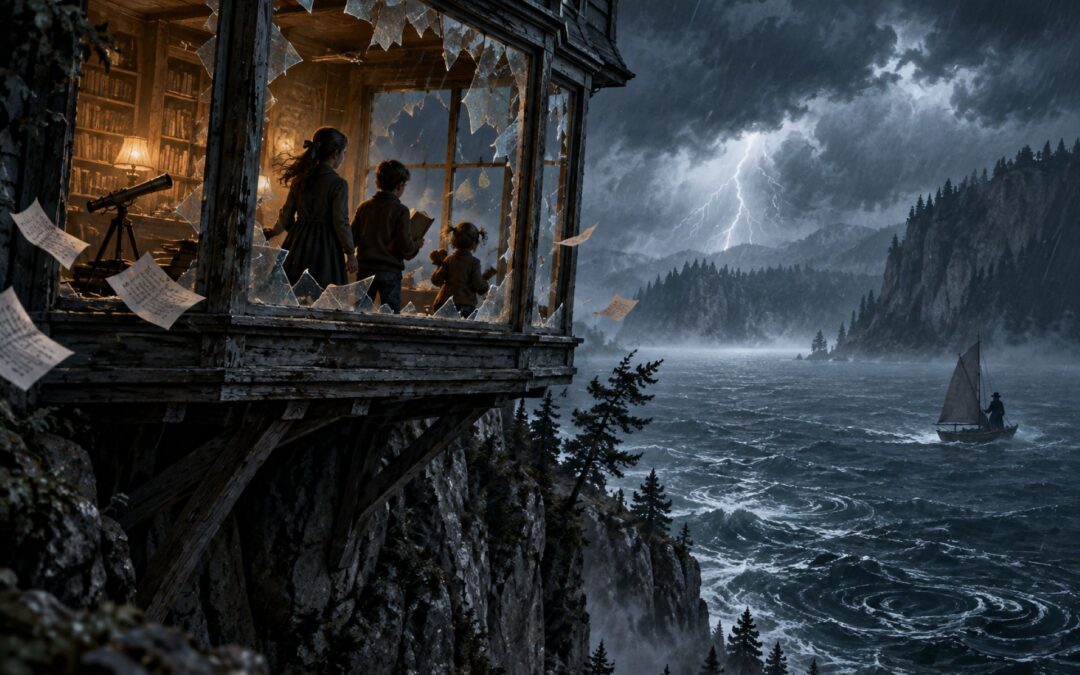
The Wide Window is the third novel in Lemony Snicket’s A Series of Unfortunate Events, following The Bad Beginning and The Reptile Room. The original 2000 edition continues the story of Violet, Klaus, and Sunny Baudelaire as they are placed with yet another guardian after the destruction of their previous attempts at finding a safe home. The official Lemony Snicket and HarperCollins listing identifies it as the third book in the thirteen-volume series, but the novel works as more than another episode in the Baudelaires’ repeated struggle against Count Olaf.
What distinguishes The Wide Window is the way seemingly ridiculous details become essential to survival. Aunt Josephine’s obsession with grammar, Mr. Poe’s forgotten peppermints, Count Olaf’s false wooden leg, a hurricane, a shattered window, and a dangerously specific rule concerning leeches all begin as jokes, eccentricities, or background details before becoming pieces of the story’s machinery. The result is a tightly constructed dark comedy about fear, grief, judgment, and the difference between possessing authority and actually knowing what to do.
The novel also develops one of the series’ most important moral tensions. Josephine is frightened of almost everything, yet her caution does not make her safe; the Baudelaire children are frightened repeatedly, yet they continue to think and act. Snicket therefore does not oppose fear with fearlessness. He contrasts paralysis with courage, showing that the ability to act intelligently while afraid matters more than the fantasy of eliminating fear altogether.
Spoiler warning: This article explains the complete novel, including Aunt Josephine’s fate and the ending.

The Wide Window: Complete Plot Summary
When The Wide Window begins, the Baudelaire children have already learned that being assigned a new guardian does not guarantee protection. Their parents are dead, their inheritance remains inaccessible until Violet comes of age, and Count Olaf has repeatedly tried to gain control of their fortune. Mr. Poe, the banker responsible for managing their affairs, nevertheless continues to treat each new placement as though ordinary administrative procedure can restore stability.
The thirteen chapters move through a carefully connected sequence in which details introduced early repeatedly return in altered form. The story begins with the children’s arrival at Lake Lachrymose, moves through Aunt Josephine’s apparent death and a coded message, becomes a storm-driven rescue adventure, and ends with another confrontation with Count Olaf. The plot is episodic enough to preserve the series’ comic rhythm, but its strongest scenes depend on cause and effect rather than coincidence alone.
Arrival at Lake Lachrymose and Aunt Josephine’s House
Violet, Klaus, and Sunny arrive at Damocles Dock with Mr. Poe, who is preparing to deliver them to their newest guardian. The setting immediately feels threatening. Lake Lachrymose is vast and cold, the weather is unpleasant, and the children’s route toward their new home carries the exaggerated ominousness characteristic of Snicket’s world.
Before leaving them, Mr. Poe offers the children peppermints. He has forgotten that all three Baudelaires are allergic to them, despite being responsible for their welfare and despite having known them for some time. The moment is comic, but it also establishes something more important: Poe’s failures usually arise not from cruelty but from inattentiveness, bureaucratic thinking, and an inability to absorb what the children tell him.
The children travel onward to meet Aunt Josephine Anwhistle, a distant relative who prefers to be called Aunt Josephine. Her house is perched precariously above Lake Lachrymose, extending out from the edge of a cliff in a way that would make most people nervous. Josephine, however, directs her fears toward very different things.
Inside the house, the children discover that Josephine is terrified of ordinary domestic objects and activities. She fears using the telephone because someone might be electrocuted, cooking on the stove because it might explode, turning on radiators because they might burst, and performing countless other mundane tasks because she can imagine some unlikely disaster. Her fearfulness governs the entire household, including its unpleasant meals, because avoiding the stove means serving food that requires no cooking.
Josephine’s welcome is not deliberately unkind, but it reveals how poorly she understands the children. She gives them presents that do not suit their interests: Violet, an inventor fascinated by mechanisms and practical problems, receives something intended for conventional play; Klaus, who loves reading and research, receives something equally unsuitable; Sunny, whose powerful teeth and physical daring make her unlike an ordinary infant, receives a simplistic baby toy. The siblings quietly rearrange the gifts among themselves, solving a minor problem through the same cooperative instinct that will later save their lives.
The one subject that genuinely excites Josephine is grammar. Her library initially delights Klaus because he sees shelves filled with books, but the collection turns out to be dominated by works about grammar, punctuation, and correct usage. Josephine corrects the children’s speech and treats grammatical rules with a seriousness far exceeding the attention she gives to practical judgment.
Her fear has a tragic origin. Josephine’s husband, Ike, died in Lake Lachrymose after being attacked by the Lachrymose Leeches. These creatures normally remain at a distance from humans, but they become dangerously aggressive toward anyone who enters the lake too soon after eating. Ike had eaten shortly before going into the water, and the leeches attacked him.
Josephine’s grief has since expanded into generalized terror. Her husband’s death explains why Lake Lachrymose frightens her, but rather than limiting her caution to the danger that actually killed Ike, she has constructed an entire life around avoiding every imaginable risk. Her house may stand over a cliff, yet she worries about doorknobs and telephones; the contradiction is funny at first, but it will eventually become the central problem of her character.
Captain Sham and Josephine’s Disappearance
After several days of cold meals, grammar lessons, and cautious routines, Josephine takes the children into town. The approaching Hurricane Herman is becoming a serious concern, and supplies are needed before the storm arrives. During the trip, Violet encounters a man dressed as a sailor who calls himself Captain Julio Sham.
Violet immediately recognizes Count Olaf. His disguise is elaborate only in the superficial sense: he wears an eye patch and sailor’s clothing, while one leg appears to be a wooden prosthetic. The false leg conveniently covers the ankle where Olaf’s distinctive eye-shaped tattoo would otherwise reveal his identity.
The children have seen this pattern before. In The Reptile Room, Olaf used the disguise of Stephano, and the Baudelaires had to struggle to convince adults that the suspicious stranger in front of them was the same man who had previously tried to steal their fortune. Captain Sham therefore does not fool the children for long, but recognizing Olaf and persuading adults to recognize him are two different problems.
Josephine responds to Sham in exactly the way the Baudelaires fear. Rather than seeing danger, she sees a confident, charming man who presents himself as another victim of Lake Lachrymose. Olaf claims that the leeches cost him his leg, a story deliberately designed to connect with Josephine’s grief over Ike.
The disguise works because Olaf understands Josephine better than she understands herself. He recognizes that her fears are not produced by careful reasoning; they are emotional habits. By presenting himself as someone who shares the trauma that dominates her life, he bypasses the skepticism she ought to show a stranger.
The children warn Josephine that Captain Sham is Count Olaf, but she refuses to believe them. She pays attention instead to surfaces that appear respectable, including Sham’s business card and his apparent status as the proprietor of a sailboat-rental business. Her confidence in such evidence is especially ironic because she is otherwise suspicious of nearly everything.
One detail does disturb her: Sham’s grammar. Josephine notices errors in his language and corrects them with the same intensity she brings to every linguistic mistake. What initially appears to be another recurring joke begins taking on structural importance because grammar is the area in which Josephine actually observes details carefully.
Olaf soon begins communicating privately with Josephine, and the children become increasingly anxious. Their warnings are ignored, while Josephine’s interest in Captain Sham grows. Because she has been lonely since Ike’s death, Olaf’s attention reaches her at a particularly vulnerable point.
The situation changes abruptly when the children discover that Josephine has vanished. A crash draws them toward the library, where the enormous window overlooking Lake Lachrymose has been shattered. Josephine is nowhere to be found.
She has apparently left a suicide note. The letter claims that she can no longer bear living without Ike and has thrown herself through the wide window into Lake Lachrymose. Even more alarming, it states that Captain Sham should become the Baudelaires’ new guardian.
The evidence seems designed to produce a single conclusion: Josephine has died, and her final wish was to entrust the children to Sham. For the Baudelaires, however, the conclusion is impossible to accept. Josephine had been terrified of Lake Lachrymose, Sham is obviously Olaf, and the convenient transfer of guardianship would give their enemy exactly what he wants.
The children spend the night distressed by Josephine’s apparent death. Klaus keeps returning to her note, noticing that it contains grammatical mistakes Josephine would never normally make. Violet initially finds his concentration on errors uncomfortable while they are supposed to be grieving, but the disagreement does not last because Klaus is not correcting grammar for its own sake; he is trying to understand why Josephine would write unlike herself.
The mistakes gradually become evidence. If Josephine was forced to produce the letter, she may have inserted errors deliberately. Her pedantry, which had seemed useless in most practical situations, might have provided her with the one method of secret communication she could rely upon.
The Coded Note and Hurricane Herman
Mr. Poe arrives after being informed of Josephine’s disappearance, but once again he proves much easier to satisfy with paperwork than with reasoning. He compares the handwriting in the suicide note with Josephine’s known handwriting and concludes that the note is genuine. Because the writing appears to be hers, he treats its contents as authoritative.
The Baudelaires insist that Captain Sham is Count Olaf, yet Poe refuses to accept their identification. His reasoning becomes circular: because the children have previously accused suspicious adults of being Olaf, he treats their repeated accusations as evidence that they see Olaf everywhere. The fact that one of those earlier accusations was correct does not produce the lesson that it should.
For Poe, Josephine’s apparent written wish has administrative force. If she wanted Sham to receive the children, he believes her instructions should be followed unless something formally disproves them. The Baudelaires understand that once they are placed in Olaf’s custody, procedure will no longer protect them.
They therefore need time. Violet remembers the peppermints Poe offered at the beginning of the book and realizes that their shared allergy can be used strategically. At the Anxious Clown restaurant, where Poe and Sham discuss what should happen next, she deliberately arranges for herself and her siblings to consume peppermints.
The reaction is immediate enough to create a convincing medical problem. Because all three children become visibly unwell, Poe agrees they should return to Josephine’s house rather than complete the transfer immediately. Violet has knowingly caused temporary suffering to buy time, an early example of the increasingly complicated moral world in which the children live: ordinary rules and ordinary prudence cannot always survive contact with adults who refuse to recognize the emergency.
Back at the house, Klaus studies Josephine’s note more carefully. Her grammatical errors are too systematic to be accidental. By analyzing them one by one, he discovers that the mistakes correspond to letters.
Together, the hidden letters form the words Curdled Cave. Josephine has used incorrect grammar as a code, trusting that someone familiar with her habits will realize that her errors are intentional. The very obsession that made her household absurd has become the mechanism through which she reveals her true location.
The children determine that Curdled Cave lies across Lake Lachrymose. Josephine did not die by jumping through the window; she escaped or was forced to disappear and then hid. Instead of leaving an ordinary message, which Olaf might recognize, she encoded her location inside language he would not understand.
The discovery gives the children a destination, but Hurricane Herman is now striking the area with full force. Wind and rain batter Josephine’s cliffside home. The house, which has always looked dangerously unstable, begins to fail.
The Baudelaires realize that the structure supporting it is giving way. They barely escape before Josephine’s home collapses from the cliff into Lake Lachrymose. The physical destruction is sudden, but the novel has prepared for it from the moment the house was introduced as a supposedly safe residence built in an obviously unsafe position.
The children are now without a guardian, without a home, and nearly without time. Yet the collapse also removes the possibility of waiting passively for an adult solution. If Josephine is alive in Curdled Cave, they will have to cross the lake during a hurricane to find her.
Crossing Lake Lachrymose and Finding Curdled Cave
The Baudelaires make their way through the storm toward the waterfront. Conditions are miserable, and the children have inadequate protection from the weather. They share what warmth they can, reinforcing the pattern that practical care between the siblings compensates for the failure of the adults around them.
Ordinary transportation across the lake is unavailable because of the hurricane. The ferry is not operating, and the children cannot simply ask responsible adults to take them to Curdled Cave. Their only viable option is to use one of the sailboats belonging to Captain Sham.
They reach Sham’s sailboat-rental business and encounter one of Olaf’s associates. The children cannot overpower an adult directly, so they must rely on their different abilities. Sunny’s size becomes particularly important because she can move in ways Violet and Klaus cannot, allowing the children to obtain the keys they need.
The escape confirms how much Sunny’s role has developed. Although she is still a baby, the narrative increasingly treats her unusual teeth, physical daring, and compressed speech not simply as jokes but as meaningful contributions to the sibling team. The older children do not protect Sunny by excluding her from danger; they protect one another through coordinated action.
They steal a sailboat and enter Lake Lachrymose during Hurricane Herman. Snicket’s narrator pointedly warns readers that stealing a boat and sailing through a hurricane is not behavior to imitate, producing one of the novel’s characteristic tensions between instructional children’s literature and a story in which the children survive precisely because they violate ordinary instructions.
Once on the water, their complementary abilities become essential. Klaus uses knowledge acquired through reading to help them understand navigation and sailing. Violet handles practical and mechanical problems, while Sunny performs tasks suited to her small body.
The voyage is dangerous, but the children reach Curdled Cave and discover Aunt Josephine alive. Their initial relief quickly gives way to anger and disbelief when they learn what has happened. Olaf threatened Josephine and forced her to write the note, but rather than contacting the authorities or finding some other way to protect the children, she retreated into hiding.
Worse, Josephine appears to have imagined that the Baudelaires could join her in the cave and remain there. Her solution to danger is the same one she has used throughout her life: retreat from the threatening world until nothing remains except avoidance. The children recognize that this plan ignores their needs entirely.
Josephine therefore becomes more morally complicated than a simple frightened victim. Olaf has genuinely terrorized her, and her grief helps explain why she responds as she does. Yet she is also the legal guardian of three orphaned children, and she has chosen a strategy that protects herself while abandoning nearly every responsibility she accepted.
When Josephine refuses to leave the cave, Klaus realizes that reason alone will not move her. He therefore manipulates one of her fears, invoking the possibility that realtors may discover and interfere with the cave. The tactic is ethically uncomfortable, but it works.
The moment mirrors Violet’s peppermint strategy. Both children use a person’s predictable physical or psychological response to produce necessary action because ordinary persuasion has failed. Their intelligence is not idealized as pure innocence; survival repeatedly pushes them toward deception, manipulation, theft, and other actions that would be inappropriate in ordinary circumstances.
Josephine finally agrees to return with them. For the first time since her disappearance, there appears to be a possibility that she could expose Sham and prevent Olaf from gaining custody. The danger, however, is not finished.
The Leeches, Josephine’s Death and Olaf Exposed
During the return trip, Josephine reveals that she has recently eaten a banana. The admission changes the situation instantly because the children know the rule governing the Lachrymose Leeches: anyone who enters the lake too soon after eating may attract them.
The leeches begin attacking the boat. Their threat is especially effective because the novel established their behavior long before the attack occurs. Unlike Count Olaf or Mr. Poe, the leeches do not lie, misunderstand evidence, or change their rules according to convenience; they behave exactly as the story has told the reader they will.
The boat begins taking damage, and the children struggle to keep it afloat. Violet takes responsibility for finding a way to signal for help while the others deal with immediate problems. Her first attempt fails because the materials she needs have become wet.
For a moment, Violet is overwhelmed. As the eldest Baudelaire, she has carried an increasing burden since their parents’ deaths, including an internal promise that she will protect Klaus and Sunny. The sinking boat, attacking leeches, hurricane, and responsibility for everyone aboard force her close to despair.
Her response demonstrates the novel’s central understanding of courage. Violet does not suddenly stop being afraid. Instead, she continues thinking while frightened and eventually recognizes that a lens from a spyglass can concentrate light strongly enough to ignite a signal.
The improvised device works, and someone notices them. Unfortunately, the approaching rescuer is Captain Sham. The children have escaped one physical danger only to fall directly back into the human danger they were trying to expose.
Olaf brings the group aboard his vessel and realizes that Josephine represents a serious problem. If she tells Mr. Poe what actually happened, the forged custody arrangement will collapse. Josephine, meanwhile, is forced to decide whether she will finally behave like a guardian or continue treating survival as something she can purchase by sacrificing others.
She chooses herself. Josephine offers to disappear and allow Olaf to keep the Baudelaires if he will spare her life. The decision is the moral climax of her character arc because it transforms her cowardice from an irritating personal habit into an act of betrayal.
The moment does not erase the fact that she has been traumatized or threatened, but it reveals the limits of sympathy. Fear can explain Josephine’s behavior without making every consequence of that behavior acceptable. The Baudelaires, who are children and have endured repeated losses themselves, have spent the entire book acting despite fear; Josephine, the adult responsible for them, finally offers them to their enemy in exchange for personal safety.
Even then, Josephine cannot abandon her obsession with grammatical correctness. During the confrontation she corrects Olaf’s language. The habit that once seemed harmlessly pedantic and later enabled her coded message now becomes fatal.
Olaf throws Josephine into Lake Lachrymose. Given the leeches and the circumstances, her survival becomes extraordinarily unlikely. The novel does not linger over a recovered body, but subsequent evidence leaves the Baudelaires with little realistic hope that she escaped.
Olaf then returns toward Damocles Dock, where Mr. Poe remains prepared to accept Captain Sham’s story. The Baudelaire children try again to explain that Sham is Olaf, but their strongest piece of documentary evidence—the note—is damaged by the storm and water. Once more, Poe wants a form of proof that fits his administrative expectations.
Sunny finally supplies the evidence in the most direct way possible. She attacks the wooden leg with her teeth and breaks through the disguise. Beneath it is Olaf’s real leg, including the distinctive eye tattoo that identifies him.
Poe can no longer deny what stands in front of him. Captain Sham is Count Olaf, exactly as the children said.
Recognition does not produce justice. While attention is diverted and official action remains characteristically slow, Olaf and his associate escape. The adult world finally reaches the correct conclusion only after the children have already solved the mystery, survived the hurricane, crossed the lake, rescued Josephine, escaped the leeches, and physically exposed the disguise themselves.
Poe also refuses to let the Baudelaires immediately return to the lake to search for Josephine because it would be dangerous for children to sail alone. The reasoning is technically sensible in isolation, which is precisely why it is so bitterly comic. These same children have already crossed the lake during a hurricane and reached Josephine when no responsible adult was willing or able to do so.
Damaged life jackets belonging to Josephine are eventually found, and she is presumed dead. Her fate leaves the Baudelaires once again without the guardian who was supposed to provide a home.
The novel ends not with justice, safety, or the discovery of a permanent family, but with the siblings recognizing what each of them contributed. Violet’s inventiveness, Klaus’s knowledge, and Sunny’s physical resourcefulness allowed them to survive situations that should never have been theirs to solve. Their circumstances remain miserable, yet they understand more clearly that one another are the most reliable source of protection they possess.
Lake Lachrymose and the Novel’s Gothic World
The setting of The Wide Window turns physical geography into part of the story’s emotional architecture. Lake Lachrymose, Damocles Dock, Curdled Cave, Hurricane Herman, the cliffside house, and the Lachrymose Leeches belong to a deliberately exaggerated landscape in which ominous names are simultaneously comic and threatening. Snicket uses the conventions of Gothic fiction without allowing the novel to become solemn Gothic tragedy; danger is real, but absurdity is always present beside it.
Lake Lachrymose dominates the story before the Baudelaires even reach Josephine’s house. The word “lachrymose” itself suggests tearfulness or sorrow, making the lake an obvious environment for three grieving orphans and a widow whose life has been transformed by bereavement. The novel does not require readers to treat the lake as a one-to-one allegory for grief, but the connection between sorrow and landscape is too persistent to be accidental at the level of literary effect.
The lake also functions practically. Ike died there, Josephine fears it, the leeches inhabit it, Curdled Cave lies across it, and the children must repeatedly decide whether entering it is more dangerous than remaining where they are. The setting therefore forces characters to reveal their attitudes toward risk rather than merely allowing those attitudes to be discussed.
Josephine’s house is an even clearer example of environment exposing character. She has organized her life around avoiding danger, yet she lives in a structure balanced over a cliff above the lake she fears most. The absurdity matters because it exposes the irrationality of her anxiety: she has not created a systematically safe life; she has simply selected certain dangers to obsess over while ignoring others.
When Hurricane Herman destroys the house, the event completes a process the architecture has foreshadowed from the beginning. The supposed refuge was structurally unstable all along. In symbolic terms, the collapse also resembles the failure of adult protection throughout the series: a structure labeled “home” does not become secure merely because responsible people say it is.
Curdled Cave offers a different kind of false safety. Josephine believes that hiding there can solve her problem because the cave removes her from immediate confrontation with Olaf. Yet a hiding place that requires permanent retreat from ordinary life cannot provide a meaningful home for the Baudelaires.
The hurricane makes the environment dynamic rather than decorative. As the children solve the coded note, external danger intensifies; intellectual success does not produce immediate safety because the building itself begins to collapse. Later, the storm makes their journey across the lake far more dangerous, turning an act of rescue into an adventure that demands all three children’s abilities.
The Lachrymose Leeches complete the setting’s strange logic. They are grotesque and improbable, yet their behavior is governed by a clear rule that the reader learns in advance. In a novel filled with unreliable adults and deceptive appearances, the monsters are almost reassuringly consistent: if a person eats and enters the lake too soon afterward, the leeches will attack.
That contrast strengthens the book’s comedy and its criticism of authority. Nature may be dangerous, but it is intelligible. The Baudelaires can learn its rules, remember them, and respond intelligently; the adult institutions around them are often harder to predict because they repeatedly refuse to learn from evidence.
Character Analysis
The central character pattern in The Wide Window reverses an expectation common to children’s fiction: adults have authority, but the children possess the competence required to survive. Violet, Klaus, and Sunny are not infallible, and their plans sometimes fail, yet they observe, learn, adapt, and cooperate. Josephine and Mr. Poe, by contrast, have the legal and social power to protect them but repeatedly fail to use it well.
This reversal is one reason broader scholarly analysis of child agency and narrative authority in A Series of Unfortunate Events is useful for understanding the book. Snicket’s children are not simply miniature adults, but they are forced into forms of judgment usually reserved for adults because the surrounding structures of protection repeatedly collapse.
Violet, Klaus and Sunny Baudelaire
Violet’s defining ability is invention, but The Wide Window expands that ability into strategic leadership. She does not merely build devices; she notices which available resources can be transformed into solutions. The peppermint plan and the improvised signal on Lake Lachrymose show two sides of the same intelligence: one social and deceptive, the other mechanical and practical.
Her greatest challenge is not technical failure but responsibility. Violet carries the emotional burden of being the eldest sibling and repeatedly feels that she ought to be able to protect Klaus and Sunny. When her first attempt to signal for help fails during the leech attack, fear threatens to disrupt the thinking on which everyone depends.
The important point is that Violet does not overcome fear by becoming emotionally invulnerable. She recovers enough composure to examine the materials around her and develop another idea. Her inventiveness therefore becomes an expression of courage rather than a magical talent that guarantees success.
Klaus’s power is knowledge. His love of reading sometimes appears less immediately useful than Violet’s ability to build things, but the entire middle of the novel depends on his capacity to recognize patterns. Josephine’s note looks nonsensical because of its errors; Klaus understands that the mistakes themselves may contain information.
He turns grammar from a collection of rules into a practical system for decoding a message. That transformation is central to the novel’s larger treatment of learning. Information becomes valuable when a person understands when and how to apply it.
Klaus is also willing to use psychological knowledge. Once he realizes Josephine cannot be persuaded through responsibility or courage, he exploits her fear of realtors to make her leave Curdled Cave. The tactic is manipulative, but the novel presents it as part of a world in which children must improvise because conventional adult cooperation is unavailable.
Sunny’s role is smaller in terms of dialogue but increasingly significant in action. Her powerful teeth remain a comic trait, yet the story repeatedly gives them concrete purpose. She helps obtain the sailboat keys and later destroys Olaf’s false wooden leg, revealing the tattoo that finally proves his identity.
That final act is particularly important because it gives Sunny a decisive role in exposing Olaf. She is not merely the sibling the older children protect. Her physical abilities solve problems neither Violet’s inventions nor Klaus’s reading could solve alone.
The three children therefore function best as a system rather than a hierarchy. Violet does not become a complete substitute parent, Klaus is not merely the intellectual assistant, and Sunny is not simply the vulnerable baby. Their survival depends on recognizing different forms of competence and trusting each other enough to coordinate them.
Aunt Josephine
Aunt Josephine is one of the novel’s most interesting figures because she is simultaneously comic, tragic, sympathetic, frustrating, and ultimately disappointing. Her fears are exaggerated to absurdity, but the book gives those fears a real origin in Ike’s death. She has not always lived this way; grief has helped reorganize her personality around avoidance.
That history matters because without it Josephine would be little more than a caricature of cowardice. The loss of Ike explains why Lake Lachrymose has become psychologically overwhelming and why Captain Sham’s false story about losing a leg to the leeches works so effectively. Olaf exploits grief before he exploits stupidity.
Josephine also appears to want to be kind to the Baudelaires. She accepts them into her home, gives them presents, and tries to create some form of family life. The failure of those efforts comes partly from the fact that she understands her own fears far better than she understands the children.
Her obsession with grammar reveals the same contradiction. Josephine is capable of extraordinary attention to technical correctness, yet she repeatedly lacks practical judgment. She can identify an incorrect sentence immediately while failing to identify Count Olaf when three frightened children explain exactly who he is.
That does not make grammar meaningless. Josephine eventually uses grammatical errors cleverly to encode her location, demonstrating intelligence and resourcefulness under pressure. The tragedy is that her knowledge does not extend into the moral courage required to fulfill her responsibilities.
The decisive moment comes when Olaf threatens her after the leech attack. Instead of standing with the children, Josephine offers to let him keep them if he will spare her. At that point her fear stops being merely a personal limitation and becomes a willingness to sacrifice those she is responsible for protecting.
Her final grammar correction is darkly appropriate. Josephine clings to linguistic rules even while surrendering ethical ones, and Olaf kills her for it. The scene is grotesquely comic, but it also completes her characterization: the one form of correctness she can defend absolutely is the least important form of correctness available in the moment.
Count Olaf and Mr. Poe
Count Olaf’s Captain Sham disguise is intentionally ridiculous, yet the disguise succeeds because Olaf understands the weaknesses of the adults around the Baudelaires. He does not need to become literally unrecognizable. He needs only to offer a social performance that adults prefer to the children’s testimony.
With Josephine, he exploits loneliness and grief. With Mr. Poe, he exploits bureaucratic habits and the assumption that respectable paperwork deserves more trust than frightened children. His villainy therefore depends not only on deception but on systems already inclined to ignore inconvenient evidence.
Olaf is effective because he adapts. The wooden leg conceals the tattoo that exposed him previously, his story about losing the leg to the leeches is designed specifically for Josephine, and his apparent respectability as a business owner gives Poe an administrative reason to take him seriously. The costume is absurd, but the manipulation behind it is calculated.
Mr. Poe represents a different danger because he is not malicious. He repeatedly intends to act responsibly, yet he treats procedure as though it were identical to judgment. Handwriting, legal instructions, custody arrangements, and official appearances matter more to him than understanding patterns of behavior.
His failure is therefore institutional rather than villainous. Poe believes that following the correct process will produce the correct outcome, even after experience repeatedly demonstrates otherwise. The Baudelaires suffer because a well-intentioned adult who refuses to update his understanding can be almost as dangerous as an openly malicious one.
Fear, Grief and the Failure of Adults
Fear is the novel’s most obvious theme, but The Wide Window is not arguing that good people are unafraid and weak people feel fear. Everyone important is afraid at some point. The real distinction lies in what characters do with fear once it appears.
Josephine’s response is avoidance. After Ike’s death, she attempts to reduce danger by eliminating situations that could possibly hurt her. The result is not safety but paralysis, because she gradually allows hypothetical disasters to govern ordinary decisions.
Her fears also become inconsistent. She refuses to cook because a stove might cause an accident, yet she lives in a house over a cliff. She is suspicious of domestic objects but accepts Captain Sham despite direct warnings from children who have already survived Count Olaf’s schemes.
The Baudelaires provide the counterexample. They are frightened by Olaf, the hurricane, the collapsing house, Lake Lachrymose, and the leeches, but fear does not end their reasoning. They experience terror while continuing to gather information, form plans, revise failed plans, and act.
The distinction becomes clearest when the children persuade Josephine to leave Curdled Cave. They do not claim that the journey will be safe. They understand the danger more realistically than she does, yet they also understand that remaining hidden forever is not a meaningful solution.
Grief complicates this contrast. Josephine has lost Ike, while Violet, Klaus, and Sunny have lost both parents and, by this point in the series, other adults who briefly offered them protection. The novel does not suggest that grief produces one inevitable psychological response.
Josephine allows grief to narrow her world. The children remain grief-stricken, but their bond with one another allows them to keep engaging with the world rather than abandoning it. Their resilience is not proof that Josephine’s suffering is trivial; it shows that suffering alone does not determine what a person becomes.
The sibling relationship is therefore the story’s strongest positive force. The Baudelaires do not possess permanent safety, wealth they can freely use, trustworthy institutions, or reliable guardians. What they possess is mutual dependence based on genuine knowledge of one another.
That relationship is visible in small moments as much as in dramatic rescues. They redistribute Josephine’s unsuitable gifts, share clothing during the storm, divide responsibilities aboard the sailboat, and eventually acknowledge each other’s contributions at the dock. Their family survives because it is cooperative rather than hierarchical.
Adult authority repeatedly fails in comparison. Josephine has guardianship but cannot provide protection. Poe controls custody decisions but cannot recognize the recurring criminal threatening the children.
This does not mean the novel simply declares children wiser than adults. The Baudelaires make dangerous choices, experience confusion, disagree, and sometimes rely on luck. The deeper criticism is that authority without attentiveness becomes hollow, especially when those with power treat obedience as more important than listening.
The children’s rule-breaking develops from that failure. They deliberately trigger allergic reactions, manipulate Josephine, steal a sailboat, and enter the lake during a hurricane. None of these actions would normally be reasonable.
The novel makes them necessary by constructing situations in which official obedience would place the children directly in Olaf’s hands. Survival therefore creates an uncomfortable moral environment: the Baudelaires increasingly have to judge not merely what rules exist, but when the institutions enforcing those rules have failed so badly that disobedience becomes the more responsible act.
Grammar, Language and Knowledge as Power
Grammar begins as one of The Wide Window’s broadest jokes. Aunt Josephine corrects language compulsively, filling her library with grammar books and reacting to errors with more confidence than she shows toward almost any physical activity. Her obsession initially seems like proof that expertise can become absurd when separated from ordinary priorities.
The coded note changes that interpretation. Josephine deliberately writes grammatical errors because anyone who knows her well should recognize that she would never make them accidentally. Klaus’s ability to identify and decode those mistakes turns linguistic knowledge into a survival tool.
The important transformation is not simply that grammar becomes useful. Klaus makes it useful by connecting abstract knowledge with context. He notices that Josephine’s behavior is inconsistent with the document attributed to her and asks why the errors exist.
Josephine herself does something similar when she creates the code. She understands that Olaf may control the circumstances under which she writes the note, but he is unlikely to understand the significance of deliberate grammatical mistakes. Her narrow expertise becomes a covert language that operates beneath the letter’s obvious meaning.
Yet the novel refuses to turn this into a simple celebration of correctness. Josephine’s knowledge repeatedly coexists with terrible judgment. She can construct a coded message but cannot recognize that hiding indefinitely with three orphaned children is an irresponsible plan.
Her final correction of Olaf completes the pattern. Grammar has become so central to her identity that she continues enforcing linguistic rules even while bargaining for her life with a murderer. The moment is funny because of its absurd priorities, but it is also disturbing.
Knowledge in The Wide Window therefore gains power only when joined to judgment. Klaus’s grammar knowledge helps because he knows when to treat an error as evidence. Josephine’s grammar knowledge sometimes helps, but her inability to rank dangers and responsibilities correctly prevents expertise from becoming wisdom.
The same distinction appears elsewhere in the novel. Poe possesses information about legal procedure without understanding the pattern of Olaf’s behavior. Violet possesses practical knowledge and continually tests it against changing circumstances.
The novel’s interest in language also extends beyond Josephine. Snicket’s narrator constantly defines words, interrupts scenes to explain expressions, warns readers about misunderstandings, and treats vocabulary as part of the storytelling itself. Language is not merely the vehicle through which the story is delivered; it is one of the story’s subjects.
Symbols and Motifs
The wide window gives the novel its title because it concentrates several of the book’s concerns in one object. It belongs to Josephine’s house and looks out over Lake Lachrymose, placing her greatest source of fear directly within the domestic space she treats as a refuge. When it shatters, the distinction between supposed safety and external danger collapses.
The broken window also creates the false story of Josephine’s suicide. Its physical destruction becomes evidence within Olaf’s scheme, demonstrating how appearances can be manipulated. The Baudelaires survive by refusing to accept what the visible scene seems to prove.
Lake Lachrymose functions as both environment and emotional motif. Its associations with tears and sorrow suit a story dominated by bereavement, while its physical dangers repeatedly force characters to confront the difference between rational caution and paralyzing fear. Josephine views the lake primarily as the site of Ike’s death, while the children learn to treat it as dangerous but navigable.
The house above the cliff is an equally strong image of unstable protection. It is introduced as the children’s newest home, yet its position makes the promise of security absurd from the beginning. Its eventual collapse externalizes the failure of Josephine’s guardianship.
Hurricane Herman intensifies that process. The storm does not create every problem in the story, but it strips away whatever temporary stability remains. Once the hurricane arrives, the Baudelaires can no longer pretend that waiting quietly in Josephine’s home will lead to rescue.
The Lachrymose Leeches operate differently because their symbolism grows from their consistency. They are dangerous according to a specific rule, and they follow that rule without exception. Against a human world filled with misleading appearances, arbitrary adult decisions, and disguised villains, even monstrous animals appear more predictable than institutions.
Cold food is a quieter recurring motif. Josephine’s refusal to use the stove turns fear into something the children literally have to consume. Her anxiety does not remain inside her mind; it makes daily life colder, duller, and more constrained for everyone around her.
Grammatical errors similarly change meaning as the story develops. They begin as mistakes Josephine would despise, become clues proving the note is unusual, form the code that reveals Curdled Cave, and culminate in the fatal moment when Josephine corrects Olaf. Their recurrence ties together comedy, mystery, character, and tragedy.
Lemony Snicket’s Narrative Style and the Novel’s Structure
The Lemony Snicket persona is one of the main reasons A Series of Unfortunate Events feels different from more conventional children’s adventure fiction. The narrator does not disappear behind the story. He interrupts, defines words, warns readers, refers mysteriously to his own experiences, and repeatedly reminds the audience that the Baudelaires’ story will not conform to reassuring expectations.
In The Wide Window, those interruptions often create comic distance from frightening events. Snicket can describe danger, pause to explain an expression, and then return to the action without fully dissolving the tension. The humor does not erase suffering; it makes the experience of reading that suffering strange and unstable.
The narrator also plays with the conventions of instructional children’s literature. During the sailboat sequence, for example, the story makes clear that readers should not imitate the children by stealing a boat and entering dangerous waters. The joke works because the children are doing something obviously reckless, yet the plot has constructed circumstances in which their reckless action is also necessary.
Definitions are another recurring device. Snicket frequently explains words or phrases even when some readers may already understand them, but the definitions are rarely neutral dictionary entries. They often contain jokes, examples, emotional commentary, or miniature stories.
This style gives the books an educational surface without allowing education to become solemn. Vocabulary is introduced through comic narration, just as grammar becomes part of the mystery. The series repeatedly encourages attention to language while mocking people who confuse linguistic correctness with complete intelligence.
The novel also uses dramatic irony and explicit foreshadowing aggressively. Snicket often tells readers that things will go badly before they do. Traditional suspense asks whether disaster will happen; Snicket’s version often asks exactly how the announced disaster will occur.
That technique suits the premise of a series literally called A Series of Unfortunate Events. The reader knows that safety will be temporary, Olaf will return, and new guardians will probably fail. The pleasure therefore comes less from hoping for a conventional happy ending than from watching the narrative transform inevitability into increasingly elaborate forms.
Structurally, The Wide Window is especially strong at setup and payoff. Poe’s forgotten peppermints become Violet’s escape strategy. Josephine’s grammar obsession becomes a code. Ike’s death establishes the rule that later brings the leeches to the boat. Olaf’s false wooden leg hides his tattoo until Sunny tears through the disguise.
These returns give the novel a satisfying internal coherence even though the broader series formula has become noticeable by Book 3. The Baudelaires receive a new guardian, Olaf appears under another identity, adults dismiss the children’s warnings, the children expose him, and he escapes before authorities can stop him. That structure is now recognizable enough to risk predictability.
The book partly compensates by making the details distinctive. Aunt Josephine is not another version of Dr. Montgomery, Lake Lachrymose is not merely a new backdrop, and the coded-note mystery produces a different type of problem from the previous books. The repetition exists at the macro level, while invention occurs at the level of character, setting, language, and action.
The Gothic elements help unify those inventions. The cliff house, storm, widow, lake, cave, threatening animals, apparent suicide, and imperiled orphans all resemble materials from melodrama and Gothic fiction, but Snicket filters them through alliteration, absurd names, linguistic jokes, and self-conscious narration. The result is macabre without becoming relentlessly grim.
That combination explains why the series has attracted literary attention beyond its intended middle-grade audience. The books invite children to distrust appearances and question narrative authority while simultaneously allowing an intrusive narrator to guide nearly every page. The tension between guidance and distrust is part of their continuing fascination.
The Wide Window Ending Explained
The ending resolves the immediate mystery but refuses to restore the world to order. Captain Sham is exposed as Count Olaf when Sunny breaks his false wooden leg and reveals the identifying tattoo underneath. Mr. Poe finally accepts what the children have been saying, yet recognition comes so late that Olaf still manages to escape.
Josephine’s fate is darker. Olaf throws her into Lake Lachrymose after she attempts to bargain for her own life and then corrects his grammar. Her damaged life jackets are later found, making her death the overwhelmingly likely conclusion even though the narrative does not supply the conventional certainty of a recovered body.
Her death completes the novel’s exploration of fear in an especially cruel way. Josephine spends much of her life trying to avoid unlikely dangers, yet when genuine danger appears she repeatedly chooses retreat rather than courageous action. Ultimately, her elaborate system of self-protection cannot save her.
That does not mean the novel presents her death as deserved. Josephine is a victim of Olaf, and her behavior is shaped by grief and terror. The stronger interpretation is that fear has narrowed her moral world so severely that when the crisis arrives she can no longer act as the guardian the children need.
Mr. Poe’s behavior after Olaf is exposed reinforces the same criticism of adult authority. He prevents the children from immediately returning to the lake because sailing alone would be unsafe. As an abstract rule, he is correct, but in context the decision exposes the absurd gap between official responsibility and actual competence.
The Baudelaires have already done what the adults failed to do. They decoded Josephine’s message, crossed the lake, found her, survived the leeches, and identified Olaf. Poe can regulate their actions, but he cannot reproduce their effectiveness.
Snicket also refuses to end with a simple lesson. The children do not decide that bravery solves every problem, because bravery has not saved Josephine or captured Olaf. They do not conclude that intelligence guarantees justice, because they have repeatedly been correct without being believed.
Instead, the final emotional movement turns inward toward the sibling relationship. Violet, Klaus, and Sunny recognize how much each contributed to their survival. The ending therefore offers solidarity rather than security: they still lack a safe home, but they understand that their most reliable source of help is one another.
Critical Review
The Wide Window is one of the strongest demonstrations of how effective the early A Series of Unfortunate Events formula can be when its individual elements are tightly connected. The basic pattern is already familiar by the third book, but the novel’s internal construction is unusually disciplined. Details introduced as jokes or atmosphere repeatedly return as necessary parts of the plot.
The peppermint setup is a good example. Poe’s forgetfulness initially appears to be a minor gag emphasizing his inattentiveness, but the allergy later becomes Violet’s method of delaying the custody transfer. Josephine’s grammar obsession undergoes an even more elaborate transformation, moving from comic characterization to code system to fatal compulsion.
The setting is another major strength. Lake Lachrymose gives the novel a clear physical identity, while the cliff house, Hurricane Herman, Curdled Cave, and leeches continually turn the environment into a problem the children must solve. The action feels rooted in place rather than interchangeable with any other Olaf scheme.
The storm and leech sequences also give the book some of the most sustained adventure in the first three installments. The Baudelaires are not merely investigating an adult conspiracy; they are navigating an actual physical emergency in which the story has clearly established the rules of danger. Violet’s improvised signal is especially satisfying because it emerges from failed effort rather than instant brilliance.
Aunt Josephine is perhaps the novel’s best character creation. Her exaggerated cowardice is funny, but the reference to Ike’s death gives it enough emotional grounding to prevent her from becoming entirely weightless. She is simultaneously victim and failed guardian, which gives her more moral complexity than a simple comic adult obstacle.
Her betrayal of the children is particularly effective because it changes how earlier scenes are understood. What initially looks like harmless eccentricity gradually reveals a deeper tendency to prioritize her own avoidance of danger over the needs of people dependent upon her. The transition is uncomfortable precisely because the reader has reasons to pity her.
Count Olaf remains a deliberately broad villain, but his manipulation becomes more interesting when considered separately from the absurdity of his disguise. Captain Sham works not because the costume is convincing, but because Olaf understands how to exploit Josephine’s loneliness and Poe’s bureaucratic assumptions. His real skill lies in identifying weaknesses in the social environment around the children.
Mr. Poe is less satisfying as a realistic adult character because his inability to recognize Olaf becomes increasingly difficult to believe. Yet the exaggeration belongs to the series’ larger satirical structure. Poe is not meant to model a plausible banker as much as the failure of institutions that continue processing evidence according to familiar procedures after the obvious pattern has changed.
The novel’s narrator remains one of its greatest assets. Snicket’s definitions, warnings, interruptions, and relentless promises of misery create a voice capable of making genuinely dark material accessible without trivializing it. The book can move from the possibility of suicide or murder to a joke about grammar without pretending that the darker event did not matter.
A contemporary Kirkus Reviews assessment praised the novel’s wordplay, dark humor, melodramatic adventure, and modern fairy-tale qualities. That judgment captures much of what still works: The Wide Window understands that children’s literature can be frightening, linguistically playful, and absurd at the same time.
The major limitation is repetition. By Book 3, readers can recognize the architecture before many of the details arrive: a new guardian, another Olaf disguise, adults refusing to listen, children gathering proof, Olaf exposed, Olaf escaping. The series turns repetition into part of its identity, but repetition can still reduce suspense.
A more critical assessment from Common Sense Media has argued that this installment can feel less subtle and more didactic than earlier entries even while acknowledging the appeal of its code-breaking, sailboat, leech, and Olaf sequences. That criticism is fair. The novel occasionally states its moral distinctions more explicitly than its strongest scenes require.
Josephine’s fear, in particular, can become repetitive because the joke must be re-established through multiple examples. The repeated grammar corrections create a similar risk. Both devices work best when they become plot mechanisms rather than merely recurring comic bits.
The series’ treatment of adult stupidity may also frustrate readers who require realistic psychological behavior. Poe’s refusal to believe the Baudelaires works thematically, but maintaining the pattern across multiple books requires increasingly strong suspension of disbelief. The world operates according to satirical logic in which adult institutions are predictably incapable of interpreting what competent children can see.
That limitation does not fatally damage The Wide Window because the book understands its own heightened world. Its villains are theatrical, its locations have ominously comic names, its narrator openly manipulates the reader, and its disasters arrive with fairy-tale inevitability. Asking it to behave like strict realism would ignore the form it has chosen.
The more important question is whether the formula continues producing emotional and intellectual variation. Here, it does. Josephine’s grief, the distinction between fear and courage, the practical use of grammar, and the growing autonomy of the siblings give the third installment its own identity.
Sunny’s increasing agency is especially welcome. Her destruction of the wooden leg makes the youngest Baudelaire responsible for the final proof of Olaf’s identity. The scene reinforces the series’ insistence that competence can take forms adults do not recognize.
The ending is also stronger because it refuses easy consolation. Olaf escapes, Josephine is presumed dead, and Poe remains fundamentally unchanged. The Baudelaires’ achievement lies not in restoring justice but in surviving without surrendering their loyalty to one another.
That limited victory suits the book’s larger worldview. The Wide Window does not promise that courage guarantees good outcomes. It suggests instead that courage, knowledge, adaptability, and solidarity matter because outcomes cannot be guaranteed.
Is The Wide Window Worth Reading?
The Wide Window remains a worthwhile third installment because it does more than repeat the machinery of the first two books. Its setting is memorable, its mystery is built around a genuinely clever use of language, and its action gives all three Baudelaire children meaningful opportunities to contribute. Aunt Josephine also brings a more complicated emotional dimension to the series’ recurring pattern of unreliable guardians, because her failure grows from grief and fear rather than indifference alone.
Readers who already dislike the series’ formula may find this the point at which repetition becomes difficult to ignore. Count Olaf’s disguise once again fools adults who should know better, Mr. Poe once again fails to act until the children provide overwhelming proof, and the villain once again escapes. Those repetitions are structural limitations even if they are intentional.
Yet within that structure, The Wide Window is unusually well assembled. The peppermints, grammar errors, lake rules, collapsing house, wooden leg, and leeches are not random eccentricities but connected pieces of a story in which attention repeatedly becomes a survival skill. The novel rewards readers for remembering apparently minor details in much the same way the Baudelaires survive by noticing what adults overlook.
Its deepest achievement is the contrast between Josephine and the children. Both have suffered terrible loss, and both are afraid, but they respond differently to that fear. Josephine tries to make the world harmless by retreating from it, while Violet, Klaus, and Sunny increasingly accept that danger cannot always be removed and must sometimes be faced intelligently.
That distinction gives the novel more weight than its comic surface suggests. The Wide Window is still a fast, strange, darkly funny children’s adventure, but beneath the leeches, grammar jokes, artificial legs, and hurricane lies a serious idea: safety is never created merely by avoiding everything that might hurt us. In the Baudelaires’ world, the closest thing to security comes from paying attention, thinking clearly, acting despite fear, and trusting the people who have repeatedly shown that they will stand beside you.
Last Updated on September 9, 2026 by Aseem Gupta