
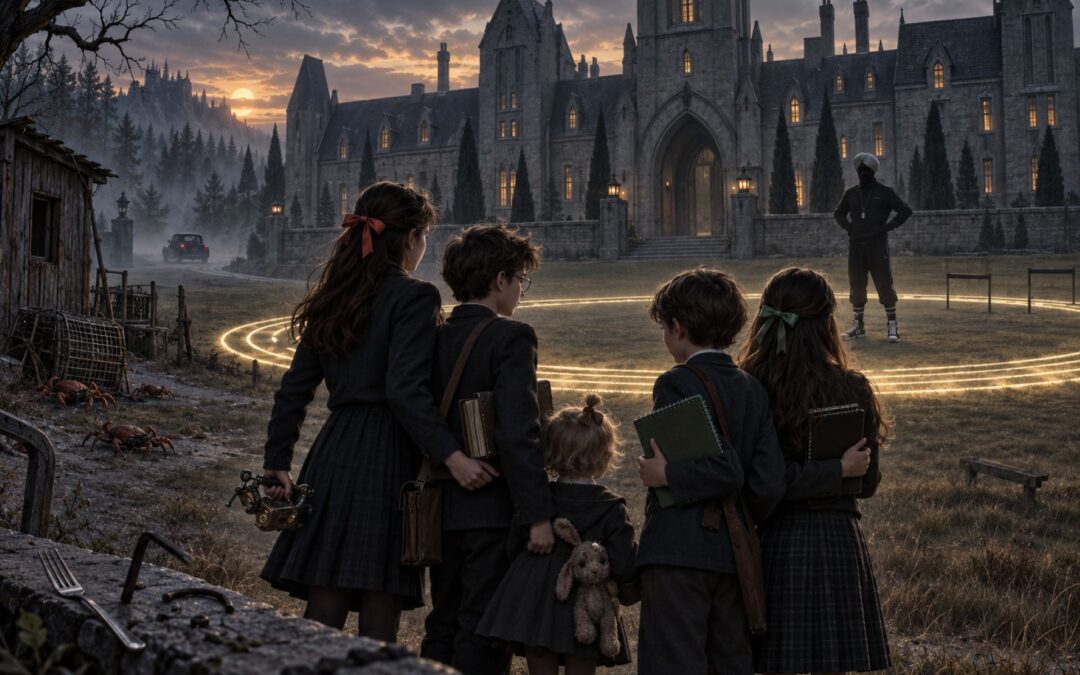
Published by HarperCollins in 2000, The Austere Academy is the fifth installment in the thirteen-book A Series of Unfortunate Events by Lemony Snicket. It begins with a familiar promise of temporary safety: after losing their parents and surviving a succession of murderous guardians and Count Olaf’s disguises, Violet, Klaus, and Sunny Baudelaire are sent to Prufrock Preparatory School. A school seems, at least in theory, like a place where responsible adults, routines, other children, and institutional rules might make it harder for Olaf to reach them.
Prufrock immediately proves otherwise. Its rules are irrational, its vice principal is vain and cruel, its educational system rewards meaningless repetition, and the adults charged with protecting the Baudelaires repeatedly trust procedures over evidence. Yet the novel also gives the children something they have badly lacked: friends. Duncan and Isadora Quagmire understand their grief, believe their warnings about Olaf, and possess enough courage to become active partners in resisting him.
That friendship changes the emotional structure of the series, while the novel’s ending changes its larger narrative structure. The conflict no longer concerns only Olaf’s attempts to seize the Baudelaire fortune. By the final pages, the Quagmires have been kidnapped, their research has disappeared with them, and three unexplained letters—V.F.D.—suggest that the mysteries surrounding Olaf, the Baudelaires, and their parents extend far beyond anything the children previously understood.
Spoiler warning: This article covers the complete plot of The Austere Academy, including Count Olaf’s disguise, the Quagmire kidnapping, and the V.F.D. ending.

The Austere Academy: Complete Plot Summary
The Austere Academy follows the Baudelaires through a complete cycle of apparent safety, institutional failure, discovery, resistance, and loss. Unlike some earlier installments, however, Count Olaf’s scheme depends less on immediate physical force than on manipulating Prufrock’s rules until the school itself begins doing his work for him.
Arriving at Prufrock Prep
Violet, Klaus, and Sunny Baudelaire arrive at Prufrock Preparatory School under the supervision of Mr. Poe, the banker who has repeatedly been responsible for arranging their guardianship. Poe treats the school as a reassuring solution to the problem of Count Olaf. Prufrock has administrators, students, teachers, rules, and what Vice Principal Nero proudly describes as an advanced computer system capable of recognizing Olaf from his known physical characteristics.
The setting offers little genuine reassurance. The school’s buildings are gray and shaped in ways that remind the Baudelaires of tombstones, while the surrounding grounds are brown and dreary rather than lively or welcoming. Over the entrance is the Latin phrase Memento Mori, which Klaus translates as “Remember you will die.” The motto immediately makes Prufrock feel less like a protected educational refuge than another stage in the series’ recurring confrontation with loss and mortality.
Before the Baudelaires have even begun classes, they meet Carmelita Spats. Carmelita is a student whose defining behavior is casual, aggressive cruelty. She quickly calls the siblings “cakesniffers,” a meaningless insult whose lack of content makes it no less effective as bullying. Carmelita’s behavior introduces another form of danger in the novel: Olaf is not the only person capable of making vulnerable children miserable. Prufrock’s social environment is capable of producing humiliation without any grand criminal plan.
Mr. Poe attempts to reassure the children that Count Olaf cannot enter the school undetected. Vice Principal Nero’s computer, he claims, has been programmed with Olaf’s known features, including his one eyebrow and the eye-shaped tattoo on his ankle. The assurance would be comforting only if Olaf had never demonstrated an ability to alter his appearance. The adults are relying on a technological procedure that treats recognition as a matter of matching visible characteristics rather than interpreting behavior, testimony, context, and accumulated evidence.
Nero himself soon reveals why the school is unlikely to protect anyone effectively. He is obsessed with authority, rules, punishments, and his own supposed musical genius. He enjoys mocking the children and repeating their words in an exaggerated tone. He also requires students to attend long violin recitals, although he is a terrible violinist, and treats attendance as a serious obligation rather than a display of his own vanity.
The school’s regulations quickly create practical problems for the Baudelaires. Sunny, still a very young child, is not placed in a class because Prufrock supposedly has no nursery-school provision for her. Instead, Nero decides that she can work as his administrative assistant. Her secretarial labor becomes another example of the institution treating arbitrary rules as more important than common sense.
Violet and Klaus face another bureaucratic obstacle. Ordinary students live in dormitories, but the Baudelaires cannot because the school requires permission from a parent or guardian. Their parents are dead, and they have no current guardian available to sign the form. Rather than recognizing that this is precisely why three recently orphaned children require additional protection, Nero applies the rule literally and sends all three siblings to the Orphans Shack.
The shack is as unpleasant as its name suggests. It is isolated from the regular dormitory system and infested with territorial crabs. A dripping tan fungus adds to the discomfort. The Baudelaires have entered a school supposedly designed to care for children, yet the first major consequence of its rules is that the most vulnerable students are placed in the worst living conditions.
The Orphans Shack and the Quagmires
The Baudelaires’ situation begins to improve when they meet Duncan and Isadora Quagmire. The meeting takes place in the cafeteria, where Carmelita continues insulting the Baudelaires and encourages other students to join her. Duncan and Isadora intervene rather than remaining safely silent, immediately distinguishing themselves from most of the people the Baudelaires have encountered since their parents’ deaths.
The Quagmires understand the Baudelaires in ways that ordinary sympathy cannot reproduce. Their own parents died in a fire, and their brother Quigley is also believed to have died in the same disaster. Duncan and Isadora explain that they are not twins but two surviving members of a set of triplets. Their shared experience of sudden family loss creates an immediate bond with Violet, Klaus, and Sunny.
The similarities between the two families are not limited to grief. Each Quagmire has a developing talent, just as each Baudelaire does. Duncan wants to become a journalist and constantly records useful information in a green notebook. Isadora is a poet, particularly fond of composing couplets, and carries a black notebook for her writing. Their habits make them observant and curious, qualities that quickly become useful in a story built around adults who refuse to investigate obvious danger.
Duncan and Isadora also know what it means to live in the Orphans Shack because they occupied it when they first came to Prufrock. They help the Baudelaires adapt and offer practical information about the crabs and fungus. Duncan’s observations indicate that the crabs dislike loud noises, leading Violet to begin thinking about a method of frightening them away.
Violet’s solution is characteristically mechanical. She develops the idea of attaching noisy pieces of metal to shoes so that walking produces enough sound to drive the crabs away. The invention does not transform the shack into luxury, but it shows how the Baudelaires repeatedly survive environments designed against them: they rarely have ideal tools, so they improvise with whatever is available.
The friendship among the five children develops quickly. They visit the school library, talk about their interests, and begin imagining a future in which their lives are not dominated by guardianship disasters and Count Olaf. The Quagmires possess a fortune of their own in the form of valuable sapphires, while the Baudelaires expect eventually to inherit their parents’ fortune. The children playfully imagine combining their resources in a publishing business built around Duncan’s journalism, Isadora’s poetry, Klaus’s reading, Violet’s invention, and Sunny’s developing skills.
That fantasy matters because it briefly gives the story a future tense. Much of the series forces the Baudelaires to concentrate on surviving the immediate crisis. With the Quagmires, they can imagine adulthood, collaboration, work, and friendship beyond Olaf’s pursuit.
Their academic lives, meanwhile, reveal the absurdity of Prufrock’s educational system. Violet’s teacher, Mr. Remora, spends class time telling long personal stories while eating bananas. Klaus’s teacher, Mrs. Bass, is obsessed with measurement and requires students to memorize the dimensions of objects. Sunny, rather than being educated at all, spends her days performing administrative work for Nero and eventually faces an apparently impossible demand when the school’s supply of staples runs out.
Even weekends offer no break, because Prufrock simply does not observe them. The children’s lives are governed by institutional routine without corresponding care, creativity, or intellectual purpose.
Into this environment comes the new gym teacher, Coach Genghis. He wears a turban that conceals his forehead and expensive high-top shoes that cover his ankles. Violet, Klaus, and Sunny immediately recognize him as Count Olaf.
The disguise is hardly convincing to anyone who knows Olaf personally. Yet the Baudelaires have already learned that recognition and proof are different things in a world where adults consistently refuse to believe them.
Coach Genghis and the Failure to Expose Olaf
Violet’s immediate reaction to Olaf’s arrival initially frightens Klaus and Sunny because she does not accuse him. Instead, she politely greets Coach Genghis and behaves as though she accepts the disguise. Her siblings soon understand that she is attempting something more strategic than the direct confrontations that have repeatedly failed them.
If Olaf believes the Baudelaires have not recognized him, he may reveal enough of his plan for them to discover what he intends. Violet’s decision shows how the siblings have changed since the beginning of the series. They are not merely intelligent children encountering the same threat; they are becoming experienced opponents who have learned from previous failures.
During one of Nero’s interminable violin concerts, Violet explains the situation to Duncan and Isadora. The Quagmires believe the Baudelaires immediately. They do not demand impossible standards of proof or dismiss Olaf’s return as childish imagination. They accept that their friends understand their own persecutor better than outsiders do.
Duncan and Isadora also volunteer to help investigate, even though the Baudelaires warn them that Count Olaf is dangerous. Their decision marks the friendship as more than companionship. They are willing to assume risk for people they have only recently met because they regard the danger as real and the Baudelaires’ safety as important.
The children develop a plan. The Baudelaires will try to make Nero reconsider Coach Genghis and use the school’s supposedly sophisticated computer, while the Quagmires begin researching Olaf independently. Duncan’s interest in journalism naturally turns him toward investigation, and Isadora participates alongside him.
Before the crisis intensifies, Snicket gives the children a brief moment of genuine happiness. Duncan and Violet talk and hold hands, suggesting an emerging affection that neither fully articulates. Klaus and Isadora discuss poetry and ideas. Sunny relaxes in their company. The moment does not establish formal romantic relationships, but it shows how rare ordinary friendship has become in the Baudelaire children’s lives.
The attempt to expose Olaf fails almost immediately. Violet, Klaus, and Sunny visit Nero without an appointment, knowingly violating another of his rules and sacrificing privileges in the process. They raise the possibility that Count Olaf may have entered the school, but Nero is more irritated by their procedural violation than concerned about the danger they describe.
Coach Genghis arrives during the conversation. The Baudelaires realize that simply shouting his true identity will accomplish nothing, so they try to turn the accusation into a joke and expose the disguise physically. Violet attempts to remove the turban that hides Olaf’s eyebrow, while Klaus tries to get at the running shoes covering his ankle tattoo.
Olaf blocks both efforts with excuses designed to make Nero afraid of questioning him. He claims that his turban is connected to his religious beliefs and cannot be removed, while his shoes supposedly need to remain on because his feet smell unpleasant. The specific excuses are absurd, but they succeed because Nero has no interest in evaluating whether Genghis’s explanations are credible. He simply accepts the appearance of a rule-bound reason.
Olaf then manipulates Nero more directly by flattering his violin playing. Nero is desperate to have his musical genius acknowledged, and Olaf understands that vanity can be more useful than intimidation. By validating Nero’s self-image, Olaf turns the vice principal into an ally without ever needing to reveal his true intentions.
Soon afterward, Carmelita appears in her new role as Genghis’s “Special Messenger.” She orders Violet, Klaus, and Sunny to report to the front lawn after dinner. Olaf has finished establishing his position inside the institution and is ready to begin the central phase of his scheme.
S.O.R.E. and the Expulsion Trap
Duncan and Isadora decide to monitor what happens after dinner. They arrange to sneak away from Nero’s violin concert and observe the front lawn from a distance. Their willingness to help creates a parallel operation: the Baudelaires must endure whatever Genghis has planned, while the Quagmires gather information.
On the lawn, Genghis introduces what he calls Special Orphan Running Exercises, shortened to S.O.R.E. The acronym is typical of Snicket’s humor, combining childish wordplay with something genuinely cruel. Olaf makes the Baudelaires paint a large luminous circle on the grass and orders them to move around it repeatedly.
Violet and Klaus run. Sunny, too small to keep pace on foot, crawls. Olaf stands nearby with a whistle and forces them to continue through the night.
At first, the Baudelaires cannot understand the purpose. They expect some further stage of Olaf’s plan to appear. Perhaps one of his associates will arrive, or perhaps the running will somehow lead to a kidnapping or demand involving the Baudelaire fortune. Instead, Olaf simply keeps them moving until morning.
The absence of an obvious second stage makes S.O.R.E. more disturbing. Count Olaf usually wants something concrete, but here his cruelty initially appears almost purposeless. Duncan and Isadora, who observe the exercise while taking turns sleeping, are equally confused.
The children discover the real purpose only through repetition. After the first night, the Baudelaires are exhausted and physically sore, yet school continues normally. Violet struggles to pay attention to Mr. Remora’s endless stories. Klaus has difficulty retaining Mrs. Bass’s measurements. Sunny becomes so tired that she falls asleep while trying to eat.
Then Carmelita delivers another message ordering them back to the lawn.
The same routine happens again. Each night the Baudelaires lose sleep, and each day they are expected to function as though nothing unusual has happened. Olaf does not need to injure them dramatically because deprivation itself is enough to reduce their abilities.
The Quagmires continue monitoring the sessions, but their spying confirms only what the Baudelaires already know: Genghis is keeping them awake. The mystery is not what Olaf is doing but why that particular form of abuse advances his plan.
As the nights accumulate, the consequences become severe. Violet can no longer remember the details of Remora’s stories well enough to satisfy him. Klaus makes mistakes in his measurements. Sunny’s administrative work deteriorates, and the problem of the missing staples remains unresolved. The siblings’ talents have not disappeared, but exhaustion prevents them from using those talents effectively.
They also miss Nero’s violin concerts because of Genghis’s exercises. After nine such absences, Nero summons them and treats the missed concerts and declining school performance as disciplinary problems rather than evidence that his employee may be endangering them.
His punishments become increasingly absurd. The Baudelaires owe candy because of missed recitals and are expected to provide expensive earrings as tips for Carmelita. Nero then announces comprehensive examinations intended to determine whether they can remain at Prufrock.
Violet must demonstrate detailed knowledge of everything Mr. Remora has told his class. Klaus must accurately reproduce Mrs. Bass’s measurements. Sunny must solve the staple problem by producing working staples and using them on a large quantity of paperwork.
If the children fail, Nero will expel them.
The final detail reveals Olaf’s scheme. Coach Genghis has generously volunteered to home-school them. If they are expelled, the man everyone believes to be Genghis will become not only their athletic coach but their teacher and guardian.
The Baudelaires finally understand that S.O.R.E. was never merely punishment. Olaf has been engineering academic failure. By depriving them of sleep, forcing them to miss school events, and reducing their ability to study, he is manufacturing the evidence Prufrock needs to remove them from the institution and place them under his control.
It is an unusually indirect Count Olaf plot. He has found a way to make official procedure deliver the Baudelaires to him while Nero interprets the result as ordinary school discipline.
The children openly accuse Genghis of being Count Olaf, but Nero once again relies on the computer system. Because Genghis’s turban and shoes prevent the machine from matching the visible characteristics in Olaf’s file, Nero treats the computer’s failure to recognize him as proof that the children are wrong.
The Baudelaires are trapped between two impossible obligations. They must spend the night running if they obey Genghis, but they need the same night to prepare for their examinations. Refusing either demand gives the adults another reason to punish them.
Duncan and Isadora decide that friendship requires more than sympathy. The five children begin constructing a counterplan.
The Quagmires’ Counterplan and the Comprehensive Exams
The children meet in the Orphans Shack, which has become somewhat more manageable through Violet’s earlier invention. The noisy shoes keep the crabs away, and the worst fungus problems have been reduced. What began as an emblem of Prufrock’s neglect now becomes the headquarters for the children’s resistance.
Duncan and Isadora explain that they have also been investigating Count Olaf through old newspapers. Their research has found reports involving suspicious men who resemble him, suggesting that Olaf’s criminal history extends beyond the events the Baudelaires personally witnessed. The investigation does not provide an immediate solution, but it establishes that the Quagmires are beginning to uncover a larger pattern.
The immediate practical problem remains severe. Violet needs time to learn Remora’s stories and somehow manufacture staples. Klaus needs to memorize Mrs. Bass’s measurements. Sunny needs to help complete the impossible secretarial requirement. None of them can prepare adequately if Olaf forces them to run all night.
Duncan develops the crucial idea: he and Isadora will substitute for Violet and Klaus during S.O.R.E.
The plan depends on darkness, distance, and Olaf’s assumption that the Baudelaires will continue obeying. Isadora will wear Violet’s ribbon. Duncan will wear Klaus’s glasses. Both will put on the Baudelaires’ noisy shoes. Because they cannot convincingly imitate Sunny, they will drag a sack of flour around the circle to create the rough appearance of a small figure crawling close to the ground.
The disguises are deliberately crude, which makes the plan a comic mirror of Olaf’s own strategy. Olaf repeatedly hides obvious features and counts on adults not looking carefully. The children now attempt their own visual deception, relying on his confidence and the darkness of the running field.
Violet is uncomfortable allowing the Quagmires to take such a risk. Count Olaf has already murdered, kidnapped, threatened, and terrorized people who interfere with him. Duncan and Isadora nevertheless insist on helping. Their choice turns friendship into sacrifice: they are not simply giving the Baudelaires advice but deliberately placing themselves in Olaf’s presence so their friends can escape his immediate control.
Once the Quagmires leave for the running field, Violet, Klaus, and Sunny begin preparing for the examinations.
Klaus studies from Isadora’s notebook and uses Duncan’s notes to help Violet remember the many stories Mr. Remora told. He reads information aloud while Violet works, allowing her to combine memorization with invention. Sunny contributes by helping manage the crabs and the physical environment of the shack.
Violet’s staple problem requires the most elaborate solution. She has collected a fork, a potato, creamed spinach, and other improvised materials. None resembles a conventional staple-making machine, but Violet’s talent lies in recognizing functions rather than depending on proper equipment.
She first uses the noisy shoes to control one of the large crabs. The crab’s claws can cut metal, but getting it to cut something at the correct length requires another idea. Violet uses the potato to attract the crab into snapping at a target, then substitutes long metal pieces at the right moment so the claws cut them into smaller sections.
The pieces still have to be bent into staple shapes. Violet makes an improvised adhesive from creamed spinach combined with available material from the shack, secures a fork in place, positions the metal strips over its handle, and uses pieces from the noisy shoes to bend them around the fork. The result is crude but functional: homemade staples produced through an improvised assembly process.
The scene is important because it does not treat Violet’s talent as magic. She has no miraculous device hidden in the shack. She solves one mechanical problem after another by identifying the properties of objects already available to her.
Klaus’s contribution is equally important even though it is less visually dramatic. His reading and memory organize the information Violet needs for Remora’s examination while allowing him to prepare for his own. Sunny assists both older siblings despite exhaustion and despite having been forced into an inappropriate secretarial role from the moment they entered Prufrock.
For a time, the work reminds the children of evenings at home with their parents. The memory is painful because that life is gone, but it also reveals what has survived. Their family no longer includes their mother and father physically, yet the habits of cooperation, curiosity, and mutual trust formed in the Baudelaire home continue to shape how the siblings respond to danger.
By morning, they have done what Nero’s system was designed to make impossible. Violet knows Remora’s stories, Klaus has memorized Bass’s measurements, and Sunny has a supply of functional staples.
The examinations take place in the Orphans Shack. Mr. Remora questions Violet about his stories, and she answers correctly. Mrs. Bass tests Klaus on measurements, and he demonstrates that he has retained the required information. Sunny’s handmade staples work.
The teachers conclude that the Baudelaires have succeeded. Remora and Bass even recognize that Violet and Klaus are competent students and suggest that Nero might have more reason to worry about Carmelita’s behavior than theirs.
For a brief moment, it appears that the children have defeated Olaf’s plan. They have met Prufrock’s demands despite the institution’s cruelty and despite being deprived of the time needed to prepare.
Then Coach Genghis arrives.
He is carrying Violet’s ribbon and Klaus’s glasses. Flour on his shoes reveals that he discovered the sack representing Sunny. The Quagmire substitution has failed.
The Baudelaires have passed the examinations, but the cost of the victory is about to become clear.
Olaf Kidnaps the Quagmires
Genghis explains that he discovered Duncan and Isadora running in place of the Baudelaires. Nero responds with characteristic absurdity. Instead of asking why the gym teacher was secretly forcing children to run all night, he focuses on the fact that Violet, Klaus, and Sunny were not present for their assigned exercise.
He treats their decision to study for the examinations as a form of cheating. The Baudelaires are therefore expelled even though they have just demonstrated that they know the required academic material.
Sunny also loses her secretarial job, a position she never should have been given in the first place. Prufrock’s system has reached its logical extreme: children are punished for resisting abuse while the adult causing the abuse remains institutionally protected.
The Baudelaires immediately become concerned about Duncan and Isadora. Olaf claims that the Quagmires have merely been sent to work elsewhere on campus, but his evasiveness convinces the children that something much worse has happened.
Mr. Poe arrives at Prufrock carrying some of the ridiculous items Nero demanded from the children, including candy and expensive jewelry. His arrival should offer adult intervention at the moment it is most needed. Instead, Poe initially falls into the same pattern that has repeatedly endangered the Baudelaires: he hesitates to believe them.
The confrontation finally changes when Poe asks Coach Genghis to remove his shoes. Olaf understands that the situation is becoming dangerous and runs.
The Baudelaires chase him across the school grounds. The pursuit contains one of the novel’s darkly comic ironies: the nights of forced S.O.R.E. have made them better runners. Olaf’s attempt to exhaust them has inadvertently helped them keep up with him.
Violet manages to seize the turban. As Olaf runs, the cloth unravels and exposes the single eyebrow he has been hiding. Sunny attacks the other half of the disguise by biting through his shoelaces. Forced to abandon the high-top shoes, Olaf reveals the eye tattoo on his ankle.
At last, the adults see what the Baudelaires have known from the moment Coach Genghis arrived.
The recognition is useless because it comes too late.
Nearby, two of Olaf’s powder-faced associates have Duncan and Isadora beside a black car. The Quagmires have become hostages.
The Baudelaires rush toward their friends. Klaus manages to get close enough to attempt a rescue and nearly pulls Isadora away, but Olaf and his associates overpower him. During the struggle, Duncan and Isadora desperately try to communicate something they discovered while researching Olaf.
They refer to information in their notebooks and repeatedly shout three letters: V.F.D.
Before the Baudelaires can learn more, Olaf takes the notebooks. He kicks Klaus, forces the Quagmires into the car, and escapes with his associates.
The kidnapping changes the immediate objective of the story. The Baudelaires are no longer simply children trying to remain outside Olaf’s custody. Their friends have been taken because they became involved in the Baudelaire struggle and because the Quagmire sapphires make them valuable targets in their own right.
The V.F.D. clue makes the loss even more painful. Duncan and Isadora discovered something significant enough to risk communicating during the kidnapping, but the explanation disappears with them. The Baudelaires are left with only the initials.
The novel closes by returning to the words over Prufrock’s entrance: Memento Mori. Earlier, the phrase seemed like another grim joke in an institution resembling a cemetery. At the end, the Baudelaires interpret mortality differently. If death is unavoidable, then the time before death matters.
They resolve to discover what V.F.D. means, find the Quagmires, understand what their friends uncovered, and continue resisting Count Olaf.
Prufrock Prep: Setting, Rules, and Institutional Failure
Prufrock Preparatory School is more than a backdrop for the fifth Baudelaire adventure. Its rules, architecture, educational practices, disciplinary system, and leadership determine how Olaf’s plan becomes possible. Count Olaf certainly creates the danger, but Prufrock continually transforms that danger into official policy.
The school’s appearance establishes the pattern before Nero explains a single rule. Gray buildings resembling tombstones and the Memento Mori motto create an atmosphere in which education and death are visually linked. The imagery is exaggerated for comic-gothic effect, but it also reflects the Baudelaires’ emotional condition. They arrive hoping to begin something resembling ordinary childhood and instead enter another environment organized around reminders of vulnerability.
The Orphans Shack is the clearest example of Prufrock’s bureaucratic logic. Violet and Klaus cannot live in a normal dormitory because they do not have a guardian available to sign the required permission. Their orphanhood therefore becomes the administrative reason to deny them the accommodations other students receive. The rule does not merely fail to solve their problem; it punishes them for having the problem.
Sunny’s treatment follows the same pattern. Because the school has no appropriate educational category for a child her age, Nero does not conclude that Prufrock should make special provision for her. He turns her into unpaid office labor. An institution supposedly dedicated to education responds to a child who does not fit its standard arrangement by making her useful to its administrator.
Nero’s authority depends heavily on procedure. Appointments matter more than urgent warnings. Concert attendance matters more than sleep. Silverware privileges and arbitrary punishments matter more than why children break rules. Comprehensive examinations are treated as a neutral measurement of performance even after the school itself has created conditions that make performance nearly impossible.
This is why Olaf’s scheme is so effective. He does not need to persuade Nero to participate knowingly in a crime. He needs only to create circumstances in which Nero’s existing rules produce the outcome Olaf wants. S.O.R.E. reduces the Baudelaires’ performance; the school’s examination system threatens expulsion; the absence of a guardian creates an opening for Genghis to volunteer as home-school teacher. Each step can be presented bureaucratically rather than criminally.
The advanced computer is another expression of the same failure. Its presence gives Poe and Nero confidence because it looks like an objective safeguard. Yet the system apparently recognizes Olaf only through a small number of known visual traits. Once those traits are concealed, the technology produces the wrong result.
The problem is not simply that the computer is primitive. The deeper problem is that the adults treat its output as more reliable than human testimony, behavioral evidence, prior experience, and common sense. The Baudelaires recognize Olaf because they know how he speaks, behaves, manipulates people, and constructs disguises. Nero trusts the system because it offers an easy answer that allows him to avoid thinking.
Prufrock’s teaching is similarly disconnected from real learning. Mr. Remora’s classes consist largely of personal anecdotes. Mrs. Bass’s instruction reduces knowledge to memorized measurement. Nero’s educational contribution is forced exposure to his violin playing. None of these activities prepares children to investigate danger, solve problems, evaluate evidence, or cooperate intelligently.
The irony is that the most meaningful learning in the novel occurs outside formal instruction. Duncan researches old newspapers. Isadora records information. Klaus organizes and memorizes knowledge because his siblings need it. Violet learns by manipulating physical objects and testing how they function. Sunny works collaboratively and adapts to difficult conditions. The library is more valuable than the classroom because it enables independent inquiry.
Prufrock is therefore not best understood as a simple argument that schools are bad. Snicket’s satire is more specific. Institutions fail when procedure becomes a substitute for judgment, status becomes a substitute for competence, and compliance becomes more important than the purpose the rules were supposedly designed to serve.
Characters and Relationships
The emotional growth of The Austere Academy depends on its characters forming relationships that do not fit the established pattern of guardian, villain, and helpless child. The Baudelaires remain the center of the story, but Duncan and Isadora Quagmire create a new possibility: children can recognize one another’s danger, believe one another’s experiences, and resist collectively.
Violet, Klaus, and Sunny
Violet remains the most strategically oriented Baudelaire. Her inventing ability is important, but The Austere Academy also emphasizes her increasing capacity to think several moves ahead. When Coach Genghis appears, she does not immediately accuse him because previous experience has taught her that recognition alone will not persuade adults. She attempts to preserve the advantage of Olaf believing his disguise has worked.
That decision shows growth without making Violet infallible. The strategy does not prevent the eventual crisis, and she cannot anticipate every consequence of involving the Quagmires. She is deeply uneasy when Duncan and Isadora propose taking the Baudelaires’ places during S.O.R.E. Her leadership therefore includes moral hesitation: she understands that a plan can be clever and still endanger people she cares about.
The staple-making sequence gives Violet’s inventiveness its most complete demonstration in the novel. She does not simply announce that she has built a machine. She breaks the problem into functions—cutting metal, shaping it, controlling the crabs, fixing components in place—and assigns unlikely objects new roles. Her talent is not possession of specialized equipment but the ability to see possibilities in materials other people would dismiss as useless.
Her relationship with Duncan also introduces a small but meaningful emotional development. Their hand-holding and mutual attention suggest attraction, but the novel keeps that possibility understated. More importantly, Duncan offers Violet something she rarely receives: confidence from someone her own age who takes her competence seriously without expecting her to solve everything alone.
Klaus’s intelligence remains rooted in reading, memory, and the organization of information. At Prufrock, those strengths are initially made useless by sleep deprivation. Olaf’s scheme demonstrates that intellectual ability depends on physical conditions. Klaus does not become less intelligent; he becomes too exhausted to use what he knows reliably.
The counterplan restores his effectiveness by giving him time to read and prepare. During the night in the Orphans Shack, Klaus becomes the information center of the group. He studies Mrs. Bass’s measurements, works through the Quagmire notebooks, and helps Violet memorize Remora’s stories while she invents the staple-making system. His role is less visually spectacular than Violet’s but equally necessary.
Klaus also occupies the emotional center of the final attempted rescue. He gets close enough to Isadora to try to pull her away from Olaf’s associates and is the sibling positioned to hear the Quagmires’ last clues. The ending therefore connects his usual relationship to information with a new form of uncertainty: he receives the letters V.F.D. but not enough information to understand them.
Sunny continues to exist in the unusual space between infant and highly capable participant that defines her role throughout the series. Prufrock’s decision to use her as Nero’s secretary is obviously absurd, but Sunny’s responses show that she is not merely a passive victim of that absurdity. She endures the workload, contributes to the noisy-shoe solution, participates in S.O.R.E., assists with the staple-making operation, and ultimately helps expose Olaf by attacking his shoelaces.
Her function is particularly important because adults consistently underestimate her on the basis of age. Nero simultaneously treats her as too young for school and old enough to perform secretarial labor, revealing the incoherence of his reasoning. Sunny’s competence does not make the situation acceptable; it makes the adults’ treatment of her look even more ridiculous.
As a group, the Baudelaire siblings remain strongest when their talents overlap rather than operate separately. The solution to the comprehensive examinations requires Violet’s invention, Klaus’s knowledge, Sunny’s practical assistance, and the emotional trust that allows all three to work under extreme pressure. Their family identity is therefore not reducible to three talents. The essential ability is cooperation.
Duncan and Isadora Quagmire
Duncan and Isadora are among the most important additions to the series because they are neither guardians nor rescuers. They are peers. Their friendship with the Baudelaires therefore creates a relationship based on mutual recognition rather than adult responsibility.
Their shared orphanhood establishes immediate emotional credibility. Duncan and Isadora do not need long explanations to understand what it means for the Baudelaires to have lost their parents, live under institutional control, and fear another loss. Their own parents died in a fire, and their brother Quigley is believed dead as well. The parallel is strong enough to create intimacy without making the two families identical.
Duncan’s journalism gives him a distinctive role within the group. He records information, notices details, researches old newspapers, and begins connecting Count Olaf to a larger criminal history. His green notebook becomes both a tool and a symbol of investigation. He is interested not only in surviving the present crisis but in understanding the pattern behind it.
Isadora’s poetry initially appears less obviously practical, but her notebook and language skills contribute to the same culture of observation. She notices, records, interprets, and communicates. Her identity as a poet also differentiates her from Klaus; both are intellectually inclined, but they approach language from different directions.
Their most important action is the decision to take the Baudelaires’ places during S.O.R.E. The plan is funny because the disguises are so crude, yet its emotional meaning is serious. Duncan and Isadora willingly enter direct danger so Violet, Klaus, and Sunny can escape the trap long enough to prepare for the examinations.
That sacrifice overturns the usual structure of Baudelaire relationships. Adults have repeatedly promised to protect the children and failed. The Quagmires never possess legal authority, money they can currently access freely, or institutional power, yet they provide more meaningful protection than almost every responsible adult around them.
Their eventual kidnapping turns their courage into tragedy. They are not taken because they foolishly wandered into danger. They are taken because they chose to help, and because Olaf recognizes that the Quagmire sapphires give him another fortune to pursue.
The emerging affection between Violet and Duncan should remain proportionate to what the novel actually shows. Their hand-holding and attention to one another suggest that their friendship may include romantic feeling, but the emotional significance of the relationship does not depend on labeling it. What matters in Book 5 is that Violet experiences closeness with someone outside her family who understands danger without demanding that she constantly prove it.
Klaus and Isadora develop a quieter intellectual companionship through conversation, writing, and shared curiosity. Again, the novel does not need a formal romance to make the relationship meaningful. The larger achievement is that the Baudelaires briefly become part of a five-child community rather than an isolated sibling unit surrounded by unreliable adults.
Olaf, Nero, Carmelita, and the Adults
Count Olaf’s Coach Genghis disguise is deliberately obvious, but his scheme is more sophisticated than the costume. He has learned that he does not always need to seize the Baudelaires directly. He can manipulate an institution into changing their legal and practical circumstances until they become accessible to him.
His greatest strength in the novel is psychological rather than theatrical. Olaf quickly identifies Nero’s vanity and flatters his violin playing. He understands that Nero wants admiration more than truth. Once Genghis validates Nero’s self-image, the vice principal becomes less willing to entertain accusations against him.
S.O.R.E. demonstrates similar tactical thinking. Olaf attacks the children’s capacity rather than their bodies in a conventionally dramatic way. By keeping them awake, he knows they will eventually fail at school. Their failure can then be used to justify expulsion and home-schooling. He converts exhaustion into administrative evidence.
Yet Olaf remains arrogant. He underestimates the children’s ability to construct a counterplan and eventually loses control of his disguise. His escape succeeds not because he remains convincing but because the adults recognize him too late.
Vice Principal Nero is the institutional counterpart to Olaf. He is not secretly collaborating with the villain, but his behavior repeatedly produces outcomes that help him. Nero’s defining flaws are vanity, cruelty, and the inability to distinguish authority from competence.
His mockery of the Baudelaires is not incidental comic business. He establishes from the beginning that he does not respect them as reliable speakers. Once that pattern exists, their later warnings about Olaf have little chance of changing his mind. Nero has decided what kind of people the children are before the central crisis begins.
His violin obsession makes the same point through comedy. Nero controls the school, so everyone must behave as if his playing deserves respect. Formal authority allows him to manufacture the appearance of artistic success in the same way his rules manufacture the appearance of educational order.
Carmelita Spats functions on a smaller social scale. She does not have Nero’s administrative power or Olaf’s criminal ambition, but she understands that cruelty can become easier when a group joins in. “Cakesniffer” is meaningless, yet repeated confidently enough it becomes a tool of exclusion. Carmelita demonstrates how arbitrary social labels can acquire power simply because enough people agree to use them.
Mr. Poe represents a different failure. He is not deliberately malicious and occasionally attempts to fulfill his responsibilities, but his standards of belief are catastrophically slow. He repeatedly requires the Baudelaires to persuade him of dangers they understand far better than he does.
At Prufrock, Poe’s faith in the computer contributes to his failure. His problem is not cruelty but a preference for official reassurance over accumulated experience. By Book 5, he has had enough encounters with Count Olaf to know that disguise is central to Olaf’s method, yet he still behaves as though each new appearance begins from zero.
Mr. Remora and Mrs. Bass are less central and somewhat more complicated. Their teaching methods are absurd, but during the comprehensive examinations they recognize that Violet and Klaus actually know the required material. They even question Nero’s negative judgment. Their limited fairness distinguishes them from Nero without transforming them into effective protectors.
The adults therefore do not fail in exactly the same way. Olaf exploits. Nero abuses. Carmelita bullies. Poe hesitates. Remora and Bass perceive fragments of the truth but lack the authority or insight to change the broader system. Together, however, they create a world in which children repeatedly understand the situation more accurately than those responsible for them.
Major Themes
The themes of The Austere Academy develop through the interaction between the school setting, Count Olaf’s scheme, and the children’s relationships. The book repeatedly contrasts formal structures with practical reality: adults possess authority but lack judgment, school offers education without meaningful learning, and rules designed to create order instead become tools of injustice.
Friendship, Grief, and Solidarity
Friendship is the novel’s most important emotional development. Before Prufrock, the Baudelaires have encountered sympathetic adults and temporary allies, but Duncan and Isadora are different because they share the children’s age, vulnerability, grief, and lack of institutional power.
The two families recognize one another through loss. Both have experienced destructive fires. Both have lost parents. The Quagmires believe Quigley died along with their parents, leaving Duncan and Isadora with the same sense of a family suddenly reduced by catastrophe.
This shared grief could have produced only mutual sadness, but Snicket makes it the basis of solidarity. The children compare experiences, share practical information, investigate together, and imagine a future beyond their current problems. Their friendship therefore transforms suffering into a source of recognition rather than isolation.
The imagined publishing enterprise is especially revealing. Duncan, Isadora, Violet, Klaus, and Sunny briefly discuss what they might build with their talents and family resources. The idea is playful, but it allows the children to see themselves as people with futures rather than merely targets of Olaf’s next plan.
Their cooperation during S.O.R.E. deepens the theme. Duncan and Isadora do not help because an adult assigns them responsibility. They choose to help after understanding the danger. Their moral judgment is therefore stronger than the official judgment of the adults around them.
The kidnapping gives that solidarity a cost. The Quagmires become victims because they refused to remain uninvolved. Their courage does not protect them from consequences, and the novel does not sentimentalize friendship as a guarantee of safety.
Instead, friendship changes what the Baudelaires are willing to do. By the ending, they are no longer focused only on protecting one another. They have an obligation to rescue Duncan and Isadora, just as the Quagmires risked themselves for them.
Authority, Rules, and Institutional Failure
Prufrock Prep repeatedly asks whether authority deserves trust merely because it is official. Nero has the title of vice principal, Poe has legal responsibility for the Baudelaire estate, and the computer carries the prestige of an objective system. None reliably distinguishes danger from safety.
Rules become especially dangerous when their purpose disappears behind literal enforcement. The Baudelaires cannot live in ordinary dormitories because they lack a guardian’s signature. The absence of a guardian is exactly what makes safe housing more important, yet the rule treats their vulnerability as disqualifying.
The same inversion occurs with the examinations. The Baudelaires perform poorly because a school employee is keeping them awake all night. Rather than investigate the cause, Nero uses the resulting performance decline as evidence that they should be expelled.
Olaf’s brilliance lies in understanding this weakness. He does not have to dismantle the institution. He only has to work within its existing logic. If Nero prefers rules to judgment, Olaf can arrange circumstances in which obeying the rules produces the criminal outcome he wants.
The computer embodies another form of misplaced authority. Nero and Poe treat it as neutral evidence even though its recognition method is obviously vulnerable to disguise. Because a machine has delivered the answer, they stop asking whether the answer makes sense.
The Baudelaires, by contrast, build judgments from accumulated evidence. They know Olaf’s voice, behavior, habits, methods, and motives. The novel repeatedly suggests that responsible judgment requires context rather than a single test.
The theme extends beyond formal bureaucracy into social authority. Carmelita can shape peer behavior because she acts as though her insults carry meaning. Nero can force people to sit through violin concerts because he controls punishments. Authority often becomes performative: people obey not because a demand is reasonable but because someone has the power to impose consequences.
Education, Knowledge, and Resourcefulness
A novel set at a school naturally raises questions about education, but The Austere Academy draws a sharp distinction between formal schooling and genuine learning. Prufrock’s official classrooms contain information, yet its most important acts of knowledge occur elsewhere.
Mr. Remora teaches by talking endlessly about himself. Mrs. Bass turns measurement into obsessive memorization. Nero demands compulsory attendance at terrible concerts as though forced exposure to his music were culturally valuable. The school treats education as compliance with whatever activity an authority figure assigns.
The children learn differently. Duncan researches newspapers because he wants to understand Olaf. Isadora records observations and uses language creatively. Klaus reads in order to solve problems. Violet discovers how materials behave through invention. Sunny learns through direct participation.
The library becomes especially important because it allows inquiry outside the prescribed curriculum. The Quagmires’ investigation does not come from an assignment. They pursue knowledge because reality has presented them with a question that matters.
The night before the examinations illustrates the difference most clearly. The Baudelaires technically study for conventional tests, but the process is collaborative, adaptive, and purpose-driven. Klaus organizes information, Violet applies mechanical reasoning, Sunny assists physically, and all three use the Quagmire notebooks.
The staple invention is also a lesson in practical knowledge. Violet cannot simply recall a textbook answer because no textbook would tell her how to manufacture office supplies in an infested shack using food, shoes, crabs, and a fork. She succeeds by understanding what objects can do and rearranging those functions creatively.
Snicket does not imply that memorization or measurement are inherently worthless. Klaus’s ability to retain information is valuable, and Mrs. Bass’s questions are answerable. The criticism is directed at education stripped of purpose, curiosity, and judgment.
The Baudelaires and Quagmires repeatedly demonstrate that knowledge becomes meaningful when connected to investigation, cooperation, and action.
Appearance, Luck, Exhaustion, and Mortality
Count Olaf’s disguise returns the series to one of its recurring questions: how much should appearance determine belief? Coach Genghis hides two known physical markers, and that is enough for the adults to behave as though he cannot possibly be Olaf.
The children understand identity differently because they rely on patterns. Olaf’s appearance changes, but his manner, intentions, manipulations, and obsessive interest in the Baudelaire fortune remain recognizable. The adults see separate surfaces; the Baudelaires see continuity.
This creates a recurring irony. Olaf’s disguises are frequently absurd from the reader’s perspective, yet they succeed because institutional systems are often designed to classify appearances rather than interpret motives. Prufrock’s computer makes this weakness explicit.
Luck also remains central to the series. The Baudelaires are exceptionally resourceful, but intelligence does not prevent misfortune. They can invent devices, read difficult books, uncover disguises, and pass examinations, yet Olaf can still escape because events depend on factors beyond their control.
The novel therefore avoids equating competence with guaranteed success. The children survive because they are capable, but their victories remain incomplete. They pass the exams and still lose the Quagmires. They expose Olaf and still fail to capture him. They discover that a mystery exists without learning its answer.
Exhaustion gives this theme a physical dimension. Olaf does not defeat the Baudelaires by becoming smarter than them. He temporarily makes it difficult for them to use their intelligence. Sleep deprivation turns competence into failure without changing who the children are.
That distinction gives S.O.R.E. much of its menace. The scheme exploits the fact that talent depends on bodily limits. Violet cannot invent effectively if she can barely think. Klaus cannot remember measurements if he cannot stay awake. Sunny cannot complete administrative work if she is physically depleted.
The mortality motif ties these themes together. Memento Mori initially appears as a bleak school motto and a gothic joke. By the ending, however, the phrase has gained a different force.
The Baudelaires cannot make themselves safe forever. They cannot bring back their parents, guarantee the Quagmires’ survival, or eliminate death. What they can control is whether they use the time available to pursue truth, protect one another, and resist people who exploit vulnerability.
The phrase therefore shifts from fatalism toward urgency. Remembering death does not mean accepting helplessness. It means understanding that action matters precisely because time is limited.
Symbols and Motifs
Snicket’s symbols in The Austere Academy are generally concrete, comic, and closely connected to plot. They rarely function as hidden codes that require elaborate interpretation. Their meaning emerges from repetition and from the way ordinary objects become associated with institutional failure, friendship, disguise, or resistance.
Memento Mori is the clearest recurring symbol. At the beginning, the words make Prufrock appear ominous and inhospitable. The school’s tombstone-shaped buildings strengthen the association between education and death, as though the Baudelaires have entered another monument to misfortune rather than a place of growth.
By the ending, the phrase means something more active. The children do not interpret mortality as proof that effort is pointless. They use it as a reason to continue searching for the Quagmires and the meaning of V.F.D.
The Orphans Shack similarly changes function. It begins as an emblem of institutional neglect. The Baudelaires are sent there because they lack the very guardians who would have been needed to protect them from such treatment.
Yet the children gradually modify the shack. The noisy shoes help control the crabs, the fungus becomes more manageable, and the building eventually becomes the place where the five friends design their counterplan. A space created by neglect becomes, temporarily, a site of resistance.
The luminous circle used for S.O.R.E. is another important image. The Baudelaires move around it repeatedly without going anywhere. Physically, the exercise is circular; institutionally, their situation is similar. They repeatedly identify Olaf and repeatedly return to the problem of adults refusing to believe them.
The circle also makes exhaustion visible as wasted movement. Olaf consumes the children’s energy without allowing them to progress toward any goal of their own. The exercise is therefore an efficient symbol of coercion: activity without freedom.
Duncan and Isadora’s notebooks represent another kind of repetition. Where the running circle wastes effort, the notebooks preserve it. Observations become records; records become patterns; patterns can lead to understanding.
That makes the loss of the notebooks at the end especially significant. Olaf does not merely kidnap the Quagmires. He takes the accumulated information that might explain his wider history. The Baudelaires retain the clue V.F.D. but lose the evidence supporting it.
Violet’s ribbon and Klaus’s glasses carry both personal and practical meaning. They are recognizable parts of the children’s identities, which is why Duncan and Isadora use them during the disguise. The plan demonstrates how easily outward identity can be imitated from a distance, reinforcing the novel’s concern with appearance and recognition.
Olaf’s turban and high-top shoes perform the same function more maliciously. They cover the two physical characteristics the adults have chosen as definitive proof of his identity. When Violet and Sunny finally remove those barriers, the adults suddenly see the truth they were previously unwilling to consider.
The shoes also connect disguise with movement. Olaf’s running shoes hide his tattoo while he forces the Baudelaires to run. Later, the children chase him using stamina developed during those same exercises. The object associated with his control becomes part of the circumstances that help expose him.
The homemade staples represent Violet’s practical resistance to arbitrary demands. Nero turns a missing office supply into a test of Sunny’s worthiness. Violet responds by converting objects from the Orphans Shack into a production system. The ridiculous requirement becomes another opportunity for the siblings to demonstrate resourcefulness.
Nero’s violin functions differently. It symbolizes authority insisting that others accept its own self-description. Nero believes himself to be a great musician, and because he controls the school he can compel an audience. The concerts therefore repeat the broader institutional problem: power creates compliance but cannot create truth.
Fire remains an important background motif because it links the Baudelaire and Quagmire families. The fires that destroyed both households create the foundation of their friendship, but they also suggest that the children’s histories may be connected in ways they do not yet understand. Book 5 does not explain those connections, so the motif should remain suggestive rather than overinterpreted.
Narrative Style, Humor, and Structure
Lemony Snicket’s narrative voice remains one of the defining features of The Austere Academy. The story is told by a narrator who knows more than the children, speaks directly to the reader, interrupts events with definitions and personal reflections, and repeatedly warns that the Baudelaire story will become more unpleasant rather than less.
The vocabulary explanations are among the most recognizable techniques. Snicket often pauses to define words, but the definitions are rarely neutral dictionary entries. He may explain a term through the immediate situation, exaggerate it for comic effect, or use the definition to foreshadow something worse.
This technique creates a double audience. Younger readers receive contextual explanations of unfamiliar vocabulary, while older readers can appreciate the narrator’s play with language, irony, and the conventions of educational children’s literature. The book teaches words while simultaneously mocking the idea that education can be reduced to formal instruction.
Direct address produces a similar effect. Snicket frequently reminds readers that they have the option to stop reading because the events ahead will be miserable. The warnings are obviously self-defeating: telling readers not to continue makes them more curious.
Yet the warnings also establish the narrator’s ethical relationship to suffering. He refuses to pretend that a children’s story must protect its audience from grief, cruelty, or unfairness. The joke lies in the exaggerated insistence on misery, but the underlying events are often genuinely painful.
Black comedy allows the novel to maintain that balance. The Orphans Shack is absurdly terrible, Nero’s punishments are ridiculous, Carmelita’s favorite insult is meaningless, and S.O.R.E. produces a deliberately painful acronym. The humor does not erase the cruelty. It makes the world readable without requiring Snicket to soften what happens.
Vice Principal Nero is perhaps the clearest example of comic exaggeration serving serious criticism. His terrible violin concerts, mocking speech, arbitrary rules, and constant vanity are far from realistic psychological portraiture. He is a caricature, but the caricature concentrates recognizable forms of institutional behavior into one figure: insecure authority, procedural obsession, and contempt for people with less power.
Repetition is structurally important throughout the novel. Carmelita repeats “cakesniffer.” Nero repeats his rules and musical demands. The Baudelaires repeatedly run around the luminous circle. Adults repeatedly fail to believe the same warning about Count Olaf.
This repetition can feel intentionally frustrating because frustration is part of the design. The reader understands Olaf’s identity immediately and must watch the adults remain behind the children. Snicket uses dramatic irony to make institutional blindness both funny and infuriating.
The S.O.R.E. sequence makes repetition function as mystery. At first, nothing appears to happen beyond endless running. The lack of visible purpose creates suspense because both the characters and reader know Olaf must be working toward something.
When the expulsion plan is finally revealed, the repeated nights acquire retrospective logic. Olaf has been producing failure gradually. The apparent absence of a scheme was itself part of the scheme.
Snicket’s narrator also possesses knowledge extending beyond the children’s immediate experience. He sometimes refers to later events, future consequences, or personal memories involving the mysterious Beatrice. These digressions make the narrative feel as though it is being reconstructed from a larger history rather than unfolding only in the present.
The Beatrice references are especially important to the series’ atmosphere even when they do not directly advance the Prufrock plot. They suggest that the narrator’s interest in the Baudelaires is personal and connected to losses the reader does not yet fully understand. The book therefore contains mystery not only inside the children’s story but in the identity and motives of the storyteller.
Structurally, The Austere Academy begins close to the established series formula. The Baudelaires enter a new environment. Olaf appears in disguise. Adults refuse to recognize him. The children investigate and eventually expose him. Olaf escapes.
If the novel ended there, it might feel like another skillful variation on a pattern already becoming predictable.
Instead, the Quagmire kidnapping and V.F.D. clue alter the formula. Olaf leaves with something other than the Baudelaire fortune, and the Baudelaires are left with a mystery extending beyond the immediate disguise. The ending therefore pushes the series from episodic repetition toward cumulative investigation.
The effect is important because it changes what later books can be about. The central question no longer has to be only “What is Olaf’s plan this time?” It can become “What larger history connects these people, symbols, fires, crimes, and organizations?”
That shift gives The Austere Academy greater structural importance than its school setting initially suggests.
The Ending Explained: V.F.D. and the Series Turning Point
The ending of The Austere Academy works on two levels. Literally, it resolves the Coach Genghis plot by exposing Count Olaf. Structurally, it refuses to provide the satisfaction that exposure normally promises and instead opens a much larger mystery.
Olaf’s disguise finally collapses through physical evidence. Violet removes the turban that has hidden his eyebrow. Sunny forces him to abandon the shoes concealing the tattoo on his ankle. Mr. Poe and the others can therefore see that Coach Genghis is Count Olaf.
The scene vindicates the Baudelaires, but Snicket deliberately makes vindication useless. The adults do not recognize the truth early enough to prevent harm. Being proven right after the danger has already escalated does not restore what the children have lost.
This is one of the novel’s harshest observations about institutional failure. Recognition is not the same as protection. An authority can eventually accept the truth and still have failed completely if that acceptance comes after the critical moment.
The Quagmire kidnapping creates the real climax. Duncan and Isadora entered the conflict because they chose to help the Baudelaires. Olaf now takes them both as revenge and because their family’s sapphires give him another financial motive.
Their kidnapping also reverses the direction of rescue. For much of the series, the Baudelaires have been the endangered children whom others occasionally attempt to help. Now their friends are in Olaf’s hands, and the Baudelaires feel responsible for finding them.
The notebooks increase the stakes. Duncan and Isadora spent time researching Count Olaf while the Baudelaires were trapped in S.O.R.E. Their work apparently uncovered information significant enough for them to try communicating it during the kidnapping.
Olaf takes the notebooks before the Baudelaires can examine them.
What remains is V.F.D.
At the end of Book 5, the initials are a question, not an answer. Duncan and Isadora know more than the Baudelaires, but neither they nor the narrator explain enough for Violet, Klaus, and Sunny to understand what the letters represent.
That incompleteness is essential to the ending’s function. A reader familiar with later books may know more about V.F.D., but importing those answers into The Austere Academy would distort what this novel actually gives its characters. Here, V.F.D. is the first clear sign that Count Olaf’s activities may belong to a wider structure of secrets, relationships, and history.
The clue also changes the children’s goals. Earlier installments often end with the Baudelaires escaping immediate danger and moving toward another uncertain guardian or location. Book 5 ends with a more active purpose.
They need to rescue Duncan and Isadora. They need to discover what the Quagmires learned. They need to understand V.F.D.
The final return to Memento Mori ties that purpose to the book’s opening image. At first, “Remember you will die” sounds like the perfect motto for a school defined by gloom and institutional cruelty. It seems to confirm that the Baudelaire world is governed by mortality and loss.
By the final pages, however, remembering death produces resolve rather than surrender. The children cannot control the fact that people die, that their parents are gone, or that danger exists. They can decide how to use the time they still possess.
The motto therefore acquires an almost ethical meaning. Mortality makes their search urgent. They cannot wait indefinitely for adults to solve the mystery because experience has shown that adult intervention may arrive too late.
This is why The Austere Academy functions as a turning point in A Series of Unfortunate Events. The familiar pattern remains visible, but the story now contains another trajectory. The Baudelaires are becoming investigators of their own history rather than only survivors of Olaf’s latest disguise.
Critical Review: What The Austere Academy Achieves
As an individual novel, The Austere Academy is one of the clearest demonstrations of how A Series of Unfortunate Events turns repetition into variation. Its basic elements are familiar by Book 5, but Snicket reorganizes them around friendship, institutional satire, and a villainous plan that depends more on exhaustion and bureaucracy than on direct abduction.
The strongest element is the integration of setting and plot. Prufrock is not a decorative school environment placed around a generic Olaf scheme. Its exact rules make the scheme possible.
The Orphans Shack exists because of a permission requirement. Sunny becomes a secretary because the institution has no sensible category for her. Nero’s concert rules give the Baudelaires another obligation. The examination system turns sleep deprivation into evidence of academic failure. The home-schooling arrangement provides Olaf with a route toward guardianship.
Because these elements connect, Count Olaf’s plan feels more structurally coherent than a simple costume-based deception. The disguise gets him inside the school, but the institution performs much of the remaining work.
The introduction of Duncan and Isadora is equally successful. Previous books often create sympathetic temporary adults, but the Quagmires provide something more emotionally important. They allow the Baudelaires to experience friendship without a large power imbalance.
That change matters because the series can otherwise become psychologically claustrophobic. Violet, Klaus, and Sunny are loyal to one another, but constant isolation risks making their world feel mechanically repetitive. Duncan and Isadora widen it.
Their presence also gives the Baudelaires something meaningful to lose beyond another home or guardian. When the Quagmires are kidnapped, the emotional consequence comes from relationships built throughout the entire novel. The ending therefore hurts in a different way from an ordinary Olaf escape.
The novel uses the three Baudelaire talents particularly well. Violet’s inventiveness receives a detailed practical challenge in the staple-making sequence. Klaus’s reading becomes crucial to the study plan. Sunny’s physical abilities contribute both to the night in the shack and the final exposure of Olaf.
The counterplan is satisfying because success requires collaboration rather than one brilliant sibling solving everything. Even the Quagmires’ participation is structurally necessary: without their substitution, the Baudelaires would have no time to prepare.
S.O.R.E. is another strong construction. The initial repetition is deliberately baffling because Olaf’s goal is not obvious. A reader accustomed to more immediate villainy may expect the exercise to conceal some additional event.
Instead, the exercise itself is the mechanism. Olaf is attacking the Baudelaires’ ability to satisfy institutional expectations. The delayed realization gives a relatively simple idea real narrative force.
Snicket’s humor remains effective because it operates at several levels. Children can enjoy ridiculous names, the “cakesniffer” insult, the S.O.R.E. acronym, bizarre teachers, and Nero’s exaggerated personality. Older readers can recognize the satire of institutions that protect themselves through rules rather than protecting the people placed under their authority.
The narrator’s vocabulary explanations and warnings also continue to give the series a distinctive literary texture. They slow the plot at times, but the interruptions are part of the voice rather than accidental digressions. The narrator is not merely delivering events; he is constantly shaping the reader’s relationship to language, misery, irony, and expectation.
The novel does have limitations, many of them inseparable from the series formula.
By Book 5, the idea that Count Olaf can appear in a minimally convincing disguise while adults refuse to identify him has become difficult to accept literally. Coach Genghis hides the two features programmed into the computer, but the Baudelaires have described Olaf repeatedly and Mr. Poe has personally encountered him before. The continued disbelief works as satire more reliably than as realism.
That distinction matters when judging the book. If Nero, Poe, and the others are read as psychologically realistic adults, their behavior often becomes absurd beyond credibility. If they are read as exaggerated embodiments of adult complacency and institutional blindness, the exaggeration becomes purposeful.
The secondary characters sometimes suffer from the same problem. Nero is memorable but intentionally one-dimensional. Carmelita is almost pure bullying energy. Mr. Remora and Mrs. Bass are comic types built around a single pedagogical obsession.
The result is a world with strong satirical clarity but limited psychological depth outside the central children. Readers looking for nuanced adult characterization may find Prufrock too cartoonish.
The repeated S.O.R.E. sequences can also feel prolonged. The monotony is thematically appropriate because the children themselves experience the exercise as exhausting repetition, but reproducing that feeling creates a pacing risk. Snicket generally manages it by gradually revealing deterioration and by allowing the mystery of Olaf’s purpose to grow.
There is also a broader series-level tension between predictability and ritual. Readers know that the new adult authority will probably fail, Olaf will probably appear, and the Baudelaires will probably recognize him before anyone else. Repetition can weaken suspense when the structure becomes too obvious.
The Austere Academy compensates by changing what the repetition produces. The Quagmires are not simply another temporary relationship. Their kidnapping carries forward. V.F.D. does not resolve within the book. The story begins accumulating unresolved material rather than resetting completely at the end.
That shift is the novel’s most important contribution to the larger series. Book 5 still belongs to the early pattern of A Series of Unfortunate Events, but it also begins loosening the boundaries of that pattern.
The ending therefore does more than advertise another installment. It changes the reader’s understanding of what kind of series this may become. Count Olaf remains the immediate villain, but he may no longer be the complete explanation for the Baudelaires’ misfortunes.
Emotionally, the book is also stronger than some of the earlier installments because its sadness comes from something gained rather than only something lost. The Baudelaires begin the novel alone except for one another. They find genuine friends. Those friends believe them, help them, joke with them, study with them, and risk themselves for them.
The kidnapping hurts because the friendship worked.
That makes Duncan and Isadora more than devices for expanding the mystery. They demonstrate what the Baudelaires’ lives might contain if they were allowed normal relationships: collaboration, affection, shared interests, and plans for the future.
The book’s institutional satire has also aged well because its central target is broader than any particular technology or school policy. The advanced computer is primitive by modern standards, but the underlying idea remains recognizable: people can use an automated or procedural system to avoid responsibility for judgment.
The same applies to Nero’s rule-following. The novel repeatedly shows that a system can be internally consistent and still produce terrible outcomes when nobody asks whether its rules serve their intended purpose.
What has aged less gracefully is the sheer extremity of adult incompetence. Readers encountering the series for the first time may accept the exaggeration as part of Snicket’s world, but older readers or those reading several books consecutively may find the recurring refusal to recognize Olaf increasingly artificial.
The fairest judgment is therefore not that The Austere Academy overcomes the series’ formula completely. It does not. It remains built around the same basic conflict.
Its achievement is that it uses that formula to do more.
The school setting gives Olaf’s plan unusually clear mechanics. Duncan and Isadora deepen the emotional world. The counterplan showcases the children’s complementary abilities. The ending converts a repeated villain escape into the beginning of a larger investigation.
For younger readers, the book offers a fast, strange, darkly funny adventure in which children repeatedly understand problems that adults refuse to see. For adults, its strongest pleasures often lie in the satire, narrative voice, and uncomfortable recognition that rules and expertise can become dangerous when people use them to avoid thinking.
Readers who dislike deliberate repetition, exaggerated villains, intrusive narration, or adults behaving with cartoonish incompetence may find the novel frustrating. Those qualities are not accidental, and they become more pronounced across the series rather than disappearing.
For readers already invested in the Baudelaires, however, The Austere Academy is especially important. It gives the siblings their first sustained peer friendships, expands the consequences of resisting Olaf, and turns the mystery surrounding their lives outward.
The novel begins with three orphans entering a school that promises safety through rules. It ends with those rules exposed as useless, two more orphans in Count Olaf’s hands, and the Baudelaires possessing only three letters as evidence that the world around them is more complicated than they believed.
That incompleteness is precisely why the ending works. The Baudelaires have failed to save their friends, but they have gained a new reason to keep searching. Memento Mori no longer functions only as Prufrock’s grotesque motto; it becomes a reminder that uncertainty does not eliminate responsibility.
As the fifth book in A Series of Unfortunate Events, The Austere Academy remains worth reading not because it abandons the series’ established pattern, but because it begins transforming what that pattern can contain. The story is still about disguises, incompetent adults, clever children, and escape. It is now also about friendship, investigation, and the first unmistakable sign that Count Olaf may be part of a mystery far larger than the Baudelaires’ fortune.
Last Updated on September 10, 2026 by Aseem Gupta