
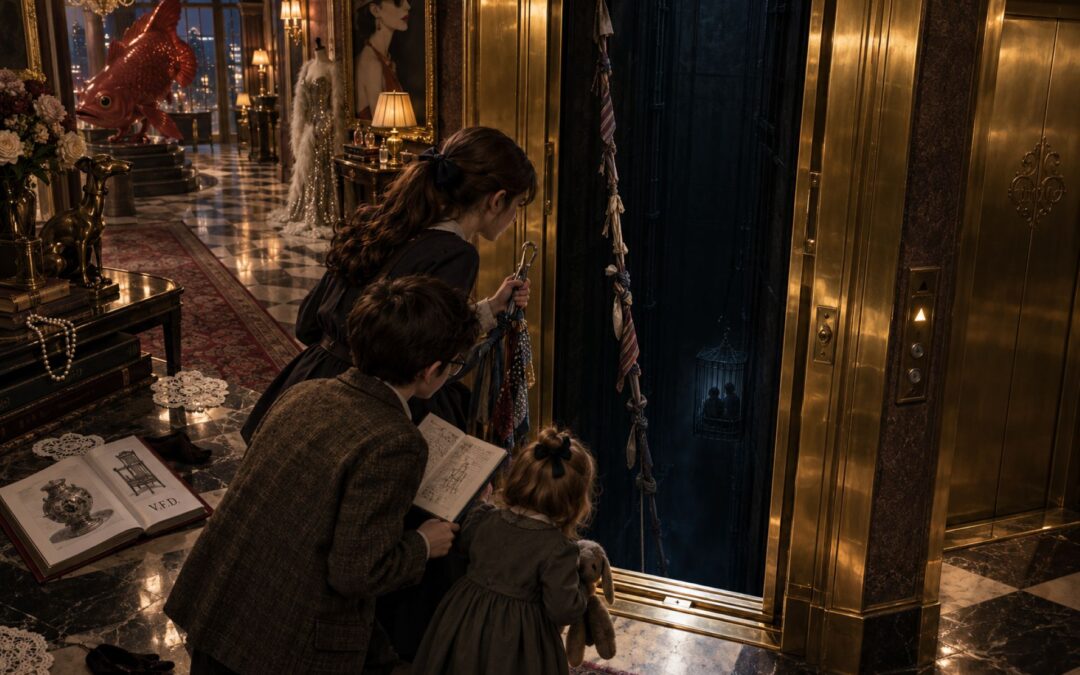
Lemony Snicket’s The Ersatz Elevator, the sixth book in A Series of Unfortunate Events, begins with the Baudelaire children in a familiar position. Violet, Klaus, and Sunny have survived another disastrous guardian arrangement, Count Olaf is still free, and the adults responsible for protecting them remain incapable of understanding how dangerous he is. Yet Book 6 changes the shape of the series in an important way. The Baudelaires are no longer concerned only with escaping Olaf themselves. Their friends Duncan and Isadora Quagmire have been kidnapped, the mysterious initials V.F.D. have entered their lives, and questions about their parents are beginning to connect with Olaf’s activities.
That shift gives The Ersatz Elevator a different kind of momentum. It still uses the recurring pattern of a new guardian, an absurd social environment, an Olaf disguise, and adult disbelief, but the children increasingly become investigators rather than passive targets. Their new home at 667 Dark Avenue contains not just another dangerous household but a literal hidden route into the wider mystery of their lives, while the adults around them embody several kinds of failure: corruption, conformity, incompetence, and the apparently gentler but equally consequential refusal to confront wrongdoing.
The title word “ersatz,” meaning an artificial or inferior substitute, becomes the organizing idea of the novel. The Baudelaires encounter a false elevator, a false auctioneer, false social values, misleading evidence, and guardianship that looks like protection without actually providing it. Against that world of substitutes, the children increasingly rely on what proves genuine: observation, ingenuity, loyalty, courage, and their relationship with one another.
Spoiler warning: This article explains the complete plot of The Ersatz Elevator, including Esmé Squalor’s betrayal, the fate of Duncan and Isadora Quagmire, Count Olaf’s escape, and the ending.

The Ersatz Elevator: Complete Plot Summary
The novel begins shortly after the events of The Austere Academy, where Duncan and Isadora Quagmire were kidnapped by Count Olaf. The Baudelaires therefore arrive at their next home with a new emotional burden. Their own survival is no longer the only urgent problem. They know their friends are in danger, they know the initials V.F.D. may be important, and they have already learned that waiting for responsible adults to solve a crisis is rarely effective.
A New Home at 667 Dark Avenue
Mr. Poe brings Violet, Klaus, and Sunny Baudelaire to 667 Dark Avenue, where they are to live with Jerome and Esmé Squalor. Poe, now promoted to Vice President in Charge of Orphan Affairs at Mulctuary Money Management, assures the children that the authorities are looking for Duncan and Isadora. His confidence does little to reassure them because almost every institution entrusted with protecting them has already failed.
The neighborhood immediately reveals the absurd logic governing the Baudelaires’ new environment. Darkness is fashionable, so the street is kept almost completely unlit. Street lamps are not used because light is “out,” and the building itself is difficult to navigate. A strangely dressed doorman, concealed under a large hat and coat, greets them but offers little practical help. Elevators are also unfashionable, forcing the children to climb many flights of stairs to reach the Squalors’ penthouse.
The climb is physically exhausting and comically excessive, but it also establishes one of the novel’s recurring spatial ideas. The Squalors live high above the city, surrounded by wealth and social prestige, yet reaching them requires the children to move through darkness and inconvenience. The building’s vertical scale will later become central to the mystery, transforming what initially seems like exaggerated luxury into something threatening.
Jerome Squalor turns out to be immediately likable. He welcomes the children warmly, seems genuinely pleased to have them, and reveals that he once knew their mother. He remembers hiking with her on Mount Fraught and explains that he had considered adopting the children before, though at the time orphans were not fashionable. The remark is disturbing even though Jerome does not intend it cruelly. It shows how deeply Esmé’s social world has influenced the household: even something as serious as adopting bereaved children can be treated as a matter of fashion.
Esmé Gigi Geniveve Squalor is Jerome’s wealthy, socially powerful wife and the city’s sixth most important financial adviser. Nearly every decision she makes depends on whether something is currently “in” or “out.” The children are fashionable because orphans are “in,” which means their place in the household rests partly on a trend rather than affection or duty. Esmé evaluates food, clothing, interior decoration, entertainment, and even behavior according to the same unstable standard.
The Squalor penthouse contains seventy-one bedrooms and appears extraordinarily luxurious, but the children quickly discover that wealth does not necessarily produce usefulness. Jerome tries to provide for their interests, yet Violet has a workbench without the tools she needs, Klaus has access to a library dominated by fashionable books rather than useful knowledge, and Sunny is given toys that do not suit her abilities. The household is full of substitutes: things that resemble what the children need without actually satisfying those needs.
Fashion changes with astonishing speed. Darkness suddenly becomes “out,” so curtains are opened and trees are cut down to allow more light into the street. The change is funny in its extremity, but it also demonstrates how completely the surrounding society surrenders judgment to fashion. Physical surroundings can be altered immediately because people have decided that yesterday’s desirable condition is now embarrassing.
Esmé is preparing an elaborate event called the In Auction, to be held at Veblen Hall. She treats the auction as both a social spectacle and an opportunity for profit, casually describing herself as the “good cause” that will benefit from the proceeds. The event will sell objects that have become fashionable, regardless of whether those objects have any genuine value.
The Baudelaires are also forced into enormous pinstripe suits because pinstripes are currently “in.” Their discomfort is irrelevant to Esmé because the social appearance of the clothing matters more than whether it fits. This pattern—appearance overriding practical reality—will repeat throughout the novel.
Esmé then tells them that the auctioneer, a fashionable man named Gunther, is coming to the apartment. When the visitor approaches, Sunny recognizes him first. Beneath knee-high boots, a monocle, and an exaggerated foreign persona is the man the children know better than almost anyone: Count Olaf.
Gunther and the Mystery of the Missing Elevator
Gunther’s disguise is deliberately obvious to the Baudelaires. His boots hide the eye tattoo on his ankle, his monocle alters the appearance of his eyebrow, and his false accent and broken English create a new social identity. To Violet, Klaus, and Sunny, however, these changes are superficial. They have encountered Olaf too many times to be fooled by costume alone.
Esmé refuses to believe them. Gunther is fashionable, successful, and useful to her auction, so the possibility that he might be a criminal does not fit the version of reality she prefers. Jerome listens more sympathetically, but his willingness to consider the children’s claims is undermined by his intense dislike of disagreement. Rather than investigate the situation decisively, he tries to reduce tension.
The children realize that simply repeating that Gunther is Count Olaf will not work. They have experienced this pattern before: they recognize Olaf, adults dismiss them, and by the time proof becomes undeniable, Olaf’s plan has already advanced. They therefore change tactics. Instead of continuing to argue, they pretend to accept Gunther’s identity while looking for evidence.
Jerome later takes them to Café Salmonella, an absurd restaurant where nearly everything is themed around salmon. The scene seems comic and unrelated to the central danger, but it reveals more about Jerome’s character. He does not particularly like salmon, yet he tolerates the restaurant because disagreeing with Esmé would create conflict. His desire to remain agreeable affects even trivial decisions, making it increasingly plausible that the same weakness will matter when the stakes become serious.
During the conversation Jerome interprets the Baudelaires’ distrust of Gunther as possible prejudice against foreigners. His principle is not absurd in itself. Judging people according to nationality or accent would be wrong. The problem is that Jerome uses an abstract moral rule to avoid evaluating the specific evidence in front of him. He mistakes refusal to investigate for fairness.
On the way back, the children pass the beach where they first learned that their parents had died in the fire that destroyed their home. The brief return to that location reconnects the current mystery with the trauma that began the series. Their new danger does not replace the old grief; it develops inside it.
When they return to 667 Dark Avenue, the mystery deepens. The doorman claims that Gunther never left the building, yet Esmé says he left the penthouse some time earlier. The Baudelaires know they did not see him on the stairs. If Gunther did not leave through the lobby and did not pass them on the staircase, then he must have used another route.
The contradiction is important because the children finally have something more useful than recognition. They have evidence that something about the building is being concealed.
The siblings begin searching the enormous penthouse. Because its seventy-one rooms are difficult to navigate, they improvise a trail of crumbs so they can find their way back. The search reveals no Gunther. They then investigate the rest of the building, counting floors and examining the layout.
Their search establishes that 667 Dark Avenue has sixty-six stories. Still, they cannot find Gunther. The children return to the lobby, where the doorman is decorating the elevator area with fashionable ocean-themed objects. He tells them, in a seemingly casual way, that sometimes the solution to a problem is directly in front of one’s nose.
Klaus notices something strange about the elevators. There are two sets of elevator doors, but the arrangement does not make architectural sense. When the children examine the top floor more carefully, one particular detail confirms his suspicion: the supposedly unused elevator has both an Up and a Down button even though they are already on the highest floor. An elevator there would have nowhere higher to go.
The second elevator is therefore not merely out of service. It is not a real elevator at all.
The Baudelaires open the doors and discover a pitch-black empty shaft. The “elevator” is ersatz, a false version of something that should provide transportation but instead offers only a dangerous vertical void. Because Gunther could have used the shaft to move secretly through the building, the children decide to investigate.
They need a way to descend safely, so Violet begins inventing. Using extension cords, curtain pulls, neckties belonging to Jerome, and other available materials, the siblings create an improvised rope long enough to reach deep into the building. The invention illustrates one of Violet’s characteristic strengths: she rarely receives proper equipment, but she can look at ordinary objects according to what they might become rather than what they were designed to be.
Their descent is long and frightening. The shaft is almost completely dark, and they have little certainty about where it leads. After roughly three hours, they finally reach the bottom.
There they discover Duncan and Isadora Quagmire.
The Quagmires are imprisoned inside a metal cage. They are dirty, hungry, and frightened, but they are alive. The discovery changes the entire direction of the novel. Until this moment, the Baudelaires have been trying to determine what Olaf is doing. Now they know where their friends are and must find a way to free them before Olaf can move them again.
The Quagmires, V.F.D., and Esmé’s Betrayal
Duncan and Isadora have not remained passive during captivity. They have continued observing their surroundings and recording information in their notebooks. Their ability to gather clues while imprisoned makes them important partners in the larger mystery rather than merely victims waiting to be rescued.
They explain that Olaf intends to move them out of the city during the In Auction. Because the Quagmire parents left behind valuable sapphires, Olaf hopes eventually to gain control of the Quagmire fortune just as he has repeatedly tried to obtain the Baudelaire inheritance. Duncan and Isadora know that they will be hidden inside one of the auction lots, though they do not know which one.
Duncan also has more information related to V.F.D. and begins trying to explain it to Violet. Violet decides that freeing the Quagmires must come first and interrupts him. Her decision is understandable because Duncan and Isadora are in immediate danger, but it becomes frustrating in retrospect. Knowledge that could have clarified the mystery is delayed at precisely the moment when it seems within reach.
The cage itself creates a practical problem. Violet cannot pick its complicated lock. Instead of giving up, she devises another plan. If they can heat metal fire tongs sufficiently, they may be able to use them as an improvised welding device to weaken the cage.
The Baudelaires climb back up the shaft to obtain the necessary materials. The trip repeats the physical ordeal of vertical movement, but the repetition now has narrative urgency. Every climb and descent costs time, and time is exactly what the children do not have.
When they return with the fire tongs, the cage is empty.
Olaf has already moved Duncan and Isadora. Violet immediately blames herself. Because her rescue invention was not completed quickly enough, she fears that her failure allowed Olaf to take the Quagmires away. Klaus and Sunny help her see the situation more accurately. The plan itself was sensible; the children simply did not have enough time. The moment is important because Violet’s intelligence does not protect her from self-doubt, but her siblings prevent temporary failure from becoming paralysis.
With direct rescue no longer possible, Klaus turns to research. The catalogue for the In Auction becomes the best source of evidence available to them. Most of its listings are absurd fashionable objects, but one entry stands out dramatically: Lot 50 is labeled only with the initials V.F.D.
The connection seems overwhelming. Duncan and Isadora have been investigating V.F.D., Olaf plans to hide them in an auction lot, and one auction lot is marked V.F.D. The children conclude that Lot 50 must contain the Quagmires.
Their reasoning is plausible, but this is one of the novel’s most important demonstrations of how evidence can be manipulated. The Baudelaires have learned to investigate instead of waiting for adults, yet intelligence does not make them immune to deliberately planted clues. They have correctly gathered the facts available to them but draw the conclusion Olaf and his allies want them to draw.
The children decide to tell Esmé what they have discovered. Despite her vanity and selfishness, they still believe she is merely an irresponsible guardian rather than an active criminal. Esmé appears to listen. For a moment it seems possible that the children have finally found an adult with enough authority and information to help them.
Instead, she pushes Violet, Klaus, and Sunny into the empty elevator shaft.
The fall is one of the novel’s most memorable formal moments. The physical darkness of the shaft is represented through pages dominated by blackness, making the reader experience the interruption visually rather than merely reading a description of it. The typographical experiment is simple, but it reinforces the book’s obsession with spaces where ordinary ways of seeing no longer work.
The Baudelaires survive because their improvised rope remains stretched across the shaft and catches them. Above them, Esmé finally reveals the truth. She knew Gunther was Count Olaf from the beginning. Olaf was once her acting teacher, and she is now cooperating with him. Her interest in the Baudelaires is not protective or fashionable in any harmless sense; she wants access to their fortune.
Esmé also mentions something Beatrice stole from her. The reference is deliberately unexplained, but it matters because Beatrice has already appeared throughout the series through Snicket’s dedications and mysterious personal history. Esmé’s comment implies that the network surrounding Olaf reaches further into the past than the children understand.
Sunny plays a crucial role in getting the siblings out of immediate danger. Using her unusually strong teeth, she climbs the shaft wall and reaches the rope. Her contribution is more than comic invention. By Book 6, Sunny is increasingly capable of taking independent physical risks and solving problems rather than functioning merely as the baby whose incomprehensible speech Violet and Klaus translate.
Instead of returning to the penthouse or lobby, the Baudelaires decide to descend deeper. Olaf and his associates must have another route through the building, and following it offers their best chance of understanding where the Quagmires have gone.
The Secret Passage and the In Auction
The children continue downward until they enter an underground passage. The tunnel is long, dark, and confusing, and they use sounds from the city above to estimate where they may be traveling. The movement changes the geography of the story. What appeared to be an isolated secret shaft inside one building is actually part of a hidden route beneath the city.
Eventually the passage seems to end. The children use the same fire tongs they had intended for the Quagmire rescue to test the walls and ground. Violet adapts them again, bending the metal so that the tool can function as a makeshift crowbar.
Dust and ash begin falling as they work. When they finally force open a trapdoor and emerge into daylight, they discover where the tunnel has taken them.
They are standing in the ruins of their former home.
The discovery is one of the largest series-wide developments so far. The secret route beneath 667 Dark Avenue does not simply allow Olaf to move around the Squalor building. It connects the location of his current operation with the site of the fire that killed the Baudelaire parents and began the children’s misfortunes. The novel does not explain what that connection means, but after this moment it becomes far more difficult to believe that the fire, Olaf, the children’s parents, and V.F.D. belong to completely separate mysteries.
There is no time for extended investigation because the In Auction is taking place nearby at Veblen Hall. Violet, Klaus, and Sunny hurry there, hoping to prevent Olaf from escaping with Duncan and Isadora.
By the time they arrive, Gunther is already conducting the auction. Esmé presides over the fashionable crowd, Jerome is present, and Mr. Poe has also appeared. Poe’s attempt to find the Quagmires has produced another false lead, reinforcing the contrast between institutional investigation and the children’s much more effective reasoning.
The children know that loudly accusing Gunther of being Count Olaf is unlikely to stop the auction. Instead, Klaus proposes a strategy based on the adults’ own rules: if Lot 50 contains Duncan and Isadora, Jerome can simply buy it.
An earlier auction item, Lot 48, is a gigantic scarlet fish. The object is absurd enough to attract attention, and the doorman from 667 Dark Avenue successfully bids on it. At this stage, neither the children nor most readers have reason to regard the fish as more than one more ridiculous fashionable object.
Eventually Lot 50 appears. It is a large cardboard box with holes in it, labeled V.F.D. Everything seems to confirm the children’s conclusion. The box is large enough to hold two people, the initials match the Quagmires’ clue, and Olaf is personally supervising the auction.
Jerome begins bidding for the lot but soon hesitates as the price rises. His reluctance is not fundamentally financial. Once again, confrontation makes him uncomfortable. The children are asking him to participate in a struggle against Esmé and Gunther, and his instinct is to retreat from conflict rather than follow the implications of what they are telling him.
Sunny finally submits an enormous bid herself, forcing the auction to end in their favor. The Baudelaires tear open the box expecting to find Duncan and Isadora.
Instead, it contains doilies.
The initials V.F.D. stand, in this case, for Very Fancy Doilies. The clue was designed to misdirect them.
Gunther ridicules the children, while Esmé publicly abandons any remaining appearance of being their guardian. The Baudelaires appear to have failed again. Yet the discarded doilies create an unexpected reversal when Gunther slips on them. His boots come off, exposing the eye tattoo on his ankle.
For once, the evidence is impossible for the adults to ignore. Jerome, Mr. Poe, and the auction crowd can finally see that Gunther is Count Olaf.
The revelation comes too late. Esmé openly joins Olaf, no longer pretending to be a guardian or respectable ally. The crowd attempts to pursue them, but the chaotic floor covered in doilies slows everyone down.
Outside, the seemingly ordinary doorman from 667 Dark Avenue reveals his own identity. He is the hook-handed man, one of Olaf’s longtime associates.
The villains then explain the deception. Lot 50 was a figurative red herring, a misleading clue intended to distract the Baudelaires. Lot 48 was something even more elaborate: an enormous literal red herring. Duncan and Isadora had been hidden inside the gigantic fish.
Olaf, Esmé, and the hook-handed man escape with the Quagmires. Authorities later recover the abandoned vehicle, but Duncan and Isadora are already gone. The Baudelaires have solved much of the plot but have still failed to save their friends.
Jerome then offers Violet, Klaus, and Sunny a possible escape from the entire situation. He proposes taking them somewhere far away, where they can forget Count Olaf, V.F.D., the Quagmires, the passage beneath the city, and the danger surrounding their family.
The offer is attractive precisely because Jerome is not trying to harm them. He wants peace and genuinely believes distance might protect them. The children nevertheless refuse. Duncan and Isadora risked themselves to help the Baudelaires at Prufrock Preparatory School, and abandoning them now would mean accepting safety purchased through disloyalty.
Jerome cannot make the same choice. He admits that he cannot tolerate the arguments and danger involved in confronting Olaf, and he relinquishes guardianship.
The Baudelaires are left without a dependable adult protector once again. Yet the ending does not return them exactly to their starting point. Violet has her inventive ability, Klaus has his research and reasoning, Sunny is increasingly capable of acting independently, and all three know that they can rely on one another. In a novel filled with false objects, false identities, misleading clues, and inadequate guardians, their sibling bond remains one of the few things that is not ersatz.
Setting and World-Building: The City of “In” and “Out”
The world of A Series of Unfortunate Events has never operated according to ordinary realism, but The Ersatz Elevator makes social absurdity unusually central to its setting. The city does not merely contain ridiculous fashions; fashion becomes a force capable of reorganizing physical space, food, clothing, architecture, and behavior. This exaggeration allows Snicket to turn social conformity into something visible.
At 667 Dark Avenue, the neighborhood is kept dark because darkness is fashionable. Once fashion changes, light becomes desirable again and trees can be cut down almost immediately. The joke works because the trend itself is arbitrary while its consequences are material. People are willing to make inconvenient or destructive choices simply because a collective authority has declared them socially desirable.
Esmé represents the extreme form of this logic, but she is not the only person participating in it. Restaurants redesign menus around fashionable ingredients, wealthy buyers attend the In Auction, clothing becomes valuable because of its pattern rather than its suitability, and enormous sums can be spent on objects that have little practical worth. The social environment constantly encourages people to ask whether something is fashionable instead of whether it is useful, true, ethical, or beautiful.
The Squalor penthouse embodies the same contradiction. With seventy-one bedrooms, it represents extraordinary abundance, yet much of that abundance is useless to the Baudelaires. Violet receives a workbench without appropriate tools, Klaus encounters books shaped by fashion rather than intellectual need, and Sunny receives objects intended for a conventional baby rather than for her unusual abilities. The children are surrounded by wealth but repeatedly lack the specific resources that would actually help them.
The choice of Veblen Hall as the auction venue reinforces the satire. The name strongly invites comparison with Thorstein Veblen’s critique of conspicuous consumption, in which status is displayed through patterns of consumption that communicate social position rather than satisfy practical needs. Snicket does not need to turn the novel into an economic treatise for the connection to be suggestive. An auction where wealthy people compete to acquire whatever is currently “in” is an almost perfect comic environment for that kind of status behavior, though the allusion should be understood as a persuasive reading rather than proven authorial intent.
Architecture carries another layer of meaning. The Squalors live at the top of a sixty-six-story building, physically elevated above the city in a home defined by money and status. The truth the Baudelaires need, however, lies below them. They must descend through the false elevator, enter the darkness beneath the building, and eventually travel underground before discovering a connection to their own past.
That reversal makes vertical space thematically useful. Height represents social prestige and visible wealth, while descent leads toward concealed knowledge. The most impressive part of the building is not where its deepest secrets are located.
The underground passage extends the setting beyond satire into series mythology. When the children emerge in the ruins of the Baudelaire mansion, geography itself becomes evidence. Their former home, the Squalor building, Olaf’s hidden movements, and the In Auction are not isolated places but connected nodes in a larger network they do not yet understand.
A detailed rereading of the novel’s darkness and architecture by Francis Bass similarly emphasizes how the building, shaft, and surrounding darkness make this installment unusually oppressive. That atmosphere matters because the physical environment reproduces the children’s intellectual situation. They know danger exists, they can sometimes hear or infer what is happening, but they rarely possess enough light to see the entire structure surrounding them.
Character Analysis
The Ersatz Elevator gives several characters more ethical complexity than the series’ recurring villain-versus-victim structure might initially suggest. Count Olaf remains unmistakably malicious, but Jerome and Esmé reveal two very different ways an adult can fail children, while Violet, Klaus, and Sunny continue developing from reactive survivors into people capable of investigation and deliberate moral choice.
Violet, Klaus, and Sunny Baudelaire
Violet remains the most mechanically inventive of the siblings, and the novel gives her several substantial problems to solve. She helps construct the rope that allows the children to descend the ersatz elevator shaft, develops the heated-tongs plan for weakening the Quagmire cage, and later repurposes those same tongs to escape the underground passage. Her strength is not access to sophisticated equipment but the ability to redefine ordinary objects according to what a situation requires.
Her failures are just as important as her inventions. When the Quagmires disappear before the rescue attempt can succeed, Violet blames herself. Her reaction shows that competence has become tied to responsibility in her mind. Because the siblings so often survive through her ingenuity, an invention that does not succeed immediately can feel like a moral failure even when circumstances, rather than design, caused the problem.
Violet also makes the decision to postpone Duncan’s explanation of V.F.D. until after the Quagmires are freed. The decision is humane and rational in the moment, but the novel uses it to show the limits of crisis thinking. Urgency forces the children to prioritize, and sometimes knowledge that seems less immediately important disappears before they can recover it.
Klaus becomes the strongest investigative figure in this installment. His reading and research remain central, but his most impressive contribution is architectural reasoning. He notices that the elevator configuration does not make sense and draws a conclusion from physical evidence rather than from something written in a book. Later, when direct rescue fails, he treats the auction catalogue as a document to be analyzed and identifies Lot 50 as the most plausible hiding place.
His mistake about Lot 50 is therefore important rather than embarrassing. The novel does not portray intelligence as the ability to avoid every error. Klaus reasons well from intentionally misleading information. Olaf’s plan succeeds not because Klaus is foolish but because a clever adversary anticipates how a rational investigator will interpret the evidence.
Sunny’s role continues expanding beyond the series’ earliest joke about a baby who likes biting things. Her physical abilities become essential when she climbs the shaft using her teeth and helps recover the rope after Esmé’s betrayal. Her impulsive auction bid also directly affects the climax, showing that she now participates in decisions rather than merely following her older siblings.
Her speech remains comic and partially translated by the narrator or her siblings, but her characterization increasingly depends on action. The series has begun treating Sunny as a small but capable member of a three-person team.
Together, the Baudelaires operate through complementary abilities. Violet improvises mechanically, Klaus observes and researches, and Sunny handles physical problems that the others cannot. Their cooperation is not presented as effortless harmony; they experience guilt, disagreement, fear, and uncertainty. What makes the relationship powerful is that each sibling helps prevent the others’ temporary weaknesses from becoming permanent failures.
Esmé Squalor: Fashion, Greed, and False Guardianship
Esmé first appears ridiculous rather than terrifying. Her obsession with fashion is so extreme that she evaluates nearly everything through whether it is “in” or “out.” She adopts the Baudelaires because orphans are fashionable, dresses them in unsuitable clothes, supports pointless trends, and treats wealth as a form of social performance.
That comic superficiality makes her betrayal more effective. The children underestimate her because they correctly identify her selfishness but misjudge its depth. She is not merely a wealthy fool who fails to recognize Olaf. She knowingly collaborates with him.
Once she pushes the children into the shaft, earlier details become more sinister. Her indifference to the Quagmires was not only narcissism, and her enthusiasm for Gunther was not simply fashion blindness. She has been participating in the deception while occupying the legal and social role of guardian.
Esmé therefore represents a more complete form of “ersatz” protection than almost anyone else in the novel. She possesses the title, home, money, and authority associated with guardianship while lacking its moral substance. Her penthouse can provide luxurious shelter without safety, just as the ersatz elevator provides doors and buttons without an elevator.
Her alliance with Olaf also expands the scale of his threat. Until this point, many of Olaf’s schemes depend on recruiting a theatrical troupe of recognizable accomplices. Esmé is different. She is wealthy, socially important, legally respectable, and embedded within institutions that adults trust. Her partnership suggests that Olaf’s world may overlap with respectable society more deeply than the children had understood.
Her reference to something Beatrice stole from her points toward an even older conflict. Book 6 does not explain that history, and the uncertainty matters. Esmé becomes frightening partly because the children discover she knows things about their family that they themselves do not.
Jerome Squalor: Why Kindness Without Courage Fails
Jerome is one of the more complicated guardians in the early series because he is genuinely kind. He likes the Baudelaires, wants them to be comfortable, remembers their mother fondly, and does not deliberately place them in danger. Unlike Esmé, he is not pretending to care in order to exploit them.
His failure comes from another source: he treats the avoidance of conflict as a moral principle.
In ordinary circumstances, Jerome’s dislike of argument might seem gentle. He does not enjoy hostility, prejudice, or confrontation. He attempts to see different sides of disagreements and prefers compromise. The problem is that he cannot distinguish pointless quarrels from conflicts in which refusing to choose a side allows harm to continue.
Café Salmonella illustrates the weakness in miniature. Jerome eats food he dislikes because disagreeing with Esmé would be uncomfortable. The decision has no catastrophic consequence, but it reveals a habit. His preference for peace repeatedly overrides his independent judgment.
The same pattern becomes dangerous when the Baudelaires identify Gunther as Count Olaf. Jerome turns a legitimate concern about prejudice into a reason not to investigate evidence. Later, when the children need him to bid aggressively at the auction, his discomfort with confrontation again weakens his ability to help.
His final offer is the clearest expression of his philosophy. Jerome is willing to care for Violet, Klaus, and Sunny if they agree to leave the conflict behind. He proposes distance, peace, and safety, but only by abandoning Duncan and Isadora and refusing to investigate the dangers connected to Olaf and V.F.D.
The Baudelaires reject that bargain because they understand that peace obtained through surrendering other people is not morally neutral. Jerome cannot follow them. His guardianship ends not because he lacks affection but because affection without courage proves insufficient.
That distinction gives his failure unusual emotional force. Olaf harms children because he is cruel; Esmé harms them because she is corrupt and greedy. Jerome harms them because he is unwilling to become uncomfortable on their behalf. The novel thereby suggests that moral failure does not require villainous intentions.
Count Olaf, the Quagmires, Mr. Poe, and the Hook-Handed Man
Count Olaf’s Gunther disguise continues the series’ recurring joke that adults cannot recognize him while the Baudelaires can. The disguise itself is not especially convincing, but Book 6 makes the situation more interesting by giving Olaf more than a costume. He now has a legitimate professional role at a public event, an alliance with Esmé, access to hidden infrastructure, and a carefully designed scheme involving misleading evidence.
The Lot 50 trick shows a more strategic Olaf than a simple impostor. He correctly anticipates what the Baudelaires will discover and builds a false solution around their growing investigative ability. The initials V.F.D. are not merely hidden from them; they are weaponized against them.
Duncan and Isadora Quagmire are crucial because they change the emotional direction of the Baudelaires’ struggle. Earlier books often ask whether Violet, Klaus, and Sunny can survive Olaf’s latest plan. Here the children risk themselves for someone else. The Quagmires are friends who previously helped them, and the obligation is reciprocal.
Their notebooks also make them fellow investigators. Even in captivity they gather information about Olaf and V.F.D., reinforcing the idea that knowledge is one of the few tools available to children in a world where adult authority repeatedly fails.
Mr. Poe continues representing institutional incompetence. He occupies the official role of protector and increasingly impressive job titles, yet his investigations remain ineffective. His presence at Veblen Hall is particularly revealing because the children have reached the real conspiracy through observation and risk while Poe arrives with another unproductive theory.
The hook-handed man’s disguise as the doorman reinforces the novel’s theme of danger hidden inside ordinary social roles. He has been visible from the beginning, but appearance and expectation prevent the children from recognizing him. The reveal also confirms that Olaf’s operation has been embedded in 667 Dark Avenue all along.
Major Themes
The major themes of The Ersatz Elevator repeatedly ask readers to distinguish appearance from substance. Fashion, guardianship, clues, identities, and physical structures all offer versions of reality that turn out to be incomplete or false, while genuine value is located in qualities that cannot be produced merely by looking respectable.
Ersatz Things: Appearance, Authenticity, and Deception
The false elevator gives the novel its title, but “ersatz” describes much more than one architectural trick. The building contains elevator doors, buttons, and a shaft that resembles the structure of ordinary transportation while lacking the mechanism that would make it useful. The object looks functional until someone tries to depend on it.
That pattern extends to people. Gunther is an ersatz identity for Olaf. Esmé is an ersatz guardian. The fashionable objects in the Squalor household are substitutes for things the children genuinely need. Lot 50 becomes an ersatz solution to the mystery, resembling the answer so convincingly that even careful investigators accept it.
Jerome offers perhaps the most emotionally complicated substitute. He gives the children affection and comfort but cannot provide the courage required of a reliable guardian. His care is genuine, yet the protection attached to it is incomplete.
The ending makes the distinction especially sharp. Jerome offers something resembling a happy ending: a peaceful life far away from Olaf and danger. The Baudelaires understand that such happiness would be ersatz because it requires pretending the Quagmires no longer matter. Safety without loyalty would preserve their bodies while violating the relationships that give their choices meaning.
Fashion, Status, and the Failure of Independent Judgment
Esmé’s obsession with “in” and “out” is comic because it reduces decision-making to social imitation. Yet the novel consistently shows that conformity becomes dangerous when it replaces independent judgment.
Fashion determines which foods people eat, what clothes they wear, whether streets are illuminated, what architectural features are used, and which objects wealthy buyers desire. The absurdity lies not only in particular trends but in the willingness to reorganize life whenever social approval changes.
Esmé embodies this worldview most completely. She measures value externally. Something matters because other fashionable people say it matters, and her own social position depends on anticipating or controlling those judgments.
The In Auction turns this mentality into a public spectacle. Buyers compete for fashionable objects because possession communicates status. The setting at Veblen Hall strengthens the connection to conspicuous consumption: goods become desirable partly because they allow people to perform membership in a social hierarchy.
The Baudelaires repeatedly resist this system because they evaluate objects according to use. Violet wants tools that work, Klaus wants books containing relevant knowledge, and Sunny needs objects suited to what she can actually do. Their practical intelligence becomes an implicit critique of a society that values appearance over function.
Independent judgment also matters morally. Most adults accept Gunther because the social environment has declared him fashionable and respectable. The Baudelaires distrust him because their evidence contradicts his appearance. The conflict between those two ways of knowing is central to the book.
Conflict, Courage, and the Ethics of Speaking Up
Jerome allows the novel to examine a subtler moral question than simple heroism. Avoiding conflict is not inherently wrong. Many arguments are pointless, and peaceful compromise can be valuable. The problem arises when opposition is necessary to prevent harm.
Jerome repeatedly treats disagreement itself as the danger. He wants everyone to remain comfortable, which means he resists situations requiring accusation, insistence, or confrontation. When the children claim that Gunther is Olaf, investigating their evidence would threaten harmony within his marriage and household. Jerome therefore gravitates toward interpretations that allow him not to act.
The Baudelaires increasingly learn the opposite lesson. They do not seek danger for its own sake, but they recognize that loyalty sometimes requires confrontation. Rescuing the Quagmires means resisting Olaf, contradicting adults, challenging Esmé, and refusing Jerome’s easier alternative.
The difference between courage and aggression therefore matters. The children are not admirable because they enjoy conflict; they are admirable because they accept conflict when avoiding it would mean abandoning someone else.
Jerome’s final choice demonstrates the ethical cost of his philosophy. He is not forced to become violent or reckless. He is simply asked to remain involved in a difficult struggle. His inability to do so leaves three children without a guardian.
Friendship, Sibling Loyalty, and Reliable Bonds
The Quagmires transform friendship from a source of comfort into an obligation. Duncan and Isadora previously took risks for the Baudelaires, and Book 6 asks what that history requires in return.
The children’s decision at the end answers the question clearly. They could accept Jerome’s offer and remove themselves from danger, but doing so would mean treating the Quagmires’ suffering as someone else’s problem. Violet, Klaus, and Sunny refuse to separate their own safety from the fate of their friends.
This reciprocal model of friendship contrasts with many adult relationships in the novel. Esmé and Olaf cooperate because their interests align around wealth and power. Jerome and Esmé remain married partly because Jerome refuses confrontation. Neither relationship offers the kind of mutual moral reliability found among the children.
The Baudelaire sibling bond remains even stronger. Their skills complement one another, but the deeper strength is emotional. When Violet blames herself for failing to rescue the Quagmires, Klaus and Sunny prevent her from collapsing into guilt. When Klaus’s interpretation of Lot 50 proves wrong, the siblings do not turn his mistake into personal failure.
Their cooperation provides a standard by which other relationships can be judged. The children cannot guarantee success for one another, but they remain dependable when circumstances deteriorate.
Knowledge, Evidence, and the Limits of Adult Authority
The early books repeatedly emphasize that adults do not believe the Baudelaires, but The Ersatz Elevator develops the problem into a broader question about evidence. The children increasingly understand that knowing something is true is not enough; they need ways to demonstrate it to people who control institutions.
Gunther’s identity illustrates the difficulty. The children recognize Olaf because of accumulated experience, but adults demand proof. Olaf exploits that gap by hiding his tattoo and adopting a socially acceptable persona.
The building mystery gives the children a different kind of evidence. Contradictory accounts of Gunther’s movements, the strange elevator buttons, and the empty shaft all form a chain of reasoning. Klaus does not simply “know” the answer. He constructs it.
Yet Lot 50 reveals that evidence can itself be manipulated. Olaf knows the children are searching for V.F.D. and gives them exactly the clue they are primed to interpret. Their error is not a rejection of reason but a reminder that good reasoning depends on the reliability and completeness of available information.
Mr. Poe represents another limitation of authority. His institutional status gives him power over the children’s lives, but title and responsibility do not automatically create competence. The Baudelaires repeatedly outperform him because they observe reality instead of assuming that official procedures must be adequate.
The novel therefore does not simply celebrate children over adults. Jerome is capable of empathy, and the children make mistakes. The deeper distinction is between people willing to examine evidence and revise their understanding and people who allow status, habit, or comfort to decide what they believe.
Symbols and Motifs
Snicket’s comic objects often operate on several levels at once. In The Ersatz Elevator, physical things repeatedly become part of the plot, jokes about language, and symbols of larger problems involving deception, knowledge, and value.
The Elevator, Shaft, and Underground Passage
The ersatz elevator is the novel’s central symbol because it perfectly captures the difference between appearance and function. It has doors and buttons and occupies the architectural position of an elevator, but nothing inside actually carries people safely between levels.
The shaft instead becomes a route into hidden knowledge. The children discover the Quagmires by descending it, are nearly killed there by Esmé, and ultimately use it to reach the underground passage. What appears to be an absence—a missing elevator—contains information more valuable than the visible rooms of the penthouse.
Vertical movement also reverses the social order represented by the Squalors’ wealth. Esmé and Jerome live high above everyone else, but the children learn almost nothing important while remaining in the penthouse. The deeper they descend, the closer they come to understanding Olaf’s operation.
The underground passage extends that symbolism into the larger series. It connects the Squalors’ home with the ruins of the Baudelaire mansion, creating a literal pathway between present danger and family history. The children still do not understand the system, but they now know that a system exists.
Darkness and Light
Darkness begins as a ridiculous fashion trend, yet it quickly becomes one of the novel’s most effective atmospheric motifs. The street is physically difficult to navigate, the elevator shaft is terrifying because the children cannot see where it leads, and the underground passage keeps them uncertain about their location.
The literal darkness parallels their incomplete knowledge. The Baudelaires repeatedly possess fragments of the truth without enough context to understand the whole. They know Olaf is Gunther but cannot prove it. They know V.F.D. matters but do not know what it means. They discover the passage but cannot explain why it reaches their home.
Light does not automatically solve those mysteries. When darkness goes “out” as a fashion, the city becomes brighter without becoming wiser. The distinction suggests that ignorance in the novel is not simply a lack of visible information. People can stand in broad daylight and still refuse to understand what is in front of them.
Red Herrings, Doilies, Pinstripes, and Ersatz Tools
The climax turns the literary idea of a red herring into both plot mechanism and physical joke. Lot 50 is the figurative red herring: the V.F.D. label exists to lead the Baudelaires toward the wrong conclusion. Lot 48 is the enormous literal red herring that actually contains the Quagmires.
The double use of the term captures Snicket’s love of vocabulary, literalization, and narrative misdirection. A reader learns what a red herring means at precisely the moment the story demonstrates how one works.
The Very Fancy Doilies perform a similar transformation. They first represent failure because they prove Lot 50 does not contain the Quagmires. Seconds later, they expose Olaf by causing him to slip and lose his boots. An object that appears useless suddenly produces the clearest evidence in the entire novel.
Pinstripe suits operate differently. Esmé forces the children to wear them because they are fashionable, even though the oversized clothing is impractical. They symbolize the pressure to fit socially approved appearances even when those appearances do not fit the actual person.
The improvised rope and fire tongs represent the opposite principle. Unlike fashionable objects, they become valuable through usefulness. The children repeatedly turn inadequate materials into functional tools. Their creativity therefore stands in direct contrast with Esmé’s consumption: she acquires things because of what they signify, while the Baudelaires value things according to what they can do.
Style, Narration, and Mystery Construction
Lemony Snicket’s narrative voice remains one of the defining pleasures of A Series of Unfortunate Events. The narrator repeatedly interrupts the story to define vocabulary, explain idioms, warn readers about approaching misery, discuss his own supposed research, and make elaborate comparisons that can be both educational and deliberately excessive. The result is a voice that treats children as capable of understanding sophisticated language while simultaneously mocking the conventions of explanatory narration.
In The Ersatz Elevator, this style fits especially well with the book’s concern about interpretation. Words repeatedly carry more than one meaning. “Ersatz,” V.F.D., and “red herring” are not merely vocabulary exercises; they become mechanisms of the plot. Language itself can reveal truth or mislead depending on how it is understood.
The narrator’s explanations also create a comic tension between precision and absurdity. Snicket often defines something at far greater length than necessary, postponing the action while claiming to clarify it. The style can deliberately frustrate narrative momentum, which mirrors the Baudelaires’ own experience of moving through systems where simple problems become unnecessarily complicated.
That tendency contributes to one of the novel’s limitations. The repeated climbs, descents, searches, and extended explanations can make the middle feel slower than the central mystery requires. The book partly uses physical exhaustion as atmosphere, but readers who are already familiar with the series’ rhythms may feel the repetition more strongly by Book 6.
The mystery itself, however, is carefully constructed. The contradiction over Gunther’s disappearance leads logically to the building search. The elevator buttons provide a fair visual clue. The shaft leads to the Quagmires. The auction catalogue then offers a clue that is plausible enough to be convincing while still permitting a later reversal.
Lot 50 works because the solution seems too perfect. V.F.D. has already become emotionally important to both the Baudelaires and the reader, so a box marked with those initials immediately attracts attention. The eventual reveal that it contains Very Fancy Doilies is comic, but the joke also demonstrates how a mystery can exploit an investigator’s expectations.
The literal red herring is even more overtly playful. Snicket turns a technical storytelling term into an auction item, then hides the real answer inside it. The joke works simultaneously at the level of vocabulary lesson, plot twist, and metafictional commentary.
The black pages during the fall down the shaft provide one of the simplest but most memorable formal experiments in the novel. Instead of merely telling readers that the children are surrounded by darkness, the book disrupts the ordinary visual experience of reading. The device is not technically complex, but it gives physical form to the novel’s atmosphere.
Book 6 also begins changing the larger structure of the series. Earlier installments can often be understood primarily as variations on a recurring formula: new guardian, new environment, Olaf disguise, adult disbelief, exposure, escape, and another placement. The Ersatz Elevator still contains that framework, but the Quagmires, V.F.D., Esmé, Beatrice, and the underground passage prevent the ending from resetting the story completely.
Consequences now carry forward more aggressively. Duncan and Isadora remain missing. Esmé survives as an antagonist. The children know their former home is connected to a hidden passage network. V.F.D. remains unresolved. The structure is becoming serial rather than merely repetitive.
The Gunther disguise is one place where the series’ comic strategy can feel more dated or strained. His exaggerated faux-foreign English is part of a plot in which Jerome initially worries that the Baudelaires are judging a foreigner unfairly, and the scene attempts to distinguish prejudice from evidence-based suspicion. Even within that purpose, however, the caricature is broad enough that contemporary readers may find it less amusing than the novel intends.
The Ending Explained: What the Escape Changes
The ending resolves the immediate auction mystery while deliberately refusing to resolve the larger conflict. Lot 50 never contained Duncan and Isadora. The V.F.D. label was planted to mislead the Baudelaires, and the initials mean Very Fancy Doilies in that particular context. The Quagmires were instead concealed inside Lot 48, the giant red herring purchased by the disguised hook-handed man.
Count Olaf’s identity is finally exposed to everyone when he slips on the doilies and loses his boots, revealing the eye tattoo on his ankle. The moment is significant because the Baudelaires finally receive the proof adults have repeatedly demanded. For once, the problem is not that nobody believes them.
Proof nevertheless fails to produce justice. Olaf escapes anyway, which demonstrates that recognition and protection are not the same thing. The institutions around the children can acknowledge reality and still be unable to act effectively enough to prevent harm.
Esmé’s public decision to escape with Olaf makes her new status unmistakable. She is no longer an irresponsible guardian who happens to be manipulated by a criminal. She is part of his operation and has her own motives connected to money, status, and an unexplained grievance involving Beatrice.
The Quagmires’ continued captivity keeps the novel from ending with even a partial victory. Violet, Klaus, and Sunny have discovered the hiding place, understood much of the scheme, exposed Olaf, and survived Esmé’s attempt to kill them, yet the people they set out to rescue remain missing.
The underground passage changes the significance of that failure. Before Book 6, Count Olaf’s pursuit could still appear primarily as a series of opportunistic attempts to steal the Baudelaire fortune. The passage from 667 Dark Avenue to the burned Baudelaire home suggests something older and more interconnected. The novel does not explain the connection, but its existence makes the children’s past part of the active mystery.
Jerome’s final offer then forces the Baudelaires to make an ethical decision rather than simply respond to another attack. He can take them far away. He can potentially give them a quieter life. He does not demand their money or threaten them.
What he cannot offer is a life in which they continue trying to rescue the Quagmires or understand the forces surrounding their family. His safety requires disengagement.
The Baudelaires refuse because they no longer define survival as simply avoiding Olaf. Duncan and Isadora helped them when doing so was dangerous, and abandoning their friends would contradict the loyalty they expect from one another.
Jerome cannot accept that responsibility. His departure therefore completes his character arc: he remains kind, but kindness without the willingness to face necessary conflict does not make him dependable.
The final position of Violet, Klaus, and Sunny marks a subtle change in the series. They are orphaned and vulnerable as before, but they have acquired more agency. They are beginning to understand that adults may never provide the stable protection they deserve and that discovering the truth will require them to act deliberately rather than wait for rescue.
That shift gives the novel’s title its final significance. The children have learned to distrust substitutes for genuine security. Prestige is not wisdom, guardianship is not necessarily care, peace is not necessarily courage, and apparent evidence is not necessarily truth. What remains reliable is their capacity to investigate, adapt, remember their obligations, and remain loyal to one another.
Critical Review: How Well The Ersatz Elevator Works
The Ersatz Elevator is one of the stronger transitional volumes in the first half of A Series of Unfortunate Events because it manages two tasks at once. It delivers the recognizable pleasures of the early series—absurd adults, theatrical disguises, elaborate vocabulary jokes, inventive children, and increasingly ridiculous danger—while expanding the story into a larger mystery that cannot be resolved within a single book.
Its greatest strength is the integration of setting and plot. 667 Dark Avenue is not merely a colorful new location for the Baudelaire formula. Its darkness, height, fake elevator, hidden shaft, and underground passage all become components of the mystery. The architecture produces both atmosphere and evidence.
Esmé Squalor is equally important. Her obsession with fashion initially makes her seem like another exaggerated incompetent adult, so the revelation of deliberate villainy works because it changes the reader’s interpretation of earlier behavior. She also gives Count Olaf access to money, social respectability, and institutional influence, making his operation feel broader than the theatrical schemes of earlier installments.
Jerome may be the book’s most interesting adult character. He allows Snicket to explore moral failure without cruelty. His affection for the children is credible, which makes his abandonment more painful than a conventional betrayal. The novel’s judgment is not that kindness is worthless but that kindness becomes inadequate when it is used as an excuse to avoid responsibility.
The Baudelaire siblings also benefit from the investigative structure. Klaus’s reasoning about the elevator and auction catalogue makes him more than “the reader,” Violet’s inventions repeatedly evolve through failure and repurposing, and Sunny receives meaningful physical agency. Their talents are increasingly woven together rather than displayed as isolated recurring gimmicks.
The Quagmires improve the emotional stakes because they force the children to act for someone other than themselves. Earlier books often depend on the fear that Olaf will acquire the Baudelaire fortune. Here, friendship becomes a reason for risk, and the ending establishes that the children will not accept personal safety if it requires abandoning those who helped them.
The auction plot is especially effective because its central twist is both absurd and fair. Lot 50 genuinely contains something called V.F.D., so the clue is not technically false. The Baudelaires simply assign the initials a meaning based on what they already know. The later reveal of the literal red herring is almost aggressively obvious as a literary joke, but that obviousness is part of the pleasure.
The novel’s language remains playful without treating young readers as intellectually fragile. Snicket assumes that vocabulary, idioms, narrative terminology, and literary jokes can be entertaining. The explanations sometimes become intentionally excessive, but they create a distinctive relationship between narrator and reader that few children’s series replicate.
There are weaknesses. The extended climbing and descending can become repetitive, particularly because the series already uses repetition structurally. The children spend enormous amounts of time moving through the building, and although the exhaustion supports the atmosphere, the pacing occasionally feels stretched.
Some of Violet’s improvised engineering operates according to the playful physics of the series rather than realistic mechanics. That is not a major flaw because A Series of Unfortunate Events has never presented itself as technological realism, but readers expecting every invention to withstand literal scrutiny will find several solutions improbable.
The continued inability of adults to identify Count Olaf also risks formula fatigue by the sixth volume. The book partly addresses the problem by making the children stop relying on recognition and start gathering evidence, but Gunther’s disguise remains deliberately thin. Readers either accept the convention as part of the series’ absurdist world or increasingly feel the machinery behind it.
Duncan’s interrupted attempt to explain V.F.D. is similarly transparent. Violet has a defensible reason to prioritize rescue, yet the interruption clearly exists because the series is not ready to reveal the information. The moment works as suspense, but it is difficult not to see the author controlling the flow of knowledge.
The book also relies more strongly than some earlier installments on continuity. A reader could understand the immediate plot without The Austere Academy, but the emotional importance of Duncan and Isadora, the significance of V.F.D., and the children’s determination to rescue them are much stronger when Book 5 is fresh in mind. That dependence is not necessarily a weakness in a thirteen-volume sequence, but it confirms that the series is becoming less episodic.
The shift is ultimately what makes The Ersatz Elevator important. The novel does not abandon the established formula; instead, it begins transforming it. Olaf is no longer merely the recurring villain who appears under another name. His schemes are connected to new allies, hidden passages, missing friends, family secrets, and organizations the children do not yet understand.
As a standalone mystery, the book offers clever misdirection, memorable atmosphere, and one of the series’ better uses of physical setting. As part of the larger sequence, it matters even more because it pushes Violet, Klaus, and Sunny toward a different role. They are still children endangered by forces they cannot fully comprehend, but they are becoming active seekers of truth.
That development keeps the novel from being merely another variation on the same unfortunate pattern. By the final pages, the Baudelaires have failed to rescue Duncan and Isadora, lost another guardian, and gained more questions than answers. Yet they have also learned something that will shape the books ahead: waiting for trustworthy adults is no longer a viable strategy.
The Ersatz Elevator remains worth reading because its comedy, mystery, and moral seriousness operate together rather than competing. Younger readers can enjoy the bizarre fashions, dangerous shaft, wordplay, and red-herring trick, while older readers are more likely to notice the sharper ideas underneath them: the emptiness of status, the difference between kindness and courage, the ease with which evidence can be manipulated, and the moral cost of choosing comfort over responsibility.
The most fitting way to understand Book 6 is therefore through its title. Nearly every institution and object that promises security turns out to be some kind of substitute. The elevator is false, Gunther is false, Esmé’s guardianship is false, Lot 50 is a false solution, and Jerome offers a version of safety that would require the children to abandon what matters to them. What survives those failures is less glamorous but more dependable: Violet’s inventiveness, Klaus’s reasoning, Sunny’s courage, the Baudelaires’ loyalty to the Quagmires, and the siblings’ refusal to abandon one another. In a world increasingly filled with disguises and substitutions, those genuine bonds are becoming the only foundation they can trust.
Last Updated on September 10, 2026 by Aseem Gupta