
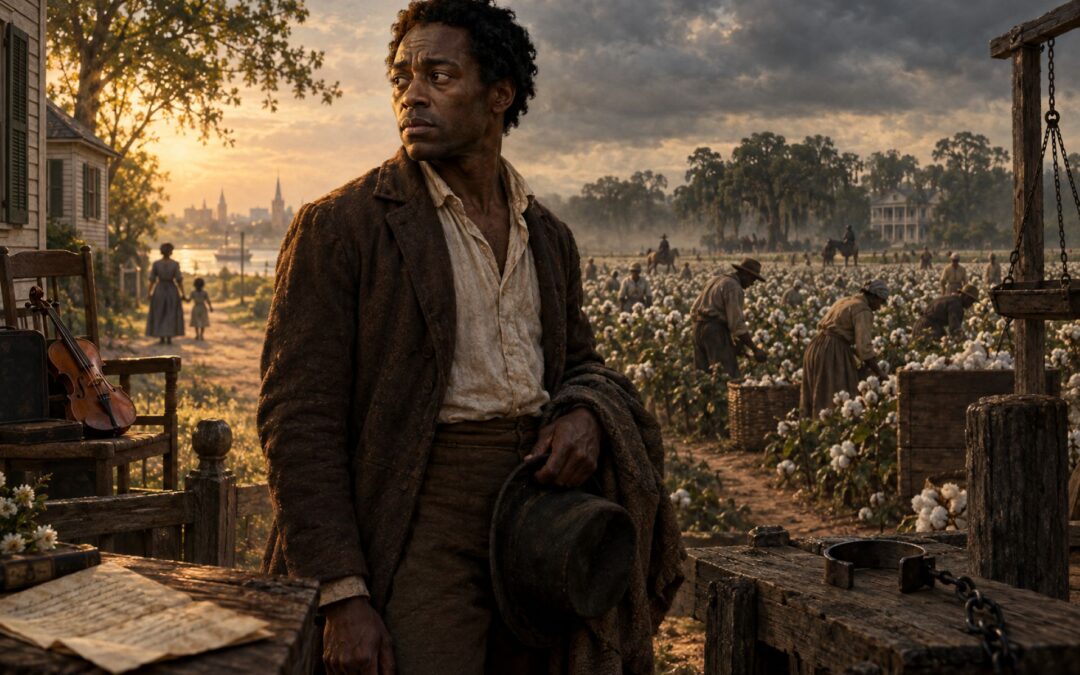
Solomon Northup begins Twelve Years a Slave with a fact that governs everything that follows: he was born free. He had spent more than thirty years as a citizen of New York, had a wife and children, earned money through several kinds of skilled work, traveled freely, and played the violin professionally before two men persuaded him to travel to Washington, D.C. Within days, his documents had disappeared, his name had been replaced, and violence had taught him that insisting on his freedom could get him killed.
That contrast gives the memoir its peculiar power. Northup does not discover freedom after slavery; he remembers freedom continuously while enslaved, which means that every restriction can be measured against a life he knows once existed. At the same time, the book grows beyond the story of one kidnapping into a remarkably detailed eyewitness account of slave trading, plantation labor, punishment, family separation, surveillance, music, religion, literacy, sexual exploitation, resistance, law, and the difficult process by which a free citizen had to prove that he was legally himself.
This article covers the complete memoir, including Northup’s rescue, the legal aftermath, and the ending. It also restores the documentary Appendix from the original 1853 edition, which is absent from some modern editions but is important to understanding how the book establishes the facts surrounding Northup’s recovery.

What Kind of Book Is Twelve Years a Slave?
Twelve Years a Slave was published in 1853 under the much fuller title Twelve Years a Slave: Narrative of Solomon Northup, a Citizen of New-York, Kidnapped in Washington City in 1841, and Rescued in 1853, from a Cotton Plantation near the Red River, in Louisiana. The original 1853 edition preserved by the Library of Congress identifies Northup immediately not merely as a formerly enslaved man but as a citizen who had been kidnapped, making the legal contradiction at the center of his story part of the title itself.
The book belongs to the nineteenth-century American slave-narrative tradition, but Northup occupies an unusual position within it. He was not born into slavery and then escaped from a world he had always known; he entered slavery in adulthood after decades of freedom. His prior life as a husband, father, wage earner, farmer, raftsman, traveler, musician, and literate citizen therefore provides a permanent point of comparison with the social system into which he is violently absorbed.
The memoir appeared at a moment when slavery had become one of the defining political and moral conflicts in the United States. Northup explicitly dedicates the book to Harriet Beecher Stowe, whose Uncle Tom’s Cabin had been published the previous year, presenting his own experience as factual testimony beside the enormous cultural influence of Stowe’s fiction. The National Endowment for the Humanities places Twelve Years a Slave within the broader slave-narrative tradition, in which first-person testimony often carried an additional burden of authentication because proslavery readers were inclined to challenge Black accounts of slavery as exaggeration or fabrication.
That pressure helps explain the structure surrounding Northup’s own voice. David Wilson, a white lawyer and writer who assisted in preparing the narrative for publication, supplies an Editor’s Preface asserting that Northup repeatedly told a consistent story, reviewed the manuscript, and corrected inaccuracies. The original edition then places legal documents after the narrative, turning the book into something more than a memoir presented on personal authority alone.
Wilson’s involvement means the prose cannot simply be treated as an untouched transcription of Northup’s speech. The safest description is that Twelve Years a Slave is Northup’s autobiography or memoir prepared with Wilson’s editorial assistance: the experiences, memories, judgments, and first-person perspective belong to Northup, while the published literary form passed through an editor who openly acknowledged his role. That mediation matters when evaluating style and reliability, but it does not erase Northup’s authorship of the life being narrated.
The complete architecture of the 1853 book is also important. Alongside the dedication, Preface, and twenty-two chapters, the complete original text includes a brief plantation song or refrain and an Appendix containing a New York law, petitions, affidavits, an official commission, and a Louisiana document recording Northup’s release. Some modern editions reproduce only the narrative, but the Appendix belongs to the original argument of the book because it shows how documentary proof eventually restored the legal identity that kidnapping and enslavement had suppressed.
From Freedom in New York to a Washington Slave Pen
Northup begins not with captivity but with ancestry, family, work, and belonging. His father, Mintus Northup, had once been enslaved but became free, and Solomon grows up in New York as a free Black man with enough education to read and participate in ordinary civic and economic life. He marries Anne Hampton, and together they raise three children, Elizabeth, Margaret, and Alonzo, while supporting themselves through a mixture of farming, seasonal work, cooking, canal labor, and Northup’s ability as a violinist.
The violin becomes especially important because it gives Northup both income and access to social worlds outside ordinary agricultural labor. He plays at dances and other events, sometimes earning money that helps support his family. He also works on waterways and timber, developing practical knowledge of rafting that will later prove unexpectedly useful in Louisiana.
Northup is not wealthy, but the opening chapter deliberately establishes that he possesses the ordinary freedoms of a working citizen. He can choose employers, negotiate wages, travel, live with his family, own possessions, and decide how to use his skills. He also encounters enslaved people brought north by Southern owners and records early reflections on slavery, but at this point the institution remains something he has witnessed from outside rather than experienced personally.
The disaster begins in Saratoga Springs in 1841 when Northup meets two white men calling themselves Merrill Brown and Abram Hamilton. They claim to be associated with a traveling entertainment company and offer him unusually good wages to accompany them as a violinist. Northup initially expects a short engagement, but the men persuade him to continue south with them toward Washington.
Because Washington is within a slaveholding jurisdiction, Northup prudently secures papers proving that he is a free citizen. That act matters because it eliminates any suggestion that he entered the South casually unaware of his legal vulnerability. He understands that documentation may be important, but documents can protect him only so long as they remain in his possession and officials are willing to recognize them.
In Washington, Northup spends time with Brown and Hamilton and becomes suddenly, violently ill after drinking with them. The memoir strongly suggests deliberate poisoning or drugging, but Northup cannot establish exactly what was administered or by whom, so the precise mechanism remains uncertain. He experiences severe thirst, pain, fading consciousness, and eventually complete insensibility.
When he wakes, the entire structure of his former life has vanished from his immediate surroundings. He is chained in darkness, without his money or free papers, and discovers that he has been confined inside Williams’s slave pen in Washington. The transformation is not magical or legal in any legitimate sense; it is produced through physical control, isolation, stolen documents, and the refusal of powerful men to acknowledge his testimony.
James H. Burch, the slave trader who controls the pen, becomes the first person to enforce the new identity through violence. Northup tells Burch that he is free, explains where he comes from, and insists that his detention is illegal. Instead of investigating the claim, Burch and his assistant Ebenezer Radburn beat him savagely with a paddle and whip until Northup learns the practical lesson that openly declaring himself a free man may bring further punishment rather than rescue.
This scene establishes a pattern that will govern his survival for years. Northup never inwardly accepts that he is properly enslaved, but he learns that self-knowledge and publicly usable identity are different things. To remain alive long enough to recover his freedom, he must often conceal literacy, intelligence, biography, and even his real name.
Inside the pen, his story becomes connected to the stories of other captives. Among them is Eliza, who has been enslaved with her children Randall and Emily after believing promises that freedom would be secured for them. Her anguish over her children introduces one of the memoir’s central realities before Northup even reaches a plantation: slavery treats the deepest human relationships as subordinate to ownership and sale.
Northup still imagines that his situation may be quickly corrected because he knows who he is and knows that there are people in New York who can prove it. The slave trade will soon show him why that confidence is inadequate. Once a captive is transported away from witnesses, assigned another name, sold among strangers, and threatened for claiming freedom, truth alone has very little practical power.
South Through the Slave Trade
Northup and the other prisoners are removed from Washington and transported toward the South as merchandise. The geography is bitterly ironic: they move through the capital and past national symbols while being denied the liberty those symbols are supposed to represent. Northup watches ordinary public life continue around a procession of captive people whose circumstances the surrounding society has made possible.
The journey takes them through Virginia and into additional slave pens, where Northup meets more people whose histories reveal the varied routes into the domestic slave trade. Some have been sold by owners, some separated from families, and some, like Northup, possess claims to freedom that are difficult to make effective. Clemens Ray, Robert, David, Mary, Lethe, and others appear as individuals rather than an anonymous mass, reinforcing Northup’s habit of preserving names and personal histories whenever he can.
From Richmond and Norfolk, the captives are placed aboard the brig Orleans for the voyage to New Orleans. Northup is assigned duties as a steward, giving him somewhat greater movement aboard ship than many of the others. He meets Arthur, another free Black man who has been seized illegally, and Arthur’s confidence that people who know him can establish his identity mirrors Northup’s own situation.
At one point Northup and other captives consider taking control of the vessel. The episode is important because it shows that resistance is constantly imagined even when conditions make it extraordinarily dangerous. The plan never develops into a successful revolt, however, and the greater immediate threat becomes disease.
Smallpox breaks out aboard the vessel. Robert dies, while Northup himself will later suffer from the disease after reaching New Orleans. The combination of confinement, illness, forced transport, and uncertainty makes the journey south not simply a change of location but another stage in the systematic destruction of the captives’ ability to control what happens to them.
A sailor named Manning offers Northup one small opening. Northup secretly sends a letter north describing what has happened to him, but without knowing his eventual destination he cannot provide enough information for rescuers to locate him. Arthur is luckier: people who can verify that he is free intervene before he disappears further into the slave system, and he is reclaimed.
Northup’s own identity is being rewritten in the opposite direction. When the Orleans reaches New Orleans, records identify him not as Solomon Northup but as “Platt Hamilton.” The surviving brig Orleans manifest documented by the U.S. National Archives preserves that imposed identity, providing one of the strongest external pieces of evidence connecting the historical Northup to the events he narrates.
The name “Platt” becomes the identity under which Northup will live for nearly twelve years. It is not merely a nickname but a tool of enslavement because anyone looking for Solomon Northup will not necessarily find a slave known as Platt, while anyone encountering Platt within Louisiana is expected to assume that the name attached to him by traders and owners is legitimate. The slave system thus turns false documentation into socially accepted truth.
In New Orleans, Theophilus Freeman prepares the newly arrived captives for sale. They are washed, dressed, arranged, and instructed to present themselves attractively to potential buyers. Customers inspect bodies, ask about skills, evaluate health, and negotiate prices, while qualities that once belonged to a person’s independent life become selling points attached to property.
Northup’s violin playing and ability to dance increase his value. The transformation is grotesque precisely because the skills themselves have not changed: the same musical ability that previously allowed him to earn wages for his family can now increase the price another person is willing to pay for him. Talent does not create autonomy under slavery; it can simply make an enslaved person more valuable to an owner.
The market also destroys families with an indifference that becomes almost unbearable in Eliza’s case. Randall is sold away from her, and later Eliza herself is purchased while Freeman refuses to include little Emily on acceptable terms. Northup watches a mother plead desperately not to be separated from her child while commercial calculation overrides every appeal.
Northup falls ill with smallpox and spends time in a hospital before returning to Freeman’s pen. Eventually William Ford purchases him, along with Eliza and Harry. Northup is now legally treated within Louisiana’s slave economy as Ford’s property, still under the false name Platt, while the people in New York who know Solomon Northup have no idea where he is.
William Ford, Tibeats, and Escape Through the Swamp
The move from Freeman’s slave market to William Ford’s property changes Northup’s immediate treatment without altering the essential fact of enslavement. Ford is the person Northup describes most sympathetically among his owners, presenting him as sincerely religious, comparatively humane, and capable of recognizing intelligence and skill in the people he owns. That favorable portrait is important because Northup refuses to make every slaveholder psychologically identical even while condemning the institution that gives all of them ownership over other human beings.
Ford’s plantation lies in the Louisiana interior, and Northup’s practical experience soon becomes useful. When lumber needs to be transported by water, he devises a more efficient rafting method based on skills learned during his free life. The success wins Ford’s confidence and demonstrates a recurring feature of the memoir: the capacities slavery supposedly places under white supervision often existed independently before enslavement and survive despite it.
Northup also describes the social and physical environment around Ford in considerable detail. He records mills, waterways, religious observance, enslaved workers, white laborers, local travel, and encounters with Native people. These passages begin the book’s gradual expansion from personal crisis into the kind of close observation that will dominate the later plantation chapters.
Ford eventually encounters financial difficulties, and Northup becomes entangled in property arrangements rather than simply being transferred from one household to another. He is sold to John M. Tibeats, with Ford retaining a financial interest through a chattel mortgage. The arrangement later becomes crucial because it gives Ford and his overseer Chapin an economic reason, in addition to whatever personal sympathy they feel, to prevent Tibeats from simply killing Northup.
Tibeats is everything Ford is not in temperament. He is insecure, vindictive, unpredictable, and quick to turn minor disagreements into challenges to his authority. A dispute over carpentry materials escalates when Tibeats prepares to whip Northup, and Northup, convinced that the punishment is undeserved, physically resists him.
The fight is one of the clearest demonstrations that Northup’s survival does not consist of passive obedience. He overpowers and beats Tibeats, knowing that striking a white man could carry fatal consequences. Tibeats leaves but returns with two other white men, Cook and Ramsey, who bind Northup and prepare to hang him.
Chapin intervenes at the critical moment. He warns the men that Ford still holds a claim in Northup and that killing him would violate Ford’s property rights as well as create other consequences. The immediate protection of Northup’s life therefore exposes one of slavery’s central perversities: his survival can be defended through the language of ownership even while the same legal order refuses to recognize his actual freedom.
The men leave Northup standing with a rope around his neck, his arms painfully bound and his feet barely supporting him. He remains in that position for hours in the Louisiana heat while the plantation continues around him. Enslaved people cannot openly release him without risking punishment themselves, though Rachel eventually brings him water and others later gather around him with sympathy.
Ford finally arrives and cuts the rope away. Yet the danger from Tibeats has not disappeared, so Northup is temporarily hired to Peter Tanner. Tanner offers another variation on slaveholding authority: he uses religious language to insist on obedience and illustrates how scripture can be made to serve a social system whose violence the book has just shown in physical form.
Northup eventually returns to Tibeats, and the conflict resumes. During another confrontation Tibeats attacks him, and Northup again gains the advantage. For a moment he considers killing Tibeats with an axe, but he understands that doing so would almost certainly make his own death inevitable and chooses flight instead.
The escape through the Great Pacoudrie swamp becomes one of the memoir’s most suspenseful sequences. Tibeats follows with dogs, forcing Northup to use water and difficult terrain to confuse their scent. He moves through a landscape of snakes, alligators, insects, darkness, and exhaustion, knowing that capture could mean torture or death.
The episode reveals both Northup’s determination and the structural difficulty of escape. Getting away from an individual master is not the same as reaching freedom; an unknown Black man traveling without authorization can be stopped almost anywhere, while patrols, dogs, distance, unfamiliar geography, and the need for food make long-term flight extraordinarily dangerous. Northup therefore heads toward Ford, a slaveholder he believes may at least prevent Tibeats from killing him.
Ford receives him and later criticizes Tibeats’s brutality, but Ford cannot simply restore Northup’s freedom because Ford himself accepts the larger property system within which Northup has been bought and mortgaged. Northup continues to be hired out, including to a planter named Eldret, and works in places such as the Big Cane Brake. These movements provide temporary distance from Tibeats but no independent control over his life.
During this period Northup learns that Eliza’s long grief has ended in death. Her fate completes an arc that began in the Washington slave pen: she survives kidnapping and sale but never recovers from the forced loss of her children. Northup does not turn her story into an abstract symbol; he records a specific person destroyed by a system that made maternal love legally irrelevant whenever it conflicted with ownership.
Eventually Tibeats sells Northup to Edwin Epps. This transfer ends the unstable sequence of Ford, Tibeats, and hiring-out and begins the longest, harshest, and most systematically described period of the memoir. Under Epps, Northup will remain for roughly a decade, and the pace of the narrative changes because escape from slavery is no longer its only subject.
Life Under Edwin Epps
The Epps chapters are the center of Twelve Years a Slave because Northup stops treating plantation life merely as the setting for his personal misfortune and explains how the system works day after day. Plot movement slows while he documents labor, food, housing, punishment, social life, surveillance, music, religion, family arrangements, gendered violence, and the narrow spaces in which enslaved people preserve community. That apparent slowing is not a digression from the book’s purpose; it is one of the main reasons the memoir remains historically valuable.
Cotton, Quotas, and the Plantation Community
Edwin Epps is introduced as a cotton planter whose authority is enforced through both economic calculation and arbitrary violence. Northup describes him drunk and sober, capable of turning work, dancing, or punishment into extensions of personal domination. Yet the larger point is not merely that Epps is cruel; it is that plantation production gives his cruelty an institutional framework.
Northup carefully explains cotton cultivation from preparing the land through planting, hoeing, picking, weighing, and processing. Workers are assigned expectations based on demonstrated capacity, which means productivity does not produce security. A person who proves capable of picking more cotton simply acquires a higher daily quota and can be whipped for failing to reproduce yesterday’s performance.
Patsey becomes the most striking example. She can pick extraordinary quantities of cotton, far more than many others, but her skill does not allow her to accumulate meaningful bargaining power. Her productivity increases her value to Epps while simultaneously deepening his sense of ownership over her.
The day’s work does not end when the field work ends. Enslaved people still have chores, food preparation, corn grinding, animal care, and other responsibilities before they can sleep. Northup describes cabins, gourds used for practical household purposes, sweet potatoes, corn, bacon, livestock, and the small material details that show how little time or energy remains outside the demands of plantation production.
Fear organizes the entire routine. Workers fear failing to meet quotas, arriving late for weighing, sleeping too long, performing chores inadequately, angering an overseer, or attracting the master’s attention for reasons unrelated to work. Punishment therefore need not occur every minute to shape behavior; the credible possibility of punishment disciplines the entire day.
Northup becomes seriously ill at one point and continues attempting to work because sickness does not automatically suspend labor expectations. Epps initially treats poor performance as possible defiance until Northup’s physical condition makes genuine illness undeniable. Even bodily incapacity must be proved to someone with the power to interpret weakness as disobedience.
The plantation community gradually receives names and histories. Uncle Abram is older and experienced; Wiley is younger and restless; Aunt Phebe occupies an important domestic and social position; Bob, Henry, Edward, and others appear as distinct people with relationships, abilities, memories, and vulnerabilities. Northup’s decision to preserve these individual identities is one of the memoir’s quietest forms of resistance to the logic that treats workers as interchangeable property.
Patsey, however, becomes the most important person in the Epps chapters after Northup himself. She is young, physically skilled, highly productive, and repeatedly exposed to Epps’s sexual desire. Mistress Epps recognizes her husband’s interest and responds not by protecting Patsey from coercion but by directing jealousy and hatred toward the enslaved woman who has no meaningful power to escape the situation.
The result is a household in which Patsey is punished for circumstances created by the people who own her. Her labor makes her economically valuable; Epps’s sexual obsession makes her personally vulnerable; Mistress Epps’s jealousy makes domestic life dangerous. Slavery turns every quality that might ordinarily provide security—skill, youth, usefulness—into another reason she remains trapped.
Sugar, Christmas, Music, and Brief Spaces of Autonomy
A crop failure in 1845 creates demand for hired labor elsewhere, and Northup is sent with others to St. Mary’s Parish. There he works for Judge Turner and becomes involved in sugar production, expanding the memoir’s economic range beyond cotton. Northup again records the technical process closely, explaining planting, cutting, hauling, and milling rather than simply saying that enslaved people worked hard.
His relative skill occasionally earns him better responsibilities, including work around a sugar house. These changes matter because the memoir does not describe every enslaved person’s daily circumstances as identical, but temporary improvement never becomes actual autonomy. Northup is still hired out by one owner to another, and any additional privilege depends on someone else’s decision.
He also records Sundays, religious services, small possessions, gatherings, hunting, fishing, and ways enslaved people try to build social lives under severe restrictions. Such passages prevent the community from appearing only at moments of punishment. People joke, court, dance, compete, sing, form attachments, and seek enjoyment, but those activities occur within conditions that can interrupt or destroy them at any time.
Northup makes another attempt to create a path home when he approaches a steamer captain in the hope of securing assistance. The effort fails, reinforcing the lesson that escape through communication requires an unusually trustworthy person willing to take real risks. Merely meeting someone who could theoretically help is not enough.
Christmas receives some of Northup’s most vivid cultural description. For a few days plantation labor routines may relax, and enslaved people travel locally, attend gatherings, prepare better food, dance, and visit one another. Northup treats these holidays as intensely anticipated because they offer a rare period in which time is not organized entirely by compulsory labor.
The violin becomes central again during these celebrations. Northup’s musical ability allows him to perform at dances and sometimes earn small amounts of money, creating one of the few spaces where a skill from his free life produces limited personal advantage. Music also gives him social mobility within the enslaved community and among local whites, even though that mobility remains conditional.
The instrument therefore carries several meanings without needing to be turned into a simple literary symbol. It once belonged to his life as a free wage earner, helped place him in the path of the men who took him south, increased his value in the slave market, provided consolation during bondage, and gave him small economic and social opportunities. The same object crosses freedom and slavery while changing function under each condition.
Northup also describes songs, courtship, dances, clothing, and informal marriage customs. The most important point is not that enslaved people enjoy a hidden freedom during Christmas but that they construct human relationships in whatever space the system leaves available. The temporary nature of those celebrations makes ordinary coercion more visible because everyone knows that the plantation schedule will resume.
Surveillance, Literacy, and the Difficulty of Escape
The obstacles to escape become especially clear when Northup explains overseers, drivers, patrols, passes, dogs, and restrictions on literacy. Slavery depends not only on owners directly watching people but on a wider network that makes unauthorized Black movement suspicious. A fugitive can escape one plantation and still remain inside a region organized to capture him.
Northup himself sometimes works as a driver, placing him in the morally compromised position of supervising other enslaved laborers. He tries where possible to reduce suffering rather than enthusiastically enforce Epps’s demands, but the role demonstrates how slave systems delegate coercion downward. The person ordered to administer discipline may himself be subject to violence if the owner decides he has not done enough.
Literacy is dangerous because writing can breach the isolation on which Northup’s enslavement depends. Epps does not want him reading or writing, and Northup understands that revealing too much education could raise questions about his past. His knowledge therefore becomes something he must conceal even while desperately needing it.
After years of searching for an opportunity, Northup obtains paper and prepares a secret letter. He confides partially in Armsby, a poor white laborer, hoping Armsby will mail it. The choice appears plausible because Armsby exists somewhat outside the planter elite, but economic and racial vulnerability do not automatically make him sympathetic to an enslaved man.
Armsby betrays Northup and informs Epps that Platt may be planning to send a letter. Northup survives the crisis through quick thinking, denying the claim so convincingly that Epps turns suspicion back toward Armsby. Northup then burns the letter because possessing it has become too dangerous.
The episode captures the trap with unusual clarity. Writing is one of Northup’s most powerful potential tools because a letter could reconnect him with people who know he is free, but the same evidence could expose his literacy and real identity to his owner. Communication is simultaneously a route toward freedom and a risk to survival.
Northup’s account of Wiley and other fugitives extends the argument. Runaways face patrols, jail, dogs, hunger, swamps, unfamiliar territory, and the constant need to explain their movement if confronted. Some hide in remote spaces for long periods, but concealment is not the same as reaching a place where legal freedom can actually be secured.
The story of fugitives attacked by dogs and the account of Celeste emphasize how narrow the options can become. Northup even considers methods for dealing with pursuit animals, demonstrating that escape is not a vague dream but a practical problem he repeatedly analyzes. Every possible route requires information, food, distance, luck, and someone willing to recognize or support a freedom claim.
A supposed insurrection plot involving Lew Cheney introduces another layer of danger. Whether organized revolt is real or rumored, betrayal and accusation can generate deadly consequences in a society already terrified of enslaved resistance. Northup consequently portrays collective rebellion not as unthinkable but as extraordinarily difficult to organize securely under constant surveillance.
His failure to run away successfully for twelve years therefore should not be mistaken for acceptance. He resists when opportunities appear, studies geography, hides information, attempts letters, physically fights Tibeats, and preserves knowledge of who he is. Survival itself requires strategic decisions about when open resistance is possible and when it would merely produce death.
Patsey and the Culmination of Plantation Violence
Patsey’s whipping in Chapter 18 is the most horrifying single episode in the memoir, but its power comes from everything already established about her position. She is an exceptionally productive worker, is sexually pursued by Epps, is hated by Mistress Epps because of that pursuit, and has almost no lawful means of refusing either person’s demands. Her suffering is therefore not an accidental eruption of cruelty but the result of several forms of slave power converging on one person.
The immediate incident begins when Patsey leaves briefly to visit the neighboring Shaw plantation because she wants soap. Epps interprets her absence through sexual jealousy and accuses her of meeting another man. Patsey denies the charge and explains why she went, but her explanation has little value because the person judging her is also the person who owns her and desires her.
Epps orders Patsey stripped and tied down. He then commands Northup to whip her, forcing one enslaved person to participate in the punishment of another. Northup obeys under coercion for a time but eventually refuses to continue, at which point Epps takes the whip himself and inflicts far more severe injuries.
The scene is morally important partly because Northup does not represent himself as standing outside the machinery of slavery. He is compelled into an act he hates, and his limited refusal cannot prevent Patsey’s suffering. Slavery is shown not only as violence inflicted by masters but as a system capable of forcing victims into roles that compromise their own moral agency.
Patsey survives, but the psychological aftermath is severe. Northup describes her as increasingly melancholy and records her thoughts about death, heaven, and freedom. He cannot provide direct access to everything Patsey thinks, and any interpretation must respect the fact that her interior life reaches the reader through his recollection, but her despair is unmistakable.
Northup also notices Epps’s son imitating the racial attitudes and authority around him. The observation pushes the memoir beyond the idea that slavery survives because a few unusually vicious adults choose cruelty. Domination is learned, normalized, rehearsed, and handed to another generation as part of ordinary social life.
Bass, the Rescue, and the Return Home
Northup’s eventual rescue depends on a chain of people, laws, documents, and risks rather than a miraculous discovery. Samuel Bass matters because he becomes the first person in years whom Northup judges both trustworthy enough to hear the truth and independent enough to act on it. Once that trust is established, Northup’s private knowledge of his identity can finally reconnect with people capable of proving it publicly.
Bass and the Secret Letters
Bass is a Canadian carpenter hired to help construct a house for Epps. His importance first emerges through arguments with Epps about slavery, during which Bass openly challenges the idea that racial difference can justify ownership of human beings. Speaking that way in the slaveholding South distinguishes him from most white men Northup has encountered.
Northup does not immediately reveal his story. Previous betrayal has taught him how dangerous disclosure can be, and Armsby’s treachery remains a recent warning. Only after observing Bass carefully does Northup decide to risk telling him that “Platt” is actually Solomon Northup, a free man kidnapped from New York.
Bass is astonished but agrees to help. Northup supplies names and locations from his former life, and Bass writes letters to contacts including Parker and Perry in Saratoga. The plan depends on those letters traveling beyond the closed plantation world and reaching people who can connect the name Solomon Northup to a missing husband, father, and citizen.
Then nothing seems to happen. Northup continues laboring without knowing whether the letters arrived, whether anyone believed them, or whether help can locate him in rural Louisiana. Hope becomes psychologically dangerous because it reopens the possibility of freedom after years in which disappointment has repeatedly followed every attempt at communication.
Bass nevertheless remains committed. When he returns around Christmas without good news, he discusses further efforts and even considers traveling north himself if necessary. Northup passes through what will turn out to be his final plantation Christmas still uncertain whether rescue is actually approaching.
The ordinary brutality of slavery continues almost to the end. Northup oversleeps and receives what becomes his final whipping. Shortly afterward, he sees a carriage and unfamiliar white men approaching across the plantation, but he does not yet understand that the machinery of his recovery has finally reached Bayou Boeuf.
How Henry B. Northup Found Solomon
At this point the narrative temporarily shifts away from what Solomon himself could have witnessed and reconstructs what had happened in New York. Bass’s letter reaches people who know Northup and is eventually brought to Anne. She then turns to Henry B. Northup, a member of the white Northup family with longstanding ties to Solomon’s family and enough legal and political standing to act.
The rescue becomes possible because New York had enacted a statute in 1840 authorizing the governor to assist free state residents who had been kidnapped or wrongfully held as slaves elsewhere. Anne submits a formal memorial, supporting witnesses provide sworn statements concerning Solomon’s freedom and identity, and Governor Washington Hunt appoints Henry B. Northup as an official state agent.
That legal framework is crucial. Henry does not travel south merely as a concerned acquaintance asking Epps to be reasonable; he carries authority derived from New York and documentary evidence designed to prove Solomon’s status. The recovery therefore shows both the potential and the limitations of antebellum law: legal institutions had failed to prevent the kidnapping, but another set of laws and documents could finally be mobilized to reverse it.
In Louisiana, Henry seeks assistance from local lawyer John P. Waddill. Even then, the search is difficult because Northup has been living under the name Platt and Henry does not initially know who owns him. Years of false naming and geographic isolation have done exactly what slave traders intended: they have made a known person difficult to locate.
A fortunate conversation eventually points Henry toward Samuel Bass. Once Bass is identified and questioned, the information chain closes. Henry and a local sheriff can finally travel to Epps’s plantation knowing where Solomon is and under what name he has been held.
The recognition in the cotton field is powerful partly because the rescue arrives in the middle of ordinary labor. Northup has not reached a border or escaped into hiding; legal authority comes directly into the plantation and identifies “Platt” as Solomon Northup. The false identity imposed in the slave trade collapses under the documentary record of the life that preceded it.
Epps cannot easily overturn the accumulated evidence. Solomon prepares to leave and says farewell to people with whom he has shared years of bondage, including those who will remain behind. His freedom is therefore inseparable from the knowledge that the system continues to hold others whose circumstances are no less human simply because they lack his unusual claim of prior legal freedom.
Freedom, the Burch Case, and Reunion
Northup’s journey home is not a simple reversal of the journey south. Documents now identify him as a free citizen, yet officials can still question his movement because the racial assumptions that made his kidnapping possible have not disappeared. Even while traveling under legal protection, he remains exposed to a society in which Black freedom is treated as something requiring proof.
In Washington, Northup attempts to prosecute James H. Burch. The case seems morally straightforward: Burch held and beat a man who had repeatedly declared that he was a free citizen. Legally, however, the proceedings reveal how racial inequality can make truth difficult to establish in court.
Northup’s own testimony is excluded because of rules preventing a Black man from testifying effectively against a white defendant. White witnesses speak, Burch denies wrongdoing, and the case collapses. The man who was kidnapped and beaten is present in the courtroom, but the legal system that supposedly adjudicates what happened restricts his ability to provide the most direct evidence.
Burch then attempts to turn the machinery of law against Northup by accusing him of conspiracy or fraud. The countercharge is abandoned, but the sequence makes the broader point unmistakable. Northup can be legally restored to freedom without the system that enabled his enslavement delivering meaningful punishment to one of the men involved in it.
The personal reunion in New York is far more joyful and far more painful. Anne has spent twelve years without her husband. The children Northup remembers have grown into adults, and Margaret, who was a child when he disappeared, is now married and has a son named Solomon Northup Staunton.
Alonzo is absent at the immediate reunion, but Northup learns that his son had been trying to earn money in the hope that he might somehow purchase his father’s freedom. The detail captures the family’s long uncertainty: they knew Solomon was missing but could not know whether he was alive, enslaved, dead, or recoverable. Their lives continued while being shaped by an absence they could not explain.
Northup closes the memoir without pretending that returning home restores the twelve lost years. He leaves readers to judge slavery from the history he has told and insists that he has described what he experienced without exaggerating it. Freedom has been recovered, but time, lost family life, justice against Burch, and the freedom of the people left behind cannot be recovered by the same legal document.
The Plantation World Northup Documents
Once Northup reaches Epps’s plantation, Twelve Years a Slave becomes one of its era’s most detailed descriptions of the ordinary machinery of slavery. The institution appears not simply as a sequence of beatings but as an integrated economic and social order in which labor schedules, property rules, violence, family insecurity, food, movement, literacy, religion, and community all interact. The later Eakin–Logsdon scholarly edition published by LSU Press became especially important because historical research confirmed much of Northup’s geography, local detail, and description of the Red River plantation world.
Labor, Property, and the Plantation Economy
Northup’s descriptions of cotton and sugar repeatedly connect production to coercion. Cotton picking is measured against individualized quotas, and the apparent rationality of weighing masks the violence that enforces the numbers. A worker’s body is treated as productive equipment whose expected output can be increased once greater capacity has been demonstrated.
The same logic governs buying, selling, hiring, and mortgaging. Northup can belong to Ford, be sold to Tibeats while remaining connected to Ford through a financial claim, be hired to other employers, and later be sold to Epps. Human movement follows the logic of debt and property transactions rather than family preference or personal choice.
Even comparatively favorable treatment operates within that economic framework. Ford appreciates Northup’s intelligence and benefits from his rafting method, but Northup cannot transform usefulness into the right to leave. Competence improves his value to an owner before it improves his freedom.
Northup’s attention to corn, bacon, livestock, gardens, cabins, sugar houses, mills, and tools is therefore not picturesque background. These details show the plantation as a material system that has to reproduce both crops and laborers. The enslaved person’s food, sleep, clothing, and shelter are regulated partly according to what is necessary to preserve a productive workforce at minimal cost.
Violence, Surveillance, and Discipline
Physical punishment is the most visible form of plantation control, but Northup makes clear that it works because it is connected to wider surveillance. Quotas create measurable grounds for punishment, patrols restrict travel, passes regulate movement, literacy restrictions limit communication, dogs pursue fugitives, overseers monitor fields, and drivers extend authority through enslaved intermediaries. The whip belongs to a system rather than standing outside it as an occasional excess.
Arbitrary violence nevertheless remains important because the rules never truly protect the enslaved person. Epps can punish from anger, jealousy, drunkenness, suspicion, or amusement, while Tibeats can turn a disagreement over carpentry into a near execution. Ownership makes the master’s emotional state a material risk to someone else’s body.
Fear consequently becomes a form of discipline in its own right. Workers do not need to be beaten every hour if they believe a missed quota, late arrival, suspected letter, unauthorized visit, or moment of defiance can produce punishment. Northup’s repeated references to fear of oversleeping or failing at weighing show how thoroughly coercion enters ordinary time.
The slave patrol extends this logic beyond plantation boundaries. An owner does not need personally to chase every runaway because surrounding white institutions help police Black movement. Escape therefore requires overcoming a region-wide enforcement system, not merely leaving the property of one particular master.
Community, Family, and Limited Autonomy
Northup’s plantation world is oppressive, but the people within it do not cease to create relationships. Christmas dances, religious gatherings, courtship, music, jokes, visits, food, hunting, and small economic exchanges provide spaces in which enslaved people act socially rather than merely as labor units. These moments matter because slavery’s attempt to reduce people to property never fully determines how they understand one another.
Yet autonomy remains fragile. Marriages can be disrupted by sale, children can be removed from parents, permission to travel can disappear, and an owner can interfere in relationships almost at will. Eliza’s story provides the most devastating example of what this insecurity means when family bonds collide with market value.
Northup’s own family exists differently because it is physically absent but psychologically continuous. Memories of Anne and the children sustain his sense that “Platt” is an imposed condition rather than his complete identity. His longing for them also allows him to understand the grief of other enslaved people whose families are not distant because of kidnapping but because sale itself has separated them.
Christmas illustrates both sides of limited autonomy. For a few days, dancing, food, music, visiting, and personal clothing become unusually important because people can temporarily organize time around social rather than plantation demands. The celebration is genuine, but its significance depends on the fact that ordinary control soon returns.
Solomon Northup: Identity, Survival, and the Meaning of Freedom
Northup’s character is shaped by a contradiction he must manage for almost twelve years: he knows he is Solomon Northup, but survival requires him to behave publicly as Platt. The distinction makes identity one of the memoir’s deepest concerns. A name, a memory, and a biography can remain internally intact while institutions force another identity onto the body.
His prior freedom gives him resources but also creates danger. Literacy could help him send a letter, yet revealing literacy can expose him. Knowledge of geography, rafting, music, carpentry, and agriculture makes him adaptable, but increased usefulness can deepen an owner’s determination to keep him.
Northup’s survival depends heavily on judgment. He resists Tibeats physically because submission seems likely to produce severe injury anyway, but he does not kill him when the opportunity arises because he understands the consequences. He tells Bass the truth only after studying Bass’s character, having already learned from Armsby what misplaced trust can cost.
This tactical caution should not be confused with psychological surrender. Northup repeatedly imagines escape, studies possible routes, sends or attempts letters, protects knowledge of his origins, and refuses to treat the name Platt as the whole truth about himself. He adapts behavior because circumstances require it while preserving a private continuity with the citizen he was before Washington.
His practical intelligence appears repeatedly. The rafting solution at Ford’s mill, musical work, ability to learn plantation routines, strategic deception after Armsby’s betrayal, and careful observation of people all help him survive. The memoir’s protagonist is therefore not powerful in the conventional sense, but he is constantly interpreting systems and deciding what risks may be survivable.
Northup’s morality is also tested by situations slavery creates rather than by abstract philosophical dilemmas. As a driver, he may be ordered to discipline other enslaved people; during Patsey’s punishment, Epps forces him to participate directly in brutality. His ability to choose the good is constrained by threats against his own body, and the narrative refuses the comforting fantasy that a victim can always remain morally untouched by coercive institutions.
Freedom, in this context, means far more than the absence of chains. Northup associates it with control of work, family life, movement, legal identity, communication, bodily security, and the right to make ordinary decisions without permission. His experience makes visible how many separate freedoms slavery must destroy in order to function.
His recovery therefore has a dual character. In one sense, Solomon Northup never ceased inwardly to know that he was a free citizen wrongfully enslaved. In another, that freedom becomes socially effective again only when documents, witnesses, state power, and armed local authority make others recognize it.
The memoir’s most unsettling implication follows from that distinction. Northup can prove that he specifically was illegally enslaved because he was legally free before kidnapping, but the cruelty he describes does not become acceptable when inflicted on people born into slavery. His special legal claim gets him out of the system while his narrative argues morally against the legitimacy of the system itself.
Patsey, Eliza, Epps, Ford, and the People Around Northup
Northup’s memoir is autobiographical, but its meaning depends heavily on the people he observes. Some reveal what slavery does to family, some show different versions of slaveholding power, and others become part of the network that finally restores his freedom. Northup does not treat them all with the same moral judgment, which gives the narrative more complexity than a simple division between flawless victims and identical villains.
Patsey and Eliza
Patsey is the most fully developed enslaved person in the memoir besides Northup. Her extraordinary cotton-picking ability makes her valuable, but value provides no meaningful protection because Epps’s sexual interest places her in a different form of danger. Mistress Epps’s jealousy then turns the household’s gender hierarchy against Patsey from another direction.
Her circumstances expose the particular vulnerability of enslaved women. Epps possesses both economic ownership and overwhelming personal power, which means sexual consent cannot be understood apart from coercion. Mistress Epps, constrained within her own marriage but vastly more powerful than Patsey, directs rage downward at the person least able to defend herself.
Patsey’s whipping crystallizes that system of domination. The punishment is triggered by Epps’s jealousy, justified through his unchecked authority, carried out through Northup under coercion, and followed by suffering that no court or employer can remedy. Her labor value prevents neither sexual exploitation nor bodily destruction.
Northup’s portrayal of her is compassionate but necessarily limited. He records what he sees, what she tells him, and how her behavior changes, but he cannot provide complete access to her interior experience. A modern reading should therefore resist turning Patsey into a symbolic extension of Northup’s story; she is a person whose life reaches the reader through someone else’s memory.
Eliza reveals another form of destruction. Her central identity within the memoir is maternal: much of what Northup records about her concerns Randall and Emily and the devastation produced by losing them. Her decline after separation demonstrates that slavery can destroy people without requiring a single climactic act comparable to Patsey’s whipping.
Together, Eliza and Patsey prevent the memoir from making Northup’s own predicament the measure of all suffering. Northup wants to return to a family that remains legally free and can potentially act for him. Eliza and Patsey inhabit vulnerabilities created by a system in which family, sexuality, and bodily autonomy are themselves subject to ownership.
Ford, Tibeats, Epps, and Mistress Epps
William Ford presents the book’s most difficult slaveholder portrait because Northup genuinely likes and respects him. Ford is kinder than later masters, recognizes Northup’s skill, rescues him from Tibeats’s rope, and appears sincerely religious. Northup refuses to falsify these experiences merely to make every owner seem personally sadistic.
The moral problem is that Ford’s kindness exists inside ownership. He can praise Northup’s intelligence while still treating him as property that may be sold or mortgaged. Modern readers therefore do not need to deny Northup’s favorable description in order to recognize that humane behavior by an owner cannot make human ownership humane.
Tibeats reveals power in a more naked form. He experiences Northup’s competence and resistance as threats to his authority, and minor disputes repeatedly become violent confrontations. Northup’s refusal to submit passively shows how unstable mastery can become when an enslaved person physically rejects the performance of total obedience.
Epps represents a more durable and therefore more frightening version of domination. He has land, crops, law, local custom, sexual power, and disciplinary authority on his side, so his control does not depend on winning individual confrontations. Even when drunk, jealous, or irrational, he acts within a system that ordinarily expects the enslaved person to absorb the consequences.
Mistress Epps demonstrates that slaveholding power is not reducible to male masters alone. She is harmed emotionally by her husband’s pursuit of Patsey, but she uses her own racial and household power against Patsey instead of recognizing the coercion involved. Her jealousy illustrates how slavery can redirect conflict between powerful people onto someone who has almost no lawful ability to resist either of them.
The differences among Ford, Tibeats, Epps, and Mistress Epps are real, but they do not amount to different answers to the moral question of slavery. Northup’s differentiated characterization strengthens rather than weakens his case because the institution remains destructive even when an owner is personally less cruel. The system does not require every participant to possess the same personality.
Bass, Anne, Henry B. Northup, and the Rescue Network
Samuel Bass becomes indispensable because moral opposition finally turns into practical action. Other white people may dislike cruelty or behave kindly toward Northup, but Bass is willing to risk involvement in the specific act that can reconnect him to the North. His antislavery argument with Epps matters less than his decision to send letters and keep a dangerous promise.
Anne Northup is physically absent from most of the narrative, but the rescue chapters reveal that she is not merely waiting passively. Once credible information arrives, her memorial to the governor helps initiate the legal process required to recover her husband. The documentary Appendix makes that role more visible than a summary focused only on Henry’s journey might suggest.
Henry B. Northup then converts private concern into official intervention. His effectiveness depends on family knowledge, witnesses, state law, a governor’s commission, Louisiana legal assistance, Bass’s information, and the cooperation of a local sheriff. Rescue is therefore collective, documentary, and institutional even though the reunion is intensely personal.
That structure is one reason Bass should not be reduced to a lone white savior. Without Northup’s preservation of his identity, Anne’s petition, the testimony of people who knew him, New York law, Henry’s work, and local documentation, Bass’s sympathy would not have been enough. Freedom is restored when a chain of people succeeds in making Solomon Northup legally visible again.
Freedom, Family, Literacy, Religion, and the Book’s Major Themes
The major themes of Twelve Years a Slave emerge from repeated situations rather than from long abstract arguments. Freedom is tested through movement and documents, family through sale and absence, literacy through secrecy, and religion through the contrast between professed belief and actual power. The memoir’s ideas remain grounded in events because Northup wants readers to judge slavery from what it does to specific lives.
Freedom, Citizenship, Race, and Law
Northup’s kidnapping exposes the difference between possessing rights in theory and being able to enforce them in practice. He enters Washington with papers proving freedom, yet those papers disappear and physical captivity takes precedence over legal truth. Once beaten into silence and transported south, he cannot simply invoke citizenship as though everyone has equal access to law.
The false identity “Platt” demonstrates how institutions can transform an obvious wrong into an apparently ordinary transaction. Traders and owners do not need to prove repeatedly that he is enslaved; the burden effectively falls on Northup to prove that he is not. Because he has been cut off from witnesses and documents, that burden becomes nearly impossible to meet.
The rescue reverses the process through paperwork. Anne’s memorial, affidavits, the 1840 New York statute, the governor’s commission, Henry’s agency, and the Louisiana surrender record create a documentary chain strong enough to overpower the false identity established by slave traders. Written law finally becomes effective because people with recognized political standing are willing to use it.
Chapter 22 immediately qualifies any easy celebration of legal justice. Northup attempts to prosecute Burch but cannot testify on equal terms against a white man, and Burch is discharged. The same society that can eventually recognize Northup’s freedom still denies him equal credibility in seeking punishment for his kidnapping.
The book therefore distinguishes liberation from justice. Solomon becomes free again, but the men responsible are not meaningfully punished, and slavery itself remains legal for millions of others. His personal restoration exposes rather than resolves the contradiction between American citizenship and racial hierarchy.
Family, Separation, and Human Bonds
Northup’s family gives the memoir its emotional beginning and ending. Because readers meet Anne, Elizabeth, Margaret, and Alonzo before the kidnapping, twelve years of slavery are also twelve years of stolen family life. The final reunion cannot restore the childhoods, marriage, decisions, and ordinary days Northup has missed.
Eliza’s experience makes the theme broader than Northup’s own loss. Her children are separated from her by sale, and commercial bargaining determines whether a mother will ever see them again. Her grief continues long after the market scene because the violence of family separation does not end when the auction ends.
Plantation relationships face similar insecurity. Enslaved people court, marry informally, raise children, and construct kinship, but ownership makes those bonds vulnerable to sale and transfer. A family can exist socially and emotionally without being protected by the legal order surrounding it.
Patsey’s situation reveals another distortion of human relationships. Epps’s desire, Mistress Epps’s jealousy, and Patsey’s lack of freedom turn the household into a structure of coercion rather than intimacy. Slavery does not merely separate families; it corrupts relationships by distributing power so unevenly that affection, sex, marriage, jealousy, and ownership become entangled.
Northup’s family, by contrast, remains outside Epps’s legal control, and memory of them helps preserve his identity. This difference makes his experience unusual within the book’s broader world. He loses access to his family but not the knowledge that a legally recognized family exists somewhere beyond slavery, which eventually becomes essential to rescue.
Literacy, Communication, and Testimony
The memoir repeatedly presents literacy as power because slavery depends on controlling information. Northup’s inability to communicate his location keeps him enslaved almost as effectively as chains. If he can send the right message to the right person, the entire false identity built around “Platt” may collapse.
That possibility explains why writing is so dangerous. Northup hides literacy, searches for paper, and risks punishment by trying to send letters. Armsby’s betrayal demonstrates that a written message can become incriminating evidence before it becomes a path to freedom.
Passes reveal the opposite use of writing. Enslaved people may need written authorization to move through space, meaning literacy and documentation can function as instruments of surveillance when controlled by owners. The power lies not simply in the ability to write but in whose writing institutions recognize.
The book itself is the final transformation of this theme. Northup spends years unable to make his true story travel beyond the plantation; after rescue, he publishes the story nationally. The testimony once punishable as a secret letter becomes a public document addressed to thousands of readers.
The Preface and Appendix complicate that victory. Northup’s testimony is surrounded by white editorial authentication and official records because the culture in which he publishes does not grant Black testimony equal presumptive authority. The book therefore uses the very documentary system that once silenced him to make his experience difficult to dismiss.
Religion, Moral Corruption, and Resistance
Religion appears in Twelve Years a Slave in contradictory forms. Northup portrays Ford’s faith respectfully and describes religious gatherings that offer community to enslaved people. He also uses providential language himself, especially when reflecting on survival and eventual deliverance.
Elsewhere, biblical authority is used to reinforce obedience. Peter Tanner’s religious instruction illustrates how scripture can be interpreted in ways that make hierarchy seem divinely sanctioned. Northup’s narrative creates a sharp distinction between religious profession and moral conduct without simply declaring every religious slaveholder identical.
The larger problem is moral corruption through unchecked power. Epps does not need an elaborate theology every time he lashes someone; ownership itself creates circumstances in which his impulses have enormous consequences. Slavery deforms the moral lives of owners by normalizing domination and threatens the moral lives of the enslaved by forcing them into coerced roles, as Northup’s participation in Patsey’s whipping painfully demonstrates.
Resistance therefore cannot be reduced to escape or revolt. Northup fights Tibeats, hides literacy, sends letters, refuses to surrender his internal identity, protects others when he can, and studies possibilities for flight. Patsey seeks small acts of relief, fugitives disappear into forests, communities preserve songs and relationships, and Bass finally resists slavery by helping Northup communicate.
None of these acts by itself destroys the system. Their significance lies in showing that domination is never the same as complete consent, even when open rebellion would be suicidal. The memoir’s enslaved people continue to make judgments, preserve loyalties, and seek spaces of agency within conditions designed to deny them control.
Names, Papers, the Violin, the Whip, and Other Recurring Motifs
The most important recurring motif is the opposition between “Solomon Northup” and “Platt.” Solomon is a husband, father, musician, worker, and citizen with a traceable history; Platt is the identity imposed by the slave trade and accepted by people who benefit from not investigating further. The eventual appearance of Henry B. Northup in the cotton field does more than secure release because it publicly reunites the body called Platt with the identity Solomon has privately preserved.
Documents form a related pattern. Free papers initially represent legal protection, but their disappearance shows the weakness of paper when a person has no power to make others honor it. The false Orleans manifest helps carry Northup deeper into slavery, while slave passes regulate movement and the secret letter threatens to expose him.
Near the end, documents change sides. Affidavits, Anne’s memorial, the governor’s commission, and the surrender record provide the proof necessary to defeat the false documentary identity created by traders. Writing is never inherently liberating in the memoir; its effect depends on who controls it and which institutions recognize it.
The violin follows a different trajectory. In New York it is part of Northup’s livelihood and personality. During the kidnapping journey it helps explain why Brown and Hamilton can plausibly recruit him, in the New Orleans market it becomes an attribute increasing his sale value, and on plantations it provides limited income, status, mobility, and consolation.
The whip is more direct. It appears in Washington when Burch punishes Northup for asserting freedom, under Tibeats and Epps as an instrument of domination, and most terribly in the punishment of Patsey. Its recurrence links the commercial slave pen to the plantation by showing that violence is not an accidental feature appearing only under one owner.
Cotton scales and quotas represent a more bureaucratic form of the same power. A number can look neutral, but the scale becomes coercive because a worker’s measured output determines exposure to punishment. Northup’s detailed explanation of weighing shows how economic calculation and bodily violence reinforce one another.
Roads, rivers, ships, and swamps repeatedly structure movement. Before kidnapping, Northup’s mobility is part of freedom and work; afterward, transportation becomes forced migration southward. Later, the swamp offers possible escape while also exposing him to deadly danger, and the road north finally becomes a route home only because he travels with legal recognition.
Dogs and patrols embody the way plantation boundaries extend into surrounding space. Christmas represents a temporary reversal, when time, movement, clothing, food, and music become somewhat less controlled. None of these motifs needs to be treated as a consciously engineered literary symbol in every appearance, but together they give the memoir a powerful material vocabulary through which freedom and enslavement can be understood.
Narrative Voice, Structure, and David Wilson’s Editorial Role
The narrative voice of Twelve Years a Slave combines personal memory with documentary explanation. Northup can write a suspenseful scene, such as the Tibeats confrontation or swamp escape, and then spend pages explaining cotton cultivation or sugar processing. The alternating modes reflect the book’s dual project: readers are meant to experience the danger of his particular story while also learning how the institution surrounding that story operates.
The memoir is predominantly chronological, which gives its first half strong narrative momentum. Freedom, kidnapping, transportation, sale, successive owners, and the move to Epps unfold as a chain of causes and consequences. Once Northup reaches long-term plantation life, chronology loosens enough to accommodate social description, recurring routines, remembered incidents, and explanations of labor.
That structural change can surprise modern readers expecting continuous plot acceleration. The chapters on cotton, food, Christmas, sugar, marriage, hunting, and patrols slow the story of rescue but deepen the book’s historical purpose. Removing them would produce a faster narrative and a much weaker account of slavery.
Northup’s tone is often strikingly restrained. He certainly condemns slavery and can write with intense feeling, but he frequently describes cruelty through concrete action rather than constant rhetorical denunciation. That restraint strengthens his authority because readers are asked to infer the moral horror from specific mechanisms and events.
Irony also appears repeatedly. A free man is imprisoned in the nation’s capital, patriotic surroundings accompany forced transport, a legally free citizen becomes “Platt” on official documents, a slaveholder’s property interest helps prevent Northup’s murder, and a legal system that eventually recognizes his freedom refuses him equal standing when he seeks justice. These contradictions emerge from narrative arrangement rather than from abstract political essays.
Dialogue gives important scenes immediacy, especially confrontations with Burch, Tibeats, Epps, and Bass. Because the memoir was written retrospectively after twelve years, exact wording should not automatically be treated as stenographic transcription. Its value lies in conveying remembered exchanges and relationships, not in pretending that Northup had recorded every conversation verbatim as it occurred.
David Wilson’s editorial role must therefore remain visible. His Preface says that he prepared the narrative from facts communicated by Northup, that Northup reviewed the manuscript, and that corrections were made where inaccuracies appeared. The text is consequently mediated, but the mediation is declared rather than hidden.
The NEH’s treatment of the memoir within the slave-narrative tradition helps explain why such authentication mattered. Nineteenth-century Black autobiographical testimony often had to be accompanied by white endorsements, documentary evidence, or other credibility devices before skeptical readers would accept it. The formal structure of Twelve Years a Slave reflects that racial inequality in whose word counted as sufficient evidence.
Chapter 21 produces the most obvious shift in narrative perspective because Northup cannot personally know everything that happened in New York while he was still enslaved. The chapter reconstructs Anne’s petition, Henry’s appointment, travel south, legal preparations, and search from information later available to Northup and Wilson. Instead of pretending that the narrator directly witnessed those events, the book broadens into a documentary account of his rescue.
The Appendix completes that strategy. The story has already told readers that affidavits, state authority, and legal documents established Northup’s identity, and the original edition then reproduces much of that material. Narrative and archive are placed beside one another so that personal testimony can be checked against public documentation.
This does not make the memoir perfectly objective or eliminate normal problems of memory. It does, however, make Twelve Years a Slave unusually self-conscious about verification. The book repeatedly asks who has the power to name, record, authenticate, believe, and legally recognize a human life.
The Ending and the Appendix Explained
The literal ending is happy in the narrowest sense: Solomon Northup returns to his family as a free man. Yet the memoir deliberately prevents that recovery from becoming a complete restoration. He has lost twelve years, his children have grown up without him, Eliza is dead, Patsey remains enslaved when he leaves, and Burch escapes meaningful punishment.
The failed Washington prosecution is especially important because it follows immediately after the successful Louisiana recovery. One legal process works because officials accept documentary proof of Northup’s prior freedom; another fails because racial rules restrict his ability to testify against a white man. The juxtaposition shows that law can rescue Northup in one context while reproducing racial inequality in another.
The family reunion carries the same mixture of recovery and irreversibility. Anne is still there, but their marriage has been transformed by twelve years of forced separation. Margaret is now an adult with a child of her own, while Alonzo has spent part of his youth imagining that he might somehow earn enough money to buy his father back.
Northup’s concluding stance is correspondingly restrained. He does not claim that his freedom compensates for what happened or that his rescue proves the system can correct itself. Instead, he offers his experience to readers and insists that he has described slavery as he personally knew it.
The documentary material following the narrative in the complete 1853 text deepens that ending. Appendix A reproduces the 1840 New York statute authorizing state action to recover free citizens wrongfully held as slaves. Appendix B includes Anne’s memorial, supporting affidavits establishing Solomon’s identity and freedom, and the authorization of Henry B. Northup as an official agent.
Appendix C records the final Louisiana surrender in January 1853. Epps acknowledges the evidence establishing Northup’s claim to freedom and releases him to Henry B. Northup. The documentary sequence therefore mirrors the narrative logic of recovery: law creates authority, witnesses reconstruct identity, an agent travels south, and an owner is forced to recognize a person whom slavery has treated as property.
The Appendix is not merely proof appended for suspicious readers, although it certainly serves that purpose. It also completes one of the book’s central patterns. Northup is kidnapped partly because his legitimate papers disappear and a false identity replaces them; he is rescued when a stronger documentary network reconnects him to his history.
The brief “Roaring River” refrain placed between the narrative and Appendix in the original edition offers a final trace of plantation musical culture. It does not alter the meaning of the ending, but it reminds readers that the book has preserved more than one man’s legal case. Northup has also recorded fragments of the world in which he spent twelve years and from which countless others did not receive a comparable release.
How Historically Reliable Is Twelve Years a Slave?
Twelve Years a Slave has an unusually strong reputation for historical reliability because many of its central claims can be checked against independent evidence. That does not mean every remembered conversation, date, or detail can be verified, but the broad structure of Northup’s account has survived extensive scrutiny remarkably well.
The Orleans manifest is a particularly powerful example. The National Archives record identifies “Plat Hamilton” among the enslaved people transported aboard the brig, matching the false identity Northup says was assigned to him. This is exactly the kind of obscure documentary detail that would be difficult to explain if the narrative’s central kidnapping history were invented.
The original Appendix supplies another major body of corroboration. Anne’s petition, affidavits from people who knew Northup, the governor’s commission, and the Louisiana surrender document provide records generated for practical legal purposes rather than created simply as literary decoration. They establish that New York authorities accepted Northup’s prior free status and acted officially to recover him.
Modern scholarship added a further layer. Historians Sue Eakin and Joseph Logsdon spent years investigating Northup’s narrative, locating plantations, tracing owners and local families, checking geography, and comparing his descriptions with archival records. The LSU Press edition based on their scholarship helped restore the memoir to historical prominence after decades of relative neglect and demonstrated how closely many of Northup’s details corresponded with the surviving record.
The memoir’s procedural descriptions also possess a kind of internal historical value independent of spectacular events. Northup explains cotton quotas, sugar processing, slave hiring, patrols, passes, food, music, and plantation routines with the confidence of someone describing repeated experience rather than simply arranging a sensational adventure. Later historians have found this material especially useful because it records everyday practices that official documents often describe less vividly.
Reliability should nevertheless not be confused with perfect transcript accuracy. Northup dictated or related events after approximately twelve years of captivity, and the published prose passed through David Wilson’s editorial work. Conversations are reconstructed from memory, chronology can occasionally be approximate, and small discrepancies appear in biographical dates.
The book’s abolitionist context also matters. Northup published at a moment of intense national debate, dedicated the work to Harriet Beecher Stowe, and clearly intended his story to influence how readers judged slavery. Purpose, however, is not the same thing as fabrication. A witness can have a moral and political reason for telling the truth, and the proper historical question is whether the claims withstand comparison with independent evidence.
Northup also repeatedly limits his scope. He does not claim to describe every plantation or every enslaved person’s experience in the United States. His strongest authority concerns what he saw in the Washington slave pen, the interstate trade, the Red River region, and the households and plantations through which he personally passed.
That limitation is essential when using the memoir historically. Northup’s experience is deeply revealing of American slavery but cannot stand as a statistical sample of every region, crop, owner, gendered experience, or period. Patsey’s inner life, for example, remains filtered through Northup’s perspective, while experiences among enslaved people on other kinds of plantations could differ significantly.
The presence of Wilson raises similar questions without destroying the book’s credibility. Editorial shaping may influence sentence structure, rhetorical polish, transitions, and organization, but Wilson openly identifies his role, and Northup’s life story can be matched to independent documentation at crucial points. The reasonable conclusion is not that the memoir is an untouched voice recording or a white-authored fabrication, but that it is a historically well-corroborated first-person narrative produced through nineteenth-century editorial collaboration.
Its reliability is strongest where different kinds of evidence converge: named people, locations, transportation records, legal documents, ownership relationships, local geography, plantation practices, and the rescue process. Exact dialogue and minor dates deserve more caution, as they would in most retrospective memoirs. That distinction allows readers to take the book seriously without demanding an impossible standard of photographic memory.
Critical Review: What Twelve Years a Slave Achieves and Where It Is Limited
The greatest achievement of Twelve Years a Slave is its ability to operate simultaneously as a personal survival narrative and a detailed description of a social system. Northup’s kidnapping provides immediate dramatic momentum, but the book refuses to make escape the only subject. By slowing down under Epps, it shows what slavery looks like after the initial shock of sale has become routine.
That choice gives the memoir extraordinary explanatory power. Readers learn not just that enslaved people were forced to pick cotton but how quotas worked, how cotton was weighed, why productivity could produce harsher expectations, what happened after field work, and how the fear of punishment organized time. Similar attention is given to sugar, food, Christmas, music, patrols, passes, letters, and hiring.
Northup is also an unusually effective observer because he combines practical intelligence with a strong memory of life outside slavery. He notices technologies, work processes, geography, legal arrangements, personalities, and social customs. His experience as a farmer, laborer, musician, and traveler before kidnapping appears to sharpen his ability to explain what he later encounters.
The contrast between freedom and slavery gives his narrative emotional force without requiring constant rhetorical escalation. A reader understands the significance of a slave pass because Northup once traveled without one; the significance of a quota because he once sold his labor rather than being owned; the significance of a secret letter because he once corresponded freely; and the significance of family separation because he remembers being able to return home to Anne and the children.
His characterization is another strength. Ford, Tibeats, Epps, Bass, Eliza, and Patsey are not interchangeable moral placeholders. Northup differentiates them even when doing so complicates the easiest version of an abolitionist narrative, particularly in his sincere praise of Ford.
That complexity strengthens the book’s attack on slavery. If only monstrous people could make slavery oppressive, then the solution might be better owners. Northup’s experience under Ford demonstrates instead that personal kindness cannot remove the fundamental fact that one person’s life remains legally controlled by another.
Patsey’s story gives the memoir its most devastating examination of gendered slavery. Her labor ability, sexual vulnerability, and exposure to Mistress Epps’s jealousy converge in a way that reveals forms of coercion Northup does not personally experience. The account is indispensable, although its limitation is equally important: Patsey does not narrate her own story, so readers know her through Northup’s observation.
Eliza creates a similar expansion. Northup’s own family is ultimately recoverable because its members are legally free and can participate in proving his identity. Eliza’s separation from her children shows what happens when the law treats the family itself as subordinate to ownership.
The prose is generally clear and direct, though the exact division between Northup’s voice and Wilson’s editorial shaping cannot always be isolated. Dramatic episodes such as the Washington beating, Tibeats’s attempted hanging, the swamp escape, Armsby’s betrayal, Patsey’s flogging, and the arrival of Henry sustain genuine narrative tension. The story rarely requires artificial suspense because Northup’s survival is repeatedly uncertain even though readers know from the existence of the memoir that he ultimately returns home.
Modern readers may find the agricultural and social descriptions in the middle chapters slower than the kidnapping and rescue narrative. Judged purely as adventure-story pacing, that is a real interruption. Judged according to the book’s purpose, however, it is one of its greatest strengths because Northup is trying to show what slavery consists of when no dramatic escape attempt or public sale is taking place.
The book’s structure also becomes more sophisticated as it progresses. The early chapters are dominated by the destruction of Northup’s identity, the middle by the normal operation of plantation slavery, and the final chapters by the reconstruction of identity through communication and law. Papers disappear near the beginning and multiply near the end; a false name carries him south and authenticated identity brings him north.
The documentary apparatus strengthens the work but also reveals the racial assumptions of its publishing environment. Wilson’s Preface and the Appendix make the case harder to dismiss, yet they also remind readers that Northup’s own word was not expected to be enough for every audience. The form of authentication becomes part of the history the book records.
As memoir, Twelve Years a Slave has the normal limitations of retrospective narration. Exact conversations cannot be independently confirmed in every case, minor chronological inconsistencies exist, and memory inevitably selects some events while omitting others. Wilson’s editorial presence adds another layer between lived experience and printed page.
Those limitations do not significantly damage the central project because the most consequential elements are unusually well corroborated. Transportation records, legal documents, named individuals, plantation geography, and later historical research converge around the essential story. What remains uncertain tends to concern details at the edges rather than the basic fact of Northup’s kidnapping, twelve-year enslavement, and legal recovery.
The memoir also has limits of perspective. Northup’s unusual status as a free-born, literate Northern man gives him exceptional comparative insight but means his experience cannot be treated as identical to that of people born into slavery. His perspective as a man also limits his ability to explain the full interior realities of women such as Patsey and Eliza.
At times his language reflects nineteenth-century assumptions and rhetorical conventions that modern readers may find distant. His religious language, judgments about particular individuals, and distinction between comparatively humane and cruel masters all belong partly to his historical moment. Those features are better interpreted than silently modernized, because they reveal the categories through which Northup himself understood his experience.
Emotionally, the memoir is powerful precisely because it rarely depends on abstraction. The separation of Eliza from Emily, the rope around Northup’s neck, the destroyed letter, Patsey tied down for punishment, and the reunion with his adult children communicate the human consequences of slavery more effectively than generalized denunciation could. Northup consistently gives the institution a body, a place, a name, and a consequence.
The ending is equally disciplined. A lesser narrative might turn the return home into a complete victory, but Northup immediately includes the failed case against Burch. His personal freedom is restored while the structure of racial injustice remains visible, preventing readers from confusing rescue with accountability.
For readers primarily familiar with the later film adaptation, the book offers a broader and more procedural experience. Its most important contribution is not simply the famous scenes of kidnapping, Patsey’s suffering, or rescue but the cumulative description of what twelve years actually contain: workdays, quotas, meals, rumors, holidays, illnesses, failed plans, friendships, dangers, compromises, and repeated calculations about survival.
That cumulative quality is why Twelve Years a Slave remains worth reading rather than merely historically important. It gives readers both the extraordinary story of a particular free man kidnapped into bondage and the ordinary mechanisms that allowed slavery to continue whether or not an individual captive had once possessed freedom papers.
The book is especially valuable for readers of American history, autobiography, African American literature, slavery studies, legal history, and narrative nonfiction. Readers seeking a brief account may find its procedural passages demanding, but those passages are precisely where the memoir stops being only an ordeal story and becomes a sustained record of a social order.
Northup’s fairest legacy is therefore not that he produced the definitive experience of every enslaved person. He did something both narrower and more powerful: he recorded, with exceptional specificity, the world he personally knew and showed how quickly freedom can become meaningless when power refuses to recognize it. The memoir’s strongest contribution lies in joining that individual memory to the economic, legal, domestic, and cultural machinery surrounding it.
When Solomon Northup finally returns home, he regains his name, his family, and his legal status, but the narrative does not pretend that freedom can simply restart from the moment at which it was interrupted. Twelve years have passed, relationships have changed, and people he leaves in Louisiana remain subject to the same system that has just released him.
That unresolved remainder is essential to the book’s meaning. Twelve Years a Slave begins as the story of an extraordinary crime committed against a legally free man, but by the end the deeper question is no longer why Solomon Northup should not have been enslaved. After everything he has shown, the more fundamental question is how the ownership of any of the people around him could be justified at all.
The memoir endures because Northup answers that question primarily through observation rather than slogan. He shows the slave pen, the market, the cotton scale, the whip, the secret letter, the violin, the family separation, the legal papers, and the people whose lives connect them. Nearly two centuries later, that accumulation of detail remains the book’s most formidable argument.
Last Updated on September 21, 2026 by Aseem Gupta