
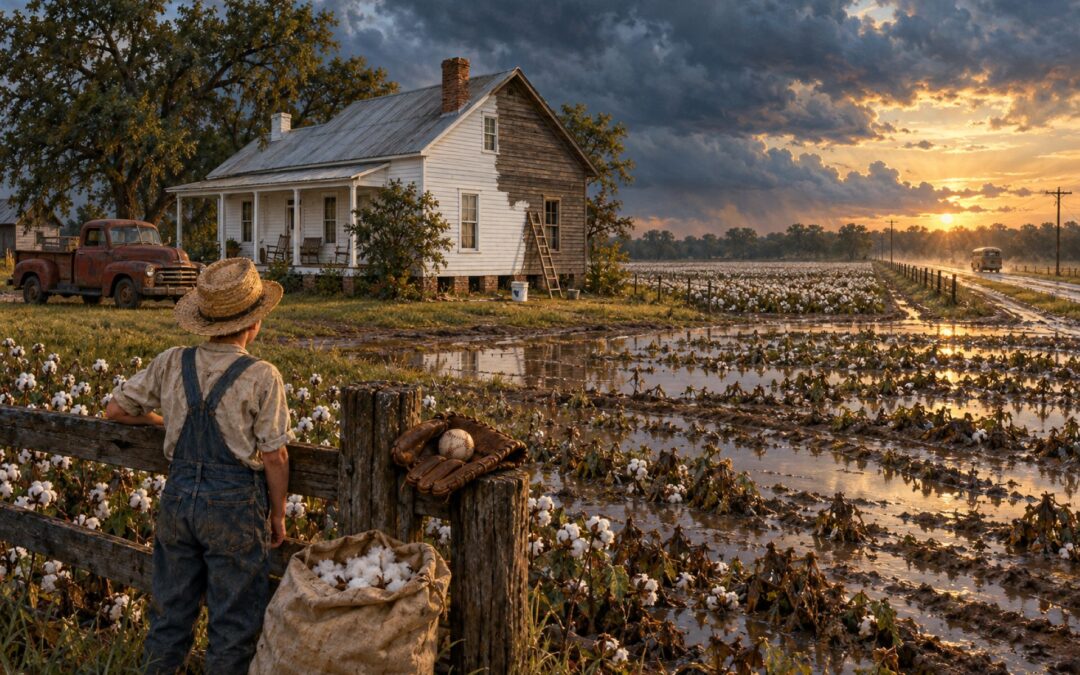
John Grisham is best known for novels built around lawyers, courtrooms, conspiracies, and institutions of power, but A Painted House moves almost completely outside that world. Published by Doubleday in 2001, the novel returns to rural Arkansas in 1952 and follows seven-year-old Luke Chandler through a single cotton harvest that gradually becomes the most important season of his childhood. There is crime in the story, including two deaths, but the novel is not fundamentally a murder mystery. Its real subject is what happens when a child begins seeing how unstable the adult world actually is.
Luke starts the novel believing in recognizable structures. His parents and grandparents know what to do, church establishes right and wrong, baseball provides heroes, farm work follows the seasons, adults protect children, and home seems permanent even when money is scarce. During the harvest, almost every one of those assumptions becomes more complicated. Luke learns about poverty, sex, violence, deception, humiliation, debt, murder, pregnancy, migration, and the compromises adults make when survival and morality point in different directions.
The cotton harvest supplies the novel’s visible structure, but Luke’s real harvest is knowledge. Each secret he acquires removes another layer of certainty, until the boy who leaves Arkansas at the end understands far more about adults than the boy who watched the first laborers arrive. At the same time, the Chandler farmhouse is slowly being painted white, becoming outwardly more respectable just as Luke’s parents decide that the life represented by the house may no longer be sustainable.
Spoiler warning: This article discusses the entire novel, including both deaths, the major family secrets, the flood, and the ending.

The Harvest Begins: Outsiders Arrive in Black Oak
The novel opens in early September 1952, when the cotton is ready and the Chandler family urgently needs labor. Luke lives with his parents, Jesse and Kathleen, and his grandparents, Pappy and Gran, on a rented farm near the small town of Black Oak, Arkansas. The family has worked the same land for years, but they do not own it, and the harvest determines whether months of labor will produce enough money to settle debts and survive another winter.
Luke is only seven, so he experiences this economic pressure indirectly. He knows that the cotton has to be picked and that everyone worries about weather, but his imagination is dominated by the St. Louis Cardinals. He wants to become a baseball player, follows the standings obsessively, and dreams of buying a Cardinals jacket with the money he earns picking cotton. Baseball gives him a world governed by scores, rules, heroes, and measurable success, which makes it a powerful contrast to the morally ambiguous world he is about to enter.
The Chandlers need two groups of seasonal workers. One is a family of poor migrants from the Arkansas Ozarks, the Spruills, led by Leon Spruill. They arrive with Leon’s wife, several children, and three figures who immediately become central to Luke’s story: the intimidating Hank, the attractive teenage Tally, and Trot, a physically disabled boy whose quiet presence initially seems less important than those of his older siblings.
The other workers are Mexicans led by Miguel. They arrive later than expected, packed into transport in conditions that surprise Luke, and are housed in the Chandlers’ barn loft. Luke sees them first largely as a group because he does not share their language and because Black Oak’s social world keeps them at a distance. Over the harvest, however, Miguel and especially Cowboy, an athletic and self-assured young worker, become distinct figures in Luke’s imagination.
These arrivals reorganize the farm. The Spruills camp on Chandler land, the Mexicans occupy the barn, and suddenly Luke’s familiar home is crowded with outsiders whose presence is necessary because Pappy and Jesse cannot harvest the crop alone. Even Luke’s baseball space is disrupted. The economic structure of cotton farming therefore enters his childhood physically: people who would normally remain outside the family’s domestic world now sleep, eat, work, argue, and compete only yards from the Chandler house.
The first days of picking establish how exhausting the work is. Cotton has to be pulled by hand and stuffed into long sacks that grow heavier as the day continues. Everyone is measured by endurance and production, and Luke quickly discovers that childhood does not exempt him from expectations. He tries to earn money and prove that he can contribute, even while the adults remain capable of outworking him.
The Chandler family’s internal world also takes shape during these opening chapters. Jesse is a hardworking former soldier whose life is tied to the land despite the meager rewards farming offers. Kathleen works within the household and farm economy but has a stronger sense than the older Chandlers that another life might be possible. Pappy carries the authority of the farm and approaches the harvest with a mixture of experience, pride, worry, and stubbornness, while Gran combines strict religious morality with practical competence and fierce care for the people around her.
One important family member is absent. Luke’s Uncle Ricky is serving in the Korean War, and the family listens anxiously for news. Ricky is Luke’s hero, an older young man associated with baseball, excitement, and the wider world. Although he barely appears directly in the novel, his absence will eventually become one of its most important narrative presences.
Luke is immediately fascinated by Tally, whose appearance and confidence introduce him to feelings he barely understands. Hank produces the opposite response. Big, aggressive, and quick to intimidate, Hank violates Luke’s assumptions about how hired workers ought to behave toward the family employing them. When Hank treats him roughly, Luke realizes that telling Pappy or Jesse could cause a confrontation severe enough to make the Spruills leave.
That realization is a small but crucial step in Luke’s education. He already understands enough about the harvest to know that his family needs the Spruills more than it needs justice for every insult. Rather than report everything honestly, Luke begins calculating what adults can afford to know.
The most revealing early confrontation concerns the Chandler house itself. The family’s home has never been painted, a visible sign that they have never had enough spare money or time to finish it in the respectable white style Kathleen wants. Hank notices Luke’s embarrassment and points out the uncomfortable fact that the supposedly inferior Spruills have a painted house back in the hills while the Chandlers do not.
The insult strikes directly at Luke’s developing sense of class. He has assumed that the Chandlers occupy a position above itinerant laborers because they are established farmers with land to work and people working for them. Hank exposes how fragile that distinction is. The Chandlers rent their land, depend on outside labor, owe money, and live in an unfinished-looking house that publicly advertises their limitations.
The first Saturday trip to town turns those tensions into violence. Luke and his friend Dewayne are present when Hank encounters the Sisco brothers, local men with whom he quickly clashes. What begins as a public fight becomes frighteningly one-sided because Hank is much stronger. He beats the brothers brutally and strikes Jerry Sisco with a piece of wood, leaving Luke with an image of violence far beyond the controlled roughness of baseball or childish fights.
Until this moment, the harvest has expanded Luke’s world. The fight changes the nature of that expansion. He is no longer simply meeting strangers and learning that social status is complicated; he has witnessed an act that may have fatal consequences, and adults will soon demand that he explain what he saw.
Murder, Lies, and the Burden of Knowing
Jerry Sisco dies after the fight, and the death follows Luke into church. Brother Akers preaches about murder while Luke sits among adults who do not possess the knowledge he carries. The experience creates one of the novel’s central psychological patterns: Luke must behave like an ordinary child while privately understanding that the public version of events is incomplete.
The local authorities investigate, and Deputy Stick Powers questions Hank. Hank does not quietly accept the possibility of arrest. The Spruills’ continued presence on the Chandler farm depends on what happens to him, because Leon makes it clear that if Hank is forced to leave, the entire family may leave with him. For Pappy and Jesse, this is not merely a question of whether they like Hank or believe he behaved badly. Losing the Spruills during harvest could mean losing part of the crop and the money needed to survive.
Hank names Luke as a witness, forcing the child into a conflict he has tried to avoid. Luke knows Hank used the wooden weapon, but he tells Stick a version that shifts responsibility toward the Siscos. The lie protects Hank, but indirectly it also protects the Chandler harvest. Luke therefore discovers something morally disturbing very early in his education: lying can serve people he loves even when it also obstructs justice.
The consequences are not immediately dramatic. Luke is not arrested, publicly accused, or exposed. That absence of punishment matters because it makes secrecy easier the next time. Once Luke has successfully concealed part of the truth from an adult authority figure, silence becomes a tool he knows how to use.
The novel broadens its portrait of poverty through the Latcher family. The Chandlers themselves have little cash, worry constantly about the crop, and live in an unpainted house, yet the Latchers are poorer still. Their household is crowded and precarious, and the Chandlers bring them food despite having little surplus of their own. Through Luke’s eyes, poverty becomes relative rather than absolute: a boy ashamed of his own house discovers a family whose circumstances make his seem comfortable.
Rumors circulate that the teenage Libby Latcher is pregnant. As with Hank’s violence, the adults know more than they say openly, and Luke begins collecting fragments of information from conversations, visits, silences, and gossip. The adult world increasingly appears to him as a place where the most important facts are often the facts nobody discusses directly.
Jesse also questions Luke about the Sisco fight. Luke lies again, this time not to a deputy but to his own father. The moral weight changes because Jesse’s authority is personal and familial, yet Luke remains trapped by the same practical logic. To tell the full truth now would mean admitting that he lied earlier and might help remove laborers the family still desperately needs.
The conflict between Hank and Cowboy develops through baseball, a game Luke initially imagines as a refuge from the adult world. A match between the Mexican workers and local players brings the groups together temporarily, and Cowboy reveals himself as an excellent pitcher. His skill earns Luke’s admiration because baseball provides a language Luke understands immediately.
Hank cannot leave the competition alone. He deliberately hurts Cowboy, turning sport into another arena for domination. Cowboy responds by producing a switchblade, and only intervention prevents the confrontation from escalating further. Luke now recognizes that Cowboy, unlike the quieter Mexican workers he has mostly watched from a distance, possesses both charisma and a capacity for serious violence.
That danger becomes explicit later when Cowboy privately shows Luke the knife and suggests that he has used violence before. The threat is not directed at Luke yet, but the knowledge changes how Luke interprets future encounters between Cowboy and Hank. Their conflict is no longer merely a feud between two proud young men. Each is capable of crossing limits.
Luke’s relationship with Tally also shifts during this part of the harvest. She takes him to Siler’s Creek, where she bathes, and Luke watches her with a mixture of fascination, embarrassment, and desire that he does not yet know how to interpret. The episode belongs to his sexual awakening, but it also establishes another dimension of secrecy: seeing something forbidden and deciding whether to reveal that he has seen it.
Meanwhile, the Korean War remains present through church prayers, radio reports, family worry, and letters from Ricky. The war enlarges the scale of danger beyond Black Oak, but Luke processes it through personal attachment. He does not think geopolitically; he thinks about whether his uncle will come home.
A letter from Ricky produces temporary relief because correspondence makes the absent soldier present again. Luke begins writing to him, and letters become another mechanism of selective truth. Luke can decide what Ricky should know about events at home, just as he decides what Stick, Jesse, Pappy, or Kathleen should know about the things he has witnessed.
At the cotton gin, Luke encounters Jackie Moon, another person who saw the Sisco fight. The discovery matters because Luke’s secret has never belonged entirely to him. Other witnesses exist, and the truth can surface independently of his choices. This gives secrecy a new dimension: concealing information does not make it disappear; it merely transfers control over when and how it may return.
By this point, Luke has already crossed an important threshold. He knows that adults can be violent, that family survival can interfere with moral clarity, that authority figures do not automatically possess the truth, and that a child can manipulate what adults know. His innocence is not destroyed in one spectacular moment. It is being replaced piece by piece by an understanding of how complicated consequences can become.
Birth, Desire, and the Secrets Inside Families
The novel’s next movement places birth and sexuality beside violence, showing Luke that the adult world produces life as mysteriously as it produces death. Around the same time, the first white paint appears on the Chandler house. At first the work seems almost magical because nobody publicly claims responsibility, but Kathleen correctly suspects that Trot has begun painting.
Trot cannot compete with the strongest workers in the cotton rows. His physical limitations reduce his value within a harvest economy that measures people by how much cotton they can pull, yet painting gives him another way to contribute. The act is especially meaningful because the Chandlers themselves have never managed to accomplish what this poor migrant boy begins doing quietly and without being asked.
The Latcher storyline intensifies when Libby goes into labor. Gran and Kathleen are summoned because childbirth, like many essential parts of life in Black Oak, is handled communally and practically rather than through the modern medical structures Luke might encounter elsewhere. The men and children remain largely outside the event, reinforcing the gender divisions that organize both domestic knowledge and farm life.
Luke does not accept exclusion easily. Tally persuades him to go near the Latcher house, and he secretly witnesses or listens to enough of the birth to gain knowledge his family would have preferred to withhold from him. The experience is frightening, fascinating, and transformative. Sex, pregnancy, and childbirth are no longer vague adult subjects; they are connected physical realities.
The birth immediately creates another secret with potentially serious consequences. Percy Latcher announces that Libby has named Ricky Chandler as the father of her baby. Because Ricky is in Korea and cannot speak for himself, the accusation enters the Chandler household as both scandal and possibility.
At first, the family has reasons to resist the claim. Libby is a poor Latcher girl, Ricky is a beloved Chandler serving overseas, and the accusation threatens the family’s image of him. Yet Kathleen sees enough resemblance in the child to make dismissal difficult, and the adults know that Ricky had opportunities to see Libby before leaving for military service.
For Luke, the revelation complicates his hero worship. Ricky has represented baseball, adventure, courage, and everything exciting beyond childhood. Now Luke must imagine him as a sexual adult capable of fathering a child and possibly leaving responsibilities behind when he went to war. Ricky does not cease being Luke’s hero, but the hero becomes a person whose life contains parts Luke never knew existed.
The carnival provides another concentrated display of adulthood as spectacle. Black Oak gathers for entertainment, money changes hands, attractions promise forbidden sights, and Hank again turns physical dominance into public performance. He accepts a wrestling challenge against Samson, defeats him with frightening force, and wins $250.
The money alters Hank’s relationship to the harvest. Picking cotton has always been something he endures for wages, and a sudden windfall reduces his willingness to submit to long days in the fields. Pappy’s concern is practical: every day Hank works less means less cotton gathered before bad weather arrives.
Stick still intends to arrest Hank over Jerry Sisco’s death, but the timing remains entangled with the harvest. Pappy persuades him to delay action, another example of economic necessity bending the ordinary expectation that a possible killer should immediately face the law. The novel does not present this compromise as cleanly admirable or villainous. It shows how quickly abstract morality becomes complicated when a family’s livelihood depends on the person causing the problem.
A different future arrives in the form of Jimmy Dale, a relative who has moved north to Michigan and returns with Stacey. Their clothes, car, money, and attitudes expose the distance between agricultural Arkansas and industrial prosperity. Stacey’s condescension irritates Luke, who retaliates with the invented threat of a “shitsnake,” a comic incident that earns him punishment but also reveals his defensiveness about home.
More importantly, Flint becomes tangible. Until now, leaving the farm has mostly belonged to dreams, military service, migrant labor, or baseball fantasies. Jimmy Dale demonstrates that a Southern farm boy can move north, work in an automobile plant, earn steady wages, and return looking prosperous.
The weather then begins asserting itself with increasing force. Storms and nearby tornadoes interrupt the picking, and every lost day matters because cotton left in the fields remains vulnerable. Pappy and Jesse watch the sky with the anxiety of people who understand that months of work can be destroyed by circumstances no amount of effort can control.
Hank’s behavior also deteriorates. He works less, remains hostile toward Cowboy, and someone—almost certainly Hank—begins harassing the Mexicans in the barn. The attacks make the social arrangement on the farm increasingly unstable. The Chandlers need both sets of workers, but the workers themselves may not be able to coexist.
Through all this, Trot continues painting. Tally helps obtain supplies, and the white sections of the house begin accumulating almost independently of the harvest. The contrast becomes increasingly important: cotton is the work everyone must do because survival demands it, while painting is work people choose to do because dignity and beauty matter even when no immediate profit results.
Luke also writes to Ricky about Libby and the baby. His decision means that he is no longer merely absorbing adult secrets; he is choosing how information moves between people who cannot speak directly. A seven-year-old child has become one of the channels through which the Chandler family’s most consequential private matters travel.
The middle of the novel therefore binds several kinds of maturation together. Luke learns about childbirth, sexuality, family shame, money, work, weather, and the possibility of leaving home. None of these lessons arrives in isolation. Each makes the others harder to simplify, which is precisely why the novel’s coming-of-age story feels cumulative rather than symbolic of one neat transition.
Storms, Murder, and the Collapse of the Harvest
Luke’s growing knowledge reaches a new level when he discovers Tally secretly meeting Cowboy. Their relationship brings together the two migrant groups living on Chandler land and gives Tally a possible route out of the life she dislikes. For Luke, who has idealized her, the discovery is both romantic disappointment and another encounter with adult desire operating beyond his control.
The Latcher conflict also becomes personal. Several of Libby’s brothers attack Luke because Ricky is his uncle, transferring anger over Libby’s pregnancy onto the youngest available Chandler. Luke has done nothing to cause the pregnancy, but family identity makes him a target. The episode reinforces how often children inherit conflicts created by adults.
Black Oak’s Fall Picnic temporarily creates the appearance of a coherent community. Church members gather, food is shared, and the annual Baptist-Methodist baseball game turns rivalry into ritualized play. Yet the community is not actually equal. The Mexican workers can watch or participate in limited ways, but they remain outsiders, and the social divisions Luke has been learning do not disappear simply because everyone occupies the same public space.
The end of the Cardinals’ season matters more to Luke than the adults around him can fully understand. Baseball has been the imaginative calendar running alongside the cotton harvest, and its disappearance removes one of Luke’s chief escapes. As the season closes, the dangers on the farm become harder to balance with thoughts of distant players and pennant races.
The Sisco problem also refuses to disappear. Stick warns that another Sisco may seek revenge against Hank, creating a threat that the Chandlers partly hope will solve their labor dilemma for them. If fear persuades Hank to leave voluntarily, the family can avoid openly expelling him while also reducing the risk he poses to everyone else.
During this period Luke encounters television at Pop and Pearl’s house. The experience is brief, but it belongs to the novel’s steady accumulation of signs that a different America is arriving. Television, automobiles, industrial wages, telephones, and northern cities sit at the edges of a world still organized around hand-picked cotton, radio broadcasts, church gatherings, and seasonal labor.
Eventually Jesse and Leon agree that Hank has to go. Stick is preparing to act, Hank is disrupting the farm, and the possibility of Sisco retaliation makes his continued presence dangerous. Hank heads away, apparently on his way out of the Chandlers’ immediate world.
Cowboy follows him.
Luke, driven by the curiosity that has repeatedly placed him near adult secrets, follows both men toward the bridge. What he witnesses becomes the novel’s most traumatic scene. Hank and Cowboy fight violently, neither willing to retreat from a conflict that has been escalating since the baseball game.
This time there is no Jesse or Miguel present to stop them. Cowboy uses his switchblade and kills Hank. Afterward he takes Hank’s money and disposes of the body in the river, transforming the rivalry Luke has been watching into a concealed murder.
Luke’s position as witness becomes far more dangerous than it was after the Sisco fight. Cowboy catches him and makes the threat personal: if Luke tells anyone, Kathleen can be harmed. Luke is no longer hiding information partly to protect the harvest or because he fears adult anger. He is keeping silent because he believes his mother’s life may depend on it.
The psychological effect appears almost immediately. Luke clings to Kathleen, avoids the fields, and struggles to behave normally. Domestic objects trigger memories of the killing, and he eventually faints while helping with tomatoes because the work recalls the violence he saw.
The adults recognize that something is wrong without knowing what caused it. This is one of the advantages of the child-centered narrative: the reader possesses Luke’s terror while the people responsible for protecting him cannot act because he will not tell them what he knows. His secrecy isolates him inside his own family.
An odd, gruesome story told by the road-grader operator Otis feeds Luke’s fixation on violent death. What adults may treat as local storytelling becomes psychologically dangerous material for a child already trying to control images of Hank’s murder. The gap between what adults casually discuss and what children can absorb becomes another quiet theme of the novel.
After a short period of refuge with his mother, Luke has to return to work. Farming allows little time for trauma because unpicked cotton does not care why someone is frightened. Back in the fields, he must face Cowboy as though nothing has happened.
Cowboy does not need to repeat the threat in words. Displaying the knife is enough. That silent reminder gives him control over Luke, whose knowledge is now tied to fear every time he sees the weapon.
At the same time, the weather is becoming a second source of suspense. Rain persists, farmers begin discussing river levels, and Pappy monitors the water. The novel’s danger shifts almost imperceptibly from what violent men can do to what the landscape can do.
That movement is structurally important because Hank’s death does not produce the kind of investigation-and-resolution plot a conventional crime novel might promise. The body disappears into the river, Cowboy continues working, and Luke remains silent. Rather than narrowing toward legal consequences, the story broadens again toward the survival of the farm.
Then another disruption occurs: the Chandler truck disappears, and so do Tally and Cowboy. The Spruills fear the worst, but evidence increasingly suggests that Tally left voluntarily with him. Their disappearance removes both the killer Luke fears and the girl he has admired.
For Luke, the relief is mixed with confusion. Cowboy can no longer threaten him directly, but he has escaped accountability. Tally may have chosen freedom, but she has chosen it with a man Luke knows to be capable of killing.
The harvest is also beginning to unravel socially. Hank is dead, Cowboy and Tally are gone, the Spruill family has lost two of its strongest young members, and bad weather is closing the window in which the remaining cotton can be gathered. What began as a carefully assembled labor force is falling apart from violence, desire, money, fear, and forces beyond anyone’s control.
Flood, Departure, and the Nearly Painted House
Stick recovers the stolen truck at the Jonesboro bus station, confirming that Tally and Cowboy have left by bus toward Chicago. Tally leaves word indicating that she intends to marry him, so the Spruills must confront the fact that she has not simply been kidnapped. Their harvest on the Chandler farm effectively ends, and they prepare to return to the hills.
Before leaving, Trot gives Luke the remaining paint and brushes. The transfer matters because the house has become a shared project. What began as Trot’s private act now becomes Luke’s responsibility, and Luke begins to understand the effort hidden behind the white patches that had seemed to appear almost magically.
With the Spruills gone, the Chandlers and the remaining Mexican workers pick whenever weather permits. Every clear hour matters because much of the crop is still exposed. The family is no longer working toward a successful harvest so much as trying to save whatever can still be saved.
Meanwhile, Jesse and Kathleen make arrangements connected to a possibility Luke does not yet fully understand. Their conversations are guarded, and the telephone becomes part of a plan that eventually leads back to Jimmy Dale and Flint. The northern industrial world that entered the novel as a comparison is becoming a practical alternative.
Luke takes over the painting in earnest. He discovers that it is physically difficult, slow work, especially for a child trying to cover an entire farmhouse. His respect for Trot deepens because he now understands what Trot had been doing rather than merely admiring the result.
The Mexican workers begin helping. Their participation transforms the symbolic meaning of the house because people who occupy the least secure place on the Chandler farm are helping improve a home they will soon leave. The paint is no longer simply a Chandler family aspiration; it is the accumulated gift of people whose lives have crossed briefly during one harvest.
Pappy brings Luke to see the rising river, making visible the danger the adults have been discussing. The farm’s economic vulnerability becomes almost brutally simple. The family can work from before dawn until exhaustion, hire labor, save money, pray, and plan carefully, but none of that can stop water from covering the fields.
Kathleen eventually tells Luke that she and Jesse are considering moving to Flint. Jimmy Dale may be able to help Jesse obtain work at the Buick plant, which would mean wages not dependent on weather or the success of one crop. To Luke, the idea threatens everything familiar: Pappy, Gran, the farm, school, church, and the world he has assumed will always be home.
Yet Flint also represents the direction in which the novel has been pointing for some time. The Chandlers live in a changing economy. Hand-picked cotton demands enormous labor while producing insecure income, and the family’s greatest material aspiration has been something as basic as enough spare resources to paint their house.
As the flood worsens, Jesse and Luke go to town for more paint. Jesse does not have enough money for all of it, so Luke spends money he earned picking cotton. Earlier he wanted those wages for a Cardinals jacket. Giving them up for the house marks a quiet but important change in his priorities.
The decision does not mean Luke has stopped loving baseball or become prematurely adult. It means his sense of belonging has expanded. The house that once embarrassed him has become an object he wants to complete because it holds the family history he may soon be forced to leave.
A letter from Ricky says that he hopes to return by Christmas, sustaining the family’s hope without guaranteeing anything. His future remains suspended between war and home, just as the question of Libby’s baby remains unresolved. Ricky continues to shape events despite never returning to take responsibility for them within the narrative.
Eventually the Mexican workers decide they must leave. The fields are becoming impossible to harvest, and remaining on the farm no longer makes economic sense. Before they go, Luke persuades them to help with the painting one last time, and a large amount of work is completed quickly.
Their departure parallels the Spruills’ earlier exit but carries a different emotional tone. There has been less open conflict between the Chandlers and Miguel’s group, and the workers’ final participation in the house project suggests mutual respect even within a social order that never fully incorporates them into the community. They leave because the harvest economy brought them there and the collapse of that economy sends them onward.
Kathleen reveals another family secret: she is pregnant. For Luke, who has recently witnessed Libby’s childbirth and struggled to understand adult sexuality, his mother’s pregnancy ties those new realities directly to his own household. The Chandler family is expanding at the same moment it is preparing to uproot itself.
Luke also admits to Kathleen that he secretly witnessed Libby’s delivery. The confession matters because it breaks the pattern of total concealment. He does not suddenly reveal everything, but he begins testing whether disturbing knowledge can be shared without destroying the people around him.
The flood finally overwhelms the surrounding area, including the Latcher farm. The poor family that already possessed less security than the Chandlers loses even the fragile protection of its home. The Chandlers respond by going to rescue them, bringing them by boat and sheltering them in the barn.
Before or during this crisis, Luke finally tells Pappy the truth about Hank. He explains that Cowboy killed him and that he saw what happened. Pappy’s reaction is significant because Luke has carried the secret partly from fear that adults will unleash consequences he cannot control.
Instead, Pappy absorbs the knowledge and tells Luke to remain silent. The decision does not restore moral simplicity. Luke has confessed, but the adult he trusts most does not turn the information over to the authorities or insist that truth must immediately prevail.
The scene completes one stage of Luke’s education. He learns that adult morality is not the opposite of childish secrecy. Adults also decide when truth should be spoken, when it should be withheld, and which dangers or loyalties justify silence.
The Chandler barn becomes an improvised refuge for the Latchers, creating practical problems almost immediately. Christian charity is sincere, but food and money remain scarce, and the Chandlers cannot support another large family indefinitely without thinking about cost. Grisham refuses to sentimentalize generosity by pretending it has no material consequences.
Libby talks to Luke and insists that she loves Ricky. She says Ricky promised to marry her when he returned. Her version makes the paternity claim more emotionally coherent, but Ricky is still absent and unable to confirm it himself, so the matter remains deliberately unresolved.
Mr. Latcher later helps Luke paint the house. This contribution completes another social circle: a man poorer than the Chandlers assists in improving the home of people who have just rescued his family. The nearly painted house has now been worked on by Trot, Tally indirectly, Luke, the Mexicans, and the Latchers.
By this point, very little cotton can be saved. The flood has exposed the fundamental weakness of the family’s economic life. The Chandlers may own tools, possess skill, work relentlessly, and draw on generations of farming knowledge, yet a season of rain can still erase the expected income.
Kathleen announces that she, Jesse, and Luke will leave for the North almost immediately. The decision is not framed as a permanent rejection of Arkansas, and the family does not know exactly what its future will become. They are going to Flint because steady factory work offers an alternative to another winter of debt and another year betting everything on weather.
The final chapter connects Jesse’s departure with an earlier journey home from war, reminding the reader that migration has always shaped the Chandler family even when the farm feels permanent to Luke. Luke says goodbye to Gran and Pappy, and the pain of leaving them is sharper than any abstract excitement about Michigan.
Pappy promises that he will finish the small remaining part of the house. Luke therefore departs without seeing the project fully completed. The promise matters more than physical completion because it allows the house to remain linked to both continuity and absence: the home will endure after Luke leaves, but his life will no longer be contained within it.
At the Jonesboro bus station, Jesse buys tickets that will carry the family first toward St. Louis and then through Chicago on the way to Flint. St. Louis has always belonged to Luke’s imagination because of the Cardinals, so his literal movement toward it collapses the distance between fantasy and experience.
The novel closes as the family travels away from flooded cotton fields. Luke sees that Kathleen is smiling. Her expression does not erase the losses of the harvest, the separation from Pappy and Gran, Ricky’s uncertain future, Hank’s hidden death, or Luke’s fear, but it makes clear that departure also contains hope.
The Chandlers have not conquered the farm. They have accepted that it may be necessary to leave it.
Black Oak and the Arkansas Cotton Economy
Black Oak is not merely scenery for Luke’s coming-of-age story. The entire plot depends on the material rules of an agricultural world in which work, class, weather, housing, migration, debt, family hierarchy, and social reputation are tightly connected. Understanding that world explains why otherwise strange choices—keeping Hank around after Jerry Sisco’s death, worrying constantly about a few days of rain, or considering factory work in Michigan a form of liberation—make practical sense.
The Chandlers are farmers, but they are not prosperous landowners. They rent their acreage from an absentee owner and assume the risks of producing a crop they do not completely control. Their relative status within Black Oak can therefore be misleading: they have a farm to work, a truck, a house, and the ability to hire seasonal labor, yet they remain financially vulnerable enough that a failed harvest can threaten the entire family.
The historical background closely matches the pressures Grisham gives them. The history of Arkansas’s cotton industry shows how tenant farming, family labor, fluctuating returns, and dependence on hired pickers shaped agricultural life, while postwar mechanization and migration increasingly undermined the older labor system. By the early 1950s, machines could perform work that had previously required many hands, and northern factories offered rural workers another route to wages.
That transition helps explain why Flint carries such force in the novel. Jesse does not leave because he suddenly hates farming. He leaves because agricultural independence is partly an illusion when the family does not own the land, has little cash reserve, and can lose months of labor to rain.
The seasonal workers reveal another part of the system. The Spruills come down from the hills because they need temporary work, while the Mexican crew arrives specifically for the harvest and leaves when the crop no longer justifies staying. Their mobility gives them a different relationship to home from the Chandlers, but it does not make them economically free. Everyone has entered the fields because someone needs money.
Mexican agricultural labor was historically present in the region during precisely this period. The Bracero Program operated in Arkansas and brought Mexican workers into Southern agriculture, including cotton farming. The novel, however, never explicitly identifies Miguel, Cowboy, or the rest of the crew as formal braceros, so the historical parallel should illuminate their presence without being mistaken for a fact about the fictional characters.
Luke initially understands class visually and socially rather than economically. The Chandlers are established in Black Oak and attend church with other local families, while the Spruills sleep in a makeshift camp and the Mexican workers live in the barn. Yet Hank’s taunt about the painted house forces Luke to recognize that local respectability does not necessarily mean wealth.
The Latchers deepen that lesson. Their poverty is severe enough that the Chandlers, who worry about their own winter finances, still regard them as people in need of charity. Grisham creates several economic layers within a small rural population rather than dividing the world neatly into rich owners and poor laborers.
The gin, Saturday trips to town, church, the carnival, the Fall Picnic, and baseball games form Black Oak’s public life. People who work in isolated fields during the week come together in recurring rituals where reputation matters intensely. News spreads quickly, gossip fills information gaps, and private behavior can become a matter of community judgment.
Religion is woven into that social order rather than existing separately from it. The Chandlers pray, attend church, hear sermons against murder, give food to the poor, and interpret life through Christian language. At the same time, religious certainty coexists with gossip, violence, hidden sexuality, and pragmatic moral compromises.
Technology quietly shows that this world is already changing. Luke listens to baseball on the radio, experiences television as something remarkable, watches relatives return from industrial Michigan with visible signs of prosperity, and eventually boards a bus toward a factory city. The novel never needs to announce that one economic era is ending because Luke experiences the transition through objects and opportunities.
Weather remains the most powerful force in this material world. Farming gives people a feeling of control because disciplined work is necessary, yet that discipline cannot guarantee success. The flood finally exposes what Pappy and Jesse have known all along: their livelihood depends on variables no amount of character or effort can master.
Grisham’s attachment to this world is not merely researched atmosphere. In a conversation with Bill Moyers about the autobiographical background of the novel, he described childhood memories of an Arkansas cotton farm, Mexican workers living in a barn loft, church, baseball, flooding, and the kind of unpainted house that gave the novel its title. The setting is therefore autobiographically rooted even though the murders, characters, and full plot should not be mistaken for a literal account of his childhood.
That personal memory helps explain the unusual balance of affection and severity in the novel. The farm is hard, insecure, and sometimes frightening, but it is also where Luke experiences belonging, family, food, baseball, work, storytelling, humor, and intimacy. A Painted House does not argue that the old rural world was simply bad and modern industrial life simply good; it shows why people could love a way of life they could no longer afford to trust.
Luke Chandler and the People Who Change His World
Although A Painted House contains murder, economic crisis, sexual scandal, and natural disaster, the story remains fundamentally organized around people as Luke encounters them. He begins with simple categories—family and outsider, good and bad, respectable and poor, child and adult—but nearly every important character forces him to revise those categories.
The novel’s character development is therefore relational. Luke changes because the people around him reveal different versions of adulthood, work, masculinity, loyalty, desire, fear, and responsibility.
Luke Chandler
Luke’s most obvious characteristic is curiosity. He wants to know what adults are saying, where people are going, what Tally is doing, why Libby is pregnant, and what happens when dangerous men disappear toward the river. That curiosity makes him an effective narrator, but it also repeatedly places him in situations he is not emotionally equipped to handle.
At the beginning, Luke’s morality is comparatively straightforward. He knows lying is wrong, church rules matter, parents punish misconduct, and violence has limits. Yet even before the most serious crimes occur, he discovers that strict honesty can conflict with family survival.
His lie about the Sisco fight is the first major step. Luke does not become dishonest because he suddenly loses a conscience. He lies because he knows the Spruills may leave if Hank is arrested, and he understands that the Chandlers need their labor.
That calculation is far more adult than Luke realizes. It introduces him to consequential morality: the same action can protect one set of people while harming another. Telling the truth may help deliver justice for Jerry Sisco but damage Luke’s family; lying protects the Chandlers but helps a violent man avoid consequences.
Luke’s sexual curiosity develops with similar ambiguity. His fascination with Tally, his secret observation of her bathing, and his intrusion into Libby’s childbirth are violations of privacy as well as steps in his education. The novel does not make Luke vicious for behaving this way, but neither does it need to turn every act of childhood curiosity into innocence.
His relationship to violence changes even more dramatically. Hank’s first intimidation frightens him, the Sisco beating shocks him, and Cowboy’s knife fascinates and alarms him. After witnessing Hank’s murder, however, Luke no longer experiences violence as public spectacle; he knows what it is like to see a person killed and then carry the knowledge alone.
His silence after Hank’s death comes from direct fear for Kathleen. This makes the secret psychologically different from the Sisco lie. Luke’s body begins expressing what he cannot say through exhaustion, fear, clinging, nightmares, and faintness.
The eventual confession to Pappy is therefore one of Luke’s most important acts. He finally transfers the burden to an adult he trusts, expecting that knowledge to produce some decisive response. Pappy’s choice to preserve the secret teaches Luke that adulthood itself does not eliminate moral uncertainty.
Luke also matures economically. Early in the novel, picking cotton is partly a way to earn enough money for a Cardinals jacket. Later, he spends his savings on paint for the house, giving up an individual dream in order to finish a family project.
The gesture matters because it is not a speech about responsibility. Luke still loves baseball and remains unmistakably a child. His values have simply widened: he can now care about something larger than what the harvest money will buy for him personally.
His final movement north is therefore both literal and psychological. The farm no longer contains his entire idea of the world, but neither has he outgrown his attachment to it. Luke leaves Black Oak with more knowledge, not with complete understanding.
That distinction makes him convincing as a coming-of-age protagonist. A Painted House does not pretend that one traumatic autumn turns a seven-year-old into an adult. It shows the first irreversible break in his belief that adulthood is simple.
The Chandler Family
The Chandler family provides Luke with security, but its members represent different responses to the same economic world. Their disagreements are rarely ideological debates; they emerge through choices about work, money, religion, family duty, and whether to stay on the farm.
Kathleen is the strongest internal force pushing toward another life. She participates fully in the exhausting work of the household, supports poorer neighbors, worries over Luke, and values the family, yet she does not romanticize farming enough to ignore what it costs. The unpainted house matters to her partly because it represents years in which there was always something more urgent than improvement.
Her interest in Flint is therefore not simple materialism. She wants stability, education, opportunity, and a future in which one storm cannot destroy a year’s income. Her smile at the end does not mean she feels nothing about leaving Gran and Pappy; it reflects relief at finally moving toward a possibility she has wanted.
Jesse is less openly eager to abandon the farm. His identity is tied to work, endurance, family responsibility, and a rural model of masculinity in which complaining accomplishes little. His wartime past also gives him a wider frame of reference than Luke initially appreciates.
What finally pushes Jesse toward Flint is not laziness or failure of character. The ruined harvest demonstrates that diligence alone cannot guarantee the life he is trying to provide for Kathleen, Luke, and the coming baby. Factory work promises less independence in one sense but more predictability in another.
Pappy is the most deeply rooted in the farm. He understands the land, organizes the harvest, negotiates with workers, watches weather, and carries family authority with the confidence of long habit. Luke admires him because Pappy seems to possess the kind of adult certainty that the harvest gradually proves nobody really has.
His reaction to Luke’s confession about Cowboy is therefore crucial. Pappy does not panic or insist upon abstract justice. He chooses silence, revealing a pragmatism that can be read as protective, morally compromised, or both.
Gran combines religious conviction with practical action. She believes strongly in moral standards, but her Christianity appears most convincingly when she feeds people, helps deliver Libby’s child, treats sickness, and shelters the Latchers after the flood. She represents a form of faith grounded in obligation rather than sermon alone.
Ricky exerts extraordinary influence despite his absence. Luke idealizes him as a soldier and baseball figure, the family worries about his survival, Libby’s baby makes him the center of scandal, and his letters carry hope from Korea. Because Ricky never returns during the novel, the reader never receives his direct account of Libby, the baby, or his promised marriage.
That absence prevents the family story from resolving neatly. Ricky remains Luke’s beloved uncle, a possible father, a soldier in danger, and an unknowable adult all at once. His storyline teaches Luke that loving someone does not mean fully knowing them.
The Spruills, Cowboy, and the Mexican Workers
The Spruills initially appear as hired labor, but each major family member becomes part of Luke’s education. Leon is a poor father responsible for keeping his family together and earning enough from the harvest to justify leaving the hills. His threat to withdraw everyone if Hank is arrested demonstrates how family loyalty can protect even a destructive relative.
Hank dominates the early half of the novel through physical intimidation. He is cruel to Luke, brutal toward the Siscos, hostile toward Cowboy, and increasingly difficult even for his own family to manage. Yet his most revealing effect on Luke comes through class rather than violence: Hank is the person who tells him that the Chandlers’ unpainted house is evidence that their supposed superiority is unstable.
The novel never excuses Hank’s behavior, but it situates his aggression inside a world of poverty, masculine pride, itinerant labor, and resentment. He measures status through physical strength because strength is one resource he possesses in abundance. His ability to beat men, dominate contests, and frighten people gives him power that his social position otherwise denies him.
Tally occupies a very different position. To Luke she first appears as an object of fascination, someone older and sexually mysterious. As the novel progresses, however, her own dissatisfaction becomes clearer: she is tired of the Spruills’ transient life and attracted to the possibility of escape.
Her relationship with Cowboy therefore cannot be reduced to Luke losing a crush. Tally chooses a dangerous man, but she also makes an active attempt to control her future. Whether the choice will save or endanger her remains unresolved.
Trot is perhaps the quietest major character and one of the most symbolically important. Because he cannot compete physically in the cotton fields, he seems marginal within the harvest’s brutal economics. Painting the house allows him to contribute through patience and care instead of strength.
His work ultimately outlasts Hank’s $250 victory, the Sisco fight, and much of the cotton itself. That does not make Trot a sentimental moral saint; it simply gives his chosen labor an importance the farm’s normal productivity measures would never capture.
Cowboy combines charm, ability, ambition, and menace. Luke admires him as a baseball player because Cowboy excels in the one arena Luke instinctively respects. His willingness to stand up to Hank also initially looks like courage.
The switchblade complicates that admiration. Cowboy’s threat after killing Hank destroys any possibility of treating the murder as a simple victory over a bully. Hank is dangerous, but Cowboy becomes dangerous in his own way, especially once he uses Luke’s love for Kathleen as leverage.
Miguel provides a steadier counterpart. He negotiates for the Mexican workers, interacts with Pappy as a representative of the group, and helps maintain enough order for the harvest to function. Through Miguel and the other workers, the novel depicts a labor community that is essential to the farm while remaining socially peripheral to Black Oak.
Their final assistance painting the house deepens their relationship with the Chandlers without pretending that social equality has suddenly been achieved. They will still leave when the economic reason for staying disappears. Their connection is temporary, but temporary relationships can still produce lasting effects.
Libby Latcher and the Latcher Family
The Latchers represent the social layer beneath the Chandlers and expose how unstable Luke’s concept of poverty is. He feels embarrassed by his own house until he sees more clearly how other families live. The comparison does not make the Chandlers wealthy; it teaches him that deprivation has degrees.
Libby becomes the family’s central figure because of her pregnancy and her claim that Ricky fathered the child. Her situation combines sexual secrecy, poverty, interrupted youth, and social vulnerability. She bears the immediate physical and reputational consequences of a relationship whose male partner is thousands of miles away.
The novel does not provide Ricky’s direct confirmation, so the paternity question remains technically unresolved. Yet Libby’s insistence that Ricky loved her and intended to marry her gives her claim emotional weight, while Kathleen’s perception of resemblance makes the Chandler family’s eventual acceptance plausible.
The Latcher boys’ attack on Luke reveals how family shame can become violence. Luke is punished not for anything he has done but because he is Ricky’s nephew and therefore the most accessible Chandler. The same principle operates more gently elsewhere: families share reputations, debts, obligations, and consequences even when individual responsibility is uneven.
When the flood destroys the Latcher family’s fragile security, the Chandlers rescue and shelter them. The episode brings the novel’s class structure full circle. The Chandlers may be frightened about their own finances, but they remain capable of becoming a refuge for people with even fewer resources.
Mr. Latcher’s help with the painting afterward gives the relationship reciprocity. Charity does not flow permanently in one direction. The Latchers, like the Spruills and Mexican workers, leave a literal mark on the Chandler home.
Secrets, Poverty, Violence, Home, and Growing Up
The novel’s major themes do not operate independently. Luke’s secrets matter because his family is poor; poverty matters because it shapes moral choices; violence matters because masculinity and reputation structure the community; home matters because nearly everyone depends on movement for survival. Grisham’s achievement lies in making these themes emerge from the harvest rather than stopping the story so characters can announce them.
Luke’s growth occurs at the intersections. He becomes less innocent not merely because he sees bad things but because he discovers that good people can make compromised choices for understandable reasons.
Secrets and the End of Childhood
Secrets are the novel’s main mechanism of maturation. Luke begins the harvest in a world where adults know things and children do not, but he gradually acquires knowledge that reverses that hierarchy. Soon he knows facts that Stick, Jesse, Kathleen, the Spruills, and much of Black Oak either do not know or cannot prove.
The Sisco fight teaches him that eyewitness knowledge carries responsibility. His lie to Stick then teaches him that knowledge can be manipulated. The absence of immediate punishment makes secrecy appear manageable.
Libby’s pregnancy introduces a different kind of concealment. Adults know that sex has occurred but avoid explaining it openly around children. Luke’s secret observation of childbirth destroys part of that protective barrier and gives him information without the emotional framework adults might have provided.
Tally and Cowboy’s relationship repeats the pattern. Luke sees something that changes how he understands people, then has to decide what the observation obligates him to do. The more he knows, the less comfortable silence becomes, yet speaking remains dangerous.
Hank’s murder is the ultimate version of the same problem. Luke possesses the truth about a death, but revealing it may put Kathleen in danger. Morality and protection become impossible to separate cleanly.
His eventual confession to Pappy might seem like the moment when adult authority finally restores order. Instead, Pappy tells Luke to preserve the secret. The scene confirms that growing up does not mean graduating into a world where every dilemma has a correct answer.
The family contains other secrets at the same time: Jesse and Kathleen are considering Flint, Kathleen is pregnant, Ricky may have fathered Libby’s child, and Ricky himself may have promised marriage. Knowledge travels unevenly, depending on fear, shame, timing, affection, and practical necessity.
Luke’s innocence therefore ends through epistemology rather than biology. He learns that truth exists independently of what people publicly acknowledge, and that possessing truth can create obligation without providing guidance. That is a far more unsettling lesson than simply discovering that adults lie.
Poverty, Work, and the Desire to Leave
Almost everyone in A Painted House works hard. That fact is essential because the novel refuses one of the easiest myths about poverty: that material insecurity results mainly from lack of effort. The Chandlers work from before sunrise, hire additional labor, plan carefully, and still face ruin.
Their rented farm exposes the limits of their independence. They may control daily operations, but they do not own the land beneath them, and the harvest has to satisfy obligations before it can improve their lives. Years of labor have not produced enough surplus to finish something as basic as painting the house.
The historical transition of Arkansas cotton farming makes the family’s dilemma more than a private failure. Postwar mechanization and northern industrial employment were changing the economic logic of hand-picked cotton. Jesse’s eventual move toward factory work therefore reflects a broader shift from labor-intensive Southern agriculture toward wage employment elsewhere.
The Spruills and Mexicans reveal the same economy from the laborer’s side. They travel because work is temporary and geographically scattered. Home cannot remain fixed when income requires migration.
The Latchers demonstrate an even harsher version of rural precarity. Their poverty makes the Chandlers look relatively secure, but the flood shows how thin the difference can be. A few days of water can turn a struggling household into a displaced one.
Jimmy Dale gives the abstract idea of migration a successful human example. He has gone north, entered industrial work, and acquired visible comforts that seem nearly luxurious by Chandler standards. His life does not prove that Flint will solve everything, but it makes staying on the farm look like a choice rather than destiny.
Kathleen understands that distinction earlier than the others. Her desire to leave is not contempt for Pappy, Gran, or Arkansas. It is a refusal to treat inherited hardship as morally superior merely because it is familiar.
Luke initially resists because children experience home differently from adults paying bills. The farm means Pappy, Gran, baseball, chores, familiarity, and identity, while Kathleen and Jesse must also see debt, insecurity, weather, and the needs of another coming child. Growing up partly means learning that the same place can be loved and judged insufficient at the same time.
Violence, Masculinity, and Moral Compromise
Violence appears in several forms throughout the novel, and Grisham rarely allows it to remain morally simple. Hank’s beating of the Siscos is clearly excessive, yet the community watches public fighting with fascination. The carnival later transforms physical domination into paid entertainment when Hank defeats Samson.
Baseball initially offers an alternative model of masculine competition. Skill, nerve, and strength matter, but rules contain them. Hank’s attack on Cowboy demonstrates how easily competition can spill beyond those boundaries when humiliation and pride take over.
Cowboy’s switchblade represents a different kind of power. He is not physically imposing in the same way Hank is, but the knife allows him to answer Hank’s strength with lethal capacity. When he eventually kills Hank, the result may feel like the culmination of Hank’s repeated aggression, but it is still murder rather than moral correction.
The Korean War expands the pattern beyond Black Oak. Ricky is honored for military service, and Jesse’s wartime history commands respect, showing that the community distinguishes socially sanctioned violence from criminal violence. Luke is too young to formulate that contradiction abstractly, but he lives inside it.
Pappy’s and Luke’s responses after the two deaths further complicate moral judgment. Luke lies about the Sisco fight because the family needs labor, while Pappy later preserves the secret of Hank’s murder. Neither act is presented as comfortably right.
This is where the novel’s economic theme meets its moral theme most sharply. Poverty does not excuse wrongdoing, but material insecurity changes what consequences people fear. The Chandlers’ decisions repeatedly arise from the fact that morality is being practiced under pressure rather than in ideal conditions.
Masculinity is similarly unstable. Hank performs it through intimidation and physical dominance, Cowboy through confidence and dangerous self-possession, Jesse through work and responsibility, Pappy through authority and endurance, and Ricky through military service in Luke’s imagination. The novel offers several models without declaring one simple formula for manhood.
Luke’s growth involves learning to distinguish strength from safety. The strongest man can be a bully, the charismatic athlete can become a killer, and the quiet disabled boy may perform the act that gives the family home its deepest symbolic value.
Family, Sexuality, Religion, and Community
Sexuality in Black Oak is both pervasive and hidden. Luke’s attraction to Tally, the carnival’s forbidden attractions, Tally’s relationship with Cowboy, Libby’s pregnancy, Ricky’s alleged paternity, and Kathleen’s pregnancy all occupy a community in which sex is rarely discussed openly around children.
This silence does not prevent Luke from learning. It simply ensures that he learns through fragments, voyeurism, gossip, accidental discovery, and inference. His understanding therefore develops without the clarity adults imagine they are preserving by excluding him.
Gender shapes who knows what and who performs which work. Men dominate the fields, negotiations, public fights, and formal authority, while women control large areas of domestic labor, caregiving, childbirth, food, health, and moral interpretation. Yet Kathleen’s desire to leave ultimately exerts enormous influence over the family’s future, showing that domestic position does not mean narrative passivity.
Religion provides the community with a moral vocabulary but does not eliminate contradiction. Brother Akers can preach against murder while Luke conceals what happened, and families can condemn sexual wrongdoing while depending on secrecy to protect reputations. The tension does not necessarily make the characters hypocrites; it shows that professed rules are easier to state than to apply.
Gran’s behavior offers the novel’s strongest practical expression of faith. She tends the sick, assists Libby, feeds poorer families, and helps shelter people displaced by the flood. Her religion is most persuasive when translated into work.
Community obligation functions similarly. The Chandlers cannot afford unlimited generosity, yet they help the Latchers because neighbors cannot simply be abandoned. Later, the Latchers contribute to the painting, turning assistance into relationship rather than a permanent hierarchy between giver and receiver.
The novel therefore treats family and community as both protection and constraint. People survive because others help them, but those same networks create gossip, inherited conflict, expectations, and secrets. Luke grows up by discovering that belonging means being implicated in other people’s lives.
The Painted House, Cotton, Baseball, and the Flood
The title object begins as a source of embarrassment. The Chandler house has never been painted, and its bare exterior tells the world that the family has never possessed enough spare resources to finish it properly. Luke does not fully understand what this means until Hank uses the contrast with the Spruills’ painted home to wound his pride.
Paint therefore begins as a class symbol. A painted house suggests respectability, surplus, permanence, and the ability to improve something beyond immediate survival. The Chandlers possess a home, but its unfinished exterior publicly records the difference between having shelter and having economic security.
Trot changes the meaning of the house when he begins painting it. He does so without demanding recognition, and the work gives him value outside the harvest’s physical hierarchy. The boy least suited to producing cotton starts producing something the Chandler family has wanted for years.
When Trot leaves, Luke inherits the project. This transfer turns paint from an unexplained gift into labor Luke can understand bodily. He discovers how difficult the work is, spends his own money on supplies, and persuades others to help.
The list of contributors becomes symbolically important because the house is not finally painted by one prosperous Chandler patriarch. Trot begins it, Tally assists, Luke continues it, Mexican workers contribute, Mr. Latcher helps, and Pappy promises to finish the remaining section. The most lasting improvement to the Chandler property is produced collectively by people who occupy very different social positions.
The timing creates the title’s deepest irony. The house becomes increasingly respectable while the farm becomes increasingly impossible. Painting can remove one visible sign of poverty, but it cannot stop rain, create land ownership, guarantee cotton prices, or produce financial reserves.
That does not make the project meaningless. On the contrary, its meaning becomes richer because it cannot solve the economic problem. Painting the house is an act of care rather than rescue.
Cotton functions differently. It is the crop around which almost every practical decision turns, and it measures time more relentlessly than a calendar. The arrival of workers, Saturday trips, wages, physical exhaustion, family anxiety, and the urgency of weather all derive from where the harvest stands.
Cotton is also the mechanism connecting characters who might otherwise never meet. The Spruills, Mexican workers, and Chandlers share the same fields because the crop temporarily binds their economic needs together. When the harvest collapses, those relationships dissolve with remarkable speed.
The crop therefore represents both community and exploitation, livelihood and burden. Luke earns money from it, but he also hates the endless picking. Pappy values it as the family’s means of survival, but it keeps him trapped in recurring uncertainty.
Baseball provides the emotional counterweight. Luke loves the Cardinals because baseball transforms uncertainty into a structured contest. Games end, scores can be counted, standings can be checked, and skill can produce visible results.
The game also allows Luke to admire people across social boundaries. Cowboy’s pitching matters to him before Cowboy’s social identity does because talent is immediately legible within baseball. Pappy’s baseball history likewise connects generations through a shared language.
Yet baseball cannot remain separate from the harsher world. Hank deliberately injures Cowboy during a game, showing that adult hostility can invade Luke’s refuge. The end of the season then coincides with the harvest’s worsening crisis, withdrawing an imaginative escape when he most needs one.
St. Louis carries symbolic weight because it is both a real city and Luke’s dream landscape. At the end, when the family buys bus tickets that will carry them in that direction, a place formerly accessible through radio and fantasy enters his actual life.
The river and weather move in the opposite symbolic direction from baseball. They embody uncertainty beyond human rules. The adults can watch clouds, consult experience, and monitor the river, but there is no negotiation with a flood.
The river is also where Cowboy disposes of Hank’s body, linking natural and human danger. Luke’s secret literally disappears into the same landscape that later threatens the entire farm. What seems hidden and what seems uncontrollable become associated in his mind.
By the final chapters, floodwater exposes the fragility of every boundary. Fields disappear under water, the Latchers lose their home, the workers leave, and the Chandlers reconsider their future. The natural environment that made cotton farming possible also demonstrates why agricultural life can never be made fully secure.
Letters and television form smaller but related motifs. Letters connect the farm to Ricky and allow private information to cross long distances, while television opens a window onto a modern world Luke has barely imagined. Together with buses, cars, factory wages, and the journey north, they show that Black Oak is not sealed off from change.
The painted house remains the novel’s most concentrated symbol because it contains all these tensions. It represents poverty and pride, labor and gift, permanence and departure, family and outsiders, achievement and insufficiency. The Chandler home is almost complete precisely when Luke learns that home itself is not permanent.
A Child’s View of an Adult World: Style and Structure
The novel’s most important formal choice is its first-person narration through Luke. Grisham does not tell the story from the perspective of an adult farmer who fully understands cotton economics, legal consequences, sexuality, or migration. He limits the reader to a boy who notices almost everything but cannot always interpret what he sees.
That gap creates dramatic irony throughout the book. Adult readers often understand the implication of a conversation before Luke does, especially when the subject is sex, money, pregnancy, or social status. The effect allows the novel to discuss difficult material without forcing Luke into implausibly adult explanations.
At the same time, the narration is clearly shaped as remembered experience rather than a transcription of a seven-year-old’s immediate thoughts. Luke can organize scenes, describe people, reproduce dialogue, and recognize thematic patterns with a degree of control that occasionally stretches the plausibility of his age. The most charitable reading is that an older consciousness is structuring memories while preserving the child’s emotional viewpoint.
That tension is also a legitimate limitation. There are moments when Luke seems exceptionally perceptive, especially about adult motives. Readers who demand strict psychological realism from a seven-year-old narrator may find the voice too polished.
More often, however, the limited perspective is productive. Luke hears incomplete conversations, invents explanations, misunderstands implications, and concentrates on details adults might dismiss. The world feels large because it is being experienced by someone small.
The novel’s structure is similarly unusual for a writer associated with tightly engineered thrillers. There is no single plot problem introduced in the opening chapter and solved in the last. Instead, the book accumulates episodes across one harvest season.
Workdays, church services, baseball games, town visits, gossip, naps, meals, fights, letters, childbirth, storms, and family conversations gradually acquire weight. Some episodes advance a crime plot, others reveal class, others develop character, and still others simply make Black Oak feel inhabited.
This looseness gives the novel much of its texture. Luke does not experience childhood as a clean sequence of plot points, so the episodic structure resembles memory: certain Saturdays, conversations, humiliations, games, and frightening images survive because they mattered rather than because they belonged to one continuous chain.
Grisham nevertheless uses suspense techniques effectively. Hank’s aggression escalates, Cowboy’s knife is introduced before it becomes fatal, the Sisco conflict creates continuing risk, Tally’s dissatisfaction prepares her departure, Jimmy Dale prepares Flint, and repeated weather anxiety makes the final flood feel inevitable without making its timing predictable.
The pacing therefore alternates between routine and threat. Long periods of labor create a baseline against which violence becomes shocking. If every chapter contained a major confrontation, Hank’s death would have less force because the world around it would already feel unrealistically dangerous.
Dialogue is one of the novel’s strongest tools for differentiating people without lengthy psychological exposition. Pappy’s blunt authority, Gran’s moral certainty, Hank’s aggression, Tally’s confidence, and Luke’s evasions emerge largely through speech. Regional language helps establish place without requiring the narrator to explain every cultural assumption.
Humor is equally important. Luke’s baseball obsession, his resentment of farm work, the “shitsnake” prank, his observations of adults, and Black Oak’s small rituals prevent the novel from becoming relentlessly grim. The humor works best because it belongs naturally to childhood rather than functioning as comic relief inserted from outside the story.
The tone is therefore difficult to reduce to nostalgia. Grisham clearly writes with affection for food, church, family routines, farm landscapes, baseball, and communal memory, but the world he reconstructs contains poverty, brutality, secrecy, racism and ethnic hierarchy, gender restriction, dangerous labor, and economic insecurity. Nostalgia and criticism coexist.
That combination explains why the novel’s slower sections matter. A thriller can often eliminate routine because routine delays the central conflict. A Painted House needs routine because Luke is losing not just innocence but a complete way of life, and the reader must first understand what ordinary life feels like before its disappearance can matter.
The episodic structure occasionally becomes a weakness when individual incidents feel more memorable than necessary to the larger movement. Yet the same accumulation gives the novel its peculiar emotional force. By the end, the reader understands why one season can contain an entire childhood dividing line.
Ending Explained: Why the Chandlers Leave
The ending does not solve every mystery because the novel’s final problem is not who committed a crime. Luke already knows who killed Hank. The deeper question is whether the Chandler family can continue organizing its future around the farm.
By the final chapters, the answer has changed. The harvest has been damaged badly enough that the family’s financial position is precarious, the seasonal labor force has dissolved, and Kathleen and Jesse have a realistic alternative through factory work in Flint. Another child is coming, which makes stability more urgent.
The Chandlers therefore leave not because they suddenly hate Arkansas but because the farm has revealed the limits of devotion. Hard work can express character, but it cannot control weather. Loving a place does not guarantee that the place can support a family.
Several narrative threads remain deliberately unresolved. Cowboy has escaped rather than faced arrest, and Hank’s body is not recovered within the novel. Tally has gone with Cowboy, apparently intending to marry him, but Luke never learns what their life becomes.
Ricky remains in Korea. His letter offers hope that he may return by Christmas, but the novel ends before that happens. Libby’s insistence that he loves her and promised marriage remains unconfirmed by Ricky himself.
The almost-finished house is another unresolved object. Luke leaves before Pappy paints the final section, so readers do not see a ceremonially completed home. Pappy’s promise replaces visual completion.
That choice prevents the symbol from becoming too neat. If the entire family stood admiring a perfectly painted house before departing, the image might feel artificially conclusive. Instead, Luke has to trust that work will continue after he is gone.
His confession about Cowboy operates similarly. Telling Pappy relieves Luke from carrying the secret completely alone, but it does not produce legal resolution. Knowledge is shared, not solved.
The journey north is emotionally complicated because Luke is leaving the people who define home. Pappy and Gran are not simply relatives he can replace with better wages, and Ricky may return to a farm from which Luke has temporarily disappeared. Luke’s grief about departure is therefore entirely compatible with Kathleen’s hope.
St. Louis adds another layer. Throughout the novel, the city belongs to baseball imagination, especially the Cardinals. The bus journey brings Luke physically closer to a place that had represented escape from the cotton fields, yet the circumstances are very different from the baseball fantasy he once cherished.
Flint is even less romantic. It represents industrial work rather than adventure. Jesse is moving toward a factory because wages there may provide the predictability farming has failed to offer.
The final image of Kathleen smiling establishes the ending’s emotional direction without resolving its uncertainties. She sees departure as possibility. After a season defined by secrets, weather, death, debt, and fear, the prospect of change gives her relief.
Luke’s position is more ambivalent, which makes the ending stronger. He is not escaping a hated childhood; he is leaving a beloved world whose limitations he now understands. That mixture of attachment and recognition is the mature feeling the entire novel has been preparing.
The painted house consequently reaches its fullest meaning at the moment of departure. It has become more beautiful, more respectable, and more complete, but appearance cannot make the farm economically secure. The Chandlers can improve the house without being able to make the life around it sustainable.
That is why the novel’s ending is neither defeat nor triumph. The crop is largely lost, one man is dead, another killer has escaped, several family questions remain unsettled, and Luke must leave his grandparents. Yet Jesse and Kathleen have chosen movement over helpless repetition, and Luke is entering a wider world with a more complicated understanding of the one behind him.
How Well A Painted House Works: Critical Review
A Painted House succeeds most fully when it is read on its own terms rather than as an unusual detour by a famous legal-thriller writer. Its central pleasure is not the solution of a mystery but immersion in a place, family, and season. Grisham uses suspense, but suspense is one instrument inside a larger coming-of-age novel.
The sense of place is one of the book’s strongest achievements. Cotton fields, the barn loft, Siler’s Creek, the gin, Black Oak’s shops, church, the carnival, the Latcher home, the river, and the Chandler kitchen become distinct spaces with different social meanings. The setting feels material because characters work, sweat, eat, argue, sleep, and worry about money inside it.
Contemporary reviewers noticed this strength. Publishers Weekly praised the novel’s characterization, prose, and evocation of its rural world, and those qualities remain central to its appeal. The book persuades not because every plot mechanism is intricate but because Black Oak feels like a community with routines that existed before Luke’s story began and will continue after he leaves.
Luke is an effective narrator because he gives the novel access to adult subjects without stripping them of mystery. Readers can understand more than he does while still feeling the fear created by his limited knowledge. His curiosity also provides a plausible mechanism for placing him near events children are normally excluded from.
The limitation is that Luke occasionally seems too narratively controlled for seven. Some observations feel more like the retrospective organization of an older storyteller than the consciousness of a young child. That is not fatal to the novel, but readers sensitive to child narration may notice the seam.
The major supporting characters are memorable, particularly Pappy, Gran, Kathleen, Hank, Tally, Trot, and Cowboy. Grisham is skilled at defining people through behavior rather than lengthy description. Trot painting without announcing himself reveals more than a page of explanation could, just as Hank’s treatment of Luke exposes both cruelty and class resentment.
Character depth is uneven, however. Several secondary figures are vivid in function but less developed inwardly, partly because Luke cannot know their private thoughts. The Mexican workers especially remain more external to the narrative than the Chandlers, even though they are essential to the farm and participate in some of the novel’s most important scenes.
That limitation should be distinguished from simple stereotyping. Miguel and Cowboy acquire individual identities, the workers display skill and solidarity, and their help painting the house gives them lasting symbolic importance. Even so, readers looking for their interior perspectives will find that Luke’s point of view keeps them at a distance.
Hank is similarly effective without being psychologically exhaustive. He is threatening from the moment he enters Luke’s world, and his escalating violence creates genuine suspense. Yet the novel also gives enough attention to poverty, pride, mobility, and humiliation to prevent him from becoming merely a monster who wandered into the cotton fields.
Cowboy provides a stronger moral complication because Luke genuinely admires him first. His baseball skill, confidence, and refusal to be intimidated make him attractive to a child surrounded by rigid hierarchies. When he kills Hank and threatens Kathleen through Luke, that admiration becomes contaminated rather than simply reversed.
The murders are among the book’s most effective structural elements because they do not transform it into a procedural crime story. Jerry Sisco’s death creates Luke’s first serious lie, while Hank’s death creates his deepest trauma. The important consequences are psychological and moral rather than investigative.
Some readers may nevertheless find the lack of conventional resolution frustrating. Hank’s body disappears, Cowboy escapes, and legal accountability never becomes the novel’s destination. That frustration is understandable if the book is approached as a thriller, but less damaging when the crimes are understood as stages in Luke’s education.
The family material is stronger than the crime material. Pappy and Gran feel especially convincing because Grisham allows them to be loving without making them infallible. Pappy’s decision to keep Cowboy’s crime secret is a good example of the book refusing to turn affection into moral perfection.
Kathleen’s arc provides the ending with much of its force. Her desire to leave the farm could easily have been written as rejection of tradition, but the novel makes clear that she loves her family while also seeing the economic trap more clearly than Luke initially can. Her final smile feels earned because the reader has watched how much the farm asks of her.
The title symbol is unusually successful because it changes meaning without needing elaborate explanation inside the novel. At first paint means status. Later it means Trot’s kindness, Luke’s work, collective contribution, family pride, and eventually the paradox of improving a home one is about to leave.
The symbol also avoids a common problem in literary fiction: it remains an actual object with practical demands. Paint costs money. Scaffolding has to be moved. Luke gets tired. People have to decide whether finishing the house is worth resources they barely possess.
Cotton operates with similar effectiveness. It is never merely a metaphor because it remains work before it becomes meaning. Characters have aching bodies, full sacks, deadlines, wages, and weather problems, which gives later interpretations of cotton as burden or economic trap a concrete foundation.
The novel’s pacing is more debatable. Kirkus characterized the book as comparatively leisurely and sentimental, and that response identifies a genuine tension. The story spends considerable time on baseball, meals, church, gossip, farm routines, town visits, and small incidents that a more aggressively plotted novel would compress.
Whether that looseness is a weakness depends partly on what the reader expects. Some episodes could disappear without breaking the main chain of causation, and the novel occasionally feels like a collection of remembered scenes attached to a harvest rather than a perfectly engineered narrative.
Yet eliminating too much of that material would damage the book’s central achievement. Luke is not simply surviving two murders; he is remembering the texture of a world. The mundane episodes establish what “normal” means, which makes violence, flood, and departure consequential.
The prose is deliberately accessible. Grisham does not pursue linguistic experimentation or ornate imagery, and readers looking for stylistic virtuosity may find the writing plain. The advantage is clarity, especially in dialogue and physical action.
That plainness suits Luke’s perspective. The strongest scenes rarely depend on abstract interpretation. A fight, a cotton sack, a knife, a bucket of paint, a bus ticket, or rising water carries the emotional meaning.
The novel’s nostalgia is another potential point of disagreement. Grisham obviously remembers rural Arkansas with affection, and the food, baseball, family rituals, and community gatherings can produce a warm retrospective atmosphere. At times that warmth risks softening the severity of the world being represented.
Yet the book contains too much hardship to be dismissed as simple pastoral nostalgia. Poverty is persistent, childbirth is dangerous, children are physically punished, violence is normalized, women face sexual consequences men can evade, migrant workers occupy marginal positions, and the family’s economic model ultimately fails. The affection is real, but so is the criticism.
The historical world is consequently convincing at the level the novel requires. It is not a comprehensive social history of the Arkansas Delta, nor should Luke’s experience be treated as one. The novel is centered on one white farming family and the workers who enter its orbit, which necessarily leaves other regional experiences outside its frame.
Its strongest social insight comes from juxtaposition rather than commentary. The Chandlers can be poor relative to landowners and prosperous relative to the Latchers. They can employ Mexican workers while still lacking money to paint their house. They can be generous neighbors while helping conceal violence because losing labor threatens their crop.
These contradictions give the novel more seriousness than its straightforward prose initially suggests. The book rarely lectures about class because Luke does not possess an adult vocabulary for structural inequality. He learns through embarrassment, observation, and comparison.
Emotionally, the ending is one of the novel’s strongest choices. Grisham avoids a melodramatic restoration in which the cotton is saved, Ricky returns, the murders are solved, and everyone gathers around a completed house. Almost every important outcome remains mixed.
That incompleteness matches the book’s central idea. Growing up does not mean receiving answers; it means discovering how many important questions remain unresolved. Luke leaves after learning more than he wanted to know, but still far less than an adult might wish to understand.
The most important limitation is therefore also connected to the novel’s method. A child’s limited viewpoint sometimes keeps adult characters and social questions at a frustrating distance. Yet replacing Luke with an omniscient narrator would likely destroy the uncertainty that gives the book its distinctive emotional power.
A Painted House is not Grisham’s most propulsive novel, and readers seeking courtroom strategy, legal maneuvering, or a tightly solved crime plot are likely to find it unusually slow. Readers interested in coming-of-age fiction, family life, rural history, childhood memory, or the moral pressures created by poverty are more likely to find that slowness productive.
Its strongest contribution is the way it connects personal maturation to economic and historical change without turning Luke into a spokesman for ideas he could not plausibly articulate. He simply watches the world stop being as permanent as he imagined.
The book remains worth reading because the central experience has not aged into irrelevance. Children still discover that adults conceal things, families still make moral decisions under financial pressure, and people still have to distinguish loving a home from being able to remain there. Grisham’s specific world is 1952 Arkansas, but the emotional problem is much larger.
For Luke, the harvest begins as a season he wants to survive so he can think about baseball again. By the end, he has witnessed two fatal acts of violence, learned about sex and childbirth, confronted poverty beyond his own, discovered secrets inside his family, helped rescue neighbors from a flood, spent his savings on the house, and admitted at least one unbearable truth to Pappy. None of those experiences turns him instantly into an adult, but they make a return to his earlier innocence impossible.
The Chandlers’ departure gives that transformation physical form. Luke leaves the fields, Pappy, Gran, church, and the familiar road to Black Oak for a route through St. Louis and Chicago toward Flint. He does not yet know whether the move is temporary, whether Ricky will come home, whether Libby and her child will become part of the Chandler family, or what happened after Tally disappeared with Cowboy.
That uncertainty is the correct ending for a novel about discovering uncertainty. The adult world Luke has entered is not defined by answers but by people making decisions with incomplete information, competing obligations, and limited control over what happens next.
Behind him stands the house that once embarrassed him because it was unpainted. By the time he leaves, workers, migrants, neighbors, family members, and Luke himself have almost transformed it. Pappy will finish what remains, but the finished paint cannot restore the lost cotton or guarantee that the Chandlers will return.
That is the lasting paradox at the center of A Painted House. The home becomes most complete at the moment Luke learns that home is not the same thing as permanence. The family leaves not because the house means less to them, but because they finally understand that loving a place and building a future there are two different questions.
Last Updated on September 28, 2026 by Aseem Gupta