
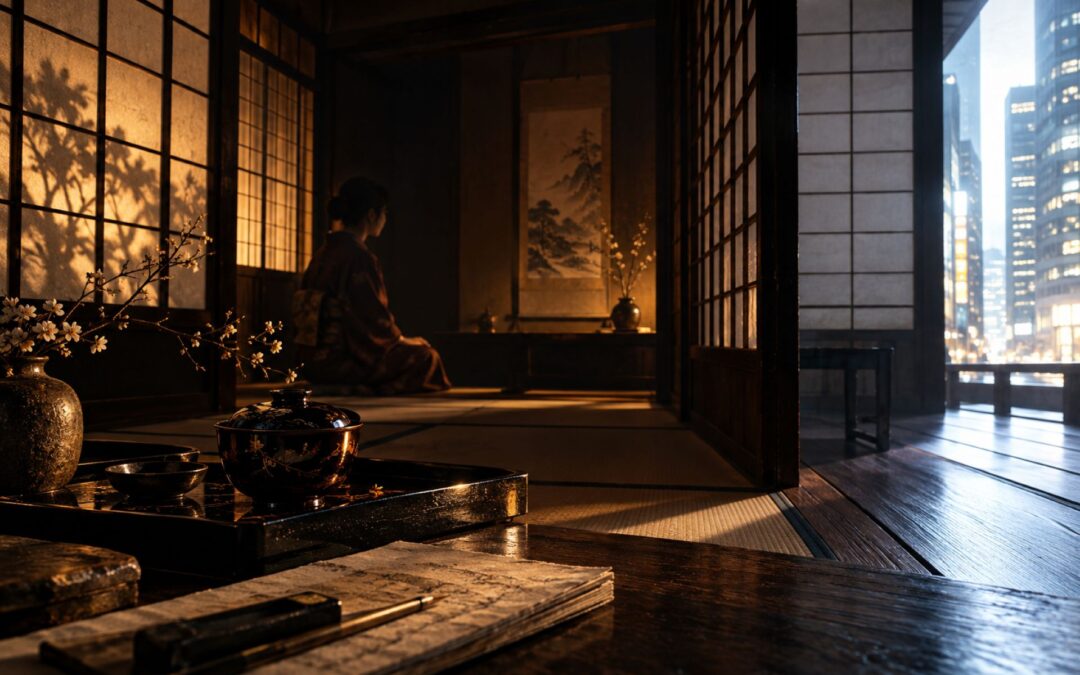
Jun’ichirō Tanizaki’s In Praise of Shadows begins with a problem so ordinary that it barely sounds philosophical: how do you install electric lights, plumbing, heating, glass and modern toilets in a traditional Japanese house without making the house look wrong? From that domestic inconvenience Tanizaki builds one of the twentieth century’s most memorable essays on beauty, technology and cultural change. His real subject is not darkness by itself, but the possibility that an entire way of seeing can disappear when the material environment that produced it is replaced.
Tanizaki published the essay in 1933–34, after the 1923 Great Kantō Earthquake had contributed to his move from the Tokyo region toward Kansai and during a period in which his writing became increasingly engaged with Japanese traditions and aesthetics. Accounts of Tanizaki’s development after the earthquake help explain why In Praise of Shadows is simultaneously an aesthetic essay and a meditation on historical displacement. This article follows the classic 1977 English translation by Thomas J. Harper and Edward G. Seidensticker; a new translation by Michael P. Cronin appeared in 2026, but the two versions should not be silently mixed.
The book is often reduced to the idea that Japanese culture values darkness whereas Western culture values light. Tanizaki does make that contrast, sometimes too broadly. Yet his more interesting claim is subtler: beauty is produced by relationships between objects and their surroundings, between surfaces and age, between bodies and clothing, between visibility and concealment, and between technology and the habits of perception that grow around it. The essay becomes most persuasive when it stays close to those relationships and least persuasive when it turns them into general theories about East and West, race, gender or national character.

In Praise of Shadows: Complete Essay Summary
In Praise of Shadows is not divided into conventional chapters. It moves by association, allowing one household problem to lead to another until architecture, writing, food, theatre, women, race, electricity and literature all become part of the same meditation. The subdivisions below follow those major movements without pretending that Tanizaki built them as a formal system.
Modern Conveniences Enter the Japanese House
Tanizaki opens with the experience of trying to build or renovate a traditional Japanese house in a modern age. The conveniences themselves are not the enemy. He wants electricity, plumbing, heating and sanitary facilities as much as anyone else, but their physical forms seem to have been designed for a different architectural language.
Electric wires must be concealed. Glass doors may be useful, yet they can disrupt the appearance of paper screens. Modern lighting is convenient, but a conspicuous bulb or fixture can look absurd inside a room whose proportions and materials were developed for subtler sources of illumination. Heating systems raise the same problem: one can hide or disguise them, but each compromise requires additional trouble and expense. Tanizaki’s irritation comes from the fact that modernization is not arriving as a set of abstract functions. Every new function comes embodied in a particular object, surface, colour and visual vocabulary.
The bathroom and toilet sharpen the issue. Tanizaki’s famous discussion of the traditional Japanese toilet is partly comic, but it also contains a miniature version of the entire essay. He admires a toilet placed slightly apart from the main living quarters, surrounded by wood rather than gleaming tile, with a view of vegetation and access to natural sounds. Rain, insects, leaves, silence and the texture of timber become part of the experience. A place devoted to a bodily necessity can therefore become contemplative because architecture protects privacy without separating the user completely from nature.
Modern sanitary fixtures solve genuine problems. White porcelain and bright surfaces make cleanliness easier to inspect, and Tanizaki does not deny the hygienic advantages. What bothers him is the assumption that maximum visibility must accompany cleanliness. Brightness removes ambiguity, but it also removes atmosphere. The traditional toilet becomes his first major example of an environment in which partial darkness, natural materials and distance from the rest of the house make an ordinary act feel aesthetically coherent.
This distinction matters because Tanizaki is not yet arguing that modernity should simply be rejected. His complaint is that useful technologies have entered Japanese life in forms that do not belong naturally to the spaces receiving them. A modern house designed entirely around those technologies may avoid the conflict, but a traditional house must either alter itself or awkwardly disguise the modern objects within it.
An Alternative Modernity Japan Never Developed
From household design Tanizaki moves into a speculative historical question. What if Asian societies had developed modern science and technology through their own materials, habits and aesthetic preferences rather than adopting devices already formed elsewhere? The result, he imagines, might not have been a refusal of modernity but a different modernity.
He uses writing instruments as a small example. Had the fountain pen evolved from the traditions of the brush rather than from Western handwriting, perhaps its nib, ink and movement would have been suited to Japanese script and Japanese paper. That seemingly trivial change could have influenced what kinds of paper remained common, how writing felt in the hand, how books were designed and perhaps even how language itself developed. The speculation is intentionally expansive: technologies do not merely perform functions; once adopted widely, they reorganize the cultural practices around them.
Tanizaki extends the idea to sound recording. A machine developed around different vocal habits and musical traditions might have preserved different qualities of voice and performance. Western recording technology can reproduce Japanese sounds, but he suspects that it imposes technical assumptions formed elsewhere. His argument is not that a machine possesses a nationality in itself. It is that technical standards emerge from particular histories and then appear universal once they become dominant.
He knows that this alternative history cannot be tested. He repeatedly admits that Japan cannot travel backward and develop a second technological civilization from scratch. The value of the thought experiment lies elsewhere: it exposes the hidden cultural choices inside apparently neutral tools.
That distinction also complicates the common interpretation of In Praise of Shadows as simple technological conservatism. Tanizaki does not oppose the desire for comfort, efficiency or scientific development. He wonders instead whether Japan could have gained those benefits without having to reshape its sensory world according to imported forms.
Paper, Patina, Jade, and the Beauty of Age
The essay then shifts from technology to materials. Tanizaki compares Western paper with traditional Japanese and Chinese paper, not primarily in terms of usefulness but in terms of the way each interacts with light and touch. The latter seems to absorb illumination softly rather than reflecting it sharply. Its surface appears warm and quiet, almost as though it contains rather than resists its surroundings.
This preference leads him toward metals and objects marked by age. Newly polished surfaces do not attract him as strongly as silver, tin or other materials that have darkened through time and handling. The sheen produced by use is visually attractive because it records contact. A surface that has absorbed years of touch possesses something a factory-fresh surface does not.
Tanizaki is perfectly aware that such patina can be described less romantically as dirt. That awareness gives the argument an important tension. The aesthetic response does not depend on denying the physical explanation; it depends on assigning different value to the same physical condition. Accumulated marks may be unsanitary in one context and beautiful in another because they create depth, history and variation.
Jade and certain forms of crystal extend the argument. Tanizaki prefers materials whose beauty is not based on pure transparency or brilliant reflection. Cloudiness, subdued colour and internal depth invite slower attention. The material seems to withhold something from immediate inspection.
Modern hospitals and dentists supply comic counterexamples. Their polished metal, bright white surfaces and intense illumination may represent hygiene and technical competence, yet Tanizaki finds them aesthetically intimidating. Their cleanliness seems to demand exposure. Nothing is allowed to remain in shadow, and the patient becomes part of the bright environment being inspected.
The larger idea emerging here is that Tanizaki values surfaces that have participated in time. Smooth perfection can be technically impressive but aesthetically empty because nothing in it records use. Age, tarnish and handling create a relationship between objects and the people who have lived with them.
Lacquerware, Food, and Candlelight
A visit to the Kyoto restaurant Waranjiya gives Tanizaki another way to explain what modern illumination changes. The restaurant had once been lit by candles, but electric lights alter the appearance of the lacquerware. The objects remain physically identical, yet their aesthetic character changes because the surrounding light changes.
Dark lacquer bowls are not designed to surrender themselves immediately. Under weak light their surfaces contain obscurity, while gold decoration emerges gradually as illumination catches it. The object cannot be understood at once. The viewer must wait for reflections to appear and disappear, which makes perception temporal rather than instantaneous.
Tanizaki is equally interested in touch and sound. A lacquer bowl is light in the hand and relatively quiet when handled. Its lid preserves warmth and conceals the contents. When the lid is lifted, the diner first encounters steam, smell and a dark surface before seeing everything clearly. Eating therefore becomes an experience organized around anticipation.
Soup is especially important because darkness preserves uncertainty. In a pale Western bowl, the contents may be immediately visible. In dark lacquerware, the liquid and the vessel seem to merge. A small movement or glimmer can suddenly reveal texture that was present all along but hidden.
Tanizaki applies the same attention to yōkan, miso soup, soy sauce, white rice and other foods. Colour changes when placed against dark vessels. A translucent sweet acquires depth. White rice seems brighter. The visual arrangement intensifies the sensory experience without changing the ingredients.
Food therefore demonstrates that Tanizaki’s praise of shadows is not merely visual. His preferred aesthetic combines temperature, texture, weight, sound, smell, expectation and sight. The bowl matters because of how it feels and sounds, the room matters because of its lighting, and the sequence of revelation matters because eating takes place over time.
Architecture and the Construction of Shadow
Tanizaki’s most complete architectural argument begins with the Japanese roof. Western buildings, as he describes them, often attempt to admit or confront sunlight, whereas traditional Japanese architecture uses deep eaves to create an extensive zone between direct exterior brightness and the interior. Shadow is not simply what remains after insufficient light enters; it is produced by design.
The roof casts darkness over verandas and walls before light reaches the interior. Shoji screens diffuse what remains, reducing direct glare and turning illumination into a soft presence. Interior walls do not need to compete with the light. Their subdued surfaces receive it.
The tokonoma, or alcove, becomes the clearest example of a space whose beauty is inseparable from shadow. A hanging scroll or floral arrangement does not simply decorate a recess. Its restrained visibility deepens the surrounding darkness, and the darkness gives the object gravity. Remove that relationship by lighting the alcove brightly and the same objects can appear disappointingly ordinary.
Tanizaki is fascinated by old temple interiors because their darkness seems almost material. Deep architectural shadow makes surfaces difficult to measure visually. Corners retreat, ceilings become uncertain, and distinctions between object and surrounding space weaken. The room acquires a temporal quality because little appears to change.
Gold decoration belongs naturally in this environment. In bright modern light, a gold surface can look ostentatious, but in a dark temple it performs another function. Scarce light strikes the gold and becomes visible. The material seems to collect and release illumination.
This helps explain why Tanizaki resists judging traditional ornament under modern lighting. An object created for dimness cannot be separated from dimness without changing its effect. A brightly lit museum may reveal more information about an artifact while simultaneously destroying some of the conditions under which its beauty originally operated.
Architecture therefore becomes the central proof of Tanizaki’s contextual aesthetics. The roof, wall, screen, alcove and decorative object form one visual ecology. Beauty emerges from their interaction rather than from isolated objects placed into neutral space.
Nō, Kabuki, Bunraku, and Bodies in Darkness
Gold textiles lead Tanizaki from architecture into theatre. Nō is particularly important because its costumes, stage and bodily visibility preserve the kind of relationship between shadow and surface that he believes modern environments are losing. The fabrics are richly coloured and sometimes metallic, but their splendour is intensified rather than diminished by limited illumination.
The human body works in the same way. Much of the performer is covered, so visible skin becomes concentrated in the hands and face. What is concealed affects the value of what is revealed. A hand seen against heavy fabric can possess more visual force than an entire exposed body under bright light.
Tanizaki also associates Nō with a historical visual environment. The old stage evokes for him the houses and interiors in which similar textiles and bodies would once have existed. Theatre thus becomes a surviving fragment of everyday conditions that have disappeared elsewhere.
Kabuki provides a contrast. Under strong modern stage lighting, makeup that may once have appeared persuasive can become too obvious. The illumination exposes the mechanisms through which the theatrical body is produced. Tanizaki’s complaint is not that artifice is inherently bad but that an art developed for one lighting environment can lose plausibility when transferred into another.
Bunraku makes the point even more dramatically. Female puppets can create the impression of complete bodies even when the visible physical construction is highly selective. Head, hands, clothing and controlled movement are sufficient because the imagination completes what is absent.
This interests Tanizaki because it reverses the modern assumption that greater visibility automatically increases realism. In Bunraku, incomplete visibility creates conviction. Concealment allows an artificial figure to feel more alive because the spectator participates in producing the missing body.
The theatre sections therefore extend the architectural principle into embodiment. Lighting does not merely reveal bodies that exist independently of it. It changes what counts as convincing skin, costume, gesture and presence.
Women, Skin, and the Racial Logic of the Essay
From theatrical bodies Tanizaki moves into the representation of women, and here the essay becomes both more revealing and more difficult. He recalls forms of traditional female dress in which much of the body remained concealed. Clothing, dark rooms and social seclusion restricted visibility so that the face and hands became the principal exposed areas.
He associates this partial visibility with older standards of beauty. Blackened teeth, subdued clothing, pale faces and relatively hidden bodies belong to an aesthetic in which contrast matters more than anatomical display. His memories of his mother and of women from an earlier generation become part of the argument.
Tanizaki’s strongest aesthetic proposition emerges directly from these examples: beauty may not belong to a body or object considered alone. It can be created by an arrangement of light and darkness around that body. A face in a shadowed room is not merely a less visible version of the same face under electric light. It becomes a different aesthetic phenomenon.
Yet his description depends heavily on a male observer’s point of view. Women are repeatedly understood through how their bodies appear when hidden, revealed or illuminated. Seclusion itself can become aesthetically desirable because it preserves the visual mystery he values.
The argument then expands into racial and civilizational categories. Tanizaki contrasts “Oriental” acceptance of darkness with what he presents as a Western drive toward brightness, cleanliness and improvement. He connects skin colour to those preferences, suggesting that different aesthetic environments emerged partly in response to bodily appearance.
These passages include discussion of whiteness, cosmetics and American anti-Black racism. Tanizaki uses racial hierarchy as part of an aesthetic comparison, which makes the section impossible to defend simply as benign cultural description. His categories reflect the racial assumptions available in his period and turn historically variable practices into claims about large groups of people.
The contradiction is significant. Earlier, Tanizaki’s technological thought experiment suggested that aesthetic differences arise historically through materials, tools and circumstances. Here he sometimes makes those differences sound almost racial or civilizational in essence. The essay is strongest when it describes how environments shape perception and weakest when it treats the resulting preferences as natural properties of peoples.
His visit to the historic Sumiya building returns the discussion to space. In candlelit darkness, women, textiles and architecture seem to merge into the aesthetic environment he has been reconstructing. For Tanizaki this is the culmination of the older visual world: bodies are not isolated objects placed under inspection but partial presences emerging from rooms designed to conceal as much as they reveal.
Electric Light, Modern Cities, and the Retreat into Literature
After moving through temples, theatres and bodies, Tanizaki returns to the technological transformation that began the essay. Japan, he complains, has embraced electric light with extraordinary enthusiasm. Streets, hotels, restaurants and public places are illuminated beyond practical necessity.
An anecdote involving Albert Einstein appears as one of Tanizaki’s ways of suggesting that Japan has become excessively bright even by Western standards. The anecdote is best read as part of Tanizaki’s rhetoric rather than as decisive historical evidence. Its function is to reverse the usual hierarchy: the supposedly Western technology has been adopted so eagerly that Japan now becomes the extreme case.
Moon-viewing reveals the loss most clearly. The moon is meaningful partly because darkness surrounds it, yet artificial lighting can overwhelm the conditions necessary to see it properly. Electric bulbs, loudspeakers and modern entertainment intrude on an experience whose value depended upon quiet and low illumination.
Hotels produce similar frustrations. Bright lights continue to burn where they are unnecessary, creating glare and even additional heat during summer. The comfort provided by modern technology begins to generate its own discomfort.
Tanizaki gradually broadens these complaints into a generational meditation. Older people, he acknowledges, often believe that the world was better in their youth. He recognizes that some of his own dissatisfaction may arise from aging rather than from objective cultural decline.
That admission is important because it prevents the essay from becoming entirely self-certain. Tanizaki understands that nostalgia can exaggerate loss. Yet he still believes that Japan has undergone unusually rapid transformation, so the fact that every older generation complains does not mean every complaint is false.
Food again becomes a way of preserving local knowledge. His account of persimmon-leaf sushi celebrates a preparation whose materials and methods make sense within a particular place. Such practices embody accumulated experience that cannot easily be reduced to abstract efficiency.
Even the countryside, however, no longer guarantees escape. Roads open forests, electric lights penetrate previously dark places and modern development transforms landscapes that once provided the conditions for the experiences he praises. The problem is no longer confined to cities.
By the end of the essay Tanizaki accepts that the historical direction cannot be reversed. He is not proposing that Japan remove its electric grid, abandon plumbing or dismantle modern cities. The world of shadows he values has already been displaced too thoroughly for material restoration to be realistic.
He therefore shifts the final act of preservation into literature. If architecture can no longer protect darkness, perhaps writing can recreate it. Literature can dim unnecessary lights, restore deep eaves, return objects to obscurity and allow readers to inhabit an imaginative “mansion of shadows.” The essay ends by proposing that artistic representation may preserve forms of perception after the physical world that produced them has disappeared.
Beauty Is Made by Relationships of Light, Material, and Time
The deepest idea in In Praise of Shadows is not that darkness is intrinsically superior to light. Tanizaki repeatedly describes situations in which an object becomes beautiful because of a relationship between material, illumination and setting. Gold looks excessive in bright light but luminous in a dark temple. Lacquer becomes flat when fully exposed but deep when reflections emerge selectively. Skin, fabric, food, paper and architecture all change aesthetically when the surrounding conditions change.
This is why Tanizaki’s argument can be called relational without turning it into a formal philosophical system he never wrote. He treats beauty less as a property stored inside an object than as an event produced between object and environment. A bowl, a room or a face can therefore be physically unchanged and aesthetically transformed.
Shadow performs several functions within that relationship. It reduces available information, slows recognition and forces the eye to work with partial evidence. Because perception is incomplete, attention becomes active. The viewer does not merely receive an already exposed object but waits for it to emerge.
This preference for partial visibility also explains the importance of concealment. Tanizaki often suggests that what cannot be seen intensifies what remains visible. Bunraku works because the spectator imagines the missing body. The Nō performer’s hands become powerful because so much else is covered. The tokonoma gains depth because its boundaries are not visually exhausted.
There is a temporal dimension as well. Patina is beautiful because it records time. Lacquer, metal and wood gain character through use, while completely new surfaces have not yet entered into a history of contact. Tanizaki’s aesthetic therefore resists not only excessive brightness but also the fantasy that an object is most perfect when untouched.
This insight remains useful beyond the cultural binaries in which he sometimes places it. A room designed for soft illumination will not produce the same experience under floodlights. A painting viewed through glass in a museum is not encountered under the conditions in which it originally functioned. A material selected for aging gracefully belongs to a different design philosophy from one selected to appear permanently new.
Recent scholarship has emphasized that the essay’s relation to utility and modern progress is more complicated than simple nostalgia. One modernist reading of Tanizaki’s aesthetics highlights the importance of inherited material practices, finitude and the relationship between beauty and usefulness. That interpretation fits the essay’s best examples because Tanizaki is rarely praising useless decoration. He is interested in the way ordinary useful things become beautiful when function, material and environment evolve together.
The weakness appears when a perceptual observation becomes a civilizational law. It is convincing to say that lacquer designed for candlelight changes under electric illumination. It is far less convincing to say that an entire “Orient” naturally prefers darkness while an entire “West” naturally prefers brightness. The first claim is grounded in a specific aesthetic relationship; the second generalizes far beyond the evidence the essay actually supplies.
The enduring power of In Praise of Shadows therefore comes from its phenomenology rather than its anthropology. Tanizaki teaches the reader to notice that perception is conditioned. He becomes much less reliable when he tries to explain those conditions through essential racial or cultural character.
Modernization, Westernization, and the Cost of Convenience
Tanizaki’s attitude toward modernity is frequently misunderstood because the essay sounds at moments like an extended complaint against electricity. In practice, he is too dependent on modern convenience to make a coherent argument for abandoning it. His houses contain modern fixtures because he wants their benefits, and much of the essay’s comedy comes from his unsuccessful attempts to have modern comfort without sacrificing traditional appearance.
The historical problem is therefore not modernization by itself but modernization through forms imported from elsewhere. His alternative-history speculation imagines a Japan that develops electricity, writing technology, recording devices and other conveniences through different material traditions. He knows that this did not happen and cannot now be recreated, but the thought experiment exposes an important question: does technological development have to produce the same material culture everywhere?
That concern takes on particular significance in Tanizaki’s own career. After the 1923 Great Kantō Earthquake and his move westward, his engagement with Japanese cultural traditions became increasingly important. In Praise of Shadows belongs to that broader reconsideration of Japanese culture during a period when modernization and Western influence were transforming both cities and domestic life.
The essay is therefore not simply a defense of the old against the new. Tanizaki frequently admires technological effectiveness. His frustration comes from the way technology appears to carry an aesthetic ideology inside it: brighter is better, cleaner-looking is better, smoother is better, newer is better, more visible is better.
Those values can become difficult to question because they arrive disguised as technical progress. An electric lamp objectively produces more usable light than a candle, but it does not follow that every place becomes aesthetically better when maximally illuminated. A sanitary white toilet may make dirt easier to see, yet visibility and cleanliness are not identical aesthetic concepts.
Tanizaki’s strongest modernity argument therefore concerns unintended consequences. A technology adopted to solve one problem alters dozens of surrounding practices. Electric light changes architecture, food presentation, theatre, night-time leisure and the appearance of bodies. Recording technology alters sound. Writing instruments affect paper and movement. Roads change forests even when their purpose is merely transportation.
This perspective helps explain why the essay continues to attract serious interpretation. Satoshi Shimizu’s discussion of shadow as part of Tanizaki’s negative discourse on modern Tokyo treats the aesthetic preference as connected to a wider unease with optimistic narratives of modernization. Shadows become more than interior decoration; they offer Tanizaki a language for thinking about what progress erases.
At the same time, he is aware that his resistance can become nostalgia. His remarks about old age and younger generations partially turn criticism back on himself. He cannot know with certainty whether every past experience was really superior or whether age has increased his irritation with present life.
That self-awareness gives the essay more complexity than a straightforward conservative manifesto. Tanizaki wants to resist the assumption that change equals improvement without claiming that everything old deserves preservation. The difficulty is that his most evocative descriptions sometimes encourage exactly the romanticization he otherwise has the intelligence to question.
His relationship with the West is similarly contradictory. Western modernity appears as the source of many disruptive forms, yet Tanizaki does not imagine a pure pre-Western Japan untouched by exchange. His speculative “Eastern” technological development is knowingly fictional. He uses the fantasy to reveal dependence rather than to propose an achievable historical alternative.
Michael Gardiner’s analysis of In Praise of Shadows and critical transparency is useful precisely because it complicates the two easiest interpretations: dismissing the essay as mere nationalist nostalgia or celebrating it as an uncomplicated expression of timeless Japanese beauty. Tanizaki’s darkness carries a deeper resistance to the demand that everything become exposed, rationalized and immediately legible.
The point remains relevant because technological systems continue to reorganize sensory life in ways users rarely choose individually. Street lighting changes the night sky. Screens alter how people read. climate-control systems change how buildings relate to season. Digital photography changes expectations of brightness and image clarity. Tanizaki’s examples belong to the early twentieth century, but his larger question survives: convenience is never only convenience once it restructures the environment in which people perceive the world.
Architecture, Objects, and the Aesthetics of Everyday Life
One reason In Praise of Shadows feels unusual is that Tanizaki refuses to separate major art from minor practical things. A temple and a toilet can reveal the same aesthetic principle. So can a theatre costume, a soup bowl and a sheet of paper. The hierarchy between “high” and “low” objects matters less than the quality of the experience they create.
Architecture provides the framework because it controls the conditions under which everything else appears. Deep eaves reduce direct light before it reaches the room. Screens diffuse what remains. Alcoves intensify darkness. Materials are chosen to cooperate with that restricted illumination.
Objects then become legible within the environment for which they were made. Lacquerware, gold leaf, dark wood and muted walls belong to an ecosystem. Remove one element and the others can seem strangely excessive or deficient.
This is why Tanizaki repeatedly returns to utility. The Japanese roof is not merely a visual symbol. It solves problems created by climate and traditional construction methods. A bowl holds hot soup. A toilet serves an unavoidable bodily function. Paper is written upon.
Beauty emerges when practical forms accumulate habits of use and perception. The distinction between function and ornament becomes unstable because functional solutions produce characteristic surfaces, shadows, movements and rituals. People learn to recognize those effects as beautiful, and later objects are created with them in mind.
Tanizaki’s sensitivity to material aging follows from the same logic. A thing handled repeatedly changes because use leaves marks. Those marks are evidence of life around the object rather than failures to preserve factory condition.
Modern design often attempts to resist that process by making surfaces easy to clean, replace or restore. Tanizaki prefers materials that can absorb history. His praise of tarnish is therefore not merely antiquarian. It reflects a belief that use should deepen an object rather than simply degrade it.
Food makes the theory especially concrete because the diner cannot separate aesthetics from bodily participation. A bowl has weight and temperature. The lid creates delay. The room shapes colour. The first glimpse of soup is conditioned by steam, darkness and smell.
Such experiences explain why Tanizaki’s aesthetic cannot be reduced to visual minimalism. He is describing environments in which the senses reinforce one another. The quiet movement of lacquerware, the softness of paper, the warmth of soup and the darkness of a room all belong to the same atmosphere.
This also explains why contemporary readers should resist turning In Praise of Shadows into a collection of decorating tips. Painting a room dark or buying Japanese ceramics does not reproduce the aesthetic world Tanizaki describes. His objects derive meaning from habits, architecture, climate, ritual and accumulated use.
The essay’s better implication is more demanding. Design should be judged not only by isolated objects but by the relationships a whole environment creates. A beautiful chair under hostile lighting, a beautiful building filled with distracting technology or a beautiful vessel that feels unpleasant in the hand may fail at the level of experience even when each component succeeds visually.
Gender, Race, and the Limits of Tanizaki’s Vision
The sections on women and race cannot be treated as embarrassing digressions to be skipped on the way to the more attractive passages about architecture. They are part of Tanizaki’s attempt to explain why shadow matters, and they expose serious limitations in that attempt.
His description of traditional feminine beauty depends upon concealment. Clothing hides most of the body, darkness restricts visibility and social arrangements keep women partially removed from public observation. Tanizaki then aestheticizes the result: visible face and hands become powerful precisely because everything else is obscured.
At the level of perception, the principle is consistent with the rest of the book. Scarcity of visual information increases attention. A hand against dark fabric can acquire unusual intensity because it is one of the few exposed elements.
The ethical difficulty appears when conditions imposed on women are valued mainly because they improve the experience of the male viewer. Seclusion, restrictive dress and reduced visibility are not neutral techniques of composition. They are social practices affecting actual people.
Tanizaki rarely asks what the aesthetic arrangement meant to the women living inside it. His attention remains primarily visual and retrospective. The woman becomes part of an interior in much the same way as lacquerware, gold or a scroll.
That tendency is intensified by his treatment of his mother and older women. Personal memory gives these passages emotional force, but memory also idealizes. The remembered figure becomes evidence for a vanished aesthetic system rather than a fully independent subject.
A similar problem shapes the racial argument. Tanizaki’s East–West contrast begins as a difference in material adaptation: one culture allegedly works with darkness while another tries to overcome it. As long as the contrast remains a provocative simplification, it can stimulate thought.
But he moves from history and material culture into bodily and racial explanations. Skin colour becomes part of his account of why different peoples allegedly developed different aesthetic preferences. The argument then invokes whiteness, cosmetic practices and American anti-Black racism.
These passages have aged badly not merely because contemporary vocabulary has changed. The underlying explanatory model is too crude. Enormously diverse societies are grouped into civilizational categories, historical conditions become naturalized and racial hierarchy becomes part of an aesthetic comparison.
Scholarship addressing race, embodiment, modernity and Orientalism in In Praise of Shadows is therefore essential to a complete reading. Tanizaki’s observations about perception may remain illuminating without requiring readers to accept the racial theory through which he sometimes explains them.
Indeed, the essay itself provides reasons to reject that theory. Tanizaki repeatedly demonstrates that aesthetic habits emerge through roofs, climate, materials, technologies, customs and inherited practices. If preferences are produced through those historical relationships, there is little need to treat them as expressions of racial essence.
The East–West binary is also too stable for the world Tanizaki actually describes. Japan has already enthusiastically adopted electricity. Western observers may appreciate subdued light. Traditional Japanese spaces themselves varied enormously by class, region and period. Cultural practice is more mixed than his rhetorical opposition allows.
The gender argument contains the same contradiction. If beauty is relational, then the aesthetic effect of a concealed body can be described without claiming that women ought to be concealed. The perceptual observation does not justify the social arrangement.
Recognizing these limitations does not require flattening the entire essay into a document of prejudice. Tanizaki’s writing is valuable partly because its contradictions remain exposed. The reader can see a sophisticated thinker recognize historical contingency in one passage and fall into essentialism in another.
The fairest interpretation is therefore neither protective nor dismissive. Tanizaki offers a powerful account of environmental perception but an unreliable account of race and gender. Those conclusions should remain separate because the failure of one does not automatically invalidate the other.
This distinction also prevents the modern reader from turning the book into a harmless lifestyle object. In Praise of Shadows is stranger and more difficult than its reputation for elegant Japanese minimalism suggests. Its beauty comes with ideological baggage, and understanding both sides makes the essay more interesting rather than less.
Form and Style: Why In Praise of Shadows Wanders
Tanizaki does not build his essay like a formal philosophical argument. He begins with household inconvenience, moves into toilets, technology, paper, restaurants, architecture, theatre, bodies, race, electric light, aging, food and forests before ending with literature. A reader expecting numbered premises and conclusions may experience the structure as undisciplined.
The wandering is partly the point. Ideas arise from sensory association rather than systematic proof. A surface recalls another surface; a room recalls a theatre; a costume recalls a body; a body leads toward questions of skin and darkness.
Thomas J. Harper’s afterword to the classic English edition argues that the form should not simply be corrected into a more linear Western essay. The movement resembles a mind following connections as they appear. Whatever one makes of the cultural generalization behind that explanation, it accurately describes the reading experience.
Tanizaki also uses comedy to prevent the essay from becoming solemn. His complaints about toilets, dentists, hotels and electrical fixtures are often exaggerated. He knows that some of his preferences border on fussiness, and his willingness to make himself ridiculous gives the voice unusual charm.
That self-mockery serves an argumentative purpose. A writer who admitted no contradiction would turn the book into cultural propaganda. Tanizaki repeatedly concedes the usefulness of technologies he criticizes and eventually concedes that age itself may be influencing his judgment.
The prose gains force through sensory precision rather than abstract terminology. Instead of defining a theory of atmosphere, Tanizaki describes how a bowl feels in the hand and how soup emerges from darkness. Instead of constructing a philosophical theory of concealment, he shows how a puppet becomes believable when the viewer supplies an unseen body.
This method explains why the essay is so memorable. Readers may forget individual claims but remember the toilet in the garden, the lacquer bowl, the gold in the temple and the darkened room. Concrete images carry the argument farther than explicit propositions.
The same method creates weaknesses. A chain of evocative examples can make a generalization feel more strongly demonstrated than it actually is. Sensory conviction substitutes at times for historical evidence.
Tanizaki’s East–West claims benefit rhetorically from this structure. By the time he makes them, the reader has already experienced a series of beautifully described contrasts. The emotional coherence of those examples can conceal the logical leap from “this object works beautifully in shadow” to “this civilization naturally values darkness.”
The form therefore produces both the essay’s strength and its vulnerability. It allows Tanizaki to capture a disappearing sensibility without reducing it to doctrine, but it also allows speculation to drift into cultural explanation without undergoing much testing.
His tonal range is equally important. In Praise of Shadows can be funny, irritated, sensuous, nostalgic, provocative and mournful within a few pages. The result feels less like a finished theory than a prolonged act of noticing.
That style suits the subject. An essay about partial visibility would become strangely self-defeating if it explained everything with perfect analytic transparency. Tanizaki leaves connections suggestive, lets objects accumulate meaning and gives the reader space to experience some of the uncertainty he praises.
The Ending Explained: Literature as a Mansion of Shadows
The ending of In Praise of Shadows changes the meaning of the entire essay because Tanizaki finally accepts that the material world he prefers cannot simply be restored. Japan will continue using electricity, modern plumbing, hotels, roads and imported technologies. The historical process is too advanced for aesthetic complaint to reverse it.
This resignation prevents the book from ending as a practical manifesto. Tanizaki does not ask readers to rebuild society according to traditional lighting or reject modern convenience. His final proposal is literary.
Writing can do what architecture can no longer do. It can close unnecessary openings, dim overwhelming illumination and rebuild in imagination the rooms modern life has destroyed. The “mansion of shadows” becomes a metaphor for art’s ability to preserve an experience after its physical conditions disappear.
The ending also reveals that In Praise of Shadows has itself been performing this work. Tanizaki has spent the essay rebuilding vanished toilets, dark alcoves, Nō stages, candlelit restaurants, old women, lacquer bowls and moonlit nights in language. Even when the historical claims are questionable, the descriptive act succeeds in making those environments imaginable.
Literature therefore becomes both refuge and archive. It cannot stop modernization, but it can preserve the memory of alternatives. Tanizaki’s final victory is smaller than cultural restoration but more realistic: if a way of seeing cannot remain dominant in everyday life, it may survive as an available possibility in art.
Critical Review: What In Praise of Shadows Achieves—and Where It Fails
In Praise of Shadows succeeds first as an act of perception. Tanizaki notices relationships that modern environments encourage people to ignore: how lighting changes colour, how objects age through touch, how architecture determines attention, how concealment produces anticipation and how technologies reorganize more than the particular problems they were invented to solve.
His strongest achievement is the idea that beauty is relational. This insight appears again and again without becoming a formal slogan. Gold, lacquer, soup, paper, theatre and human skin demonstrate that aesthetic meaning emerges through circumstances.
The argument has unusual explanatory power because it refuses to isolate fine art from ordinary life. A toilet matters because everyday architecture forms perception just as surely as a temple does. A bowl matters because habits of eating help create cultural taste.
This attention to the mundane also gives the essay historical depth. Modernization becomes visible not only through factories, political institutions or large public works but through bulbs, writing implements, bathrooms, stage lights and hotel rooms. Tanizaki shows how major cultural change enters the body through ordinary objects.
The prose is another major strength. Few aesthetic essays communicate material experience as vividly. Tanizaki can make the reflection on a dark bowl feel intellectually consequential without draining it of sensuality.
His humour prevents nostalgia from becoming completely self-important. He often sounds like a difficult homeowner, an irritable hotel guest or an older man annoyed by the world’s brightness. That comic self-consciousness makes the later elegy more credible because he is not entirely unaware of his own temperament.
The structure, though loose, is also effective. Each digression expands the stakes. What begins as an interior-design problem gradually becomes a theory of technological dependence, cultural memory and artistic preservation.
The book’s most important weakness is its tendency to generalize from particular aesthetic experiences into civilizational essence. “Japan” and “the West” frequently become more homogeneous than any historical culture could actually be. Complex differences are simplified into darkness versus brightness, accommodation versus improvement, restraint versus exposure.
Those binaries make the essay rhetorically powerful because they provide contrast, but they also weaken its explanatory reliability. A richly observed Japanese room does not prove that Japanese civilization possesses a timeless preference for shadow, any more than a brightly lit Western building proves that Western culture possesses a single philosophy of light.
The racial passages expose the danger most clearly. Once Tanizaki tries to connect aesthetic preferences to bodies and racial categories, the argument moves far beyond what his examples can sustain. The material becomes historically revealing but intellectually weak.
His treatment of women raises a related problem. The concealed female body is aesthetically valuable because it produces mystery for the viewer, but the social conditions that create that concealment remain underexamined. Women become part of the composition of traditional interiors.
These weaknesses matter because they are not incidental sentences surrounding an otherwise untouched aesthetic theory. Tanizaki uses race and gender as explanatory components. A responsible reading must therefore treat them as part of the book’s argument rather than simply labeling them “dated” and moving on.
At the same time, they do not destroy the essay’s central achievement. The perceptual claim that environments shape beauty does not logically depend upon racial essentialism. One can reject Tanizaki’s civilizational anthropology while retaining his insight into contextual aesthetics.
The nostalgia also deserves a qualified judgment. Tanizaki often romanticizes the past, particularly when old darkness becomes associated with harmony and modern brightness with vulgarity. The past almost inevitably gains aesthetic coherence when reconstructed through selective memory.
Yet he partially anticipates this criticism himself. His acknowledgement that older generations habitually complain about younger ones introduces a degree of skepticism. He knows that memory edits experience.
The most interesting modern readings of the essay therefore avoid choosing between reverence and dismissal. Gardiner’s discussion of critical transparency and modernity demonstrates why Tanizaki’s shadows can be read as more than decorative nostalgia, while still recognizing the problems in treating the essay as a transparent expression of national identity. That balance is the most productive way to approach the book.
What has aged best is Tanizaki’s suspicion of technological neutrality. Modern technologies do more than perform useful tasks. They establish new defaults for brightness, speed, cleanliness, visibility and comfort, and those defaults can erase experiences whose value was never included in the original technical calculation.
His sensitivity to sensory overload also feels contemporary. The assumption that more illumination, more information and greater exposure are automatically improvements has hardly disappeared. Digital environments have intensified rather than resolved the problem.
His treatment of aging materials is similarly durable. Contemporary design often treats visible wear as failure unless it can be marketed as deliberate “distressing.” Tanizaki recognizes instead that time can become part of an object’s meaning.
What has aged worst is his confidence in civilizational categories. Readers should not use In Praise of Shadows as an empirical guide to what Japanese or Western people essentially prefer. Its evidence is personal, selective and literary.
Nor should the book be turned into a generic guide to Japanese minimalism. Tanizaki’s interiors are not simply empty, neat or restrained. They can be richly ornamented, heavily textured and sensually complex. What matters is how those elements are moderated through shadow.
The essay is also not a reliable summary of “wabi-sabi,” a Buddhist teaching or a Zen philosophy. Those labels may help modern readers make associations, but imposing them too quickly can replace Tanizaki’s actual discussion with more familiar contemporary branding.
As a work of criticism, In Praise of Shadows is therefore more valuable for the questions it creates than for the cultural theory it sometimes offers as an answer. What does a technology make newly possible, and what does it make newly difficult? Which forms of beauty depend on slowness, wear, silence or concealment? When does visibility clarify, and when does it flatten?
Those questions extend far beyond Japan in the 1930s. They can be asked about cities saturated with artificial light, buildings designed around climate control, objects replaced rather than repaired and digital interfaces optimized for constant attention. Tanizaki’s own East–West scheme may be too narrow, but his method of noticing remains widely applicable.
The book will therefore reward readers interested in architecture, design, literature, Japanese cultural history and the sensory consequences of technological change. Readers looking for a systematic philosophy may find its digressions frustrating, while readers seeking an authoritative account of Japanese culture should approach its generalizations cautiously.
Its fairest overall evaluation is that In Praise of Shadows is a brilliant literary essay containing an imperfect cultural theory. Tanizaki sees extraordinarily clearly when he looks at objects, rooms, surfaces and light. He becomes much less trustworthy when he turns those observations into explanations of whole races, genders or civilizations.
The contradiction is ultimately part of why the essay remains worth reading. A weaker book could be reduced either to wisdom or to error. Tanizaki’s work demands both appreciation and resistance because its perceptual intelligence and its ideological limitations occupy the same pages.
The central question of In Praise of Shadows is therefore not whether modern people should abandon electricity and return to candlelight. It is whether improvement can become impoverishment when every environment is made brighter, cleaner, clearer and more immediately legible. Tanizaki’s answer is exaggerated in places, but his challenge survives: some forms of beauty depend upon age, uncertainty, restraint and things that cannot be seen all at once.
That is why the book remains worth reading. Its racial and gender generalizations should not be accepted as timeless truths, and its nostalgia should not be mistaken for history. But as a meditation on how technologies reshape perception, In Praise of Shadows still makes the reader notice what modern environments habitually erase—and, for a while, restores the possibility of seeing in the dark.
Last Updated on October 7, 2026 by Aseem Gupta